

Mortality risk attributable to high and low ambient temperature: a multicountry observational study
Open accessThe DOI matches its Crossref record; 43 of the 43 references it cites were found in a registry or an index.
Abstract
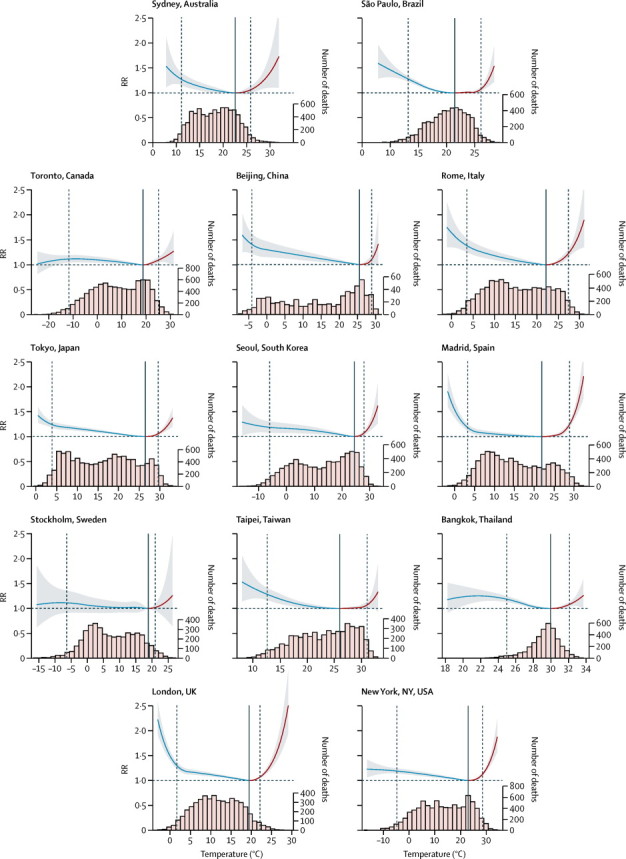
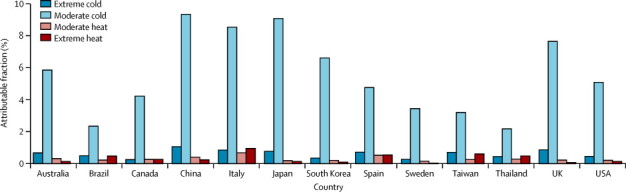
BACKGROUND: Although studies have provided estimates of premature deaths attributable to either heat or cold in selected countries, none has so far offered a systematic assessment across the whole temperature range in populations exposed to different climates. We aimed to quantify the total mortality burden attributable to non-optimum ambient temperature, and the relative contributions from heat and cold and from moderate and extreme temperatures. METHODS: We collected data for 384 locations in Australia, Brazil, Canada, China, Italy, Japan, South Korea, Spain, Sweden, Taiwan, Thailand, UK, and USA. We fitted a standard time-series Poisson model for each location, controlling for trends and day of the week. We estimated temperature-mortality associations with a distributed lag non-linear model with 21 days of lag, and then pooled them in a multivariate metaregression that included country indicators and temperature average and range. We calculated attributable deaths for heat and cold, defined as temperatures above and below the optimum temperature, which corresponded to the point of minimum mortality, and for moderate and extreme temperatures, defined using cutoffs at the 2·5th and 97·5th temperature percentiles. FINDINGS: We analysed 74,225,200 deaths in various periods between 1985 and 2012. In total, 7·71% (95% empirical CI 7·43-7·91) of mortality was attributable to non-optimum temperature in the selected countries within the study period, with substantial differences between countries, ranging from 3·37% (3·06 to 3·63) in Thailand to 11·00% (9·29 to 12·47) in China. The temperature percentile of minimum mortality varied from roughly the 60th percentile in tropical areas to about the 80-90th percentile in temperate regions. More temperature-attributable deaths were caused by cold (7·29%, 7·02-7·49) than by heat (0·42%, 0·39-0·44). Extreme cold and hot temperatures were responsible for 0·86% (0·84-0·87) of total mortality. INTERPRETATION: Most of the temperature-related mortality burden was attributable to the contribution of cold. The effect of days of extreme temperature was substantially less than that attributable to milder but non-optimum weather. This evidence has important implications for the planning of public-health interventions to minimise the health consequences of adverse temperatures, and for predictions of future effect in climate-change scenarios. FUNDING: UK Medical Research Council.
Overview
The claims and statistics of this paper haven’t been checked yet.
Free: it reads the open-access text and checks the first 5 claims that cite a source we can check. Create a free account to check every claim.
Integrity signals
Registry
Cites
Statistics
Figures
Verification
Claims the paper makes
The claims and statistics of this paper haven’t been checked yet.
Free: it reads the open-access text and checks the first 5 claims that cite a source we can check. Create a free account to check every claim.
Claims other papers make about this one
Each is checked against this paper’s own text: does it say what the citing paper says it does?
The cited source says what the claim attributes to it.
In the citing paper
“An immediate and direct impact of climate change is through human exposure to high outdoor temperatures, which is associated with morbidity and an increased risk of premature death (mortality)2–4.”
From The burden of heat-related mortality attributable to recent human-induced climate change (2021) · cites this paper as [2]
The cited source says what the claim attributes to it.
In the citing paper
“Increasing evidence from experimental, epidemiological, and econometric studies has demonstrated the effects of increased heat exposures on productivity [38], learning ability [39], and morbidity and mortality in humans [17,18,40].”
From Reduced cognitive function during a heat wave among residents of non-air-conditioned buildings: An observational study of young adults in the summer of 2016 (2018) · cites this paper as [18]
In the citing paper
“Hundreds of cardiovascular deaths each year among construction workers in Qatar may likewise be due to workplace heat (25).”
From Heat, Human Performance, and Occupational Health: A Key Issue for the Assessment of Global Climate Change Impacts (2016) · cites this paper as [25]
Self-check
Percentages, sums and reported differences re-computed from the paper’s own numbers.
The self-check needs the paper’s full text.
Citations
Cites
Quantifying heterogeneity in a meta‐analysis
Higgins, J. P. T., & Thompson, S. G. (2002) · Statistics in Medicine · doi:10.1002/sim.1186 · Cited by 36,763
(2013) · Cited by 6,752
The Effects of Climate Change on Cardiac Health
De Blois, J., Kjellstrom, T., Agewall, S., Ezekowitz, J. A., Armstrong, P. W., & Atar, D. (2015) · Cardiology · doi:10.1159/000398787 · Cited by 1,697
Relation between elevated ambient temperature and mortality: A review of the epidemiologic evidence
Basu, R. (2002) · Epidemiologic Reviews · doi:10.1093/epirev/mxf007 · Cited by 1,381
Heat-Related Deaths during the July 1995 Heat Wave in Chicago
Semenza, J. C., Rubin, C. H., Falter, K. H., Selanikio, J. D., Flanders, W. D., Howe, H. L., & Wilhelm, J. L. (1996) · New England Journal of Medicine · doi:10.1056/nejm199607113350203 · Cited by 1,376
Weather-Related Mortality: How Heat, Cold, and Heat Waves Affect Mortality in the United States
Anderson, B. G., & Bell, M. L. (2009) · Epidemiology · doi:10.1097/ede.0b013e318190ee08 · Cited by 1,229
Self-citationTime series regression studies in environmental epidemiology
Bhaskaran, K., Gasparrini, A., Hajat, S., Smeeth, L., & Armstrong, B. (2013) · International Journal of Epidemiology · doi:10.1093/ije/dyt092 · Cited by 1,150
Self-citationHigh ambient temperature and mortality: a review of epidemiologic studies from 2001 to 2008
Basu, R. (2009) · Environmental Health · doi:10.1186/1476-069x-8-40 · Cited by 1,135
Reducing and meta-analysing estimates from distributed lag non-linear models
Gasparrini, A., & Armstrong, B. (2013) · BMC Medical Research Methodology · doi:10.1186/1471-2288-13-1 · Cited by 1,081
Self-citation
Cited by
Items 901–1,000 of 1,006
Rethinking extreme heat in a cool climate: a New Zealand case study
Harrington, L. J. (2020) · Environmental Research Letters · doi:10.1088/1748-9326/abbd61 · Cited by 31
Parliari, D., Cheristanidis, S., Giannaros, C., Keppas, S. C., Papadogiannaki, S., de'Donato, F. K., Sarras, C., & Melas, D. S. (2022) · Atmosphere · doi:10.3390/atmos13060852 · Cited by 31
The location routing problem for cooling shelters during heat waves
Yoon, S., Woo, S., Kim, J., Hwang, S. W., & Kweon, S. J. (2022) · Urban Climate · doi:10.1016/j.uclim.2022.101138 · Cited by 33
Kim, Y., Yeo, H., & Kim, Y. (2022) · Sustainable Cities and Society · doi:10.1016/j.scs.2022.104073 · Cited by 31
Tong, M., Wondmagegn, B. Y., Xiang, J., Hansen, A. L., Dear, K. B. G., Pisaniello, D., Varghese, B. M., Xiao, J., Jian, L., Scalley, B., et al. (2022) · International Journal of Environmental Research and Public Health · doi:10.3390/ijerph19159706 · Cited by 31
Extreme Temperature and Mortality by Educational Attainment in Spain, 2012–2018
Keivabu, R. C. (2022) · European Journal of Population / Revue européenne de Démographie · doi:10.1007/s10680-022-09641-4 · Cited by 32
Assessment of the hazard of extreme low-temperature events over China in 2021
Zhang, Y., & Wang, G. (2022) · Advances in Climate Change Research · doi:10.1016/j.accre.2022.11.005 · Cited by 31
Fan, Z., Li, Y., Wei, J., Chen, G., Wang, R., Xu, R., Liu, T., Lv, Z., Huang, S., Sun, H. W., et al. (2023) · Environmental Research · doi:10.1016/j.envres.2023.115405 · Cited by 31
Bae, S., Lim, Y., Oh, J., & Kwon, H. (2023) · Environment International · doi:10.1016/j.envint.2023.108078 · Cited by 31
Liao, J., Zhang, Y., Yang, Z., Qiu, C., Chen, W., Zhang, J. J., Berhane, K. T., Bai, Z., Han, B., Xu, J., et al. (2023) · Environmental Health · doi:10.1186/s12940-023-01022-6 · Cited by 31
“In doing so, we applied distributed lag non-linear models (DLNM) to evaluate weekly-specific time-varying effect estimates of maternal exposure to air pollution [38].”
Heat impacts on human health in the Western Pacific Region: an umbrella review
Lo, Y. T. E., Vosper, E., Higgins, J. P. T., & Howard, G. (2023) · The Lancet Regional Health - Western Pacific · doi:10.1016/j.lanwpc.2023.100952 · Cited by 31
“30,49,54 In 2019, 26,800 heat-related deaths occurred.”
Saeki, K., Obayashi, K., & Kurumatani, N. (2017) · Journal of Epidemiology · doi:10.1016/j.je.2016.12.018 · Cited by 31
Yang, L., Chang, Y.-M., Hsieh, T.-H., Hou, W., & Li, C. (2018) · PubMed Central · doi:10.6515/acs.201803_34(2).20171101a · Cited by 31
“showed that the effect of cold on mortality was more prominent than heat.(24) In addition, Guo et al.”
Kim, H., Kim, H., Byun, G., Choi, Y., Song, H., & Lee, J.-T. (2018) · The Science of The Total Environment · doi:10.1016/j.scitotenv.2018.11.210 · Cited by 32
Self-citationDíaz, J., López-Bueno, J. A., Sáez, M., Miron, I. J., Luna, M. Y., Martínez, G. S., Carmona, R., Barceló, M. A., & Linares, C. (2019) · Environmental Research · doi:10.1016/j.envres.2019.108557 · Cited by 31
Onozuka, D., Gasparrini, A., Sera, F., Hashizume, M., Honda, Y., Nishimura, K., & Hagihara, A. (2019) · Environmental Health Perspectives · doi:10.1289/ehp4731 · Cited by 31
“We projected excess morbidity due to temperature using the weekly temperature and morbidity time-series model by assuming the absence of adaptation and population alterations, according to previous studies (Gasparrini et al. 2015, 2017; Onozuka and Hagihara 2017).”
Self-citationA Nationwide Comparative Analysis of Temperature-Related Mortality and Morbidity in Japan
Yuan, L., Madaniyazi, L., Vicedo‐Cabrera, A. M., Honda, Y., Ng, C. F. S., Ueda, K., Oka, K., Tobías, A., & Hashizume, M. (2023) · Environmental Health Perspectives · doi:10.1289/ehp12854 · Cited by 30
“2,3 To date, the relationship between temperature and mortality has been investigated by a large number of studies, 4,5 across multiple locations, 6,7 and over time.”
Self-citationMortality Effects of Temperature Changes in the United Kingdom
Seklecka, M., Pantelous, A. A., & O’Hare, C. (2016) · Journal of Forecasting · doi:10.1002/for.2473 · Cited by 30
Yan, M., Wilson, A., Peel, J. L., Magzamen, S. L., Sun, Q., Li, T., & Anderson, G. B. (2020) · Epidemiology · doi:10.1097/ede.0000000000001182 · Cited by 30
Indoor temperatures and energy use in NSW social housing
Daly, D., Harada, T., Tibbs, M., Cooper, P., Waitt, G., & Tartarini, F. (2021) · Energy and Buildings · doi:10.1016/j.enbuild.2021.111240 · Cited by 30
Projected risks associated with heat stress in the UK Climate Projections (UKCP18)
Kennedy-Asser, A. T., Owen, G. E., Griffith, G. J., Andrews, O., Lo, Y. T. E., Mitchell, D., Jenkins, K., & Warren, R. (2022) · Environmental Research Letters · doi:10.1088/1748-9326/ac541a · Cited by 30
“An alternative approach to using absolute thresholds is to use relative percentile-based thresholds based on observation (Armstrong et al 2011, Gasparrini et al 2015).”
InfluentialFlückiger, B., Kloog, I., Ragettli, M. S., Eeftens, M., Röösli, M., & de Hoogh, K. (2022) · International Journal of Climatology · doi:10.1002/joc.7597 · Cited by 30
The impact of humidity on Australia’s operational heatwave services
Nairn, J., Moise, A. F., & Ostendorf, B. (2022) · Climate Services · doi:10.1016/j.cliser.2022.100315 · Cited by 30
Ellena, M., Ballester, J., Costa, G., & Achebak, H. (2022) · Environmental Research · doi:10.1016/j.envres.2022.114082 · Cited by 30
Associations and burdens of relative humidity with cause-specific mortality in three Chinese cities
Mei, Y., Li, A., Zhao, M., Xu, J., Li, R., Zhao, J., Zhou, Q., Ge, X., & Xu, Q. (2022) · Environmental Science and Pollution Research · doi:10.1007/s11356-022-22350-z · Cited by 30
Impact of chronic cold exposure on lung inflammation, pyroptosis and oxidative stress in mice
Liu, J., Wu, J., Qiao, C., He, Y., Xia, S., Zheng, Y., & Lv, H. (2022) · International Immunopharmacology · doi:10.1016/j.intimp.2022.109590 · Cited by 30
Trends in tropical nights and their effects on mortality in Switzerland across 50 years
Rippstein, V., de Schrijver, E., Eckert, S., & Vicedo‐Cabrera, A. M. (2023) · PLOS Climate · doi:10.1371/journal.pclm.0000162 · Cited by 30
Chen, M.-J., Guo, Y. L., Lin, P., Chiang, H., Chen, Y., & Chen, Y. (2023) · Environmental Research · doi:10.1016/j.envres.2023.116214 · Cited by 30
Self-citationPlazas, F. L., Sánchez, E. C., Pérez, R. L., & Albanilla, E. S. (2023) · Journal of Cleaner Production · doi:10.1016/j.jclepro.2023.139588 · Cited by 30
Onozuka, D., & Hagihara, A. (2015) · The Science of The Total Environment · doi:10.1016/j.scitotenv.2015.11.098 · Cited by 30
Urban and Transport Planning, Environment and Health
Nieuwenhuijsen, M. J., & Khreis, H. (2018) · Springer eBooks · doi:10.1007/978-3-319-74983-9_1 · Cited by 33
Is Sensible Heat Flux Useful for the Assessment of Thermal Vulnerability in Seoul (Korea)?
Kwon, Y. J., Lee, D. K., & Kwon, Y. H. (2020) · International Journal of Environmental Research and Public Health · doi:10.3390/ijerph17030963 · Cited by 32
Climate and health: mortality attributable to heat and cold
Dear, K. B. G., & Wang, Z. (2015) · The Lancet · doi:10.1016/s0140-6736(15)60897-2 · Cited by 30
NPCC4: Climate change and New York City's health risk
Matte, T., Lane, K., Tipaldo, J. F., Barnes, J., Knowlton, K., Torem, E., Anand, G., Yoon, L., Marcotullio, P., Balk, D., et al. (2024) · Annals of the New York Academy of Sciences · doi:10.1111/nyas.15115 · Cited by 29
Urban cemeteries: The forgotten but powerful cooling islands
Stumpe, B., Stuhrmann, N., Jostmeier, A., & Marschner, B. (2024) · The Science of The Total Environment · doi:10.1016/j.scitotenv.2024.173167 · Cited by 29
Climate change effects in older people's health: A scoping review
Montoro-Ramírez, E. M., Parra‐Anguita, L., Álvarez‐Nieto, C., Parra, G., & López‐Medina, I. M. (2024) · Journal of Advanced Nursing · doi:10.1111/jan.16270 · Cited by 30
“However, research using an analysis with a more recent statistical approach showed that of the mortality burden related to extreme temperatures, the majority occurred on days colder than the optimal temperature, compared with warmer days (Burkart et al., 2021; Gasparrini et al., 2015).”
Heat exposure and coping strategies for food delivery riders under urban heat extremes
Jiang, L., Wang, J., Castaño-Rosa, R., Zhong, C., & Cao, S. (2024) · Energy and Buildings · doi:10.1016/j.enbuild.2024.114693 · Cited by 30
Basagaña, X., & Ballester, J. (2024) · The Lancet Planetary Health · doi:10.1016/s2542-5196(24)00212-2 · Cited by 29
Amplified or exaggerated changes in perceived temperature extremes under global warming
Wang, S., & Zhu, J. (2019) · Climate Dynamics · doi:10.1007/s00382-019-04994-9 · Cited by 29
“Given the speed of current climate changes and various physiological constraints, it is unlikely that the human physiology will necessarily evolve higher heat tolerance (Hanna and Tait 2015; Mora et al.”
Ambient temperature and non-accidental mortality: a time series study
Deng, J., Hu, X., Xiao, C., Xu, S., Gao, X., Ma, Y., Yang, J., Wu, M., Liu, X., Ni, J., et al. (2019) · Environmental Science and Pollution Research · doi:10.1007/s11356-019-07015-8 · Cited by 29
Pablo, Z. C., & London, K. A. (2020) · Engineering Construction & Architectural Management · doi:10.1108/ecam-07-2019-0346 · Cited by 29
Urban Heat Implications from Parking, Roads, and Cars: a Case Study of Metro Phoenix
Hoehne, C. G., Chester, M., Sailor, D. J., & King, D. A. (2020) · Sustainable and Resilient Infrastructure · doi:10.1080/23789689.2020.1773013 · Cited by 29
“…Markolf et al., 2017; Schaeffer et al., 2012), dissuading outdoor activity and travel (Karner et al., 2015; Obradovich & Fowler, 2017; Stamatakis et al., 2013), and causing increased heat-related injury or death (CDC, 2012; Eisenman et al., 2016; Gasparrini et al., 2015; Kovats & Hajat, 2008).”
Michikawa, T., Yamazaki, S., Ueda, K., Yoshino, A., Sugata, S., Saito, S., Hoshi, J., Nitta, H., & Takami, A. (2020) · The Science of The Total Environment · doi:10.1016/j.scitotenv.2020.142489 · Cited by 29
Huang, W. T. K., Charlton-Perez, A. J., Lee, R. W., Neal, R., Sarran, C. E., & Sun, T. (2020) · Environmental Research Letters · doi:10.1088/1748-9326/abcbba · Cited by 29
“Excessmortality associatedwith extreme hot and cold temperatures represents a significant public health risk and consequently is a topic well studied in the public health literature (e.g. Analitis et al 2008, Basu 2009, Gasparrini et al 2015, Hajat et al 2016, Ryti et al 2016).”
InfluentialWind and greenery effects in attenuating heat stress: A case study
Feitosa, R. C., Wilkinson, S. J., de Oliveira, B. F. A., & Hacon, S. D. S. (2021) · Journal of Cleaner Production · doi:10.1016/j.jclepro.2021.125919 · Cited by 29
Revich, B., & Grigorieva, E. A. (2021) · Issues of Risk Analysis · doi:10.32686/1812-5220-2021-18-2-12-33 · Cited by 29
International Energy Agency (2022) · OECD eBooks · doi:10.1787/bda80fad-en · Cited by 29
Asthma mortality attributable to ambient temperatures: A case-crossover study in China
Zhou, Y., Pan, J., Xu, R., Lu, W., Wang, Y., Liu, T., Fan, Z., Li, Y., Shi, C., Zhang, L., et al. (2022) · Environmental Research · doi:10.1016/j.envres.2022.114116 · Cited by 29
Lehmann, F., Alary, P.-E., Rey, G., & Slama, R. (2022) · American Journal of Epidemiology · doi:10.1093/aje/kwac150 · Cited by 29
Demoury, C., Troeyer, K. D., Berete, F., Aerts, R., Schaeybroeck, B. V., der Heyden, J. V., & Clercq, E. M. D. (2022) · The Science of The Total Environment · doi:10.1016/j.scitotenv.2022.158336 · Cited by 29
Nyadanu, S. D., Tessema, G. A., Mullins, B. J., & Pereira, G. F. (2022) · International Journal of Hygiene and Environmental Health · doi:10.1016/j.ijheh.2022.114029 · Cited by 29
Lei, Y., Wang, Z., Zhang, X., Che, H., Yue, X., Tian, C., Zhong, J., Guo, L., Li, L., & Zhou, H. (2022) · Environmental Research Letters · doi:10.1088/1748-9326/ac8e1b · Cited by 30
Effects of hot-humid exposure on human cognitive performance under sustained multi-tasks
Zhu, H., Hu, M., Hu, S., Wang, H., & Guan, J. (2022) · Energy and Buildings · doi:10.1016/j.enbuild.2022.112704 · Cited by 29
Wu, Y., Yuan, J., Yuan, Y., Kong, C., Jing, W., Liu, J., Ye, H., & Liu, M. (2023) · Frontiers in Public Health · doi:10.3389/fpubh.2023.1101283 · Cited by 29
He, C., Yin, P., Chen, R., Gao, Y., Liu, W., Schneider, A. E., Bell, M. L., Kan, H., & Zhou, M. (2023) · Environment International · doi:10.1016/j.envint.2023.108231 · Cited by 29
Self-citationNet impact of air conditioning on heat-related mortality in Japanese cities
Chua, P. L., Takane, Y., Ng, C. F. S., Oka, K., Honda, Y., Kim, Y., & Hashizume, M. (2023) · Environment International · doi:10.1016/j.envint.2023.108310 · Cited by 29
Self-citationCold wintertime air masses over Europe: where do they come from and how do they form?
Nygård, T., Papritz, L., Naakka, T., & Vihma, T. (2023) · Weather and Climate Dynamics · doi:10.5194/wcd-4-943-2023 · Cited by 29
Heat-related mortality in the extreme summer of 2022—an analysis based on daily data
Huber, V., Breitner, S., He, C., Matthies‐Wiesler, F., Peters, A., & Schneider, A. E. (2024) · Deutsches Ärzteblatt international · doi:10.3238/arztebl.m2023.0254 · Cited by 29
Zhou, H., Yu, W., Zhao, K., Shan, H., Zhou, S., Zhang, Y., Wang, H., & Wei, S. (2024) · Building and Environment · doi:10.1016/j.buildenv.2024.111262 · Cited by 29
Labib, S. M. (2024) · The Science of The Total Environment · doi:10.1016/j.scitotenv.2024.172387 · Cited by 29
Hadei, M., Hopke, P. K., Aghababaeian, H., Faridi, S., Firooz, M. H., & Ostadtaghizadeh, A. (2024) · Scientific Reports · doi:10.1038/s41598-024-74821-7 · Cited by 30
Sympathetic function during whole body cooling is altered in hypertensive adults
Greaney, J. L., Kenney, W. L., & Alexander, L. M. (2017) · Journal of Applied Physiology · doi:10.1152/japplphysiol.00613.2017 · Cited by 29
The temperature–mortality relationship: an analysis from 31 Chinese provincial capital cities
Luan, G., Yin, P., Wang, L., & Zhou, M. (2018) · International Journal of Environmental Health Research · doi:10.1080/09603123.2018.1453056 · Cited by 29
Javorac, J., Jevtić, M., Živanović, D., Ilic, M. P., Bijelović, S., & Dragić, N. (2021) · Atmosphere · doi:10.3390/atmos12040442 · Cited by 29
“Even though low temperatures during winter [21,52,53] and sudden temperature changes regardless of the current season have the most significant effect on patients with COPD nowadays [54,55], the effects of high temperatures are becoming a growing concern for patients with COPD.”
The association between temperature and cause-specific mortality in the Klang Valley, Malaysia
Yatim, A. N. M., Latif, M. T., Sofwan, N. M., Ahamad, F., Khan, M. F., Mahiyuddin, W. R. W., & Sahani, M. (2021) · Environmental Science and Pollution Research · doi:10.1007/s11356-021-14962-8 · Cited by 29
Wang, Q., He, Y., Hajat, S., Cheng, J., Xu, Z., Hu, W., Ma, W., & Huang, C. (2021) · International Journal of Biometeorology · doi:10.1007/s00484-021-02143-8 · Cited by 29
van der Linden, N., Longden, T., Richards, J. R., Khursheed, M., Goddijn, W. M. T., van Veelen, M. J., Khan, U. R., & van der Linden, M. C. (2019) · PLOS ONE · doi:10.1371/journal.pone.0214242 · Cited by 28
US federal resource allocations are inconsistent with concentrations of energy poverty
Batlle, C., Heller, P., Knittel, C. R., & Schittekatte, T. (2024) · Science Advances · doi:10.1126/sciadv.adp8183 · Cited by 28
Xiang, W., Lyu, K., Li, Y., Yin, B., Ke, L., & Di, Q. (2024) · Environmental Research · doi:10.1016/j.envres.2024.120348 · Cited by 29
Validating new limits for human thermoregulation
Meade, R. D., O’Connor, F. K., Richards, B. J., Tetzlaff, E. J., Wagar, K. E., Harris‐Mostert, R. C., Egube, T., McCormick, J. J., & Kenny, G. P. (2025) · Proceedings of the National Academy of Sciences · doi:10.1073/pnas.2421281122 · Cited by 28
Cause of death variation under the shared socioeconomic pathways
Sellers, S. (2020) · Climatic Change · doi:10.1007/s10584-020-02824-0 · Cited by 29
Lee, O., Seo, J., Won, J., Choi, J., & Kim, S. (2021) · Atmospheric Research · doi:10.1016/j.atmosres.2021.105541 · Cited by 28
The Potential of a Smartphone as an Urban Weather Station—An Exploratory Analysis
Cabrera, A. N., Droste, A., Heusinkveld, B. G., & Steeneveld, G. (2021) · Frontiers in Environmental Science · doi:10.3389/fenvs.2021.673937 · Cited by 28
Jin, Z., Ma, Y., Chu, L., Liu, Y., Dubrow, R., & Chen, K. (2021) · Environmental Research · doi:10.1016/j.envres.2021.111960 · Cited by 28
Pantavou, K. G., Delibasis, K. K., & Nikolopoulos, G. K. (2022) · International Journal of Biometeorology · doi:10.1007/s00484-022-02333-y · Cited by 28
Du, J., Cui, L., Ma, Y., Zhang, X., Wei, J., Chu, N., Ruan, S., & Zhou, C. (2022) · Environmental Research · doi:10.1016/j.envres.2022.114073 · Cited by 28
Mugele, H., Marume, K., Amin, S. B., Possnig, C., Kühn, L. C., Riehl, L., Pieper, R., Schabbehard, E., Oliver, S. J., Gagnon, D., et al. (2022) · Experimental Physiology · doi:10.1113/ep090563 · Cited by 28
Ambient temperature and risk of motor vehicle crashes: A countrywide analysis in Spain
Basagaña, X., & de la Peña-Ramirez, C. (2022) · Environmental Research · doi:10.1016/j.envres.2022.114599 · Cited by 28
Chu, L., Chen, K., Crowley, S. T., & Dubrow, R. (2023) · Environment International · doi:10.1016/j.envint.2023.107783 · Cited by 28
Han, L., Sun, Z., Li, Z., Zhang, Y., Tong, S., & Qin, T. (2023) · Frontiers in Microbiology · doi:10.3389/fmicb.2023.1118001 · Cited by 28
Self-citationMarghidan, C. P., van Aalst, M., Blanford, J. I., Guigma, K. H., Pinto, I., Maúre, G. A., & Marrufo, T. J. (2023) · Weather and Climate Extremes · doi:10.1016/j.wace.2023.100565 · Cited by 29
Tang, L., Lyu, B., Gao, D., Zhou, Y., Wang, Y. X., Wang, F., Jia, Z., Fu, Y., Chen, K., & Ma, J. (2024) · Advanced Science · doi:10.1002/advs.202400687 · Cited by 28
Ding, Z., Liu-jiu, L., Wei, R., Dong, W., Guo, P., Yang, S., Liu, J., & Zhang, Q. (2016) · Environmental Research · doi:10.1016/j.envres.2016.06.029 · Cited by 28
Clyde, M. A., Weber, R. P., Iversen, E. S., Poole, E. M., Doherty, J. A., Goodman, M. T., Ness, R. B., Risch, H. A., Rossing, M. A., Terry, K. L., et al. (2016) · American Journal of Epidemiology · doi:10.1093/aje/kww091 · Cited by 28
Cheng, J., Zhang, Y., Zhang, W., Xu, Z., Bambrick, H., Hu, W., & Tong, S. (2018) · Environmental Research · doi:10.1016/j.envres.2018.06.026 · Cited by 28
Self-citationLiu, X., Wen, Y. R., Zhang, K., Duan, Y., Li, H., Yan, S., Yin, P., Cheng, J., & Jiang, H. (2020) · The Science of The Total Environment · doi:10.1016/j.scitotenv.2020.140302 · Cited by 28
Impacts of Personalized Sensor Feedback Regarding Exposure to Environmental Stressors
Becker, A. M., Marquart, H., Masson, T., Helbig, C., & Schlink, U. (2021) · Current Pollution Reports · doi:10.1007/s40726-021-00209-0 · Cited by 28
Stanišić, S., Stanišić, N., & Stojić, A. (2016) · Environmental Health · doi:10.1186/s12940-016-0164-6 · Cited by 28
“[9], cold temperatures were responsible for advancing a substantial fraction of deaths (7.”
InfluentialIt's getting hot in here: Spatial impact of humidity on heat wave severity in the U.S.
Narayanan, A., Rezaali, M., Bunting, E., & Keellings, D. J. (2025) · The Science of The Total Environment · doi:10.1016/j.scitotenv.2025.178397 · Cited by 27
Lu, P., Xia, G., Zhao, Q., Green, D., Lim, Y., Li, S., & Guo, Y. (2021) · International Journal of Epidemiology · doi:10.1093/ije/dyab189 · Cited by 27
“As with previous studies, the 95% CIs for the attributable numbers were calculated from the 95% CIs of the RRs using Monte Carlo simulations.(25,26)”
Self-citationSuicides and ambient temperature in Switzerland: A nationwide time-series analysis
Bär, S., Bundo, M., de Schrijver, E., Müller, T., & Vicedo-Cabrera, A. M. (2022) · Swiss Medical Weekly · doi:10.4414/smw.2022.w30115 · Cited by 28
“The lag–response association represents the temporal distribution of the risk after the exposure, accounting for immediate and delayed effects that cumulate across the lag period [51].”
Barboza, E. P., Nieuwenhuijsen, M. J., Ambrós, A., de Sá, T. H., & Mueller, N. (2022) · The Science of The Total Environment · doi:10.1016/j.scitotenv.2022.154836 · Cited by 27
Cimmino, G., Serafino, L. D., & Cirillo, P. L. (2022) · Expert Review of Cardiovascular Therapy · doi:10.1080/14779072.2022.2074836 · Cited by 27
EFFECTS OF URBAN GREENERY ON HEALTH. A STUDY FROM REMOTE SENSING
Arellano, B., & Cladera, J. R. (2022) · The international archives of the photogrammetry, remote sensing and spatial information sciences/International archives of the photogrammetry, remote sensing and spatial information sciences · doi:10.5194/isprs-archives-xliii-b3-2022-17-2022 · Cited by 27
Psistaki, K., Dokas, Ι. M., & Paschalidou, A. Κ. (2022) · Environmental Research · doi:10.1016/j.envres.2022.114831 · Cited by 27
Zafeiratou, S., Samoli, E., Analitis, A., Gasparrini, A., Stafoggia, M., de'Donato, F. K., Rao, S., Zhang, S., Breitner, S., Masselot, P., et al. (2023) · Environmental Epidemiology · doi:10.1097/ee9.0000000000000269 · Cited by 27
Self-citationA systematic review of the impacts of extreme heat on health and wellbeing in the United Kingdom
Ige, J., Powell, J. E., & Pilkington, P. (2023) · Cities & Health · doi:10.1080/23748834.2023.2283240 · Cited by 27
Gasparrini, A., Vicedo-Cabrera, A. M., & Tobías, A. (2024) · Environmental Epidemiology · doi:10.1097/ee9.0000000000000339 · Cited by 27
“26,27 These contributions provided novel results on the relative magnitude of cold-and heat-related impacts and the importance of nonextreme non-optimal temperatures.”
Self-citationHuber, V., Ibarreta, D., & Frieler, K. (2017) · Climatic Change · doi:10.1007/s10584-017-1956-6 · Cited by 27
“…mortality in cities (counties) across geographical regions and the development of customized metaanalytical approaches (Gasparrini et al. 2015a; Gasparrini et al. 2015b; Nordio et al. 2015), the first knowledge is emerging on factors that may explain across space and time differences in…”
Wang, W., Zhang, W., Zhao, J., Li, H., Wu, J., Deng, F., Ma, Q., & Guo, X. (2021) · Toxics · doi:10.3390/toxics9050108 · Cited by 25
“, Tt−14, df = 4) is a cross-basis function using the distributed lag nonlinear model (DLNM) with a maximum period of 14 days and 4 degrees of freedom for temperature [25], and ns (RH, df = 3) is a natural cubic spline function with 3 degrees of freedom for RH, consistent with previous studies [26].”
Metadata
- Authors
- Gasparrini, A., Guo, Y., Hashizume, M., Lavigne, E., Zanobetti, A., Schwartz, J., Tobias, A., Tong, S., Rocklöv, J., Forsberg, B., Leone, M., De Sario, M., Bell, M. L., Guo, Y.-L. L., Wu, C.-F., Kan, H., Yi, S.-M., de Sousa Zanotti Stagliorio Coelho, M., Saldiva, P. H. N., Honda, Y., Kim, H., & Armstrong, B.
- Affiliations
- London School of Hygiene & Tropical Medicine (GB)
- The University of Queensland (AU)
- Nagasaki University (JP)
- Harvard University (US)
- Queensland University of Technology (AU)
- Umeå University (SE)
- Regione Lazio (IT)
- Yale University (US)
- National Taiwan University (TW)
- Fudan University (CN)
- Seoul National University (KR)
- University of Tsukuba (JP)
- Corresponding author
- Gasparrini, Antonio
- ORCID
- Venue
- The Lancet
- Publisher
- Elsevier BV
- Published
- 2015-07
- Volume
- 386
- Issue
- 9991
- Pages
- 369-375
- ISSN
- 0099-5355 (ISSN-L)
- 0140-6736
- PMC
- PMC4521077
- OpenAlex
- W2162775913
- Semantic Scholar
- ad689db0aa12fd8b5d847aacec3d0f3aad1214f0
- Cited by
- 2,965
- References
- 43
- Citations by year
- 2026: 402 · 2025: 399 · 2024: 363 · 2023: 303 · 2022: 341 · 2021: 288 · 2020: 230 · 2019: 202 · 2018: 146 · 2017: 150 · 2016: 96 · 2015: 40
- FWCI
- 90.15
- Type
- journal article
- Language
- en
- Open access
- hybrid
- doi.org
- Licence
- cc-by
- www.elsevier.com/tdm/userlicense/1.0/ (tdm)
- creativecommons.org/licenses/by/4.0/ (vor)
- Locations
- The Lancet (publishedVersion, cc-by)
- Europe PMC (PubMed Central) (publishedVersion, other-oa)
- PubMed Central (publishedVersion, cc-by)
- PubMed (publishedVersion)
- LSHTM Research Online (London School of Hygiene and Tropical Medicine) (acceptedVersion)
- DIGITAL.CSIC (Spanish National Research Council (CSIC)) (submittedVersion, cc-by)
- QUT ePrints (Queensland University of Technology) (submittedVersion)
- Institutional Repositories DataBase (IRDB) (submittedVersion, cc-by)
- Nagasaki University's Academic Output SITE (Nagasaki University) (submittedVersion, cc-by-nc-nd)
- Funders
- UK Medical Research Council ((grant G1002296))
- Ministry of Education of the Spanish Government (PRX12/00515)
- NHMRC research fellowship ((#553043))
- ARC Discovery Grant ((DP110100651))
- Global Research Laboratory (grant K21004000001-10A0500-00710)
- Topics
- Physical Sciences › Environmental Science › Health, Toxicology and Mutagenesis › Climate Change and Health Impacts
- Physical Sciences › Environmental Science › Health, Toxicology and Mutagenesis › Air Quality and Health Impacts
- Health Sciences › Medicine › Physiology (medical) › Thermoregulation and physiological responses
- Keywords
- temperature-related mortality, ambient temperature, cold-related mortality, heat-related mortality, temperature extremes, attributable mortality, temperature-mortality relationship, climate and health, minimum mortality temperature, public health interventions, distributed lag non-linear model, meta-regression
- MeSH terms
- Climate, Cold Temperature, Hot Temperature, Humans, Mortality, Global Health, Risk Assessment
About these checks
Registry, retraction, Cites and statistics results are computed, not judged, with one exception: a printed reference that no index lists is read once by a model before it counts as a citation error. Claims are extracted by a model and kept only when their quote appears verbatim in the text; each cited source is then checked, with a model’s help, for whether it says what the claim relies on. Those verdicts can be wrong — read the claim’s quote and the cited source before relying on one.
Statistics and arithmetic are recomputed, not judged.
Confidence bands are shown only for fields calibrated on our annotated test set. None is calibrated yet, so no band is shown.
What counts as a claim ›How we measure confidence ›How we check this ›
Are you an author, or do you see a problem with this page? Request a review
Data sources
Bibliographic data: Semantic Scholar, OpenAlex, Crossref.
Contains information from the Semantic Scholar Academic Graph Datasets, made available under the ODC Attribution License (ODC-BY 1.0).
Semantic Scholar’s data is described in: Kinney, R., et al. (2023). The Semantic Scholar Open Data Platform. arXiv:2301.10140.
