

Mortality risk attributable to high and low ambient temperature: a multicountry observational study
Open accessThe DOI matches its Crossref record; 43 of the 43 references it cites were found in a registry or an index.
Abstract
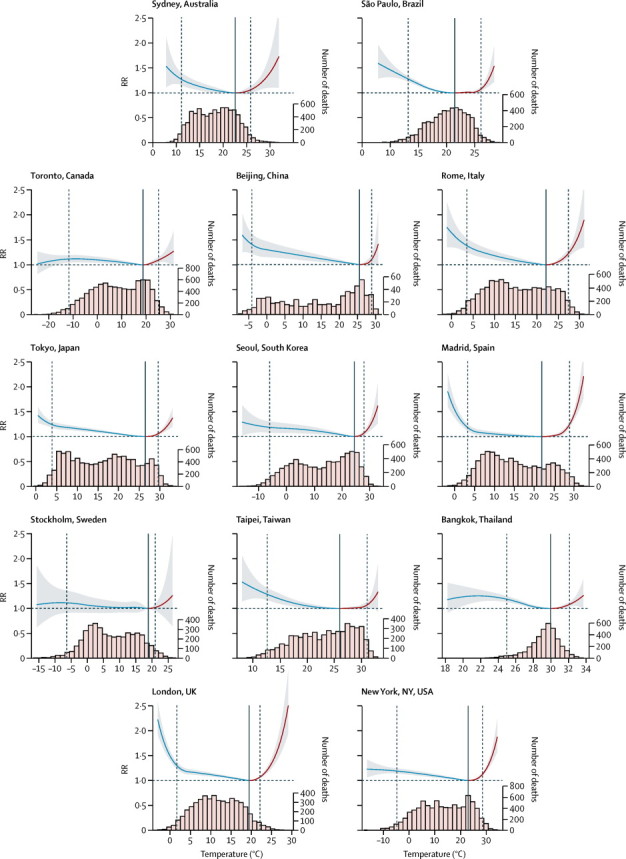
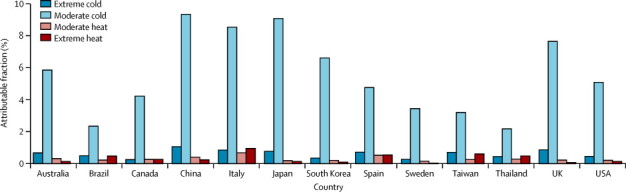
BACKGROUND: Although studies have provided estimates of premature deaths attributable to either heat or cold in selected countries, none has so far offered a systematic assessment across the whole temperature range in populations exposed to different climates. We aimed to quantify the total mortality burden attributable to non-optimum ambient temperature, and the relative contributions from heat and cold and from moderate and extreme temperatures. METHODS: We collected data for 384 locations in Australia, Brazil, Canada, China, Italy, Japan, South Korea, Spain, Sweden, Taiwan, Thailand, UK, and USA. We fitted a standard time-series Poisson model for each location, controlling for trends and day of the week. We estimated temperature-mortality associations with a distributed lag non-linear model with 21 days of lag, and then pooled them in a multivariate metaregression that included country indicators and temperature average and range. We calculated attributable deaths for heat and cold, defined as temperatures above and below the optimum temperature, which corresponded to the point of minimum mortality, and for moderate and extreme temperatures, defined using cutoffs at the 2·5th and 97·5th temperature percentiles. FINDINGS: We analysed 74,225,200 deaths in various periods between 1985 and 2012. In total, 7·71% (95% empirical CI 7·43-7·91) of mortality was attributable to non-optimum temperature in the selected countries within the study period, with substantial differences between countries, ranging from 3·37% (3·06 to 3·63) in Thailand to 11·00% (9·29 to 12·47) in China. The temperature percentile of minimum mortality varied from roughly the 60th percentile in tropical areas to about the 80-90th percentile in temperate regions. More temperature-attributable deaths were caused by cold (7·29%, 7·02-7·49) than by heat (0·42%, 0·39-0·44). Extreme cold and hot temperatures were responsible for 0·86% (0·84-0·87) of total mortality. INTERPRETATION: Most of the temperature-related mortality burden was attributable to the contribution of cold. The effect of days of extreme temperature was substantially less than that attributable to milder but non-optimum weather. This evidence has important implications for the planning of public-health interventions to minimise the health consequences of adverse temperatures, and for predictions of future effect in climate-change scenarios. FUNDING: UK Medical Research Council.
Overview
The claims and statistics of this paper haven’t been checked yet.
Free: it reads the open-access text and checks the first 5 claims that cite a source we can check. Create a free account to check every claim.
Integrity signals
Registry
Cites
Statistics
Figures
Verification
Claims the paper makes
The claims and statistics of this paper haven’t been checked yet.
Free: it reads the open-access text and checks the first 5 claims that cite a source we can check. Create a free account to check every claim.
Claims other papers make about this one
Each is checked against this paper’s own text: does it say what the citing paper says it does?
The cited source says what the claim attributes to it.
In the citing paper
“An immediate and direct impact of climate change is through human exposure to high outdoor temperatures, which is associated with morbidity and an increased risk of premature death (mortality)2–4.”
From The burden of heat-related mortality attributable to recent human-induced climate change (2021) · cites this paper as [2]
The cited source says what the claim attributes to it.
In the citing paper
“Increasing evidence from experimental, epidemiological, and econometric studies has demonstrated the effects of increased heat exposures on productivity [38], learning ability [39], and morbidity and mortality in humans [17,18,40].”
From Reduced cognitive function during a heat wave among residents of non-air-conditioned buildings: An observational study of young adults in the summer of 2016 (2018) · cites this paper as [18]
In the citing paper
“Hundreds of cardiovascular deaths each year among construction workers in Qatar may likewise be due to workplace heat (25).”
From Heat, Human Performance, and Occupational Health: A Key Issue for the Assessment of Global Climate Change Impacts (2016) · cites this paper as [25]
Self-check
Percentages, sums and reported differences re-computed from the paper’s own numbers.
The self-check needs the paper’s full text.
Citations
Cites
Quantifying heterogeneity in a meta‐analysis
Higgins, J. P. T., & Thompson, S. G. (2002) · Statistics in Medicine · doi:10.1002/sim.1186 · Cited by 36,763
(2013) · Cited by 6,752
The Effects of Climate Change on Cardiac Health
De Blois, J., Kjellstrom, T., Agewall, S., Ezekowitz, J. A., Armstrong, P. W., & Atar, D. (2015) · Cardiology · doi:10.1159/000398787 · Cited by 1,697
Relation between elevated ambient temperature and mortality: A review of the epidemiologic evidence
Basu, R. (2002) · Epidemiologic Reviews · doi:10.1093/epirev/mxf007 · Cited by 1,381
Heat-Related Deaths during the July 1995 Heat Wave in Chicago
Semenza, J. C., Rubin, C. H., Falter, K. H., Selanikio, J. D., Flanders, W. D., Howe, H. L., & Wilhelm, J. L. (1996) · New England Journal of Medicine · doi:10.1056/nejm199607113350203 · Cited by 1,376
Weather-Related Mortality: How Heat, Cold, and Heat Waves Affect Mortality in the United States
Anderson, B. G., & Bell, M. L. (2009) · Epidemiology · doi:10.1097/ede.0b013e318190ee08 · Cited by 1,229
Self-citationTime series regression studies in environmental epidemiology
Bhaskaran, K., Gasparrini, A., Hajat, S., Smeeth, L., & Armstrong, B. (2013) · International Journal of Epidemiology · doi:10.1093/ije/dyt092 · Cited by 1,150
Self-citationHigh ambient temperature and mortality: a review of epidemiologic studies from 2001 to 2008
Basu, R. (2009) · Environmental Health · doi:10.1186/1476-069x-8-40 · Cited by 1,135
Reducing and meta-analysing estimates from distributed lag non-linear models
Gasparrini, A., & Armstrong, B. (2013) · BMC Medical Research Methodology · doi:10.1186/1471-2288-13-1 · Cited by 1,081
Self-citation
Cited by
Items 401–500 of 1,006
Kim, Y., Ratnam, J. V., Doi, T., Morioka, Y., Behera, S. K., Tsuzuki, A., Minakawa, N., Sweijd, N. A., Kruger, P. S., Maharaj, R., et al. (2019) · Scientific Reports · doi:10.1038/s41598-019-53838-3 · Cited by 76
Self-citationHeat, Heatwaves and Cardiorespiratory Hospital Admissions in Helsinki, Finland
Sohail, H., Tiittanen, P., Kollanus, V., Schneider, A. E., & Lanki, T. (2020) · International Journal of Environmental Research and Public Health · doi:10.3390/ijerph17217892 · Cited by 75
Ambient Temperature and Years of Life Lost: A National Study in China
Liu, T., Zhou, C., Zhang, H., Huang, B., Xu, Y., Lin, L., Wang, L., Hu, R., Hou, Z., Xiao, Y., et al. (2020) · The Innovation · doi:10.1016/j.xinn.2020.100072 · Cited by 74
Self-citationFuture cooling gap in shared socioeconomic pathways
Andrijevic, M., Byers, E. A., Mastrucci, A., Smits, J. P. J. M., & Fuss, S. (2021) · Environmental Research Letters · doi:10.1088/1748-9326/ac2195 · Cited by 74
“Exposure to abnormal heat can cause various adverse effects on human health, from thermal discomfort to lethal outcomes [1].”
Optimal heat stress metric for modelling heat‐related mortality varies from country to country
Lo, Y. T. E., Mitchell, D., Buzan, J., Zscheischler, J., Schneider, R., Mistry, M., Kyselý, J., Lavigne, É., Silva, S. P., Royé, D., et al. (2023) · International Journal of Climatology · doi:10.1002/joc.8160 · Cited by 77
Self-citationHealth impact of urban green spaces: a systematic review of heat-related morbidity and mortality
Nazish, A., Abbas, K., & Sattar, E. (2024) · BMJ Open · doi:10.1136/bmjopen-2023-081632 · Cited by 74
Temperature-related hospitalization burden under climate change
Liao, S., Pan, W., Wen, L., Chen, R., Pan, D., Wang, R., Hu, C., Duan, H., Weng, H., Tian, C., et al. (2025) · Nature · doi:10.1038/s41586-025-09352-w · Cited by 77
Global predictability of temperature extremes
de Perez, E. C., van Aalst, M., Bischiniotis, K., Mason, S., Nissan, H., Pappenberger, F., Stephens, E., Zsoter, E., & van den Hurk, B. (2018) · Environmental Research Letters · doi:10.1088/1748-9326/aab94a · Cited by 63
“In fact, most heatwave and coldwave definitions that have been derived from local mortality relationships tend to show impact at the most extreme percentiles of the local temperature climatology (Astrom et al 2011, Gasparrini et al 2015).”
Hondula, D. M., Kuras, E. R., Betzel, S., Drake, L., Eneboe, J., Kaml, M., Munoz, M., Sevig, M., Singh, M., Ruddell, B. L., et al. (2020) · Environment International · doi:10.1016/j.envint.2020.106271 · Cited by 75
Urbanization-driven increases in summertime compound heat extremes across China
Wu, S., Wang, P., Tong, X., Tian, H., Zhao, Y., & Luo, M. (2021) · The Science of The Total Environment · doi:10.1016/j.scitotenv.2021.149166 · Cited by 73
Varghese, B. M., Barnett, A. G., Hansen, A. L., Bi, P., Hanson‐Easey, S., Heyworth, J. S., Sim, M. R., & Pisaniello, D. (2018) · Environmental Research · doi:10.1016/j.envres.2018.12.024 · Cited by 73
Heatwaves and dengue outbreaks in Hanoi, Vietnam: New evidence on early warning
Cheng, J., Bambrick, H., Yakob, L., Devine, G. J., Frentiu, F. D., Toàn, Đ. T. T., Thái, P. Q., Xu, Z., & Hu, W. (2020) · PLoS neglected tropical diseases · doi:10.1371/journal.pntd.0007997 · Cited by 73
“Using a widely used approach in the field of climate change and burden of disease [30, 34], we found that temperature was responsible for a large number of dengue cases, with more temperature-related cases from large outbreaks.”
Heat-health action planning in the WHO European Region: Status and policy implications
Martínez, G. S., Kendrovski, V., Salazar, M. A., de'Donato, F. K., & Boeckmann, M. (2022) · Environmental Research · doi:10.1016/j.envres.2022.113709 · Cited by 75
Xu, J., Wang, Q., Anikeeva, O., Zhu, P., Bi, P., & Huang, C. (2025) · BMJ · doi:10.1136/bmj-2025-084675 · Cited by 72
Lowe, R., García‐Díez, M., Ballester, J., Creswick, J., Robine, J., Herrmann, F. R., & Rodó, X. (2016) · International Journal of Environmental Research and Public Health · doi:10.3390/ijerph13020206 · Cited by 72
“Deaths attributable to extreme heat are roughly as frequent as those attributable to moderate heat [13].”
Heat-related mortality in Cyprus for current and future climate scenarios
Heaviside, C., Tsangari, H., Paschalidou, A. Κ., Vardoulakis, S., Kassomenos, P. A., Georgiou, K. E., & Yamasaki, E. N. (2016) · The Science of The Total Environment · doi:10.1016/j.scitotenv.2016.06.138 · Cited by 72
Tropical nights on the Spanish Mediterranean coast, 1950-2014
Cantos, J. O., Serrano‐Notivoli, R., Miró, J. J., & Meseguer-Ruiz, Ó. (2019) · Climate Research · doi:10.3354/cr01569 · Cited by 74
McElroy, S., Schwarz, L., Green, H., Corcos, I. A., Guirguis, K. J., Gershunov, A., & Benmarhnia, T. (2020) · The Science of The Total Environment · doi:10.1016/j.scitotenv.2020.137678 · Cited by 72
“Other studies found that the heat-health relationship varies greatly by geography (Gasparrini et al., 2015; Curriero et al., 2002).”
Wang, B., Chai, G., Sha, Y., Zha, Q., Su, Y., & Gao, Y. (2020) · The Science of The Total Environment · doi:10.1016/j.scitotenv.2020.143254 · Cited by 72
Lee, H., Myung, W., Kim, H., Lee, E.-M., & Kim, H. (2020) · The Science of The Total Environment · doi:10.1016/j.scitotenv.2020.141261 · Cited by 71
Self-citationXu, M., Li, Y., Liu, B.-Y., Chen, R., Sheng, L., Yan, S., Chen, H., Hou, J., Yuan, L., Ke, L., et al. (2020) · Epidemiology and Infection · doi:10.1017/s0950268820003040 · Cited by 71
Lei, J., Chen, R., Liu, C., Zhu, Y., Xue, X., Jiang, Y., Shi, S., Gao, Y., Kan, H., & Xuan, J. (2023) · International Journal of Epidemiology · doi:10.1093/ije/dyad056 · Cited by 75
Self-citationSpatiotemporal trends in human vulnerability and adaptation to heat across the United States
Sheridan, S. C., & Dixon, P. (2016) · Anthropocene · doi:10.1016/j.ancene.2016.10.001 · Cited by 74
Lo, Y. T. E., Mitchell, D. M., Gasparrini, A., Vicedo-Cabrera, A. M., Ebi, K. L., Frumhoff, P. C., Millar, R. J., Roberts, W., Sera, F., Sparrow, S., et al. (2019) · Science Advances · doi:10.1126/sciadv.aau4373 · Cited by 70
Self-citationThermal Control, Weather, and Aging
Schneider, A. E., Rückerl, R., Breitner, S., Wolf, K., & Peters, A. (2017) · Current Environmental Health Reports · doi:10.1007/s40572-017-0129-0 · Cited by 71
Attributable risks of emergency hospital visits due to air pollutants in China: A multi-city study
Chen, G., Zhang, Y., Zhang, W., Li, S., Williams, G. M., Marks, G. B., Jalaludin, B. B., Abramson, M. J., Luo, F., Yang, D., et al. (2017) · Environmental Pollution · doi:10.1016/j.envpol.2017.05.026 · Cited by 70
Self-citationA multi-resolution air temperature model for France from MODIS and Landsat thermal data
Hough, I., Just, A. C., Zhou, B., Dorman, M., Lepeule, J., & Kloog, I. (2020) · Environmental Research · doi:10.1016/j.envres.2020.109244 · Cited by 70
“High or low Ta is associated with increased morbidity and mortality across regions and climates (Gasparrini et al., 2015; Guo et al., 2014; Song et al., 2017), and recent work suggests that high Ta may exacerbate the effect of exposure to particulate matter (PM), another major health hazard (Li et al.”
Global socioeconomic exposure of heat extremes under climate change
Chen, J., Liu, Y., Pan, T., Ciais, P., Ma, T., Liu, Y., Yamazaki, D., Ge, Q., & Peñuelas, J. (2020) · Journal of Cleaner Production · doi:10.1016/j.jclepro.2020.123275 · Cited by 70
Hu, K., Guo, Y., Yang, X., Zhong, J., Fei, F., Chen, F., Zhao, Q., Zhang, Y., Chen, G., Chen, Q., et al. (2018) · The Science of The Total Environment · doi:10.1016/j.scitotenv.2018.08.095 · Cited by 69
Self-citationKhan, A. M., Finlay, J., Clarke, P. J., Sol, K., Melendez, R. A., Judd, S. E., & Gronlund, C. J. (2021) · BMC Public Health · doi:10.1186/s12889-021-11533-x · Cited by 69
“To our knowledge, the temperature-cognition association has not previously been studied across regions despite previous evidence that temperature effects of other health outcomes show regional differences [6, 8, 42].”
Excess mortality during the warm summer of 2015 in Switzerland
Vicedo‐Cabrera, A. M., Ragettli, M. S., Schindler, C., & Röösli, M. (2016) · Swiss Medical Weekly · doi:10.4414/smw.2016.14379 · Cited by 69
“However, it has to be taken into account that extreme events are rare and, in terms of absolute numbers, days with moderately hot temperatures are expected to be more relevant for the whole summer, as shown by Gasparrini et al. 2015 [1].”
Extreme heat-related mortality avoided under Paris Agreement goals
Mitchell, D., Heaviside, C., Schaller, N., Allen, M., Ebi, K. L., Fischer, E. M., Gasparrini, A., Harrington, L., Kharin, V., Shiogama, H., et al. (2018) · Nature Climate Change · doi:10.1038/s41558-018-0210-1 · Cited by 58
Self-citationZhu, J., Wang, S., & Huang, G. (2019) · Journal of Geophysical Research Atmospheres · doi:10.1029/2018jd029444 · Cited by 68
Denpetkul, T., & Phosri, A. (2021) · The Science of The Total Environment · doi:10.1016/j.scitotenv.2021.148373 · Cited by 67
Gatterer, H., Dünnwald, T., Turner, R., Csapo, R., Schobersberger, W., Burtscher, M., Faulhaber, M., & Kennedy, M. D. (2021) · International Journal of Environmental Research and Public Health · doi:10.3390/ijerph18189700 · Cited by 67
Liu, J., Liu, T., Burkart, K. G., Wang, H., He, G., Hu, J., Xiao, J., Yin, P., Wang, L., Liang, X., et al. (2022) · The Lancet Regional Health - Western Pacific · doi:10.1016/j.lanwpc.2022.100493 · Cited by 67
What is a heat(wave)? An interdisciplinary perspective
Boni, Z., Bienkowska, Z. M., Chwałczyk, F., Jancewicz, B., Marginean, I., & Serrano, P. Y. (2023) · Climatic Change · doi:10.1007/s10584-023-03592-3 · Cited by 68
Sun, Z., Zhang, X., Li, Z., Liang, Y., An, X., Zhao, Y., Miao, S., Han, L., & Li, D. (2023) · Journal of Environmental Management · doi:10.1016/j.jenvman.2023.119576 · Cited by 67
Methods to Estimate Acclimatization to Urban Heat Island Effects on Heat- and Cold-Related Mortality
Milojevic, A., Armstrong, B., Gasparrini, A., Bohnenstengel, S. I., Barratt, B., & Wilkinson, P. (2016) · Environmental Health Perspectives · doi:10.1289/ehp.1510109 · Cited by 68
“In addition, this may explain the contrast of our results with studies finding higher heat risks in areas more affected by UHI, which were all in cities with a higher proportion of heat-affected days (Goggins et al. 2012, 2013), as indicated by the MMTs found by Gasparrini et al. (2015).”
Self-citationLi, J., Xu, X. J., Yang, J., Liu, Z., Xu, L., Gao, J., Liu, X., Wu, H., Wang, J., Yu, J., et al. (2017) · Environmental Research · doi:10.1016/j.envres.2017.04.020 · Cited by 67
Cots, M. V., Watts, A. E., Cruz-Lemini, M., Shah, N., Ndugga, N., McCann, P., Barritt, A. S., Jain, A., Ravi, S., Fernández‐Carrillo, C., et al. (2018) · Hepatology · doi:10.1002/hep.30315 · Cited by 67
“(8) Furthermore, recent epidemiological studies have established a relationship between ambient temperature and allcause mortality.(9,10) For example, Gasparrini et al.”
Cheng, J., Xu, Z., Bambrick, H., Su, H., Tong, S., & Hu, W. (2019) · International Journal of Biometeorology · doi:10.1007/s00484-019-01716-y · Cited by 67
Self-citationWang, Y., Liu, Y., Ye, D., Li, N., Bi, P., Tong, S., Wang, Y., Cheng, Y., Li, Y., & Yao, X. (2020) · Environment International · doi:10.1016/j.envint.2020.105486 · Cited by 67
“Health impacts of high temperatures, particular heatwaves, have been well documented (Gasparrini et al., 2015; Xiaofang et al., 2012), but with much of the evidences coming from assessment on mortality.”
Self-citationVicedo‐Cabrera, A. M., de Schrijver, E., Schumacher, D. L., Ragettli, M. S., Fischer, E. M., & Seneviratne, S. I. (2023) · Environmental Research Letters · doi:10.1088/1748-9326/ace0d0 · Cited by 70
“In brief, for each sex-age (0–65 and above 65 years) subgroup, we derived the temperature-mortality association (pooled or nationwide, and canton-specific risks) through a two-stage time-series [24] analysis using high-resolution temperature and mortality data.”
Yin, P., Gao, Y., Chen, R., Liu, W., He, C., Hao, J., Zhou, M., & Kan, H. (2023) · Nature Communications · doi:10.1038/s41467-023-44066-5 · Cited by 66
Self-citationĐăng, T. N., Seposo, X., Duc, N. H. C., Thang, T. B., Do, A. D., Hang, L. T. M., Long, T. T., Loan, B. T. H., & Honda, Y. (2016) · Global Health Action · doi:10.3402/gha.v9.28738 · Cited by 66
“(9) found that the attributable deaths were more pronounced for low than for high temperatures, and the differences in attributable deaths between low and high temperatures were even greater in tropical or subtropical”
Self-citationDevelopment and appraisal of long-term adaptation pathways for managing heat-risk in London
Kingsborough, A. B., Jenkins, K., & Hall, J. W. (2017) · Climate Risk Management · doi:10.1016/j.crm.2017.01.001 · Cited by 67
Zhao, Q., Coêlho, M. D. S. Z. S., Li, S., Saldiva, P. H. N., Hu, K., Abramson, M. J., Huxley, R., & Guo, Y. (2018) · Environment International · doi:10.1016/j.envint.2018.08.021 · Cited by 66
Self-citationThe influence of extreme cold events on mortality in the United States
Smith, E. T., & Sheridan, S. C. (2018) · The Science of The Total Environment · doi:10.1016/j.scitotenv.2018.07.466 · Cited by 66
Human-perceived temperature changes over South China: Long-term trends and urbanization effects
Wang, Y., Chen, L., Song, Z., Huang, Z., Ge, E., Lin, L., & Luo, M. (2018) · Atmospheric Research · doi:10.1016/j.atmosres.2018.09.006 · Cited by 66
Zhao, Q., Li, S., Coêlho, M. D. S. Z. S., Saldiva, P. H. N., Hu, K., Arblaster, J. M., Nicholls, N., Huxley, R., Abramson, M. J., & Guo, Y. (2019) · Environmental Health Perspectives · doi:10.1289/ehp3889 · Cited by 66
“This method has been widely used in multicountry studies (Gasparrini et al. 2015b; Guo et al. 2018).”
Self-citationPredicted temperature-increase-induced global health burden and its regional variability
Lee, J. Y., Kim, H., Gasparrini, A., Armstrong, B., Bell, M. L., Sera, F., Lavigne, É., Abrutzky, R., Tong, S., Coêlho, M. D. S. Z. S., et al. (2019) · Environment International · doi:10.1016/j.envint.2019.105027 · Cited by 66
Self-citationTiitta, I., McDermott‐Levy, R., Hannele, T., Jaakkola, J. J. K., & Lauri, K. (2020) · Nursing Forum · doi:10.1111/nuf.12540 · Cited by 68
da Silveira, I. H., Hartwig, S. V., Moura, M. D. N., Cortes, T. R., Junger, W. L., Cirino, G. G., Ignotti, E., & de Oliveira, B. F. A. (2023) · International Journal of Hygiene and Environmental Health · doi:10.1016/j.ijheh.2022.114109 · Cited by 65
Dimitrova, A., Dimitrova, A., Mengel, M., Gasparrini, A., Lotze‐Campen, H., & Gabrysch, S. (2024) · Nature Communications · doi:10.1038/s41467-024-49890-x · Cited by 65
“Similar to other studies 36 , we fi nd that moderately hot and cold temperatures dominate the temperature-related burden, which could be explained by their higher frequency throughout the year.”
Self-citationChen, H., Wang, J., Li, Q. X., Yagouti, A., Lavigne, É., Foty, R., Burnett, R. T., Villeneuve, P. J., Cakmak, S., & Copes, R. (2016) · CMAJ Open · doi:10.9778/cmajo.20150111 · Cited by 65
A systematic review on lagged associations in climate–health studies
Pin, W., Zhang, X., Hashizume, M., Goggins, W. B., & Luo, C. (2020) · International Journal of Epidemiology · doi:10.1093/ije/dyaa286 · Cited by 64
Self-citationPanlasigui, S., Spotswood, E. N., Beller, E. E., & Grossinger, R. M. (2021) · Sustainability · doi:10.3390/su13052450 · Cited by 68
Crank, P. J., Hondula, D. M., & Sailor, D. J. (2022) · The Science of The Total Environment · doi:10.1016/j.scitotenv.2022.160599 · Cited by 65
Ballester, J., van Daalen, K. R., Chen, Z., Achebak, H., Antó, J. M., Basagaña, X., Robine, J., Herrmann, F. R., Tonne, C. C., Semenza, J. C., et al. (2023) · The Lancet Regional Health - Europe · doi:10.1016/j.lanepe.2023.100779 · Cited by 64
“Projects and initiatives, such as PHEWE, 13,14 NMMAPS, 15 EURO-HEAT, 16 CIRCE, 17 PHASE, 18 MCC 2,9 and EARLY-ADAPT, 1 have been designed to compile and jointly analyse daily health databases covering large continental or global domains.”
Meade, R. D., Akerman, A. P., Notley, S. R., Kirby, N. V., Sigal, R. J., & Kenny, G. P. (2024) · Environmental Health Perspectives · doi:10.1289/ehp13159 · Cited by 66
Qiu, H., Sun, S., Tang, R., Chan, K.-P., & Tian, L. (2016) · American Journal of Epidemiology · doi:10.1093/aje/kww041 · Cited by 65
Impact of temperature on mortality in Hubei, China: a multi-county time series analysis
Zhang, Y., Yu, C., Bao, J., & Li, X. (2017) · Scientific Reports · doi:10.1038/srep45093 · Cited by 64
Hanazawa, T., Asayama, K., Watabe, D., Tanabe, A., Satoh, M., Inoue, R., Hara, A., Obara, T., Kikuya, M., Nomura, K., et al. (2018) · Journal of the American Heart Association · doi:10.1161/jaha.117.008509 · Cited by 59
Urban Heat Management in Louisville, Kentucky: A Framework for Climate Adaptation Planning
Stone, B., Lanza, K., Mallen, E., Vargo, J., & Russell, A. (2023) · Journal of Planning Education and Research · doi:10.1177/0739456x19879214 · Cited by 55
“On average, the attributable fraction of daily deaths due to warm season temperatures across Louisville as a whole is 0.47 percent (Gasparrini et al. 2015).”
InfluentialChen, Y., Kong, D., Fu, J., Zhang, Y., Zhao, Y., Liu, Y., Chang, Z., Liu, Y., Liu, X., Xu, K., et al. (2022) · Respiratory Research · doi:10.1186/s12931-022-01960-8 · Cited by 63
“These results were consistent with several previous studies focusing on mortality [31, 35, 48].”
InfluentialThe biospheric emergency calls for scientists to change tactics
Racimo, F., Valentini, E., Rijo, G., Santos, T. L., Norberg, A., Atmore, L. M., Murray, M., Hakala, S. M., Olsen, F. A., Gardner, C. J., et al. (2022) · eLife · doi:10.7554/elife.83292 · Cited by 63
Extreme Temperatures and Stroke Mortality: Evidence From a Multi-Country Analysis
Alahmad, B., Khraishah, H., Kamineni, M., Royé, D., Papatheodorou, S., Vicedo-Cabrera, A. M., Guo, Y., Lavigne, É., Armstrong, B., Sera, F., et al. (2024) · Stroke · doi:10.1161/strokeaha.123.045751 · Cited by 63
“The 2 functions were represented by a quadratic B-spline with 3 internal knots placed at the 10th, 75th, and 90th temperature percentiles of each location 19 and a natural splines with 3 internal knots equally spaced in the log scale over a period of 14 lag days.”
Self-citationRespiratory risks from wildfire-specific PM2.5 across multiple countries and territories
Zhang, Y., Xu, R., Huang, W., Ye, T., Yu, P., Yu, W., Wu, Y. Y., Liu, Y., Yang, Z., Wen, B., et al. (2025) · Nature Sustainability · doi:10.1038/s41893-025-01533-9 · Cited by 63
“…equation: Where Y it denotes the hospitalization counts in community i on day t ; cb is a distributed lag model incorporated with a crossbasis 47 function of a linear term over the current and previous seven (lag 0–7) days and two internal knots placed at equally spaced values in the log…”
Self-citationHeat stress mortality and desired adaptation responses of healthcare system in Poland
Błażejczyk, A., Błażejczyk, K., Baranowski, J., & Kuchcik, M. (2017) · International Journal of Biometeorology · doi:10.1007/s00484-017-1423-0 · Cited by 63
Effect of the Great Recession on regional mortality trends in Europe
Ballester, J., Robine, J., Herrmann, F. R., & Rodó, X. (2019) · Nature Communications · doi:10.1038/s41467-019-08539-w · Cited by 64
Pan, R., Wang, X., Yi, W., Wei, Q., Gao, J., Xu, Z., Duan, J., He, Y., Tang, C., Liu, X., et al. (2020) · The Science of The Total Environment · doi:10.1016/j.scitotenv.2020.137804 · Cited by 63
Liu, J., Hansen, A. L., Varghese, B. M., Liu, Z., Tong, M., Qiu, H., Tian, L., Lau, K. K., Ng, E., Ren, C., et al. (2020) · Sustainable Cities and Society · doi:10.1016/j.scs.2020.102131 · Cited by 63
Zhu, R., Fang, H., Chen, M., Hu, X., Cao, Y., Yang, F., & Xia, K. (2020) · Public Health · doi:10.1016/j.puhe.2020.07.028 · Cited by 64
Cold Spells and Cause-Specific Mortality in 47 Japanese Prefectures: A Systematic Evaluation
Ma, C., Yang, J., Nakayama, S. F., Iwai‐Shimada, M., Jung, C., Sun, X., & Honda, Y. (2021) · Environmental Health Perspectives · doi:10.1289/ehp7109 · Cited by 62
Self-citationSong, J., Yu, H., & Lü, Y. (2021) · Sustainable Cities and Society · doi:10.1016/j.scs.2021.103159 · Cited by 63
Interpreting extreme climate impacts from large ensemble simulations—are they unseen or unrealistic?
Kelder, T., Wanders, N., van der Wiel, K., Marjoribanks, T. I., Slater, L. J., Wilby, R. L., & Prudhomme, C. (2022) · Environmental Research Letters · doi:10.1088/1748-9326/ac5cf4 · Cited by 71
Huang, W., Li, S., Vogt, T., Xu, R., Tong, S., Molina, T., Masselot, P., Gasparrini, A., Armstrong, B., Pascal, M., et al. (2023) · The Lancet Planetary Health · doi:10.1016/s2542-5196(23)00143-2 · Cited by 62
“15,16 Briefly, the integrated dataset covers 1630 locations from 45 countries or territories.”
Self-citationEnvironmental public health risks in European metropolitan areas within the EURO-HEALTHY project
Mitsakou, C., Dimitroulopoulou, S., Heaviside, C., Katsouyanni, K., Samoli, E., Rodopoulou, S., da Costa, C. H., Almendra, R., Santana, P., Marí-Dell’Olmo, M., et al. (2018) · The Science of The Total Environment · doi:10.1016/j.scitotenv.2018.12.130 · Cited by 62
“Projected increases in temperature and the frequency of heatwaves in future is likely to increase the risk of heat related mortality and morbidity (Analitis et al., 2008; Gasparrini et al., 2015; Basu et al., 2008; Gronlund et al., 2014).”
The Living Environment and Thermal Behaviours of Older South Australians: A Multi-Focus Group Study
van Hoof, J., Bennetts, H., Hansen, A. L., Kazak, J. K., & Soebarto, V. I. (2019) · International Journal of Environmental Research and Public Health · doi:10.3390/ijerph16060935 · Cited by 62
“Likewise, living in cold conditions increases the chance of experiencing illnesses such as arthritis, influenza, pneumonia and asthma as well as blood pressure changes, cardiac conditions, and strokes, which can lead to death [12,19].”
Comparison of temperature-mortality associations estimated with different exposure metrics
Weinberger, K. R., Spangler, K. R., Zanobetti, A., Schwartz, J. D., & Wellenius, G. A. (2019) · Environmental Epidemiology · doi:10.1097/ee9.0000000000000072 · Cited by 62
“(1) temperature observations from a single weather station and (2) population-weighted temperature estimates constructed from a”
InfluentialSelf-citationEnvironmental temperature and human epigenetic modifications: A systematic review
Xu, R., Li, S., Guo, S., Zhao, Q., Abramson, M. J., Li, S., & Guo, Y. (2019) · Environmental Pollution · doi:10.1016/j.envpol.2019.113840 · Cited by 62
Self-citationWang, Y.-Y., Li, Q., Guo, Y., Zhou, H., Wang, Q., Shen, H., Zhang, Y., Yan, D., Li, S., Chen, G., et al. (2020) · Environment International · doi:10.1016/j.envint.2020.105851 · Cited by 62
“Previous studies have reported that exposure to relatively low or high temperatures was associated with mortality and morbidity regarding cardiopulmonary system, infectious and mental health (Gasparrini et al. 2015; Peng et al. 2017; Ye et al. 2012).”
Self-citationGu, S., Zhang, L., Sun, S., Wang, X., Lü, B., Han, H., Yang, J., & Wang, A. (2020) · Environment International · doi:10.1016/j.envint.2020.105889 · Cited by 62
Chen, J., Zhou, M., Yang, J., Yin, P., Wang, B., Ou, C., & Liu, Q. (2020) · Environmental Research Letters · doi:10.1088/1748-9326/abaea0 · Cited by 62
“Moreover, cold was identified to induce a higher health burden than heat (Gasparrini et al 2015).”
Heat-Related Mortality: An Analysis of the Impact of Heatwaves in Germany Between 1992 and 2017
der Heiden, M. A., Muthers, S., Niemann, H., Buchholz, U., Grabenhenrich, L., & Matzarakis, A. (2020) · Deutsches Ärzteblatt international · doi:10.3238/arztebl.2020.0603 · Cited by 62
Estimating heat-related mortality in near real time for national heatwave plans
Lo, Y. T. E., Mitchell, D., Thompson, R., O’Connell, E., & Gasparrini, A. (2022) · Environmental Research Letters · doi:10.1088/1748-9326/ac4cf4 · Cited by 62
“In conclusion, quasi-Poisson regression coupled with DLNMs can be used in a novel way to model regional summer heat-related deaths in near real time.”
InfluentialSelf-citationde Schrijver, E., Bundo, M., Ragettli, M. S., Sera, F., Gasparrini, A., Franco, O. H., & Vicedo‐Cabrera, A. M. (2022) · doi:10.48350/167234 · Cited by 61
Self-citationWintertime outdoor thermal sensations and comfort in cold-humid environments of Chongqing China
Xiong, K., & He, B. (2022) · Sustainable Cities and Society · doi:10.1016/j.scs.2022.104203 · Cited by 61
Lu, C., Liu, Q., Deng, M., Liao, H., Xu, Y., & Ma, P. (2023) · The Science of The Total Environment · doi:10.1016/j.scitotenv.2023.161760 · Cited by 61
(IPCC), I. P. O. C. C. (2023) · Cambridge University Press eBooks · doi:10.1017/9781009325844.016 · Cited by 76
Egondi, T., Kyobutungi, C. K., & Rocklöv, J. (2015) · International Journal of Environmental Research and Public Health · doi:10.3390/ijerph120302735 · Cited by 61
Self-citationDaniel, L., Baker, E., & Williamson, T. (2019) · Building and Environment · doi:10.1016/j.buildenv.2019.01.037 · Cited by 61
Amplified Increases of Compound Hot Extremes Over Urban Land in China
Liao, W., Li, D., Malyshev, S. L., Shevliakova, E., Zhang, H., & Liu, X. (2021) · Geophysical Research Letters · doi:10.1029/2020gl091252 · Cited by 61
“As more and more studies have demonstrated that consecutive hot periods without limited nighttime relief will significantly increase mortality and morbidity rates (Gasparrini et al., 2015; Guo et al., 2017; Hansen et al., 2008), the faster increases in the frequency, duration, and intensity of CHEs in urban areas high…”
Carrión, D., Arfer, K. B., Rush, J., Dorman, M., Rowland, S. T., Kioumourtzoglou, M., Kloog, I., & Just, A. C. (2021) · Environmental Research · doi:10.1016/j.envres.2021.111477 · Cited by 61
Wan, K., Feng, Z., Hajat, S., & Doherty, R. M. (2022) · Environmental Health · doi:10.1186/s12940-022-00912-5 · Cited by 60
“It may partly be because of the acclimatisation and adaptation effect where people and society are adapted to their local climate as previous studies found higher heat thresholds in warmer places than cooler places of Europe, e.g. around 30 °C in Athens and Rome and around 20 °C in Helsinki and Stockholm [13, 38, 39].”
InfluentialA simulation framework for assessing thermally resilient buildings and communities
Krelling, A. F., Lamberts, R., Malik, J., & Hong, T. (2023) · Building and Environment · doi:10.1016/j.buildenv.2023.110887 · Cited by 60
He, Q., Liu, Y., Yin, P., Gao, Y., Kan, H., Zhou, M., Chen, R., & Li, Y. (2023) · EBioMedicine · doi:10.1016/j.ebiom.2023.104854 · Cited by 60
Self-citationLuo, K., Li, R., Wang, Z., Zhang, R., & Xu, Q. (2017) · Environmental Pollution · doi:10.1016/j.envpol.2017.07.045 · Cited by 60
“It is well established that these extreme temperature events are associated with higher population mortality and morbidity (Anderson and Bell, 2009; Gasparrini et al., 2015; Xie et al., 2013; Xu et al., 2016).”
InfluentialMa, C., Yang, J., Nakayama, S. F., & Honda, Y. (2019) · Environment International · doi:10.1016/j.envint.2019.03.025 · Cited by 61
Self-citation
Metadata
- Authors
- Gasparrini, A., Guo, Y., Hashizume, M., Lavigne, E., Zanobetti, A., Schwartz, J., Tobias, A., Tong, S., Rocklöv, J., Forsberg, B., Leone, M., De Sario, M., Bell, M. L., Guo, Y.-L. L., Wu, C.-F., Kan, H., Yi, S.-M., de Sousa Zanotti Stagliorio Coelho, M., Saldiva, P. H. N., Honda, Y., Kim, H., & Armstrong, B.
- Affiliations
- London School of Hygiene & Tropical Medicine (GB)
- The University of Queensland (AU)
- Nagasaki University (JP)
- Harvard University (US)
- Queensland University of Technology (AU)
- Umeå University (SE)
- Regione Lazio (IT)
- Yale University (US)
- National Taiwan University (TW)
- Fudan University (CN)
- Seoul National University (KR)
- University of Tsukuba (JP)
- Corresponding author
- Gasparrini, Antonio
- ORCID
- Venue
- The Lancet
- Publisher
- Elsevier BV
- Published
- 2015-07
- Volume
- 386
- Issue
- 9991
- Pages
- 369-375
- ISSN
- 0099-5355 (ISSN-L)
- 0140-6736
- PMC
- PMC4521077
- OpenAlex
- W2162775913
- Semantic Scholar
- ad689db0aa12fd8b5d847aacec3d0f3aad1214f0
- Cited by
- 2,965
- References
- 43
- Citations by year
- 2026: 402 · 2025: 399 · 2024: 363 · 2023: 303 · 2022: 341 · 2021: 288 · 2020: 230 · 2019: 202 · 2018: 146 · 2017: 150 · 2016: 96 · 2015: 40
- FWCI
- 90.15
- Type
- journal article
- Language
- en
- Open access
- hybrid
- doi.org
- Licence
- cc-by
- www.elsevier.com/tdm/userlicense/1.0/ (tdm)
- creativecommons.org/licenses/by/4.0/ (vor)
- Locations
- The Lancet (publishedVersion, cc-by)
- Europe PMC (PubMed Central) (publishedVersion, other-oa)
- PubMed Central (publishedVersion, cc-by)
- PubMed (publishedVersion)
- LSHTM Research Online (London School of Hygiene and Tropical Medicine) (acceptedVersion)
- DIGITAL.CSIC (Spanish National Research Council (CSIC)) (submittedVersion, cc-by)
- QUT ePrints (Queensland University of Technology) (submittedVersion)
- Institutional Repositories DataBase (IRDB) (submittedVersion, cc-by)
- Nagasaki University's Academic Output SITE (Nagasaki University) (submittedVersion, cc-by-nc-nd)
- Funders
- UK Medical Research Council ((grant G1002296))
- Ministry of Education of the Spanish Government (PRX12/00515)
- NHMRC research fellowship ((#553043))
- ARC Discovery Grant ((DP110100651))
- Global Research Laboratory (grant K21004000001-10A0500-00710)
- Topics
- Physical Sciences › Environmental Science › Health, Toxicology and Mutagenesis › Climate Change and Health Impacts
- Physical Sciences › Environmental Science › Health, Toxicology and Mutagenesis › Air Quality and Health Impacts
- Health Sciences › Medicine › Physiology (medical) › Thermoregulation and physiological responses
- Keywords
- temperature-related mortality, ambient temperature, cold-related mortality, heat-related mortality, temperature extremes, attributable mortality, temperature-mortality relationship, climate and health, minimum mortality temperature, public health interventions, distributed lag non-linear model, meta-regression
- MeSH terms
- Climate, Cold Temperature, Hot Temperature, Humans, Mortality, Global Health, Risk Assessment
About these checks
Registry, retraction, Cites and statistics results are computed, not judged, with one exception: a printed reference that no index lists is read once by a model before it counts as a citation error. Claims are extracted by a model and kept only when their quote appears verbatim in the text; each cited source is then checked, with a model’s help, for whether it says what the claim relies on. Those verdicts can be wrong — read the claim’s quote and the cited source before relying on one.
Statistics and arithmetic are recomputed, not judged.
Confidence bands are shown only for fields calibrated on our annotated test set. None is calibrated yet, so no band is shown.
What counts as a claim ›How we measure confidence ›How we check this ›
Are you an author, or do you see a problem with this page? Request a review
Data sources
Bibliographic data: Semantic Scholar, OpenAlex, Crossref.
Contains information from the Semantic Scholar Academic Graph Datasets, made available under the ODC Attribution License (ODC-BY 1.0).
Semantic Scholar’s data is described in: Kinney, R., et al. (2023). The Semantic Scholar Open Data Platform. arXiv:2301.10140.
