

Mortality risk attributable to high and low ambient temperature: a multicountry observational study
Open accessThe DOI matches its Crossref record; 43 of the 43 references it cites were found in a registry or an index.
Abstract
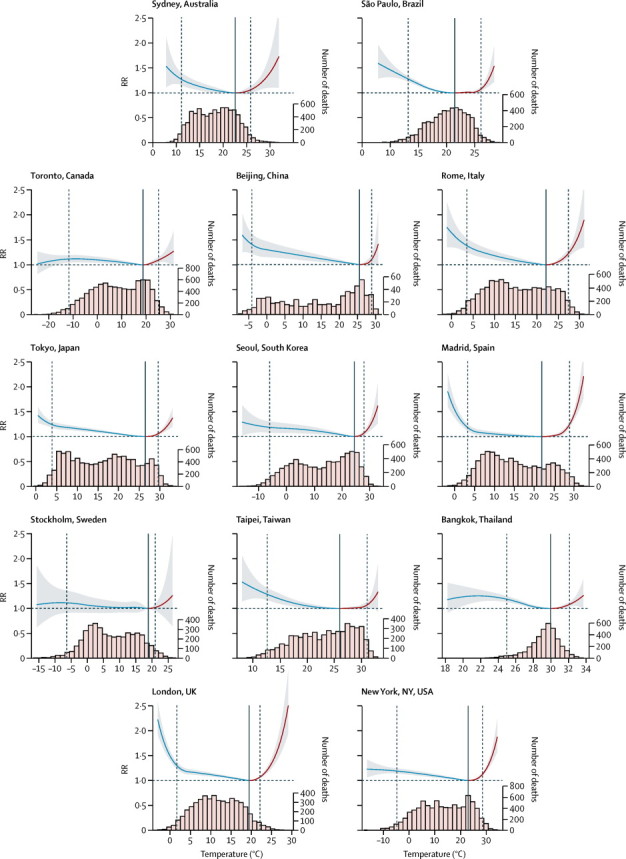
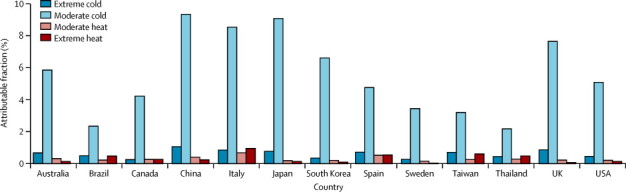
BACKGROUND: Although studies have provided estimates of premature deaths attributable to either heat or cold in selected countries, none has so far offered a systematic assessment across the whole temperature range in populations exposed to different climates. We aimed to quantify the total mortality burden attributable to non-optimum ambient temperature, and the relative contributions from heat and cold and from moderate and extreme temperatures. METHODS: We collected data for 384 locations in Australia, Brazil, Canada, China, Italy, Japan, South Korea, Spain, Sweden, Taiwan, Thailand, UK, and USA. We fitted a standard time-series Poisson model for each location, controlling for trends and day of the week. We estimated temperature-mortality associations with a distributed lag non-linear model with 21 days of lag, and then pooled them in a multivariate metaregression that included country indicators and temperature average and range. We calculated attributable deaths for heat and cold, defined as temperatures above and below the optimum temperature, which corresponded to the point of minimum mortality, and for moderate and extreme temperatures, defined using cutoffs at the 2·5th and 97·5th temperature percentiles. FINDINGS: We analysed 74,225,200 deaths in various periods between 1985 and 2012. In total, 7·71% (95% empirical CI 7·43-7·91) of mortality was attributable to non-optimum temperature in the selected countries within the study period, with substantial differences between countries, ranging from 3·37% (3·06 to 3·63) in Thailand to 11·00% (9·29 to 12·47) in China. The temperature percentile of minimum mortality varied from roughly the 60th percentile in tropical areas to about the 80-90th percentile in temperate regions. More temperature-attributable deaths were caused by cold (7·29%, 7·02-7·49) than by heat (0·42%, 0·39-0·44). Extreme cold and hot temperatures were responsible for 0·86% (0·84-0·87) of total mortality. INTERPRETATION: Most of the temperature-related mortality burden was attributable to the contribution of cold. The effect of days of extreme temperature was substantially less than that attributable to milder but non-optimum weather. This evidence has important implications for the planning of public-health interventions to minimise the health consequences of adverse temperatures, and for predictions of future effect in climate-change scenarios. FUNDING: UK Medical Research Council.
Overview
The claims and statistics of this paper haven’t been checked yet.
Free: it reads the open-access text and checks the first 5 claims that cite a source we can check. Create a free account to check every claim.
Integrity signals
Registry
Cites
Statistics
Figures
Verification
Claims the paper makes
The claims and statistics of this paper haven’t been checked yet.
Free: it reads the open-access text and checks the first 5 claims that cite a source we can check. Create a free account to check every claim.
Claims other papers make about this one
Each is checked against this paper’s own text: does it say what the citing paper says it does?
The cited source says what the claim attributes to it.
In the citing paper
“An immediate and direct impact of climate change is through human exposure to high outdoor temperatures, which is associated with morbidity and an increased risk of premature death (mortality)2–4.”
From The burden of heat-related mortality attributable to recent human-induced climate change (2021) · cites this paper as [2]
The cited source says what the claim attributes to it.
In the citing paper
“Increasing evidence from experimental, epidemiological, and econometric studies has demonstrated the effects of increased heat exposures on productivity [38], learning ability [39], and morbidity and mortality in humans [17,18,40].”
From Reduced cognitive function during a heat wave among residents of non-air-conditioned buildings: An observational study of young adults in the summer of 2016 (2018) · cites this paper as [18]
In the citing paper
“Hundreds of cardiovascular deaths each year among construction workers in Qatar may likewise be due to workplace heat (25).”
From Heat, Human Performance, and Occupational Health: A Key Issue for the Assessment of Global Climate Change Impacts (2016) · cites this paper as [25]
Self-check
Percentages, sums and reported differences re-computed from the paper’s own numbers.
The self-check needs the paper’s full text.
Citations
Cites
Quantifying heterogeneity in a meta‐analysis
Higgins, J. P. T., & Thompson, S. G. (2002) · Statistics in Medicine · doi:10.1002/sim.1186 · Cited by 36,763
(2013) · Cited by 6,752
The Effects of Climate Change on Cardiac Health
De Blois, J., Kjellstrom, T., Agewall, S., Ezekowitz, J. A., Armstrong, P. W., & Atar, D. (2015) · Cardiology · doi:10.1159/000398787 · Cited by 1,697
Relation between elevated ambient temperature and mortality: A review of the epidemiologic evidence
Basu, R. (2002) · Epidemiologic Reviews · doi:10.1093/epirev/mxf007 · Cited by 1,381
Heat-Related Deaths during the July 1995 Heat Wave in Chicago
Semenza, J. C., Rubin, C. H., Falter, K. H., Selanikio, J. D., Flanders, W. D., Howe, H. L., & Wilhelm, J. L. (1996) · New England Journal of Medicine · doi:10.1056/nejm199607113350203 · Cited by 1,376
Weather-Related Mortality: How Heat, Cold, and Heat Waves Affect Mortality in the United States
Anderson, B. G., & Bell, M. L. (2009) · Epidemiology · doi:10.1097/ede.0b013e318190ee08 · Cited by 1,229
Self-citationTime series regression studies in environmental epidemiology
Bhaskaran, K., Gasparrini, A., Hajat, S., Smeeth, L., & Armstrong, B. (2013) · International Journal of Epidemiology · doi:10.1093/ije/dyt092 · Cited by 1,150
Self-citationHigh ambient temperature and mortality: a review of epidemiologic studies from 2001 to 2008
Basu, R. (2009) · Environmental Health · doi:10.1186/1476-069x-8-40 · Cited by 1,135
Reducing and meta-analysing estimates from distributed lag non-linear models
Gasparrini, A., & Armstrong, B. (2013) · BMC Medical Research Methodology · doi:10.1186/1471-2288-13-1 · Cited by 1,081
Self-citation
Cited by
Items 801–900 of 1,006
Pruimboom, L., & Muskiet, F. A. J. (2018) · Medical Hypotheses · doi:10.1016/j.mehy.2018.08.002 · Cited by 35
Michikawa, T., Ueda, K., Takami, A., Sugata, S., Yoshino, A., Nitta, H., & Yamazaki, S. (2018) · Journal of Epidemiology · doi:10.2188/jea.je20180122 · Cited by 35
“12 With respect to PM 2.5 exposure, to estimate the health e ff ects at PM 2.5 concentrations not exceeding the daily World Health Organization (WHO) guideline values, 13 we analyzed after restricting to days with PM 2.5 concentrations at lag0-1 ≤ 25µg = m 3 .”
InfluentialLuan, G., Yin, P., Wang, L., & Zhou, M. (2019) · Environmental Science and Pollution Research · doi:10.1007/s11356-019-05252-5 · Cited by 35
Han, L., Sun, Z., Gong, T., Zhang, X., He, J., Xing, Q., Li, Z., Wang, J., Ye, D., & Miao, S. (2020) · Environmental Research Letters · doi:10.1088/1748-9326/ab6f13 · Cited by 35
Aboubakri, O., Khanjani, N., Jahani, Y., Bakhtiari, B., & Mesgari, E. (2020) · The Science of The Total Environment · doi:10.1016/j.scitotenv.2020.138700 · Cited by 35
Ayiku, L., Levay, P., Hudson, T., & Finnegan, A. (2020) · Research Synthesis Methods · doi:10.1002/jrsm.1431 · Cited by 35
A heat-health watch and warning system with extended season and evolving thresholds
Issa, M. A., Chebana, F., Masselot, P., Campagna, C., Lavigne, É., Gosselin, P., & Ouarda, T. B. M. J. (2021) · BMC Public Health · doi:10.1186/s12889-021-10982-8 · Cited by 35
The Mortality Effect of Apparent Temperature: A Multi-City Study in Asia
Cao, R., Wang, Y., Huang, J., He, J., Ponsawansong, P., Jin, J., Xu, Z., Yang, T., Pan, X., Prapamontol, T., et al. (2021) · International Journal of Environmental Research and Public Health · doi:10.3390/ijerph18094675 · Cited by 35
Temperature-mortality relationship in North Carolina, USA: Regional and urban-rural differences
Choi, H. M., Chen, C., Son, J.-Y., & Bell, M. L. (2021) · The Science of The Total Environment · doi:10.1016/j.scitotenv.2021.147672 · Cited by 37
Self-citationNikolaou, N., Dallavalle, M., Stafoggia, M., Bouwer, L. M., Peters, A., Chen, K., Wolf, K., & Schneider, A. E. (2022) · Environmental Research · doi:10.1016/j.envres.2022.115062 · Cited by 36
Foudi, S., Spadaro, J. V., Chiabai, A., Polanco-Martínez, J. M., & Neumann, M. B. (2017) · Ecosystem Services · doi:10.1016/j.ecoser.2017.03.004 · Cited by 36
“(Davis et al., 2003; Díaz et al., 2006, 2002; Gasparrini et al., 2015).”
Weather patterns and all-cause mortality in England, UK
Psistaki, K., Paschalidou, A. Κ., & McGregor, G. R. (2019) · International Journal of Biometeorology · doi:10.1007/s00484-019-01803-0 · Cited by 34
Light rain exacerbates extreme humid heat
Zhang, Z. S., Wang, Y., Zhang, G. J., Cheng, X., Xia, W., & Yang, M. (2024) · Nature Communications · doi:10.1038/s41467-024-51778-9 · Cited by 35
Projections of Extreme Temperature–Related Deaths in the US
Khatana, S. A. M., Szeto, J. J., Eberly, L. A., Nathan, A. S., Puvvula, J., & Chen, A. (2024) · JAMA Network Open · doi:10.1001/jamanetworkopen.2024.34942 · Cited by 35
Temperature-mortality associations by age and cause: a multi-country multi-city study
Scovronick, N., Sera, F., Vu, B. N., Vicedo-Cabrera, A. M., Royé, D., Tobías, A., Seposo, X., Forsberg, B., Guo, Y., Li, S., et al. (2024) · Environmental Epidemiology · doi:10.1097/ee9.0000000000000336 · Cited by 36
Self-citationRainfall events and daily mortality across 645 global locations: two stage time series analysis
He, C., Breitner, S., Huber, V., Chen, K., Zhang, S., Gasparrini, A., Bell, M. L., Kan, H., Royé, D., Armstrong, B., et al. (2024) · BMJ · doi:10.1136/bmj-2024-080944 · Cited by 34
“45 The potential effect modifiers examined include the classification of local climate types, the amount of total annual precipitation, the yearly average standard deviation of precipitation on rainfall days, economic status, population density, and average vegetation coverage.”
InfluentialSelf-citationGoldie, J., Alexander, L. V., Lewis, S. C., Sherwood, S. C., & Bambrick, H. (2017) · International Journal of Biometeorology · doi:10.1007/s00484-017-1451-9 · Cited by 35
Zhao, Q., Coêlho, M. D. S. Z. S., Li, S., Saldiva, P. H. N., Hu, K., Abramson, M. J., Huxley, R., & Guo, Y. (2018) · Environmental Pollution · doi:10.1016/j.envpol.2018.12.063 · Cited by 35
Self-citationMokoena, K. K., Ethan, C. J., Yu, Y., & Asenso, T. Q. (2020) · International Journal of Environmental Research and Public Health · doi:10.3390/ijerph17239027 · Cited by 34
Risk assessment of hot and humid environments through an integrated fuzzy AHP-VIKOR method
Ramavandi, B., Darabi, A. H., & Omidvar, M. (2021) · Stochastic Environmental Research and Risk Assessment · doi:10.1007/s00477-021-01995-1 · Cited by 34
Temperatures and health costs of emergency department visits: A multisite time series study in China
Wang, Y., Liu, Y., Ye, D., Li, N., Bi, P., Tong, S., Wang, Y., Cheng, Y., Li, Y., & Yao, X. (2021) · Environmental Research · doi:10.1016/j.envres.2021.111023 · Cited by 34
Self-citationKontis, V., Bennett, J. E., Parks, R. M., Rashid, T., Pearson‐Stuttard, J., Asaria, P., Zhou, B., Guillot, M., Mathers, C. D., Khang, Y., et al. (2021) · Wellcome Open Research · doi:10.12688/wellcomeopenres.17253.1 · Cited by 34
Ambient temperatures associated with increased risk of motor vehicle crashes in New York and Chicago
Hou, K., Zhang, L., Xu, X., Yang, F. L., Chen, B., & Hu, W. (2022) · The Science of The Total Environment · doi:10.1016/j.scitotenv.2022.154731 · Cited by 34
Extreme environmental temperatures and motorcycle crashes: a time-series analysis
Sakhvidi, M. J. Z., Yang, J., Mohammadi, D., FallahZadeh, H., Mehrparvar, A. H., Stevenson, M., Basagaña, X., Gasparrini, A., & Dadvand, P. (2022) · Environmental Science and Pollution Research · doi:10.1007/s11356-022-21151-8 · Cited by 34
Self-citationWarm-season temperatures and emergency department visits among children with health insurance
Stowell, J., Sun, Y., Spangler, K. R., Milando, C. W., Bernstein, A. S., Weinberger, K. R., Sun, S., & Wellenius, G. A. (2022) · Environmental Research Health · doi:10.1088/2752-5309/ac78fa · Cited by 34
“We applied a well-established distributed lag non-linear modeling framework to allow for both non-linear exposure-response functions and nonlinear lag-response functions [44].”
Extreme weather should be defined according to impacts on climate-vulnerable communities
Winter, S. C., Winter, M. R., Plaxico, L., Balakrishnan, A. K., Dzombo, M. N., Tabb, L. P., Ukoh, E., Lincoln, C., Obara, L. M., Otieno, S. A., et al. (2024) · Nature Climate Change · doi:10.1038/s41558-024-01983-7 · Cited by 34
“…percentile of the long-term (30 year) temperature record ( T 97.5 )—a value significantly associated with adverse health effects and mortality 15 ; and (3) a minimum daily temperature below the 2.5th percentile of the long-term temperature record ( T 2.5 )—a value also associated with…”
InfluentialProjecting future summer mortality due to ambient ozone concentration and temperature changes
Lee, J. Y., Lee, S. H., Hong, S.-C., & Kim, H. (2017) · Atmospheric Environment · doi:10.1016/j.atmosenv.2017.02.034 · Cited by 34
Self-citationAsumadu-Sakyi, A. B., Barnett, A. G., Thai, P. K., Jayaratne, E. R., Miller, W., Thompson, H., Roghani, R., & Morawska, L. (2019) · Energy and Buildings · doi:10.1016/j.enbuild.2019.03.010 · Cited by 34
Ambient temperatures associated with reduced cognitive function in older adults in China
Hou, K., & Xu, X. (2023) · Scientific Reports · doi:10.1038/s41598-023-44776-2 · Cited by 33
“The displacement effects of temperature include two parts: the lag effect of temperature in the months before the current month and the lead effect of temperature in the months after the current month, both of which have been confirmed to exert a certain impact on various health outcomes 32,43 .”
Cordiner, R., Wan, K., Hajat, S., & Macintyre, H. L. (2024) · Environment International · doi:10.1016/j.envint.2024.108761 · Cited by 33
Liu, Q., Xie, M., Peng, J., Zhou, X., Yang, K., Zhu, R., & Liu, Y. (2024) · Sustainable Cities and Society · doi:10.1016/j.scs.2024.105592 · Cited by 33
Yang, J., Zhou, M., Guo, C., Zhu, S., Sakhvidi, M. J. Z., Réquia, W. J., Sun, Q., Tong, S., Li, M., & Liu, Q. (2024) · Communications Medicine · doi:10.1038/s43856-024-00557-0 · Cited by 33
“People residing in southern and warm regionsarewellpreparedforthefrequenthightemperature,butnotforcold temperatures and thus, they are more vulnerable to cold spell, while people in cold regions are less prepared for the high temperature and particularly sensitive to heat wave 3,34,35 .”
Self-citationSanz-Mas, M., Continente, X., Brugueras, S., Marí-Dell’Olmo, M., Oliveras, L., & López, M. J. (2024) · Landscape and Urban Planning · doi:10.1016/j.landurbplan.2024.105206 · Cited by 33
High-resolution modeling and projection of heat-related mortality in Germany under climate change
Wang, J., Nikolaou, N., der Heiden, M. A., & Irrgang, C. (2024) · Communications Medicine · doi:10.1038/s43856-024-00643-3 · Cited by 33
Elderly vulnerability to temperature-related mortality risks in China
Yao, X., Qu, Y., Mishra, A., MANN, M. E., Zhang, L., Bai, C., Li, M., Lin, J., Wei, J., Yu, Q., et al. (2025) · Science Advances · doi:10.1126/sciadv.ado5499 · Cited by 34
Zhou, Y., Larochelle, L., Khan, F. A., & Pilote, L. (2025) · Environmental Health · doi:10.1186/s12940-025-01175-6 · Cited by 33
“The burden of disease and mortality attributable to global warming is steadily rising [3–5], with approximately 489,000 heat-related deaths annually from 2000 to 2019 [6] and 153,000 heat wave-related deaths during each warm season from 1990 to 2019 [7].”
A Systematic Review of Urban Heat Island (UHI) Impacts and Mitigation: Health, Equity, and Policy
Zheng, Z., Fong, C. S., Aghamohammadi, N., & Law, Y. K. (2026) · Systems · doi:10.3390/systems14010082 · Cited by 33
Tong, S., Confalonieri, U., Ebi, K. L., & Olsen, J. (2016) · Environmental Health Perspectives · doi:10.1289/ehp555 · Cited by 33
Self-citationThe Science of Adaptation to Extreme Heat
Coffel, E., de Sherbinin, A., Horton, R., Lane, K., Kienberger, S., & Wilhelmi, O. V. (2018) · Elsevier eBooks · doi:10.1016/b978-0-12-811891-7.00007-4 · Cited by 35
Varghese, B. M., Barnett, A. G., Hansen, A. L., Bi, P., Heyworth, J. S., Sim, M. R., Hanson‐Easey, S., Nitschke, M., Rowett, S., & Pisaniello, D. (2019) · The Science of The Total Environment · doi:10.1016/j.scitotenv.2019.06.098 · Cited by 33
“365 (2, 12) It is possible that these differences are related to workplace factors; for example, 366 although there exists harmonised model workplace health and safety (WHS) legislations, 367 there are variances in how they are implemented and enforced across states and territories.”
Lin, Y., Sung, F., Honda, Y., Chen, Y.-J., & Wang, Y.-C. (2020) · The Science of The Total Environment · doi:10.1016/j.scitotenv.2020.138012 · Cited by 33
Self-citationSu, Y., Cheng, L., Cai, W., LEE, J. K. W., Zhong, S., Chen, S., Li, T., Huang, X., & Huang, C. (2020) · Environmental Research · doi:10.1016/j.envres.2020.109532 · Cited by 33
Estimation of Hourly near Surface Air Temperature Across Israel Using an Ensemble Model
Zhou, B., Erell, E., Hough, I., Shtein, A., Just, A. C., Novack, V., Rosenblatt, J. D., & Kloog, I. (2020) · Remote Sensing · doi:10.3390/rs12111741 · Cited by 33
Fujii, F., Egami, N., Inoue, M., & Koga, H. (2020) · The Science of The Total Environment · doi:10.1016/j.scitotenv.2020.140469 · Cited by 33
Madaniyazi, L., Chung, Y., Kim, Y., Tobías, A., Ng, C. F. S., Seposo, X., Guo, Y., Honda, Y., Gasparrini, A., Armstrong, B., et al. (2021) · Environmental Health and Preventive Medicine · doi:10.1186/s12199-021-00992-8 · Cited by 33
Self-citationHealth Risks to the Russian Population from Temperature Extremes at the Beginning of the XXI Century
Grigorieva, E. A., & Revich, B. (2021) · Atmosphere · doi:10.3390/atmos12101331 · Cited by 33
“The variety of publications on the effects of temperature waves on the health of the population is rapidly growing, both in the northern and the southern regions [47,68,73,74,83,105,117,124,125].”
Liu, H., Tong, M., Guo, F., Nie, Q., Li, J., Li, P., Zhu, T., & Xue, T. (2022) · Environment International · doi:10.1016/j.envint.2022.107520 · Cited by 34
Jenkins, K., Kennedy-Asser, A. T., Andrews, O., & Lo, Y. T. E. (2022) · Environmental Research Letters · doi:10.1088/1748-9326/ac9cf3 · Cited by 33
“This is similar to findings of Gasparinni et al [3] and Williams et al [45].”
Ragettli, M. S., Saucy, A., Flückiger, B., Vienneau, D., de Hoogh, K., Vicedo‐Cabrera, A. M., Schindler, C., & Röösli, M. (2023) · International Journal of Environmental Research and Public Health · doi:10.3390/ijerph20064958 · Cited by 33
“, [10], the placement of the knots in the exposure dimension of the cross-basis function was based on the region-specific temperature distribution (50th and 90th percentile).”
InfluentialBorg, M., Xiang, J., Anikeeva, O., Ostendorf, B., Varghese, B. M., Dear, K. B. G., Pisaniello, D., Hansen, A. L., Zander, K. K., Sim, M. R., et al. (2023) · Environmental Research · doi:10.1016/j.envres.2023.116852 · Cited by 33
Enhancing health resilience in Japan in a changing climate
Kim, Y., Oka, K., Kawazu, E. C., Ng, C. F. S., Seposo, X., Ueda, K., Hashizume, M., & Honda, Y. (2023) · The Lancet Regional Health - Western Pacific · doi:10.1016/j.lanwpc.2023.100970 · Cited by 34
Self-citationKotharkar, R., Dongarsane, P., Ghosh, A., & Kotharkar, V. (2023) · Sustainable Cities and Society · doi:10.1016/j.scs.2023.105099 · Cited by 34
Excess Mortality Attributable to Extreme Heat in New York City, 1997-2013
Matte, T., Lane, K., & Ito, K. (2016) · Health Security · doi:10.1089/hs.2015.0059 · Cited by 33
“While not the focus of this study, other studies have found, as we did in NYC, that in many cities a large proportion of deaths attributable to hot weather occur during the much greater number of hot but more seasonal days outside of extreme heat events.(19) This observation suggests that in addition to heat emergency…”
Ryti, N., Mäkikyrö, E. M. S., Antikainen, H., Junttila, J. M., Hookana, E., Ikäheimo, T. M., Kortelainen, M., Huikuri, H. V., & Jaakkola, J. J. K. (2017) · Scientific Reports · doi:10.1038/srep41060 · Cited by 33
A public health needs assessment for domestic indoor overheating
Bundle, N., O’Connell, E., O'Connor, N., & Bone, A. (2018) · Public Health · doi:10.1016/j.puhe.2017.12.016 · Cited by 33
“016 occur vary by country(2) and region within the UK(3) and are relatively low;(4) for example, ecological time series studies have estimated excess mortality rate to increase with temperature from levels as low as 19 C in London.(3,5)”
InfluentialLiu, Y., Hoppe, B. O., & Convertino, M. (2018) · Risk Analysis · doi:10.1111/risa.12998 · Cited by 33
“These results are consistent with the existing literature (Gasparrini et al., 2015; Kingsley et al., 2016; Knowlton et al., 2009; Schaffer, Muscatello, Broome, Corbett, & Smith, 2012; Y. Zhang et al., 2014).”
Urban, A., Hondula, D. M., Hanzlíková, H., & Kyselý, J. (2019) · International Journal of Biometeorology · doi:10.1007/s00484-019-01684-3 · Cited by 33
Health Impacts of Energy Poverty and Cold Indoor Temperature
O’Sullivan, K. C. (2019) · Elsevier eBooks · doi:10.1016/b978-0-12-409548-9.11566-0 · Cited by 33
Wang, F., Wang, W., Zhang, F., Peng, S., Wang, H., Chen, R., Wang, J., Li, P., Wang, Y., Zhao, M., et al. (2023) · Military Medical Research · doi:10.1186/s40779-023-00478-4 · Cited by 32
“A multi-country study based on 384 locations estimated that about 7.71% of mortality between 1985 and 2012 is attributable to non-optimal ambient temperature over a short-term exposure of 21 d of lag [6].”
InfluentialRodrigues, P., Orssatto, L. B. R., Gagnon, D., Dahhak, A., Hecksteden, A., Stewart, I. B., & Minett, G. M. (2024) · Journal of Applied Physiology · doi:10.1152/japplphysiol.00701.2023 · Cited by 33
Wang, Q., Chen, C., Xu, H., Liu, Y., Zhong, Y., Liu, J., Wang, M., Zhang, M., Liu, Y., Li, J., et al. (2025) · The Lancet Regional Health - Western Pacific · doi:10.1016/j.lanwpc.2024.101266 · Cited by 32
Tropical deforestation is associated with considerable heat-related mortality
Reddington, C. L. S., Smith, C., Butt, E., Baker, J. C. A., de Oliveira, B. F. A., Yamba, E. I., & Spracklen, D. V. (2025) · Nature Climate Change · doi:10.1038/s41558-025-02411-0 · Cited by 32
Cui, Y., Yin, F., Deng, Y., Volinn, E., Chen, F., Ji, K., Zeng, J., Zhao, X., & Li, X. (2016) · International Journal of Environmental Research and Public Health · doi:10.3390/ijerph13121225 · Cited by 32
Yamazaki, S., & Michikawa, T. (2017) · Environmental Health and Preventive Medicine · doi:10.1186/s12199-017-0669-9 · Cited by 32
“For example, a multicountry study showed that mortality risk increased slowly for cold temperatures below the minimum mortality temperature and quickly at high temperature [3].”
Kim, S. E., Lee, H., Kim, J., Lee, Y. K., Kang, M., Hijioka, Y., & Kim, H. (2019) · Environmental Health · doi:10.1186/s12940-019-0491-5 · Cited by 33
Self-citationTemporal changes in years of life lost associated with heat waves in the Czech Republic
Urban, A., Kyselý, J., Plavcová, E., Hanzlíková, H., & Štěpánek, P. (2020) · The Science of The Total Environment · doi:10.1016/j.scitotenv.2020.137093 · Cited by 32
Gronlund, C. J., & Berrocal, V. J. (2020) · Journal of Exposure Science & Environmental Epidemiology · doi:10.1038/s41370-020-0220-8 · Cited by 32
Lu, P., Zhao, Q., Xia, G., Xu, R., Hanna, L., Jiang, J., Li, S., & Guo, Y. (2020) · Environmental Research Letters · doi:10.1088/1748-9326/abab33 · Cited by 32
Self-citationJang, J., Lee, W., Choi, M., Kang, C., & Kim, H. (2020) · Environment International · doi:10.1016/j.envint.2020.106127 · Cited by 33
Self-citationSong, X., Jiang, L., Wang, S., Tian, J., Yang, K., Wang, X., Guan, H., & Zhang, N. (2020) · Environmental Science and Pollution Research · doi:10.1007/s11356-020-10949-z · Cited by 32
Zhao, L., Wu, H., Jiao, W., Yin, X., Si, Y., Yu, J., & Ding, B. (2021) · Composites Communications · doi:10.1016/j.coco.2021.100681 · Cited by 32
Living with air-conditioning: experiences in Dubai, Chongqing and London
Murtagh, N., Badi, S. M., Shi, Y., Wei, S., & Yu, W. (2022) · Buildings and Cities · doi:10.5334/bc.147 · Cited by 32
Huang, Y., Yang, J., Chen, J., Shi, H., & Lu, X. (2022) · Environmental Research · doi:10.1016/j.envres.2022.113103 · Cited by 32
Lang, M., Lane, R., Zhao, K., & Raven, R. P. J. M. (2022) · Energy Research & Social Science · doi:10.1016/j.erss.2022.102533 · Cited by 32
Oka, K., Honda, Y., Phung, V. L. H., & Hijioka, Y. (2022) · Environmental Research · doi:10.1016/j.envres.2022.114666 · Cited by 32
Self-citationInteraction Effects of Night-Time Temperature and Pm2.5 on Preterm Birth in Huai River Basin, China
Zhang, H., Zhang, X., Feng, D., Gao, Z., Gong, Y., Zhang, J. J., Song, S., Yu, Z., & Huang, C. (2022) · Environment International · doi:10.1016/j.envint.2023.107729 · Cited by 32
Salvador, C., Gullón, P., Franco, M., & Vicedo‐Cabrera, A. M. (2023) · Environmental Research · doi:10.1016/j.envres.2023.115698 · Cited by 34
de Schrijver, E., Sivaraj, S., Raible, C. C., Franco, O. H., Chen, K., & Vicedo‐Cabrera, A. M. (2023) · Environmental Research Letters · doi:10.1088/1748-9326/ace7e1 · Cited by 32
Lee, J., & Dessler, A. E. (2023) · GeoHealth · doi:10.1029/2023gh000799 · Cited by 32
“…has found that climate change will significantly impact future temperature-related mortality; however, these impacts vary depending on location and the implementation of adaptation and mitigation strategies (Gasparrini et al., 2015b, 2017; Lee and Kim, 2016; Martínez-Solanas et al., 2021).”
Song, J., Gasparrini, A., Fischer, T. B., Hu, K., & Lü, Y. (2023) · Environmental Health Perspectives · doi:10.1289/ehp12589 · Cited by 33
Self-citationSchinasi, L. H., Bakhtsiyarava, M., Sánchez, B. N., Kephart, J. L., Ju, Y., Arunachalam, S., Gouveia, N., Caiaffa, W. T., O’Neill, M. S., Dronova, I., et al. (2023) · Environment International · doi:10.1016/j.envint.2023.108230 · Cited by 32
“Indeed, over 50% of the human population now lives in cities (Grimm et al., 2008; UN, Department of Economic and Social A airs, 2018), and there is strong empirical evidence that extreme heat contributes to excess premature death (Gasparrini et al., 2015; Laaidi et al., 2012).”
Rau, A., Tarr, G. A. M., Baldomero, A. K., Wendt, C. H., Alexander, B. H., & Berman, J. D. (2024) · Environmental Health Perspectives · doi:10.1289/ehp13176 · Cited by 32
Dahlquist, M., Raza, A., Bedada, G. B., Hollenberg, J., Lind, T., Orsini, N., Sjögren, B., Svensson, L. A., & Ljungman, P. L. S. (2016) · International Journal of Hygiene and Environmental Health · doi:10.1016/j.ijheh.2016.03.005 · Cited by 32
Wu, S., Yang, D., Pan, L., Shan, J., Li, H., Wei, H., Wang, B., Huang, J., Baccarelli, A., Shima, M., et al. (2017) · Environmental Research · doi:10.1016/j.envres.2017.02.036 · Cited by 32
“One reason for the smaller heat effect on the cardiovascular risk may be that the relatively temperate climate in the study areas masks the potential effect of extreme heat, as demonstrated by a major study that the temperature percentile of minimum mortality varied from roughly the 60 percentile in tropical areas to…”
InfluentialProjected Changes in Temperature-related Morbidity and Mortality in Southern New England
Weinberger, K. R., Kirwa, K., Eliot, M., Gold, J., Suh, H. H., & Wellenius, G. A. (2018) · Epidemiology · doi:10.1097/ede.0000000000000825 · Cited by 33
Aboubakri, O., Khanjani, N., Jahani, Y., & Bakhtiari, B. (2019) · Journal of Thermal Biology · doi:10.1016/j.jtherbio.2019.03.013 · Cited by 33
Short-term effects of air pollution and temperature on cattle mortality in the Netherlands
Egberts, V., Schaik, G. V., Brunekreef, B., & Hoek, G. (2019) · Preventive Veterinary Medicine · doi:10.1016/j.prevetmed.2019.03.021 · Cited by 32
Pathways to Climate Justice in a Desert Metropolis
Harlan, S. L., Chakalian, P. M., Declet‐Barreto, J., Hondula, D. M., & Jenerette, G. D. (2019) · Oxford University Press eBooks · doi:10.1093/oso/9780190886455.003.0002 · Cited by 32
Arsenović, D., Savić, S. M., Lužanin, Z., Radić, I., Milošević, D. D., & Arsić, M. (2019) · Geographica Pannonica · doi:10.5937/gp23-22680 · Cited by 31
“Similar findings were presented in other studies reporting heat-related cardiorespiratory mortality (Lubczynska et al., 2015; Goldberg et al., 2011; Basu et al., 2005).”
Long-term changes in hazardous heat and cold stress in humans: multi-city study in Poland
Kuchcik, M., Błażejczyk, K., & Hałaś, A. (2021) · International Journal of Biometeorology · doi:10.1007/s00484-020-02069-7 · Cited by 32
Short-term association of air pollution with lung cancer mortality in Osaka, Japan
Ma, C., Jung, C., Nakayama, S. F., Tabuchi, T., Nishihama, Y., Kudo, H., Morishima, T., Ohno, Y., Sobue, T., & Miyashiro, I. (2023) · Environmental Research · doi:10.1016/j.envres.2023.115503 · Cited by 31
High-resolution projections of ambient heat for major European cities using different heat metrics
Schwingshackl, C., Daloz, A. S., Iles, C. E., Aunan, K., & Sillmann, J. (2024) · Natural hazards and earth system sciences · doi:10.5194/nhess-24-331-2024 · Cited by 32
Li, J., Sun, R., Li, J., Ma, Y., Zhang, M., & Chen, L. (2024) · Humanities and Social Sciences Communications · doi:10.1057/s41599-024-02790-3 · Cited by 31
Moist heatwaves intensified by entrainment of dry air that limits deep convection
Duan, S. Q., Ahmed, F., & Neelin, J. D. (2024) · Nature Geoscience · doi:10.1038/s41561-024-01498-y · Cited by 32
Hanneman, K. A., Alahmad, B., Ghosh, A., Khatana, S. A. M., Huang, M., Liu, J., Abadi, A. M., Khraishah, H., Beckie, T. M., Rajagopalan, S., et al. (2026) · Circulation · doi:10.1161/cir.0000000000001419 · Cited by 32
Daily ambient temperature and renal colic incidence in Guangzhou, China: a time-series analysis
Yang, C., Chen, X., Chen, R., Cai, J., Meng, X., Wan, Y., & Kan, H. (2015) · International Journal of Biometeorology · doi:10.1007/s00484-015-1106-7 · Cited by 31
Self-citationZhan, Z., Yu, Y.-M., Qian, J., Song, Y.-F., Chen, P., & Ou, C. (2018) · PLoS ONE · doi:10.1371/journal.pone.0207187 · Cited by 31
Deng, C., Ding, Z., Liu-jiu, L., Wang, Y., Guo, P., Yang, S., Liu, J., Wang, Y., & Zhang, Q. (2019) · BMJ Open · doi:10.1136/bmjopen-2018-024708 · Cited by 31
“Exposure to low temperature has been widely demonstrated to be strongly associated with excess cardiovascular and respiratory deaths,(19) 30 40 41 and the biological processes that underlie cold-related mortality are associated with cardiorespiratory disease.(5) 11 30 42 We found a higher point-estimated attributable…”
InfluentialGlobal drivers of minimum mortality temperatures in cities
Krummenauer, L., Prahl, B. F., Costa, L., Holsten, A., Walther, C., & Kropp, J. P. (2019) · The Science of The Total Environment · doi:10.1016/j.scitotenv.2019.07.366 · Cited by 32
Regional Temperature-Sensitive Diseases and Attributable Fractions in China
Su, X., Cheng, Y., Wang, Y., Liu, Y., Li, N., Li, Y., & Yao, X. (2019) · International Journal of Environmental Research and Public Health · doi:10.3390/ijerph17010184 · Cited by 31
“00% reported in the global analysis [3] and 14.”
Metadata
- Authors
- Gasparrini, A., Guo, Y., Hashizume, M., Lavigne, E., Zanobetti, A., Schwartz, J., Tobias, A., Tong, S., Rocklöv, J., Forsberg, B., Leone, M., De Sario, M., Bell, M. L., Guo, Y.-L. L., Wu, C.-F., Kan, H., Yi, S.-M., de Sousa Zanotti Stagliorio Coelho, M., Saldiva, P. H. N., Honda, Y., Kim, H., & Armstrong, B.
- Affiliations
- London School of Hygiene & Tropical Medicine (GB)
- The University of Queensland (AU)
- Nagasaki University (JP)
- Harvard University (US)
- Queensland University of Technology (AU)
- Umeå University (SE)
- Regione Lazio (IT)
- Yale University (US)
- National Taiwan University (TW)
- Fudan University (CN)
- Seoul National University (KR)
- University of Tsukuba (JP)
- Corresponding author
- Gasparrini, Antonio
- ORCID
- Venue
- The Lancet
- Publisher
- Elsevier BV
- Published
- 2015-07
- Volume
- 386
- Issue
- 9991
- Pages
- 369-375
- ISSN
- 0099-5355 (ISSN-L)
- 0140-6736
- PMC
- PMC4521077
- OpenAlex
- W2162775913
- Semantic Scholar
- ad689db0aa12fd8b5d847aacec3d0f3aad1214f0
- Cited by
- 2,965
- References
- 43
- Citations by year
- 2026: 402 · 2025: 399 · 2024: 363 · 2023: 303 · 2022: 341 · 2021: 288 · 2020: 230 · 2019: 202 · 2018: 146 · 2017: 150 · 2016: 96 · 2015: 40
- FWCI
- 90.15
- Type
- journal article
- Language
- en
- Open access
- hybrid
- doi.org
- Licence
- cc-by
- www.elsevier.com/tdm/userlicense/1.0/ (tdm)
- creativecommons.org/licenses/by/4.0/ (vor)
- Locations
- The Lancet (publishedVersion, cc-by)
- Europe PMC (PubMed Central) (publishedVersion, other-oa)
- PubMed Central (publishedVersion, cc-by)
- PubMed (publishedVersion)
- LSHTM Research Online (London School of Hygiene and Tropical Medicine) (acceptedVersion)
- DIGITAL.CSIC (Spanish National Research Council (CSIC)) (submittedVersion, cc-by)
- QUT ePrints (Queensland University of Technology) (submittedVersion)
- Institutional Repositories DataBase (IRDB) (submittedVersion, cc-by)
- Nagasaki University's Academic Output SITE (Nagasaki University) (submittedVersion, cc-by-nc-nd)
- Funders
- UK Medical Research Council ((grant G1002296))
- Ministry of Education of the Spanish Government (PRX12/00515)
- NHMRC research fellowship ((#553043))
- ARC Discovery Grant ((DP110100651))
- Global Research Laboratory (grant K21004000001-10A0500-00710)
- Topics
- Physical Sciences › Environmental Science › Health, Toxicology and Mutagenesis › Climate Change and Health Impacts
- Physical Sciences › Environmental Science › Health, Toxicology and Mutagenesis › Air Quality and Health Impacts
- Health Sciences › Medicine › Physiology (medical) › Thermoregulation and physiological responses
- Keywords
- temperature-related mortality, ambient temperature, cold-related mortality, heat-related mortality, temperature extremes, attributable mortality, temperature-mortality relationship, climate and health, minimum mortality temperature, public health interventions, distributed lag non-linear model, meta-regression
- MeSH terms
- Climate, Cold Temperature, Hot Temperature, Humans, Mortality, Global Health, Risk Assessment
About these checks
Registry, retraction, Cites and statistics results are computed, not judged, with one exception: a printed reference that no index lists is read once by a model before it counts as a citation error. Claims are extracted by a model and kept only when their quote appears verbatim in the text; each cited source is then checked, with a model’s help, for whether it says what the claim relies on. Those verdicts can be wrong — read the claim’s quote and the cited source before relying on one.
Statistics and arithmetic are recomputed, not judged.
Confidence bands are shown only for fields calibrated on our annotated test set. None is calibrated yet, so no band is shown.
What counts as a claim ›How we measure confidence ›How we check this ›
Are you an author, or do you see a problem with this page? Request a review
Data sources
Bibliographic data: Semantic Scholar, OpenAlex, Crossref.
Contains information from the Semantic Scholar Academic Graph Datasets, made available under the ODC Attribution License (ODC-BY 1.0).
Semantic Scholar’s data is described in: Kinney, R., et al. (2023). The Semantic Scholar Open Data Platform. arXiv:2301.10140.
