

Adjunctive everolimus therapy for treatment-resistant focal-onset seizures associated with tuberous sclerosis (EXIST-3): a phase 3, randomised, double-blind, placebo-controlled study
Open accessThe DOI matches its Crossref record; 31 of the 31 references it cites were found in a registry or an index.
Abstract
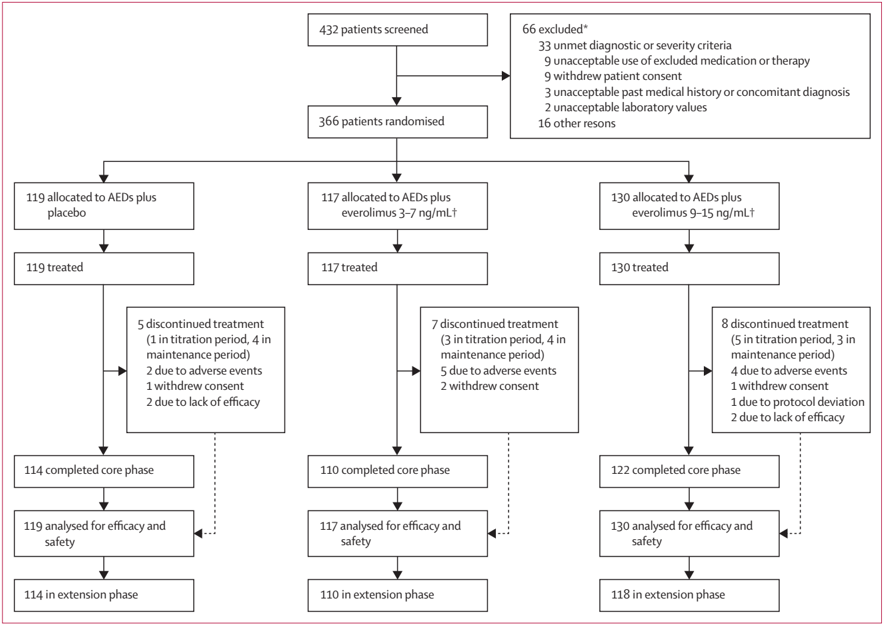
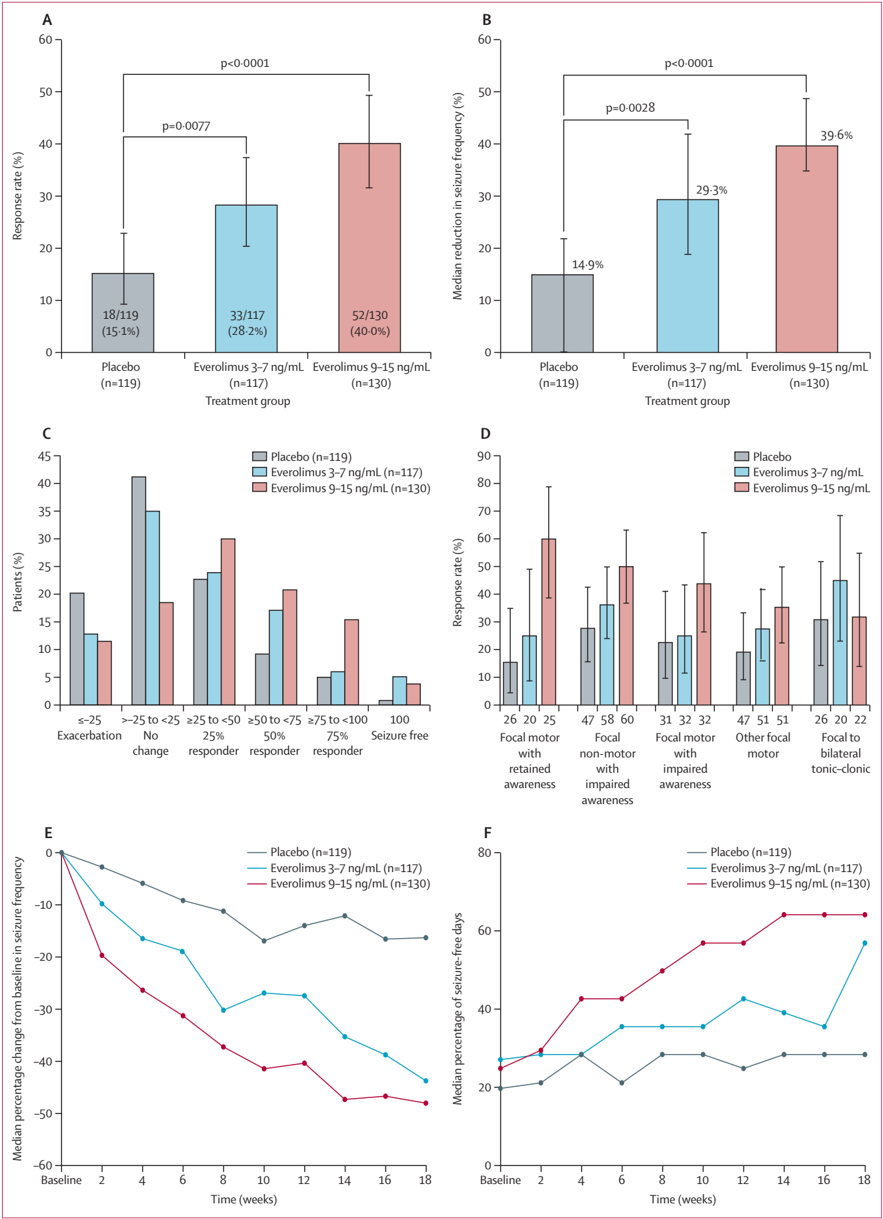
BACKGROUND: Everolimus, a mammalian target of rapamycin (mTOR) inhibitor, has been used for various benign tumours associated with tuberous sclerosis complex. We assessed the efficacy and safety of two trough exposure concentrations of everolimus, 3-7 ng/mL (low exposure) and 9-15 ng/mL (high exposure), compared with placebo as adjunctive therapy for treatment-resistant focal-onset seizures in tuberous sclerosis complex. METHODS: In this phase 3, randomised, double-blind, placebo-controlled study, eligible patients aged 2-65 years with tuberous sclerosis complex and treatment-resistant seizures (≥16 in an 8-week baseline phase) receiving one to three concomitant antiepileptic drugs were recruited from 99 centres across 25 countries. Participants were randomly assigned (1:1:1), via permuted-block randomisation (block size of six) implemented by Interactive Response Technology software, to receive placebo, low-exposure everolimus, or high-exposure everolimus. Randomisation was stratified by age subgroup (<6 years, 6 to <12 years, 12 to <18 years, and ≥18 years). Patients, investigators, site personnel, and the sponsor's study team were masked to treatment allocation. The starting dose of everolimus depended on age, body-surface area, and concomitant use of cytochrome 3A4/P-glycoprotein inducers. Dose adjustments were done to attain target trough ranges during a 6-week titration period, and as needed during a 12-week maintenance period of core phase. Patients or their caregivers recorded events in a seizure diary throughout the study. The primary endpoint was change from baseline in the frequency of seizures during the maintenance period, defined as response rate (the proportion of patients achieving ≥50% reduction in seizure frequency) and median percentage reduction in seizure frequency, in all randomised patients. This study is registered with ClinicalTrials.gov, number NCT01713946. FINDINGS: Between July 3, 2013, and May 29, 2015, 366 patients were enrolled and randomly assigned to placebo (n=119), low-exposure everolimus, (n=117), or high-exposure everolimus (n=130). The response rate was 15·1% with placebo (95% CI 9·2-22·8; 18 patients) compared with 28·2% for low-exposure everolimus (95% CI 20·3-37·3; 33 patients; p=0·0077) and 40·0% for high-exposure everolimus (95% CI 31·5-49·0; 52 patients; p<0·0001). The median percentage reduction in seizure frequency was 14·9% (95% CI 0·1-21·7) with placebo versus 29·3% with low-exposure everolimus (95% CI 18·8-41·9; p=0·0028) and 39·6% with high-exposure everolimus (95% CI 35·0-48·7; p<0·0001). Grade 3 or 4 adverse events occurred in 13 (11%) patients in the placebo group, 21 (18%) in the low-exposure group, and 31 (24%) in the high-exposure group. Serious adverse events were reported in three (3%) patients who received placebo, 16 (14%) who received low-exposure everolimus, and 18 (14%) who received high-exposure everolimus. Adverse events led to treatment discontinuation in two (2%) patients in the placebo group versus six (5%) in the low-exposure group and four (3%) in the high-exposure group. INTERPRETATION: Adjunctive everolimus treatment significantly reduced seizure frequency with a tolerable safety profile compared with placebo in patients with tuberous sclerosis complex and treatment-resistant seizures. FUNDING: Novartis Pharmaceuticals Corporation.
Overview
The claims and statistics of this paper haven’t been checked yet.
Free: it reads the open-access text and checks the first 5 claims that cite a source we can check. Create a free account to check every claim.
Integrity signals
Registry
Cites
Statistics
Figures
Verification
Claims the paper makes
The claims and statistics of this paper haven’t been checked yet.
Free: it reads the open-access text and checks the first 5 claims that cite a source we can check. Create a free account to check every claim.
Claims other papers make about this one
Each is checked against this paper’s own text: does it say what the citing paper says it does?
The source backs part of the claim, not all of it — or backs it for a different population, condition or comparison.
In the citing paper
“mTOR pathway inhibitors, including everolimus and sirolimus may be beneficial as a targeted treatment 131 .”
From Developmental and epileptic encephalopathies (2024) · cites this paper as [131]
Experimental — accuracy not yet measuredThe source backs part of the claim, not all of it — or backs it for a different population, condition or comparison.
In the citing paper
“One example is the EXIST-3 RCT in which the mTOR inhibitor everolimus was trialled in patients with drug-resistant focal seizures in the setting of tuberous sclerosis complex, due to pathogenic variants in the mTOR pathway genes, TSC1 or TSC2.”
From Developmental and epileptic encephalopathies (2024) · cites this paper as [131]
Experimental — accuracy not yet measuredThe cited source says what the claim attributes to it.
In the citing paper
“In this RCT, responder rates were greater with higher-dose everolimus than with placebo; however, they were perhaps less compelling than one might expect for a precision therapy (40% vs 15.1%, p<0.0001) 131 .”
From Developmental and epileptic encephalopathies (2024) · cites this paper as [131]
The cited source says what the claim attributes to it.
In the citing paper
“Effects on cognition and other neuropsychiatric symptoms were not reported.”
From Developmental and epileptic encephalopathies (2024) · cites this paper as [131]
In the citing paper
“Subsequently, inhibitors of mTOR have been proposed as treatments for such syndromes and one drug Everolimus has been approved for treatment of seizures in tuberous sclerosis (French et al., 2016).”
From Getting to the cores of autism (2019) · cites this paper as French et al., 2016
Self-check
Percentages, sums and reported differences re-computed from the paper’s own numbers.
The self-check needs the paper’s full text.
Citations
Cites
Kwan, P., Schachter, S. C., & Brodie, M. J. (2011) · New England Journal of Medicine · doi:10.1056/nejmra1004418 · Cited by 1,052
Everolimus for Subependymal Giant-Cell Astrocytomas in Tuberous Sclerosis
Krueger, D. A., Care, M. M., Holland, K., Agricola, K., Tudor, C., Mangeshkar, P., Wilson, K. A., Byars, A., Sahmoud, T., & Franz, D. N. (2010) · New England Journal of Medicine · doi:10.1056/nejmoa1001671 · Cited by 1,006
Self-citationBissler, J. J., Kingswood, J. C., Radzikowska, E., Zonnenberg, B. A., Frost, M., Belousova, E., Sauter, M., Nonomura, N., Brakemeier, S., de Vries, P. J., et al. (2013) · The Lancet · doi:10.1016/s0140-6736(12)61767-x · Cited by 880
Franz, D. N., Belousova, E., Sparagana, S., Bebin, E. M., Frost, M., Kuperman, R., Witt, O., Kohrman, M. H., Flamini, J. R., Wu, J. Y., et al. (2013) · The Lancet · doi:10.1016/s0140-6736(12)61134-9 · Cited by 794
Self-citationArroyo, S., Rumià, J., Martínez, I., & Ribalta, T. (1998) · PubMed · Cited by 652
Rapamycin prevents epilepsy in a mouse model of tuberous sclerosis complex.
Zeng, L., Xu, L., Gutmann, D. H., & Wong, M. (2008) · Annals of Neurology · doi:10.1002/ana.21331 · Cited by 639
The natural history of epilepsy in tuberous sclerosis complex
Chu‐Shore, C. J., Major, P., Camposano, S., Muzykewicz, D., & Thiele, E. A. (2010) · Epilepsia · doi:10.1111/j.1528-1167.2009.02474.x · Cited by 637
Neurological and neuropsychiatric aspects of tuberous sclerosis complex
Curatolo, P., Moavero, R., & de Vries, P. J. (2015) · The Lancet Neurology · doi:10.1016/s1474-4422(15)00069-1 · Cited by 600
Self-citationMeikle, L., Pollizzi, K., Egnor, A., Kramvis, I., Lane, H., Sahin, M., & Kwiatkowski, D. J. (2008) · The Journal of Neuroscience · doi:10.1523/jneurosci.0955-08.2008 · Cited by 501
Efficacy and Safety of Oral Lacosamide as Adjunctive Therapy in Adults with Partial‐Onset Seizures
Ben‐Menachem, E., Biton, V., Jatuzis, D., Abou‐Khalil, B., Doty, P., & Rudd, G. D. (2007) · Epilepsia · doi:10.1111/j.1528-1167.2007.01188.x · Cited by 485
Research works printed but not linked: 1
- 20. European Medicines Agency. Guideline on clinical investigation of medicinal products in the treatment of epileptic disorders. July 22, 2010. CHMP/EWP/566/98 Rev.2/Corr. http:// wwwemaeuropaeu/docs/en_GB/document_library/Scientifi c_ guideline/2010/01/WC500070043pdf (accessed July 8, 2016).
Cited by
Items 101–200 of 796
Applying the Lessons of Tuberous Sclerosis: The 2015 Hower Award Lecture
Roach, E. S. (2016) · Pediatric Neurology · doi:10.1016/j.pediatrneurol.2016.07.003 · Cited by 65
Mei, D., Parrini, E., Marini, C., & Guerrini, R. (2017) · Molecular Diagnosis & Therapy · doi:10.1007/s40291-017-0257-0 · Cited by 64
Hasbani, D. M., & Crino, P. B. (2018) · Handbook of clinical neurology · doi:10.1016/b978-0-444-64076-5.00052-1 · Cited by 66
Filamin A inhibition reduces seizure activity in a mouse model of focal cortical malformations
Zhang, L., Huang, T., Teaw, S., Nguyen, L. H., Hsieh, L. S., Gong, X., Burns, L. H., & Bordey, A. (2020) · Science Translational Medicine · doi:10.1126/scitranslmed.aay0289 · Cited by 56
DEPDC5-related epilepsy: A comprehensive review
Samanta, D. (2022) · Epilepsy & Behavior · doi:10.1016/j.yebeh.2022.108678 · Cited by 64
Samueli, S., Abraham, K., Dressler, A., Gröppel, G., Mühlebner-Fahrngruber, A., Scholl, T., Kasprian, G., Laccone, F., & Feucht, M. (2016) · Orphanet Journal of Rare Diseases · doi:10.1186/s13023-016-0530-z · Cited by 59
“The percentage of adverse events in our study was comparable to previous studies [17, 18, 23, 32]; Grade I adverse events occurred in 93 %, the most common reported AE was stomatitis.”
BackgroundResultSpecchio, N., Nabbout, R., Aronica, E., Auvin, S., Benvenuto, A., de Palma, L., Feucht, M., Jansen, F., Kotulska, K., Sarnat, H., et al. (2023) · European Journal of Paediatric Neurology · doi:10.1016/j.ejpn.2023.08.005 · Cited by 58
Self-citationWhy we urgently need improved seizure and epilepsy therapies for children and neonates
Pressler, R., & Lagae, L. G. (2019) · Neuropharmacology · doi:10.1016/j.neuropharm.2019.107854 · Cited by 59
Wong, M. (2019) · Journal of Neurodevelopmental Disorders · doi:10.1186/s11689-019-9289-6 · Cited by 63
Benson, K. A., White, M., Allen, N. M., Byrne, S., Carton, R., Comerford, E., Costello, D. J., Doherty, C. P., Dunleavey, B., Naggar, H. E., et al. (2020) · European Journal of Human Genetics · doi:10.1038/s41431-020-0610-3 · Cited by 60
“The patient with the TSC1 variant may be suitable for treatment with evorolimus, an mTOR inhibitor originally developed as a cancer drug shown to improve seizures in patients with tuberous sclerosis [37, 38].”
BackgroundFrom next-generation sequencing to targeted treatment of non-acquired epilepsies
Møller, R. S., Hammer, T. B., Rubboli, G., Lemke, J. R., & Johannesen, K. M. (2019) · Expert Review of Molecular Diagnostics · doi:10.1080/14737159.2019.1573144 · Cited by 53
“A recent trial showed that everolimus, an mTOR inhibitor, is efficient in treating the epilepsy in TS[153].”
BackgroundEctopic HCN4 expression drives mTOR-dependent epilepsy in mice
Hsieh, L. S., Wen, J. H., Nguyen, L. H., Zhang, L., Getz, S. A., Torres-Reveron, J., Wang, Y., Spencer, D. D., & Bordey, A. (2020) · Science Translational Medicine · doi:10.1126/scitranslmed.abc1492 · Cited by 57
Clinical Characteristics of Subependymal Giant Cell Astrocytoma in Tuberous Sclerosis Complex
Jansen, A., Belousova, E., Benedik, M. P., Carter, T., Cottin, V., Curatolo, P., Dahlin, M. G., D’Amato, L., d’Augères, G. B., de Vries, P. J., et al. (2019) · Frontiers in Neurology · doi:10.3389/fneur.2019.00705 · Cited by 58
Self-citationSchubert‐Bast, S., & Strzelczyk, A. (2021) · Therapeutic Advances in Neurological Disorders · doi:10.1177/17562864211031100 · Cited by 58
The UK guidelines for management and surveillance of Tuberous Sclerosis Complex
Amin, S., Kingswood, J. C., Bolton, P., Elmslie, F., Gale, D. P., Harland, C. C., Johnson, S. R., Parker, A. P. J., Sampson, J. R., Smeaton, M., et al. (2018) · QJM · doi:10.1093/qjmed/hcy215 · Cited by 55
An update on the central nervous system manifestations of tuberous sclerosis complex
Cotter, J. A. (2019) · Acta Neuropathologica · doi:10.1007/s00401-019-02003-1 · Cited by 56
Yuskaitis, C. J., Rossitto, L.-A. M., Gurnani, S. D., Bainbridge, E., Poduri, A., & Şahin, M. (2019) · Human Molecular Genetics · doi:10.1093/hmg/ddz123 · Cited by 54
Réthelyi, J., Vincze, K., Schall, D., Glennon, J. C., & Berkel, S. (2023) · Neuroscience & Biobehavioral Reviews · doi:10.1016/j.neubiorev.2023.105330 · Cited by 55
Everolimus dosing recommendations for tuberous sclerosis complex–associated refractory seizures
Franz, D. N., Lawson, J. A., Yapici, Z., Brandt, C., Kohrman, M. H., Wong, M., Milh, M., Wiemer‐Kruel, A., Voi, M., Coello, N., et al. (2018) · Epilepsia · doi:10.1111/epi.14085 · Cited by 52
Self-citationEverolimus as adjunctive therapy for tuberous sclerosis complex-associated partial-onset seizures
Lechuga, L., & Franz, D. N. (2019) · Expert Review of Neurotherapeutics · doi:10.1080/14737175.2019.1635457 · Cited by 54
“0019) reduction in seizure frequency [15,17].”
BackgroundMethodSelf-citationPredictors of Drug-Resistant Epilepsy in Tuberous Sclerosis Complex
Jeong, A., Nakagawa, J. A., & Wong, M. (2017) · Journal of Child Neurology · doi:10.1177/0883073817737446 · Cited by 52
“Washington, DC (William McClintock, MD); (6) The University of Chicago, Chicago, IL (Michael Kohrman, MD, 2007-2016; Patricia Ogden, APN, FNP, NP-C); (7) UCSF Benioff Children’s Hospital Oakland, Oakland, CA (Candida Brown, MD, 2007-2010; Rachel Kuperman, MD); (8) University of California Los Angeles, Los Angeles, CA…”
BackgroundCentral nervous system manifestations of tuberous sclerosis complex
Lu, D. S., Karas, P. J., Krueger, D. A., & Weiner, H. L. (2018) · American Journal of Medical Genetics Part C Seminars in Medical Genetics · doi:10.1002/ajmg.c.31647 · Cited by 60
“Subsequent prospective clinical trials have shown reduction in SEGA volumes and improvement in seizure control, either alone or in conjunction with operative intervention (Cardamone et al., 2014; Franz et al., 2013; French et al., 2016; Krueger et al., 2010; Krueger et al., 2016; Overwater et al., 2016).”
BackgroundWu, J. Y., Cock, H. R., Devinsky, O., Joshi, C., Miller, I., Roberts, C. M., Sánchez-Carpintero, R., Checketts, D., & Sahebkar, F. (2022) · Epilepsia · doi:10.1111/epi.17199 · Cited by 54
“Number of TSC- associated seizures during the 28day baseline period, median (Q1, Q3)b 54 (26, 102) 56 (21, 101) 61 (36, 117)”
Novel therapies for epilepsy in the pipeline
Mesraoua, B., Deleu, D., Kullmann, D. M., Shetty, A. K., Boon, P., Perucca, E., Mikati, M. A., & Asadi‐Pooya, A. A. (2019) · Epilepsy & Behavior · doi:10.1016/j.yebeh.2019.04.042 · Cited by 55
“At least in the case of everolimus for focal epilepsy associated with TSC, efficacy has been clearly demonstrated in a doubleblind parallel-group adjunctive-therapy randomized controlled trial in which exposure to trough everolimus concentrations of 3–7 ng/mL (low exposure, n = 117) and 9–15 ng/mL (high exposure, n =…”
BackgroundInfluentialLandmark, C. J., Potschka, H., Auvin, S., Wilmshurst, J. M., Johannessen, S. I., Trenité, D. G. A. K.-N., & Wirrell, E. C. (2021) · Epilepsia · doi:10.1111/epi.16849 · Cited by 51
Real-life survey of pitfalls and successes of precision medicine in genetic epilepsies
Balestrini, S., Chiarello, D., Gogou, M., Silvennoinen, K., Puvirajasinghe, C., Jones, W. D., Reif, P., Klein, K. M., Rosenow, F., Weber, Y. G., et al. (2021) · Journal of Neurology, Neurosurgery & Psychiatry · doi:10.1136/jnnp-2020-325932 · Cited by 49
Auvin, S., Galanopoulou, A. S., Moshé, S. L., Potschka, H., Rocha, L., Walker, M. C., & the TASK1 workgroup on drug‐resistant epilepsy of the ILAE/AES Joint Translational Task Force (2023) · Epilepsia · doi:10.1111/epi.17751 · Cited by 55
“48,50 In-deed, in humans, it is not usually possible to confirm in vivo target modification.”
BackgroundLieberman, O. J., Cartocci, V., Pigulevskiy, I., Molinari, M., Carbonell, J., Broseta, M. B., Post, M. R., Sulzer, D., Borgkvist, A., & Santini, E. (2020) · Frontiers in Cellular Neuroscience · doi:10.3389/fncel.2020.00070 · Cited by 50
Zimmer, T. S., Broekaart, D. W. M., Gruber, V.-E., van Vliet, E. A., Mühlebner, A., & Aronica, E. (2020) · Frontiers in Neurology · doi:10.3389/fneur.2020.01028 · Cited by 48
“Characteristic lesions in the brain are cortical tubers and ventricular subependymal nodules, which may progress into subependymal giant cell astrocytomas (SEGAs) (2–4).”
Mills, J. D., van Vliet, E. A., Chen, B. J., Janitz, M., Anink, J. J., Baayen, J. C., Idema, S., Devore, S., Friedman, D., Diehl, B., et al. (2020) · Neurobiology of Disease · doi:10.1016/j.nbd.2019.104612 · Cited by 48
“, 2012), and the mTOR inhibitor everolimus is currently used in the clinic as adjunctive therapy for patients with tuberous sclerosis complex (Franz et al., 2018; French et al., 2016).”
Surgery for drug‐resistant tuberous sclerosis complex‐associated epilepsy: who, when, and what
Specchio, N., Pepi, C., Palma, L. D., Moavero, R., BENEDICTIS, A. D., Marras, C. E., Vigevano, F., & Curatolo, P. (2021) · Epileptic Disorders · doi:10.1684/epd.2021.1253 · Cited by 49
Self-citationCurrent concepts on epilepsy management in tuberous sclerosis complex
Canevini, M., Kotulska-Jóźwiak, K., Curatolo, P., Briola, F. L., Peron, A., Słowińska, M., Strzelecka, J., Vignoli, A., & Jóżwiak, S. (2018) · American Journal of Medical Genetics. Part C, Seminars in Medical Genetics · doi:10.1002/ajmg.c.31652 · Cited by 42
“…placebo-controlled study aiming at assessing the effect of Everolimus on seizure frequency in TSC patients with drug-resistant epilepsy (EXIST-3) documented a positive antiepileptic effect of Everolimus as additional antiepileptic therapy with tolerable safety profile (French et al., 2016).”
BackgroundSelf-citationEpilepsy: key experimental therapeutics in early clinical development
Steriade, C., French, J. A., & Devinsky, O. (2020) · Expert Opinion on Investigational Drugs · doi:10.1080/13543784.2020.1743678 · Cited by 48
“cebo-controlled trial enrolling TSC subjects demonstrated the efficacy of everolimus in reducing seizure frequency [82].”
BackgroundSelf-citationSirolimus for epileptic seizures associated with focal cortical dysplasia type II
Kato, M., Kada, A., Shiraishi, H., Tohyama, J., Nakagawa, E., Takahashi, Y., Akiyama, T., Kakita, A., Miyake, N., Fujita, A., et al. (2022) · Annals of Clinical and Translational Neurology · doi:10.1002/acn3.51505 · Cited by 41
“%) was comparable to that of everolimus, another mTOR inhibitor, for treatment-resistant seizures in patients with TSC.22 The average trough level of sirolimus was relatively lower than the anticipated value during the maintenance therapy period.”
ResultSchubert‐Bast, S., Rosenow, F., Klein, K. M., Reif, P. S., Kieslich, M., & Strzelczyk, A. (2018) · Epilepsy & Behavior · doi:10.1016/j.yebeh.2018.05.039 · Cited by 47
Effects of antiepileptic drugs in a new TSC/mTOR‐dependent epilepsy mouse model
Koene, L. M. C., van Grondelle, S. E., Onori, M. P., Wallaard, I., Kooijman, N. H. R. M., van Oort, A., Schreiber, J., & Elgersma, Y. (2019) · Annals of Clinical and Translational Neurology · doi:10.1002/acn3.50829 · Cited by 47
Franz, D. N., Lawson, J. A., Yapıcı, Z., Ikeda, H., Polster, T., Nabbout, R., Curatolo, P., de Vries, P. J., Dlugos, D., Herbst, F., et al. (2021) · Epilepsia · doi:10.1111/epi.17099 · Cited by 51
Self-citationLee, W. S., Baldassari, S., Stephenson, S. E. M., Lockhart, P. J., Baulac, S., & Leventer, R. J. (2022) · International Journal of Molecular Sciences · doi:10.3390/ijms23031344 · Cited by 45
Cai, Y., Guo, H., Wang, W., Li, H., Sun, H., Shi, B., & Zhang, Y. (2018) · Orphanet Journal of Rare Diseases · doi:10.1186/s13023-018-0781-y · Cited by 45
“Randomized clinical trials support the use of everolimus, an inhibitor of the mammalian target of rapamycin, in the treatment of subependymal giant cell astrocytomas (SEGA), RAML and seizure related to TSC in western populations [8, 14, 15].”
MethodDermatological manifestations of tuberous sclerosis complex (TSC)
Ebrahimi‐Fakhari, D., Meyer, S., VOGT, T. M., Pföhler, C., & Müller, F. M. (2017) · JDDG Journal der Deutschen Dermatologischen Gesellschaft · doi:10.1111/ddg.13264 · Cited by 53
Gunasekera, C. L., Sirven, J. I., & Feyissa, A. M. (2023) · Journal of Central Nervous System Disease · doi:10.1177/11795735231209209 · Cited by 48
He, W., Chen, J., Wang, Y., Zhang, M., Qian-Lu, Wang, Q., Luo, X., Chen, X.-Q., & Zou, L. (2020) · Seizure · doi:10.1016/j.seizure.2020.03.018 · Cited by 44
Antiepileptogenesis and disease modification: Clinical and regulatory issues
French, J. A., Bebin, M., Dichter, M. A., Engel, J., Hartman, A. L., Jóźwiak, S., Klein, P., McNamara, J., Twyman, R. E., & Vespa, P. M. (2021) · Epilepsia Open · doi:10.1002/epi4.12526 · Cited by 43
Self-citationDeSpenza, T., Carlson, M., Panchagnula, S., Robert, S. M., Duy, P. Q., Mermin‐Bunnell, K., Reeves, B. C., Kundishora, A. J., Elsamadicy, A. A., Smith, H. L., et al. (2021) · Trends in Neurosciences · doi:10.1016/j.tins.2021.08.007 · Cited by 43
Rapamycin for longevity: the pros, the cons, and future perspectives
Roark, K. M., & Iffland, P. H. (2025) · Frontiers in Aging · doi:10.3389/fragi.2025.1628187 · Cited by 44
Willems, L. M., Hamer, H. M., Knake, S., Rosenow, F., Reese, J., & Strzelczyk, A. (2019) · Applied Health Economics and Health Policy · doi:10.1007/s40258-019-00487-2 · Cited by 41
Effects of Mutations in TSC Genes on Neurodevelopment and Synaptic Transmission
Bassetti, D., Luhmann, H. J., & Kirischuk, S. (2021) · International Journal of Molecular Sciences · doi:10.3390/ijms22147273 · Cited by 45
“For example, at dosages of 9–15 ng/mL led to a reduction of circa 20% in median change in seizure frequency as compared to baseline levels after 2 weeks, with further improvements over time (up to ca 50%) [116].”
BackgroundRaptor downregulation rescues neuronal phenotypes in mouse models of Tuberous Sclerosis Complex
Karalis, V., Caval-Holme, F., & Bateup, H. S. (2022) · Nature Communications · doi:10.1038/s41467-022-31961-6 · Cited by 40
Welin, K.-O., Carlqvist, P., Svensson, A. E., Althin, R., Eklund, E. A., & Rask, O. (2017) · Seizure · doi:10.1016/j.seizure.2017.10.005 · Cited by 42
“Recent evidence supports mTOR-inhibitors as adjunctive treatment to AEDs for treating epilepsy in TSC patients [13].”
Cavalheiro, S., da Costa, M. D. S., & Richtmann, R. (2021) · Child s Nervous System · doi:10.1007/s00381-021-05218-4 · Cited by 40
Precision Therapy for Epilepsy Related to Brain Malformations
D’Gama, A. M., & Poduri, A. (2021) · Neurotherapeutics · doi:10.1007/s13311-021-01122-6 · Cited by 40
“The double-blind, placebo-controlled, phase III EXIST-3 clinical trial (NCT01713946) assessed the efficacy and safety of low and high trough exposure concentrations of adjunctive everolimus compared with placebo for 366 patients aged 2–65 years with refractory focal seizures related to TSC [68].”
MethodCockerell, I., Christensen, J., Hoei‐Hansen, C. E., Holst, L., Frederiksen, M. G., Issa-Epe, A. I., Nedregaard, B., Solhoff, R., Heimdal, K., Landmark, C. J., et al. (2023) · Orphanet Journal of Rare Diseases · doi:10.1186/s13023-023-02982-1 · Cited by 40
“This proportion is similar to the patients treated with a low dose of everolimus in EXIST-3 [24], and similar to another randomised, placebo-controlled trial [48].”
BackgroundResultInfluentialSafety and tolerability profile of new antiepileptic drug treatment in children with epilepsy
Moavero, R., Pisani, L. R., Pisani, F., & Curatolo, P. (2018) · Expert Opinion on Drug Safety · doi:10.1080/14740338.2018.1518427 · Cited by 40
“high-exposure EVR groups, respectively [162].”
MethodSelf-citationResective surgery in tuberous Sclerosis complex, from Penfield to 2018: A critical review
Ostrowsky‐Coste, K., Neal, A. J., Guénot, M., Ryvlin, P., Bouvard, S., Bourdillon, P., Jung, J., Catenoix, H., Montavont, A., Isnard, J., et al. (2019) · Revue Neurologique · doi:10.1016/j.neurol.2018.11.002 · Cited by 41
Current and Emerging Precision Therapies for Developmental and Epileptic Encephalopathies
Samanta, D., Bhatia, S., Hunter, S. E., Rao, C. K., Xiong, K., Karakas, C., Reeders, P. C., Erdemir, G., Sattar, S., Axeen, E. T., et al. (2025) · Pediatric Neurology · doi:10.1016/j.pediatrneurol.2025.04.010 · Cited by 39
Innovative Study Designs Optimizing Clinical Pharmacology Research in Infants and Children
Balevic, S. J., & Cohen‐Wolkowiez, M. (2018) · The Journal of Clinical Pharmacology · doi:10.1002/jcph.1053 · Cited by 39
The metformin in tuberous sclerosis (MiTS) study: A randomised double-blind placebo-controlled trial
Amin, S., Mallick, A. A., Edwards, H. B., Cortina‐Borja, M., Laugharne, M. J., Likeman, M. J., & O'Callaghan, F. J. (2021) · EClinicalMedicine · doi:10.1016/j.eclinm.2020.100715 · Cited by 41
“The EXIST-3 trial has shown that everolimus therapy reduces seizure frequency in patients with TSC and treatment-resistant focal seizures and that it has a tolerable safety profile [11].”
BackgroundGenome sequencing of 320 Chinese children with epilepsy: a clinical and molecular study
Zou, D., Wang, L., Liao, J., Xiao, H., Duan, J., Zhang, T., Li, J., Yin, Z., Zhou, J., Yan, H., et al. (2021) · Brain · doi:10.1093/brain/awab233 · Cited by 41
Brain Symptoms of Tuberous Sclerosis Complex: Pathogenesis and Treatment
Mizuguchi, M., Ohsawa, M., Kashii, H., & Sato, A. (2021) · International Journal of Molecular Sciences · doi:10.3390/ijms22136677 · Cited by 42
“Furthermore, clinical studies have recently shown that mTOR inhibitors are effective not only for tumors, phenotypes predominantly resulting from the second hit, but also for brain dysfunction (epilepsy) caused by a combination of the first and second hits [27].”
BackgroundInfluentialA Review of Targeted Therapies for Monogenic Epilepsy Syndromes
Zimmern, V., Minassian, B. A., & Korff, C. M. (2022) · Frontiers in Neurology · doi:10.3389/fneur.2022.829116 · Cited by 39
Srivastava, S., Jo, B., Zhang, B., Frazier, T. W., Gallagher, A. S., Peck, F. C., Levin, A. R., Mondal, S., Li, Z., Filip‐Dhima, R., et al. (2022) · Human Molecular Genetics · doi:10.1093/hmg/ddac111 · Cited by 40
“Although everolimus (a sirolimus analog) has received Food and Drug Administration (FDA) approval for specific indications in tuberous sclerosis complex (TSC) (18), another disorder of mTOR overactivity, its safety and efficacy remains untested in PHTS.”
BackgroundInfluentialBlair, J. D., & Bateup, H. S. (2019) · Developmental Dynamics · doi:10.1002/dvdy.60 · Cited by 39
“tolerated and include infections due to immunosuppression and stomatitis.(6) Despite some success with rapalogues, there is still”
Scheldeman, C., Mills, J. D., Siekierska, A., Serra, I., Copmans, D., Iyer, A. M., Whalley, B. J., Maes, J., Jansen, A., Lagae, L. G., et al. (2017) · Neurobiology of Disease · doi:10.1016/j.nbd.2017.09.004 · Cited by 41
Xu, Q., Uliel‐Sibony, S., Dunham, C. P., Sarnat, H. B., Flores‐Sarnat, L., Brunga, L., Davidson, S., Lo, W. W., Shlien, A., Connolly, M. B., et al. (2018) · Journal of Child Neurology · doi:10.1177/0883073818813238 · Cited by 39
Bonazzi, S., Goold, C. P., Gray, A., Thomsen, N. M., Nunez, J., Karki, R., Gorde, A., Biag, J., Malik, H. A., Sun, Y., et al. (2020) · Journal of Medicinal Chemistry · doi:10.1021/acs.jmedchem.9b01398 · Cited by 32
Mechanistic Target of Rapamycin (mTOR) Inhibitors
Wang, D., & Eisen, H. J. (2021) · Handbook of experimental pharmacology · doi:10.1007/164_2021_553 · Cited by 41
Emerging drugs for focal epilepsy
Mula, M. (2018) · Expert Opinion on Emerging Drugs · doi:10.1080/14728214.2018.1527903 · Cited by 38
Modifying genetic epilepsies – Results from studies on tuberous sclerosis complex
Jóźwiak, S., Kotulska, K., Wong, M., & Bebin, M. (2019) · Neuropharmacology · doi:10.1016/j.neuropharm.2019.107908 · Cited by 44
Petrasek, T., Vojtechova, I., Klovrza, O., Tuckova, K., Vejmola, C., Rak, J., Sulakova, A., Kaping, D., Bernhardt, N., de Vries, P. J., et al. (2021) · Journal of Neurodevelopmental Disorders · doi:10.1186/s11689-021-09357-2 · Cited by 30
Tuberous sclerosis complex for the pulmonologist
Rebaine, Y., Nasser, M., Girerd, B., Leroux, C., & Cottin, V. (2021) · European Respiratory Review · doi:10.1183/16000617.0348-2020 · Cited by 38
Pathophysiology to Risk Factor and Therapeutics to Treatment Strategies on Epilepsy
Boleti, A. P. D. A., Cardoso, P. H. D. O., Frihling, B. E. F., de Moraes, L. F. R. N., Nunes, E. A. C., Mukoyama, L. T. H., Nunes, E. A. C., Carvalho, C. M. E., Macedo, M. L. R., & Migliolo, L. (2024) · Brain Sciences · doi:10.3390/brainsci14010071 · Cited by 42
“A total of 24.8% of the participants receiving the lowest dose, and 42% of participants in the highest dose group showed a 50% decrease in seizure frequency [116].”
BackgroundInfluentialMechanistic Target of Rapamycin Pathway in Epileptic Disorders
Kim, J., & Lee, J. H. (2019) · Journal of Korean Neurosurgical Society · doi:10.3340/jkns.2019.0027 · Cited by 39
Chronic activation of anti‐oxidant pathways and iron accumulation in epileptogenic malformations
Zimmer, T. S., Ciriminna, G., Arena, A., Anink, J. J., Korotkov, A., Jansen, F. E., van Hecke, W., Spliet, W. G., van Rijen, P. C., Baayen, J. C., et al. (2020) · Neuropathology and Applied Neurobiology · doi:10.1111/nan.12596 · Cited by 33
Zou, J., Zhang, B., Gutmann, D., & Wong, M. (2017) · Epilepsia · doi:10.1111/epi.13923 · Cited by 33
Personalized translational epilepsy research — Novel approaches and future perspectives
Rosenow, F., van Alphen, N., Becker, A. J., Chiocchetti, A. G., Deichmann, R., Deller, T., Freiman, T. M., Freitag, C. M., Gehrig, J., Hermsen, A., et al. (2017) · Epilepsy & Behavior · doi:10.1016/j.yebeh.2017.06.041 · Cited by 36
“The mTOR inhibitor everolimus inhibits the overactive mTOR pathway in tuberous sclerosis [5].”
BackgroundInfluentialde Vries, P. J., Franz, D. N., Curatolo, P., Nabbout, R., Neary, M. P., Herbst, F., Sully, K., Brohan, E., Bennett, B., & Lawson, J. A. (2018) · Frontiers in Pharmacology · doi:10.3389/fphar.2018.00964 · Cited by 36
Self-citationGitaí, D. L. G., de Andrade, T. G., dos Santos, Y. D. R., Attaluri, S., & Shetty, A. K. (2019) · Neuroscience & Biobehavioral Reviews · doi:10.1016/j.neubiorev.2019.01.004 · Cited by 37
Nabbout, R., Belousova, E., Benedik, M. P., Carter, T., Cottin, V., Curatolo, P., Dahlin, M. G., D’Amato, L., d’Augères, G. B., de Vries, P. J., et al. (2021) · Frontiers in Neurology · doi:10.3389/fneur.2021.697467 · Cited by 34
Self-citationHoltkamp, M., May, T. W., Berkenfeld, R., Bien, C. G., Coban, I., Knake, S., Michaelis, R., Rémi, J., Seeck, M., Surges, R., et al. (2024) · Clinical Epileptology · doi:10.1007/s10309-024-00663-y · Cited by 34
He, R., Xu, B., Li, P., & Lv, X. (2021) · European Journal of Medicinal Chemistry · doi:10.1016/j.ejmech.2021.113249 · Cited by 33
Neuropilin-1: A Key Protein to Consider in the Progression of Pediatric Brain Tumors
Douyère, M., Chastagner, P. B., & Boura, C. (2021) · Frontiers in Oncology · doi:10.3389/fonc.2021.665634 · Cited by 36
Akt Inhibitor Perifosine Prevents Epileptogenesis in a Rat Model of Temporal Lobe Epilepsy
Zhu, F., Kai, J.-J., Chen, L.-L., Wu, M.-L., Dong, J.-Y., Wang, Q., & Zeng, L.-H. (2017) · Neuroscience Bulletin · doi:10.1007/s12264-017-0165-7 · Cited by 29
mTORopathies: A Road Well-Traveled
Crino, P. B. (2020) · Epiliepsy currents/Epilepsy currents · doi:10.1177/1535759720959320 · Cited by 36
Theilmann, W., Gericke, B., Schidlitzki, A., Anjum, S. M. M., Borsdorf, S., Harries, T., Roberds, S. L., Aguiar, D. J., Brunner, D., Leiser, S. C., et al. (2020) · Neuropharmacology · doi:10.1016/j.neuropharm.2020.108297 · Cited by 32
Current and future pharmacotherapy options for drug-resistant epilepsy
Elkommos, S., & Mula, M. (2022) · Expert Opinion on Pharmacotherapy · doi:10.1080/14656566.2022.2128670 · Cited by 36
Tipton, A. E., Angel, Y. C. D., Hixson, K. M., Carlsen, J., Strode, D., Busquet, N., Mesches, M. H., González, M. I., Napoli, E., Russek, S. J., et al. (2023) · Annals of Neurology · doi:10.1002/ana.26644 · Cited by 34
Siroky, B. J., Towbin, A. J., Trout, A. T., Schäfer, H., Thamann, A., Agricola, K. D., Tudor, C., Capal, J. K., Dixon, B. P., Krueger, D. A., et al. (2017) · The Journal of Pediatrics · doi:10.1016/j.jpeds.2017.05.015 · Cited by 33
Self-citationSamueli, S., Dressler, A., Gröppel, G., Scholl, T. O., & Feucht, M. (2018) · Epilepsia · doi:10.1111/epi.14529 · Cited by 33
Modeling epileptic spasms during infancy: Are we heading for the treatment yet?
Velíšek, L., & Velíšková, J. (2020) · Pharmacology & Therapeutics · doi:10.1016/j.pharmthera.2020.107578 · Cited by 35
Precision Medicine Approaches for Infantile-Onset Developmental and Epileptic Encephalopathies
Myers, K. A., & Scheffer, I. E. (2021) · The Annual Review of Pharmacology and Toxicology · doi:10.1146/annurev-pharmtox-052120-084449 · Cited by 32
Zhang, B., Guo, D., Han, L., Rensing, N. R., Satoh, A., & Wong, M. (2019) · Neurobiology of Disease · doi:10.1016/j.nbd.2019.104615 · Cited by 30
Tuberous Sclerosis Complex (TSC): Expert Recommendations for Provision of Coordinated Care
Annear, N. M. P., Appleton, R. E., Bassi, Z., Bhatt, R. I., Bolton, P., Crawford, P. M., Crowe, A., Tossi, M., Elmslie, F., Finlay, E., et al. (2019) · Frontiers in Neurology · doi:10.3389/fneur.2019.01116 · Cited by 32
Stelmaszewski, E. V., Parente, D. B., Farina, A., Stein, A., Gutierrez, A., Raquelo‐Menegassio, A. F., Manterola, C., de Sousa, C. F., Victor, C. R., Maki, D., et al. (2020) · Cardiology in the Young · doi:10.1017/s1047951119003147 · Cited by 33
Singh, R., Sarangi, S. C., Singh, S., & Tripathi, M. (2022) · Seizure · doi:10.1016/j.seizure.2022.09.003 · Cited by 31
Mechanistic target of rapamycin signaling in human nervous system development and disease
Girodengo, M., Ultanir, S. K., & Bateman, J. E. (2022) · Frontiers in Molecular Neuroscience · doi:10.3389/fnmol.2022.1005631 · Cited by 34
“mTOR pathway inhibitor drugs are currently used to treat the neurological manifestations of TSC (French et al., 2016; Stockinger et al., 2021).”
BackgroundSteps to Improve Precision Medicine in Epilepsy
Balestrini, S., Mei, D., Sisodiya, S. M., & Guerrini, R. (2023) · Molecular Diagnosis & Therapy · doi:10.1007/s40291-023-00676-9 · Cited by 31
“Everolimus, an mTOR inhibitor, proved effective at reducing focal seizures, in a large-scale phase 3, randomised, double-blind, placebo-controlled trial in TSC [27].”
BackgroundLongitudinal Effects of Everolimus on White Matter Diffusion in Tuberous Sclerosis Complex
Peters, J. M., Prohl, A., Kapur, K., Nath, A., Scherrer, B., Clancy, S., Prabhu, S. P., Sahin, M., Franz, D. N., Warfield, S. K., et al. (2019) · Pediatric Neurology · doi:10.1016/j.pediatrneurol.2018.10.005 · Cited by 27
Self-citationMechanistic target of rapamycin (mTOR) signaling in status epilepticus
Crino, P. B. (2019) · Epilepsy & Behavior · doi:10.1016/j.yebeh.2019.106550 · Cited by 31
Borsari, C., Keles, E., Rageot, D., Treyer, A., Bohnacker, T., Bissegger, L., Pascale, M. D., Melone, A., SriRamaratnam, R., Beaufils, F., et al. (2020) · Journal of Medicinal Chemistry · doi:10.1021/acs.jmedchem.0c00620 · Cited by 22
Yuskaitis, C. J., Modasia, J. B., Schrötter, S., Rossitto, L.-A. M., Groff, K. J., Morici, C., Mithal, D. S., Chakrabarty, R. P., Chandel, N. S., Manning, B. D., et al. (2022) · Cell Reports · doi:10.1016/j.celrep.2022.111278 · Cited by 29
“We demonstrate that loss of the upstream regulators of mTOR (i.e., DEPDC5 and TSC2) leads to hyperactive mTORC1 in neurons, and a decrease in sensitivity to detect nutrient or growth factor withdrawal.”
Influential
Metadata
- Authors
- French, J. A., Lawson, J. A., Yapici, Z., Ikeda, H., Polster, T., Nabbout, R., Curatolo, P., de Vries, P. J., Dlugos, D. J., Berkowitz, N., Voi, M., Peyrard, S., Pelov, D., & Franz, D. N.
- Affiliations
- NYU Langone Health (US)
- Sydney Children's Hospital (AU)
- National Epilepsy Center (JP)
- Krankenhaus Mara (DE)
- Hôpital Necker-Enfants Malades (FR)
- Policlinico Tor Vergata (IT)
- Children's Hospital of Philadelphia (US)
- Cincinnati Children's Hospital Medical Center (US)
- Corresponding author
- French, Jacqueline A
- ORCID
- Venue
- The Lancet
- Publisher
- Elsevier BV
- Published
- 2016-10
- Volume
- 388
- Issue
- 10056
- Pages
- 2153-2163
- ISSN
- 0099-5355 (ISSN-L)
- 0140-6736
- OpenAlex
- W2511912940
- Cited by
- 764
- References
- 31
- Citations by year
- 2026: 55 · 2025: 75 · 2024: 57 · 2023: 78 · 2022: 76 · 2021: 97 · 2020: 108 · 2019: 73 · 2018: 65 · 2017: 69 · 2016: 10
- FWCI
- 58.25
- Type
- journal article
- Language
- en
- Open access
- hybrid
- doi.org
- Licence
- cc-by-nc-nd
- www.elsevier.com/tdm/userlicense/1.0/ (tdm)
- creativecommons.org/licenses/by-nc-nd/4.0/ (vor)
- Locations
- The Lancet (publishedVersion, cc-by-nc-nd)
- PubMed (publishedVersion)
- Cineca Institutional Research Information System (Tor Vergata University) (submittedVersion)
- INFM-OAR (INFN Catania) (submittedVersion, cc-by-nc-nd)
- Funders
- Novartis Pharmaceuticals Corporation
- Topics
- Health Sciences › Medicine › Genetics (clinical) › Tuberous Sclerosis Complex Research
- Health Sciences › Medicine › Clinical Neurology › Epilepsy research and treatment
- Health Sciences › Medicine › Pediatrics, Perinatology and Child Health › Pharmacological Effects and Toxicity Studies
- Keywords
- everolimus, tuberous sclerosis complex, focal seizures, drug-resistant epilepsy, adjunctive antiepileptic therapy, mTOR inhibitors, seizure frequency reduction, antiepileptic drug interactions, adverse events, pharmacovigilance
- MeSH terms
- Everolimus, Adolescent, Adult, Aged, Anticonvulsants, Antineoplastic Agents, Child, Child, Preschool, Combined Modality Therapy, Dose-Response Relationship, Drug, Double-Blind Method, Female, Humans, Male, Middle Aged, Seizures, Tuberous Sclerosis
About these checks
Registry, retraction, Cites and statistics results are computed, not judged, with one exception: a printed reference that no index lists is read once by a model before it counts as a citation error. Claims are extracted by a model and kept only when their quote appears verbatim in the text; each cited source is then checked, with a model’s help, for whether it says what the claim relies on. Those verdicts can be wrong — read the claim’s quote and the cited source before relying on one.
Statistics and arithmetic are recomputed, not judged.
Confidence bands are shown only for fields calibrated on our annotated test set. None is calibrated yet, so no band is shown.
What counts as a claim ›How we measure confidence ›How we check this ›
Are you an author, or do you see a problem with this page? Request a review
Data sources
Bibliographic data: Semantic Scholar, OpenAlex, Crossref.
Contains information from the Semantic Scholar Academic Graph Datasets, made available under the ODC Attribution License (ODC-BY 1.0).
Semantic Scholar’s data is described in: Kinney, R., et al. (2023). The Semantic Scholar Open Data Platform. arXiv:2301.10140.
