

Adjunctive everolimus therapy for treatment-resistant focal-onset seizures associated with tuberous sclerosis (EXIST-3): a phase 3, randomised, double-blind, placebo-controlled study
Open accessThe DOI matches its Crossref record; 31 of the 31 references it cites were found in a registry or an index.
Abstract
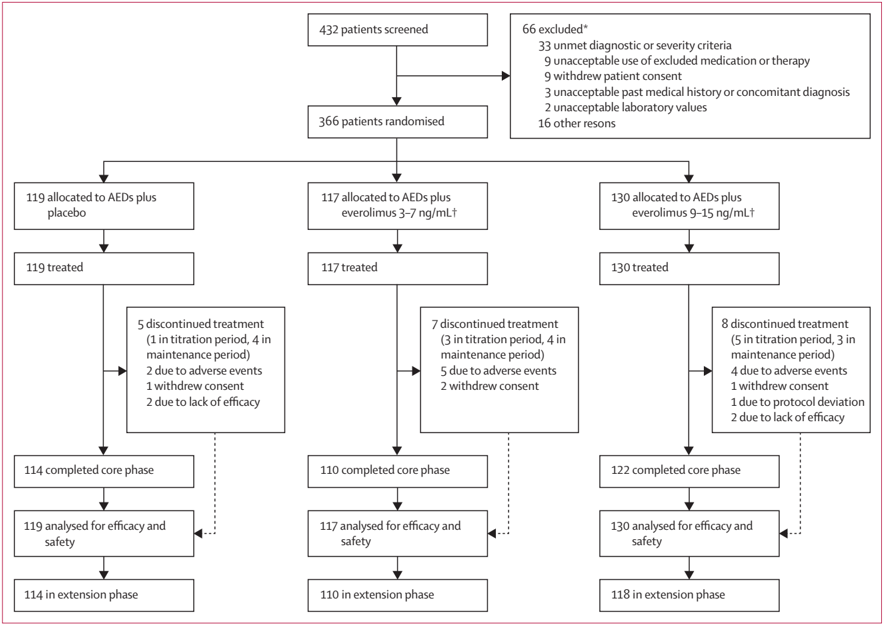
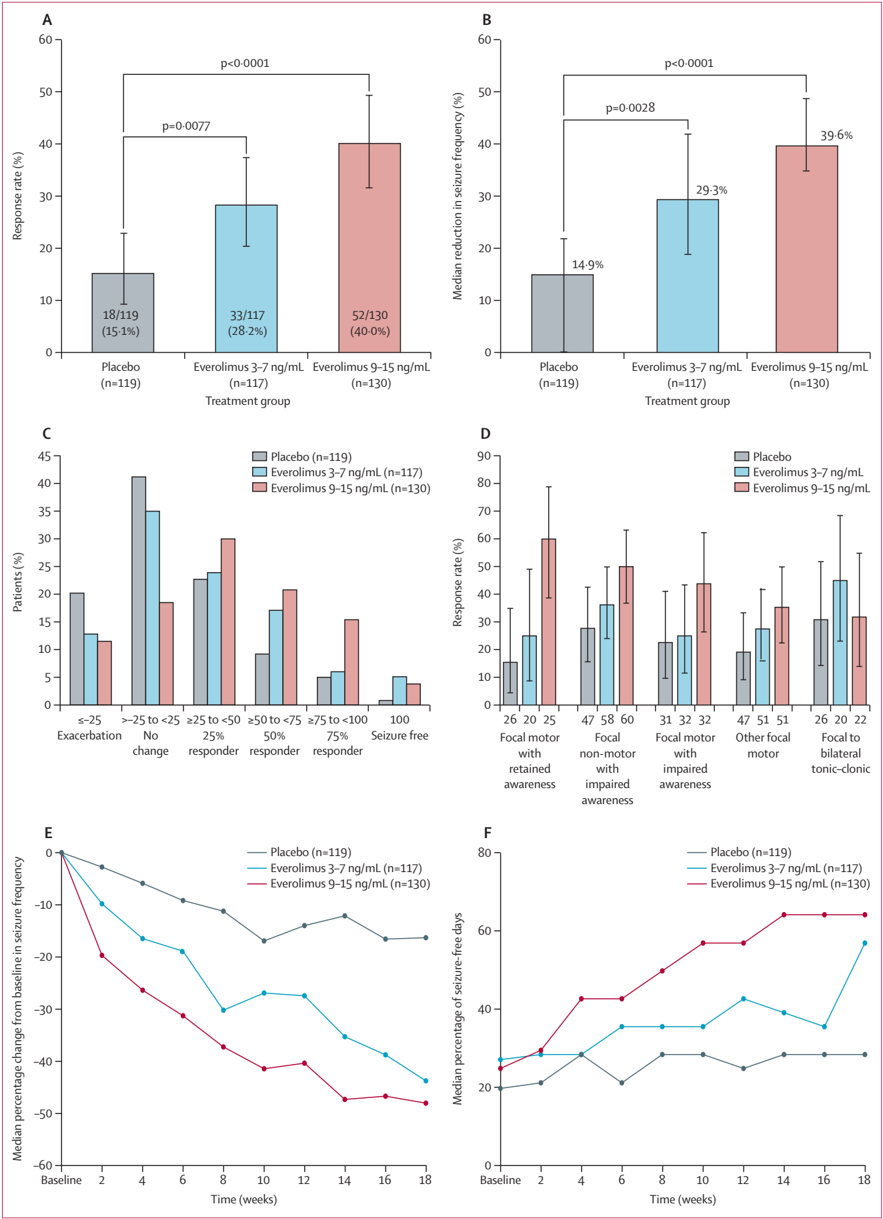
BACKGROUND: Everolimus, a mammalian target of rapamycin (mTOR) inhibitor, has been used for various benign tumours associated with tuberous sclerosis complex. We assessed the efficacy and safety of two trough exposure concentrations of everolimus, 3-7 ng/mL (low exposure) and 9-15 ng/mL (high exposure), compared with placebo as adjunctive therapy for treatment-resistant focal-onset seizures in tuberous sclerosis complex. METHODS: In this phase 3, randomised, double-blind, placebo-controlled study, eligible patients aged 2-65 years with tuberous sclerosis complex and treatment-resistant seizures (≥16 in an 8-week baseline phase) receiving one to three concomitant antiepileptic drugs were recruited from 99 centres across 25 countries. Participants were randomly assigned (1:1:1), via permuted-block randomisation (block size of six) implemented by Interactive Response Technology software, to receive placebo, low-exposure everolimus, or high-exposure everolimus. Randomisation was stratified by age subgroup (<6 years, 6 to <12 years, 12 to <18 years, and ≥18 years). Patients, investigators, site personnel, and the sponsor's study team were masked to treatment allocation. The starting dose of everolimus depended on age, body-surface area, and concomitant use of cytochrome 3A4/P-glycoprotein inducers. Dose adjustments were done to attain target trough ranges during a 6-week titration period, and as needed during a 12-week maintenance period of core phase. Patients or their caregivers recorded events in a seizure diary throughout the study. The primary endpoint was change from baseline in the frequency of seizures during the maintenance period, defined as response rate (the proportion of patients achieving ≥50% reduction in seizure frequency) and median percentage reduction in seizure frequency, in all randomised patients. This study is registered with ClinicalTrials.gov, number NCT01713946. FINDINGS: Between July 3, 2013, and May 29, 2015, 366 patients were enrolled and randomly assigned to placebo (n=119), low-exposure everolimus, (n=117), or high-exposure everolimus (n=130). The response rate was 15·1% with placebo (95% CI 9·2-22·8; 18 patients) compared with 28·2% for low-exposure everolimus (95% CI 20·3-37·3; 33 patients; p=0·0077) and 40·0% for high-exposure everolimus (95% CI 31·5-49·0; 52 patients; p<0·0001). The median percentage reduction in seizure frequency was 14·9% (95% CI 0·1-21·7) with placebo versus 29·3% with low-exposure everolimus (95% CI 18·8-41·9; p=0·0028) and 39·6% with high-exposure everolimus (95% CI 35·0-48·7; p<0·0001). Grade 3 or 4 adverse events occurred in 13 (11%) patients in the placebo group, 21 (18%) in the low-exposure group, and 31 (24%) in the high-exposure group. Serious adverse events were reported in three (3%) patients who received placebo, 16 (14%) who received low-exposure everolimus, and 18 (14%) who received high-exposure everolimus. Adverse events led to treatment discontinuation in two (2%) patients in the placebo group versus six (5%) in the low-exposure group and four (3%) in the high-exposure group. INTERPRETATION: Adjunctive everolimus treatment significantly reduced seizure frequency with a tolerable safety profile compared with placebo in patients with tuberous sclerosis complex and treatment-resistant seizures. FUNDING: Novartis Pharmaceuticals Corporation.
Overview
The claims and statistics of this paper haven’t been checked yet.
Free: it reads the open-access text and checks the first 5 claims that cite a source we can check. Create a free account to check every claim.
Integrity signals
Registry
Cites
Statistics
Figures
Verification
Claims the paper makes
The claims and statistics of this paper haven’t been checked yet.
Free: it reads the open-access text and checks the first 5 claims that cite a source we can check. Create a free account to check every claim.
Claims other papers make about this one
Each is checked against this paper’s own text: does it say what the citing paper says it does?
The source backs part of the claim, not all of it — or backs it for a different population, condition or comparison.
In the citing paper
“mTOR pathway inhibitors, including everolimus and sirolimus may be beneficial as a targeted treatment 131 .”
From Developmental and epileptic encephalopathies (2024) · cites this paper as [131]
Experimental — accuracy not yet measuredThe source backs part of the claim, not all of it — or backs it for a different population, condition or comparison.
In the citing paper
“One example is the EXIST-3 RCT in which the mTOR inhibitor everolimus was trialled in patients with drug-resistant focal seizures in the setting of tuberous sclerosis complex, due to pathogenic variants in the mTOR pathway genes, TSC1 or TSC2.”
From Developmental and epileptic encephalopathies (2024) · cites this paper as [131]
Experimental — accuracy not yet measuredThe cited source says what the claim attributes to it.
In the citing paper
“In this RCT, responder rates were greater with higher-dose everolimus than with placebo; however, they were perhaps less compelling than one might expect for a precision therapy (40% vs 15.1%, p<0.0001) 131 .”
From Developmental and epileptic encephalopathies (2024) · cites this paper as [131]
The cited source says what the claim attributes to it.
In the citing paper
“Effects on cognition and other neuropsychiatric symptoms were not reported.”
From Developmental and epileptic encephalopathies (2024) · cites this paper as [131]
In the citing paper
“Subsequently, inhibitors of mTOR have been proposed as treatments for such syndromes and one drug Everolimus has been approved for treatment of seizures in tuberous sclerosis (French et al., 2016).”
From Getting to the cores of autism (2019) · cites this paper as French et al., 2016
Self-check
Percentages, sums and reported differences re-computed from the paper’s own numbers.
The self-check needs the paper’s full text.
Citations
Cites
Kwan, P., Schachter, S. C., & Brodie, M. J. (2011) · New England Journal of Medicine · doi:10.1056/nejmra1004418 · Cited by 1,052
Everolimus for Subependymal Giant-Cell Astrocytomas in Tuberous Sclerosis
Krueger, D. A., Care, M. M., Holland, K., Agricola, K., Tudor, C., Mangeshkar, P., Wilson, K. A., Byars, A., Sahmoud, T., & Franz, D. N. (2010) · New England Journal of Medicine · doi:10.1056/nejmoa1001671 · Cited by 1,006
Self-citationBissler, J. J., Kingswood, J. C., Radzikowska, E., Zonnenberg, B. A., Frost, M., Belousova, E., Sauter, M., Nonomura, N., Brakemeier, S., de Vries, P. J., et al. (2013) · The Lancet · doi:10.1016/s0140-6736(12)61767-x · Cited by 880
Franz, D. N., Belousova, E., Sparagana, S., Bebin, E. M., Frost, M., Kuperman, R., Witt, O., Kohrman, M. H., Flamini, J. R., Wu, J. Y., et al. (2013) · The Lancet · doi:10.1016/s0140-6736(12)61134-9 · Cited by 794
Self-citationArroyo, S., Rumià, J., Martínez, I., & Ribalta, T. (1998) · PubMed · Cited by 652
Rapamycin prevents epilepsy in a mouse model of tuberous sclerosis complex.
Zeng, L., Xu, L., Gutmann, D. H., & Wong, M. (2008) · Annals of Neurology · doi:10.1002/ana.21331 · Cited by 639
The natural history of epilepsy in tuberous sclerosis complex
Chu‐Shore, C. J., Major, P., Camposano, S., Muzykewicz, D., & Thiele, E. A. (2010) · Epilepsia · doi:10.1111/j.1528-1167.2009.02474.x · Cited by 637
Neurological and neuropsychiatric aspects of tuberous sclerosis complex
Curatolo, P., Moavero, R., & de Vries, P. J. (2015) · The Lancet Neurology · doi:10.1016/s1474-4422(15)00069-1 · Cited by 600
Self-citationMeikle, L., Pollizzi, K., Egnor, A., Kramvis, I., Lane, H., Sahin, M., & Kwiatkowski, D. J. (2008) · The Journal of Neuroscience · doi:10.1523/jneurosci.0955-08.2008 · Cited by 501
Efficacy and Safety of Oral Lacosamide as Adjunctive Therapy in Adults with Partial‐Onset Seizures
Ben‐Menachem, E., Biton, V., Jatuzis, D., Abou‐Khalil, B., Doty, P., & Rudd, G. D. (2007) · Epilepsia · doi:10.1111/j.1528-1167.2007.01188.x · Cited by 485
Research works printed but not linked: 1
- 20. European Medicines Agency. Guideline on clinical investigation of medicinal products in the treatment of epileptic disorders. July 22, 2010. CHMP/EWP/566/98 Rev.2/Corr. http:// wwwemaeuropaeu/docs/en_GB/document_library/Scientifi c_ guideline/2010/01/WC500070043pdf (accessed July 8, 2016).
Cited by
Items 601–700 of 796
Treatment strategies targeting specific genetic etiologies in epilepsy
Kim, H. J., & Kang, H. (2021) · Journal of genetic medicine · doi:10.5734/jgm.2021.18.1.8 · Cited by 1
“Data from the EXIST-3 trial support that everolimus leads to a significant seizure reduction in TSC patients with refractory epilepsy [66-68].”
MethodManagement of adult tuberous sclerosis complex-related angiomyolipoma: A single-center experience
Li, T., Siddoji, M., Hoogenes, J., Tajzler, C., Singhal, N., & Kapoor, A. (2021) · Canadian Urological Association Journal · doi:10.5489/cuaj.7556 · Cited by 2
Ferry, I., Alli, S. B., & Rutka, J. T. (2018) · Springer eBooks · doi:10.1007/978-3-319-31512-6_81-1 · Cited by 1
Medication-Resistant Epilepsy: Diagnosis and Treatment
(2020) · Cambridge University Press eBooks · doi:10.1017/9781316492376 · Cited by 1
Ferry, I., Alli, S. B., & Rutka, J. T. (2020) · Springer eBooks · doi:10.1007/978-3-319-72168-2_81 · Cited by 1
Islam, M. P., & Roach, E. S. (2020) · Elsevier eBooks · doi:10.1016/b978-0-12-813866-3.00013-8 · Cited by 1
Srivastava, S., & Şahin, M. (2020) · Elsevier eBooks · doi:10.1016/b978-0-12-814409-1.00001-x · Cited by 1
Familial tumour syndromes: tuberous sclerosis complex
Weiner, H. L., & Crino, P. B. (2017) · Oxford University Press eBooks · doi:10.1093/med/9780199651870.003.0017 · Cited by 1
Dorn, T. (2022) · Clinical Epileptology · doi:10.1007/s10309-022-00512-w · Cited by 1
“Seine Wirksamkeit wurde in der oben bereits erwähnten placebokontrollierten, dreiarmigen EXIST-3Studiemit 366 Patienten im Alter von 2 bis 65 Jahren mit pharmakotherapieresistenten Epilepsien nachgewiesen [13].”
BackgroundKoike-Kumagai, M., & Wataya‐Kaneda, M. (2022) · Journal of Experimental Neurology · doi:10.33696/neurol.3.064 · Cited by 1
Babu, S., Murali, S., Ellappan, V., Mahendran, A., & Lakshmanan, R. (2023) · Scientific and technical journal of information technologies mechanics and optics · doi:10.17586/2226-1494-2023-23-3-575-584 · Cited by 1
Non-canonical functions of a mutant TSC2 protein in mitotic division
Chalkley, M. L., Mersfelder, R. B., Sundberg, M., Armstrong, L. C., Şahin, M., Ihrie, R. A., & Ess, K. C. (2023) · PLoS ONE · doi:10.1371/journal.pone.0292086 · Cited by 1
“Previous studies on tuberin function have primarily focused on mTORC1-dependent phenotypes, but more investigation into mTORC1-independent tuberin functions is strongly needed as some aspects of the TSC phenotype appear to be resistant to treatment with rapamycin or structurally related drugs (Bissler et al., 2008; Fr…”
BackgroundGarcía, T. P. P., Pérez, S. C., & Ordieres-Ortega, L. (2023) · Galicia Clínica · doi:10.22546/70/4081 · Cited by 1
Common Monogenetic Conditions in Newborns
Umandap, C. H., & Pereira, E. M. (2024) · Elsevier eBooks · doi:10.1016/b978-0-323-69415-5.00079-5 · Cited by 1
Parreira, G. M., de Oliveira, A. C. P., Guarnieri, L. D. O., & Vieira, R. P. (2024) · Frontiers in clinical drug research. CNS and neurological disorders · doi:10.2174/9789815179842124120007 · Cited by 1
Islam, M. P., & Roach, E. S. (2024) · Elsevier eBooks · doi:10.1016/b978-0-443-19176-3.00019-4 · Cited by 1
Yamashita, F., Koike-Kumagai, M., Fujimoto, M., & Wataya‐Kaneda, M. (2024) · Exploration of neuroscience · doi:10.37349/en.2024.00064 · Cited by 1
Fariyike, O. A., Narayan, N., Liu, H. Y., Sanchez, D. R., & Phillips, H. W. (2025) · Frontiers in Surgery · doi:10.3389/fsurg.2025.1568939 · Cited by 1
Increased seizure frequency graphs in medication trials: FDA labels vs. peer-review
Henry, C., Creasey, M., Cannon, L., Terman, S. W., & Goldenholz, D. M. (2025) · Seizure · doi:10.1016/j.seizure.2025.05.021 · Cited by 1
Targeted therapy in patients with genetic tumor syndromes
Jahn, A., Heining, C., Fröhling, S., Glimm, H., & Schröck, E. (2025) · Medizinische Genetik · doi:10.1515/medgen-2025-2045 · Cited by 1
The Natural History of Epilepsy
Lee, B., & Kim, S. (2020) · Cambridge University Press eBooks · doi:10.1017/9781316492376.001 · Cited by 1
Cystic fibrosis diagnosed in a black adolescent with long-standing, unstable diabetes mellitus.
Mos-hafi, F., Espiritu, N. B., Pensler, L., Polgar, G., & Hoffman, W. H. (1981) · PubMed · Cited by 1
Mokitimi, S., Schneider, M., & de Vries, P. J. (2021) · Research Square · doi:10.21203/rs.3.rs-524889/v2 · Cited by 1
Everolimus als neue personalisierte Therapie – Evidenz aus der EXIT-3-Studie
Lerche, H. (2017) · InFo Neurologie + Psychiatrie · doi:10.1007/s15005-017-2104-6
Neue Therapieoptionen bei Epilepsie — bald in den Leitlinien
Müller, T. M. (2017) · InFo Neurologie + Psychiatrie · doi:10.1007/s15005-017-2160-y
An mTOuR of Epilepsy in Tuberous Sclerosis Complex
Gupta, A. (2017) · Epiliepsy currents/Epilepsy currents · doi:10.5698/1535-7511.17.2.84
“One of the best aspects of this trial is the relatively longer 6-month duration of sirolimus treatment, more than most epilepsy drug trials and the recently concluded phase 3 randomized trial (18 weeks duration) (5), allowing sufficient period to assess the clinically relevant effect on seizure frequency.”
BackgroundResultInfluentialTuberous sclerosis–A Neurocutaneous Disorder
Akhter, R. J., Yasmeen, B. N., Begum, N., & Imran, A. A. (2017) · Northern International Medical College Journal · doi:10.3329/nimcj.v8i2.32550
The epidemiology and aetiologies of the severe epilepsies of infancy
Howell, K. B. (2016) · Minerva Access (University of Melbourne)
Diagnóstico y tratamiento de la esclerosis tuberosa
Giacaman, A., Corral-Magaña, O., Sanz, J. A. S., & Martin‐Santiago, A. (2017) · Piel · doi:10.1016/j.piel.2017.09.005
Navigating the genetic landscape of childhood epilepsy: a new perspective?
McTague, A. (2019) · Developmental Medicine & Child Neurology · doi:10.1111/dmcn.14203
Emerging treatments and therapeutic targets for tuberous sclerosis complex in children
Słowińska, M., & Jóźwiak, S. (2019) · Expert Opinion on Orphan Drugs · doi:10.1080/21678707.2019.1662295
雅, 水. (2018) · 児童青年精神医学とその近接領域 · doi:10.20615/jscap.59.4_363
Diagnostik und Therapie neurologischer Erkrankungen bei Kindern und Jugendlichen
Trollmann, R. (2019) · Elsevier eBooks · doi:10.1016/b978-3-437-21882-8.00018-9
[Efficacy of brain-targeted rapamycin for treatment of epilepsy in rats].
Zhang, Y., Wang, Q., Dong, J., Zhang, B., Liu, L., Zhu, F., & Zeng, L. (2018) · PubMed Central · doi:10.3785/j.issn.1008-9292.2018.10.03 · Cited by 1
Spannende Entwicklungen in der Diagnostik und Therapie der Epilepsie
Schulze‐Bonhage, A. (2019) · DNP - Der Neurologe und Psychiater · doi:10.1007/s15202-019-2297-2
“Gegenüber den in der EXIST-3-Studie berichteten Ergebnissen [13] verbesserte sich die Anfallskontrolle nach zwei Behandlungsjahren weiter [14].”
BackgroundGenetische Ursachen von Epilepsien: Neue Erkenntnisse und praktische Anwendung heute und in Zukunft
Wolking, S., & Lerche, H. (2019) · Nervenheilkunde · doi:10.1055/a-0952-6908
Moutton, S. (2019) · theses.fr (ABES) · doi:10.70675/dbb54472z24ebz470dza226z0dfba2fa5e83 · Cited by 1
Goldman, A. (2020) · Epilepsy Currents · doi:10.1177/1535759720919467
Approach to the Treatment of Medication-Resistant Epilepsy
Stern, J. M. (2020) · Cambridge University Press eBooks · doi:10.1017/9781316492376.015
Hippocampal Sclerosis as a Cause of Medication-Resistant Epilepsy
Chowdhury, F. A., Diehl, B., & Thom, M. (2020) · Cambridge University Press eBooks · doi:10.1017/9781316492376.011
Genetic Causes of Medication-Resistant Epilepsy
Ferraro, T. N., Fischer, B. D., & Buono, R. J. (2020) · Cambridge University Press eBooks · doi:10.1017/9781316492376.009
International League Against Epilepsy’s Definition of Medication-Resistant Epilepsy
Josephson, C. B., & Wiebe, S. (2020) · Cambridge University Press eBooks · doi:10.1017/9781316492376.003
Neurobiology of Medication-Resistant Epilepsy
Engel, J. (2020) · Cambridge University Press eBooks · doi:10.1017/9781316492376.008
Models for Medication-Resistant Epilepsy
Sankar, R. (2020) · Cambridge University Press eBooks · doi:10.1017/9781316492376.007
Mortality and Morbidity of Medication-Resistant Epilepsy
Lacuey, N., & Lhatoo, S. D. (2020) · Cambridge University Press eBooks · doi:10.1017/9781316492376.006
Challenges in Identifying Medication-Resistant Epilepsy
Brodie, M. J., & Auce, P. (2020) · Cambridge University Press eBooks · doi:10.1017/9781316492376.002
Malformations of Cortical Development as Causes of Medication-Resistant Epilepsy
Kuzniecky, R. (2020) · Cambridge University Press eBooks · doi:10.1017/9781316492376.010
Reproductive Health for Women with Medication-Resistant Epilepsy
Yoo, J. Y., & Harden, C. L. (2020) · Cambridge University Press eBooks · doi:10.1017/9781316492376.017
Autoimmune Causes of Medication-Resistant Epilepsy
Feyissa, A. M., & Britton, J. W. (2020) · Cambridge University Press eBooks · doi:10.1017/9781316492376.012
Resective Surgery for Medication-Resistant Epilepsy
Jobst, B. C., & Bujarski, K. A. (2020) · Cambridge University Press eBooks · doi:10.1017/9781316492376.018
Ablative Surgery for Medication-Resistant Epilepsy
Hoelscher, C. M., Atsina, K., Wu, C., & Sharan, A. D. (2020) · Cambridge University Press eBooks · doi:10.1017/9781316492376.019
Diet Therapy for Medication-Resistant Epilepsy
Kossoff, E. H., & Lowenstein, D. B. (2020) · Cambridge University Press eBooks · doi:10.1017/9781316492376.021
Botanical Treatments for Medication-Resistant Epilepsy
Schachter, S. C. (2020) · Cambridge University Press eBooks · doi:10.1017/9781316492376.022
Interventions in childhood epilepsy: pharmacotherapy and ketogenic diet
Weijenberg, A. (2020) · University of Groningen research database (University of Groningen / Centre for Information Technology) · doi:10.33612/diss.132700288
Approach to the patient with tuberous sclerosis
Silvia, M., & Strowd, R. E., III (2020) · Elsevier eBooks · doi:10.1016/b978-0-323-69494-0.00017-8
mTOR 系神経伝達と知的機能の関連 ── 結節性硬化症の脳症状の分子病態と治療 ──
雅, 水. (2020) · 認知神経科学 · doi:10.11253/ninchishinkeikagaku.22.49
Risk of epilepsy in an asymptomatic infant with prenatally diagnosed tuberous sclerosis
Clark, R., & Ramaanthan, S. (2020) · Neonatology Today · doi:10.51362/neonatology.today/2020121512111113
Tuberous Sclerosis Complex: Skin and Heart: Pivotal Common and Early Signs
Słowińska, M., Schwartz, R. A., & Jóźwiak, S. (2021) · Springer eBooks · doi:10.1007/978-3-030-54779-0_5
Reflections in the rear-view mirror. Two decades of epilepsy 6
Manford, M. (2020) · Advances in Clinical Neuroscience & Rehabilitation · doi:10.47795/bcdw9725
Infantile Spasms: Pharmacotherapy Challenges
Velíšková, J., & Velíšek, L. (2021) · Springer eBooks · doi:10.1007/978-3-319-56015-1_435-1
de Wit, M. Y., & Overwater, I. E. (2017) · Neurology · doi:10.1212/wnl.0000000000003704
Patienten mit geistiger Behinderung
Kerling, F., & Rauch, C. (2020) · Springer eBooks · doi:10.1007/978-3-662-59198-7_68
The Spectrum of DEPDC5-Related Epilepsy
Salomone, G., Comella, M., Portale, A., Pecora, G., Costanza, G., Bianco, M. L., Sciuto, S., Praticò, E. R., & Falsaperla, R. (2021) · Journal of Pediatric Neurology · doi:10.1055/s-0041-1727139
Epilepsie bei Tuberöser-Sklerose-Komplex
Ramantani, G., & Toelle, S. P. (2020) · Springer eBooks · doi:10.1007/978-3-662-59198-7_13
Syndromspezifische Therapien, Impfung gegen Corona und Epileptologie in der DDR
Strzelczyk, A., & Schmitt, F. C. (2021) · Clinical Epileptology · doi:10.1007/s10309-021-00411-6
“Demnächst wird die Zulassung von Cannabidiol in der Behandlung der TSC ohne die zusätzliche Gabe von Clobazam erwartet [8].”
BackgroundСигнальные каскады белкового фосфорилирования при аутизме (с акцентом на путь mTOR)
Бокша, И. С., Prokhorova, T. A., Терешкина, Е. Б., Savushkina, O. K., & Бурбаева, Г. Ш. (2021) · Biochemistry (Moscow) · doi:10.31857/s0320972521050031 · Cited by 1
The effect of everolimus on neurocognitive aspects of tuberous sclerosis complex
Saxena, A. (2021) · ORCA Online Research @Cardiff (Cardiff University)
Targeting the Molecular Mechanisms of Tuberous Sclerosis
Volovelsky, O., & Dixon, B. P. (2021)
Trollmann, R., Borggräfe, I., Müller‐Felber, W., & Brandl, U. (2021) · Klinische Neurophysiologie · doi:10.1055/a-1528-3511
“In den letzten Jahren wurden auch einzelne monogene pathogene Varianten als Ursache eines LGS beschrieben, die u. a. STXBP1- (Synaptische Vesikelfunktion [30]), ▶abb.”
BackgroundInfluentialSclerosi tuberosa ed everolimus: una nuova storia
Cervesi, C., Marzio, G. M. D., Kiren, V., Cattaruzzi, E., Costa, P., & Carrozzi, M. (2021) · Medico e Bambino · doi:10.53126/meb40443
Population pharmacokinetics of everolimus in patients with focal cortical dysplasia
박진하 (2021) · YUHSpace (Yonsei University Medical Library)
Prognose, follow-up en behandelkeuze bij kinderen met tubereuze sclerose en epilepsie
Jansen, F. E., & de Wit, M. Y. (2021) · Epilepsie periodiek voor professionals · doi:10.54160/epilepsie.11397
Ferry, I., Alli, S. B., & Rutka, J. T. (2018) · Springer eBooks · doi:10.1007/978-3-319-31512-6_81-2
Stimulation Treatment for Medication-Resistant Epilepsy
Stern, J. M., Sankar, R., & Sperling, M. R. (2020) · Cambridge University Press eBooks · doi:10.1017/9781316492376.020
Girirajan, S. (2019) · Faculty Opinions – Post-Publication Peer Review of the Biomedical Literature · doi:10.3410/f.732015148.793556414
Clinical, Genetic and Quality of Life Study of a Cohort of Adult Patients With Tuberous SclerosisPreprint
de Borbón, E. C. D. S., Vales, J. M. G., Lumbreras, C., Guerrero‐Ramos, F., Padilla, M. J. B., de la Aleja, J. G., & Morales‐Conejo, M. (2021) · Research Square · doi:10.21203/rs.3.rs-163941/v1
Stern, J. M., Sankar, R., & Sperling, M. R. (2020) · Cambridge University Press eBooks · doi:10.1017/9781316492376.024
Malformazioni dello sviluppo corticale
Chassoux, F. (2019) · EMC - Neurologia · doi:10.1016/s1634-7072(19)42019-9
Steinhoff, B. J. (2020) · Springer eBooks · doi:10.1007/978-3-662-59198-7_45 · Cited by 4
Elger, C. E., Jeub, M., & Kovac, S. (2021) · Elsevier eBooks · doi:10.1016/b978-3-437-23844-4.00005-6
The road towards precision therapy for genetic epilepsies
Stevelink, R. (2022) · Utrecht University Repository (Utrecht University) · doi:10.33540/1102
Subependymales Riesenzellastrozytom
Linscott, L. L., Osborn, A. G., Rees, J., & Thieme, S. F. (2022) · Elsevier eBooks · doi:10.1016/b978-3-437-23715-7.00057-8
Carbamazepine and oxcarbazepine induced hyponatremia
Berghuis, B. (2022) · Utrecht University Repository (Utrecht University) · doi:10.33540/1576
Infantile Spasms: Pharmacotherapy Challenges
Velíšková, J., & Velíšek, L. (2022) · Springer eBooks · doi:10.1007/978-3-030-62059-2_435
Anti-convulsant Agents: Beginning and Duration of Therapy, Withdrawal, and Resistance – Children
Borggraefe, I. (2022) · Springer eBooks · doi:10.1007/978-3-030-62059-2_371
Bcl-2, JAK and mTOR Inhibitors
Mueller, N. J., & Burkhard, S. (2022) · Springer eBooks · doi:10.1007/978-3-031-11363-5_16
Quental, K. N. (2022) · Digital Library of Theses and Dissertations (Universidade de São Paulo) · doi:10.11606/d.5.2022.tde-16022023-161201 · Cited by 1
Optimizing Therapy of Seizures in Children and Adolescents with Developmental Disabilities
Fine, A. L., Wirrell, E. C., & Nickels, K. C. (2023) · Springer eBooks · doi:10.1007/978-3-031-20792-1_39
Kinase Inhibitors in Genetic Diseases
D’Antona, L., Amato, R., Brescia, C., Rocca, V., Colao, E., Iuliano, R., Blazer‐Yost, B. L., & Perrotti, N. (2023) · International Journal of Molecular Sciences · doi:10.3390/ijms24065276
“The rate limiting parameter is a >−50% reduction in epileptic frequency, and it was seen that this parameter was achieved more frequently (40%) in patients treated with high doses of everolimus and that this effect could be achieved by treating patients with low doses for longer time [62].”
BackgroundResearch Progress of Focal Cortical Dysplasia
张, 馨. (2023) · Advances in Clinical Medicine · doi:10.12677/acm.2023.133575
Management of Pediatric Patient with Non-NF Phakomatosis
Snyder, R. I., & Weiner, H. L. (2023) · Springer eBooks · doi:10.1007/978-3-031-23687-7_13
Dill, P. E. (2023) · Springer eBooks · doi:10.1007/978-3-662-65724-9_18
How early is too early? Diagnosis of tuberous sclerosis complex in a neonate
Prashanth, R. R., Nair, S., Haribalakrishna, A., & Thakkar, H. (2023) · Journal of Postgraduate Medicine · doi:10.4103/jpgm.jpgm_326_23
(2023) · The MIT Press eBooks · doi:10.7551/mitpress/15380.003.0024
Epilepsy and preventive antiepileptic treatment in tuberous sclerosis complex. Literature review
Kasiulevičiūtė, I. (2023) · Neurologijos seminarai · doi:10.29014/ns.2022.26.9
An Update on the Pathways and Aspects of Epilepsy Treatment Targets
Sande, R., Kale, P. P., Godad, A. P., & Doshi, G. (2023) · Current Signal Transduction Therapy · doi:10.2174/0115743624252836230924075249 · Cited by 1
Tuberoskleroz kompleksine bağlı dirençli epilepside everolimus tedavisi: Tek merkez olgu serisi
Aksoy, H. U., Yılmaz, C., Ayça, S., Atasever, A. K., Kubur, Ç. Ç., Orak, S. A., & Polat, M. (2022) · Acta Medica Nicomedia
Crise tonicoclonique généralisée pendant la grossesse : cas de sclérose tubéreuse de Bourneville
Karam, S. M., Haloua, M., Errarhay, S., Mamouni, N., Bouchikhi, C., Bοubbοu, M., & Banani, A. (2023) · Imagerie de la Femme · doi:10.1016/j.femme.2023.09.001
Neue Antiepileptika für Kinder mit Epilepsie
Kurlemann, G., & Polster, T. (2023) · Pädiatrie up2date · doi:10.1055/a-1339-9047
Self-citation
Metadata
- Authors
- French, J. A., Lawson, J. A., Yapici, Z., Ikeda, H., Polster, T., Nabbout, R., Curatolo, P., de Vries, P. J., Dlugos, D. J., Berkowitz, N., Voi, M., Peyrard, S., Pelov, D., & Franz, D. N.
- Affiliations
- NYU Langone Health (US)
- Sydney Children's Hospital (AU)
- National Epilepsy Center (JP)
- Krankenhaus Mara (DE)
- Hôpital Necker-Enfants Malades (FR)
- Policlinico Tor Vergata (IT)
- Children's Hospital of Philadelphia (US)
- Cincinnati Children's Hospital Medical Center (US)
- Corresponding author
- French, Jacqueline A
- ORCID
- Venue
- The Lancet
- Publisher
- Elsevier BV
- Published
- 2016-10
- Volume
- 388
- Issue
- 10056
- Pages
- 2153-2163
- ISSN
- 0099-5355 (ISSN-L)
- 0140-6736
- OpenAlex
- W2511912940
- Cited by
- 764
- References
- 31
- Citations by year
- 2026: 55 · 2025: 75 · 2024: 57 · 2023: 78 · 2022: 76 · 2021: 97 · 2020: 108 · 2019: 73 · 2018: 65 · 2017: 69 · 2016: 10
- FWCI
- 58.25
- Type
- journal article
- Language
- en
- Open access
- hybrid
- doi.org
- Licence
- cc-by-nc-nd
- www.elsevier.com/tdm/userlicense/1.0/ (tdm)
- creativecommons.org/licenses/by-nc-nd/4.0/ (vor)
- Locations
- The Lancet (publishedVersion, cc-by-nc-nd)
- PubMed (publishedVersion)
- Cineca Institutional Research Information System (Tor Vergata University) (submittedVersion)
- INFM-OAR (INFN Catania) (submittedVersion, cc-by-nc-nd)
- Funders
- Novartis Pharmaceuticals Corporation
- Topics
- Health Sciences › Medicine › Genetics (clinical) › Tuberous Sclerosis Complex Research
- Health Sciences › Medicine › Clinical Neurology › Epilepsy research and treatment
- Health Sciences › Medicine › Pediatrics, Perinatology and Child Health › Pharmacological Effects and Toxicity Studies
- Keywords
- everolimus, tuberous sclerosis complex, focal seizures, drug-resistant epilepsy, adjunctive antiepileptic therapy, mTOR inhibitors, seizure frequency reduction, antiepileptic drug interactions, adverse events, pharmacovigilance
- MeSH terms
- Everolimus, Adolescent, Adult, Aged, Anticonvulsants, Antineoplastic Agents, Child, Child, Preschool, Combined Modality Therapy, Dose-Response Relationship, Drug, Double-Blind Method, Female, Humans, Male, Middle Aged, Seizures, Tuberous Sclerosis
About these checks
Registry, retraction, Cites and statistics results are computed, not judged, with one exception: a printed reference that no index lists is read once by a model before it counts as a citation error. Claims are extracted by a model and kept only when their quote appears verbatim in the text; each cited source is then checked, with a model’s help, for whether it says what the claim relies on. Those verdicts can be wrong — read the claim’s quote and the cited source before relying on one.
Statistics and arithmetic are recomputed, not judged.
Confidence bands are shown only for fields calibrated on our annotated test set. None is calibrated yet, so no band is shown.
What counts as a claim ›How we measure confidence ›How we check this ›
Are you an author, or do you see a problem with this page? Request a review
Data sources
Bibliographic data: Semantic Scholar, OpenAlex, Crossref.
Contains information from the Semantic Scholar Academic Graph Datasets, made available under the ODC Attribution License (ODC-BY 1.0).
Semantic Scholar’s data is described in: Kinney, R., et al. (2023). The Semantic Scholar Open Data Platform. arXiv:2301.10140.
