

Adjunctive everolimus therapy for treatment-resistant focal-onset seizures associated with tuberous sclerosis (EXIST-3): a phase 3, randomised, double-blind, placebo-controlled study
Open accessThe DOI matches its Crossref record; 31 of the 31 references it cites were found in a registry or an index.
Abstract
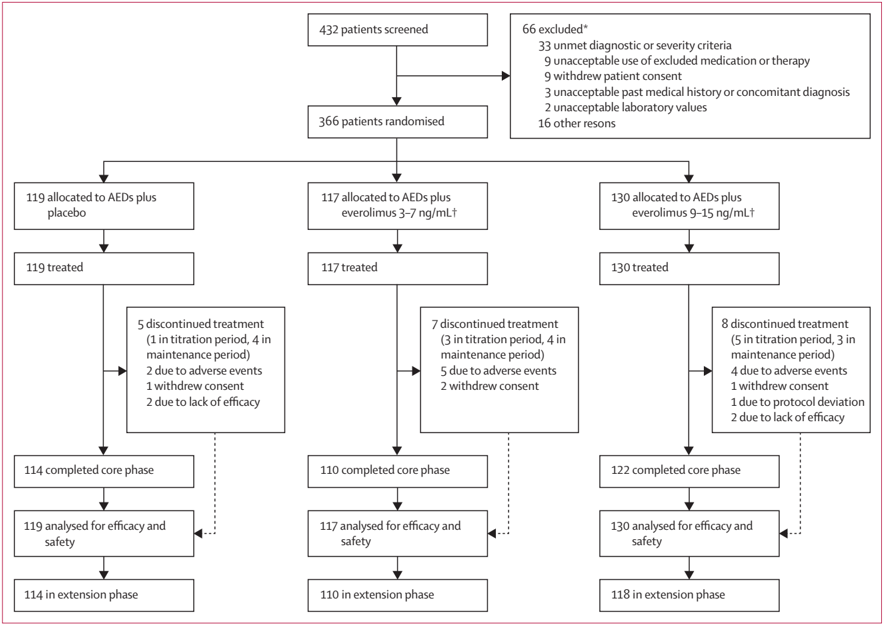
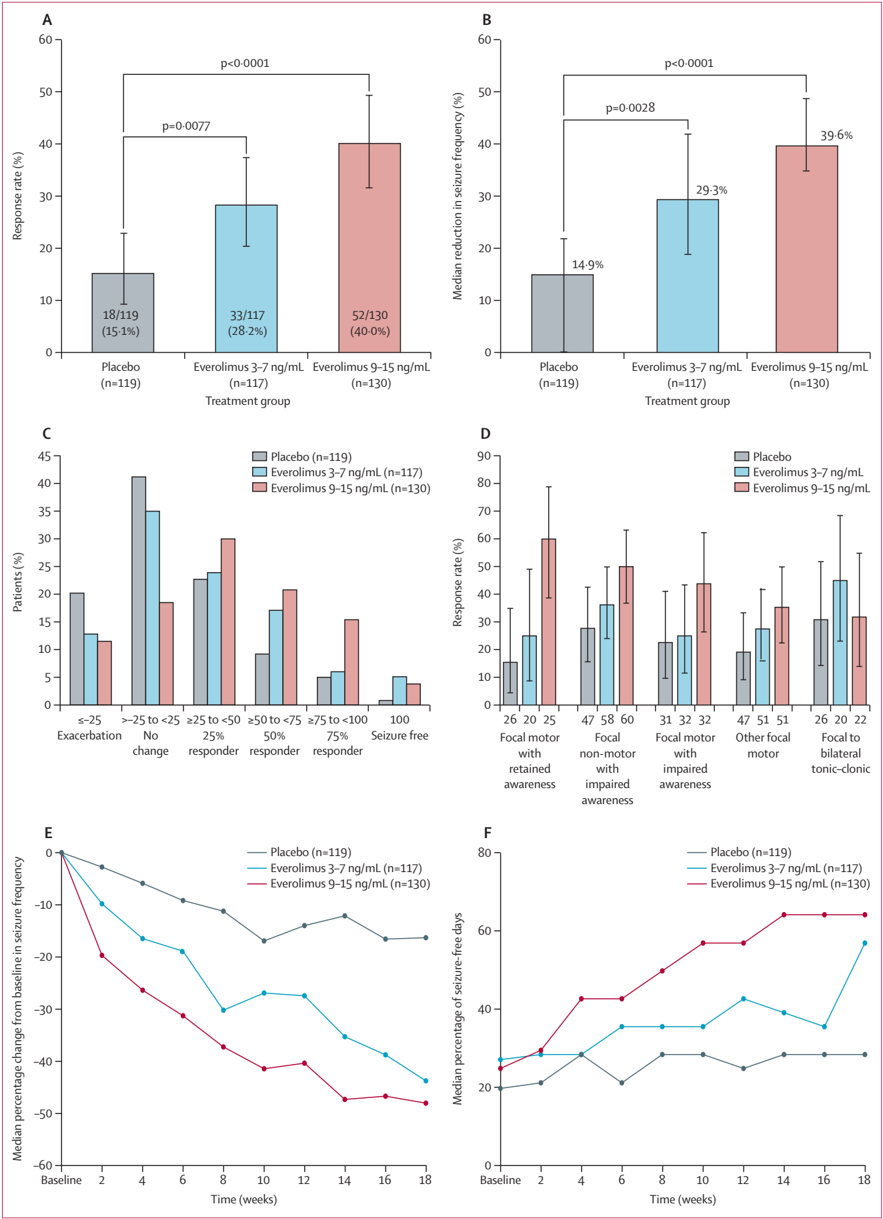
BACKGROUND: Everolimus, a mammalian target of rapamycin (mTOR) inhibitor, has been used for various benign tumours associated with tuberous sclerosis complex. We assessed the efficacy and safety of two trough exposure concentrations of everolimus, 3-7 ng/mL (low exposure) and 9-15 ng/mL (high exposure), compared with placebo as adjunctive therapy for treatment-resistant focal-onset seizures in tuberous sclerosis complex. METHODS: In this phase 3, randomised, double-blind, placebo-controlled study, eligible patients aged 2-65 years with tuberous sclerosis complex and treatment-resistant seizures (≥16 in an 8-week baseline phase) receiving one to three concomitant antiepileptic drugs were recruited from 99 centres across 25 countries. Participants were randomly assigned (1:1:1), via permuted-block randomisation (block size of six) implemented by Interactive Response Technology software, to receive placebo, low-exposure everolimus, or high-exposure everolimus. Randomisation was stratified by age subgroup (<6 years, 6 to <12 years, 12 to <18 years, and ≥18 years). Patients, investigators, site personnel, and the sponsor's study team were masked to treatment allocation. The starting dose of everolimus depended on age, body-surface area, and concomitant use of cytochrome 3A4/P-glycoprotein inducers. Dose adjustments were done to attain target trough ranges during a 6-week titration period, and as needed during a 12-week maintenance period of core phase. Patients or their caregivers recorded events in a seizure diary throughout the study. The primary endpoint was change from baseline in the frequency of seizures during the maintenance period, defined as response rate (the proportion of patients achieving ≥50% reduction in seizure frequency) and median percentage reduction in seizure frequency, in all randomised patients. This study is registered with ClinicalTrials.gov, number NCT01713946. FINDINGS: Between July 3, 2013, and May 29, 2015, 366 patients were enrolled and randomly assigned to placebo (n=119), low-exposure everolimus, (n=117), or high-exposure everolimus (n=130). The response rate was 15·1% with placebo (95% CI 9·2-22·8; 18 patients) compared with 28·2% for low-exposure everolimus (95% CI 20·3-37·3; 33 patients; p=0·0077) and 40·0% for high-exposure everolimus (95% CI 31·5-49·0; 52 patients; p<0·0001). The median percentage reduction in seizure frequency was 14·9% (95% CI 0·1-21·7) with placebo versus 29·3% with low-exposure everolimus (95% CI 18·8-41·9; p=0·0028) and 39·6% with high-exposure everolimus (95% CI 35·0-48·7; p<0·0001). Grade 3 or 4 adverse events occurred in 13 (11%) patients in the placebo group, 21 (18%) in the low-exposure group, and 31 (24%) in the high-exposure group. Serious adverse events were reported in three (3%) patients who received placebo, 16 (14%) who received low-exposure everolimus, and 18 (14%) who received high-exposure everolimus. Adverse events led to treatment discontinuation in two (2%) patients in the placebo group versus six (5%) in the low-exposure group and four (3%) in the high-exposure group. INTERPRETATION: Adjunctive everolimus treatment significantly reduced seizure frequency with a tolerable safety profile compared with placebo in patients with tuberous sclerosis complex and treatment-resistant seizures. FUNDING: Novartis Pharmaceuticals Corporation.
Overview
The claims and statistics of this paper haven’t been checked yet.
Free: it reads the open-access text and checks the first 5 claims that cite a source we can check. Create a free account to check every claim.
Integrity signals
Registry
Cites
Statistics
Figures
Verification
Claims the paper makes
The claims and statistics of this paper haven’t been checked yet.
Free: it reads the open-access text and checks the first 5 claims that cite a source we can check. Create a free account to check every claim.
Claims other papers make about this one
Each is checked against this paper’s own text: does it say what the citing paper says it does?
The source backs part of the claim, not all of it — or backs it for a different population, condition or comparison.
In the citing paper
“mTOR pathway inhibitors, including everolimus and sirolimus may be beneficial as a targeted treatment 131 .”
From Developmental and epileptic encephalopathies (2024) · cites this paper as [131]
Experimental — accuracy not yet measuredThe source backs part of the claim, not all of it — or backs it for a different population, condition or comparison.
In the citing paper
“One example is the EXIST-3 RCT in which the mTOR inhibitor everolimus was trialled in patients with drug-resistant focal seizures in the setting of tuberous sclerosis complex, due to pathogenic variants in the mTOR pathway genes, TSC1 or TSC2.”
From Developmental and epileptic encephalopathies (2024) · cites this paper as [131]
Experimental — accuracy not yet measuredThe cited source says what the claim attributes to it.
In the citing paper
“In this RCT, responder rates were greater with higher-dose everolimus than with placebo; however, they were perhaps less compelling than one might expect for a precision therapy (40% vs 15.1%, p<0.0001) 131 .”
From Developmental and epileptic encephalopathies (2024) · cites this paper as [131]
The cited source says what the claim attributes to it.
In the citing paper
“Effects on cognition and other neuropsychiatric symptoms were not reported.”
From Developmental and epileptic encephalopathies (2024) · cites this paper as [131]
In the citing paper
“Subsequently, inhibitors of mTOR have been proposed as treatments for such syndromes and one drug Everolimus has been approved for treatment of seizures in tuberous sclerosis (French et al., 2016).”
From Getting to the cores of autism (2019) · cites this paper as French et al., 2016
Self-check
Percentages, sums and reported differences re-computed from the paper’s own numbers.
The self-check needs the paper’s full text.
Citations
Cites
Kwan, P., Schachter, S. C., & Brodie, M. J. (2011) · New England Journal of Medicine · doi:10.1056/nejmra1004418 · Cited by 1,052
Everolimus for Subependymal Giant-Cell Astrocytomas in Tuberous Sclerosis
Krueger, D. A., Care, M. M., Holland, K., Agricola, K., Tudor, C., Mangeshkar, P., Wilson, K. A., Byars, A., Sahmoud, T., & Franz, D. N. (2010) · New England Journal of Medicine · doi:10.1056/nejmoa1001671 · Cited by 1,006
Self-citationBissler, J. J., Kingswood, J. C., Radzikowska, E., Zonnenberg, B. A., Frost, M., Belousova, E., Sauter, M., Nonomura, N., Brakemeier, S., de Vries, P. J., et al. (2013) · The Lancet · doi:10.1016/s0140-6736(12)61767-x · Cited by 880
Franz, D. N., Belousova, E., Sparagana, S., Bebin, E. M., Frost, M., Kuperman, R., Witt, O., Kohrman, M. H., Flamini, J. R., Wu, J. Y., et al. (2013) · The Lancet · doi:10.1016/s0140-6736(12)61134-9 · Cited by 794
Self-citationArroyo, S., Rumià, J., Martínez, I., & Ribalta, T. (1998) · PubMed · Cited by 652
Rapamycin prevents epilepsy in a mouse model of tuberous sclerosis complex.
Zeng, L., Xu, L., Gutmann, D. H., & Wong, M. (2008) · Annals of Neurology · doi:10.1002/ana.21331 · Cited by 639
The natural history of epilepsy in tuberous sclerosis complex
Chu‐Shore, C. J., Major, P., Camposano, S., Muzykewicz, D., & Thiele, E. A. (2010) · Epilepsia · doi:10.1111/j.1528-1167.2009.02474.x · Cited by 637
Neurological and neuropsychiatric aspects of tuberous sclerosis complex
Curatolo, P., Moavero, R., & de Vries, P. J. (2015) · The Lancet Neurology · doi:10.1016/s1474-4422(15)00069-1 · Cited by 600
Self-citationMeikle, L., Pollizzi, K., Egnor, A., Kramvis, I., Lane, H., Sahin, M., & Kwiatkowski, D. J. (2008) · The Journal of Neuroscience · doi:10.1523/jneurosci.0955-08.2008 · Cited by 501
Efficacy and Safety of Oral Lacosamide as Adjunctive Therapy in Adults with Partial‐Onset Seizures
Ben‐Menachem, E., Biton, V., Jatuzis, D., Abou‐Khalil, B., Doty, P., & Rudd, G. D. (2007) · Epilepsia · doi:10.1111/j.1528-1167.2007.01188.x · Cited by 485
Research works printed but not linked: 1
- 20. European Medicines Agency. Guideline on clinical investigation of medicinal products in the treatment of epileptic disorders. July 22, 2010. CHMP/EWP/566/98 Rev.2/Corr. http:// wwwemaeuropaeu/docs/en_GB/document_library/Scientifi c_ guideline/2010/01/WC500070043pdf (accessed July 8, 2016).
Cited by
Items 501–600 of 796
A crash course in genomics for epilepsy clinicians
Moloney, P. B., & Delanty, N. (2025) · Epilepsy & Behavior · doi:10.1016/j.yebeh.2025.110553 · Cited by 4
New frontier for epilepsy treatment through targeting cellular senescence
Bello, S. T., Rafe, M. R., & Huang, F. (2025) · Progress in Neuro-Psychopharmacology and Biological Psychiatry · doi:10.1016/j.pnpbp.2025.111506 · Cited by 3
Current Perspectives on The Diagnosis and Management of Lymphangioleiomyomatosis
Saluja, P., & Gupta, N. (2025) · Clinics in Chest Medicine · doi:10.1016/j.ccm.2025.07.002 · Cited by 3
Haile, H., Leskinen, S., Adapa, A. R., Goldberg, A. R., Viswanathan, A., Milligan, C., Conboy, K., Schevon, C. A., Canoll, P., & Gill, B. J. A. (2025) · Biomedicines · doi:10.3390/biomedicines13112593 · Cited by 3
“Clinical trials have demonstrated significant reductions in seizure frequency, tumor volume, and disease progression, shown in the EXIST 3 study (NCT01713946) [140–143].”
Diagnosis and Management of Children With Tuberous Sclerosis Complex
Dewell, C., Chan, D., Sarkozy, V., Farley, E., Russell, J., Mowat, D. R., Kennedy, S., & Chung, C. W. T. (2025) · Journal of Paediatrics and Child Health · doi:10.1111/jpc.70243 · Cited by 3
Wu, Q., Guignet, M. A., Vuong, J., White, H. S., Kerr, W. T., Shih, E. K., Ngo, L. Y., Carrazana, E. J., & Rabinowicz, A. L. (2026) · Epilepsia · doi:10.1002/epi.70051 · Cited by 3
“7,8 The impact of seizure clusters on the underlying disease of epilepsy is unclear.”
Impact of prenatal sirolimus on cardiac rhabdomyomas and brain tubers
Vergote, S., der Veeken, L. V., Chitayat, D. A., JAEGGI, E. T., Ryan, G., Miller, E., & Shinar, S. (2026) · Ultrasound in Obstetrics and Gynecology · doi:10.1002/uog.70185 · Cited by 3
“Recognizing this, mTOR inhibitors, such as sirolimus and everolimus, have been used postnatally to treat symptomatic rhabdomyomas, renal angiomyolipomas and cutaneous angiofibromas, and to reduce the severity of seizures 10,11 .”
Perilli, L., Ferretti, A., Riva, A., Grosso, S., Verrotti, A., & Striano, P. (2026) · Expert Review of Clinical Pharmacology · doi:10.1080/17512433.2026.2652967 · Cited by 4
“Targeting the underlying mTOR pathway, randomized controlled trials confirmed the efficacy and tolerability of everolimus, an established selective inhibitor (Tier 3) [47].”
Ebrahimi‐Fakhari, D., Poryo, M., Graf, N. M., Zemlin, M., Flotats‐Bastardas, M., Heine, G. H., Ragoschke-Schumm, A., & Meyer, S. (2017) · Klinische Pädiatrie · doi:10.1055/s-0043-120069 · Cited by 3
Drug-resistant epilepsy: modern concepts, integrative mechanisms, and therapeutic advances
Chiosa, V., Ciolac, D., Chelban, V., Gasnaș, D., Vataman, A., Munteanu, C., & Groppa, S. A. (2021) · The Moldovan Medical Journal · doi:10.52418/moldovan-med-j.64-4.21.14 · Cited by 5
Menezes, C. E. G., dos Santos, D. L., Nery, E. S., Serpa, E. D., Morais, L. A. S., Dutra, L. S., Filho, M. B. P., & Góes, J. (2023) · Arquivos de Neuro-Psiquiatria · doi:10.1055/s-0042-1758442 · Cited by 3
Zhou, H., Zheng, Z., Tu, Z., Li, Y., Yang, J., & Fan, C. (2023) · Frontiers in Pediatrics · doi:10.3389/fped.2023.1263631 · Cited by 3
Xu, Y., Lu, R., Li, H., Feng, W., & Zhao, R. (2024) · Biochimica et Biophysica Acta (BBA) - Molecular Basis of Disease · doi:10.1016/j.bbadis.2024.167232 · Cited by 3
Holtkamp, M., May, T. W., Berkenfeld, R., Bien, C. G., Coban, I., Knake, S., Michaelis, R., Rémi, J., Seeck, M., Surges, R., et al. (2024) · Clinical Epileptology · doi:10.1007/s10309-024-00693-6 · Cited by 3
Chang, B., Walker, M. C., Kullmann, D. M., & Schorge, S. (2024) · Epilepsia · doi:10.1111/epi.18169 · Cited by 3
Tuberous sclerosis: a survey in the canton of Vaud, Switzerland
Hagon-Nicod, O., Fellmann, F., Nový, J., Lebon, S., Wider, C. W., Lazor, R., & Bonny, O. (2024) · Frontiers in Medicine · doi:10.3389/fmed.2024.1513619 · Cited by 3
Neue Perspektiven für eine bessere Betreuung
Polster, T. (2019) · Pädiatrie · doi:10.1007/s15014-019-1745-y · Cited by 3
“Dabei zeigte sich für Cannabidiol, einem vermutlich nicht-psychotropen Inhaltssto der Cannabis-P²anze, eine Überlegenheit in der Anfallsreduktion gegenüber Placebo [8].”
BackgroundSelf-citationThe Economic Impact of Medication-Resistant Epilepsy
Begley, C. E., & Jeong, S. (2020) · Cambridge University Press eBooks · doi:10.1017/9781316492376.004 · Cited by 3
Oro, A. B., Sánchez, M. D. C. E., Hernández, M. E. R., Ibarra, J. J. M., Reyes-Vaca, J. G., Valdez, D. M. M. V., & Elías, C. L. G. (2020) · Acta Pediátrica de México · doi:10.18233/apm41no5pp208-2141962 · Cited by 7
Review of Tuberous Sclerosis Complex: A Single Center Experience
Tosun, A. F., Yüzbaşı, B. K., & Akyol, A. (2021) · The Journal of Pediatric Research · doi:10.4274/jpr.galenos.2020.47750 · Cited by 3
“A significant decrease in seizure frequency was found (53).”
BackgroundEgami, A., Takahashi, S., Kokubo, T., Boggarapu, S., & Beresford, E. (2023) · Dermatology and Therapy · doi:10.1007/s13555-023-00914-2 · Cited by 4
Concha, J., Sangüesa, E., Segura, J. L. P., Ribate, M. P., & García, C. B. (2023) · Pharmacogenomics · doi:10.2217/pgs-2023-0140 · Cited by 3
Braun, M., & Riney, K. (2024) · Epilepsia · doi:10.1111/epi.18069 · Cited by 5
“23 Lastly, guidelines for the management of TSC epilepsy have been updated.”
Are antiseizure medications disease modifiers?
Tyvaert, L. (2025) · Revue Neurologique · doi:10.1016/j.neurol.2025.03.009 · Cited by 3
Epilepsy research in 2016: new treatment directions
Berkovic, S. F. (2016) · The Lancet Neurology · doi:10.1016/s1474-4422(16)30334-9 · Cited by 3
New Genes for Epilepsy–Autism Comorbidity
Ishii, A., & Hirose, S. (2017) · Journal of Pediatric Neurology · doi:10.1055/s-0037-1602822 · Cited by 3
Non-convulsive status epilepticus in two patients with tuberous sclerosis
Erdal, Y., Alnak, A., Çakmak, Ö. Ö., Tektürk, P., & Yapıcı, Z. (2019) · Child s Nervous System · doi:10.1007/s00381-019-04382-y · Cited by 4
Mobile Apps und Internetanwendungen zur Unterstützung von Versorgung und Dokumentation bei Epilepsie
von Spiczak, S., Luef, G., & Stephani, U. (2021) · Clinical Epileptology · doi:10.1007/s10309-021-00429-w · Cited by 3
“Dabei ist sowohldie prospektiveDokumentation in randomisierten Studien möglich [16, 17] als auch eine retrospektive Auswertung von Behandlungsdaten und Anfallsfrequenzen [18].”
BackgroundNovel and emerging therapeutics for genetic epilepsies
Pejčić, A. V., Јаnkovic, S., Đešević, M., Gojak, R., Lukić, S., Marković, N., & Milosavljević, M. N. (2021) · Expert Review of Neurotherapeutics · doi:10.1080/14737175.2021.1992275 · Cited by 3
“At the end of EXIST-3, 361 of 366 patients received at least one dose of everolimus.”
InfluentialSomatic AKT1 Mutations May Confer Increased Risk of Preoperative Seizures in Meningiomas
Dedhia, M., Devarajan, A., Rao, A., Monnig, E., Unterberger, A., Feng, R., Chapman, E. K., Tong, A. P., Dullea, J. T., Gill, C. M., et al. (2025) · Neurosurgery · doi:10.1227/neu.0000000000003445 · Cited by 2
Gallus, S., Markl, A., Posorske, B., Tiwari, N. R., Kuwabara, M. S., Keller, L., Hoffman, L. M., & Mangum, R. (2025) · Journal of Pediatric Hematology/Oncology · doi:10.1097/mph.0000000000003063 · Cited by 2
Fu, J., Zhang, G., Yang, Z., & Qin, J. (2025) · Frontiers in Neurology · doi:10.3389/fneur.2025.1623212 · Cited by 4
Treatment of pediatric epilepsy
Li, J., Liu, T., Liu, C., Deng, J., Wu, S., Kuang, S., Li, X., Wei, Z., & Liang, S. (2026) · Pediatric Investigation · doi:10.1002/ped4.70043 · Cited by 2
“94 In contrast, an RCT indicated that sirolimus was ineffective for seizure control and was associated with adverse events.”
Targeted therapies in pediatric oncology: A start
Shah, N. (2026) · Molecular Therapy Oncology · doi:10.1016/j.omton.2026.201146 · Cited by 2
Kobow, K., & Mühlebner, A. (2026) · Clinical Epileptology · doi:10.1007/s10309-026-00828-x · Cited by 2
Boßelmann, C. M., Wagner, M., Borggräfe, I., Brandt, C., Didt, S., Fazeli, W., Grimmer, A., Kegele, J., Klein, K. M., Kluger, G. J., et al. (2026) · Clinical Epileptology · doi:10.1007/s10309-026-00832-1 · Cited by 2
Cell-intrinsic regulation of epilepsy-associated pathology by mTORC1 and mTORC2
Godale, C. M., Yaser, S., Drake, A. W., Kraus, K. L., Mayer, N., Dusing, M. R., LaSarge, C. L., Gross, C., & Danzer, S. C. (2026) · Journal of Neuroscience · doi:10.1523/jneurosci.1211-25.2026 · Cited by 2
Current and Future Research Priorities in the Psychiatry of Intellectual Disability
Thurston, R., Tromans, S. J., Chester, V., Cooper, S., Strydom, A., Bhaumik, S., & Rai, D. (2020) · Oxford University Press eBooks · doi:10.1093/med/9780198794585.003.0026 · Cited by 2
Medication-Resistant Epilepsy in Adults
Holtkamp, M., & Benninger, F. (2020) · Cambridge University Press eBooks · doi:10.1017/9781316492376.014 · Cited by 2
Wang, X., Wang, W., Zhao, Y., Wang, Z., & Zhang, Y. (2022) · Frontiers in Medicine · doi:10.3389/fmed.2022.840709 · Cited by 2
Médicaments antiépileptiques : quoi de neuf récemment ?
Guery, D., & Rheims, S. (2022) · Pratique Neurologique - FMC · doi:10.1016/j.praneu.2022.07.006 · Cited by 2
Deng, S., Shi, W. F., Cai, Y., Tang, Y., Liu, W., Yin, P., Chen, C., Li, M., Dong, H., Huang, J., et al. (2022) · PubMed Central · doi:10.11817/j.issn.1672-7347.2022.210452 · Cited by 2
Zhang, J. (2022) · Clinical Medicine · doi:10.7861/clinmed.22-4-s48 · Cited by 2
Concurrent diagnoses of Tuberous sclerosis and multiple sclerosis
Quigley, S., Asad, M., Doherty, C. P., Byrne, D., Cronin, S., & KEARNEY, H. F. (2023) · Multiple Sclerosis and Related Disorders · doi:10.1016/j.msard.2023.104586 · Cited by 3
Metadiscourse markers in research article abstracts. An interlingual and interdisciplinary study
Šandová, J. K. (2023) · LINGUISTICA SILESIANA · doi:10.24425/linsi.2017.117053 · Cited by 2
Treatment of tuberous sclerosis complex manifestations in children with mTOR inhibitors
Yeşil, Ş., Kurucu, B., Hamamcı, M. B., Yılmaz, Ş., & Şahin, G. (2023) · Child s Nervous System · doi:10.1007/s00381-023-06218-2 · Cited by 3
Cancer Predisposition Syndromes in Neuro-oncology
Na, B. S., Shah, S. R., & Nghiemphu, P. L. (2023) · Seminars in Neurology · doi:10.1055/s-0043-1777702 · Cited by 2
CHI, O. Z., Liu, X., Fortus, H., Werlen, G., Jacinto, E., & Weiss, H. R. (2024) · NeuroMolecular Medicine · doi:10.1007/s12017-024-08780-7 · Cited by 2
“Rapamycin has been tested in humans with ASD, with some potential benefit (Cavalheiro et al., 2021; Franz et al., 2021; French et al., 2016; Krueger et al., 2018; Mizuguchi et al., 2021; Winden et al., 2018).”
BackgroundPatient-Centered Management of Brain Tumor-Related Epilepsy
Dorotan, M. K., & Tobochnik, S. D. (2024) · Current Neurology and Neuroscience Reports · doi:10.1007/s11910-024-01360-z · Cited by 2
“A prime example of targeting genetically-mediated mTOR pathway dysregulation for BTRE is the superior response of subependymal giant-cell astrocytoma and seizure control in patients with tuberous sclerosis with the use of the mTOR inhibitor everolimus [22, 23].”
Update on neonatal and infantile onset epilepsies
Carapancea, E., Sands, T. T., & Cilio, M. R. (2025) · Current Opinion in Pediatrics · doi:10.1097/mop.0000000000001448 · Cited by 3
“Everolimus, an mTOR inhibitor validated for TSC [20], offers potential for GATOR1 complex-related epilepsies, which share a similar mechanism of mTORC1 hyperactivation due to loss of inhibition.”
How to use mTOR inhibitors in children
Tse, Y., Vasey, N., Thomas, R. H., Leech, S., Owens, S., & Sayer, J. (2025) · Archives of Disease in Childhood Education & Practice · doi:10.1136/archdischild-2024-327852 · Cited by 2
Narrative Review on Common Traits of Parkinson’s Disease and Epilepsy
Tilz, C., & Wang‐Tilz, Y. (2025) · Journal of Clinical Medicine · doi:10.3390/jcm14082716 · Cited by 2
“Epilepsy affects approximately 50–70 million people globally, with a higher prevalence in low-and middle-income countries [13].”
Zhao, T., Chen, F., Cao, B., Yang, L., Yin, J., Li, Y., & Feng, F. (2025) · Frontiers in Neuroscience · doi:10.3389/fnins.2025.1595667 · Cited by 2
Epilepsy and intellectual disabilities
Brandt, C. (2019) · Elsevier eBooks · doi:10.1016/b978-0-12-814877-8.00014-3 · Cited by 2
Epileptogenese und Konsequenzen für die Therapie
Hedrich, U. B. S., Koch, H., Becker, A. J., & Lerche, H. (2019) · Der Nervenarzt · doi:10.1007/s00115-019-0749-8 · Cited by 3
“TSC1/2 Hamartin/Tuberin Tuberöse Sklerose Everolimus (mTOR-Inhibitor) [10]”
Diagnostik genetisch bedingter Epilepsien
Lemke, J. R. (2019) · Medizinische Genetik · doi:10.1007/s11825-019-00255-6 · Cited by 3
Surgical treatment of epilepsy in a teenager with tuberous sclerosis
Polyanskaya, M. V., Vasilyev, I. G., Чадаев, В. А., Демушкина, А. А., Khondkaryan, G. S., Zavadenko, N. N., & Alikhanov, A. A. (2020) · Rossiyskiy Vestnik Perinatologii i Pediatrii (Russian Bulletin of Perinatology and Pediatrics) · doi:10.21508/1027-4065-2020-65-2-92-98 · Cited by 2
[Research advances in the role of mTOR signaling pathway in autism spectrum disorder].
Sheng, G., & Jiang, K. (2019) · PubMed Central · doi:10.7499/j.issn.1008-8830.2019.07.019 · Cited by 2
Pharmacotherapy for Medication-Resistant Epilepsy
Powell, G. A., & Marson, A. G. (2020) · Cambridge University Press eBooks · doi:10.1017/9781316492376.016 · Cited by 2
Kada, A., Tohyama, J., Shiraishi, H., Takahashi, Y., Nakagawa, E., Akiyama, T., Saito, A. M., Inoue, Y., & Kato, M. (2019) · The Kurume Medical Journal · doi:10.2739/kurumemedj.ms662007 · Cited by 2
Stick or twist: Everolimus for seizures in tuberous sclerosis complex during the COVID-19 pandemic
Moloney, P. B., & Delanty, N. (2021) · Seizure · doi:10.1016/j.seizure.2021.06.035 · Cited by 2
The flaws in assessing and reporting the toxicities of oral targeted therapies
Fojo, T. (2023) · Seminars in Oncology · doi:10.1053/j.seminoncol.2023.04.001 · Cited by 2
Psychiatric Comorbidities in Medication-Resistant Epilepsy
Kanner, A. M. (2020) · Cambridge University Press eBooks · doi:10.1017/9781316492376.023 · Cited by 2
Medication-Resistant Epilepsy Syndromes in Children
Pestana‐Knight, E., & Wyllie, E. (2020) · Cambridge University Press eBooks · doi:10.1017/9781316492376.013 · Cited by 1
Anti-convulsant Agents: Everolimus
Hertzberg, C., & Franz, D. N. (2022) · Springer eBooks · doi:10.1007/978-3-030-62059-2_306 · Cited by 1
Self-citationNew possibilities of overcoming pharmacoresistance in epilepsy
Sorokovikova, T. V., Menshikova, T. V., Morozov, A. M., Kryukova, A. N., & Naumova, S. A. (2024) · Medical alphabet · doi:10.33667/2078-5631-2023-33-44-49 · Cited by 1
Nasir, K., & Ahmad, A. (2023) · PubMed · doi:10.4103/sjkdt.sjkdt_324_21 · Cited by 2
Neonatal Cardiac Rhabdomyoma: A Single-Center Experience
Kaya, B., Akduman, H., Díllí, D., Sayici, İ. U., Aydoğan, S., Doğangönül, M., Şahin, G., Aksoy, Ö. N., Uçan, B., & Zenciroğlu, A. (2024) · Zeitschrift für Geburtshilfe und Neonatologie · doi:10.1055/a-2325-5490 · Cited by 1
Yin, H.-Q., Li, X., Fu, Y. S., Zhu, H., & Luo, Y.-S. (2024) · Frontiers in Immunology · doi:10.3389/fimmu.2024.1425988 · Cited by 1
Trujillo‐Quintero, J. P., Brunet‐Vega, A., Spataro, N., Petanas, J., Gallego, O., Mateo, F., Pujana, M. Á., & Ruiz, A. (2025) · Clinical Genetics · doi:10.1111/cge.14734 · Cited by 1
Dlugos, D., Lozano, M., DiVentura, B. D., Farfel, G. M., Shellhaas, R. A., Sullivan, J. E., Thio, L. L., Kessler, S. K., Sadleir, L. G., & French, J. A. (2025) · Epilepsia · doi:10.1111/epi.18440 · Cited by 1
Self-citationClinical Manifestations of Tuberous Sclerosis: A Retrospective Analysis of 20 Cases
Zhang, X., Xie, C., Si, Z., Liu, J., Wang, A., Kong, M., Liu, J., & Xia, Z. (2025) · European Neurology · doi:10.1159/000546608 · Cited by 1
“Furthermore, everolimus and rapamycin are effective in treating various complications of TSC, including renal AML, SEGA, and LAM, and can be used as adjunctive therapies for seizures [53].”
Senoo, S., Kanda, S., Takizawa, K., Terashima, H., Kajiho, Y., & Harita, Y. (2025) · Nephrology · doi:10.1111/nep.70069 · Cited by 2
Boggarapu, S., Rushing, G. V., Pounders, A. J., Roberds, S. L., & Beresford, E. (2025) · Orphanet Journal of Rare Diseases · doi:10.1186/s13023-025-03653-z · Cited by 1
Clinical Application of Anti-seizure Medication as Drug Therapy
Zhou, L., & Chen, Z. (2025) · Springer eBooks · doi:10.1007/978-981-96-8520-2_4 · Cited by 1
NEAT1 Promotes Epileptogenesis in Tuberous Sclerosis Complex
Kuang, S., Liu, T., Wei, Z., Xu, J., Han, J., Wang, J., Zhai, F., Tian, Y., & Liang, S. (2025) · Advanced Science · doi:10.1002/advs.202504316 · Cited by 1
Focal postnatal deletion of Tsc2 causes epilepsy
McCoy, C., Dusing, M. R., Jerow, L. G., Winstel, G. C., Zhan, F., Rogers, J. L., Wesley, M., Otten, J. B., Danzer, S. C., & LaSarge, C. L. (2025) · Frontiers in Molecular Neuroscience · doi:10.3389/fnmol.2025.1686023 · Cited by 2
Chen, X., Yi, X., Liu, Y., Wang, X., Peng, Y., Wang, Q., Shuai, Y., & Zhang, H. (2025) · Frontiers in Pharmacology · doi:10.3389/fphar.2025.1718032 · Cited by 1
Liu, Y., Wang, R., Srivastava, S., Jo, B., Frazier, T. W., Filip‐Dhima, R., Eng, C., Hanna, R., Sahin, M., Hardan, A. Y., et al. (2025) · Advances in Therapy · doi:10.1007/s12325-025-03441-y · Cited by 1
The Clinical Spectrum and Neurodevelopmental Pathogenesis of KPTN ‐Related Disorder in a Mouse Model
Rawlins, L. E., Iffland, P. H., Page, J., Flessner, R., Elziny, S., Sbornova, I., Babus, J. K., Bruckmeier, S., Parikh, R. K., Verhoeven, M., et al. (2026) · Annals of Neurology · doi:10.1002/ana.78159 · Cited by 1
Präventive Therapie bei tuberöser Sklerose: Konzepte, Evidenz und offene Fragen
Driedger, J. H., & Syrbe, S. (2026) · Clinical Epileptology · doi:10.1007/s10309-026-00834-z · Cited by 1
de Vries, P. J., Chambers, N. J., Campbell, E., Gutiérrez-Lafrentz, L., Heunis, T.-M., Schlebusch, L., d’Augères, G. B., Bissell, S., Byars, A. W., Capal, J. K., et al. (2026) · JMIR Research Protocols · doi:10.2196/91726 · Cited by 2
Tuberöse Sklerose-Komplex: Präzisionstherapie mit mTOR-Inhibitoren
Franz, D. N., Eckeberg, W. C., & Ritter, D. M. (2026) · Clinical Epileptology · doi:10.1007/s10309-026-00829-w · Cited by 1
Self-citationRenal angiomyolipoma in pregnancy – A review
Morton, A. (2026) · Obstetric Medicine · doi:10.1177/1753495x261439226 · Cited by 1
From comorbidity to continuum: Alzheimer’s disease and epilepsy are connected-now what?
Alves, S. S., Manzine, P. R., dos Santos, F. M., Migliaccio, M. M., Alves, L. D. C., da Silva-Júnior, R. M. P., Becerra-Hernández, L. V., González-Acosta, C. A., Buriticá, E., Cominetti, M. R., et al. (2026) · Neuroscience & Biobehavioral Reviews · doi:10.1016/j.neubiorev.2026.106682 · Cited by 1
Holistic management of epilepsy in adults with intellectual development disorders
Fonseca, E., Riva, A., López‐Maza, S., Zaddach, M., Porter, M., Borggraefe, I., Watkins, L. V., Schulze‐Bonhage, A., Shankar, R., Striano, P., et al. (2026) · Epileptic Disorders · doi:10.1002/epd2.70272 · Cited by 1
Spyrou, J., Lockhart, P. J., Maljevic, S., Howell, K. B., & Reid, C. A. (2026) · Acta Neuropathologica · doi:10.1007/s00401-026-03059-6 · Cited by 1
Mula, M. (2026) · CNS Drugs · doi:10.1007/s40263-026-01331-7 · Cited by 1
“The largest randomised controlled trial (EXIST-3) specifically noted that assessment of cognitive and behavioural outcomes was limited by profound intellectual disability in the study population, and no clear improvement in adaptive behaviour could be established [55].”
Fan, B., Liu, Y., Cao, W., Li, T., Li, M., Zhang, K., & Ma, F. (2026) · Drug Design Development and Therapy · doi:10.2147/dddt.s632911 · Cited by 1
“26 It was developed as an improved derivative of rapamycin, offering superior pharmacokinetic properties that include higher oral bioavailability, faster time to steady-state concentration, and a shorter half-life that allows for more flexible dose adjustment.”
Antiepileptika – Besonderheiten bei Menschen mit geistiger Behinderung
Kerling, F., Brandt, C., & Baier, H. (2017) · Clinical Epileptology · doi:10.1007/s10309-017-0134-1 · Cited by 1
“Entscheidend für die Zulassung war die EXIST-3-Studie [14].”
BackgroundBesondere Bildgebung bei sonstigen genetisch determinierten Epilepsien
Marquetand, J. C., & Lerche, H. (2018) · Clinical Epileptology · doi:10.1007/s10309-017-0167-5 · Cited by 1
“Reduktion der Anfallsfrequenz bereits gezeigt [7].”
InfluentialKaraoğlan, M. (2018) · Turkish Journal Of Neurology · doi:10.4274/tnd.78466 · Cited by 1
“(1) assessed the efficacy and safety of two trough exposure concentrations of everolimus, 3-7 ng/mL (low exposure) and 9-15 ng/mL (high exposure), compared with placebo as an adjunctive therapy for treatment-resistant focalonset seizures in tuberous sclerosis complex.”
BackgroundThe mTOR pathway as a therapeutic target for precision medicine
Dill, P. E., & Datta, A. (2019) · Clinical Epileptology · doi:10.1007/s10309-019-0267-5 · Cited by 1
Anticonvulsant Agents: Everolimus
Hertzberg, C., & Franz, D. N. (2020) · Springer eBooks · doi:10.1007/978-3-319-56015-1_306-1 · Cited by 2
Self-citationAnticonvulsant Agents: Beginning and Duration of Therapy, Withdrawal, and Resistance – Children
Borggraefe, I. (2020) · Springer eBooks · doi:10.1007/978-3-319-56015-1_371-1 · Cited by 1
Long-term use of mTORC1 inhibitors in tuberous sclerosis complex associated neurological aspects
Moavero, R., & Curatolo, P. (2020) · Expert Opinion on Orphan Drugs · doi:10.1080/21678707.2020.1789862 · Cited by 1
Self-citationSocial Consequences of Medication-Resistant Epilepsy
Crepeau, A. Z., & Sirven, J. I. (2020) · Cambridge University Press eBooks · doi:10.1017/9781316492376.005 · Cited by 1
Raab, C., Gilligan, L. A., Trout, A. T., Krueger, D. A., Franz, D. N., Zhang, B., & Towbin, A. J. (2020) · Radiology Imaging Cancer · doi:10.1148/rycan.2020190091 · Cited by 2
Self-citationMedical Management in Focal versus Generalized Epilepsy
Sannagowdara, K., & Khan, N. (2021) · Journal of Pediatric Epilepsy · doi:10.1055/s-0040-1722297 · Cited by 1
Lee, M. T. W., Mahy, W., & Rackham, M. D. (2021) · RSC Medicinal Chemistry · doi:10.1039/d1md00113b · Cited by 1
Metadata
- Authors
- French, J. A., Lawson, J. A., Yapici, Z., Ikeda, H., Polster, T., Nabbout, R., Curatolo, P., de Vries, P. J., Dlugos, D. J., Berkowitz, N., Voi, M., Peyrard, S., Pelov, D., & Franz, D. N.
- Affiliations
- NYU Langone Health (US)
- Sydney Children's Hospital (AU)
- National Epilepsy Center (JP)
- Krankenhaus Mara (DE)
- Hôpital Necker-Enfants Malades (FR)
- Policlinico Tor Vergata (IT)
- Children's Hospital of Philadelphia (US)
- Cincinnati Children's Hospital Medical Center (US)
- Corresponding author
- French, Jacqueline A
- ORCID
- Venue
- The Lancet
- Publisher
- Elsevier BV
- Published
- 2016-10
- Volume
- 388
- Issue
- 10056
- Pages
- 2153-2163
- ISSN
- 0099-5355 (ISSN-L)
- 0140-6736
- OpenAlex
- W2511912940
- Cited by
- 764
- References
- 31
- Citations by year
- 2026: 55 · 2025: 75 · 2024: 57 · 2023: 78 · 2022: 76 · 2021: 97 · 2020: 108 · 2019: 73 · 2018: 65 · 2017: 69 · 2016: 10
- FWCI
- 58.25
- Type
- journal article
- Language
- en
- Open access
- hybrid
- doi.org
- Licence
- cc-by-nc-nd
- www.elsevier.com/tdm/userlicense/1.0/ (tdm)
- creativecommons.org/licenses/by-nc-nd/4.0/ (vor)
- Locations
- The Lancet (publishedVersion, cc-by-nc-nd)
- PubMed (publishedVersion)
- Cineca Institutional Research Information System (Tor Vergata University) (submittedVersion)
- INFM-OAR (INFN Catania) (submittedVersion, cc-by-nc-nd)
- Funders
- Novartis Pharmaceuticals Corporation
- Topics
- Health Sciences › Medicine › Genetics (clinical) › Tuberous Sclerosis Complex Research
- Health Sciences › Medicine › Clinical Neurology › Epilepsy research and treatment
- Health Sciences › Medicine › Pediatrics, Perinatology and Child Health › Pharmacological Effects and Toxicity Studies
- Keywords
- everolimus, tuberous sclerosis complex, focal seizures, drug-resistant epilepsy, adjunctive antiepileptic therapy, mTOR inhibitors, seizure frequency reduction, antiepileptic drug interactions, adverse events, pharmacovigilance
- MeSH terms
- Everolimus, Adolescent, Adult, Aged, Anticonvulsants, Antineoplastic Agents, Child, Child, Preschool, Combined Modality Therapy, Dose-Response Relationship, Drug, Double-Blind Method, Female, Humans, Male, Middle Aged, Seizures, Tuberous Sclerosis
About these checks
Registry, retraction, Cites and statistics results are computed, not judged, with one exception: a printed reference that no index lists is read once by a model before it counts as a citation error. Claims are extracted by a model and kept only when their quote appears verbatim in the text; each cited source is then checked, with a model’s help, for whether it says what the claim relies on. Those verdicts can be wrong — read the claim’s quote and the cited source before relying on one.
Statistics and arithmetic are recomputed, not judged.
Confidence bands are shown only for fields calibrated on our annotated test set. None is calibrated yet, so no band is shown.
What counts as a claim ›How we measure confidence ›How we check this ›
Are you an author, or do you see a problem with this page? Request a review
Data sources
Bibliographic data: Semantic Scholar, OpenAlex, Crossref.
Contains information from the Semantic Scholar Academic Graph Datasets, made available under the ODC Attribution License (ODC-BY 1.0).
Semantic Scholar’s data is described in: Kinney, R., et al. (2023). The Semantic Scholar Open Data Platform. arXiv:2301.10140.
