

Adjunctive everolimus therapy for treatment-resistant focal-onset seizures associated with tuberous sclerosis (EXIST-3): a phase 3, randomised, double-blind, placebo-controlled study
Open accessThe DOI matches its Crossref record; 31 of the 31 references it cites were found in a registry or an index.
Abstract
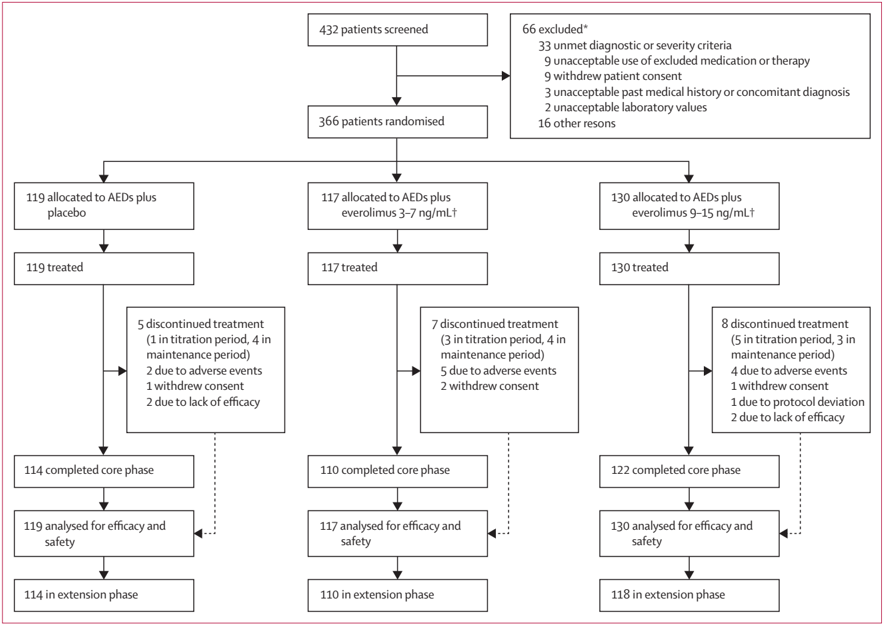
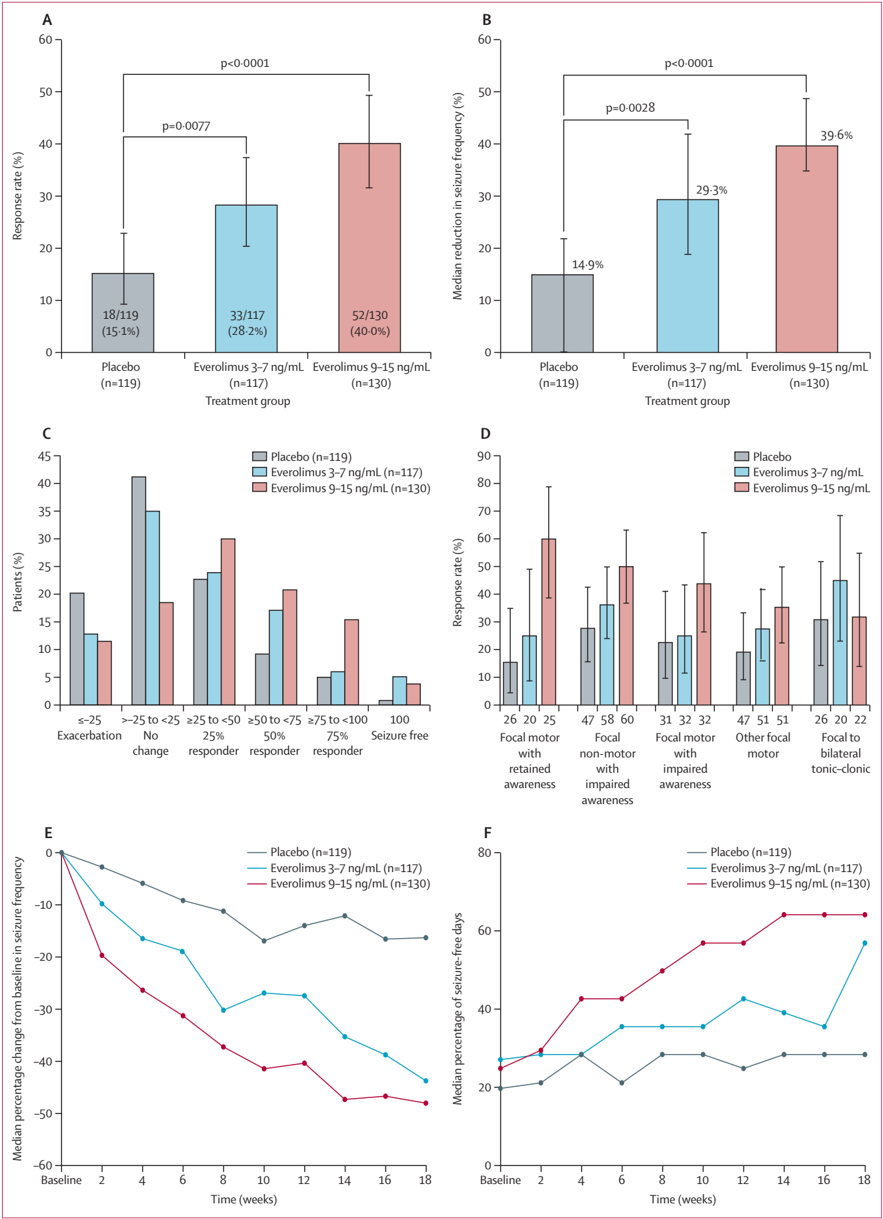
BACKGROUND: Everolimus, a mammalian target of rapamycin (mTOR) inhibitor, has been used for various benign tumours associated with tuberous sclerosis complex. We assessed the efficacy and safety of two trough exposure concentrations of everolimus, 3-7 ng/mL (low exposure) and 9-15 ng/mL (high exposure), compared with placebo as adjunctive therapy for treatment-resistant focal-onset seizures in tuberous sclerosis complex. METHODS: In this phase 3, randomised, double-blind, placebo-controlled study, eligible patients aged 2-65 years with tuberous sclerosis complex and treatment-resistant seizures (≥16 in an 8-week baseline phase) receiving one to three concomitant antiepileptic drugs were recruited from 99 centres across 25 countries. Participants were randomly assigned (1:1:1), via permuted-block randomisation (block size of six) implemented by Interactive Response Technology software, to receive placebo, low-exposure everolimus, or high-exposure everolimus. Randomisation was stratified by age subgroup (<6 years, 6 to <12 years, 12 to <18 years, and ≥18 years). Patients, investigators, site personnel, and the sponsor's study team were masked to treatment allocation. The starting dose of everolimus depended on age, body-surface area, and concomitant use of cytochrome 3A4/P-glycoprotein inducers. Dose adjustments were done to attain target trough ranges during a 6-week titration period, and as needed during a 12-week maintenance period of core phase. Patients or their caregivers recorded events in a seizure diary throughout the study. The primary endpoint was change from baseline in the frequency of seizures during the maintenance period, defined as response rate (the proportion of patients achieving ≥50% reduction in seizure frequency) and median percentage reduction in seizure frequency, in all randomised patients. This study is registered with ClinicalTrials.gov, number NCT01713946. FINDINGS: Between July 3, 2013, and May 29, 2015, 366 patients were enrolled and randomly assigned to placebo (n=119), low-exposure everolimus, (n=117), or high-exposure everolimus (n=130). The response rate was 15·1% with placebo (95% CI 9·2-22·8; 18 patients) compared with 28·2% for low-exposure everolimus (95% CI 20·3-37·3; 33 patients; p=0·0077) and 40·0% for high-exposure everolimus (95% CI 31·5-49·0; 52 patients; p<0·0001). The median percentage reduction in seizure frequency was 14·9% (95% CI 0·1-21·7) with placebo versus 29·3% with low-exposure everolimus (95% CI 18·8-41·9; p=0·0028) and 39·6% with high-exposure everolimus (95% CI 35·0-48·7; p<0·0001). Grade 3 or 4 adverse events occurred in 13 (11%) patients in the placebo group, 21 (18%) in the low-exposure group, and 31 (24%) in the high-exposure group. Serious adverse events were reported in three (3%) patients who received placebo, 16 (14%) who received low-exposure everolimus, and 18 (14%) who received high-exposure everolimus. Adverse events led to treatment discontinuation in two (2%) patients in the placebo group versus six (5%) in the low-exposure group and four (3%) in the high-exposure group. INTERPRETATION: Adjunctive everolimus treatment significantly reduced seizure frequency with a tolerable safety profile compared with placebo in patients with tuberous sclerosis complex and treatment-resistant seizures. FUNDING: Novartis Pharmaceuticals Corporation.
Overview
The claims and statistics of this paper haven’t been checked yet.
Free: it reads the open-access text and checks the first 5 claims that cite a source we can check. Create a free account to check every claim.
Integrity signals
Registry
Cites
Statistics
Figures
Verification
Claims the paper makes
The claims and statistics of this paper haven’t been checked yet.
Free: it reads the open-access text and checks the first 5 claims that cite a source we can check. Create a free account to check every claim.
Claims other papers make about this one
Each is checked against this paper’s own text: does it say what the citing paper says it does?
The source backs part of the claim, not all of it — or backs it for a different population, condition or comparison.
In the citing paper
“mTOR pathway inhibitors, including everolimus and sirolimus may be beneficial as a targeted treatment 131 .”
From Developmental and epileptic encephalopathies (2024) · cites this paper as [131]
Experimental — accuracy not yet measuredThe source backs part of the claim, not all of it — or backs it for a different population, condition or comparison.
In the citing paper
“One example is the EXIST-3 RCT in which the mTOR inhibitor everolimus was trialled in patients with drug-resistant focal seizures in the setting of tuberous sclerosis complex, due to pathogenic variants in the mTOR pathway genes, TSC1 or TSC2.”
From Developmental and epileptic encephalopathies (2024) · cites this paper as [131]
Experimental — accuracy not yet measuredThe cited source says what the claim attributes to it.
In the citing paper
“In this RCT, responder rates were greater with higher-dose everolimus than with placebo; however, they were perhaps less compelling than one might expect for a precision therapy (40% vs 15.1%, p<0.0001) 131 .”
From Developmental and epileptic encephalopathies (2024) · cites this paper as [131]
The cited source says what the claim attributes to it.
In the citing paper
“Effects on cognition and other neuropsychiatric symptoms were not reported.”
From Developmental and epileptic encephalopathies (2024) · cites this paper as [131]
In the citing paper
“Subsequently, inhibitors of mTOR have been proposed as treatments for such syndromes and one drug Everolimus has been approved for treatment of seizures in tuberous sclerosis (French et al., 2016).”
From Getting to the cores of autism (2019) · cites this paper as French et al., 2016
Self-check
Percentages, sums and reported differences re-computed from the paper’s own numbers.
The self-check needs the paper’s full text.
Citations
Cites
Kwan, P., Schachter, S. C., & Brodie, M. J. (2011) · New England Journal of Medicine · doi:10.1056/nejmra1004418 · Cited by 1,052
Everolimus for Subependymal Giant-Cell Astrocytomas in Tuberous Sclerosis
Krueger, D. A., Care, M. M., Holland, K., Agricola, K., Tudor, C., Mangeshkar, P., Wilson, K. A., Byars, A., Sahmoud, T., & Franz, D. N. (2010) · New England Journal of Medicine · doi:10.1056/nejmoa1001671 · Cited by 1,006
Self-citationBissler, J. J., Kingswood, J. C., Radzikowska, E., Zonnenberg, B. A., Frost, M., Belousova, E., Sauter, M., Nonomura, N., Brakemeier, S., de Vries, P. J., et al. (2013) · The Lancet · doi:10.1016/s0140-6736(12)61767-x · Cited by 880
Franz, D. N., Belousova, E., Sparagana, S., Bebin, E. M., Frost, M., Kuperman, R., Witt, O., Kohrman, M. H., Flamini, J. R., Wu, J. Y., et al. (2013) · The Lancet · doi:10.1016/s0140-6736(12)61134-9 · Cited by 794
Self-citationArroyo, S., Rumià, J., Martínez, I., & Ribalta, T. (1998) · PubMed · Cited by 652
Rapamycin prevents epilepsy in a mouse model of tuberous sclerosis complex.
Zeng, L., Xu, L., Gutmann, D. H., & Wong, M. (2008) · Annals of Neurology · doi:10.1002/ana.21331 · Cited by 639
The natural history of epilepsy in tuberous sclerosis complex
Chu‐Shore, C. J., Major, P., Camposano, S., Muzykewicz, D., & Thiele, E. A. (2010) · Epilepsia · doi:10.1111/j.1528-1167.2009.02474.x · Cited by 637
Neurological and neuropsychiatric aspects of tuberous sclerosis complex
Curatolo, P., Moavero, R., & de Vries, P. J. (2015) · The Lancet Neurology · doi:10.1016/s1474-4422(15)00069-1 · Cited by 600
Self-citationMeikle, L., Pollizzi, K., Egnor, A., Kramvis, I., Lane, H., Sahin, M., & Kwiatkowski, D. J. (2008) · The Journal of Neuroscience · doi:10.1523/jneurosci.0955-08.2008 · Cited by 501
Efficacy and Safety of Oral Lacosamide as Adjunctive Therapy in Adults with Partial‐Onset Seizures
Ben‐Menachem, E., Biton, V., Jatuzis, D., Abou‐Khalil, B., Doty, P., & Rudd, G. D. (2007) · Epilepsia · doi:10.1111/j.1528-1167.2007.01188.x · Cited by 485
Research works printed but not linked: 1
- 20. European Medicines Agency. Guideline on clinical investigation of medicinal products in the treatment of epileptic disorders. July 22, 2010. CHMP/EWP/566/98 Rev.2/Corr. http:// wwwemaeuropaeu/docs/en_GB/document_library/Scientifi c_ guideline/2010/01/WC500070043pdf (accessed July 8, 2016).
Cited by
Items 701–796 of 796
Elger, C. E., Jeub, M., & Kovac, S. (2024) · Elsevier eBooks · doi:10.1016/b978-3-437-21004-4.00007-9
Die neuen anfallsunterdrückenden Medikamente für das Kindes- und Jugendalter
Kurlemann, G., Lehbrink, R., & Bosse, H. (2024) · Monatsschrift Kinderheilkunde · doi:10.1007/s00112-024-01924-w
“39,6% vs. Placebo mit 14,9% gezeigt werden [23].”
Caractérisation d’un modèle murin d’épilepsie liée à mTOR
Layus, L. (2022) · theses.fr (ABES) · doi:10.70675/9878b6a8z9300z4596z8b4dz6cb90e294325
Seyama, K., Komiyama, E., Tsuchihashi, H., Okura, M. K., Sekimoto, Y., & Mitsuishi, Y. (2024) · Cureus · doi:10.7759/cureus.58805 · Cited by 2
“Second, although the target trough level in the blood for sirolimus and everolimus is typically supposed to be 5 ng/m1-15 ng/m1 [2,6,11], we have previously reported that low trough levels of sirolimus, such as 1 ng/m1-2 ng/ml, are also therapeutic [12].”
BackgroundCullen, E. R., Safari, M., Mittelstadt, I., & Weston, M. C. (2024) · eLife · doi:10.7554/elife.91323.2.sa4
Current and Future Drugs for Brain Tumors Treatment
Bruno, F., Pellerino, A., Marchesani, E. M., & Rudà, R. (2024) · Springer eBooks · doi:10.1007/978-3-031-59341-3_6 · Cited by 1
Dugan, P. C. (2024) · Oxford University Press eBooks · doi:10.1093/med/9780198820758.003.0008
Severe hypertension in tuberous sclerosis complex caused by renal artery stenosis: A case report
Xiong, Y., Li, S., & Shen, G. (2024) · Nephrology · doi:10.1111/nep.14398
D’Gama, A. M., Poduri, A., & Volpe, J. J. (2024) · Elsevier eBooks · doi:10.1016/b978-0-443-10513-5.00005-x
Resective surgery in tuberous sclerosis complex-related epilepsy: tuberectomy and tuberectomy plus
Liang, S., Wei, Z., Wang, J., & Zhai, F. (2024) · Elsevier eBooks · doi:10.1016/b978-0-323-95981-0.00017-5
GATOR1 gene variants in focal epilepsy
Kovačević, M., Vojvodić, N. M., & Novaković, I. V. (2024) · Medicinski podmladak · doi:10.5937/mp75-45140
“Everolimus, an mTOR inhibitor, has been proven to be safe and efficacious in treating epilepsy in TSC (47), as well as polyhydramnios, megalencephaly and symptomatic epilepsy, another mTORopathy (48).”
Novel Approaches for Treating Pediatric Psychiatric Disorders
Sabetfakhri, N. P., & Cook, E. H. (2025) · Oxford University Press eBooks · doi:10.1093/med/9780197640654.003.0068
Dun, S., Wan, L., Wang, Y.-Y., Lu, Q., Zhang, Q., Wang, Q.-H., Wang, J., Zhao, H.-Q., & Zou, L.-P. (2025) · Kidney International Reports · doi:10.1016/j.ekir.2025.03.021
Treatment of Neurodevelopmental Disorders
van Karnebeek, C., Berry‐Kravis, E., & Gropman, A. L. (2024) · Elsevier eBooks · doi:10.1016/b978-0-443-10944-7.00079-2
Antiseizure Medication Therapy in Children
Arya, R., & Glauser, T. A. (2025) · Elsevier eBooks · doi:10.1016/b978-0-443-10944-7.00098-6
Emerging Gene-Based Pathways: mTORopathies
Ziobro, J. M., & Dang, L. T. (2025) · Elsevier eBooks · doi:10.1016/b978-0-443-10944-7.00054-8
Prinzipien der medikamentösen Epilepsietherapie
Krämer, G., & Steinhoff, B. J. (2025) · Springer eBooks · doi:10.1007/978-3-662-67714-8_1
Tanvir, Z., Haq, K., Khan, H. A., Ahmad, W., Okon, I. I., & Chaurasia, B. K. (2025) · Surgery Case Reports · doi:10.1016/j.sycrs.2025.100130
Phase 1 study of ABI ‐009 ( nab ‐rapamycin) for surgically refractory epilepsy ( RaSuRE )
Hall, K., Saneto, R. P., Randle, S. C., Wainwright, M. S., Berry, P., Leary, S. E. S., Mirzaa, G., Lockrow, J. P., Goldstein, H. E., Ojemann, J. G., et al. (2025) · Epilepsia · doi:10.1111/epi.18555
“32 At the molecular level, a pilot study evaluating everolimus in TSC and MCD resulted in lower mTOR signaling.”
Influential(2022) · Elsevier eBooks · doi:10.1016/b978-3-437-21884-2.00033-7
Diagnostik und Therapie neurologischer Erkrankungen bei Kindern und Jugendlichen
Trollmann, R. (2022) · Elsevier eBooks · doi:10.1016/b978-3-437-21884-2.00018-0
Intermediate Stage of Epileptogenesis Is Not Affected by Disrupting Memory Consolidation Processes
Howey, C., McFetridge, A., & Luczak, A. (2025) · International Journal of Molecular Sciences · doi:10.3390/ijms26178364
“Additionally, a derivative of rapamycin has been approved by the American Food and Drug Administration for its use as a treatment for seizures in tuberous sclerosis patients following the success of clinical trials [33].”
Rare gliomas: standard treatment approaches and new target therapies
Bruno, F., Pellerino, A., Pronello, E., & Rudà, R. (2025) · Current Opinion in Neurology · doi:10.1097/wco.0000000000001428
Application of population pharmacokinetic modeling of SVG-101 to evaluate proper dose selection
Mo, K. H., Chae, D., Jung, Y. S., Jin, B. H., Keum, D. H., Choi, M., Cha, J. S., Park, M. S., & Kim, C. O. (2025) · Translational and Clinical Pharmacology · doi:10.12793/tcp.2025.33.e14
Urbańska, M., Sadowski, K., Stawikowska, A., Liszewska, E., Mlostek, M., Grajkowska, W., & Kotulska, K. (2025) · Journal of Neurochemistry · doi:10.1111/jnc.70247
Clinical profiles of tuberous sclerosis complex: A regionally based survey
Yamada, M., Natsume, J., Maki, Y., Ishimaru, S., Numoto, S., Kobayashi, S., Hattori, A., Matsukawa, Y., Wakahara, K., Ishihara, N., et al. (2025) · Brain and Development · doi:10.1016/j.braindev.2025.104479
mTORC1 inhibition by sirolimus as adjunctive treatment in experimental pneumococcal meningitis
Koning, R., Bakker, D., van ROON, M. A., Jaspers, V., Brouwer, M. C., & van de Beek, D. (2025) · Brain Communications · doi:10.1093/braincomms/fcaf460
Vasseghi, M., Behan, C., Connolly, A., Cunningham, D., Dempsey, E., Flynn, C., Galvin, M., Griffin, G., Moloney, P. B., Murphy, M., et al. (2024) · Figshare · doi:10.6084/m9.figshare.26787028
Cerullo, M. S. (2021) · CINECA IRIS Institutial Research Information System (University of Genoa) · doi:10.15167/cerullo-maria-sabina_phd2021-04-27
Additional file 1 of Prevalence of thoracoabdominal imaging findings in tuberous sclerosis complex
Ritter, D. M., Fessler, B. K., Ebrahimi‐Fakhari, D., Wei, J., Franz, D. N., Krueger, D. A., Trout, A. T., & Towbin, A. J. (2022) · Figshare · doi:10.6084/m9.figshare.19367635
Self-citationCockerell, I., Christensen, J., Hoei‐Hansen, C. E., Holst, L., Grenaa Frederiksen, M., Issa-Epe, A. I., Nedregaard, B., Solhoff, R., Heimdal, K., Johannessen Landmark, C., et al. (2023) · Figshare · doi:10.6084/m9.figshare.24716947
Petrásek, T., Vojtěchová, I., Klovrza, O., Tuckova, K., Vejmola, Č., Rak, J., Šuláková, A., Kaping, D., Bernhardt, N. R., de Vries, P. J., et al. (2021) · Figshare · doi:10.6084/m9.figshare.14443138
Self-citationPhotography as a medium of biographical reportage: Witkacy's "Theatre of Life"
Grabowska, A. (2024) · Jagiellonian University Repository (Jagiellonian University)
Advances of Genomic Medicine in Neurodevelopmental Disorders
Akter, H., Uddin, M. J., & Nabi, A. H. M. N. (2026) · Interdisciplinary biotechnological advances · doi:10.1007/978-981-95-3612-2_6
Hsieh, C. C., Huang, N., Tung, S.-Y., Lin, W.-X., Wang, H., Nguyen, T. T. A., Chern, Y., & Lee, Y. (2026) · Cell & Bioscience · doi:10.1186/s13578-025-01518-3
“In addition, mTOR inhibitors such as sirolimus (rapamycin) and everolimus have been approved by the U.S. FDA as an adjunctive treatment for drug-resistant TSC-associ-ated epilepsy based on the results of the clinical study [5].”
Nörolojik Hastalıklarda Güncel Tedaviler
Demir, T. G., Çelik, O., Işık, K., Tur, E. K., Koçak, Y., Çevik, D. E., Çolakoğlu, D., Ertekin, A., Taşkın, Y., Şencan, R., et al. (2026) · Akademisyen Kitabevi eBooks · doi:10.37609/akya.3932
Ruan, Y., Chen, L., Xia, S., Lu, Q., Wang, J., Zhu, F., Li, N., Du, H., & Sun, D. (2026) · Frontiers in Pediatrics · doi:10.3389/fped.2026.1751113
“Notable progress has been made with molecular targeted therapies; for instance, mTOR inhibitors have demonstrated clear benefits in treating DRE associated with TSC mutations and show potential efficacy in cases caused by DEPDC5 mutations (29–32).”
Bedrosian, T. A., Wong, M., Heinzen, E., Deneen, B., & Christian-Hinman, C. A. (2026) · Epilepsy Currents · doi:10.1177/15357597261418332
“19 Therefore, mTOR inhibitors are established in clinical practice to be effective treatments for both tumors and epilepsy in TSC and likely involve overlapping mTOR-mediated mechanisms.”
Esserlind, A.-L., Pedersén, A., Abel, F., Hallböök, T., Reilly, C. J., Nilsson, D., Liakina, T., & Bontell, T. O. (2026) · Epilepsy & Behavior Reports · doi:10.1016/j.ebr.2026.100856
“This finding is especially relevant to RHEB -associated DRFE, as RHEB functions up-stream of mTOR within the same signaling pathway, suggesting that patients with somatic RHEB mutations may similarly benefit from mTORC1-targeted therapy [43,72,73].”
Cameron, A. (2025) · TSpace (University of Toronto)
Tuberoskleroz Kompleksi ve Epilepsi
Ayça, S. (2026) · Yüksek İhtisas Üniversitesi Sağlık Bilimleri Dergisi · doi:10.51261/yiu.2026.1837289
Tuberoskleroz: Olgu Sunumu ve Nörolojik Takip
Ulukapı, N. A., & Yüksel, D. (2026) · Yüksek İhtisas Üniversitesi Sağlık Bilimleri Dergisi · doi:10.51261/yiu.2026.1864847
Ding, R., Meng, L., Hong, S.-Q., Guo, Y., Cheng, M., Hu, Y., Luo, Y., Jiang, L., & Xie, L. (2026) · Seizure · doi:10.1016/j.seizure.2026.04.002
Investigations génétiques et physiopathologiques des dysplasies corticales focales de type 2
Ribierre, T. (2020) · theses.fr (ABES) · doi:10.70675/7ac267e2z8712z4e0fza9a1z424bc9445787
Role of the mTOR-downstream effector S6K1 in tuberous sclerosis complex neurological manifestations
Avanzi, F. (2023) · theses.fr (ABES) · doi:10.70675/20853cbdz078bz47dcza392zaeb61eb11f48
Implication de la neuropiline-1 dans la progression du médulloblastome
Douyère, M. (2023) · theses.fr (ABES) · doi:10.70675/539deff7z7212z4a82za430z09efcbe482fc
Characterizing and targeting the microenviromental changes in PIK3CA related overgrowth syndromes
Galasso, I. (2024) · theses.fr (ABES) · doi:10.70675/b81c167azcc23z4977z90f0z0ff71e3da7c4
Pineau, L. (2023) · theses.fr (ABES) · doi:10.70675/39c790cfzdf57z416bzb9cez06eca43d9cda
Kadandelu, M., Periya, S., Rekha, P. D., & Raghu, S. V. (2026) · Reviews in the Neurosciences · doi:10.1515/revneuro-2025-0144
“Everolimus is an mTOR pathway inhibitor that e ff ectively reduced the TSC-related tumors while also signi fi cantly decreasing seizure frequency in patients with TSC (French et al. 2016).”
Early provoking factors of epileptogenesis in mesial temporal lobe epilepsy
Котов, А. С., & Firsov, K. V. (2026) · Epilepsy and Paroxysmal Conditions · doi:10.17749/2077-8333/epi.par.con.2026.264
Alsharhan, M., Alkhezi, O. S., & Alfayez, O. M. (2026) · Saudi Pharmaceutical Journal · doi:10.1007/s44446-026-00067-1
“Everolimus has demonstrated in randomized clinical trials to be effective in TSC-related tumors such as subependymal giant cell astrocytoma (SEGA) and angiomyolipoma (AML) (Bissler et al. 2013; Franz et al. 2013; French et al. 2016).”
Olson, C. V., Shariati, N., Procházková, N., Čížek, K., Řehořová, M., Populová, J., Rozlivková, J. T., Wang, S., Ricketts, B., Kucerova, B., et al. (2026) · bioRxiv (Cold Spring Harbor Laboratory) · doi:10.64898/2026.05.19.726138
Capal, J. K., Ritter, D. M., Horn, P. S., Currans, K., Kent, B., Pearson, D. A., Mansour, R., O’Kelley, S. E., Şahin, M., Bebin, E. M., et al. (2026) · Pediatric Neurology · doi:10.1016/j.pediatrneurol.2026.07.001
Vũ Phương Nhung, L. N. M., Hùng, C. V., & Tôn, N. Đ. (2026) · Ministry of Science and Technology Vietnam · doi:10.31276/vjst.2026.3925
Epilepsy and disability in adults with tuberous sclerosis complex: a 16-year retrospective analysis
Calonge, Q., Hanin, A., Dade, M., Bailly, L., Gourfinkel‐An, I., & Navarro, V. (2026) · Journal of Neurology · doi:10.1007/s00415-026-13945-4
“These data support the potential interest of everolimus in selected patients with TSC-related drug-resistant epilepsy [28].”
Suh, Y.-A., Kim, S. W., Choi, S., Park, M. S., Lee, J. H., Jeong, S. I., Yu, R., & Sohn, Y. B. (2026) · Epilepsy & Behavior Reports · doi:10.1016/j.ebr.2026.100887
“The phase III EXIST-3 trial established its role as adjunctive therapy for seizure control in patients aged ≥ 2 years [7,8].”
Gao, K., Duan, Y., Ren, B., Guo, B., Su, R., Gu, H., Chen, F. L., Zhang, C., Wu, G., & Ni, J. (2026) · Frontiers in Oncology · doi:10.3389/fonc.2026.1893155
Sodium ion channels as therapeutic targets in epilepsy: a drug discovery perspective
Kong, W., Lv, K., Gao, R., Liangju, H., Zhou, Y., Liu, X., Chen, D., Li, F., & Chen, W. (2026) · Bioorganic Chemistry · doi:10.1016/j.bioorg.2026.110297
Saxena, A., Drew, C. J., Cannings-John, R., Pickles, T., Mills, L., McDermott, E., Angel, L., McNamara, R., Smalley, M., Randell, E., et al. (2026) · Journal of Medical Genetics · doi:10.1136/jmg-2026-111529
Wang, L., Zou, Y., He, Z., Liang, X., & Zhang, S. (2026) · doi:10.2196/preprints.109502
Okanishi, T., Sakuma, S., Kikuchi, K., Ito, S., Okanari, K., Fujimoto, A., Honda, R., & Mizuguchi, M. (2026) · Brain and Development · doi:10.1016/j.braindev.2026.104583
Rare genetic endocrine tumor syndromes: VHL, NF1, TSC, and Carney complex
Vrachnis, D. N., & Stratakis, C. A. (2026) · Best Practice & Research Clinical Endocrinology & Metabolism · doi:10.1016/j.beem.2026.102159
Abnormal KCC2 expression and function in a mouse model of epilepsy and tuberous sclerosis complex
Guo, D., Han, L., Rensing, N. R., Jansen, L. A., & Wong, M. (2026) · Epilepsia · doi:10.1002/epi.70434
Cai, M.-S., Li, H.-R., Liao, P., Hu, Z., & Chen, Y.-J. (2026) · Frontiers in Genetics · doi:10.3389/fgene.2026.1902275
“However, trials in tuberous sclerosis complex show that pathway-or mechanism-directed treatment may improve specific seizure outcomes without parallel benefits across cognition, development, and all seizure types (French et al., 2016; Bebin et al., 2023).”
Perilli, L., Dell’Isola, G. B., Ferrara, P., Savasta, S., Vigevano, F., Striano, P., & Verrotti, A. (2026) · Expert Opinion on Pharmacotherapy · doi:10.1080/14656566.2026.2725871
“In particular, everolimus is a clear example of etiology-targeted treatment for TSC-related temporal seizures and mTOR-related malformations [61,89].”
InfluentialTuberous sclerosis in a young child: A case report
Rajani, H. S., & Bhat, A. V. (2026) · Karnataka Pediatric Journal · doi:10.25259/kpj_29_2026
Herini, E. S., Triono, A., Iskandar, K., Nugrahanto, A. P., Damroni, R. A., Mooiindie, K. H., & Timoti, J. (2026) · Neurogenetics · doi:10.1007/s10048-026-00932-0
The Burden of Epilepsy: The Contribution of Seizures (AES 2025 Presidential Symposium)
Downs, J. A., Berg, A. T., Dang, L. T., Kapur, J., McDonald, C. R., & Goodkin, H. P. (2026) · Epiliepsy currents/Epilepsy currents · doi:10.1177/15357597261478432
Li, L., Li, J., Yang, L., Zhou, J., & Ma, Y. (2026) · Pharmaceuticals · doi:10.3390/ph19091388
“…FKBP12-mediated inhibition of mTORC1, is approved as an adjunctive treatment for tuberous sclerosis complex (TSC)-associated partial-onset seizures [107], illustrating that stabilizing or reconfiguring regulatory protein complexes can produce clinically meaningful effects in neurological disease.”
mTOR-Mediated Neuron–Cancer Interactions
Nyarkoh, J. K., Wolan, M. J., & Feliciano, D. M. (2026) · Kinases and Phosphatases · doi:10.3390/kinasesphosphatases4030024
“In the phase III clinical trial EXIST-3, everolimus (blood concentration: 9–15 ng/mL) significantly reduced seizure frequency in patients with refractory focal-onset epilepsy [110].”
Su, T., Chen, P., Peng, S. S., Shang, C., Lin, C.-W., & Fan, P. (2026) · Journal of the Formosan Medical Association · doi:10.1016/j.jfma.2026.09.003
Somatic mosaicism in the brain: linking development, ageing and neurodegeneration
Zhou, Z., & Walsh, C. A. (2026) · Nature Reviews Neurology · doi:10.1038/s41582-026-01268-x · Cited by 1
Emerging role of targeted therapy in drug-resistant epilepsy in patients with glioma
Bruno, F., Pellerino, A., & Rudà, R. (2026) · Current Opinion in Oncology · doi:10.1097/cco.0000000000001279
Tuberous sclerosis complex - neurological aspects, diagnosis and modern treatment
Kubek, J., Březinová, E., Marvanová, E., Pažourková, M., & Doležalová, I. (2026) · Neurologie pro praxi · doi:10.36290/neu.2026.050
Boßelmann, C. M., Wagner, M., Borggräfe, I., Brandt, C., Didt, S., Fazeli, W., Grimmer, A., Kegele, J., Klein, K.-M., Kluger, G., et al. (2026) · Clinical Epileptology · doi:10.1007/s10309-026-00876-3
Zhang, B., Wang, W., Li, T., & Hua, H. (2026) · Frontiers in Cellular Neuroscience · doi:10.3389/fncel.2026.1979155
“…risk (Clemens et al., 2015; Marie et al., 2019). mTOR Nutrient/insulin sensing; glycolytic reprogramming; interaction with HIF-1 α and inflammatory pathways (Cheng et al., 2014) Rapamycin/sirolimus; everolimus clinically reduces TSC-associated treatment-resistant seizures (French et al., 2016).”
InfluentialPerry, M. S. (2026) · Journal of Clinical Medicine · doi:10.3390/jcm15207886
“In the phase III EXIST-3 trial, low-and high-exposure everolimus produced ≥ 50% seizure-response rates of 28% and 40%, respectively, compared with 15% with placebo, confirming exposure-dependent antiseizure efficacy [135].”
Genetic developmental and epileptic encephalopathies in adulthood: Gaps in evidence and care
Dudley, A. M., Widdess‐Walsh, P., Linehan, C., Andrade, D. M., Delanty, N., & Moloney, P. B. (2026) · Epilepsia Open · doi:10.1002/epi4.70359
Pacheva, I. H. (2026) · Genes · doi:10.3390/genes17101308
“…phase 3 EXIST-3 trial, adjunctive everolimus significantly reduced seizure frequency compared with placebo, providing high-level evidence that pharmacological targeting of a genetically dysregulated intracellular pathway can translate into clinically meaningful seizure reduction [88].”
Xie, Y., Luo, Y., Wan, L., Zhang, Z., 王永安, & Yang, G. (2026) · Current Issues in Molecular Biology · doi:10.3390/cimb48111112
Dong, R., Zhang, H., Wang, X., Zhang, K., & Liu, G.-H. (2026) · Genes · doi:10.3390/genes17111326
Новые возможности преодоления фармакорезистентности при эпилепсии
Викторовна, С. Т., Викторовна, М. Т., Михайлович, М. А., Николаевна, К. А., & Александровна, Н. С. (2023) · Medical alphabet
BindingDB (2024) · UC San Diego · doi:10.7270/q2cr5zqh
BindingDB Entry 50012662: 4-(Difluoromethyl)-5-(4-((3
BindingDB (2022) · UC San Diego · doi:10.7270/q2sn0dns
Network analysis reveals converging molecular mechanisms in genetic epilepsiesPreprint
Duan, Y., Valeanu, A., Rouhl, R. P. W., Vermeulen, R. J., de Kok, T. M. C. M., & Ehrhart, F. (2026) · bioRxiv (Cold Spring Harbor Laboratory) · doi:10.64898/2026.10.28.762494
Zhang, J., Dang, Y., Wan, L., Liu, Q., Liu, X., Hu, L., Wang, J., Shi, X., Zhao, H., & Yang, G. (2026) · Biology · doi:10.3390/biology15211976
Sha, L., Fu, Y., Basang, S., Jin, L., Huang, S., Chen, T., Zhang, J., He, M., Zhang, J., & Chen, L. (2026) · Signal Transduction and Targeted Therapy · doi:10.1038/s41392-026-03104-6
Alqurashi, R. S. (2026) · Frontiers in Pharmacology · doi:10.3389/fphar.2026.1972918
Thiele, E. A., Greco, T. L., Nortvedt, C., Vyas, K., & Nabbout, R. (2026) · Neurology and Therapy · doi:10.1007/s40120-026-01075-y
Self-citationLubbers, K., Stijl, E. M., Dierckx, B., Hagenaar, D. A., ten Hoopen, L. W., Legerstee, J. S., de Nijs, P. F. A., Rietman, A. B., Greaves-Lord, K., Hillegers, M. H. J., et al. (2022) · doi:10.3389/fpsyt.2022.852208.s002
Zhou, H., Zheng, Z., Tu, Z., Li, Y., Yang, J., & Fan, C. (2023) · doi:10.3389/fped.2023.1263631.s003
Metadata
- Authors
- French, J. A., Lawson, J. A., Yapici, Z., Ikeda, H., Polster, T., Nabbout, R., Curatolo, P., de Vries, P. J., Dlugos, D. J., Berkowitz, N., Voi, M., Peyrard, S., Pelov, D., & Franz, D. N.
- Affiliations
- NYU Langone Health (US)
- Sydney Children's Hospital (AU)
- National Epilepsy Center (JP)
- Krankenhaus Mara (DE)
- Hôpital Necker-Enfants Malades (FR)
- Policlinico Tor Vergata (IT)
- Children's Hospital of Philadelphia (US)
- Cincinnati Children's Hospital Medical Center (US)
- Corresponding author
- French, Jacqueline A
- ORCID
- Venue
- The Lancet
- Publisher
- Elsevier BV
- Published
- 2016-10
- Volume
- 388
- Issue
- 10056
- Pages
- 2153-2163
- ISSN
- 0099-5355 (ISSN-L)
- 0140-6736
- OpenAlex
- W2511912940
- Cited by
- 764
- References
- 31
- Citations by year
- 2026: 55 · 2025: 75 · 2024: 57 · 2023: 78 · 2022: 76 · 2021: 97 · 2020: 108 · 2019: 73 · 2018: 65 · 2017: 69 · 2016: 10
- FWCI
- 58.25
- Type
- journal article
- Language
- en
- Open access
- hybrid
- doi.org
- Licence
- cc-by-nc-nd
- www.elsevier.com/tdm/userlicense/1.0/ (tdm)
- creativecommons.org/licenses/by-nc-nd/4.0/ (vor)
- Locations
- The Lancet (publishedVersion, cc-by-nc-nd)
- PubMed (publishedVersion)
- Cineca Institutional Research Information System (Tor Vergata University) (submittedVersion)
- INFM-OAR (INFN Catania) (submittedVersion, cc-by-nc-nd)
- Funders
- Novartis Pharmaceuticals Corporation
- Topics
- Health Sciences › Medicine › Genetics (clinical) › Tuberous Sclerosis Complex Research
- Health Sciences › Medicine › Clinical Neurology › Epilepsy research and treatment
- Health Sciences › Medicine › Pediatrics, Perinatology and Child Health › Pharmacological Effects and Toxicity Studies
- Keywords
- everolimus, tuberous sclerosis complex, focal seizures, drug-resistant epilepsy, adjunctive antiepileptic therapy, mTOR inhibitors, seizure frequency reduction, antiepileptic drug interactions, adverse events, pharmacovigilance
- MeSH terms
- Everolimus, Adolescent, Adult, Aged, Anticonvulsants, Antineoplastic Agents, Child, Child, Preschool, Combined Modality Therapy, Dose-Response Relationship, Drug, Double-Blind Method, Female, Humans, Male, Middle Aged, Seizures, Tuberous Sclerosis
About these checks
Registry, retraction, Cites and statistics results are computed, not judged, with one exception: a printed reference that no index lists is read once by a model before it counts as a citation error. Claims are extracted by a model and kept only when their quote appears verbatim in the text; each cited source is then checked, with a model’s help, for whether it says what the claim relies on. Those verdicts can be wrong — read the claim’s quote and the cited source before relying on one.
Statistics and arithmetic are recomputed, not judged.
Confidence bands are shown only for fields calibrated on our annotated test set. None is calibrated yet, so no band is shown.
What counts as a claim ›How we measure confidence ›How we check this ›
Are you an author, or do you see a problem with this page? Request a review
Data sources
Bibliographic data: Semantic Scholar, OpenAlex, Crossref.
Contains information from the Semantic Scholar Academic Graph Datasets, made available under the ODC Attribution License (ODC-BY 1.0).
Semantic Scholar’s data is described in: Kinney, R., et al. (2023). The Semantic Scholar Open Data Platform. arXiv:2301.10140.
