

Adjunctive everolimus therapy for treatment-resistant focal-onset seizures associated with tuberous sclerosis (EXIST-3): a phase 3, randomised, double-blind, placebo-controlled study
Open accessThe DOI matches its Crossref record; 31 of the 31 references it cites were found in a registry or an index.
Abstract
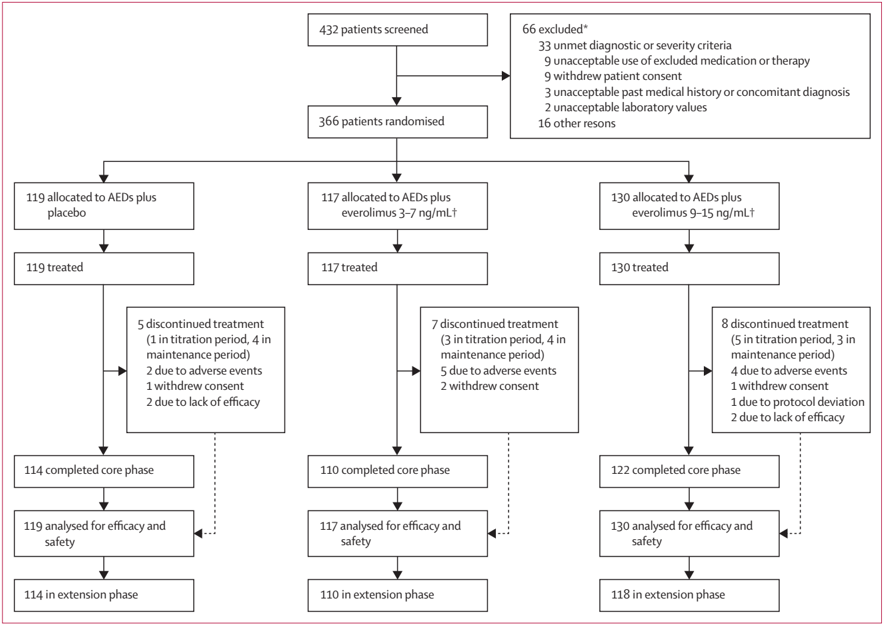
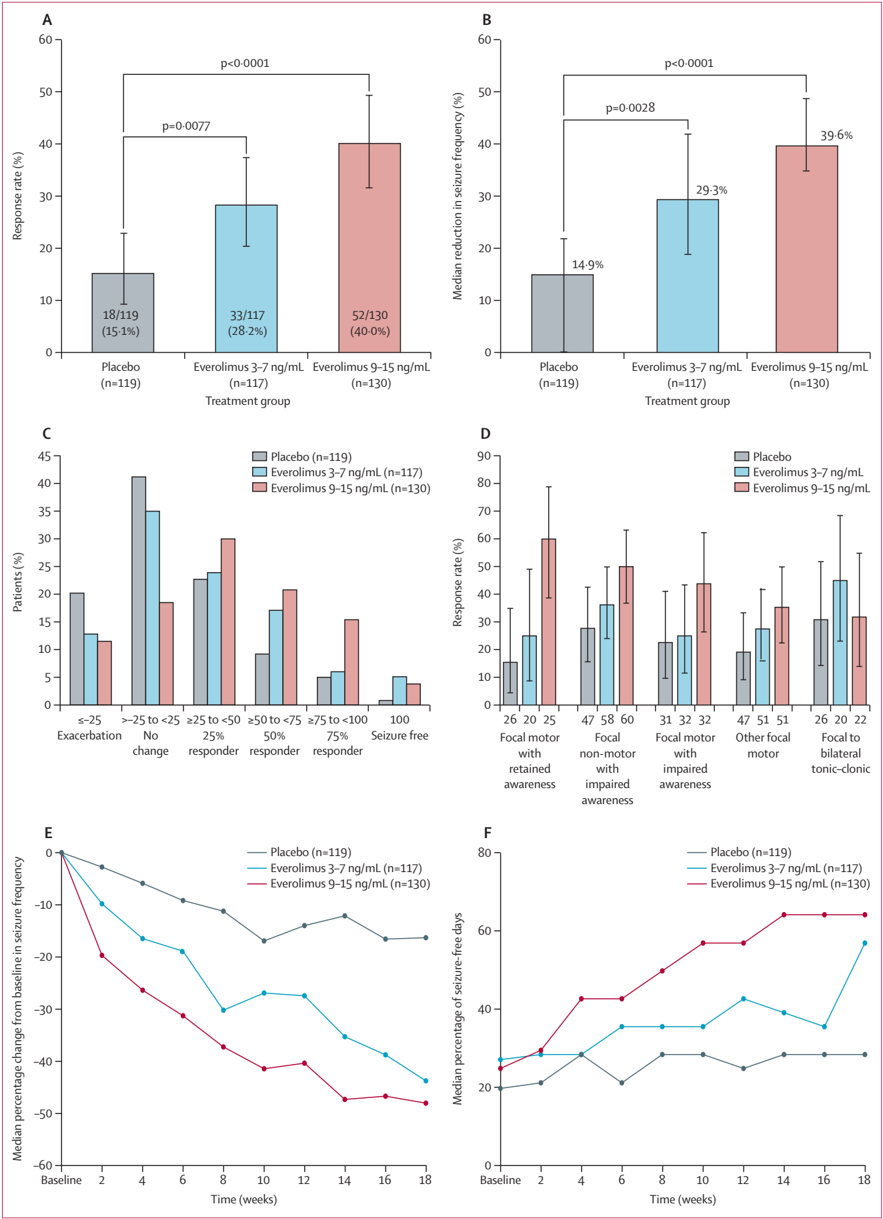
BACKGROUND: Everolimus, a mammalian target of rapamycin (mTOR) inhibitor, has been used for various benign tumours associated with tuberous sclerosis complex. We assessed the efficacy and safety of two trough exposure concentrations of everolimus, 3-7 ng/mL (low exposure) and 9-15 ng/mL (high exposure), compared with placebo as adjunctive therapy for treatment-resistant focal-onset seizures in tuberous sclerosis complex. METHODS: In this phase 3, randomised, double-blind, placebo-controlled study, eligible patients aged 2-65 years with tuberous sclerosis complex and treatment-resistant seizures (≥16 in an 8-week baseline phase) receiving one to three concomitant antiepileptic drugs were recruited from 99 centres across 25 countries. Participants were randomly assigned (1:1:1), via permuted-block randomisation (block size of six) implemented by Interactive Response Technology software, to receive placebo, low-exposure everolimus, or high-exposure everolimus. Randomisation was stratified by age subgroup (<6 years, 6 to <12 years, 12 to <18 years, and ≥18 years). Patients, investigators, site personnel, and the sponsor's study team were masked to treatment allocation. The starting dose of everolimus depended on age, body-surface area, and concomitant use of cytochrome 3A4/P-glycoprotein inducers. Dose adjustments were done to attain target trough ranges during a 6-week titration period, and as needed during a 12-week maintenance period of core phase. Patients or their caregivers recorded events in a seizure diary throughout the study. The primary endpoint was change from baseline in the frequency of seizures during the maintenance period, defined as response rate (the proportion of patients achieving ≥50% reduction in seizure frequency) and median percentage reduction in seizure frequency, in all randomised patients. This study is registered with ClinicalTrials.gov, number NCT01713946. FINDINGS: Between July 3, 2013, and May 29, 2015, 366 patients were enrolled and randomly assigned to placebo (n=119), low-exposure everolimus, (n=117), or high-exposure everolimus (n=130). The response rate was 15·1% with placebo (95% CI 9·2-22·8; 18 patients) compared with 28·2% for low-exposure everolimus (95% CI 20·3-37·3; 33 patients; p=0·0077) and 40·0% for high-exposure everolimus (95% CI 31·5-49·0; 52 patients; p<0·0001). The median percentage reduction in seizure frequency was 14·9% (95% CI 0·1-21·7) with placebo versus 29·3% with low-exposure everolimus (95% CI 18·8-41·9; p=0·0028) and 39·6% with high-exposure everolimus (95% CI 35·0-48·7; p<0·0001). Grade 3 or 4 adverse events occurred in 13 (11%) patients in the placebo group, 21 (18%) in the low-exposure group, and 31 (24%) in the high-exposure group. Serious adverse events were reported in three (3%) patients who received placebo, 16 (14%) who received low-exposure everolimus, and 18 (14%) who received high-exposure everolimus. Adverse events led to treatment discontinuation in two (2%) patients in the placebo group versus six (5%) in the low-exposure group and four (3%) in the high-exposure group. INTERPRETATION: Adjunctive everolimus treatment significantly reduced seizure frequency with a tolerable safety profile compared with placebo in patients with tuberous sclerosis complex and treatment-resistant seizures. FUNDING: Novartis Pharmaceuticals Corporation.
Overview
The claims and statistics of this paper haven’t been checked yet.
Free: it reads the open-access text and checks the first 5 claims that cite a source we can check. Create a free account to check every claim.
Integrity signals
Registry
Cites
Statistics
Figures
Verification
Claims the paper makes
The claims and statistics of this paper haven’t been checked yet.
Free: it reads the open-access text and checks the first 5 claims that cite a source we can check. Create a free account to check every claim.
Claims other papers make about this one
Each is checked against this paper’s own text: does it say what the citing paper says it does?
The source backs part of the claim, not all of it — or backs it for a different population, condition or comparison.
In the citing paper
“mTOR pathway inhibitors, including everolimus and sirolimus may be beneficial as a targeted treatment 131 .”
From Developmental and epileptic encephalopathies (2024) · cites this paper as [131]
Experimental — accuracy not yet measuredThe source backs part of the claim, not all of it — or backs it for a different population, condition or comparison.
In the citing paper
“One example is the EXIST-3 RCT in which the mTOR inhibitor everolimus was trialled in patients with drug-resistant focal seizures in the setting of tuberous sclerosis complex, due to pathogenic variants in the mTOR pathway genes, TSC1 or TSC2.”
From Developmental and epileptic encephalopathies (2024) · cites this paper as [131]
Experimental — accuracy not yet measuredThe cited source says what the claim attributes to it.
In the citing paper
“In this RCT, responder rates were greater with higher-dose everolimus than with placebo; however, they were perhaps less compelling than one might expect for a precision therapy (40% vs 15.1%, p<0.0001) 131 .”
From Developmental and epileptic encephalopathies (2024) · cites this paper as [131]
The cited source says what the claim attributes to it.
In the citing paper
“Effects on cognition and other neuropsychiatric symptoms were not reported.”
From Developmental and epileptic encephalopathies (2024) · cites this paper as [131]
In the citing paper
“Subsequently, inhibitors of mTOR have been proposed as treatments for such syndromes and one drug Everolimus has been approved for treatment of seizures in tuberous sclerosis (French et al., 2016).”
From Getting to the cores of autism (2019) · cites this paper as French et al., 2016
Self-check
Percentages, sums and reported differences re-computed from the paper’s own numbers.
The self-check needs the paper’s full text.
Citations
Cites
Kwan, P., Schachter, S. C., & Brodie, M. J. (2011) · New England Journal of Medicine · doi:10.1056/nejmra1004418 · Cited by 1,052
Everolimus for Subependymal Giant-Cell Astrocytomas in Tuberous Sclerosis
Krueger, D. A., Care, M. M., Holland, K., Agricola, K., Tudor, C., Mangeshkar, P., Wilson, K. A., Byars, A., Sahmoud, T., & Franz, D. N. (2010) · New England Journal of Medicine · doi:10.1056/nejmoa1001671 · Cited by 1,006
Self-citationBissler, J. J., Kingswood, J. C., Radzikowska, E., Zonnenberg, B. A., Frost, M., Belousova, E., Sauter, M., Nonomura, N., Brakemeier, S., de Vries, P. J., et al. (2013) · The Lancet · doi:10.1016/s0140-6736(12)61767-x · Cited by 880
Franz, D. N., Belousova, E., Sparagana, S., Bebin, E. M., Frost, M., Kuperman, R., Witt, O., Kohrman, M. H., Flamini, J. R., Wu, J. Y., et al. (2013) · The Lancet · doi:10.1016/s0140-6736(12)61134-9 · Cited by 794
Self-citationArroyo, S., Rumià, J., Martínez, I., & Ribalta, T. (1998) · PubMed · Cited by 652
Rapamycin prevents epilepsy in a mouse model of tuberous sclerosis complex.
Zeng, L., Xu, L., Gutmann, D. H., & Wong, M. (2008) · Annals of Neurology · doi:10.1002/ana.21331 · Cited by 639
The natural history of epilepsy in tuberous sclerosis complex
Chu‐Shore, C. J., Major, P., Camposano, S., Muzykewicz, D., & Thiele, E. A. (2010) · Epilepsia · doi:10.1111/j.1528-1167.2009.02474.x · Cited by 637
Neurological and neuropsychiatric aspects of tuberous sclerosis complex
Curatolo, P., Moavero, R., & de Vries, P. J. (2015) · The Lancet Neurology · doi:10.1016/s1474-4422(15)00069-1 · Cited by 600
Self-citationMeikle, L., Pollizzi, K., Egnor, A., Kramvis, I., Lane, H., Sahin, M., & Kwiatkowski, D. J. (2008) · The Journal of Neuroscience · doi:10.1523/jneurosci.0955-08.2008 · Cited by 501
Efficacy and Safety of Oral Lacosamide as Adjunctive Therapy in Adults with Partial‐Onset Seizures
Ben‐Menachem, E., Biton, V., Jatuzis, D., Abou‐Khalil, B., Doty, P., & Rudd, G. D. (2007) · Epilepsia · doi:10.1111/j.1528-1167.2007.01188.x · Cited by 485
Research works printed but not linked: 1
- 20. European Medicines Agency. Guideline on clinical investigation of medicinal products in the treatment of epileptic disorders. July 22, 2010. CHMP/EWP/566/98 Rev.2/Corr. http:// wwwemaeuropaeu/docs/en_GB/document_library/Scientifi c_ guideline/2010/01/WC500070043pdf (accessed July 8, 2016).
Cited by
Items 201–300 of 796
Cullen, E. R., Tariq, K., Shore, A. N., Luikart, B. W., & Weston, M. C. (2022) · Journal of Neuroscience · doi:10.1523/jneurosci.1354-22.2022 · Cited by 30
Acute Management of Symptomatic Subependymal Giant Cell Astrocytoma With Everolimus
Arroyo, M. S., Krueger, D. A., Broomall, E. M., Stevenson, C. B., & Franz, D. N. (2017) · Pediatric Neurology · doi:10.1016/j.pediatrneurol.2017.04.008 · Cited by 29
Self-citationCox, R. L., de Anda, F. C., Mangoubi, T., & Yoshii, A. (2018) · Frontiers in Molecular Neuroscience · doi:10.3389/fnmol.2018.00409 · Cited by 31
“For example, everolimus, a rapamycin derivative, reduced the size of SEGA and improved seizure control (Krueger et al., 2010; French et al., 2016).”
The role of somatic mutational events in the pathogenesis of epilepsy
Iffland, P. H., & Crino, P. B. (2019) · Current Opinion in Neurology · doi:10.1097/wco.0000000000000667 · Cited by 31
Precision therapy in the genetic epilepsies of childhood
Byrne, S., Enright, N., & Delanty, N. (2021) · Developmental Medicine & Child Neurology · doi:10.1111/dmcn.14929 · Cited by 28
“Everolimus, which is an mTOR inhibitor similar to rapamycin but with better bioavailability, is a licensed precision therapy for use in tuberous sclerosis-associated epilepsy, based on evidence from the randomized controlled EXIST-3 clinical trial.(19) It works by downregulating an overactive mTOR pathway.”
MethodIntractable Generalized Epilepsy: Therapeutic Approaches
Hwang, S., Stevens, S. J., Fu, A. X., & Proteasa, S. V. (2019) · Current Neurology and Neuroscience Reports · doi:10.1007/s11910-019-0933-z · Cited by 28
Wataya‐Kaneda, M., Nagai, H., Ohno, Y., Yokozeki, H., Fujita, Y., Niizeki, H., Yoshida, K., Ogai, M., Yoshida, Y., Asahina, A., et al. (2020) · Dermatology and Therapy · doi:10.1007/s13555-020-00387-7 · Cited by 29
Molecular genetics and therapeutic targets of pediatric low-grade gliomas
Tateishi, K., Nakamura, T., & Yamamoto, T. (2019) · Brain Tumor Pathology · doi:10.1007/s10014-019-00340-3 · Cited by 27
Treiber, J. M., Curry, D. J., Weiner, H. L., & Roth, J. (2020) · Child s Nervous System · doi:10.1007/s00381-020-04715-2 · Cited by 27
“The EXIST-3 study has shown that similar to the effect of mTOR inhibitors on SEGA and AML regression, these drugs significantly reduced the seizure frequency compared with placebo in a subset of patients [13].”
ResultKingswood, J. C., Belousova, E., Benedik, M. P., Budde, K., Carter, T., Cottin, V., Curatolo, P., Dahlin, M. G., D’Amato, L., d’Augères, G. B., et al. (2021) · Frontiers in Neurology · doi:10.3389/fneur.2021.630378 · Cited by 28
Self-citationLi, Y., Scerif, F., Picker, S. R., Stone, T. J., Pickles, J. C., MOULDING, D. A., Avery, A., Virasami, A. K., Fairchild, A. R., Tisdall, M. M., et al. (2021) · Neuropathology and Applied Neurobiology · doi:10.1111/nan.12715 · Cited by 27
Role of mammalian target of rapamycin (mTOR) signalling in oncogenesis
El‐Tanani, M., Nsairat, H., Aljabali, A. A. A., Serrano‐Aroca, Á., Mishra, V. K., Mishra, Y., Naikoo, G. A., Alshaer, W., & Tambuwala, M. M. (2023) · Life Sciences · doi:10.1016/j.lfs.2023.121662 · Cited by 28
Epilepsy treatment patterns among patients with tuberous sclerosis complex
Song, J., Swallow, E., Said, Q., Peeples, M., Meiselbach, M. K., Signorovitch, J., Kohrman, M. H., Korf, B. R., Krueger, D. A., Wong, M., et al. (2018) · Journal of the Neurological Sciences · doi:10.1016/j.jns.2018.06.011 · Cited by 28
Seizures and Epilepsy in Autism Spectrum Disorder
Besag, F., & Vasey, M. J. (2020) · Child and Adolescent Psychiatric Clinics of North America · doi:10.1016/j.chc.2020.02.002 · Cited by 30
Genetic advances in neurodevelopmental disorders
Gao, S., Shan, C., Zhang, R., & Wang, T. (2024) · Medical Review · doi:10.1515/mr-2024-0040 · Cited by 31
“Currently, drug development for TSC primarily focuses on mTOR inhibitors, such as rapamycin and everolimus [72, 73].”
mTOR Inhibitors in Children: Current Indications and Future Directions in Neurology
Jeong, A., & Wong, M. (2016) · Current Neurology and Neuroscience Reports · doi:10.1007/s11910-016-0708-8 · Cited by 27
“…et al. 2008; Bissler et al. 2013 Pulmonary lymphangioleiomyomatosis Bissler et al. 2008; Bissler et al. 2013 Potential indications, with controlled clinical trials Facial angiofibromas Hofbauer et al. 2008; Koenig et al. 2012 Epilepsy French et al. 2016; NCT01713946 Neurocognition NCT01289912 Fig.”
BackgroundLubbers, K., Stijl, E. M., Dierckx, B., Hagenaar, D. A., ten Hoopen, L. W., Legerstee, J. S., de Nijs, P. F. A., Rietman, A. B., Greaves‐Lord, K., Hillegers, M. H. J., et al. (2022) · Frontiers in Psychiatry · doi:10.3389/fpsyt.2022.852208 · Cited by 28
Śmiałek, D., Kotulska, K., Duda, A., & Jóźwiak, S. (2023) · Neurology and Therapy · doi:10.1007/s40120-023-00476-7 · Cited by 26
“Similar observations were described in the EXIST-3 reports, where the group with lower exposure to everolimus (3–7 ng/mL) had less significant improvement in epilepsy control than the high-exposure group (9–15 ng/ mL) [40].”
ResultWray, L., Berwaerts, J., Critchley, D. J. P., Hyland, K., Chen, C., Thai, C., & Tayo, B. (2023) · Clinical Pharmacology in Drug Development · doi:10.1002/cpdd.1262 · Cited by 26
Galanopoulou, A. S., Mowrey, W. B., Liu, W., Li, Q., Shandra, O. O., & Moshé, S. L. (2017) · Neurochemical Research · doi:10.1007/s11064-017-2282-0 · Cited by 26
“Unfortunately, the large clinical studies testing the effects of everolimus on seizures in patients with TSC exclude patients younger than 2 years with active IS and therefore it is premature to draw any definitive conclusions on efficacy in human IS [58].”
Tuberous sclerosis complex: new insights into clinical and therapeutic approach
Volpi, A., Sala, G., Lesma, E. A., Labriola, F. S., Righetti, M., Alfano, R. M., & Cozzolino, M. G. (2018) · Journal of Nephrology · doi:10.1007/s40620-018-0547-6 · Cited by 29
Clinical outcome of prenatally suspected cardiac rhabdomyomas of the fetus
Altmann, J., Kiver, V. I. I., Henrich, W., & Weichert, A. (2019) · Journal of Perinatal Medicine · doi:10.1515/jpm-2019-0246 · Cited by 26
“The randomized double-blind placebo-controlled study EXIST-3 has proven a significant reduction in seizure frequency in TSC patients with treatment-resistant seizures after mTOR inhibitor application [24].”
BackgroundSeizures and Epilepsy in Autism Spectrum Disorder
Besag, F., & Vasey, M. J. (2021) · Psychiatric Clinics of North America · doi:10.1016/j.psc.2020.11.005 · Cited by 30
Gene Editing and Modulation: the Holy Grail for the Genetic Epilepsies?
Carpenter, J. C., & Lignani, G. (2021) · Neurotherapeutics · doi:10.1007/s13311-021-01081-y · Cited by 25
Kanner, A. M. (2017) · Neurochemical Research · doi:10.1007/s11064-017-2331-8 · Cited by 25
“By the same token, drugs targeting the mTOR signaling pathways have been found to yield a therapeutic effect in the management of treatment-resistant focal epilepsy associated with tuberous sclerosis [63].”
Cepeda, C., Levinson, S. R., Yazon, V.-W., Barry, J., Mathern, G. W., Fallah, A., Vinters, H. V., Levine, M. S., & Wu, J. Y. (2018) · Epilepsia Open · doi:10.1002/epi4.12253 · Cited by 25
Rapamycin and rapalogs for tuberous sclerosis complex
Sasongko, T. H., Kademane, K., Hou, S. C. S., Jocelyn, T., & Zabidi-Hussin, Z. (2023) · Cochrane Database of Systematic Reviews · doi:10.1002/14651858.cd011272.pub3 · Cited by 25
Precision therapies for genetic epilepsies in 2025: Promises and pitfalls
Wang, S., Perucca, E., Berkovic, S. F., & Perucca, P. (2025) · Epilepsia Open · doi:10.1002/epi4.70065 · Cited by 25
“24 The initial use of mTOR inhibitors targeted non-seizure manifestations of TSC, such as subependymal giant cell astrocytomas and angiolipomas.”
InfluentialMoavero, R., Mühlebner, A., Luinenburg, M. J., Craiu, D., Aronica, E., & Curatolo, P. (2021) · Epilepsy & Behavior · doi:10.1016/j.yebeh.2020.107713 · Cited by 27
Self-citationParadigm shift in the treatment of tuberous sclerosis: Effectiveness of everolimus
Previtali, R., Prontera, G., Alfei, E., Nespoli, L. F., Masnada, S., Veggiotti, P., & Mannarino, S. (2023) · Pharmacological Research · doi:10.1016/j.phrs.2023.106884 · Cited by 24
Tong, J., Ji, T., Liu, T., Liu, J., Chen, Y., Li, Z., Lu, N., & Li, Q. (2024) · Epilepsy & Behavior · doi:10.1016/j.yebeh.2024.109653 · Cited by 24
A brain proteomic investigation of rapamycin effects in the Tsc1 +/− mouse model
Wesseling, H., Elgersma, Y., & Bahn, S. (2017) · Molecular Autism · doi:10.1186/s13229-017-0151-y · Cited by 26
Zhang, L., Huang, T., Teaw, S., & Bordey, A. (2019) · Epilepsia · doi:10.1111/epi.15969 · Cited by 25
Mokitimi, S., Schneider, M., & de Vries, P. J. (2022) · Child and Adolescent Psychiatry and Mental Health · doi:10.1186/s13034-022-00440-7 · Cited by 25
“Tuberous Sclerosis Complex (TSC) Clinical trial of everolimus for epilepsy in TSC [57] French, Lancet, 388: 2153–2163”
BackgroundGenetics of tuberous sclerosis complex: an update
Marom, D. (2020) · Child s Nervous System · doi:10.1007/s00381-020-04726-z · Cited by 23
Leitner, D., Kanshin, E., Askenazi, M., Siu, Y., Friedman, D. J., Devore, S., Jones, D. R., Ueberheide, B. M., Wısnıewskı, T., & Devinsky, O. (2022) · PLoS ONE · doi:10.1371/journal.pone.0268597 · Cited by 23
Current Principles in the Management of Drug-Resistant Epilepsy
Shlobin, N. A., & Sander, J. W. A. S. (2022) · CNS Drugs · doi:10.1007/s40263-022-00922-4 · Cited by 27
“9% in the placebo group, while serious adverse events occurred in 14% of the low-exposure and high-exposure groups [205].”
BackgroundNervous system (NS) Tumors in Cancer Predisposition Syndromes
Patil, P., Pencheva, B., Patil, V. M., & Fangusaro, J. (2022) · Neurotherapeutics · doi:10.1007/s13311-022-01277-w · Cited by 23
TFEB activation restores migration ability to Tsc1-deficient adult neural stem/progenitor cells
Magini, A., Polchi, A., Meo, D. D., Mariucci, G., Sagini, K., Marco, F. D., Cassano, T., Giovagnoli, S., Dolcetta, D., & Emiliani, C. (2017) · Human Molecular Genetics · doi:10.1093/hmg/ddx214 · Cited by 23
Drug Development for Rare Paediatric Epilepsies: Current State and Future Directions
Auvin, S., Avberšek, A., Bast, T., Chiron, C., Guerrini, R., Kaminski, R. M., Lagae, L. G., Muglia, P., & Cross, J. H. (2019) · Drugs · doi:10.1007/s40265-019-01223-9 · Cited by 23
Słowińska, M., Kotulska, K., Szymańska, S., Roberds, S. L., Fladrowski, C., & Jóźwiak, S. (2020) · Pediatric Neurology · doi:10.1016/j.pediatrneurol.2020.11.003 · Cited by 23
Willems, L. M., Rosenow, F., Schubert‐Bast, S., Kurlemann, G., Zöllner, J. P., Bast, T., Bertsche, A., Bettendorf, U., Ebrahimi‐Fakhari, D., Grau, J., et al. (2021) · CNS Drugs · doi:10.1007/s40263-021-00839-4 · Cited by 24
“In line with the most pivotal and post-marketing studies, frequently reported AEs included stomatitis, symptoms of immunosuppression, trivial infections and an acne-like rash [17, 18, 51].”
ResultInhibition of MEK-ERK signaling reduces seizures in two mouse models of tuberous sclerosis complex
Nguyen, L. H., Leiser, S. C., Song, D., Brunner, D., Roberds, S. L., Wong, M., & Bordey, A. (2022) · Epilepsy Research · doi:10.1016/j.eplepsyres.2022.106890 · Cited by 25
Drug Treatment of Seizures and Epilepsy in Newborns and Children
Dang, L. T., & Silverstein, F. S. (2017) · Pediatric Clinics of North America · doi:10.1016/j.pcl.2017.08.007 · Cited by 26
Animal models and human tissue compared to better understand and treat the epilepsies
Milior, G., Morin‐Brureau, M., Pallud, J., Miles, R., & Huberfeld, G. (2023) · Epilepsia · doi:10.1111/epi.17552 · Cited by 24
Auvin, S., & Baulac, S. (2023) · Revue Neurologique · doi:10.1016/j.neurol.2022.12.007 · Cited by 22
Aledo‐Serrano, Á., Carbó, A. V., Fenger, C., Gröppel, G., Hartlieb, T., Pascual, I., Herráez, E., Cabal-Paz, B., García‐Morales, I., Toledano, R., et al. (2023) · Neurotherapeutics · doi:10.1007/s13311-023-01395-z · Cited by 22
“For example, in tuberous sclerosis complex (TSC), caused by dysregulation of the mTOR pathway, rapamycin and other mTOR inhibitors demonstrated a reduction greater than 50% of seizure frequency compared with 15% treated with placebo [16].”
Samanta, D. (2025) · Children · doi:10.3390/children12040481 · Cited by 29
“For a more targeted approach, everolimus, an mTOR inhibitor, was supported by the phase 3 EXIST-3 study for use in TSC-associated seizures [97].”
Broekaart, D. W. M., van Scheppingen, J., Geijtenbeek, K. W., Zuidberg, M. R. J., Anink, J. J., Baayen, J. C., Mühlebner, A., Aronica, E., Gorter, J. A., & van Vliet, E. A. (2017) · Epilepsia · doi:10.1111/epi.13823 · Cited by 22
Stockinger, J., Strzelczyk, A., Nemecek, A., Cicanic, M., Bösebeck, F., Brandt, C., Hamer, H. M., Intravooth, T., & Steinhoff, B. J. (2021) · Epilepsia · doi:10.1111/epi.16829 · Cited by 23
Hisatsune, C., Shimada, T., Miyamoto, A., Lee, A., & Yamagata, K. (2021) · Journal of Neuroscience · doi:10.1523/jneurosci.1930-20.2021 · Cited by 25
“In addition, recent clinical studies reported that the use of mTOR inhibitors is a promising treatment for intractable epilepsy (Cardamone et al., 2014; French et al., 2016; Krueger et al., 2016; Mizuguchi et al., 2019).”
BackgroundSadowski, K., Sijko, K., Domańska‐Pakieła, D., Borkowska, J., Chmielewski, D., Ulatowska, A., Jóźwiak, S., & Kotulska, K. (2022) · Frontiers in Neurology · doi:10.3389/fneur.2022.704978 · Cited by 21
The Coordination of mTOR Signaling and Non-Coding RNA in Regulating Epileptic Neuroinflammation
Zeng, C., Hu, J. J., Chen, F., Huang, T., & Zhang, L. (2022) · Frontiers in Immunology · doi:10.3389/fimmu.2022.924642 · Cited by 23
Epilepsy, gut microbiota, and circadian rhythm
Wang, Y., Zhuo, Z., & Wang, H. (2023) · Frontiers in Neurology · doi:10.3389/fneur.2023.1157358 · Cited by 24
“It is known that abnormal activation of the mTOR pathway can cause a number of neurological diseases such as tuberous sclerosis and epilepsy (76).”
BackgroundMasuda, S., Lemaitre, F., Barten, M. J., Bergan, S., Shipkova, M., van Gelder, T., Vinks, S., Wieland, E., Bornemann-Kolatzki, K., Brunet, M., et al. (2024) · Therapeutic Drug Monitoring · doi:10.1097/ftd.0000000000001250 · Cited by 23
Current trends in the management of subependymal giant cell astrocytomas in tuberous sclerosis
Frassanito, P., Noya, C., & Tamburrini, G. (2020) · Child s Nervous System · doi:10.1007/s00381-020-04889-9 · Cited by 21
Is the mechanism of action of antiseizure drugs a key element in the choice of treatment?
Guery, D., & Rheims, S. (2020) · Fundamental and Clinical Pharmacology · doi:10.1111/fcp.12614 · Cited by 22
Ho, K. S., Markham, L. M., Twede, H., Lortz, A., Olson, L. M., Sheng, X., Weng, C. H., Wassman, E. R., Newcomb, T. M., Wassman, E. R., et al. (2018) · Epilepsy & Behavior · doi:10.1016/j.yebeh.2017.12.008 · Cited by 21
Mir, A., Qahtani, M., & Bashir, S. (2019) · Journal of Pediatric Genetics · doi:10.1055/s-0039-3401028 · Cited by 21
Specchio, N., Pietrafusa, N., Perucca, E., & Cross, J. H. (2021) · Epilepsy & Behavior · doi:10.1016/j.yebeh.2021.107961 · Cited by 21
Focal cortical dysplasia: a practical guide for neurologists
Balestrini, S., Barba, C., Thom, M., & Guerrini, R. (2023) · Practical Neurology · doi:10.1136/pn-2022-003404 · Cited by 20
Capal, J. K., Ritter, D. M., Franz, D. N., Griffith, M. S., Currans, K., Kent, B., Bebin, E. M., Northrup, H., Koenig, M. K., Mizuno, T., et al. (2024) · Annals of the Child Neurology Society · doi:10.1002/cns3.20070 · Cited by 21
Self-citationConte, E., Boccanegra, B., Dinoi, G., Pusch, M., Luca, A. D., Liantonio, A., & Imbrici, P. (2024) · Biomolecules · doi:10.3390/biom14091190 · Cited by 20
Chi, X., Huang, C., Li, R., Wang, W., Wu, M., Li, J.-M., & Zhou, D. (2017) · Journal of Molecular Neuroscience · doi:10.1007/s12031-017-0897-x · Cited by 18
Pharmacological treatment of focal epilepsy in adults: an evidence based approach
Mula, M. (2020) · Expert Opinion on Pharmacotherapy · doi:10.1080/14656566.2020.1829594 · Cited by 21
Cullen, E. R., Safari, M., Mittelstadt, I., & Weston, M. C. (2024) · eLife · doi:10.7554/elife.91323 · Cited by 19
Intelligent use of antiepileptic drugs is beneficial to patients
Cheng, J. Y., & French, J. A. (2017) · Current Opinion in Neurology · doi:10.1097/wco.0000000000000532 · Cited by 19
Self-citationHamer, H. M., Pfäfflin, M., Baier, H., Bösebeck, F., Franz, M., Holtkamp, M., Kurlemann, G., May, T. W., Mayer, T., Metzner, M., et al. (2018) · Epilepsy & Behavior · doi:10.1016/j.yebeh.2018.03.006 · Cited by 19
2017 WONOEP appraisal: Studying epilepsy as a network disease using systems biology approaches
Mahoney, J. M., Mills, J. D., Mühlebner, A., Noebels, J. L., Potschka, H., Simonato, M., & Kobow, K. (2019) · Epilepsia · doi:10.1111/epi.15216 · Cited by 19
Liu, A. J., Staffaroni, A. M., Rojas-Martinez, J. C., Olney, N. T., Alquezar-Burillo, C., Ljubenkov, P. A., La Joie, R., Fong, J. C., Taylor, J., Karydas, A., et al. (2020) · JAMA Neurology · doi:10.1001/jamaneurol.2019.4284 · Cited by 18
Personalized translational epilepsy research — Novel approaches and future perspectives
Bauer, S., van Alphen, N., Becker, A. J., Chiocchetti, A. G., Deichmann, R., Deller, T., Freiman, T. M., Freitag, C. M., Gehrig, J., Hermsen, A., et al. (2017) · Epilepsy & Behavior · doi:10.1016/j.yebeh.2017.06.040 · Cited by 18
Subependymal giant-cell astrocytoma: A surgical review in the modern era of mTOR inhibitors
Danassegarane, G., Tinois, J., Sahler, Y., Aouaissia, S., & Riffaud, L. (2022) · Neurochirurgie · doi:10.1016/j.neuchi.2022.07.003 · Cited by 18
Boggarapu, S., Roberds, S. L., Nakagawa, J., & Beresford, E. (2022) · Orphanet Journal of Rare Diseases · doi:10.1186/s13023-022-02496-2 · Cited by 18
Dramatic relapse of seizures after everolimus withdrawal
Mingarelli, A., Vignoli, A., Briola, F. L., Peron, A., Giordano, L., Banderali, G., & Canevini, M. P. (2017) · European Journal of Paediatric Neurology · doi:10.1016/j.ejpn.2017.07.018 · Cited by 18
New anti-epileptic drugs in paediatrics
Málaga, I., Sánchez-Carpintero, R., Roldán, S., Lizana, J. R., & García-Peñas, J. J. (2019) · Anales de Pediatría (English Edition) · doi:10.1016/j.anpede.2019.09.005 · Cited by 18
Rensing, N., Johnson, K. J., Foutz, T., Friedman, J. L., Galindo, R., & Wong, M. (2020) · Epilepsia · doi:10.1111/epi.16495 · Cited by 14
Testing blood and CSF in people with epilepsy: a practical guide
Sutton, F., Bârcă, D., Komoltsev, I. G., Craiu, D., Guekht, A. B., von Oertzen, T. J., & Cock, H. R. (2020) · Epileptic Disorders · doi:10.1684/epd.2020.1191 · Cited by 19
Strzelczyk, A., Grau, J., Bast, T., Bertsche, A., Bettendorf, U., Hahn, A., Hartmann, H., Hertzberg, C., Hornemann, F., Immisch, I., et al. (2021) · Expert Review of Clinical Pharmacology · doi:10.1080/17512433.2021.1911643 · Cited by 19
“The results from the EXIST-3 study (NCT01713946) showed good efficacy of everolimus on refractory epilepsy [13].”
Rojas, M. L. R.-F., Feucht, M., Macaya, A., Wilken, B., Hahn, A., Maamari, R., Hirschberg, Y., Ridolfi, A., & Kingswood, J. C. (2022) · Frontiers in Pharmacology · doi:10.3389/fphar.2022.802334 · Cited by 18
EEG Monitoring of the Epileptic Newborn
Pisani, F., Spagnoli, C., & Fusco, C. (2020) · Current Neurology and Neuroscience Reports · doi:10.1007/s11910-020-1027-7 · Cited by 18
The interaction between circadian rhythm and epilepsy
Liu, M., Ding, J., & Wang, X. (2022) · Acta Epileptologica · doi:10.1186/s42494-022-00094-0 · Cited by 19
“In addition, mTOR signaling inhibitors such as rapamycin and everolimus can reduce seizures in patients with tuberous sclerosis epilepsy [99, 100], which further support the role of the mTOR pathway in the epileptic seizures.”
BackgroundBoßelmann, C. M., Borggräfe, I., Fazeli, W., Klein, K. M., Kluger, G. J., Müller‐Schlüter, K., Neubauer, B. A., von Spiczak, S., von Stülpnagel-Steinbeis, C., Weber, Y. G., et al. (2023) · Clinical Epileptology · doi:10.1007/s10309-023-00580-6 · Cited by 17
“Letztlich den höchsten Evidenzgrad zur Therapie auf Proteinebene bietet die EXIST-3 Studie, eine Phase III randomisierte, doppelblinde, placebokontrollierte Studie, die den Nutzen einer Zusatztherapiemit Everolimus (einemmTOR-Inhibitor) bei der Tuberösen Sklerose belegt hat [51].”
Pharmacotherapeutic strategies for drug-resistant epilepsy in children
Auvin, S., & Specchio, N. (2024) · Epilepsy & Behavior · doi:10.1016/j.yebeh.2024.110139 · Cited by 17
DeSpenza, T., Kiziltug, E., Allington, G., Barson, D. G., McGee, S., O’Connor, D. A., Robert, S. M., Mekbib, K. Y., Nanda, P., Greenberg, A. B. W., et al. (2025) · Nature Neuroscience · doi:10.1038/s41593-024-01865-3 · Cited by 17
“…Drug Administration-approved adjunctive treatment for complex partial seizures in children (>2 years old) and adults with tuberous sclerosis complex 166 , was recently demonstrated safe and potentially effective for treatment of neurocognitive and behavioral deficits in a double-blind controlled…”
Model‐Informed Drug Development for Everolimus Dosing Selection in Pediatric Infant Patients
Combes, F. P., Einolf, H. J., Coello, N., Heimbach, T., He, H., & Grosch, K. (2020) · CPT Pharmacometrics & Systems Pharmacology · doi:10.1002/psp4.12502 · Cited by 18
Vasić, V., Jones, M. S. O., Haslinger, D., Knaus, L. S., Schmeißer, M. J., Novarino, G., & Chiocchetti, A. G. (2021) · Genes · doi:10.3390/genes12111746 · Cited by 19
Dlugos, D., Worrell, G. A., Davis, K. A., Stacey, W. C., Szaflarski, J. P., Kanner, A. M., Sunderam, S., Rogawski, M., Jackson-Ayotunde, P. L., Loddenkemper, T., et al. (2016) · Epiliepsy currents/Epilepsy currents · doi:10.5698/1535-7511-16.3.192 · Cited by 17
Self-citationGipson, T., & Johnston, M. V. (2017) · F1000Research · doi:10.12688/f1000research.11110.1 · Cited by 22
“Two studies are in progress to address the treatment of TAND 46 .”
BackgroundInfluentialKuki, I., Kawawaki, H., Okazaki, S., Ehara, E., Yoshida, Y., Kunihiro, N., & Matsusaka, Y. (2018) · Brain and Development · doi:10.1016/j.braindev.2018.01.001 · Cited by 19
McKenna, J., Kapfhamer, D., Kinchen, J. M., Wasek, B. L., Dunworth, M., Stewart, T. M., Bottiglieri, T., Casero, R. A., & Gambello, M. J. (2018) · Human Molecular Genetics · doi:10.1093/hmg/ddy118 · Cited by 18
“Recently, a placebo-controlled double blind study showed that rapalogs are useful adjunctive therapy for refractory epilepsy associated with TSC (20).”
BackgroundEarly-onset genetic epilepsies reaching adult clinics
Lewis‐Smith, D., Ellis, C. A., Helbig, I., & Thomas, R. H. (2020) · Brain · doi:10.1093/brain/awaa029 · Cited by 17
“In particular, as acknowledged by the authors, the panel did not include TSC1 or TSC2, which may contrib- ute up to 10 cases per 100 000 live births (Ebrahimi-Fakhari et al., 2018) potentially benefiting from everolimus (French et al., 2016).”
BackgroundWinden, K. D., Bebin, E. M., Jeste, S., Krueger, D. A., Paul, E., & Sahin, M. (2026) · Nature Reviews Disease Primers · doi:10.1038/s41572-026-00688-9 · Cited by 17
New and emerging pharmacologic treatments for developmental and epileptic encephalopathies
Vasquez, A., Buraniqi, E., & Wirrell, E. C. (2022) · Current Opinion in Neurology · doi:10.1097/wco.0000000000001029 · Cited by 16
“Although the genetic landscape in DEEs is extensive, identifying the genetic etiology has served as certain DEEs [13–29,30 ,31–36 ,37–46,47 ,48–54]. mechanism rapamycin (mTOR) inhibitors which have been evaluated for tuberous sclerosis complex (TSC) and other mTORopathies [14,55]. mTOR is comprised…”
Howell, K. B., White, S. M., McTague, A., D’Gama, A. M., Costain, G., Poduri, A., Scheffer, I. E., Chau, V., Smith, L., Stephenson, S. E. M., et al. (2025) · npj Genomic Medicine · doi:10.1038/s41525-025-00474-8 · Cited by 18
Thoracoabdominal imaging of tuberous sclerosis
Morin, C. E., Morin, N. P., Franz, D. N., Krueger, D. A., Trout, A. T., & Towbin, A. J. (2018) · Pediatric Radiology · doi:10.1007/s00247-018-4123-y · Cited by 17
Self-citationAssessment of genetic variant burden in epilepsy-associated brain lesions
Niestroj, L., May, P., Artomov, M., Kobow, K., Coras, R., Pérez‐Palma, E., Altmüller, J., Thiele, H., Nürnberg, P., Leu, C., et al. (2019) · European Journal of Human Genetics · doi:10.1038/s41431-019-0484-4 · Cited by 16
Nuevos fármacos antiepilépticos en Pediatría
Málaga, I., Sánchez-Carpintero, R., Roldán, S., Lizana, J. R., & García-Peñas, J. J. (2019) · Anales de Pediatría · doi:10.1016/j.anpedi.2019.09.008 · Cited by 16
Nogová, L., Mattonet, C., Scheffler, M., Taubert, M., Gardizi, M., Sos, M. L., Michels, S. Y. F., Fischer, R. N., Limburg, M., Abdulla, D. S. Y., et al. (2020) · Cancer Medicine · doi:10.1002/cam4.3131 · Cited by 16
Hemimegalencephaly and tuberous sclerosis complex: A rare yet challenging association
Sidira, C., Vargiami, E., Dragoumi, P., & Zafeiriou, D. (2020) · European Journal of Paediatric Neurology · doi:10.1016/j.ejpn.2020.12.007 · Cited by 16
The Putative Role of mTOR Inhibitors in Non-tuberous Sclerosis Complex-Related Epilepsy
Goldstein, H. E., & Hauptman, J. S. (2021) · Frontiers in Neurology · doi:10.3389/fneur.2021.639319 · Cited by 17
Metadata
- Authors
- French, J. A., Lawson, J. A., Yapici, Z., Ikeda, H., Polster, T., Nabbout, R., Curatolo, P., de Vries, P. J., Dlugos, D. J., Berkowitz, N., Voi, M., Peyrard, S., Pelov, D., & Franz, D. N.
- Affiliations
- NYU Langone Health (US)
- Sydney Children's Hospital (AU)
- National Epilepsy Center (JP)
- Krankenhaus Mara (DE)
- Hôpital Necker-Enfants Malades (FR)
- Policlinico Tor Vergata (IT)
- Children's Hospital of Philadelphia (US)
- Cincinnati Children's Hospital Medical Center (US)
- Corresponding author
- French, Jacqueline A
- ORCID
- Venue
- The Lancet
- Publisher
- Elsevier BV
- Published
- 2016-10
- Volume
- 388
- Issue
- 10056
- Pages
- 2153-2163
- ISSN
- 0099-5355 (ISSN-L)
- 0140-6736
- OpenAlex
- W2511912940
- Cited by
- 764
- References
- 31
- Citations by year
- 2026: 55 · 2025: 75 · 2024: 57 · 2023: 78 · 2022: 76 · 2021: 97 · 2020: 108 · 2019: 73 · 2018: 65 · 2017: 69 · 2016: 10
- FWCI
- 58.25
- Type
- journal article
- Language
- en
- Open access
- hybrid
- doi.org
- Licence
- cc-by-nc-nd
- www.elsevier.com/tdm/userlicense/1.0/ (tdm)
- creativecommons.org/licenses/by-nc-nd/4.0/ (vor)
- Locations
- The Lancet (publishedVersion, cc-by-nc-nd)
- PubMed (publishedVersion)
- Cineca Institutional Research Information System (Tor Vergata University) (submittedVersion)
- INFM-OAR (INFN Catania) (submittedVersion, cc-by-nc-nd)
- Funders
- Novartis Pharmaceuticals Corporation
- Topics
- Health Sciences › Medicine › Genetics (clinical) › Tuberous Sclerosis Complex Research
- Health Sciences › Medicine › Clinical Neurology › Epilepsy research and treatment
- Health Sciences › Medicine › Pediatrics, Perinatology and Child Health › Pharmacological Effects and Toxicity Studies
- Keywords
- everolimus, tuberous sclerosis complex, focal seizures, drug-resistant epilepsy, adjunctive antiepileptic therapy, mTOR inhibitors, seizure frequency reduction, antiepileptic drug interactions, adverse events, pharmacovigilance
- MeSH terms
- Everolimus, Adolescent, Adult, Aged, Anticonvulsants, Antineoplastic Agents, Child, Child, Preschool, Combined Modality Therapy, Dose-Response Relationship, Drug, Double-Blind Method, Female, Humans, Male, Middle Aged, Seizures, Tuberous Sclerosis
About these checks
Registry, retraction, Cites and statistics results are computed, not judged, with one exception: a printed reference that no index lists is read once by a model before it counts as a citation error. Claims are extracted by a model and kept only when their quote appears verbatim in the text; each cited source is then checked, with a model’s help, for whether it says what the claim relies on. Those verdicts can be wrong — read the claim’s quote and the cited source before relying on one.
Statistics and arithmetic are recomputed, not judged.
Confidence bands are shown only for fields calibrated on our annotated test set. None is calibrated yet, so no band is shown.
What counts as a claim ›How we measure confidence ›How we check this ›
Are you an author, or do you see a problem with this page? Request a review
Data sources
Bibliographic data: Semantic Scholar, OpenAlex, Crossref.
Contains information from the Semantic Scholar Academic Graph Datasets, made available under the ODC Attribution License (ODC-BY 1.0).
Semantic Scholar’s data is described in: Kinney, R., et al. (2023). The Semantic Scholar Open Data Platform. arXiv:2301.10140.
