

Adjunctive everolimus therapy for treatment-resistant focal-onset seizures associated with tuberous sclerosis (EXIST-3): a phase 3, randomised, double-blind, placebo-controlled study
Open accessThe DOI matches its Crossref record; 31 of the 31 references it cites were found in a registry or an index.
Abstract
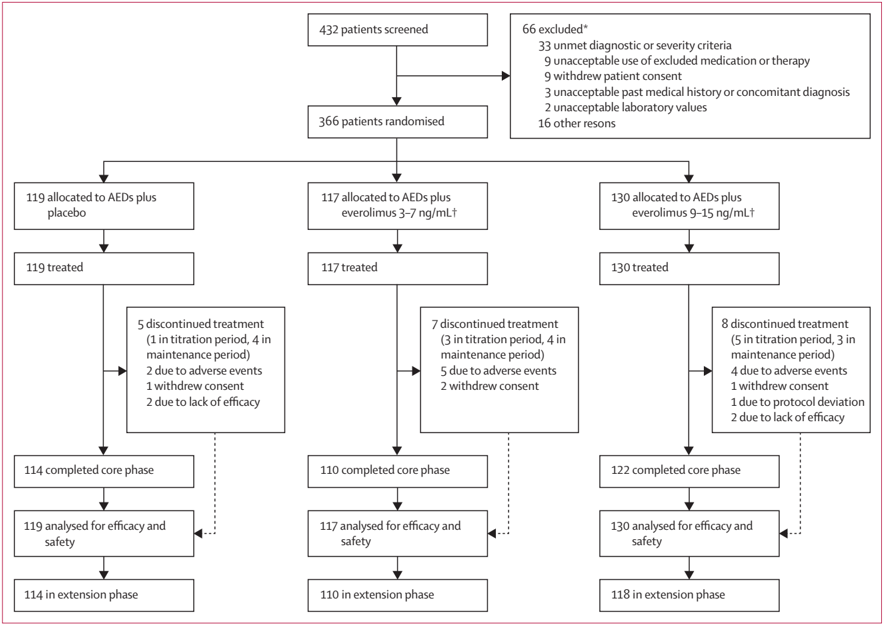
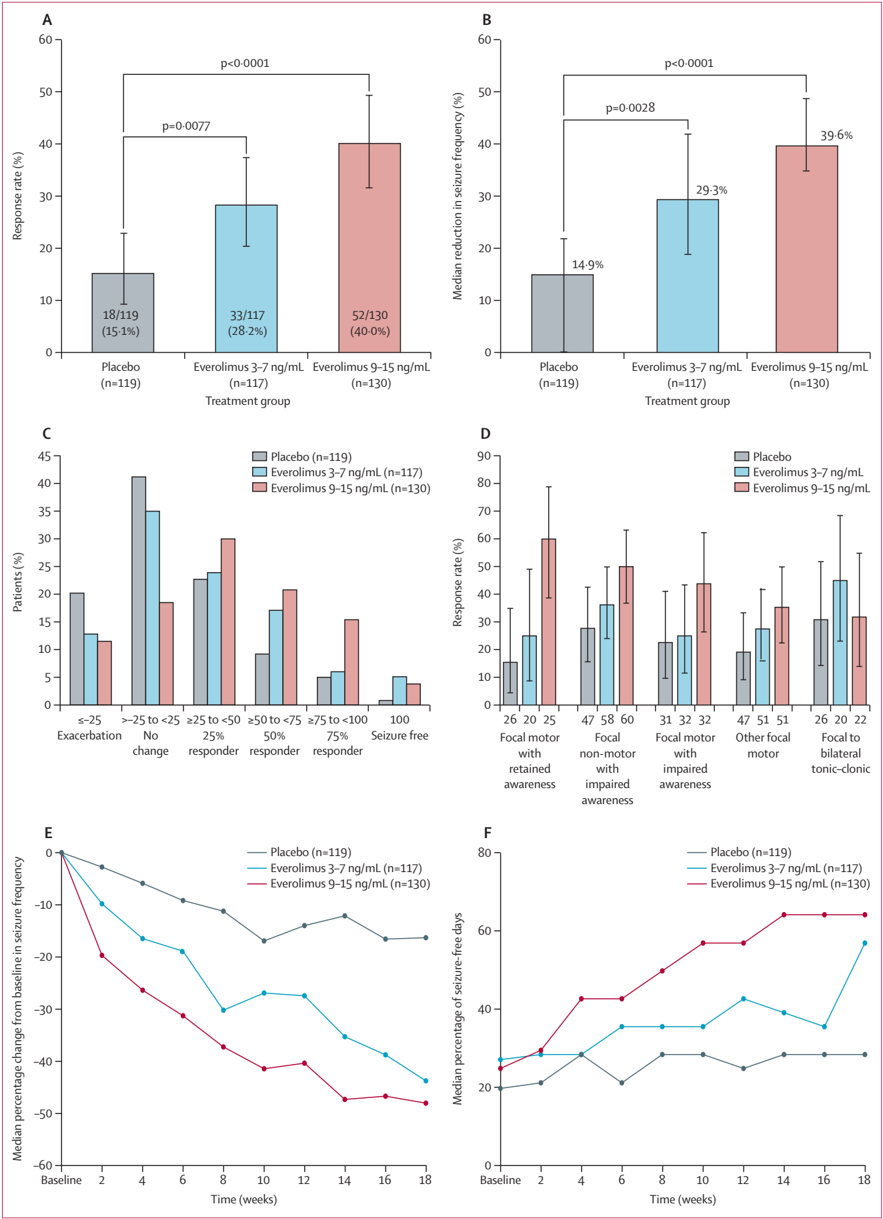
BACKGROUND: Everolimus, a mammalian target of rapamycin (mTOR) inhibitor, has been used for various benign tumours associated with tuberous sclerosis complex. We assessed the efficacy and safety of two trough exposure concentrations of everolimus, 3-7 ng/mL (low exposure) and 9-15 ng/mL (high exposure), compared with placebo as adjunctive therapy for treatment-resistant focal-onset seizures in tuberous sclerosis complex. METHODS: In this phase 3, randomised, double-blind, placebo-controlled study, eligible patients aged 2-65 years with tuberous sclerosis complex and treatment-resistant seizures (≥16 in an 8-week baseline phase) receiving one to three concomitant antiepileptic drugs were recruited from 99 centres across 25 countries. Participants were randomly assigned (1:1:1), via permuted-block randomisation (block size of six) implemented by Interactive Response Technology software, to receive placebo, low-exposure everolimus, or high-exposure everolimus. Randomisation was stratified by age subgroup (<6 years, 6 to <12 years, 12 to <18 years, and ≥18 years). Patients, investigators, site personnel, and the sponsor's study team were masked to treatment allocation. The starting dose of everolimus depended on age, body-surface area, and concomitant use of cytochrome 3A4/P-glycoprotein inducers. Dose adjustments were done to attain target trough ranges during a 6-week titration period, and as needed during a 12-week maintenance period of core phase. Patients or their caregivers recorded events in a seizure diary throughout the study. The primary endpoint was change from baseline in the frequency of seizures during the maintenance period, defined as response rate (the proportion of patients achieving ≥50% reduction in seizure frequency) and median percentage reduction in seizure frequency, in all randomised patients. This study is registered with ClinicalTrials.gov, number NCT01713946. FINDINGS: Between July 3, 2013, and May 29, 2015, 366 patients were enrolled and randomly assigned to placebo (n=119), low-exposure everolimus, (n=117), or high-exposure everolimus (n=130). The response rate was 15·1% with placebo (95% CI 9·2-22·8; 18 patients) compared with 28·2% for low-exposure everolimus (95% CI 20·3-37·3; 33 patients; p=0·0077) and 40·0% for high-exposure everolimus (95% CI 31·5-49·0; 52 patients; p<0·0001). The median percentage reduction in seizure frequency was 14·9% (95% CI 0·1-21·7) with placebo versus 29·3% with low-exposure everolimus (95% CI 18·8-41·9; p=0·0028) and 39·6% with high-exposure everolimus (95% CI 35·0-48·7; p<0·0001). Grade 3 or 4 adverse events occurred in 13 (11%) patients in the placebo group, 21 (18%) in the low-exposure group, and 31 (24%) in the high-exposure group. Serious adverse events were reported in three (3%) patients who received placebo, 16 (14%) who received low-exposure everolimus, and 18 (14%) who received high-exposure everolimus. Adverse events led to treatment discontinuation in two (2%) patients in the placebo group versus six (5%) in the low-exposure group and four (3%) in the high-exposure group. INTERPRETATION: Adjunctive everolimus treatment significantly reduced seizure frequency with a tolerable safety profile compared with placebo in patients with tuberous sclerosis complex and treatment-resistant seizures. FUNDING: Novartis Pharmaceuticals Corporation.
Overview
The claims and statistics of this paper haven’t been checked yet.
Free: it reads the open-access text and checks the first 5 claims that cite a source we can check. Create a free account to check every claim.
Integrity signals
Registry
Cites
Statistics
Figures
Verification
Claims the paper makes
The claims and statistics of this paper haven’t been checked yet.
Free: it reads the open-access text and checks the first 5 claims that cite a source we can check. Create a free account to check every claim.
Claims other papers make about this one
Each is checked against this paper’s own text: does it say what the citing paper says it does?
The source backs part of the claim, not all of it — or backs it for a different population, condition or comparison.
In the citing paper
“mTOR pathway inhibitors, including everolimus and sirolimus may be beneficial as a targeted treatment 131 .”
From Developmental and epileptic encephalopathies (2024) · cites this paper as [131]
Experimental — accuracy not yet measuredThe source backs part of the claim, not all of it — or backs it for a different population, condition or comparison.
In the citing paper
“One example is the EXIST-3 RCT in which the mTOR inhibitor everolimus was trialled in patients with drug-resistant focal seizures in the setting of tuberous sclerosis complex, due to pathogenic variants in the mTOR pathway genes, TSC1 or TSC2.”
From Developmental and epileptic encephalopathies (2024) · cites this paper as [131]
Experimental — accuracy not yet measuredThe cited source says what the claim attributes to it.
In the citing paper
“In this RCT, responder rates were greater with higher-dose everolimus than with placebo; however, they were perhaps less compelling than one might expect for a precision therapy (40% vs 15.1%, p<0.0001) 131 .”
From Developmental and epileptic encephalopathies (2024) · cites this paper as [131]
The cited source says what the claim attributes to it.
In the citing paper
“Effects on cognition and other neuropsychiatric symptoms were not reported.”
From Developmental and epileptic encephalopathies (2024) · cites this paper as [131]
In the citing paper
“Subsequently, inhibitors of mTOR have been proposed as treatments for such syndromes and one drug Everolimus has been approved for treatment of seizures in tuberous sclerosis (French et al., 2016).”
From Getting to the cores of autism (2019) · cites this paper as French et al., 2016
Self-check
Percentages, sums and reported differences re-computed from the paper’s own numbers.
The self-check needs the paper’s full text.
Citations
Cites
Kwan, P., Schachter, S. C., & Brodie, M. J. (2011) · New England Journal of Medicine · doi:10.1056/nejmra1004418 · Cited by 1,052
Everolimus for Subependymal Giant-Cell Astrocytomas in Tuberous Sclerosis
Krueger, D. A., Care, M. M., Holland, K., Agricola, K., Tudor, C., Mangeshkar, P., Wilson, K. A., Byars, A., Sahmoud, T., & Franz, D. N. (2010) · New England Journal of Medicine · doi:10.1056/nejmoa1001671 · Cited by 1,006
Self-citationBissler, J. J., Kingswood, J. C., Radzikowska, E., Zonnenberg, B. A., Frost, M., Belousova, E., Sauter, M., Nonomura, N., Brakemeier, S., de Vries, P. J., et al. (2013) · The Lancet · doi:10.1016/s0140-6736(12)61767-x · Cited by 880
Franz, D. N., Belousova, E., Sparagana, S., Bebin, E. M., Frost, M., Kuperman, R., Witt, O., Kohrman, M. H., Flamini, J. R., Wu, J. Y., et al. (2013) · The Lancet · doi:10.1016/s0140-6736(12)61134-9 · Cited by 794
Self-citationArroyo, S., Rumià, J., Martínez, I., & Ribalta, T. (1998) · PubMed · Cited by 652
Rapamycin prevents epilepsy in a mouse model of tuberous sclerosis complex.
Zeng, L., Xu, L., Gutmann, D. H., & Wong, M. (2008) · Annals of Neurology · doi:10.1002/ana.21331 · Cited by 639
The natural history of epilepsy in tuberous sclerosis complex
Chu‐Shore, C. J., Major, P., Camposano, S., Muzykewicz, D., & Thiele, E. A. (2010) · Epilepsia · doi:10.1111/j.1528-1167.2009.02474.x · Cited by 637
Neurological and neuropsychiatric aspects of tuberous sclerosis complex
Curatolo, P., Moavero, R., & de Vries, P. J. (2015) · The Lancet Neurology · doi:10.1016/s1474-4422(15)00069-1 · Cited by 600
Self-citationMeikle, L., Pollizzi, K., Egnor, A., Kramvis, I., Lane, H., Sahin, M., & Kwiatkowski, D. J. (2008) · The Journal of Neuroscience · doi:10.1523/jneurosci.0955-08.2008 · Cited by 501
Efficacy and Safety of Oral Lacosamide as Adjunctive Therapy in Adults with Partial‐Onset Seizures
Ben‐Menachem, E., Biton, V., Jatuzis, D., Abou‐Khalil, B., Doty, P., & Rudd, G. D. (2007) · Epilepsia · doi:10.1111/j.1528-1167.2007.01188.x · Cited by 485
Research works printed but not linked: 1
- 20. European Medicines Agency. Guideline on clinical investigation of medicinal products in the treatment of epileptic disorders. July 22, 2010. CHMP/EWP/566/98 Rev.2/Corr. http:// wwwemaeuropaeu/docs/en_GB/document_library/Scientifi c_ guideline/2010/01/WC500070043pdf (accessed July 8, 2016).
Cited by
Items 401–500 of 796
Ye, Z., Bennett, M. F., Bahlo, M., Scheffer, I. E., Berkovic, S. F., Perucca, P., & Hildebrand, M. S. (2021) · Expert Review of Neurotherapeutics · doi:10.1080/14737175.2021.1981288 · Cited by 9
State of the art: glioma-associated epilepsy—bridging tumor biology and epileptogenesis
Divé, I., Luger, A., Muench, D., Weber, K. J., Steinbach, J. P., Rosenow, F., Winkler, F., & Zeiner, P. S. (2025) · Neurological Research and Practice · doi:10.1186/s42466-025-00434-8 · Cited by 9
“…which have demonstrated consistent efficacy in the treatment of SEGAs in patients with tuberous sclerosis complex, supported by early phase II data [94], the pivotal phase III EXIST-1 trial [95], and phase III evidence from the EXIST-3 study demonstrating substantial seizure reduction [96].”
Available Therapies for Patients with Neurofibromatosis-Related Nervous System Tumors
Strowd, R. E., III (2020) · Current Treatment Options in Oncology · doi:10.1007/s11864-020-00779-z · Cited by 8
Specific Features of Focal Cortical Dysplasia in Tuberous Sclerosis Complex
Bychkova, E. Y., Dorofeeva, M. Y., Levov, A. V., Kislyakov, A. N., Karandasheva, K., Strelnikov, V. V., & Аношкин, К. И. (2023) · Current Issues in Molecular Biology · doi:10.3390/cimb45050254 · Cited by 8
“patients with drug-resistant epilepsy in the placebo-controlled EXIST-3 study [101,107].”
BackgroundResultInfluentialReverse repurposing: Potential utility of cancer drugs in nonmalignant illnesses
Nikanjam, M., Wells, K., Kato, S., Adashek, J. J., Block, S., & Kurzrock, R. (2024) · Med · doi:10.1016/j.medj.2024.04.008 · Cited by 8
Angela Asir, R., V, Buzaeva, P., & Michaelevski, I. (2025) · Exploration of Drug Science · doi:10.37349/eds.2025.100892 · Cited by 11
Clinical, genetic and quality-of-life study of a cohort of adult patients with tuberous sclerosis
de Borbón, E. C. D. S., Vales, J. M. G., Lumbreras, C., Guerrero‐Ramos, F., Padilla, M. J. B., de la Aleja, J. G., & Conejo, M. M. (2021) · Orphanet Journal of Rare Diseases · doi:10.1186/s13023-021-01878-2 · Cited by 8
“Conference of 2012, and refractory epilepsy was added later [8, 12, 13].”
BackgroundHirabatake, M., Mizuno, T., Kato, H., & Hashida, T. (2022) · Frontiers in Pharmacology · doi:10.3389/fphar.2022.984002 · Cited by 8
“, 1999; Nashan, 2002), is used not only for treating inoperable or recurrent breast cancer but also for suppressing rejection in organ transplantation and for the treatment of tuberous sclerosis complex (Eisen et al., 2003; Tedesco Silva et al., 2010; French et al., 2016; Jeng et al., 2018).”
BackgroundTadtaeva, Z. G., Galustyan, A. N., Громова, О. А., & Sardaryan, I. S. (2023) · Epilepsy and Paroxysmal Conditions · doi:10.17749/2077-8333/epi.par.con.2023.149 · Cited by 9
Moderne Epilepsiebehandlung bei Kindern
Bast, T. (2017) · Monatsschrift Kinderheilkunde · doi:10.1007/s00112-017-0275-3 · Cited by 9
eHealth as a Facilitator of Precision Medicine in Epilepsy
Cavalleri, G. L., Petrovski, S., Fitzsimons, M. B., & Delanty, N. (2017) · Biomedicine Hub · doi:10.1159/000481793 · Cited by 8
Surendra Nath Sehgal: A pioneer in rapamycin discovery
Samanta, D. (2017) · Indian Journal of Cancer · doi:10.4103/ijc.ijc_84_18 · Cited by 8
Investigating adults with early-onset epilepsy and intellectual or physical disability
Nashef, L. A. M., Singh, R., Moran, N. F., & Murphy, E. (2019) · Practical Neurology · doi:10.1136/practneurol-2018-001965 · Cited by 8
Clinical trials using molecular stratification of pediatric brain tumors
Hanz, S. Z., Adeuyan, O. O., Lieberman, G., & Hennika, T. (2020) · Translational Pediatrics · doi:10.21037/tp.2020.03.04 · Cited by 8
“2000 Feb 29 - Identifier NCT01713946,”
BackgroundTargeted Therapies in Rare Brain Tumours
Bruno, F., Pellerino, A., Bertero, L., Soffietti, R., & Rudà, R. (2021) · International Journal of Molecular Sciences · doi:10.3390/ijms22157949 · Cited by 9
“, 2016 EXIST-3 trial [17] Phase III 366 10.”
BackgroundEpilepsy Treatment: A Futurist View
Privitera, M. (2017) · Epiliepsy currents/Epilepsy currents · doi:10.5698/1535-7597.17.4.204 · Cited by 9
“This “precision medicine” approach has already been quite successful in human trials within the mechanistic target of rapamycin (mTOR) cascade (59).”
Tuberous Sclerosis Complex: An updated in the treatment of epilepsy for early careers
Valente, K. D. R., Sampaio, L. P. D. B., Vincentiis, S., Pinto, A., & Montenegro, M. A. (2025) · Epilepsy & Behavior · doi:10.1016/j.yebeh.2025.110396 · Cited by 7
“Targeting Neuroimmune Pathways in Epilepsy: Advances in Mechanisms and Emerging Therapeutics”
Ravikumar, M., Uvarajan, D., & Durairaj, B. (2025) · Neurochemical Research · doi:10.1007/s11064-025-04489-6 · Cited by 7
How modern treatments have modified the role of surgery in pediatric low-grade glioma
Boop, S. H., Shimony, N., & Boop, F. A. (2024) · Child s Nervous System · doi:10.1007/s00381-024-06412-w · Cited by 7
“For TS patients, the use of everolimus has been shown to be very successful in treating subependymal giant cell astrocytomas (SEGAs) and has been proven useful for both tumor control and seizure control [48].”
BackgroundWillems, L. M., Strzelczyk, A., & Rosenow, F. (2021) · Clinical Epileptology · doi:10.1007/s10309-020-00393-x · Cited by 8
“Neben der EXIST-3-Studie wurden in diesen Review eine offene LangzeitVerlängerungsstudie, die aus dem glei- 170 Zeitschrift für Epileptologie 2 · 2021 Tab.”
BackgroundInfluentialSugiura, H., Shimada, T., Moriya‐Ito, K., Goto, J.-I., Fujiwara, H., Ishii, R., Shitara, H., Taya, C., Fujii, S., Kobayashi, T., et al. (2022) · Journal of Neuroscience · doi:10.1523/jneurosci.0449-21.2022 · Cited by 8
McTague, A., Scheffer, I. E., Kullmann, D. M., & Sisodiya, S. M. (2024) · Handbook of clinical neurology · doi:10.1016/b978-0-323-90820-7.00016-1 · Cited by 8
Shrot, S., Hwang, M., Stafstrom, C. E., Huisman, T. A. G. M., & Soares, B. P. (2017) · Neuroradiology · doi:10.1007/s00234-017-1961-5 · Cited by 7
“Recent studies utilizing the mTOR inhibitors rapamycin and everolimus reported marked improvement of seizure control in tuberous sclerosis complex (TSC) patients [13, 14].”
Chung, N. K. X., Metherall, P., McCormick, J., Simms, R., & Ong, A. C. M. (2022) · Clinical Kidney Journal · doi:10.1093/ckj/sfac037 · Cited by 7
“Additionally, the EXIST-1 and -3 trials demonstrated that everolimus improved other features of TSC, including subependymal giant cell astrocytomas (SEGA), seizure frequency and skin lesions [14, 15].”
Treatment of Focal-Onset Seizures in Children: Should This Be More Etiology-Driven?
Aeby, A., Ceulemans, B., & Lagae, L. G. (2022) · Frontiers in Neurology · doi:10.3389/fneur.2022.842276 · Cited by 8
“Everolimus not only affects seizure frequency but also reduces the volume of brain and renal tumors seen in TSC, improves skin lesions and preserves renal function in patients with TSC (105–108).”
InfluentialGenetische epileptische Enzephalopathien des Säuglingsalters
Syrbe, S. (2019) · Clinical Epileptology · doi:10.1007/s10309-018-0238-2 · Cited by 8
Antiepileptic Drugs in Pediatrics
Zelleke, T. G., Pasupuleti, A., Depositario‐Cabacar, D., & Kao, A. (2019) · Handbook of experimental pharmacology · doi:10.1007/164_2019_248 · Cited by 7
Mastrangelo, M., Commone, C., Greco, C., & Leuzzi, V. (2021) · Neuropediatrics · doi:10.1055/s-0041-1722881 · Cited by 7
PTEN Gene and Autism: Genetic Underpinnings and Neurodevelopmental Impacts
Genovese, A., & Butler, M. G. (2025) · Genes · doi:10.3390/genes16091061 · Cited by 6
“In addition, Everolimus, an approved drug for partial seizures in children and adults with tuberous sclerosis, has been used with potential success in controlled clinical trials in treating individuals with PTEN -associated ASD and neurodevelopmental disorders [36,37].”
Tackling the Unmet Therapeutic Needs in Nonsurgical Treatments for Epilepsy
Steriade, C., & French, J. A. (2022) · JAMA Neurology · doi:10.1001/jamaneurol.2022.2635 · Cited by 6
Self-citationTuberous Sclerosis Complex Kidney Lesion Pathogenesis: A Developmental Perspective
Pietrobon, A., & Stanford, W. L. (2023) · Journal of the American Society of Nephrology · doi:10.1681/asn.0000000000000146 · Cited by 6
Chalkley, M. L., Guerin, L. N., Iyer, T., Mallahan, S., Nelson, S., Şahin, M., Hodges, E. C., Ess, K. C., & Ihrie, R. A. (2025) · Human Molecular Genetics · doi:10.1093/hmg/ddae199 · Cited by 6
Mao, S., Long, Q., Lin, H.-J., & Liu, J. (2017) · Experimental and Therapeutic Medicine · doi:10.3892/etm.2017.5335 · Cited by 6
“Everolimus is applied for brain (subependymal giant cell astrocytoma) and kidney (renal angiomyolipoma) tumor treatment in children with TSC (10) and has also been demonstrated to be effective for TSC-epilepsy treatment (11).”
Translational Medicine Strategies in Drug Development for Neurodevelopmental Disorders
Srivastava, S., Şahin, M., & Prock, L. A. (2019) · Handbook of behavioral neuroscience · doi:10.1016/b978-0-12-803161-2.00022-9 · Cited by 9
Neonatal rhabdomyoma with cardiac dysfunction: favourable response to sirolimus
Duan, M., Sundararaghavan, S., Koh, A. L., & Soh, S. Y. (2022) · BMJ Case Reports · doi:10.1136/bcr-2021-244915 · Cited by 6
Wiegand, G., Japaridze, N., Gröning, K., Stephani, U., & Kadish, N. E. (2022) · Seizure · doi:10.1016/j.seizure.2022.10.022 · Cited by 6
Babaoğlu, K., Başar, E. Z., Usta, E., Yılmaz, E. H., & Günlemez, A. (2023) · Cardiology in the Young · doi:10.1017/s1047951123000094 · Cited by 6
Cystic kidney diseases in children
Groof, J. D., Dachy, A., Breysem, L., & Mekahli, D. (2023) · Archives de Pédiatrie · doi:10.1016/j.arcped.2023.02.005 · Cited by 6
The evolution of epilepsy surgery in tuberous sclerosis in Sweden: A national registry study
Pearsson, K., Eklund, E. A., Rask, O., Rosén, I., Sjunnesson, H., & Strandberg, M. (2023) · Seizure · doi:10.1016/j.seizure.2023.09.016 · Cited by 6
“Everolimus, an mTOR inhibitor, has also shown good efficacy in treating drug-resistant epilepsy in patients with TSC [6].”
Backgroundde Vries, P. J., Leclezio, L., Wilmshurst, J. M., Fieggen, G. A. G., Gottlich, E., Jacklin, L., Naiker, I. P., Newaj, R., Shamley, D. P., Schlegel, B., et al. (2017) · South African Medical Journal · doi:10.7196/samj.2017.v107i5.12447 · Cited by 8
“[2] mTOR inhibitors have recently been approved as adjunctive treatment for partial-onset seizures.[13]”
BackgroundRiikonen, R., & Kokki, H. J. (2018) · European Journal of Paediatric Neurology · doi:10.1016/j.ejpn.2018.11.001 · Cited by 9
How to Find Candidate Drug-targets for Antiepileptogenic Therapy?
Yu, N., Lin, X., & Di, Q. (2020) · Current Neuropharmacology · doi:10.2174/1570159x18666200128124338 · Cited by 6
“According to a large randomized clinical trial [92], everolimus, one mTOR inhibitor and also an analogue of rapamycin, has been recently approved by the FDA of the United States and European Union for TSC-associated partial-onset seizures alongside with many other aspects of TSC, such as cortical dysplasia, subependym…”
BackgroundTuberous sclerosis complex presenting as primary intestinal lymphangiectasia: A case report
Lin, W., Zhang, Z.-H., Wang, H., Ren, L., & Geng, L. (2020) · World Journal of Clinical Cases · doi:10.12998/wjcc.v8.i10.1995 · Cited by 6
Rahman, M. M., & Fatema, K. (2020) · Journal of Epilepsy Research · doi:10.14581/jer.20004 · Cited by 7
“Although there are different studies regarding the ketogenic diet, surgery and vagus nerve stimulation in TSC with epilepsy, none of the modalities have been used in this study.(17,19) Apart from epilepsy and neurological stigma, there is the involvement of multiple organs in TSC.”
BackgroundShoji, T., Niida, Y., Osawa, T., Matsumoto, R., Sakurai, K., Suzuki, M., Matsuno, Y., & Konno, S. (2021) · Respiratory Medicine Case Reports · doi:10.1016/j.rmcr.2021.101526 · Cited by 8
Waltereit, R., Feucht, M., de Vries, M. C., Huemer, J., Roessner, V., & de Vries, P. J. (2018) · Zeitschrift für Kinder- und Jugendpsychiatrie und Psychotherapie · doi:10.1024/1422-4917/a000604 · Cited by 7
Ess, K. C., & Franz, D. N. (2019) · Neurology · doi:10.1212/wnl.0000000000007744 · Cited by 6
Self-citationSomatic mosaicism and interneuron involvement in mTORopathies
Jerow, L. G., Krueger, D. A., Groß, C., & Danzer, S. C. (2025) · Trends in Neurosciences · doi:10.1016/j.tins.2025.02.009 · Cited by 5
Recent Advances in the Management of Seizures in Children
Besag, F., Vasey, M. J., & Chin, R. (2025) · Pediatric Drugs · doi:10.1007/s40272-025-00710-9 · Cited by 7
“The pivotal phase 3 RCT, the EXIST-3 trial [42], reported a statistically significant decrease in seizure frequency and 4).”
Applying biologically anchored subtypes to advance precision medicine in autism spectrum disorder
Choi, T.-Y., Gunawan, A., Seo, D., Park, J., Ahn, E. H., Suh, S. W., Fuccillo, M. V., & Choi, K. (2025) · Neurobiology of Disease · doi:10.1016/j.nbd.2025.107219 · Cited by 5
Saber, W. A., Ruíz, J. P., Gisser, I., Yang, Z., Mehendale, L., Teaney, N. A., Hobson, R., Glass, M. R., Pham, T. T., Bainbridge, E., et al. (2025) · Cell Reports · doi:10.1016/j.celrep.2025.116664 · Cited by 6
“7 In addition, mTORC1 inhibition does not have any effect on neurocognitive symptoms in patients with TSC. 8,9 This is seen throughout disorders associated with mTORC1 hyperactivation, such as phosphatase and tensin homolog (PTEN) tumor hamartoma syndrome, where everolimus has a minimal effect on…”
Amin, S., Ruban‐Fell, B., Newell, I., Evans, J. S., Vyas, K., Nortvedt, C., & Chin, R. (2024) · Orphanet Journal of Rare Diseases · doi:10.1186/s13023-023-02994-x · Cited by 5
“…for everolimus managing seizures, as a phase III, randomised, double-blind, placebo-controlled study in 2016 has shown that adjunctive treatment significantly reduces seizure frequency with a tolerable safety profile compared with placebo in patients with TSC and treatment-resistant seizures [68].”
BackgroundTargeting the EGFR pathway: An alternative strategy for the treatment of tuberous sclerosis complex?
Schachenhofer, J., Gruber, V., Fehrer, S. V., Haider, C., Glatter, S., Liszewska, E., Höftberger, R., Aronica, E., Rössler, K., Jaworski, J., et al. (2024) · Neuropathology and Applied Neurobiology · doi:10.1111/nan.12974 · Cited by 5
“…various TSC-associated (non-)neurological manifestations, the mTORC1 inhibitor everolimus was approved for the treatment of SEGA patients <1 year of age not eligible for curative surgery [2] and for the adjunctive treatment of patients >2 years of age with TSC-associated partial-onset epilepsy [3].”
BackgroundDistinct peripheral pro‐inflammatory profile associated with tuberous sclerosis complex and epilepsy
Balthazard, R., Drouin‐Engler, R., Bertrand, S., Zine-Eddine, F., Li, J., Tastet, O., Daigneault, A., Mamane, V. H., Ortega-Delgado, G.-G., Flores, A. M. S., et al. (2025) · Epilepsia · doi:10.1111/epi.18261 · Cited by 5
“6 In addition to its role in tumor formation and angiogenesis, mTOR is a central mediator of inflammatory responses.”
Bonniaud, B., Luu, M., Cormier, C., Racine, C., Espitalier, A., Malbranche, C., Rega, A., Gaumet, T., Kuentz, P., Vabres, P., et al. (2025) · European Journal of Medical Genetics · doi:10.1016/j.ejmg.2025.105012 · Cited by 5
Early Vocal Development in Tuberous Sclerosis Complex
Gipson, T., Ramsay, G., Ellison, E. E., Bene, E. R., Long, H. L., & Oller, D. K. (2021) · Pediatric Neurology · doi:10.1016/j.pediatrneurol.2021.08.009 · Cited by 5
Wan, L., He, W., Wang, Y., Xu, Y., Lu, Q., Zhang, M., Wang, Q., Dun, S., Liu, L., Shi, X., et al. (2022) · Therapeutic Advances in Neurological Disorders · doi:10.1177/17562864221138148 · Cited by 6
Gau, S., Chen, S., Chang, C.-S., Tsao, T., & Tsai, J. (2023) · International Journal of Medical Sciences · doi:10.7150/ijms.88022 · Cited by 5
“However, severe infectious adverse events have been reported in previous randomized controlled trials (EXIST-3 study) among mTOR inhibitor users, resulting in severe pneumonia, septic shock, and subsequent participant deaths [19].”
BackgroundBalaji, A., Mohanlal, S., Pachat, D., Babu, S. S., Suresh Kumar, E. K., Mamukoya, N., & Das, S. (2023) · Annals of Indian Academy of Neurology · doi:10.4103/aian.aian_314_23 · Cited by 6
“[14] Vigabatrin, employed for treating infantile spasms and focal seizures linked to tuberous sclerosis was also utilized for presymptomatic children with ictal/interictal EEG abnormalities, though our experience in this realm remains limited.”
BackgroundDrug Treatments for Core Symptoms of Autism Spectrum Disorder: Unmet Needs and Future Directions
Giovagnoli, G., Siracusano, M., Postorino, V., Curatolo, P., & Mazzone, L. (2017) · Journal of Pediatric Neurology · doi:10.1055/s-0037-1602823 · Cited by 6
Self-citationDermatologische Manifestationen der tuberösen Sklerose (TSC)
Ebrahimi‐Fakhari, D., Meyer, S., VOGT, T. M., Pföhler, C., & Müller, F. M. (2017) · JDDG Journal der Deutschen Dermatologischen Gesellschaft · doi:10.1111/ddg.13264_g · Cited by 7
Ebrahimi‐Fakhari, D., Müller, F. M., Altmeyer, K., Yılmaz, U., Flotats‐Bastardas, M., Zemlin, M., & Meyer, S. (2017) · Monatsschrift Kinderheilkunde · doi:10.1007/s00112-017-0353-6 · Cited by 5
“In der Studie Examining everolimus in a study of TSC (EXIST-3) konnte sowohl eine signifikante Reduktion der Anfallshäufigkeit als auch eine verbesserte Responserate (≥50%ige Reduktion der Häufigkeit der Krampfanfälle) gezeigt werden [30].”
BackgroundGrigoryeva, A. V., Dorofeeva, M. Y., Perminov, V. S., & Белоусова, Е. Д. (2020) · Almanac of Clinical Medicine · doi:10.18786/2072-0505-2020-48-003 · Cited by 5
Dulămea, A. O., Arbune, A.-A., Anghel, D. N., Boșcaiu, V., Andronesi, A. G., & Ismail, G. (2023) · Journal of Clinical Medicine · doi:10.3390/jcm12206550 · Cited by 6
“This finding supports previous studies on mTOR inhibitors’ efficacy on seizure frequency in patients without SEGA [11,12].”
ResultDo You Believe in Magic (Bullets)?
French, J. A. (2020) · Epiliepsy currents/Epilepsy currents · doi:10.1177/1535759720948437 · Cited by 5
Self-citationWang, S., Li, K., He, Q., Yang, H., Yang, Y., Wang, X., Shu, Y., & Ding, J. (2025) · Epilepsia · doi:10.1111/epi.18498 · Cited by 4
“Consistent with the antiepileptic effect of rapamycin, 25,26 rapamycin significantly elevated the threshold intensity of FCD_GFP + neurons, as compared to their nearby FCD_GFP − neurons, as well as FCD_GFP + neurons in vehicle-treated mice (Figure 5I).”
Everolimus precision therapy in NPRL2‐ and NPRL3‐related epilepsy
Carapancea, E., Eklund, E. A., Verhelst, H., & Cilio, M. R. (2025) · Epilepsia · doi:10.1111/epi.18543 · Cited by 4
Chémaly, N., Kuchenbuch, M., Losito, E., Kamińska, A., Coste‐Zeitoun, D., Barcia, G., Desguerre, I., Hully, M., & Nabbout, R. (2025) · European Journal of Neurology · doi:10.1111/ene.70304 · Cited by 5
Self-citationFrom mechanism to phenotype: What fits in a basket trial
Valente, K. D. R. (2026) · Epilepsia · doi:10.1002/epi.70086 · Cited by 4
Stansley, B. J., Islam, M. M., Aguiar, D. J., Fuchs, Z., Catron, M., Morairty, S., Yuan, Y., Santos, R., Hou, J.-G., de Kater, A. D., et al. (2026) · Epilepsia · doi:10.1002/epi.70227 · Cited by 4
“22,23 There is an urgent need to improve epilepsy treatment strategies for patients with TSC, and one promising approach has been to identify molecules involved in disease pathogenesis.”
Park, J., Kim, S. H., Hahn, J., Kang, H., Lee, S., Kim, H. D., & Chang, M. J. (2023) · Frontiers in Pharmacology · doi:10.3389/fphar.2023.1197549 · Cited by 4
Exploring Cardiovascular Involvement in Tuberous Sclerosis: Insights for Pediatric Clinicians
Lazea, C., Țaranu, I., & Bolboaca, S. D. (2024) · Children · doi:10.3390/children11060674 · Cited by 4
“A significant reduction in seizure frequency was found in children with TS with treatment-refractory seizures after receiving everolimus as adjuvant therapy [70–72].”
BackgroundNarvaiz, D. A., Blandin, K. J., Sullens, D. G., Womble, P. D., Pilcher, J. B., O’Neill, G., Wiley, T. A., Kwok, E. M., Chilukuri, S. V., & Lugo, J. N. (2024) · Epilepsy Research · doi:10.1016/j.eplepsyres.2024.107440 · Cited by 4
Shen, N.-X., Zhuo, Z., Luo, X., Li, B., Lin, X., Luo, S., Ye, Z.-L., Wang, P., He, N., Shi, Y., et al. (2024) · Acta Epileptologica · doi:10.1186/s42494-024-00189-w · Cited by 4
Moderne Pharmakotherapie Erwachsener: Was gibt es über die Leitlinien hinaus zu beachten?
Steinhoff, B. J. (2024) · Clinical Epileptology · doi:10.1007/s10309-024-00733-1 · Cited by 4
Ricketts, C. J., Vocke, C. D., Lang, M., Velazquez, J. M., Srirama, V. S., Crooks, D. R., Gamble, D., Malta, C. D., Reynolds, K. L., Gautam, R., et al. (2025) · Human Molecular Genetics · doi:10.1093/hmg/ddaf173 · Cited by 4
Chen, J., He, W., Wang, Y., Zhang, M., Lu, Q., Wang, Q., Luo, X., Wang, B., & Zou, L. (2022) · Child s Nervous System · doi:10.1007/s00381-022-05446-2 · Cited by 4
“In fact, due to epileptic seizures, about 60% of patients can be diagnosed in the first year of life or even the neonatal period, which is the critical period of physical development [7].”
BackgroundA dermatological assessment of pediatric patients with tuberous sclerosis complex (TSC)
Nunes, B. A., Romano, A. K. F. G., Morgan, M. A. P., Gonçalves, A. A., Cardozo, L. F. M., Dufner‐Almeida, L. G., Haddad, L. A., Crippa, A. C. D. S., Antoniuk, S. A., & Abagge, K. T. (2024) · Anais Brasileiros de Dermatologia · doi:10.1016/j.abd.2023.11.004 · Cited by 4
mTOR in Acquired and Genetic Models of Epilepsy
Wong, M., Bordey, A., & Danzer, S. C. (2024) · Oxford University Press eBooks · doi:10.1093/med/9780197549469.003.0004 · Cited by 9
Kirkeby, K., Cockerell, I., Christensen, J., Hoei‐Hansen, C. E., Holst, L., Fredriksen, M. G., Lund, C., & Landmark, C. J. (2024) · Medicine · doi:10.1097/md.0000000000039244 · Cited by 4
“[4] Everolimus is approved as adjunctive treat-ment for patients from 2 years with TSC and refractory focal seizures.”
BackgroundMethodInfluentialVasseghi, M., Behan, C. L., Connolly, A., Cunningham, D., Dempsey, E., Flynn, C., Galvin, M., Griffin, G., Moloney, P. B., Murphy, M., et al. (2024) · Journal of Rare Diseases · doi:10.1007/s44162-024-00049-8 · Cited by 4
“Mammalian target rapamycin (mTOR) inhibitors have emerged as the cornerstone of TSC tumour management, generating disease control and improved outcomes [3, 10, 11].”
BackgroundAn overview of the value of mTOR inhibitors to the treatment of epilepsy: the evidence to date
Moloney, P. B., & Delanty, N. (2025) · Expert Review of Neurotherapeutics · doi:10.1080/14737175.2025.2462280 · Cited by 5
“In the placebo-controlled EXIST-3 trial, treatment with everolimus significantly reduced seizure frequency in children and adults with TSC-related epilepsy [10].”
InfluentialInsights into Tuberous Sclerosis Complex : From Genes to Clinics
Kim, S. Y. (2025) · Journal of Korean Neurosurgical Society · doi:10.3340/jkns.2025.0035 · Cited by 4
Everolimus for epilepsy in paediatric tuberous sclerosis complex
Devinsky, O. (2018) · The Lancet Child & Adolescent Health · doi:10.1016/s2352-4642(18)30128-7 · Cited by 4
Personalized treatment in the epilepsies: challenges and opportunities
Balestrini, S., & Sisodiya, S. M. (2018) · Expert Review of Precision Medicine and Drug Development · doi:10.1080/23808993.2018.1486189 · Cited by 5
„Orphan drugs“ in der Epileptologie
Schulze‐Bonhage, A. (2019) · Clinical Epileptology · doi:10.1007/s10309-019-0274-6 · Cited by 4
Zhan, T., Cui, L., Geng, Z., Zhang, L., Gu, Y., & Chan, I. S. F. (2021) · Statistics in Medicine · doi:10.1002/sim.9104 · Cited by 4
Neurosurgical Considerations of Neurocutaneous Syndromes
Iyer, R. R., Strahle, J. M., & Groves, M. L. (2021) · Neurosurgery Clinics of North America · doi:10.1016/j.nec.2021.09.013 · Cited by 6
Berar, O. V., Tzadok, M., Zloto, O., Moroz, I., Hecht, I., Musika, A. A., Shlomovitz, O., Fabian, I. D., & Vishnevskia-Dai, V. (2022) · Graefe s Archive for Clinical and Experimental Ophthalmology · doi:10.1007/s00417-022-05585-x · Cited by 4
The state of pediatric tuberous sclerosis complex epilepsy care: Results from a national survey
Whitney, R., Zak, M., Haile, D., & Nouri, M. N. (2022) · Epilepsia Open · doi:10.1002/epi4.12652 · Cited by 5
Hunter‐Dickson, M., Wu, P., Athavale, A., & Wang, Y. (2022) · Journal of Clinical Medicine · doi:10.3390/jcm11206084 · Cited by 4
“In EXIST-2, urinary tract infections were the most common infective adverse event with rates of 15%, while in EXIST-3, upper respiratory tract infections were most common with rates of 13–15% reported [4,9].”
BackgroundInfluentialGianessi, L., Magini, A., Dominici, R., Giovagnoli, S., & Dolcetta, D. (2023) · International Journal of Molecular Sciences · doi:10.3390/ijms242417478 · Cited by 4
“However, the maximum tolerated dose of RAD001 (maximal blood concentration 9–15 ng/mL) can benefit only 40% of patients, reducing the size of SEGAs [6] and improving seizure control [7].”
BackgroundMethodInfluentialSeizures in tuberous sclerosis complex: hitting the target.
Roach, E., & Kwiatkowski, D. (2016) · The Lancet · doi:10.1016/s0140-6736(16)31576-8 · Cited by 4
The Toxicity of Newer and Lesser-Known Anticonvulsant Drugs
Walsh, S. J., Chen, R. J., Ershad, M., & Krueger, J. A. (2020) · Current Emergency and Hospital Medicine Reports · doi:10.1007/s40138-020-00220-7 · Cited by 4
New Insights into Red Blood Cell Microcytosis upon mTOR Inhibitor Administration
Jakubowska, J., Pawlik, B., Wyka, K., Stolarska, M., Kotulska, K., Jóźwiak, S., Mlynarski, W. M., & Trelińska, J. (2021) · International Journal of Molecular Sciences · doi:10.3390/ijms22136802 · Cited by 4
Wagnon, J. L. (2023) · Epiliepsy currents/Epilepsy currents · doi:10.1177/15357597231202859 · Cited by 4
“2 However, determining the molecular mechanisms underlying genetic epilepsies can be complicated with many gene variants exhibiting multiple downstream effects.”
Background[Epilepsy-new diagnostic tools, old drugs? : Therapeutic consequences of epilepsy genetics].
Tacke, M., Neubauer, B. A., Gerstl, L., Roser, T., Rémi, J., & Borggraefe, I. (2017) · PubMed · doi:10.1007/s00115-017-0427-7 · Cited by 3
“In multizentrischen, randomisierten, placebokontrollierten Studien konnte nachgewiesen werden, dass der mTORInhibitor Everolimus zuverlässig zu einer Verkleinerung der SEGA und zu einer nachhaltigen Reduktion der Anfälle bei TSC-assoziierten therapierefraktären Epilepsien führt (Studien EXIST1 [11] und EXIST-3 [12]).”
InfluentialIdentification of Brain-Penetrant ATP-Competitive mTOR Inhibitors for CNS Syndromes.
Bonazzi, S., Gray, A., Thomsen, N. M., Biag, J., Labbé-Giguère, N., Keaney, E., Malik, H. A., Sun, Y., Nunez, J., Karki, R., et al. (2023) · Journal of Medicinal Chemistry · doi:10.1021/acs.jmedchem.3c00705 · Cited by 2
Preclinical Testing Strategies for Epilepsy Therapy Development
Riley, V. A., & Danzer, S. C. (2024) · Epiliepsy currents/Epilepsy currents · doi:10.1177/15357597241292197 · Cited by 3
“20 24 mTOR antagonists directly target the disease mechanism and thus should have disease-modifying effects; however, seizure recurrence and disease progression following drug withdrawal are evident in animal studies 25 – 29 and patients.”
Vedala, K., Aungaroon, G., Ritter, D. M., Greiner, H. M., Tenney, J. R., Skoch, J. M., Horn, P. S., Leach, J. L., Mangano, F. T., Krueger, D. A., et al. (2025) · Clinical Neurophysiology · doi:10.1016/j.clinph.2025.02.001 · Cited by 3
Metadata
- Authors
- French, J. A., Lawson, J. A., Yapici, Z., Ikeda, H., Polster, T., Nabbout, R., Curatolo, P., de Vries, P. J., Dlugos, D. J., Berkowitz, N., Voi, M., Peyrard, S., Pelov, D., & Franz, D. N.
- Affiliations
- NYU Langone Health (US)
- Sydney Children's Hospital (AU)
- National Epilepsy Center (JP)
- Krankenhaus Mara (DE)
- Hôpital Necker-Enfants Malades (FR)
- Policlinico Tor Vergata (IT)
- Children's Hospital of Philadelphia (US)
- Cincinnati Children's Hospital Medical Center (US)
- Corresponding author
- French, Jacqueline A
- ORCID
- Venue
- The Lancet
- Publisher
- Elsevier BV
- Published
- 2016-10
- Volume
- 388
- Issue
- 10056
- Pages
- 2153-2163
- ISSN
- 0099-5355 (ISSN-L)
- 0140-6736
- OpenAlex
- W2511912940
- Cited by
- 764
- References
- 31
- Citations by year
- 2026: 55 · 2025: 75 · 2024: 57 · 2023: 78 · 2022: 76 · 2021: 97 · 2020: 108 · 2019: 73 · 2018: 65 · 2017: 69 · 2016: 10
- FWCI
- 58.25
- Type
- journal article
- Language
- en
- Open access
- hybrid
- doi.org
- Licence
- cc-by-nc-nd
- www.elsevier.com/tdm/userlicense/1.0/ (tdm)
- creativecommons.org/licenses/by-nc-nd/4.0/ (vor)
- Locations
- The Lancet (publishedVersion, cc-by-nc-nd)
- PubMed (publishedVersion)
- Cineca Institutional Research Information System (Tor Vergata University) (submittedVersion)
- INFM-OAR (INFN Catania) (submittedVersion, cc-by-nc-nd)
- Funders
- Novartis Pharmaceuticals Corporation
- Topics
- Health Sciences › Medicine › Genetics (clinical) › Tuberous Sclerosis Complex Research
- Health Sciences › Medicine › Clinical Neurology › Epilepsy research and treatment
- Health Sciences › Medicine › Pediatrics, Perinatology and Child Health › Pharmacological Effects and Toxicity Studies
- Keywords
- everolimus, tuberous sclerosis complex, focal seizures, drug-resistant epilepsy, adjunctive antiepileptic therapy, mTOR inhibitors, seizure frequency reduction, antiepileptic drug interactions, adverse events, pharmacovigilance
- MeSH terms
- Everolimus, Adolescent, Adult, Aged, Anticonvulsants, Antineoplastic Agents, Child, Child, Preschool, Combined Modality Therapy, Dose-Response Relationship, Drug, Double-Blind Method, Female, Humans, Male, Middle Aged, Seizures, Tuberous Sclerosis
About these checks
Registry, retraction, Cites and statistics results are computed, not judged, with one exception: a printed reference that no index lists is read once by a model before it counts as a citation error. Claims are extracted by a model and kept only when their quote appears verbatim in the text; each cited source is then checked, with a model’s help, for whether it says what the claim relies on. Those verdicts can be wrong — read the claim’s quote and the cited source before relying on one.
Statistics and arithmetic are recomputed, not judged.
Confidence bands are shown only for fields calibrated on our annotated test set. None is calibrated yet, so no band is shown.
What counts as a claim ›How we measure confidence ›How we check this ›
Are you an author, or do you see a problem with this page? Request a review
Data sources
Bibliographic data: Semantic Scholar, OpenAlex, Crossref.
Contains information from the Semantic Scholar Academic Graph Datasets, made available under the ODC Attribution License (ODC-BY 1.0).
Semantic Scholar’s data is described in: Kinney, R., et al. (2023). The Semantic Scholar Open Data Platform. arXiv:2301.10140.
