

Adjunctive everolimus therapy for treatment-resistant focal-onset seizures associated with tuberous sclerosis (EXIST-3): a phase 3, randomised, double-blind, placebo-controlled study
Open accessThe DOI matches its Crossref record; 31 of the 31 references it cites were found in a registry or an index.
Abstract
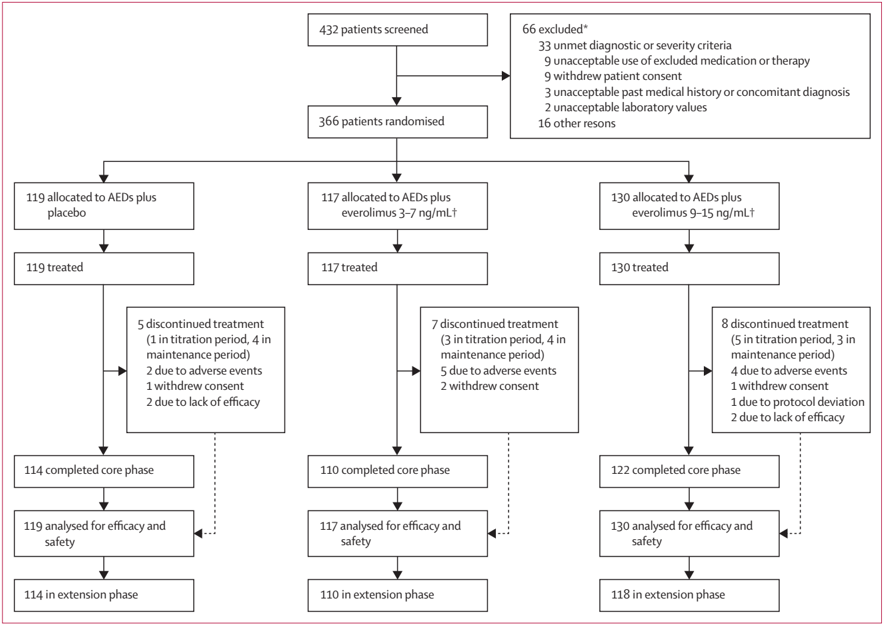
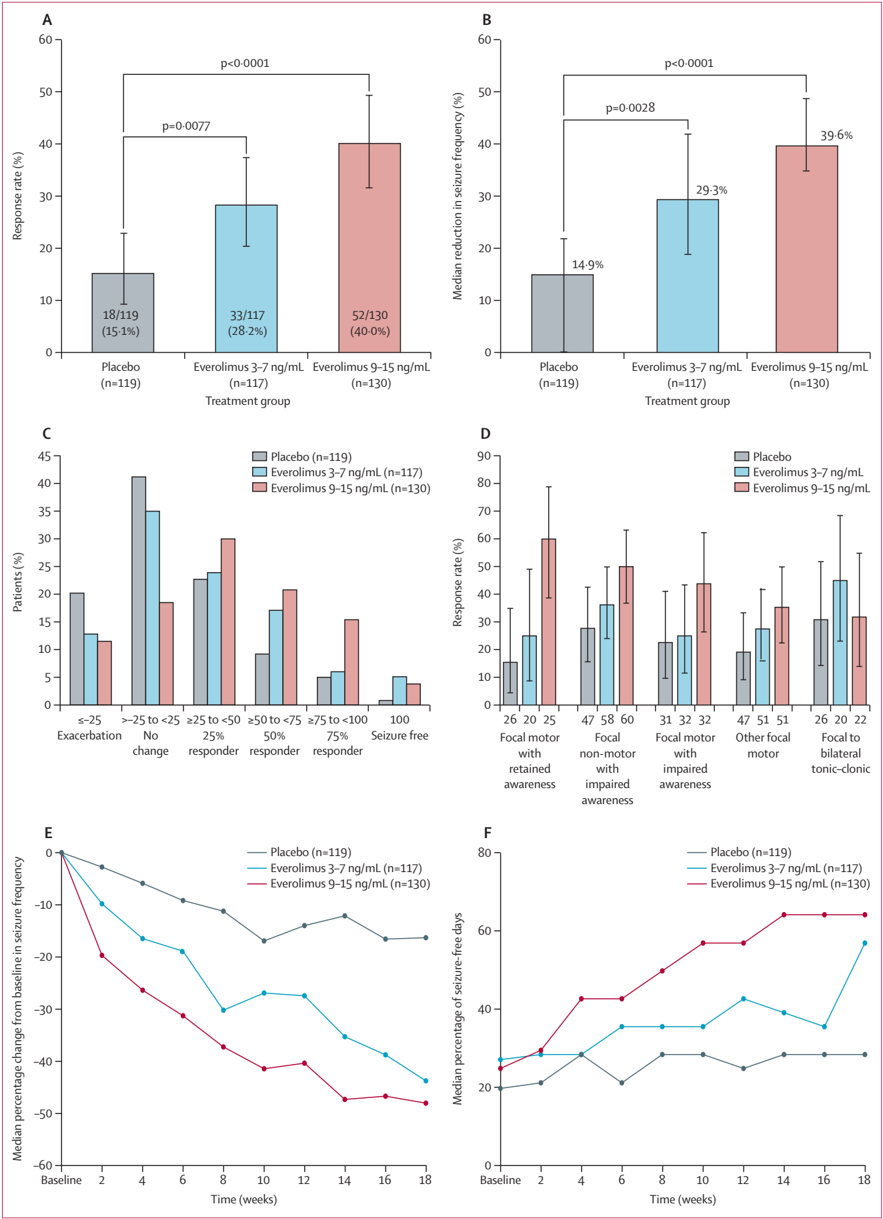
BACKGROUND: Everolimus, a mammalian target of rapamycin (mTOR) inhibitor, has been used for various benign tumours associated with tuberous sclerosis complex. We assessed the efficacy and safety of two trough exposure concentrations of everolimus, 3-7 ng/mL (low exposure) and 9-15 ng/mL (high exposure), compared with placebo as adjunctive therapy for treatment-resistant focal-onset seizures in tuberous sclerosis complex. METHODS: In this phase 3, randomised, double-blind, placebo-controlled study, eligible patients aged 2-65 years with tuberous sclerosis complex and treatment-resistant seizures (≥16 in an 8-week baseline phase) receiving one to three concomitant antiepileptic drugs were recruited from 99 centres across 25 countries. Participants were randomly assigned (1:1:1), via permuted-block randomisation (block size of six) implemented by Interactive Response Technology software, to receive placebo, low-exposure everolimus, or high-exposure everolimus. Randomisation was stratified by age subgroup (<6 years, 6 to <12 years, 12 to <18 years, and ≥18 years). Patients, investigators, site personnel, and the sponsor's study team were masked to treatment allocation. The starting dose of everolimus depended on age, body-surface area, and concomitant use of cytochrome 3A4/P-glycoprotein inducers. Dose adjustments were done to attain target trough ranges during a 6-week titration period, and as needed during a 12-week maintenance period of core phase. Patients or their caregivers recorded events in a seizure diary throughout the study. The primary endpoint was change from baseline in the frequency of seizures during the maintenance period, defined as response rate (the proportion of patients achieving ≥50% reduction in seizure frequency) and median percentage reduction in seizure frequency, in all randomised patients. This study is registered with ClinicalTrials.gov, number NCT01713946. FINDINGS: Between July 3, 2013, and May 29, 2015, 366 patients were enrolled and randomly assigned to placebo (n=119), low-exposure everolimus, (n=117), or high-exposure everolimus (n=130). The response rate was 15·1% with placebo (95% CI 9·2-22·8; 18 patients) compared with 28·2% for low-exposure everolimus (95% CI 20·3-37·3; 33 patients; p=0·0077) and 40·0% for high-exposure everolimus (95% CI 31·5-49·0; 52 patients; p<0·0001). The median percentage reduction in seizure frequency was 14·9% (95% CI 0·1-21·7) with placebo versus 29·3% with low-exposure everolimus (95% CI 18·8-41·9; p=0·0028) and 39·6% with high-exposure everolimus (95% CI 35·0-48·7; p<0·0001). Grade 3 or 4 adverse events occurred in 13 (11%) patients in the placebo group, 21 (18%) in the low-exposure group, and 31 (24%) in the high-exposure group. Serious adverse events were reported in three (3%) patients who received placebo, 16 (14%) who received low-exposure everolimus, and 18 (14%) who received high-exposure everolimus. Adverse events led to treatment discontinuation in two (2%) patients in the placebo group versus six (5%) in the low-exposure group and four (3%) in the high-exposure group. INTERPRETATION: Adjunctive everolimus treatment significantly reduced seizure frequency with a tolerable safety profile compared with placebo in patients with tuberous sclerosis complex and treatment-resistant seizures. FUNDING: Novartis Pharmaceuticals Corporation.
Overview
The claims and statistics of this paper haven’t been checked yet.
Free: it reads the open-access text and checks the first 5 claims that cite a source we can check. Create a free account to check every claim.
Integrity signals
Registry
Cites
Statistics
Figures
Verification
Claims the paper makes
The claims and statistics of this paper haven’t been checked yet.
Free: it reads the open-access text and checks the first 5 claims that cite a source we can check. Create a free account to check every claim.
Claims other papers make about this one
Each is checked against this paper’s own text: does it say what the citing paper says it does?
The source backs part of the claim, not all of it — or backs it for a different population, condition or comparison.
In the citing paper
“mTOR pathway inhibitors, including everolimus and sirolimus may be beneficial as a targeted treatment 131 .”
From Developmental and epileptic encephalopathies (2024) · cites this paper as [131]
Experimental — accuracy not yet measuredThe source backs part of the claim, not all of it — or backs it for a different population, condition or comparison.
In the citing paper
“One example is the EXIST-3 RCT in which the mTOR inhibitor everolimus was trialled in patients with drug-resistant focal seizures in the setting of tuberous sclerosis complex, due to pathogenic variants in the mTOR pathway genes, TSC1 or TSC2.”
From Developmental and epileptic encephalopathies (2024) · cites this paper as [131]
Experimental — accuracy not yet measuredThe cited source says what the claim attributes to it.
In the citing paper
“In this RCT, responder rates were greater with higher-dose everolimus than with placebo; however, they were perhaps less compelling than one might expect for a precision therapy (40% vs 15.1%, p<0.0001) 131 .”
From Developmental and epileptic encephalopathies (2024) · cites this paper as [131]
The cited source says what the claim attributes to it.
In the citing paper
“Effects on cognition and other neuropsychiatric symptoms were not reported.”
From Developmental and epileptic encephalopathies (2024) · cites this paper as [131]
In the citing paper
“Subsequently, inhibitors of mTOR have been proposed as treatments for such syndromes and one drug Everolimus has been approved for treatment of seizures in tuberous sclerosis (French et al., 2016).”
From Getting to the cores of autism (2019) · cites this paper as French et al., 2016
Self-check
Percentages, sums and reported differences re-computed from the paper’s own numbers.
The self-check needs the paper’s full text.
Citations
Cites
Kwan, P., Schachter, S. C., & Brodie, M. J. (2011) · New England Journal of Medicine · doi:10.1056/nejmra1004418 · Cited by 1,052
Everolimus for Subependymal Giant-Cell Astrocytomas in Tuberous Sclerosis
Krueger, D. A., Care, M. M., Holland, K., Agricola, K., Tudor, C., Mangeshkar, P., Wilson, K. A., Byars, A., Sahmoud, T., & Franz, D. N. (2010) · New England Journal of Medicine · doi:10.1056/nejmoa1001671 · Cited by 1,006
Self-citationBissler, J. J., Kingswood, J. C., Radzikowska, E., Zonnenberg, B. A., Frost, M., Belousova, E., Sauter, M., Nonomura, N., Brakemeier, S., de Vries, P. J., et al. (2013) · The Lancet · doi:10.1016/s0140-6736(12)61767-x · Cited by 880
Franz, D. N., Belousova, E., Sparagana, S., Bebin, E. M., Frost, M., Kuperman, R., Witt, O., Kohrman, M. H., Flamini, J. R., Wu, J. Y., et al. (2013) · The Lancet · doi:10.1016/s0140-6736(12)61134-9 · Cited by 794
Self-citationArroyo, S., Rumià, J., Martínez, I., & Ribalta, T. (1998) · PubMed · Cited by 652
Rapamycin prevents epilepsy in a mouse model of tuberous sclerosis complex.
Zeng, L., Xu, L., Gutmann, D. H., & Wong, M. (2008) · Annals of Neurology · doi:10.1002/ana.21331 · Cited by 639
The natural history of epilepsy in tuberous sclerosis complex
Chu‐Shore, C. J., Major, P., Camposano, S., Muzykewicz, D., & Thiele, E. A. (2010) · Epilepsia · doi:10.1111/j.1528-1167.2009.02474.x · Cited by 637
Neurological and neuropsychiatric aspects of tuberous sclerosis complex
Curatolo, P., Moavero, R., & de Vries, P. J. (2015) · The Lancet Neurology · doi:10.1016/s1474-4422(15)00069-1 · Cited by 600
Self-citationMeikle, L., Pollizzi, K., Egnor, A., Kramvis, I., Lane, H., Sahin, M., & Kwiatkowski, D. J. (2008) · The Journal of Neuroscience · doi:10.1523/jneurosci.0955-08.2008 · Cited by 501
Efficacy and Safety of Oral Lacosamide as Adjunctive Therapy in Adults with Partial‐Onset Seizures
Ben‐Menachem, E., Biton, V., Jatuzis, D., Abou‐Khalil, B., Doty, P., & Rudd, G. D. (2007) · Epilepsia · doi:10.1111/j.1528-1167.2007.01188.x · Cited by 485
Research works printed but not linked: 1
- 20. European Medicines Agency. Guideline on clinical investigation of medicinal products in the treatment of epileptic disorders. July 22, 2010. CHMP/EWP/566/98 Rev.2/Corr. http:// wwwemaeuropaeu/docs/en_GB/document_library/Scientifi c_ guideline/2010/01/WC500070043pdf (accessed July 8, 2016).
Cited by
Items 301–400 of 796
Sclérose tubéreuse de Bourneville : mise au point
Pfirmann, P., Combe, C., & Rigothier, C. (2021) · La Revue de Médecine Interne · doi:10.1016/j.revmed.2021.03.003 · Cited by 22
Stomberg, M., Bien, C. G., Kalbhenn, T., Polster, T., & May, T. W. (2021) · Epilepsy & Behavior · doi:10.1016/j.yebeh.2021.108210 · Cited by 16
Self-citationKoike-Kumagai, M., Fujimoto, M., & Wataya‐Kaneda, M. (2022) · Neuropharmacology · doi:10.1016/j.neuropharm.2022.109203 · Cited by 17
Larrew, T., Skoch, J. M., Ihnen, S. K. Z., Arya, R., Holland, K. D., Tenney, J. R., Horn, P. S., Leach, J., Krueger, D. A., Greiner, H. M., et al. (2022) · Neurosurgical FOCUS · doi:10.3171/2022.7.focus22335 · Cited by 16
Ni, X.-J., Zhong, H., Liu, Y., Lin, H., & Gu, Z. (2022) · Frontiers in Neurology · doi:10.3389/fneur.2022.1023832 · Cited by 17
Chordoma Occurs in Young Children With Tuberous Sclerosis
Dahl, N. A., Luebbert, T., Loi, M. M., Neuberger, I., Handler, M. H., Kleinschmidt-DeMasters, B. K., & Levy, J. M. M. (2017) · Journal of Neuropathology & Experimental Neurology · doi:10.1093/jnen/nlx032 · Cited by 16
“mTOR inhibition has been shown to be a useful strategy for those with TSC related to refractory epilepsy (21), renal angiomyolipomas (22), pulmonary lymphangioleiomyomatosis (23), and facial angiofibromas (24).”
Genetics of human epilepsies: Continuing progress
Szepetowski, P. (2017) · La Presse Médicale · doi:10.1016/j.lpm.2017.10.020 · Cited by 18
Combes, F. P., Baneyx, G., Coello, N., Zhu, P., Sallas, W. M., Yin, H., & Nedelman, J. R. (2018) · Journal of Pharmacokinetics and Pharmacodynamics · doi:10.1007/s10928-018-9600-2 · Cited by 17
“There are limited data in patients with Cmin concentration values [ 15 ng/mL in existing clinical studies and the safety profile with Cmin exposure [ 15 ng/mL is not well established, making 15 ng/mL an upper bound of the therapeutic range [3].”
BackgroundMethodInfluentialCaplan, R., Mefford, H. C., Berl, M. M., Chang, B. S., Lin, J. J., Mazarati, A. M., Fureman, B. E., & Dingledine, R. J. (2016) · Epiliepsy currents/Epilepsy currents · doi:10.5698/1535-7511-16.3.182 · Cited by 16
Driedger, J. H., Schröter, J., PROTECT-Study Group, Hertzberg, C., Weschke, B., Kaindl, A. M., Lücke, T., Thiels, C., Klotz, K. A., Fazeli, W., et al. (2025) · Orphanet Journal of Rare Diseases · doi:10.1186/s13023-024-03495-1 · Cited by 16
The concept of disease modification
Cross, J. H., & Lagae, L. G. (2019) · European Journal of Paediatric Neurology · doi:10.1016/j.ejpn.2019.12.005 · Cited by 15
Avoiding complacency when treating uncontrolled seizures: why and how?
Amin, U., & Benbadis, S. R. (2020) · Expert Review of Neurotherapeutics · doi:10.1080/14737175.2020.1713100 · Cited by 15
“sclerosis when treated with everolimus, indicating that inhibition of mTOR results in anti-epileptogenic effects via alteration of signaling pathways and protein expression involved in causing epilepsy [37].”
BackgroundWeidman, D. R., Palasamudram, S., Zak, M., Whitney, R., McCoy, B., Bouffet, É., Taylor, M. D., Shroff, M. M., & Bartels, U. K. (2020) · Journal of Neuro-Oncology · doi:10.1007/s11060-020-03487-8 · Cited by 15
Pharmacotherapy for Seizures in Tuberous Sclerosis Complex
Nabbout, R., Kuchenbuch, M., Chiron, C., & Curatolo, P. (2021) · CNS Drugs · doi:10.1007/s40263-021-00835-8 · Cited by 16
“1) and the second concerned the use of cannabidiol as an add-on therapy (GWPCARE6) in 199 individuals with TSC [21, 91].”
BackgroundSelf-citationCurrent role of surgery for tuberous sclerosis complex‐associated epilepsy
Specchio, N., Pavia, G. C., Palma, L. D., BENEDICTIS, A. D., Pepi, C., Conti, M., Marras, C. E., Vigevano, F., & Curatolo, P. (2022) · Pediatric Investigation · doi:10.1002/ped4.12312 · Cited by 16
Self-citationChildhood tuberous sclerosis complex in southern Sweden: a paradigm shift in diagnosis and treatment
Pearsson, K., Werner, J. B., Lundgren, J., Gränse, L., Karlsson, E., Källén, K., Eklund, E. A., & Békássy, Z. D. (2023) · BMC Pediatrics · doi:10.1186/s12887-023-04137-4 · Cited by 15
Chang, B. S., Krishnan, V., Dulla, C. G., Jetté, N., Marsh, E. D., Dacks, P. A., Whittemore, V., & Poduri, A. (2020) · Epiliepsy currents/Epilepsy currents · doi:10.1177/1535759719895280 · Cited by 16
“There are genetic diagnoses for which specific antiepileptic therapies are either indicated or relatively contraindicated (eg, GLUT1 deficiency, pyridoxine dependency, SCN1A-related epilepsy), and mTOR inhibitors are now known to be at least partially effective for tuberous sclerosis complex–associated epilepsy.(32) B…”
BackgroundEbrahimi‐Fakhari, D., Mann, L. L., Poryo, M., Graf, N. M., von Kries, R., Heinrich, B., Ebrahimi‐Fakhari, D., Flotats‐Bastardas, M., Gortner, L., Zemlin, M., et al. (2019) · Orphanet Journal of Rare Diseases · doi:10.1186/s13023-019-1090-9 · Cited by 15
Zillich, L., Gasparotto, M., Rossetti, A. C., Fechtner, O., Maillard, C., Hoffrichter, A., Zillich, E., Jabali, A., Marsoner, F., Artioli, A., et al. (2025) · Nature Communications · doi:10.1038/s41467-025-64980-0 · Cited by 14
A survey of the European Reference Network EpiCARE on clinical practice for selected rare epilepsies
Baumgartner, T. R., Carreño, M., Rocamora, R., Bisulli, F., Boni, A., Brázdil, M., Horák, O., Craiu, D., Pereira, C., Guerrini, R., et al. (2021) · Epilepsia Open · doi:10.1002/epi4.12459 · Cited by 14
Self-citationMRI-based diagnosis and treatment of pediatric brain tumors: is tissue sample always needed?
Soleman, J., Dvir, R., Ben‐Sira, L., Yalon, M., Boop, F. A., Constantini, S., & Roth, J. (2021) · Child s Nervous System · doi:10.1007/s00381-021-05148-1 · Cited by 15
Protein Phosphorylation Signaling Cascades in Autism: The Role of mTOR Pathway
Бокша, И. С., Prokhorova, T. A., Терешкина, Е. Б., Savushkina, O. K., & Burbaeva, G. S. (2021) · Biochemistry (Moscow) · doi:10.1134/s0006297921050072 · Cited by 15
Martinez, L. A., Lai, Y., Holder, J. L., & Anderson, A. E. (2021) · Neurologic Clinics · doi:10.1016/j.ncl.2021.05.005 · Cited by 14
Drug Treatment of Epilepsy: From Serendipitous Discovery to Evolutionary Mechanisms
Lou, S., & Cui, S. (2021) · Current Medicinal Chemistry · doi:10.2174/0929867328666210910124727 · Cited by 14
Treatment strategies for mosaic overgrowth syndromes of the PI3K-AKT-mTOR pathway
Morin, G., & Canaud, G. (2021) · British Medical Bulletin · doi:10.1093/bmb/ldab023 · Cited by 15
Mulder, F. V. M., Peeters, E. F. H. I., Westerink, J., Zwartkruis, F. J. T., & de Ranitz‐Greven, W. L. (2022) · Orphanet Journal of Rare Diseases · doi:10.1186/s13023-022-02385-8 · Cited by 15
Antiepileptic Drugs in Clinical Development: Differentiate or Die?
Zaccara, G., & Schmidt, D. (2017) · Current Pharmaceutical Design · doi:10.2174/1381612823666170809100524 · Cited by 14
Daenthanasanmak, A., Lin, Y., Zhang, M., Bryant, B. R., Petrus, M. N., Bamford, R. N., Thomas, C. J., Miljković, M. D., Conlon, K. C., & Waldmann, T. A. (2020) · Translational Oncology · doi:10.1016/j.tranon.2020.100913 · Cited by 15
Traynelis, S. F., Dlugos, D., Henshall, D. C., Mefford, H. C., Rogawski, M. A., Staley, K. J., Dacks, P. A., Whittemore, V., & Poduri, A. (2020) · Epiliepsy currents/Epilepsy currents · doi:10.1177/1535759719895279 · Cited by 14
“everolimus for seizures in patients with tuberous sclerosis complex.(58) In addition, new treatment approaches for specific epilepsies are under investigation with novel or disease-specific targets, including AMPA receptors containing the TARPg8 subunit, expressed predominantly in the temporal lobe and of potential re…”
BackgroundSelf-citationChen, W.-L., Pao, E., Owens, J. W. M., Glass, I. A., Pritchard, C. C., Shirts, B. H., Lockwood, C. M., & Mirzaa, G. (2022) · PubMed Central · doi:10.1101/mcs.a006188 · Cited by 14
“2016), and the FDA-approved MTOR inhibitor everolimus has shown promising results in treating TSC-related refractory epilepsy (Krueger et al. 2013; French et al. 2016; Saffari et al. 2019), which occurs in ∼30% of patients even after surgical resection (Fallah et al.”
BackgroundInfluentialSha, Y., Yuan, Q., Qian, Y., Li, X., Niu, M., Du, Y., Liang, X., Sun, S., Lu, Y., & Han, J. (2025) · Therapeutic Advances in Drug Safety · doi:10.1177/20420986251405091 · Cited by 13
“28 Given the shorter median time to onset in fatal cases, close monitoring for neurological symptoms and patient education during the initial treatment phase are especially crucial.”
Prevalence of thoracoabdominal imaging findings in tuberous sclerosis complex
Ritter, D. M., Fessler, B. K., Ebrahimi‐Fakhari, D., Wei, J. J., Franz, D. N., Krueger, D. A., Trout, A. T., & Towbin, A. J. (2022) · Orphanet Journal of Rare Diseases · doi:10.1186/s13023-022-02277-x · Cited by 13
Self-citationModels of KPTN-related disorder implicate mTOR signalling in cognitive and overgrowth phenotypes
Levitin, M. O., Rawlins, L. E., Sánchez-Andrade, G., Arshad, O. A., Collins, S. C., Sawiak, S. J., Iffland, P. H., Andersson, M. H. L., Bupp, C. P., Cambridge, E. L., et al. (2023) · Brain · doi:10.1093/brain/awad231 · Cited by 14
“26 As mTOR inhibitors are generally well tolerated, 100,101 the path to clinical intervention in KRD may be tantaliz-ingly short, and follow-up experiments using our mouse and cellular models should provide critical information to shape clinical trials.”
BackgroundCurrent and emerging pharmacotherapies in Lennox-Gastaut syndrome
Samanta, D., & Nath, M. (2025) · Expert Opinion on Pharmacotherapy · doi:10.1080/14656566.2025.2516630 · Cited by 14
“Everolimus, an mTOR inhibitor, has been validated for the treatment of TSC-associated epilepsy in the Phase 3 EXIST-3 study, demonstrating its efficacy in reducing seizure frequency and improving patient outcomes [81].”
A review of the pharmacotherapeutic considerations for managing epilepsy in people with autism
Watkins, L. V., O’Dwyer, M., & Shankar, R. (2022) · Expert Opinion on Pharmacotherapy · doi:10.1080/14656566.2022.2055461 · Cited by 13
“The functional effect of the TSC mutations is over activation of mammalian target of rapamycin (mTOR) protein complex [65].”
BackgroundInfluentialHurtado-Sierra, D., Garzón, J. X. R., Rojas, L. Z., Fernández-Gómez, Ó., & Manrique-Rincón, F. (2023) · Frontiers in Pediatrics · doi:10.3389/fped.2023.1109646 · Cited by 14
Genomics-Guided Precise Anti-Epileptic Drug Development
Delanty, N., & Cavalleri, G. L. (2017) · Neurochemical Research · doi:10.1007/s11064-017-2312-y · Cited by 13
Fujimoto, A., Okanishi, T., Imai, S., Ogai, M., Fukunaga, A., Nakamura, H., Sato, K., Obana, A., Masui, T., Arai, Y., et al. (2018) · Scientific Reports · doi:10.1038/s41598-018-35168-y · Cited by 14
Pharmacodynamic Monitoring of Antiepileptic Drug Therapy
Brandt, C. (2019) · Therapeutic Drug Monitoring · doi:10.1097/ftd.0000000000000623 · Cited by 14
Woodford, M. R., Backe, S. J., Sager, R., Bourboulia, D., Bratslavsky, G., & Mollapour, M. (2020) · Urologic Oncology Seminars and Original Investigations · doi:10.1016/j.urolonc.2020.03.016 · Cited by 13
Liu, Y., Ma, M., Hu, X., Yan, H., Zhang, Y.-K., Yang, H.-X., Feng, J., Wang, L., Zhang, H., Zhang, B., et al. (2020) · Frontiers in Neurology · doi:10.3389/fneur.2020.00475 · Cited by 13
Compassionate use of everolimus for refractory epilepsy in a patient with MTOR mosaic mutation
Hadouiri, N., Darmency, V., Guibaud, L., Arzimanoglou, A. A., Sorlin, A., Carmignac, V., Rivière, J., Huet, F., Luu, M., Bardou, M., et al. (2020) · European Journal of Medical Genetics · doi:10.1016/j.ejmg.2020.104036 · Cited by 13
Nouri, M. N., Zak, M., Jain, P., & Whitney, R. (2021) · Pediatric Neurology · doi:10.1016/j.pediatrneurol.2021.09.017 · Cited by 14
Becker, B., & Strowd, R. E., III (2019) · Dermatologic Clinics · doi:10.1016/j.det.2019.05.015 · Cited by 16
Śmiałek, D., Jóźwiak, S., & Kotulska, K. (2023) · Journal of Clinical Medicine · doi:10.3390/jcm12010365 · Cited by 13
“The typical drop-out rate in the studies on mTOR inhibitors in patients with TSC is 0–5% [17,45,46].”
BackgroundKatz, J. S., Frankel, H., Ma, T., Zagzag, D., Liechty, B., Zeev, B. B., Tzadok, M., Devinsky, O., Weiner, H. L., & Roth, J. (2017) · Child s Nervous System · doi:10.1007/s00381-017-3335-z · Cited by 13
mTOR pathway diseases: challenges and opportunities from bench to bedside and the mTOR node
Ritter, L. M., Annear, N. M. P., Baple, E. L., Ben-Chaabane, L. Y., Bódi, I., Brosson, L., Cadwgan, J., Coslett, B., Crosby, A. H., Davies, D. M., et al. (2025) · Orphanet Journal of Rare Diseases · doi:10.1186/s13023-025-03740-1 · Cited by 13
“The treatment was generally well-tolerated, with a manageable safety profile [249].”
Natural Killer Cell‐Mediated Antitumor Immunity: Molecular Mechanisms and Clinical Applications
Luo, N., Chen, C., Zhou, W., Hao, J., He, S., Liu, Y., Ku, Y., Huang, L., Zhang, C., Shu, Y., et al. (2025) · MedComm · doi:10.1002/mco2.70387 · Cited by 12
Gene therapy for epilepsy: An emerging, promising approach for a serious neurological disorder
Ledri, M., & Kokaia, M. (2025) · Journal of Internal Medicine · doi:10.1111/joim.70059 · Cited by 15
“Designing targeted CRISPRi therapies to downregulate key components of the mTOR pathway could provide a promising alternative to current pharmacological treatments with mTOR inhibitors [119].”
Chen, X., Wang, D., Zhu, L., Lu, J., Huang, Y., Wang, G., Zhu, Y., Ye, Q., Wang, Y., Xu, H. M., et al. (2021) · Frontiers in Pharmacology · doi:10.3389/fphar.2021.647232 · Cited by 12
Novel treatments in epilepsy guided by genetic diagnosis
Marini, C., & Giardino, M. (2021) · British Journal of Clinical Pharmacology · doi:10.1111/bcp.15139 · Cited by 14
“for TSC patients with refractory epilepsy has been demonstrated in some clinical trials.(52,84) The only phase 3, randomized, double-blind, placebo-controlled study enrolled 366 patients with tuberous sclerosis complex and treatment-resistant seizures across 25 countries.”
BackgroundMonitoring and Managing Patients with Tuberous Sclerosis Complex: Current State of Knowledge
Gomes, I. D. M. E. S., Jesus‐Ribeiro, J., & Palavra, F. (2022) · Journal of Multidisciplinary Healthcare · doi:10.2147/jmdh.s266990 · Cited by 13
Wei, Z., Fallah, A., Wang, Y., Kuang, S., Weil, A. G., Wang, J., & Liang, S. (2023) · Seizure · doi:10.1016/j.seizure.2023.04.002 · Cited by 12
Sands, T. T., & Gelinas, J. N. (2023) · Pediatric Neurology · doi:10.1016/j.pediatrneurol.2023.09.019 · Cited by 14
Liu, M., Ye, J., & You, X. (2023) · Child s Nervous System · doi:10.1007/s00381-023-06200-y · Cited by 14
The use of rapamycin in patients with tuberous sclerosis complex: Long-term results
Canpolat, M., Gümüş, H., Kumandaş, S., Çoşkun, A., & Per, H. (2018) · Epilepsy & Behavior · doi:10.1016/j.yebeh.2018.09.020 · Cited by 15
Electrophysiological Biomarkers in Genetic Epilepsies
Armstrong, C., & Marsh, E. D. (2021) · Neurotherapeutics · doi:10.1007/s13311-021-01132-4 · Cited by 14
Tuber Brain Proportion Determines Epilepsy Onset in Children With Tuberous Sclerosis Complex
Zhang, F., Xie, L., He, X., Song, X., Zheng, H., Wang, L., & Jiang, L. (2021) · Pediatric Neurology · doi:10.1016/j.pediatrneurol.2021.12.012 · Cited by 12
Genetic Testing for Malformations of Cortical Development: A Clinical Diagnostic Study
Straka, B., Splítková, B., Krsková, L., Zámečník, J., Vlčková, M., Balaščaková, M., Tesner, P., Ježdík, P., Tichý, M., Kynčl, M., et al. (2022) · Neurology Genetics · doi:10.1212/nxg.0000000000200032 · Cited by 12
“These patients with a definite genetic diagnosis might in future profit from targeted pharmacologic therapy, such as patientswithTSCbenefitted from adjunctive treatment with everolimus leading to decrease in seizure frequency.(33) Another mTOR inhibitor, sirolimus, temporarily aborted seizures in a 3.”
BackgroundDiagnosis and Treatment of Tuberous Sclerosis Manifestations in Children: A Multicenter Study
Ebrahimi‐Fakhari, D., Gortner, L., Poryo, M., Zemlin, M., Macaya, A., Meyer, S., & Flotats‐Bastardas, M. (2018) · Neuropediatrics · doi:10.1055/s-0038-1637738 · Cited by 14
Samanta, D. (2024) · Epilepsy & Behavior · doi:10.1016/j.yebeh.2024.110123 · Cited by 11
Uno, K., Nomura, Y., Kawaguchi, M., Ebina, A., Imanishi, R., Kawai, S., & Hayakawa, H. (2025) · Orphanet Journal of Rare Diseases · doi:10.1186/s13023-025-03780-7 · Cited by 11
“Several studies have revealed beneficial effects of mTOR inhibitors on reducing the size of cardiac rhabdomyomas and subependymal giant cell astrocytomas (SEGA) in postnatal patients with TSC [14–16].”
Dynamic analysis of 4E-BP1 phosphorylation in neurons with Tsc2 or Depdc5 knockout
Iffland, P. H., Barnes, A. E., Baybis, M., & Crino, P. B. (2020) · Experimental Neurology · doi:10.1016/j.expneurol.2020.113432 · Cited by 11
Datta, A. (2023) · PubMed Central · Cited by 21
Innovations in the Neurosurgical Management of Epilepsy
Hoffman, C. E., Parker, W. E., Rapoport, B. I., Zhao, M., Ma, H., & Schwartz, T. H. (2020) · World Neurosurgery · doi:10.1016/j.wneu.2020.03.031 · Cited by 11
Long-term treatment with everolimus in TSC-associated therapy-resistant epilepsies
Wiegand, G., May, T. W., Lehmann, I., Stephani, U., & Kadish, N. E. (2021) · Seizure · doi:10.1016/j.seizure.2021.10.011 · Cited by 12
GluN2C selective inhibition is a target to develop new antiepileptic compounds
Gataullina, S., Galvani, G., Touchet, S., Nous, C., Lemaire, É., Laschet, J. J., Chiron, C., Dulac, O., Dossi, E., Brion, J., et al. (2022) · Epilepsia · doi:10.1111/epi.17396 · Cited by 11
Phosphorylated-S6 Expression in Sturge-Weber Syndrome Brain Tissue
McCann, M., Cho, A., Pardo, C. A., Phung, T. L., Hammill, A. M., & Comi, A. M. (2022) · Journal of Vascular Anomalies · doi:10.1097/jova.0000000000000046 · Cited by 11
Cenobamate tablets as a treatment for focal-onset seizures in adults
Steinhoff, B. J. (2021) · Expert Review of Clinical Pharmacology · doi:10.1080/17512433.2021.1879637 · Cited by 11
Cipri, S., Baldo, G. D., Fabozzi, F., Boccuto, L., Carai, A., & Mastronuzzi, A. (2023) · Frontiers in Oncology · doi:10.3389/fonc.2023.1204829 · Cited by 13
Subependymal Giant Cell Astrocytoma: The Molecular Landscape and Treatment Advances
Pucko, E. B., Sulejczak, D., & Ostrowski, R. P. (2024) · Cancers · doi:10.3390/cancers16193406 · Cited by 11
“As with any therapy, patients may experience side effects, e.g., aphthous ulcers, acne rash, inflammation of the oral mucosa, hematological complications, fever, nasopharyngitis, fatigue, otitis media, and upper respiratory tract infections [114,119].”
BackgroundEverolimus and sirolimus in the treatment of cardiac rhabdomyomas in neonates
Hurtado-Sierra, D., Garzón, J. X. R., Guevara, S. L. R., García, A. Y. S., & Rojas, L. Z. (2025) · Pediatric Research · doi:10.1038/s41390-025-04043-8 · Cited by 11
“It is reasonable in newborns and infants to use lower doses of mTORi than those approved for other manifestations associated with TSC, adjusting the dose according to the target serum level.”
Rudolph, J., Hoeflich, K. P., & Dar, A. C. (2026) · Nature Reviews Drug Discovery · doi:10.1038/s41573-026-01411-9 · Cited by 13
RHEB1 insufficiency in aged male mice is associated with stress-induced seizures
Tian, Q., Gromov, P., Clement, J. H., Wang, Y., Riemann, M., Weih, F., Sun, X., Dai, M., & Fedorov, L. M. (2017) · GeroScience · doi:10.1007/s11357-017-9997-3 · Cited by 10
Trends in survival and treatment of SEGA: National Cancer Database Analysis
Ryoo, J. S., Khalid, S. I., Chaker, A. N., Behbahani, M., Nunna, R. S., & Mehta, A. I. (2020) · Neuro-Oncology Practice · doi:10.1093/nop/npaa060 · Cited by 11
Litwa, K. (2022) · Frontiers in Genetics · doi:10.3389/fgene.2022.997461 · Cited by 11
“Thus, while the rapamycin derivative everolimus reduces patient tumor burden, decreased KCC2 expression could contribute to the persistence of epileptic seizures in ~50% of treated patients (French et al., 2016; Overwater et al., 2019).”
BackgroundSarnat, H. B., & Scantlebury, M. H. (2017) · Seminars in Pediatric Neurology · doi:10.1016/j.spen.2017.08.010 · Cited by 11
Magalhães, P. H. M., de Moraes, H. T., Athié, M. C. P., Secolin, R., & Lopes‐Cendes, Í. (2019) · Epilepsy & Behavior · doi:10.1016/j.yebeh.2019.07.029 · Cited by 10
Korotkov, A., Sim, N. S., Luinenburg, M. J., Anink, J. J., van Scheppingen, J., Zimmer, T. S., Bongaarts, A., Broekaart, D. W. M., Mijnsbergen, C., Jansen, F. E., et al. (2021) · Neuropathology and Applied Neurobiology · doi:10.1111/nan.12717 · Cited by 10
“Inhibitors of mTORC1 have also been shown efficacious in reduction of neurological manifestations of TSC, such as the frequency of spontaneous seizures [73,74].”
BackgroundSelf-citationProgress of clinical research studies on tuberous sclerosis complex‐related epilepsy in China
Liu, T., Chen, F., Zhai, F., & Liang, S. (2022) · Acta Neurologica Scandinavica · doi:10.1111/ane.13692 · Cited by 10
Grioni, D., & Landi, A. (2018) · World Neurosurgery · doi:10.1016/j.wneu.2018.10.077 · Cited by 10
Johnson, S. R. (2023) · Springer eBooks · doi:10.1007/978-3-031-12950-6_19 · Cited by 11
Efficacy and safety of everolimus for patients with focal cortical dysplasia type 2
Kim, S. H., Kang, H.-C., Roh, Y., Hahn, J., Min, K. L., Lee, S.-J., Yang, D., Choi, H. S., Park, S., Lee, J., et al. (2024) · Epilepsia Open · doi:10.1002/epi4.13104 · Cited by 8
Treatment of Seizures in People with Intellectual Disability
Watkins, L. V., Kinney, M. O., & Shankar, R. (2025) · CNS Drugs · doi:10.1007/s40263-024-01149-1 · Cited by 9
“…and could include clinician bias against proposing this treatment, therapeutic nihilism, difficulties of achieving compliance with the presurgical investigation pathway, resource limitation and lack of appropriate evidence-based aids to explain the surgical pathway to those with mild ID especially.”
Targeted therapies in epilepsies.
Auvin, S. (2025) · Revue neurologique (Paris) · doi:10.1016/j.neurol.2025.04.003 · Cited by 6
Potential for Therapeutic Alteration of the Underlying Biology of Epilepsy
Sperling, M. R., Peters, J. M., Wu, Q., Guignet, M. A., White, H. S., Shih, E. K., Ngo, L. Y., Carrazana, E. J., & Rabinowicz, A. L. (2025) · Biomedicines · doi:10.3390/biomedicines13092258 · Cited by 9
“Everolimus inhibits mammalian target of rapamycin (mTOR) signaling, which is involved in the pathophysiology of TSC [129].”
InfluentialSamanta, D., & Naik, S. (2025) · Seizure · doi:10.1016/j.seizure.2025.11.016 · Cited by 9
From clinical practice to mechanistic insights in ketogenic diets for epilepsy
Figueroa, A. G., Joshi, C., & Patel, M. (2026) · The Lancet Neurology · doi:10.1016/s1474-4422(26)00008-6 · Cited by 9
Proceedings of the 15th Antiepileptic Drug and Device Trials Meeting: State of the Science
Boada, C. M., French, J. A., & Dumanis, S. B. (2020) · Epilepsy & Behavior · doi:10.1016/j.yebeh.2020.107189 · Cited by 10
“However, this method is rational when both themechanismof the drug and themechanism of the disease are known and concordant, as is the case for everolimus use in tuberous sclerosis complex (TSC) [44].”
MethodSelf-citationOverview of therapeutic options for epilepsy.
Kuchenbuch, M., Chiron, C., & Milh, M. (2022) · Archives de pédiatrie · doi:10.1016/s0929-693x(22)00285-8 · Cited by 6
The Evolving Landscape of Therapeutics for Epilepsy in Tuberous Sclerosis Complex
Vitale, G., Terrone, G., Vitale, S., Vitulli, F., Aiello, S., Bravaccio, C., Pisano, S., Bove, I., Rizzo, F. M., Seetahal-Maraj, P., et al. (2023) · Biomedicines · doi:10.3390/biomedicines11123241 · Cited by 9
“The EXIST-3 trial was a randomized, double-blind, placebo-controlled phase 3 study assessing the efficacy and safety of the mTOR inhibitor everolimus as adjunctive therapy for treatment-resistant focal seizures in TSC [64].”
MethodGuo, D., Han, L.-R., Godale, C. M., Rensing, N., Danzer, S. C., & Wong, M. (2024) · Epilepsia · doi:10.1111/epi.18011 · Cited by 3
Treating epilepsy with options other than antiepileptic medications
Muthaffar, O. Y. (2020) · Neurosciences · doi:10.17712/nsj.2020.4.20200010 · Cited by 10
Progress in Tuberous Sclerosis Complex Renal Disease
Bissler, J. J., Batchelor, D., & Kingswood, J. C. (2022) · Critical Reviews™ in Oncogenesis · doi:10.1615/critrevoncog.2022042857 · Cited by 10
Understanding the controversial drug targets in epilepsy and pharmacoresistant epilepsy
Lalitha, S., Minz, R., & Medhi, B. (2018) · Reviews in the Neurosciences · doi:10.1515/revneuro-2017-0043 · Cited by 9
Behavioral problems and family distress in tuberous sclerosis complex
Uematsu, M., Numata‐Uematsu, Y., Aihara, Y., Kobayashi, T., Fujikawa, M., Togashi, N., Shiihara, T., Ohashi, K., Hattori, A., Saitoh, S., et al. (2020) · Epilepsy & Behavior · doi:10.1016/j.yebeh.2020.107321 · Cited by 9
A conjoint analysis of epilepsy and migraine through network-and-pathway-based method
Shu, Y., Xu, Y., Xiao, W., Deng, X.-L., Zeng, Y., Chen, R., Xiao, B., & Long, H. (2020) · Annals of Palliative Medicine · doi:10.21037/apm-19-690 · Cited by 9
“The concept of “disease-modifying drugs in epilepsy” is coming up and the mTOR inhibitor Everolimus seems to have a similar but slightly delayed antiseizure efficacy in tuberous sclerosis complex disease associated seizures (56).”
BackgroundLi, S., Shao, H., & Chang, L. (2020) · BioMed Research International · doi:10.1155/2020/4980609 · Cited by 9
“Consequently, mTOR inhibitors have been proven effective in reducing the frequency of epilepsy in TSC patients besides antiepileptics [5].”
BackgroundSpatiotemporal Correlation of Epileptiform Activity and Gene Expression in vitro
Schlabitz, S., Monni, L., Ragot, A., Wawra, M., Onken, J., Holtkamp, M., & Fidzinski, P. (2021) · Frontiers in Molecular Neuroscience · doi:10.3389/fnmol.2021.643763 · Cited by 9
Peeters, S., Muftuoglu, Y., Na, B. S., Daniels, D. J., & Wang, A. (2021) · Neurosurgery Clinics of North America · doi:10.1016/j.nec.2020.12.001 · Cited by 10
Metadata
- Authors
- French, J. A., Lawson, J. A., Yapici, Z., Ikeda, H., Polster, T., Nabbout, R., Curatolo, P., de Vries, P. J., Dlugos, D. J., Berkowitz, N., Voi, M., Peyrard, S., Pelov, D., & Franz, D. N.
- Affiliations
- NYU Langone Health (US)
- Sydney Children's Hospital (AU)
- National Epilepsy Center (JP)
- Krankenhaus Mara (DE)
- Hôpital Necker-Enfants Malades (FR)
- Policlinico Tor Vergata (IT)
- Children's Hospital of Philadelphia (US)
- Cincinnati Children's Hospital Medical Center (US)
- Corresponding author
- French, Jacqueline A
- ORCID
- Venue
- The Lancet
- Publisher
- Elsevier BV
- Published
- 2016-10
- Volume
- 388
- Issue
- 10056
- Pages
- 2153-2163
- ISSN
- 0099-5355 (ISSN-L)
- 0140-6736
- OpenAlex
- W2511912940
- Cited by
- 764
- References
- 31
- Citations by year
- 2026: 55 · 2025: 75 · 2024: 57 · 2023: 78 · 2022: 76 · 2021: 97 · 2020: 108 · 2019: 73 · 2018: 65 · 2017: 69 · 2016: 10
- FWCI
- 58.25
- Type
- journal article
- Language
- en
- Open access
- hybrid
- doi.org
- Licence
- cc-by-nc-nd
- www.elsevier.com/tdm/userlicense/1.0/ (tdm)
- creativecommons.org/licenses/by-nc-nd/4.0/ (vor)
- Locations
- The Lancet (publishedVersion, cc-by-nc-nd)
- PubMed (publishedVersion)
- Cineca Institutional Research Information System (Tor Vergata University) (submittedVersion)
- INFM-OAR (INFN Catania) (submittedVersion, cc-by-nc-nd)
- Funders
- Novartis Pharmaceuticals Corporation
- Topics
- Health Sciences › Medicine › Genetics (clinical) › Tuberous Sclerosis Complex Research
- Health Sciences › Medicine › Clinical Neurology › Epilepsy research and treatment
- Health Sciences › Medicine › Pediatrics, Perinatology and Child Health › Pharmacological Effects and Toxicity Studies
- Keywords
- everolimus, tuberous sclerosis complex, focal seizures, drug-resistant epilepsy, adjunctive antiepileptic therapy, mTOR inhibitors, seizure frequency reduction, antiepileptic drug interactions, adverse events, pharmacovigilance
- MeSH terms
- Everolimus, Adolescent, Adult, Aged, Anticonvulsants, Antineoplastic Agents, Child, Child, Preschool, Combined Modality Therapy, Dose-Response Relationship, Drug, Double-Blind Method, Female, Humans, Male, Middle Aged, Seizures, Tuberous Sclerosis
About these checks
Registry, retraction, Cites and statistics results are computed, not judged, with one exception: a printed reference that no index lists is read once by a model before it counts as a citation error. Claims are extracted by a model and kept only when their quote appears verbatim in the text; each cited source is then checked, with a model’s help, for whether it says what the claim relies on. Those verdicts can be wrong — read the claim’s quote and the cited source before relying on one.
Statistics and arithmetic are recomputed, not judged.
Confidence bands are shown only for fields calibrated on our annotated test set. None is calibrated yet, so no band is shown.
What counts as a claim ›How we measure confidence ›How we check this ›
Are you an author, or do you see a problem with this page? Request a review
Data sources
Bibliographic data: Semantic Scholar, OpenAlex, Crossref.
Contains information from the Semantic Scholar Academic Graph Datasets, made available under the ODC Attribution License (ODC-BY 1.0).
Semantic Scholar’s data is described in: Kinney, R., et al. (2023). The Semantic Scholar Open Data Platform. arXiv:2301.10140.
