

Risk thresholds for alcohol consumption: combined analysis of individual-participant data for 599 912 current drinkers in 83 prospective studies
Open accessThe DOI matches its Crossref record, with a small difference in title or year; 59 of the 59 references it cites were found in a registry or an index.
Abstract
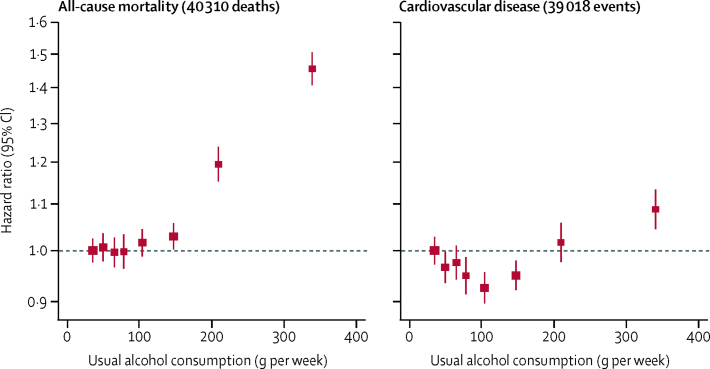
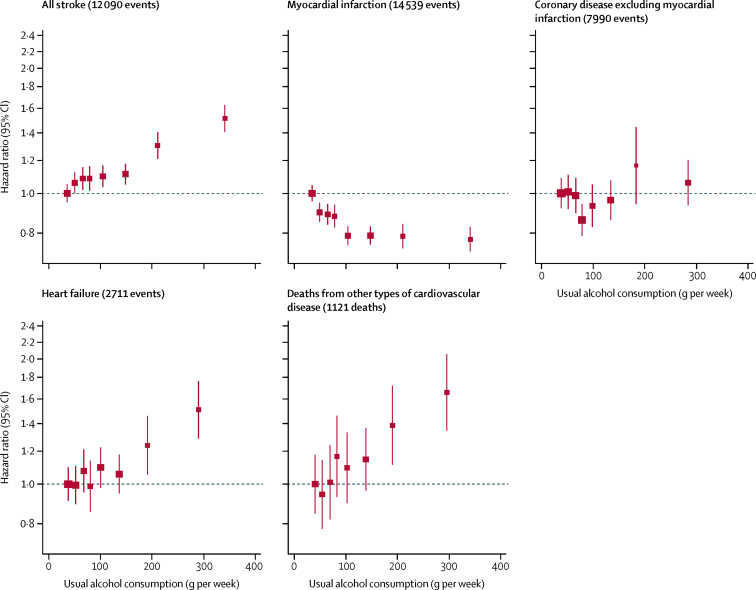
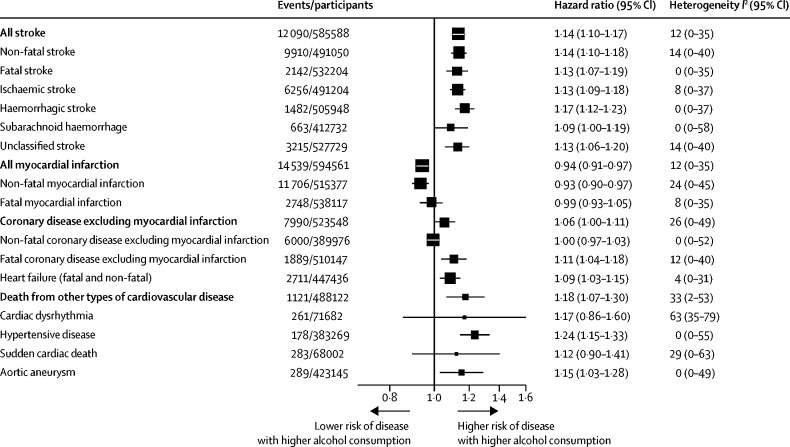
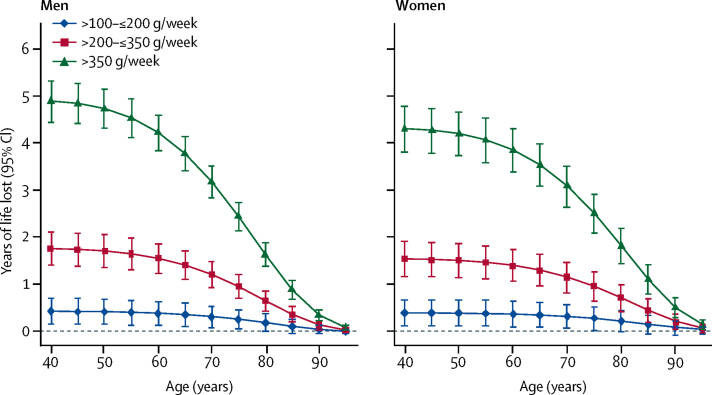
BACKGROUND: Low-risk limits recommended for alcohol consumption vary substantially across different national guidelines. To define thresholds associated with lowest risk for all-cause mortality and cardiovascular disease, we studied individual-participant data from 599 912 current drinkers without previous cardiovascular disease. METHODS: We did a combined analysis of individual-participant data from three large-scale data sources in 19 high-income countries (the Emerging Risk Factors Collaboration, EPIC-CVD, and the UK Biobank). We characterised dose-response associations and calculated hazard ratios (HRs) per 100 g per week of alcohol (12·5 units per week) across 83 prospective studies, adjusting at least for study or centre, age, sex, smoking, and diabetes. To be eligible for the analysis, participants had to have information recorded about their alcohol consumption amount and status (ie, non-drinker vs current drinker), plus age, sex, history of diabetes and smoking status, at least 1 year of follow-up after baseline, and no baseline history of cardiovascular disease. The main analyses focused on current drinkers, whose baseline alcohol consumption was categorised into eight predefined groups according to the amount in grams consumed per week. We assessed alcohol consumption in relation to all-cause mortality, total cardiovascular disease, and several cardiovascular disease subtypes. We corrected HRs for estimated long-term variability in alcohol consumption using 152 640 serial alcohol assessments obtained some years apart (median interval 5·6 years [5th-95th percentile 1·04-13·5]) from 71 011 participants from 37 studies. FINDINGS: In the 599 912 current drinkers included in the analysis, we recorded 40 310 deaths and 39 018 incident cardiovascular disease events during 5·4 million person-years of follow-up. For all-cause mortality, we recorded a positive and curvilinear association with the level of alcohol consumption, with the minimum mortality risk around or below 100 g per week. Alcohol consumption was roughly linearly associated with a higher risk of stroke (HR per 100 g per week higher consumption 1·14, 95% CI, 1·10-1·17), coronary disease excluding myocardial infarction (1·06, 1·00-1·11), heart failure (1·09, 1·03-1·15), fatal hypertensive disease (1·24, 1·15-1·33); and fatal aortic aneurysm (1·15, 1·03-1·28). By contrast, increased alcohol consumption was log-linearly associated with a lower risk of myocardial infarction (HR 0·94, 0·91-0·97). In comparison to those who reported drinking >0-≤100 g per week, those who reported drinking >100-≤200 g per week, >200-≤350 g per week, or >350 g per week had lower life expectancy at age 40 years of approximately 6 months, 1-2 years, or 4-5 years, respectively. INTERPRETATION: In current drinkers of alcohol in high-income countries, the threshold for lowest risk of all-cause mortality was about 100 g/week. For cardiovascular disease subtypes other than myocardial infarction, there were no clear risk thresholds below which lower alcohol consumption stopped being associated with lower disease risk. These data support limits for alcohol consumption that are lower than those recommended in most current guidelines. FUNDING: UK Medical Research Council, British Heart Foundation, National Institute for Health Research, European Union Framework 7, and European Research Council.
Overview
The claims and statistics of this paper haven’t been checked yet.
Free: it reads the open-access text and checks the first 5 claims that cite a source we can check. Create a free account to check every claim.
Integrity signals
Registry
Cites
Statistics
Figures
Verification
Claims the paper makes
The claims and statistics of this paper haven’t been checked yet.
Free: it reads the open-access text and checks the first 5 claims that cite a source we can check. Create a free account to check every claim.
Claims other papers make about this one
Each is checked against this paper’s own text: does it say what the citing paper says it does?
The source backs part of the claim, not all of it — or backs it for a different population, condition or comparison.
In the citing paper
“For example, systematic reviews have quantified exposure levels of alcohol use (e.g. by standard drinks/week) that represent risk-thresholds for stroke, cardio-vascular disease and atrial fibrillation (Samokhvalov, Irving, & Rehm, 2010; Tu et al., 2021; Wood et al., 2018)”
From Risk-thresholds for the association between frequency of cannabis use and the development of psychosis: a systematic review and meta-analysis (2023) · cites this paper as Wood et al., 2018
Experimental — accuracy not yet measuredThe check wasn’t confident either way, so it gives no verdict — never disputed.
In the citing paper
“Regular physical exercise reduces plasma TG levels over and above the effect of weight reduction [151,168,169].”
From 2019 ESC/EAS guidelines for the management of dyslipidaemias: lipid modification to reduce cardiovascular risk (2019) · cites this paper as [168]
Experimental — accuracy not yet measuredIn the citing paper
“However, it is analogous to evidence-based alcohol-related health guidelines where the risk for specific adverse (e.g. cardio-vascular) outcomes is low/absent below certain consumption levels and ‘moderate’ use is recommended”
From Risk-thresholds for the association between frequency of cannabis use and the development of psychosis: a systematic review and meta-analysis (2023) · cites this paper as Wood et al., 2018
Self-check
Percentages, sums and reported differences re-computed from the paper’s own numbers.
The self-check needs the paper’s full text.
Citations
Cites
Bias in meta-analysis detected by a simple, graphical test
Egger, M., Smith, G. D., Schneider, M., & Minder, C. (1997) · BMJ · doi:10.1136/bmj.315.7109.629 · Cited by 56,722 · cited 1×
“35 Methods we used to estimate reductions in life expectancy (years of life lost) are described in the appendix (pp 6–7).”
Quantifying heterogeneity in a meta‐analysis
Higgins, J. P. T., & Thompson, S. G. (2002) · Statistics in Medicine · doi:10.1002/sim.1186 · Cited by 36,763
Self-citationOperating characteristics of a rank correlation test for publication bias
Begg, C. B., & Mazumdar, M. (1994) · Biometrics · doi:10.2307/2533446 · Cited by 16,955 · cited 1×
“33 Evidence of small study effects was assessed visually with funnel plots and by Begg and Mazumdar’s test 34 and Egger’s test.”
Sudlow, C., Gallacher, J., Allen, N., Beral, V., Burton, P., Danesh, J., Downey, P., Elliott, P., Green, J., Landray, M., et al. (2015) · PLOS Medicine · doi:10.1371/journal.pmed.1001779 · Cited by 12,728
Self-citationMACMAHON, S. (1990) · The Lancet · doi:10.1016/0140-6736(90)90878-9 · Cited by 4,253 · cited 1×
“55 However, we did not find convincing evidence that other known risk factors were important mediators or confounders.”
Genomic Aberrations and Survival in Chronic Lymphocytic Leukemia
Döhner, H., Stilgenbauer, S., Benner, A., Leupolt, E., Kröber, A., Bullinger, L., Döhner, K., Bentz, M., & Lichter, P. (2000) · New England Journal of Medicine · doi:10.1056/nejm200012283432602 · Cited by 3,318
ABT-199, a potent and selective BCL-2 inhibitor, achieves antitumor activity while sparing platelets
Souers, A. J., Leverson, J. D., Boghaert, E. R., Ackler, S. L., Catron, N. D., Chen, J., Dayton, B. D., Ding, H., Enschede, S. H., Fairbrother, W. J., et al. (2013) · Nature Medicine · doi:10.1038/nm.3048 · Cited by 3,058
Unmutated Ig VH Genes Are Associated With a More Aggressive Form of Chronic Lymphocytic Leukemia
Hamblin, T. J., Davis, Z., Gardiner, A., Oscier, D. G., & Stevenson, F. K. (1999) · Blood · doi:10.1182/blood.v94.6.1848 · Cited by 2,783
Major lipids, apolipoproteins, and risk of vascular disease
The Emerging Risk Factors Collaboration* (2009) · JAMA · doi:10.1001/jama.2009.1619 · Cited by 2,731
Targeting BCL2 with Venetoclax in Relapsed Chronic Lymphocytic Leukemia
Roberts, A. W., Davids, M. S., Pagel, J. M., Kahl, B. S., Puvvada, S. D., Gerecitano, J. F., Kipps, T. J., Anderson, M. A., Brown, J. R., Gressick, L., et al. (2016) · New England Journal of Medicine · doi:10.1056/nejmoa1513257 · Cited by 1,900
Cited by
Items 601–700 of 1,000
Kawamura, C., Iwagami, M., Sun, Y., Komiyama, J., Ito, T., Sugiyama, T., Bando, H., & Tamiya, N. (2023) · Breast Cancer · doi:10.1007/s12282-023-01486-x · Cited by 10
“We categorized alcohol consumption as never or quit drinking, social drinker/low-risk group (> 0 to ≤ 100 g/week), mid-dle-risk drinking (> 100 to ≤ 350 g/week), and high-risk drinking (> 350 g/week) [19, 20].”
BackgroundAsowata, O. J., Okekunle, A. P., Adedokun, B., & Akpa, O. M. (2023) · Public Health · doi:10.1016/j.puhe.2023.10.016 · Cited by 10
The Association of Prescribed Opioids and Incident Cardiovascular Disease
Sung, M., Eden, S., Becker, W. C., Crystal, S., Duncan, M. S., Gordon, K. S., Kerns, R. D., Kundu, S., Freiberg, M. S., So‐Armah, K., et al. (2023) · Journal of Pain · doi:10.1016/j.jpain.2023.11.019 · Cited by 8
Gao, X., Guo, W., Liu, P., Yuwen, M., Ren, H., Hu, S., Liu, Z., Tan, R., Liu, K., Yang, Z., et al. (2026) · eLife · doi:10.7554/elife.97632.4 · Cited by 8
Choi, S., Park, T., & Je, Y. (2025) · Addiction · doi:10.1111/add.70092 · Cited by 8
“This finding is consistent with previous studies that reported similar adverse effects of alcohol intake on cardiovascular outcomes across alcohol types [7, 26].”
Zheng, Y., Wu, T., Chen, Y., Hou, X., Yang, Y., Ma, X., Ma, Y., Zhang, J., & Xie, X. (2019) · Metabolic Syndrome and Related Disorders · doi:10.1089/met.2019.0009 · Cited by 8
Blalock, D. V., Calhoun, P. S., Crowley, M. J., & Dedert, E. A. (2019) · Current Hypertension Reports · doi:10.1007/s11906-019-0966-3 · Cited by 9
Degerud, E., Høiseth, G., Mørland, J. G., Ariansen, I., Graff‐Iversen, S., Ystrøm, E., Zuccolo, L., & Næss, Ø. (2020) · PLoS Medicine · doi:10.1371/journal.pmed.1003030 · Cited by 8
“A recent consortium-based individual-level analysis of current drinkers found that an intake of 14 grams/day was associated with the lowest risk of both outcomes [31].”
BackgroundLanng, A. R., Gasbjerg, L. S., Bergmann, N. C., Gillum, M. P., Rehfeld, J. F., Helsted, M. M., Møller, H. J., Grønbæk, H., Vilsbøll, T., & Knop, F. K. (2020) · Alcohol · doi:10.1016/j.alcohol.2020.04.006 · Cited by 11
Slow associative learning in alcohol dependence and the alcohol cue exposure treatment paradox
Buckfield, C., Sinclair, J., & Glautier, S. (2020) · Addiction · doi:10.1111/add.15210 · Cited by 9
Kunutsor, S. K., Kremer, D., Eisenga, M. F., Gruppen, E. G., de Borst, M. H., Kobold, A. C. M., Kootstra‐Ros, J. E., Dullaart, R. P. F., & Bakker, S. J. L. (2021) · Clinica Chimica Acta · doi:10.1016/j.cca.2021.05.024 · Cited by 8
Treatment of alcohol dependence in Swedish primary care: perceptions among general practitioners
Hyland, K., Hammarberg, A., Andréasson, S., & Jirwe, M. (2021) · Scandinavian Journal of Primary Health Care · doi:10.1080/02813432.2021.1922834 · Cited by 13
“maybe our prejudices or our own thoughts about this will be reflected in the contact [8].”
BackgroundAboutara, N., Müller, A., Jungen, H., Szewczyk, A., van Rüth, V., Bertram, F., Püschel, K., Heinrich, F., & Iwersen‐Bergmann, S. (2021) · Forensic Science International · doi:10.1016/j.forsciint.2021.111147 · Cited by 9
Effects of Alcohol Reduction Interventions on Blood Pressure
Blalock, D. V., Berlin, S. A., Young, J. R., Blakey, S. M., Calhoun, P. S., & Dedert, E. A. (2022) · Current Hypertension Reports · doi:10.1007/s11906-022-01171-y · Cited by 10
Is drinking wine in moderation good for health or not?
Poli, A. (2022) · European Heart Journal Supplements · doi:10.1093/eurheartjsupp/suac084 · Cited by 8
Kunutsor, S. K., Bhattacharjee, A., Connelly, M. A., Bakker, S. J. L., & Dullaart, R. P. F. (2024) · International Journal of Molecular Sciences · doi:10.3390/ijms25042290 · Cited by 8
“The association was also independent of all evaluated HDL parameters including HDL-C, a finding which contrasts with another meta-analysis [21].”
BackgroundResultInfluentialMoon, J., Hwang, I. C., Kim, K. K., Kang, W. C., Cha, J.-Y., & Moon, Y.-A. (2018) · BMC Public Health · doi:10.1186/s12889-018-6000-x · Cited by 8
Loman, J. G. B., de Vries, S. A., Kukken, N., van Baaren, R. B., Buijzen, M., & Müller, B. C. N. (2019) · PLoS ONE · doi:10.1371/journal.pone.0211030 · Cited by 11
AIN‐93 Diet as an Alternative Model to Lieber–DeCarli Diet for Alcoholic Cardiomyopathy
Cao, Z., Zhang, T., Xu, C., Jia, Y., Wang, T., & Zhu, B.-L. (2019) · Alcoholism Clinical and Experimental Research · doi:10.1111/acer.14069 · Cited by 9
van de Luitgaarden, I. A. T., Schrieks, I. C., Kieneker, L. M., Touw, D. J., van Ballegooijen, A. J., van Oort, S., Grobbee, D. E., Mukamal, K. J., Kootstra‐Ros, J. E., Kobold, A. C. M., et al. (2020) · Journal of the American Heart Association · doi:10.1161/jaha.119.014324 · Cited by 10
Self-citationDaya, N. R., Rebholz, C. M., Appel, L. J., Selvin, E., & Lazo, M. (2020) · Alcoholism Clinical and Experimental Research · doi:10.1111/acer.14393 · Cited by 8
“The associations between moderate alcohol consumption and lower rates of mortality and adverse health outcomes compared to recent and lifetime abstainers are generally well accepted (Keyes et al., 2019, Wood et al., 2018, Costanzo et al., 2018).”
BackgroundSelf-citationSteinkohl, F., Barbieri, F., Senoner, T., Strobl, S., Finkenstedt, A., Plank, F., Langer, C., Beyer, C., Birkl, K., Widmann, G., et al. (2020) · European Radiology · doi:10.1007/s00330-020-07037-8 · Cited by 8
“Heavy drinking may adversely affect the cardiovascular system, but there is controversy in the literature [5, 6].”
BackgroundResultInfluentialLow-risk Drinking Guidelines Around the World: An Overview of the Current Situation
de Paula, T. C. S., Chagas, C., Martins, L. B., & Ferri, C. P. (2020) · Addictive Disorders & Their Treatment · doi:10.1097/adt.0000000000000225 · Cited by 12
Trias‐Llimós, S., Pennells, L. A. M., Tverdal, A., Kudryavtsev, A. V., Malyutina, S. K., Hopstock, L. A., Iakunchykova, O. P., Nikitin, Y., Magnus, P. M., Kaptoge, S. K., et al. (2020) · Scientific Reports · doi:10.1038/s41598-020-77877-3 · Cited by 10
Self-citationYe, X., Miao, C., Zhang, W., Sheng, C., Huang, Q., & Wang, J. (2021) · BMC Public Health · doi:10.1186/s12889-021-12140-6 · Cited by 8
DeJong, W. (2020) · European Journal of Preventive Cardiology · doi:10.1177/2047487320915802 · Cited by 10
Sarich, P., Canfell, K., Egger, S. J., Banks, E., Joshy, G., Grogan, P. B., & Weber, M. F. (2025) · Public Health · doi:10.1016/j.puhe.2024.12.022 · Cited by 8
Self-citationAl-Moussally, F., Khan, S., Katukuri, V. K., Kinaan, M., & Mansi, I. A. (2025) · Drugs · doi:10.1007/s40265-025-02177-x · Cited by 12
“AUD is associated with increased morbidity and mortality [2, 3], and alcohol-associated liver disease is the leading cause of alcohol-related deaths, responsible for 19.1% [2, 3].”
InfluentialMetALD: Genetic Factors and Clinical Outcomes
Israelsen, M. E., Trépo, E., Krag, A. A., & Stender, S. (2025) · Seminars in Liver Disease · doi:10.1055/a-2630-0952 · Cited by 9
Kiefer, P., Lebherz, L., Freitag, J., Schulz, H., Bleich, C., Bokemeyer, C., & Bokemeyer, F. (2025) · Scientific Reports · doi:10.1038/s41598-025-04849-w · Cited by 8
“…Cancer Research Fund (WCRF) consider there to be no safe level of alcohol consumption in terms of cancer risk (i.e. progression and recurrence) 2,28 and recommend total abstinence for patients, as there is no evidence for a specific threshold of risk-free or even beneficial drinking levels 29 .”
Griessbach, A., Mueller, B. U., Battegay, E. J., & Beeler, P. E. (2019) · Drug and Alcohol Dependence · doi:10.1016/j.drugalcdep.2019.107708 · Cited by 7
Hu, Q., Chen, H., Shen, C., Zhang, B., Weng, X., Sun, X., Liu, J., Dong, Z., Hu, K., Ge, J., et al. (2022) · Alcoholism Clinical and Experimental Research · doi:10.1111/acer.14811 · Cited by 8
Yang, Y., Hodge, A. M., Lynch, B. M., Dugué, P., Williamson, E., Jayasekara, H., Mishra, G. D., & English, D. R. (2023) · American Journal of Epidemiology · doi:10.1093/aje/kwad164 · Cited by 7
Zhuang, X., He, G., Zeng, Y., Li, M., Su, Y., Chen, X., Zhang, Y., Gan, Y., Wen, F., & Zhang, X. (2023) · Microvascular Research · doi:10.1016/j.mvr.2023.104629 · Cited by 8
Alcohol – a scoping review for Nordic Nutrition Recommendations 2023
Thelle, D. S., & Grønbæk, M. (2024) · Food & Nutrition Research · doi:10.29219/fnr.v68.10540 · Cited by 9
“Wood et al. assessed the risk thresholds for alcohol consumption based on data from 599,912 current drinkers in 83 prospective studies (26).”
BackgroundResultNagao, M., Okazaki, K., Ohira, T., Nakano, H., Hayashi, F., Shimabukuro, M., Sakai, A., Hosoya, M., Kazama, J. J., Takahashi, A., et al. (2024) · Public Health · doi:10.1016/j.puhe.2024.04.029 · Cited by 8
Overcoming biases of individual level shopping history data in health research
Skatova, A. (2024) · npj Digital Medicine · doi:10.1038/s41746-024-01231-4 · Cited by 10
The role of social determinants in alcohol consumption and cardiovascular health: The pathways study
Liu, M., Pan, Y., Wang, Z., Wang, J., Shi, Y., & Chu, J. (2024) · Nutrition Metabolism and Cardiovascular Diseases · doi:10.1016/j.numecd.2024.10.021 · Cited by 8
A modern view on the pathogenesis, diagnosis and treatment of alcoholic cardiomyopathy
Кобалава, Ж. Д., Lazarev, P. V., & Goncharov, A. (2019) · Russian Journal of Cardiology · doi:10.15829/1560-4071-2019-11-164-172 · Cited by 10
Alcohol use among HIV-positive women of childbearing age, United States, 2013–2014
Frazier, E. L., Esser, M. B., McKnight-Eily, L. R., Zhou, W., & Chavez, P. R. G. (2020) · AIDS Care · doi:10.1080/09540121.2020.1808161 · Cited by 7
“Any alcohol use is associated with increased all-cause mortality in the general population (Griswold et al., 2018; Wood et al., 2018).”
BackgroundMazumder, A. H., Barnett, J. H., Lindberg, N., Torniainen‐Holm, M., Lähteenvuo, M., Lahdensuo, K., Kerkelä, M., Hietala, J. A., Isometsä, E. T., Kampman, O., et al. (2021) · Brain Sciences · doi:10.3390/brainsci11060688 · Cited by 7
“Study findings suggesting a positive association between alcohol use and cognition could be attributed to unmeasured or residual confounding factors [79,80], such as smoking [81], drink types [82], drinking patterns [83], personality [81,84], intelligence [70,85,86], educational attainment [87,88], potential abstainer…”
BackgroundPan‐risk factor for a comprehensive cardiovascular health management
Zheng, R., Xu, Y., Li, M., Lu, J., Xu, M., Wang, T., Zhao, Z., Wang, S., Lin, H., Zhang, X., et al. (2022) · Journal of Diabetes · doi:10.1111/1753-0407.13258 · Cited by 9
“A combined analysis of 83 prospective studies summarized that the threshold for the lowest risk of allcause mortality was about 100 g/week, but no clear thresholds below for lower CVD risk.(25) Several mechanisms had been proposed to explain the beneficial effects of moderate alcohol consumption on the cardiovascular…”
BackgroundArcher, M., Kampman, O., Bloigu, A. H., Bloigu, R., Luoto, K. E., Kultti, J., Hämäläinen, M., Moilanen, E., Leinonen, E. V. J., & Niemelä, O. J. (2019) · Alcohol and Alcoholism · doi:10.1093/alcalc/agz002 · Cited by 7
Wang, J., Li, X., Pu, J., Jin, S., Jia, L., Li, X., Liu, F., Shan, C., & Yang, Y. (2019) · BioMed Research International · doi:10.1155/2019/9602783 · Cited by 12
Cheng, J., Li, F., Sun, X., Liu, S., Chen, L., Tian, F., Zhao, Z., Hu, H., & Li, X. (2019) · Neuroscience Letters · doi:10.1016/j.neulet.2019.134568 · Cited by 9
The Inflammatory Potential of Diet and Pain Incidence: A Cohort Study in Older Adults
Carballo‐Casla, A., García‐Esquinas, E., López‐García, E., Donat‐Vargas, C., Banegas, J. R., Rodríguez‐Artalejo, F., & Ortolá, R. (2022) · The Journals of Gerontology Series A · doi:10.1093/gerona/glac103 · Cited by 7
Falk, H., Ahlner, F., Wetterberg, H., Fässberg, M. M., & Skoog, I. G. (2023) · Age and Ageing · doi:10.1093/ageing/afad041 · Cited by 7
“Risk consumption was defined as ≥100 g alcohol/week, which corresponds with the National Institute on Alcohol Abuse and Alcoholism’s definition of ‘heavy consumption’ for adults aged >65 years [21, 22].”
BackgroundMethodDifférences en matière de santé mentale selon le statut de minorité sexuelle
Martin‐Storey, A., Temcheff, C. E., Laventure, M., & Lévesque, G. (2019) · Santé mentale au Québec · doi:10.7202/1060275ar · Cited by 11
Finally, a Regimen to Extend Human Life Expectancy
Larrick, J. W., & Mendelsohn, A. R. (2018) · Rejuvenation Research · doi:10.1089/rej.2018.2088 · Cited by 11
“12 Likely, the increased cancer rate somewhat balances out the apparent cardiovascular health improvements observed.”
Minimum unit pricing for alcohol in Scotland
Mooney, J. D., & Carlin, E. (2019) · BMJ · doi:10.1136/bmj.l5603 · Cited by 7
Clay, J. M., Callaghan, R. C., Sherk, A., Naimi, T. S., Stockwell, T. R., & Asbridge, M. (2024) · Drug and Alcohol Review · doi:10.1111/dar.13993 · Cited by 7
Yu, X., Gain, E. P., Ajoku, M. J., & Kedia, S. (2024) · Healthcare · doi:10.3390/healthcare13010053 · Cited by 11
“For example, the risk of overall mortality and cardiovascular diseases started increasing significantly after 100 g of alcohol per week for males, which renders to 7 drinks/week with the US standard of 14 g/drink [12].”
Adherence to Healthy Lifestyle and Risk of Cardiometabolic Diseases in Individuals With Hypertension
Qiu, Z., Liu, G., Hu, Y., Wang, S., Liu, B., Rimm, E. B., Wang, M., Manson, J. E., Hu, F. B., & Sun, Q. (2026) · JAMA Network Open · doi:10.1001/jamanetworkopen.2026.0937 · Cited by 8
Self-citationMeta-analysis of alcohol consumption and venous thromboembolism
Zhang, X., Chen, X., Yang, J., Du, L., Zhou, Y., & Li, K. (2021) · Journal of Public Health · doi:10.1093/pubmed/fdab045 · Cited by 6
Jung, H., Jeon, Y., Huh, K. H., Park, J. B., Kim, M.-G., Lee, S., Han, S., Ro, H., Yang, J., Ahn, C., et al. (2022) · Transplant International · doi:10.3389/ti.2022.10243 · Cited by 6
Current Understanding of Diabetic Dyslipidemia: A Review
Gupta, A., & Gupta, R. (2022) · Journal of the Indian Institute of Science · doi:10.1007/s41745-022-00346-5 · Cited by 7
Sun, Y. B., Zhang, H., Wang, B., Wang, Y., Chen, C., Chen, Y., Lu, Y., & Wang, N. (2023) · Chinese Medical Journal · doi:10.1097/cm9.0000000000002794 · Cited by 7
Pár, A., & Pár, G. (2023) · Orvosi Hetilap · doi:10.1556/650.2023.32921 · Cited by 6
Discrimination and social identity processes predict impairment and dysfunction among heavy drinkers
Cruwys, T., Selwyn, J., Rathbone, J. A., & Frings, D. (2023) · Social Science & Medicine · doi:10.1016/j.socscimed.2023.116549 · Cited by 6
Surma, S., & Gajos, G. (2024) · Polskie Archiwum Medycyny Wewnętrznej · doi:10.20452/pamw.16708 · Cited by 7
Prognostic value of sarcopenia in the patients with locally advanced nasopharyngeal carcinoma
Liu, T., Wang, G., Chen, C., He, L., & Wang, R. (2024) · Japanese Journal of Radiology · doi:10.1007/s11604-024-01587-3 · Cited by 7
“Alcohol consumption history is defined as an average alcohol intake of ≥ 100 g/week before admission, and for a duration exceeding 1 year [26].”
Liu, C., Peng, J., Liu, Y., Peng, Y., & Ma, Q. (2024) · Atherosclerosis · doi:10.1016/j.atherosclerosis.2024.118572 · Cited by 6
Windler, F., Coburn, M., Bette, B., Fingerhut, D., Jacobi, A., & Kruse, P. (2024) · British Journal of Anaesthesia · doi:10.1016/j.bja.2024.10.002 · Cited by 6
A Saudi Heart Association Position Statement on Cardiovascular Diseases and Diabetes Mellitus
AlHabeeb, W., Elasfar, A., Kinsara, A. J., Aljizeeri, A. H., Jelaidan, I., Alghalayini, K. W., AlKheraiji., M. F., Akbar, M. A. J., Lawand, S., Alyousif, S. M., et al. (2024) · Journal of the Saudi Heart Association · doi:10.37616/2212-5043.1407 · Cited by 11
“In general, foods that are associated with worse cardiometabolic outcomes should be avoided or reduced (namely sugars, and sugar-sweetened soft drinks [87,88], alcohol [89 e 91], and sodium [92].”
Yuan, S., Damrauer, S. M., & Larsson, S. C. (2025) · Arteriosclerosis Thrombosis and Vascular Biology · doi:10.1161/atvbaha.125.322136 · Cited by 10
Nutritional and Dietary Interventions for Nonalcoholic Fatty Liver Disease
Cai, C. X., Carlos, S., Solaimani, P., Trivedi, B. J., Tran, C. T., & Castelino‐Prabhu, S. (2019) · Elsevier eBooks · doi:10.1016/b978-0-12-814466-4.00029-x · Cited by 6
Studying biological science does not lead to adoption of a healthy lifestyle
Bhatti, S. N., Leidi, A., Leake, D. S., & Li, J. (2019) · Perspectives in Public Health · doi:10.1177/1757913919890889 · Cited by 7
“29 Another worrying outcome from this study is that approximately 19.4% of university students consumed alcohol beyond the safe limit of 14 units/week ( 112g/week) with a majority of this percentage being males.”
BackgroundInfluentialLiu, C., Yin, R., Shi, Z.-H., Zheng, P., Deng, G., Guan, Y., & Wei, B. (2021) · Aging · doi:10.18632/aging.202514 · Cited by 6
Thørrisen, M. M., Sadeghi, T., Bonsaksen, T., Graham, I. D., & Aas, R. W. (2022) · Addiction Science & Clinical Practice · doi:10.1186/s13722-022-00335-0 · Cited by 6
Direct and indirect costs attributed to alcohol consumption in Brazil, 2010 to 2018
de Freitas, M. G., & da Silva, E. N. (2022) · PLoS ONE · doi:10.1371/journal.pone.0270115 · Cited by 6
Kim, L. H. C., Bang, A., Sarich, P., Nair‐Shalliker, V., Patel, M. I., & Smith, D. P. (2023) · Annals of Epidemiology · doi:10.1016/j.annepidem.2023.04.014 · Cited by 8
Weng, T.-L., Meng, L., Peng, L., Lin, M., Hsiao, F., & Chen, L. (2024) · Journal of the American Medical Directors Association · doi:10.1016/j.jamda.2024.03.119 · Cited by 6
Time to revise the definition of NAFLD: A purist vision
Mantovani, A. (2019) · Digestive and Liver Disease · doi:10.1016/j.dld.2018.12.018 · Cited by 6
Analysis of fatal cases of psychoactive drug overdoses in the Crimean Republic between 1993-2017
Бабанин, А. А., & Сергеевич, У. В. (2019) · Forensic Medical Expertise · doi:10.17116/sudmed20196205154 · Cited by 6
Association between abdominal aortic aneurysms and alcohol-related diseases
Li, L.-Y., Chien, W., Wang, J., Tzeng, N., Chung, C., Lin, C.-Y., & Tsai, S. (2020) · Medicine · doi:10.1097/md.0000000000022968 · Cited by 7
“Alcohol consumption was nonetheless a reported risk factor for the development of AAA in a metaanalysis study and in a Korean population study.([5,6]) In a metaanalysis, although lower levels of alcohol consumption appeared to be associated with a lower risk of AAA, the risk of AAA”
BackgroundKosti, R. I., Lorenzo, C. D., Panagiotakos, D. B., Sandeman, G., Frittella, N., Iasiello, B., Teissèdre, P., & Restani, P. (2021) · OENO One · doi:10.20870/oeno-one.2021.55.4.4757 · Cited by 10
Self-citationDonat, M., Barrio, G., Guerras, J. M., Herrero, L., Pulido, J., Belza, M. J., & Regidor, E. (2022) · International Journal of Environmental Research and Public Health · doi:10.3390/ijerph19074371 · Cited by 8
“, 20–40 g), both in men and women [1,2].”
BackgroundInfluencing factors of wide pulse pressure in an elderly Chinese population: A cross‐sectional study
Yang, D., Chen, J., Zhang, T., Lin, Y., Yao, X., Meng, L., Guo, F., Chen, K., Dai, H., & Tang, M. (2022) · Journal of Clinical Hypertension · doi:10.1111/jch.14582 · Cited by 7
Whitfield, J. B., Seth, D., & Morgan, T. R. M. (2022) · Alcoholism Clinical and Experimental Research · doi:10.1111/acer.14968 · Cited by 7
“Many studies have compared all-cause mortality, mortality from predefined causes, or incidence of conditions of interest between groups of people classified by their self-reported alcohol intake (Corrao et al., 1998 , 2004; Wood et al., 2018; Xi et al., 2017).”
BackgroundKwon, A. J., Morales, L., Chatagnier, L., Quigley, J. A., Pascua, J., Pinkowski, N. J., Brasser, S. M., & Hong, M. Y. (2024) · Alcohol · doi:10.1016/j.alcohol.2024.03.010 · Cited by 7
McQuire, C., & de Vocht, F. (2019) · Drug and Alcohol Review · doi:10.1111/dar.12898 · Cited by 6
“For example a large combined analysis of prospective cohort studies, based on 599 912 participants, described how associations between alcohol use and mortality from a variety of cardiovascular diseases, including myocardial infarction, stroke and heart failure, were characterised by multiple different and sometimes o…”
BackgroundLibman, H., Jiang, Z. G., Tapper, E. B., & Reynolds, E. E. (2019) · Annals of Internal Medicine · doi:10.7326/m19-1125 · Cited by 6
Chevance, A., Daouda, O. S., Salvador, A., Légeron, P., Morvan, Y., Saporta, G., Hocine, M. N., & Gaillard, R. (2020) · PLoS ONE · doi:10.1371/journal.pone.0233472 · Cited by 10
“Finally, 9.2% reported drinking > 10 glasses per week, which is a cut-off for high risk of all-cause-mortality recently identified [22].”
InfluentialAdams, R. S., Ketchum, J. M., Nakase‐Richardson, R., Katz, D. I., & Corrigan, J. D. (2021) · American Journal of Physical Medicine & Rehabilitation · doi:10.1097/phm.0000000000001753 · Cited by 8
“The appropriateness of the low-risk drinking guidelines in the United States and other high-income countries has been criticized recently for being too high; a systematic review in the Lancet supports limits for alcohol consumption that are lower than those recommended in current guidelines to reduce risk for all-caus…”
BackgroundThørrisen, M. M., Bonsaksen, T., Skogen, J. C., Skarpaas, L. S., Sevic, A., van Mechelen, W., & Aas, R. W. (2021) · Frontiers in Public Health · doi:10.3389/fpubh.2021.692605 · Cited by 6
Risk thresholds for alcohol consumption
Astrup, A. V., Costanzo, S., & de Gaetano, G. (2018) · The Lancet · doi:10.1016/s0140-6736(18)32192-5 · Cited by 6
Miller, L. M., Anderson, C. A. M., & Ix, J. H. (2020) · European Journal of Preventive Cardiology · doi:10.1177/2047487320904230 · Cited by 6
Alcohol and heart health: The need for a randomized controlled trial
Thelle, D. S. (2020) · European Journal of Preventive Cardiology · doi:10.1177/2047487320914433 · Cited by 6
Cardio-renal-metabolic (CRM): Call for action for European Guidelines for Primary Care Physicians
Säemann, M. D., Biesiada, A. M., Smatana, M., & Liebermann, N. (2025) · Journal of Primary Care & Community Health · doi:10.1177/21501319251379732 · Cited by 7
Study of Cardiovascular Risks in Adolescents (ERICA): alcohol consumption and associated factors
Miguez, F. G. G., Oliveira, G., Corrêa, M. M., & de Oliveira, E. R. A. (2023) · Revista Brasileira de Epidemiologia · doi:10.1590/1980-549720230025 · Cited by 5
Lee, A., Sung, Y., Pan, S., Sung, K., Su, C., Ding, S.-L., Lu, Y.-J., Hsieh, C., Chen, Y., Liu, C., et al. (2023) · Communications Biology · doi:10.1038/s42003-023-04985-x · Cited by 5
“6a, c; Supplementary Movies 3, 4).”
Rico, M. S., Plessz, M., Airagnes, G., Ribet, C., Hoertel, N., Goldberg, M., Zins, M., & Meneton, P. (2023) · BMJ Open · doi:10.1136/bmjopen-2023-074835 · Cited by 7
Hetland, R. A., Wilsgaard, T., Hopstock, L. A., Ariansen, I., Johansson, J., Jacobsen, B. K., & Grimsgaard, S. (2024) · BMJ Open · doi:10.1136/bmjopen-2023-080611 · Cited by 6
Tevik, K., Skråstad, R. B., Benth, J. Š., Selbæk, G., Bergh, S., Eldholm, R. S., Krokstad, S., & Helvik, A. (2024) · PLoS ONE · doi:10.1371/journal.pone.0304714 · Cited by 6
Marzan, M. B., Callinan, S., Livingston, M., & Jiang, H. (2024) · International Journal of Drug Policy · doi:10.1016/j.drugpo.2024.104502 · Cited by 5
“It was the seventh leading risk factor for premature death and disability worldwide (Wood et al., 2018).”
BackgroundInfluentialSex-specific predictive factors of smoking cessation in subjects at high cardiovascular risk
Allagbé, I., Zeller, M., Thomas, D., Airagnes, G., Limosin, F., Boussadi, A., Chague, F., & Faou, A.-L. L. (2024) · Archives of cardiovascular diseases · doi:10.1016/j.acvd.2024.06.001 · Cited by 5
Factors Associated with Dietary Diversity in Community-Dwelling Brazilian Older Adults
Corona, L. P., Silva, G., & Freiria, C. N. (2024) · Foods · doi:10.3390/foods13213449 · Cited by 8
“The positive association found in the present study between dietary diversity and sporadic alcohol intake can be explained by the various existing recommendations that relate moderate consumption with lower risks of diseases and cardiovascular mortality [57].”
BackgroundIp, N., Scarrott, K., & Conklin, A. (2024) · Frontiers in Medicine · doi:10.3389/fmed.2024.1468990 · Cited by 6
Yan, C., Ding, Y., He, H., Lyu, J., Zhao, Y., Yang, Z., & Meng, H. (2025) · Social Psychiatry and Psychiatric Epidemiology · doi:10.1007/s00127-025-02873-9 · Cited by 6
van de Luitgaarden, I. A. T., Schrieks, I. C., Bacquer, D. D., van Oort, S., Mirrakhimov, E. M., Вачиковна, П. Н., Davletov, K., Долженко, М. М., van Ballegooijen, A. J., Kotseva, K., et al. (2020) · Atherosclerosis · doi:10.1016/j.atherosclerosis.2020.09.009 · Cited by 5
Self-citation
Metadata
- Authors
- Wood, A. M., Kaptoge, S., Butterworth, A. S., Willeit, P., Warnakula, S., Bolton, T., Paige, E., Paul, D. S., Sweeting, M., Burgess, S., Bell, S., Astle, W., Stevens, D., Koulman, A., Selmer, R. M., Verschuren, W. M. M., Sato, S., Njølstad, I., Woodward, M., Salomaa, V., Nordestgaard, B. G., Yeap, B. B., Fletcher, A., Melander, O., Kuller, L. H., Balkau, B., Marmot, M., Koenig, W., Casiglia, E., Cooper, C., Arndt, V., Franco, O. H., Wennberg, P., Gallacher, J., de la Cámara, A. G., Völzke, H., Dahm, C. C., Dale, C. E., Bergmann, M. M., Crespo, C. J., van der Schouw, Y. T., Kaaks, R., Simons, L. A., Lagiou, P., Schoufour, J. D., Boer, J. M. A., Key, T. J., Rodriguez, B., Moreno-Iribas, C., Davidson, K. W., Taylor, J. O., Sacerdote, C., Wallace, R. B., Quiros, J. R., Tumino, R., Blazer, D. G., Linneberg, A., Daimon, M., Panico, S., Howard, B., Skeie, G., Strandberg, T., Weiderpass, E., Nietert, P. J., Psaty, B. M., Kromhout, D., Salamanca-Fernandez, E., Kiechl, S., Krumholz, H. M., Grioni, S., Palli, D., Huerta, J. M., Price, J., Sundström, J., Arriola, L., Arima, H., Travis, R. C., Panagiotakos, D. B., Karakatsani, A., Trichopoulou, A., Kühn, T., Grobbee, D. E., Barrett-Connor, E., van Schoor, N., Boeing, H., Overvad, K., Kauhanen, J., Wareham, N., Langenberg, C., Forouhi, N., Wennberg, M., Després, J.-P., Cushman, M., Cooper, J. A., Rodriguez, C. J., Sakurai, M., Shaw, J. E., Knuiman, M., Voortman, T., Meisinger, C., Tjønneland, A., Brenner, H., Palmieri, L., Dallongeville, J., Brunner, E. J., Assmann, G., Trevisan, M., Gillum, R. F., Ford, I., Sattar, N., Lazo, M., Thompson, S. G., Ferrari, P., Leon, D. A., Smith, G. D., Peto, R., Jackson, R., Banks, E., Di Angelantonio, E., Danesh, J., Wood, A. M., Kaptoge, S., Butterworth, A., Willeit, P., Warnakula, S., Bolton, T., Paige, E., Paul, D. S., Sweeting, M., Burgess, S., Bell, S., Astle, W., Stevens, D., Koulman, A., Selmer, R. M., Verschuren, M., Sato, S., Njølstad, I., Woodward, M., Veikko, S., Nordestgaard, B. G., Yeap, B. B., Flecther, A., Melander, O., Kuller, L. H., Balkau, B., Marmot, M., Koenig, W., Casiglia, E., Cooper, C., Arndt, V., Franco, O. H., Wennberg, P., Gallacher, J., Gómez de la Cámara, A., Völzke, H., Dahm, C. C., Dale, C. E., Bergmann, M., Crespo, C., van der Schouw, Y. T., Kaaks, R., Simons, L. A., Lagiou, P., Schoufour, J. D., Boer, J. M. A., Key, T. J., Rodriguez, B., Moreno-Iribas, C., Davidson, K. W., Taylor, J. O., Sacerdote, C., Wallace, R. B., Quiros, J. R., Rimm, E. B., Tumino, R., Blazer III, D. G., Linneberg, A., Daimon, M., Panico, S., Howard, B., Skeie, G., Salomaa, V., Strandberg, T., Weiderpass, E., Nietert, P. J., Psaty, B. M., Kromhout, D., Salamanca-Fernandez, E., Kiechl, S., Krumholz, H. M., Grioni, S., Palli, D., Huerta, J. M., Price, J., Sundström, J., Arriola, L., Arima, H., Travis, R. C., Panagiotakos, D. B., Karakatsani, A., Trichopoulou, A., Kühn, T., Grobbee, D. E., Barrett-Connor, E., van Schoor, N., Boeing, H., Overvad, K., Kauhanen, J., Wareham, N., Langenberg, C., Forouhi, N., Wennberg, M., Després, J.-P., Cushman, M., Cooper, J. A., Rodriguez, C. J., Sakurai, M., Shaw, J. E., Knuiman, M., Voortman, T., Meisinger, C., Tjønneland, A., Brenner, H., Palmieri, L., Dallongeville, J.-P., Brunner, E. J., Assmann, G., Trevisan, M., Gillumn, R. F., Ford, I. F., Sattar, N., Lazo, M., Thompson, S., Ferrari, P., Leon, D. A., Davey Smith, G., Peto, R., Jackson, R., Banks, E., Di Angelantonio, E., & Danesh, J.
- Affiliations
- University of Cambridge (GB)
- University Medical Center Utrecht (NL)
- London School of Hygiene & Tropical Medicine (GB)
- German Institute of Human Nutrition (DE)
- Portland State University (US)
- Institut Pasteur de Lille (FR)
- Howard University Hospital (US)
- ORCID
- Venue
- The Lancet
- Publisher
- Elsevier BV
- Published
- 2018-04
- Volume
- 391
- Issue
- 10129
- Pages
- 1513-1523
- ISSN
- 0099-5355 (ISSN-L)
- 0140-6736
- PMC
- PMC5899998
- OpenAlex
- W2787107952
- Semantic Scholar
- 67861ba0b72d3635d063ce89d6b401c9f5a93164
- Cited by
- 1,188
- References
- 54
- Citations by year
- 2026: 78 · 2025: 117 · 2024: 135 · 2023: 146 · 2022: 155 · 2021: 173 · 2020: 164 · 2019: 155 · 2018: 63
- FWCI
- 105.54
- Type
- journal article
- Language
- en
- Update notices
- erratum (2018-06-02)
- Open access
- hybrid
- doi.org
- Licence
- cc-by
- www.elsevier.com/tdm/userlicense/1.0/ (tdm)
- creativecommons.org/licenses/by/4.0/ (vor)
- Locations
- The Lancet (publishedVersion, cc-by)
- Europe PMC (PubMed Central) (publishedVersion, other-oa)
- PubMed Central (publishedVersion, cc-by)
- PubMed (publishedVersion)
- Pure Amsterdam UMC (publishedVersion, cc-by)
- Research at the University of Copenhagen (University of Copenhagen) (publishedVersion, cc-by)
- Amsterdam UMC (VU Amsterdam) - Institutional Repository (publishedVersion, other-oa)
- EUR Research Repository (Erasmus University Rotterdam) (publishedVersion)
- University of Groningen research database (University of Groningen / Centre for Information Technology) (publishedVersion, cc-by)
- Explore Bristol Research (publishedVersion, other-oa)
- ENLIGHTEN (Jurnal Bimbingan dan Konseling Islam) (acceptedVersion, cc-by-sa)
- ePrints Soton (University of Southampton) (acceptedVersion)
- Socio-Environmental Systems Modeling (acceptedVersion, cc-by)
- Leicester Research Archive (University of Leicester) (acceptedVersion, other-oa)
- LSHTM Research Online (London School of Hygiene and Tropical Medicine) (acceptedVersion)
- ANU Open Research (Australian National University) (submittedVersion, cc-by)
- UNSWorks (UNSW Sydney) (submittedVersion, cc-by)
- UEF eRepo (University of Eastern Finland) (submittedVersion, cc-by)
- VBN Forskningsportal (Aalborg Universitet) (submittedVersion, cc-by)
- RISalud Institutional Health Repository of Andalucía (submittedVersion, cc-by)
- Apollo (University of Cambridge) (submittedVersion, cc-by)
- PDXScholar (Portland State University) (submittedVersion)
- UWA Profiles and Research Repository (UWA) (submittedVersion, cc-by)
- EUR Research Repository (Erasmus University Rotterdam) (submittedVersion)
- RePub (Erasmus University Rotterdam) (submittedVersion, other-oa)
- DiVA at Umeå University (Umeå University) (submittedVersion, other-oa)
- Uppsala University Publications (Uppsala University) (submittedVersion, other-oa)
- HAL (submittedVersion)
- LA Referencia (Red Federada de Repositorios Institucionales de Publicaciones Científicas) (submittedVersion, other-oa)
- Utrecht University Repository (Utrecht University) (submittedVersion, other-oa)
- UCL Discovery (University College London) (submittedVersion)
- NORA - Norwegian Open Research Archives (submittedVersion, other-oa)
- Figshare (submittedVersion, cc-by)
- Työväentutkimus Vuosikirja (submittedVersion)
- Lund University Publications (Lund University) (submittedVersion)
- mediaTUM – the media and publications repository of the Technical University Munich (Technical University Munich) (submittedVersion, other-oa)
- mediaTUM (Technical University of Munich) (submittedVersion)
- Site cant be reached (submittedVersion)
- Edinburgh Research Explorer (University of Edinburgh) (submittedVersion, cc-by)
- Research Portal (Queen's University Belfast) (submittedVersion, cc-by)
- PuSH - Publication Server of Helmholtz Zentrum München (submittedVersion)
- Bristol Research (University of Bristol) (submittedVersion, other-oa)
- Rivm Repository (Netherlands National Institute for Public Health and the Environment) (submittedVersion, cc-by)
- Rivm (National Institute for Public Health and the Environment) (submittedVersion)
- OPUS (Augsburg University) (submittedVersion)
- OPUS (Augsburg University) (submittedVersion, cc-by)
- STM:n Hallinnonalan avoin julkaisuarkisto (Julkari) (submittedVersion)
- Rivm (National Institute for Public Health and the Environment) (submittedVersion, cc-by)
- University of Groningen research database (University of Groningen / Centre for Information Technology) (submittedVersion, cc-by)
- Utrecht University Repository (Utrecht University) (submittedVersion, cc-by)
- Data Archiving and Networked Services (DANS) (submittedVersion, other-oa)
- Data Archiving and Networked Services (DANS) (submittedVersion, cc-by)
- Apollo (cc-by)
- Columbia Academic Commons (Columbia University)
- WOS
- Funders
- World Health Organization
- Wellcome Trust (204623/Z/16/Z)
- Cancer Research UK (16491)
- National Institute for Health and Care Research (NF-SI-0617-10113, NF-SI-0512-10165, NF-SI-0508-10082, NF-SI-0513-10085, NF-SI-0512-10135, NF-SI-0617-10149)
- British Heart Foundation (MR/L003120/1, G0800270, RG/16/11/32334, SP/09/002, RG/08/014, CH/12/2/29428, PG/11/63/29011, RG/13/13/30194, RG/13/2/30098)
- European Commission (LSHM_CT_2006_037197, 279233, 37197)
- National Centre for the Replacement, Refinement and Reduction of Animals in Research (NC/P001076/1)
- Cambridge University Hospitals (146281)
- Novo Nordisk Fonden (NNF14OC0009819)
- Medical Research Council (MR/K013351/1, MC_UU_12015/5, SP/09/002, MR/R024227/1, MR/L003120/1, G0800270, MC_PC_17228, MR/N003284/1, MC_UU_12011/1, MC_UU_12015/1, MR/L003120, MC_UU_00011/1, MR/K014811/1)
- NIHR Cambridge Biomedical Research Centre (MR/L003120/1)
- National Institute on Alcohol Abuse and Alcoholism (U10AA025286)
- FP7 Ideas: European Research Council (268834)
- Topics
- Health Sciences › Medicine › Pathology and Forensic Medicine › Alcohol Consumption and Health Effects
- Health Sciences › Medicine › Epidemiology › Substance Abuse Treatment and Outcomes
- Health Sciences › Medicine › Pharmacology (medical) › Coffee research and impacts
- Keywords
- alcohol consumption, all-cause mortality, cardiovascular disease, stroke, coronary artery disease, heart failure, dose-response relationship, alcohol guidelines, current drinkers, UK Biobank, individual patient data meta-analysis, high-income countries
- MeSH terms
- Alcohol Drinking, Cardiovascular Diseases, Female, Humans, Male, Middle Aged, Prospective Studies
About these checks
Registry, retraction, Cites and statistics results are computed, not judged, with one exception: a printed reference that no index lists is read once by a model before it counts as a citation error. Claims are extracted by a model and kept only when their quote appears verbatim in the text; each cited source is then checked, with a model’s help, for whether it says what the claim relies on. Those verdicts can be wrong — read the claim’s quote and the cited source before relying on one.
Statistics and arithmetic are recomputed, not judged.
Confidence bands are shown only for fields calibrated on our annotated test set. None is calibrated yet, so no band is shown.
What counts as a claim ›How we measure confidence ›How we check this ›
Are you an author, or do you see a problem with this page? Request a review
Data sources
Bibliographic data: Semantic Scholar, OpenAlex, Crossref.
Contains information from the Semantic Scholar Academic Graph Datasets, made available under the ODC Attribution License (ODC-BY 1.0).
Semantic Scholar’s data is described in: Kinney, R., et al. (2023). The Semantic Scholar Open Data Platform. arXiv:2301.10140.
