

Risk thresholds for alcohol consumption: combined analysis of individual-participant data for 599 912 current drinkers in 83 prospective studies
Open accessThe DOI matches its Crossref record, with a small difference in title or year; 59 of the 59 references it cites were found in a registry or an index.
Abstract
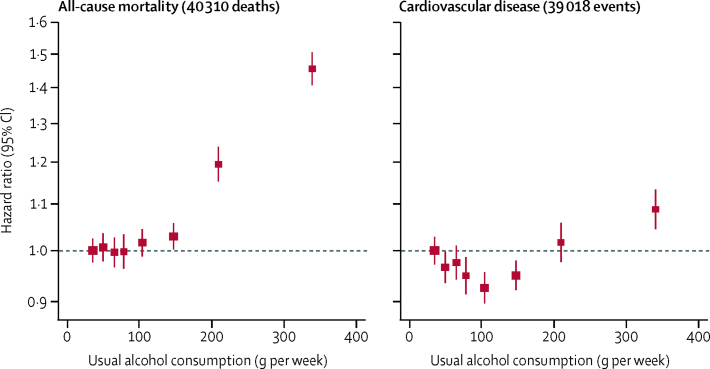
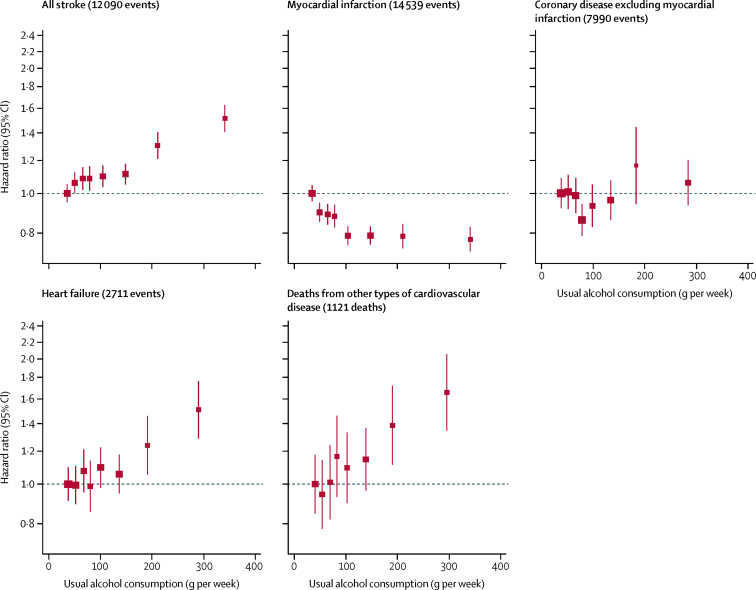
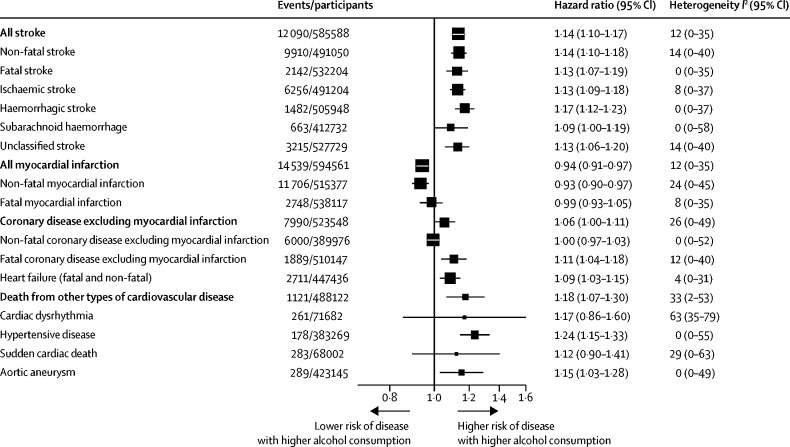
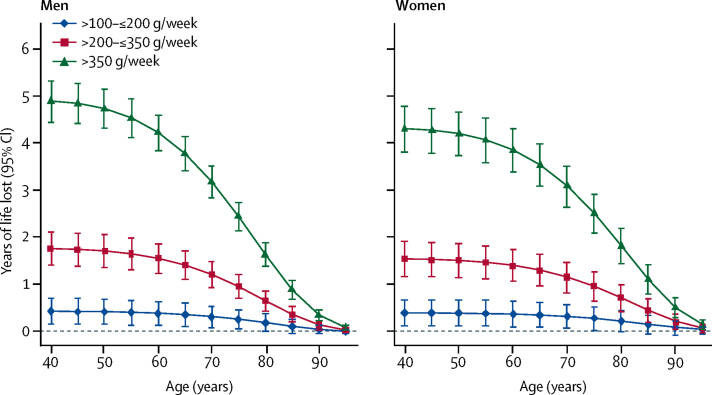
BACKGROUND: Low-risk limits recommended for alcohol consumption vary substantially across different national guidelines. To define thresholds associated with lowest risk for all-cause mortality and cardiovascular disease, we studied individual-participant data from 599 912 current drinkers without previous cardiovascular disease. METHODS: We did a combined analysis of individual-participant data from three large-scale data sources in 19 high-income countries (the Emerging Risk Factors Collaboration, EPIC-CVD, and the UK Biobank). We characterised dose-response associations and calculated hazard ratios (HRs) per 100 g per week of alcohol (12·5 units per week) across 83 prospective studies, adjusting at least for study or centre, age, sex, smoking, and diabetes. To be eligible for the analysis, participants had to have information recorded about their alcohol consumption amount and status (ie, non-drinker vs current drinker), plus age, sex, history of diabetes and smoking status, at least 1 year of follow-up after baseline, and no baseline history of cardiovascular disease. The main analyses focused on current drinkers, whose baseline alcohol consumption was categorised into eight predefined groups according to the amount in grams consumed per week. We assessed alcohol consumption in relation to all-cause mortality, total cardiovascular disease, and several cardiovascular disease subtypes. We corrected HRs for estimated long-term variability in alcohol consumption using 152 640 serial alcohol assessments obtained some years apart (median interval 5·6 years [5th-95th percentile 1·04-13·5]) from 71 011 participants from 37 studies. FINDINGS: In the 599 912 current drinkers included in the analysis, we recorded 40 310 deaths and 39 018 incident cardiovascular disease events during 5·4 million person-years of follow-up. For all-cause mortality, we recorded a positive and curvilinear association with the level of alcohol consumption, with the minimum mortality risk around or below 100 g per week. Alcohol consumption was roughly linearly associated with a higher risk of stroke (HR per 100 g per week higher consumption 1·14, 95% CI, 1·10-1·17), coronary disease excluding myocardial infarction (1·06, 1·00-1·11), heart failure (1·09, 1·03-1·15), fatal hypertensive disease (1·24, 1·15-1·33); and fatal aortic aneurysm (1·15, 1·03-1·28). By contrast, increased alcohol consumption was log-linearly associated with a lower risk of myocardial infarction (HR 0·94, 0·91-0·97). In comparison to those who reported drinking >0-≤100 g per week, those who reported drinking >100-≤200 g per week, >200-≤350 g per week, or >350 g per week had lower life expectancy at age 40 years of approximately 6 months, 1-2 years, or 4-5 years, respectively. INTERPRETATION: In current drinkers of alcohol in high-income countries, the threshold for lowest risk of all-cause mortality was about 100 g/week. For cardiovascular disease subtypes other than myocardial infarction, there were no clear risk thresholds below which lower alcohol consumption stopped being associated with lower disease risk. These data support limits for alcohol consumption that are lower than those recommended in most current guidelines. FUNDING: UK Medical Research Council, British Heart Foundation, National Institute for Health Research, European Union Framework 7, and European Research Council.
Overview
The claims and statistics of this paper haven’t been checked yet.
Free: it reads the open-access text and checks the first 5 claims that cite a source we can check. Create a free account to check every claim.
Integrity signals
Registry
Cites
Statistics
Figures
Verification
Claims the paper makes
The claims and statistics of this paper haven’t been checked yet.
Free: it reads the open-access text and checks the first 5 claims that cite a source we can check. Create a free account to check every claim.
Claims other papers make about this one
Each is checked against this paper’s own text: does it say what the citing paper says it does?
The source backs part of the claim, not all of it — or backs it for a different population, condition or comparison.
In the citing paper
“For example, systematic reviews have quantified exposure levels of alcohol use (e.g. by standard drinks/week) that represent risk-thresholds for stroke, cardio-vascular disease and atrial fibrillation (Samokhvalov, Irving, & Rehm, 2010; Tu et al., 2021; Wood et al., 2018)”
From Risk-thresholds for the association between frequency of cannabis use and the development of psychosis: a systematic review and meta-analysis (2023) · cites this paper as Wood et al., 2018
Experimental — accuracy not yet measuredThe check wasn’t confident either way, so it gives no verdict — never disputed.
In the citing paper
“Regular physical exercise reduces plasma TG levels over and above the effect of weight reduction [151,168,169].”
From 2019 ESC/EAS guidelines for the management of dyslipidaemias: lipid modification to reduce cardiovascular risk (2019) · cites this paper as [168]
Experimental — accuracy not yet measuredIn the citing paper
“However, it is analogous to evidence-based alcohol-related health guidelines where the risk for specific adverse (e.g. cardio-vascular) outcomes is low/absent below certain consumption levels and ‘moderate’ use is recommended”
From Risk-thresholds for the association between frequency of cannabis use and the development of psychosis: a systematic review and meta-analysis (2023) · cites this paper as Wood et al., 2018
Self-check
Percentages, sums and reported differences re-computed from the paper’s own numbers.
The self-check needs the paper’s full text.
Citations
Cites
Bias in meta-analysis detected by a simple, graphical test
Egger, M., Smith, G. D., Schneider, M., & Minder, C. (1997) · BMJ · doi:10.1136/bmj.315.7109.629 · Cited by 56,722 · cited 1×
“35 Methods we used to estimate reductions in life expectancy (years of life lost) are described in the appendix (pp 6–7).”
Quantifying heterogeneity in a meta‐analysis
Higgins, J. P. T., & Thompson, S. G. (2002) · Statistics in Medicine · doi:10.1002/sim.1186 · Cited by 36,763
Self-citationOperating characteristics of a rank correlation test for publication bias
Begg, C. B., & Mazumdar, M. (1994) · Biometrics · doi:10.2307/2533446 · Cited by 16,955 · cited 1×
“33 Evidence of small study effects was assessed visually with funnel plots and by Begg and Mazumdar’s test 34 and Egger’s test.”
Sudlow, C., Gallacher, J., Allen, N., Beral, V., Burton, P., Danesh, J., Downey, P., Elliott, P., Green, J., Landray, M., et al. (2015) · PLOS Medicine · doi:10.1371/journal.pmed.1001779 · Cited by 12,728
Self-citationMACMAHON, S. (1990) · The Lancet · doi:10.1016/0140-6736(90)90878-9 · Cited by 4,253 · cited 1×
“55 However, we did not find convincing evidence that other known risk factors were important mediators or confounders.”
Genomic Aberrations and Survival in Chronic Lymphocytic Leukemia
Döhner, H., Stilgenbauer, S., Benner, A., Leupolt, E., Kröber, A., Bullinger, L., Döhner, K., Bentz, M., & Lichter, P. (2000) · New England Journal of Medicine · doi:10.1056/nejm200012283432602 · Cited by 3,318
ABT-199, a potent and selective BCL-2 inhibitor, achieves antitumor activity while sparing platelets
Souers, A. J., Leverson, J. D., Boghaert, E. R., Ackler, S. L., Catron, N. D., Chen, J., Dayton, B. D., Ding, H., Enschede, S. H., Fairbrother, W. J., et al. (2013) · Nature Medicine · doi:10.1038/nm.3048 · Cited by 3,058
Unmutated Ig VH Genes Are Associated With a More Aggressive Form of Chronic Lymphocytic Leukemia
Hamblin, T. J., Davis, Z., Gardiner, A., Oscier, D. G., & Stevenson, F. K. (1999) · Blood · doi:10.1182/blood.v94.6.1848 · Cited by 2,783
Major lipids, apolipoproteins, and risk of vascular disease
The Emerging Risk Factors Collaboration* (2009) · JAMA · doi:10.1001/jama.2009.1619 · Cited by 2,731
Targeting BCL2 with Venetoclax in Relapsed Chronic Lymphocytic Leukemia
Roberts, A. W., Davids, M. S., Pagel, J. M., Kahl, B. S., Puvvada, S. D., Gerecitano, J. F., Kipps, T. J., Anderson, M. A., Brown, J. R., Gressick, L., et al. (2016) · New England Journal of Medicine · doi:10.1056/nejmoa1513257 · Cited by 1,900
Cited by
Items 801–900 of 1,000
Wong, T. H. T., Buyken, A. E., Brand-Miller, J. C., & Louie, J. C. Y. (2019) · European Journal of Nutrition · doi:10.1007/s00394-019-02084-4 · Cited by 3
Protective Roles of Hop Proanthocyanidins on Alcohol-Induced SH-SY5Y Cell Damage
Dong, X., Zhang, X., Zhao, W., Nie, C., Li, Y., Li, Z., Zhai, N., Zhang, W., Mao, F., Ting, P. L., et al. (2019) · Journal of the American Society of Brewing Chemists · doi:10.1080/03610470.2019.1686572 · Cited by 3
MATSUMOTO-YAMAUCHI, H., Kondo, K., Miura, K., Tanaka‐Mizuno, S., Segawa, H., Ohno, S., Miyagawa, N., Zaid, M., Okami, Y., Okuda, N., et al. (2021) · Journal of Nutritional Science and Vitaminology · doi:10.3177/jnsv.67.28 · Cited by 3
Yu, D., Lu, B., & Piggott, J. (2022) · The Journal of the Economics of Ageing · doi:10.1016/j.jeoa.2022.100368 · Cited by 5
Taams, N. E., Knol, M. J., Hanewinckel, R., Drenthen, J., Adams, H. H. H., van Doorn, P. A., & Ikram, M. A. (2022) · European Journal of Neurology · doi:10.1111/ene.15311 · Cited by 3
“Misclassification of abstainers in observational studies is an issue, as this group consists of both never and former drinkers, although they systematically differ [21].”
BackgroundComorbidity Burden in Psoriatic Arthritis and its Impact on Disease Measures
Chanakya, K., Shobha, V., Chandrashekara, S., Kumar, S., Haridas, V. M., Rao, V. K. R., Jois, R., Daware, M. A., Singh, Y. P., Singhai, S., et al. (2022) · Indian Journal of Rheumatology · doi:10.4103/injr.injr_29_22 · Cited by 3
“[16,17] The data were collected on paper case record forms at each center and were fed into a common Excel sheet which was then used for analysis.”
Predictive risk markers in alcoholism
Niemelä, O. J. (2023) · Advances in clinical chemistry · doi:10.1016/bs.acc.2023.05.002 · Cited by 5
Chronic ethanol ingestion impairs Drosophila melanogaster health in a microbiome-dependent mannerPreprint
Chandler, J., Innocent, L. V., Huang, I. L., Yang, J. L., Eisen, M. B., & Ludington, W. B. (2017) · bioRxiv (Cold Spring Harbor Laboratory) · doi:10.1101/217240 · Cited by 3
“While the results in humans are conflicting at very low ethanol consumption, in general ethanol consumption is associated with shorter lifespan (Wood et al. 2018).”
How Would You Manage This Patient With Nonalcoholic Fatty Liver Disease?
Pearlman, B. L. (2019) · Annals of Internal Medicine · doi:10.7326/l19-0667 · Cited by 3
Is there a safe threshold for alcohol consumption in nonalcoholic fatty liver disease?
Kim, M., & Jun, D. W. (2020) · HepatoBiliary Surgery and Nutrition · doi:10.21037/hbsn.2019.11.36 · Cited by 3
“In 2018, combined analysis of 599,912 current drinkers in 83 prospective studies of high income countries, showed alcohol consumption was positive and curvilinear association with all-cause mortality and roughly linearly associated with a cardiovascular disease other than myocardial infarction (1).”
BackgroundGong, W., Zeng, N., Corsi, D. J., & Wen, S. W. (2020) · Research Square · doi:10.21203/rs.3.rs-36772/v1 · Cited by 5
Genotype-stratified GWAS meta-analysis reveals novel loci associated with alcohol consumptionPreprint
Koyanagi, Y. N., Nakatochi, M., Ito, H. M., Kasugai, Y., Narita, A., Kawaguchi, T., Ikezaki, H., Hishida, A., Hara, M., Takezaki, T., et al. (2021) · medRxiv · doi:10.1101/2021.06.02.21258094 · Cited by 3
Time to Promote the Awareness of Unhealthy Alcohol Use Among Women
Hwang, C., Phillips, S. A., Tu, M., & Piano, M. R. (2021) · Journal of Women s Health · doi:10.1089/jwh.2021.0546 · Cited by 4
“21 More than likely, the reasons for the increase and change in women’s drinking intensity and patterns are multifactorial but may relate to drinking motives that may include social, coping, enhancement, and conformity.”
Correale, M., & Brunetti, N. D. (2022) · European Journal of Preventive Cardiology · doi:10.1093/eurjpc/zwac190 · Cited by 3
Alcohol: Absorption, metabolism, and physiological effects
Rajendram, R., Hunter, R. J., & Preedy, V. R. (2022) · Elsevier eBooks · doi:10.1016/b978-0-12-821848-8.00133-5 · Cited by 3
Petersen, K. E. N., Rosthøj, S., Halkjær, J., Loft, S. H., Tjønneland, A. M., & Olsen, A. (2023) · Atherosclerosis · doi:10.1016/j.atherosclerosis.2023.117406 · Cited by 2
Self-citationHuang, K., Ma, T., Li, Q., Zhong, Z., Zhou, Y., Zhang, W., Qin, T., Tang, S., Zhong, J., & Lu, S. (2023) · BMC Medical Genomics · doi:10.1186/s12920-023-01737-y · Cited by 2
“Furthermore, numerous epidemiological academic researches have suggested a J-shaped linkage between drinking and CHD morbidity and mortality, that is, non-drinkers and heavy drinkers have a slightly higher risk of CHD compared with light drinkers [34, 35].”
BackgroundDiagnostic Delay in HPV-Related Oropharyngeal Squamous Cell Carcinoma
McGarey, P. O., Hamdi, O. A., Donaldson, L. B., Zhan, K. Y., Crandley, E. F., Wilson, D. D., Sim, A. J., Read, P. W., Garneau, J. C., Fedder, K. L., et al. (2024) · International Archives of Otorhinolaryngology · doi:10.1055/s-0043-1767795 · Cited by 2
Qian, D., Zhou, H. C., Yang, Q., Liu, Y., Wang, Z., Lu, S., Tong, G., Zhang, L., Wang, X., & Zhou, S. (2024) · International Journal of Pharmacology · doi:10.3923/ijp.2024.229.240 · Cited by 3
Neupert, S. D., Graham, E. K., Ogle, D., Ali, S., Zavala, D. V., Kincaid, R., Hughes, M., Hu, R. X., Antonucci, T. C., Suitor, J. J., et al. (2024) · The Journals of Gerontology Series B · doi:10.1093/geronb/gbae086 · Cited by 2
“…within subfields of the psychological sciences that rely on long-term longitudinal data (Beck et al., 2023; Graham et al., 2017; Graham et al., 2020; Graham et al., 2022; Luo et al., 2022; Turiano et al., 2020; Weston et al., 2020; Willroth et al., 2022; Wood et al., 2018; Yoneda et al., 2021).”
BackgroundMorandi, A. (2024) · International Journal of Ayurveda Research · doi:10.4103/ijar.ijar_171_24 · Cited by 2
Yun, J. P., Han, K., Ki, Y., Hwang, D., Kang, J., Yang, H., Park, K. W., Kang, H., Koo, B., Kim, H.-S., et al. (2024) · Journal of Clinical Medicine · doi:10.3390/jcm13216542 · Cited by 2
“First, the status and amount of alcohol consumption were referenced using self-reported questionnaires.”
BackgroundMethodInfluentialCall for a consensual definition of dyslipidemia in coronary angiography trials
Clerc, A., Togni, M., & Cook, S. (2025) · Frontiers in Cardiovascular Medicine · doi:10.3389/fcvm.2025.1506149 · Cited by 2
Clinical Characterisation of the Co-Occurrence of Mental and Physical Disorders
Holt, R. I. G. (2025) · Springer eBooks · doi:10.1007/978-3-031-81802-8_6 · Cited by 2
Kunutsor, S. K., Connelly, M. A., Shah, A. H., Bakker, S. J. L., & Dullaart, R. P. F. (2025) · Journal of Hypertension · doi:10.1097/hjh.0000000000004014 · Cited by 2
Kadu, V. A. S., Asutkar, R., Sharma, A. K., & Priyangika, R. K. N. (2025) · Journal of Ayurveda · doi:10.4103/joa.joa_55_25 · Cited by 2
Doren, N. V., Chi, F. W., Young‐Wolff, K. C., Satre, D. D., & Sterling, S. (2025) · Addiction · doi:10.1111/add.70134 · Cited by 3
Castriota, S., Frumento, P., & Suppressa, F. (2025) · Journal of Wine Economics · doi:10.1017/jwe.2025.10077 · Cited by 2
“A series of scientific studies, such as Griswold et al (2018), started to claim that there is no safe level of alcohol intake (Mehta and Sheron, 2019; Topiwala et al, 2022; Wood et al, 2018).”
Xiang, S., Shan, Y., Shi-hong, X., Wang, J., Luo, M., Zhou, J., & Chen, Q. (2025) · Advanced Science · doi:10.1002/advs.202501820 · Cited by 2
The Short‐Term Health Effects of Dealcoholised Red Wine: A Systematic Review and Meta‐Analysis
Mekonen, T., Chan, G., Stjepanović, D., Sun, T., Shin, D., Lucey, M., Choi, J., Saunders, J. B., Connor, J. P., & Leung, J. (2025) · Drug and Alcohol Review · doi:10.1111/dar.70047 · Cited by 2
Wang, Y., Li, J., Bilal, H., Yu, X., & Sun, L. (2025) · Health Science Reports · doi:10.1002/hsr2.71244 · Cited by 2
“Paradoxically, alcohol intake exhibited a consistent inverse association with IHD risk across ages, reflecting a potential “ J ‐ shaped ” dose – response pattern where moderate consumption may confer protection compared to abstention or heavy use [32, 33].”
Tevik, K., Skråstad, R. B., Benth, J. Š., Selbæk, G., Bergh, S., Spigset, O., Krokstad, S., & Helvik, A. (2025) · PLoS ONE · doi:10.1371/journal.pone.0334556 · Cited by 2
Iliakis, P., Stamou, E., Vakka, A., Ntalekou, K., Kouremeti, M., Ktenopoulos, N., Karakasis, P., Theofilis, P., Pitsillidi, A., Sakalidis, A., et al. (2025) · Journal of Clinical Medicine · doi:10.3390/jcm15010299 · Cited by 2
“Estimates of reduced risk may have been overstated due to “abstainer bias” or the “sick quitter” phenomenon [5,21].”
InfluentialDionisi, T., Vita, V. D., Sario, G. D., Gasbarrini, A., & Addolorato, G. (2026) · European Journal of Internal Medicine · doi:10.1016/j.ejim.2026.106837 · Cited by 2
Alonso-Díaz, J., Gómez‐Sánchez, M., Echeverría, D. A., González‐Sánchez, S., Rodríguez‐Sánchez, E., García‐Ortiz, L., Gomez-Sanchez, L., Gómez-Marcos, M. Á., & EVA Investigators Group (2026) · Nutrients · doi:10.3390/nu18091314 · Cited by 3
“Meanwhile, excessive alcohol consumption contributes to increased blood pressure and arterial stiffness [33–37].”
Rubenstein, E. P. (2026) · International Journal on Science and Technology · doi:10.71097/ijsat.v17.i2.11342 · Cited by 2
“…alcohol intake, tobacco smoking, highly processed foods, industrial trans fats, and chronically high sugar consumption can undermine metabolic health, vascular function, inflammatory balance, mitochondrial resilience, body composition, sleep quality, and long-term functional capacity [13-17].”
Armario, P., Brotons, C., Elosúa, R., de Leciñana, M. A., Castro, A., Clarà, A. B. I., Cortés, O., Rodríguez, Á. D., Herranz, M., Justo, S., et al. (2021) · Clínica e Investigación en Arteriosclerosis · doi:10.1016/j.arteri.2020.11.004 · Cited by 7
“El umbral de menor riesgo de mortalidad por todas las causas se encuentra entre 0 y 100 g por semana; es decir, que ningún nivel de consumo de alcohol se asocia a un mejor estado de salud (147).”
Bernal-Sobrino, J. L., Árias, F., Varela-Rodríguez, C., Losada-Pérez, C., Blanco-Echevarría, A., Álvarez, M. J. D. Y., Martín-Mayor, M., & Rubio, G. (2023) · Alcohol and Alcoholism · doi:10.1093/alcalc/agad004 · Cited by 2
Forgerini, M., Gini, A. L. R., Lemos, I. H., Santos, A. C. S., Bessa, M. P., Valentini, S. R., & Mastroianni, P. D. C. (2024) · Hospital Pharmacy · doi:10.1177/00185787241269111 · Cited by 2
“The stratification of alcohol consumption was based on the proposal by Wood et al, 27 which investigated the influence of the amount of alcohol consumed weekly and the associated risks, including cardiovascular events.”
Prevalence and risk factors of covert brain infarction: A community-based cross-sectional study
Zhang, R., Yao, D., Cai, X., Zhang, Y., Yang, Y., Li, S., Jing, J., Wang, S., Wang, Y., Pan, Y., et al. (2025) · International Journal of Stroke · doi:10.1177/17474930241313435 · Cited by 5
Gamboa, D., Kabashi, S., Jørgenrud, B., Lerdal, A., Nordby, G., & Bogstrand, S. T. (2025) · Advances in Drug and Alcohol Research · doi:10.3389/adar.2025.14149 · Cited by 3
Lucki, M., Chlebuś, E., Wareńczak, A., & Lisiński, P. (2021) · International Journal of Environmental Research and Public Health · doi:10.3390/ijerph18116021 · Cited by 2
“The following criteria were used [31]: qualifier 0—alcohol intake per day < 10 g; qualifier 4—alcohol intake per day > 10 g.”
MethodInfluentialHalk Sağlığı Gözüyle Koroner Arter Hastalığı ve Sağlık Okuryazarlığı
Ahçıoğlu, A., & Yılmazel, G. (2021) · Türkiye Sağlık Okuryazarlığı Dergisi · doi:10.54247/soyd.2021.28 · Cited by 2
Tchoffo, R. N., & Nkemgha, G. Z. (2021) · Natural Resources for Human Health · doi:10.53365/nrfhh/142585 · Cited by 2
The Regional Differences in Mortality Attributable to Alcohol in the Czech Republic in 2017
Gavurová, B., Tarhaničová, M., & Kulhánek, A. (2021) · ADIKTOLOGIE Journal · doi:10.35198/01-2021-001-0004 · Cited by 2
Nutrición, riesgo de enfermedad cardiovascular y cambio climático
Svatetz, C. A. G. (2022) · Clínica e Investigación en Arteriosclerosis · doi:10.1016/j.arteri.2022.06.001 · Cited by 2
Family influences on older adults' problem drinking: A representative nationwide study of China
Ye, Y., Feng, J., Zhang, Y., Wang, M., Chen, J., Wu, D., Kathleen, Y., & Jiang, S. (2022) · Frontiers in Public Health · doi:10.3389/fpubh.2022.850931 · Cited by 2
Piepoli, M. F., Rosano, G. M. C., Abreu, A., Adamo, M., Attanasio, A., Chioncel, O., Solal, A. C., Filippatos, G., Gerdts, E., Gevaert, A. B., et al. (2023) · European Heart Journal · doi:10.1093/eurheartj/ehag362 · Cited by 7
Николаевна, К. О. (2024) · Russian Journal of Preventive Medicine · doi:10.17116/profmed20242701150 · Cited by 3
Lifestyle Interventions and Atherosclerotic Cardiovascular Disease Outcomes
Kirkpatrick, C. F., Greaves, K. A., & Foster, E. O. (2024) · Contemporary cardiology · doi:10.1007/978-3-031-54960-1_8 · Cited by 2
Pastor, R. F., Iermoli, R. H., Saporito-Magriñá, C., Pastor, I., Pastor, E., Carabetti, Z. M., Iermoli, L. V., Lairion, F., Chiesa, I., Sarrasague, M. M., et al. (2024) · Nutrition and Healthy Aging · doi:10.1177/24519502241304330 · Cited by 4
“54 The participants replaced the wine they consumed regularly with the resveratrol-enriched wine.”
Dhand, R., Okumura, K., Wolfe, K., Bodin, R. I., Nishida, S., Frishman, W. H., & Dhand, A. (2025) · Cardiology in Review · doi:10.1097/crd.0000000000000880 · Cited by 2
Socio-economic equity in the impact of population-based interventions to reduce alcohol consumption
Roheger, M., Guertler, D., Eidswick, J., Ittermann, T., Freyer‐Adam, J., & Baumann, S. (2025) · Cochrane Database of Systematic Reviews · doi:10.1002/14651858.cd016015 · Cited by 3
de Hevia, J. O., López‐González, Á. A., Ramírez‐Manent, J. I., Busquets-Cortés, C., López, P. J. T., Samuelsson, M. G., & Sbert, P. R. (2025) · Life · doi:10.3390/life15060923 · Cited by 2
“This is consistent with recent meta-analyses questioning the net benefits of alcohol consumption [53,54].”
Sahle, B. W., Owen, A. J., Wing, L. M. H., Beilin, L. J., Nelson, M. R., Jennings, G., & Reid, C. M. (2018) · The American Journal of Cardiology · doi:10.1016/j.amjcard.2018.06.046 · Cited by 2
Martínez-Sangüinetti, M. A., Leiva, A. M., Petermann-Rocha, F. E., Garrido, A., & Celis-Morales, C. A. (2018) · Revista médica de Chile · doi:10.4067/s0034-98872018000901087 · Cited by 2
Patterns of drinking and disease-free living: Only a problem for alcohol abusers?
Rehm, J. T. (2022) · The Lancet Regional Health - Europe · doi:10.1016/j.lanepe.2022.100432 · Cited by 2
Wang, N., Zoungas, S., & Chalmers, J. P. (2022) · La Presse Médicale · doi:10.1016/j.lpm.2022.104160 · Cited by 3
Gavril, O. I., Gavril, R. S., Mitu, F., Gavrilescu, O., Popa, I. V., Tatarciuc, D., Drugescu, A., Oprescu, A. C., Gherasim, A., Mihalache, L., et al. (2023) · Metabolites · doi:10.3390/metabo13040571 · Cited by 2
“Chronic alcohol consumption was considered more than 100 g of alcohol per week [25].”
BackgroundAlcohol Consumption and Health
Wilson, T. E., & Temple, N. J. (2023) · Nutrition and health · doi:10.1007/978-3-031-24663-0_12 · Cited by 3
Dich, N., & Doan, S. N. (2019) · European Journal of Public Health · doi:10.1093/eurpub/ckz066 · Cited by 4
The role of physical activity in primary stroke prevention
Scutelnic, A., Arnold, M., Jung, S., & Heldner, M. R. (2019) · Swiss Sports & Exercise Medicine · doi:10.34045/ssem/2019/34 · Cited by 2
Differenzialdiagnose der Fettlebererkrankung
Schattenberg, J. M., & Straub, B. K. (2020) · Die Gastroenterologie · doi:10.1007/s11377-020-00416-z · Cited by 2
“Obwohl ein absoluter Grenzwert für nichtschädigenden Alkoholkonsum nicht definiert ist und erhebliche individuelleUnterschiede bestehen, ist gezeigt worden, dass die Mortalität ab 100g/Woche ansteigt [12].”
BackgroundConsumption of Alcohol and Drugs in the School Population of Sao Tome and Principe
Santiago, I. D., Ribeiro, R. M., Bacelar–Nicolau, L., Marinho, R. T., & Miguel, J. P. (2020) · Acta Médica Portuguesa · doi:10.20344/amp.11876 · Cited by 2
Blalock, D. V., Grubber, J. M., Smith, V. A., Zulman, D. M., Weidenbacher, H. J., Greene, L., Dedert, E. A., & Maciejewski, M. L. (2021) · Alcoholism Clinical and Experimental Research · doi:10.1111/acer.14610 · Cited by 2
Reaction Time and Visual Memory in Connection to Alcohol Use in Persons with Bipolar Disorder
Mazumder, A. H., Barnett, J. H., Isometsä, E. T., Lindberg, N., Torniainen‐Holm, M., Lähteenvuo, M., Lahdensuo, K., Kerkelä, M., Ahola‐Olli, A., Hietala, J. A., et al. (2021) · Brain Sciences · doi:10.3390/brainsci11091154 · Cited by 2
“We did not correct self-report bias [131,132] and misreports and longitudinal changes (MLC) which could affect the study results [133,134].”
BackgroundKhan, S., Cain, O. L., & Rajoriya, N. (2022) · Springer eBooks · doi:10.1007/978-3-030-84752-4_11 · Cited by 2
Risk thresholds for alcohol consumption
Schernhammer, E. S. (2018) · The Lancet · doi:10.1016/s0140-6736(18)32202-5 · Cited by 2
Is it time to rethink low‐risk drinking guidelines?
Kranzler, H. R. (2022) · Alcoholism Clinical and Experimental Research · doi:10.1111/acer.14817 · Cited by 2
Gao, X., Guo, W., Liu, P., Yuwen, M., Ren, H., Hu, S., Liu, Z., Tan, R., Liu, K., Yang, Z., et al. (2024) · eLife · doi:10.7554/elife.97632 · Cited by 2
Gao, X., Guo, W., Liu, P., Yuwen, M., Liu, Z., Tan, R., Liu, K., Yang, Z., Ba, J., Bai, X. T., et al. (2025) · eLife · doi:10.7554/elife.97632.2 · Cited by 2
Bergh, S., Michaelsen, E., Andfossen, N. B., Lichtwarck, B., Selbæk, G., & Kirkevold, Ø. (2021) · Tidsskrift for omsorgsforskning · doi:10.18261/issn.2387-5984-2021-03-03 · Cited by 2
Christoffersen, L. A. N., Mortensen, E. L., Sørensen, H. J., Becker, U., Osler, M., & Flensborg‐Madsen, T. (2021) · Nordic Journal of Psychiatry · doi:10.1080/08039488.2021.2007999 · Cited by 2
Anderson, J. L., Le, V. T., Bair, T. L., Muhlestein, J. B., Knowlton, K. U., & Horne, B. D. (2022) · Journal of Clinical Medicine · doi:10.3390/jcm11164797 · Cited by 1
Revisión bibliográfica: tratamiento de las urgencias hipertensivas
Maridueña, M. D., Quinteros, J. A. S., Daniela, Q. S. M., Lopez, C. A. A., Daniel, P. R. O., Valencia, B. S. S., Toasa, A. G. N., & Reyna, G. M. D. (2023) · Brazilian Journal of Health Review · doi:10.34119/bjhrv6n1-152 · Cited by 1
Disorders Due to Substance Use
Saunders, J. B. (2023) · Cambridge University Press eBooks · doi:10.1017/9781009182232.007 · Cited by 3
Chen, X., Yang, H., Li, K., Cao, J., Xu, X., Pan, S., & Li, E. (2024) · Food Science and Human Wellness · doi:10.26599/fshw.2024.9250087 · Cited by 2
“…of three groups of mice treated by gavage from week 0 to week 16 was 24.35-35.27 g. Range of gavage dose was 0.39-0.56 mL. Based on previous report [24], the administration dosage was consistent with a human equivalent dose of 100 g ethanol per week for a 70 kg adult human, and was calculated by…”
MethodInfluentialOuyang, F., Wu, Q., Liu, J., Xu, Z., Lv, L., Pan, L., Wang, B., & Zeng, X. (2024) · Clinical Radiology · doi:10.1016/j.crad.2024.08.004 · Cited by 2
Liang, Y., Zou, G., Wang, D., Zeng, W., Zhang, J., Huang, X., Miao, L., Mai, C., Song, F., Zhang, Y., et al. (2024) · World Journal of Emergency Medicine · doi:10.5847/wjem.j.1920-8642.2024.096 · Cited by 2
Tamaki, Y., Hiratsuka, Y., & Kumakawa, T. (2024) · Journal of Ageing and Longevity · doi:10.3390/jal4040025 · Cited by 1
Age-Based Lifestyle Patterns in Patients with Acute Myocardial Infarction
Tsuji, M., & Minatsuki, S. (2024) · International Heart Journal · doi:10.1536/ihj.24-576 · Cited by 1
Capitalising on Tax Variation to Estimate the Effect of Alcohol Consumption on Edentulism
Baumeister, S., Holtfreter, B., Kocher, T., & Nascimento, G. G. (2025) · Journal Of Clinical Periodontology · doi:10.1111/jcpe.14176 · Cited by 1
“However, more recent evidence, including large-scale cohort studies and Mendelian randomisation (MR) analyses, has challenged this hypothesis, demonstrating a linear relationship between alcohol consumption and increased CVD risk (Millwood et al. 2023; Nyberg et al. 2022; Wood et al. 2018).”
García-García, D., Pérez‐Rivas, F. J., Gómez‐Gascón, T., Rico‐Blázquez, M., Cabeza, M. B., Cortés, S. B., Bidagor, J. D., & Jiménez-González, J. (2025) · Healthcare · doi:10.3390/healthcare13131564 · Cited by 1
Qian, F., Yang, J., Tobias, D. K., Ley, S. H., Chavarro, J. E., Liu, G., Chen, Z., Yeung, E. H., Sun, Q., Willett, W. C., et al. (2025) · Journal of the American Heart Association · doi:10.1161/jaha.124.038936 · Cited by 1
“37,38 The precise role of alcohol on CVD among women with GD warrants further investigation.”
Alcohol, Depression, and Anxiety
Onaemo, V. N., & Chireh, B. (2025) · Springer eBooks · doi:10.1007/978-3-031-73363-5_130 · Cited by 1
Beach, S. R. H., Philibert, R. A., Ong, M. L., Lei, M., & Ye, K. (2025) · Epigenomes · doi:10.3390/epigenomes9040040 · Cited by 3
“Likewise, regularly consuming elevated levels of alcohol significantly increased risk of stroke, heart failure, fatal hypertensive disease, and fatal aortic aneurysm [36].”
Yano, Y., Albert, P. S., Roy, S., Farhat, Z., Baer, D. J., Moore, S. C., Dorgan, J. F., Viallon, V., Keski‐Rahkonen, P., Ferrari, P., et al. (2026) · Journal of Nutrition · doi:10.1016/j.tjnut.2026.101488 · Cited by 1
Self-citationMustafa, A., Dallaway, A., Lagojda, L., Kite, C., Abdelhameed, F., Chatha, K. K., Suresh, A., Randeva, H. S., & Kyrou, I. (2026) · Frontiers in Nutrition · doi:10.3389/fnut.2026.1778393 · Cited by 1
Lee, J. M., Kim, Y., Lee, S. Y., Kwon, W., Hwang, D., Chon, M. K., Joh, H. S., Lee, S. H., Lee, K. Y., Seo, Y. H., et al. (2026) · Korean Circulation Journal · doi:10.4070/kcj.2026.0191 · Cited by 1
“29)30)”
Cormier, O., Davies, E., & Seddon, J. L. (2026) · Veterinary Record · doi:10.1002/vetr.70911 · Cited by 1
Choi, S., & Je, Y. (2026) · Addiction · doi:10.1111/add.70558 · Cited by 2
Mazumder, A. H., Barnett, J. H., Isometsä, E. T., Lindberg, N., Torniainen‐Holm, M., Lähteenvuo, M., Lahdensuo, K., Kerkelä, M., Ahola‐Olli, A., Hietala, J. A., et al. (2021) · Brain Sciences · doi:10.3390/brainsci11111422 · Cited by 1
“We did not correct self-report bias [56,57] and Misreports and Longitudinal Changes (MLC), which could affect the study results [58,59].”
BackgroundStrategies to Maintain Ovarian Function
Jia, W. P., Ye, S., Chen, Q., Li, M., Tang, W., Zhang, J., Lu, H., Xi, Y., Wu, M., Yuan, M., et al. (2023) · Springer eBooks · doi:10.1007/978-981-19-8848-6_9 · Cited by 1
Laari, S. P. K., Kauranen, T. V., Turunen, K. E. A., Mustanoja, S. M., Tatlisumak, T., & Poutiainen, E. T. (2024) · Frontiers in Aging Neuroscience · doi:10.3389/fnagi.2024.1360236 · Cited by 1
“However, the standard acceptable weekly intake in Europe is approximately similar to that in the US ( Wood et al., 2018).”
BackgroundMirabi, S., Chaurasia, A. K., & Oremus, M. (2024) · Journal of Religion and Health · doi:10.1007/s10943-024-02048-x · Cited by 1
“For example, alcohol consumption— linked to many health conditions (Wood et al., 2018)—is sinful in Islam and practicing Muslims do not consume alcoholic beverages.”
Jiménez, J., Ni, H., Katz, S. D., Haas, G. J., Cao, J., Rubens, M., Chaparro, S. V., Saxena, A., Hofmeyer, M. R., Kransdorf, E. P., et al. (2025) · Circulation Genomic and Precision Medicine · doi:10.1161/circgen.124.004946 · Cited by 2
“…demonstrated an association between higher levels of alcohol intake and greater risk for developing atrial fibrillation, 2 stroke and heart failure, 3,4 although increased risk of heart failure was not observed in the Framingham study 5 or a more recent Mendelian randomization study conducted in…”
Multiomic insights into the MPO-mediated NET formation pathway in alcohol-induced epilepsy risk
Zhang, N., Chen, S., Jiang, J., Jiang, H., Wang, Q., Raju, S. P., Schumacher, J. G., Lu, J., Lian, Y., Zhang, Y., et al. (2025) · Genes & Diseases · doi:10.1016/j.gendis.2025.101917 · Cited by 1
“7,8 Moreover, alcohol-related injuries, including traffic accident injuries and interpersonal violence, are major public health concerns.”
Infectious microbes and spectrum of cancer: Need to sharpen the depth and broaden the width
Anand, T., & Kumar, A. (2025) · The Microbe · doi:10.1016/j.microb.2025.100615 · Cited by 1
Zhang, R., Xiang, B., Zhou, Y., Li, C., Chen, X., & Zhu, S. (2025) · BMC Cardiovascular Disorders · doi:10.1186/s12872-025-05312-4 · Cited by 3
“A previous combined analysis of 83 prospective studies showed that alcohol intake was log-linearly associated with a decreased risk of myocardial infarction but was associated with increased risks of other CVDs [7].”
Managing cardiovascular risk factors in patients with Sjögren’s disease: a comprehensive approach
Giuggioli, D., Mattioli, A. V., & Pinti, M. (2025) · Future Cardiology · doi:10.1080/14796678.2025.2603895 · Cited by 1
Metadata
- Authors
- Wood, A. M., Kaptoge, S., Butterworth, A. S., Willeit, P., Warnakula, S., Bolton, T., Paige, E., Paul, D. S., Sweeting, M., Burgess, S., Bell, S., Astle, W., Stevens, D., Koulman, A., Selmer, R. M., Verschuren, W. M. M., Sato, S., Njølstad, I., Woodward, M., Salomaa, V., Nordestgaard, B. G., Yeap, B. B., Fletcher, A., Melander, O., Kuller, L. H., Balkau, B., Marmot, M., Koenig, W., Casiglia, E., Cooper, C., Arndt, V., Franco, O. H., Wennberg, P., Gallacher, J., de la Cámara, A. G., Völzke, H., Dahm, C. C., Dale, C. E., Bergmann, M. M., Crespo, C. J., van der Schouw, Y. T., Kaaks, R., Simons, L. A., Lagiou, P., Schoufour, J. D., Boer, J. M. A., Key, T. J., Rodriguez, B., Moreno-Iribas, C., Davidson, K. W., Taylor, J. O., Sacerdote, C., Wallace, R. B., Quiros, J. R., Tumino, R., Blazer, D. G., Linneberg, A., Daimon, M., Panico, S., Howard, B., Skeie, G., Strandberg, T., Weiderpass, E., Nietert, P. J., Psaty, B. M., Kromhout, D., Salamanca-Fernandez, E., Kiechl, S., Krumholz, H. M., Grioni, S., Palli, D., Huerta, J. M., Price, J., Sundström, J., Arriola, L., Arima, H., Travis, R. C., Panagiotakos, D. B., Karakatsani, A., Trichopoulou, A., Kühn, T., Grobbee, D. E., Barrett-Connor, E., van Schoor, N., Boeing, H., Overvad, K., Kauhanen, J., Wareham, N., Langenberg, C., Forouhi, N., Wennberg, M., Després, J.-P., Cushman, M., Cooper, J. A., Rodriguez, C. J., Sakurai, M., Shaw, J. E., Knuiman, M., Voortman, T., Meisinger, C., Tjønneland, A., Brenner, H., Palmieri, L., Dallongeville, J., Brunner, E. J., Assmann, G., Trevisan, M., Gillum, R. F., Ford, I., Sattar, N., Lazo, M., Thompson, S. G., Ferrari, P., Leon, D. A., Smith, G. D., Peto, R., Jackson, R., Banks, E., Di Angelantonio, E., Danesh, J., Wood, A. M., Kaptoge, S., Butterworth, A., Willeit, P., Warnakula, S., Bolton, T., Paige, E., Paul, D. S., Sweeting, M., Burgess, S., Bell, S., Astle, W., Stevens, D., Koulman, A., Selmer, R. M., Verschuren, M., Sato, S., Njølstad, I., Woodward, M., Veikko, S., Nordestgaard, B. G., Yeap, B. B., Flecther, A., Melander, O., Kuller, L. H., Balkau, B., Marmot, M., Koenig, W., Casiglia, E., Cooper, C., Arndt, V., Franco, O. H., Wennberg, P., Gallacher, J., Gómez de la Cámara, A., Völzke, H., Dahm, C. C., Dale, C. E., Bergmann, M., Crespo, C., van der Schouw, Y. T., Kaaks, R., Simons, L. A., Lagiou, P., Schoufour, J. D., Boer, J. M. A., Key, T. J., Rodriguez, B., Moreno-Iribas, C., Davidson, K. W., Taylor, J. O., Sacerdote, C., Wallace, R. B., Quiros, J. R., Rimm, E. B., Tumino, R., Blazer III, D. G., Linneberg, A., Daimon, M., Panico, S., Howard, B., Skeie, G., Salomaa, V., Strandberg, T., Weiderpass, E., Nietert, P. J., Psaty, B. M., Kromhout, D., Salamanca-Fernandez, E., Kiechl, S., Krumholz, H. M., Grioni, S., Palli, D., Huerta, J. M., Price, J., Sundström, J., Arriola, L., Arima, H., Travis, R. C., Panagiotakos, D. B., Karakatsani, A., Trichopoulou, A., Kühn, T., Grobbee, D. E., Barrett-Connor, E., van Schoor, N., Boeing, H., Overvad, K., Kauhanen, J., Wareham, N., Langenberg, C., Forouhi, N., Wennberg, M., Després, J.-P., Cushman, M., Cooper, J. A., Rodriguez, C. J., Sakurai, M., Shaw, J. E., Knuiman, M., Voortman, T., Meisinger, C., Tjønneland, A., Brenner, H., Palmieri, L., Dallongeville, J.-P., Brunner, E. J., Assmann, G., Trevisan, M., Gillumn, R. F., Ford, I. F., Sattar, N., Lazo, M., Thompson, S., Ferrari, P., Leon, D. A., Davey Smith, G., Peto, R., Jackson, R., Banks, E., Di Angelantonio, E., & Danesh, J.
- Affiliations
- University of Cambridge (GB)
- University Medical Center Utrecht (NL)
- London School of Hygiene & Tropical Medicine (GB)
- German Institute of Human Nutrition (DE)
- Portland State University (US)
- Institut Pasteur de Lille (FR)
- Howard University Hospital (US)
- ORCID
- Venue
- The Lancet
- Publisher
- Elsevier BV
- Published
- 2018-04
- Volume
- 391
- Issue
- 10129
- Pages
- 1513-1523
- ISSN
- 0099-5355 (ISSN-L)
- 0140-6736
- PMC
- PMC5899998
- OpenAlex
- W2787107952
- Semantic Scholar
- 67861ba0b72d3635d063ce89d6b401c9f5a93164
- Cited by
- 1,188
- References
- 54
- Citations by year
- 2026: 78 · 2025: 117 · 2024: 135 · 2023: 146 · 2022: 155 · 2021: 173 · 2020: 164 · 2019: 155 · 2018: 63
- FWCI
- 105.54
- Type
- journal article
- Language
- en
- Update notices
- erratum (2018-06-02)
- Open access
- hybrid
- doi.org
- Licence
- cc-by
- www.elsevier.com/tdm/userlicense/1.0/ (tdm)
- creativecommons.org/licenses/by/4.0/ (vor)
- Locations
- The Lancet (publishedVersion, cc-by)
- Europe PMC (PubMed Central) (publishedVersion, other-oa)
- PubMed Central (publishedVersion, cc-by)
- PubMed (publishedVersion)
- Pure Amsterdam UMC (publishedVersion, cc-by)
- Research at the University of Copenhagen (University of Copenhagen) (publishedVersion, cc-by)
- Amsterdam UMC (VU Amsterdam) - Institutional Repository (publishedVersion, other-oa)
- EUR Research Repository (Erasmus University Rotterdam) (publishedVersion)
- University of Groningen research database (University of Groningen / Centre for Information Technology) (publishedVersion, cc-by)
- Explore Bristol Research (publishedVersion, other-oa)
- ENLIGHTEN (Jurnal Bimbingan dan Konseling Islam) (acceptedVersion, cc-by-sa)
- ePrints Soton (University of Southampton) (acceptedVersion)
- Socio-Environmental Systems Modeling (acceptedVersion, cc-by)
- Leicester Research Archive (University of Leicester) (acceptedVersion, other-oa)
- LSHTM Research Online (London School of Hygiene and Tropical Medicine) (acceptedVersion)
- ANU Open Research (Australian National University) (submittedVersion, cc-by)
- UNSWorks (UNSW Sydney) (submittedVersion, cc-by)
- UEF eRepo (University of Eastern Finland) (submittedVersion, cc-by)
- VBN Forskningsportal (Aalborg Universitet) (submittedVersion, cc-by)
- RISalud Institutional Health Repository of Andalucía (submittedVersion, cc-by)
- Apollo (University of Cambridge) (submittedVersion, cc-by)
- PDXScholar (Portland State University) (submittedVersion)
- UWA Profiles and Research Repository (UWA) (submittedVersion, cc-by)
- EUR Research Repository (Erasmus University Rotterdam) (submittedVersion)
- RePub (Erasmus University Rotterdam) (submittedVersion, other-oa)
- DiVA at Umeå University (Umeå University) (submittedVersion, other-oa)
- Uppsala University Publications (Uppsala University) (submittedVersion, other-oa)
- HAL (submittedVersion)
- LA Referencia (Red Federada de Repositorios Institucionales de Publicaciones Científicas) (submittedVersion, other-oa)
- Utrecht University Repository (Utrecht University) (submittedVersion, other-oa)
- UCL Discovery (University College London) (submittedVersion)
- NORA - Norwegian Open Research Archives (submittedVersion, other-oa)
- Figshare (submittedVersion, cc-by)
- Työväentutkimus Vuosikirja (submittedVersion)
- Lund University Publications (Lund University) (submittedVersion)
- mediaTUM – the media and publications repository of the Technical University Munich (Technical University Munich) (submittedVersion, other-oa)
- mediaTUM (Technical University of Munich) (submittedVersion)
- Site cant be reached (submittedVersion)
- Edinburgh Research Explorer (University of Edinburgh) (submittedVersion, cc-by)
- Research Portal (Queen's University Belfast) (submittedVersion, cc-by)
- PuSH - Publication Server of Helmholtz Zentrum München (submittedVersion)
- Bristol Research (University of Bristol) (submittedVersion, other-oa)
- Rivm Repository (Netherlands National Institute for Public Health and the Environment) (submittedVersion, cc-by)
- Rivm (National Institute for Public Health and the Environment) (submittedVersion)
- OPUS (Augsburg University) (submittedVersion)
- OPUS (Augsburg University) (submittedVersion, cc-by)
- STM:n Hallinnonalan avoin julkaisuarkisto (Julkari) (submittedVersion)
- Rivm (National Institute for Public Health and the Environment) (submittedVersion, cc-by)
- University of Groningen research database (University of Groningen / Centre for Information Technology) (submittedVersion, cc-by)
- Utrecht University Repository (Utrecht University) (submittedVersion, cc-by)
- Data Archiving and Networked Services (DANS) (submittedVersion, other-oa)
- Data Archiving and Networked Services (DANS) (submittedVersion, cc-by)
- Apollo (cc-by)
- Columbia Academic Commons (Columbia University)
- WOS
- Funders
- World Health Organization
- Wellcome Trust (204623/Z/16/Z)
- Cancer Research UK (16491)
- National Institute for Health and Care Research (NF-SI-0617-10113, NF-SI-0512-10165, NF-SI-0508-10082, NF-SI-0513-10085, NF-SI-0512-10135, NF-SI-0617-10149)
- British Heart Foundation (MR/L003120/1, G0800270, RG/16/11/32334, SP/09/002, RG/08/014, CH/12/2/29428, PG/11/63/29011, RG/13/13/30194, RG/13/2/30098)
- European Commission (LSHM_CT_2006_037197, 279233, 37197)
- National Centre for the Replacement, Refinement and Reduction of Animals in Research (NC/P001076/1)
- Cambridge University Hospitals (146281)
- Novo Nordisk Fonden (NNF14OC0009819)
- Medical Research Council (MR/K013351/1, MC_UU_12015/5, SP/09/002, MR/R024227/1, MR/L003120/1, G0800270, MC_PC_17228, MR/N003284/1, MC_UU_12011/1, MC_UU_12015/1, MR/L003120, MC_UU_00011/1, MR/K014811/1)
- NIHR Cambridge Biomedical Research Centre (MR/L003120/1)
- National Institute on Alcohol Abuse and Alcoholism (U10AA025286)
- FP7 Ideas: European Research Council (268834)
- Topics
- Health Sciences › Medicine › Pathology and Forensic Medicine › Alcohol Consumption and Health Effects
- Health Sciences › Medicine › Epidemiology › Substance Abuse Treatment and Outcomes
- Health Sciences › Medicine › Pharmacology (medical) › Coffee research and impacts
- Keywords
- alcohol consumption, all-cause mortality, cardiovascular disease, stroke, coronary artery disease, heart failure, dose-response relationship, alcohol guidelines, current drinkers, UK Biobank, individual patient data meta-analysis, high-income countries
- MeSH terms
- Alcohol Drinking, Cardiovascular Diseases, Female, Humans, Male, Middle Aged, Prospective Studies
About these checks
Registry, retraction, Cites and statistics results are computed, not judged, with one exception: a printed reference that no index lists is read once by a model before it counts as a citation error. Claims are extracted by a model and kept only when their quote appears verbatim in the text; each cited source is then checked, with a model’s help, for whether it says what the claim relies on. Those verdicts can be wrong — read the claim’s quote and the cited source before relying on one.
Statistics and arithmetic are recomputed, not judged.
Confidence bands are shown only for fields calibrated on our annotated test set. None is calibrated yet, so no band is shown.
What counts as a claim ›How we measure confidence ›How we check this ›
Are you an author, or do you see a problem with this page? Request a review
Data sources
Bibliographic data: Semantic Scholar, OpenAlex, Crossref.
Contains information from the Semantic Scholar Academic Graph Datasets, made available under the ODC Attribution License (ODC-BY 1.0).
Semantic Scholar’s data is described in: Kinney, R., et al. (2023). The Semantic Scholar Open Data Platform. arXiv:2301.10140.
