

Risk thresholds for alcohol consumption: combined analysis of individual-participant data for 599 912 current drinkers in 83 prospective studies
Open accessThe DOI matches its Crossref record, with a small difference in title or year; 59 of the 59 references it cites were found in a registry or an index.
Abstract
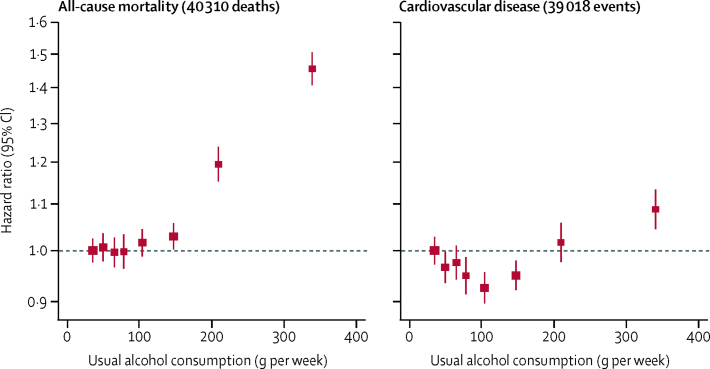
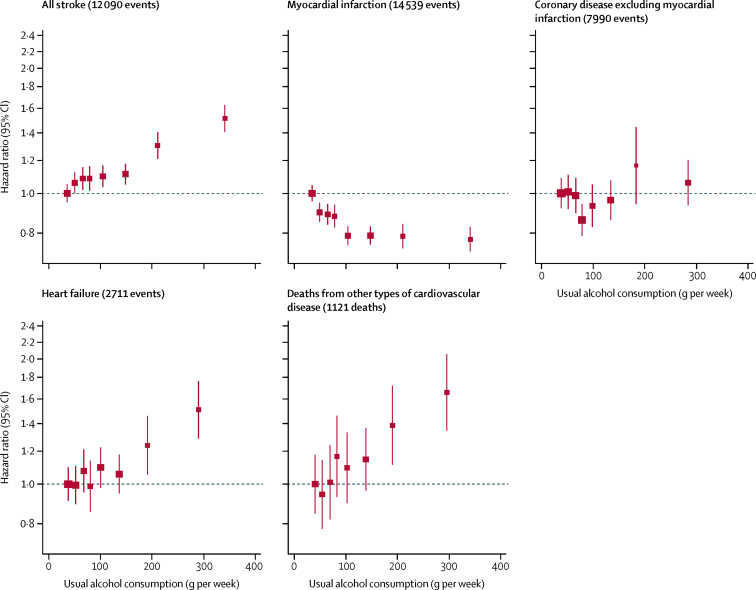
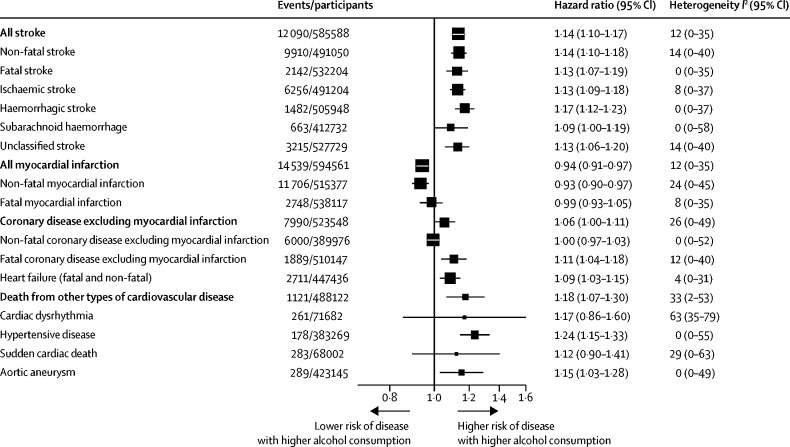
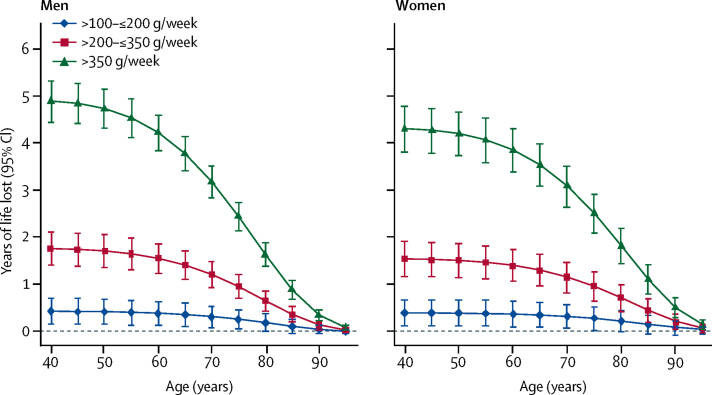
BACKGROUND: Low-risk limits recommended for alcohol consumption vary substantially across different national guidelines. To define thresholds associated with lowest risk for all-cause mortality and cardiovascular disease, we studied individual-participant data from 599 912 current drinkers without previous cardiovascular disease. METHODS: We did a combined analysis of individual-participant data from three large-scale data sources in 19 high-income countries (the Emerging Risk Factors Collaboration, EPIC-CVD, and the UK Biobank). We characterised dose-response associations and calculated hazard ratios (HRs) per 100 g per week of alcohol (12·5 units per week) across 83 prospective studies, adjusting at least for study or centre, age, sex, smoking, and diabetes. To be eligible for the analysis, participants had to have information recorded about their alcohol consumption amount and status (ie, non-drinker vs current drinker), plus age, sex, history of diabetes and smoking status, at least 1 year of follow-up after baseline, and no baseline history of cardiovascular disease. The main analyses focused on current drinkers, whose baseline alcohol consumption was categorised into eight predefined groups according to the amount in grams consumed per week. We assessed alcohol consumption in relation to all-cause mortality, total cardiovascular disease, and several cardiovascular disease subtypes. We corrected HRs for estimated long-term variability in alcohol consumption using 152 640 serial alcohol assessments obtained some years apart (median interval 5·6 years [5th-95th percentile 1·04-13·5]) from 71 011 participants from 37 studies. FINDINGS: In the 599 912 current drinkers included in the analysis, we recorded 40 310 deaths and 39 018 incident cardiovascular disease events during 5·4 million person-years of follow-up. For all-cause mortality, we recorded a positive and curvilinear association with the level of alcohol consumption, with the minimum mortality risk around or below 100 g per week. Alcohol consumption was roughly linearly associated with a higher risk of stroke (HR per 100 g per week higher consumption 1·14, 95% CI, 1·10-1·17), coronary disease excluding myocardial infarction (1·06, 1·00-1·11), heart failure (1·09, 1·03-1·15), fatal hypertensive disease (1·24, 1·15-1·33); and fatal aortic aneurysm (1·15, 1·03-1·28). By contrast, increased alcohol consumption was log-linearly associated with a lower risk of myocardial infarction (HR 0·94, 0·91-0·97). In comparison to those who reported drinking >0-≤100 g per week, those who reported drinking >100-≤200 g per week, >200-≤350 g per week, or >350 g per week had lower life expectancy at age 40 years of approximately 6 months, 1-2 years, or 4-5 years, respectively. INTERPRETATION: In current drinkers of alcohol in high-income countries, the threshold for lowest risk of all-cause mortality was about 100 g/week. For cardiovascular disease subtypes other than myocardial infarction, there were no clear risk thresholds below which lower alcohol consumption stopped being associated with lower disease risk. These data support limits for alcohol consumption that are lower than those recommended in most current guidelines. FUNDING: UK Medical Research Council, British Heart Foundation, National Institute for Health Research, European Union Framework 7, and European Research Council.
Overview
The claims and statistics of this paper haven’t been checked yet.
Free: it reads the open-access text and checks the first 5 claims that cite a source we can check. Create a free account to check every claim.
Integrity signals
Registry
Cites
Statistics
Figures
Verification
Claims the paper makes
The claims and statistics of this paper haven’t been checked yet.
Free: it reads the open-access text and checks the first 5 claims that cite a source we can check. Create a free account to check every claim.
Claims other papers make about this one
Each is checked against this paper’s own text: does it say what the citing paper says it does?
The source backs part of the claim, not all of it — or backs it for a different population, condition or comparison.
In the citing paper
“For example, systematic reviews have quantified exposure levels of alcohol use (e.g. by standard drinks/week) that represent risk-thresholds for stroke, cardio-vascular disease and atrial fibrillation (Samokhvalov, Irving, & Rehm, 2010; Tu et al., 2021; Wood et al., 2018)”
From Risk-thresholds for the association between frequency of cannabis use and the development of psychosis: a systematic review and meta-analysis (2023) · cites this paper as Wood et al., 2018
Experimental — accuracy not yet measuredThe check wasn’t confident either way, so it gives no verdict — never disputed.
In the citing paper
“Regular physical exercise reduces plasma TG levels over and above the effect of weight reduction [151,168,169].”
From 2019 ESC/EAS guidelines for the management of dyslipidaemias: lipid modification to reduce cardiovascular risk (2019) · cites this paper as [168]
Experimental — accuracy not yet measuredIn the citing paper
“However, it is analogous to evidence-based alcohol-related health guidelines where the risk for specific adverse (e.g. cardio-vascular) outcomes is low/absent below certain consumption levels and ‘moderate’ use is recommended”
From Risk-thresholds for the association between frequency of cannabis use and the development of psychosis: a systematic review and meta-analysis (2023) · cites this paper as Wood et al., 2018
Self-check
Percentages, sums and reported differences re-computed from the paper’s own numbers.
The self-check needs the paper’s full text.
Citations
Cites
Bias in meta-analysis detected by a simple, graphical test
Egger, M., Smith, G. D., Schneider, M., & Minder, C. (1997) · BMJ · doi:10.1136/bmj.315.7109.629 · Cited by 56,722 · cited 1×
“35 Methods we used to estimate reductions in life expectancy (years of life lost) are described in the appendix (pp 6–7).”
Quantifying heterogeneity in a meta‐analysis
Higgins, J. P. T., & Thompson, S. G. (2002) · Statistics in Medicine · doi:10.1002/sim.1186 · Cited by 36,763
Self-citationOperating characteristics of a rank correlation test for publication bias
Begg, C. B., & Mazumdar, M. (1994) · Biometrics · doi:10.2307/2533446 · Cited by 16,955 · cited 1×
“33 Evidence of small study effects was assessed visually with funnel plots and by Begg and Mazumdar’s test 34 and Egger’s test.”
Sudlow, C., Gallacher, J., Allen, N., Beral, V., Burton, P., Danesh, J., Downey, P., Elliott, P., Green, J., Landray, M., et al. (2015) · PLOS Medicine · doi:10.1371/journal.pmed.1001779 · Cited by 12,728
Self-citationMACMAHON, S. (1990) · The Lancet · doi:10.1016/0140-6736(90)90878-9 · Cited by 4,253 · cited 1×
“55 However, we did not find convincing evidence that other known risk factors were important mediators or confounders.”
Genomic Aberrations and Survival in Chronic Lymphocytic Leukemia
Döhner, H., Stilgenbauer, S., Benner, A., Leupolt, E., Kröber, A., Bullinger, L., Döhner, K., Bentz, M., & Lichter, P. (2000) · New England Journal of Medicine · doi:10.1056/nejm200012283432602 · Cited by 3,318
ABT-199, a potent and selective BCL-2 inhibitor, achieves antitumor activity while sparing platelets
Souers, A. J., Leverson, J. D., Boghaert, E. R., Ackler, S. L., Catron, N. D., Chen, J., Dayton, B. D., Ding, H., Enschede, S. H., Fairbrother, W. J., et al. (2013) · Nature Medicine · doi:10.1038/nm.3048 · Cited by 3,058
Unmutated Ig VH Genes Are Associated With a More Aggressive Form of Chronic Lymphocytic Leukemia
Hamblin, T. J., Davis, Z., Gardiner, A., Oscier, D. G., & Stevenson, F. K. (1999) · Blood · doi:10.1182/blood.v94.6.1848 · Cited by 2,783
Major lipids, apolipoproteins, and risk of vascular disease
The Emerging Risk Factors Collaboration* (2009) · JAMA · doi:10.1001/jama.2009.1619 · Cited by 2,731
Targeting BCL2 with Venetoclax in Relapsed Chronic Lymphocytic Leukemia
Roberts, A. W., Davids, M. S., Pagel, J. M., Kahl, B. S., Puvvada, S. D., Gerecitano, J. F., Kipps, T. J., Anderson, M. A., Brown, J. R., Gressick, L., et al. (2016) · New England Journal of Medicine · doi:10.1056/nejmoa1513257 · Cited by 1,900
Cited by
Items 301–400 of 1,000
Designing Effective Alcohol Warnings: Consumer Reactions to Icons and Health Topics
Grummon, A. H., Ruggles, P. R., Greenfield, T. K., & Hall, M. G. (2022) · American Journal of Preventive Medicine · doi:10.1016/j.amepre.2022.09.006 · Cited by 29
Muhlack, E., Carter, D., Braunack‐Mayer, A., Morfidis, N., & Eliott, J. (2018) · BMC Public Health · doi:10.1186/s12889-018-5948-x · Cited by 27
Impaired subjective self-control in alcohol use: An ecological momentary assessment study
Remmerswaal, D., Jongerling, J., Jansen, P. W., Eielts, C., & Franken, I. H. A. (2019) · Drug and Alcohol Dependence · doi:10.1016/j.drugalcdep.2019.04.043 · Cited by 35
The effectiveness of workplace interventions for the prevention of alcohol use: A meta‐analysis
Fellbaum, L., Mojzisch, A., Bielefeld, L., Benit, N., & Soellner, R. (2023) · Addiction · doi:10.1111/add.16276 · Cited by 33
Luo, G., Xiao, L., Wang, D., Wang, N., Luo, C., Yang, X., & Hao, L. (2020) · The Journal of Nutritional Biochemistry · doi:10.1016/j.jnutbio.2020.108568 · Cited by 26
Moderate excess alcohol consumption and adverse cardiac remodelling in dilated cardiomyopathy
Tayal, U., Gregson, J., Buchan, R. J., Whiffin, N., Halliday, B. P., Lota, A. S., Roberts, A. M., Baksi, A. J., Voges, I., Jarman, J. W. E., et al. (2021) · Heart · doi:10.1136/heartjnl-2021-319418 · Cited by 31
Alcohol consumption and microvascular dysfunction: a J-shaped association: The Maastricht Study
van der Heide, F. C. T., Eussen, S. J. P. M., Houben, A. J. H. M., Henry, R. M. A., Kroon, A. A., Kallen, C., Dagnelie, P. C., DONGEN, M. C. J. M. V., Berendschot, T. T. J. M., Schouten, J., et al. (2023) · Cardiovascular Diabetology · doi:10.1186/s12933-023-01783-x · Cited by 30
“For example, a recent individual participant data analysis of n ~ 600,000 participants found that 100 g/week of alcohol consumption (for both men and women) was associated with a lower risk of all-cause mortality; [82] and a recent randomized clinical trial found that < 1 unit of alcohol consumption was associated wit…”
BackgroundCuthbertson, C. C., Tan, X., Heiss, G., Kucharska‐Newton, A., Nichols, H. B., Kubota, Y., & Evenson, K. R. (2019) · Journal of the American Heart Association · doi:10.1161/jaha.119.012657 · Cited by 26
The impact of dietary interventions on cardiometabolic health
Gjermeni, E., Fiebiger, R., Bundalian, L., Garten, A., Schöneberg, T., Duc, D. L., & Blüher, M. (2025) · Cardiovascular Diabetology · doi:10.1186/s12933-025-02766-w · Cited by 30
“…studies suggest that mild-to-moderate alcohol consumption is associated with lower adverse cardiovascular events [127] and lower all-cause and cardiovascular mortality [129], but can increase the risk for cancer [127], atrial fibrillation, hemorrhagic stroke, adiposity and hypertension [53, 130].”
Wang, X., Liu, A., Du, M., Wu, J., Wang, W., Qian, Y., Zheng, H., Liu, D., Nan, X., Jia, L., et al. (2019) · Public Health Nutrition · doi:10.1017/s136898001900301x · Cited by 28
“Long-term excessive intake of alcohol is an independent risk factor for hypertension(37,38).”
Backgroundsup, R. W. S., Li, B., Jiang, Y., Guan, Y., Wang, G., & Zhao, G. (2019) · Tobacco Induced Diseases · doi:10.18332/tid/114076 · Cited by 27
Alcohol consumption and risk of incident atrial fibrillation: A population-based cohort study
Johansson, C., Lind, M. M., Eriksson, M., Wennberg, M., Andersson, J. S. O., & Johansson, L. Å. (2020) · European Journal of Internal Medicine · doi:10.1016/j.ejim.2020.02.022 · Cited by 27
Self-citationOptimal diet for cardiovascular and planetary health
Verschuren, W. M. M., Boer, J. M. A., & Temme, E. H. M. (2021) · Heart · doi:10.1136/heartjnl-2019-316373 · Cited by 26
Self-citationJané‐Llopis, E., O'Donnell, A. J., Kaner, E., & Anderson, P. (2022) · Alcohol and Alcoholism · doi:10.1093/alcalc/agac025 · Cited by 26
“Forty-year-old men and women who drink over six UK standard drinks a day (more than about 350 g of alcohol a week) lose 4–5 years of life, compared with those who drink under two standard UK drinks a day (100 g of alcohol or less a week) (Wood et al., 2018).”
BackgroundLiu, Y., Lee, J. H., Tsai, M. K., Wei, J. C., & Wen, C.-P. (2022) · Scientific Reports · doi:10.1038/s41598-022-11427-x · Cited by 29
Nyberg, S. T., Batty, G. D., Pentti, J., Madsen, I. E. H., Alfredsson, L. S., Bjørner, J. B., Borritz, M., Burr, H., Ervasti, J. M., Goldberg, M., et al. (2022) · The Lancet Regional Health - Europe · doi:10.1016/j.lanepe.2022.100417 · Cited by 31
Freichel, R., Pfirrmann, J., Cousijn, J., de Jong, P. J., Franken, I. H. A., Banaschewski, T., Bokde, A. L. W., Desrivières, S., Flor, H., Grigis, A., et al. (2023) · Addiction · doi:10.1111/add.16231 · Cited by 37
“Substance use disorders, including alcohol use disorders, present severe psychiatric conditions that have been linked to all-cause mortality and cardiovascular disease [1], thereby causing a substantial health and economic burden [2].”
BackgroundChen, H., Yin, J., Xiang, Y., Zhang, N., Huang, Z., Zhang, Y., Tang, D., Wang, Z., Baimayangji, Chen, L., et al. (2024) · Addiction · doi:10.1111/add.16501 · Cited by 25
Kuczmarski, M. F., Brewer, B. C., Rawal, R., Pohlig, R. T., Zonderman, A. B., & Evans, M. K. (2019) · Nutrients · doi:10.3390/nu11051034 · Cited by 29
“Although there are no clear risk thresholds below which lower alcohol consumption stops being associated with lower cardiovascular disease risk, among current drinkers, the threshold for lowest risk of all-cause mortality has been reported to be about 100 g per week [68].”
BackgroundSpiegelman, D. L., Lovato, L., Khudyakov, P., Wilkens, T. L., Adebamowo, C., Adebamowo, S. N., Appel, L. J., Beulens, J. W. J., Coughlin, J. W., Dragsted, L. O., et al. (2020) · European Journal of Preventive Cardiology · doi:10.1177/2047487320912376 · Cited by 29
“A lower risk of coronary heart disease (CHD) and myocardial infarction (MI) among moderate drinkers compared to abstainers has been reported in over 100 observational studies.(2,3) In addition, numerous short-term randomized controlled trials have shown beneficial effects on a range of biomarkers that could explain th…”
Self-citationTrauma-focused treatment for comorbid post-traumatic stress and substance use disorder
Kline, A. C., Panza, K. E., Lyons, R., Kehle-Forbes, S. M., Hien, D. A., & Norman, S. B. (2022) · Nature Reviews Psychology · doi:10.1038/s44159-022-00129-w · Cited by 24
Kang, D. O., Lee, D. I., Roh, S., Na, J. O., Choi, C. U., Kim, J. W., Kim, E. J., Rha, S., Park, C. G., Kim, Y.-S., et al. (2024) · JAMA Network Open · doi:10.1001/jamanetworkopen.2024.4013 · Cited by 28
Combined effects of lifestyle risk factors on fatty liver index
Nivukoski, U., Niemelä, M., Bloigu, A. H., Bloigu, R., Aalto, M., Laatikainen, T. K., & Niemelä, O. J. (2020) · BMC Gastroenterology · doi:10.1186/s12876-020-01270-7 · Cited by 28
“In obese individuals or in smokers, regular alcohol drinking even in relatively modest amounts may increase the risk for abnormal liver enzyme activities [6, 15, 18, 32].”
BackgroundAlcohol consumption and risk of Alzheimer's disease: A dose–response meta‐analysis
Xie, C., & Feng, Y. (2022) · Geriatrics and gerontology international/Geriatrics & gerontology international · doi:10.1111/ggi.14357 · Cited by 25
Kleerekooper, I., Chua, S. Y. L., Foster, P. J., Trip, S. A., Plant, G. T., Petzold, A., Patel, P. J., Allen, N. E., Aslam, T. M., Atan, D., et al. (2022) · JAMA Network Open · doi:10.1001/jamanetworkopen.2022.0902 · Cited by 25
Self-citationConsumo de bebidas alcoólicas no Brasil: estimativa de razões de prevalências – 2013 e 2019
de Freitas, M. G., Stopa, S. R., & da Silva, E. N. (2023) · Revista de Saúde Pública · doi:10.11606/s1518-8787.2023057004380 · Cited by 40
Association between tobacco smoking and alcohol consumption with arterial stiffness
Vallée, A. (2023) · Journal of Clinical Hypertension · doi:10.1111/jch.14669 · Cited by 24
Association between alcohol intake and incident hypertension in the Korean population
Yoo, M., Park, K. J., Kim, H., Jang, H. B., Lee, H., & Park, S. I. (2018) · Alcohol · doi:10.1016/j.alcohol.2018.09.002 · Cited by 28
Accelerated DNA methylation changes in middle-aged men define sexual dimorphism in human lifespans
Xiao, F., Chen, X., He, Y., & Kong, Q. (2018) · Clinical Epigenetics · doi:10.1186/s13148-018-0573-1 · Cited by 25
Strandberg, A. K., Skoglund, C. B., Gripenberg, J., & Kvillemo, P. (2019) · Nordic Studies on Alcohol and Drugs · doi:10.1177/1455072519845970 · Cited by 29
Impact of Wnt/β‐catenin signaling on ethanol‐induced changes in brain endothelial cell permeability
Laksitorini, M. D., Yathindranath, V., Xiong, W., Parkinson, F. E., Thliveris, J. A., & Miller, D. W. (2020) · Journal of Neurochemistry · doi:10.1111/jnc.15203 · Cited by 28
“Long-term consumption of as little as 100 g of alcohol per week has been attributed to an increased risk of several cardiovascular diseases, including stroke, heart failure, hypertension, and coronary heart disease (Wood et al., 2018).”
BackgroundZhang, Y., Li, Y., Peila, R., Wang, T., Xue, X., Kaplan, R. C., Dannenberg, A. J., Qi, Q., & Rohan, T. E. (2024) · American Journal of Clinical Nutrition · doi:10.1016/j.ajcnut.2024.04.025 · Cited by 26
Alagaratnam, J., van Bremen, K., Behrens, G. M. N., Boccara, F., Cinque, P. M., Gisslén, M., Guaraldi, G., Konopnicki, D., Kowalska, J. D., Mallon, P. W. G., et al. (2025) · The Lancet HIV · doi:10.1016/s2352-3018(25)00047-5 · Cited by 36
Grupo de expertos del PAPPS. Recomendaciones sobre el estilo de vida
García, R. C., Guillem, F. C., Seco, E. M., Puente, J. M. G., Arango, J. S. J., Ramírez‐Manent, J. I., Martín-Cantera, C., Giménez, M. D. C., & Frauca, J. R. (2020) · Atención Primaria · doi:10.1016/j.aprim.2020.07.004 · Cited by 38
Cumulative alcohol consumption and stroke risk in men
Duan, Y., Wang, A., Wang, Y., Wang, X., Chen, S., Zhao, Q., Li, X., Wu, S., & Li, Y. (2019) · Journal of Neurology · doi:10.1007/s00415-019-09361-6 · Cited by 26
Wang, Y., Wang, J., Chen, Z., Ma, M., Lin, C., He, Q., & Ye, M. (2021) · BMC Cancer · doi:10.1186/s12885-021-08700-z · Cited by 26
Effect of Fermentation Strategy on the Quality and Aroma Characteristics of Yellow Peach Wines
Liang, H., Gao, D., Wang, C., Gao, H., Guo, Y., Zhao, Z., & Shi, H. (2022) · Fermentation · doi:10.3390/fermentation8110604 · Cited by 23
Coelho, M., Patarrão, R. S., Sousa‐Lima, I., Ribeiro, R. T., Meneses, M. J., Andrade, R., Mendes, V. M., Manadas, B. J., Raposo, J. F., Macedo, M. P., et al. (2022) · Nutrients · doi:10.3390/nu15010004 · Cited by 27
“Mean alcohol intake was within the current 14 units per week guideline recommended by the NHS [27].”
MethodFat, L. N., Bell, S., & Britton, A. R. (2020) · Addiction · doi:10.1111/add.15013 · Cited by 25
“Our finding that current hazardous drinkers have increased blood pressure is consistent with other studies [29], and this might be one pathway implicated in the increased risk of stroke found in this study [30] and elsewhere [8,31].”
ResultSelf-citationWallar, L. E., & Rosella, L. C. (2020) · PLoS ONE · doi:10.1371/journal.pone.0229465 · Cited by 35
Alcohol mortality in Russia: assessment with representative survey data
Кузнецова, П. О. (2020) · Population and Economics · doi:10.3897/popecon.4.e51653 · Cited by 28
“The paper (Wood et al. 2018) analyzed the results of 83 prospective studies in 19 high-income countries.”
BackgroundKanakaris, N. K., Ciriello, V., Stavrou, P., West, R. M., & Giannoudis, P. V. (2021) · European Journal of Trauma and Emergency Surgery · doi:10.1007/s00068-021-01618-y · Cited by 23
Debts of despair: Education, financial losses, and precursors of deaths of despair
Fishman, S. H., & Gutin, I. (2021) · SSM - Population Health · doi:10.1016/j.ssmph.2021.100759 · Cited by 29
“The binary indicator reflects the threshold-type association between between alcohol consumption and related mortality, with steep increases in the mortality risk above 200 grams of alcohol per week (Wood et al., 2018).”
BackgroundZhang, J., Mitsuhashi, T., Matsuo, T., Yorifuji, T., Hamada, J., & Liu, Y. (2021) · Current Eye Research · doi:10.1080/02713683.2021.1942070 · Cited by 27
Zhao, X., Zhou, R., Li, H., Fan, Y., Sun, Y., Hu, X., & Zhang, S. (2021) · Frontiers in Cardiovascular Medicine · doi:10.3389/fcvm.2021.767692 · Cited by 24
“Epidemiological studies illustrated that moderate alcohol intake (one to two cups a day, or 100 grams per week) was associated with a decreased incidence of CAD (4, 5).”
BackgroundWelford, P., Östh, J., Hoy, S., Rossell, S. L., Pascoe, M. C., Diwan, V. K., & Hallgren, M. Å. (2023) · Clinical Interventions in Aging · doi:10.2147/cia.s359185 · Cited by 26
The Rise in the Prevalence of Nonalcoholic Fatty Liver Disease and Hepatocellular Carcinoma
Sherif, Z. A. (2019) · IntechOpen eBooks · doi:10.5772/intechopen.85780 · Cited by 27
Shalnova, S. A., Maksimov, S. A., Balanova, Y. А., Deev, А. D., Евстифеева, С. Е., Имаева, А. Э., Владимировна, К. А., Аркадьевна, М. Г., Mordvinova, R. S., Rotar, O. P., et al. (2019) · Russian Journal of Preventive Medicine · doi:10.17116/profmed20192205145 · Cited by 22
A Systematic Review on Alcohol Consumption among Non-Religious and Religious Adults
Chagas, C., Martins, L. B., Bezerra, A. G., de Paula, T. C. S., Xavier, A. C. A., Zangari, W., & Galduróz, J. C. F. (2022) · Substance Use & Misuse · doi:10.1080/10826084.2022.2155477 · Cited by 24
“This review included any pattern of alcohol consumption, considering that there is no risk-free dose of alcohol (Wood et al., 2018).”
BackgroundKABANDA, I. K., NGONZO, C. K., BOWAMOU, C.-K. E., Divengi, J.-P. N., PONTE, N. K., MADODA, O. T., Natuhoyila, A. N., M’Buyamba-Kabangu, J.-R., Longo‐Mbenza, B., BOMBA, D. B., et al. (2024) · Heliyon · doi:10.1016/j.heliyon.2024.e28311 · Cited by 23
Laboratory test based assessment of WHO alcohol risk drinking levels
Niemelä, O. J., Nivukoski, U., Bloigu, A. H., Bloigu, R., Aalto, M., & Laatikainen, T. K. (2019) · Scandinavian Journal of Clinical and Laboratory Investigation · doi:10.1080/00365513.2019.1571625 · Cited by 24
“Recent studies on the relationships between the amount of alcohol consumption and all-cause mortality [10] or liver status [11] have supported the view that alcohol consumption may be associated with health problems even at relatively low drinking levels.”
BackgroundResultInfluentialJørgenrud, B., Kabashi, S., Надеждин, А. В., Bryun, E. A., Koshkina, E. A., Tetenova, E., Lerdal, A., Norby, G., Kolgashkin, A. J., Petukhov, A., et al. (2021) · Alcohol and Alcoholism · doi:10.1093/alcalc/agab013 · Cited by 23
Johnson, E. C., Pierre, C. L. S., Meyers, J. L., Alıev, F., McCutcheon, V. V., Lai, D., Dick, D. M., Goate, A., Kramer, J., Kuperman, S., et al. (2019) · Alcoholism Clinical and Experimental Research · doi:10.1111/acer.14064 · Cited by 24
Alcohol consumption and risk of breast and ovarian cancer: A Mendelian randomization study
Zhu, J., Jiang, X., & Niu, Z. (2020) · Cancer Genetics · doi:10.1016/j.cancergen.2020.06.001 · Cited by 22
The association of the Mediterranean diet with heart failure risk in a Dutch population
Strengers, J. G., den Ruijter, H. M., Boer, J. M. A., Asselbergs, F. W., Verschuren, W. M. M., van der Schouw, Y. T., & Sluijs, I. (2020) · Nutrition Metabolism and Cardiovascular Diseases · doi:10.1016/j.numecd.2020.08.003 · Cited by 24
Self-citationHisamatsu, T., Miura, K., Tabara, Y., Sawayama, Y., Kadowaki, T., Kadota, A., Torii, S., Kondo, K., Yano, Y., Fujiyoshi, A., et al. (2022) · European Journal of Preventive Cardiology · doi:10.1093/eurjpc/zwac156 · Cited by 21
Rethinking Unhealthy Alcohol Use in the United States: A Structured Review
Volpicelli, J. R., & Menzies, P. (2022) · Substance Abuse: Research and Treatment · doi:10.1177/11782218221111832 · Cited by 20
Armario, P., Brotons, C., Elosúa, R., de Leciñana, M. A., Castro, A., Clarà, A. B. I., Cortés, O., Rodríguez, Á. D., Herranz, M., Justo, S., et al. (2021) · Clínica e Investigación en Arteriosclerosis (English Edition) · doi:10.1016/j.artere.2021.02.001 · Cited by 22
Thørrisen, M. M., Skogen, J. C., Kjeken, I., Jensen, I. B., & Aas, R. W. (2019) · Substance Abuse Treatment Prevention and Policy · doi:10.1186/s13011-019-0217-2 · Cited by 24
“Harmful alcohol consumption is a major risk factor for disease, disability and mortality, and has been identified as a causal agent in more than 200 disease and injury conditions [10, 11].”
Liver enzymes in alcohol consumers with or without binge drinking
Nivukoski, U., Bloigu, A. H., Bloigu, R., Aalto, M., Laatikainen, T. K., & Niemelä, O. J. (2019) · Alcohol · doi:10.1016/j.alcohol.2019.03.001 · Cited by 20
The Impact of Lower-Strength Alcohol Products on Alcohol Purchases by Spanish Households
Anderson, P., & Kokole, D. (2022) · Nutrients · doi:10.3390/nu14163412 · Cited by 23
“Forty-year-olds who drink more than 350 g of alcohol a week (about five drinks a day) lose four to five years of life compared to those who drink 100 g of alcohol or fewer a week (about one-and-a-half drinks a day) [6].”
BackgroundLower Strength Alcohol Products—A Realist Review-Based Road Map for European Policy Making
Anderson, P., Kokole, D., Jané‐Llopis, E., Burton, R., & Lachenmeier, D. W. (2022) · Nutrients · doi:10.3390/nu14183779 · Cited by 27
“5% would be metabolized by the first pass metabolism of the stomach and liver [135–137], and are, likely, of no measurable health risk, [16] being below the safety margin of 2.”
BackgroundRico, M. S., Plessz, M., Airagnes, G., Ribet, C., Hoertel, N., Goldberg, M., Zins, M., & Meneton, P. (2023) · PLoS ONE · doi:10.1371/journal.pone.0288747 · Cited by 30
Carballo‐Casla, A., Stefler, D., Ortolá, R., Chen, Y., Knüppel, A., Kubínová, R., Pająk, A., Rodríguez‐Artalejo, F., Brunner, E. J., & Bobák, M. (2023) · European Journal of Preventive Cardiology · doi:10.1093/eurjpc/zwad370 · Cited by 22
“20,21 On one hand, the association of wine and mortality might be different to that of beer or spirits, partially because it is drunk more frequently (when consuming the same amount) than the said beverages and rarely entails binge drinking.”
BackgroundSelf-citationAlgharably, E. A. E., Meinert, F. M., Januszewicz, A., & Kreutz, R. H. (2024) · Kardiologia Polska · doi:10.33963/v.kp.98704 · Cited by 27
Zhang, Y., Zhang, P., & Yin, D. (2024) · Lipids in Health and Disease · doi:10.1186/s12944-024-02165-2 · Cited by 22
“The main hypotheses center on the functions of cerebral and cardiovascular networks, as well as brain-derived neurotrophic factors [61–65].”
BackgroundLee, D. I., Kim, S., & Kang, D. O. (2025) · Trends in Cardiovascular Medicine · doi:10.1016/j.tcm.2024.12.011 · Cited by 22
Beer, wine consumption, and 10-year CVD incidence: the ATTICA study
Panagiotakos, D. B., Kouli, G.-M., Magriplis, E., Kyrou, I., Georgousopoulou, E. N., Chrysohoou, C. A., Tsigos, C., Tousoulis, D. M., & Pitsavos, C. S. (2018) · European Journal of Clinical Nutrition · doi:10.1038/s41430-018-0296-6 · Cited by 20
Self-citationGruppen, E. G., Bakker, S. J. L., James, R. W., & Dullaart, R. P. F. (2018) · American Journal of Clinical Nutrition · doi:10.1093/ajcn/nqy217 · Cited by 21
Devilly, G. J., Greber, M., Brown, K., & Allen, C. (2019) · Drug and Alcohol Dependence · doi:10.1016/j.drugalcdep.2019.107603 · Cited by 20
Dietary Research on Coffee: Improving Adjustment for Confounding
R.Thomas, D., & Hodges, I. D. (2019) · Current Developments in Nutrition · doi:10.1093/cdn/nzz142 · Cited by 23
Glyn‐Owen, K., Böhning, D., Parkes, J., Roderick, P. J., & Buchanan, R. M. (2020) · Liver International · doi:10.1111/liv.14754 · Cited by 23
Lin, C.-H., Nfor, O. N., Ho, C., Hsu, S., Tantoh, D. M., Liaw, Y.-C., Mochly‐Rosen, D., Chen, C., & Liaw, Y. (2021) · Journal of Translational Medicine · doi:10.1186/s12967-021-02904-4 · Cited by 21
“A meta-analysis of 83 prospective studies with 5,99,912 current alcoholic beverage drinkers mainly of European descent suggested that stroke incidence increased steadily with the alcohol intake [11].”
BackgroundAssociation between alcohol dietary pattern and prevalence of dyslipidaemia: WASEDA’S Health Study
Tanisawa, K., Ito, T., Kawakami, R., Usui, C., Kawamura, T., Suzuki, K., Sakamoto, S., Ishii, K., Muraoka, I., Oka, K., et al. (2021) · British Journal Of Nutrition · doi:10.1017/s0007114521002671 · Cited by 22
“Many epidemiological studies have demonstrated that high alcohol intake is associated with an increased risk of mortality (1,2) , various types of cancer (3,4) , and cardiovascular diseases (2) .”
BackgroundZatońska, K., Psikus, P., Basiak-Rasała, A., Stępnicka, Z., Wołyniec, M., Wojtyła, A., Szuba, A., & Połtyn–Zaradna, K. (2021) · International Journal of Environmental Research and Public Health · doi:10.3390/ijerph18084185 · Cited by 28
“For CVDs other than myocardial infarction, there was no threshold below which lower alcohol consumption ceased to be associated with a lower risk [51].”
BackgroundInfluentialChun, H. S., Lee, M., Lee, J. S., Lee, H. W., Kim, B. K., Park, J. Y., Kim, D. Y., Ahn, S. H., Lee, Y., Kim, J., et al. (2023) · Liver International · doi:10.1111/liv.15508 · Cited by 21
Yuan, S., Wu, J., Chen, J., Sun, Y., Burgess, S., Li, X., Åkesson, A., & Larsson, S. C. (2024) · European Journal of Preventive Cardiology · doi:10.1093/eurjpc/zwae142 · Cited by 22
“…an inverse association between light-to-moderate alcohol consumption and PAD risk, which is in line with evidence from large-scale updated studies 30, 31 since PAD shares the pathological basis (i.e., atherosclerosis) with CHD as well as the current study was based on the middle-aged and older…”
Self-citationXue, L., Zhu, W., Yang, F., Dai, S., Han, Z., Xu, F., Guo, P., & Chen, Y. (2019) · Biochemical and Biophysical Research Communications · doi:10.1016/j.bbrc.2019.03.037 · Cited by 19
Suliga, E., Kozieł, D., Ciesla, E., Rebak, D., Głuszek-Osuch, M., Naszydłowska, E., & Głuszek, S. (2019) · Nutrients · doi:10.3390/nu11061318 · Cited by 19
Hanna, J. M., Malhotra, A., Brauer, P. R., Luryi, A. L., & Michaelides, E. M. (2019) · American Journal of Otolaryngology · doi:10.1016/j.amjoto.2019.07.007 · Cited by 20
Alcohol Use Among Mental Health Professionals in China: A Nationwide Cross-sectional Survey
Tao, R., Jiang, F., Min, K., Liu, T., Liu, Y., Xia, L., Wang, J., Liu, H., & Tang, Y. (2020) · Alcohol and Alcoholism · doi:10.1093/alcalc/agaa065 · Cited by 21
Cardiovascular symptoms affect the patterns of habitual coffee consumption
Hyppönen, E., & Zhou, A. (2021) · American Journal of Clinical Nutrition · doi:10.1093/ajcn/nqab014 · Cited by 23
Chazova, I. E., Shestakova, M. V., Zhernakova, Y. V., Blinova, N. V., Маркова, Т. Н., Mazurina, N. V., Владиславович, Е. М., Tereshchenko, S. N., Жиров, И. В., Komarov, A. L., et al. (2021) · Eurasian heart journal · doi:10.38109/2225-1685-2021-2-6-61 · Cited by 27
Lu, Y., Chi, F. W., Parthasarathy, S., Palzes, V. A., Kline‐Simon, A. H., Metz, V. E., Weisner, C. M., Satre, D. D., Campbell, C. I., Elson, J., et al. (2021) · Alcoholism Clinical and Experimental Research · doi:10.1111/acer.14702 · Cited by 23
Alcohol intake and long-term mortality risk after myocardial infarction in the Alpha Omega Cohort
Cruijsen, E., de Ruiter, A. J., Küpers, L. K., Busstra, M. C., & Geleijnse, J. M. (2021) · American Journal of Clinical Nutrition · doi:10.1093/ajcn/nqab366 · Cited by 20
“(2) performed a population-based pooling study of almost 600,000 current alcohol users (i.”
Fabbri, C., Mutz, J., Lewis, C. M., & Serretti, A. (2021) · Psychological Medicine · doi:10.1017/s003329172100502x · Cited by 23
“No or very low alcohol intake was negatively associated with FWS, but might be attributable to individuals not drinking alcohol because of medical conditions that contraindicate it (Wood et al., 2018).”
Strebel, J. E., & Terry, M. B. (2021) · American Journal of Public Health · doi:10.2105/ajph.2021.306233 · Cited by 19
Baumann, S., Staudt, A., Freyer‐Adam, J., Bischof, G., Meyer, C., & John, U. (2021) · Addiction · doi:10.1111/add.15412 · Cited by 18
Tholen, R., Ponnet, K. S., Hal, G. F. V., Bruyn, S. D., Buffel, V., de Velde, S. M. V., Bracke, P., & Wouters, E. (2022) · International Journal of Environmental Research and Public Health · doi:10.3390/ijerph19074348 · Cited by 23
Sexual behaviors, cannabis, alcohol and monkeypox infection
Vallée, A. (2023) · Frontiers in Public Health · doi:10.3389/fpubh.2022.1054488 · Cited by 20
Association Between Alcohol Consumption and Ectopic Fat in the Multi‐Ethnic Study of Atherosclerosis
Kazibwe, R., Chevli, P. A., Evans, J. K., Allison, M., Michos, E. D., Wood, A. C., Ding, J., Shapiro, M. D., & Mongraw‐Chaffin, M. (2023) · Journal of the American Heart Association · doi:10.1161/jaha.123.030470 · Cited by 21
Self-citationIs there a safe limit for consumption of alcohol?
Musto, J., Brown, R., & Lucey, M. R. (2024) · Journal of Hepatology · doi:10.1016/j.jhep.2024.10.024 · Cited by 24
My own personal hell: approaching and exceeding thresholds of too much alcohol
Burgess, M., Cooke, R. W. I., & Davies, E. (2019) · Psychology and Health · doi:10.1080/08870446.2019.1616087 · Cited by 19
“People construct their threshold of too much alcohol on judgements of whether their night will end badly rather than whether their life will end early (cf. Global Burden of Disease Alcohol Collaborators, 2018; Wood et al., 2018).”
BackgroundInfluentialon behalf of the Topic Group “Initial Data Analysis” of the STRATOS Initiative (STRengthening Analytical Thinking for Observational Studies, )., Huebner, M., Vach, W., le Cessie, S., Schmidt, C. O., & Lusa, L. (2020) · BMC Medical Research Methodology · doi:10.1186/s12874-020-00942-y · Cited by 25
Rehm, J. T., Neufeld, M., Yurasova, E., Bunova, A., Gil, A. U., Gornyi, B., Breda, J., Bryun, E. A., Drapkina, O. M., Fadeeva, E. V., et al. (2020) · Alcohol and Alcoholism · doi:10.1093/alcalc/agaa067 · Cited by 21
“Research has clearly shown that even harmful use (in terms of impacting mortality) starts at fairly low levels of alcohol consumption (Shield et al., 2017; GBD 2016 Alcohol Collaborators, 2018; Wood et al., 2018; Shield and Rehm, 2019), for breast cancer at less than one drink containing 12 g of alcohol per day (Shiel…”
BackgroundGambini, J., Gimeno-Mallench, L., González, G. O., Mastaloudis, A., Traber, M. G., Monleón, D., Borrás, C., & Viña, J. (2021) · Antioxidants · doi:10.3390/antiox10020301 · Cited by 21
“Certainly, higher doses will lead to detrimental effects and lower doses are likely to also cause less advantageous effects than drinking one or two glasses of red wine per day [27].”
BackgroundPettigrew, S., Booth, L., Jongenelis, M. I., Brennan, E., Chikritzhs, T. N., Hasking, P. A., Miller, P. G., Hastings, G., & Wakefield, M. A. (2021) · Addictive Behaviors · doi:10.1016/j.addbeh.2021.107004 · Cited by 20
Hung, H.-Y., Chien, W., Chung, C., Kao, L., Chow, L., Chen, Y.-H., Kotlinska, J. H., Silberring, J., & Huang, E. Y. (2021) · Drug and Alcohol Dependence · doi:10.1016/j.drugalcdep.2021.109102 · Cited by 21
Wilkens, T. L., Tranæs, K., Eriksen, J. N., & Dragsted, L. O. (2021) · Nutrition Reviews · doi:10.1093/nutrit/nuab102 · Cited by 20
McEvoy, L. K., Bergstrom, J., Tu, X., Garduno, A. C., Cummins, K. M., Franz, C. E., Lyons, M. J., Reynolds, C. A., Kremen, W. S., Panizzon, M. S., et al. (2022) · Nutrients · doi:10.3390/nu14112183 · Cited by 18
Metadata
- Authors
- Wood, A. M., Kaptoge, S., Butterworth, A. S., Willeit, P., Warnakula, S., Bolton, T., Paige, E., Paul, D. S., Sweeting, M., Burgess, S., Bell, S., Astle, W., Stevens, D., Koulman, A., Selmer, R. M., Verschuren, W. M. M., Sato, S., Njølstad, I., Woodward, M., Salomaa, V., Nordestgaard, B. G., Yeap, B. B., Fletcher, A., Melander, O., Kuller, L. H., Balkau, B., Marmot, M., Koenig, W., Casiglia, E., Cooper, C., Arndt, V., Franco, O. H., Wennberg, P., Gallacher, J., de la Cámara, A. G., Völzke, H., Dahm, C. C., Dale, C. E., Bergmann, M. M., Crespo, C. J., van der Schouw, Y. T., Kaaks, R., Simons, L. A., Lagiou, P., Schoufour, J. D., Boer, J. M. A., Key, T. J., Rodriguez, B., Moreno-Iribas, C., Davidson, K. W., Taylor, J. O., Sacerdote, C., Wallace, R. B., Quiros, J. R., Tumino, R., Blazer, D. G., Linneberg, A., Daimon, M., Panico, S., Howard, B., Skeie, G., Strandberg, T., Weiderpass, E., Nietert, P. J., Psaty, B. M., Kromhout, D., Salamanca-Fernandez, E., Kiechl, S., Krumholz, H. M., Grioni, S., Palli, D., Huerta, J. M., Price, J., Sundström, J., Arriola, L., Arima, H., Travis, R. C., Panagiotakos, D. B., Karakatsani, A., Trichopoulou, A., Kühn, T., Grobbee, D. E., Barrett-Connor, E., van Schoor, N., Boeing, H., Overvad, K., Kauhanen, J., Wareham, N., Langenberg, C., Forouhi, N., Wennberg, M., Després, J.-P., Cushman, M., Cooper, J. A., Rodriguez, C. J., Sakurai, M., Shaw, J. E., Knuiman, M., Voortman, T., Meisinger, C., Tjønneland, A., Brenner, H., Palmieri, L., Dallongeville, J., Brunner, E. J., Assmann, G., Trevisan, M., Gillum, R. F., Ford, I., Sattar, N., Lazo, M., Thompson, S. G., Ferrari, P., Leon, D. A., Smith, G. D., Peto, R., Jackson, R., Banks, E., Di Angelantonio, E., Danesh, J., Wood, A. M., Kaptoge, S., Butterworth, A., Willeit, P., Warnakula, S., Bolton, T., Paige, E., Paul, D. S., Sweeting, M., Burgess, S., Bell, S., Astle, W., Stevens, D., Koulman, A., Selmer, R. M., Verschuren, M., Sato, S., Njølstad, I., Woodward, M., Veikko, S., Nordestgaard, B. G., Yeap, B. B., Flecther, A., Melander, O., Kuller, L. H., Balkau, B., Marmot, M., Koenig, W., Casiglia, E., Cooper, C., Arndt, V., Franco, O. H., Wennberg, P., Gallacher, J., Gómez de la Cámara, A., Völzke, H., Dahm, C. C., Dale, C. E., Bergmann, M., Crespo, C., van der Schouw, Y. T., Kaaks, R., Simons, L. A., Lagiou, P., Schoufour, J. D., Boer, J. M. A., Key, T. J., Rodriguez, B., Moreno-Iribas, C., Davidson, K. W., Taylor, J. O., Sacerdote, C., Wallace, R. B., Quiros, J. R., Rimm, E. B., Tumino, R., Blazer III, D. G., Linneberg, A., Daimon, M., Panico, S., Howard, B., Skeie, G., Salomaa, V., Strandberg, T., Weiderpass, E., Nietert, P. J., Psaty, B. M., Kromhout, D., Salamanca-Fernandez, E., Kiechl, S., Krumholz, H. M., Grioni, S., Palli, D., Huerta, J. M., Price, J., Sundström, J., Arriola, L., Arima, H., Travis, R. C., Panagiotakos, D. B., Karakatsani, A., Trichopoulou, A., Kühn, T., Grobbee, D. E., Barrett-Connor, E., van Schoor, N., Boeing, H., Overvad, K., Kauhanen, J., Wareham, N., Langenberg, C., Forouhi, N., Wennberg, M., Després, J.-P., Cushman, M., Cooper, J. A., Rodriguez, C. J., Sakurai, M., Shaw, J. E., Knuiman, M., Voortman, T., Meisinger, C., Tjønneland, A., Brenner, H., Palmieri, L., Dallongeville, J.-P., Brunner, E. J., Assmann, G., Trevisan, M., Gillumn, R. F., Ford, I. F., Sattar, N., Lazo, M., Thompson, S., Ferrari, P., Leon, D. A., Davey Smith, G., Peto, R., Jackson, R., Banks, E., Di Angelantonio, E., & Danesh, J.
- Affiliations
- University of Cambridge (GB)
- University Medical Center Utrecht (NL)
- London School of Hygiene & Tropical Medicine (GB)
- German Institute of Human Nutrition (DE)
- Portland State University (US)
- Institut Pasteur de Lille (FR)
- Howard University Hospital (US)
- ORCID
- Venue
- The Lancet
- Publisher
- Elsevier BV
- Published
- 2018-04
- Volume
- 391
- Issue
- 10129
- Pages
- 1513-1523
- ISSN
- 0099-5355 (ISSN-L)
- 0140-6736
- PMC
- PMC5899998
- OpenAlex
- W2787107952
- Semantic Scholar
- 67861ba0b72d3635d063ce89d6b401c9f5a93164
- Cited by
- 1,188
- References
- 54
- Citations by year
- 2026: 78 · 2025: 117 · 2024: 135 · 2023: 146 · 2022: 155 · 2021: 173 · 2020: 164 · 2019: 155 · 2018: 63
- FWCI
- 105.54
- Type
- journal article
- Language
- en
- Update notices
- erratum (2018-06-02)
- Open access
- hybrid
- doi.org
- Licence
- cc-by
- www.elsevier.com/tdm/userlicense/1.0/ (tdm)
- creativecommons.org/licenses/by/4.0/ (vor)
- Locations
- The Lancet (publishedVersion, cc-by)
- Europe PMC (PubMed Central) (publishedVersion, other-oa)
- PubMed Central (publishedVersion, cc-by)
- PubMed (publishedVersion)
- Pure Amsterdam UMC (publishedVersion, cc-by)
- Research at the University of Copenhagen (University of Copenhagen) (publishedVersion, cc-by)
- Amsterdam UMC (VU Amsterdam) - Institutional Repository (publishedVersion, other-oa)
- EUR Research Repository (Erasmus University Rotterdam) (publishedVersion)
- University of Groningen research database (University of Groningen / Centre for Information Technology) (publishedVersion, cc-by)
- Explore Bristol Research (publishedVersion, other-oa)
- ENLIGHTEN (Jurnal Bimbingan dan Konseling Islam) (acceptedVersion, cc-by-sa)
- ePrints Soton (University of Southampton) (acceptedVersion)
- Socio-Environmental Systems Modeling (acceptedVersion, cc-by)
- Leicester Research Archive (University of Leicester) (acceptedVersion, other-oa)
- LSHTM Research Online (London School of Hygiene and Tropical Medicine) (acceptedVersion)
- ANU Open Research (Australian National University) (submittedVersion, cc-by)
- UNSWorks (UNSW Sydney) (submittedVersion, cc-by)
- UEF eRepo (University of Eastern Finland) (submittedVersion, cc-by)
- VBN Forskningsportal (Aalborg Universitet) (submittedVersion, cc-by)
- RISalud Institutional Health Repository of Andalucía (submittedVersion, cc-by)
- Apollo (University of Cambridge) (submittedVersion, cc-by)
- PDXScholar (Portland State University) (submittedVersion)
- UWA Profiles and Research Repository (UWA) (submittedVersion, cc-by)
- EUR Research Repository (Erasmus University Rotterdam) (submittedVersion)
- RePub (Erasmus University Rotterdam) (submittedVersion, other-oa)
- DiVA at Umeå University (Umeå University) (submittedVersion, other-oa)
- Uppsala University Publications (Uppsala University) (submittedVersion, other-oa)
- HAL (submittedVersion)
- LA Referencia (Red Federada de Repositorios Institucionales de Publicaciones Científicas) (submittedVersion, other-oa)
- Utrecht University Repository (Utrecht University) (submittedVersion, other-oa)
- UCL Discovery (University College London) (submittedVersion)
- NORA - Norwegian Open Research Archives (submittedVersion, other-oa)
- Figshare (submittedVersion, cc-by)
- Työväentutkimus Vuosikirja (submittedVersion)
- Lund University Publications (Lund University) (submittedVersion)
- mediaTUM – the media and publications repository of the Technical University Munich (Technical University Munich) (submittedVersion, other-oa)
- mediaTUM (Technical University of Munich) (submittedVersion)
- Site cant be reached (submittedVersion)
- Edinburgh Research Explorer (University of Edinburgh) (submittedVersion, cc-by)
- Research Portal (Queen's University Belfast) (submittedVersion, cc-by)
- PuSH - Publication Server of Helmholtz Zentrum München (submittedVersion)
- Bristol Research (University of Bristol) (submittedVersion, other-oa)
- Rivm Repository (Netherlands National Institute for Public Health and the Environment) (submittedVersion, cc-by)
- Rivm (National Institute for Public Health and the Environment) (submittedVersion)
- OPUS (Augsburg University) (submittedVersion)
- OPUS (Augsburg University) (submittedVersion, cc-by)
- STM:n Hallinnonalan avoin julkaisuarkisto (Julkari) (submittedVersion)
- Rivm (National Institute for Public Health and the Environment) (submittedVersion, cc-by)
- University of Groningen research database (University of Groningen / Centre for Information Technology) (submittedVersion, cc-by)
- Utrecht University Repository (Utrecht University) (submittedVersion, cc-by)
- Data Archiving and Networked Services (DANS) (submittedVersion, other-oa)
- Data Archiving and Networked Services (DANS) (submittedVersion, cc-by)
- Apollo (cc-by)
- Columbia Academic Commons (Columbia University)
- WOS
- Funders
- World Health Organization
- Wellcome Trust (204623/Z/16/Z)
- Cancer Research UK (16491)
- National Institute for Health and Care Research (NF-SI-0617-10113, NF-SI-0512-10165, NF-SI-0508-10082, NF-SI-0513-10085, NF-SI-0512-10135, NF-SI-0617-10149)
- British Heart Foundation (MR/L003120/1, G0800270, RG/16/11/32334, SP/09/002, RG/08/014, CH/12/2/29428, PG/11/63/29011, RG/13/13/30194, RG/13/2/30098)
- European Commission (LSHM_CT_2006_037197, 279233, 37197)
- National Centre for the Replacement, Refinement and Reduction of Animals in Research (NC/P001076/1)
- Cambridge University Hospitals (146281)
- Novo Nordisk Fonden (NNF14OC0009819)
- Medical Research Council (MR/K013351/1, MC_UU_12015/5, SP/09/002, MR/R024227/1, MR/L003120/1, G0800270, MC_PC_17228, MR/N003284/1, MC_UU_12011/1, MC_UU_12015/1, MR/L003120, MC_UU_00011/1, MR/K014811/1)
- NIHR Cambridge Biomedical Research Centre (MR/L003120/1)
- National Institute on Alcohol Abuse and Alcoholism (U10AA025286)
- FP7 Ideas: European Research Council (268834)
- Topics
- Health Sciences › Medicine › Pathology and Forensic Medicine › Alcohol Consumption and Health Effects
- Health Sciences › Medicine › Epidemiology › Substance Abuse Treatment and Outcomes
- Health Sciences › Medicine › Pharmacology (medical) › Coffee research and impacts
- Keywords
- alcohol consumption, all-cause mortality, cardiovascular disease, stroke, coronary artery disease, heart failure, dose-response relationship, alcohol guidelines, current drinkers, UK Biobank, individual patient data meta-analysis, high-income countries
- MeSH terms
- Alcohol Drinking, Cardiovascular Diseases, Female, Humans, Male, Middle Aged, Prospective Studies
About these checks
Registry, retraction, Cites and statistics results are computed, not judged, with one exception: a printed reference that no index lists is read once by a model before it counts as a citation error. Claims are extracted by a model and kept only when their quote appears verbatim in the text; each cited source is then checked, with a model’s help, for whether it says what the claim relies on. Those verdicts can be wrong — read the claim’s quote and the cited source before relying on one.
Statistics and arithmetic are recomputed, not judged.
Confidence bands are shown only for fields calibrated on our annotated test set. None is calibrated yet, so no band is shown.
What counts as a claim ›How we measure confidence ›How we check this ›
Are you an author, or do you see a problem with this page? Request a review
Data sources
Bibliographic data: Semantic Scholar, OpenAlex, Crossref.
Contains information from the Semantic Scholar Academic Graph Datasets, made available under the ODC Attribution License (ODC-BY 1.0).
Semantic Scholar’s data is described in: Kinney, R., et al. (2023). The Semantic Scholar Open Data Platform. arXiv:2301.10140.
