

The economics of small business finance: The roles of private equity and debt markets in the financial growth cycle
Open accessThe DOI matches its Crossref record; 217 of the 230 references it cites were found in a registry or an index, and 1 are not checked yet; 24 of the 170 sources its claims cite were checked for support.
Abstract
This article examines the economics of financing small business in private equity and debt markets. Firms are viewed through a financial growth cycle paradigm in which different capital structures are optimal at different points in the cycle. We show the sources of small business finance, and how capital structure varies with firm size and age. The interconnectedness of small firm finance is discussed along with the impact of the macroeconomic environment. We also analyze a number of research and policy issues, review the literature, and suggest topics for future research.
Verified 2026-11-25 · 1 reference not checked yet
Overview
CoChat Summary
TL;DR
This article reviews the economics of small business finance through a financial growth cycle paradigm, emphasizing informational opacity and the roles of private equity and debt markets. It documents US small business funding sources and contracts, and analyzes vulnerability to macroeconomic shocks, credit crunches, and bank consolidation.
Key findings
- US small business finance is split roughly evenly between equity (49.63%) and debt (50.37%); the largest sources are the principal owner, commercial banks, and trade creditors, together accounting for 70.10% of total funding. Commercial banks provide 18.75%, trade credit 15.78%, principal owner equity 31.33%, angel finance 3.59%, venture capital 1.85%, and credit card debt 0.14%.
- Financial institution debt is used by 54.23% of small businesses; 86.95% name a commercial bank as their primary financial institution. Average relationship length is 6.64 years overall and 9.01 years with the primary institution; 52.03% of financial institution debt is under lines of credit, 91.94% is secured, and 51.63% is guaranteed.
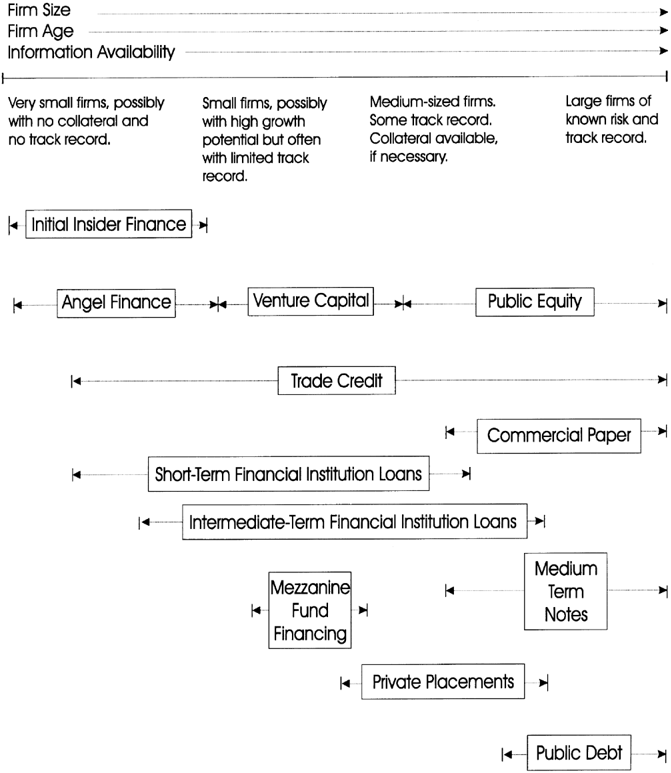
- The growth cycle paradigm predicts younger/more opaque firms rely on insider finance, trade credit, and angel finance, then venture capital and banks, and eventually public markets. However, 1993 NSSBF data show insider finance does not dominate external finance even for adolescents (upper bound 56.8% insider, roughly equal to external), and financial institution debt is important to very young firms, often based on personal guarantees or collateral.
- Macro vulnerability: the early-1990s credit crunch saw real C&I loans fall 23.2% ($596.7 billion to $458.2 billion) and estimated small business lending fall 38.5% ($143.7 billion to $88.4 billion). Banks with less than $100 million in assets held about 9% of portfolios in small business loans versus about 2% for banks over $10 billion; large banks charged about 100 basis points less and required collateral about 25% less often than small banks, other things equal.
Methods
- Design: review and synthesis organized around the financial growth cycle paradigm, covering theoretical and empirical literature on private equity and debt markets, contracts, and macroeconomic vulnerability.
- Data: primarily the 1993 National Survey of Small Business Finances (NSSBF) for US small business finance tables, plus other sources including NFIB, SCF, STBL, CALL, CRA, Venture Economics/VentureOne, and international data.
- Analysis: descriptive tabulations (Tables 1 and 2) and literature synthesis; the paper is a review rather than a new primary empirical study.
Limitations
- Paper-stated: Table 1 data are not completely accurate or consistent and should be considered rough estimates; angel finance estimates are imprecise (range $15 billion to $120 billion); 1993 data may not reflect current conditions; weighted averages mask considerable heterogeneity.
- Paper-stated: the growth cycle paradigm is not intended to fit all small businesses; firm size, age, and information availability are far from perfectly correlated, and the points at which different funding sources begin and end are not definitive.
- Evident from the text: informational opacity and the intertwining of personal and business finances make small business finance difficult to research, and data on owners’ finances are often unavailable; the paper relies heavily on existing literature and available data rather than new primary data collection.
Model-written summary. Check it against the paper before relying on it.
Integrity signals
Registry
Cites
Statistics
Figures
Verification
Claims the paper makes
22 Valid · 27 Not valid · 107 Not checked · 201 Own results and interpretations
Every source the paper cites for this claim was checked and supports it.
In the paper
“This use of personal assets to help with external ®nance also highlights another important aspect of small business ®nance ± the ®nancial intertwining of owners and their businesses (Ang, 1992).”
§ The economics of small business ®nance: The roles of private equity and debt markets in the ®nancial growth cycle > 2.3. The ®nancial growth cycle of small business
What the sources say
- Supportedcites Ang, 1992 matched to “On the Theory of Finance for Privately Held Firms” (1992) source
In “Integrating Personal and Business Accounts,” Ang says that personal guarantees or collateral make business risk inseparable from owners’ personal risk. “The Financing Decision” also identifies owners’ assets used for loan guarantees as contributions to the business. Together, these passages support the cited point that using personal assets to obtain external finance intertwines owners’ and businesses’ finances. (LLM, conf=0.94)
plainstates an association- Asserted: passes — The authors put it forward as true.
- Checkable: passes — It can be checked against evidence.
- Load-bearing: unclear — It is unclear whether the paper’s conclusions depend on it.
- Based: passes — The paper gives a reason why it holds.
- Supported
The cited sources support only part of this claim — read each source’s verdict below.
In the paper
“Costly state veri®cation (Townsend, 1979;Diamond, 1984) and adverse selection (Myers, 1984;Myers and Majluf, 1984;Nachman and Noe, 1994) arguments suggest the optimality of debt contracts after insider ®nance has been exhausted.”
§ The economics of small business ®nance: The roles of private equity and debt markets in the ®nancial growth cycle > 2.3. The ®nancial growth cycle of small business
What the sources say
- Partly supportedcites Townsend, 1979 matched to “Optimal contracts and competitive markets with costly state verification” (1979) sourceExperimental — accuracy not yet measured
Section 3 characterizes an optimal contract for a firm financing an investment project as a bond that defaults when returns fall below a threshold, supporting the costly-state-verification rationale for debt. The paper does not establish that debt becomes optimal only after insider finance has been exhausted. The adverse-selection citations in the sentence refer to other sources, not Townsend. (LLM, conf=0.85)
- Not checked — no full text of the sourcecites Diamond, 1984 matched to “Financial intermediation and delegated monitoring” (1984) source
- Not matchedcites Myers, 1984
More than one paper fits this citation.
hedgedstates a cause- Asserted: passes — The authors put it forward as true.
- Checkable: passes — It can be checked against evidence.
- Load-bearing: passes — The paper’s conclusions depend on it.
- Based: passes — The paper gives a reason why it holds.
- Partly supported
The cited sources support only part of this claim — read each source’s verdict below.
In the paper
“An agency problem arises in the relationship between the entrepreneur and the venture capitalist in which the entrepreneur may expend insucient eort, exhibit expense preference behavior, or lack sucient information or skill to make optimal production decisions.”
§ The economics of small business ®nance: The roles of private equity and debt markets in the ®nancial growth cycle > 3.2. The venture capital market
What the sources say
- Not checked — no full text of the sourcecites Cooper and Carleton, 1979 matched to “Dynamics of Borrower‐Lender Interaction: Partitioning Final Payoff in Venture Capital Finance” (1979) source
- Partly supportedcites Bergemann and Hege, 1998 matched to “Venture capital financing, moral hazard, and learning” (1998) sourceExperimental — accuracy not yet measured
Section 2.3, “Moral hazard and financing,” describes an entrepreneur who may reduce costly effort or divert investment funds to private ends, supporting the insufficient-effort and expense-preference parts of the claim. It does not identify a lack of the entrepreneur’s information or skill as a cause of poor production decisions; it instead says the entrepreneur and venture capitalists initially have the same assessment of the project. (LLM, conf=0.88)
hedgedstates a possible cause- Asserted: passes — The authors put it forward as true.
- Checkable: passes — It can be checked against evidence.
- Load-bearing: passes — The paper’s conclusions depend on it.
- Based: passes — The paper gives a reason why it holds.
Every source the paper cites for this claim was checked and supports it.
In the paper
“Since 1990, this share has about doubled to 30% (Fenn et al., 1997).”
§ The economics of small business ®nance: The roles of private equity and debt markets in the ®nancial growth cycle > 3. The role of private equity markets in small business ®nance
What the sources say
- Supportedcites Fenn et al., 1997 matched to “The Private Equity Market: An Overveiw” (1997) source
In “IPO Firms that Received Private Equity Backing,” the paper states that the share of IPOs with venture backing averaged 15% during the 1980s and doubled to 30% since 1990. This directly supports the cited claim. (LLM, conf=0.95)
plainstates an association- Asserted: passes — The authors put it forward as true.
- Checkable: passes — It can be checked against evidence.
- Load-bearing: unclear — It is unclear whether the paper’s conclusions depend on it.
- Based: passes — The paper gives a reason why it holds.
- Supported
The cited sources support only part of this claim — read each source’s verdict below.
In the paper
“During the 1980s, approximately 15% of all IPOs were backed by venture capital, well out of proportion to the fraction of all ®rms that received venture capital.”
§ The economics of small business ®nance: The roles of private equity and debt markets in the ®nancial growth cycle > 3. The role of private equity markets in small business ®nance
What the sources say
- Partly supportedcites Fenn et al., 1997 matched to “The Private Equity Market: An Overveiw” (1997) sourceExperimental — accuracy not yet measured
The section “IPO Firms that Received Private Equity Backing” states that venture-backed IPOs averaged 15% of IPOs during the 1980s. It does not give the fraction of all firms that received venture capital or make the claimed comparison with that fraction. (LLM, conf=0.84)
plainstates an association- Asserted: passes — The authors put it forward as true.
- Checkable: passes — It can be checked against evidence.
- Load-bearing: unclear — It is unclear whether the paper’s conclusions depend on it.
- Based: passes — The paper gives a reason why it holds.
- Partly supported
184 more claims · 6 with their cited sources checked
Create a free account to see all 357 claims and to verify the 12 references still open.
- Probably not a substantial claim. 94
- It may state two separate claims as one. 87
- Borderline: one of the tests for a substantial claim is unclear. 2
Claims other papers make about this one
Each is checked against this paper’s own text: does it say what the citing paper says it does?
The cited source says what the claim attributes to it.
In the citing paper
“SMEs are more dependent on external financing supplied by commercial banks (Berger and Udell 1998) because most of them are not qualified to raise money from the stock market.”
From Local Bank, Digital Financial Inclusion and SME Financing Constraints: Empirical Evidence from China (2022) · cites this paper as Berger and Udell 1998
Self-check
Percentages, sums and reported differences re-computed from the paper’s own numbers.
Rated minor: it would not touch a result — a value no result rests on, a p-value that stays on the same side of the significance level, or a conflict that is clerical, resolved elsewhere in the paper, or outside its own findings.
In the paper
“Non®nancial business/government debt provides 19.26% of small business funding (mostly trade credit)”
§ The economics of small business ®nance: The roles of private equity and debt markets in the ®nancial growth cycle > 4. The role of private debt markets in small business ®nance
Reported 19.26 · recomputed 18.01
Citations
Cites
Corporate financing and investment decisions when firms have information that investors do not have
Myers, S. C., & Majluf, N. S. (1984) · Journal of Financial Economics · doi:10.1016/0304-405x(84)90023-0 · Cited by 18,957
The Cost of Capital, Corporation Finance and the Theory of Investment
Miller, M. H. (1958) · American Economic Review · Cited by 14,574
Determinants of corporate borrowing
Myers, S. C. (1977) · Journal of Financial Economics · doi:10.1016/0304-405x(77)90015-0 · Cited by 13,169
Credit Rationing in Markets with Imperfect Information
Stiglitz, J. E., & Weiss, A. (1981) · Columbia University · doi:10.7916/d8v12ft1 · Cited by 12,769 · cited 1×
“…pledging outside collateral may help resolve adverse selection problems when the borrower has more information about the quality of the investment than the lender, and may help prevent credit rationing (Stiglitz and Weiss 1981, 1986, Bester 1985, Chan and Kanatas 1985, Besanko and Thakor 1987a,b).”
The cost of capital, corporation finance and the theory of investment
Terra, P. R. (2008) · Revista de Administração e Contabilidade da Unisinos · doi:10.4013/base.20082.07 · Cited by 8,615
Financial intermediation and delegated monitoring
Diamond, D. W. (1984) · The Review of Economic Studies · doi:10.2307/2297430 · Cited by 8,476 · cited 2×
“Costly state verification (Townsend 1979, Diamond 1984) and adverse selection (Myers 1984, Myers and Majluf 1984, Nachman and Noe 1994) arguments suggest the optimality of debt contracts after insider cFor example, there are generally accepted definitions of the stages of finance for the kind of…”
Corporate Financing and Investment Decisions When Firms Have InformationThat Investors Do Not Have
Myers, S., & Majluf, N. (1984) · doi:10.3386/w1396 · Cited by 6,745
The Benefits of Lending Relationships: Evidence from Small Business Data
PETERSEN, M. A., & RAJAN, R. G. (1994) · The Journal of Finance · doi:10.1111/j.1540-6261.1994.tb04418.x · Cited by 5,440 · cited 4×
“…whereas mortgages, equipment loans, motor vehicle loans, and other loans may more often be transactionsdriven .zs It was also found that dependence on trade credit decreased with the length of the banking relationship, supporting the value of relationship lending (Petersen and Rajan 1994, 1995).”
InfluentialInside the black box: the credit channel of monetary policy transmission
Bernanke, B. S., & Gertler, M. (1995) · Journal of Economic Perspectives · doi:10.1257/jep.9.4.27 · Cited by 4,211
Insiders and Outsiders: The Choice between Informed and Arm's‐Length Debt
RAJAN, R. G. (1992) · The Journal of Finance · doi:10.1111/j.1540-6261.1992.tb04662.x · Cited by 3,902 · cited 1×
“Some research suggests that these firms may try to reduce the control of their banks by issuing public debt, even though public debt may entail higher costs (Diamond 1991, 1993, Rajan 1992, Houston and James 1996).”
Research works printed but not linked: 11
- 66. Cook, L., 1997. Trade ®nance, bank ®nance, and capital market imperfections. Working paper. Harvard University, Cambridge, MA.
- 89. Freear, J., Sohl, J.E., Wetzel, W.E., Jr., 1994. The private investor market for venture capital. The Financier 1, 7±19.
- 112. Hancock, D., Wilcox, J.A., 1997. Bank capital, nonbank ®nance, and real estate activity. Journal of Housing Research 8, 75±105.
- 117. Hempel, G., Coleman, A., Simonson, D., 1986. Bank Management, Wiley, New York.
- 119. Ho, R., 1997. Credit-card use to ®nance small business is soaring, says survey of small ®rms. Wall Street Journal B2, Sept. 25.
- 153. Megginson, W.L., Weiss, K.A., 1991. Venture capitalist certi®cation in initial public oerings. Journal of Finance 46, 903±979.
- 162. Morsman Jr., E., 1986. Commercial loan structuring. Journal of Commercial Bank Lending 68, 2± 20.
- 187. Ravid, S.A., 1996. Debt maturity ± A survey. Financial Markets, Institutions and Instruments 5 (3), 1±68.
- 217. Wetzel Jr. W.E., 1994. Venture capital. In: Bygrave, W.D. (Ed.), Portable MBA in Entrepreneur- ship. Wiley, New York, pp. 172±194.
- 219. White, L.J., 1995. An analytical framework. In: Zahid, S.N. (Ed.), Financial Sector Development in Asia. Oxford University Press, New York, pp. 3±35.
- 222. McKean, R. (Ed.), Issues in Defense Economics. Columbia University Press, New York.
Cited by
Items 701–800 of 3,739
Lichtenstein, S., Badu, E., Owusu‐Manu, D., Edwards, D. J., & Holt, G. D. (2013) · Journal of Engineering Design and Technology · doi:10.1108/jedt-09-2012-0041 · Cited by 49
How do corporate characteristics affect capital structure decisions of French SMEs?
Benkraiem, R., & Gurǎu, C. (2013) · International Journal of Entrepreneurial Behaviour & Research · doi:10.1108/13552551311310356 · Cited by 65
Patel, P. C., Fiet, J. O., & Sohl, J. E. (2011) · International Small Business Journal Researching Entrepreneurship · doi:10.1177/0266242610396622 · Cited by 55
“Thus, it is unsurprising that bootstrapping accounts for nearly 35 percent of all start-up capital (Udell, 1998), with around 95 percent of new ventures using this option.”
BackgroundGeographical factors and business failure: An empirical study from the Madrid metropolitan area
Maté‐Sánchez‐Val, M., Hernández, F. A. L., & Fuentes, C. C. R. (2018) · Economic Modelling · doi:10.1016/j.econmod.2018.05.022 · Cited by 56
Effect of Firm Size on Financial Performance on Banks: Case of Commercial Banks in Kenya
Muhindi, A. K., & Ngaba, D. (2018) · Cited by 39
Small business lending and credit risk: Granger causality evidence
Aysan, A. F., & Disli, M. (2019) · Economic Modelling · doi:10.1016/j.econmod.2019.02.014 · Cited by 48
“Closer to our study are Keeton (1999), Berger and Udell (2004) and Foos et al.”
BackgroundMethodHoang, H. C., Xiao, Q., & Akbar, S. (2019) · International Journal of Managerial Finance · doi:10.1108/ijmf-09-2018-0258 · Cited by 65
Regional entrepreneurial ecosystems in China
Lai, Y., & Vonortas, N. S. (2019) · Industrial and Corporate Change · doi:10.1093/icc/dtz035 · Cited by 50
Asset tangibility, information asymmetries and intangibles as determinants of family firms leverage
Zornoza, C. C., Clemente‐Almendros, J. A., & Camisón-Haba, S. (2022) · Review of Managerial Science · doi:10.1007/s11846-022-00522-y · Cited by 59
Life-cycle effects in small business finance
Ylhäinen, I. (2017) · Journal of Banking & Finance · doi:10.1016/j.jbankfin.2017.01.008 · Cited by 50
Firm Level Implications of Early Stage Venture Capital Investment - an Empirical InvestigationPreprint
Engel, D., & Keilbach, M. (2003) · SSRN Electronic Journal · doi:10.2139/ssrn.392925 · Cited by 39
“A deal between a venture capitalist and a portfolio firm implies that the former provides not only venture funding but also management advice to close the gap in managing non-technical shortcomings (Amit et al., 1998, Berger and Udell, 1998, Gompers and Lerner, 1999, Hellmann and Puri, 2002).”
BackgroundBrevoort, K. P., Wolken, J. D., & Holmes, J. A. (2011) · SSRN Electronic Journal · doi:10.2139/ssrn.1782053 · Cited by 44
Acceso a la financiación en Pymes colombianas: una mirada desde sus indicadores financieros
Vera-Colina, M. A., Melgarejo, Z., & Mora-Riapira, E. H. (2014) · Innovar · doi:10.15446/innovar.v24n53.43922 · Cited by 38
Small Business Entrepreneurships In The United States
Yallapragada, R. R., & Bhuiyan, M. Z. H. (2011) · Journal of Applied Business Research (JABR) · doi:10.19030/jabr.v27i6.6470 · Cited by 43
“Sources of equity include wealthy individual investors and venture capital investors (Berger and Udell, 1998).”
BackgroundInfluentialThe role of R&D investments and export on SMEs’ growth: a domain ambidexterity perspective
Battaglia, D., Neirotti, P., & Paolucci, E. (2018) · Management Decision · doi:10.1108/md-02-2017-0136 · Cited by 47
Quas, A., Martí, J., & Reverte, C. (2020) · Small Business Economics · doi:10.1007/s11187-020-00352-w · Cited by 60
Do bank bailouts affect the provision of trade credit?
Nordén, L., Udell, G. F., & Wang, T. (2019) · Journal of Corporate Finance · doi:10.1016/j.jcorpfin.2019.101522 · Cited by 40
Self-citationPiva, E., Rentocchini, F., & Rossi‐Lamastra, C. (2012) · Journal of Small Business Management · doi:10.1111/j.1540-627x.2012.00356.x · Cited by 49
“This situation inhibits access to equity capital for most new high-tech ventures, especially in countries with a less developed and/or bank-based financial system (Berger and Udell 1998).”
BackgroundSzerb, L., Terjesen, S. A., & Rappai, G. (2007) · Venture Capital · doi:10.1080/13691060701414949 · Cited by 47
“Informal venture capital plays a key role in the ‘firm size-age finance continuum’ (Berger and Udell, 1998) and is the primary source of external equity finance for entrepreneurs’ new ventures (Bygrave et al., 2003).”
The Evolution of Financing Structure in U.S. Startups
Cotei, C., & Farhat, J. B. (2017) · The Journal of Entrepreneurial Finance · doi:10.57229/2373-1761.1307 · Cited by 59
“The financial growth life cycle model developed by Berger and Udell (1998) is based on the idea that firms have different financial needs and options as they grow and become less informationally opaque.”
BackgroundMethodResultInfluentialBank Relationships and Firms' Financial Performance: The Italian Experience
Castelli, A., Dwyer, G. P., & Hasan, I. (2009) · European Financial Management · doi:10.1111/j.1468-036x.2009.00531.x · Cited by 51
“) Analysis of bank lending behaviour focused on banks’ liabilities suggests that, thanks to their access to core deposits, banks can protect themselves from exogenous shocks and consequently insulate long-term borrowers from exogenous credit shocks (Berlin and Mester, 1999). There are exceptions. For example, Kang and…”
The Knowledge Spillover Theory of Entrepreneurship
Audretsch, D. B., Keilbach, M., & Lehmann, E. E. (2006) · Oxford University Press eBooks · doi:10.1093/acprof:oso/9780195183511.003.0003 · Cited by 42
HETEROGENEOUS EXITS: EVIDENCE FROM NEW FIRMSPreprint
Kato, M., & Honjo, Y. (2010) · RePEc: Research Papers in Economics · Cited by 40
Debt Financing, Survival, and Growth of Start-Up FirmsPreprint
Cole, R. A., & Sokolyk, T. (2014) · SSRN Electronic Journal · doi:10.2139/ssrn.2506800 · Cited by 38
“Berger and Udell (1995) extend Petersen and Rajan by analyzing the lines of credit, a type of lending where relationships should be especially important. They document that loan rates are lower for firms with longer firm-lender relationships. Cole (1998), on the other hand, focuses on the lender’s decision whether or…”
BackgroundBerger, A. N., & Udell, G. F. (2001) · SSRN Electronic Journal · doi:10.2139/ssrn.285937 · Cited by 50
Self-citationEthics in Entrepreneurial Finance: Exploring Problems in Venture Partner Entry and Exit
Fassin, Y., & Drover, W. (2015) · Journal of Business Ethics · doi:10.1007/s10551-015-2873-0 · Cited by 50
Gama, A. P. M., & Auken, H. V. (2014) · Journal of Small Business Management · doi:10.1111/jsbm.12115 · Cited by 47
Failure processes of young manufacturing micro firms in Europe
Lukason, O., Laitinen, E. K., & Suvas, A. (2016) · Management Decision · doi:10.1108/md-07-2015-0294 · Cited by 54
Does corporate social responsibility extend firm life-cycles?
Hsu, F. J. (2018) · Management Decision · doi:10.1108/md-09-2017-0865 · Cited by 43
“1 Equity structure and life-cycle Firms in different life-cycle phases differ in terms of their financing capacity, resources, and investment opportunities to raise funds from the market (Berger and Udell, 1998).”
BackgroundInfluentialThe Role of Assurance in Equity Crowdfunding
Bogdani, E., Causholli, M., & Knechel, W. R. (2021) · The Accounting Review · doi:10.2308/tar-2019-0427 · Cited by 46
Local financial development and cash holdings in Italian SMEs
Fasano, F., & Deloof, M. (2021) · International Small Business Journal Researching Entrepreneurship · doi:10.1177/02662426211011554 · Cited by 39
“…banks and their customers facilitates screening and monitoring of informationally opaque firms, the local presence of banks can alleviate asymmetric information problems, which reduce the access of SMEs to external finance, (Beck et al., 2005; Berger and Udell, 1998; Petersen and Rajan, 2002).”
BackgroundInfluentialExpanding long-term financing through bond market development : a post-crisis policy task
Batten, J. A., & Kim, Y.-H. (2001) · Cited by 37
Start-Up Capital: Differences Between Male and Female Entrepreneurs 'Does Gender Matter?'Preprint
Thurik, R., Verheul, I., Cressy, R., Goossens, S., Risseeuw, P. A., Stigter, H., van Uxem, F. W., & Vermeulen, E. P. M. (2000) · SSRN Electronic Journal · Cited by 38
The role of accelerator programmes on the capital structure of start-ups
Venâncio, A., & Jorge, J. (2021) · Small Business Economics · doi:10.1007/s11187-021-00572-8 · Cited by 43
“Consequently, they face high levels of asymmetry of information (Berger & Udell, 1998), which prevents them from raising the required amount of capital.”
BackgroundResultThe financing dynamics of newly founded firms
Hirsch, J., & Walz, U. (2018) · Journal of Banking & Finance · doi:10.1016/j.jbankfin.2018.11.009 · Cited by 50
Corruption and the business environment in Vietnam: Implications from an empirical study
Maruichi, D., & Abe, M. (2019) · Asia & the Pacific Policy Studies · doi:10.1002/app5.275 · Cited by 36
“In both developing and developed countries, smaller firms have less access to institutional finance and more constraints in their operation and growth (Berger & Udell, 1998; Galindo & Schiantarelli, 2003).”
BackgroundBANK FINANCING AND FIRM GROWTH: EVIDENCE FROM TRANSITION ECONOMIES
Ullah, B., & Wei, Z. (2017) · The Journal of Financial Research · doi:10.1111/jfir.12133 · Cited by 35
“According to the financial intermediation literature, informal financing is composed of individual lenders or non-delegated monitors such as moneylenders and non-banking institutions that operate without state charters (Diamond, 1984; Berger and Udell, 1998; Tsai, 2004; Allen, et al. 2008).”
Relationship between the financial and the real economy: A bibliometric analysis
Zabavnik, D., & Verbič, M. (2021) · International Review of Economics & Finance · doi:10.1016/j.iref.2021.04.014 · Cited by 49
Investment Patterns of Informal Investors in the Alberta Private Equity Market*
Robinson, M. J., & Cottrell, T. J. (2006) · Journal of Small Business Management · doi:10.1111/j.1540-627x.2007.00198.x · Cited by 36
“There is, however, evidence (Berger and Udell 1998) that investment by wealthy individuals, angels, appears to bridge the gap between the demand and supply of equity capital in this context.”
BackgroundGrowth history, knowledge intensity and capital structure in small firms
Thornhill, S., Gellatly, G., & Riding, A. (2004) · Venture Capital · doi:10.1080/1369106042000175591 · Cited by 37
“Berger and Udell (1998) suggest that access to debt and equity by small firms will be influenced by three aspects of informational opacity: high verification costs, adverse selection and moral hazard.”
Financing small businesses in FrancePreprint
Dietsch, M. (2003) · RePEc: Research Papers in Economics · Cited by 36
The impact of the budgeting process on performance in small and medium-sized firms in China
Yang, Q. (2010) · doi:10.3990/1.9789036529839 · Cited by 50
“The role of the ‘entrepreneurial enterprise’ has been particularly emphasized in SME literature, since some researchers (Berger & Udell, 1998) believe that innovation, as an engine of economic growth, essentially depends on an expansion of entrepreneurial base in SMEs.”
BackgroundEntrepreneurial Finance and Non-diversifiable Risk
Chen, H., Miao, J., & Wang, N. (2009) · National Bureau of Economic Research · doi:10.3386/w14848 · Cited by 39
Boudreaux, C. J., Clarke, G. R. G., & Jha, A. (2021) · Small Business Economics · doi:10.1007/s11187-021-00560-y · Cited by 65
“…to the U.S. small business administration, approximately 20% of small businesses in the U.S. do not receive financing from banks and rely on credits from suppliers.5 Berger and Udell (1998) note that a typical small business has an almost equal amount of debt from banks as it has from suppliers.”
BackgroundThe Relationship Between Owner Characteristics and Use of Bootstrap Financing Methods
Neeley, L., & Auken, H. V. (2009) · Journal of Small Business & Entrepreneurship · doi:10.1080/08276331.2009.10593462 · Cited by 50
“Prior research has shown that small business owner-managers’ preferences and traits (Chaganti, DeCarolis and Deeds, 1995; Berger and Udell, 1998; Coleman, 2007; Orser, Riding and Manley, 2006) and business’s internal structural issues influence financial decisions, which include the use of debt and equity, as well as…”
BackgroundGrilli, L., & Murtinu, S. (2012) · Prometheus · doi:10.1080/08109028.2012.676836 · Cited by 44
“Because of the technology-intensive nature of their activity, the absence of a consolidated track record, and because their assets are often firm-specific and intangible and hence cannot be pledged as collateral, NTBFs are very likely to face adverse selection and moral hazard problems in raising external capital (Ber…”
BackgroundIvory wave: the next mephedrone?
Durham, M. (2011) · Emergency Medicine Journal · doi:10.1136/emj.2011.112920 · Cited by 41
Stakeholder salience of economic investors on professional football clubs in Europe
Buchholz, F., & Lopatta, K. (2017) · European Sport Management Quarterly · doi:10.1080/16184742.2017.1306870 · Cited by 32
“Thus, the existence of venture capital financing is very likely since small businesses often attempt to raise private equity from these kinds of outside investors who are known to monitor a target company’s management strictly (Berger & Udell, 1998; Fenn & Liang, 1998).”
BackgroundSmall Business Borrowing and the Owner–Manager Agency Costs: Evidence on Finnish Data
Niskanen, M., & Niskanen, J. (2009) · Journal of Small Business Management · doi:10.1111/j.1540-627x.2009.00284.x · Cited by 64
“Berger and Udell (1998) suggest that the constraints in raising external finance are even more pronounced for smaller firms.”
Financial Constraints on Innovative SMEs: Empirical Evidence from the Visegrad Countries
Belás, J., Rahman, A., Rahman, M., & Schönfeld, J. (2017) · Engineering Economics · doi:10.5755/j01.ee.28.5.18204 · Cited by 36
“Berger & Udell (1998) argue that SMEs pursue capital structure of various combinations throughout their lifespan, but equity financing is a more common form of financing in the start-up period for investments.”
BackgroundSMEs' Use Of Financial Statements For Decision Making: Evidence From Pakistan
Akhtar, S., & Yan-ping, L. (2018) · Journal of Applied Business Research (JABR) · doi:10.19030/jabr.v34i2.10138 · Cited by 57
“Integration of financial statements in decision making process assists owners to calculate the risk effects and financial outcomes of their decisions (Berger & Udell, 1998).”
BackgroundD’Amato, A. (2021) · Managerial Finance · doi:10.1108/mf-02-2020-0089 · Cited by 59
Forrester, J. K., & Neville, F. (2021) · Journal of Business Venturing · doi:10.1016/j.jbusvent.2021.106156 · Cited by 42
Atherton, A. (2009) · International Small Business Journal Researching Entrepreneurship · doi:10.1177/0266242609334969 · Cited by 47
Do business angel networks deliver value to business angels?
zu Knyphausen‐Aufseß, D., & Westphal, R. (2008) · Venture Capital · doi:10.1080/13691060801946188 · Cited by 35
“…these resources, either because they cannot find the right angel, or because the angels are not able to find attractive investment opportunities (Mason and Harrison 1994; Berger and Udell 1998; Teel 1999; Harrison and Mason 2000; Paul, Whittam, and Johnston 2003; Harding and Cowling 2006).”
BackgroundFinancial Contracting Under Imperfect Enforcement
Ellingsen, T., & Kristiansen, E. G. (2011) · The Quarterly Journal of Economics · doi:10.1093/qje/qjq006 · Cited by 39
Determinants of Small firm survival and growth
Cressy, R. (2009) · Oxford University Press eBooks · doi:10.1093/oxfordhb/9780199546992.003.0007 · Cited by 44
Foreign Currency Borrowing by Small FirmsPreprint
Brown, M., Ongena, S. R. G., & Yesin, P. A. (2009) · SSRN Electronic Journal · doi:10.2139/ssrn.1092761 · Cited by 37
“These costs of information acquisition are also particularly high when dealing with small firms, which are less likely to have audited financial accounts (Berger and Udell (1998)).14 13 See Friberg and Wilander (2008) for example.”
ECB unconventional monetary policy and SME access to finance
Finnegan, M., & Kapoor, S. (2023) · Small Business Economics · doi:10.1007/s11187-023-00730-0 · Cited by 52
“Previous literature suggests that younger and smaller firms have higher financial constraints due to their inherent risks (Berger & Udell, 1998; Bernanke et al., 1996; Artola & Genre, 2011; Ferrando & Mulier, 2015).”
BackgroundResultInfluentialEmission Taxes and Capital Investments: The Role of Tax Incidence
Jacob, M., & Zerwer, K. (2024) · The Accounting Review · doi:10.2308/tar-2023-0053 · Cited by 43
Empirical evidence of banking relationships for Spanish SMEs
Iturralde, T., Maseda, A., & San-José, L. (2010) · International Small Business Journal Researching Entrepreneurship · doi:10.1177/0266242609360706 · Cited by 46
“…another bank, which assigns it a low credit rating because it is considered to have resorted to the second bank after failing to obtain additional funding from its house bank, which implies that the operation entails high risks (Berger and Udell, 1998; Rajan 1992; Sharpe, 1990; Von Thadden, 2004).”
BackgroundResultInfluentialOptimal exercise of jointly held real options: A Nash bargaining approach with value diversion
Banerjee, S., Güçbilmez, U., & Pawlina, G. (2014) · European Journal of Operational Research · doi:10.1016/j.ejor.2014.06.004 · Cited by 34
“Therefore, equity financing should be particularly attractive for such firms, a conjecture that agrees with the results in Berger and Udell (1998).”
InfluentialDifficulties in Securing Funding from Banks: Success Factors for Small and Medium Enterprises (SMEs)
Zairani, Z., & Zaimah, Z. A. (2013) · Journal of Advanced Management Science · doi:10.12720/joams.1.4.354-357 · Cited by 43
“[6] stated that because SMEs usually do not have current audited financial statements it is difficult for them to ascertain their capability/ability to repay a loan, and at the same time to build up a good reputation and relationship with financial institutions.”
BackgroundOwen, R., & Mason, C. M. (2016) · Environment and Planning C Politics and Space · doi:10.1177/0263774x16667072 · Cited by 34
Bertoni, F., D’Adda, D., & Grilli, L. (2018) · Strategic Entrepreneurship Journal · doi:10.1002/sej.1280 · Cited by 38
“While, in principle, adverse selection and moral hazard problems could be alleviated by collateralized loans (Berger and Udell 1998), these instruments are extremely inefficient for NTBFs, the value of which is mostly in intangible assets that can hardly be pledged as collateral.”
BackgroundPublic subsidies and new ventures’ use of bank loans
Hottenrott, H., Lins, E., & Lutz, E. (2017) · Economics of Innovation and New Technology · doi:10.1080/10438599.2017.1408200 · Cited by 45
“Collateral addresses both uncertainty problems and its use aligns the interests of the founder with those of the bank (Berger and Udell 1998).”
BackgroundInfluentialPath Dependence in New Ventures’ Capital Structures
Samuelsson, M. J., Söderblom, A., & McKelvie, A. (2020) · Entrepreneurship Theory and Practice · doi:10.1177/1042258720901717 · Cited by 47
“The main funding source for startup firms is provided by the founders, their families, and friends (i.e., internal financing), representing between 20% and 40% of the total amount employed by young ventures (Berger & Udell, 1998; Robb & Robinson, 2014).”
BackgroundResultInfluentialSignaling Value of Quality Certification: Financing Under Asymmetric Information
Ullah, B. (2019) · Journal of Multinational Financial Management · doi:10.1016/j.mulfin.2020.100629 · Cited by 46
The regulation of prosocial lending: Are loan ceilings effective?
Cozarenco, A., & Szafarz, A. (2020) · Journal of Banking & Finance · doi:10.1016/j.jbankfin.2020.105979 · Cited by 38
Assessing the Innovation-finance Nexus for SMEs: Evidence from the Arab Region (MENA)
Bakhouche, A. (2021) · Journal of the Knowledge Economy · doi:10.1007/s13132-021-00786-x · Cited by 45
Development strategy and the MSMEs finance gap
Lin, J. Y., Yang, Z., Li, Y., & Zhang, Y. (2022) · Journal of Government and Economics · doi:10.1016/j.jge.2022.100034 · Cited by 76
Behavior and attitudes of small family firms towards different funding sources
Lappalainen, J., & Niskanen, M. (2013) · Journal of Small Business & Entrepreneurship · doi:10.1080/08276331.2014.892309 · Cited by 34
“…negative attitudes towards trade credits and bank loans, they have to use short-term funding such as trade credits because family firms may be more prone to difficulties in obtaining loans from banks (Niskanen, Niskanen, and Laukkanen 2010), and they may lack collaterals (Berger and Udell 1998).”
BackgroundInfluentialAlternative financing and private firm performance
Yiu, D. W., Su, J., & Xu, Y. (2012) · Asia Pacific Journal of Management · doi:10.1007/s10490-012-9303-y · Cited by 43
“Therefore, private firms may rely primarily on bank financing, personal equity (Berger & Udell, 1998; Van Auken & Holman, 1995), and venture capital (Lu, Tan, & Huang, 2012; Tyebjee & Bruno, 1984).”
Finance-seeking behaviour and outcomes for small- and medium-sized enterprises
Dong, X. L., & Worthington, A. C. (2015) · International Journal of Managerial Finance · doi:10.1108/ijmf-01-2013-0005 · Cited by 66
“Start-up and early-stage SMEs may then resort to external equity, particularly private investors and business angels (Berger and Udell, 1998).”
BackgroundSmall and Medium Enterprises' Access to Finance: Evidence from Selected Asian EconomiesPreprint
Harvie, C., Narjoko, D., & Oum, S. (2013) · RePEc: Research Papers in Economics · Cited by 67
The geography of business angel investments in the UK: Does local bias (still) matter?
Cowling, M., Brown, R., & Lee, N. (2021) · Environment and Planning A Economy and Space · doi:10.1177/0308518x20984484 · Cited by 38
“Both matter given the information asymmetries that characterise the market for capital for younger, smaller private companies (Berger and Udell, 1998).”
BackgroundInfluentialOwen, R., Vedanthachari, L. N., & Hussain, J. (2023) · Venture Capital · doi:10.1080/13691066.2023.2205606 · Cited by 53
Ullah, F., Abbas, Q., & Akbar, S. (2009) · International Entrepreneurship and Management Journal · doi:10.1007/s11365-008-0105-0 · Cited by 43
“Empirical studies such as Leland and Pyle (1977); Himmelberg and Petersen (1994); Wright and Robbie (1996); Berger and Udell (1998) ; Trester (1998); Wright and Robbie (1998) and Jordan, Lowe and Taylor (1998) suggest that ‘information asymmetry’ is the most important characteristic of small business finance which is…”
BackgroundTrade Credit as a Sustainable Resource during an SME’s Life Cycle
Canto-Cuevas, F.-J., Palacín-Sánchez, M.-J., & di Pietro, F. (2019) · Sustainability · doi:10.3390/su11030670 · Cited by 43
“Our study has the major advantage of overcoming one of the limitations of the previous literature on trade credit, that is, the relationship between the life cycle and the use of trade credit may differ based on the type of SMEs analyzed [7,14,19].”
BackgroundInfluentialWhat lies beneath—Negative interest rates and bank lending
Schelling, T., & Towbin, P. (2022) · Journal of Financial Intermediation · doi:10.1016/j.jfi.2022.100969 · Cited by 38
The dynamics of financial innovation system
Wonglimpiyarat, J. (2011) · The Journal of High Technology Management Research · doi:10.1016/j.hitech.2011.03.003 · Cited by 37
The number of bank relationships and borrowing costs: The role of information asymmetries
Bonfim, D., Dai, Q., & Franco, F. A. (2017) · Journal of Empirical Finance · doi:10.1016/j.jempfin.2017.12.005 · Cited by 57
WHY DO VENTURE CAPITAL COMPANIES SYNDICATEPreprint
Manigart, S., Lockett, A., Meuleman, M. L. C. J., et al. (2004) · RePEc: Research Papers in Economics · Cited by 33
The Effects of Bank Consolidation and Market Entry on Small Business LendingPreprint
di Patti, E. B., & Gobbi, G. (2001) · RePEc: Research Papers in Economics · Cited by 40
Local Financial Structure and Economic ResiliencePreprint
Levine, R. E., Lin, C., & Xie, W. (2020) · SSRN Electronic Journal · doi:10.2139/ssrn.3755560 · Cited by 36
“Besides employing almost half of all private-sector workers and more than half of low-income workers (Acs and Nichols 2007; Small Business Administration 2020), research suggests that small firms are often more opaque and hence subject to tighter financing constraints than larger firms (Petersen and Rajan 1994; Berger…”
Sustainability disclosure and firms’ performance in a voluntary environment
Alodat, A. Y., Salleh, Z., Hashim, H. A., & Sulong, F. (2023) · Measuring Business Excellence · doi:10.1108/mbe-01-2023-0008 · Cited by 49
Public Credit Guarantee Schemes and SMEs’ Profitability: Evidence from Italy
Caselli, S., Corbetta, G., Rossolini, M., & Vecchi, V. (2019) · Journal of Small Business Management · doi:10.1111/jsbm.12509 · Cited by 51
“…that size is another important determinant of firm capital structure choice since larger firms should be characterized by lower information opacity (Berger and Udell (1998) and lower asymmetric information (Chemmanur and Fulghieri 1999; leland and Pyle 1977; Rajan and Zingales 1995). age is a…”
BackgroundInfluentialThe effect of bank branch closures on new firm formation: the Swedish case
Ho, C. S. T., & Berggren, B. (2020) · The Annals of Regional Science · doi:10.1007/s00168-020-00986-4 · Cited by 36
The impact of founders’ human capital on initial capital structure: Evidence from Japan
Honjo, Y. (2020) · Technovation · doi:10.1016/j.technovation.2020.102191 · Cited by 45
Cowling, M., & Liu, W. (2021) · IEEE Transactions on Engineering Management · doi:10.1109/tem.2021.3066685 · Cited by 44
“[14] A. N. Berger and G. F. Udell, “Some evidence on the empirical significance of credit rationing,” J. Political Econ., vol. 100, no. 5, pp. 1047–1077, 1992.”
BackgroundInfluentialFiscal and monetary policies supporting the tourism industry during COVID-19
Şengel, Ü., Işkın, M., Çevrimkaya, M., & Genç, G. (2022) · Journal of Hospitality and Tourism Insights · doi:10.1108/jhti-08-2021-0209 · Cited by 39
Alodat, A. Y., Salleh, Z., Hashim, H. A., & Sulong, F. (2022) · Management of Environmental Quality An International Journal · doi:10.1108/meq-07-2021-0182 · Cited by 46
Angel Investing: Changing Strategies During Volatile Times
Sohl, J. E. (2006) · The Journal of Entrepreneurial Finance · doi:10.57229/2373-1761.1045 · Cited by 36
“Business angels often act as financial intermediaries assessing of small business quality through a variety of activities, including screening, contracting and monitoring, and help address broader information problems inherent to the private equity market (Berger and Udell (1998)). In the United Kingdom it has been es…”
BackgroundInfluentialHigh‐tech Start‐up Access to Public Funds and Venture Capital: Evidence from Italy
Colombo, M. G., Grilli, L., & Verga, C. (2007) · International Review of Applied Economics · doi:10.1080/02692170701390361 · Cited by 40
“Second, in countries with a bank‐based financial system (Berger & Udell, 1998 ), the supply of VC funds may be very thin and high‐tech firms may simply encounter obstacles in obtaining equity funds because of a supply shortage (Schertler, 2001 ; Bottazzi & Da Rin, 2002 ).”
BackgroundFirm Entry and Financial Shocks
Bergin, P. R., Feng, L., & Lin, C. (2017) · The Economic Journal · doi:10.1111/ecoj.12413 · Cited by 41
The causal relationship between SME sustainability and banks’ risk
Shihadeh, F., Gamage, S. K. N., & Hannoon, A. (2019) · Economic Research-Ekonomska Istraživanja · doi:10.1080/1331677x.2019.1655465 · Cited by 52
“The reasons for this low percentage are collateral issues, bank risk, and the absence of government regulations that enhance SMEs’ access to financial resources (Beck & Demirg€uç-Kunt, 2006; Berger & Udell, 1998; International Monetary Fund, 2014).”
BackgroundAdverse Selection and Capital Structure: Evidence from Venture CapitalPreprint
Cumming, D. J. (2001) · SSRN Electronic Journal · doi:10.2139/ssrn.261693 · Cited by 32
The Limits of Lending: Banks and Technology Adoption Across RussiaPreprint
Bircan, Ç., & Haas, R. D. (2015) · SSRN Electronic Journal · doi:10.2139/ssrn.2570842 · Cited by 37
Capital Structure and the Financing of Smes: Empirical Evidence From an Irish SurveyPreprint
Lucey, B. M., & Bhaird, C. M. A. (2006) · SSRN Electronic Journal · doi:10.2139/ssrn.905845 · Cited by 49
A Lender-Based Theory of CollateralPreprint
Mueller, H. M., & Inderst, R. (2007) · SSRN Electronic Journal · doi:10.2139/ssrn.900378 · Cited by 195
“While the vast majority of small business loans in the United States are collateralized (Avery, Bostic, and Samolyk, 1998; Berger and Udell, 1998), small business loans made by transaction lenders on the basis of credit scoring are generally unsecured (Zuckerman, 1996; Frame, Srinivasan, and…”
Metadata
- Authors
- N. Berger, A., & F. Udell, G.
- Venue
- Journal of Banking & Finance
- Publisher
- Elsevier BV
- Published
- 1998-08
- Volume
- 22
- Issue
- 6-8
- Pages
- 613-673
- ISSN
- 0378-4266 (ISSN-L)
- OpenAlex
- W2119780569
- Semantic Scholar
- dfc06f7f7eb83d2c0e2a1d67ecb95b520a406843
- Cited by
- 3,690
- References
- 230
- Citations by year
- 2026: 136 · 2025: 148 · 2024: 144 · 2023: 193 · 2022: 155 · 2021: 211 · 2020: 200 · 2019: 156 · 2018: 208 · 2017: 174 · 2016: 186 · 2015: 187 · 2014: 168 · 2013: 177 · 2012: 171
- FWCI
- 169.26
- Type
- journal article
- Language
- en
- Open access
- hybrid
- doi.org
- Licence
- cc-by-nc-nd
- www.elsevier.com/tdm/userlicense/1.0/ (tdm)
- www.elsevier.com/legal/tdmrep-license (tdm)
- creativecommons.org/licenses/by-nc-nd/4.0/ (vor, 125 d)
- Locations
- Journal of Banking & Finance (publishedVersion, cc-by-nc-nd)
- RePEc: Research Papers in Economics (submittedVersion)
- Funders
- York University
- Topics
- Social Sciences › Economics, Econometrics and Finance › Finance › Private Equity and Venture Capital
- Social Sciences › Economics, Econometrics and Finance › Finance › Corporate Finance and Governance
- Social Sciences › Economics, Econometrics and Finance › Finance › Banking stability, regulation, efficiency
- Keywords
- small business financing, private equity, debt markets, capital structure, firm size, firm age, macroeconomic conditions
About these checks
Registry, retraction, Cites and statistics results are computed, not judged, with one exception: a printed reference that no index lists is read once by a model before it counts as a citation error. Claims are extracted by a model and kept only when their quote appears verbatim in the text; each cited source is then checked, with a model’s help, for whether it says what the claim relies on. Those verdicts can be wrong — read the claim’s quote and the cited source before relying on one.
The claim verdicts this report counts are experimental: their accuracy is not yet measured.
A language model drew the claims from the paper on 2026-10-10, under version 3 of the claim definition (model deepseek-v4.1-flash, prompt extract-v3).
A second model labelled each claim on 2026-10-10 (model jev-1.13-20260917, definition revision gold-guideline-v0.2).
Cited sources are checked with a language model’s help (gpt-6-sol).
Statistics and arithmetic are recomputed, not judged.
Confidence bands are shown only for fields calibrated on our annotated test set. None is calibrated yet, so no band is shown.
What counts as a claim ›How we measure confidence ›How we check this ›
Are you an author, or do you see a problem with this page? Request a review
Data sources
Bibliographic data: Semantic Scholar, OpenAlex, Crossref.
Contains information from the Semantic Scholar Academic Graph Datasets, made available under the ODC Attribution License (ODC-BY 1.0).
Semantic Scholar’s data is described in: Kinney, R., et al. (2023). The Semantic Scholar Open Data Platform. arXiv:2301.10140.
