

The economics of small business finance: The roles of private equity and debt markets in the financial growth cycle
Open accessThe DOI matches its Crossref record; 217 of the 230 references it cites were found in a registry or an index, and 1 are not checked yet; 24 of the 170 sources its claims cite were checked for support.
Abstract
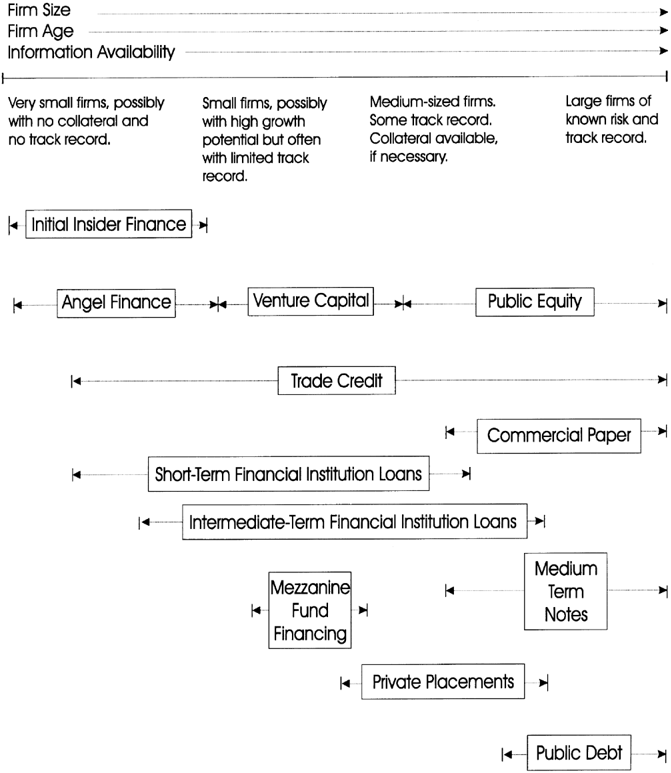
This article examines the economics of financing small business in private equity and debt markets. Firms are viewed through a financial growth cycle paradigm in which different capital structures are optimal at different points in the cycle. We show the sources of small business finance, and how capital structure varies with firm size and age. The interconnectedness of small firm finance is discussed along with the impact of the macroeconomic environment. We also analyze a number of research and policy issues, review the literature, and suggest topics for future research.
Verified 2026-11-25 · 1 reference not checked yet
Overview
CoChat Summary
TL;DR
This article reviews the economics of small business finance through a financial growth cycle paradigm, emphasizing informational opacity and the roles of private equity and debt markets. It documents US small business funding sources and contracts, and analyzes vulnerability to macroeconomic shocks, credit crunches, and bank consolidation.
Key findings
- US small business finance is split roughly evenly between equity (49.63%) and debt (50.37%); the largest sources are the principal owner, commercial banks, and trade creditors, together accounting for 70.10% of total funding. Commercial banks provide 18.75%, trade credit 15.78%, principal owner equity 31.33%, angel finance 3.59%, venture capital 1.85%, and credit card debt 0.14%.
- Financial institution debt is used by 54.23% of small businesses; 86.95% name a commercial bank as their primary financial institution. Average relationship length is 6.64 years overall and 9.01 years with the primary institution; 52.03% of financial institution debt is under lines of credit, 91.94% is secured, and 51.63% is guaranteed.
- The growth cycle paradigm predicts younger/more opaque firms rely on insider finance, trade credit, and angel finance, then venture capital and banks, and eventually public markets. However, 1993 NSSBF data show insider finance does not dominate external finance even for adolescents (upper bound 56.8% insider, roughly equal to external), and financial institution debt is important to very young firms, often based on personal guarantees or collateral.
- Macro vulnerability: the early-1990s credit crunch saw real C&I loans fall 23.2% ($596.7 billion to $458.2 billion) and estimated small business lending fall 38.5% ($143.7 billion to $88.4 billion). Banks with less than $100 million in assets held about 9% of portfolios in small business loans versus about 2% for banks over $10 billion; large banks charged about 100 basis points less and required collateral about 25% less often than small banks, other things equal.
Methods
- Design: review and synthesis organized around the financial growth cycle paradigm, covering theoretical and empirical literature on private equity and debt markets, contracts, and macroeconomic vulnerability.
- Data: primarily the 1993 National Survey of Small Business Finances (NSSBF) for US small business finance tables, plus other sources including NFIB, SCF, STBL, CALL, CRA, Venture Economics/VentureOne, and international data.
- Analysis: descriptive tabulations (Tables 1 and 2) and literature synthesis; the paper is a review rather than a new primary empirical study.
Limitations
- Paper-stated: Table 1 data are not completely accurate or consistent and should be considered rough estimates; angel finance estimates are imprecise (range $15 billion to $120 billion); 1993 data may not reflect current conditions; weighted averages mask considerable heterogeneity.
- Paper-stated: the growth cycle paradigm is not intended to fit all small businesses; firm size, age, and information availability are far from perfectly correlated, and the points at which different funding sources begin and end are not definitive.
- Evident from the text: informational opacity and the intertwining of personal and business finances make small business finance difficult to research, and data on owners’ finances are often unavailable; the paper relies heavily on existing literature and available data rather than new primary data collection.
Model-written summary. Check it against the paper before relying on it.
Integrity signals
Registry
Cites
Statistics
Figures
Verification
Claims the paper makes
22 Valid · 27 Not valid · 107 Not checked · 201 Own results and interpretations
Every source the paper cites for this claim was checked and supports it.
In the paper
“This use of personal assets to help with external ®nance also highlights another important aspect of small business ®nance ± the ®nancial intertwining of owners and their businesses (Ang, 1992).”
§ The economics of small business ®nance: The roles of private equity and debt markets in the ®nancial growth cycle > 2.3. The ®nancial growth cycle of small business
What the sources say
- Supportedcites Ang, 1992 matched to “On the Theory of Finance for Privately Held Firms” (1992) source
In “Integrating Personal and Business Accounts,” Ang says that personal guarantees or collateral make business risk inseparable from owners’ personal risk. “The Financing Decision” also identifies owners’ assets used for loan guarantees as contributions to the business. Together, these passages support the cited point that using personal assets to obtain external finance intertwines owners’ and businesses’ finances. (LLM, conf=0.94)
plainstates an association- Asserted: passes — The authors put it forward as true.
- Checkable: passes — It can be checked against evidence.
- Load-bearing: unclear — It is unclear whether the paper’s conclusions depend on it.
- Based: passes — The paper gives a reason why it holds.
- Supported
The cited sources support only part of this claim — read each source’s verdict below.
In the paper
“Costly state veri®cation (Townsend, 1979;Diamond, 1984) and adverse selection (Myers, 1984;Myers and Majluf, 1984;Nachman and Noe, 1994) arguments suggest the optimality of debt contracts after insider ®nance has been exhausted.”
§ The economics of small business ®nance: The roles of private equity and debt markets in the ®nancial growth cycle > 2.3. The ®nancial growth cycle of small business
What the sources say
- Partly supportedcites Townsend, 1979 matched to “Optimal contracts and competitive markets with costly state verification” (1979) sourceExperimental — accuracy not yet measured
Section 3 characterizes an optimal contract for a firm financing an investment project as a bond that defaults when returns fall below a threshold, supporting the costly-state-verification rationale for debt. The paper does not establish that debt becomes optimal only after insider finance has been exhausted. The adverse-selection citations in the sentence refer to other sources, not Townsend. (LLM, conf=0.85)
- Not checked — no full text of the sourcecites Diamond, 1984 matched to “Financial intermediation and delegated monitoring” (1984) source
- Not matchedcites Myers, 1984
More than one paper fits this citation.
hedgedstates a cause- Asserted: passes — The authors put it forward as true.
- Checkable: passes — It can be checked against evidence.
- Load-bearing: passes — The paper’s conclusions depend on it.
- Based: passes — The paper gives a reason why it holds.
- Partly supported
The cited sources support only part of this claim — read each source’s verdict below.
In the paper
“An agency problem arises in the relationship between the entrepreneur and the venture capitalist in which the entrepreneur may expend insucient eort, exhibit expense preference behavior, or lack sucient information or skill to make optimal production decisions.”
§ The economics of small business ®nance: The roles of private equity and debt markets in the ®nancial growth cycle > 3.2. The venture capital market
What the sources say
- Not checked — no full text of the sourcecites Cooper and Carleton, 1979 matched to “Dynamics of Borrower‐Lender Interaction: Partitioning Final Payoff in Venture Capital Finance” (1979) source
- Partly supportedcites Bergemann and Hege, 1998 matched to “Venture capital financing, moral hazard, and learning” (1998) sourceExperimental — accuracy not yet measured
Section 2.3, “Moral hazard and financing,” describes an entrepreneur who may reduce costly effort or divert investment funds to private ends, supporting the insufficient-effort and expense-preference parts of the claim. It does not identify a lack of the entrepreneur’s information or skill as a cause of poor production decisions; it instead says the entrepreneur and venture capitalists initially have the same assessment of the project. (LLM, conf=0.88)
hedgedstates a possible cause- Asserted: passes — The authors put it forward as true.
- Checkable: passes — It can be checked against evidence.
- Load-bearing: passes — The paper’s conclusions depend on it.
- Based: passes — The paper gives a reason why it holds.
Every source the paper cites for this claim was checked and supports it.
In the paper
“Since 1990, this share has about doubled to 30% (Fenn et al., 1997).”
§ The economics of small business ®nance: The roles of private equity and debt markets in the ®nancial growth cycle > 3. The role of private equity markets in small business ®nance
What the sources say
- Supportedcites Fenn et al., 1997 matched to “The Private Equity Market: An Overveiw” (1997) source
In “IPO Firms that Received Private Equity Backing,” the paper states that the share of IPOs with venture backing averaged 15% during the 1980s and doubled to 30% since 1990. This directly supports the cited claim. (LLM, conf=0.95)
plainstates an association- Asserted: passes — The authors put it forward as true.
- Checkable: passes — It can be checked against evidence.
- Load-bearing: unclear — It is unclear whether the paper’s conclusions depend on it.
- Based: passes — The paper gives a reason why it holds.
- Supported
The cited sources support only part of this claim — read each source’s verdict below.
In the paper
“During the 1980s, approximately 15% of all IPOs were backed by venture capital, well out of proportion to the fraction of all ®rms that received venture capital.”
§ The economics of small business ®nance: The roles of private equity and debt markets in the ®nancial growth cycle > 3. The role of private equity markets in small business ®nance
What the sources say
- Partly supportedcites Fenn et al., 1997 matched to “The Private Equity Market: An Overveiw” (1997) sourceExperimental — accuracy not yet measured
The section “IPO Firms that Received Private Equity Backing” states that venture-backed IPOs averaged 15% of IPOs during the 1980s. It does not give the fraction of all firms that received venture capital or make the claimed comparison with that fraction. (LLM, conf=0.84)
plainstates an association- Asserted: passes — The authors put it forward as true.
- Checkable: passes — It can be checked against evidence.
- Load-bearing: unclear — It is unclear whether the paper’s conclusions depend on it.
- Based: passes — The paper gives a reason why it holds.
- Partly supported
184 more claims · 6 with their cited sources checked
Create a free account to see all 357 claims and to verify the 12 references still open.
- Probably not a substantial claim. 94
- It may state two separate claims as one. 87
- Borderline: one of the tests for a substantial claim is unclear. 2
Claims other papers make about this one
Each is checked against this paper’s own text: does it say what the citing paper says it does?
The cited source says what the claim attributes to it.
In the citing paper
“SMEs are more dependent on external financing supplied by commercial banks (Berger and Udell 1998) because most of them are not qualified to raise money from the stock market.”
From Local Bank, Digital Financial Inclusion and SME Financing Constraints: Empirical Evidence from China (2022) · cites this paper as Berger and Udell 1998
Self-check
Percentages, sums and reported differences re-computed from the paper’s own numbers.
Rated minor: it would not touch a result — a value no result rests on, a p-value that stays on the same side of the significance level, or a conflict that is clerical, resolved elsewhere in the paper, or outside its own findings.
In the paper
“Non®nancial business/government debt provides 19.26% of small business funding (mostly trade credit)”
§ The economics of small business ®nance: The roles of private equity and debt markets in the ®nancial growth cycle > 4. The role of private debt markets in small business ®nance
Reported 19.26 · recomputed 18.01
Citations
Cites
Corporate financing and investment decisions when firms have information that investors do not have
Myers, S. C., & Majluf, N. S. (1984) · Journal of Financial Economics · doi:10.1016/0304-405x(84)90023-0 · Cited by 18,957
The Cost of Capital, Corporation Finance and the Theory of Investment
Miller, M. H. (1958) · American Economic Review · Cited by 14,574
Determinants of corporate borrowing
Myers, S. C. (1977) · Journal of Financial Economics · doi:10.1016/0304-405x(77)90015-0 · Cited by 13,169
Credit Rationing in Markets with Imperfect Information
Stiglitz, J. E., & Weiss, A. (1981) · Columbia University · doi:10.7916/d8v12ft1 · Cited by 12,769 · cited 1×
“…pledging outside collateral may help resolve adverse selection problems when the borrower has more information about the quality of the investment than the lender, and may help prevent credit rationing (Stiglitz and Weiss 1981, 1986, Bester 1985, Chan and Kanatas 1985, Besanko and Thakor 1987a,b).”
The cost of capital, corporation finance and the theory of investment
Terra, P. R. (2008) · Revista de Administração e Contabilidade da Unisinos · doi:10.4013/base.20082.07 · Cited by 8,615
Financial intermediation and delegated monitoring
Diamond, D. W. (1984) · The Review of Economic Studies · doi:10.2307/2297430 · Cited by 8,476 · cited 2×
“Costly state verification (Townsend 1979, Diamond 1984) and adverse selection (Myers 1984, Myers and Majluf 1984, Nachman and Noe 1994) arguments suggest the optimality of debt contracts after insider cFor example, there are generally accepted definitions of the stages of finance for the kind of…”
Corporate Financing and Investment Decisions When Firms Have InformationThat Investors Do Not Have
Myers, S., & Majluf, N. (1984) · doi:10.3386/w1396 · Cited by 6,745
The Benefits of Lending Relationships: Evidence from Small Business Data
PETERSEN, M. A., & RAJAN, R. G. (1994) · The Journal of Finance · doi:10.1111/j.1540-6261.1994.tb04418.x · Cited by 5,440 · cited 4×
“…whereas mortgages, equipment loans, motor vehicle loans, and other loans may more often be transactionsdriven .zs It was also found that dependence on trade credit decreased with the length of the banking relationship, supporting the value of relationship lending (Petersen and Rajan 1994, 1995).”
InfluentialInside the black box: the credit channel of monetary policy transmission
Bernanke, B. S., & Gertler, M. (1995) · Journal of Economic Perspectives · doi:10.1257/jep.9.4.27 · Cited by 4,211
Insiders and Outsiders: The Choice between Informed and Arm's‐Length Debt
RAJAN, R. G. (1992) · The Journal of Finance · doi:10.1111/j.1540-6261.1992.tb04662.x · Cited by 3,902 · cited 1×
“Some research suggests that these firms may try to reduce the control of their banks by issuing public debt, even though public debt may entail higher costs (Diamond 1991, 1993, Rajan 1992, Houston and James 1996).”
Research works printed but not linked: 11
- 66. Cook, L., 1997. Trade ®nance, bank ®nance, and capital market imperfections. Working paper. Harvard University, Cambridge, MA.
- 89. Freear, J., Sohl, J.E., Wetzel, W.E., Jr., 1994. The private investor market for venture capital. The Financier 1, 7±19.
- 112. Hancock, D., Wilcox, J.A., 1997. Bank capital, nonbank ®nance, and real estate activity. Journal of Housing Research 8, 75±105.
- 117. Hempel, G., Coleman, A., Simonson, D., 1986. Bank Management, Wiley, New York.
- 119. Ho, R., 1997. Credit-card use to ®nance small business is soaring, says survey of small ®rms. Wall Street Journal B2, Sept. 25.
- 153. Megginson, W.L., Weiss, K.A., 1991. Venture capitalist certi®cation in initial public oerings. Journal of Finance 46, 903±979.
- 162. Morsman Jr., E., 1986. Commercial loan structuring. Journal of Commercial Bank Lending 68, 2± 20.
- 187. Ravid, S.A., 1996. Debt maturity ± A survey. Financial Markets, Institutions and Instruments 5 (3), 1±68.
- 217. Wetzel Jr. W.E., 1994. Venture capital. In: Bygrave, W.D. (Ed.), Portable MBA in Entrepreneur- ship. Wiley, New York, pp. 172±194.
- 219. White, L.J., 1995. An analytical framework. In: Zahid, S.N. (Ed.), Financial Sector Development in Asia. Oxford University Press, New York, pp. 3±35.
- 222. McKean, R. (Ed.), Issues in Defense Economics. Columbia University Press, New York.
Cited by
Items 1,001–1,100 of 3,739
Components Of Credit Rationing
Beyhaghi, M., Firoozi, F., Jalilvand, A., & Samarbakhsh, L. (2019) · Journal of Financial Stability · doi:10.1016/j.jfs.2020.100762 · Cited by 31
The impact of personal bankruptcy law on entrepreneurship
Jia, Y. (2015) · Canadian Journal of Economics/Revue canadienne d économique · doi:10.1111/caje.12133 · Cited by 30
Commercial Lending and Distance: Evidence from Community Reinvestment Act Data
Brevoort, K. P., & Hannan, T. H. (2004) · Finance and Economics Discussion Series · doi:10.17016/feds.2004.24 · Cited by 35
Newman, A., Borgia, D. J., & Deng, Z. (2013) · Thunderbird International Business Review · doi:10.1002/tie.21568 · Cited by 23
Influences on Frequency of Preparation of Financial Statements Among SMEs
Auken, H. V. (2013) · Journal of Innovation Management · doi:10.24840/2183-0606_001.001_0010 · Cited by 34
“Berger and Udell (1998) suggest that smaller firms are more financially opaque, but become more financially transparent as they grow.”
BackgroundLa structure d’endettement des PME françaises: une étude sur données de panel
Ziane, Y. (2012) · Revue internationale P M E Économie et gestion de la petite et moyenne entreprise · doi:10.7202/1008454ar · Cited by 26
Supply of Venture Capital by European Governments
Economie, F. (2001) · Cited by 23
Mutual Funds that Invest in Private Equity? an Analysis of Labour Sponsored Investment FundsPreprint
Cumming, D. J., & MacIntosh, J. G. (2003) · SSRN Electronic Journal · doi:10.2139/ssrn.418280 · Cited by 23
Bank Relationships and Small Firms' Financial PerformancePreprint
Dwyer, G. P., Castelli, A., & Hasan, I. (2006) · SSRN Electronic Journal · doi:10.2139/ssrn.903154 · Cited by 46
“…that relationship lending can have a number of benefits for small firms including lower cost or greater availability of credit due to efficient gathering of information, protection against credit crunches and provision of implicit interest rate or credit risk insurance (Berger and Udell, 1998).”
BackgroundInfluentialIs it the Law or the Lawyers? Investment Covenants Around the WorldPreprint
Johan, S. A., & Cumming, D. J. (2005) · SSRN Electronic Journal · doi:10.2139/ssrn.642124 · Cited by 23
Financing Firms in IndiaPreprint
Allen, F., Chakrabarti, R., De, S., Qian, J. “., & Qian, M. (2006) · SSRN Electronic Journal · doi:10.2139/ssrn.898066 · Cited by 18
Chakravarty, S., & Xiang, M. (2009) · SSRN Electronic Journal · doi:10.2139/ssrn.1344098 · Cited by 23
Existence of Credit Rationing for Sme's in the Belgian Corporate Bank Loan MarketPreprint
Steijvers, T. (2008) · SSRN Electronic Journal · doi:10.2139/ssrn.495162 · Cited by 31
“Collateral is a powerful instrument that allows financial institutions to offer credit at more favorable terms to SMEs who might otherwise, due to their information asymmetry, be credit rationed (Berger and Udell 1998).”
BackgroundInfluentialFinancing and Performance of Female-Owned Firms in Middle Eastern and African EconomiesPreprint
Baliamoune‐Lutz, M., & Lutz, S. (2017) · SSRN Electronic Journal · doi:10.2139/ssrn.2907977 · Cited by 23
Loan Commitments and Private FirmsPreprint
Agarwal, S. D., Chomsisengphet, S., & Driscoll, J. C. (2004) · SSRN Electronic Journal · doi:10.2139/ssrn.593862 · Cited by 25
Factors for success in European crowdinvesting
Borello, G., Crescenzo, V. D., & Pichler, F. (2019) · Journal of Economics and Business · doi:10.1016/j.jeconbus.2019.05.002 · Cited by 20
Voluntary audit, investment, and financing decisions in Latin American small and medium enterprises
Briozzo, A., & Albanese, D. (2020) · Journal of International Accounting Auditing and Taxation · doi:10.1016/j.intaccaudtax.2020.100302 · Cited by 34
Zarei, H., Rasti−Barzoki, M., & Moon, I. (2020) · IEEE Transactions on Engineering Management · doi:10.1109/tem.2020.2974532 · Cited by 26
“The financial growth cycle paradigm states that new firms pass several stages of growth until they become mature companies [4]–[6].”
BackgroundCrowdfunding and Bank Financing: Substitutes or Complements
Miglo, A. (2020) · Small Business Economics · doi:10.1007/s11187-021-00571-9 · Cited by 31
“Also a recent wave of literature discovered significant interests in debt financing by small entrepreneurial firms (see, e.g., Ang, 1992; Berger & Udell, 1998; Cole, 2010, 2013; Brav, 2009; Ang et al., 2010; Robb & Robinson, 2012).”
Does national culture impact trade credit provision of SMEs?
Hoang, H. C., Ly, K. C., Xiao, Q., & Zhang, X. (2023) · Economic Modelling · doi:10.1016/j.econmod.2023.106288 · Cited by 26
Fasano, F., & Rocca, T. L. (2023) · Small Business Economics · doi:10.1007/s11187-023-00758-2 · Cited by 35
“Some studies suggest that personal interactions are still important even in a digital banking world (Ferri & Murro, 2015; Grunert & Norden, 2012; Marinč, 2013) because soft information still matters, especially for SMEs that face more asymmetric information problems (Berger & Udell, 1998).”
Small and medium sized European firms and energy saving measures: The role of financing
Caporale, G. M., Donati, C., & Spagnolo, N. (2023) · Energy Policy · doi:10.1016/j.enpol.2023.113613 · Cited by 22
THE IMPACT OF EU TAXONOMY ON CORPORATE INVESTMENTS
Lucarelli, C., Mazzoli, C., Rancan, M., & Severini, S. (2023) · Journal of Financial Management Markets and Institutions · doi:10.1142/s2282717x23500044 · Cited by 42
A survival analysis of de novo co-operative credit banks
Maggiolini, P., & Mistrulli, P. E. (2005) · Empirical Economics · doi:10.1007/s00181-005-0237-9 · Cited by 24
Firms as credit suppliers: an empirical study of Spanish firms
Rodríguez, O. M. (2008) · International Journal of Managerial Finance · doi:10.1108/17439130810864032 · Cited by 31
An empirical analysis of the determinants and pricing of corporate bond clawbacks
Daniels, K. N., Ejara, D. D., & Vijayakumar, J. (2009) · Journal of Corporate Finance · doi:10.1016/j.jcorpfin.2009.03.003 · Cited by 22
Wang, Y., Ahmed, P. K., & Farquhar, S. S. (2007) · The Journal of Entrepreneurship · doi:10.1177/097135570701600203 · Cited by 30
“At the business start-up stage, due to unsound financial records, asset security and equity base, family firms tend to rely on personal equity (Peterson & Shulman, 1987; Poutziouris & Wang, 2004), family loan and trade credit (Berger & Udell, 1998; Romano et al., 2000).”
BackgroundOladepo, E. D. (2010) · International Journal of Business and Management · doi:10.5539/ijbm.v5n5p201 · Cited by 32
“Berger and Udell (1998), for example, examine mergers occurring in the 1980s that involved banking organizations with at least $1 billion in assets. The results of their paper are based on data aggregated to the holding company level, using frontier methodology and the relative industry rankings of banks participating…”
BackgroundPARENTAL SELF-EMPLOYMENT, START-UP ACTIVITIES AND FUNDING: EXPLORING INTERGENERATIONAL EFFECTS
BarNir, A., & McLaughlin, E. (2011) · Journal of Developmental Entrepreneurship · doi:10.1142/s1084946711001884 · Cited by 27
Rehman, A. U., Wang, M., & Yu, H. (2016) · China Finance and Economic Review · doi:10.1186/s40589-016-0041-z · Cited by 22
“In the past studies, researchers used univariate proxy for firm life cycle such as firm age or size to study how capital structure respond to dynamics of its life cycle (Berger and Udell 1998).”
Las limitaciones al financiamiento bancario de las Pymes de alta tecnología
Guercio, M., Martínez, L. B., & Vigier, H. P. (2017) · Estudios Gerenciales · doi:10.1016/j.estger.2017.02.001 · Cited by 22
Natarajan, R. R., & Sasidharan, S. (2018) · The Developing Economies · doi:10.1111/deve.12183 · Cited by 30
Who is the king of the hill? On bargaining power in private equity buyouts
Michel, A., Ahlers, O., Hack, A., & Kellermanns, F. W. (2018) · Long Range Planning · doi:10.1016/j.lrp.2018.11.003 · Cited by 25
CREDIT RATIONING AND SME DEVELOPMENT IN BOTSWANA: IMPLICATIONS FOR ECONOMIC DIVERSIFICATION
Okurut, F. N., Olalekan, Y., & Mangadi, K. T. (2011) · Greater South Information System · doi:10.60692/m8scj-hx960 · Cited by 22
Corporate Liquidity and Solvency in Europe during COVID-19: The Role of Policies
Ebeke, C., Jovanovic, N., Valderrama, L., & Zhou, J. (2021) · IMF Working Paper · doi:10.5089/9781513570914.001 · Cited by 22
Some evidence of the external financing costs of new technology-based firms in Canada
Carpentier, C., & Suret, J. (2006) · Venture Capital · doi:10.1080/13691060600748421 · Cited by 21
“The problem of asymmetry is particularly acute for technological firms, for which it is the predominant factor that penalizes financing possibilities (Berger and Udell, 1998 ).”
BackgroundInvestment, internal funds and public banking in Germany
Engel, D., & Middendorf, T. (2009) · Journal of Banking & Finance · doi:10.1016/j.jbankfin.2009.05.006 · Cited by 25
Creditor- and Debtor-Oriented Corporate Bankruptcy Regimes Revisited
Franken, S. M. (2004) · European Business Organization Law Review · doi:10.1017/s1566752904006457 · Cited by 54
Coleman, S., & Robb, A. (2018) · Venture Capital · doi:10.1080/13691066.2018.1419845 · Cited by 29
Start-Ups and External Equity: The Role of Entrepreneurial Experience
Zaleski, P. A. (2011) · Business Economics · doi:10.1057/be.2010.41 · Cited by 22
Staging of Venture Financing, Investor Opportunism and Patent Law
Bigus, J. (2006) · Journal of Business Finance & Accounting · doi:10.1111/j.1468-5957.2006.00005.x · Cited by 34
“Berglöf (1994) and Bascha and Walz (2000) investigate conflicts of interest when a venture capitalist wants to sell his stocks and show that convertible preferred stock might be useful to mitigate these conflicts.”
Kumar, A., & Francisco, M. (2007) · SSRN Electronic Journal · doi:10.2139/ssrn.960152 · Cited by 22
Entrepreneurial finance and regional ecosystem emergence
Clayton, P. A., Feldman, M. P., & Montmartin, B. (2023) · Small Business Economics · doi:10.1007/s11187-023-00827-6 · Cited by 29
Murray, G. C., Cowling, M., Liu, W., & Kalinowska-Beszczyńska, O. (2012) · Cited by 37
Sadiq, M., Yousaf, S. U., Anser, M. K., Khan, H. U. R., Sriyanto, S., Zaman, K., Tu, D. V., & Anis, S. N. M. (2020) · The Quarterly Review of Economics and Finance · doi:10.1016/j.qref.2020.11.001 · Cited by 36
DETERMINANTS OF LEVERAGE IN EMERGING MARKETS: EMPIRICAL EVIDENCE
Chen, Y., Sensini, L., & Vazquez, M. (2021) · International Journal of Economics and Financial Issues · doi:10.32479/ijefi.10997 · Cited by 41
“These studies have favoured the development of different theories that have been tested on companies of different sizes and in different economic contexts (Kraus and Litzenberger, 1973; Jensen and Meckling, 1976; Myers, 1984; Myers and Majluf, 1984; Berger and Udell, 1998; among others).”
BackgroundSmall Business Lending in Financial Crises: The Role of Government-Guaranteed Loans
Hackney, J. (2022) · European Finance Review · doi:10.1093/rof/rfac002 · Cited by 30
The PropTech investors' dilemma – What are the key success factors that secure survival?
Kassner, A. J., Cajias, M., & Zhu, B. (2022) · Journal of Property Investment and Finance · doi:10.1108/jpif-01-2022-0007 · Cited by 32
Chhillar, P., & Lellapalli, R. V. (2022) · Cogent Economics & Finance · doi:10.1080/23322039.2022.2106634 · Cited by 37
“The literature indicates that the availability of sources of finance and capital structure varies with the financial growth life cycle of the firm with special reference to the small businesses and entrepreneurial ventures (Berger & Udell, 1998).”
BackgroundHarrer, T., & Owen, R. (2022) · International Journal of Entrepreneurial Behaviour & Research · doi:10.1108/ijebr-10-2021-0849 · Cited by 29
The effect of bank failures on small business loans and income inequality
Contreras, S. A., Ghosh, A., & Hasan, I. (2022) · Journal of Banking & Finance · doi:10.1016/j.jbankfin.2022.106690 · Cited by 26
SMEs and dividend payout policy in case of poor legal environment
Falavigna, G., & Ippoliti, R. (2022) · Journal of Small Business Management · doi:10.1080/00472778.2022.2144634 · Cited by 23
“These results are coherent if we assume that credit rating scores might also represent a measure of the SMEs’ maturity, strengthening the validity of the financial growth cycle theory (Berger & Udell, 1998).”
ResultThe role of culture in firm-bank matching
Accetturo, A., Barboni, G., Cascarano, M., & García-Appendini, E. (2023) · Journal of Financial Intermediation · doi:10.1016/j.jfi.2023.101018 · Cited by 24
Mandatory Financial Information Disclosure and Credit Ratings
Vanhaverbeke, S., Balsmeier, B., & Doherr, T. (2022) · Journal of Accounting and Economics · doi:10.1016/j.jacceco.2024.101676 · Cited by 28
“…of trade credit to ratings remains largely unchanged, and that trade credit is one of the most important sources of external financing for firms (Berger and Udell, 1998; Bundesbank, 2012), disclosure regulation and its associated effect on credit ratings might adversely impact some firms ’…”
The Use and Usefulness of Financial Assistance to UK SMEs
Han, L., & Benson, A. (2010) · Environment and Planning C Government and Policy · doi:10.1068/c0985b · Cited by 21
How to Design Public Venture Capital Funds: Empirical Evidence from South Korea
Lim, S., & Kim, Y. (2014) · Journal of Small Business Management · doi:10.1111/jsbm.12109 · Cited by 27
“High information asymmetries between risk-capital providers and entrepreneurs that cause the severe adverse selection and moral hazard problems characterize the financing of NTBFs (Berger and Udell 1998; Carpenter and Petersen 2002; Carpentier and Suret 2006; Denis 2004).”
BackgroundLocal bank competition and small business lending after the onset of the financial crisis
Sääskilahti, J. (2016) · Journal of Banking & Finance · doi:10.1016/j.jbankfin.2016.04.004 · Cited by 25
“The availability and cost of bank loans are crucial for many small businesses because these businesses often lack other options for external funding (Berger and Udell, 1998; Carbo-Valverde et al., 2009).”
BackgroundBongomin, G. O. C., Munene, J. C. K., Ntayi, J. M., & Malinga, C. A. (2017) · World Journal of Entrepreneurship Management and Sustainable Development · doi:10.1108/wjemsd-06-2017-0026 · Cited by 47
How financial systems and firm strategy impact the choice of innovation funding
González, J. H. S. (2019) · European Journal of Innovation Management · doi:10.1108/ejim-07-2018-0147 · Cited by 28
Rodríguez‐Pose, A., Ganau, R., Maslauskaite, K., & Brezzi, M. (2020) · Journal of Regional Science · doi:10.1111/jors.12514 · Cited by 27
“Indeed, they use trade credit for short-term financing (Petersen and Rajan 1995; Berger and Udell 1998; Ogawa et al. 2013), obtain state subsidies (Gerritse and Rodríguez-Pose 2018), or rely on informal sources of finance – such as family or friends (Chavis et al. 2011; Hanedar et al. 2014).”
BackgroundCredit Availability and the Structure of the Homebuilding Industry
Ambrose, B. W., & Peek, J. (2008) · Real Estate Economics · doi:10.1111/j.1540-6229.2008.00226.x · Cited by 22
An Initial Investigation of Firm Size and Debt Use by Small Restaurant Firms
Dalbor, M. C., Kim, A. M., & Upneja, A. (2004) · The Journal of Hospitality Financial Management · doi:10.1080/10913211.2004.10653785 · Cited by 25
“Berger and Udell (1998) hypothesize about (but do not specifically test for) the amount and maturity structure of debt in small firms. Their focus is primarily on the use of debt by firms as they go through the "financial growth cycle." Van Auken and Holman (1995) find similar financing characteristics between small,…”
BackgroundResultInfluentialMaté‐Sánchez‐Val, M., & HARRIS, R. I. D. (2018) · Land Use Policy · doi:10.1016/j.landusepol.2018.02.024 · Cited by 26
Distance, Bank Organizational Structure, and Lending Decisions
Cerqueiro, G., Degryse, H., & Ongena, S. R. G. (2009) · Springer eBooks · doi:10.1007/978-0-387-98078-2_4 · Cited by 33
Moore, W. R., & Craigwell, R. (2003) · Applied Financial Economics · doi:10.1080/09603100110116434 · Cited by 25
“This point can be further developed as follows: according to the financial growth cycle theory of small businesses as laid out in Berger and Udell (1998), banks’ lending would typically not be available to small businesses unless they have accumulated substantial levels of tangible assets to pledge…”
BackgroundBank-Firm Relationships and International Banking Markets
Degryse, H., & Ongena, S. R. G. (2002) · International Journal of the Economics of Business · doi:10.1080/1357151021000010000a · Cited by 30
“See Berger and Udell (1998), Boot (2000), and Ongena and Smith (2000a) for formal reviews of the bank-firm relationship literature.”
BackgroundHow Do Start-Up Firms Finance Their Assets? Evidence from the Kauffman Firm SurveysPreprint
Cole, R. A., & Sokolyk, T. (2012) · SSRN Electronic Journal · doi:10.2139/ssrn.2028176 · Cited by 26
Hope, O., Thomas, W. B., & Vyas, D. (2014) · SSRN Electronic Journal · doi:10.2139/ssrn.2457956 · Cited by 21
Securities Crowdfunding: More than Family, Friends, and Fools?Preprint
Abrams, E. (2017) · SSRN Electronic Journal · doi:10.2139/ssrn.2902217 · Cited by 21
“Berger and Udell (1998) provide a helpful taxonomy of financing options used by companies at different stages of development and document that early stage companies have limited access to external financing. Robb and Robinson (2014) provide a detailed breakdown of the financing of business startups in the Kauffman Fir…”
BackgroundGama, A. P. M., Mateus, C., & Teixeira, A. (2008) · SSRN Electronic Journal · doi:10.2139/ssrn.1310818 · Cited by 21
Amoa‐Gyarteng, K., & Dhliwayo, S. (2023) · Journal of Entrepreneurship Management and Innovation · doi:10.7341/20231943 · Cited by 36
Valuations in Corporate Takeovers and Financial Constraints on Private Targets
Greene, D. T. (2017) · Journal of Financial and Quantitative Analysis · doi:10.1017/s0022109017000527 · Cited by 19
“…will affect private targets in sellouts to a greater extent than public acquirers, because private firms tend to rely on local banks for capital (Berger and Udell (1998), Petersen and Rajan (2002)).1 However, interstate bank branching deregulation is likely exogenous to private target…”
Schachel, H., Lachmann, M., Endenich, C., & Breucker, O. (2021) · Journal of Accounting & Organizational Change · doi:10.1108/jaoc-07-2020-0089 · Cited by 31
Vo, H., Phan, A. C. H., Trinh, Q. D., & Vu, L. N. (2021) · Economic Analysis and Policy · doi:10.1016/j.eap.2021.12.011 · Cited by 23
Positive effects of portfolio financing strategy for startups
Hyun, S., & Lee, H. S. (2022) · Economic Analysis and Policy · doi:10.1016/j.eap.2022.03.017 · Cited by 20
Dong, T., Tylaite, M., & Wilson, R. J. (2022) · Accounting and Business Research · doi:10.1080/00014788.2022.2063105 · Cited by 28
“In private fi rms, trade credit is an important source of fi nancing, and as such, a potential substitute for bank fi nancing (Berger and Udell 1998).”
BackgroundA literature review of risk, regulation, and profitability of banks using a scientometric study
Rastogi, S., Sharma, A., Pinto, G., & Bhimavarapu, V. M. (2022) · Future Business Journal · doi:10.1186/s43093-022-00146-4 · Cited by 40
“Bergera and Udell [18] The economics of small business finance: The roles of private equity and debt markets in the financial growth cycle Journal of Banking and Finance 1300 22”
BackgroundDo trade credit and bank credit complement or substitute each other in public and private firms?
Afrifa, G. A., Tingbani, I., Alshehabi, A., & Halabi, H. (2023) · International Review of Economics & Finance · doi:10.1016/j.iref.2023.07.017 · Cited by 26
Capital Structure Determinants for Tax‐Exempt Organisations: Evidence from the UK
Smith, G. P. (2012) · Financial Accountability and Management · doi:10.1111/j.1468-0408.2012.00540.x · Cited by 20
DeGeest, D. S., Follmer, E. H., Walter, S. L., & O’Boyle, E. H. (2015) · Journal of Management · doi:10.1177/0149206315569313 · Cited by 38
“…as private equity investments and angel investors account for less than 5% of the total amount of financing for small businesses, while debt and equity financing from banks and personal contacts account for the vast majority of external financing for firms (Berger & Udell, 1998; Ou & Haynes, 2006).”
BackgroundRetractedBank capital, firm liquidity, and project quality
Minetti, R. (2007) · Journal of Monetary Economics · doi:10.1016/j.jmoneco.2007.01.002 · Cited by 20
“Rosengren, 2000); as for small firms, they are not monitored by rating agencies or by the financial press and this tends to make them dependent on local, informed banks ( Berger and Udell, 1998 ).”
BackgroundFinancing SME Growth: The Role of the National Stock Exchange of Australia and Business Advisors
Dwyer, B., & Kotey, B. (2015) · Australian Accounting Review · doi:10.1111/auar.12074 · Cited by 31
THE DETERMINANTS OF ENTERPRISE PROFI TABILITY DURING REDUCED ECONOMIC ACTIVITY
Steinerowska–Streb, I. (2012) · Journal of Business Economics and Management · doi:10.3846/16111699.2011.645864 · Cited by 20
Saparito, P. A., & Gopalakrishnan, S. (2009) · IEEE Transactions on Engineering Management · doi:10.1109/tem.2009.2013832 · Cited by 25
“Since efficient debt markets depend upon a sufficient understanding by lenders to make informed investment decisions [17], [61], the uncertainty surrounding lending decisions about small- and midsized firms results in constrained access to debt financing for these companies [ 6 ], [7], [42].”
BackgroundInfluentialFinanciación de la innovación en Colombia
Universidad del Valle, C. C., Barona-Zuluaga, B., Godoy, J. A. R., et al. (2015) · ENTRAMADO · doi:10.18041/entramado.2015v11n1.21126 · Cited by 20
Bhaumik, S. K., Kutan, A. M., & Majumdar, S. (2017) · European Journal of Finance · doi:10.1080/1351847x.2017.1391857 · Cited by 21
“Similarly, following Berger and Udell (1998, 2006), and accounting for a host of factors such as absence of credit registers, weak bankruptcy laws and weak credit protection, in general, we should expect monetary policy to have a greater impact on smaller (younger) firms than on larger (older)…”
How do neighboring peer companies influence SMEs’ financial behavior?
Maté‐Sánchez‐Val, M., Hernández, F. A. L., & Lacambra, J. M. (2017) · Economic Modelling · doi:10.1016/j.econmod.2017.01.023 · Cited by 24
Firm life cycle and advisory directors
Habib, A., Bhuiyan, M. B. U., & Hasan, M. M. (2017) · Australian Journal of Management · doi:10.1177/0312896217731502 · Cited by 26
“…the importance of organisational life cycle in influencing dividend payout (e.g., DeAngelo et al., 2006; Fama and French, 2001), capital structure (Berger and Udell, 1998), investment decisions (Richardson, 2006), cost of equity (Hasan et al., 2015), corporate risk taking (Habib and Hasan, 2017),…”
BackgroundDo borrower-lender relationships still matter for small business loans?
Durguner, S. (2017) · Journal of International Financial Markets Institutions and Money · doi:10.1016/j.intfin.2017.09.007 · Cited by 26
Patel, P. C., Kim, K. Y., Devaraj, S., & Li, M. (2017) · Journal of Retailing · doi:10.1016/j.jretai.2017.12.001 · Cited by 22
Interaction effect of tax evasion and legal system inefficiency on firms' financial constraints
Giombini, G., Teobaldelli, D., & SCHNEIDER, F. G. (2018) · International Review of Economics & Finance · doi:10.1016/j.iref.2018.01.009 · Cited by 21
“Berger and Udell (1998) analyze a life-cycle theory of firm financial models and argue that the firm’s optimal strategy is to use different sources of funding at different stages of its growth and development; we therefore control for both firm size and firm age.”
BackgroundAulia, D., & Siregar, S. V. (2018) · BAR - Brazilian Administration Review · doi:10.1590/1807-7692bar2018170120 · Cited by 33
Engelen, P., Heugens, P. P. M. A. R., van Essen, M., Turturea, R., & Bailey, N. (2018) · Long Range Planning · doi:10.1016/j.lrp.2018.10.003 · Cited by 32
“A primary motivation for firms to undergo an IPO is to raise financial capital (Berger and Udell, 1998; Pagano et al., 1998; Ritter and Welch, 2002).”
BackgroundCrash risk and debt maturity: evidence from Australia
Hasan, M. M., Rahman, D., Taylor, G., & Oliver, B. (2020) · International Journal of Managerial Finance · doi:10.1108/ijmf-12-2019-0467 · Cited by 29
Mättö, M., & Niskanen, M. (2020) · International Journal of Finance & Economics · doi:10.1002/ijfe.2061 · Cited by 35
Do Women Lag Behind Men? A Matched-Sample Analysis of the Dynamics of Gender Gaps
Farhat, J. B., & Mijid, N. (2016) · Journal of Economics and Finance · doi:10.1007/s12197-017-9416-8 · Cited by 36
The concentration of creditors: evidence from small businesses
Han, L., STOREY, D. J., & Fraser, S. (2008) · Applied Financial Economics · doi:10.1080/09603100701720476 · Cited by 28
“This is because, the problem of asymmetric information is one of the key characteristics of financing small businesses (Berger and Udell, 1998) and small businesses are recognized as more informationally opaque than large firms and the collection of private information is costly (Ang, 1991).”
Capital Structure and Financing of SMEs: The Tunisian Case
Ayed, W. H. B., & Zouari, S. (2014) · International Journal of Economics and Finance · doi:10.5539/ijef.v6n5p96 · Cited by 26
“This is a necessary condition according to Berger and Udell (1998).”
BackgroundDoes the private equity financing improve performance in family SMEs?
Salerno, D. (2018) · Journal of Family Business Management · doi:10.1108/jfbm-12-2017-0046 · Cited by 20
Incidence of Bank Levy and Bank Market Power
Capelle‐Blancard, G., & Havrylchyk, O. (2016) · European Finance Review · doi:10.1093/rof/rfw069 · Cited by 42
“…extended to small enterprises and there is an extensive discussion in recent literature about the importance of “relationship banking” in increasing switching costs and, hence, leading to banks’ market power (James, 1987; Vale, 1993; Petersen and Rajan, 1994; Berger and Udell, 1998; Boot, 2000).”
Metadata
- Authors
- N. Berger, A., & F. Udell, G.
- Venue
- Journal of Banking & Finance
- Publisher
- Elsevier BV
- Published
- 1998-08
- Volume
- 22
- Issue
- 6-8
- Pages
- 613-673
- ISSN
- 0378-4266 (ISSN-L)
- OpenAlex
- W2119780569
- Semantic Scholar
- dfc06f7f7eb83d2c0e2a1d67ecb95b520a406843
- Cited by
- 3,690
- References
- 230
- Citations by year
- 2026: 136 · 2025: 148 · 2024: 144 · 2023: 193 · 2022: 155 · 2021: 211 · 2020: 200 · 2019: 156 · 2018: 208 · 2017: 174 · 2016: 186 · 2015: 187 · 2014: 168 · 2013: 177 · 2012: 171
- FWCI
- 169.26
- Type
- journal article
- Language
- en
- Open access
- hybrid
- doi.org
- Licence
- cc-by-nc-nd
- www.elsevier.com/tdm/userlicense/1.0/ (tdm)
- www.elsevier.com/legal/tdmrep-license (tdm)
- creativecommons.org/licenses/by-nc-nd/4.0/ (vor, 125 d)
- Locations
- Journal of Banking & Finance (publishedVersion, cc-by-nc-nd)
- RePEc: Research Papers in Economics (submittedVersion)
- Funders
- York University
- Topics
- Social Sciences › Economics, Econometrics and Finance › Finance › Private Equity and Venture Capital
- Social Sciences › Economics, Econometrics and Finance › Finance › Corporate Finance and Governance
- Social Sciences › Economics, Econometrics and Finance › Finance › Banking stability, regulation, efficiency
- Keywords
- small business financing, private equity, debt markets, capital structure, firm size, firm age, macroeconomic conditions
About these checks
Registry, retraction, Cites and statistics results are computed, not judged, with one exception: a printed reference that no index lists is read once by a model before it counts as a citation error. Claims are extracted by a model and kept only when their quote appears verbatim in the text; each cited source is then checked, with a model’s help, for whether it says what the claim relies on. Those verdicts can be wrong — read the claim’s quote and the cited source before relying on one.
The claim verdicts this report counts are experimental: their accuracy is not yet measured.
A language model drew the claims from the paper on 2026-10-10, under version 3 of the claim definition (model deepseek-v4.1-flash, prompt extract-v3).
A second model labelled each claim on 2026-10-10 (model jev-1.13-20260917, definition revision gold-guideline-v0.2).
Cited sources are checked with a language model’s help (gpt-6-sol).
Statistics and arithmetic are recomputed, not judged.
Confidence bands are shown only for fields calibrated on our annotated test set. None is calibrated yet, so no band is shown.
What counts as a claim ›How we measure confidence ›How we check this ›
Are you an author, or do you see a problem with this page? Request a review
Data sources
Bibliographic data: Semantic Scholar, OpenAlex, Crossref.
Contains information from the Semantic Scholar Academic Graph Datasets, made available under the ODC Attribution License (ODC-BY 1.0).
Semantic Scholar’s data is described in: Kinney, R., et al. (2023). The Semantic Scholar Open Data Platform. arXiv:2301.10140.
