

The economics of small business finance: The roles of private equity and debt markets in the financial growth cycle
Open accessThe DOI matches its Crossref record; 217 of the 230 references it cites were found in a registry or an index, and 1 are not checked yet; 24 of the 170 sources its claims cite were checked for support.
Abstract
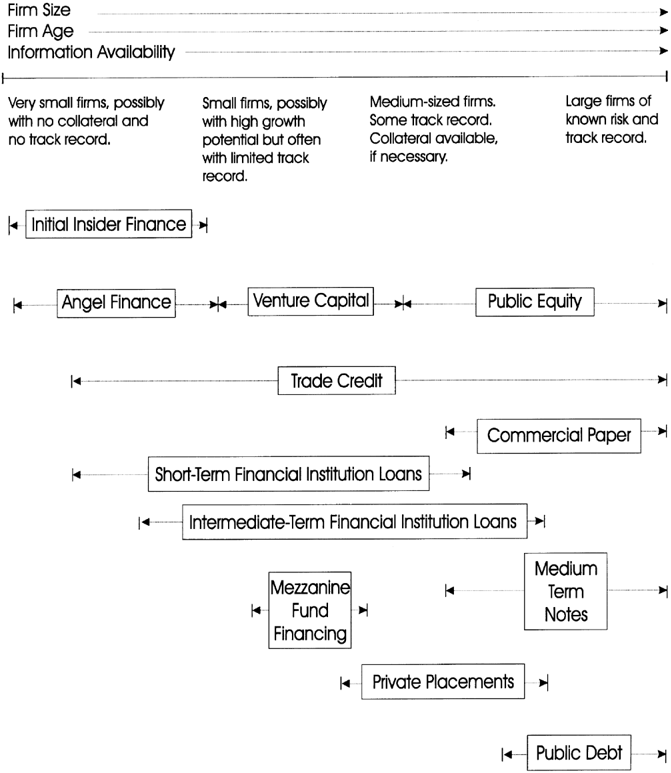
This article examines the economics of financing small business in private equity and debt markets. Firms are viewed through a financial growth cycle paradigm in which different capital structures are optimal at different points in the cycle. We show the sources of small business finance, and how capital structure varies with firm size and age. The interconnectedness of small firm finance is discussed along with the impact of the macroeconomic environment. We also analyze a number of research and policy issues, review the literature, and suggest topics for future research.
Verified 2026-11-25 · 1 reference not checked yet
Overview
CoChat Summary
TL;DR
This article reviews the economics of small business finance through a financial growth cycle paradigm, emphasizing informational opacity and the roles of private equity and debt markets. It documents US small business funding sources and contracts, and analyzes vulnerability to macroeconomic shocks, credit crunches, and bank consolidation.
Key findings
- US small business finance is split roughly evenly between equity (49.63%) and debt (50.37%); the largest sources are the principal owner, commercial banks, and trade creditors, together accounting for 70.10% of total funding. Commercial banks provide 18.75%, trade credit 15.78%, principal owner equity 31.33%, angel finance 3.59%, venture capital 1.85%, and credit card debt 0.14%.
- Financial institution debt is used by 54.23% of small businesses; 86.95% name a commercial bank as their primary financial institution. Average relationship length is 6.64 years overall and 9.01 years with the primary institution; 52.03% of financial institution debt is under lines of credit, 91.94% is secured, and 51.63% is guaranteed.
- The growth cycle paradigm predicts younger/more opaque firms rely on insider finance, trade credit, and angel finance, then venture capital and banks, and eventually public markets. However, 1993 NSSBF data show insider finance does not dominate external finance even for adolescents (upper bound 56.8% insider, roughly equal to external), and financial institution debt is important to very young firms, often based on personal guarantees or collateral.
- Macro vulnerability: the early-1990s credit crunch saw real C&I loans fall 23.2% ($596.7 billion to $458.2 billion) and estimated small business lending fall 38.5% ($143.7 billion to $88.4 billion). Banks with less than $100 million in assets held about 9% of portfolios in small business loans versus about 2% for banks over $10 billion; large banks charged about 100 basis points less and required collateral about 25% less often than small banks, other things equal.
Methods
- Design: review and synthesis organized around the financial growth cycle paradigm, covering theoretical and empirical literature on private equity and debt markets, contracts, and macroeconomic vulnerability.
- Data: primarily the 1993 National Survey of Small Business Finances (NSSBF) for US small business finance tables, plus other sources including NFIB, SCF, STBL, CALL, CRA, Venture Economics/VentureOne, and international data.
- Analysis: descriptive tabulations (Tables 1 and 2) and literature synthesis; the paper is a review rather than a new primary empirical study.
Limitations
- Paper-stated: Table 1 data are not completely accurate or consistent and should be considered rough estimates; angel finance estimates are imprecise (range $15 billion to $120 billion); 1993 data may not reflect current conditions; weighted averages mask considerable heterogeneity.
- Paper-stated: the growth cycle paradigm is not intended to fit all small businesses; firm size, age, and information availability are far from perfectly correlated, and the points at which different funding sources begin and end are not definitive.
- Evident from the text: informational opacity and the intertwining of personal and business finances make small business finance difficult to research, and data on owners’ finances are often unavailable; the paper relies heavily on existing literature and available data rather than new primary data collection.
Model-written summary. Check it against the paper before relying on it.
Integrity signals
Registry
Cites
Statistics
Figures
Verification
Claims the paper makes
22 Valid · 27 Not valid · 107 Not checked · 201 Own results and interpretations
Every source the paper cites for this claim was checked and supports it.
In the paper
“This use of personal assets to help with external ®nance also highlights another important aspect of small business ®nance ± the ®nancial intertwining of owners and their businesses (Ang, 1992).”
§ The economics of small business ®nance: The roles of private equity and debt markets in the ®nancial growth cycle > 2.3. The ®nancial growth cycle of small business
What the sources say
- Supportedcites Ang, 1992 matched to “On the Theory of Finance for Privately Held Firms” (1992) source
In “Integrating Personal and Business Accounts,” Ang says that personal guarantees or collateral make business risk inseparable from owners’ personal risk. “The Financing Decision” also identifies owners’ assets used for loan guarantees as contributions to the business. Together, these passages support the cited point that using personal assets to obtain external finance intertwines owners’ and businesses’ finances. (LLM, conf=0.94)
plainstates an association- Asserted: passes — The authors put it forward as true.
- Checkable: passes — It can be checked against evidence.
- Load-bearing: unclear — It is unclear whether the paper’s conclusions depend on it.
- Based: passes — The paper gives a reason why it holds.
- Supported
The cited sources support only part of this claim — read each source’s verdict below.
In the paper
“Costly state veri®cation (Townsend, 1979;Diamond, 1984) and adverse selection (Myers, 1984;Myers and Majluf, 1984;Nachman and Noe, 1994) arguments suggest the optimality of debt contracts after insider ®nance has been exhausted.”
§ The economics of small business ®nance: The roles of private equity and debt markets in the ®nancial growth cycle > 2.3. The ®nancial growth cycle of small business
What the sources say
- Partly supportedcites Townsend, 1979 matched to “Optimal contracts and competitive markets with costly state verification” (1979) sourceExperimental — accuracy not yet measured
Section 3 characterizes an optimal contract for a firm financing an investment project as a bond that defaults when returns fall below a threshold, supporting the costly-state-verification rationale for debt. The paper does not establish that debt becomes optimal only after insider finance has been exhausted. The adverse-selection citations in the sentence refer to other sources, not Townsend. (LLM, conf=0.85)
- Not checked — no full text of the sourcecites Diamond, 1984 matched to “Financial intermediation and delegated monitoring” (1984) source
- Not matchedcites Myers, 1984
More than one paper fits this citation.
hedgedstates a cause- Asserted: passes — The authors put it forward as true.
- Checkable: passes — It can be checked against evidence.
- Load-bearing: passes — The paper’s conclusions depend on it.
- Based: passes — The paper gives a reason why it holds.
- Partly supported
The cited sources support only part of this claim — read each source’s verdict below.
In the paper
“An agency problem arises in the relationship between the entrepreneur and the venture capitalist in which the entrepreneur may expend insucient eort, exhibit expense preference behavior, or lack sucient information or skill to make optimal production decisions.”
§ The economics of small business ®nance: The roles of private equity and debt markets in the ®nancial growth cycle > 3.2. The venture capital market
What the sources say
- Not checked — no full text of the sourcecites Cooper and Carleton, 1979 matched to “Dynamics of Borrower‐Lender Interaction: Partitioning Final Payoff in Venture Capital Finance” (1979) source
- Partly supportedcites Bergemann and Hege, 1998 matched to “Venture capital financing, moral hazard, and learning” (1998) sourceExperimental — accuracy not yet measured
Section 2.3, “Moral hazard and financing,” describes an entrepreneur who may reduce costly effort or divert investment funds to private ends, supporting the insufficient-effort and expense-preference parts of the claim. It does not identify a lack of the entrepreneur’s information or skill as a cause of poor production decisions; it instead says the entrepreneur and venture capitalists initially have the same assessment of the project. (LLM, conf=0.88)
hedgedstates a possible cause- Asserted: passes — The authors put it forward as true.
- Checkable: passes — It can be checked against evidence.
- Load-bearing: passes — The paper’s conclusions depend on it.
- Based: passes — The paper gives a reason why it holds.
Every source the paper cites for this claim was checked and supports it.
In the paper
“Since 1990, this share has about doubled to 30% (Fenn et al., 1997).”
§ The economics of small business ®nance: The roles of private equity and debt markets in the ®nancial growth cycle > 3. The role of private equity markets in small business ®nance
What the sources say
- Supportedcites Fenn et al., 1997 matched to “The Private Equity Market: An Overveiw” (1997) source
In “IPO Firms that Received Private Equity Backing,” the paper states that the share of IPOs with venture backing averaged 15% during the 1980s and doubled to 30% since 1990. This directly supports the cited claim. (LLM, conf=0.95)
plainstates an association- Asserted: passes — The authors put it forward as true.
- Checkable: passes — It can be checked against evidence.
- Load-bearing: unclear — It is unclear whether the paper’s conclusions depend on it.
- Based: passes — The paper gives a reason why it holds.
- Supported
The cited sources support only part of this claim — read each source’s verdict below.
In the paper
“During the 1980s, approximately 15% of all IPOs were backed by venture capital, well out of proportion to the fraction of all ®rms that received venture capital.”
§ The economics of small business ®nance: The roles of private equity and debt markets in the ®nancial growth cycle > 3. The role of private equity markets in small business ®nance
What the sources say
- Partly supportedcites Fenn et al., 1997 matched to “The Private Equity Market: An Overveiw” (1997) sourceExperimental — accuracy not yet measured
The section “IPO Firms that Received Private Equity Backing” states that venture-backed IPOs averaged 15% of IPOs during the 1980s. It does not give the fraction of all firms that received venture capital or make the claimed comparison with that fraction. (LLM, conf=0.84)
plainstates an association- Asserted: passes — The authors put it forward as true.
- Checkable: passes — It can be checked against evidence.
- Load-bearing: unclear — It is unclear whether the paper’s conclusions depend on it.
- Based: passes — The paper gives a reason why it holds.
- Partly supported
184 more claims · 6 with their cited sources checked
Create a free account to see all 357 claims and to verify the 12 references still open.
- Probably not a substantial claim. 94
- It may state two separate claims as one. 87
- Borderline: one of the tests for a substantial claim is unclear. 2
Claims other papers make about this one
Each is checked against this paper’s own text: does it say what the citing paper says it does?
The cited source says what the claim attributes to it.
In the citing paper
“SMEs are more dependent on external financing supplied by commercial banks (Berger and Udell 1998) because most of them are not qualified to raise money from the stock market.”
From Local Bank, Digital Financial Inclusion and SME Financing Constraints: Empirical Evidence from China (2022) · cites this paper as Berger and Udell 1998
Self-check
Percentages, sums and reported differences re-computed from the paper’s own numbers.
Rated minor: it would not touch a result — a value no result rests on, a p-value that stays on the same side of the significance level, or a conflict that is clerical, resolved elsewhere in the paper, or outside its own findings.
In the paper
“Non®nancial business/government debt provides 19.26% of small business funding (mostly trade credit)”
§ The economics of small business ®nance: The roles of private equity and debt markets in the ®nancial growth cycle > 4. The role of private debt markets in small business ®nance
Reported 19.26 · recomputed 18.01
Citations
Cites
Corporate financing and investment decisions when firms have information that investors do not have
Myers, S. C., & Majluf, N. S. (1984) · Journal of Financial Economics · doi:10.1016/0304-405x(84)90023-0 · Cited by 18,957
The Cost of Capital, Corporation Finance and the Theory of Investment
Miller, M. H. (1958) · American Economic Review · Cited by 14,574
Determinants of corporate borrowing
Myers, S. C. (1977) · Journal of Financial Economics · doi:10.1016/0304-405x(77)90015-0 · Cited by 13,169
Credit Rationing in Markets with Imperfect Information
Stiglitz, J. E., & Weiss, A. (1981) · Columbia University · doi:10.7916/d8v12ft1 · Cited by 12,769 · cited 1×
“…pledging outside collateral may help resolve adverse selection problems when the borrower has more information about the quality of the investment than the lender, and may help prevent credit rationing (Stiglitz and Weiss 1981, 1986, Bester 1985, Chan and Kanatas 1985, Besanko and Thakor 1987a,b).”
The cost of capital, corporation finance and the theory of investment
Terra, P. R. (2008) · Revista de Administração e Contabilidade da Unisinos · doi:10.4013/base.20082.07 · Cited by 8,615
Financial intermediation and delegated monitoring
Diamond, D. W. (1984) · The Review of Economic Studies · doi:10.2307/2297430 · Cited by 8,476 · cited 2×
“Costly state verification (Townsend 1979, Diamond 1984) and adverse selection (Myers 1984, Myers and Majluf 1984, Nachman and Noe 1994) arguments suggest the optimality of debt contracts after insider cFor example, there are generally accepted definitions of the stages of finance for the kind of…”
Corporate Financing and Investment Decisions When Firms Have InformationThat Investors Do Not Have
Myers, S., & Majluf, N. (1984) · doi:10.3386/w1396 · Cited by 6,745
The Benefits of Lending Relationships: Evidence from Small Business Data
PETERSEN, M. A., & RAJAN, R. G. (1994) · The Journal of Finance · doi:10.1111/j.1540-6261.1994.tb04418.x · Cited by 5,440 · cited 4×
“…whereas mortgages, equipment loans, motor vehicle loans, and other loans may more often be transactionsdriven .zs It was also found that dependence on trade credit decreased with the length of the banking relationship, supporting the value of relationship lending (Petersen and Rajan 1994, 1995).”
InfluentialInside the black box: the credit channel of monetary policy transmission
Bernanke, B. S., & Gertler, M. (1995) · Journal of Economic Perspectives · doi:10.1257/jep.9.4.27 · Cited by 4,211
Insiders and Outsiders: The Choice between Informed and Arm's‐Length Debt
RAJAN, R. G. (1992) · The Journal of Finance · doi:10.1111/j.1540-6261.1992.tb04662.x · Cited by 3,902 · cited 1×
“Some research suggests that these firms may try to reduce the control of their banks by issuing public debt, even though public debt may entail higher costs (Diamond 1991, 1993, Rajan 1992, Houston and James 1996).”
Research works printed but not linked: 11
- 66. Cook, L., 1997. Trade ®nance, bank ®nance, and capital market imperfections. Working paper. Harvard University, Cambridge, MA.
- 89. Freear, J., Sohl, J.E., Wetzel, W.E., Jr., 1994. The private investor market for venture capital. The Financier 1, 7±19.
- 112. Hancock, D., Wilcox, J.A., 1997. Bank capital, nonbank ®nance, and real estate activity. Journal of Housing Research 8, 75±105.
- 117. Hempel, G., Coleman, A., Simonson, D., 1986. Bank Management, Wiley, New York.
- 119. Ho, R., 1997. Credit-card use to ®nance small business is soaring, says survey of small ®rms. Wall Street Journal B2, Sept. 25.
- 153. Megginson, W.L., Weiss, K.A., 1991. Venture capitalist certi®cation in initial public oerings. Journal of Finance 46, 903±979.
- 162. Morsman Jr., E., 1986. Commercial loan structuring. Journal of Commercial Bank Lending 68, 2± 20.
- 187. Ravid, S.A., 1996. Debt maturity ± A survey. Financial Markets, Institutions and Instruments 5 (3), 1±68.
- 217. Wetzel Jr. W.E., 1994. Venture capital. In: Bygrave, W.D. (Ed.), Portable MBA in Entrepreneur- ship. Wiley, New York, pp. 172±194.
- 219. White, L.J., 1995. An analytical framework. In: Zahid, S.N. (Ed.), Financial Sector Development in Asia. Oxford University Press, New York, pp. 3±35.
- 222. McKean, R. (Ed.), Issues in Defense Economics. Columbia University Press, New York.
Cited by
Items 901–1,000 of 3,739
Asset life, leverage, and debt maturity matching
Geelen, T., Hajda, J., Morellec, E., & Winegar, A. (2022) · Journal of Financial Economics · doi:10.1016/j.jfineco.2024.103796 · Cited by 33
The Close Relationship Strategy – Corporate brand development in banking
Silver, L., & Berggren, B. (2009) · Journal of Brand Management · doi:10.1057/bm.2009.8 · Cited by 35
Empirical investigation of SMEs’ perceptions towards PLS financing in Morocco
Badaj, F., & Radi, B. (2017) · International Journal of Islamic and Middle Eastern Finance and Management · doi:10.1108/imefm-05-2017-0133 · Cited by 37
Why choosing IFRS? Benefits of voluntary adoption by European private companies
Bertrand, J., de Brébisson, H., & Burietz, A. (2020) · International Review of Law and Economics · doi:10.1016/j.irle.2020.105968 · Cited by 46
Financing Early Stage Cleantech Firms
O’Reilly, S., Bhaird, C. M. A., & Cassells, D. (2021) · IEEE Transactions on Engineering Management · doi:10.1109/tem.2021.3095373 · Cited by 27
“This is due to the fact that, if firms had more tangible assets, they would use this as collateral for debt financing that coincides with studies on tangible assets and debt financing [11], [70].”
BackgroundAchleitner, A., & Braun, R. (2018) · Springer eBooks · doi:10.1007/978-3-658-04994-2_8 · Cited by 26
Alvi, F. H., & Ulrich, K. (2022) · Journal of Business Research · doi:10.1016/j.jbusres.2022.113450 · Cited by 48
The Development of Small Medium Enterprises and Their Impact on the Ghanaian Economy
Adjabeng, F. N., & Osei, F. (2022) · Open Journal of Business and Management · doi:10.4236/ojbm.2022.106145 · Cited by 51
FinTech entrepreneurial ecosystem in India: Role of incubators and accelerators
Kaur, M., Ahmad, W., Hari, K. S., & Kattumuri, R. (2024) · Global Finance Journal · doi:10.1016/j.gfj.2024.100933 · Cited by 50
The Analytics of Risk Model Validation
Christodoulakis, G. A., & Satchell, S. (2008) · Elsevier eBooks · doi:10.1016/b978-0-7506-8158-2.x5001-x · Cited by 37
DETERMINANTS OF CAPITAL STRUCTURE IN THE NIGERIAN LISTED FIRMS
Chandrasekharan, C. V. (2012) · Cited by 36
The importance of housing and neighbourhood resources for urban microbusinesses
Reuschke, D., & Houston, D. (2016) · European Planning Studies · doi:10.1080/09654313.2016.1168364 · Cited by 26
“Personal savings are usually used at start-up and it is not until later that external fi nance becomes important (Berger & Udell, 1998).”
BackgroundAdvances in Entrepreneurial Finance: With Applications from Behavioral Finance and Economics
Yazdipour, R. (2010) · Springer eBooks · doi:10.1007/978-1-4419-7527-0 · Cited by 39
Mobilizing Investors for Blue Growth
van den Burg, S. W. K., Stuiver, M., Bolman, B. C., Wijnen, R. A. A., Selnes, T., & Dalton, G. (2017) · Frontiers in Marine Science · doi:10.3389/fmars.2016.00291 · Cited by 30
“Berger and Udell (1998), among others, have illustrated that there is a great diversity of investors that serve different markets.”
BackgroundThe knowledge enablers of knowledge transfer: a study in the construction industries in Ghana
Owusu‐Manu, D., Edwards, D. J., Parn, E. A., Antwi‐Afari, M. F., & Aigbavboa, C. O. (2018) · Journal of Engineering Design and Technology · doi:10.1108/jedt-02-2017-0015 · Cited by 28
Start‐up financing: How founders finance their ventures' early stage
Waleczek, P., Zehren, T., & Flatten, T. C. (2018) · Managerial and Decision Economics · doi:10.1002/mde.2925 · Cited by 47
Omani SME perceptions towards Islamic financing systems
Balushi, Y. A., Locke, S. M., & Boulanouar, Z. (2019) · Qualitative Research in Financial Markets · doi:10.1108/qrfm-06-2018-0078 · Cited by 26
Financing entrepreneurial activity in Chile: scale and scope of public support programs
Romaní, G., Atienza, M., & Amorós, J. E. (2009) · Venture Capital · doi:10.1080/13691060802351230 · Cited by 33
The East Asian crisis and financing corporate investment: is there a cause for concern?
Driffield, N. L., & Pal, S. (2001) · Journal of Asian Economics · doi:10.1016/s1049-0078(01)00099-9 · Cited by 24
Federal Home Loan Bank Lending to Community Banks: Are Targeted Subsidies Desirable?
Craig, B. R., & Thomson, J. B. (2003) · Journal of Financial Services Research · doi:10.1023/a:1022191726414 · Cited by 26
House Prices, Collateral and Self-Employment
Adelino, M., Schoar, A., & Severino, F. (2013) · National Bureau of Economic Research · doi:10.3386/w18868 · Cited by 62
“…found that bank credit is an important source of financing for small businesses (Petersen and Rajan, 1994; Robb and Robinson, 2013; Fracassi, Garmaise, Kogan, and Natividad, 2013) and that entrepreneurs often have to provide personal guarantees when they obtain financing (Berger and Udell, 1998).”
BackgroundThe Impact of Cloud Computing and AI on Industry Dynamics and ConcentrationPreprint
Lu, Y., Phillips, G. M., & Jia, Y. (2023) · SSRN Electronic Journal · doi:10.2139/ssrn.4480570 · Cited by 28
Variance of Firm Performance and Leverage of Small Businesses
Tsuruta, D. (2016) · Journal of Small Business Management · doi:10.1111/jsbm.12243 · Cited by 33
“As Berger and Udell (2006) argue, lenders mitigate the information problem using various lending technologies, such as relationship and collateral lending and credit scoring.”
BackgroundInfluentialMättö, M., & Niskanen, M. (2019) · International Journal of Managerial Finance · doi:10.1108/ijmf-06-2018-0172 · Cited by 37
Do initial financial conditions determine the exit routes of start-up firms?
Honjo, Y., & Kato, M. (2019) · Journal of Evolutionary Economics · doi:10.1007/s00191-019-00623-0 · Cited by 25
Sultan, K., Ahmed, R. R., Sharif, R. J. M., Murtaza, M. M., & Gardi, B. (2020) · Humanities & Social Sciences Reviews · doi:10.18510/hssr.2020.8218 · Cited by 35
“Berger & Udell (1998) also revealed on isolated equity & debt market upon the monetary development.”
BackgroundThe role of finance in inclusive human development in Africa revisited
Asongu, S. A., & Nting, R. T. (2021) · Journal of economic and administrative sciences. · doi:10.1108/jeas-07-2020-0138 · Cited by 30
Cooperative lenders and the performance of small business loans
Nitani, M., & Legendre, N. (2021) · Journal of Banking & Finance · doi:10.1016/j.jbankfin.2021.106125 · Cited by 38
National culture and small firms' use of trade credit: Evidence from Europe
Moro, A., Belghitar, Y., & Mateus, C. (2021) · Global Finance Journal · doi:10.1016/j.gfj.2021.100655 · Cited by 30
Solving the SME finance puzzle: an examination of demand and supply failure in the UK
Owen, R., Botelho, T., Hussain, J., & Anwar, O. (2022) · Venture Capital · doi:10.1080/13691066.2022.2135468 · Cited by 31
Singh, M., Dhir, S., & Mishra, H. (2022) · Management Review Quarterly · doi:10.1007/s11301-022-00308-2 · Cited by 36
“The works in this factor primarily discuss small business resourcing behaviors (Cassar 2004; Berger and Udell 1998 explaining the concept of bootstrapping, the motives behind bootstrapping, changes in this behavior over time, the role of social and human capital, and the impact of bootstrapping on…”
The impact of credit supply on sales growth: Swedish evidence
Yazdanfar, D., & Öhman, P. (2015) · International Journal of Managerial Finance · doi:10.1108/ijmf-07-2014-0110 · Cited by 34
Debt and taxes for private firms
Bartholdy, J., & Mateus, C. (2011) · International Review of Financial Analysis · doi:10.1016/j.irfa.2011.02.012 · Cited by 26
Hierarchy and conservatism in the contributions of resources to entrepreneurial activity
Clercq, D. D., Lim, D. S. K., & Oh, C. H. (2013) · Small Business Economics · doi:10.1007/s11187-013-9515-7 · Cited by 42
“, banks) tend to be unwilling to invest in the very early stages of new ventures (Berger and Udell 1998; Szerb et al. 2007).”
BackgroundAhsan, T., Wang, M., & Qureshi, M. A. (2016) · Journal of Asia Business Studies · doi:10.1108/jabs-06-2015-0080 · Cited by 35
Interenterprise Credit and Adjustment during Financial Crises: The Role of Firm Size
Coricelli, F. R., & Frigerio, M. (2018) · Journal of money credit and banking · doi:10.1111/jmcb.12557 · Cited by 29
“Consistently with Berger and Udell (1998), young firms face larger obstacles to borrowing funds from external sources and thus they are more likely to borrow from more established suppliers, while being more reluctant to lend to their customers.”
BackgroundEconomic forecast and corporate leverage choices: The role of the institutional environment
Pindado, J., Requejo, I., & Rivera, J. C. (2017) · International Review of Economics & Finance · doi:10.1016/j.iref.2017.05.006 · Cited by 29
Mutoko, W. R., & Kapunda, S. M. (2017) · Acta Commercii · doi:10.4102/ac.v17i1.426 · Cited by 30
SME finance and the construction of value in Rwanda
van Klyton, A. C., & Ngoga, S. R. (2017) · Journal of Small Business and Enterprise Development · doi:10.1108/jsbed-02-2017-0046 · Cited by 35
“In response, the banks, originally in a weaker position because of these asymmetries, implement a relational lending model (Berger & Udell, 1998, 2006).”
MethodEntrepreneurial manipulation with staged financing
Yung, C. (2018) · Journal of Banking & Finance · doi:10.1016/j.jbankfin.2018.06.016 · Cited by 28
The Impact of Venture Capital on Innovation
Dessí, R., & Yin, N. (2012) · Oxford University Press eBooks · doi:10.1093/oxfordhb/9780195391596.013.0023 · Cited by 34
Finnish Industry Investment Ltd: An International Evaluation
MAULA, M. V. J., & Murray, G. C. (2003) · Cited by 30
Matthews, C. H., Hechavarria, D. M., & Schenkel, M. T. (2011) · International studies in entrepreneurship · doi:10.1007/978-1-4614-0911-3_2 · Cited by 29
“Both anecdotal observation and empirical studies suggest that nascent entrepreneurs mobilize a mix of both family and nonfamily fi nancial resources (e.g., Aldrich and Waldinger 1990 ; Berger and Udell 1998 ; Steier and Greenwood 2000 ) .”
BackgroundCorporate Governance and Entrepreneurial Firms
Audretsch, D. B., & Lehmann, E. E. (2014) · Foundations and Trends® in Entrepreneurship · doi:10.1561/0300000037 · Cited by 35
Sasson, A. (2008) · Organization Science · doi:10.1287/orsc.1080.0363 · Cited by 27
“Small and medium size firms (SME) with total sales between $1m to $50m per annum were chosen due to their heavy dependence on bank financing and the existence of meaningful information asymmetry between them and their mediators (Berger and Udell 1998).”
BackgroundFinancial Innovation, Organizations, and Small Business Lending
Udell, G. F. (2009) · Springer eBooks · doi:10.1007/978-0-387-98078-2_2 · Cited by 40
“1 For a review of the relationship lending literature see Berger and Udell (1998) , Boot (2000) and”
BackgroundSelf-citationCowling, M., Bates, P. W., Jagger, N., & Murray, G. C. (2008) · Figshare · Cited by 43
The Transformation of Banking and Its Impact on Consumers and Small Businesses
Keeton, W. R. (2001) · RePEc: Research Papers in Economics · Cited by 40
Financial Distress and Corporate Investment: The Japanese Case in the 90sPreprint
Ogawa, K. (2003) · SSRN Electronic Journal · doi:10.2139/ssrn.414980 · Cited by 35
“An adverse shock to the borrower’s net worth increases the external finance premium and reduces borrowings as well as investment.(2) Note that the external finance premium is not equally imposed on borrowers.”
BackgroundFinancing of SME's: An Asset Side StoryPreprint
Bartholdy, J., & Mateus, C. (2008) · SSRN Electronic Journal · doi:10.2139/ssrn.1098347 · Cited by 36
How does government-backed finance affect SMEs’ crisis predictors?
Gai, L., Arcuri, M. C., & Ielasi, F. (2023) · Small Business Economics · doi:10.1007/s11187-023-00733-x · Cited by 35
“Previous studies (Berger & Udell, 1998; De Jong et al, 2008; Denis & Mihov, 2003; Leland & Pyle, 1977; Rajan & Zingales, 1995) show that the following additional variables should be included in analyses comparing firms’ ease of access to finance: size (measured by the log of total assets and the…”
BackgroundSiefkes, M. (2024) · Journal of Small Business Management · doi:10.1080/00472778.2024.2319777 · Cited by 33
“Often, BAs are highly specialized in the sector or technology they invest in (Berger & Udell, 1998), especially in high-tech environments (J. B. Barney et al., 1996).”
Decisiones de financiamiento en pymes: ¿existen diferencias en función del tamaño y la forma legal?
Briozzo, A., Vigier, H. P., Pesce, G., Castillo, N., & Speroni, M. C. (2016) · Estudios Gerenciales · doi:10.1016/j.estger.2015.11.003 · Cited by 74
State dependence in access to credit
Pigini, C., Presbitero, A., & Zazzaro, A. (2016) · Journal of Financial Stability · doi:10.1016/j.jfs.2016.08.003 · Cited by 31
Bank finance for private firms in China: Does political capital still pay off?
Cheng, W., & Wu, Y. (2018) · World Economy · doi:10.1111/twec.12678 · Cited by 30
CROWDFUNDING AND INNOVATION: CROWDFUNDING AND INNOVATION
Hervé, F., & Schwienbacher, A. (2018) · Journal of Economic Surveys · Cited by 24
Gender Diversity Effects in Investment Decisions
Hohl, L., Bican, P. M., Guderian, C. C., & Riar, F. J. (2021) · The Journal of Entrepreneurship · doi:10.1177/0971355720974821 · Cited by 41
“In fact, it is crucial for entrepreneurial success to secure the necessary funding (Berger & Udell, 1998).”
BackgroundFrimanslund, T., & Nath, A. (2022) · Journal of Small Business & Entrepreneurship · doi:10.1080/08276331.2022.2035171 · Cited by 30
“Accessible financing for innovative firms is considered a vital factor for success in a venture (Berger and Udell 1998; Cassar 2004; Kerr and Nanda 2015), and evidence shows that there are structural effects that influence the accessibility of financing to innovative firms (Lee, Sameen, and Cowling…”
BackgroundTrade credit and global value chain: Evidence from cross-country firm-level data
Doan, N. T., & Hà, L. T. (2022) · International Economics · doi:10.1016/j.inteco.2022.05.006 · Cited by 29
Sharma, P., & Gounder, N. (2013) · Asia-Pacific development journal · doi:10.18356/baf1ef41-en · Cited by 33
“This phenomenon appears well articulated by Berger and Udell (1998), a nancial growth model to which the literature frequently refers.”
InfluentialFinanciación de la innovación en las mipyme Iberoamericanas
de Lema, D. G. P., Zuluaga, B. B., & Guijarro, A. M. (2013) · Estudios Gerenciales · doi:10.1016/s0123-5923(13)70015-9 · Cited by 57
ARE THE IMPLICATIONS OF THE FINANCIAL GROWTH CYCLE CONFIRMED FOR SPANISH SMES?
Vidal, J. S., & Martín‐Ugedo, J. F. (2012) · Journal of Business Economics and Management · doi:10.3846/16111699.2011.620161 · Cited by 31
“One of the essential aspects referred to by Berger and Udell (1998), which underpins their reasoning about the financial growth cycle, is the company’s risk. Risk makes the information opacity and agency cost problems worse. Jovanovic (1982) argues that the more mature an industry is, the more stable are the incomes o…”
BackgroundMethodResultInfluentialLife cycle and performance among SMEs: Swedish empirical evidence
Yazdanfar, D., & Öhman, P. (2014) · The Journal of Risk Finance · doi:10.1108/jrf-04-2014-0043 · Cited by 44
“, 2014), high and volatile profitability (Dunlop, 1992) and high risk (James and Wier, 1990; Berger and Udell, 1998).”
BackgroundMethodAre UK technology-based small firms still finance constrained?
Ullah, F., & Taylor, P. (2006) · International Entrepreneurship and Management Journal · doi:10.1007/s11365-006-0027-7 · Cited by 37
“Empirical studies such as Leland and Pyle (1977), Himmelberg and Petersen (1994), Berger and Udell (1998) , Jordan et al. (1998), Trester (1998), Wright and Robbie (1996) and Wright and Robbie (1998) suggest that information asymmetry is the most important characteristic of small business finance and is a phenomenon w…”
BackgroundOn the usefulness of tax incentives for informal investors
Carpentier, C., & Suret, J. (2006) · Venture Capital · doi:10.1080/13691060600996673 · Cited by 24
“The financing of small firms is characterized by highly asymmetric information, and, according to Berger and Udell ( 1998 ), informational opacity.”
BackgroundApplication and success of R&D subsidies: what is the role of firm age?
Segarra‐Blasco, A., & Teruel, M. (2016) · Industry and Innovation · doi:10.1080/13662716.2016.1201649 · Cited by 30
“Some authors state that debt is not the most suitable way to finance R&D (Berger and Udell 1998), others (Brown, Fazzari, and Petersen 2009) point out that equity may be preferable, since it does not have collateral requirements and does not increase problems of adverse selection.”
BackgroundRossi, F., Boylan, R., & Cebula, R. J. (2018) · Corporate Governance · doi:10.1108/cg-01-2017-0014 · Cited by 31
Entrepreneur’s Social Capital and Firm Growth: The Moderating Role of Access to Finance
Boohene, R. (2018) · Journal of Enterprising Culture · doi:10.1142/s0218495818500127 · Cited by 32
Owen, R., Deakins, D., & Savic, M. (2019) · Strategic Change · doi:10.1002/jsc.2243 · Cited by 37
Small shop survival – The financial response to a global financial crisis
Arrieta-Paredes, M.-P., Hallsworth, A. G., & Coca‐Stefaniak, J. A. (2019) · Journal of Retailing and Consumer Services · doi:10.1016/j.jretconser.2019.101984 · Cited by 38
“The importance of informational opacity in this context was first investigated by Berger and Udell (1998).”
BackgroundBanking Deregulation, Local Credit Supply, and Small-Business Growth
Krishnamurthy, P. (2015) · The Journal of Law and Economics · doi:10.1086/684489 · Cited by 27
“It also complements the literature examining the level of small-business lending by larger, multimarket banks (Berger et al. 1998; Berger and Udell 2002; Berger et al. 2005) and the literature on the aggregate effects of banks’ balance sheet shocks (Bernanke and Blinder 1988; Peek and Rosengreen…”
Personal Insolvency Law and the Demand for Venture Capital
Armour, J. H. (2004) · European Business Organization Law Review · doi:10.1017/s1566752904000874 · Cited by 24
Financing successful small business projects
Comeig, I., Brío, E. B. D., & Fernández-Blanco, M. O. (2014) · Management Decision · doi:10.1108/md-01-2012-0051 · Cited by 41
Investment into venture capital funds in Europe: An exploratory study
Barnes, S., & Menzies, V. (2005) · Venture Capital · doi:10.1080/13691060500258919 · Cited by 34
“The role of VCs as intermediaries, who screen, monitor, advise and assist in investments into new ventures, has been well documented in the literature (Sahlman, 1990 ; Berger & Udell, 1998 ).”
BackgroundFounding angels as an emerging subtype of the angel investment model in high-tech businesses
Festel, G. W., & Cleyn, S. H. D. (2013) · Venture Capital · doi:10.1080/13691066.2013.807059 · Cited by 28
“These information asymmetries result from access to different and incomplete information between entrepreneurs and (potential) financiers (hidden information) and the inability to control some actions of the other stakeholders (hidden action) (Amit, Brander, and Zott 1998; Berger and Udell 1998).”
BackgroundThe Role of Collateral in the Credit Acquisition Process: Evidence from SME Lending
Duarte, F. D., Gama, A. P. M., & Esperança, J. P. (2016) · Journal of Business Finance & Accounting · doi:10.1111/jbfa.12207 · Cited by 30
Are financing decisions of family-owned SMEs different? Empirical evidence using panel data
Serrasqueiro, Z., Nunes, P. M., & da Silva, J. V. (2012) · Journal of Management & Organization · doi:10.5172/jmo.2012.18.3.363 · Cited by 24
“Berger and Udell (2002) suggest that more severe information asymmetry in SMEs may lead investors, as a consequence of the increased risk caused by opaque information and the inability to monitor the actions of SMEs’ owners/managers, to request higher return rates or propose short-term debt to firms.”
BackgroundGovernment funding of small and medium-sized enterprises in FinlandPreprint
Hyytinen, A., & Väänänen, L. (2002) · RePEc: Research Papers in Economics · Cited by 24
Public Credit Guarantees and SME FinancePreprint
Zecchini, S., & Ventura, M. (2006) · SSRN Electronic Journal · doi:10.2139/ssrn.947106 · Cited by 35
Qian, J., Strahan, P. E., & Yang, Z. (2012) · SSRN Electronic Journal · doi:10.2139/ssrn.2137708 · Cited by 24
Does a Local Bias Exist in Equity Crowdfunding?Preprint
Hornuf, L., Schmitt, M., & Stenzhorn, E. (2016) · SSRN Electronic Journal · doi:10.2139/ssrn.2801170 · Cited by 26
Jadheer, M., & Cannoth, T. (2020) · NORMA · Cited by 24
Mueller, E., & Zimmermann, V. (2006) · SSRN Electronic Journal · doi:10.2139/ssrn.890491 · Cited by 27
Kaya, O. (2024) · Economic Modelling · doi:10.1016/j.econmod.2024.106896 · Cited by 23
Banks, Regions and Development After the Crisis and Under the New Regulatory System
Alessandrini, P., Fratianni, M. U., Papi, L., & Zazzaro, A. (2016) · Credit and Capital Markets – Kredit und Kapital · doi:10.3790/ccm.49.4.535 · Cited by 31
Mödl, M. (2020) · Small Business Economics · doi:10.1007/s11187-020-00340-0 · Cited by 29
“For instance, business angels are said to take a less formal approach to investing than venture capitalists (Maxwell et al. 2011; Berger and Udell 1998; Wong 2002) and might therefore be less concerned about contract formalities.”
BackgroundFinancial Information Credibility, Legal Environment, and SMEs’ Access to Finance
Chit, M. M. (2019) · International Journal of the Economics of Business · doi:10.1080/13571516.2019.1645379 · Cited by 34
“The previous literature suggests that when firms become bigger, they become more transparent (Berger and Udell 1998) and have better collateralizable assets (Gregory et al. 2005).”
BackgroundInfluentialThe nexus between capital structure and firm-specific factors: evidence from Indian companies
Pathak, M., & Chandani, A. (2021) · Journal of economic and administrative sciences. · doi:10.1108/jeas-02-2021-0028 · Cited by 31
FORMAL AND INFORMAL EQUITY FUNDING IN CHILE
Amorós, J. E., Atienza, M., & ROMANÍ, G. (2008) · Estudios De Economia · doi:10.4067/s0718-52862008000200004 · Cited by 30
Small Business Financing: Survey Evidence in West Texas
He, W., & Baker, H. K. (2007) · The Journal of Entrepreneurial Finance · doi:10.57229/2373-1761.1033 · Cited by 37
Dynamic analysis of the capital structure in technological firms based on their life cycle stages
Castro, P., Fernández, M. T. T., & Tapia, B. A. (2015) · Spanish Journal of Finance and Accounting / Revista Española de Financiación y Contabilidad · doi:10.1080/02102412.2015.1088202 · Cited by 42
The Spatial Dispersion of Informal Investment at a Regional Level: Evidence from the UK
Jones‐Evans, D., & Thompson, P. (2009) · European Planning Studies · doi:10.1080/09654310902782138 · Cited by 25
“Email: innovation@wales.ac.uk ISSN 0965-4313 Print=ISSN 1469-5944 Online=09=050659–17 # 2009 Taylor & Francis DOI: 10.1080/09654310902782138 Mason, 2000) which then become available after one or more rounds of informal financing (Berger & Udell, 1998).”
BackgroundInfluentialL’effet de l’âge et de la taille sur la performance financière et économique des PME
St‐Pierre, J., Julien, P., & Morin, M. (2010) · Journal of Small Business & Entrepreneurship · doi:10.1080/08276331.2010.10593487 · Cited by 35
Oakey, R. (2007) · Venture Capital · doi:10.1080/13691060701410160 · Cited by 23
“The new Enterprise Capital Fund concept (ECF) is a good example of how, based on the experiences of agencies in the United States and elsewhere, the UK government is seeking to trigger the investment of private capital through the provision of public support.”
BackgroundResultInfluentialFinancing in Developing Countries
Ayyagari, M., Demirgüç‐Kunt, A., & Maksimovic, V. (2013) · Handbook of the economics of finance · doi:10.1016/b978-0-44-453594-8.00010-0 · Cited by 27
Eriksson, K., Fjeldstad, Ø. D., & Jönsson, S. (2016) · International Business Review · doi:10.1016/j.ibusrev.2016.06.001 · Cited by 32
Linking distinctive management competencies to SMEs’ growth decisions
Bilal, A. R., Naveed, M., & Anwar, F. (2017) · Studies in Economics and Finance · doi:10.1108/sef-10-2015-0236 · Cited by 47
Cowling, M., Robson, P., Stone, I., & Allinson, G. (2017) · Applied Economics · doi:10.1080/00036846.2017.1392004 · Cited by 30
“Berger and Udell (1998), in their lifecycle theory of small business financing, predict and empirically validate that younger and smaller firms will tend to rely more on debt financing for information-based reasons, and Diamond (1991) suggests that use of debt helps build credibility through bank…”
Collateral, mutual guarantees and the entrepreneurial orientation of SMEs
Beltrame, F., Floreani, J., Grassetti, L., Mason, M. C., & Miani, S. (2018) · Management Decision · doi:10.1108/md-11-2017-1077 · Cited by 29
Do Working Capital Strategies Matter? Evidence from Small Business Data in Japan
Tsuruta, D. (2018) · Asia-Pacific Journal of Financial Studies · doi:10.1111/ajfs.12239 · Cited by 31
Metadata
- Authors
- N. Berger, A., & F. Udell, G.
- Venue
- Journal of Banking & Finance
- Publisher
- Elsevier BV
- Published
- 1998-08
- Volume
- 22
- Issue
- 6-8
- Pages
- 613-673
- ISSN
- 0378-4266 (ISSN-L)
- OpenAlex
- W2119780569
- Semantic Scholar
- dfc06f7f7eb83d2c0e2a1d67ecb95b520a406843
- Cited by
- 3,690
- References
- 230
- Citations by year
- 2026: 136 · 2025: 148 · 2024: 144 · 2023: 193 · 2022: 155 · 2021: 211 · 2020: 200 · 2019: 156 · 2018: 208 · 2017: 174 · 2016: 186 · 2015: 187 · 2014: 168 · 2013: 177 · 2012: 171
- FWCI
- 169.26
- Type
- journal article
- Language
- en
- Open access
- hybrid
- doi.org
- Licence
- cc-by-nc-nd
- www.elsevier.com/tdm/userlicense/1.0/ (tdm)
- www.elsevier.com/legal/tdmrep-license (tdm)
- creativecommons.org/licenses/by-nc-nd/4.0/ (vor, 125 d)
- Locations
- Journal of Banking & Finance (publishedVersion, cc-by-nc-nd)
- RePEc: Research Papers in Economics (submittedVersion)
- Funders
- York University
- Topics
- Social Sciences › Economics, Econometrics and Finance › Finance › Private Equity and Venture Capital
- Social Sciences › Economics, Econometrics and Finance › Finance › Corporate Finance and Governance
- Social Sciences › Economics, Econometrics and Finance › Finance › Banking stability, regulation, efficiency
- Keywords
- small business financing, private equity, debt markets, capital structure, firm size, firm age, macroeconomic conditions
About these checks
Registry, retraction, Cites and statistics results are computed, not judged, with one exception: a printed reference that no index lists is read once by a model before it counts as a citation error. Claims are extracted by a model and kept only when their quote appears verbatim in the text; each cited source is then checked, with a model’s help, for whether it says what the claim relies on. Those verdicts can be wrong — read the claim’s quote and the cited source before relying on one.
The claim verdicts this report counts are experimental: their accuracy is not yet measured.
A language model drew the claims from the paper on 2026-10-10, under version 3 of the claim definition (model deepseek-v4.1-flash, prompt extract-v3).
A second model labelled each claim on 2026-10-10 (model jev-1.13-20260917, definition revision gold-guideline-v0.2).
Cited sources are checked with a language model’s help (gpt-6-sol).
Statistics and arithmetic are recomputed, not judged.
Confidence bands are shown only for fields calibrated on our annotated test set. None is calibrated yet, so no band is shown.
What counts as a claim ›How we measure confidence ›How we check this ›
Are you an author, or do you see a problem with this page? Request a review
Data sources
Bibliographic data: Semantic Scholar, OpenAlex, Crossref.
Contains information from the Semantic Scholar Academic Graph Datasets, made available under the ODC Attribution License (ODC-BY 1.0).
Semantic Scholar’s data is described in: Kinney, R., et al. (2023). The Semantic Scholar Open Data Platform. arXiv:2301.10140.
