

The economics of small business finance: The roles of private equity and debt markets in the financial growth cycle
Open accessThe DOI matches its Crossref record; 217 of the 230 references it cites were found in a registry or an index, and 1 are not checked yet; 24 of the 170 sources its claims cite were checked for support.
Abstract
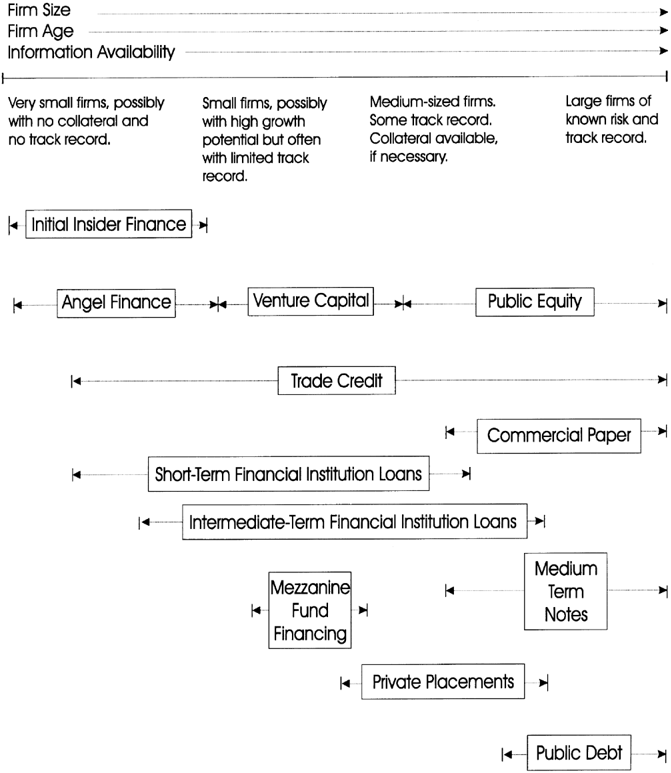
This article examines the economics of financing small business in private equity and debt markets. Firms are viewed through a financial growth cycle paradigm in which different capital structures are optimal at different points in the cycle. We show the sources of small business finance, and how capital structure varies with firm size and age. The interconnectedness of small firm finance is discussed along with the impact of the macroeconomic environment. We also analyze a number of research and policy issues, review the literature, and suggest topics for future research.
Verified 2026-11-25 · 1 reference not checked yet
Overview
CoChat Summary
TL;DR
This article reviews the economics of small business finance through a financial growth cycle paradigm, emphasizing informational opacity and the roles of private equity and debt markets. It documents US small business funding sources and contracts, and analyzes vulnerability to macroeconomic shocks, credit crunches, and bank consolidation.
Key findings
- US small business finance is split roughly evenly between equity (49.63%) and debt (50.37%); the largest sources are the principal owner, commercial banks, and trade creditors, together accounting for 70.10% of total funding. Commercial banks provide 18.75%, trade credit 15.78%, principal owner equity 31.33%, angel finance 3.59%, venture capital 1.85%, and credit card debt 0.14%.
- Financial institution debt is used by 54.23% of small businesses; 86.95% name a commercial bank as their primary financial institution. Average relationship length is 6.64 years overall and 9.01 years with the primary institution; 52.03% of financial institution debt is under lines of credit, 91.94% is secured, and 51.63% is guaranteed.
- The growth cycle paradigm predicts younger/more opaque firms rely on insider finance, trade credit, and angel finance, then venture capital and banks, and eventually public markets. However, 1993 NSSBF data show insider finance does not dominate external finance even for adolescents (upper bound 56.8% insider, roughly equal to external), and financial institution debt is important to very young firms, often based on personal guarantees or collateral.
- Macro vulnerability: the early-1990s credit crunch saw real C&I loans fall 23.2% ($596.7 billion to $458.2 billion) and estimated small business lending fall 38.5% ($143.7 billion to $88.4 billion). Banks with less than $100 million in assets held about 9% of portfolios in small business loans versus about 2% for banks over $10 billion; large banks charged about 100 basis points less and required collateral about 25% less often than small banks, other things equal.
Methods
- Design: review and synthesis organized around the financial growth cycle paradigm, covering theoretical and empirical literature on private equity and debt markets, contracts, and macroeconomic vulnerability.
- Data: primarily the 1993 National Survey of Small Business Finances (NSSBF) for US small business finance tables, plus other sources including NFIB, SCF, STBL, CALL, CRA, Venture Economics/VentureOne, and international data.
- Analysis: descriptive tabulations (Tables 1 and 2) and literature synthesis; the paper is a review rather than a new primary empirical study.
Limitations
- Paper-stated: Table 1 data are not completely accurate or consistent and should be considered rough estimates; angel finance estimates are imprecise (range $15 billion to $120 billion); 1993 data may not reflect current conditions; weighted averages mask considerable heterogeneity.
- Paper-stated: the growth cycle paradigm is not intended to fit all small businesses; firm size, age, and information availability are far from perfectly correlated, and the points at which different funding sources begin and end are not definitive.
- Evident from the text: informational opacity and the intertwining of personal and business finances make small business finance difficult to research, and data on owners’ finances are often unavailable; the paper relies heavily on existing literature and available data rather than new primary data collection.
Model-written summary. Check it against the paper before relying on it.
Integrity signals
Registry
Cites
Statistics
Figures
Verification
Claims the paper makes
22 Valid · 27 Not valid · 107 Not checked · 201 Own results and interpretations
Every source the paper cites for this claim was checked and supports it.
In the paper
“This use of personal assets to help with external ®nance also highlights another important aspect of small business ®nance ± the ®nancial intertwining of owners and their businesses (Ang, 1992).”
§ The economics of small business ®nance: The roles of private equity and debt markets in the ®nancial growth cycle > 2.3. The ®nancial growth cycle of small business
What the sources say
- Supportedcites Ang, 1992 matched to “On the Theory of Finance for Privately Held Firms” (1992) source
In “Integrating Personal and Business Accounts,” Ang says that personal guarantees or collateral make business risk inseparable from owners’ personal risk. “The Financing Decision” also identifies owners’ assets used for loan guarantees as contributions to the business. Together, these passages support the cited point that using personal assets to obtain external finance intertwines owners’ and businesses’ finances. (LLM, conf=0.94)
plainstates an association- Asserted: passes — The authors put it forward as true.
- Checkable: passes — It can be checked against evidence.
- Load-bearing: unclear — It is unclear whether the paper’s conclusions depend on it.
- Based: passes — The paper gives a reason why it holds.
- Supported
The cited sources support only part of this claim — read each source’s verdict below.
In the paper
“Costly state veri®cation (Townsend, 1979;Diamond, 1984) and adverse selection (Myers, 1984;Myers and Majluf, 1984;Nachman and Noe, 1994) arguments suggest the optimality of debt contracts after insider ®nance has been exhausted.”
§ The economics of small business ®nance: The roles of private equity and debt markets in the ®nancial growth cycle > 2.3. The ®nancial growth cycle of small business
What the sources say
- Partly supportedcites Townsend, 1979 matched to “Optimal contracts and competitive markets with costly state verification” (1979) sourceExperimental — accuracy not yet measured
Section 3 characterizes an optimal contract for a firm financing an investment project as a bond that defaults when returns fall below a threshold, supporting the costly-state-verification rationale for debt. The paper does not establish that debt becomes optimal only after insider finance has been exhausted. The adverse-selection citations in the sentence refer to other sources, not Townsend. (LLM, conf=0.85)
- Not checked — no full text of the sourcecites Diamond, 1984 matched to “Financial intermediation and delegated monitoring” (1984) source
- Not matchedcites Myers, 1984
More than one paper fits this citation.
hedgedstates a cause- Asserted: passes — The authors put it forward as true.
- Checkable: passes — It can be checked against evidence.
- Load-bearing: passes — The paper’s conclusions depend on it.
- Based: passes — The paper gives a reason why it holds.
- Partly supported
The cited sources support only part of this claim — read each source’s verdict below.
In the paper
“An agency problem arises in the relationship between the entrepreneur and the venture capitalist in which the entrepreneur may expend insucient eort, exhibit expense preference behavior, or lack sucient information or skill to make optimal production decisions.”
§ The economics of small business ®nance: The roles of private equity and debt markets in the ®nancial growth cycle > 3.2. The venture capital market
What the sources say
- Not checked — no full text of the sourcecites Cooper and Carleton, 1979 matched to “Dynamics of Borrower‐Lender Interaction: Partitioning Final Payoff in Venture Capital Finance” (1979) source
- Partly supportedcites Bergemann and Hege, 1998 matched to “Venture capital financing, moral hazard, and learning” (1998) sourceExperimental — accuracy not yet measured
Section 2.3, “Moral hazard and financing,” describes an entrepreneur who may reduce costly effort or divert investment funds to private ends, supporting the insufficient-effort and expense-preference parts of the claim. It does not identify a lack of the entrepreneur’s information or skill as a cause of poor production decisions; it instead says the entrepreneur and venture capitalists initially have the same assessment of the project. (LLM, conf=0.88)
hedgedstates a possible cause- Asserted: passes — The authors put it forward as true.
- Checkable: passes — It can be checked against evidence.
- Load-bearing: passes — The paper’s conclusions depend on it.
- Based: passes — The paper gives a reason why it holds.
Every source the paper cites for this claim was checked and supports it.
In the paper
“Since 1990, this share has about doubled to 30% (Fenn et al., 1997).”
§ The economics of small business ®nance: The roles of private equity and debt markets in the ®nancial growth cycle > 3. The role of private equity markets in small business ®nance
What the sources say
- Supportedcites Fenn et al., 1997 matched to “The Private Equity Market: An Overveiw” (1997) source
In “IPO Firms that Received Private Equity Backing,” the paper states that the share of IPOs with venture backing averaged 15% during the 1980s and doubled to 30% since 1990. This directly supports the cited claim. (LLM, conf=0.95)
plainstates an association- Asserted: passes — The authors put it forward as true.
- Checkable: passes — It can be checked against evidence.
- Load-bearing: unclear — It is unclear whether the paper’s conclusions depend on it.
- Based: passes — The paper gives a reason why it holds.
- Supported
The cited sources support only part of this claim — read each source’s verdict below.
In the paper
“During the 1980s, approximately 15% of all IPOs were backed by venture capital, well out of proportion to the fraction of all ®rms that received venture capital.”
§ The economics of small business ®nance: The roles of private equity and debt markets in the ®nancial growth cycle > 3. The role of private equity markets in small business ®nance
What the sources say
- Partly supportedcites Fenn et al., 1997 matched to “The Private Equity Market: An Overveiw” (1997) sourceExperimental — accuracy not yet measured
The section “IPO Firms that Received Private Equity Backing” states that venture-backed IPOs averaged 15% of IPOs during the 1980s. It does not give the fraction of all firms that received venture capital or make the claimed comparison with that fraction. (LLM, conf=0.84)
plainstates an association- Asserted: passes — The authors put it forward as true.
- Checkable: passes — It can be checked against evidence.
- Load-bearing: unclear — It is unclear whether the paper’s conclusions depend on it.
- Based: passes — The paper gives a reason why it holds.
- Partly supported
184 more claims · 6 with their cited sources checked
Create a free account to see all 357 claims and to verify the 12 references still open.
- Probably not a substantial claim. 94
- It may state two separate claims as one. 87
- Borderline: one of the tests for a substantial claim is unclear. 2
Claims other papers make about this one
Each is checked against this paper’s own text: does it say what the citing paper says it does?
The cited source says what the claim attributes to it.
In the citing paper
“SMEs are more dependent on external financing supplied by commercial banks (Berger and Udell 1998) because most of them are not qualified to raise money from the stock market.”
From Local Bank, Digital Financial Inclusion and SME Financing Constraints: Empirical Evidence from China (2022) · cites this paper as Berger and Udell 1998
Self-check
Percentages, sums and reported differences re-computed from the paper’s own numbers.
Rated minor: it would not touch a result — a value no result rests on, a p-value that stays on the same side of the significance level, or a conflict that is clerical, resolved elsewhere in the paper, or outside its own findings.
In the paper
“Non®nancial business/government debt provides 19.26% of small business funding (mostly trade credit)”
§ The economics of small business ®nance: The roles of private equity and debt markets in the ®nancial growth cycle > 4. The role of private debt markets in small business ®nance
Reported 19.26 · recomputed 18.01
Citations
Cites
Corporate financing and investment decisions when firms have information that investors do not have
Myers, S. C., & Majluf, N. S. (1984) · Journal of Financial Economics · doi:10.1016/0304-405x(84)90023-0 · Cited by 18,957
The Cost of Capital, Corporation Finance and the Theory of Investment
Miller, M. H. (1958) · American Economic Review · Cited by 14,574
Determinants of corporate borrowing
Myers, S. C. (1977) · Journal of Financial Economics · doi:10.1016/0304-405x(77)90015-0 · Cited by 13,169
Credit Rationing in Markets with Imperfect Information
Stiglitz, J. E., & Weiss, A. (1981) · Columbia University · doi:10.7916/d8v12ft1 · Cited by 12,769 · cited 1×
“…pledging outside collateral may help resolve adverse selection problems when the borrower has more information about the quality of the investment than the lender, and may help prevent credit rationing (Stiglitz and Weiss 1981, 1986, Bester 1985, Chan and Kanatas 1985, Besanko and Thakor 1987a,b).”
The cost of capital, corporation finance and the theory of investment
Terra, P. R. (2008) · Revista de Administração e Contabilidade da Unisinos · doi:10.4013/base.20082.07 · Cited by 8,615
Financial intermediation and delegated monitoring
Diamond, D. W. (1984) · The Review of Economic Studies · doi:10.2307/2297430 · Cited by 8,476 · cited 2×
“Costly state verification (Townsend 1979, Diamond 1984) and adverse selection (Myers 1984, Myers and Majluf 1984, Nachman and Noe 1994) arguments suggest the optimality of debt contracts after insider cFor example, there are generally accepted definitions of the stages of finance for the kind of…”
Corporate Financing and Investment Decisions When Firms Have InformationThat Investors Do Not Have
Myers, S., & Majluf, N. (1984) · doi:10.3386/w1396 · Cited by 6,745
The Benefits of Lending Relationships: Evidence from Small Business Data
PETERSEN, M. A., & RAJAN, R. G. (1994) · The Journal of Finance · doi:10.1111/j.1540-6261.1994.tb04418.x · Cited by 5,440 · cited 4×
“…whereas mortgages, equipment loans, motor vehicle loans, and other loans may more often be transactionsdriven .zs It was also found that dependence on trade credit decreased with the length of the banking relationship, supporting the value of relationship lending (Petersen and Rajan 1994, 1995).”
InfluentialInside the black box: the credit channel of monetary policy transmission
Bernanke, B. S., & Gertler, M. (1995) · Journal of Economic Perspectives · doi:10.1257/jep.9.4.27 · Cited by 4,211
Insiders and Outsiders: The Choice between Informed and Arm's‐Length Debt
RAJAN, R. G. (1992) · The Journal of Finance · doi:10.1111/j.1540-6261.1992.tb04662.x · Cited by 3,902 · cited 1×
“Some research suggests that these firms may try to reduce the control of their banks by issuing public debt, even though public debt may entail higher costs (Diamond 1991, 1993, Rajan 1992, Houston and James 1996).”
Research works printed but not linked: 11
- 66. Cook, L., 1997. Trade ®nance, bank ®nance, and capital market imperfections. Working paper. Harvard University, Cambridge, MA.
- 89. Freear, J., Sohl, J.E., Wetzel, W.E., Jr., 1994. The private investor market for venture capital. The Financier 1, 7±19.
- 112. Hancock, D., Wilcox, J.A., 1997. Bank capital, nonbank ®nance, and real estate activity. Journal of Housing Research 8, 75±105.
- 117. Hempel, G., Coleman, A., Simonson, D., 1986. Bank Management, Wiley, New York.
- 119. Ho, R., 1997. Credit-card use to ®nance small business is soaring, says survey of small ®rms. Wall Street Journal B2, Sept. 25.
- 153. Megginson, W.L., Weiss, K.A., 1991. Venture capitalist certi®cation in initial public oerings. Journal of Finance 46, 903±979.
- 162. Morsman Jr., E., 1986. Commercial loan structuring. Journal of Commercial Bank Lending 68, 2± 20.
- 187. Ravid, S.A., 1996. Debt maturity ± A survey. Financial Markets, Institutions and Instruments 5 (3), 1±68.
- 217. Wetzel Jr. W.E., 1994. Venture capital. In: Bygrave, W.D. (Ed.), Portable MBA in Entrepreneur- ship. Wiley, New York, pp. 172±194.
- 219. White, L.J., 1995. An analytical framework. In: Zahid, S.N. (Ed.), Financial Sector Development in Asia. Oxford University Press, New York, pp. 3±35.
- 222. McKean, R. (Ed.), Issues in Defense Economics. Columbia University Press, New York.
Cited by
Items 801–900 of 3,739
The Use of SME Tax Incentives in the European UnionPreprint
Bergner, S., Brrutigam, R., Evers, M. T., & Spengel, C. (2017) · SSRN Electronic Journal · doi:10.2139/ssrn.2910339 · Cited by 62
The "Liability of Newness" and Small Firm Access to Debt Capital: Is There a Link?
Coleman, S. (2004) · The Journal of Entrepreneurial Finance · doi:10.57229/2373-1761.1069 · Cited by 42
Le, C. H. A., Nguyen, B., & Vo, V. X. (2023) · Small Business Economics · doi:10.1007/s11187-023-00785-z · Cited by 56
“This limits the sources of financing available to them (Berger & Udell, 1998).”
Financial management practices in successful Small and Medium Enterprises (SMEs)
Wolmarans, H. P., & Meintjes, Q. (2015) · The Southern African Journal of Entrepreneurship and Small Business Management · doi:10.4102/sajesbm.v7i1.8 · Cited by 81
“Traditionally, SMEs are also typically expected to aim at growth over time (Berger & Udell, 1998:613).”
BackgroundZonooz, B. H., Farzam, V., Satarifar, M., & Bakhshi, L. (2011) · International Business Management · doi:10.3968/j.ibm.1923842820110201.019 · Cited by 53
Determinants of Capital Structure in Nigerian Banking Sector
Aremu, M. A., Imoh Christopher, E. K. P. O., Mustapha, A. M., & Salami, A. I. (2013) · International Journal of Academic Research in Economics and Management Sciences · doi:10.6007/ijarems/v2-i4/50 · Cited by 69
“Bank financing will depend upon whether the lending can be secured by tangible assets (Storey, 1994; Berger and Udell, 1998).”
Direct and indirect effects of private- and government-sponsored venture capital
Engberg, E., Tingvall, P. G., & Halvarsson, D. (2019) · Empirical Economics · doi:10.1007/s00181-019-01770-w · Cited by 40
Determinants of perceived bank financing accessibility for SMEs: evidence from an emerging market
Erdogan, A. I. (2019) · Economic Research-Ekonomska Istraživanja · doi:10.1080/1331677x.2019.1578678 · Cited by 48
“…License (http://creativecommons.org/ licenses/by/4.0/), which permits unrestricted use, distribution, and reproduction in any medium, provided the original work is properly cited. face (Ang, 1992; Berger & Udell, 1998; Bernini & Montagnoli, 2017; Gregory, Rutherford, Oswald, & Gardiner, 2005).”
BackgroundInfluentialInformal financing choice in SMEs: do the types of formal credit constraints matter?
Nguyen, H. T., Nguyen, T. T., Dang, L. P. X., & Nguyen, H. M. (2019) · Journal of Small Business & Entrepreneurship · doi:10.1080/08276331.2019.1692441 · Cited by 47
“Many SMEs, however, report that financial constraint is a serious problem hindering their growth, innovation and development (Beck and Demirguc-Kunt 2006; Beck et al. 2008; Berger and Udell 1998; Hall 2002).”
BackgroundSupply Chain Financial Risk Evaluation of Small- and Medium-Sized Enterprises under Smart City
Wang, K., Yan, F., Zhang, Y., Xiao, Y., & Gu, L. (2020) · Journal of Advanced Transportation · doi:10.1155/2020/8849356 · Cited by 35
Determining the Characteristics of the Private Equity Targets: UK Evidence
Wilson, N., Amini, S., & Wright, M. (2021) · British Journal of Management · doi:10.1111/1467-8551.12518 · Cited by 40
“The sample split in our study is also in line with the business cycle, given that the flow of funds to small businesses in PE depends significantly on fluctuations in the macroeconomic environment (Berger and Udell, 1998).”
ResultGaudio, B. L. D., Sampagnaro, G., Porzio, C., & Verdoliva, V. (2021) · Journal of Business Finance & Accounting · doi:10.1111/jbfa.12554 · Cited by 35
Azadegan, A., Napshin, S. A., & Oke, A. (2013) · International Journal of Operations & Production Management · doi:10.1108/01443571311300755 · Cited by 38
“At the individual level, the institutional logic incorporates the norms and values of decision makers (Berger and Udell, 1998).”
BackgroundCapital structure and growth of the firms in the backward regions of the south Italy
Sarno, D. (2008) · Applied Financial Economics · doi:10.1080/09603100701222309 · Cited by 37
“From another perspective, the ‘financial growth cycle’ hypothesis proposes the same points (Berger and Udell, 1998).”
BackgroundInfluentialDo independent directors protect shareholder value?
Giráldez, P., & González, J. M. H. (2013) · Business Ethics A European Review · doi:10.1111/beer.12039 · Cited by 32
Gender in campus incubation: evidence from Ireland
Treanor, L., & Henry, C. (2010) · International Journal of Gender and Entrepreneurship · doi:10.1108/17566261011051008 · Cited by 31
“With regard to the latter, the extant literature identifies access to finance as being a fundamentally important determinant of firm growth and performance ( Berger and Udell, 1998”
BackgroundHartarska, V., & Nadolnyak, D. (2012) · Journal of Agricultural and Applied Economics · doi:10.1017/s1074070800024147 · Cited by 31
Determinants of Capital Structure of Banks: Evidence from Sub-Sahara Africa
Anarfo, E. B. (2015) · Asian Economic and Financial Review · doi:10.18488/journal.aefr/2015.5.4/102.4.624.640 · Cited by 31
A Demand-Side Approach to Smes' Capital Structure: Evidence from Argentina
Briozzo, A., & Vigier, H. P. (2009) · Journal of business & entrepreneurship · Cited by 46
New venture financing in Germany: Effects of firm and owner characteristics
Achleitner, A., Braun, R., & Kohn, K. (2011) · Journal of Business Economics · doi:10.1007/s11573-011-0441-3 · Cited by 39
“They are mainly private firms that have no track record ( Berger and Udell 1998; Cassar 2004; Huyghebaert and Gucht 2007).”
BackgroundInfluentialFinancing innovation: A bibliometric analysis of the field
Ospina, A. M. P., Vásquez, J. E. M., & Godoy, J. A. R. (2018) · Journal of Business & Finance Librarianship · doi:10.1080/08963568.2018.1448678 · Cited by 39
“The articles that are closest to the subject of innovation financing with more citations from the field itself are Berger and Udell (1998), Bhattacharya and Ritter (1983), Brown, Fazzari, and Petersen (2009), Carpenter and Petersen (2002), Hall (2002), Hall (1992), Himmelberg and Petersen (1994),…”
BackgroundInfluentialTargeted monetary policy and financing constraints of Chinese small businesses
Lin, C., He, L., & Yang, G. (2020) · Small Business Economics · doi:10.1007/s11187-020-00365-5 · Cited by 37
Expectations of access to debt finance for SMEs in times of uncertainty
Calabrese, R., Degl’Innocenti, M., & Zhou, S. (2020) · Journal of Small Business Management · doi:10.1080/00472778.2020.1756309 · Cited by 30
“Furthermore, they do not exhibit the scale to diversify their investment portfolio and reduce asymmetric information as large firms do (Berger and Udell, 1998; Lee et al., 2015).”
BackgroundCash holdings in start-ups: The role of founder sociodemographic characteristics
Gaio, C., Gonçalves, T. C., & Venâncio, A. (2021) · Journal of Business Research · doi:10.1016/j.jbusres.2021.09.046 · Cited by 33
What are the Capital Structure Determinants for Tax‐Exempt Organizations?
Smith, G. P. (2010) · Financial Review · doi:10.1111/j.1540-6288.2010.00274.x · Cited by 43
“Berger and Udell (1998) suggest that start-up organizations have difficulty raising capital because they are informationally opaque. Diamond (1989) suggests that organizations with shorter track records also have a greater probability of default.”
InfluentialThe use and impacts of bank support on UK small and medium-sized enterprises
Han, L., Benson, A., Chen, J. J., & Zhang, S. (2012) · International Small Business Journal Researching Entrepreneurship · doi:10.1177/0266242612455008 · Cited by 49
“…faced by SMEs in terms of availability and cost of finance are influenced significantly by business size (Han, 2008), stage of business cycle (Berger and Udell, 1998), industry (Petersen and Rajan, 1995), information transparency (Petersen and Rajan, 2002) and organisation type (Avery et…”
BackgroundGolman, R., & Klepper, S. (2016) · The RAND Journal of Economics · doi:10.1111/1756-2171.12130 · Cited by 39
Access to the Internet and Access to Finance: Theory and Evidence
Chen, Y., Gong, X., Chu, C., & Cao, Y. (2018) · Sustainability · doi:10.3390/su10072534 · Cited by 38
“For instance, Chittenden et al. [37] examined the effect of capital structure of small firms on growth and access to capital markets, documenting that the over-reliance on internal finance and the importance of collateral are likely to be major constraints on their sustainable growth, while Berger and Udell [38] thoro…”
BackgroundCollateralization and distance
Bellucci, A., Borisov, A., Giombini, G., & Zazzaro, A. (2019) · Journal of Banking & Finance · doi:10.1016/j.jbankfin.2019.01.011 · Cited by 34
Membership Matters: On the Value of Being Embedded in Customer Networks
Fjeldstad, Ø. D., & Sasson, A. (2010) · Journal of Management Studies · doi:10.1111/j.1467-6486.2009.00901.x · Cited by 37
Bank Consolidation and Small Business Lending: The Role of Community BanksPreprint
Avery, R. B., & Samolyk, K. A. (2006) · SSRN Electronic Journal · doi:10.2139/ssrn.886688 · Cited by 30
“Therefore, as banks get larger and more organizationally complex, their focus shifts to larger commercial credits or more standardized types of loan products (Berger and Udell, 1998).”
BackgroundTaxes and Corporate Debt Policy: Evidence for Unlisted Firms of Sixteen European CountriesPreprint
Bartholdy, J., & Mateus, C. (2008) · SSRN Electronic Journal · doi:10.2139/ssrn.1098370 · Cited by 38
Hancock, D., Peek, J., & Wilcox, J. A. (2007) · SSRN Electronic Journal · doi:10.2139/ssrn.973976 · Cited by 29
The Impact of Private Equity on Firms' Innovation ActivityPreprint
Amess, K., Stiebale, J., & Wright, M. (2015) · RePEc: Research Papers in Economics · Cited by 30
Credit rationing prevalence for Eurozone firms
Kallandranis, C., Anastasiou, D., & Δράκος, Κ. (2023) · Journal of Business Research · doi:10.1016/j.jbusres.2022.113640 · Cited by 32
Handling default risks in microfinance: the case of Bangladesh
Kassim, S., & Rahman, M. (2018) · Qualitative Research in Financial Markets · doi:10.1108/qrfm-03-2017-0018 · Cited by 46
The View of Angels From Above: Angel Governance and Institutional Environments
Collewaert, V., Filatotchev, I. V., & Khoury, T. A. (2018) · Academy of Management Perspectives · doi:10.5465/amp.2017.0191 · Cited by 42
Determinants of Financing Decisions of SMEs: Evidence from Hotel Industry
Mueller, A., & Sensini, L. (2021) · International Journal of Business and Management · doi:10.5539/ijbm.v16n3p117 · Cited by 47
“Although the literature has extensively shown the differences in financial behaviour between SMEs and large firms (Berger & Udell, 1998; Michaelas et al., 1999; López-Gracia & Sogorb-Mira, 2008; Macan Bhaird & Lucey, 2010; among others), few studies have focused on this topic in the context of…”
BackgroundResultDeterminants of working capital: empirical evidence on manufacturing SMEs
Sardo, F., & Serrasqueiro, Z. (2021) · Journal of Economic Studies · doi:10.1108/jes-10-2020-0513 · Cited by 39
Yang, X., Gu, X., & Yang, X. (2021) · Economics of Innovation and New Technology · doi:10.1080/10438599.2021.1916486 · Cited by 33
“Second, using the life cycle stage as a starting point, Berger and Udell (1998) argue that firms tend to become increasingly dependent on bank loans as they grow from ‘infancy (0-2 years)’ to ‘adolescence (3-4 years)’, but as they grow older, they use less bank borrowing.”
BackgroundMethodFirm life cycle and financial statement comparability
Biswas, P. K., Habib, A., & Ranasinghe, D. (2022) · Advances in Accounting · doi:10.1016/j.adiac.2022.100608 · Cited by 45
Financial inclusion and banking stability: Does interest rate repression matter?
Ghosh, S. (2022) · Finance research letters · doi:10.1016/j.frl.2022.103205 · Cited by 38
Cowling, M., & Sclip, A. (2022) · British Journal of Management · doi:10.1111/1467-8551.12666 · Cited by 34
“…that use business credit lines (Cole and Sokolyk, 2016; Han et al., 2009; Petersen and Rajan, 2002) and/or have longer/better bank-firm relationships (Berger and Udell, 1998) are more likely to be discouraged because they received informal inquiries from their banks before deciding not to apply.”
BackgroundFalavigna, G., & Ippoliti, R. (2023) · The North American Journal of Economics and Finance · doi:10.1016/j.najef.2023.101903 · Cited by 39
Steinerowska–Streb, I., & Steiner, A. (2014) · Thunderbird International Business Review · doi:10.1002/tie.21627 · Cited by 29
Decomposing Racial and Ethnic Differences in Small Business Lending: Evidence of Discrimination
Mijid, N., & Bernasek, A. (2013) · Review of Social Economy · doi:10.1080/00346764.2012.761751 · Cited by 41
“However, small business owners face greater difficulty securing external funds compared to large corporations (Berger and Udell 1998; Cole et al. 2004; Robb and Robinson 2009).”
BackgroundMethodSerrasqueiro, Z., Nunes, P. M., & Armada, M. J. D. R. (2014) · European Journal of Finance · doi:10.1080/1351847x.2014.946068 · Cited by 48
“The great information asymmetry between high-tech SMEs and lenders (Bank of England 1996; Berger and Udell 1998) and, consequently, higher transaction costs may imply that the adjustment of the actual level of debt towards the target debt ratio is merely a secondary objective for high-tech SMEs.”
BackgroundEarnings Management, IPO Underpricing, and Post-Issue Stock Performance of Chinese SMEs
Gao, J., Cong, L. M., & Evans, J. P. (2015) · Chinese Economy · doi:10.1080/10971475.2015.1067085 · Cited by 33
“As a result, SMEs have been referred to as “acutely informationally opaque,” that is, in a worsened, information asymmetrical situation (Berger & Udell, 1998; Ou & Haynes, 2006).”
BackgroundAn assessment of the business impacts of the UK’s Enterprise Capital Funds
Baldock, R. (2016) · Environment and Planning C Government and Policy · doi:10.1177/0263774x15625995 · Cited by 32
Kolmakov, V. V., Grigorievna, A. P., & Shalaev, V. (2015) · Economic Annals · doi:10.2298/eka1507007k · Cited by 29
Briozzo, A., Vigier, H. P., & Martínez, L. B. (2016) · Latin American Business Review · doi:10.1080/10978526.2016.1209081 · Cited by 42
“These results agree with Serrasquiero and Maças Nunes (2012), who found that young SMEs are more likely to follow a PO, and with Berger and Udell’s (1998) financing growth cycle.”
ResultInfluentialIndebtedness for young companies: effects on survival
Wamba, L. D., Hikkerova, L., Sahut, J., & Braune, É. (2016) · Entrepreneurship and Regional Development · doi:10.1080/08985626.2016.1255435 · Cited by 46
“Second, and for numerous reasons, in most countries, bank debts, besides trade credit, are the sole financial means available for new firms seeking external finance (Franks and Sussman 2005; Berger and Udell 1998).”
BackgroundMoghaddam, K., Aidov, A., DuVal, C., & Azarpanah, S. (2016) · Venture Capital · doi:10.1080/13691066.2016.1256295 · Cited by 40
“It is important to note that the choice of funding sources for a new firm is made over time and along the firm life cycle (Berger and Udell 1998).”
BackgroundBank competition, government intervention and SME debt financing
Du, J., Bian, C., & Gan, C. E. C. (2017) · China Finance Review International · doi:10.1108/cfri-02-2017-0007 · Cited by 34
“More, numerous studies have examined the phenomenon that SMEs face difficulties in accessing bank loans compared to large businesses both in the developing and developed world (Berger and Udell, 1998; Galindo and Schiantarelli, 2003).”
BackgroundSmall finance banks: Challenges
Jayadev, M., Singh, H., & Kumar, P. (2017) · IIMB Management Review · doi:10.1016/j.iimb.2017.10.001 · Cited by 42
The Role of Community Banks in the U.S. Economy
Kahn, G. A., Schroeder, L., Weiner, S. E., Keeton, W. R., Harvey, J., & Willis, P. B. (2003) · RePEc: Research Papers in Economics · Cited by 32
Alodat, A. Y., Nobanee, H., Salleh, Z., & Hashim, H. A. (2023) · Business Strategy & Development · doi:10.1002/bsd2.285 · Cited by 33
Business angels investing in green ventures: how do they add value to their start-ups?
Siefkes, M., Bjørgum, Ø., & Sørheim, R. (2023) · Venture Capital · doi:10.1080/13691066.2023.2260101 · Cited by 52
“The entrepreneur typically has better information about their company than the investor (Berger and Udell 1998).”
Credit Gap in Small Businesses: Some New Evidence
Chakraborty, A., & Mallick, R. (2012) · International Journal of Business · Cited by 55
Attitudes of family firms toward outside investors: the importance of organizational identification
Neckebrouck, J., Manigart, S., & Meuleman, M. L. C. J. (2016) · Venture Capital · doi:10.1080/13691066.2016.1255414 · Cited by 39
“Finally, because high growth firms are more likely to seek for outside equity (Berger and Udell 1998; Fama and French 2002), we control for firm growth, measured as three-year average growth in assets.”
BackgroundTrade credit in times of crisis: evidence from European SMEs
Bussoli, C., & Marino, F. (2018) · Journal of Small Business and Enterprise Development · doi:10.1108/jsbed-08-2017-0249 · Cited by 44
Sticking it on plastic: credit card finance and small and medium-sized enterprises in the UK
Brown, R., Liñares-Zegarra, J. M., & Wilson, J. O. S. (2018) · Regional Studies · doi:10.1080/00343404.2018.1490016 · Cited by 28
“This aligns with prior evidence which emphasises interconnections between insider and external sources of finance (Berger and Udell, 1998).”
BackgroundThe role of government venture capital funds: Recent lessons from the U.K. experience
Owen, R., North, D., & Bhaird, C. M. A. (2019) · Strategic Change · doi:10.1002/jsc.2247 · Cited by 28
“This adopts Berger and Udell’s (1998) entrepreneurial finance model”
The impact of improvisation and financial bootstrapping strategies on business performance
Issa, H.-E. A. (2020) · EuroMed Journal of Business · doi:10.1108/emjb-03-2020-0022 · Cited by 54
Márkus, G., & Rideg, A. (2020) · Competitiveness Review An International Business Journal incorporating Journal of Global Competitiveness · doi:10.1108/cr-01-2020-0019 · Cited by 51
Mittal, V., & Raman, T. V. (2021) · South Asian Journal of Business Studies · doi:10.1108/sajbs-07-2020-0228 · Cited by 48
Financial development, legal systems and SME finance: Cross-country evidence
Wang, H., Xiang, X., & Han, L. (2023) · International Review of Economics & Finance · doi:10.1016/j.iref.2023.07.021 · Cited by 56
Access to Financing in a Small Island Economy: Evidence From Mauritius
Kasseeah, H., & Thoplan, R. (2012) · Journal of African Business · doi:10.1080/15228916.2012.727753 · Cited by 37
“Hence, as found by Berger and Udell (1995), smaller and younger firms are more likely to face higher cost of financing and they are required to offer collateral.”
BackgroundInfluentialThe effect of firm characteristics in accessing credit for SMEs
Yildirim, H. S., Akçi, Y., & Ekşi, İ. H. (2013) · Journal of Financial Services Marketing · doi:10.1057/fsm.2012.28 · Cited by 35
Gender, Performance And Financial Strategy: A Dynamic Capabilities Perspective
Coleman, S., & Kariv, D. (2013) · Journal of Developmental Entrepreneurship · doi:10.1142/s1084946713500209 · Cited by 36
“Berger and Udell (1998) were the first to actually apply the Life Cycle Model to entrepreneurial finance by pointing out that different financial sources and strategies are appropriate at different stages of firm growth and development.”
Policies of promoting entrepreneurship and Angel Investment: Evidence from China
Li, C., Shi, Y., Wu, C., Wu, Z., & Zheng, L. (2016) · Emerging Markets Review · doi:10.1016/j.ememar.2016.08.011 · Cited by 28
Clemente‐Almendros, J. A., & Sogorb, F. (2018) · Revista de Contabilidad · doi:10.1016/j.rcsar.2018.05.001 · Cited by 41
“Berger and Udell (1998) stated that firms’ equity-debt choice varies over the course of their lifecycle and is motivated by the existence of information asymmetries.”
BackgroundThe Intermingling of Family and Business Financial Resources: Understanding the Copreneurial Couple
Muske, G., Fitzgerald, M. A., Haynes, G. W., Black, M., Chin, L., MacClure, R., & Mashburn, A. (2009) · Journal of Financial Counseling and Planning · Cited by 34
The Determinants of Financial Structure: New Insights from Business Start-UpsPreprint
Gucht, L. M. V. D., & Huyghebaert, N. (2002) · SSRN Electronic Journal · doi:10.2139/ssrn.296841 · Cited by 28
Financial systems and venture capital in Nordic countries: A comparative studyPreprint
Hyytinen, A., & Pajarinen, M. (2001) · RePEc: Research Papers in Economics · Cited by 32
Generale, A., Colle, D. M. D., & Russo, P. F. (2006) · SSRN Electronic Journal · doi:10.2139/ssrn.901949 · Cited by 37
Law, Finance, and Politics: The Case of IndiaPreprint
Armour, J. H., & Lele, P. P. (2008) · SSRN Electronic Journal · doi:10.2139/ssrn.1116608 · Cited by 28
“This makes such firms unsuitable candidates for debt investment ( Berger and Udell, 1998; Carpenter and Petersen, 2002).”
How Did the Financial Crisis Affect Small Business Lending in the U.S.?Preprint
Cole, R. A., & Damm, J. (2011) · SSRN Electronic Journal · doi:10.2139/ssrn.1899067 · Cited by 28
Commercial Lending and Distance: Evidence from Community Reinvestment Act DataPreprint
Brevoort, K. P., & Hannan, T. H. (2004) · SSRN Electronic Journal · doi:10.2139/ssrn.593801 · Cited by 33
Analyse the Role of Family in Entrepreneurship Education: Effective Support and Assistance
Harahap, M. A. K., Ausat, A. M. A., Sutrisno, S., Suherlan, S., & Azzaakiyyah, H. K. (2023) · Journal on Education · doi:10.31004/joe.v5i4.2510 · Cited by 35
Does energy efficiency of UK SMEs affect their access to finance?
Chen, J., Calabrese, R., & Cowling, M. (2023) · Energy Economics · doi:10.1016/j.eneco.2023.107251 · Cited by 34
The Effect of Banking Relationship on Firm Performance in Vietnam
Thành, V. H., & Hà, N. M. (2013) · International Journal of Economics and Finance · doi:10.5539/ijef.v5n5p148 · Cited by 39
“This problem will become more serious (Berger and Udell, 1998).”
Horváth, K., & Szerb, L. (2018) · Strategic Change · doi:10.1002/jsc.2191 · Cited by 37
The role of private versus governmental venture capital in fostering job creation during the crisis
Croce, A., Martí, J., & Reverte, C. (2018) · Small Business Economics · doi:10.1007/s11187-018-0108-3 · Cited by 41
Cowling, M., Liu, W., & Zhang, N. (2020) · International Small Business Journal Researching Entrepreneurship · doi:10.1177/0266242620947281 · Cited by 41
“But Bertoni et al. (2015) also establish a certification effect of venture capitalist (VC), which enhances the supply of external capital more generally to smaller firms by flattening out the investment curve.”
BackgroundFernández, M. T. T., Castro, P., & Ferreras, A. (2021) · Business Strategy and the Environment · doi:10.1002/bse.2722 · Cited by 35
Owusu, J., Owusu-Ansah, W., Djan, K. O., & Anin, E. K. (2021) · Cogent Business & Management · doi:10.1080/23311975.2021.1920676 · Cited by 38
Owen, R., & Vedanthachari, L. N. (2022) · IEEE Transactions on Engineering Management · doi:10.1109/tem.2022.3153319 · Cited by 38
“1249 [50] A. N. Berger and G. F. Udell, “The economics of small business fi- 1250 nance: The roles of private equity and debt markets in the financial 1251 growth cycle,” J. Bank.”
BackgroundFinancing of Micro and Small Enterprises in China: An Exploratory Study
Chan, S. H. J., & Lin, J. J. (2013) · Strategic Change · doi:10.1002/jsc.1949 · Cited by 33
On the Relevance of Agency Conflicts in SME Debt Maturity Structure
López‐Gracia, J., & Mestre-Barberá, R. (2015) · Journal of Small Business Management · doi:10.1111/jsbm.12083 · Cited by 40
“Smaller companies have higher levels of asymmetric information (Berger et al. 2005; Berger and Udell 1998) and, therefore, face greater agency conflicts associated to debt (Smith and Warner 1979).”
BackgroundMaking Loan Decisions in Banks: Straight from the Gut?
Wilson, F. (2015) · Journal of Business Ethics · doi:10.1007/s10551-014-2515-y · Cited by 27
Özlü, P. Ö., & Yalçın, C. (2012) · Emerging Markets Finance and Trade · doi:10.2753/ree1540-496x480406 · Cited by 37
“The empirical literature provides mixed evidence and does not support the bank-lending channel strongly (see Atanasova and Wilson 2001; Berger and Udell 1998; Elliehausen and Wolken 1993; Kaplan and Zingales 1997; Kohler et al. 2000; Rajan and Zingales 1995).”
BackgroundTHE CHALLENGES BEHIND SMES' ACCESS TO DEBTS FINANCING IN THE GHANAIAN FINANCIAL MARKET
Kwaning, C. O., Nyantakyi, K., & Kyereh, B. (2015) · Cited by 27
SMEs and Green Growth: The Effectiveness of Support Mechanisms and Initiatives Matters
Liargovas, P. G., Αποστολόπουλος, Ν., Pappas, I., & Kakouris, A. (2017) · Emerald Group Publishing Limited eBooks · doi:10.1108/978-1-78714-499-620171004 · Cited by 36
Mueller, E. (2007) · Journal of Empirical Finance · doi:10.1016/j.jempfin.2007.09.002 · Cited by 32
The effect of foreign bank presence on firm entry and exit in transition economies
Havrylchyk, O. (2012) · Journal of Banking & Finance · doi:10.1016/j.jbankfin.2012.01.015 · Cited by 31
Small Business Finance in Two Chicago Minority Neighborhoods
Huck, P. F., Rhine, S. L. W., Bond, P. L., & Townsend, R. M. (1999) · RePEc: Research Papers in Economics · Cited by 32
Small and medium enterprises’ (SMEs’) access to finance in selected East Asian economies
Oum, S., Harvie, C., & Narjoko, D. (2011) · Research Online (University of Wollongong) · Cited by 30
Financial Statement and Projection Preparation in Start-Up VenturesPreprint
Cassar, G. J. (2008) · SSRN Electronic Journal · doi:10.2139/ssrn.1153673 · Cited by 27
Sanders, M. W. J. L., Serebriakova, A., Fragkos, P. F., Polzin, F., Egli, F., & Steffen, B. (2022) · Environmental Research Letters · doi:10.1088/1748-9326/ac7f48 · Cited by 26
Metadata
- Authors
- N. Berger, A., & F. Udell, G.
- Venue
- Journal of Banking & Finance
- Publisher
- Elsevier BV
- Published
- 1998-08
- Volume
- 22
- Issue
- 6-8
- Pages
- 613-673
- ISSN
- 0378-4266 (ISSN-L)
- OpenAlex
- W2119780569
- Semantic Scholar
- dfc06f7f7eb83d2c0e2a1d67ecb95b520a406843
- Cited by
- 3,690
- References
- 230
- Citations by year
- 2026: 136 · 2025: 148 · 2024: 144 · 2023: 193 · 2022: 155 · 2021: 211 · 2020: 200 · 2019: 156 · 2018: 208 · 2017: 174 · 2016: 186 · 2015: 187 · 2014: 168 · 2013: 177 · 2012: 171
- FWCI
- 169.26
- Type
- journal article
- Language
- en
- Open access
- hybrid
- doi.org
- Licence
- cc-by-nc-nd
- www.elsevier.com/tdm/userlicense/1.0/ (tdm)
- www.elsevier.com/legal/tdmrep-license (tdm)
- creativecommons.org/licenses/by-nc-nd/4.0/ (vor, 125 d)
- Locations
- Journal of Banking & Finance (publishedVersion, cc-by-nc-nd)
- RePEc: Research Papers in Economics (submittedVersion)
- Funders
- York University
- Topics
- Social Sciences › Economics, Econometrics and Finance › Finance › Private Equity and Venture Capital
- Social Sciences › Economics, Econometrics and Finance › Finance › Corporate Finance and Governance
- Social Sciences › Economics, Econometrics and Finance › Finance › Banking stability, regulation, efficiency
- Keywords
- small business financing, private equity, debt markets, capital structure, firm size, firm age, macroeconomic conditions
About these checks
Registry, retraction, Cites and statistics results are computed, not judged, with one exception: a printed reference that no index lists is read once by a model before it counts as a citation error. Claims are extracted by a model and kept only when their quote appears verbatim in the text; each cited source is then checked, with a model’s help, for whether it says what the claim relies on. Those verdicts can be wrong — read the claim’s quote and the cited source before relying on one.
The claim verdicts this report counts are experimental: their accuracy is not yet measured.
A language model drew the claims from the paper on 2026-10-10, under version 3 of the claim definition (model deepseek-v4.1-flash, prompt extract-v3).
A second model labelled each claim on 2026-10-10 (model jev-1.13-20260917, definition revision gold-guideline-v0.2).
Cited sources are checked with a language model’s help (gpt-6-sol).
Statistics and arithmetic are recomputed, not judged.
Confidence bands are shown only for fields calibrated on our annotated test set. None is calibrated yet, so no band is shown.
What counts as a claim ›How we measure confidence ›How we check this ›
Are you an author, or do you see a problem with this page? Request a review
Data sources
Bibliographic data: Semantic Scholar, OpenAlex, Crossref.
Contains information from the Semantic Scholar Academic Graph Datasets, made available under the ODC Attribution License (ODC-BY 1.0).
Semantic Scholar’s data is described in: Kinney, R., et al. (2023). The Semantic Scholar Open Data Platform. arXiv:2301.10140.
