

The economics of small business finance: The roles of private equity and debt markets in the financial growth cycle
Open accessThe DOI matches its Crossref record; 217 of the 230 references it cites were found in a registry or an index, and 1 are not checked yet; 24 of the 170 sources its claims cite were checked for support.
Abstract
This article examines the economics of financing small business in private equity and debt markets. Firms are viewed through a financial growth cycle paradigm in which different capital structures are optimal at different points in the cycle. We show the sources of small business finance, and how capital structure varies with firm size and age. The interconnectedness of small firm finance is discussed along with the impact of the macroeconomic environment. We also analyze a number of research and policy issues, review the literature, and suggest topics for future research.
Verified 2026-11-25 · 1 reference not checked yet
Overview
CoChat Summary
TL;DR
This article reviews the economics of small business finance through a financial growth cycle paradigm, emphasizing informational opacity and the roles of private equity and debt markets. It documents US small business funding sources and contracts, and analyzes vulnerability to macroeconomic shocks, credit crunches, and bank consolidation.
Key findings
- US small business finance is split roughly evenly between equity (49.63%) and debt (50.37%); the largest sources are the principal owner, commercial banks, and trade creditors, together accounting for 70.10% of total funding. Commercial banks provide 18.75%, trade credit 15.78%, principal owner equity 31.33%, angel finance 3.59%, venture capital 1.85%, and credit card debt 0.14%.
- Financial institution debt is used by 54.23% of small businesses; 86.95% name a commercial bank as their primary financial institution. Average relationship length is 6.64 years overall and 9.01 years with the primary institution; 52.03% of financial institution debt is under lines of credit, 91.94% is secured, and 51.63% is guaranteed.
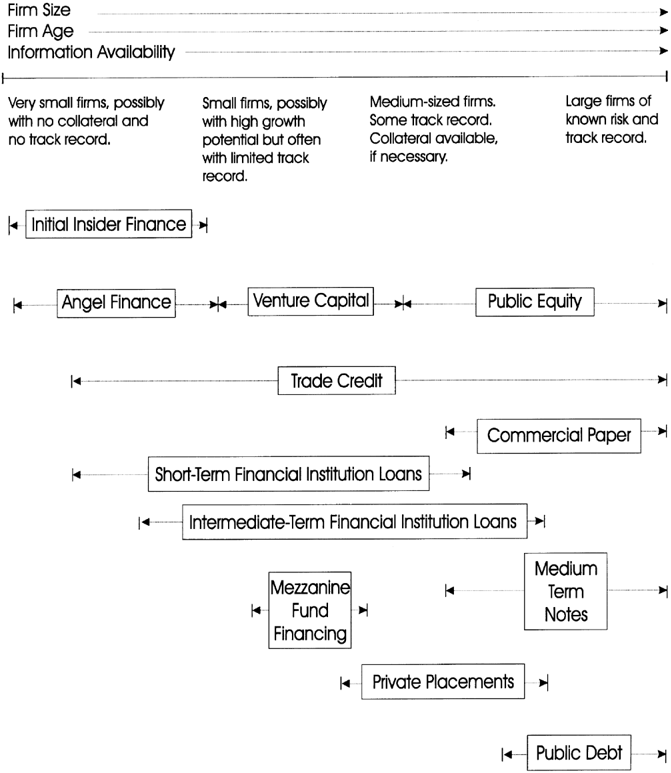
- The growth cycle paradigm predicts younger/more opaque firms rely on insider finance, trade credit, and angel finance, then venture capital and banks, and eventually public markets. However, 1993 NSSBF data show insider finance does not dominate external finance even for adolescents (upper bound 56.8% insider, roughly equal to external), and financial institution debt is important to very young firms, often based on personal guarantees or collateral.
- Macro vulnerability: the early-1990s credit crunch saw real C&I loans fall 23.2% ($596.7 billion to $458.2 billion) and estimated small business lending fall 38.5% ($143.7 billion to $88.4 billion). Banks with less than $100 million in assets held about 9% of portfolios in small business loans versus about 2% for banks over $10 billion; large banks charged about 100 basis points less and required collateral about 25% less often than small banks, other things equal.
Methods
- Design: review and synthesis organized around the financial growth cycle paradigm, covering theoretical and empirical literature on private equity and debt markets, contracts, and macroeconomic vulnerability.
- Data: primarily the 1993 National Survey of Small Business Finances (NSSBF) for US small business finance tables, plus other sources including NFIB, SCF, STBL, CALL, CRA, Venture Economics/VentureOne, and international data.
- Analysis: descriptive tabulations (Tables 1 and 2) and literature synthesis; the paper is a review rather than a new primary empirical study.
Limitations
- Paper-stated: Table 1 data are not completely accurate or consistent and should be considered rough estimates; angel finance estimates are imprecise (range $15 billion to $120 billion); 1993 data may not reflect current conditions; weighted averages mask considerable heterogeneity.
- Paper-stated: the growth cycle paradigm is not intended to fit all small businesses; firm size, age, and information availability are far from perfectly correlated, and the points at which different funding sources begin and end are not definitive.
- Evident from the text: informational opacity and the intertwining of personal and business finances make small business finance difficult to research, and data on owners’ finances are often unavailable; the paper relies heavily on existing literature and available data rather than new primary data collection.
Model-written summary. Check it against the paper before relying on it.
Integrity signals
Registry
Cites
Statistics
Figures
Verification
Claims the paper makes
22 Valid · 27 Not valid · 107 Not checked · 201 Own results and interpretations
Every source the paper cites for this claim was checked and supports it.
In the paper
“This use of personal assets to help with external ®nance also highlights another important aspect of small business ®nance ± the ®nancial intertwining of owners and their businesses (Ang, 1992).”
§ The economics of small business ®nance: The roles of private equity and debt markets in the ®nancial growth cycle > 2.3. The ®nancial growth cycle of small business
What the sources say
- Supportedcites Ang, 1992 matched to “On the Theory of Finance for Privately Held Firms” (1992) source
In “Integrating Personal and Business Accounts,” Ang says that personal guarantees or collateral make business risk inseparable from owners’ personal risk. “The Financing Decision” also identifies owners’ assets used for loan guarantees as contributions to the business. Together, these passages support the cited point that using personal assets to obtain external finance intertwines owners’ and businesses’ finances. (LLM, conf=0.94)
plainstates an association- Asserted: passes — The authors put it forward as true.
- Checkable: passes — It can be checked against evidence.
- Load-bearing: unclear — It is unclear whether the paper’s conclusions depend on it.
- Based: passes — The paper gives a reason why it holds.
- Supported
The cited sources support only part of this claim — read each source’s verdict below.
In the paper
“Costly state veri®cation (Townsend, 1979;Diamond, 1984) and adverse selection (Myers, 1984;Myers and Majluf, 1984;Nachman and Noe, 1994) arguments suggest the optimality of debt contracts after insider ®nance has been exhausted.”
§ The economics of small business ®nance: The roles of private equity and debt markets in the ®nancial growth cycle > 2.3. The ®nancial growth cycle of small business
What the sources say
- Partly supportedcites Townsend, 1979 matched to “Optimal contracts and competitive markets with costly state verification” (1979) sourceExperimental — accuracy not yet measured
Section 3 characterizes an optimal contract for a firm financing an investment project as a bond that defaults when returns fall below a threshold, supporting the costly-state-verification rationale for debt. The paper does not establish that debt becomes optimal only after insider finance has been exhausted. The adverse-selection citations in the sentence refer to other sources, not Townsend. (LLM, conf=0.85)
- Not checked — no full text of the sourcecites Diamond, 1984 matched to “Financial intermediation and delegated monitoring” (1984) source
- Not matchedcites Myers, 1984
More than one paper fits this citation.
hedgedstates a cause- Asserted: passes — The authors put it forward as true.
- Checkable: passes — It can be checked against evidence.
- Load-bearing: passes — The paper’s conclusions depend on it.
- Based: passes — The paper gives a reason why it holds.
- Partly supported
The cited sources support only part of this claim — read each source’s verdict below.
In the paper
“An agency problem arises in the relationship between the entrepreneur and the venture capitalist in which the entrepreneur may expend insucient eort, exhibit expense preference behavior, or lack sucient information or skill to make optimal production decisions.”
§ The economics of small business ®nance: The roles of private equity and debt markets in the ®nancial growth cycle > 3.2. The venture capital market
What the sources say
- Not checked — no full text of the sourcecites Cooper and Carleton, 1979 matched to “Dynamics of Borrower‐Lender Interaction: Partitioning Final Payoff in Venture Capital Finance” (1979) source
- Partly supportedcites Bergemann and Hege, 1998 matched to “Venture capital financing, moral hazard, and learning” (1998) sourceExperimental — accuracy not yet measured
Section 2.3, “Moral hazard and financing,” describes an entrepreneur who may reduce costly effort or divert investment funds to private ends, supporting the insufficient-effort and expense-preference parts of the claim. It does not identify a lack of the entrepreneur’s information or skill as a cause of poor production decisions; it instead says the entrepreneur and venture capitalists initially have the same assessment of the project. (LLM, conf=0.88)
hedgedstates a possible cause- Asserted: passes — The authors put it forward as true.
- Checkable: passes — It can be checked against evidence.
- Load-bearing: passes — The paper’s conclusions depend on it.
- Based: passes — The paper gives a reason why it holds.
Every source the paper cites for this claim was checked and supports it.
In the paper
“Since 1990, this share has about doubled to 30% (Fenn et al., 1997).”
§ The economics of small business ®nance: The roles of private equity and debt markets in the ®nancial growth cycle > 3. The role of private equity markets in small business ®nance
What the sources say
- Supportedcites Fenn et al., 1997 matched to “The Private Equity Market: An Overveiw” (1997) source
In “IPO Firms that Received Private Equity Backing,” the paper states that the share of IPOs with venture backing averaged 15% during the 1980s and doubled to 30% since 1990. This directly supports the cited claim. (LLM, conf=0.95)
plainstates an association- Asserted: passes — The authors put it forward as true.
- Checkable: passes — It can be checked against evidence.
- Load-bearing: unclear — It is unclear whether the paper’s conclusions depend on it.
- Based: passes — The paper gives a reason why it holds.
- Supported
The cited sources support only part of this claim — read each source’s verdict below.
In the paper
“During the 1980s, approximately 15% of all IPOs were backed by venture capital, well out of proportion to the fraction of all ®rms that received venture capital.”
§ The economics of small business ®nance: The roles of private equity and debt markets in the ®nancial growth cycle > 3. The role of private equity markets in small business ®nance
What the sources say
- Partly supportedcites Fenn et al., 1997 matched to “The Private Equity Market: An Overveiw” (1997) sourceExperimental — accuracy not yet measured
The section “IPO Firms that Received Private Equity Backing” states that venture-backed IPOs averaged 15% of IPOs during the 1980s. It does not give the fraction of all firms that received venture capital or make the claimed comparison with that fraction. (LLM, conf=0.84)
plainstates an association- Asserted: passes — The authors put it forward as true.
- Checkable: passes — It can be checked against evidence.
- Load-bearing: unclear — It is unclear whether the paper’s conclusions depend on it.
- Based: passes — The paper gives a reason why it holds.
- Partly supported
184 more claims · 6 with their cited sources checked
Create a free account to see all 357 claims and to verify the 12 references still open.
- Probably not a substantial claim. 94
- It may state two separate claims as one. 87
- Borderline: one of the tests for a substantial claim is unclear. 2
Claims other papers make about this one
Each is checked against this paper’s own text: does it say what the citing paper says it does?
The cited source says what the claim attributes to it.
In the citing paper
“SMEs are more dependent on external financing supplied by commercial banks (Berger and Udell 1998) because most of them are not qualified to raise money from the stock market.”
From Local Bank, Digital Financial Inclusion and SME Financing Constraints: Empirical Evidence from China (2022) · cites this paper as Berger and Udell 1998
Self-check
Percentages, sums and reported differences re-computed from the paper’s own numbers.
Rated minor: it would not touch a result — a value no result rests on, a p-value that stays on the same side of the significance level, or a conflict that is clerical, resolved elsewhere in the paper, or outside its own findings.
In the paper
“Non®nancial business/government debt provides 19.26% of small business funding (mostly trade credit)”
§ The economics of small business ®nance: The roles of private equity and debt markets in the ®nancial growth cycle > 4. The role of private debt markets in small business ®nance
Reported 19.26 · recomputed 18.01
Citations
Cites
Corporate financing and investment decisions when firms have information that investors do not have
Myers, S. C., & Majluf, N. S. (1984) · Journal of Financial Economics · doi:10.1016/0304-405x(84)90023-0 · Cited by 18,957
The Cost of Capital, Corporation Finance and the Theory of Investment
Miller, M. H. (1958) · American Economic Review · Cited by 14,574
Determinants of corporate borrowing
Myers, S. C. (1977) · Journal of Financial Economics · doi:10.1016/0304-405x(77)90015-0 · Cited by 13,169
Credit Rationing in Markets with Imperfect Information
Stiglitz, J. E., & Weiss, A. (1981) · Columbia University · doi:10.7916/d8v12ft1 · Cited by 12,769 · cited 1×
“…pledging outside collateral may help resolve adverse selection problems when the borrower has more information about the quality of the investment than the lender, and may help prevent credit rationing (Stiglitz and Weiss 1981, 1986, Bester 1985, Chan and Kanatas 1985, Besanko and Thakor 1987a,b).”
The cost of capital, corporation finance and the theory of investment
Terra, P. R. (2008) · Revista de Administração e Contabilidade da Unisinos · doi:10.4013/base.20082.07 · Cited by 8,615
Financial intermediation and delegated monitoring
Diamond, D. W. (1984) · The Review of Economic Studies · doi:10.2307/2297430 · Cited by 8,476 · cited 2×
“Costly state verification (Townsend 1979, Diamond 1984) and adverse selection (Myers 1984, Myers and Majluf 1984, Nachman and Noe 1994) arguments suggest the optimality of debt contracts after insider cFor example, there are generally accepted definitions of the stages of finance for the kind of…”
Corporate Financing and Investment Decisions When Firms Have InformationThat Investors Do Not Have
Myers, S., & Majluf, N. (1984) · doi:10.3386/w1396 · Cited by 6,745
The Benefits of Lending Relationships: Evidence from Small Business Data
PETERSEN, M. A., & RAJAN, R. G. (1994) · The Journal of Finance · doi:10.1111/j.1540-6261.1994.tb04418.x · Cited by 5,440 · cited 4×
“…whereas mortgages, equipment loans, motor vehicle loans, and other loans may more often be transactionsdriven .zs It was also found that dependence on trade credit decreased with the length of the banking relationship, supporting the value of relationship lending (Petersen and Rajan 1994, 1995).”
InfluentialInside the black box: the credit channel of monetary policy transmission
Bernanke, B. S., & Gertler, M. (1995) · Journal of Economic Perspectives · doi:10.1257/jep.9.4.27 · Cited by 4,211
Insiders and Outsiders: The Choice between Informed and Arm's‐Length Debt
RAJAN, R. G. (1992) · The Journal of Finance · doi:10.1111/j.1540-6261.1992.tb04662.x · Cited by 3,902 · cited 1×
“Some research suggests that these firms may try to reduce the control of their banks by issuing public debt, even though public debt may entail higher costs (Diamond 1991, 1993, Rajan 1992, Houston and James 1996).”
Research works printed but not linked: 11
- 66. Cook, L., 1997. Trade ®nance, bank ®nance, and capital market imperfections. Working paper. Harvard University, Cambridge, MA.
- 89. Freear, J., Sohl, J.E., Wetzel, W.E., Jr., 1994. The private investor market for venture capital. The Financier 1, 7±19.
- 112. Hancock, D., Wilcox, J.A., 1997. Bank capital, nonbank ®nance, and real estate activity. Journal of Housing Research 8, 75±105.
- 117. Hempel, G., Coleman, A., Simonson, D., 1986. Bank Management, Wiley, New York.
- 119. Ho, R., 1997. Credit-card use to ®nance small business is soaring, says survey of small ®rms. Wall Street Journal B2, Sept. 25.
- 153. Megginson, W.L., Weiss, K.A., 1991. Venture capitalist certi®cation in initial public oerings. Journal of Finance 46, 903±979.
- 162. Morsman Jr., E., 1986. Commercial loan structuring. Journal of Commercial Bank Lending 68, 2± 20.
- 187. Ravid, S.A., 1996. Debt maturity ± A survey. Financial Markets, Institutions and Instruments 5 (3), 1±68.
- 217. Wetzel Jr. W.E., 1994. Venture capital. In: Bygrave, W.D. (Ed.), Portable MBA in Entrepreneur- ship. Wiley, New York, pp. 172±194.
- 219. White, L.J., 1995. An analytical framework. In: Zahid, S.N. (Ed.), Financial Sector Development in Asia. Oxford University Press, New York, pp. 3±35.
- 222. McKean, R. (Ed.), Issues in Defense Economics. Columbia University Press, New York.
Cited by
Items 1,101–1,200 of 3,739
Intangible Assets and Entrepreneurial Finance: The Role of Growth History and Growth Expectations
Thornhill, S., & Gellatly, G. (2005) · International Entrepreneurship and Management Journal · doi:10.1007/s11365-005-1125-7 · Cited by 25
“Berger and Udell (1998) suggest that access to external financing by small firms will be influenced by three aspects of informational opacity: high verification costs, adverse selection and moral hazard.”
BackgroundInfluentialTaken by Storm: Business Survival in the Aftermath of Hurricane KatrinaPreprint
Basker, E., & Miranda, J. (2014) · SSRN Electronic Journal · doi:10.2139/ssrn.2417911 · Cited by 20
Do Firms Have Financing Preferences Along Their Life Cycles? Evidence from IberiaPreprint
Teixeira, G., & dos Santos, M. C. (2005) · SSRN Electronic Journal · doi:10.2139/ssrn.676869 · Cited by 26
Capital Structure Policy and Determinants: Theory and Managerial EvidencePreprint
Marques, M. O., & dos Santos, M. C. (2004) · SSRN Electronic Journal · doi:10.2139/ssrn.494143 · Cited by 24
Hedging Behavior in Small and Medium-Sized Enterprises: The Role of Unobserved HeterogeneityPreprint
Pennings, J. M. E., & Garcia, P. (2003) · SSRN Electronic Journal · doi:10.2139/ssrn.393960 · Cited by 20
What Do We Know About Nonprofit Entrepreneurs?: Results from a Large-Scale SurveyPreprint
Lecy, J. D., Slyke, D. M. V., & Yoon, N. (2016) · SSRN Electronic Journal · doi:10.2139/ssrn.2890231 · Cited by 23
Hervé, F., & Schwienbacher, A. (2019) · Wiley eBooks · doi:10.1002/9781119565178.ch11 · Cited by 31
Hearn, B. A. (2013) · Journal of Multinational Financial Management · doi:10.1016/j.mulfin.2013.12.002 · Cited by 24
“capital to firms subject to extremely high asymmetric information, such as those with minimal track records at start-up (see Berger and Udell, 1998 for an extensive literature review). A key differentiating feature of private equity as opposed to investors simply seeking to derive benefits from diversification of risk…”
InfluentialVenture Capital (VC): The all Important MSMEs Financing Strategy under Neglect in Kenya
Jagongo, A. O. (2012) · Kenyatta University Institutional Repository (Kenyatta University) · Cited by 31
A dose–response approach to evaluate the effects of different levels of partial credit guarantees
Cerulli, G., & Ventura, M. (2020) · Applied Economics · doi:10.1080/00036846.2020.1834499 · Cited by 22
Singh, S., & Subrahmanya, M. H. B. (2020) · International Journal of Finance & Economics · doi:10.1002/ijfe.2362 · Cited by 30
Contribution of Islamic Debt Financing in Entrepreneurship Promoting Financial Sector Transformation
Sohail, H., & Arshed, N. (2022) · International Journal of Management Research and Emerging Sciences · doi:10.56536/ijmres.v12i2.186 · Cited by 21
“Debt financing Bank debt and other private debt sources play a crucial role in financing entrepreneurs (Berger & Udell, 1998; shareef el al., 2017).”
BackgroundLocal banking markets and barriers to entrepreneurship in minority and other areas
Prieger, J. E. (2023) · Journal of Economics and Business · doi:10.1016/j.jeconbus.2023.106108 · Cited by 22
Founding Team Entrepreneurial Experience, External Financing and Social Enterprise Performance
Sahasranamam, S., Lall, S., Nicolopoulou, K., & Shaw, E. (2023) · British Journal of Management · doi:10.1111/1467-8551.12726 · Cited by 22
“Debt financing plays an important role in the early-stage capitalization of ventures (Berger and Udell, 1998; Eddleston et al. , 2016).”
The phenomenon of zero-leverage policy: Literature review
Saona, P., Muro, L., & Gregoriou, A. (2023) · Research in International Business and Finance · doi:10.1016/j.ribaf.2023.102012 · Cited by 22
“All that glitters is not gold!”: The (Unexplored) Determinants of Equity Crowdfunding
Civardi, C., Moro, A., & Winborg, J. (2023) · Small Business Economics · doi:10.1007/s11187-023-00813-y · Cited by 29
“Berger and Udell (1998) identify the opacity of new firms and their limited track record as a deterrent in accessing financing from banks.”
Badu, E., Edwards, D. J., & Owusu‐Manu, D. (2012) · Journal of Engineering Design and Technology · doi:10.1108/17260531211274729 · Cited by 25
External Knowledge Accession and Innovation Speed in the Small and Medium Sized Enterprise (SME)
Kessler, E. H., Allocca, M. A., & Rahman, N. (2007) · Small Enterprise Research · doi:10.1080/13215906.2007.11005829 · Cited by 30
Chen, D., Ding, S., & Wu, Z. (2014) · International Small Business Journal Researching Entrepreneurship · doi:10.1177/0266242613481991 · Cited by 25
“Privately held firms are not required to disclose their details, ensuring that verification is difficult; consequently, lenders have to rely on soft information despite their institutional status (Berger and Udell, 1995, 1998; Berger et al., 2001).”
BackgroundInstitutional transition and the financing of high-tech SMEs in China: A longitudinal perspective
Xiao, L., & North, D. (2012) · Venture Capital · doi:10.1080/13691066.2012.688578 · Cited by 22
“projects with an expected positive return), this has been argued to be mainly due to informational asymmetries arising from conditions of imperfect information (Stiglitz and Weiss 1981 ; Berger and Udell 1998 ; Deakins, Whittam, and Wyper 2010).”
BackgroundEmpirical evidence of trade credit uses of Brazilian publicly-listed companies
Saito, R., & Bandeira, M. L. (2010) · BAR - Brazilian Administration Review · doi:10.1590/s1807-76922010000300003 · Cited by 26
“…July/Sept. 2010 www.anpad.org.br/bar 248 Like firms’ age, firms’ size can be a proxy for some firms’ characteristics, for example: more transparency (Berger & Udell, 1998), more creditworthiness (Petersen & Rajan, 1997) or fewer financing obstacles (Beck, Demirgüç-Kunt, Laeven, & Maksimovic,…”
BackgroundInfluentialEssien, U. A., & Arene, C. J. (2014) · RePEc: Research Papers in Economics · doi:10.22004/ag.econ.186271 · Cited by 24
Financing innovative SMEs of traditional sectors: the supply side
Harel, R., & Kaufmann, D. (2016) · EuroMed Journal of Business · doi:10.1108/emjb-02-2015-0007 · Cited by 28
Debt and ownership structure: evidence from Italy
Rossi, F., & Cebula, R. J. (2016) · Corporate Governance · doi:10.1108/cg-02-2016-0025 · Cited by 19
Turkish SMEs’ Use of Financial Statements for Decision Making
Vanauken, H. E., Aşcıgil, S. F., & Carraher, S. M. (2016) · The Journal of Entrepreneurial Finance · doi:10.57229/2373-1761.1267 · Cited by 35
“Integrating financial statements into the decision-making process enables owners to evaluate the risk implications and financial consequences of their decisions (Berger and Udell, 1998).”
BackgroundInfluentialInstitutional Dynamism in Entrepreneurial Ecosystems
Fuentelsaz, L., Maícas, J. P., & Mata, P. (2017) · International studies in entrepreneurship · doi:10.1007/978-3-319-63531-6_3 · Cited by 23
Chu, S., & Gao, C. (2019) · Asia-Pacific Journal of Accounting & Economics · doi:10.1080/16081625.2019.1566010 · Cited by 25
Public or perish? From founding to initial public offering
Honjo, Y. (2020) · Review of Managerial Science · doi:10.1007/s11846-020-00390-4 · Cited by 24
Entrepreneurial Finance: Insights from English Language Training Market in Vietnam
Pham, T.-H., Ho, M., Vuong, T., Nguyen, M.-C., & Vuong, Q. (2020) · Journal of risk and financial management · doi:10.3390/jrfm13050096 · Cited by 22
“The majority of highly successful companies followed a similar funding cycle (Berger and Udell 1998).”
BackgroundThe role of gender and succession on the debt adjustments of family firm capital structure
Sardo, F., Vieira, E. F. S., & Serrasqueiro, Z. (2021) · Eurasian economic review : · doi:10.1007/s40821-021-00186-w · Cited by 27
Depressed access to formal finance and the use of credit card debt in Chinese SMEs
Xu, N., Yuan, Y. Z., & Rong, Z. (2022) · China Economic Review · doi:10.1016/j.chieco.2022.101758 · Cited by 27
Akbar, M., Hussain, A., Sokolová, M., et al. (2022) · Economies · doi:10.3390/economies10070175 · Cited by 19
“These results are consistent with the following studies (Akbar et al. 2019; Ahsan et al. 2016; Diamond 1989; Berger and Udell 1998; La Rocca et al. 2011).”
BackgroundResultFinancial System and Innovations: Determinants of Early Stage Venture Capital in Europe
Schröder, C. A. (2010) · Springer eBooks · doi:10.1007/978-3-642-16274-9_4 · Cited by 21
Chen, Q., Ding, S., Wu, Z., & Yang, F. (2015) · Journal of Small Business Management · doi:10.1111/jsbm.12160 · Cited by 24
“Researchers, practitioners, and policymakers have documented a variety of means to deal with this critical issue (Berger and Udell 1995, 1998, 2002).”
BackgroundAddressing Information Asymmetries in Online Peer-to-Peer Lending
Cummins, M., Lynn, T., Bhaird, C. M. A., & Rosati, P. (2018) · Palgrave studies in digital business & enabling technologies · doi:10.1007/978-3-030-02330-0_2 · Cited by 23
“New venture financing, in particular, often mobilises existing peers based on family, friendship, or professional social relationships with the entre-preneur(s) (Berger and Udell 1998; Kotha and George 2012; Robb and Robinson 2014).”
BackgroundKhan, S. U., Khan, N. U., & Ullah, A. (2021) · Asia-Pacific Journal of Financial Studies · doi:10.1111/ajfs.12334 · Cited by 20
Schreiner, M. J. (1999) · Evaluation Review · doi:10.1177/0193841x9902300502 · Cited by 19
Debt and Taxes: Evidence from Bank-Financed Small and Medium-Sized FirmsPreprint
Bartholdy, J., & Mateus, C. (2003) · SSRN Electronic Journal · doi:10.2139/ssrn.391666 · Cited by 18
The Survival and Success of Canadian Penny Stock IPOsPreprint
Carpentier, C., & Suret, J. (2012) · SSRN Electronic Journal · doi:10.2139/ssrn.1504183 · Cited by 19
Secured Lending and Borrowers' RiskinessPreprint
Pozzolo, A. F. (2002) · SSRN Electronic Journal · doi:10.2139/ssrn.302124 · Cited by 25
Distance, Bank Organizational Structure, and CreditPreprint
Degryse, H., Cerqueiro, G., & Ongena, S. R. G. (2007) · SSRN Electronic Journal · doi:10.2139/ssrn.992691 · Cited by 23
“19 See for example Boot (2000) and Berger and Udell (2002).”
The dynamic performance of Australian enterprisesPreprint
Bosworth, D., & Loundes, J. (2002) · RePEc: Research Papers in Economics · Cited by 19
Inequality, Finance and Pro-Poor Investment in AfricaPreprint
Asongu, S. A., & Tchamyou, V. S. (2016) · SSRN Electronic Journal · doi:10.2139/ssrn.2713088 · Cited by 23
“Absence of equal opportunities in access to finance may: (i) prompt corruption (Berger & Udell, 1998); (ii) slowdown the growth of firms (Ayyagari et al., 2006; Beck et al., 2005); (iii) decrease entrepreneurial activities and convergence in growth rates between rich and poor countries (Banerjee &…”
Friend or foe? Crowdfunding versus credit when banks are stressed ?Preprint
Blaseg, D., & Koetter, M. (2015) · RePEc: Research Papers in Economics · Cited by 21
Hasan, I., Jackowicz, K., Kowalewski, O., et al. (2015) · SSRN Electronic Journal · doi:10.2139/ssrn.2727941 · Cited by 19
Determinants of capital structure in small and medium sized enterprises in Malaysia
Nawi, H. M. (2015) · Brunel University Research Archive (BURA) (Brunel University London) · Cited by 38
Dynamics of bank relationships in entrepreneurial finance
Takahashi, H. (2015) · Journal of Corporate Finance · doi:10.1016/j.jcorpfin.2015.07.006 · Cited by 18
Martínez, L. B., Guercio, M., & Bariviera, A. F. (2020) · International Journal of Finance & Economics · doi:10.1002/ijfe.2247 · Cited by 30
Funding Access and Innovation in Small Businesses
Harel, R., Schwartz, D., & Kaufmann, D. (2020) · Journal of risk and financial management · doi:10.3390/jrfm13090209 · Cited by 23
When venture capitalists are attracted by the experienced
Kim, D., & Lee, S. Y. (2022) · Journal of Innovation and Entrepreneurship · doi:10.1186/s13731-022-00227-2 · Cited by 31
“Since VCs aim to generate high profitability by investing in high-risk ventures (Berger & Udell, 1998), they collect information about ventures and entrepreneurs and make decisions using a multi-step process for making the best choice (Silva, 2004).”
BackgroundDoes venture capital investment enhance corporate innovation? Evidence from Korea
Lee, K., Oh, F. D., Shin, D., & Yoon, H. (2022) · Journal of Business Finance & Accounting · doi:10.1111/jbfa.12618 · Cited by 17
Capital Markets, Temporary Migration and Entrepreneurship: Evidence from Bangladesh
Bossavie, L. L. Y., Görlach, J., Özden, Ç., & Wang, H. (2024) · World Development · doi:10.1016/j.worlddev.2023.106505 · Cited by 29
European SMEs’ growth: the role of market-based finance and public financial support
Boccaletti, S., Ferrando, A., Rossi, E., & Rossolini, M. (2024) · Small Business Economics · doi:10.1007/s11187-024-00918-y · Cited by 41
“These results are in line with the life cycle theory of firms’ financial choices (Berger & Udell, 1998; Carey et al., 1993; Meyer, 1998) and with several studies relative to firms’ financial patterns in Europe (Bongini et al., 2021; De Jong et al., 2008; Lawless et al., 2015; Moritz et al., 2016;…”
Berggren, B., & Silver, L. (2010) · Journal of Small Business and Enterprise Development · doi:10.1108/14626001011041238 · Cited by 35
“biotech and IT sectors as they have traditionally financed the manufacturing sector ( Berger and Udell 1998 ).”
BackgroundAkpan, E. S., & Nneji, I. D. (2015) · Journals & Books Hosting (International Knowledge Sharing Platform) · Cited by 18
The determinants of foreign exchange hedging in Alternative Investment Market firms
Marshall, A. P., Kemmitt, M., & Pinto, H. (2012) · European Journal of Finance · doi:10.1080/1351847x.2012.659267 · Cited by 18
“Also, in general, the capital structure of AIM firms is different from large firms as they have less public debt and rely more on private equity, bank loans, and personal commitments (Berger and Udell 1998).”
BackgroundMicro Small-sized Enterprises and Bank Credit: Evidence from West Africa
Boateng, A., & Abdulrahman, M. D.-A. (2013) · Journal of Emerging Market Finance · doi:10.1177/0972652713494043 · Cited by 35
“To Berger and Udell (1995), the length of the firm’s relationship with its lenders decreases the probability that the lender will require collateral to secure the loan.”
BackgroundInfluentialProposing a Financial Legitimacy Threshold in Emerging Ventures: A Multi-Method Investigation
Rutherford, M. W., Tocher, N. M., Pollack, J. M., & Coombes, S. M. T. (2016) · Group & Organization Management · doi:10.1177/1059601116669632 · Cited by 27
“Based on the notion of organizational life cycle theory, the collective view of growth cycle theory (Berger & Udell, 1998, 2006) suggests that firms can be placed on a When Do Liabilities of Age and Size Dissipate?”
BackgroundMethodVenture capital and efficiency of portfolio companies
Rajan, A. T. (2010) · IIMB Management Review · doi:10.1016/j.iimb.2010.10.009 · Cited by 31
Cobo, E. P., Crespo, A., & del Corte, J. M. (2017) · Risk Management · doi:10.1057/s41283-017-0030-z · Cited by 22
Leverage over the Firm Life Cycle, Firm Growth, and Aggregate Fluctuations
Dinlersoz, E., Kalemli‐Özcan, Ṣ., Hyatt, H. R., & Penciakova, V. (2019) · doi:10.29338/wp2019-18 · Cited by 24
“Using the 1993 survey, Berger and Udell (1998) show that due to a high degree of informational opacity, small businesses depend more on funding provided by insiders and receive external funding primarily from private equity and debt markets, as opposed to the public market.”
Religion and venture investing: A cross‐country analysis
Maung, M. T., Tang, Z., & Xu, X. (2020) · Financial Review · doi:10.1111/fire.12233 · Cited by 20
Ling, S., Han, G., An, D., Akhmedov, A. R., Wang, H., Li, H., & Hunter, W. C. (2020) · Sustainability · doi:10.3390/su12176704 · Cited by 21
Small-business financing after the financial crisis – lessons from the literature
Wille, D., Hoffer, A. J., & Miller, S. M. (2017) · Journal of Entrepreneurship and Public Policy · doi:10.1108/jepp-d-17-00005 · Cited by 33
Capital Structure in Small Manufacturing Firms: Evidence from the Data
Coleman, S. (2006) · The Journal of Entrepreneurial Finance · doi:10.57229/2373-1761.1041 · Cited by 25
Avramidis, P. K., Pennacchi, G., Serfes, K., & Wu, K. (2022) · Journal of money credit and banking · doi:10.1111/jmcb.12938 · Cited by 23
Corporate entrepreneurship and debt financing: evidence from the GCC countries
Chowdhury, R. H., & Maung, M. T. (2013) · International Journal of Managerial Finance · doi:10.1108/ijmf-11-2012-0124 · Cited by 18
The angel capital electronic network (ACE-Net)
Ács, Z. J., & Tarpley, F. A., Jr. (1998) · Journal of Banking & Finance · doi:10.1016/s0378-4266(98)00028-4 · Cited by 18
Bureaucratic Systems’ Facilitating and Hindering Influence on Social Capital
Saparito, P. A., & Coombs, J. E. (2013) · Entrepreneurship Theory and Practice · doi:10.1111/etap.12028 · Cited by 18
“Because SMEs are generally more dependent upon particular banks than large firms with more financing options (Berger & Udell, 1998), bank responsiveness and interest in the SME’s success is particularly salient.”
BackgroundInfluentialSMEs access to finance and the value of supplier financing
Martínez‐Sola, C., García‐Teruel, P. J., & Solano, P. M. (2017) · Spanish Journal of Finance and Accounting / Revista Española de Financiación y Contabilidad · doi:10.1080/02102412.2017.1345196 · Cited by 29
“However, despite the importance of trade credit financing for SMEs, which constitutes a major source of their short-term financing (Berger & Udell, 1998; Petersen & Rajan, 1997), there is no empirical evidence for its effect on value.”
The patent paradox in crowdfunding: an empirical analysis of Kickstarter data
Meoli, A., Munari, F., & Bort, J. (2019) · Industrial and Corporate Change · doi:10.1093/icc/dtz004 · Cited by 17
“This variable is measured via the "Flesch–Kincaid Grade Level Formula" (Bansal and Aggrarwal, 2015), which generates a score indicating number of years of education generally required to understand the text.”
MethodSmall business finance in Finland: A descriptive studyPreprint
Hyytinen, A., & Pajarinen, M. (2002) · RePEc: Research Papers in Economics · Cited by 36
Mandatory auditor choice and small firm finance: Evidence from FinlandPreprint
Hyytinen, A., & Väänänen, L. (2004) · RePEc: Research Papers in Economics · Cited by 26
Moritz, A., & Block, J. (2013) · SSRN Electronic Journal · doi:10.2139/ssrn.2274141 · Cited by 18
Why Do SMEs Use Informal Credit? A Comparison between CountriesPreprint
Hanedar, E. Y., Altunbaş, Y., & Bazzana, F. (2014) · RePEc: Research Papers in Economics · doi:10.12831/77237 · Cited by 30
“mostly rely on internal and informal finance (Berger and Udell, 1998). In line with these predictions, Huck et al. (1999) and Zhang (2008) identify business experience and age of the firm as important determinants of the informal credit use of firms.”
InfluentialGama, A. P. M., Mateus, C., & Teixeira, A. (2009) · SSRN Electronic Journal · doi:10.2139/ssrn.1345302 · Cited by 26
“Our empirical evidence for the variable age, and agree with Berger and Udell (1995, 1998), confirms that the variable age is positively related with trade credit for infant and adolescent firms.”
InfluentialCrowdfunding for financing new ventures:consequences of the financial model on operational decisions
Voorbraak, K. K.-A. (2011) · TU/e Research Portal · Cited by 30
Soft and Hard Information and Signal Extraction in Securities CrowdfundingPreprint
Knyazeva, A., & Ivanov, V. I. (2017) · SSRN Electronic Journal · doi:10.2139/ssrn.3051380 · Cited by 20
Financial and Strategic Factors Associated with the Profitability and Growth of SME in Portugal
Silva, A. P., & Santos, C. M. (2012) · International Journal of Economics and Finance · doi:10.5539/ijef.v4n3p46 · Cited by 30
“…behaviour (besides strict covenants and collateral) include short maturities, especially for the very small firms that do not have audited financial statements and to whom effective covenants, typically attached to medium and long-term debt, cannot therefore be imposed (Berger & Udell, 1998).”
BackgroundBibliometric Analysis: Agency Theory in Accounting
Antwi, I. F. (2020) · Journal of Accounting Finance and Auditing Studies · doi:10.32602/jafas.2021.003 · Cited by 23
Yang, X. Z., Zhang, H., Hu, D., & Wu, B. (2022) · Small Business Economics · doi:10.1007/s11187-022-00645-2 · Cited by 21
“Debt financing is an important source of such additional financing (Berger & Udell, 1998), but it is often affected by typical information asymmetry friction (Mann, 1997).”
BackgroundIs financial distress risk important for manufacturing SMEs to rebalance the short-term debt ratio?
Sardo, F., Serrasqueiro, Z., Vieira, E. F. S., & Armada, M. J. D. R. (2022) · The Journal of Risk Finance · doi:10.1108/jrf-12-2021-0207 · Cited by 30
Naming as business strategy: an analysis of eponymy and debt contracting
Chen, C., Song, M., Truong, C., & Zhang, J. (2023) · Review of Accounting Studies · doi:10.1007/s11142-023-09765-w · Cited by 21
“Prior studies have shown a number of ways that firm characteristics can affect the design and pricing of debt contracts, such as family shareholding (Anderson et al. 2003; Díaz-Díaz et al. 2016) and using soft information (Berger and Udell 1998, 2006; Petersen 2004).”
InfluentialAccess to external credit during COVID-19: evidence from green SMEs in Italy
Arcuri, M. C., & Pisani, R. (2023) · Review of Managerial Science · doi:10.1007/s11846-023-00654-9 · Cited by 28
“2013) than bigger firms, at the same time they have a higher probability of failure than large and established firms (Berger and Udell 1998; Davidson and Gordon 2016; Doern et al. 2019; Herbane 2013, 2019; May and Lixl 2019; Beck and Demirguc-Kunt 2006; Juergensen et al. 2020), partly due to their ownership structure…”
Financing the green transition. The role of macro-economic policies in ensuring a just transition
Braga, J. P., & Ernst, E. (2023) · Frontiers in Climate · doi:10.3389/fclim.2023.1192706 · Cited by 42
Analyzing the effects of climate risk on discouraged borrowers: Deciphering the contradictory forces
Anastasiou, D., Ballis, A., Kallandranis, C., & Lakhal, F. (2024) · Risk Analysis · doi:10.1111/risa.15071 · Cited by 24
“Indeed, SMEs exhibit a high reliance on bank credit as their limited size prevents them from accessing the capital markets (Banerjee & Duflo, 2014; Beck & Demirguc-Kunt, 2006; Berger & Frame, 2007; Berger & Udell, 1998; Drakos & Kallandranis, 2005; Kallandranis et al., 2023).”
Do Portuguese private firms follow pecking order financing?
Bartholdy, J., Mateus, C., & Olson, D. O. (2012) · European Journal of Finance · doi:10.1080/1351847x.2012.706815 · Cited by 23
“Portuguese firms meet their financing needs with nearly 50% equity, which is similar to levels reported by Berger and Udell (1998) for SMEs in the USA. In contrast, Rajan and Zingales (1995) report that large listed firms in the G7 countries have equity percentages ranging from 28% in Germany to 42% in the UK.”
BackgroundResultInfluentialLeveraging donor funds: the switch to commercial funding
Biekpe, N. B., & Kiweu, J. M. (2009) · Managerial Finance · doi:10.1108/03074350911000061 · Cited by 17
Dimitri, M., & Sumani, S. (2014) · Jurnal Manajemen · doi:10.25170/jm.v11i1.834 · Cited by 23
Capital structure dynamics among SMEs: Swedish empirical evidence
Yazdanfar, D., & Öhman, P. (2016) · The Journal of Risk Finance · doi:10.1108/jrf-04-2015-0040 · Cited by 36
Gill, A. S., Maung, M. T., & Chowdhury, R. H. (2016) · International Journal of Managerial Finance · doi:10.1108/ijmf-01-2015-0001 · Cited by 24
Limited attention by lenders and small business debt financing: Advertising as attention grabber
Ding, S., Jia, C., Wu, Z., & Yuan, W. (2016) · International Review of Financial Analysis · doi:10.1016/j.irfa.2016.12.003 · Cited by 21
Motta, V. (2017) · Tourism Economics · doi:10.1177/1354816617692476 · Cited by 21
“Access to capital: A global perspective Berger and Udell (1998) reveal that the largest sources of capital for small- and medium-sized businesses are owner’s equity through retained earnings and bank loans, which account for nearly 70% of total funding.”
BackgroundQuintiliani, A. (2017) · The Journal of Risk Finance · doi:10.1108/jrf-04-2017-0071 · Cited by 21
Butzbach, O., & Sarno, D. (2019) · International Journal of Financial Studies · doi:10.3390/ijfs7010003 · Cited by 24
Lin, Q., & Qiao, B. (2020) · Applied Economics · doi:10.1080/00036846.2020.1809632 · Cited by 23
Antonczyk, R. C., Breuer, W., & Salzmann, A. J. (2014) · Management International Review · doi:10.1007/s11575-014-0201-z · Cited by 21
Innovation Systems, Policy and Management
Belussi, F., Orsi, L., & Ganzaroli, A. (2018) · Cambridge University Press eBooks · doi:10.1017/9781108529525 · Cited by 21
Brevoort, K. P., Holmes, J. A., & Wolken, J. D. (2009) · Finance and Economics Discussion Series · doi:10.17016/feds.2010.08 · Cited by 20
Molinari, M. (2012) · Structural Change and Economic Dynamics · doi:10.1016/j.strueco.2012.11.003 · Cited by 21
Metadata
- Authors
- N. Berger, A., & F. Udell, G.
- Venue
- Journal of Banking & Finance
- Publisher
- Elsevier BV
- Published
- 1998-08
- Volume
- 22
- Issue
- 6-8
- Pages
- 613-673
- ISSN
- 0378-4266 (ISSN-L)
- OpenAlex
- W2119780569
- Semantic Scholar
- dfc06f7f7eb83d2c0e2a1d67ecb95b520a406843
- Cited by
- 3,690
- References
- 230
- Citations by year
- 2026: 136 · 2025: 148 · 2024: 144 · 2023: 193 · 2022: 155 · 2021: 211 · 2020: 200 · 2019: 156 · 2018: 208 · 2017: 174 · 2016: 186 · 2015: 187 · 2014: 168 · 2013: 177 · 2012: 171
- FWCI
- 169.26
- Type
- journal article
- Language
- en
- Open access
- hybrid
- doi.org
- Licence
- cc-by-nc-nd
- www.elsevier.com/tdm/userlicense/1.0/ (tdm)
- www.elsevier.com/legal/tdmrep-license (tdm)
- creativecommons.org/licenses/by-nc-nd/4.0/ (vor, 125 d)
- Locations
- Journal of Banking & Finance (publishedVersion, cc-by-nc-nd)
- RePEc: Research Papers in Economics (submittedVersion)
- Funders
- York University
- Topics
- Social Sciences › Economics, Econometrics and Finance › Finance › Private Equity and Venture Capital
- Social Sciences › Economics, Econometrics and Finance › Finance › Corporate Finance and Governance
- Social Sciences › Economics, Econometrics and Finance › Finance › Banking stability, regulation, efficiency
- Keywords
- small business financing, private equity, debt markets, capital structure, firm size, firm age, macroeconomic conditions
About these checks
Registry, retraction, Cites and statistics results are computed, not judged, with one exception: a printed reference that no index lists is read once by a model before it counts as a citation error. Claims are extracted by a model and kept only when their quote appears verbatim in the text; each cited source is then checked, with a model’s help, for whether it says what the claim relies on. Those verdicts can be wrong — read the claim’s quote and the cited source before relying on one.
The claim verdicts this report counts are experimental: their accuracy is not yet measured.
A language model drew the claims from the paper on 2026-10-10, under version 3 of the claim definition (model deepseek-v4.1-flash, prompt extract-v3).
A second model labelled each claim on 2026-10-10 (model jev-1.13-20260917, definition revision gold-guideline-v0.2).
Cited sources are checked with a language model’s help (gpt-6-sol).
Statistics and arithmetic are recomputed, not judged.
Confidence bands are shown only for fields calibrated on our annotated test set. None is calibrated yet, so no band is shown.
What counts as a claim ›How we measure confidence ›How we check this ›
Are you an author, or do you see a problem with this page? Request a review
Data sources
Bibliographic data: Semantic Scholar, OpenAlex, Crossref.
Contains information from the Semantic Scholar Academic Graph Datasets, made available under the ODC Attribution License (ODC-BY 1.0).
Semantic Scholar’s data is described in: Kinney, R., et al. (2023). The Semantic Scholar Open Data Platform. arXiv:2301.10140.
