

The economics of small business finance: The roles of private equity and debt markets in the financial growth cycle
Open accessThe DOI matches its Crossref record; 217 of the 230 references it cites were found in a registry or an index, and 1 are not checked yet; 24 of the 170 sources its claims cite were checked for support.
Abstract
This article examines the economics of financing small business in private equity and debt markets. Firms are viewed through a financial growth cycle paradigm in which different capital structures are optimal at different points in the cycle. We show the sources of small business finance, and how capital structure varies with firm size and age. The interconnectedness of small firm finance is discussed along with the impact of the macroeconomic environment. We also analyze a number of research and policy issues, review the literature, and suggest topics for future research.
Verified 2026-11-25 · 1 reference not checked yet
Overview
CoChat Summary
TL;DR
This article reviews the economics of small business finance through a financial growth cycle paradigm, emphasizing informational opacity and the roles of private equity and debt markets. It documents US small business funding sources and contracts, and analyzes vulnerability to macroeconomic shocks, credit crunches, and bank consolidation.
Key findings
- US small business finance is split roughly evenly between equity (49.63%) and debt (50.37%); the largest sources are the principal owner, commercial banks, and trade creditors, together accounting for 70.10% of total funding. Commercial banks provide 18.75%, trade credit 15.78%, principal owner equity 31.33%, angel finance 3.59%, venture capital 1.85%, and credit card debt 0.14%.
- Financial institution debt is used by 54.23% of small businesses; 86.95% name a commercial bank as their primary financial institution. Average relationship length is 6.64 years overall and 9.01 years with the primary institution; 52.03% of financial institution debt is under lines of credit, 91.94% is secured, and 51.63% is guaranteed.
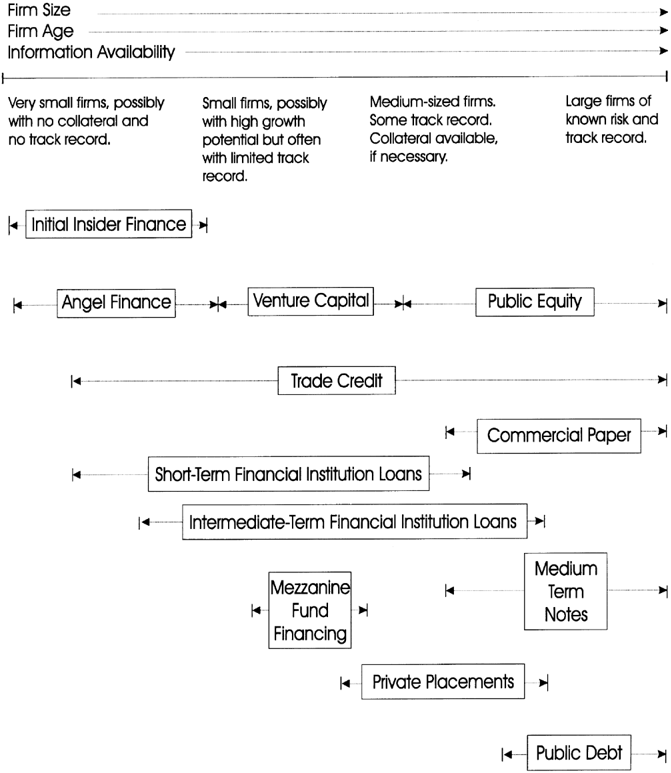
- The growth cycle paradigm predicts younger/more opaque firms rely on insider finance, trade credit, and angel finance, then venture capital and banks, and eventually public markets. However, 1993 NSSBF data show insider finance does not dominate external finance even for adolescents (upper bound 56.8% insider, roughly equal to external), and financial institution debt is important to very young firms, often based on personal guarantees or collateral.
- Macro vulnerability: the early-1990s credit crunch saw real C&I loans fall 23.2% ($596.7 billion to $458.2 billion) and estimated small business lending fall 38.5% ($143.7 billion to $88.4 billion). Banks with less than $100 million in assets held about 9% of portfolios in small business loans versus about 2% for banks over $10 billion; large banks charged about 100 basis points less and required collateral about 25% less often than small banks, other things equal.
Methods
- Design: review and synthesis organized around the financial growth cycle paradigm, covering theoretical and empirical literature on private equity and debt markets, contracts, and macroeconomic vulnerability.
- Data: primarily the 1993 National Survey of Small Business Finances (NSSBF) for US small business finance tables, plus other sources including NFIB, SCF, STBL, CALL, CRA, Venture Economics/VentureOne, and international data.
- Analysis: descriptive tabulations (Tables 1 and 2) and literature synthesis; the paper is a review rather than a new primary empirical study.
Limitations
- Paper-stated: Table 1 data are not completely accurate or consistent and should be considered rough estimates; angel finance estimates are imprecise (range $15 billion to $120 billion); 1993 data may not reflect current conditions; weighted averages mask considerable heterogeneity.
- Paper-stated: the growth cycle paradigm is not intended to fit all small businesses; firm size, age, and information availability are far from perfectly correlated, and the points at which different funding sources begin and end are not definitive.
- Evident from the text: informational opacity and the intertwining of personal and business finances make small business finance difficult to research, and data on owners’ finances are often unavailable; the paper relies heavily on existing literature and available data rather than new primary data collection.
Model-written summary. Check it against the paper before relying on it.
Integrity signals
Registry
Cites
Statistics
Figures
Verification
Claims the paper makes
22 Valid · 27 Not valid · 107 Not checked · 201 Own results and interpretations
Every source the paper cites for this claim was checked and supports it.
In the paper
“This use of personal assets to help with external ®nance also highlights another important aspect of small business ®nance ± the ®nancial intertwining of owners and their businesses (Ang, 1992).”
§ The economics of small business ®nance: The roles of private equity and debt markets in the ®nancial growth cycle > 2.3. The ®nancial growth cycle of small business
What the sources say
- Supportedcites Ang, 1992 matched to “On the Theory of Finance for Privately Held Firms” (1992) source
In “Integrating Personal and Business Accounts,” Ang says that personal guarantees or collateral make business risk inseparable from owners’ personal risk. “The Financing Decision” also identifies owners’ assets used for loan guarantees as contributions to the business. Together, these passages support the cited point that using personal assets to obtain external finance intertwines owners’ and businesses’ finances. (LLM, conf=0.94)
plainstates an association- Asserted: passes — The authors put it forward as true.
- Checkable: passes — It can be checked against evidence.
- Load-bearing: unclear — It is unclear whether the paper’s conclusions depend on it.
- Based: passes — The paper gives a reason why it holds.
- Supported
The cited sources support only part of this claim — read each source’s verdict below.
In the paper
“Costly state veri®cation (Townsend, 1979;Diamond, 1984) and adverse selection (Myers, 1984;Myers and Majluf, 1984;Nachman and Noe, 1994) arguments suggest the optimality of debt contracts after insider ®nance has been exhausted.”
§ The economics of small business ®nance: The roles of private equity and debt markets in the ®nancial growth cycle > 2.3. The ®nancial growth cycle of small business
What the sources say
- Partly supportedcites Townsend, 1979 matched to “Optimal contracts and competitive markets with costly state verification” (1979) sourceExperimental — accuracy not yet measured
Section 3 characterizes an optimal contract for a firm financing an investment project as a bond that defaults when returns fall below a threshold, supporting the costly-state-verification rationale for debt. The paper does not establish that debt becomes optimal only after insider finance has been exhausted. The adverse-selection citations in the sentence refer to other sources, not Townsend. (LLM, conf=0.85)
- Not checked — no full text of the sourcecites Diamond, 1984 matched to “Financial intermediation and delegated monitoring” (1984) source
- Not matchedcites Myers, 1984
More than one paper fits this citation.
hedgedstates a cause- Asserted: passes — The authors put it forward as true.
- Checkable: passes — It can be checked against evidence.
- Load-bearing: passes — The paper’s conclusions depend on it.
- Based: passes — The paper gives a reason why it holds.
- Partly supported
The cited sources support only part of this claim — read each source’s verdict below.
In the paper
“An agency problem arises in the relationship between the entrepreneur and the venture capitalist in which the entrepreneur may expend insucient eort, exhibit expense preference behavior, or lack sucient information or skill to make optimal production decisions.”
§ The economics of small business ®nance: The roles of private equity and debt markets in the ®nancial growth cycle > 3.2. The venture capital market
What the sources say
- Not checked — no full text of the sourcecites Cooper and Carleton, 1979 matched to “Dynamics of Borrower‐Lender Interaction: Partitioning Final Payoff in Venture Capital Finance” (1979) source
- Partly supportedcites Bergemann and Hege, 1998 matched to “Venture capital financing, moral hazard, and learning” (1998) sourceExperimental — accuracy not yet measured
Section 2.3, “Moral hazard and financing,” describes an entrepreneur who may reduce costly effort or divert investment funds to private ends, supporting the insufficient-effort and expense-preference parts of the claim. It does not identify a lack of the entrepreneur’s information or skill as a cause of poor production decisions; it instead says the entrepreneur and venture capitalists initially have the same assessment of the project. (LLM, conf=0.88)
hedgedstates a possible cause- Asserted: passes — The authors put it forward as true.
- Checkable: passes — It can be checked against evidence.
- Load-bearing: passes — The paper’s conclusions depend on it.
- Based: passes — The paper gives a reason why it holds.
Every source the paper cites for this claim was checked and supports it.
In the paper
“Since 1990, this share has about doubled to 30% (Fenn et al., 1997).”
§ The economics of small business ®nance: The roles of private equity and debt markets in the ®nancial growth cycle > 3. The role of private equity markets in small business ®nance
What the sources say
- Supportedcites Fenn et al., 1997 matched to “The Private Equity Market: An Overveiw” (1997) source
In “IPO Firms that Received Private Equity Backing,” the paper states that the share of IPOs with venture backing averaged 15% during the 1980s and doubled to 30% since 1990. This directly supports the cited claim. (LLM, conf=0.95)
plainstates an association- Asserted: passes — The authors put it forward as true.
- Checkable: passes — It can be checked against evidence.
- Load-bearing: unclear — It is unclear whether the paper’s conclusions depend on it.
- Based: passes — The paper gives a reason why it holds.
- Supported
The cited sources support only part of this claim — read each source’s verdict below.
In the paper
“During the 1980s, approximately 15% of all IPOs were backed by venture capital, well out of proportion to the fraction of all ®rms that received venture capital.”
§ The economics of small business ®nance: The roles of private equity and debt markets in the ®nancial growth cycle > 3. The role of private equity markets in small business ®nance
What the sources say
- Partly supportedcites Fenn et al., 1997 matched to “The Private Equity Market: An Overveiw” (1997) sourceExperimental — accuracy not yet measured
The section “IPO Firms that Received Private Equity Backing” states that venture-backed IPOs averaged 15% of IPOs during the 1980s. It does not give the fraction of all firms that received venture capital or make the claimed comparison with that fraction. (LLM, conf=0.84)
plainstates an association- Asserted: passes — The authors put it forward as true.
- Checkable: passes — It can be checked against evidence.
- Load-bearing: unclear — It is unclear whether the paper’s conclusions depend on it.
- Based: passes — The paper gives a reason why it holds.
- Partly supported
184 more claims · 6 with their cited sources checked
Create a free account to see all 357 claims and to verify the 12 references still open.
- Probably not a substantial claim. 94
- It may state two separate claims as one. 87
- Borderline: one of the tests for a substantial claim is unclear. 2
Claims other papers make about this one
Each is checked against this paper’s own text: does it say what the citing paper says it does?
The cited source says what the claim attributes to it.
In the citing paper
“SMEs are more dependent on external financing supplied by commercial banks (Berger and Udell 1998) because most of them are not qualified to raise money from the stock market.”
From Local Bank, Digital Financial Inclusion and SME Financing Constraints: Empirical Evidence from China (2022) · cites this paper as Berger and Udell 1998
Self-check
Percentages, sums and reported differences re-computed from the paper’s own numbers.
Rated minor: it would not touch a result — a value no result rests on, a p-value that stays on the same side of the significance level, or a conflict that is clerical, resolved elsewhere in the paper, or outside its own findings.
In the paper
“Non®nancial business/government debt provides 19.26% of small business funding (mostly trade credit)”
§ The economics of small business ®nance: The roles of private equity and debt markets in the ®nancial growth cycle > 4. The role of private debt markets in small business ®nance
Reported 19.26 · recomputed 18.01
Citations
Cites
Corporate financing and investment decisions when firms have information that investors do not have
Myers, S. C., & Majluf, N. S. (1984) · Journal of Financial Economics · doi:10.1016/0304-405x(84)90023-0 · Cited by 18,957
The Cost of Capital, Corporation Finance and the Theory of Investment
Miller, M. H. (1958) · American Economic Review · Cited by 14,574
Determinants of corporate borrowing
Myers, S. C. (1977) · Journal of Financial Economics · doi:10.1016/0304-405x(77)90015-0 · Cited by 13,169
Credit Rationing in Markets with Imperfect Information
Stiglitz, J. E., & Weiss, A. (1981) · Columbia University · doi:10.7916/d8v12ft1 · Cited by 12,769 · cited 1×
“…pledging outside collateral may help resolve adverse selection problems when the borrower has more information about the quality of the investment than the lender, and may help prevent credit rationing (Stiglitz and Weiss 1981, 1986, Bester 1985, Chan and Kanatas 1985, Besanko and Thakor 1987a,b).”
The cost of capital, corporation finance and the theory of investment
Terra, P. R. (2008) · Revista de Administração e Contabilidade da Unisinos · doi:10.4013/base.20082.07 · Cited by 8,615
Financial intermediation and delegated monitoring
Diamond, D. W. (1984) · The Review of Economic Studies · doi:10.2307/2297430 · Cited by 8,476 · cited 2×
“Costly state verification (Townsend 1979, Diamond 1984) and adverse selection (Myers 1984, Myers and Majluf 1984, Nachman and Noe 1994) arguments suggest the optimality of debt contracts after insider cFor example, there are generally accepted definitions of the stages of finance for the kind of…”
Corporate Financing and Investment Decisions When Firms Have InformationThat Investors Do Not Have
Myers, S., & Majluf, N. (1984) · doi:10.3386/w1396 · Cited by 6,745
The Benefits of Lending Relationships: Evidence from Small Business Data
PETERSEN, M. A., & RAJAN, R. G. (1994) · The Journal of Finance · doi:10.1111/j.1540-6261.1994.tb04418.x · Cited by 5,440 · cited 4×
“…whereas mortgages, equipment loans, motor vehicle loans, and other loans may more often be transactionsdriven .zs It was also found that dependence on trade credit decreased with the length of the banking relationship, supporting the value of relationship lending (Petersen and Rajan 1994, 1995).”
InfluentialInside the black box: the credit channel of monetary policy transmission
Bernanke, B. S., & Gertler, M. (1995) · Journal of Economic Perspectives · doi:10.1257/jep.9.4.27 · Cited by 4,211
Insiders and Outsiders: The Choice between Informed and Arm's‐Length Debt
RAJAN, R. G. (1992) · The Journal of Finance · doi:10.1111/j.1540-6261.1992.tb04662.x · Cited by 3,902 · cited 1×
“Some research suggests that these firms may try to reduce the control of their banks by issuing public debt, even though public debt may entail higher costs (Diamond 1991, 1993, Rajan 1992, Houston and James 1996).”
Research works printed but not linked: 11
- 66. Cook, L., 1997. Trade ®nance, bank ®nance, and capital market imperfections. Working paper. Harvard University, Cambridge, MA.
- 89. Freear, J., Sohl, J.E., Wetzel, W.E., Jr., 1994. The private investor market for venture capital. The Financier 1, 7±19.
- 112. Hancock, D., Wilcox, J.A., 1997. Bank capital, nonbank ®nance, and real estate activity. Journal of Housing Research 8, 75±105.
- 117. Hempel, G., Coleman, A., Simonson, D., 1986. Bank Management, Wiley, New York.
- 119. Ho, R., 1997. Credit-card use to ®nance small business is soaring, says survey of small ®rms. Wall Street Journal B2, Sept. 25.
- 153. Megginson, W.L., Weiss, K.A., 1991. Venture capitalist certi®cation in initial public oerings. Journal of Finance 46, 903±979.
- 162. Morsman Jr., E., 1986. Commercial loan structuring. Journal of Commercial Bank Lending 68, 2± 20.
- 187. Ravid, S.A., 1996. Debt maturity ± A survey. Financial Markets, Institutions and Instruments 5 (3), 1±68.
- 217. Wetzel Jr. W.E., 1994. Venture capital. In: Bygrave, W.D. (Ed.), Portable MBA in Entrepreneur- ship. Wiley, New York, pp. 172±194.
- 219. White, L.J., 1995. An analytical framework. In: Zahid, S.N. (Ed.), Financial Sector Development in Asia. Oxford University Press, New York, pp. 3±35.
- 222. McKean, R. (Ed.), Issues in Defense Economics. Columbia University Press, New York.
Cited by
Items 201–300 of 3,739
Cross Border Venture Capital Investment: A Network of Emerging Trust
Hain, D. S., Johan, S., & Wang, D. (2014) · Journal of Business Ethics · doi:10.1007/s10551-015-2772-4 · Cited by 174
“In the case of start-ups, this problem is further amplified as historical data enabling the projection of future performance are neither available for the applied technology nor the firm (Berger and Frame 2007; Berger and Udell 1998; Berger and Udell 2002; Freel 1999, 2000, 2007).”
The Determinants of Financial Structure: New Insights from Business Start‐ups
Huyghebaert, N., & Gucht, L. M. V. D. (2007) · European Financial Management · doi:10.1111/j.1468-036x.2006.00287.x · Cited by 224
An empirical evidence of small business financing in China
Wu, J., Song, J., & Zeng, C. (2008) · Management Research News · doi:10.1108/01409170810920666 · Cited by 147
Capital structure in new technology-based firms: Evidence from the Irish software sector
Hogan, T., & Hutson, E. (2005) · Global Finance Journal · doi:10.1016/j.gfj.2004.12.001 · Cited by 153
Hervé, F., & Schwienbacher, A. (2018) · Journal of Economic Surveys · doi:10.1111/joes.12274 · Cited by 173
The Differential Impact of Leverage on the Default Risk of Small and Large Firms
Cathcart, L., Dufour, A., Rossi, L., & Varotto, S. (2018) · Journal of Corporate Finance · doi:10.1016/j.jcorpfin.2019.101541 · Cited by 203
Determinants of capital structure: evidence from Malaysian firms
Saif-Alyousfi, A. Y. H., Md-Rus, R., Mohd, K. N. T., Taib, H. M., & Shahar, H. K. (2020) · Asia-Pacific Journal of Business Administration · doi:10.1108/apjba-09-2019-0202 · Cited by 226
Firm Level Investment and R&D in France and the United States: A Comparison
Mulkay, B., Hall, B. H., & Mairesse, J. (2001) · Springer eBooks · doi:10.1007/978-3-642-56601-1_19 · Cited by 179
A Theory of ICOs: Diversification, Agency, and Information AsymmetryPreprint
Chod, J., & Lyandres, E. (2018) · SSRN Electronic Journal · doi:10.2139/ssrn.3159528 · Cited by 141
“8Debt financing is typically not a viable option for entrepreneurial ventures lacking collateral and stable cash flows (e.g., Berger and Udell (1998)).”
BackgroundGorton, G., & Winton, A. (2002) · National Bureau of Economic Research · doi:10.3386/w8928 · Cited by 193
The importance of equity finance for R&D activity
Mueller, E., & Zimmermann, V. (2008) · Small Business Economics · doi:10.1007/s11187-008-9098-x · Cited by 174
“Also, young companies generally have less collateral available to pledge to banks (Berger and Udell 1998).”
The Importance of Angel Investing in Financing the Growth of Entrepreneurial Ventures
Shane, S. A. (2012) · Quarterly Journal of Finance · doi:10.1142/s2010139212500097 · Cited by 140
Foundations of High Impact Entrepreneurship
Ács, Z. J. (2008) · Foundations and Trends® in Entrepreneurship · doi:10.1561/0300000025 · Cited by 170
Seghers, A., Manigart, S., & Vanacker, T. R. (2011) · Journal of Small Business Management · doi:10.1111/j.1540-627x.2011.00344.x · Cited by 190
Entrepreneurship Capital and Economic Performance
Audretsch, D. B., Keilbach, M., & Lehmann, E. E. (2006) · Oxford University Press eBooks · doi:10.1093/acprof:oso/9780195183511.003.0004 · Cited by 142
A Survey of Venture Capital ResearchPreprint
Rin, M. D., Hellmann, T. F., & Puri, M. (2011) · SSRN Electronic Journal · doi:10.2139/ssrn.1942821 · Cited by 139
Financial Integration and Firm Performance: Evidence from Foreign Bank Entry in Emerging MarketsPreprint
Giannetti, M., & Ongena, S. R. G. (2005) · SSRN Electronic Journal · doi:10.2139/ssrn.669421 · Cited by 139
Does the Financial Crisis Change the Effect of Financing on Investment? Evidence From Private SMEs
Zubair, S. M., Kabir, R., & Huang, X. (2019) · Journal of Business Research · doi:10.1016/j.jbusres.2020.01.063 · Cited by 178
Bootstrap financing and owners’ perceptions of their business constraints and opportunities
Carter, R. B., & Auken, H. V. (2005) · Entrepreneurship and Regional Development · doi:10.1080/08985620500067548 · Cited by 185
“About 49.6% of US small business financing comes from equity and about 50.4% from debt (Berger and Udell 1998).”
BackgroundInfluentialFinancing patterns of European SMEs – an empirical taxonomy
Moritz, A., Block, J., & Heinz, A. (2016) · Venture Capital · doi:10.1080/13691066.2016.1145900 · Cited by 182
“Informal financing is more important early in the companies’ life and will be replaced with more formal financing when companies mature (Berger and Udell 1998; Chavis et al. 2011; Cosh et al. 2009; Huyghebaert and van de Gucht 2007).”
InfluentialEntrepreneurial risk taking: empirical evidence from UK family firms
Wang, Y., & Poutziouris, P. Z. (2010) · International Journal of Entrepreneurial Behaviour & Research · doi:10.1108/13552551011071841 · Cited by 163
“) or family loans, therefore easing the firm from financial anaemia ( Berger and Udell, 1998”
BackgroundThe Multiple Effects of Business Planning on New Venture Performance
Burke, A., Fraser, S., & Greene, F. J. (2010) · Journal of Management Studies · doi:10.1111/j.1467-6486.2009.00857.x · Cited by 173
“However, as in the UK, the main external source of finance is bank loans (16 per cent), with only a very small percentage using venture capital (Berger and Udell, 1998).”
BackgroundHasan, I., Jackowicz, K., Kowalewski, O., & Kozłowski, Ł. (2017) · Journal of Banking & Finance · doi:10.1016/j.jbankfin.2017.03.009 · Cited by 135
The problem of private under-investment in innovation: A policy mind map
Peneder, M. (2008) · Technovation · doi:10.1016/j.technovation.2008.02.006 · Cited by 147
“As a consequence, the optimal (or feasible) capital structure typically changes over time, as a firm increases in size and age (Berger and Udell, 1998; Myers, 2001). Due to the high degree of informational opacity and the associated problems of asymmetric information, young and small start-up companies initially rely…”
InfluentialCumming, D. J., Fleming, G. A., & Schwienbacher, A. (2009) · Journal of Business Finance & Accounting · doi:10.1111/j.1468-5957.2009.02137.x · Cited by 143
“kinds of institutional investors ( Berger and Udell, 1998, Gompers and Lerner, 1999, Cressy, 2002,”
Capital Structure, Corporate Taxation and Firm Age*
Pfaffermayr, M., Stöckl, M., & Winner, H. (2013) · Fiscal Studies · doi:10.1111/j.1475-5890.2013.00179.x · Cited by 149
“Trade credits are typically used by younger firms, especially to cope with short-term liquidity shortages (see Berger and Udell 1998).”
InfluentialThe Gender Gap in Bank Credit Access
de Andrés, P., Gimeno, R., & de Cabo, R. M. (2019) · Journal of Corporate Finance · doi:10.1016/j.jcorpfin.2020.101782 · Cited by 181
The pecking order hypothesis: does it apply to start‐up firms?
Stuart, P., Whittam, G., & Wyper, J. (2007) · Journal of Small Business and Enterprise Development · doi:10.1108/14626000710727854 · Cited by 188
The international evidence on discouraged small businesses
Chakravarty, S., & Xiang, M. (2012) · Journal of Empirical Finance · doi:10.1016/j.jempfin.2012.09.001 · Cited by 152
The Role of Debt and Equity Finance Over the Business Cycle
Covas, F. B., & Haan, W. J. D. (2012) · The Economic Journal · doi:10.1111/j.1468-0297.2012.02528.x · Cited by 131
“See Berger and Udell (1998).”
Bank Financing for SMEs – Lessons from the Literature
Beck, T. (2013) · National Institute Economic Review · doi:10.1177/002795011322500105 · Cited by 204
Bank Consolidation and Small Business Lending: The Role of Community Banks
Avery, R. B., & Samolyk, K. A. (2004) · Journal of Financial Services Research · doi:10.1023/b:fina.0000020667.29802.1c · Cited by 154
The Business Model and Firm Performance: The Case of Russian Food Service Ventures
Morris, M. H., Shirokova, G., & Shatalov, A. (2012) · Journal of Small Business Management · doi:10.1111/j.1540-627x.2012.00377.x · Cited by 157
“Research has demonstrated that entrepreneurs working in this industry are oriented first and foremost toward their own funds and the investments of friends and acquaintances (Berger and Udell 1998).”
BackgroundSME Financing in Emerging Markets: Firm Characteristics, Banking Structure and Institutions
Dong, Y., & Men, C. (2014) · Emerging Markets Finance and Trade · doi:10.2753/ree1540-496x500107 · Cited by 185
Entrepreneurial finance: Unifying themes and future directions
Cumming, D. J., & Groh, A. P. (2018) · Journal of Corporate Finance · doi:10.1016/j.jcorpfin.2018.01.011 · Cited by 178
Stock market listing and the use of trade credit: Evidence from public and private firms
Abdulla, Y., Dang, V. A., & Khurshed, A. (2017) · Journal of Corporate Finance · doi:10.1016/j.jcorpfin.2017.08.004 · Cited by 146
Opacity of young businesses: Evidence from rating disagreements
Hyytinen, A., & Pajarinen, M. (2007) · Journal of Banking & Finance · doi:10.1016/j.jbankfin.2007.10.006 · Cited by 155
Small Business and Debt Finance
Berger, A. N., & Udell, G. F. (2005) · Springer eBooks · doi:10.1007/0-387-24519-7_13 · Cited by 156
Self-citationStrengths and Weaknesses of Academic Startups: A Conceptual Model
Colombo, M. G., & Piva, E. (2008) · IEEE Transactions on Engineering Management · doi:10.1109/tem.2007.912807 · Cited by 160
“On the other hand, venture capitalists typically invest after firms’ products have been successfully test marketed [63].”
BackgroundSovereign stress and SMEs’ access to finance: Evidence from the ECB's SAFE survey
Ferrando, A., Popov, A. A., & Udell, G. F. (2017) · Journal of Banking & Finance · doi:10.1016/j.jbankfin.2017.04.012 · Cited by 147
Self-citationWhich criteria matter when impact investors screen social enterprises?
Block, J., Hirschmann, M., & Fisch, C. O. (2020) · Journal of Corporate Finance · doi:10.1016/j.jcorpfin.2020.101813 · Cited by 160
Cumming, D. J., Kumar, S., Lim, W. M., & Pandey, N. (2022) · Small Business Economics · doi:10.1007/s11187-022-00684-9 · Cited by 170
“Berger and Udell (1998) study the role of venture capital in the financial growth cycle of small firms.”
BackgroundFinance and Inequality: Channels and EvidencePreprint
Claessens, S., & Perotti, E. C. (2007) · SSRN Electronic Journal · doi:10.2139/ssrn.998468 · Cited by 125
The Effects of COVID-19 on U.S. Small Businesses: Evidence from Owners, Managers, and Employees
Alekseev, G., Amer, S. R., Gopal, M., Kuchler, T., Schneider, J. W., Stroebel, J., & Wernerfelt, N. (2020) · Management Science · doi:10.1287/mnsc.2022.4327 · Cited by 121
Regulatory harmonization and the development of private equity markets
Cumming, D. J., & Johan, S. (2007) · Journal of Banking & Finance · doi:10.1016/j.jbankfin.2007.01.010 · Cited by 150
The Value Added from Investment Managers: An Examination of Funds of REITs
Kallberg, J. G., Liu, C. L., & TRZCINKA, C. A. (2000) · Journal of Financial and Quantitative Analysis · doi:10.2307/2676210 · Cited by 137
Purchase Order Financing: Credit, Commitment, and Supply Chain Consequences
Reindorp, M. J., Tanrısever, F., & Lange, A. (2018) · Operations Research · doi:10.1287/opre.2018.1727 · Cited by 122
“Boyabatli and Toktay (2011) investigate technology choice with endogenous interest rates and show how the result is conditioned by capital market frictions.”
BackgroundCSR performance and the cost of debt: does audit quality matter?
Bacha, S., Ajina, A., & Saad, S. B. (2020) · Corporate Governance · doi:10.1108/cg-11-2019-0335 · Cited by 175
Wang, Y., & Ahmed, P. K. (2009) · The Journal of Strategic Information Systems · doi:10.1016/j.jsis.2008.11.001 · Cited by 140
“They have to primarily rely on internal capital, such as personal equity (Peterson and Schulman, 1987), family loan and trade credit (Berger and Udell, 1998; Romano et al., 2000), whilst the provision of finance through these channels is often insufficient. Under this regime, the firms’ eCommerce aspiration may eventu…”
BackgroundInfluentialSMEs, foreign direct investment and financial constraints: The case of Belgium
Maeseneire, W. D., & Claeys, T. (2011) · International Business Review · doi:10.1016/j.ibusrev.2011.03.004 · Cited by 171
A conceptual framework for identifying financing preferences of SMEs
Kumar, S., & Ps, R. (2015) · Small Enterprise Research · doi:10.1080/13215906.2015.1036504 · Cited by 174
“However, equity finance is the most suitable form of finance available to young and small firms (Berger & Udell, 1998).”
BackgroundBurgstaller, J., & Wagner, E. (2015) · The Journal of Risk Finance · doi:10.1108/jrf-06-2014-0091 · Cited by 169
The impact of venture capital on innovation behaviour and firm growth
Peneder, M. (2010) · Venture Capital · doi:10.1080/13691061003643250 · Cited by 172
“Therefore, as a rule, entrepreneurs who can meet their capital needs using other sources will generally do so (Berger and Udell, 1998; Bozkaya and van Pottelsberghe, 2008).”
The cost of growth: small firms and the pricing of bank loans
Rostamkalaei, A., & Freel, M. (2015) · Small Business Economics · doi:10.1007/s11187-015-9681-x · Cited by 166
“…equation, we try to consider not only the variables that ease access to loans (e.g. firm size, asset base, and legal status) (Beck and DemirgucKunt 2006; Berger and Udell 1998, 2006; Freel 2007), but also variables that may affect the demand for loans (e.g. export activity, innovation, and recent…”
InfluentialGrilli, L., & Murtinu, S. (2013) · Industrial and Corporate Change · doi:10.1093/icc/dtu025 · Cited by 130
“fact, debt capital is not the most suited financing mode for NTBFs (Berger and Udell, 1998).”
Bank debt and trade credit for SMEs in Europe: firm-, industry-, and country-level determinants
Andrieu, G., Staglianò, R., & van der Zwan, P. (2017) · Small Business Economics · doi:10.1007/s11187-017-9926-y · Cited by 148
Giraudo, E., Giudici, G., & Grilli, L. (2019) · Research Policy · doi:10.1016/j.respol.2019.05.010 · Cited by 169
Equity Crowdfunding: High-Quality or Low-Quality Entrepreneurs?
Blaseg, D., Cumming, D. J., & Koetter, M. (2020) · Entrepreneurship Theory and Practice · doi:10.1177/1042258719899427 · Cited by 148
“First, external sources of capital, such as banks, are a source of governance for entrepreneurs (Berger & Udell, 1998).”
BackgroundDávila, A. F., FOSTER, G. J., & Jia, N. (2014) · European Accounting Review · doi:10.1080/09638180.2014.965720 · Cited by 162
“The financial growth cycle model (Berger & Udell, 1998) suggests that small businesses have different optimal capital structures and financing options at different organisational stages.”
Is there Ethnic Discrimination in the UK Market for Small Business Credit?
Fraser, S. (2009) · International Small Business Journal Researching Entrepreneurship · doi:10.1177/0266242609338756 · Cited by 154
“may be imperfect and asymmetric with entrepreneurs being typically better informed about their chances of success/failure than outsiders (see e.g., Berger and Udell, 1998 )ii.”
BackgroundClatworthy, M. A., & Peel, M. J. (2013) · Journal of Accounting and Public Policy · doi:10.1016/j.jaccpubpol.2013.02.005 · Cited by 149
Xie, Z., Wang, X., Xie, L., & Duan, K. (2021) · Journal of Business Research · doi:10.1016/j.jbusres.2021.02.015 · Cited by 144
Potential Competitive Effects of Basel II on Banks in SME Credit Markets in the United States
Berger, A. N. (2006) · Journal of Financial Services Research · doi:10.1007/s10693-005-5106-3 · Cited by 131
Self-citationBrinckmann, J., & Hoegl, M. (2011) · Strategic Entrepreneurship Journal · doi:10.1002/sej.106 · Cited by 155
Beck, T., & Cull, R. (2014) · Journal of African Economies · doi:10.1093/jae/eju016 · Cited by 217
The effect of public subsidies on firms’ investment–cash flow sensitivity: Transient or persistent?
Colombo, M. G., Croce, A., & Guerini, M. (2013) · Research Policy · doi:10.1016/j.respol.2013.07.003 · Cited by 142
Bank Financing in China’s Private Sector: The Payoffs of Political Capital
Zhou, W. (2009) · World Development · doi:10.1016/j.worlddev.2008.07.011 · Cited by 132
“To deal with the information asymmetry problem, one important contracting method often used by banks is relationship lending (Berger & Udell, 1998; IFC, 2000).”
MethodVarieties of entrepreneurship: institutional drivers across entrepreneurial activity and country
Chowdhury, F., Terjesen, S. A., & Audretsch, D. B. (2014) · European Journal of Law and Economics · doi:10.1007/s10657-014-9464-x · Cited by 143
“Financial institutions are less likely to lend money to entrepreneurs because of the high risk associated with the endeavor and the lack of information (Berger and Udell 1998).”
BackgroundAlodat, A. Y., & Hao, Y. (2024) · Sustainable Development · doi:10.1002/sd.3126 · Cited by 168
Gartner, W. B., Frid, C. J., & Alexander, J. C. (2011) · Small Business Economics · doi:10.1007/s11187-011-9359-y · Cited by 150
“of credit and loans, personal guarantees, relationship lending, and shorter maturities on debt contracts to shield lenders from shifting risk profiles all serve to diminish the high information asymmetries between new ventures and lenders (Berger and Udell, 2003). Other studies have analyzed the capital structure choi…”
Board Characteristics and Firm Performance: Evidence from New Zealand
Bathula, H. (2011) · Tuwhera (Auckland University of Technology) · Cited by 200
Bank–Firm Relationships: Do Perceptions Vary by Gender?
Saparito, P. A., Elam, A. B., & Brush, C. G. (2013) · Entrepreneurship Theory and Practice · doi:10.1111/j.1540-6520.2012.00524.x · Cited by 123
“The growth rate of sales may signal the health of a firm as well as the potential future business for the bank (Berger & Udell, 1998; Berlin & Mester, 1998).”
BackgroundInfluentialFinancial reporting quality and the cost of debt of SMEs
Bauwhede, H. V., Meyere, M. D., & Cauwenberge, P. V. (2015) · Small Business Economics · doi:10.1007/s11187-015-9645-1 · Cited by 146
The Past, Present, and Probable Future for Community BanksPreprint
DeYoung, R. E., Hunter, W. C., & Udell, G. F. (2004) · SSRN Electronic Journal · doi:10.2139/ssrn.446961 · Cited by 110
“28 See Berger and Udell (1998) and Boot (2000) for a more detailed discussion and reviews of the literature on relationship lending.”
InfluentialSelf-citationYoung family firms: Financing decisions and the willingness to dilute control
Keasey, K., Martínez, B., & Pindado, J. (2015) · Journal of Corporate Finance · doi:10.1016/j.jcorpfin.2015.07.014 · Cited by 111
“Similarly, different capital structures are optimal at different stages (Berger and Udell, 1998), because of changes in firm characteristics that in turn represent a change in its”
BackgroundNorth, D., Baldock, R., & Ullah, F. (2013) · Venture Capital · doi:10.1080/13691066.2013.804755 · Cited by 116
“In their seminal paper on the financing of small businesses, Berger and Udell (1998) explain how the financial needs and options of small firms change as they become ‘less informationally opaque’ to potential finance providers.”
BackgroundVenture Debt Financing: Determinants of the Lending Decision
de Rassenfosse, G., & Fischer, T. (2011) · Strategic Entrepreneurship Journal · doi:10.1002/sej.1220 · Cited by 145
“See also Brophy and Shulman (1993), Berger and Udell (1998), Carpenter and Petersen (2002), Tykvova (2007) and de Bettignies (2008) among others.”
Adair, P., & Adaskou, M. (2015) · Cogent Economics & Finance · doi:10.1080/23322039.2015.1006477 · Cited by 174
De-segmenting research in entrepreneurial finance
Cumming, D. J., & Vismara, S. (2016) · Venture Capital · doi:10.1080/13691066.2016.1225910 · Cited by 145
“This is mainly due to the fact that debt holders bear the downside risk, but do not share the upside of successful innovation (Berger and Udell, 1998).”
Financial Flexibility and Investment Ability Across the Euro Area and the UK
Ferrando, A., Marchica, M., & Mura, R. (2016) · European Financial Management · doi:10.1111/eufm.12091 · Cited by 146
“Private companies (e.g., Brav, 2009; Saunders and Steffen, 2011), small-sized (Berger and Udell, 1998 and 2006), and young firms (e.g., Rauh, 2006; Fee et al., 2009) face different and often more severe financing problems than do public, large, and more mature companies.”
The Effects of Financial Literacy on Sustainable Entrepreneurship
Burchi, A., Włodarczyk, B., Szturo, M., & Martelli, D. (2021) · Sustainability · doi:10.3390/su13095070 · Cited by 222
“A vast amount of literature has documented that the ability to access the necessary external funding is a catalyst for entrepreneurship [30,31].”
BackgroundEntrepreneurship and Public Policy
Henrekson, M., & Stenkula, M. (2010) · Springer eBooks · doi:10.1007/978-1-4419-1191-9_21 · Cited by 160
Small Firms' Demand for Finance: A Research Note
Howorth, C. (2001) · International Small Business Journal Researching Entrepreneurship · doi:10.1177/0266242601194005 · Cited by 113
Hussain, J., Mahmood, S., & Scott, J. M. (2018) · Journal of International Development · doi:10.1002/jid.3403 · Cited by 142
Wang, Z., Akbar, M., & Akbar, A. (2020) · Sustainability · doi:10.3390/su12041661 · Cited by 105
“Studies also contend that the corporate life cycle (CLC) stage has a strong impact on its operating performance [17], financing [18], investment [19] and bankruptcy risk [20].”
BackgroundSmall Business Reliance on Bank Financing in Ghana
Abor, J. Y., & Biekpe, N. B. (2007) · Emerging Markets Finance and Trade · doi:10.2753/ree1540-496x430405 · Cited by 140
Du, J., Guariglia, A., & Newman, A. (2015) · Entrepreneurship Theory and Practice · doi:10.1111/etap.12051 · Cited by 128
“This may result from the fact that spending on entertaining and gift giving may impact the financial position of SMEs, preventing them from accumulating sufficient assets which may be pledged as collateral against long-term debt (Bhabra et al., 2008; Li et al., 2009).”
Background‘Why Even Bother Trying?’ Examining Discouragement among Racial‐Minority Entrepreneurs
Neville, F., Forrester, J. K., O’Toole, J., & Riding, A. (2017) · Journal of Management Studies · doi:10.1111/joms.12319 · Cited by 130
Unlocking finance for social tech start-ups: Is there a new opportunity space?
Arena, M., Bengo, I., Calderini, M., & Chiodo, V. (2017) · Technological Forecasting and Social Change · doi:10.1016/j.techfore.2017.05.035 · Cited by 153
SMEs capital structure: trade-off or pecking order theory: a systematic review
Martínez, L. B., Scherger, V., & Guercio, M. (2018) · Journal of Small Business and Enterprise Development · doi:10.1108/jsbed-12-2017-0387 · Cited by 166
Capital Market Imperfections, High-Tech Investment, and New Equity FinancingPreprint
Petersen, B. C., & Carpenter, R. E. (2002) · SSRN Electronic Journal · Cited by 115
Financing new venture exporters
Riding, A., Orser, B., Spence, M. M., & Belanger, B. (2010) · Small Business Economics · doi:10.1007/s11187-009-9259-6 · Cited by 135
“This is important because firms seeking relatively small loans typically face higher transaction costs and higher risk premiums because they may be more informationally opaque ( Berger and Udell 1998; Beck et al. 2006).”
BackgroundGovernance mechanisms, investment opportunity set and SMEs cash holdings
Belghitar, Y., & Khan, J. (2011) · Small Business Economics · doi:10.1007/s11187-011-9366-z · Cited by 126
“Small firms are described as suffering from severe exposure to informational asymmetries (Berger and Udell 1998).”
BackgroundShort-term Debt in Spanish SMEs
García‐Teruel, P. J., & Solano, P. M. (2007) · International Small Business Journal Researching Entrepreneurship · doi:10.1177/0266242607082523 · Cited by 122
“The most representative characteristic of smaller fi rms, and the greatest difference between them and larger firms, is their greater information opacity (Berger and Udell, 1998). When we combine this with the coincidence of ownership and control and their greater operational fl exibility, we see that small fi rms pre…”
InfluentialBrown, R., Mawson, S., Rowe, A., & Mason, C. M. (2017) · International Small Business Journal Researching Entrepreneurship · doi:10.1177/0266242617729743 · Cited by 133
“8 against (Berger and Udell, 1998; Carpenter and Petersen, 2002) and absence of a credit track record (Binks and Ennew, 1996) combined with the lending technologies utilised by banks (Berger and Black, 2011) means that they are often unable to access debt finance.”
InfluentialThe Effect of Venture Capital Financing on the Sensitivity to Cash Flow of Firm's Investments
Bertoni, F., Colombo, M. G., & Croce, A. (2010) · European Financial Management · doi:10.1111/j.1468-036x.2008.00463.x · Cited by 119
“On the other hand, most of their assets are firm-specific or intangible and hence cannot be pledged as collateral (Berger and Udell, 1998; Carpenter and Petersen, 2002a; Denis, 2004).”
On the adjustment speed of SMEs to their optimal capital structure
Aybar, C., Casino-Martínez, A., & López‐Gracia, J. (2011) · Small Business Economics · doi:10.1007/s11187-011-9327-6 · Cited by 111
“These results roughly corroborate previous empirical research on SME capital structure (see Berger and Udell 1998; Michaelas et al. 1999; Sogorb 2005).”
ResultIs Age a Determinant of SMEs’ Financing Decisions? Empirical Evidence Using Panel Data Models
Serrasqueiro, Z., & Nunes, P. M. (2011) · Entrepreneurship Theory and Practice · doi:10.1111/j.1540-6520.2010.00433.x · Cited by 140
What is Fueling FinTech Lending? The Role of Banking Market StructurePreprint
Balyuk, T., Berger, A. N., & Hackney, J. (2020) · SSRN Electronic Journal · doi:10.2139/ssrn.3633907 · Cited by 102
Self-citationWhat's in a relationship? The case of commercial lending
Udell, G. F. (2008) · Business Horizons · doi:10.1016/j.bushor.2007.10.005 · Cited by 143
Self-citation
Metadata
- Authors
- N. Berger, A., & F. Udell, G.
- Venue
- Journal of Banking & Finance
- Publisher
- Elsevier BV
- Published
- 1998-08
- Volume
- 22
- Issue
- 6-8
- Pages
- 613-673
- ISSN
- 0378-4266 (ISSN-L)
- OpenAlex
- W2119780569
- Semantic Scholar
- dfc06f7f7eb83d2c0e2a1d67ecb95b520a406843
- Cited by
- 3,690
- References
- 230
- Citations by year
- 2026: 136 · 2025: 148 · 2024: 144 · 2023: 193 · 2022: 155 · 2021: 211 · 2020: 200 · 2019: 156 · 2018: 208 · 2017: 174 · 2016: 186 · 2015: 187 · 2014: 168 · 2013: 177 · 2012: 171
- FWCI
- 169.26
- Type
- journal article
- Language
- en
- Open access
- hybrid
- doi.org
- Licence
- cc-by-nc-nd
- www.elsevier.com/tdm/userlicense/1.0/ (tdm)
- www.elsevier.com/legal/tdmrep-license (tdm)
- creativecommons.org/licenses/by-nc-nd/4.0/ (vor, 125 d)
- Locations
- Journal of Banking & Finance (publishedVersion, cc-by-nc-nd)
- RePEc: Research Papers in Economics (submittedVersion)
- Funders
- York University
- Topics
- Social Sciences › Economics, Econometrics and Finance › Finance › Private Equity and Venture Capital
- Social Sciences › Economics, Econometrics and Finance › Finance › Corporate Finance and Governance
- Social Sciences › Economics, Econometrics and Finance › Finance › Banking stability, regulation, efficiency
- Keywords
- small business financing, private equity, debt markets, capital structure, firm size, firm age, macroeconomic conditions
About these checks
Registry, retraction, Cites and statistics results are computed, not judged, with one exception: a printed reference that no index lists is read once by a model before it counts as a citation error. Claims are extracted by a model and kept only when their quote appears verbatim in the text; each cited source is then checked, with a model’s help, for whether it says what the claim relies on. Those verdicts can be wrong — read the claim’s quote and the cited source before relying on one.
The claim verdicts this report counts are experimental: their accuracy is not yet measured.
A language model drew the claims from the paper on 2026-10-10, under version 3 of the claim definition (model deepseek-v4.1-flash, prompt extract-v3).
A second model labelled each claim on 2026-10-10 (model jev-1.13-20260917, definition revision gold-guideline-v0.2).
Cited sources are checked with a language model’s help (gpt-6-sol).
Statistics and arithmetic are recomputed, not judged.
Confidence bands are shown only for fields calibrated on our annotated test set. None is calibrated yet, so no band is shown.
What counts as a claim ›How we measure confidence ›How we check this ›
Are you an author, or do you see a problem with this page? Request a review
Data sources
Bibliographic data: Semantic Scholar, OpenAlex, Crossref.
Contains information from the Semantic Scholar Academic Graph Datasets, made available under the ODC Attribution License (ODC-BY 1.0).
Semantic Scholar’s data is described in: Kinney, R., et al. (2023). The Semantic Scholar Open Data Platform. arXiv:2301.10140.
