

The economics of small business finance: The roles of private equity and debt markets in the financial growth cycle
Open accessThe DOI matches its Crossref record; 217 of the 230 references it cites were found in a registry or an index, and 1 are not checked yet; 24 of the 170 sources its claims cite were checked for support.
Abstract
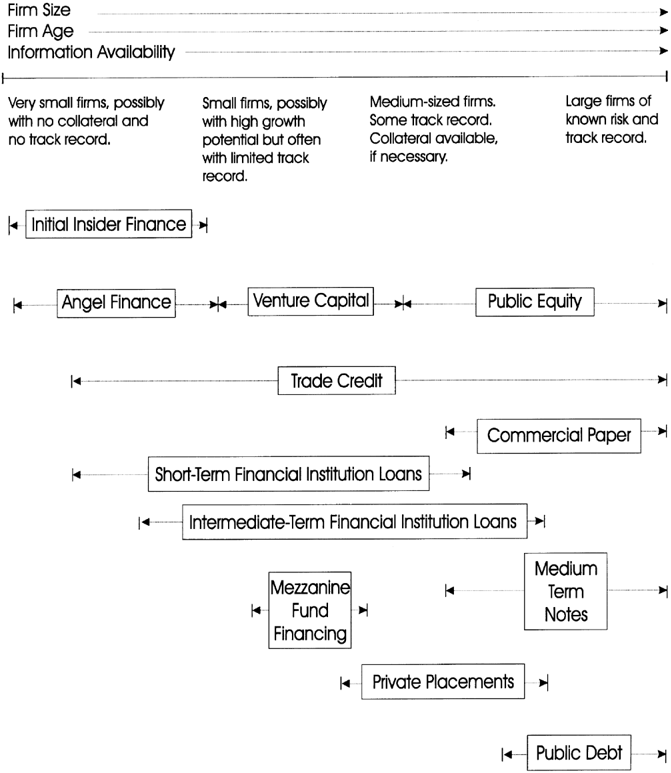
This article examines the economics of financing small business in private equity and debt markets. Firms are viewed through a financial growth cycle paradigm in which different capital structures are optimal at different points in the cycle. We show the sources of small business finance, and how capital structure varies with firm size and age. The interconnectedness of small firm finance is discussed along with the impact of the macroeconomic environment. We also analyze a number of research and policy issues, review the literature, and suggest topics for future research.
Verified 2026-11-25 · 1 reference not checked yet
Overview
CoChat Summary
TL;DR
This article reviews the economics of small business finance through a financial growth cycle paradigm, emphasizing informational opacity and the roles of private equity and debt markets. It documents US small business funding sources and contracts, and analyzes vulnerability to macroeconomic shocks, credit crunches, and bank consolidation.
Key findings
- US small business finance is split roughly evenly between equity (49.63%) and debt (50.37%); the largest sources are the principal owner, commercial banks, and trade creditors, together accounting for 70.10% of total funding. Commercial banks provide 18.75%, trade credit 15.78%, principal owner equity 31.33%, angel finance 3.59%, venture capital 1.85%, and credit card debt 0.14%.
- Financial institution debt is used by 54.23% of small businesses; 86.95% name a commercial bank as their primary financial institution. Average relationship length is 6.64 years overall and 9.01 years with the primary institution; 52.03% of financial institution debt is under lines of credit, 91.94% is secured, and 51.63% is guaranteed.
- The growth cycle paradigm predicts younger/more opaque firms rely on insider finance, trade credit, and angel finance, then venture capital and banks, and eventually public markets. However, 1993 NSSBF data show insider finance does not dominate external finance even for adolescents (upper bound 56.8% insider, roughly equal to external), and financial institution debt is important to very young firms, often based on personal guarantees or collateral.
- Macro vulnerability: the early-1990s credit crunch saw real C&I loans fall 23.2% ($596.7 billion to $458.2 billion) and estimated small business lending fall 38.5% ($143.7 billion to $88.4 billion). Banks with less than $100 million in assets held about 9% of portfolios in small business loans versus about 2% for banks over $10 billion; large banks charged about 100 basis points less and required collateral about 25% less often than small banks, other things equal.
Methods
- Design: review and synthesis organized around the financial growth cycle paradigm, covering theoretical and empirical literature on private equity and debt markets, contracts, and macroeconomic vulnerability.
- Data: primarily the 1993 National Survey of Small Business Finances (NSSBF) for US small business finance tables, plus other sources including NFIB, SCF, STBL, CALL, CRA, Venture Economics/VentureOne, and international data.
- Analysis: descriptive tabulations (Tables 1 and 2) and literature synthesis; the paper is a review rather than a new primary empirical study.
Limitations
- Paper-stated: Table 1 data are not completely accurate or consistent and should be considered rough estimates; angel finance estimates are imprecise (range $15 billion to $120 billion); 1993 data may not reflect current conditions; weighted averages mask considerable heterogeneity.
- Paper-stated: the growth cycle paradigm is not intended to fit all small businesses; firm size, age, and information availability are far from perfectly correlated, and the points at which different funding sources begin and end are not definitive.
- Evident from the text: informational opacity and the intertwining of personal and business finances make small business finance difficult to research, and data on owners’ finances are often unavailable; the paper relies heavily on existing literature and available data rather than new primary data collection.
Model-written summary. Check it against the paper before relying on it.
Integrity signals
Registry
Cites
Statistics
Figures
Verification
Claims the paper makes
22 Valid · 27 Not valid · 107 Not checked · 201 Own results and interpretations
Every source the paper cites for this claim was checked and supports it.
In the paper
“This use of personal assets to help with external ®nance also highlights another important aspect of small business ®nance ± the ®nancial intertwining of owners and their businesses (Ang, 1992).”
§ The economics of small business ®nance: The roles of private equity and debt markets in the ®nancial growth cycle > 2.3. The ®nancial growth cycle of small business
What the sources say
- Supportedcites Ang, 1992 matched to “On the Theory of Finance for Privately Held Firms” (1992) source
In “Integrating Personal and Business Accounts,” Ang says that personal guarantees or collateral make business risk inseparable from owners’ personal risk. “The Financing Decision” also identifies owners’ assets used for loan guarantees as contributions to the business. Together, these passages support the cited point that using personal assets to obtain external finance intertwines owners’ and businesses’ finances. (LLM, conf=0.94)
plainstates an association- Asserted: passes — The authors put it forward as true.
- Checkable: passes — It can be checked against evidence.
- Load-bearing: unclear — It is unclear whether the paper’s conclusions depend on it.
- Based: passes — The paper gives a reason why it holds.
- Supported
The cited sources support only part of this claim — read each source’s verdict below.
In the paper
“Costly state veri®cation (Townsend, 1979;Diamond, 1984) and adverse selection (Myers, 1984;Myers and Majluf, 1984;Nachman and Noe, 1994) arguments suggest the optimality of debt contracts after insider ®nance has been exhausted.”
§ The economics of small business ®nance: The roles of private equity and debt markets in the ®nancial growth cycle > 2.3. The ®nancial growth cycle of small business
What the sources say
- Partly supportedcites Townsend, 1979 matched to “Optimal contracts and competitive markets with costly state verification” (1979) sourceExperimental — accuracy not yet measured
Section 3 characterizes an optimal contract for a firm financing an investment project as a bond that defaults when returns fall below a threshold, supporting the costly-state-verification rationale for debt. The paper does not establish that debt becomes optimal only after insider finance has been exhausted. The adverse-selection citations in the sentence refer to other sources, not Townsend. (LLM, conf=0.85)
- Not checked — no full text of the sourcecites Diamond, 1984 matched to “Financial intermediation and delegated monitoring” (1984) source
- Not matchedcites Myers, 1984
More than one paper fits this citation.
hedgedstates a cause- Asserted: passes — The authors put it forward as true.
- Checkable: passes — It can be checked against evidence.
- Load-bearing: passes — The paper’s conclusions depend on it.
- Based: passes — The paper gives a reason why it holds.
- Partly supported
The cited sources support only part of this claim — read each source’s verdict below.
In the paper
“An agency problem arises in the relationship between the entrepreneur and the venture capitalist in which the entrepreneur may expend insucient eort, exhibit expense preference behavior, or lack sucient information or skill to make optimal production decisions.”
§ The economics of small business ®nance: The roles of private equity and debt markets in the ®nancial growth cycle > 3.2. The venture capital market
What the sources say
- Not checked — no full text of the sourcecites Cooper and Carleton, 1979 matched to “Dynamics of Borrower‐Lender Interaction: Partitioning Final Payoff in Venture Capital Finance” (1979) source
- Partly supportedcites Bergemann and Hege, 1998 matched to “Venture capital financing, moral hazard, and learning” (1998) sourceExperimental — accuracy not yet measured
Section 2.3, “Moral hazard and financing,” describes an entrepreneur who may reduce costly effort or divert investment funds to private ends, supporting the insufficient-effort and expense-preference parts of the claim. It does not identify a lack of the entrepreneur’s information or skill as a cause of poor production decisions; it instead says the entrepreneur and venture capitalists initially have the same assessment of the project. (LLM, conf=0.88)
hedgedstates a possible cause- Asserted: passes — The authors put it forward as true.
- Checkable: passes — It can be checked against evidence.
- Load-bearing: passes — The paper’s conclusions depend on it.
- Based: passes — The paper gives a reason why it holds.
Every source the paper cites for this claim was checked and supports it.
In the paper
“Since 1990, this share has about doubled to 30% (Fenn et al., 1997).”
§ The economics of small business ®nance: The roles of private equity and debt markets in the ®nancial growth cycle > 3. The role of private equity markets in small business ®nance
What the sources say
- Supportedcites Fenn et al., 1997 matched to “The Private Equity Market: An Overveiw” (1997) source
In “IPO Firms that Received Private Equity Backing,” the paper states that the share of IPOs with venture backing averaged 15% during the 1980s and doubled to 30% since 1990. This directly supports the cited claim. (LLM, conf=0.95)
plainstates an association- Asserted: passes — The authors put it forward as true.
- Checkable: passes — It can be checked against evidence.
- Load-bearing: unclear — It is unclear whether the paper’s conclusions depend on it.
- Based: passes — The paper gives a reason why it holds.
- Supported
The cited sources support only part of this claim — read each source’s verdict below.
In the paper
“During the 1980s, approximately 15% of all IPOs were backed by venture capital, well out of proportion to the fraction of all ®rms that received venture capital.”
§ The economics of small business ®nance: The roles of private equity and debt markets in the ®nancial growth cycle > 3. The role of private equity markets in small business ®nance
What the sources say
- Partly supportedcites Fenn et al., 1997 matched to “The Private Equity Market: An Overveiw” (1997) sourceExperimental — accuracy not yet measured
The section “IPO Firms that Received Private Equity Backing” states that venture-backed IPOs averaged 15% of IPOs during the 1980s. It does not give the fraction of all firms that received venture capital or make the claimed comparison with that fraction. (LLM, conf=0.84)
plainstates an association- Asserted: passes — The authors put it forward as true.
- Checkable: passes — It can be checked against evidence.
- Load-bearing: unclear — It is unclear whether the paper’s conclusions depend on it.
- Based: passes — The paper gives a reason why it holds.
- Partly supported
184 more claims · 6 with their cited sources checked
Create a free account to see all 357 claims and to verify the 12 references still open.
- Probably not a substantial claim. 94
- It may state two separate claims as one. 87
- Borderline: one of the tests for a substantial claim is unclear. 2
Claims other papers make about this one
Each is checked against this paper’s own text: does it say what the citing paper says it does?
The cited source says what the claim attributes to it.
In the citing paper
“SMEs are more dependent on external financing supplied by commercial banks (Berger and Udell 1998) because most of them are not qualified to raise money from the stock market.”
From Local Bank, Digital Financial Inclusion and SME Financing Constraints: Empirical Evidence from China (2022) · cites this paper as Berger and Udell 1998
Self-check
Percentages, sums and reported differences re-computed from the paper’s own numbers.
Rated minor: it would not touch a result — a value no result rests on, a p-value that stays on the same side of the significance level, or a conflict that is clerical, resolved elsewhere in the paper, or outside its own findings.
In the paper
“Non®nancial business/government debt provides 19.26% of small business funding (mostly trade credit)”
§ The economics of small business ®nance: The roles of private equity and debt markets in the ®nancial growth cycle > 4. The role of private debt markets in small business ®nance
Reported 19.26 · recomputed 18.01
Citations
Cites
Corporate financing and investment decisions when firms have information that investors do not have
Myers, S. C., & Majluf, N. S. (1984) · Journal of Financial Economics · doi:10.1016/0304-405x(84)90023-0 · Cited by 18,957
The Cost of Capital, Corporation Finance and the Theory of Investment
Miller, M. H. (1958) · American Economic Review · Cited by 14,574
Determinants of corporate borrowing
Myers, S. C. (1977) · Journal of Financial Economics · doi:10.1016/0304-405x(77)90015-0 · Cited by 13,169
Credit Rationing in Markets with Imperfect Information
Stiglitz, J. E., & Weiss, A. (1981) · Columbia University · doi:10.7916/d8v12ft1 · Cited by 12,769 · cited 1×
“…pledging outside collateral may help resolve adverse selection problems when the borrower has more information about the quality of the investment than the lender, and may help prevent credit rationing (Stiglitz and Weiss 1981, 1986, Bester 1985, Chan and Kanatas 1985, Besanko and Thakor 1987a,b).”
The cost of capital, corporation finance and the theory of investment
Terra, P. R. (2008) · Revista de Administração e Contabilidade da Unisinos · doi:10.4013/base.20082.07 · Cited by 8,615
Financial intermediation and delegated monitoring
Diamond, D. W. (1984) · The Review of Economic Studies · doi:10.2307/2297430 · Cited by 8,476 · cited 2×
“Costly state verification (Townsend 1979, Diamond 1984) and adverse selection (Myers 1984, Myers and Majluf 1984, Nachman and Noe 1994) arguments suggest the optimality of debt contracts after insider cFor example, there are generally accepted definitions of the stages of finance for the kind of…”
Corporate Financing and Investment Decisions When Firms Have InformationThat Investors Do Not Have
Myers, S., & Majluf, N. (1984) · doi:10.3386/w1396 · Cited by 6,745
The Benefits of Lending Relationships: Evidence from Small Business Data
PETERSEN, M. A., & RAJAN, R. G. (1994) · The Journal of Finance · doi:10.1111/j.1540-6261.1994.tb04418.x · Cited by 5,440 · cited 4×
“…whereas mortgages, equipment loans, motor vehicle loans, and other loans may more often be transactionsdriven .zs It was also found that dependence on trade credit decreased with the length of the banking relationship, supporting the value of relationship lending (Petersen and Rajan 1994, 1995).”
InfluentialInside the black box: the credit channel of monetary policy transmission
Bernanke, B. S., & Gertler, M. (1995) · Journal of Economic Perspectives · doi:10.1257/jep.9.4.27 · Cited by 4,211
Insiders and Outsiders: The Choice between Informed and Arm's‐Length Debt
RAJAN, R. G. (1992) · The Journal of Finance · doi:10.1111/j.1540-6261.1992.tb04662.x · Cited by 3,902 · cited 1×
“Some research suggests that these firms may try to reduce the control of their banks by issuing public debt, even though public debt may entail higher costs (Diamond 1991, 1993, Rajan 1992, Houston and James 1996).”
Research works printed but not linked: 11
- 66. Cook, L., 1997. Trade ®nance, bank ®nance, and capital market imperfections. Working paper. Harvard University, Cambridge, MA.
- 89. Freear, J., Sohl, J.E., Wetzel, W.E., Jr., 1994. The private investor market for venture capital. The Financier 1, 7±19.
- 112. Hancock, D., Wilcox, J.A., 1997. Bank capital, nonbank ®nance, and real estate activity. Journal of Housing Research 8, 75±105.
- 117. Hempel, G., Coleman, A., Simonson, D., 1986. Bank Management, Wiley, New York.
- 119. Ho, R., 1997. Credit-card use to ®nance small business is soaring, says survey of small ®rms. Wall Street Journal B2, Sept. 25.
- 153. Megginson, W.L., Weiss, K.A., 1991. Venture capitalist certi®cation in initial public oerings. Journal of Finance 46, 903±979.
- 162. Morsman Jr., E., 1986. Commercial loan structuring. Journal of Commercial Bank Lending 68, 2± 20.
- 187. Ravid, S.A., 1996. Debt maturity ± A survey. Financial Markets, Institutions and Instruments 5 (3), 1±68.
- 217. Wetzel Jr. W.E., 1994. Venture capital. In: Bygrave, W.D. (Ed.), Portable MBA in Entrepreneur- ship. Wiley, New York, pp. 172±194.
- 219. White, L.J., 1995. An analytical framework. In: Zahid, S.N. (Ed.), Financial Sector Development in Asia. Oxford University Press, New York, pp. 3±35.
- 222. McKean, R. (Ed.), Issues in Defense Economics. Columbia University Press, New York.
Cited by
Items 101–200 of 3,739
A darker side to decentralized banks: Market power and credit rationing in SME lending
Canales, R., & Nanda, R. (2012) · Journal of Financial Economics · doi:10.1016/j.jfineco.2012.03.006 · Cited by 294
Crowdfunding: A Literature Review and Research Directions
Moritz, A., & Block, J. H. (2016) · FGF Studies in Small Business and Entrepreneurship · doi:10.1007/978-3-319-18017-5_3 · Cited by 281
Financial Sector Development and the Millennium Development Goals
Claessens, S., & Feijen, E. (2007) · World Bank Working Papers · doi:10.1596/978-0-8213-6865-7 · Cited by 250
Niskanen, J., & Niskanen, M. (2006) · European Financial Management · doi:10.1111/j.1354-7798.2006.00311.x · Cited by 249
Informed finance and technological change: Evidence from credit relationships☆
Maria Herrera, A., & Minetti, R. (2007) · Journal of Financial Economics · doi:10.1016/j.jfineco.2005.12.001 · Cited by 255
“Small firms are also thought to be less informationally transparent than bigger ones because generally they are not monitored by rating agencies or by the financial press (Petersen and Rajan, 1994; Berger and Udell, 1998).”
BackgroundInfluentialEquity crowdfunding: First resort or last resort?
Walthoff-Borm, X., Schwienbacher, A., & Vanacker, T. (2018) · Journal of Business Venturing · doi:10.1016/j.jbusvent.2018.04.001 · Cited by 246
The focus of working capital management in UK small firms
Howorth, C., & Westhead, P. (2003) · Management Accounting Research · doi:10.1016/s1044-5005(03)00022-2 · Cited by 245
The demand and supply of external finance for innovative firms
Mina, A., Lahr, H., & Hughes, A. (2013) · Industrial and Corporate Change · doi:10.1093/icc/dtt020 · Cited by 235
“Firms in need of external finance, however, might not be able to obtain it because of capital market imperfections (Berger and Udell, 1998).”
InfluentialA Theory of ICOs: Diversification, Agency, and Information Asymmetry
Chod, J., & Lyandres, E. (2021) · Management Science · doi:10.1287/mnsc.2020.3754 · Cited by 298
The impact of corporate governance mechanisms on value increase in leveraged buyouts
Nikoskelainen, E., & Wright, M. (2007) · Journal of Corporate Finance · doi:10.1016/j.jcorpfin.2007.04.002 · Cited by 225
Financial Structure of the Family Business: Evidence From a Group of Small Spanish Firms
López-Gracia, J., & Sánchez-Andújar, S. (2007) · Family Business Review · doi:10.1111/j.1741-6248.2007.00094.x · Cited by 235
“The age of a business, referred to as AGE, which is measured as the Neperian logarithm of the number of years that have passed since the business in question was founded, is also considered an important determinant of debt (Berger & Udell, 1998; Coleman & Carski, 1999; Romano et al. 2000).”
BackgroundResultOn the Determinants of SME Cash Holdings: Evidence from Spain
García‐Teruel, P. J., & Martínez‐Solano, P. (2008) · Journal of Business Finance & Accounting · doi:10.1111/j.1468-5957.2007.02022.x · Cited by 229
“Indeed, as Berger and Udell (1998) point out, the main characteristic of SMEs, which distinguishes them to a large extent from larger firms, is their greater informational opacity, which worsens information asymmetry problems.”
Myth-busting and entrepreneurship policy: the case of high growth firms
Brown, R., Mawson, S., & Mason, C. (2017) · Entrepreneurship & Regional Development · doi:10.1080/08985626.2017.1291762 · Cited by 234
A systematic literature review on SME financing: Trends and future directions
Rao, P., Kumar, S., Chavan, M., & Lim, W. M. (2023) · Journal of Small Business Management · doi:10.1080/00472778.2021.1955123 · Cited by 235
“…life cycle model to understand the financial behavior of SMEs, others have criticized this model on the grounds that the model (1) does not provide a holistic picture of SME financial decisions and behavior, and (2) cannot be generalized across SMEs in different industries (Berger & Udell, 1998).”
BackgroundWhy regulate private firm disclosure and auditing?
Minnis, M., & Shroff, N. (2017) · Accounting and Business Research · doi:10.1080/00014788.2017.1303962 · Cited by 215
“(Berger and Udell 1998, Rajan and Zingales 1995). Recent studies such as Costello (2014), Hope et al. (2016), and Lisowsky and Minnis (2016) find empirical evidence in a US setting that suppliers/customers value a firm’s financial statements.”
BackgroundDebt financing, survival, and growth of start-up firms
Cole, R. A., & Sokolyk, T. (2018) · Journal of Corporate Finance · doi:10.1016/j.jcorpfin.2017.10.013 · Cited by 239
Financial Constraints and Other Obstacles: are they a Threat to Innovation Activity?
Mohnen, P., Palm, F. C., van der Loeff, S. S., & Tiwari, A. (2008) · De Economist · doi:10.1007/s10645-008-9089-y · Cited by 273
“the financing problem of many young, small firms but in terms of size this type of finance is of less importance than venture capital (see Berger and Udell, 1998 ).”
Corporate Finance and the Monetary Transmission Mechanism
Bolton, P., & Freixas, X. (2006) · Review of Financial Studies · doi:10.1093/rfs/hhl002 · Cited by 217
“See, for example, Berger and Udell (1998, p. 655) , for a review of the empirical literature on the credit crunch.”
BackgroundTrust, social capital, and the bond market benefits of ESG performance
Amiraslani, H., Lins, K. V., Servaes, H., & Tamayo, A. (2023) · Review of Accounting Studies · doi:10.1007/s11142-021-09646-0 · Cited by 222
“Third, our results add to the literature on the determinants of firms’ contractual arrangements with creditors in the primary bond market (e.g., Berger and Udell 1998; Billett et al. 2007; Chava et al. 2010).”
The changing structure of local credit markets: Are small businesses special?
Bonaccorsi di Patti, E., & Gobbi, G. (2001) · Journal of Banking & Finance · doi:10.1016/s0378-4266(01)00191-1 · Cited by 218
Serrasqueiro, Z., & Caetano, A. (2014) · Journal of Business Economics and Management · doi:10.3846/16111699.2012.744344 · Cited by 218
Corporate life cycle, organizational financial resources and corporate social responsibility
Hasan, M. M., & Habib, A. (2017) · Journal of Contemporary Accounting & Economics · doi:10.1016/j.jcae.2017.01.002 · Cited by 217
The value of private sector business credit information sharing: The US case
Kallberg, J. G., & Udell, G. F. (2003) · Journal of Banking & Finance · doi:10.1016/s0378-4266(02)00387-4 · Cited by 203
“Recent evidence suggests that trade credit may be the most important source of external finance to small businesses (Berger and Udell, 1998).”
BackgroundInfluentialSelf-citationRisk, Uncertainty, and Entrepreneurship: Evidence from a Lab-in-the-Field Experiment
Koudstaal, M., Sloof, R., & van Praag, M. (2016) · Management Science · doi:10.1287/mnsc.2015.2249 · Cited by 214
“Interestingly, 1For further references, see e.g., Cantillon (1755); Say (1803); Knight (1921); Petersen and Rajan (1994); Berger and Udell (1998); Heaton and Lucas (2000); Moskowitz and Vissing-Jorgensen (2002); Gentry and Hubbard (2004); Heaton and Lucas (2004) and Parker (2009).”
BackgroundCapital structure of SMEs: a systematic literature review and bibliometric analysis
Kumar, S., Sureka, R., & Colombage, S. (2020) · Management Review Quarterly · doi:10.1007/s11301-019-00175-4 · Cited by 214
European trade credit use and SME survival
McGuinness, G., Hogan, T., & Powell, R. (2018) · Journal of Corporate Finance · doi:10.1016/j.jcorpfin.2017.12.005 · Cited by 210
“Calomiris et al. (1995) reports that liquid firms often provide a cushion of support to financially constrained firms during periods of credit tightening (e.g., Guariglia and Mateut, 2006; Berger and Udell, 1998; Biais and Gollier, 1997).”
BackgroundFINANCING MICROENTERPRISES: AN ANALYTICAL STUDY OF ISLAMIC MICROFINANCE INSTITUTIONS
Ahmed, H. (2002) · RePEc: Research Papers in Economics · Cited by 214
Formal Versus Informal Finance : Evidence From China
Ayyagari, M., & Demirgüç-Kunt, A. (2008) · World Bank, Washington, DC eBooks · doi:10.1596/1813-9450-4465 · Cited by 208
QIAN, J. (., STRAHAN, P. E., & YANG, Z. (2015) · The Journal of Finance · doi:10.1111/jofi.12251 · Cited by 210
Organization capital and firm life cycle
Hasan, M. M., & Cheung, A. (.-K. (2018) · Journal of Corporate Finance · doi:10.1016/j.jcorpfin.2017.12.003 · Cited by 205
The geography of initial coin offerings
Huang, W., Meoli, M., & Vismara, S. (2020) · Small Business Economics · doi:10.1007/s11187-019-00135-y · Cited by 196
Habib, A., & Hasan, M. M. (2019) · International Review of Financial Analysis · doi:10.1016/j.irfa.2018.12.004 · Cited by 210
Entrepreneurial finance: Banks versus venture capital
Winton, A., & Yerramilli, V. (2008) · Journal of Financial Economics · doi:10.1016/j.jfineco.2007.05.004 · Cited by 206
“from the National Survey of Small Business Finances, Berger and Udell (1998) find that commercial bank loans provide ncing for small businesses, finance company loans provide 5%, and venture capital investments provide 2%.”
InfluentialHan, L., Fraser, S., & Storey, D. J. (2009) · Journal of Banking & Finance · doi:10.1016/j.jbankfin.2008.08.014 · Cited by 201
“The existing literature (e.g. Berger and Udell, 1998) suggests that larger businesses are less risky and more informationally transparent.”
BackgroundInfluentialFinancing technology-based small firms in Europe: what do we know?
Revest, V., & Sapio, A. (2012) · Small Business Economics · doi:10.1007/s11187-010-9291-6 · Cited by 197
“whereas Berger and Udell (1998) and Denis (2004) deal with the financial structure of TBSFs.”
BackgroundCressy, R. (2002) · The Economic Journal · doi:10.1111/1468-0297.00680 · Cited by 195
J.S. Ramalho, J., & da Silva, J. V. (2009) · Quantitative Finance · doi:10.1080/14697680802448777 · Cited by 198
“…into contracts that are publicly visible or widely reported in the press, do not issue traded securities that are continuously priced in public markets and do not have audited financial statements that can be shared with any provider of outside finance (Berger and Udell 1998; see also Ang 1991).”
BackgroundResultInfluentialPecking order and debt capacity considerations for high-growth companies seeking financing
Vanacker, T. R., & Manigart, S. (2010) · Small Business Economics · doi:10.1007/s11187-008-9150-x · Cited by 197
“Asymmetric information is probably one of the most important reasons why outside funds are thought to be substantially more costly compared to internal funds ( Berger and Udell 1998 ).”
BackgroundInfluentialPatents as quality signals? The implications for financing constraints on R&D
Hottenrott, H., Hall, B. H., & Czarnitzki, D. (2016) · Economics of Innovation and New Technology · doi:10.1080/10438599.2015.1076200 · Cited by 195
Corporate life cycle and cost of equity capital
Hasan, M. M., Hossain, M., Cheung, A. (.-K., & Habib, A. (2015) · Journal of Contemporary Accounting & Economics · doi:10.1016/j.jcae.2014.12.002 · Cited by 199
“Berger and Udell (1998) argued that small and young firms generally resort to private equity and debt markets, while larger and more mature firms mainly rely on public markets.”
InfluentialDeterminants of start-up firm external financing worldwide
Nofsinger, J. R., & Wang, W. (2011) · Journal of Banking & Finance · doi:10.1016/j.jbankfin.2011.01.024 · Cited by 197
ONO, A., & UESUGI, I. (2009) · Journal of Money, Credit and Banking · doi:10.1111/j.1538-4616.2009.00239.x · Cited by 192
Effects of the New Basel Capital Accord on Bank Capital Requirements for SMEs
Altman, E. I., & Sabato, G. (2005) · Journal of Financial Services Research · doi:10.1007/s10693-005-4355-5 · Cited by 196
Angel investors and the market for angel investments
Prowse, S. (1998) · Journal of Banking & Finance · doi:10.1016/s0378-4266(98)00044-2 · Cited by 197
Outside Entrepreneurial CapitalPreprint
Cosh, A., Cumming, D. J., & Hughes, A. (2005) · RePEc: Research Papers in Economics · Cited by 192
Winners or Losers? The Effects of Banking Consolidation on Corporate Borrowers
DI PATTI, E. B., & GOBBI, G. (2007) · The Journal of Finance · doi:10.1111/j.1540-6261.2007.01220.x · Cited by 191
“The aggregate evidence from bank portfolios tends to support the view that small businesses are adversely affected by bank consolidation, although the microeconomic reasons why this would be the case are not so clear (see Berger and Udell, 1998, and Berger, Demsetz and Strahan, 1999 for reviews).”
InfluentialThe impact of public guarantees on credit to SMEs
Zecchini, S., & Ventura, M. (2009) · Small Business Economics · doi:10.1007/s11187-007-9077-7 · Cited by 193
Allen, F., McAndrews, J., & Strahan, P. (2002) · Journal of Financial Services Research · doi:10.1023/a:1016007126394 · Cited by 190
Angel finance: the other venture capital
Wong, A., Bhatia, M., & Freeman, Z. (2009) · Strategic Change · doi:10.1002/jsc.849 · Cited by 182
Do UK venture capitalists still have a bias against investment in new technology firms
Lockett, A., Murray, G., & Wright, M. (2002) · Research Policy · doi:10.1016/s0048-7333(01)00174-3 · Cited by 188
Innovation and SME finance: Evidence from developing countries
Wellalage, N. H., & Fernandez, V. (2019) · International Review of Financial Analysis · doi:10.1016/j.irfa.2019.06.009 · Cited by 184
Capital Market Frictions and Deposit Constraints at Banks
Jayaratne, J., & Morgan, D. P. (2000) · Journal of Money, Credit and Banking · doi:10.2307/2601093 · Cited by 172
DEPOSITS AND RELATIONSHIP LENDING
Berlin, M., & Mester, L. J. (1998) · Review of Financial Studies · doi:10.1093/rfs/12.3.579 · Cited by 177
Goldberg, L. G., Cole, R. A., & White, L. J. (2002) · SSRN Electronic Journal · doi:10.2139/ssrn.300702 · Cited by 167
The survival of venture capital backed companies
Manigart, S., Baeyens, K., & Van Hyfte, W. (2002) · Venture Capital · doi:10.1080/13691060110103233 · Cited by 181
“From the entrepreneur’s perspective, a VC company may provide a wide range of benefits to a venture in addition to capital (Ehrlich et al. 1994) through its roles of pre-investment screening, post-investment monitoring and value-adding (Berger and Udell 1998, Manigart and Sapienza 1999).”
A model for understanding the orders of magnitude of disruptive technologies
Schuelke-Leech, B.-A. (2018) · Technological Forecasting and Social Change · doi:10.1016/j.techfore.2017.09.033 · Cited by 183
FinTech and financing constraints of enterprises: Evidence from China
Guo, J., Fang, H., Liu, X., Wang, C., & Wang, Y. (2023) · Journal of International Financial Markets, Institutions and Money · doi:10.1016/j.intfin.2022.101713 · Cited by 181
Trade credit and SME profitability
Martínez-Sola, C., García-Teruel, P. J., & Martínez-Solano, P. (2014) · Small Business Economics · doi:10.1007/s11187-013-9491-y · Cited by 178
“In fact, problems of asymmetric information and greater difficulty in accessing capital markets mean trade credit is more intensive in SMEs (Berger and Udell 1998; Petersen and Rajan 1997).”
BackgroundGrow the Pie: How Great Companies Deliver Both Purpose and Profit
Edmans, A. (2020) · Cambridge University Press eBooks · doi:10.1017/9781108860093 · Cited by 177
Financing, Regulatory Costs and Entrepreneurial Propensity
Ho, Y.-P., & Wong, P.-K. (2007) · Small Business Economics · doi:10.1007/s11187-006-9015-0 · Cited by 177
“As new firms lack tangible assets that may be pledged as collateral, bank financing might not be available to them (Berger and Udell, 1998).”
BackgroundMethodInfluentialWho needs credit and who gets credit? Evidence from the surveys of small business finances
Cole, R., & Sokolyk, T. (2016) · Journal of Financial Stability · doi:10.1016/j.jfs.2016.04.002 · Cited by 173
Venture capitalist value-added activities, fundraising and drawdowns
Cumming, D., Fleming, G., & Suchard, J.-A. (2005) · Journal of Banking & Finance · doi:10.1016/j.jbankfin.2004.05.007 · Cited by 164
Credit channel, trade credit channel, and inventory investment: Evidence from a panel of UK firms
Guariglia, A., & Mateut, S. (2006) · Journal of Banking & Finance · doi:10.1016/j.jbankfin.2005.11.002 · Cited by 175
“Yet, according to Berger and Udell (1998), in 1993, 15.78% of the total assets of small US businesses were funded by trade credit. Similarly, Rajan and Zingales (1995) document that in 1991, funds loaned to customers represented 17.8% of total assets for US firms, 22% for UK firms, and more than 25% for countries such…”
BackgroundInfluentialValuing University–Based Firms: The Effects of Academic Affiliation on IPO Performance
Bonardo, D., Paleari, S., & Vismara, S. (2011) · Entrepreneurship Theory and Practice · doi:10.1111/j.1540-6520.2010.00369.x · Cited by 169
Long-term debt maturity and financing constraints of SMEs during the Global Financial Crisis
Vermoesen, V., Deloof, M., & Laveren, E. (2013) · Small Business Economics · doi:10.1007/s11187-012-9435-y · Cited by 173
“Therefore, problems of adverse selection, moral hazard, and credit rationing are more pronounced for SMEs than for large firms (e.g., Beck et al. 2008; Berger and Udell 1998; Hyytinen and Väänänen 2006).”
BackgroundInfluentialSecond–Order Gender Effects: The Case of U.S. Small Business Borrowing Cost
Wu, Z., & Chua, J. H. (2012) · Entrepreneurship Theory and Practice · doi:10.1111/j.1540-6520.2012.00503.x · Cited by 172
Where Is Credit Due? Legal Institutions, Connections, and the Efficiency of Bank Lending in Vietnam
Malesky, E. J., & Taussig, M. (2009) · Journal of Law, Economics, and Organization · doi:10.1093/jleo/ewn011 · Cited by 171
O'Sullivan, M. (2009) · The Oxford Handbook of Innovation · doi:10.1093/oxfordhb/9780199286805.003.0009 · Cited by 171
Quantity and quality of information and SME financial structure
Van Caneghem, T., & Van Campenhout, G. (2012) · Small Business Economics · doi:10.1007/s11187-010-9306-3 · Cited by 165
“It is generally accepted that informational opacity hinders SMEs’ access to external funds (see e.g. Berger and Udell 1998), but the effect of differences in (quality of) publicly available information has been barely examined.”
BackgroundCole, R. A. (2013) · Financial Management · doi:10.1111/fima.12015 · Cited by 167
Söderblom, A., Samuelsson, M., Wiklund, J., & Sandberg, R. (2015) · Research Policy · doi:10.1016/j.respol.2015.05.009 · Cited by 168
“The reason is that equity is considered the major external source of financing to innovative startup firms, while debt is fairly uncommon in such ventures (Berger and Udell, 1998).”
BackgroundU.S. Banking Deregulation, Small Businesses, and Interstate Insurance of Personal Income
DEMYANYK, Y., OSTERGAARD, C., & SØRENSEN, B. E. (2007) · The Journal of Finance · doi:10.1111/j.1540-6261.2007.01292.x · Cited by 158
Bellavitis, C., Filatotchev, I., Kamuriwo, D. S., & Vanacker, T. (2017) · Venture Capital · doi:10.1080/13691066.2016.1259733 · Cited by 164
“The 1993 U.S. NSSBF data show that angel financing accounted for an estimated 3.59% and VC funding 1.85% of small business finance (Berger and Udell 1998).”
InfluentialMicroenterprise Development Programs in the United States and in the Developing World
Schreiner, M., & Woller, G. (2003) · World Development · doi:10.1016/s0305-750x(03)00112-8 · Cited by 167
“Wealth is the biggest constraint on debt (Berger & Udell, 1998), and, according to Bates (1997, p. 4), ‘‘no serious studies have demonstrated that small amounts of debt can overcome human-capital deficiencies that otherwise minimize chances for business success.’’”
BackgroundBonini, S., & Capizzi, V. (2019) · Venture Capital · doi:10.1080/13691066.2019.1608697 · Cited by 164
“Figure 6.”
BackgroundInfluentialFinancing Constraints of SMEs in Developing Countries: Evidence, Determinants and SolutionsPreprint
Beck, T. (2007) · RePEc: Research Papers in Economics · Cited by 388
Capital structure determinants: an empirical study of French companies in the wine industry
Viviani, J. (2008) · International Journal of Wine Business Research · doi:10.1108/17511060810883786 · Cited by 165
Financing High-Tech Growth: The Role of Banks and Venture Capitalists
Audretsch, D. B., & Lehmann, E. E. (2004) · Schmalenbach Business Review · doi:10.1007/bf03396700 · Cited by 164
The Role of Angels in Technology SMEs: A Link to Venture Capital
Madill, J. J., Haines, Jr., & RIding, A. L. (2005) · Venture Capital · doi:10.1080/1369106042000316341 · Cited by 162
“In the USA, as well as in other countries, this market has been identified as the single most important source of risk capital for small- and medium-sized enterprises (Berger and Udell, 1998; GEM, 2001).”
BackgroundOn the Determinants and Dynamics of Trade Credit Use: Empirical Evidence from Business Start‐ups
Huyghebaert, N. (2006) · Journal of Business Finance & Accounting · doi:10.1111/j.1468-5957.2006.001364.x · Cited by 162
Zhao, T., & Xiao, X. (2019) · International Review of Economics & Finance · doi:10.1016/j.iref.2018.08.010 · Cited by 160
Disequilibrium in the UK corporate loan market
Atanasova, C. V., & Wilson, N. (2004) · Journal of Banking & Finance · doi:10.1016/s0378-4266(03)00037-2 · Cited by 159
“Berger and Udell (1998) report that 70% of small firm finance is made up of the owners own funds, commercial bank loans and trade creditors (pp. 691). Brewer et al. (1996) document that the small firms in their sample are more bank-dependent than large firms.”
BackgroundInfluentialNakku, V. B., Agbola, F. W., Miles, M. P., & Mahmood, A. (2020) · Journal of Small Business Management · doi:10.1080/00472778.2019.1659671 · Cited by 162
“It is also plausible that some entrepreneurs wanting to remain autonomous chose to self-finance the SME by neither incurring debt nor selling equity (Berger & Udell, 1998).”
BackgroundThe Financial Structure of Private Held Belgian Firms
Heyman, D., Deloof, M., & Ooghe, H. (2007) · Small Business Economics · doi:10.1007/s11187-006-9031-0 · Cited by 205
“However, Berger and Udell (1998) argue that effective covenants generally cannot be imposed on the small firms which do not have audited financial statements, so short maturities must be used in place of formal covenants to control the behaviour of these firms.”
BackgroundTrade Credit: Suppliers as Debt Collectors and Insurance ProvidersPreprint
Cuñat, V. (2003) · SSRN Electronic Journal · doi:10.2139/ssrn.423501 · Cited by 160
“Equation (8) together with equations (1), (2) and (3) uniquely determine the values of all the endogenous variables.”
Adverse Selection and Capital Structure: Evidence from Venture Capital
Cumming, D. J. (2006) · Entrepreneurship Theory and Practice · doi:10.1111/j.1540-6520.2006.00116.x · Cited by 190
“, Berger and Udell (1998), Bergmann and Hege (1998), Casamatta (2003), Casamatta and Haritchabalet (2003) De Clercq and Sapienza (2001), Gompers and Lerner (1999), Kanniainen and Keuschnigg (2003, 2004), Keuschnigg (2003), Manigart et al.”
The impact of cash conversion cycle on firm profitability: An empirical study based on Swedish data
Yazdanfar, D., & Öhman, P. (2014) · International Journal of Managerial Finance · doi:10.1108/ijmf-12-2013-0137 · Cited by 157
“Berger and Udell (1998) argue that older Impact of cash conversion cycle firms have better access to external financing than do younger ones, so older firms are less constrained in financing their working capital.”
BackgroundWomen-Owned businesses and access to bank credit: Evidence from three surveys since 1987
Treichel, M. Z., & Scott, J. A. (2006) · Venture Capital · doi:10.1080/13691060500453726 · Cited by 185
“Because the strength of the lending relationship affects the price and availability of credit (Uzzi, 1999; Berger and Udell, 2002a; Brau, 2002), a shorter relationship with a lender may influence the application for and approval of loans, as well as loan terms.”
BackgroundMethodInfluentialHow do we explain the capital structure of SMEs in sub‐Saharan Africa?: Evidence from Ghana
Abor, J., & Biekpe, N. (2009) · Journal of Economic Studies · doi:10.1108/01443580910923812 · Cited by 156
Ou, C., & Haynes, G. W. (2006) · Small Business Economics · doi:10.1007/s11187-006-0009-8 · Cited by 156
Do CEO demographics explain cash holdings in SMEs?
Orens, R., & Reheul, A. (2013) · European Management Journal · doi:10.1016/j.emj.2013.01.003 · Cited by 211
Determinants of the Capital Structure of Ghanaian FirmsPreprint
Abor, J. Y. (2008) · RePEc: Research Papers in Economics · Cited by 254
Switching Costs in Local Credit MarketsPreprint
Barone, G., Felici, R., & Pagnini, M. (2010) · SSRN Electronic Journal · doi:10.2139/ssrn.1699233 · Cited by 153
New directions in entrepreneurial finance
Cumming, D. J., Deloof, M., Manigart, S., & Wright, M. (2019) · Journal of Banking & Finance · doi:10.1016/j.jbankfin.2019.02.008 · Cited by 193
Entrepreneurial Finance and Nondiversifiable Risk
Chen, H., Miao, J., & Wang, N. (2010) · Review of Financial Studies · doi:10.1093/rfs/hhq122 · Cited by 149
“Among the other empirical studies are Gentry and Hubbard (2004), Berger and Udell (1998), Cole and Wolken (1996), and Petersen and Rajan (1994). (2)Leland and Pyle (1977) and Myers and Majluf (1984) argue that debt often dominates equity in settings with asymmetric information because debt is less information-sensitiv…”
InfluentialEquity crowdfunding, shareholder structures, and firm performance
Walthoff‐Borm, X., Vanacker, T. R., & Collewaert, V. (2018) · Corporate Governance An International Review · doi:10.1111/corg.12259 · Cited by 159
Industrial research versus development investment: the implications of financial constraints
Czarnitzki, D., Hottenrott, H., & Thorwarth, S. (2010) · Cambridge Journal of Economics · doi:10.1093/cje/beq038 · Cited by 166
“Mansfield 1977, Berger and Udell 1998, Harhoff 1998).”
BackgroundBank credit and trade credit: Evidence from SMEs over the financial crisis
McGuinness, G., & Hogan, T. (2014) · International Small Business Journal Researching Entrepreneurship · doi:10.1177/0266242614558314 · Cited by 180
“This is an important research agenda since SMEs are (a) more dependent on trade credit to cover their short-term financing needs (Berger and Udell, 1998; Petersen and Rajan, 1997), (b) have less potential to access external financing sources (Berger and Udell, 1998; Cowling et al., 2012;…”
InfluentialDoes bankruptcy law improve the fate of distressed firms? The role of credit channels
Bose, U., Filomeni, S., & Mallick, S. (2020) · Journal of Corporate Finance · doi:10.1016/j.jcorpfin.2020.101836 · Cited by 174
“Therefore, this may lead to credit restrictions, higher interest rates, or increased collateral requirements for smaller firms, deterring their demand for credit (Berger and Udell, 1990; Berger and Udell, 1998).”
BackgroundInfluentialCollateral and its substitutes in emerging markets’ lending
Menkhoff, L., Neuberger, D., & Rungruxsirivorn, O. (2011) · Journal of Banking & Finance · doi:10.1016/j.jbankfin.2011.09.010 · Cited by 175
Metadata
- Authors
- N. Berger, A., & F. Udell, G.
- Venue
- Journal of Banking & Finance
- Publisher
- Elsevier BV
- Published
- 1998-08
- Volume
- 22
- Issue
- 6-8
- Pages
- 613-673
- ISSN
- 0378-4266 (ISSN-L)
- OpenAlex
- W2119780569
- Semantic Scholar
- dfc06f7f7eb83d2c0e2a1d67ecb95b520a406843
- Cited by
- 3,690
- References
- 230
- Citations by year
- 2026: 136 · 2025: 148 · 2024: 144 · 2023: 193 · 2022: 155 · 2021: 211 · 2020: 200 · 2019: 156 · 2018: 208 · 2017: 174 · 2016: 186 · 2015: 187 · 2014: 168 · 2013: 177 · 2012: 171
- FWCI
- 169.26
- Type
- journal article
- Language
- en
- Open access
- hybrid
- doi.org
- Licence
- cc-by-nc-nd
- www.elsevier.com/tdm/userlicense/1.0/ (tdm)
- www.elsevier.com/legal/tdmrep-license (tdm)
- creativecommons.org/licenses/by-nc-nd/4.0/ (vor, 125 d)
- Locations
- Journal of Banking & Finance (publishedVersion, cc-by-nc-nd)
- RePEc: Research Papers in Economics (submittedVersion)
- Funders
- York University
- Topics
- Social Sciences › Economics, Econometrics and Finance › Finance › Private Equity and Venture Capital
- Social Sciences › Economics, Econometrics and Finance › Finance › Corporate Finance and Governance
- Social Sciences › Economics, Econometrics and Finance › Finance › Banking stability, regulation, efficiency
- Keywords
- small business financing, private equity, debt markets, capital structure, firm size, firm age, macroeconomic conditions
About these checks
Registry, retraction, Cites and statistics results are computed, not judged, with one exception: a printed reference that no index lists is read once by a model before it counts as a citation error. Claims are extracted by a model and kept only when their quote appears verbatim in the text; each cited source is then checked, with a model’s help, for whether it says what the claim relies on. Those verdicts can be wrong — read the claim’s quote and the cited source before relying on one.
The claim verdicts this report counts are experimental: their accuracy is not yet measured.
A language model drew the claims from the paper on 2026-10-10, under version 3 of the claim definition (model deepseek-v4.1-flash, prompt extract-v3).
A second model labelled each claim on 2026-10-10 (model jev-1.13-20260917, definition revision gold-guideline-v0.2).
Cited sources are checked with a language model’s help (gpt-6-sol).
Statistics and arithmetic are recomputed, not judged.
Confidence bands are shown only for fields calibrated on our annotated test set. None is calibrated yet, so no band is shown.
What counts as a claim ›How we measure confidence ›How we check this ›
Are you an author, or do you see a problem with this page? Request a review
Data sources
Bibliographic data: Semantic Scholar, OpenAlex, Crossref.
Contains information from the Semantic Scholar Academic Graph Datasets, made available under the ODC Attribution License (ODC-BY 1.0).
Semantic Scholar’s data is described in: Kinney, R., et al. (2023). The Semantic Scholar Open Data Platform. arXiv:2301.10140.
