

The economics of small business finance: The roles of private equity and debt markets in the financial growth cycle
Open accessThe DOI matches its Crossref record; 217 of the 230 references it cites were found in a registry or an index, and 1 are not checked yet; 24 of the 170 sources its claims cite were checked for support.
Abstract
This article examines the economics of financing small business in private equity and debt markets. Firms are viewed through a financial growth cycle paradigm in which different capital structures are optimal at different points in the cycle. We show the sources of small business finance, and how capital structure varies with firm size and age. The interconnectedness of small firm finance is discussed along with the impact of the macroeconomic environment. We also analyze a number of research and policy issues, review the literature, and suggest topics for future research.
Verified 2026-11-25 · 1 reference not checked yet
Overview
CoChat Summary
TL;DR
This article reviews the economics of small business finance through a financial growth cycle paradigm, emphasizing informational opacity and the roles of private equity and debt markets. It documents US small business funding sources and contracts, and analyzes vulnerability to macroeconomic shocks, credit crunches, and bank consolidation.
Key findings
- US small business finance is split roughly evenly between equity (49.63%) and debt (50.37%); the largest sources are the principal owner, commercial banks, and trade creditors, together accounting for 70.10% of total funding. Commercial banks provide 18.75%, trade credit 15.78%, principal owner equity 31.33%, angel finance 3.59%, venture capital 1.85%, and credit card debt 0.14%.
- Financial institution debt is used by 54.23% of small businesses; 86.95% name a commercial bank as their primary financial institution. Average relationship length is 6.64 years overall and 9.01 years with the primary institution; 52.03% of financial institution debt is under lines of credit, 91.94% is secured, and 51.63% is guaranteed.
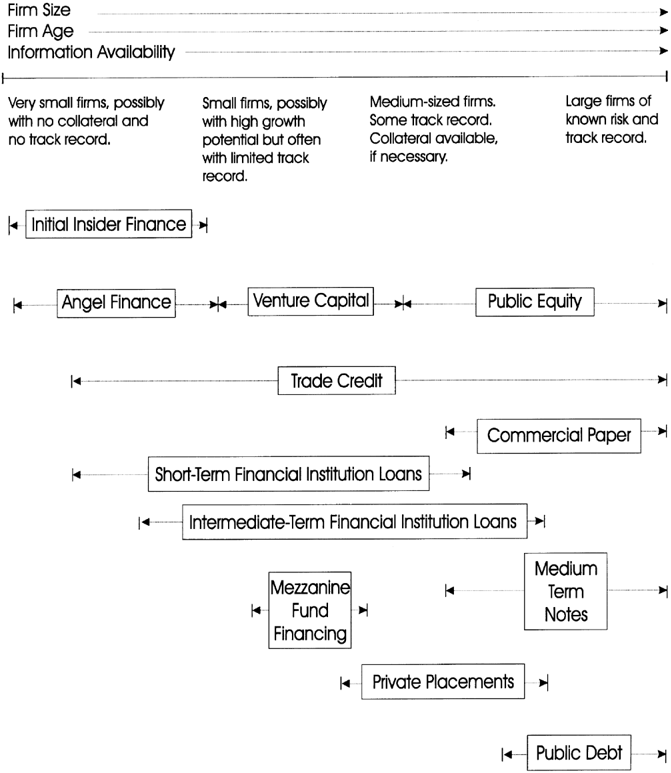
- The growth cycle paradigm predicts younger/more opaque firms rely on insider finance, trade credit, and angel finance, then venture capital and banks, and eventually public markets. However, 1993 NSSBF data show insider finance does not dominate external finance even for adolescents (upper bound 56.8% insider, roughly equal to external), and financial institution debt is important to very young firms, often based on personal guarantees or collateral.
- Macro vulnerability: the early-1990s credit crunch saw real C&I loans fall 23.2% ($596.7 billion to $458.2 billion) and estimated small business lending fall 38.5% ($143.7 billion to $88.4 billion). Banks with less than $100 million in assets held about 9% of portfolios in small business loans versus about 2% for banks over $10 billion; large banks charged about 100 basis points less and required collateral about 25% less often than small banks, other things equal.
Methods
- Design: review and synthesis organized around the financial growth cycle paradigm, covering theoretical and empirical literature on private equity and debt markets, contracts, and macroeconomic vulnerability.
- Data: primarily the 1993 National Survey of Small Business Finances (NSSBF) for US small business finance tables, plus other sources including NFIB, SCF, STBL, CALL, CRA, Venture Economics/VentureOne, and international data.
- Analysis: descriptive tabulations (Tables 1 and 2) and literature synthesis; the paper is a review rather than a new primary empirical study.
Limitations
- Paper-stated: Table 1 data are not completely accurate or consistent and should be considered rough estimates; angel finance estimates are imprecise (range $15 billion to $120 billion); 1993 data may not reflect current conditions; weighted averages mask considerable heterogeneity.
- Paper-stated: the growth cycle paradigm is not intended to fit all small businesses; firm size, age, and information availability are far from perfectly correlated, and the points at which different funding sources begin and end are not definitive.
- Evident from the text: informational opacity and the intertwining of personal and business finances make small business finance difficult to research, and data on owners’ finances are often unavailable; the paper relies heavily on existing literature and available data rather than new primary data collection.
Model-written summary. Check it against the paper before relying on it.
Integrity signals
Registry
Cites
Statistics
Figures
Verification
Claims the paper makes
22 Valid · 27 Not valid · 107 Not checked · 201 Own results and interpretations
Every source the paper cites for this claim was checked and supports it.
In the paper
“This use of personal assets to help with external ®nance also highlights another important aspect of small business ®nance ± the ®nancial intertwining of owners and their businesses (Ang, 1992).”
§ The economics of small business ®nance: The roles of private equity and debt markets in the ®nancial growth cycle > 2.3. The ®nancial growth cycle of small business
What the sources say
- Supportedcites Ang, 1992 matched to “On the Theory of Finance for Privately Held Firms” (1992) source
In “Integrating Personal and Business Accounts,” Ang says that personal guarantees or collateral make business risk inseparable from owners’ personal risk. “The Financing Decision” also identifies owners’ assets used for loan guarantees as contributions to the business. Together, these passages support the cited point that using personal assets to obtain external finance intertwines owners’ and businesses’ finances. (LLM, conf=0.94)
plainstates an association- Asserted: passes — The authors put it forward as true.
- Checkable: passes — It can be checked against evidence.
- Load-bearing: unclear — It is unclear whether the paper’s conclusions depend on it.
- Based: passes — The paper gives a reason why it holds.
- Supported
The cited sources support only part of this claim — read each source’s verdict below.
In the paper
“Costly state veri®cation (Townsend, 1979;Diamond, 1984) and adverse selection (Myers, 1984;Myers and Majluf, 1984;Nachman and Noe, 1994) arguments suggest the optimality of debt contracts after insider ®nance has been exhausted.”
§ The economics of small business ®nance: The roles of private equity and debt markets in the ®nancial growth cycle > 2.3. The ®nancial growth cycle of small business
What the sources say
- Partly supportedcites Townsend, 1979 matched to “Optimal contracts and competitive markets with costly state verification” (1979) sourceExperimental — accuracy not yet measured
Section 3 characterizes an optimal contract for a firm financing an investment project as a bond that defaults when returns fall below a threshold, supporting the costly-state-verification rationale for debt. The paper does not establish that debt becomes optimal only after insider finance has been exhausted. The adverse-selection citations in the sentence refer to other sources, not Townsend. (LLM, conf=0.85)
- Not checked — no full text of the sourcecites Diamond, 1984 matched to “Financial intermediation and delegated monitoring” (1984) source
- Not matchedcites Myers, 1984
More than one paper fits this citation.
hedgedstates a cause- Asserted: passes — The authors put it forward as true.
- Checkable: passes — It can be checked against evidence.
- Load-bearing: passes — The paper’s conclusions depend on it.
- Based: passes — The paper gives a reason why it holds.
- Partly supported
The cited sources support only part of this claim — read each source’s verdict below.
In the paper
“An agency problem arises in the relationship between the entrepreneur and the venture capitalist in which the entrepreneur may expend insucient eort, exhibit expense preference behavior, or lack sucient information or skill to make optimal production decisions.”
§ The economics of small business ®nance: The roles of private equity and debt markets in the ®nancial growth cycle > 3.2. The venture capital market
What the sources say
- Not checked — no full text of the sourcecites Cooper and Carleton, 1979 matched to “Dynamics of Borrower‐Lender Interaction: Partitioning Final Payoff in Venture Capital Finance” (1979) source
- Partly supportedcites Bergemann and Hege, 1998 matched to “Venture capital financing, moral hazard, and learning” (1998) sourceExperimental — accuracy not yet measured
Section 2.3, “Moral hazard and financing,” describes an entrepreneur who may reduce costly effort or divert investment funds to private ends, supporting the insufficient-effort and expense-preference parts of the claim. It does not identify a lack of the entrepreneur’s information or skill as a cause of poor production decisions; it instead says the entrepreneur and venture capitalists initially have the same assessment of the project. (LLM, conf=0.88)
hedgedstates a possible cause- Asserted: passes — The authors put it forward as true.
- Checkable: passes — It can be checked against evidence.
- Load-bearing: passes — The paper’s conclusions depend on it.
- Based: passes — The paper gives a reason why it holds.
Every source the paper cites for this claim was checked and supports it.
In the paper
“Since 1990, this share has about doubled to 30% (Fenn et al., 1997).”
§ The economics of small business ®nance: The roles of private equity and debt markets in the ®nancial growth cycle > 3. The role of private equity markets in small business ®nance
What the sources say
- Supportedcites Fenn et al., 1997 matched to “The Private Equity Market: An Overveiw” (1997) source
In “IPO Firms that Received Private Equity Backing,” the paper states that the share of IPOs with venture backing averaged 15% during the 1980s and doubled to 30% since 1990. This directly supports the cited claim. (LLM, conf=0.95)
plainstates an association- Asserted: passes — The authors put it forward as true.
- Checkable: passes — It can be checked against evidence.
- Load-bearing: unclear — It is unclear whether the paper’s conclusions depend on it.
- Based: passes — The paper gives a reason why it holds.
- Supported
The cited sources support only part of this claim — read each source’s verdict below.
In the paper
“During the 1980s, approximately 15% of all IPOs were backed by venture capital, well out of proportion to the fraction of all ®rms that received venture capital.”
§ The economics of small business ®nance: The roles of private equity and debt markets in the ®nancial growth cycle > 3. The role of private equity markets in small business ®nance
What the sources say
- Partly supportedcites Fenn et al., 1997 matched to “The Private Equity Market: An Overveiw” (1997) sourceExperimental — accuracy not yet measured
The section “IPO Firms that Received Private Equity Backing” states that venture-backed IPOs averaged 15% of IPOs during the 1980s. It does not give the fraction of all firms that received venture capital or make the claimed comparison with that fraction. (LLM, conf=0.84)
plainstates an association- Asserted: passes — The authors put it forward as true.
- Checkable: passes — It can be checked against evidence.
- Load-bearing: unclear — It is unclear whether the paper’s conclusions depend on it.
- Based: passes — The paper gives a reason why it holds.
- Partly supported
184 more claims · 6 with their cited sources checked
Create a free account to see all 357 claims and to verify the 12 references still open.
- Probably not a substantial claim. 94
- It may state two separate claims as one. 87
- Borderline: one of the tests for a substantial claim is unclear. 2
Claims other papers make about this one
Each is checked against this paper’s own text: does it say what the citing paper says it does?
The cited source says what the claim attributes to it.
In the citing paper
“SMEs are more dependent on external financing supplied by commercial banks (Berger and Udell 1998) because most of them are not qualified to raise money from the stock market.”
From Local Bank, Digital Financial Inclusion and SME Financing Constraints: Empirical Evidence from China (2022) · cites this paper as Berger and Udell 1998
Self-check
Percentages, sums and reported differences re-computed from the paper’s own numbers.
Rated minor: it would not touch a result — a value no result rests on, a p-value that stays on the same side of the significance level, or a conflict that is clerical, resolved elsewhere in the paper, or outside its own findings.
In the paper
“Non®nancial business/government debt provides 19.26% of small business funding (mostly trade credit)”
§ The economics of small business ®nance: The roles of private equity and debt markets in the ®nancial growth cycle > 4. The role of private debt markets in small business ®nance
Reported 19.26 · recomputed 18.01
Citations
Cites
Corporate financing and investment decisions when firms have information that investors do not have
Myers, S. C., & Majluf, N. S. (1984) · Journal of Financial Economics · doi:10.1016/0304-405x(84)90023-0 · Cited by 18,957
The Cost of Capital, Corporation Finance and the Theory of Investment
Miller, M. H. (1958) · American Economic Review · Cited by 14,574
Determinants of corporate borrowing
Myers, S. C. (1977) · Journal of Financial Economics · doi:10.1016/0304-405x(77)90015-0 · Cited by 13,169
Credit Rationing in Markets with Imperfect Information
Stiglitz, J. E., & Weiss, A. (1981) · Columbia University · doi:10.7916/d8v12ft1 · Cited by 12,769 · cited 1×
“…pledging outside collateral may help resolve adverse selection problems when the borrower has more information about the quality of the investment than the lender, and may help prevent credit rationing (Stiglitz and Weiss 1981, 1986, Bester 1985, Chan and Kanatas 1985, Besanko and Thakor 1987a,b).”
The cost of capital, corporation finance and the theory of investment
Terra, P. R. (2008) · Revista de Administração e Contabilidade da Unisinos · doi:10.4013/base.20082.07 · Cited by 8,615
Financial intermediation and delegated monitoring
Diamond, D. W. (1984) · The Review of Economic Studies · doi:10.2307/2297430 · Cited by 8,476 · cited 2×
“Costly state verification (Townsend 1979, Diamond 1984) and adverse selection (Myers 1984, Myers and Majluf 1984, Nachman and Noe 1994) arguments suggest the optimality of debt contracts after insider cFor example, there are generally accepted definitions of the stages of finance for the kind of…”
Corporate Financing and Investment Decisions When Firms Have InformationThat Investors Do Not Have
Myers, S., & Majluf, N. (1984) · doi:10.3386/w1396 · Cited by 6,745
The Benefits of Lending Relationships: Evidence from Small Business Data
PETERSEN, M. A., & RAJAN, R. G. (1994) · The Journal of Finance · doi:10.1111/j.1540-6261.1994.tb04418.x · Cited by 5,440 · cited 4×
“…whereas mortgages, equipment loans, motor vehicle loans, and other loans may more often be transactionsdriven .zs It was also found that dependence on trade credit decreased with the length of the banking relationship, supporting the value of relationship lending (Petersen and Rajan 1994, 1995).”
InfluentialInside the black box: the credit channel of monetary policy transmission
Bernanke, B. S., & Gertler, M. (1995) · Journal of Economic Perspectives · doi:10.1257/jep.9.4.27 · Cited by 4,211
Insiders and Outsiders: The Choice between Informed and Arm's‐Length Debt
RAJAN, R. G. (1992) · The Journal of Finance · doi:10.1111/j.1540-6261.1992.tb04662.x · Cited by 3,902 · cited 1×
“Some research suggests that these firms may try to reduce the control of their banks by issuing public debt, even though public debt may entail higher costs (Diamond 1991, 1993, Rajan 1992, Houston and James 1996).”
Research works printed but not linked: 11
- 66. Cook, L., 1997. Trade ®nance, bank ®nance, and capital market imperfections. Working paper. Harvard University, Cambridge, MA.
- 89. Freear, J., Sohl, J.E., Wetzel, W.E., Jr., 1994. The private investor market for venture capital. The Financier 1, 7±19.
- 112. Hancock, D., Wilcox, J.A., 1997. Bank capital, nonbank ®nance, and real estate activity. Journal of Housing Research 8, 75±105.
- 117. Hempel, G., Coleman, A., Simonson, D., 1986. Bank Management, Wiley, New York.
- 119. Ho, R., 1997. Credit-card use to ®nance small business is soaring, says survey of small ®rms. Wall Street Journal B2, Sept. 25.
- 153. Megginson, W.L., Weiss, K.A., 1991. Venture capitalist certi®cation in initial public oerings. Journal of Finance 46, 903±979.
- 162. Morsman Jr., E., 1986. Commercial loan structuring. Journal of Commercial Bank Lending 68, 2± 20.
- 187. Ravid, S.A., 1996. Debt maturity ± A survey. Financial Markets, Institutions and Instruments 5 (3), 1±68.
- 217. Wetzel Jr. W.E., 1994. Venture capital. In: Bygrave, W.D. (Ed.), Portable MBA in Entrepreneur- ship. Wiley, New York, pp. 172±194.
- 219. White, L.J., 1995. An analytical framework. In: Zahid, S.N. (Ed.), Financial Sector Development in Asia. Oxford University Press, New York, pp. 3±35.
- 222. McKean, R. (Ed.), Issues in Defense Economics. Columbia University Press, New York.
Cited by
Items 401–500 of 3,739
Baldock, R., & Mason, C. M. (2015) · Venture Capital · doi:10.1080/13691066.2015.1021025 · Cited by 74
“The early stage finance escalator Berger and Udell (1998) present a conceptual framework of declining information opacity of young firms as they progress through early stage financing.”
BackgroundRamalho, J. J. S., Rita, R. M. S., & da Silva, J. V. (2018) · International Small Business Journal Researching Entrepreneurship · doi:10.1177/0266242617753050 · Cited by 95
Arena, M. P. (2010) · Review of Quantitative Finance and Accounting · doi:10.1007/s11156-010-0182-3 · Cited by 95
“The close monitoring and the covenants associated with bank debt and non-bank traditional private debt reduce the cost of debt for small firms that are early in their life cycle and have not had the opportunity to build a reputation about their credit quality yet (Berger and Udell (1998)). Firms in the early stages of…”
InfluentialExternal funding and firm growth: Comparing female- and male-controlled SMEs
Watson, J. S. (2006) · Venture Capital · doi:10.1080/13691060500433512 · Cited by 74
“Further, Berger and Udell (1998) argued that younger firms (with less information available about them) would generally have to rely more on internal funds compared to firms that were older and less ‘informationally opaque’.”
BackgroundInfluentialBasco, R., & Voordeckers, W. (2015) · Journal of Management & Organization · doi:10.1017/jmo.2015.23 · Cited by 91
“First, it is difficult to obtain reliable objective performance measures from privately held firms as their financial statements are not usually audited (Berger & Udell, 1998).”
BackgroundInformation, Informal Finance, and SME Financing
Lin, J. Y., & Sun, X. (2006) · Frontiers of Economics in China · doi:10.1007/s11459-005-0010-1 · Cited by 84
Relationship lending and innovation: empirical evidence on a sample of European firms
Cosci, S., Meliciani, V., & Sabato, V. (2015) · Economics of Innovation and New Technology · doi:10.1080/10438599.2015.1062098 · Cited by 79
“Furthermore, they have more overall physical assets that could serve as collateral compared to smaller firms and may be more transparent, as their activities and output are more easily verifiable to banks (Petersen and Rajan 1994; Berger and Udell 1998).”
BackgroundThe impact of government-supported participative loans on the growth of entrepreneurial ventures
Bertoni, F., Martí, J., & Reverte, C. (2018) · Research Policy · doi:10.1016/j.respol.2018.09.006 · Cited by 108
“As funds are allocated to young entrepreneurial ventures, which are deeply financially constrained (Berger and Udell, 1998; Brav, 2009), the external financing obtained will help reduce investments’ dependency on internal sources of finance (Carpenter and Petersen, 2002b).”
BackgroundFinancial inclusion and micro, small, and medium enterprises (MSMEs) growth in Uganda
Lakuma, C. P., Marty, R., & Muhumuza, F. (2019) · Journal of Innovation and Entrepreneurship · doi:10.1186/s13731-019-0110-2 · Cited by 129
“The international literature mentions that MSMEs depend heavily on internal finance due to lack of transparency (Berger & Udell, 1998), lack of trading history (Cassar, 2004), and high risk of failure (Huyghebaert & Van de Gucht, 2007), among other constraints.”
BackgroundDoes Religiosity Influence Venture Capital Investment Decisions?
Chircop, J., Johan, S., & Tarsalewska, M. (2018) · Journal of Corporate Finance · doi:10.1016/j.jcorpfin.2020.101589 · Cited by 97
Choosing crowdfunding: Why do entrepreneurs choose to engage in crowdfunding?
Junge, L. B., Laursen, I. C., & Nielsen, K. R. (2021) · Technovation · doi:10.1016/j.technovation.2021.102385 · Cited by 72
The role of accruals quality in the access to bank debt
García-Teruel, P. J., Martínez-Solano, P., & Sánchez-Ballesta, J. P. (2014) · Journal of Banking & Finance · doi:10.1016/j.jbankfin.2013.10.003 · Cited by 61
Habitual late payment of trade credit: an empirical examination of UK small firms
Howorth, C., & Reber, B. (2003) · Managerial and Decision Economics · doi:10.1002/mde.1128 · Cited by 85
Manolova, T. S., Manev, I. M., & Gyoshev, B. S. (2013) · International Small Business Journal Researching Entrepreneurship · doi:10.1177/0266242613482482 · Cited by 89
“The result is consistent with financial growth cycle theory (Berger and Udell, 1998), which postulates that finding new sources of finance becomes more important as firms grow.”
BackgroundResultYacus, A. M., Esposito, S. E., & Yang, Y. (2018) · Journal of Small Business Management · doi:10.1111/jsbm.12491 · Cited by 95
Debt maturity structure in private firms: Does the family control matter?
Díaz, N. L. D., García‐Teruel, P. J., & Solano, P. M. (2016) · Journal of Corporate Finance · doi:10.1016/j.jcorpfin.2016.01.016 · Cited by 91
Trade credit versus bank credit: a simultaneous analysis in European SMEs
Palacín-Sánchez, M.-J., Canto-Cuevas, F.-J., & di Pietro, F. (2018) · Small Business Economics · doi:10.1007/s11187-018-0101-x · Cited by 93
Culture's influences: An investigation of inter-country differences in capital structure
Bhaird, C. M. A., & Lucey, B. M. (2013) · Borsa Istanbul Review · doi:10.1016/j.bir.2013.10.004 · Cited by 86
“This result is consistent with previous empirical studies, and provides further support for the stages model and the financial growth life cycle theory (Berger & Udell, 1998, Mac An Bhaird & Lucey, 2010).”
ResultCobo, E. P., Crespo, A., & del Corte, J. M. (2017) · Small Business Economics · doi:10.1007/s11187-017-9966-3 · Cited by 109
Does Firm Life Cycle Impact Corporate Investment Efficiency?
Ahmed, B., Akbar, M., Sabahat, T., Ali, S., Hussain, A., Akbar, A., & Hongming, X. (2020) · Sustainability · doi:10.3390/su13010197 · Cited by 99
How do micro firms differ in their financing patterns from larger SMEs?
Masiak, C., Block, J., Moritz, A., Lang, F., & Kraemer-Eis, H. (2019) · Venture Capital · doi:10.1080/13691066.2019.1569333 · Cited by 94
“This result is in line with previous findings that smaller firms have difficulties to obtain external financing (Berger and Udell 1998) but also that these firms simply might not require external funding.”
BackgroundResultInfluentialThe determinants of debt financing: The case of fintech start-ups
Giaretta, E., & Chesini, G. (2021) · Journal of Innovation & Knowledge · doi:10.1016/j.jik.2021.10.001 · Cited by 95
Financial Markets, Money, and Banking
Keister, L. A. (2002) · Annual Review of Sociology · doi:10.1146/annurev.soc.28.110601.140836 · Cited by 105
“An extensive body of literature in economics documents changes in business finance over the life cycle of the firm (see Berger & Udell 1998 for a thorough overview).”
BackgroundVenture Capital Contracting in Theory and Practice: Implications for Entrepreneurship Research
Burchardt, J., Hommel, U., Kamuriwo, D. S., & Billitteri, C. (2016) · Entrepreneurship Theory and Practice · doi:10.1111/etap.12104 · Cited by 104
“See Berger and Udell (1998), Bergmann and Hege (1998), Chan (198 3), Casamatta (2003), Casamatta and Haritchabalet (2007), De Clercq and Sapienza (2001), Gompers and Lerner (1999 ), Kanniainen and Keuschnigg (2003, 2004), Manigart, Sapienza and Vermeir (1996), Manigart et al., ( 2000, 2002a, 2002b, 2002c), Mayer, Scho…”
BackgroundInfluentialFinancing constraints and SME innovation during economic crises
Guijarro, A. M., García-Pérez-de-Lema, D., & Auken, H. V. (2016) · Academia Revista Latinoamericana de Administración · doi:10.1108/arla-04-2015-0067 · Cited by 90
Are SMEs with immigrant owners exceptional exporters?
Morgan, H. M., Sui, S., & Baum, M. (2018) · Journal of Business Venturing · doi:10.1016/j.jbusvent.2017.12.003 · Cited by 95
The Choice between Bank Debt and Trace Credit in Business Start-ups
Huyghebaert, N., Gucht, L. M. V. D., & Hulle, C. V. (2007) · Small Business Economics · doi:10.1007/s11187-006-9005-2 · Cited by 86
Like Milk or Wine: Does Firm Performance Improve with Age?Preprint
Coad, A., Segarra‐Blasco, A., & Teruel, M. (2011) · SSRN Electronic Journal · doi:10.2139/ssrn.1815028 · Cited by 68
An empirical investigation of the financial growth life cycle
Bhaird, C. M. A., & Lucey, B. M. (2010) · Munich Personal RePEc Archive (Ludwig Maximilian University of Munich) · doi:10.1108/14626001111179767 · Cited by 1
“The financial growth lifecycle model developed by Berger and Udell (1998)”
MethodNew resources and new ideas: Private equity for small businesses
Fenn, G. W., & Liang, N. (1998) · Journal of Banking & Finance · doi:10.1016/s0378-4266(98)00042-9 · Cited by 81
Toward A Theory Of Optimal Financial Structure
Sun, X., Lin, J. Y., & Ye, J. (2009) · The World Bank Open Knowledge Repository (World Bank) · doi:10.1596/1813-9450-5038 · Cited by 92
The Legislative Road to Silicon ValleyPreprint
Armour, J. H., & Cumming, D. J. (2003) · SSRN Electronic Journal · doi:10.2139/ssrn.473593 · Cited by 68
“This makes such firms unsuitable candidates for debt investment (see, e.g., Berger and Udell, 1998).”
BackgroundBerger, A. N., Strahan, P. E., & Demsetz, R. S. (1998) · SSRN Electronic Journal · doi:10.2139/ssrn.139456 · Cited by 77
Self-citationChallenges of SMEs innovation and entrepreneurial financing
Wonglimpiyarat, J. (2015) · World Journal of Entrepreneurship Management and Sustainable Development · doi:10.1108/wjemsd-04-2015-0019 · Cited by 104
Law, Finance, and Politics: The Case of India
Armour, J. H., & Lele, P. P. (2009) · Law & Society Review · doi:10.1111/j.1540-5893.2009.00380.x · Cited by 96
Can green credit increase firm value? Evidence from Chinese listed new energy companies
Lai, X., Yue, S., & Chen, H. (2021) · Environmental Science and Pollution Research · doi:10.1007/s11356-021-17038-9 · Cited by 80
How do banking fintech services affect SME debt?
Fasano, F., & Cappa, F. (2022) · Journal of Economics and Business · doi:10.1016/j.jeconbus.2022.106070 · Cited by 86
Partial credit guarantees and SMEs financing
Boschi, M., Girardi, A., & Ventura, M. (2014) · Journal of Financial Stability · doi:10.1016/j.jfs.2014.09.007 · Cited by 85
Informed Finance and Technological Conservatism
Minetti, R. (2010) · European Finance Review · doi:10.1093/rof/rfq024 · Cited by 71
The evolution of debt policies: New evidence from business startups
Hanssens, J., Deloof, M., & Vanacker, T. R. (2016) · Journal of Banking & Finance · doi:10.1016/j.jbankfin.2016.01.008 · Cited by 81
“management literature but is also used in economics and finance research (Bertrand and Schoar, 2003; Rotemberg and Saloner, 2000)―suggests that (a) conditions at the time of founding define”
BackgroundInfluentialBank Market Power and SME Financing ConstraintsPreprint
Valverde, S. C., Udell, G. F., & Fernández, F. R. (2006) · SSRN Electronic Journal · doi:10.2139/ssrn.910226 · Cited by 65
Self-citationFinancing Decisions along a Firm’s Life-cycle: Debt as a Commitment Device
Hirsch, J., & Walz, U. (2011) · European Financial Management · doi:10.1111/j.1468-036x.2011.00618.x · Cited by 69
“When analyzing data of firms at different stages of their life-cycle, Bulan and Yan [2009] show that the impact of certain classic determinants like, for example, profitability is not monotonic across different stages of the firm’s life-cycle. This underlines the importance to control for the development stage when ma…”
InfluentialMurabaha syndrome of Islamic banks: a paradox or product of the system?
Miah, M. D., & Suzuki, Y. (2020) · Journal of Islamic accounting and business research · doi:10.1108/jiabr-05-2018-0067 · Cited by 66
Why discouraged borrowers exist? An empirical (re)examination from less developed countries
Gama, A. P. M., Duarte, F. D., & Esperança, J. P. (2017) · Emerging Markets Review · doi:10.1016/j.ememar.2017.08.003 · Cited by 75
Lending technologies and access to finance for SMEs in the hospitality industry
Motta, V., & Sharma, A. (2019) · International Journal of Hospitality Management · doi:10.1016/j.ijhm.2019.102371 · Cited by 95
Relationship Banking and Smes: A Theoretical AnalysisPreprint
Baas, T., & Schrooten, M. (2005) · SSRN Electronic Journal · doi:10.2139/ssrn.788344 · Cited by 66
Gender and Access to Finance: Perceived Constraints of Majority‐Female‐owned Indian Firms
Dutta, N., & Mallick, S. (2022) · British Journal of Management · doi:10.1111/1467-8551.12623 · Cited by 94
Trade Credit in Small and Medium Size Firms: An Application of the System Estimator With Panel Data
Rodríguez, O. M. (2006) · Small Business Economics · doi:10.1007/s11187-006-0017-8 · Cited by 74
“and Wolken (1993) and Berger and Udell (1998) .”
BackgroundAssessment of Government Funding of Business Angel Networks in Flanders
Collewaert, V., Manigart, S., & Aernoudt, R. (2008) · Regional Studies · doi:10.1080/00343400802070860 · Cited by 68
“Therefore, they have to rely on BAs or VCs as they monitor their investments more actively (B erger and U dell , 1998 ).”
Access to bank finance for UK SMEs in the wake of the recent financial crisis
Cowling, M., Liu, W., & Zhang, N. (2016) · International Journal of Entrepreneurial Behaviour & Research · doi:10.1108/ijebr-06-2015-0126 · Cited by 83
“Thus, for firms with high levels of information opacity and the subsequent agency problems, equity is a more appropriate form of finance especially for high-growth, high-risk new ventures (Berger and Udell, 1998; Gompers and Lerner, 1999, 2001a, 2001b; Keuschnigg and Nielsen, 2003, 2004; Mason, 2009; Maier and Walker,…”
BackgroundShahrier, N. A., Ho, J. S. Y., & Gaur, S. S. (2018) · Journal of Management & Governance · doi:10.1007/s10997-018-9436-6 · Cited by 100
The Financing of Small and Medium-Sized Enterprises: An Analysis of the Financing Gap in Brazil
Veiga, M. G., & McCahery, J. A. (2019) · European Business Organization Law Review · doi:10.1007/s40804-019-00167-7 · Cited by 118
The Limits of Lending? Banks and Technology Adoption across Russia
Bircan, Ç., & Haas, R. D. (2019) · Review of Financial Studies · doi:10.1093/rfs/hhz060 · Cited by 82
Law or Finance: Evidence from Finland
Hyytinen, A., Kuosa, I., & Takalo, T. (2003) · European Journal of Law and Economics · doi:10.1023/a:1023932325783 · Cited by 78
The impact of government financial assistance on the performance and financing of Australian SMEs
Dong, X. L., & Worthington, A. C. (2017) · Accounting Research Journal · doi:10.1108/arj-04-2014-0034 · Cited by 94
“For example, mum-and-dad SMEs do not typically pursue a high-growth strategy (Berger and Udell, 1998).”
BackgroundCapizzi, V., Croce, A., & Tenca, F. (2021) · British Journal of Management · doi:10.1111/1467-8551.12526 · Cited by 86
“This is consistent with the traditional paradigm of a company’s lifecycle and the identification of the different sources of financing associatedwith each stage, as stated by standard finance theory (Berger and Udell, 1998).”
ResultFalavigna, G., & Ippoliti, R. (2022) · Business Strategy and the Environment · doi:10.1002/bse.2995 · Cited by 77
“Turning to the control variables and focusing on corporate governance (Model A and Model C), we can gain additional interesting insights that are coherent with the financial growth cycle theory (Berger & Udell, 1998).”
Gender Biases in Bank Lending: Lessons from Microcredit in France
Cozarenco, A., & Szafarz, A. (2015) · Journal of Business Ethics · doi:10.1007/s10551-015-2948-y · Cited by 83
“In France, women account for 47% of the workforce but only 30% of entrepreneurs (Brana, 2013) and, as elsewhere, commercial banks are the main providers of small-business finance (Berger and Udell, 2002; Cornée and Szafarz, 2013).”
BackgroundThe Rationality and Irrationality of Financing Green Start-Ups
Bergset, L. (2015) · Administrative Sciences · doi:10.3390/admsci5040260 · Cited by 91
“Not only risk is a potential problem, the entrepreneur may invest insufficient effort or may indulge in expenses or make decisions that are not otherwise aligned with investor preferences [13,17,49,55].”
BackgroundInfluentialFinancing patterns of SMEs in India during 2006 to 2013 – an empirical analysis
Kumar, S., & Ps, R. (2016) · Journal of Small Business & Entrepreneurship · doi:10.1080/08276331.2015.1132513 · Cited by 100
“A firm’s financial needs and options depend on a size/age/information continuum (Berger and Udell 1998).”
BackgroundWHO FUNDS TECHNOLOGY-BASED SMALL FIRMS? EVIDENCE FROM BELGIUM
Bozkaya, A., & de la Potterie, B. V. P. (2008) · Economics of Innovation and New Technology · doi:10.1080/10438590701279466 · Cited by 84
“It is well documented that some of the most dynamic technology companies of US received support from one or more of the US 5 See Gompers and Lerner (2001b) and the references therein. government programs, designed to stimulate entrepreneurial firms such as the SBIC, Small Business Investment Research (SBIR) program, o…”
BackgroundMethodInfluentialThe present and future roles of banks in small business finance
Meyer, L. H. (1998) · Journal of Banking & Finance · doi:10.1016/s0378-4266(98)00019-3 · Cited by 64
Kim, H. E. (1999) · World Bank policy research working paper · doi:10.1596/1813-9450-2103 · Cited by 83
Start-Up Financing in the Digital Age – A Systematic Review and Comparison of New Forms of Financing
Klein, M., Neitzert, F., Hartmann‐Wendels, T., & Kraus, S. (2019) · The Journal of Entrepreneurial Finance · doi:10.57229/2373-1761.1353 · Cited by 92
“The contribution by Berger and Udell (1998), published as early as 1998, can be seen as leading articles here, in which all forms assigned to the category of traditional forms of financing are mentioned.”
BackgroundMethodInfluentialTrade credit and cost stickiness
Costa, M. D., & Habib, A. (2020) · Accounting and Finance · doi:10.1111/acfi.12606 · Cited by 70
Female entrepreneurship, financial frictions and capital misallocation in the US
Morazzoni, M., & Sy, A. (2022) · Journal of Monetary Economics · doi:10.1016/j.jmoneco.2022.03.007 · Cited by 90
“Small and nascent firms tend to rely more heavily on owners’ personal assets to secure external finance (Berger and Udell, 1998), as for example in the case of housing collateral (Schmalz et al., 2017). Since female-owned firms tend to be smaller, their leverage ratios might also suffer from a bigger estimation bias.…”
BackgroundThe Role of Owner in Capital Structure Decisions: An Analysis of Single-Owner Corporations
Ang, J. S. K., Cole, R. A., & Lawson, D. (2010) · The Journal of Entrepreneurial Finance · doi:10.57229/2373-1761.1015 · Cited by 72
Relationship lending: a survey of the literature
Elyasiani, E. (2004) · Journal of Economics and Business · doi:10.1016/s0148-6195(04)00022-0 · Cited by 68
Terjesen, S. A., & Szerb, L. (2008) · Estudios De Economia · doi:10.4067/s0718-52862008000200003 · Cited by 100
“To close the gap, entrepreneurs may seek outside investors (berger and Udell, 1998).”
BackgroundRocca, M. L., Rocca, T. L., & Cariola, A. (2010) · International Small Business Journal Researching Entrepreneurship · doi:10.1177/0266242609360614 · Cited by 75
“The financing of small firms is conducted in an institutional context that is very different compared to that of corporations, operating in a large and relatively more transparent capital market (Berger and Udell, 1998; Chittenden et al., 1996; Demirgüç-Kunt and Maksimovic, 1998; Pollard, 2003).”
BackgroundStanding the test of time. Does firm performance improve with age? An analysis of the wine industry
Capasso, A., Gallucci, C., & Rossi, M. (2015) · Business History · doi:10.1080/00076791.2014.993614 · Cited by 67
Determinants of the decision to adopt Islamic finance: evidence from Oman
Balushi, Y. A., Locke, S. M., & Boulanouar, Z. (2019) · ISRA International Journal of Islamic Finance · doi:10.1108/ijif-02-2018-0020 · Cited by 78
The influence of corporate governance on the relation between capital structure and value
Rocca, M. L. (2007) · Corporate Governance · doi:10.1108/14720700710756580 · Cited by 102
Bongomin, G. O. C., Woldie, A., & Wakibi, A. (2020) · Journal of Small Business and Enterprise Development · doi:10.1108/jsbed-12-2018-0383 · Cited by 86
The role of finance in the literature of entrepreneurial ecosystems
Frimanslund, T., Kwiatkowski, G., & Oklevik, O. (2022) · European Planning Studies · doi:10.1080/09654313.2022.2055962 · Cited by 80
“Berger and Udell (1998) and Lee, Sameen, and Cowling (2015) argue that there is a financial gap among innovative firms that is exacerbated during financial crises.”
BackgroundMarkets connectivity and financial contagion
Grilli, R., Tedeschi, G., & Gallegati, M. (2014) · Journal of Economic Interaction and Coordination · doi:10.1007/s11403-014-0129-1 · Cited by 62
“The initial bank funding to new rms is around 16% (see Berger and Udell 1998; Cassar, G. 2004).”
BackgroundThe trade credit channel revisited: evidence from micro data of Japanese small firms
Ogawa, K., Sterken, E., & Tokutsu, I. (2011) · Small Business Economics · doi:10.1007/s11187-011-9344-5 · Cited by 72
“…and the participants of the seminars at the University of Groningen and the RIETI Corporate Finance and Network Research Group for 22 Berger and Udell (1998), Reid (2003) and Huyghebaert and Van de Gucht (2007) reported that suppliers and commercial banks are the largest provider of credit for…”
BackgroundResultInfluentialBank Funding, Securitization, and Loan Terms: Evidence from Foreign Currency Lending
Brown, M., Kirschenmann, K., & Ongena, S. R. G. (2014) · Journal of money credit and banking · doi:10.1111/jmcb.12147 · Cited by 62
The Ability of Banks to Lend to Informationally Opaque Small Businesses
Berger, A. N., Klapper, L. F., & Udell, G. F. (2001) · Finance and Economics Discussion Series · doi:10.17016/feds.2001.34 · Cited by 75
Self-citationThe determinants of venture capital: a panel data analysis of 16 OECD countries
Romain, A., & Pottelsberghe, B. V. (2003) · Institutional Repositories DataBase (IRDB) · Cited by 62
Financial Development And Innovation In Small Firms
Sharma, S. (2007) · World Bank, Washington, DC eBooks · doi:10.1596/1813-9450-4350 · Cited by 62
“While banks are the main source of R&D financing in European countries, and a significant source in the U.S. (Herrera and Minetti (2007), Berger and Udell (1998)), the sources of funds vary with the size of the R&D project.”
BackgroundResultOrtega‐Argilés, R., Ács, Z. J., Szerb, L., Autio, E., & Komlosi, E. S. (2014) · University of Groningen research database (University of Groningen / Centre for Information Technology) · doi:10.2776/79241 · Cited by 90
The recent financial crisis, start‐up financing and survival
Deloof, M., & Vanacker, T. R. (2018) · Journal of Business Finance & Accounting · doi:10.1111/jbfa.12319 · Cited by 77
Bank Consolidation and the Provision of Banking Services: The Case of Small Commercial LoansPreprint
Samolyk, K. A., & Avery, R. B. (2002) · SSRN Electronic Journal · doi:10.2139/ssrn.308479 · Cited by 61
“11 For discussions of these studies, see Berger, Demsetz, and Strahan (1999); Berger and Udell (1998); and Samolyk (1997). 12 Many reduced-form tests include measures of local economic condition or local market concentration, but these are frequently measured only for the market in which a bank is headquartered, which…”
InfluentialFintech, Financial Constraints and OFDI: Evidence from China
Wang, K., Hu, Y., Zhou, J., & Hu, F. (2023) · Global Economic Review · doi:10.1080/1226508x.2023.2283878 · Cited by 63
“In traditional fi nancial systems, external fi nancing sources for fi rms typically include funding from stock and bond markets, fi nancial institutions, and venture capital fi rms (Berger and Udell 1998).”
BackgroundTuryahebwa, A., Arthur, S., Burani, A., & Eliabu, B. (2013) · Research Journal of Finance and Accounting · Cited by 108
Demand for private equity minority investments: A study of large family firms
Tappeiner, F., Howorth, C., Achleitner, A., & Schraml, S. C. (2012) · Journal of Family Business Strategy · doi:10.1016/j.jfbs.2012.01.001 · Cited by 68
The Benefits of Relationship Banking: Evidence from Small Business Financing in Finland
Peltoniemi, J. (2007) · Journal of Financial Services Research · doi:10.1007/s10693-007-0009-0 · Cited by 76
“In the U.S., the proportion of debt for firms less than 2 years old is 52% ( Berger and Udell 1998 ).”
BackgroundStock market liquidity, family ownership, and capital structure choices in an emerging country
ElBannan, M. A. (2017) · Emerging Markets Review · doi:10.1016/j.ememar.2017.11.001 · Cited by 69
The Anatomy of a Credit Supply Shock: Evidence from an Internal Credit Market
Liberti, J. M., & Sturgess, J. (2014) · Journal of Financial and Quantitative Analysis · doi:10.1017/s0022109017000837 · Cited by 69
“Berger and Udell (1998) argue that guarantees and outside assets provide similar incentives for entrepreneurs to behave in a manner that benefits the creditor, especially when the entrepreneur pledges a personal guarantee.”
BackgroundCroce, A., Martí, J., & Murtinu, S. (2010) · SSRN Electronic Journal · doi:10.2139/ssrn.1705225 · Cited by 60
Al‐Najjar, B. (2014) · Journal of Small Business Management · doi:10.1111/jsbm.12062 · Cited by 84
“SMEs show information opacity that leads to financial asymmetry problems (see, Berger and Udell 1998; Garcia-Teruel and Martinez-Solano 2008). In addition, according to Titman and Wessels (1988) and Fazzari and Peterson (1993) small firms suffer from specific financial difficulties and constraints, as well as higher t…”
BackgroundInfluentialFactors affecting SME access to bank financing: an interview study with Turkish bankers
Erdogan, A. I. (2018) · Small Enterprise Research · doi:10.1080/13215906.2018.1428911 · Cited by 82
“Access to bank financing is critical to the survival and expansion of SMEs (Beck, Demirguc-Kunt, Laeven, & Levine, 2008; Berger & Udell, 1998; Paulson & Townsend, 2004; Robb & Robinson, 2014; Saridakis,Mole, & Storey, 2008), yet SMEs face considerable difficulties in accessing bank financing…”
BackgroundInvestment and Inequality in Africa: Which Financial Channels are Good for the Poor?Preprint
Asongu, S. A. (2011) · SSRN Electronic Journal · doi:10.2139/ssrn.2493146 · Cited by 70
“Absence of equal opportunities in access to finance may result in corruption(Berger & Udell,1998), slower firm growth(Ayyagari et al.,2006; Beck et al.,2005), reduction in entrepreneurial activities and lack of convergence in growth rates between rich and poor countries(Banerjee & Duflo, 2005),…”
BackgroundHow can firms access bank finance for circular business model innovation?
Toxopeus, H. S., Achterberg, E., & Polzin, F. (2021) · Business Strategy and the Environment · doi:10.1002/bse.2893 · Cited by 83
Innovation and borrower discouragement in SMEs
Brown, R., Liñares-Zegarra, J. M., & Wilson, J. O. S. (2022) · Small Business Economics · doi:10.1007/s11187-021-00587-1 · Cited by 70
“Second, given that SMEs have more information regarding the likely success of any innovation, banks cannot accurately estimate the likely returns to innovative investments due to informational asymmetries (Berger & Udell, 1998; Hall & Lerner, 2010).”
BackgroundOgubazghi, S. K., & Muturi, W. (2014) · American Journal of Industrial and Business Management · doi:10.4236/ajibm.2014.411069 · Cited by 58
“However, several empirical evidences (such as: Pandula, 2011 [12]; Berger and Udell, 1998 [14]; Beck and Demirguc-Kunt, 2006 [15]) witnessed that accessing external finance is still a challenge for small firms than it is for large firms.”
BackgroundGender disparity in angel financing
Poczter, S. L., & Shapsis, M. (2017) · Small Business Economics · doi:10.1007/s11187-017-9922-2 · Cited by 73
A bibliometric analysis of venture capital research
Cancino, C. A., Merigó, J. M., Torres, J. P., & Díaz, D. (2018) · Journal of Economics Finance and Administrative Science · doi:10.1108/jefas-01-2018-0016 · Cited by 68
Firm size and growth barriers: a data-driven approach
Karlsson, J. (2020) · Small Business Economics · doi:10.1007/s11187-020-00350-y · Cited by 78
Metadata
- Authors
- N. Berger, A., & F. Udell, G.
- Venue
- Journal of Banking & Finance
- Publisher
- Elsevier BV
- Published
- 1998-08
- Volume
- 22
- Issue
- 6-8
- Pages
- 613-673
- ISSN
- 0378-4266 (ISSN-L)
- OpenAlex
- W2119780569
- Semantic Scholar
- dfc06f7f7eb83d2c0e2a1d67ecb95b520a406843
- Cited by
- 3,690
- References
- 230
- Citations by year
- 2026: 136 · 2025: 148 · 2024: 144 · 2023: 193 · 2022: 155 · 2021: 211 · 2020: 200 · 2019: 156 · 2018: 208 · 2017: 174 · 2016: 186 · 2015: 187 · 2014: 168 · 2013: 177 · 2012: 171
- FWCI
- 169.26
- Type
- journal article
- Language
- en
- Open access
- hybrid
- doi.org
- Licence
- cc-by-nc-nd
- www.elsevier.com/tdm/userlicense/1.0/ (tdm)
- www.elsevier.com/legal/tdmrep-license (tdm)
- creativecommons.org/licenses/by-nc-nd/4.0/ (vor, 125 d)
- Locations
- Journal of Banking & Finance (publishedVersion, cc-by-nc-nd)
- RePEc: Research Papers in Economics (submittedVersion)
- Funders
- York University
- Topics
- Social Sciences › Economics, Econometrics and Finance › Finance › Private Equity and Venture Capital
- Social Sciences › Economics, Econometrics and Finance › Finance › Corporate Finance and Governance
- Social Sciences › Economics, Econometrics and Finance › Finance › Banking stability, regulation, efficiency
- Keywords
- small business financing, private equity, debt markets, capital structure, firm size, firm age, macroeconomic conditions
About these checks
Registry, retraction, Cites and statistics results are computed, not judged, with one exception: a printed reference that no index lists is read once by a model before it counts as a citation error. Claims are extracted by a model and kept only when their quote appears verbatim in the text; each cited source is then checked, with a model’s help, for whether it says what the claim relies on. Those verdicts can be wrong — read the claim’s quote and the cited source before relying on one.
The claim verdicts this report counts are experimental: their accuracy is not yet measured.
A language model drew the claims from the paper on 2026-10-10, under version 3 of the claim definition (model deepseek-v4.1-flash, prompt extract-v3).
A second model labelled each claim on 2026-10-10 (model jev-1.13-20260917, definition revision gold-guideline-v0.2).
Cited sources are checked with a language model’s help (gpt-6-sol).
Statistics and arithmetic are recomputed, not judged.
Confidence bands are shown only for fields calibrated on our annotated test set. None is calibrated yet, so no band is shown.
What counts as a claim ›How we measure confidence ›How we check this ›
Are you an author, or do you see a problem with this page? Request a review
Data sources
Bibliographic data: Semantic Scholar, OpenAlex, Crossref.
Contains information from the Semantic Scholar Academic Graph Datasets, made available under the ODC Attribution License (ODC-BY 1.0).
Semantic Scholar’s data is described in: Kinney, R., et al. (2023). The Semantic Scholar Open Data Platform. arXiv:2301.10140.
