

The economics of small business finance: The roles of private equity and debt markets in the financial growth cycle
Open accessThe DOI matches its Crossref record; 217 of the 230 references it cites were found in a registry or an index, and 1 are not checked yet; 24 of the 170 sources its claims cite were checked for support.
Abstract
This article examines the economics of financing small business in private equity and debt markets. Firms are viewed through a financial growth cycle paradigm in which different capital structures are optimal at different points in the cycle. We show the sources of small business finance, and how capital structure varies with firm size and age. The interconnectedness of small firm finance is discussed along with the impact of the macroeconomic environment. We also analyze a number of research and policy issues, review the literature, and suggest topics for future research.
Verified 2026-11-25 · 1 reference not checked yet
Overview
CoChat Summary
TL;DR
This article reviews the economics of small business finance through a financial growth cycle paradigm, emphasizing informational opacity and the roles of private equity and debt markets. It documents US small business funding sources and contracts, and analyzes vulnerability to macroeconomic shocks, credit crunches, and bank consolidation.
Key findings
- US small business finance is split roughly evenly between equity (49.63%) and debt (50.37%); the largest sources are the principal owner, commercial banks, and trade creditors, together accounting for 70.10% of total funding. Commercial banks provide 18.75%, trade credit 15.78%, principal owner equity 31.33%, angel finance 3.59%, venture capital 1.85%, and credit card debt 0.14%.
- Financial institution debt is used by 54.23% of small businesses; 86.95% name a commercial bank as their primary financial institution. Average relationship length is 6.64 years overall and 9.01 years with the primary institution; 52.03% of financial institution debt is under lines of credit, 91.94% is secured, and 51.63% is guaranteed.
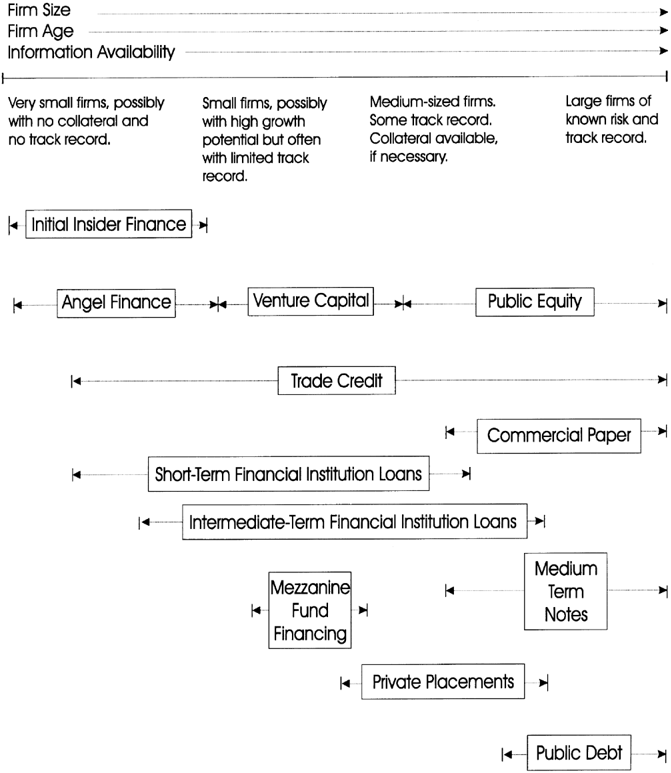
- The growth cycle paradigm predicts younger/more opaque firms rely on insider finance, trade credit, and angel finance, then venture capital and banks, and eventually public markets. However, 1993 NSSBF data show insider finance does not dominate external finance even for adolescents (upper bound 56.8% insider, roughly equal to external), and financial institution debt is important to very young firms, often based on personal guarantees or collateral.
- Macro vulnerability: the early-1990s credit crunch saw real C&I loans fall 23.2% ($596.7 billion to $458.2 billion) and estimated small business lending fall 38.5% ($143.7 billion to $88.4 billion). Banks with less than $100 million in assets held about 9% of portfolios in small business loans versus about 2% for banks over $10 billion; large banks charged about 100 basis points less and required collateral about 25% less often than small banks, other things equal.
Methods
- Design: review and synthesis organized around the financial growth cycle paradigm, covering theoretical and empirical literature on private equity and debt markets, contracts, and macroeconomic vulnerability.
- Data: primarily the 1993 National Survey of Small Business Finances (NSSBF) for US small business finance tables, plus other sources including NFIB, SCF, STBL, CALL, CRA, Venture Economics/VentureOne, and international data.
- Analysis: descriptive tabulations (Tables 1 and 2) and literature synthesis; the paper is a review rather than a new primary empirical study.
Limitations
- Paper-stated: Table 1 data are not completely accurate or consistent and should be considered rough estimates; angel finance estimates are imprecise (range $15 billion to $120 billion); 1993 data may not reflect current conditions; weighted averages mask considerable heterogeneity.
- Paper-stated: the growth cycle paradigm is not intended to fit all small businesses; firm size, age, and information availability are far from perfectly correlated, and the points at which different funding sources begin and end are not definitive.
- Evident from the text: informational opacity and the intertwining of personal and business finances make small business finance difficult to research, and data on owners’ finances are often unavailable; the paper relies heavily on existing literature and available data rather than new primary data collection.
Model-written summary. Check it against the paper before relying on it.
Integrity signals
Registry
Cites
Statistics
Figures
Verification
Claims the paper makes
22 Valid · 27 Not valid · 107 Not checked · 201 Own results and interpretations
Every source the paper cites for this claim was checked and supports it.
In the paper
“This use of personal assets to help with external ®nance also highlights another important aspect of small business ®nance ± the ®nancial intertwining of owners and their businesses (Ang, 1992).”
§ The economics of small business ®nance: The roles of private equity and debt markets in the ®nancial growth cycle > 2.3. The ®nancial growth cycle of small business
What the sources say
- Supportedcites Ang, 1992 matched to “On the Theory of Finance for Privately Held Firms” (1992) source
In “Integrating Personal and Business Accounts,” Ang says that personal guarantees or collateral make business risk inseparable from owners’ personal risk. “The Financing Decision” also identifies owners’ assets used for loan guarantees as contributions to the business. Together, these passages support the cited point that using personal assets to obtain external finance intertwines owners’ and businesses’ finances. (LLM, conf=0.94)
plainstates an association- Asserted: passes — The authors put it forward as true.
- Checkable: passes — It can be checked against evidence.
- Load-bearing: unclear — It is unclear whether the paper’s conclusions depend on it.
- Based: passes — The paper gives a reason why it holds.
- Supported
The cited sources support only part of this claim — read each source’s verdict below.
In the paper
“Costly state veri®cation (Townsend, 1979;Diamond, 1984) and adverse selection (Myers, 1984;Myers and Majluf, 1984;Nachman and Noe, 1994) arguments suggest the optimality of debt contracts after insider ®nance has been exhausted.”
§ The economics of small business ®nance: The roles of private equity and debt markets in the ®nancial growth cycle > 2.3. The ®nancial growth cycle of small business
What the sources say
- Partly supportedcites Townsend, 1979 matched to “Optimal contracts and competitive markets with costly state verification” (1979) sourceExperimental — accuracy not yet measured
Section 3 characterizes an optimal contract for a firm financing an investment project as a bond that defaults when returns fall below a threshold, supporting the costly-state-verification rationale for debt. The paper does not establish that debt becomes optimal only after insider finance has been exhausted. The adverse-selection citations in the sentence refer to other sources, not Townsend. (LLM, conf=0.85)
- Not checked — no full text of the sourcecites Diamond, 1984 matched to “Financial intermediation and delegated monitoring” (1984) source
- Not matchedcites Myers, 1984
More than one paper fits this citation.
hedgedstates a cause- Asserted: passes — The authors put it forward as true.
- Checkable: passes — It can be checked against evidence.
- Load-bearing: passes — The paper’s conclusions depend on it.
- Based: passes — The paper gives a reason why it holds.
- Partly supported
The cited sources support only part of this claim — read each source’s verdict below.
In the paper
“An agency problem arises in the relationship between the entrepreneur and the venture capitalist in which the entrepreneur may expend insucient eort, exhibit expense preference behavior, or lack sucient information or skill to make optimal production decisions.”
§ The economics of small business ®nance: The roles of private equity and debt markets in the ®nancial growth cycle > 3.2. The venture capital market
What the sources say
- Not checked — no full text of the sourcecites Cooper and Carleton, 1979 matched to “Dynamics of Borrower‐Lender Interaction: Partitioning Final Payoff in Venture Capital Finance” (1979) source
- Partly supportedcites Bergemann and Hege, 1998 matched to “Venture capital financing, moral hazard, and learning” (1998) sourceExperimental — accuracy not yet measured
Section 2.3, “Moral hazard and financing,” describes an entrepreneur who may reduce costly effort or divert investment funds to private ends, supporting the insufficient-effort and expense-preference parts of the claim. It does not identify a lack of the entrepreneur’s information or skill as a cause of poor production decisions; it instead says the entrepreneur and venture capitalists initially have the same assessment of the project. (LLM, conf=0.88)
hedgedstates a possible cause- Asserted: passes — The authors put it forward as true.
- Checkable: passes — It can be checked against evidence.
- Load-bearing: passes — The paper’s conclusions depend on it.
- Based: passes — The paper gives a reason why it holds.
Every source the paper cites for this claim was checked and supports it.
In the paper
“Since 1990, this share has about doubled to 30% (Fenn et al., 1997).”
§ The economics of small business ®nance: The roles of private equity and debt markets in the ®nancial growth cycle > 3. The role of private equity markets in small business ®nance
What the sources say
- Supportedcites Fenn et al., 1997 matched to “The Private Equity Market: An Overveiw” (1997) source
In “IPO Firms that Received Private Equity Backing,” the paper states that the share of IPOs with venture backing averaged 15% during the 1980s and doubled to 30% since 1990. This directly supports the cited claim. (LLM, conf=0.95)
plainstates an association- Asserted: passes — The authors put it forward as true.
- Checkable: passes — It can be checked against evidence.
- Load-bearing: unclear — It is unclear whether the paper’s conclusions depend on it.
- Based: passes — The paper gives a reason why it holds.
- Supported
The cited sources support only part of this claim — read each source’s verdict below.
In the paper
“During the 1980s, approximately 15% of all IPOs were backed by venture capital, well out of proportion to the fraction of all ®rms that received venture capital.”
§ The economics of small business ®nance: The roles of private equity and debt markets in the ®nancial growth cycle > 3. The role of private equity markets in small business ®nance
What the sources say
- Partly supportedcites Fenn et al., 1997 matched to “The Private Equity Market: An Overveiw” (1997) sourceExperimental — accuracy not yet measured
The section “IPO Firms that Received Private Equity Backing” states that venture-backed IPOs averaged 15% of IPOs during the 1980s. It does not give the fraction of all firms that received venture capital or make the claimed comparison with that fraction. (LLM, conf=0.84)
plainstates an association- Asserted: passes — The authors put it forward as true.
- Checkable: passes — It can be checked against evidence.
- Load-bearing: unclear — It is unclear whether the paper’s conclusions depend on it.
- Based: passes — The paper gives a reason why it holds.
- Partly supported
184 more claims · 6 with their cited sources checked
Create a free account to see all 357 claims and to verify the 12 references still open.
- Probably not a substantial claim. 94
- It may state two separate claims as one. 87
- Borderline: one of the tests for a substantial claim is unclear. 2
Claims other papers make about this one
Each is checked against this paper’s own text: does it say what the citing paper says it does?
The cited source says what the claim attributes to it.
In the citing paper
“SMEs are more dependent on external financing supplied by commercial banks (Berger and Udell 1998) because most of them are not qualified to raise money from the stock market.”
From Local Bank, Digital Financial Inclusion and SME Financing Constraints: Empirical Evidence from China (2022) · cites this paper as Berger and Udell 1998
Self-check
Percentages, sums and reported differences re-computed from the paper’s own numbers.
Rated minor: it would not touch a result — a value no result rests on, a p-value that stays on the same side of the significance level, or a conflict that is clerical, resolved elsewhere in the paper, or outside its own findings.
In the paper
“Non®nancial business/government debt provides 19.26% of small business funding (mostly trade credit)”
§ The economics of small business ®nance: The roles of private equity and debt markets in the ®nancial growth cycle > 4. The role of private debt markets in small business ®nance
Reported 19.26 · recomputed 18.01
Citations
Cites
Corporate financing and investment decisions when firms have information that investors do not have
Myers, S. C., & Majluf, N. S. (1984) · Journal of Financial Economics · doi:10.1016/0304-405x(84)90023-0 · Cited by 18,957
The Cost of Capital, Corporation Finance and the Theory of Investment
Miller, M. H. (1958) · American Economic Review · Cited by 14,574
Determinants of corporate borrowing
Myers, S. C. (1977) · Journal of Financial Economics · doi:10.1016/0304-405x(77)90015-0 · Cited by 13,169
Credit Rationing in Markets with Imperfect Information
Stiglitz, J. E., & Weiss, A. (1981) · Columbia University · doi:10.7916/d8v12ft1 · Cited by 12,769 · cited 1×
“…pledging outside collateral may help resolve adverse selection problems when the borrower has more information about the quality of the investment than the lender, and may help prevent credit rationing (Stiglitz and Weiss 1981, 1986, Bester 1985, Chan and Kanatas 1985, Besanko and Thakor 1987a,b).”
The cost of capital, corporation finance and the theory of investment
Terra, P. R. (2008) · Revista de Administração e Contabilidade da Unisinos · doi:10.4013/base.20082.07 · Cited by 8,615
Financial intermediation and delegated monitoring
Diamond, D. W. (1984) · The Review of Economic Studies · doi:10.2307/2297430 · Cited by 8,476 · cited 2×
“Costly state verification (Townsend 1979, Diamond 1984) and adverse selection (Myers 1984, Myers and Majluf 1984, Nachman and Noe 1994) arguments suggest the optimality of debt contracts after insider cFor example, there are generally accepted definitions of the stages of finance for the kind of…”
Corporate Financing and Investment Decisions When Firms Have InformationThat Investors Do Not Have
Myers, S., & Majluf, N. (1984) · doi:10.3386/w1396 · Cited by 6,745
The Benefits of Lending Relationships: Evidence from Small Business Data
PETERSEN, M. A., & RAJAN, R. G. (1994) · The Journal of Finance · doi:10.1111/j.1540-6261.1994.tb04418.x · Cited by 5,440 · cited 4×
“…whereas mortgages, equipment loans, motor vehicle loans, and other loans may more often be transactionsdriven .zs It was also found that dependence on trade credit decreased with the length of the banking relationship, supporting the value of relationship lending (Petersen and Rajan 1994, 1995).”
InfluentialInside the black box: the credit channel of monetary policy transmission
Bernanke, B. S., & Gertler, M. (1995) · Journal of Economic Perspectives · doi:10.1257/jep.9.4.27 · Cited by 4,211
Insiders and Outsiders: The Choice between Informed and Arm's‐Length Debt
RAJAN, R. G. (1992) · The Journal of Finance · doi:10.1111/j.1540-6261.1992.tb04662.x · Cited by 3,902 · cited 1×
“Some research suggests that these firms may try to reduce the control of their banks by issuing public debt, even though public debt may entail higher costs (Diamond 1991, 1993, Rajan 1992, Houston and James 1996).”
Research works printed but not linked: 11
- 66. Cook, L., 1997. Trade ®nance, bank ®nance, and capital market imperfections. Working paper. Harvard University, Cambridge, MA.
- 89. Freear, J., Sohl, J.E., Wetzel, W.E., Jr., 1994. The private investor market for venture capital. The Financier 1, 7±19.
- 112. Hancock, D., Wilcox, J.A., 1997. Bank capital, nonbank ®nance, and real estate activity. Journal of Housing Research 8, 75±105.
- 117. Hempel, G., Coleman, A., Simonson, D., 1986. Bank Management, Wiley, New York.
- 119. Ho, R., 1997. Credit-card use to ®nance small business is soaring, says survey of small ®rms. Wall Street Journal B2, Sept. 25.
- 153. Megginson, W.L., Weiss, K.A., 1991. Venture capitalist certi®cation in initial public oerings. Journal of Finance 46, 903±979.
- 162. Morsman Jr., E., 1986. Commercial loan structuring. Journal of Commercial Bank Lending 68, 2± 20.
- 187. Ravid, S.A., 1996. Debt maturity ± A survey. Financial Markets, Institutions and Instruments 5 (3), 1±68.
- 217. Wetzel Jr. W.E., 1994. Venture capital. In: Bygrave, W.D. (Ed.), Portable MBA in Entrepreneur- ship. Wiley, New York, pp. 172±194.
- 219. White, L.J., 1995. An analytical framework. In: Zahid, S.N. (Ed.), Financial Sector Development in Asia. Oxford University Press, New York, pp. 3±35.
- 222. McKean, R. (Ed.), Issues in Defense Economics. Columbia University Press, New York.
Cited by
Items 601–700 of 3,739
R&D investment of start-up firms: does founders’ human capital matter?
Honjo, Y., Kato, M., & Okamuro, H. (2013) · Small Business Economics · doi:10.1007/s11187-013-9476-x · Cited by 71
Typologies of bootstrap financing behavior in small ventures
Malmström, M. (2013) · Venture Capital · doi:10.1080/13691066.2013.863064 · Cited by 79
“…the acquisition of large amounts of financial resources from external financiers, such as venture capitalists, business angels, and other financial institutions (Ang 1992; Berger and Udell 1998; Cassar 2004; Cosh, Cumming, and Hughes 2009; O’Brien 2003; Rapoport 1990; Vicente-Lorente 2001).”
BackgroundDorfleitner, G., Röhe, M., & Renier, N. (2016) · The Quarterly Review of Economics and Finance · doi:10.1016/j.qref.2016.06.005 · Cited by 47
Early stage SME bankruptcy: does the local banking market matter?
Arcuri, G., & Levratto, N. (2018) · Small Business Economics · doi:10.1007/s11187-018-0042-4 · Cited by 57
Local Banking Development and the Use of Debt Financing by New Firms
Deloof, M., Rocca, M. L., & Vanacker, T. R. (2018) · Entrepreneurship Theory and Practice · doi:10.1177/1042258718783486 · Cited by 54
Stakeholders and Long-Term Sustainability of SMEs. Who Really Matters in Crisis Contexts, and When
Lizano, M. M., Alfaro, E., & de la Cruz, A. M. P. (2019) · Sustainability · doi:10.3390/su11236551 · Cited by 58
“That is, certain characteristics of SMEs such as informational opacity [56] make them heavily dependent on internal sources of funding because their risk of loan default is greater.”
BackgroundPiva, E., & Rovelli, P. (2021) · Small Business Economics · doi:10.1007/s11187-021-00525-1 · Cited by 61
Categorization of angel investments: an explorative analysis of risk reduction strategies in Finland
Lahti, T. (2011) · Venture Capital · doi:10.1080/13691066.2010.543322 · Cited by 66
“Moreover, as many of the costs of due diligence tend to be fixed regardless of the size of the investment it may be more preferable in DDDIs to place stronger emphasis on DD because of economies of scale (Berger and Udell 1998 ).”
BackgroundDewaelheyns, N., & Hulle, C. V. (2007) · Small Business Economics · doi:10.1007/s11187-007-9060-3 · Cited by 50
Entrepreneurial Finance: Banks Versus Venture CapitalPreprint
Winton, A., & Yerramilli, V. (2006) · SSRN Electronic Journal · doi:10.2139/ssrn.952037 · Cited by 47
Cole, R. A. (2008) · SSRN Electronic Journal · doi:10.2139/ssrn.1013085 · Cited by 47
Inter-sectoral Differences in the SME Financing Gap: Evidence from Selected Sectors in Ghana
Domeher, D., Musah, G., & Hassan, N. (2017) · Journal of African Business · doi:10.1080/15228916.2017.1265056 · Cited by 46
“According to the financial life cycle model of Berger and Udell (1998), SMEs at the start-up phase rely mostly on personal funds, angel financing and funds from families and friends.”
MethodThe influence of entrepreneur’s characteristics on small manufacturing firm debt financing
Slavec, A., & Prodan, I. (2012) · Journal of East European Management Studies · doi:10.5771/0949-6181-2012-1-104 · Cited by 59
Bertoni, F., D’Adda, D., & Grilli, L. (2012) · Small Business Economics · doi:10.1007/s11187-015-9690-9 · Cited by 58
“Collateralized loans are not a solution because the value of a young high-tech company is mostly in intangible assets, which normally cannot be used as collateral (Berger and Udell 1998).”
BackgroundFinancing gap in Malaysian small-medium enterprises: A supply-side perspective
Ramlee, S., & Berma, M. (2013) · South African Journal of Economic and Management Sciences · doi:10.4102/sajems.v16i5.641 · Cited by 69
Relocation to Get Venture Capital: A Resource Dependence Perspective
Prijcker, S. D., Manigart, S., Collewaert, V., & Vanacker, T. R. (2017) · Entrepreneurship Theory and Practice · doi:10.1177/1042258717739003 · Cited by 63
“Indeed, bootstrap finance and angel money tend to cover smaller financing needs, but are unlikely to cover all financing needs as ventures grow (Berger & Udell, 1998).”
BackgroundMethodInfluentialBhaumik, S. K., Owolabi, O. A., & Pal, S. (2018) · Journal of World Business · doi:10.1016/j.jwb.2018.02.005 · Cited by 54
“The consequences of this information asymmetry and the associated adverse selection problem for credit market failures are much discussed and well documented (Stiglitz and Weiss, 1981; Williamson, 1986, 1987; Berger and Udell, 1998).”
BackgroundFinancing Entrepreneurial Production: Security Design with Flexible Information Acquisition
Yang, M., & Zeng, Y. (2018) · Review of Financial Studies · doi:10.1093/rfs/hhy084 · Cited by 43
“Looking at a more representative sample of private firms, Berger and Udell (1998) also suggest that younger and more innovative firms are more likely to be financed by both external debt and equity at the same time. The combination of debt and equity as proscribed in Proposition 3 also resembles participating converti…”
BackgroundResultInfluentialAre Mergers Responsible for the Surge in New Bank Charters
Keeton, W. R. (2000) · RePEc: Research Papers in Economics · Cited by 50
Small Banks, Small Business, and Relationships: An Empirical Study of Lending to Small Farms
Akhavein, J. D., Goldberg, L. G., & White, L. J. (2004) · Journal of Financial Services Research · doi:10.1023/b:fina.0000040051.30624.e2 · Cited by 55
Trade Credit and Monetary Policy Transmission
Mateut, S. (2005) · Journal of Economic Surveys · doi:10.1111/j.0950-0804.2005.00262.x · Cited by 57
Finance and development: Is Schumpeter’s analysis still relevant?
Bertocco, G. (2007) · Journal of Banking & Finance · doi:10.1016/j.jbankfin.2007.10.010 · Cited by 61
“31 See for example: Gompers (1995), Berger and Udell (1998), Freel (2000), Mason and Harrison (2001), Carpenter and Petersen (2002).”
BackgroundThe Determinants of Venture Capital: Additional EvidencePreprint
de la Potterie, B. V. P., & Romain, A. (2016) · SSRN Electronic Journal · doi:10.2139/ssrn.2785064 · Cited by 46
An Analysis of Shareholder AgreementsPreprint
Chemla, G., Ljungqvist, A. P., & Habib, M. A. (2002) · SSRN Electronic Journal · doi:10.2139/ssrn.299420 · Cited by 46
U.S. Banking Deregulation, Small Businesses, and Interstate Insurance of Personal IncomePreprint
Demyanyk, Y. S., Ostergaard, C., & Sørensen, B. E. (2007) · SSRN Electronic Journal · doi:10.2139/ssrn.557094 · Cited by 208
Business Life Cycle and Capital Structure: Evidence from Chinese Manufacturing Firms
Tian, L., Han, L., & Zhang, S. (2015) · China & World Economy · doi:10.1111/cwe.12105 · Cited by 45
Becchetti, L., Castelli, A., & Hasan, I. (2009) · Small Business Economics · doi:10.1007/s11187-008-9167-1 · Cited by 64
“and financial constraints (with the exception of what was found in Tables 8 and 9) goes in the opposite direction with respect to standard literature findings ( Berger and Udell 1998; Carpenter and Petersen 2002; Denis 2004).”
Changes in the banking system and small business lending
Vera, D. R., & Onji, K. (2008) · Small Business Economics · doi:10.1007/s11187-008-9119-9 · Cited by 59
Drivers of External Equity Funding in Small High-Tech Ventures
Hogan, T., Hutson, E., & Drnevich, P. L. (2016) · Journal of Small Business Management · doi:10.1111/jsbm.12270 · Cited by 71
Financing preferences of micro and small enterprise owners in Tigray: does POH hold?
Gebru, G. H. (2009) · Journal of Small Business and Enterprise Development · doi:10.1108/14626000910956083 · Cited by 64
RETRACTED: Financing Irish high-tech SMEs: The analysis of capital structure
Neville, C., & Lucey, B. M. (2022) · International Review of Financial Analysis · doi:10.1016/j.irfa.2022.102219 · Cited by 58
RetractedWomen in the informal sector in Mauritius: a survival mode
Kasseeah, H., & Tandrayen‐Ragoobur, V. (2014) · Equality Diversity and Inclusion An International Journal · doi:10.1108/edi-04-2013-0022 · Cited by 45
The financing decisions of innovative firms
Casson, P. D., Martin, R., & Nisar, T. M. (2007) · Research in International Business and Finance · doi:10.1016/j.ribaf.2007.05.001 · Cited by 49
Gao, Y. (2011) · Journal of Accounting Research · doi:10.1111/j.1475-679x.2011.00416.x · Cited by 38
IS THE COST OF DEBT CAPITAL HIGHER FOR YOUNGER FIRMS?
Hyytinen, A., & Pajarinen, M. (2007) · Scottish Journal of Political Economy · doi:10.1111/j.1467-9485.2007.00404.x · Cited by 58
“2 Theoretical background The received theory suggests that agency problems can stem both from the manager-shareholder conflict (i.e. separation of ownership and control) and from the lender-borrower conflict (see, e.g., Jensen and Meckling 1976, Berger and Udell 1998).”
Dopfer, M., Fallahi, S., Kirchberger, M. A., & Gassmann, O. (2017) · Creativity and Innovation Management · doi:10.1111/caim.12218 · Cited by 61
Lu, Z., Wu, J., & Liu, J. (2020) · International Journal of Bank Marketing · doi:10.1108/ijbm-01-2020-0007 · Cited by 52
HOW DID THE FINANCIAL CRISIS AFFECT SMALL‐BUSINESS LENDING IN THE UNITED STATES?
Cole, R. A., & Damm, J. (2020) · The Journal of Financial Research · doi:10.1111/jfir.12225 · Cited by 66
External Finance, Firm Growth and the Benefits of Information Disclosure: Evidence from Finland
Hyytinen, A., & Pajarinen, M. (2005) · European Journal of Law and Economics · doi:10.1007/s10657-005-5276-3 · Cited by 58
“It is often argued that one of the most important sources of financial market imperfections is the opacity of firms, i.e., the degree of asymmetric information between corporate insiders and investors (see, e.g., Petersen and Rajan, 1994; Berger and Udell, 1998; Hubbard, 1998).”
BackgroundThe Economic Impact of Venture CapitalPreprint
Romain, A., & Pottelsberghe, B. V. (2004) · RePEc: Research Papers in Economics · Cited by 44
Bank Credit, Trade Credit or No Credit: Evidence from the Surveys of Small Business FinancesPreprint
Cole, R. A. (2010) · SSRN Electronic Journal · doi:10.2139/ssrn.1540221 · Cited by 61
“Bank lenders, on the other hand, are more likely to be secured by collateral and hold claims that are senior to those of trade creditors, so they are more likely to pursue liquidation in the event of default than are trade creditors (Berger and Udell, 1998).”
Externalities of Public Firm Presence: Evidence from Private Firms’ Investment DecisionsPreprint
Badertscher, B. A., Shroff, N., & White, H. D. (2012) · SSRN Electronic Journal · doi:10.2139/ssrn.2037287 · Cited by 44
“The reliance on leverage is not surprising given that private firms have little access to equity markets (Berger and Udell, 1998).”
Local Bias in Venture Capital InvestmentsPreprint
Cumming, D. J., & Dai, N. (2007) · SSRN Electronic Journal · doi:10.2139/ssrn.1034222 · Cited by 44
Does Crowdfunding Benefit Entrepreneurs and Venture Capital Investors?Preprint
Babich, V., Marinesi, S., & Tsoukalas, G. (2017) · SSRN Electronic Journal · doi:10.2139/ssrn.2971685 · Cited by 44
Institutional Frameworks, Venture Capital and the Financing of E uropean New Technology‐based Firms
Vanacker, T. R., Heughebaert, A., & Manigart, S. (2013) · Corporate Governance An International Review · doi:10.1111/corg.12046 · Cited by 52
Gender Differences in Bank Loan Access: An Empirical Analysis
Calcagnini, G., Giombini, G., & Lenti, E. (2014) · Italian Economic Journal · doi:10.1007/s40797-014-0004-1 · Cited by 63
“As older firms have had time to build up a reputation compared to younger firms, which therefore are considered riskier, informational opaqueness problems decrease (Berger and Udell 1998) with Firm age.”
BackgroundInfluentialFinancial statement filing lags: An empirical analysis among small firms
Luypaert, M., Caneghem, T. V., & Uytbergen, S. V. (2015) · International Small Business Journal Researching Entrepreneurship · doi:10.1177/0266242615569324 · Cited by 57
“As noted above, financial debt, that is, bank loans, and trade debt, that is, credit provided by suppliers, are considered to be the most important types of credit for small firms (Berger and Udell, 2006). While all creditors are likely to rely on financial statement information (cf. H1), the extent to which the alter…”
BackgroundInfluentialSegmenting “digital investors”: evidence from the Italian equity crowdfunding market
Feola, R., Vesci, M., Marinato, E., & Parente, R. (2019) · Small Business Economics · doi:10.1007/s11187-019-00265-3 · Cited by 54
“(2018) recognized that firms have often utilized bank debt before searching for equity crowdfunding while much evidence suggests that young entrepreneurs generally experience great difficulty in accessing this kind of external capital (Berger and Udell 1998; Vanacker and Manigart 2010).”
BackgroundInfluentialShow me how to live: Firms' financial conditions and innovation during the crisis
Cefis, E., Bartoloni, E., & Bonati, M. (2019) · Structural Change and Economic Dynamics · doi:10.1016/j.strueco.2019.10.001 · Cited by 55
Crowdlending campaigns for renewable energy: Success factors
Slimane, F. B., & Rousseau, A. (2019) · Journal of Cleaner Production · doi:10.1016/j.jclepro.2019.119330 · Cited by 57
Under pressure: Family financial support and the ambidextrous use of causation and effectuation
Braun, I., & Sieger, P. (2021) · Strategic Entrepreneurship Journal · doi:10.1002/sej.1388 · Cited by 58
Introduction to the Handbook of Entrepreneurship Research
Ács, Z. J., & Audretsch, D. B. (2005) · Springer eBooks · doi:10.1007/0-387-24519-7_1 · Cited by 54
Competition for small firm banking business: Bank actions versus market structure
Scott, J. A., & Dunkelberg, W. C. (2010) · Journal of Banking & Finance · doi:10.1016/j.jbankfin.2010.06.004 · Cited by 49
A Model of Small Firm Capital Acquisition Decisions
Auken, H. E. V. (2005) · International Entrepreneurship and Management Journal · doi:10.1007/s11365-005-2599-z · Cited by 56
“Several studies ( Berger and Udell, 1998; Gibson, 1992; Van Auken, 2001) have suggested that information dissemination among small firms is not consistent with the traditional theory of capital structure.”
BackgroundCrowdfunding: A Literature Review and Research DirectionsPreprint
Moritz, A., & Block, J. (2015) · SSRN Electronic Journal · doi:10.2139/ssrn.2554444 · Cited by 43
When does the tone of earnings press releases matter?
Boudt, K., Thewissen, J., & Torsin, W. (2018) · International Review of Financial Analysis · doi:10.1016/j.irfa.2018.02.002 · Cited by 57
“Baeyens and Manigaart (2003) report that information asymmetry decreases over the lifetime of a firm and Berger and Udell (1998) show that firms in different life cycle stages have strong differences in funding possibilities.”
BackgroundThe long-term effects of loan guarantees on SME performance
Bertoni, F., Colombo, M. G., & Quas, A. (2023) · Journal of Corporate Finance · doi:10.1016/j.jcorpfin.2023.102408 · Cited by 69
Borgia, D. J., & Newman, A. (2012) · Journal of Chinese Entrepreneurship · doi:10.1108/17561391211262148 · Cited by 77
Toward a theory of financial bricolage: the impact of small loans on new businesses
Kariv, D., & Coleman, S. (2015) · Journal of Small Business and Enterprise Development · doi:10.1108/jsbed-02-2013-0020 · Cited by 54
“publish or disclose financial or other information about the business or its products and services (Ang, 1992; Berger and Udell, 1998).”
BackgroundLeverage and firm performance of small businesses: evidence from Japan
Tsuruta, D. (2014) · Small Business Economics · doi:10.1007/s11187-014-9601-5 · Cited by 55
Does employment protection legislation affect firm investment? The European case
Calcagnini, G., Ferrando, A., & Giombini, G. (2013) · Economic Modelling · doi:10.1016/j.econmod.2013.06.036 · Cited by 42
On the Social and Financial Effects of the Transformation of Microfinance NGOs
Chahine, S., & Tannir, L. (2010) · VOLUNTAS International Journal of Voluntary and Nonprofit Organizations · doi:10.1007/s11266-010-9136-6 · Cited by 44
Small and Medium Enterprises and Their Financing Patterns: Evidence from Malaysia
Abdullah, M. A., & Manan, S. K. A. (2011) · Journal of economic cooperation and development · doi:10.5281/zenodo.21133518 · Cited by 64
The Determinant of Capital Structure of SMEs in Malaysia: Evidence from Enterprise 50 (E50) SMEs
Saarani, A. N., & Shahadan, F. B. (2013) · Asian Social Science · doi:10.5539/ass.v9n6p64 · Cited by 58
“As companies grow and mature, different types of debt requirement become important until a company is ready to enter the capital market and obtain external financing (Berger & Udell, 1998; Wijst & Thurik, 1993).”
BackgroundSerrasqueiro, Z., Nunes, P. M., & da Silva, J. V. (2016) · Long Range Planning · doi:10.1016/j.lrp.2015.12.012 · Cited by 65
Credit Guarantees and the Cost of Debt: Evidence from Corporate Loans
Beyhaghi, M. (2019) · European Finance Review · doi:10.1093/rof/rfab012 · Cited by 49
Gama, A. P. M., & Geraldes, H. S. A. (2012) · Management Research Review · doi:10.1108/01409171211247712 · Cited by 74
Bypassing the financial growth cycle: Evidence from Capital Pool Companies
Carpentier, C., & Suret, J. (2005) · Journal of Business Venturing · doi:10.1016/j.jbusvent.2005.01.001 · Cited by 43
Cassar, G. (2011) · Journal of Accounting Research · doi:10.1111/j.1475-679x.2011.00412.x · Cited by 58
“Research on debt financing shows the importance of these contractual features on loan terms for larger firms (Asquith Beatty and Weber 2005; Roberts and Sufi 2009), yet contracting term importance is heightened for smaller private firms (Berger and Udell 1998; Scholtens 1999).”
Tan, J. D., Purba, J. T., & Widjaya, A. E. (2019) · Aceh Global Conference (AGC) · doi:10.2991/agc-18.2019.58 · Cited by 41
Impact of sources of finance on the growth of SMEs: evidence from Pakistan
Khan, S. (2015) · DECISION · doi:10.1007/s40622-014-0071-z · Cited by 63
Personal Guarantees, Loan Pricing, and Lending Structure in Finnish Small Business Loans
Peltoniemi, J., & Vieru, M. (2013) · Journal of Small Business Management · doi:10.1111/jsbm.12015 · Cited by 66
Financial structure and diversification of European firms
Lawless, M., O’Connell, B. J., & O’Toole, C. M. (2015) · Applied Economics · doi:10.1080/00036846.2015.1005829 · Cited by 50
“Berger and Udell (1998) highlight the role of trade credit in financing early-stage firms.”
BackgroundResultInfluentialDETERMINANTS OF CAPITAL STRUCTURE IN NEW VENTURES: EVIDENCE FROM SWEDISH LONGITUDINAL DATA
Örtqvist, D., Masli, E. K., Rahman, S. F., & Selvarajah, C. (2006) · Journal of Developmental Entrepreneurship · doi:10.1142/s1084946706000477 · Cited by 52
Working capital requirements of manufacturing SMEs: evidence from emerging economy
Singh, H. P., & Kumar, S. (2017) · Review of International Business and Strategy · doi:10.1108/ribs-03-2017-0027 · Cited by 61
Bootstrapping: Reviewing the Literature, Clarifying the Construct, and Charting a New Path Forward
Rutherford, M. W., Pollack, J. M., Mazzei, M. J., & Sanchez-Ruiz, P. (2017) · Group & Organization Management · doi:10.1177/1059601117730574 · Cited by 54
“But, as firms age, they become more able to produce and transmit information to stakeholders and information becomes more symmetrical—this is known as the financial growth cycle (Berger & Udell, 1998).”
BackgroundDeterminants of the Use of Fintech Finance among Chinese Small and Medium-Sized Enterprises
Xiang, D., Zhang, Y., & Worthington, A. C. (2018) · IEEE International Symposium on Innovation and Entrepreneurship (TEMS-ISIE) · doi:10.1109/tems-isie.2018.8478470 · Cited by 51
“Start-up and early-stage SMEs may then resort to external equity, particularly private investors, and business angels (Berger and Udell, 1998).”
BackgroundAlleviating Financing Constraints of SMEs through Supply Chain
Yang, Y., Chen, X., Gu, J., & Fujita, H. (2019) · Sustainability · doi:10.3390/su11030673 · Cited by 63
“However, compared with large enterprises, SMEs face greater difficulties in accessing external financing due to the many inherent features of SMEs, such as an information asymmetry [16], a lack of trading history [17], a high risk of failure [29], and a low portion of tangible assets in their total assets [30].”
BackgroundTwesige, D., & Gasheja, F. (2019) · Journal of Accounting and Taxation · doi:10.5897/jat2019.0339 · Cited by 50
Optimal branching strategy, local financial development, and SMEs’ performance
Hossain, M., Yoshino, N., & Hesary, F. T. (2020) · Economic Modelling · doi:10.1016/j.econmod.2020.03.027 · Cited by 48
The Determinants Of Financial Leverage Of SMEs In Mauritius
Odit, M. P., & Gobardhun, Y. D. (2011) · International Business & Economics Research Journal (IBER) · doi:10.19030/iber.v10i3.4107 · Cited by 65
Financial Distress and Employment: The Japanese Case in the 90s
Ogawa, K. (2003) · National Bureau of Economic Research · doi:10.3386/w9646 · Cited by 57
Gender and the credit rationing of small businesses
Mijid, N., & Bernasek, A. (2012) · The Social Science Journal · doi:10.1016/j.soscij.2012.09.002 · Cited by 56
Capital structure and its choice in Central and Eastern Europe
Hernádi, P., & Ormos, M. (2012) · Acta Oeconomica · doi:10.1556/aoecon.62.2012.2.5 · Cited by 45
Are capital structure decisions of service SMEs different? Empirical evidence from Portugal
Serrasqueiro, Z. (2011) · Management Research Review · doi:10.1108/01409171111096469 · Cited by 45
“Cressy and Olofsson (1997) and Bhaird and Lucey (2010) use a questionnaire with Swedish and Irish SMEs, respectively, adopting multivariate analysis for treatment of the responses.”
BackgroundMethodProduct Market Competition and the Financing of New Ventures
de Bettignies, J., & Duchêne, A. (2015) · Management Science · doi:10.1287/mnsc.2014.2041 · Cited by 36
“, Berger and Udell 1998), this prediction is consistent with Klepper (1996), who finds that firms devote an increasing share of their R&D to process innovation rather than product innovation over the product life cycle.”
InfluentialScreening model for the support of governmental venture capital
Minola, T., Vismara, S., & Hahn, D. (2016) · The Journal of Technology Transfer · doi:10.1007/s10961-015-9461-4 · Cited by 46
The Demand for Voluntary Audit in Micro‐Companies: Evidence from Finland
Ojala, H., Collis, J., Kinnunen, J., Niemi, L., & Troberg, P. (2016) · International Journal of Auditing · doi:10.1111/ijau.12070 · Cited by 83
“However, many micro-companies differ from their larger counterparts and are more likely to be financed by owner’s equity with little or no bank finance (Berger & Udell, 1998).”
Edin, K., & Yazdanfar, D. (2016) · Management Research Review · doi:10.1108/mrr-04-2015-0093 · Cited by 68
Net trade credit: what are the determinants?
Afrifa, G. A., & Gyapong, E. (2017) · International Journal of Managerial Finance · doi:10.1108/ijmf-12-2015-0222 · Cited by 52
“However, a research by Berger and Udell (1998) in the US shows that trade credit financing (31.3”
BackgroundResultInfluentialThe influence of gender on financial decisions: evidence from small start-up firms in spain
Hernández‐Nicolás, C. M., Martín‐Ugedo, J. F., & Mínguez‐Vera, A. (2015) · E+M Ekonomie a Management · doi:10.15240/tul/001/2015-4-007 · Cited by 42
“It must be highlighted that the sample examined includes micro and small fi rms that usually get their funds from bank credit [7], their own fi nance or from family and friends and, especially, microcredits.”
BackgroundInfluentialNizaeva, M., & Çoşkun, A. (2019) · SAGE Open · doi:10.1177/2158244019876269 · Cited by 49
“First, the lending policies of banks differ, in part due to regulatory and supervisory differences (Berger & Udell, 1998).”
BackgroundCapital structure dynamics of Indian corporates
Rani, N., Yadav, S. S., & Tripathy, N. (2019) · Journal of Advances in Management Research · doi:10.1108/jamr-12-2017-0125 · Cited by 61
Financial fragmentation and SMEs’ access to finance
Calabrese, R., Girardone, C., & Sclip, A. (2020) · Small Business Economics · doi:10.1007/s11187-020-00393-1 · Cited by 67
“This latter result can be related to their greater opaqueness or because they typically have less availability of collateral than older firms (Berger and Udell, 1998; 2006).”
BackgroundThe local bias in equity crowdfunding: Behavioral anomaly or rational preference?
Hornuf, L., Schmitt, M., & Stenzhorn, E. (2022) · Journal of Economics & Management Strategy · doi:10.1111/jems.12475 · Cited by 51
Ownership structure and debt maturity: new evidence from Spain
García‐Teruel, P. J., & Solano, P. M. (2009) · Review of Quantitative Finance and Accounting · doi:10.1007/s11156-009-0115-1 · Cited by 62
“Warner 1979), higher levels of asymmetric information ( Berger and Udell 1998 ), and higher bankruptcy risk and less access to capital markets (Titman and Wessels 1988).”
BackgroundBricks vs clicks: entrepreneurial online banking behaviour and relationship banking
Han, L. (2008) · International Journal of Entrepreneurial Behaviour & Research · doi:10.1108/13552550810852820 · Cited by 51
“for the UK), stage of business cycle ( Berger and Udell, 1998”
BackgroundSogorb-Mira, F., & López‐Gracia, J. (2003) · SSRN Electronic Journal · doi:10.2139/ssrn.393160 · Cited by 82
“This result is the same as that obtained by a considerable number of previous studies (Ocaña et al., 1994; Hutchinson, 1995; Chittenden et al., 1996; Berger and Udell, 1998; Michaelas et al., 1999; Romano et al., 2000).”
Financial inclusion and business practices of microbusiness in Colombia
Mejía, J. C. U., Gutiérrez, L. H., & Lesmes, P. A. R. (2023) · Eurasian economic review : · doi:10.1007/s40821-022-00231-2 · Cited by 62
“The need for finance is a function of the business’ life-cycle, but the real access is also a function of the size of the business (Berger & Udell, 1998).”
BackgroundMay the resources be with you: a systematic review and framework of startup funding options
Bauer, D., Junge, S., & Reif, T. (2023) · Management Review Quarterly · doi:10.1007/s11301-023-00336-6 · Cited by 39
“Given the major autonomy trade-offs and high required return on investment demanded by venture capitalists, late-stage startups might refrain from using venture capital, especially when cheaper debt funding alternatives are available (Berger and Udell 1998).”
Influential
Metadata
- Authors
- N. Berger, A., & F. Udell, G.
- Venue
- Journal of Banking & Finance
- Publisher
- Elsevier BV
- Published
- 1998-08
- Volume
- 22
- Issue
- 6-8
- Pages
- 613-673
- ISSN
- 0378-4266 (ISSN-L)
- OpenAlex
- W2119780569
- Semantic Scholar
- dfc06f7f7eb83d2c0e2a1d67ecb95b520a406843
- Cited by
- 3,690
- References
- 230
- Citations by year
- 2026: 136 · 2025: 148 · 2024: 144 · 2023: 193 · 2022: 155 · 2021: 211 · 2020: 200 · 2019: 156 · 2018: 208 · 2017: 174 · 2016: 186 · 2015: 187 · 2014: 168 · 2013: 177 · 2012: 171
- FWCI
- 169.26
- Type
- journal article
- Language
- en
- Open access
- hybrid
- doi.org
- Licence
- cc-by-nc-nd
- www.elsevier.com/tdm/userlicense/1.0/ (tdm)
- www.elsevier.com/legal/tdmrep-license (tdm)
- creativecommons.org/licenses/by-nc-nd/4.0/ (vor, 125 d)
- Locations
- Journal of Banking & Finance (publishedVersion, cc-by-nc-nd)
- RePEc: Research Papers in Economics (submittedVersion)
- Funders
- York University
- Topics
- Social Sciences › Economics, Econometrics and Finance › Finance › Private Equity and Venture Capital
- Social Sciences › Economics, Econometrics and Finance › Finance › Corporate Finance and Governance
- Social Sciences › Economics, Econometrics and Finance › Finance › Banking stability, regulation, efficiency
- Keywords
- small business financing, private equity, debt markets, capital structure, firm size, firm age, macroeconomic conditions
About these checks
Registry, retraction, Cites and statistics results are computed, not judged, with one exception: a printed reference that no index lists is read once by a model before it counts as a citation error. Claims are extracted by a model and kept only when their quote appears verbatim in the text; each cited source is then checked, with a model’s help, for whether it says what the claim relies on. Those verdicts can be wrong — read the claim’s quote and the cited source before relying on one.
The claim verdicts this report counts are experimental: their accuracy is not yet measured.
A language model drew the claims from the paper on 2026-10-10, under version 3 of the claim definition (model deepseek-v4.1-flash, prompt extract-v3).
A second model labelled each claim on 2026-10-10 (model jev-1.13-20260917, definition revision gold-guideline-v0.2).
Cited sources are checked with a language model’s help (gpt-6-sol).
Statistics and arithmetic are recomputed, not judged.
Confidence bands are shown only for fields calibrated on our annotated test set. None is calibrated yet, so no band is shown.
What counts as a claim ›How we measure confidence ›How we check this ›
Are you an author, or do you see a problem with this page? Request a review
Data sources
Bibliographic data: Semantic Scholar, OpenAlex, Crossref.
Contains information from the Semantic Scholar Academic Graph Datasets, made available under the ODC Attribution License (ODC-BY 1.0).
Semantic Scholar’s data is described in: Kinney, R., et al. (2023). The Semantic Scholar Open Data Platform. arXiv:2301.10140.
