

The economics of small business finance: The roles of private equity and debt markets in the financial growth cycle
Open accessThe DOI matches its Crossref record; 217 of the 230 references it cites were found in a registry or an index, and 1 are not checked yet; 24 of the 170 sources its claims cite were checked for support.
Abstract
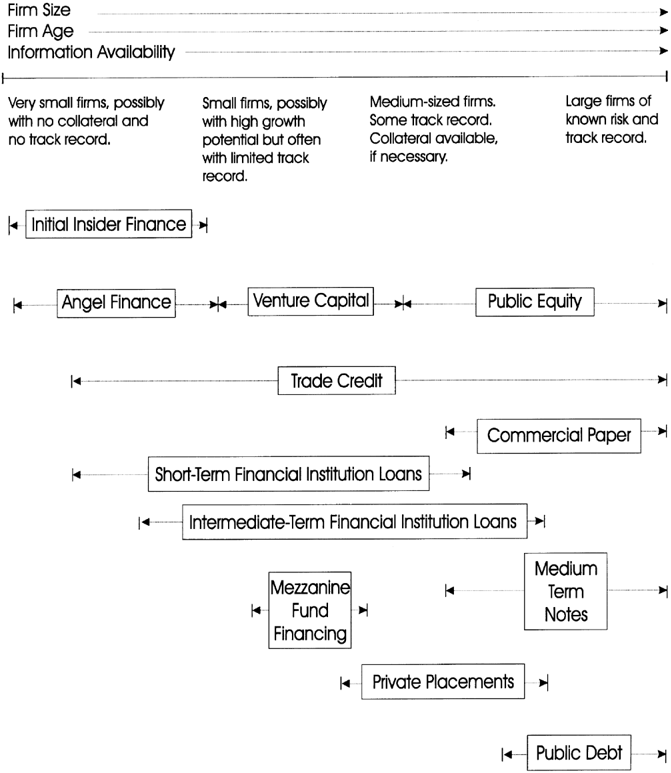
This article examines the economics of financing small business in private equity and debt markets. Firms are viewed through a financial growth cycle paradigm in which different capital structures are optimal at different points in the cycle. We show the sources of small business finance, and how capital structure varies with firm size and age. The interconnectedness of small firm finance is discussed along with the impact of the macroeconomic environment. We also analyze a number of research and policy issues, review the literature, and suggest topics for future research.
Verified 2026-11-25 · 1 reference not checked yet
Overview
CoChat Summary
TL;DR
This article reviews the economics of small business finance through a financial growth cycle paradigm, emphasizing informational opacity and the roles of private equity and debt markets. It documents US small business funding sources and contracts, and analyzes vulnerability to macroeconomic shocks, credit crunches, and bank consolidation.
Key findings
- US small business finance is split roughly evenly between equity (49.63%) and debt (50.37%); the largest sources are the principal owner, commercial banks, and trade creditors, together accounting for 70.10% of total funding. Commercial banks provide 18.75%, trade credit 15.78%, principal owner equity 31.33%, angel finance 3.59%, venture capital 1.85%, and credit card debt 0.14%.
- Financial institution debt is used by 54.23% of small businesses; 86.95% name a commercial bank as their primary financial institution. Average relationship length is 6.64 years overall and 9.01 years with the primary institution; 52.03% of financial institution debt is under lines of credit, 91.94% is secured, and 51.63% is guaranteed.
- The growth cycle paradigm predicts younger/more opaque firms rely on insider finance, trade credit, and angel finance, then venture capital and banks, and eventually public markets. However, 1993 NSSBF data show insider finance does not dominate external finance even for adolescents (upper bound 56.8% insider, roughly equal to external), and financial institution debt is important to very young firms, often based on personal guarantees or collateral.
- Macro vulnerability: the early-1990s credit crunch saw real C&I loans fall 23.2% ($596.7 billion to $458.2 billion) and estimated small business lending fall 38.5% ($143.7 billion to $88.4 billion). Banks with less than $100 million in assets held about 9% of portfolios in small business loans versus about 2% for banks over $10 billion; large banks charged about 100 basis points less and required collateral about 25% less often than small banks, other things equal.
Methods
- Design: review and synthesis organized around the financial growth cycle paradigm, covering theoretical and empirical literature on private equity and debt markets, contracts, and macroeconomic vulnerability.
- Data: primarily the 1993 National Survey of Small Business Finances (NSSBF) for US small business finance tables, plus other sources including NFIB, SCF, STBL, CALL, CRA, Venture Economics/VentureOne, and international data.
- Analysis: descriptive tabulations (Tables 1 and 2) and literature synthesis; the paper is a review rather than a new primary empirical study.
Limitations
- Paper-stated: Table 1 data are not completely accurate or consistent and should be considered rough estimates; angel finance estimates are imprecise (range $15 billion to $120 billion); 1993 data may not reflect current conditions; weighted averages mask considerable heterogeneity.
- Paper-stated: the growth cycle paradigm is not intended to fit all small businesses; firm size, age, and information availability are far from perfectly correlated, and the points at which different funding sources begin and end are not definitive.
- Evident from the text: informational opacity and the intertwining of personal and business finances make small business finance difficult to research, and data on owners’ finances are often unavailable; the paper relies heavily on existing literature and available data rather than new primary data collection.
Model-written summary. Check it against the paper before relying on it.
Integrity signals
Registry
Cites
Statistics
Figures
Verification
Claims the paper makes
22 Valid · 27 Not valid · 107 Not checked · 201 Own results and interpretations
Every source the paper cites for this claim was checked and supports it.
In the paper
“This use of personal assets to help with external ®nance also highlights another important aspect of small business ®nance ± the ®nancial intertwining of owners and their businesses (Ang, 1992).”
§ The economics of small business ®nance: The roles of private equity and debt markets in the ®nancial growth cycle > 2.3. The ®nancial growth cycle of small business
What the sources say
- Supportedcites Ang, 1992 matched to “On the Theory of Finance for Privately Held Firms” (1992) source
In “Integrating Personal and Business Accounts,” Ang says that personal guarantees or collateral make business risk inseparable from owners’ personal risk. “The Financing Decision” also identifies owners’ assets used for loan guarantees as contributions to the business. Together, these passages support the cited point that using personal assets to obtain external finance intertwines owners’ and businesses’ finances. (LLM, conf=0.94)
plainstates an association- Asserted: passes — The authors put it forward as true.
- Checkable: passes — It can be checked against evidence.
- Load-bearing: unclear — It is unclear whether the paper’s conclusions depend on it.
- Based: passes — The paper gives a reason why it holds.
- Supported
The cited sources support only part of this claim — read each source’s verdict below.
In the paper
“Costly state veri®cation (Townsend, 1979;Diamond, 1984) and adverse selection (Myers, 1984;Myers and Majluf, 1984;Nachman and Noe, 1994) arguments suggest the optimality of debt contracts after insider ®nance has been exhausted.”
§ The economics of small business ®nance: The roles of private equity and debt markets in the ®nancial growth cycle > 2.3. The ®nancial growth cycle of small business
What the sources say
- Partly supportedcites Townsend, 1979 matched to “Optimal contracts and competitive markets with costly state verification” (1979) sourceExperimental — accuracy not yet measured
Section 3 characterizes an optimal contract for a firm financing an investment project as a bond that defaults when returns fall below a threshold, supporting the costly-state-verification rationale for debt. The paper does not establish that debt becomes optimal only after insider finance has been exhausted. The adverse-selection citations in the sentence refer to other sources, not Townsend. (LLM, conf=0.85)
- Not checked — no full text of the sourcecites Diamond, 1984 matched to “Financial intermediation and delegated monitoring” (1984) source
- Not matchedcites Myers, 1984
More than one paper fits this citation.
hedgedstates a cause- Asserted: passes — The authors put it forward as true.
- Checkable: passes — It can be checked against evidence.
- Load-bearing: passes — The paper’s conclusions depend on it.
- Based: passes — The paper gives a reason why it holds.
- Partly supported
The cited sources support only part of this claim — read each source’s verdict below.
In the paper
“An agency problem arises in the relationship between the entrepreneur and the venture capitalist in which the entrepreneur may expend insucient eort, exhibit expense preference behavior, or lack sucient information or skill to make optimal production decisions.”
§ The economics of small business ®nance: The roles of private equity and debt markets in the ®nancial growth cycle > 3.2. The venture capital market
What the sources say
- Not checked — no full text of the sourcecites Cooper and Carleton, 1979 matched to “Dynamics of Borrower‐Lender Interaction: Partitioning Final Payoff in Venture Capital Finance” (1979) source
- Partly supportedcites Bergemann and Hege, 1998 matched to “Venture capital financing, moral hazard, and learning” (1998) sourceExperimental — accuracy not yet measured
Section 2.3, “Moral hazard and financing,” describes an entrepreneur who may reduce costly effort or divert investment funds to private ends, supporting the insufficient-effort and expense-preference parts of the claim. It does not identify a lack of the entrepreneur’s information or skill as a cause of poor production decisions; it instead says the entrepreneur and venture capitalists initially have the same assessment of the project. (LLM, conf=0.88)
hedgedstates a possible cause- Asserted: passes — The authors put it forward as true.
- Checkable: passes — It can be checked against evidence.
- Load-bearing: passes — The paper’s conclusions depend on it.
- Based: passes — The paper gives a reason why it holds.
Every source the paper cites for this claim was checked and supports it.
In the paper
“Since 1990, this share has about doubled to 30% (Fenn et al., 1997).”
§ The economics of small business ®nance: The roles of private equity and debt markets in the ®nancial growth cycle > 3. The role of private equity markets in small business ®nance
What the sources say
- Supportedcites Fenn et al., 1997 matched to “The Private Equity Market: An Overveiw” (1997) source
In “IPO Firms that Received Private Equity Backing,” the paper states that the share of IPOs with venture backing averaged 15% during the 1980s and doubled to 30% since 1990. This directly supports the cited claim. (LLM, conf=0.95)
plainstates an association- Asserted: passes — The authors put it forward as true.
- Checkable: passes — It can be checked against evidence.
- Load-bearing: unclear — It is unclear whether the paper’s conclusions depend on it.
- Based: passes — The paper gives a reason why it holds.
- Supported
The cited sources support only part of this claim — read each source’s verdict below.
In the paper
“During the 1980s, approximately 15% of all IPOs were backed by venture capital, well out of proportion to the fraction of all ®rms that received venture capital.”
§ The economics of small business ®nance: The roles of private equity and debt markets in the ®nancial growth cycle > 3. The role of private equity markets in small business ®nance
What the sources say
- Partly supportedcites Fenn et al., 1997 matched to “The Private Equity Market: An Overveiw” (1997) sourceExperimental — accuracy not yet measured
The section “IPO Firms that Received Private Equity Backing” states that venture-backed IPOs averaged 15% of IPOs during the 1980s. It does not give the fraction of all firms that received venture capital or make the claimed comparison with that fraction. (LLM, conf=0.84)
plainstates an association- Asserted: passes — The authors put it forward as true.
- Checkable: passes — It can be checked against evidence.
- Load-bearing: unclear — It is unclear whether the paper’s conclusions depend on it.
- Based: passes — The paper gives a reason why it holds.
- Partly supported
184 more claims · 6 with their cited sources checked
Create a free account to see all 357 claims and to verify the 12 references still open.
- Probably not a substantial claim. 94
- It may state two separate claims as one. 87
- Borderline: one of the tests for a substantial claim is unclear. 2
Claims other papers make about this one
Each is checked against this paper’s own text: does it say what the citing paper says it does?
The cited source says what the claim attributes to it.
In the citing paper
“SMEs are more dependent on external financing supplied by commercial banks (Berger and Udell 1998) because most of them are not qualified to raise money from the stock market.”
From Local Bank, Digital Financial Inclusion and SME Financing Constraints: Empirical Evidence from China (2022) · cites this paper as Berger and Udell 1998
Self-check
Percentages, sums and reported differences re-computed from the paper’s own numbers.
Rated minor: it would not touch a result — a value no result rests on, a p-value that stays on the same side of the significance level, or a conflict that is clerical, resolved elsewhere in the paper, or outside its own findings.
In the paper
“Non®nancial business/government debt provides 19.26% of small business funding (mostly trade credit)”
§ The economics of small business ®nance: The roles of private equity and debt markets in the ®nancial growth cycle > 4. The role of private debt markets in small business ®nance
Reported 19.26 · recomputed 18.01
Citations
Cites
Corporate financing and investment decisions when firms have information that investors do not have
Myers, S. C., & Majluf, N. S. (1984) · Journal of Financial Economics · doi:10.1016/0304-405x(84)90023-0 · Cited by 18,957
The Cost of Capital, Corporation Finance and the Theory of Investment
Miller, M. H. (1958) · American Economic Review · Cited by 14,574
Determinants of corporate borrowing
Myers, S. C. (1977) · Journal of Financial Economics · doi:10.1016/0304-405x(77)90015-0 · Cited by 13,169
Credit Rationing in Markets with Imperfect Information
Stiglitz, J. E., & Weiss, A. (1981) · Columbia University · doi:10.7916/d8v12ft1 · Cited by 12,769 · cited 1×
“…pledging outside collateral may help resolve adverse selection problems when the borrower has more information about the quality of the investment than the lender, and may help prevent credit rationing (Stiglitz and Weiss 1981, 1986, Bester 1985, Chan and Kanatas 1985, Besanko and Thakor 1987a,b).”
The cost of capital, corporation finance and the theory of investment
Terra, P. R. (2008) · Revista de Administração e Contabilidade da Unisinos · doi:10.4013/base.20082.07 · Cited by 8,615
Financial intermediation and delegated monitoring
Diamond, D. W. (1984) · The Review of Economic Studies · doi:10.2307/2297430 · Cited by 8,476 · cited 2×
“Costly state verification (Townsend 1979, Diamond 1984) and adverse selection (Myers 1984, Myers and Majluf 1984, Nachman and Noe 1994) arguments suggest the optimality of debt contracts after insider cFor example, there are generally accepted definitions of the stages of finance for the kind of…”
Corporate Financing and Investment Decisions When Firms Have InformationThat Investors Do Not Have
Myers, S., & Majluf, N. (1984) · doi:10.3386/w1396 · Cited by 6,745
The Benefits of Lending Relationships: Evidence from Small Business Data
PETERSEN, M. A., & RAJAN, R. G. (1994) · The Journal of Finance · doi:10.1111/j.1540-6261.1994.tb04418.x · Cited by 5,440 · cited 4×
“…whereas mortgages, equipment loans, motor vehicle loans, and other loans may more often be transactionsdriven .zs It was also found that dependence on trade credit decreased with the length of the banking relationship, supporting the value of relationship lending (Petersen and Rajan 1994, 1995).”
InfluentialInside the black box: the credit channel of monetary policy transmission
Bernanke, B. S., & Gertler, M. (1995) · Journal of Economic Perspectives · doi:10.1257/jep.9.4.27 · Cited by 4,211
Insiders and Outsiders: The Choice between Informed and Arm's‐Length Debt
RAJAN, R. G. (1992) · The Journal of Finance · doi:10.1111/j.1540-6261.1992.tb04662.x · Cited by 3,902 · cited 1×
“Some research suggests that these firms may try to reduce the control of their banks by issuing public debt, even though public debt may entail higher costs (Diamond 1991, 1993, Rajan 1992, Houston and James 1996).”
Research works printed but not linked: 11
- 66. Cook, L., 1997. Trade ®nance, bank ®nance, and capital market imperfections. Working paper. Harvard University, Cambridge, MA.
- 89. Freear, J., Sohl, J.E., Wetzel, W.E., Jr., 1994. The private investor market for venture capital. The Financier 1, 7±19.
- 112. Hancock, D., Wilcox, J.A., 1997. Bank capital, nonbank ®nance, and real estate activity. Journal of Housing Research 8, 75±105.
- 117. Hempel, G., Coleman, A., Simonson, D., 1986. Bank Management, Wiley, New York.
- 119. Ho, R., 1997. Credit-card use to ®nance small business is soaring, says survey of small ®rms. Wall Street Journal B2, Sept. 25.
- 153. Megginson, W.L., Weiss, K.A., 1991. Venture capitalist certi®cation in initial public oerings. Journal of Finance 46, 903±979.
- 162. Morsman Jr., E., 1986. Commercial loan structuring. Journal of Commercial Bank Lending 68, 2± 20.
- 187. Ravid, S.A., 1996. Debt maturity ± A survey. Financial Markets, Institutions and Instruments 5 (3), 1±68.
- 217. Wetzel Jr. W.E., 1994. Venture capital. In: Bygrave, W.D. (Ed.), Portable MBA in Entrepreneur- ship. Wiley, New York, pp. 172±194.
- 219. White, L.J., 1995. An analytical framework. In: Zahid, S.N. (Ed.), Financial Sector Development in Asia. Oxford University Press, New York, pp. 3±35.
- 222. McKean, R. (Ed.), Issues in Defense Economics. Columbia University Press, New York.
Cited by
Items 501–600 of 3,739
Should banks own equity stakes in their borrowers? A contractual solution to hold-up problems
Mahrt‐Smith, J. (2006) · Journal of Banking & Finance · doi:10.1016/j.jbankfin.2005.12.003 · Cited by 63
“finance is by far the largest source of finance for these firms ( Berger and Udell (1998) ).”
BackgroundDeterminants of the Use of Fintech Finance Among Chinese Small and Medium-Sized Enterprises
Xiang, D., Zhang, Y., & Worthington, A. C. (2020) · IEEE Transactions on Engineering Management · doi:10.1109/tem.2020.2989136 · Cited by 57
“Start-up and early-stage SMEs may then resort to external equity, particularly private investors, and business angels [61].”
BackgroundLehmann, E. E. (2006) · Small Business Economics · doi:10.1007/s11187-005-5599-z · Cited by 67
Determinants of weather derivatives usage in the Austrian winter tourism industry
Bank, M., & Wiesner, R. (2009) · Tourism Management · doi:10.1016/j.tourman.2009.11.005 · Cited by 70
Crowdfunding und Crowdinvesting: State of the Art der wirtschaftswissenschaftlichen Literatur
Moritz, A., & Block, J. (2014) · Zeitschrift für Klein- und Mittelunternehmen/Zeitschrift für KMU und Entrepreneurship · doi:10.3790/zfke.62.1.57 · Cited by 98
Agency theoretic determinants of debt levels: evidence from Ghana
Abor, J. Y. (2008) · Review of Accounting and Finance · doi:10.1108/14757700810874146 · Cited by 57
Clercq, D. D., Meuleman, M. L. C. J., & Wright, M. (2011) · International Business Review · doi:10.1016/j.ibusrev.2011.02.001 · Cited by 72
Small Business Financing: Differences Between Young and Old Firms
Robb, A. (2002) · The Journal of Entrepreneurial Finance · doi:10.57229/2373-1761.1090 · Cited by 79
Is it the Law or the Lawyers? Investment Covenants around the World*
Cumming, D. J., & Johan, S. (2006) · European Financial Management · doi:10.1111/j.1468-036x.2006.00331.x · Cited by 63
The Impact of Corporate Governance Mechanisms on Value Increase in Leveraged BuyoutsPreprint
Wright, M., & Nikoskelainen, E. (2006) · SSRN Electronic Journal · doi:10.2139/ssrn.877233 · Cited by 57
A Matter of Trust? The Bond Market Benefits of Corporate Social Capital during the Financial CrisisPreprint
Amiraslani, H., Lins, K. V., Servaes, H., & Tamayo, A. M. (2017) · SSRN Electronic Journal · doi:10.2139/ssrn.2978794 · Cited by 54
Too risky – The role of finance as a driver of sustainability transitions
Nykvist, B., & Maltais, A. (2022) · Environmental Innovation and Societal Transitions · doi:10.1016/j.eist.2022.01.001 · Cited by 95
Relationship marketing and the management of corporate image in the bank‐SME relationship
Vegholm, F. (2011) · Management Research Review · doi:10.1108/01409171111116330 · Cited by 75
Agglomeration of Invention in the Bay Area: Not Just ICT
Forman, C., Goldfarb, A., & Greenstein, S. (2016) · American Economic Review · doi:10.1257/aer.p20161018 · Cited by 54
Ding, S., Liu, M., & Wu, Z. (2016) · Abacus · doi:10.1111/abac.12083 · Cited by 69
Short- and long-term debt determinants in Swedish SMEs
Öhman, P., & Yazdanfar, D. (2017) · Review of Accounting and Finance · doi:10.1108/raf-08-2015-0118 · Cited by 100
Are small family firms financially sophisticated?
Giuli, A. D., Caselli, S., & Gatti, S. (2011) · Journal of Banking & Finance · doi:10.1016/j.jbankfin.2011.03.021 · Cited by 86
An Examination of the Factors Associated with Bank Switching in the U.K. Small Firm Sector
Howorth, C., Peel, M. J., & Wilson, N. (2003) · Small Business Economics · doi:10.1023/a:1022963226621 · Cited by 66
“Stiglitz and Weiss, 1981; De Meza and Webb, 1987; Cressy, 1996), it is generally agreed that credit rationing is more likely to occur where information asymmetries are highest and that small firms in particular are more likely to suffer from informational opacity ( Berger and Udell, 1998 ).”
BackgroundInfluentialThe Value of Relationship Banking during Financial Crises: Evidence from the Republic of Korea
Ferri, G., Kang, T. S., & Kim, I.-J. (2001) · World Bank, Washington, DC eBooks · doi:10.1596/1813-9450-2553 · Cited by 65
The impact of green credit on firms' green investment efficiency: Evidence from China
Li, L., Qiu, L., Xu, F., & Zheng, X. (2023) · Pacific-Basin Finance Journal · doi:10.1016/j.pacfin.2023.101995 · Cited by 64
Cases of start‐up financing: An analysis of new venture capitalisation structures and patterns
Atherton, A. (2012) · International Journal of Entrepreneurial Behaviour & Research · doi:10.1108/13552551211201367 · Cited by 107
Accruals Quality and Debt Maturity Structure
García‐Teruel, P. J., Solano, P. M., & Sánchez‐Ballesta, J. P. (2010) · Abacus · doi:10.1111/j.1467-6281.2010.00312.x · Cited by 73
Relationship lending and firm innovativeness
Giannetti, C. (2012) · Journal of Empirical Finance · doi:10.1016/j.jempfin.2012.08.005 · Cited by 60
Sarapaivanich, N., & Kotey, B. (2006) · Journal of Enterprising Culture · doi:10.1142/s0218495806000143 · Cited by 54
Is Bankruptcy Risk Tied to Corporate Life-Cycle? Evidence from Pakistan
Akbar, A., Akbar, M., Tang, W., & Qureshi, M. A. (2019) · Sustainability · doi:10.3390/su11030678 · Cited by 57
“Studies on firm life-cycle suggest that they have a strong impact on a firm’s operating performance [19], financing [20,21] investment [22] and dividend decisions [15,23].”
BackgroundCapital Structure, Hurdle Rates, and Portfolio Choice - Interactions in an Entrepreneurial Firm
Heaton, J. C., & Lucas, D. J. (2011) · Cited by 51
Borrower-Lender Distance, Credit Scoring, and the Performance of Small Business LoansPreprint
DeYoung, R. E., Glennon, D. C., & Nigro, P. J. (2006) · SSRN Electronic Journal · doi:10.2139/ssrn.888576 · Cited by 51
“There is a growing body of academic work on small business lending and community banking; Berger and Udell (1998) and DeYoung, Hunter, and Udell (2004) provide reviews of the literature.”
Pyramidal Ownership and the Creation of New FirmsPreprint
Bena, J., & Ortiz‐Molina, H. (2010) · SSRN Electronic Journal · doi:10.2139/ssrn.1681184 · Cited by 55
Bank Competition and Firm CreationPreprint
di Patti, E. B., & Dell’Ariccia, G. (2001) · SSRN Electronic Journal · doi:10.2139/ssrn.258811 · Cited by 52
The Financing of Technology-Based Small Firms: A Review of the LiteraturePreprint
Brierley, P. (2005) · SSRN Electronic Journal · Cited by 55
Cariola, A., Fasano, F., Rocca, M. L., & Skatova, E. (2020) · Journal of Cleaner Production · doi:10.1016/j.jclepro.2020.123133 · Cited by 64
Financing constraints and SME growth: the suppression effect of cost-saving management innovations
Blick, T. D., Paeleman, I., & Laveren, E. (2023) · Small Business Economics · doi:10.1007/s11187-023-00797-9 · Cited by 80
“Compared to larger (listed) firms, privately held SMEs have typically limited historical financial information available (Berger & Udell, 1998), which implies that monitoring the firm or gathering financial information is much more costly for privately held SMEs (Beck & Demirguc-Kunt, 2006).”
Benmelech, E., Kumar, N., & Rajan, R. G. (2024) · The Journal of Finance · doi:10.1111/jofi.13308 · Cited by 79
Sun, X., & Xie, X. (2024) · Pacific-Basin Finance Journal · doi:10.1016/j.pacfin.2024.102316 · Cited by 71
SME recovery following a financial crisis: Does debt overhang matter?
Lawless, M., O’Connell, B. J., & O’Toole, C. M. (2015) · Journal of Financial Stability · doi:10.1016/j.jfs.2015.05.002 · Cited by 73
“Berger and Udell (1998) discuss how firm financing options vary over the life cycle with younger firms less likely to be in a position to have taken out bank credit due to information asymmetries in the banking system.”
BackgroundThe use of financial statements for decision making by small firms
Carraher, S. M., & Auken, H. V. (2013) · Journal of Small Business & Entrepreneurship · doi:10.1080/08276331.2013.803676 · Cited by 105
“Bruns and McKinnon (1993) report that managers want better information and that the quality of information they obtain determines the effectiveness of their decisions (Berger and Udell 1998; Gibson 1992).”
BackgroundDiscouraged finance seekers: An analysis of Australian small and medium-sized enterprises
Dong, X. L., Worthington, A. C., & Higgs, H. (2014) · International Small Business Journal Researching Entrepreneurship · doi:10.1177/0266242613516138 · Cited by 72
“This is a similar categorisation as in Berger and Udell (1998).”
MethodDuarte, F. D., Gama, A. P. M., & Esperança, J. P. (2016) · Research in International Business and Finance · doi:10.1016/j.ribaf.2016.07.005 · Cited by 76
“The provision of collateral can ease conditions of credit rationing that firms face, especially SMEs (e.g., Berger and Udell, 1998), through several channels: It (1) decreases lenders’ risk in the event of default (Coco, 2000), (2) rectifies credit market imperfections related to adverse problems…”
BackgroundFinancial Credit Risk Evaluation Based on Core Enterprise Supply Chains
Mou, W., Wong, W., & McAleer, M. J. (2018) · Sustainability · doi:10.3390/su10103699 · Cited by 69
“In a much earlier contribution, [16] Berger and Udell (1998) found that small firms have limited access to external financing, and were more tightly constrained in their operations, both in developing and developed countries.”
BackgroundTwo-level trade credit with default risk in the supply chain under stochastic demand
Vandana, & Kaur, A. (2018) · Omega · doi:10.1016/j.omega.2018.12.003 · Cited by 56
SME access to market-based finance across Eurozone countries
Bongini, P. A., Ferrando, A., Rossi, E., & Rossolini, M. (2019) · Small Business Economics · doi:10.1007/s11187-019-00285-z · Cited by 85
“According to the life cycle paradigm (Carey et al. 1993; Berger and Udell 1998; La Rocca et al. 2011), younger firms depend heavily on insider funding sources during their start-up and initial stages of growth because of their unique features, including informational opacity stemming from a limited…”
BackgroundInfluentialSelf‐Employment, Microenterprise, and the Poorest Americans
Schreiner, M. J. (1999) · Social Service Review · doi:10.1086/514443 · Cited by 56
Costs and Benefits of Creditor Concentration: An Empirical ApproachPreprint
Omiccioli, M., & Carmignani, A. (2007) · SSRN Electronic Journal · doi:10.2139/ssrn.1075164 · Cited by 58
“4 See Gorton and Winton (2003), Boot (2000), Ongena and Smith (2000a), and Berger and Udell (1998) for an extensive survey of this literature.”
BackgroundThe Effect of Corporate Governance on Firm Performance in Jordan
Marashdeh, Z. (2014) · CLOK (University of Central Lancashire) · Cited by 118
Crowdfunding In France: A New Revolution?
Sannajust, A., Roux, F., & Chaibi, A. (2014) · Journal of Applied Business Research (JABR) · doi:10.19030/jabr.v30i6.8947 · Cited by 45
The role of formal and informal finance in the informal sector in Ghana
Turkson, F. E., Amissah, E., & Gyeke‐Dako, A. (2020) · Journal of Small Business & Entrepreneurship · doi:10.1080/08276331.2020.1724002 · Cited by 72
Arslan, A., Kamara, S., Zahoor, N., Rani, P., & Khan, Z. (2022) · International Journal of Entrepreneurial Behaviour & Research · doi:10.1108/ijebr-05-2021-0396 · Cited by 68
Informed Finance and Technological Change: Evidence from Credit RelationshipsPreprint
Herrera, A. M., & Minetti, R. (2004) · SSRN Electronic Journal · doi:10.2139/ssrn.539782 · Cited by 53
Legality and Venture Governance Around the WorldPreprint
Cumming, D. J., Schmidt, D. M., & Uwe Walz, B. (2008) · SSRN Electronic Journal · doi:10.2139/ssrn.537243 · Cited by 59
“Venture capital is distinct from other forms of financial intermediation primarily through the governance and value added that the investor provides to the investee (Manigart et al., 1996; Bergmann and Hege, 1998; Black and Gilson, 1998; Trester, 1998; Berger and Udell, 1998; Gompers and Lerner, 1999; Casamatta, 2003;…”
A survival analysis of public guaranteed loans: Does financial intermediary matter?
Caselli, S., Corbetta, G., Cucinelli, D., & Rossolini, M. (2021) · Journal of Financial Stability · doi:10.1016/j.jfs.2021.100880 · Cited by 65
A Property Rights Perspective on Venture Capital Investment Decisions
Dimov, D. P., & Gedajlovic, E. R. (2009) · Journal of Management Studies · doi:10.1111/j.1467-6486.2009.00905.x · Cited by 57
Drivers of holding period firm-level returns in private equity-backed buyouts
Valkama, P., MAULA, M. V. J., Nikoskelainen, E., & Wright, M. (2013) · Journal of Banking & Finance · doi:10.1016/j.jbankfin.2013.01.042 · Cited by 49
Agency and similarity effects and the VC’s attitude towards academic spin-out investing
Knockaert, M., Wright, M., Clarysse, B., & Lockett, A. (2009) · The Journal of Technology Transfer · doi:10.1007/s10961-009-9138-y · Cited by 63
“High tech start-ups require substantial amounts of financing to get started, which causes internal financial resources to be insufficient or inappropriate (Oakey, 1984; Westhead and Storey, 1995; Berger and Udell, 1998).”
BackgroundO’Dair, M., & Owen, R. (2019) · Strategic Change · doi:10.1002/jsc.2242 · Cited by 65
Van, Q. L., Nguyen, T. V., & Nguyen, M. (2019) · Business Strategy and the Environment · doi:10.1002/bse.2272 · Cited by 62
Leverage and performance: do size and crisis matter?
Danso, A., Lartey, T. A., Gyimah, D., & Adu‐Ameyaw, E. (2020) · Managerial Finance · doi:10.1108/mf-10-2019-0522 · Cited by 74
Does the CFO matter in family firms? Evidence from Italy
Caselli, S., & Giuli, A. D. (2009) · European Journal of Finance · doi:10.1080/13518470903211657 · Cited by 66
A Literature Review and Classification of Relationship Marketing Research
Gupta, A. K., & Sahu, G. P. (2012) · International Journal of Customer Relationship Marketing and Management · doi:10.4018/ijcrmm.2012010104 · Cited by 61
China: A New Model for Growth and Development
Garnaut, R., & Song, L. (2013) · ANU Press eBooks · doi:10.22459/cnmgd.07.2013 · Cited by 119
Hossain, M. M., Ibrahim, Y., & Uddin, M. M. (2020) · Journal of Small Business & Entrepreneurship · doi:10.1080/08276331.2020.1793097 · Cited by 85
China: A New Model for Growth and Development
Garnaut, R., & Song, L. (2013) · ANU Press eBooks · doi:10.26530/oapen_459949 · Cited by 51
Corporate governance and sustainability disclosure: evidence from Jordan
Alodat, A. Y., Salleh, Z., & Hashim, H. A. (2022) · Corporate Governance · doi:10.1108/cg-04-2022-0162 · Cited by 78
The choice between bank debt and trade credits in business start-ups
Huygebaert, N., Gucht, L. M. V. D., & Hulle, C. V. (2007) · Small Business Economics · doi:10.1007/s11187-007-9068-8 · Cited by 52
“Similar practices have been observed in other countries (see, e.g., Mann, 1997; Schwartz, 1997; Berger and Udell, 1998).”
BackgroundResultInfluentialRasheed, R., & Siddiqui, S. H. (2018) · Journal of economic and administrative sciences. · doi:10.1108/jeas-05-2018-0057 · Cited by 50
Are trade creditors relationship lenders?
Uchida, H., Udell, G. F., & Watanabe, W. (2013) · Japan and the World Economy · doi:10.1016/j.japwor.2013.01.002 · Cited by 54
“The ratio for the U.S. is from Berger and Udell (1998).”
BackgroundSelf-citationA Theory of Banks' Industry Expertise, Market Power, and Credit Risk
Stomper, A. (2006) · Management Science · doi:10.1287/mnsc.1060.0559 · Cited by 55
“Additionally, see Berger and Udell (1998) for the role of bank lending in small business financing.”
Financing Innovation in New Small Firms: New Evidence from CanadaPreprint
Baldwin, J. R., Gellatly, G., & Gaudreault, V. (2002) · SSRN Electronic Journal · doi:10.2139/ssrn.316849 · Cited by 51
“All stem from information asymmetries that are posited to raise the cost of external capital relative to internally-generated funds (Berger and Udell, 1998).”
Leverage over the Firm Life-Cycle, Firm Growth, and Aggregate Fluctuations
Dinlersoz, E., Kalemli‐Özcan, Ṣ., Hyatt, H. R., & Penciakova, V. (2018) · National Bureau of Economic Research · doi:10.3386/w25226 · Cited by 63
“Using the 1993 survey, Berger and Udell (1998) show that due to a high degree of informational opacity, small businesses depend more on funding provided by insiders and receive external funding primarily from private equity and debt markets, as opposed to the public market.”
Chowdhury, R. H., & Maung, M. T. (2020) · Journal of Small Business Management · doi:10.1080/00472778.2020.1726125 · Cited by 53
“This finding is in line with the analysis provided by Berger and Udell (1998) in 10It can be argued that the presence of entrepreneurs may result in subsequent demand for external financing.”
BackgroundResultInfluentialBank interlinkages and macroeconomic stability
Grilli, R., Tedeschi, G., & Gallegati, M. (2014) · International Review of Economics & Finance · doi:10.1016/j.iref.2014.07.002 · Cited by 54
Umer, U. M. (2013) · International Journal of Economics and Finance · doi:10.5539/ijef.v6n1p53 · Cited by 66
“When we see most empirical studies on capital structure they reveal a negative correlation between profitability and leverage of a firm, which is consistent with the pecking order theory, for example the work of Titman and Wessels (1988); Rajan and Zingales (1995); Bevan and Danbolt (2002); Antoniou, Guney and Paudyal…”
BackgroundResultInfluentialImages of Entrepreneurship: Exploring Root Metaphors and Expanding Upon Them
Lundmark, E., Krzeminska, A., & Shepherd, D. A. (2017) · Entrepreneurship Theory and Practice · doi:10.1177/1042258717734369 · Cited by 63
Singh, P., & Kaur, C. (2019) · Journal of Small Business & Entrepreneurship · doi:10.1080/08276331.2019.1641662 · Cited by 62
“In an imperfect market, information asymmetry (Berger and Udell 1998), makes access to external finance costly particularly for SMEs which further leads to adverse selection (Stiglitz and Weiss 1981), and moral hazard (Ghosh, Mookherjee, and Ray 2001).”
BackgroundEngel, D., & Stiebale, J. (2013) · Small Business Economics · doi:10.1007/s11187-013-9530-8 · Cited by 63
“Berger and Udell (1998) point out that business contacts and audited financial statements are not publicly visible for many SMEs, and thus external investors face high transaction costs in acquiring sufficient information about these firms.”
Dai, N., Ivanov, V. I., & Cole, R. A. (2017) · Journal of Corporate Finance · doi:10.1016/j.jcorpfin.2017.04.005 · Cited by 85
BRIDGING CAPITAL GAPS TO PROMOTE INNOVATION IN FRANCE
Cieply, S. (2001) · Industry and Innovation · doi:10.1080/13662710120072958 · Cited by 50
Alakaleek, W., & Cooper, S. Y. (2017) · Venture Capital · doi:10.1080/13691066.2017.1345120 · Cited by 57
“Thus, to ensure successful entrepreneurial entry and survival, different sources of capital and capital structures are required at various stages of the business development process (Berger and Udell 1998).”
BackgroundVenture capital and the investment curve of young high-tech companies
Bertoni, F., Croce, A., & Guerini, M. (2015) · Journal of Corporate Finance · doi:10.1016/j.jcorpfin.2015.08.012 · Cited by 54
“These companies typically have a limited availability of internally generated cash flow and are also severely exposed to frictions in capital markets that inhibit the access to other forms of external financing (Berger and Udell, 1998).”
BackgroundDynamic Financing Strategies: The Role of Venture Capital
Baeyens, K., & Manigart, S. (2003) · The Journal of Private Equity · doi:10.3905/jpe.2003.320063 · Cited by 57
“Moreover, through their roles of screening, contracting, and monitoring, venture capitalists minimize the costs of delegating decisions to entrepreneurs or induce them to reveal critical information on their activities (Berger and Udell [1998]; Manigart and Sapienza [1999]). If they perform their roles well, informed…”
BackgroundInfluentialFinancing of small and medium enterprises (SMEs): Determinants of bank loan application
Khalid, H. A., & Kalsom, A. W. (2014) · AFRICAN JOURNAL OF BUSINESS MANAGEMENT · doi:10.5897/ajbm2013.7222 · Cited by 48
The characteristics of a monetary economy: a Keynes-Schumpeter approach
Bertocco, G. (2006) · Cambridge Journal of Economics · doi:10.1093/cje/bel002 · Cited by 75
SME policies as a barrier to growth of SMEs
Tsuruta, D. (2018) · Small Business Economics · doi:10.1007/s11187-018-0119-0 · Cited by 79
“These findings are consistent with the notion of Berger and Udell (1998) that shows sources of finance for SMEs divided by firm size. Small-sized firms use financial institution loans, so the equity issue is not the main source of finance.21 Therefore, the constraints on capital stock for treatment2 and treatment3 hav…”
BackgroundResultInfluentialThe impact of financial reporting quality on debt maturity: the case of private firms
Meyere, M. D., Bauwhede, H. V., & Cauwenberge, P. V. (2018) · Accounting and Business Research · doi:10.1080/00014788.2018.1431103 · Cited by 49
“Privately held firms are estimated to have approximately four times more employees and sales and twice as much assets compared to listed firms (see Berzins et al. 2008). 2. As Hope and Vyas (2017, pp. 510–511) mention, to mitigate agency conflicts, borrowers are commonly required by banks to comply with a number of ac…”
InfluentialAngel Finance: The Other Venture Capital
Wong, A. (2010) · Wiley eBooks · doi:10.1002/9781118266908.ch5 · Cited by 68
Entrepreneurial finance – issues and evidence, revisited
Mitter, C., & Kraus, S. (2011) · International Journal of Entrepreneurship and Innovation Management · doi:10.1504/ijeim.2011.041728 · Cited by 63
“Value adding is not common and not necessary in these kinds of ventures (Nathusius, 2003; Berger and Udell, 1998).”
BackgroundInfluentialFinancing social enterprises and the demand for social investment
Lyon, F., & Owen, R. (2019) · Strategic Change · doi:10.1002/jsc.2245 · Cited by 63
“6 become ‘less informationally opaque’ to potential finance providers (Berger and Udell, 1998).”
BackgroundExplaining loan rate differentials between small and large companies: evidence from Switzerland
Dietrich, A. (2010) · Small Business Economics · doi:10.1007/s11187-010-9273-8 · Cited by 66
“As several authors have pointed out, SMEs are more vulnerable to asymmetric information problems since small companies tend to be more informationally opaque than larger businesses (see, e.g., Berger and Udell 1998 ).”
BackgroundInfluentialFirm Size and Financial Performance: Intermediate Effects of Indebtedness
Lopez‐Valeiras, E., Gomez‐Conde, J., & Fernández-Rodríguez, M. A. T. (2016) · Agribusiness · doi:10.1002/agr.21458 · Cited by 63
Crowdfunding as a New Financing Tool
Leboeuf, G., & Schwienbacher, A. (2018) · Springer eBooks · doi:10.1007/978-3-319-66119-3_2 · Cited by 53
Grilli, L. (2018) · Regional Studies · doi:10.1080/00343404.2018.1479524 · Cited by 62
“In the funding escalator (Gregson, 2014; Roberts, 2015) and financial growth cycle (Berger & Udell, 1998) models, despite some variations (Gregson, Mann, & Harrison, 2013), the BA’s stage is represented by the life phase where the start-up has not yet entered any market.”
BackgroundInfluentialGovernment connections and credit access around the world: Evidence from discouraged borrowers
Qi, S., & Nguyen, D. D. (2020) · Journal of International Business Studies · doi:10.1057/s41267-020-00341-x · Cited by 48
Bank Relationships and Private Firms’ Financial Reporting Quality
Bigus, J., & Hillebrand, C. (2016) · European Accounting Review · doi:10.1080/09638180.2016.1152906 · Cited by 67
“Following the literature (Berger & Udell, 1998; Elsas, 2005; Ongena, Tümer-Alkan, & Westernhagen, 2012), we measure relationship lending by the number of bank relationships a firm has.”
BackgroundMethodInfluentialSupplier relationships and small business use of trade credit
Aaronson, D. M., Bostic, R. W., Huck, P. F., & Townsend, R. M. (2003) · Journal of Urban Economics · doi:10.1016/j.jue.2003.02.001 · Cited by 60
FUNDING GAPS: A SYMPOSIUM 1 By
Cressy, R. (2011) · Cited by 49
Berg, G., & Fuchs, M. (2013) · World Bank, Washington, DC eBooks · doi:10.1596/1813-9450-6563 · Cited by 80
“Among the main factors impacting bank financing for SMEs are inter alia the macroeconomic environment, the legal and regulatory framework, the state of the financial sector infrastructure, bank-internal limitations in terms of capacity and technology, and SME specific factors, particularly the SME landscape in terms o…”
BackgroundHouse Prices, Home Equity and Entrepreneurship: Evidence from U.S. Census Micro DataPreprint
Kerr, S. P., Kerr, W. A., & Nanda, R. (2015) · SSRN Electronic Journal · doi:10.2139/ssrn.2638045 · Cited by 48
“Debt …nancing is important for small and young businesses (e.g., Berger and Udell, 1998; Robb and Robinson, 2014), but the challenges associated with asymmetric information in small business lending are di¢ cult for banks to overcome (e.g., Stiglitz and Weiss, 1981).”
The Financing of Small Innovative Firms: The Italian CasePreprint
Magri, S. (2007) · SSRN Electronic Journal · doi:10.2139/ssrn.1022522 · Cited by 48
Credit guarantees and SME efficiency
García-Tabuenca, A., & Espert, J. L. C. (2008) · Small Business Economics · doi:10.1007/s11187-008-9148-4 · Cited by 60
“On the other hand, the preferential order in the election of financial sources by the companies (Myers and Majluf 1984) has a close relationship with business size, as well as with age and information, so these evolve throughout a cycle of financial growth ( Berger and Udell 1998 ).”
BackgroundCorporate philanthropy and bank loans in China
Chen, D., Jiang, D., & Yu, X. (2015) · Pacific-Basin Finance Journal · doi:10.1016/j.pacfin.2015.03.004 · Cited by 50
Financing patterns in new technology-based firms: an extension of the pecking order theory
Minola, T., Cassia, L., & Criaco, G. (2013) · International Journal of Entrepreneurship and Small Business · doi:10.1504/ijesb.2013.054964 · Cited by 47
“Technology-based small firms experience different financial problems during the business lifecycle (Berger and Udell, 1998), due to the need of R&D and marketing expenses and peculiar typologies of investments (Giudici and Paleari, 2000).”
Metadata
- Authors
- N. Berger, A., & F. Udell, G.
- Venue
- Journal of Banking & Finance
- Publisher
- Elsevier BV
- Published
- 1998-08
- Volume
- 22
- Issue
- 6-8
- Pages
- 613-673
- ISSN
- 0378-4266 (ISSN-L)
- OpenAlex
- W2119780569
- Semantic Scholar
- dfc06f7f7eb83d2c0e2a1d67ecb95b520a406843
- Cited by
- 3,690
- References
- 230
- Citations by year
- 2026: 136 · 2025: 148 · 2024: 144 · 2023: 193 · 2022: 155 · 2021: 211 · 2020: 200 · 2019: 156 · 2018: 208 · 2017: 174 · 2016: 186 · 2015: 187 · 2014: 168 · 2013: 177 · 2012: 171
- FWCI
- 169.26
- Type
- journal article
- Language
- en
- Open access
- hybrid
- doi.org
- Licence
- cc-by-nc-nd
- www.elsevier.com/tdm/userlicense/1.0/ (tdm)
- www.elsevier.com/legal/tdmrep-license (tdm)
- creativecommons.org/licenses/by-nc-nd/4.0/ (vor, 125 d)
- Locations
- Journal of Banking & Finance (publishedVersion, cc-by-nc-nd)
- RePEc: Research Papers in Economics (submittedVersion)
- Funders
- York University
- Topics
- Social Sciences › Economics, Econometrics and Finance › Finance › Private Equity and Venture Capital
- Social Sciences › Economics, Econometrics and Finance › Finance › Corporate Finance and Governance
- Social Sciences › Economics, Econometrics and Finance › Finance › Banking stability, regulation, efficiency
- Keywords
- small business financing, private equity, debt markets, capital structure, firm size, firm age, macroeconomic conditions
About these checks
Registry, retraction, Cites and statistics results are computed, not judged, with one exception: a printed reference that no index lists is read once by a model before it counts as a citation error. Claims are extracted by a model and kept only when their quote appears verbatim in the text; each cited source is then checked, with a model’s help, for whether it says what the claim relies on. Those verdicts can be wrong — read the claim’s quote and the cited source before relying on one.
The claim verdicts this report counts are experimental: their accuracy is not yet measured.
A language model drew the claims from the paper on 2026-10-10, under version 3 of the claim definition (model deepseek-v4.1-flash, prompt extract-v3).
A second model labelled each claim on 2026-10-10 (model jev-1.13-20260917, definition revision gold-guideline-v0.2).
Cited sources are checked with a language model’s help (gpt-6-sol).
Statistics and arithmetic are recomputed, not judged.
Confidence bands are shown only for fields calibrated on our annotated test set. None is calibrated yet, so no band is shown.
What counts as a claim ›How we measure confidence ›How we check this ›
Are you an author, or do you see a problem with this page? Request a review
Data sources
Bibliographic data: Semantic Scholar, OpenAlex, Crossref.
Contains information from the Semantic Scholar Academic Graph Datasets, made available under the ODC Attribution License (ODC-BY 1.0).
Semantic Scholar’s data is described in: Kinney, R., et al. (2023). The Semantic Scholar Open Data Platform. arXiv:2301.10140.
