

Climate anxiety in children and young people and their beliefs about government responses to climate change: a global survey
Open accessThe DOI matches its Crossref record; 27 of the 30 references it cites were found in a registry or an index, and 1 are not checked yet; 14 of the 48 sources its claims cite were checked for support.
Abstract
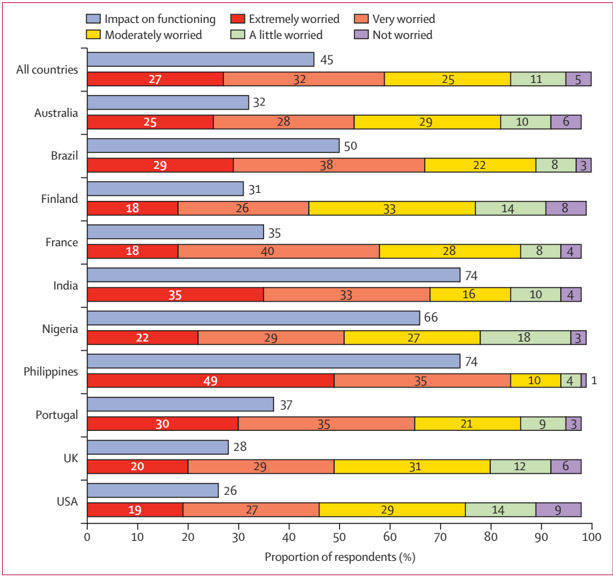
Background Climate change has important implications for the health and futures of children and young people, yet they have little power to limit its harm, making them vulnerable to climate anxiety. This is the first large-scale investigation of climate anxiety in children and young people globally and its relationship with perceived government response. Methods We surveyed 10 000 children and young people (aged 16-25 years) in ten countries (Australia, Brazil, Finland, France, India, Nigeria, Philippines, Portugal, the UK, and the USA; 1000 participants per country). Invitations to complete the survey were sent via the platform Kantar between May 18 and June 7, 2021. Data were collected on participants' thoughts and feelings about climate change, and government responses to climate change. Descriptive statistics were calculated for each aspect of climate anxiety, and Pearson's correlation analysis was done to evaluate whether climate-related distress, functioning, and negative beliefs about climate change were linked to thoughts and feelings about government response. Findings Respondents across all countries were worried about climate change (59% were very or extremely worried and 84% were at least moderately worried). More than 50% reported each of the following emotions: sad, anxious, angry, powerless, helpless, and guilty. More than 45% of respondents said their feelings about climate change negatively affected their daily life and functioning, and many reported a high n…
Verified 2026-11-25 · 1 reference not checked yet
Overview
CoChat Summary
TL;DR
This global survey of 10,000 people aged 16–25 across ten countries found widespread climate anxiety and distress, with many reporting negative functional impacts. Climate distress was correlated with negative perceptions of government responses and feelings of betrayal.
Key findings
- 59% were very or extremely worried about climate change and 84% were at least moderately worried; more than 50% reported feeling sad, anxious, angry, powerless, helpless, and guilty.
- More than 45% said their feelings about climate change negatively affected their daily life and functioning; 75% said the future is frightening and 83% said people have failed to take care of the planet.
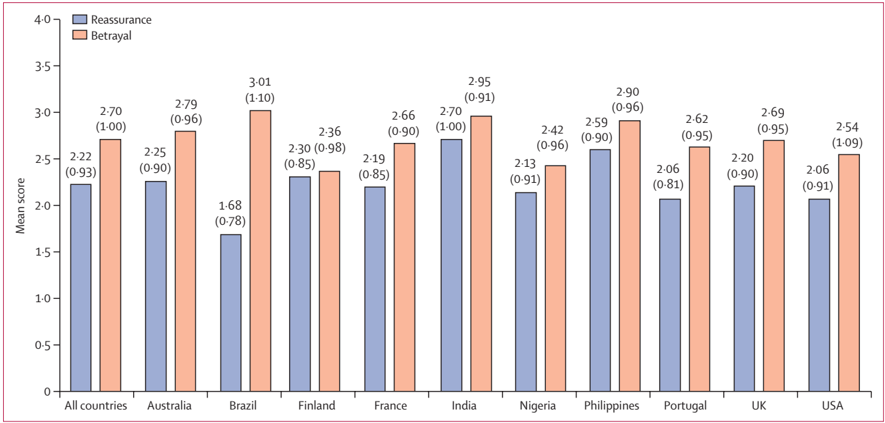
- Respondents rated government responses negatively (mean 14.96 on a 9–18 scale, SD 2.57) and reported greater betrayal (mean 2.7, SD 1.0) than reassurance (mean 2.22, SD 0.93; p<0.0001).
- Climate anxiety and distress were correlated with perceived inadequate government response and associated feelings of betrayal.
Methods
- Cross-sectional online survey of 10,000 children and young people aged 16–25 years in ten countries (Australia, Brazil, Finland, France, India, Nigeria, Philippines, Portugal, the UK, and the USA; 1000 per country), recruited via Kantar between May 18 and June 7, 2021.
- Quota sampling was based on age, gender, and region, with data weighted to OECD statistics for each country by age group, gender, and region.
- Descriptive statistics were calculated for climate anxiety constructs, and Pearson’s correlation analysis explored links between climate-related distress, functioning, negative beliefs, and thoughts/feelings about government response; findings significant at p≤0.001 are reported.
Limitations
- The paper states that non-standardised measures were used because no appropriate standardised measures existed; the study cannot indicate severity compared with normative samples, did not measure mental health outcomes, and used a yes/no/prefer-not-to-say response scale.
- The paper states that equal sample sizes per country were not weighted by population size, so aggregated results are not globally representative; online polling required internet access and sometimes English, and gender was recorded only as male or female.
- Evident from the text: the cross-sectional design cannot establish causality between perceived government response and climate distress.
Model-written summary. Check it against the paper before relying on it.
Integrity signals
Registry
Cites
Statistics
Figures
Verification
Claims the paper makes
12 Valid · 0 Not valid · 19 Not checked · 99 Own results and interpretations
Every source the paper cites for this claim was checked and supports it.
In the paper
“Children are now turning to legal action based on government failure to protect ecosystems, young citizens, and their futures. 26”
What the sources say
- Supportedcites [26] 26 Salas RN, Jacobs W, Perera F. The case of Juliana v. US-children and the health burdens of climate change. N Engl J Med 2019; 380: 2085-87 . source
The supplied Abstract passages describe children filing suit over federal inaction on climate change, which they say violates their constitutional rights. They also connect that inaction to threats to children’s safe environment and to future generations, supporting the citing sentence’s paraphrase. (LLM, conf=0.88)
plainstates a cause- Asserted: passes — The authors put it forward as true.
- Checkable: passes — It can be checked against evidence.
- Load-bearing: unclear — It is unclear whether the paper’s conclusions depend on it.
- Based: passes — The paper gives a reason why it holds.
- Supported
A result the paper reports from its own data — it cites no other source for it, so there is none to check. The quote shows it is in the paper.
In the paper
“in the Global North, Portugal (which had dramatic increases in wildfires since 2017) showed the highest level of worry.”
plainn = 1,000- Asserted: passes — The authors put it forward as true.
- Checkable: passes — It can be checked against evidence.
- Load-bearing: unclear — It is unclear whether the paper’s conclusions depend on it.
- Based: passes — The paper gives a reason why it holds.
A result the paper reports from its own data — it cites no other source for it, so there is none to check. The quote shows it is in the paper.
In the paper
“Respondents rated governmental responses to climate change negatively”
plain- Asserted: passes — The authors put it forward as true.
- Checkable: passes — It can be checked against evidence.
- Load-bearing: passes — The paper’s conclusions depend on it.
- Based: passes — The paper gives a reason why it holds.
A result the paper reports from its own data — it cites no other source for it, so there is none to check. The quote shows it is in the paper.
In the paper
“This distress was associated with beliefs about inadequate governmental response and feelings of betrayal.”
plainstates an association- Asserted: passes — The authors put it forward as true.
- Checkable: passes — It can be checked against evidence.
- Load-bearing: passes — The paper’s conclusions depend on it.
- Based: passes — The paper gives a reason why it holds.
A result the paper reports from its own data — it cites no other source for it, so there is none to check. The quote shows it is in the paper.
In the paper
“More than 45% of respondents said their feelings about climate change negatively affected their daily life and functioning”
- Also stated in: § Results · p. 5 · plain
“More than 45% of respondents said their feelings about climate change negatively affected their daily lives”
plainn = 10- Asserted: passes — The authors put it forward as true.
- Checkable: passes — It can be checked against evidence.
- Load-bearing: passes — The paper’s conclusions depend on it.
- Based: passes — The paper gives a reason why it holds.
- Also stated in: § Results · p. 5 · plain
50 more claims
Create a free account to see all 130 claims and to verify the 1 reference still open.
- Probably not a substantial claim. 51
- It may state two separate claims as one. 41
- The quote only partly states this claim. 6
Claims other papers make about this one
Each is checked against this paper’s own text: does it say what the citing paper says it does?
The source backs part of the claim, not all of it — or backs it for a different population, condition or comparison.
In the citing paper
“Investigations into anxiety about climate change have revealed that it is increasingly common for many people across the globe [9], with large-scale international studies identifying growing concern about climate change [10–12].”
From The relationship between climate change and mental health: a systematic review of the association between eco-anxiety, psychological distress, and symptoms of major affective disorders (2024) · cites this paper as [10]
Experimental — accuracy not yet measuredThe source backs part of the claim, not all of it — or backs it for a different population, condition or comparison.
In the citing paper
“The high prevalence of eco-anxiety [10] - be it at clinical or subclinical levels - underscores the need for broader level changes related to climate change.”
From The relationship between climate change and mental health: a systematic review of the association between eco-anxiety, psychological distress, and symptoms of major affective disorders (2024) · cites this paper as [10]
Experimental — accuracy not yet measuredThe source backs part of the claim, not all of it — or backs it for a different population, condition or comparison.
In the citing paper
“and varied understandings and experiences of climate change have differing impacts on the relationship with mental health [10, 12].”
From The relationship between climate change and mental health: a systematic review of the association between eco-anxiety, psychological distress, and symptoms of major affective disorders (2024) · cites this paper as [10]
Experimental — accuracy not yet measuredThe source backs part of the claim, not all of it — or backs it for a different population, condition or comparison.
In the citing paper
“A global survey of 10,000 young people (16-25) across 10 countries found: (1) 75% were frightened about the future; (2) 84% were moderately worried; (3) 59% were very or extremely worried; and (4) 45%+ reported climate change-related feelings negatively affected their daily life and functioning [21].”
From Climate Distress: A Review of Current Psychological Research and Practice (2023) · cites this paper as [21]
Experimental — accuracy not yet measuredThe source backs part of the claim, not all of it — or backs it for a different population, condition or comparison.
In the citing paper
“An overall lack of trust in government was also identified, with a wide belief that the government response to climate change will continue to be inadequate [21].”
From Climate Distress: A Review of Current Psychological Research and Practice (2023) · cites this paper as [21]
Experimental — accuracy not yet measured
21 more claims about this paper
Create a free account to see every claim other papers make about this one.
Self-check
Percentages, sums and reported differences re-computed from the paper’s own numbers.
Rated minor: it would not touch a result — a value no result rests on, a p-value that stays on the same side of the significance level, or a conflict that is clerical, resolved elsewhere in the paper, or outside its own findings.
In the paper
“15 543 people began the survey and 10 000 (68%) completed it.”
Reported 68 · recomputed 64.337644
Citations
Cites
Mental health of young people: A global public-health challenge
Patel, V., Flisher, A. J., Hetrick, S., & McGorry, P. (2007) · The Lancet · doi:10.1016/s0140-6736(07)60368-7 · Cited by 3,126 · cited 2×
“23 Children facing a future severely damaged by climate change will need support.”
Stress and Health: Psychological, Behavioral, and Biological Determinants
Schneiderman, N., Ironson, G., & Siegel, S. D. (2005) · Annual Review of Clinical Psychology · doi:10.1146/annurev.clinpsy.1.102803.144141 · Cited by 2,252 · cited 2×
“22 Exposure to chronic stress in childhood has a long-lasting impact and increases the risk of developing mental health problems.”
Development and validation of a measure of climate change anxiety
Clayton, S., & Karazsia, B. T. (2020) · Journal of Environmental Psychology · doi:10.1016/j.jenvp.2020.101434 · Cited by 1,196
Self-citationAnxiety and the Ecological Crisis: An Analysis of Eco-Anxiety and Climate Anxiety
Pihkala, P. (2020) · Sustainability · doi:10.3390/su12197836 · Cited by 978 · cited 2×
“In threatening and uncertain situations such as the climate crisis, this response can be seen as what is sometimes referred to as practical anxiety 1,4 because it has the beneficial effect of leading people to reassess their behaviour in order to respond appropriately.”
Self-citationMoral Injury: An Integrative Review
Griffin, B. J., Purcell, N., Burkman, K., Litz, B. T., Bryan, C. J., Schmitz, M., Villierme, C., Walsh, J., & Maguen, S. (2019) · Journal of Traumatic Stress · doi:10.1002/jts.22362 · Cited by 752 · cited 2×
“28 This might include an awareness of or failure to prevent harmful unethical behaviour.”
Stanley, S. K., Hogg, T. L., Leviston, Z., & Walker, I. (2021) · The Journal of Climate Change and Health · doi:10.1016/j.joclim.2021.100003 · Cited by 715
Anxiety, worry, and grief in a time of environmental and climate crisis: a narrative review
Ojala, M., Cunsolo, A., Ogunbode, C. A., & Middleton, J. (2021) · Annual Review of Environment and Resources · doi:10.1146/annurev-environ-012220-022716 · Cited by 670
The case for systems thinking about climate change and mental health
Berry, H. L., Waite, T. D., Dear, K. B. G., Capon, A. G., & Murray, V. (2018) · Nature Climate Change · doi:10.1038/s41558-018-0102-4 · Cited by 485 · cited 2×
“Changing climate and weather-related disasters have diverse impacts, both direct (eg, destruction and trauma) and indirect (eg, strained personal and public resources, interrupted community functioning), 2 as well as resulting in climate anxiety.”
Eco-Anxiety and Environmental Education
Pihkala, P. (2020) · Sustainability · doi:10.3390/su122310149 · Cited by 475
Self-citationThe Hogg Eco-Anxiety Scale: Development and Validation of a Multidimensional Scale
(2021) · doi:10.31219/osf.io/rxudb · Cited by 465
Research works printed but not linked: 4
- 11 Jensen T. Ecologies of guilt in environmental rhetorics. Cham: Palgrave Macmillan, 2019.
- 18 UNICEF. One billion children at 'extremely high risk' of the impacts of the climate crisis. Aug 20, 2021. https://www.unicef.org. uk/press-releases/onebillion-children-at-extremely-high-risk-of-theimpacts-of-the-climate-crisis-unicef (accessed Sept 5, 2021).
- 27 Weintrobe S. Psychological roots of the climate crisis: neoliberal exceptionalism and the culture of uncare. New York, NY: Bloomsbury Academic, 2021.
- 32 Mavronicola N. Torture, inhumanity and degradation under article 3 of the ECHR: absolute rights and absolute wrongs. Oxford: Bloomsbury Publishing, 2021.
Cited by
Items 1,701–1,800 of 2,164
Sampaio, F., Costa, T. F. O., Teixeira-Santos, L., de Pinho, L. G., Sequeira, C., Luís, S., Loureiro, A., Soro, J. C., Roldán-Merino, J. F., Moreno‐Poyato, A. R., et al. (2024) · Figshare · doi:10.6084/m9.figshare.26622049
Fostering Children’s Embodied Wisdom as Education for Ecological Civilizations
Malone, K., & Corcoran, P. B. (2025) · Springer international handbooks of education · doi:10.1007/978-981-97-8101-0_71-1
Awan, M., Gul, I., Aleem, S., & Ahmed, M. (2025) · Advances in global change research · doi:10.1007/978-3-032-04141-8_16
Kühner, C., & Peter, F. (2025) · Springer eBooks · doi:10.1007/978-3-658-48374-6_16
스키 참여자의 기후위험인식과 기후위험 태도 및 참여행동의 관계
김, 성., & 최, 영. (2025) · 한국체육학회지 · doi:10.23949/kjpe.2025.9.64.5.15
Irawan, D., Syihabuddin, S., & Ayu, D. R. (2025) · Jurnal Onoma Pendidikan Bahasa dan Sastra · doi:10.30605/onoma.v11i4.7170
“Fakta bahwa kerusakan ini disebabkan oleh pemimpin yang korup mencerminkan sentimen ketidakpercayaan kaum muda terhadap generasi penguasa, sebuah temuan yang juga dilaporkan oleh Hickman et al. (2021).”
InfluentialTożsamość kryzysowa i podświadomy lęk o dalsze dobre życie. Casus kręgów żałoby ekologicznej
Lange, Ł. (2025) · Władza Sądzenia · doi:10.18778/2300-1690.29.05
Cairns, J. (2025) · Nordic Journal of Religion and Society · doi:10.18261/njrs.38.2.3
Ouali, S. E., & Kakar, Q. (2025) · International Journal of Sustainability in Higher Education · doi:10.1108/ijshe-05-2025-0443 · Cited by 2
بررسی رابطه بین اضطراب اقلیمی و سلامت روان در محصلان پوهنتون کابل: نقش میانجی تابآوری روانشناختی
میرزایی, م., Azad, A. A., & مشتاق, س. ع. (2025) · Journal of Social Sciences - Kabul University · doi:10.62810/jss.v8i3.395 · Cited by 1
Williams, I., & Godwin, S. (2025) · Educational and Child Psychology · doi:10.53841/bpsecp.2025.42.4.57
Sustainable Human-Robot Interaction: From Current Trends to Future Visions
Torre, I., Parreira, M. T., Pelikan, H. R. M., Lagerstedt, E., Schömbs, S., Winkle, K., & Ljungblad, S. (2026) · Lecture notes in computer science · doi:10.1007/978-981-95-2398-6_33 · Cited by 2
Quando o mundo se escuta pelo corpo
Valverde, L. H. O., & Wiziack, S. R. D. C. (2025) · Ambiente & Educação · doi:10.63595/ambeduc.v30i3.19684
Gebhardt, N., Sutcliffe, M., Friederich, H., & Nikendei, C. (2025) · Journal of Mental Health · doi:10.1080/09638237.2025.2607984
“Eco-distress is a phenomenon reported throughout the world (Gallè et al., 2025), and young people and indigenous groups seem to be particularly affected (Hickman et al., 2021; Middleton et al., 2020).”
La formación del futuro profesorado y la seducción de la extrema derecha
Gutiérrez, E. J. D., & González‐Calvo, G. (2026) · Teoría de la Educación Revista Interuniversitaria · doi:10.14201/teri.32590
The Right to the Realization of Prosperity
Knowles, S. H. (2025) · Springer eBooks · doi:10.1007/978-3-032-07068-5_10
Ecological Pedagogies for Planetary Health: New Ways of Thinking in Higher Education
Davidson, K. C. (2025) · Springer eBooks · doi:10.1007/978-3-031-82338-1_11
Klimavulnerabilität auf personaler Ebene
Fiedler, M., & Lorenz, L. (2025) · Springer eBooks · doi:10.1007/978-3-662-71727-1_17
Tayyab, S., & Jabeen, S. (2025) · Journal of Professional & Applied Psychology · doi:10.52053/jpap.v6i4.438 · Cited by 2
-, P. B., & Bhat, A. (2025) · Environmental Ethics & Law · doi:10.63385/eel.v1i2.196
“The strong negative association between eco-anxiety and life satisfaction observed in this study corroborates earlier research demonstrating that persistent climate-related worry can erode perceived agency and future orientation [11,24] .”
Argyriadi, A., Patelarou, A. E., Ioannidou, L. M., Patelarou, E., Kleanthous, E., & Argyriadis, A. (2026) · IGI Global eBooks · doi:10.4018/979-8-3373-5931-1.ch001
Contemporary pedagogical approaches to climate change education in Kindergarten
Hu, H. (2026) · Journal of Outdoor and Environmental Education · doi:10.1007/s42322-025-00233-4 · Cited by 1
Biddulph, J., Pearse, H., & Shuckburgh, E. F. (2026) · Cambridge University Press eBooks · doi:10.1017/9781009309042.002
Butterflies that Talk and Sense: Tangible Designs for Young Children’s Environmental SensemakingPreprint
Om, C., Vella, K., Dema, T., et al. (2026) · SSRN Electronic Journal · doi:10.2139/ssrn.6056947
(2025) · Presses universitaires de Vincennes eBooks · doi:10.3917/puv.agulh.2025.01.0205
A Snapshot of Australian Adolescents Eco-anxiety and Impairments to Mental Well-Being
Cárdenas, D., Reynolds, K. J., & Stanley, S. K. (2026) · Journal of Adolescent Health · doi:10.1016/j.jadohealth.2025.11.020 · Cited by 2
Coping When the Struggle Is Real: Cognitive Behavioral Therapy Strategies for Youth Anxiety
Chu, B. C., Badin, E., & Pimentel, S. S. (2026) · Neuromethods · doi:10.1007/978-1-0716-5134-6_6
Addressing Ageism and Fostering Intergenerational Climate Solidarity
Lytle, A. E., & Apriceno, M. (2026) · Journal of Intergenerational Relationships · doi:10.1080/15350770.2026.2616262
GRAHAM, G., & Altenberger, I. (2026) · The British Journal of Social Work · doi:10.1093/bjsw/bcaf301 · Cited by 1
Crammond, L., Halliday, S., & van Antwerpen, N. (2026) · The Journal of Psychology · doi:10.1080/00223980.2026.2614472 · Cited by 3
“This perceived trend is attributed to existential threats like climate change, with an international survey finding 56% of surveyed young people agreed with the statement “Humanity is doomed” (Hickman et al., 2021).”
Environmental Psychology Alignments to SDG in Brazil: Towards Healthy Societies?
Martins, M. H. D. M., Pato, C. M. L., Bassani, M. A., Neto, I. L., Felippe, M. L., Gurgel, F. F., Milani, R. G., Bannach, E. L., Bianchi, A., Profice, C. C., et al. (2025) · Paidéia (Ribeirão Preto) · doi:10.1590/1982-4327e3533
Selinger, E., Kalman, M., Baďura, P., & Fürstová, J. (2025) · Central European Journal of Public Health · doi:10.21101/cejph.a8798
NATIONAL SURVEY AND FACTOR ANALYSIS OF ECO-ANXIETY IN JAPAN USING HOGG ECO-ANXIETY SCALE
Hori, K., MATSUMURA, Y., Haga, C., & Saito, T. (2025) · Japanese Journal of JSCE · doi:10.2208/jscejj.25-26014
317Climate Anxiety as a Spiritual Crisis
Pihkala, P. (2025) · De Gruyter eBooks · doi:10.1515/9783111453750-018 · Cited by 1
Self-citation342343Five Ecological Lenses for Preaching
Kim‐Cragg, H. (2025) · De Gruyter eBooks · doi:10.1515/9783111453750-019
302303The Spiritual Lives of Children in an Age of Climate Anxiety
Mercer, J. A. (2025) · De Gruyter eBooks · doi:10.1515/9783111453750-017
Aldrin, V. (2025) · De Gruyter eBooks · doi:10.1515/9783111453750-016
Eco-anxiété, changement climatique et santé mentale
Heeren, A. (2024) · Carrefour des psychothérapies · doi:10.3917/dbu.heere.2024.01.0201
Stories for the Planet: Using Local Folklore and Storytelling to Teach Climate Justice
Amelia, R., Suriansyah, A., & Aslamiah, A. (2026) · IGI Global eBooks · doi:10.4018/979-8-3373-5571-9.ch002
Szeberényi, A. (2026) · Discover Sustainability · doi:10.1007/s43621-026-02666-3 · Cited by 2
“Thus, some hypotheses (H1-H3) were specified for one sex to allow focused testing of these patterns as suggested by the literature, while H4 addressed comparative differences across sexes [17, 28].”
InfluentialÉmotions, anxiété et actions climatiques d’enfants et adolescents en France : une étude qualitative
Thomas, I., Wicker, A., Martin, A., & Benoit, L. (2025) · La psychiatrie de l enfant · doi:10.3917/psye.682.0259
Learning About Extreme Weather With Data
Fagan, E. R., Waterman, K. P., Louie, J., et al. (2026) · Science Scope · doi:10.1080/08872376.2025.2601364
Le bien-être dans la transition écologique
Gravend-Tirole, X. (2025) · RELIER Revue interdisciplinaire d’études religieuses · doi:10.7202/1122470ar
Ibourk, A., & Morrison, D. (2026) · Science Education · doi:10.1002/sce.70054 · Cited by 4
Dwyer, A. (2025) · Twentieth Century Literature · doi:10.1215/0041462x-12201822
Climate change and dementia: the impacts of social inequalities
Zhou, X., & Ding, D. (2025) · Current Opinion in Psychiatry · doi:10.1097/yco.0000000000001055 · Cited by 1
Elkhwesky, Z., Derhab, N., Varmus, M., Kubina, M., & Kolaly, H. E. (2026) · Scientific African · doi:10.1016/j.sciaf.2026.e03224 · Cited by 1
Dreaming Beyond a World on Fire: Radical Imagination as Research Method
Watson, A. (2025) · Atlantis Critical Studies in Gender Culture & Social Justice · doi:10.7202/1122963ar
Karumanthra, A., Buck, G. A., Sprenger, S., Heidari, N., & Kubow, P. K. (2026) · Science Education · doi:10.1002/sce.70055 · Cited by 1
Environmental Concerns of Russian Youth in the Context of the Global Climate Crisis
Brushkova, L. A., & Vladimirov, I. A. (2026) · Lecture notes in intelligent transportation and infrastructure · doi:10.1007/978-3-032-12181-3_44
Hill-Harding, C. K. V., Klein, M. D., von Stackelberg, C., Papies, E. K., & Barsalou, L. W. (2026) · Applied Psychology Health and Well-Being · doi:10.1111/aphw.70125 · Cited by 5
“…change or environmental pollution (Dodd et al., 2018; Hrabok et al., 2020), (3) social interactions related to climate change (Galway et al., 2021; Hickman et al., 2021; Hoggett & Randall, 2018) and (4) performing (un)sustainable habitual behaviours (Galway et al., 2021; Godden et al., 2021;…”
Galéry, K., & Beauchet, O. (2026) · Arts & Health · doi:10.1080/17533015.2026.2627471
Climate change and vulnerability from the perspective of psychology and pedagogy
Lubinszki, M. (2025) · European Integration Studies · doi:10.46941/2025.se1.16
Assessing attitudes and behaviors for climate action among school-teachers and adolescents
Pelullo, C. P., Paduano, G., Onofrio, V. D., Sansone, V., Gallé, F., & Giuseppe, G. D. (2026) · Discover Sustainability · doi:10.1007/s43621-026-02723-x
Climate change awareness and anxiety among Estonian upper secondary school students
Semilarski, H., Semilarski, H., & Alajan, A. (2026) · Environmental Education Research · doi:10.1080/13504622.2026.2627244 · Cited by 1
Ayhan, C. H., Sükut, Ö., aktaş, S., Aktaş, M. C., Çataldaş, S. K., & Ozkan, U. (2026) · Scientific Reports · doi:10.1038/s41598-026-39907-4 · Cited by 1
“In parallel, the concept of climate anxiety has gained increasing attention, describing persistent worries, feelings of helplessness, and emotional distress related to climate change, which have been observed across diverse age groups and cultural contexts 8,9 .”
Ward, A. (2026) · Qualitative Sociology · doi:10.1007/s11133-025-09620-1 · Cited by 1
Liu, S., & Eccarius, T. (2026) · International Journal of Sustainability in Higher Education · doi:10.1108/ijshe-07-2025-0623 · Cited by 1
Émergence de l’écoanxiété : implications dans les organisations
Remy, M., & Levesque-Côté, J. (2025) · Revue québécoise de psychologie · doi:10.7202/1122703ar
Vianna, M. D. D. A., Zimermann, P., & Saraiva, A. M. (2026) · The Journal of Climate Change and Health · doi:10.1016/j.joclim.2026.100661
“These events have severe direct and indirect health consequences, including water contamination (e.g., leptospirosis), health system collapse, disease spread in shelters, and mental health issues like post-traumatic stress [12,13] and climate anxiety [14].”
Perspective: A utilitarian approach to prioritization in climate and health research
Cumming, T. B., Loftus, M. J., & Leder, K. S. (2026) · The Journal of Climate Change and Health · doi:10.1016/j.joclim.2026.100648
From Anger to Adaptation: The Process of Eco-anxiety in Young Australians
Panditha, A., Harris, N., Wiseman, N., & Sofija, E. (2026) · Young · doi:10.1177/11033088261418378
Fear motivates and dread stalls: the role of emotions in climate support
Gradidge, S., Harvey, A. J., Gibson, N., Keyes, H., Knuppel, A., McKendrick, E., Ownsworth, R., & Zawisza, M. J. (2026) · Frontiers in Psychology · doi:10.3389/fpsyg.2026.1667470 · Cited by 1
“Research has often focused on emotion-related effects of climate change, such as eco-anxiety (Hickman et al., 2021; Lammel, 2025; Niedzwiedz and Katikireddi, 2023), but less on whether emotions drive climate change beliefs and action (Brosch, 2021; Brosch and Steg, 2021; Pihkala, 2022a).”
Vulnerability and psychosocial impacts of extreme weather events among young people in AustraliaPreprint
Gao, C. X., Teo, S. M., Gan, D. Z. Q., & Ziou, M. (2024) · OSF Preprints (OSF Preprints)
Mansikka‐aho, A., Saari, A., & Portus, R. (2026) · Environmental Education Research · doi:10.1080/13504622.2026.2630279
“…people have reported feeling powerless to have an impact to solving eco-crisis (Reilly et al. 2024), and they feel left alone with their concerns (Hickman et al. 2021; Van de Velde 2023), research shows that many of them also articulate feeling the need to work towards pushing it as a global…”
Tremblay, É., & Harrisson, S. (2026) · Culture Medicine and Psychiatry · doi:10.1007/s11013-026-09974-3
“Eco-anxiety refers to the anxiety that arises in response to anticipated future threats from climate change, including environmental destruction, loss of species, and disruptions to ways of life (Clayton et al., 2021; Comtesse et al., 2021; Pihkala, 2018; 2020).”
InfluentialL’éco-anxiété : une souffrance à prendre au sérieux par l’allergologue
Marmouz, F., Chabane, H., & Martens, C. (2026) · Revue française d'allergologie · doi:10.1016/j.reval.2026.104675
Lougheed, P., Wuerth, K. C., Mallia, E., Lawrence, B., Fleming, K., Wenger, M., Marchand, K., Tee, K. A., & Barbic, S. P. (2026) · Psychiatric Services · doi:10.1176/appi.ps.20240389 · Cited by 1
Stanley, K., & Case, K. (2026) · Cambridge University Press eBooks · doi:10.1017/9781009688611.016
Facing the Anthropocene with William James
Dancer, T. (2026) · Cambridge University Press eBooks · doi:10.1017/9781009688611.020
BÖLÜKBAŞI, S., Yelboğa, N., & Aktu, Y. (2026) · Frontiers in Psychology · doi:10.3389/fpsyg.2026.1750175
“A study conducted with 10,000 children and young people aged 16–25 revealed that feelings of helplessness, anger, guilt, and anxiety were prevalent, negatively impacting their daily lives and leading them to perceive the future as frightening (Hickman et al., 2021).”
Sutcliffe, M., & Samuel, G. (2026) · Social Sciences & Humanities Open · doi:10.1016/j.ssaho.2026.102617 · Cited by 1
Leveraging Self-regulation to Effectively Address the Environmental Attitude–Behaviour Gap
Simione, L., Colombo, S. L., Chiarella, S. G., & Raffone, A. (2025) · Emerald Group Publishing Limited eBooks · doi:10.1108/978-1-83708-844-720251004
Ecological Citizenship: Addressing and Harnessing Eco-Anxiety
Bourban, M. (2026) · Springer eBooks · doi:10.1007/978-3-032-03219-5_3
Introduction: Living Beyond Planetary Boundaries
Bourban, M. (2026) · Springer eBooks · doi:10.1007/978-3-032-03219-5_1
Eco-Anxiety: Understanding an Ecological Emotion
Bourban, M. (2026) · Springer eBooks · doi:10.1007/978-3-032-03219-5_2 · Cited by 1
Naydenov, K. M., & Atanasova, A. T. (2026) · Frontiers in Climate · doi:10.3389/fclim.2026.1763521 · Cited by 2
“Similar results are confirmed by an international survey of 10,000 young people, which found that 59% experience severe anxiety about their future in relation to climate change (Hickman et al., 2021).”
van Koningsbruggen, G. M., Lopes, A. I., Arendsen, J., & Tielbeek, J. J. (2026) · Social Marketing Quarterly · doi:10.1177/15245004261425019
Psychiatry in transition: an assessment in the context of societal change
Wedmann, F. M., Albasini, F., Davidson, R., Mayr, A. M., & Conca, A. (2026) · Annals of General Psychiatry · doi:10.1186/s12991-026-00637-6
Explore, explain, evaluate and predict: Purposeful research
Park, J. (2026) · Elsevier eBooks · doi:10.1016/b978-0-443-26629-4.00260-4 · Cited by 1
Gambin, M., Oleksy, T., Wnuk, A., & Lassota, I. (2026) · Globalization and Health · doi:10.1186/s12992-026-01199-8
“Meanwhile, climate anxiety continues to weigh heavily on youth, with nearly half of young people worldwide reporting that climate-related concerns negatively impact daily functioning [30].”
ClimarisQ: What can we learn from playing a game for climate education?
Faranda, D., Taligrot, L., Yiou, P., & Caud, N. (2026) · Geoscience Communication · doi:10.5194/gc-9-115-2026 · Cited by 3
Distress and denial: Dutch youth aged 16-35 grappling with climate change
Reitsema, A. M., Venhof, V. S. M., Becht, A., & Jeronimus, B. F. (2026) · Journal of Environmental Psychology · doi:10.1016/j.jenvp.2026.102969
Examining the relationship between climate concern, climate anxiety and climate action in the UK
Wolstenholme, E., Steentjes, K., Demski, C., & Poortinga, W. (2026) · BMC Psychology · doi:10.1186/s40359-026-04170-9 · Cited by 1
“Higher levels of climate anxiety have been shown among younger age groups [6, 7, 9], with climate change anxiety being widespread among young people across the world [10].”
Rashidova, S. B. (2026) · Social naja politika i social noe partnerstvo (Social Policy and Social Partnership) · doi:10.33920/pol-01-2602-10
Pouliot, È., Maltais-Dufour, O., Laliberté, A., Potvin-Hudon, N., Simard, A.-S., Gervais, C., Tardif‐Grenier, K., Maltais, D., Lacelle, C., & Dallaire, G. (2025) · Santé mentale au Québec · doi:10.7202/1123615ar
Nutrition and Lifestyle of Generation Z: Emerging Concerns for Sustainable Development Goals
Saini, B., Gaur, D. J., Nehra, S., & Yadav, N. (2026) · International Journal of Latest Technology in Engineering Management & Applied Science · doi:10.51583/ijltemas.2026.15020000012 · Cited by 1
Soron, D. (2025) · Emerald Group Publishing Limited eBooks · doi:10.1108/978-1-83549-400-420251006
Climate change anxiety in daily life: prevalence and distribution among young people in Canada
Aylward, B., Cunsolo, A., Clayton, S., Minor, K., Cooper, M., Chatwood, S., & Harper, S. L. (2026) · Climatic Change · doi:10.1007/s10584-026-04141-4
Self-citationOffenberger, U., Schwertel, T., Retz, C., & Glaesser, J. (2026) · GENDER – Zeitschrift für Geschlecht Kultur und Gesellschaft · doi:10.3224/gender.v18i1.10
Climate change and youth in South Korea: A gendered analysis of psychosocial and behavioral profile
Lee, E., Vanderloo, L. M., Faulkner, G., Jeon, J. Y., Rhodes, R. E., & Spence, J. C. (2026) · The Journal of Climate Change and Health · doi:10.1016/j.joclim.2026.100663 · Cited by 1
The psychological toll of drought in a changing climate
Vaheddoost, M. (2026) · Elsevier eBooks · doi:10.1016/b978-0-443-34205-9.00008-1 · Cited by 3
SÖGÜT, S. C., Cangöl, E., & Taştemel, T. Ç. (2026) · BMC Women s Health · doi:10.1186/s12905-026-04370-w
“Indeed, Hickman et al. (2021) noted that the uncertainties caused by climate change increase potential parents’ concerns about the living conditions of future generations and, therefore, reduce their intention to have children [22].”
Exploring how climate change anxiety differs from other mental health problems in youth
Veillard, M. L., & Rizeq, J. (2026) · Current Psychology · doi:10.1007/s12144-026-09150-1 · Cited by 1
Coaching psychology and climate change
Shams, M. (2026) · International Coaching Psychology Review · doi:10.53841/bpsicpr.2026.21.1.6
Heitzmann, M., & Raiteri, D. (2026) · International Coaching Psychology Review · doi:10.53841/bpsicpr.2026.21.1.48
Analysis of Environmental Awareness and Attitudes of Youth in Terms of Sustainability
Kaya, A., & Çakın, Ö. (2026) · Kahramanmaraş Sütçü İmam Üniversitesi Tarım ve Doğa Dergisi · doi:10.18016/ksutarimdoga.vi.1755201
Coping with sustainable travel: young adults and the role of parents, peers and partners
Therkelsen, A., Jensen, M. T., & Jensen, N. B. (2026) · Scandinavian Journal of Hospitality and Tourism · doi:10.1080/15022250.2026.2638144
“Educating equals guilt tripping, which is identified as unacceptable behaviour among friends, possibly because climate shame looms large among many young people (Hickman et al., 2021; Mandić et al., 2024; Maran & Begotti, 2021).”
InfluentialEquity-aware optimization for urban transit decarbonization: Modeling and case study
Wang, J., Chen, Q., Nicholls, S., & Mérida, W. (2026) · Sustainable Cities and Society · doi:10.1016/j.scs.2026.107297
Metadata
- Authors
- Hickman, C., Marks, E., Pihkala, P., Clayton, S., Lewandowski, R. E., Mayall, E. E., Wray, B., Mellor, C., & van Susteren, L.
- Affiliations
- University of Bath (GB)
- University of Helsinki (FI)
- College of Wooster (US)
- NYU Langone Health (US)
- University of East Anglia (GB)
- London School of Hygiene & Tropical Medicine (GB)
- Oxford Health NHS Foundation Trust (GB)
- Corresponding author
- Hickman, Caroline
- Venue
- The Lancet Planetary Health
- Publisher
- Elsevier BV
- Published
- 2021-12
- Volume
- 5
- Issue
- 12
- Pages
- e863-e873
- ISSN
- 2542-5196 (ISSN-L)
- OpenAlex
- W4200005759
- Semantic Scholar
- 4a876cc35863ba593aacf58fe6a24773b3cb9c29
- Cited by
- 2,324
- References
- 27
- Citations by year
- 2026: 566 · 2025: 652 · 2024: 566 · 2023: 364 · 2022: 170 · 2021: 4
- FWCI
- 382.19
- Type
- journal article
- Language
- en
- Open access
- gold
- doi.org
- Licence
- cc-by-nc-nd
- www.elsevier.com/tdm/userlicense/1.0/ (tdm)
- www.elsevier.com/legal/tdmrep-license (tdm)
- creativecommons.org/licenses/by-nc-nd/4.0/ (vor)
- Locations
- The Lancet Planetary Health (publishedVersion, cc-by-nc-nd)
- PubMed (publishedVersion)
- DOAJ (DOAJ: Directory of Open Access Journals) (submittedVersion, cc-by-sa)
- Työväentutkimus Vuosikirja (submittedVersion)
- Topics
- Social Sciences › Sociology and Political Science › Climate Change Communication and Perception
- Physical Sciences › Environmental Science › Health, Toxicology and Mutagenesis › Climate Change and Health Impacts
- Social Sciences › Psychology › Clinical Psychology › COVID-19 and Mental Health
- Keywords
- climate anxiety, children and young people, climate change, betrayal, climate change beliefs, daily functioning, global survey
- MeSH terms
- Adolescent, Adult, Anxiety, Australia, Child, Government, Humans, Surveys and Questionnaires, Young Adult, Climate Change
About these checks
Registry, retraction, Cites and statistics results are computed, not judged, with one exception: a printed reference that no index lists is read once by a model before it counts as a citation error. Claims are extracted by a model and kept only when their quote appears verbatim in the text; each cited source is then checked, with a model’s help, for whether it says what the claim relies on. Those verdicts can be wrong — read the claim’s quote and the cited source before relying on one.
The claim verdicts this report counts are experimental: their accuracy is not yet measured.
A language model drew the claims from the paper on 2026-10-10, under version 3 of the claim definition (model deepseek-v4.1-flash, prompt extract-v3).
A second model labelled each claim on 2026-10-10 (model jev-1.13-20260917, definition revision gold-guideline-v0.2).
Cited sources are checked with a language model’s help (gpt-6-sol).
Statistics and arithmetic are recomputed, not judged.
Confidence bands are shown only for fields calibrated on our annotated test set. None is calibrated yet, so no band is shown.
What counts as a claim ›How we measure confidence ›How we check this ›
Are you an author, or do you see a problem with this page? Request a review
Data sources
Bibliographic data: Semantic Scholar, OpenAlex, Crossref.
Contains information from the Semantic Scholar Academic Graph Datasets, made available under the ODC Attribution License (ODC-BY 1.0).
Semantic Scholar’s data is described in: Kinney, R., et al. (2023). The Semantic Scholar Open Data Platform. arXiv:2301.10140.
