

Climate anxiety in children and young people and their beliefs about government responses to climate change: a global survey
Open accessThe DOI matches its Crossref record; 27 of the 30 references it cites were found in a registry or an index, and 1 are not checked yet; 14 of the 48 sources its claims cite were checked for support.
Abstract
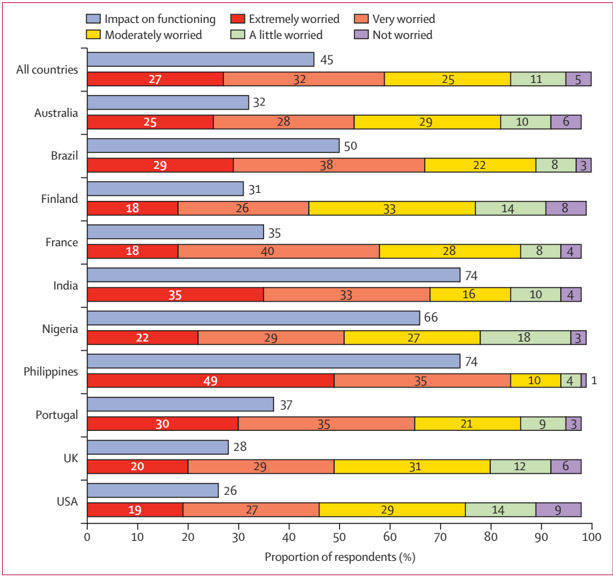
Background Climate change has important implications for the health and futures of children and young people, yet they have little power to limit its harm, making them vulnerable to climate anxiety. This is the first large-scale investigation of climate anxiety in children and young people globally and its relationship with perceived government response. Methods We surveyed 10 000 children and young people (aged 16-25 years) in ten countries (Australia, Brazil, Finland, France, India, Nigeria, Philippines, Portugal, the UK, and the USA; 1000 participants per country). Invitations to complete the survey were sent via the platform Kantar between May 18 and June 7, 2021. Data were collected on participants' thoughts and feelings about climate change, and government responses to climate change. Descriptive statistics were calculated for each aspect of climate anxiety, and Pearson's correlation analysis was done to evaluate whether climate-related distress, functioning, and negative beliefs about climate change were linked to thoughts and feelings about government response. Findings Respondents across all countries were worried about climate change (59% were very or extremely worried and 84% were at least moderately worried). More than 50% reported each of the following emotions: sad, anxious, angry, powerless, helpless, and guilty. More than 45% of respondents said their feelings about climate change negatively affected their daily life and functioning, and many reported a high n…
Verified 2026-11-25 · 1 reference not checked yet
Overview
CoChat Summary
TL;DR
This global survey of 10,000 people aged 16–25 across ten countries found widespread climate anxiety and distress, with many reporting negative functional impacts. Climate distress was correlated with negative perceptions of government responses and feelings of betrayal.
Key findings
- 59% were very or extremely worried about climate change and 84% were at least moderately worried; more than 50% reported feeling sad, anxious, angry, powerless, helpless, and guilty.
- More than 45% said their feelings about climate change negatively affected their daily life and functioning; 75% said the future is frightening and 83% said people have failed to take care of the planet.
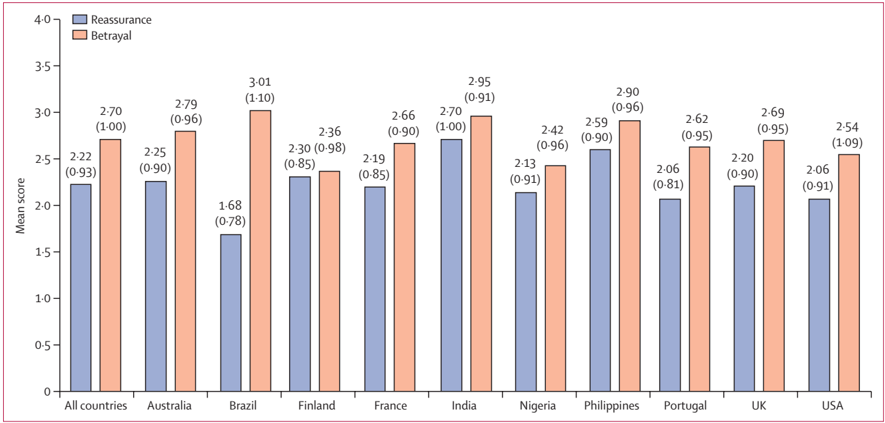
- Respondents rated government responses negatively (mean 14.96 on a 9–18 scale, SD 2.57) and reported greater betrayal (mean 2.7, SD 1.0) than reassurance (mean 2.22, SD 0.93; p<0.0001).
- Climate anxiety and distress were correlated with perceived inadequate government response and associated feelings of betrayal.
Methods
- Cross-sectional online survey of 10,000 children and young people aged 16–25 years in ten countries (Australia, Brazil, Finland, France, India, Nigeria, Philippines, Portugal, the UK, and the USA; 1000 per country), recruited via Kantar between May 18 and June 7, 2021.
- Quota sampling was based on age, gender, and region, with data weighted to OECD statistics for each country by age group, gender, and region.
- Descriptive statistics were calculated for climate anxiety constructs, and Pearson’s correlation analysis explored links between climate-related distress, functioning, negative beliefs, and thoughts/feelings about government response; findings significant at p≤0.001 are reported.
Limitations
- The paper states that non-standardised measures were used because no appropriate standardised measures existed; the study cannot indicate severity compared with normative samples, did not measure mental health outcomes, and used a yes/no/prefer-not-to-say response scale.
- The paper states that equal sample sizes per country were not weighted by population size, so aggregated results are not globally representative; online polling required internet access and sometimes English, and gender was recorded only as male or female.
- Evident from the text: the cross-sectional design cannot establish causality between perceived government response and climate distress.
Model-written summary. Check it against the paper before relying on it.
Integrity signals
Registry
Cites
Statistics
Figures
Verification
Claims the paper makes
12 Valid · 0 Not valid · 19 Not checked · 99 Own results and interpretations
Every source the paper cites for this claim was checked and supports it.
In the paper
“Children are now turning to legal action based on government failure to protect ecosystems, young citizens, and their futures. 26”
What the sources say
- Supportedcites [26] 26 Salas RN, Jacobs W, Perera F. The case of Juliana v. US-children and the health burdens of climate change. N Engl J Med 2019; 380: 2085-87 . source
The supplied Abstract passages describe children filing suit over federal inaction on climate change, which they say violates their constitutional rights. They also connect that inaction to threats to children’s safe environment and to future generations, supporting the citing sentence’s paraphrase. (LLM, conf=0.88)
plainstates a cause- Asserted: passes — The authors put it forward as true.
- Checkable: passes — It can be checked against evidence.
- Load-bearing: unclear — It is unclear whether the paper’s conclusions depend on it.
- Based: passes — The paper gives a reason why it holds.
- Supported
A result the paper reports from its own data — it cites no other source for it, so there is none to check. The quote shows it is in the paper.
In the paper
“in the Global North, Portugal (which had dramatic increases in wildfires since 2017) showed the highest level of worry.”
plainn = 1,000- Asserted: passes — The authors put it forward as true.
- Checkable: passes — It can be checked against evidence.
- Load-bearing: unclear — It is unclear whether the paper’s conclusions depend on it.
- Based: passes — The paper gives a reason why it holds.
A result the paper reports from its own data — it cites no other source for it, so there is none to check. The quote shows it is in the paper.
In the paper
“Respondents rated governmental responses to climate change negatively”
plain- Asserted: passes — The authors put it forward as true.
- Checkable: passes — It can be checked against evidence.
- Load-bearing: passes — The paper’s conclusions depend on it.
- Based: passes — The paper gives a reason why it holds.
A result the paper reports from its own data — it cites no other source for it, so there is none to check. The quote shows it is in the paper.
In the paper
“This distress was associated with beliefs about inadequate governmental response and feelings of betrayal.”
plainstates an association- Asserted: passes — The authors put it forward as true.
- Checkable: passes — It can be checked against evidence.
- Load-bearing: passes — The paper’s conclusions depend on it.
- Based: passes — The paper gives a reason why it holds.
A result the paper reports from its own data — it cites no other source for it, so there is none to check. The quote shows it is in the paper.
In the paper
“More than 45% of respondents said their feelings about climate change negatively affected their daily life and functioning”
- Also stated in: § Results · p. 5 · plain
“More than 45% of respondents said their feelings about climate change negatively affected their daily lives”
plainn = 10- Asserted: passes — The authors put it forward as true.
- Checkable: passes — It can be checked against evidence.
- Load-bearing: passes — The paper’s conclusions depend on it.
- Based: passes — The paper gives a reason why it holds.
- Also stated in: § Results · p. 5 · plain
50 more claims
Create a free account to see all 130 claims and to verify the 1 reference still open.
- Probably not a substantial claim. 51
- It may state two separate claims as one. 41
- The quote only partly states this claim. 6
Claims other papers make about this one
Each is checked against this paper’s own text: does it say what the citing paper says it does?
The source backs part of the claim, not all of it — or backs it for a different population, condition or comparison.
In the citing paper
“Investigations into anxiety about climate change have revealed that it is increasingly common for many people across the globe [9], with large-scale international studies identifying growing concern about climate change [10–12].”
From The relationship between climate change and mental health: a systematic review of the association between eco-anxiety, psychological distress, and symptoms of major affective disorders (2024) · cites this paper as [10]
Experimental — accuracy not yet measuredThe source backs part of the claim, not all of it — or backs it for a different population, condition or comparison.
In the citing paper
“The high prevalence of eco-anxiety [10] - be it at clinical or subclinical levels - underscores the need for broader level changes related to climate change.”
From The relationship between climate change and mental health: a systematic review of the association between eco-anxiety, psychological distress, and symptoms of major affective disorders (2024) · cites this paper as [10]
Experimental — accuracy not yet measuredThe source backs part of the claim, not all of it — or backs it for a different population, condition or comparison.
In the citing paper
“and varied understandings and experiences of climate change have differing impacts on the relationship with mental health [10, 12].”
From The relationship between climate change and mental health: a systematic review of the association between eco-anxiety, psychological distress, and symptoms of major affective disorders (2024) · cites this paper as [10]
Experimental — accuracy not yet measuredThe source backs part of the claim, not all of it — or backs it for a different population, condition or comparison.
In the citing paper
“A global survey of 10,000 young people (16-25) across 10 countries found: (1) 75% were frightened about the future; (2) 84% were moderately worried; (3) 59% were very or extremely worried; and (4) 45%+ reported climate change-related feelings negatively affected their daily life and functioning [21].”
From Climate Distress: A Review of Current Psychological Research and Practice (2023) · cites this paper as [21]
Experimental — accuracy not yet measuredThe source backs part of the claim, not all of it — or backs it for a different population, condition or comparison.
In the citing paper
“An overall lack of trust in government was also identified, with a wide belief that the government response to climate change will continue to be inadequate [21].”
From Climate Distress: A Review of Current Psychological Research and Practice (2023) · cites this paper as [21]
Experimental — accuracy not yet measured
21 more claims about this paper
Create a free account to see every claim other papers make about this one.
Self-check
Percentages, sums and reported differences re-computed from the paper’s own numbers.
Rated minor: it would not touch a result — a value no result rests on, a p-value that stays on the same side of the significance level, or a conflict that is clerical, resolved elsewhere in the paper, or outside its own findings.
In the paper
“15 543 people began the survey and 10 000 (68%) completed it.”
Reported 68 · recomputed 64.337644
Citations
Cites
Mental health of young people: A global public-health challenge
Patel, V., Flisher, A. J., Hetrick, S., & McGorry, P. (2007) · The Lancet · doi:10.1016/s0140-6736(07)60368-7 · Cited by 3,126 · cited 2×
“23 Children facing a future severely damaged by climate change will need support.”
Stress and Health: Psychological, Behavioral, and Biological Determinants
Schneiderman, N., Ironson, G., & Siegel, S. D. (2005) · Annual Review of Clinical Psychology · doi:10.1146/annurev.clinpsy.1.102803.144141 · Cited by 2,252 · cited 2×
“22 Exposure to chronic stress in childhood has a long-lasting impact and increases the risk of developing mental health problems.”
Development and validation of a measure of climate change anxiety
Clayton, S., & Karazsia, B. T. (2020) · Journal of Environmental Psychology · doi:10.1016/j.jenvp.2020.101434 · Cited by 1,196
Self-citationAnxiety and the Ecological Crisis: An Analysis of Eco-Anxiety and Climate Anxiety
Pihkala, P. (2020) · Sustainability · doi:10.3390/su12197836 · Cited by 978 · cited 2×
“In threatening and uncertain situations such as the climate crisis, this response can be seen as what is sometimes referred to as practical anxiety 1,4 because it has the beneficial effect of leading people to reassess their behaviour in order to respond appropriately.”
Self-citationMoral Injury: An Integrative Review
Griffin, B. J., Purcell, N., Burkman, K., Litz, B. T., Bryan, C. J., Schmitz, M., Villierme, C., Walsh, J., & Maguen, S. (2019) · Journal of Traumatic Stress · doi:10.1002/jts.22362 · Cited by 752 · cited 2×
“28 This might include an awareness of or failure to prevent harmful unethical behaviour.”
Stanley, S. K., Hogg, T. L., Leviston, Z., & Walker, I. (2021) · The Journal of Climate Change and Health · doi:10.1016/j.joclim.2021.100003 · Cited by 715
Anxiety, worry, and grief in a time of environmental and climate crisis: a narrative review
Ojala, M., Cunsolo, A., Ogunbode, C. A., & Middleton, J. (2021) · Annual Review of Environment and Resources · doi:10.1146/annurev-environ-012220-022716 · Cited by 670
The case for systems thinking about climate change and mental health
Berry, H. L., Waite, T. D., Dear, K. B. G., Capon, A. G., & Murray, V. (2018) · Nature Climate Change · doi:10.1038/s41558-018-0102-4 · Cited by 485 · cited 2×
“Changing climate and weather-related disasters have diverse impacts, both direct (eg, destruction and trauma) and indirect (eg, strained personal and public resources, interrupted community functioning), 2 as well as resulting in climate anxiety.”
Eco-Anxiety and Environmental Education
Pihkala, P. (2020) · Sustainability · doi:10.3390/su122310149 · Cited by 475
Self-citationThe Hogg Eco-Anxiety Scale: Development and Validation of a Multidimensional Scale
(2021) · doi:10.31219/osf.io/rxudb · Cited by 465
Research works printed but not linked: 4
- 11 Jensen T. Ecologies of guilt in environmental rhetorics. Cham: Palgrave Macmillan, 2019.
- 18 UNICEF. One billion children at 'extremely high risk' of the impacts of the climate crisis. Aug 20, 2021. https://www.unicef.org. uk/press-releases/onebillion-children-at-extremely-high-risk-of-theimpacts-of-the-climate-crisis-unicef (accessed Sept 5, 2021).
- 27 Weintrobe S. Psychological roots of the climate crisis: neoliberal exceptionalism and the culture of uncare. New York, NY: Bloomsbury Academic, 2021.
- 32 Mavronicola N. Torture, inhumanity and degradation under article 3 of the ECHR: absolute rights and absolute wrongs. Oxford: Bloomsbury Publishing, 2021.
Cited by
Items 1,501–1,600 of 2,164
Understanding the dynamics of climate stress and mental health in urban and rural India
Govindan, M., & Murali, R. (2024) · Elsevier eBooks · doi:10.1016/b978-0-443-29240-8.00003-1
Predictors of Climate Change Activism Communication in Social Networks
Latkin, C. A., Dayton, L., Parker, K., & Rimal, R. N. (2024) · Climate · doi:10.3390/cli12120195
Daly, Z., Jenkins, E., Howard, A. F., & Barbic, S. P. (2024) · Journal of Environmental Psychology · doi:10.1016/j.jenvp.2024.102492
Negotiating Good Parenthood in Swedish Climate Change Fiction
Björklund, J. (2024) · NORA - Nordic Journal of Feminist and Gender Research · doi:10.1080/08038740.2024.2429634 · Cited by 1
“…of reproductive age factor climate change into reproductive decision-making (Arnocky et al., 2012; Fjell, 2022; Fu et al., 2023; Helm et al., 2024; Hickman et al., 2021; Sasser, 2024; Schneider-Mayerson & Ling Leong, 2020) or the experiences of people who have chosen to live childfree for…”
To the Issue of Studying Ecological Emotional Experiences
Baranov, V. (2023) · Visnyk of V N Karazin Kharkiv National University A Series of Psychology · doi:10.26565/2225-7756-2023-75-08 · Cited by 1
Gesellschaftliche Transformation zur Postwachstumsgesellschaft
Ernst, A. M., Reese, G., & Henn, L. (2024) · Springer eBooks · doi:10.1007/978-3-662-69166-3_7
Hva mener norske ungdommer om konspirasjonsteoretikere?
Iversen, L. L. (2024) · Norsk sosiologisk tidsskrift · doi:10.18261/nost.8.5.4
Becoming Climate-Informed Physicians
Messineo, E., Pardo, C. C., Lee, J. M., et al. (2024) · Journal of Graduate Medical Education · doi:10.4300/jgme-d-24-00060.1
Ahmad, M. (2024) · Media Biznes Kultura · doi:10.4467/25442554.mbk.24.019.20893
Kılıç, L. S., & Koçoğlu, D. (2024) · Halk Sağlığı Hemşireliği Dergisi · doi:10.54061/jphn.1504944
Cwikel, J. (2025) · Cogent Social Sciences · doi:10.1080/23311886.2024.2444469 · Cited by 3
“%) and 59% were very or extremely worried about climate change, with corresponding negative thoughts about their future. these anxious feelings were associated with an assessment that their government has inadequately responded to the crisis (Hickman et al., 2021).”
Fröhlich, K. (2024) · Erziehungswissenschaftliche Edition: Persönlichkeitsbildung in Schule · doi:10.1007/978-3-658-45777-8_8
Vecchio, K. D. (2024) · Journal of Religious Ethics · doi:10.1111/jore.12488 · Cited by 1
Climate awareness, and psychological responses to climate change among Turkish youthPreprint
Ünver, H., Akmehmet, S. S., & Fiş, N. P. (2025) · Research Square · doi:10.21203/rs.3.rs-5781013/v1
Hilf, J. (2025) · Springer eBooks · doi:10.1007/978-3-031-25960-9_113-1 · Cited by 2
Fisher participation in citizen science of the US South Atlantic: Ethical concerns about engagement
Tookes, J. S., Yandle, T., & Fluech, B. A. (2025) · MAST. Maritime studies/Maritime studies · doi:10.1007/s40152-024-00399-5
“Others note that moral injury leads to distressing psychological aftermath that occurs after witnessing actions that violate one’s own moral or ethical code (Hickman et al. 2021).”
Fazer o luto da idealização e reparar os ideais no clima humano
Lühmann, D., & Weintrobe, S. (2025) · Recherches en psychanalyse · doi:10.3917/rep2.037.0044
Adorni, F., Cavigli, C., Jesuthasan, N., Cori, L., Šojić, A., Bianchi, F., Curzio, O., & Prinelli, F. (2025) · International Journal of Environmental Research and Public Health · doi:10.3390/ijerph22020314 · Cited by 1
“Several studies focused the analysis on eco-anxiety and, in particular, the risks to wellbeing and mental health associated with climate change [52] and with specific reference to younger generations [53].”
Climate Change Awareness Among University Students in Delhi NcrPreprint
Manchanda, R., Abidi, N., & Gupta, D. (2025) · SSRN Electronic Journal · doi:10.2139/ssrn.5142100 · Cited by 2
Wankmüller, F., Loy, L. S., & Siegmund, A. (2025) · Journal of Environmental Psychology · doi:10.1016/j.jenvp.2025.102560 · Cited by 4
Depolarizing Health Policy Through Intergenerational Conversations
Jain, B., Lin, J. C. H., & Adams, J. M. (2025) · American Journal of Public Health · doi:10.2105/ajph.2024.307971
Managing Psychoterratic Responses: Promising Interventions for Ecological Grief, Anxiety, and Guilt
Clark, T. (2024) · Palgrave Studies in Sustainable Futures. · doi:10.1007/978-3-031-24952-5_11-1
Climate change: Educational needs of students
Marzban, A., Marzaleh, M. A., Razmi, M. R., & Emami, P. (2025) · Environmental Health Engineering and Management · doi:10.34172/ehem.1361 · Cited by 1
Transformative Approaches to an Ecologically Sustainable Welfare State
Bock‐Schappelwein, J., Egger, A., Falkner, K., Famira-Mühlberger, U., Köppl, A., Liebeswar, C., Mayrhuber, C., & Schratzenstaller, M. (2024) · Vierteljahreshefte zur Arbeits- und Wirtschaftsforschung · doi:10.3790/vaw.2024.1454904 · Cited by 1
Écouter l’Éco-Anxiété ou comment accompagner l’incertitude en thérapie
Schoutheete, L. D., Marina, M. S., & Dellucci, H. (2025) · Cahiers critiques de thérapie familiale et de pratiques de réseaux · doi:10.3917/ctf.074.0039
Phenotyping Climate Change Distress: The Difference to General DistressPreprint
Beckord, J., Gebhardt, N., Nikendei, C., Krakowczyk, J. B., Skoda, E.-M., Teufel, M., & Bäuerle, A. (2025) · SSRN Electronic Journal · doi:10.2139/ssrn.5212840
Bureau, J., Gauthier, A. J., With, S., Deneault, A., Racine, N. M., Beaudry, S. G., Lorteau, S., & Pelletier, L. G. (2025) · European Journal of Investigation in Health Psychology and Education · doi:10.3390/ejihpe15040062 · Cited by 5
“Facing the spectre of major environmental change, many young people report experiences of climate-related distress (Hickman et al., 2021; Ojala et al., 2021), an umbrella term referring to the negative emotions and mental health problems caused by their perception of climate change, such as…”
The value of a life course approach to the health consequences of climate change
Simonin, E. M., Leap, S. R., Klibaner-Schiff, E., Kirsh, S., Kline, O., Matthews, H., Vogler, N., Kepner, C., Sampath, V., Johnson, M. M. D., et al. (2025) · Oxford University Press eBooks · doi:10.1093/oso/9780198895961.003.0003
Que nous disent les maux des éco-anxieux ?
Peyraud, T., Delrieu, E., Chrétien, A., & Peyronnet, M. (2025) · HEGEL - HEpato-GastroEntérologie Libérale · doi:10.3917/heg.151.0013
L’éco-anxiété : maladie ou symptômes sociétaux ?
Paillé, F. (2025) · HEGEL - HEpato-GastroEntérologie Libérale · doi:10.3917/heg.151.0009
Eco-anxiété : clinique d’un stress pré-traumatique
Ostermann, G., & Lesœurs, G. (2025) · HEGEL - HEpato-GastroEntérologie Libérale · doi:10.3917/heg.151.0029 · Cited by 1
Kingston University’s Holistic Approach to Climate Change Education
Fonseca, T. D., Todd, S., & Baker, A. (2025) · Springer eBooks · doi:10.1007/978-3-031-25960-9_133-1
Epel, E. S., White, K. E., Brownell, K. D., Rodin, J., Hollis, A. M., Diefenbach, M. A., Alegria, K. E., Fromer, E., Czajkowski, S. M., Bacon, S., et al. (2025) · Psychosomatic Medicine · doi:10.1097/psy.0000000000001369
“These include cardiac and respiratory diseases, poor birth outcomes, vector-borne and zoonotic diseases, potential pandemics (8), and pervasive mental health consequences, including wide-spread youth climate hopelessness (9,10).”
Lobodenko, L. K., Shesterkina, L., Lapshin, M. S., Baskov, A., & Zaitceva, A. (2025) · Communication Strategies in Digital Society Seminar (ComSDS) · doi:10.1109/comsds65569.2025.10971305
“Foreign scientists also note that environmental issues today are extremely important in the modern media space and concern 84% of young people [6].”
‘Peace is a beacon of hope’: young people’s commitment to building a culture of peace in Scotland
Nesterova, Y., & Anderson, S. K. (2025) · Journal of Peace Education · doi:10.1080/17400201.2025.2496407 · Cited by 1
“…McLernon and Cairns 2001) and may feel overwhelmed when faced with the world’s challenges and complexities (Covell, Rose-Krasnor, and Fletcher 1994; Hickman et al. 2021; Walker, Myers-Bowman, and Myers-Walls 2003), our aim was to work with youth (12–18 years old) in one of the least peaceful…”
Psychological Research Contributions to Urgent Global Health Challenges for the Next Decade
Barello, S. (2025) · Springer eBooks · doi:10.1007/978-3-031-88408-5_4
Outlook: Socio-Ecological Imaginations
Hajer, M. A., & Oomen, J. (2025) · Oxford University Press eBooks · doi:10.1093/9780198955382.003.0012
Futures in Environmental Politics
Hajer, M. A., & Oomen, J. (2025) · Oxford University Press eBooks · doi:10.1093/9780198955382.003.0004
Hajer, M. A., & Oomen, J. (2025) · Oxford University Press eBooks · doi:10.1093/9780198955382.003.0011
The Drama of Environmental Politics
Hajer, M. A., & Oomen, J. (2025) · Oxford University Press eBooks · doi:10.1093/9780198955382.003.0003 · Cited by 1
A Cultural Politics of the Environment
Hajer, M. A., & Oomen, J. (2025) · Oxford University Press eBooks · doi:10.1093/9780198955382.003.0009
Hajer, M. A., & Oomen, J. (2025) · Oxford University Press eBooks · doi:10.1093/9780198955382.003.0001 · Cited by 1
Ecological Modernization’s Last Stand: Geoengineering
Hajer, M. A., & Oomen, J. (2025) · Oxford University Press eBooks · doi:10.1093/9780198955382.003.0007
Hajer, M. A., & Oomen, J. (2025) · Oxford University Press eBooks · doi:10.1093/9780198955382.003.0006
Lexicon of Concepts and Definitions
Hajer, M. A., & Oomen, J. (2025) · Oxford University Press eBooks · doi:10.1093/9780198955382.003.0013
Hajer, M. A., & Oomen, J. (2025) · Oxford University Press eBooks · doi:10.1093/9780198955382.003.0010 · Cited by 1
Hong, Y., Liu-Galvin, R. E., Khan, M., Nguyen, O. T., Yoon, H., Yang, J. J., & Prosperi, M. (2025) · Journal of Public Health · doi:10.1007/s10389-025-02477-2 · Cited by 1
De l’écoanxiété aux émotions climatiques : état des lieux des interventions psychosociales
Gauthier, A., & Plusquellec, P. (2025) · Revue de psychoéducation · doi:10.7202/1117796ar
Widening circles of care: Exploring self-care with activists using ecodramatherapy
Hart, R., & Harnden, B. (2025) · Drama Therapy Review · doi:10.1386/dtr_00161_1 · Cited by 1
Wearing sunglasses to see more clearly: Drama therapy calls attention to the climate crisis
Bleuer, J., Oluoch, A. E., Lowry, A. W., Yong, B., Sweett, E., Kothare, E., Montgomery, M., & Dadzie, S.-D. (2025) · Drama Therapy Review · doi:10.1386/dtr_00160_1 · Cited by 1
Horváth, M. D., Torma, Z. L., Mihók, B., Sallay, V., & Martos, T. (2025) · Szociológiai szemle · doi:10.51624/szocszemle.17022 · Cited by 2
Kvandal, H., & Levy, G. (2025) · Zygon® · doi:10.16995/zygon.18365
Climate Change and Suicidal Behaviour
Kabir, R., Syed, H. Z., & Vinnakota, D. (2025) · Springer eBooks · doi:10.1007/978-981-96-4028-7_3
What Would the Younger Generation Give Up for a Better, More Sustainable Future?
Kolnhofer-Derecskei, A., & Majláth, M. (2025) · FEB International Scientific Conference · doi:10.18690/um.epf.5.2025.49
Sinnkrise – wenn der Boden brüchig wird
Schnell, T. (2025) · Springer eBooks · doi:10.1007/978-3-662-70097-6_9
Individuelle Einflussfaktoren von umweltfreundlichem Verhalten am Arbeitsplatz
Rietze, S., Kühner, C., & Zacher, H. (2025) · SDG - Forschung, Konzepte, Lösungsansätze zur Nachhaltigkeit · doi:10.1007/978-3-662-70700-5_3
Multisystemic Resilience as a Necessary Condition for Ensuring Child Well-Being
Michałowska, A. A. (2025) · Pedagogika Społeczna Nova · doi:10.14746/psn.2025.5.9.6
Belova, A., Munson, K., Keeler, D. G., Sluder, M., Kiesel, A., Sarofim, M. C., Silva, R., Anenberg, S. C., Clayton, S., & Gould, C. A. (2025) · SSRN Electronic Journal · doi:10.2139/ssrn.5261619
Self-citation(2025) · Praxis der Kinderpsychologie und Kinderpsychiatrie · doi:10.13109/prkk.2025.74.4.293
Peter, F., & Asbrand, J. (2025) · Praxis der Kinderpsychologie und Kinderpsychiatrie · doi:10.13109/prkk.2025.74.4.297 · Cited by 2
Arjaliès, D. (2025) · SSRN Electronic Journal · doi:10.2139/ssrn.5270178
Survey of Pediatric Infectious Diseases Providers on Healthcare Sustainability and Climate Change
Doshi, S. M., Dalby, A., & Jaggi, P. (2025) · Journal of the Pediatric Infectious Diseases Society · doi:10.1093/jpids/piaf038
Ceylantekin, Y., Çördük, S., Kaçar, Z. K., et al. (2025) · TOGÜ Sağlık Bilimleri Dergisi · doi:10.52369/togusagbilderg.1535796
Teaching in a Time of Climate Collapse: From “An Education in Hope” to a Praxis of Critical Hope
Williams, R. J., & Grain, K. M. (2025) · Sustainability · doi:10.3390/su17125459 · Cited by 6
Neue Herausforderungen und Handlungsfelder der Kinder- und Jugendgesundheit
Loss, J., Hölling, H., & Lemcke, J. (2025) · Public Health Forum · doi:10.1515/pubhef-2025-0001
Basto, R. S. (2025) · RELACult - Revista Latino-Americana de Estudos em Cultura e Sociedade · doi:10.23899/ver9j931
Managing Psychoterratic Responses: Promising Interventions for Ecological Grief, Anxiety, and Guilt
Clark, T., Zolnikov, T. R., Furio, F., Salinas, N. D., & Dick, S. (2025) · Palgrave Studies in Sustainable Futures. · doi:10.1007/978-3-031-24952-5_11-2
Ji, Z., Tian, J., Gong, Y., Li, Y., & Sun, Y. (2025) · Sustainability Science · doi:10.1007/s11625-025-01710-x
“Climate change concerns are also a variable that climate scientists have focused on (Clayton and Karazsia 2020; Hickman et al. 2021; Jakucionyte-Skodiene and Liobikiene 2021).”
Dissensus in Europe: climate protesters before court
Eckes, C. (2025) · European Political Science · doi:10.1057/s41304-025-00540-w · Cited by 4
“However, some climate protesters break the law as a form of civil disobedi-ence (American Psychological Association 2020; Hickman et al. 2021; Mathiesen 2023).”
Empowering Students to Articulate Personal “Purpose Statements”
Swenddal, H. J., & Corredor, S. (2025) · Management Teaching Review · doi:10.1177/23792981251346167
Climate Change Anxiety in Adults with Schizophrenia: a Descriptive Study
Lim, C., Freudenreich, S., McKowen, J., MacLaurin, S. A., & Freudenreich, O. (2025) · Community Mental Health Journal · doi:10.1007/s10597-025-01485-6
“This contrasts with non-clinical youth studies linking climate anxiety to greater impairing distress such as the global study by Hickman (Hickman et al., 2021) and the US-based study by Lewandowski (Lewandowski et al., 2024).”
InfluentialKozmus, A., & Pšunder, M. (2025) · doi:10.18690/um.ff.6.2025.10 · Cited by 3
Okoljska kriza: Izzivi in priložnosti za krepitev odpornosti
Rutar, M., Plohl, N., Horvat, M., Tement, S., Musil, B., & Bakračevič, K. (2025) · doi:10.18690/um.ff.6.2025.2 · Cited by 1
Levy, S. R., Ramírez, L. F., & Barbosa, S. (2025) · International Perspectives in Psychology · doi:10.1027/2157-3891/a000135 · Cited by 1
Aquije-Mansilla, M. E. (2025) · Health Leadership and Quality of Life · doi:10.56294/hl2025650 · Cited by 4
Colombo, S. L., Lefrançois, C., Fradin, J., Chiarella, S. G., Raffone, A., & Simione, L. (2025) · Sustainability · doi:10.3390/su17146649 · Cited by 3
Coffey, Y., Schutte, N. S., Rogers, M., & Bhullar, N. (2025) · International Journal of Psychology · doi:10.1002/ijop.70084 · Cited by 4
“connection to nature, and empowerment (Hickman et al. 2021; Ojala 2012).”
Assessing stringency: A survey experiment of energy saving policies across five EU countries
Salmanova, A., Nicoli, F., & Dupont, C. (2025) · Public Policy and Administration · doi:10.1177/09520767251359126
The conviction of the inevitable: Collapsism and collective action in contemporary rural FrancePreprint
Tournadre, J. (2024) · doi:10.31235/osf.io/mb9zx_v1
Eco-Anxiety in Global Perspectives: From Awareness to Anxiety - The Emotional Cost of Climate Change
Kumari, S., & Kumari, P. D. N. (2025) · International Journal of Advanced Research in Science Communication and Technology · doi:10.48175/ijarsct-28514
Padwick, A., Hocking, E. P., Shimwell, J., Davenport, C., Bourne, J., Ransome, K., Baxter, C., Ramsay, A., & Blazey, E. (2025) · Journal of Environmental Studies and Sciences · doi:10.1007/s13412-025-01045-0 · Cited by 1
Art Activism, and the Anthropocene
Parker, I. C. (2023) · Teaching Artist Journal · doi:10.1080/15411796.2025.2523246
Sutcliffe, M., & Samuel, G. (2025) · SSRN Electronic Journal · doi:10.2139/ssrn.5374086
Groeve, B. D., Ellmer, H.-P., Luketina, R., & Prettenthaler, F. E. (2025) · Globale Ziele für nachhaltige Entwicklung. · doi:10.1007/978-3-662-70588-9_5
Current State of Mental Health of Youth
Chatterjee, S., Dindarian, A., & Rengaraju, U. (2025) · Apress eBooks · doi:10.1007/979-8-8688-1186-9_1
Ecopolitical Psychology at the Capital-Climate Nexus: A Research Agenda for the Capitalocene
Trott, C. D. (2025) · Review of General Psychology · doi:10.1177/10892680251357828 · Cited by 2
“This is particularly acute with young people who are worried about the future of the planet, concerned about their own future prospects, and incensed by inaction on the part of today ’ s policymakers and powerholders (Hickman et al., 2021; Wray, 2022).”
Mental healthcare in the times of climate change action and data science
Sreevalsan‐Nair, J., Mundayatt, A., Gnanaraj, B., Thomas, A., Kumar, N., Sabhahit, G. G., Joshi, S., & Srikanth, T. K. (2025) · Elsevier eBooks · doi:10.1016/b978-0-443-33044-5.00010-3 · Cited by 2
Earth observation applications in air quality and climate research
Srivastava, N., & Dumka, U. C. (2025) · Elsevier eBooks · doi:10.1016/b978-0-443-23965-6.00007-1
Wamsler, C., & Janss, J. (2025) · De Gruyter eBooks · doi:10.1515/9783111453729-024 · Cited by 1
Ruf, N., Sopp, M. R., Lass‐Hennemann, J., Schäfer, S. K., Braun, M. N., Equit, M., & Michael, T. (2025) · Kindheit und Entwicklung · doi:10.1026/0942-5403/a000483
Imagining a future family: students with care experience
Ellis, K. (2025) · Journal of Youth Studies · doi:10.1080/13676261.2025.2531781
“There is evidence that the global birth rate is in decline (Bhattachar-jee et al. 2024) and in their international research with young people, Hickman et al. (2021) reports that almost 40% were reluctant to have children due to fears around climate change.”
Social capital as a predictor of collective environmental action in high school students
Gibson, L., Stevenson, K. T., Busch, K. C., Cutts, B. B., Seekamp, E., & Krementz, S. (2025) · The Journal of Environmental Education · doi:10.1080/00958964.2025.2525105 · Cited by 1
“A 2021 study of 10,000 young people found that, of those who talked to other people about climate change, approximately half felt they were dismissed (Hickman et al., 2021).”
French, N. J., Freichel, R., Kahveci, S., Werntz, A. J., Howell, J. L., Lindgren, K. P., O’Shea, B. A., Boker, S. M., & Teachman, B. A. (2025) · Clinical Psychological Science · doi:10.1177/21677026251359621 · Cited by 1
Stanley, S. K., Gregersen, T., Summerell, E., & Walker, I. A. (2026) · Journal of Environmental Psychology · doi:10.1016/j.jenvp.2026.103074
Jankowski, M. (2025) · Studia Politicae Universitatis Silesiensis · doi:10.31261/spus.18263
Ding, X. (2025) · Emerald Group Publishing Limited eBooks · doi:10.1108/978-1-83797-811-320251003
Telling Transformative Climate Narratives from Prehistoric Pasts for Future Positive Existence
Piper, S. F., Grimm, S. B., & Bradtmöller, M. (2025) · Human-environment interactions · doi:10.1007/978-3-031-85348-7_6
Emotions in Education for Sustainability in Engineering
Bielefeldt, A. R., & Tisdale, J. K. (2025) · ASEE Annual Conference & Exposition · doi:10.18260/1-2--56331 · Cited by 1
Mental health and the environment – evolutionary perspectives
Gosrani, R., O'Connell, H. P., Brar, G., John‐Smith, P. S., Hafes, R., & Abed, R. (2025) · Irish Journal of Psychological Medicine · doi:10.1017/ipm.2025.10091 · Cited by 2
“It is a growing source of anxiety, particularly among younger individuals who may feel a sense of helplessness in the face of an uncertain future (Hickman et al. 2021).”
Metadata
- Authors
- Hickman, C., Marks, E., Pihkala, P., Clayton, S., Lewandowski, R. E., Mayall, E. E., Wray, B., Mellor, C., & van Susteren, L.
- Affiliations
- University of Bath (GB)
- University of Helsinki (FI)
- College of Wooster (US)
- NYU Langone Health (US)
- University of East Anglia (GB)
- London School of Hygiene & Tropical Medicine (GB)
- Oxford Health NHS Foundation Trust (GB)
- Corresponding author
- Hickman, Caroline
- Venue
- The Lancet Planetary Health
- Publisher
- Elsevier BV
- Published
- 2021-12
- Volume
- 5
- Issue
- 12
- Pages
- e863-e873
- ISSN
- 2542-5196 (ISSN-L)
- OpenAlex
- W4200005759
- Semantic Scholar
- 4a876cc35863ba593aacf58fe6a24773b3cb9c29
- Cited by
- 2,324
- References
- 27
- Citations by year
- 2026: 566 · 2025: 652 · 2024: 566 · 2023: 364 · 2022: 170 · 2021: 4
- FWCI
- 382.19
- Type
- journal article
- Language
- en
- Open access
- gold
- doi.org
- Licence
- cc-by-nc-nd
- www.elsevier.com/tdm/userlicense/1.0/ (tdm)
- www.elsevier.com/legal/tdmrep-license (tdm)
- creativecommons.org/licenses/by-nc-nd/4.0/ (vor)
- Locations
- The Lancet Planetary Health (publishedVersion, cc-by-nc-nd)
- PubMed (publishedVersion)
- DOAJ (DOAJ: Directory of Open Access Journals) (submittedVersion, cc-by-sa)
- Työväentutkimus Vuosikirja (submittedVersion)
- Topics
- Social Sciences › Sociology and Political Science › Climate Change Communication and Perception
- Physical Sciences › Environmental Science › Health, Toxicology and Mutagenesis › Climate Change and Health Impacts
- Social Sciences › Psychology › Clinical Psychology › COVID-19 and Mental Health
- Keywords
- climate anxiety, children and young people, climate change, betrayal, climate change beliefs, daily functioning, global survey
- MeSH terms
- Adolescent, Adult, Anxiety, Australia, Child, Government, Humans, Surveys and Questionnaires, Young Adult, Climate Change
About these checks
Registry, retraction, Cites and statistics results are computed, not judged, with one exception: a printed reference that no index lists is read once by a model before it counts as a citation error. Claims are extracted by a model and kept only when their quote appears verbatim in the text; each cited source is then checked, with a model’s help, for whether it says what the claim relies on. Those verdicts can be wrong — read the claim’s quote and the cited source before relying on one.
The claim verdicts this report counts are experimental: their accuracy is not yet measured.
A language model drew the claims from the paper on 2026-10-10, under version 3 of the claim definition (model deepseek-v4.1-flash, prompt extract-v3).
A second model labelled each claim on 2026-10-10 (model jev-1.13-20260917, definition revision gold-guideline-v0.2).
Cited sources are checked with a language model’s help (gpt-6-sol).
Statistics and arithmetic are recomputed, not judged.
Confidence bands are shown only for fields calibrated on our annotated test set. None is calibrated yet, so no band is shown.
What counts as a claim ›How we measure confidence ›How we check this ›
Are you an author, or do you see a problem with this page? Request a review
Data sources
Bibliographic data: Semantic Scholar, OpenAlex, Crossref.
Contains information from the Semantic Scholar Academic Graph Datasets, made available under the ODC Attribution License (ODC-BY 1.0).
Semantic Scholar’s data is described in: Kinney, R., et al. (2023). The Semantic Scholar Open Data Platform. arXiv:2301.10140.
