

Climate anxiety in children and young people and their beliefs about government responses to climate change: a global survey
Open accessThe DOI matches its Crossref record; 27 of the 30 references it cites were found in a registry or an index, and 1 are not checked yet; 14 of the 48 sources its claims cite were checked for support.
Abstract
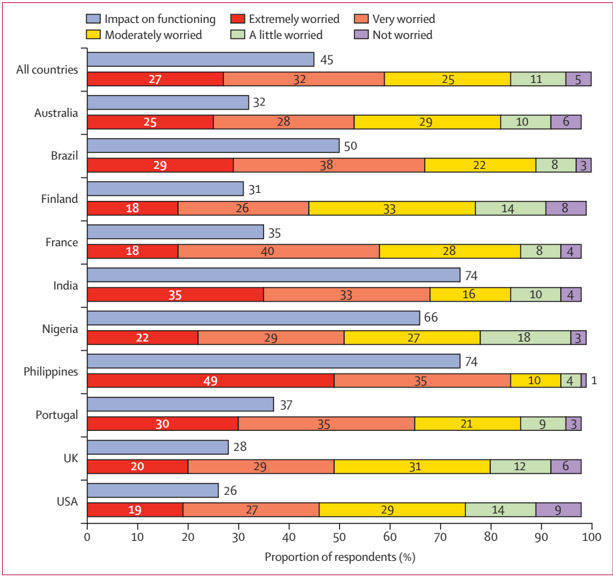
Background Climate change has important implications for the health and futures of children and young people, yet they have little power to limit its harm, making them vulnerable to climate anxiety. This is the first large-scale investigation of climate anxiety in children and young people globally and its relationship with perceived government response. Methods We surveyed 10 000 children and young people (aged 16-25 years) in ten countries (Australia, Brazil, Finland, France, India, Nigeria, Philippines, Portugal, the UK, and the USA; 1000 participants per country). Invitations to complete the survey were sent via the platform Kantar between May 18 and June 7, 2021. Data were collected on participants' thoughts and feelings about climate change, and government responses to climate change. Descriptive statistics were calculated for each aspect of climate anxiety, and Pearson's correlation analysis was done to evaluate whether climate-related distress, functioning, and negative beliefs about climate change were linked to thoughts and feelings about government response. Findings Respondents across all countries were worried about climate change (59% were very or extremely worried and 84% were at least moderately worried). More than 50% reported each of the following emotions: sad, anxious, angry, powerless, helpless, and guilty. More than 45% of respondents said their feelings about climate change negatively affected their daily life and functioning, and many reported a high n…
Verified 2026-11-25 · 1 reference not checked yet
Overview
CoChat Summary
TL;DR
This global survey of 10,000 people aged 16–25 across ten countries found widespread climate anxiety and distress, with many reporting negative functional impacts. Climate distress was correlated with negative perceptions of government responses and feelings of betrayal.
Key findings
- 59% were very or extremely worried about climate change and 84% were at least moderately worried; more than 50% reported feeling sad, anxious, angry, powerless, helpless, and guilty.
- More than 45% said their feelings about climate change negatively affected their daily life and functioning; 75% said the future is frightening and 83% said people have failed to take care of the planet.
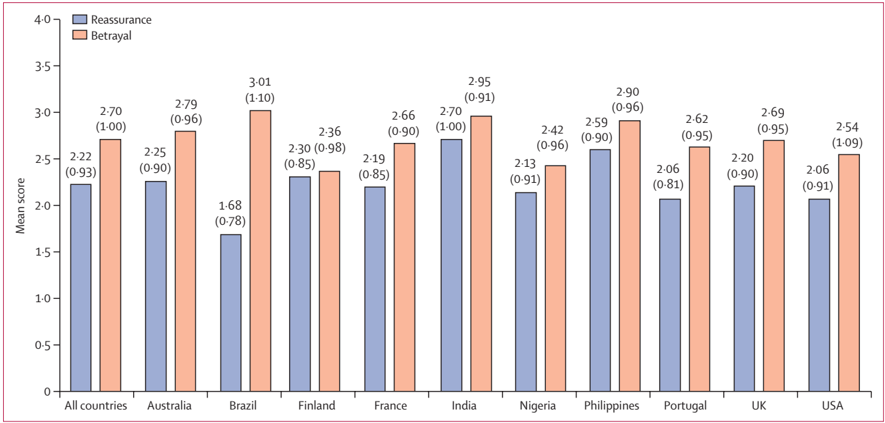
- Respondents rated government responses negatively (mean 14.96 on a 9–18 scale, SD 2.57) and reported greater betrayal (mean 2.7, SD 1.0) than reassurance (mean 2.22, SD 0.93; p<0.0001).
- Climate anxiety and distress were correlated with perceived inadequate government response and associated feelings of betrayal.
Methods
- Cross-sectional online survey of 10,000 children and young people aged 16–25 years in ten countries (Australia, Brazil, Finland, France, India, Nigeria, Philippines, Portugal, the UK, and the USA; 1000 per country), recruited via Kantar between May 18 and June 7, 2021.
- Quota sampling was based on age, gender, and region, with data weighted to OECD statistics for each country by age group, gender, and region.
- Descriptive statistics were calculated for climate anxiety constructs, and Pearson’s correlation analysis explored links between climate-related distress, functioning, negative beliefs, and thoughts/feelings about government response; findings significant at p≤0.001 are reported.
Limitations
- The paper states that non-standardised measures were used because no appropriate standardised measures existed; the study cannot indicate severity compared with normative samples, did not measure mental health outcomes, and used a yes/no/prefer-not-to-say response scale.
- The paper states that equal sample sizes per country were not weighted by population size, so aggregated results are not globally representative; online polling required internet access and sometimes English, and gender was recorded only as male or female.
- Evident from the text: the cross-sectional design cannot establish causality between perceived government response and climate distress.
Model-written summary. Check it against the paper before relying on it.
Integrity signals
Registry
Cites
Statistics
Figures
Verification
Claims the paper makes
12 Valid · 0 Not valid · 19 Not checked · 99 Own results and interpretations
Every source the paper cites for this claim was checked and supports it.
In the paper
“Children are now turning to legal action based on government failure to protect ecosystems, young citizens, and their futures. 26”
What the sources say
- Supportedcites [26] 26 Salas RN, Jacobs W, Perera F. The case of Juliana v. US-children and the health burdens of climate change. N Engl J Med 2019; 380: 2085-87 . source
The supplied Abstract passages describe children filing suit over federal inaction on climate change, which they say violates their constitutional rights. They also connect that inaction to threats to children’s safe environment and to future generations, supporting the citing sentence’s paraphrase. (LLM, conf=0.88)
plainstates a cause- Asserted: passes — The authors put it forward as true.
- Checkable: passes — It can be checked against evidence.
- Load-bearing: unclear — It is unclear whether the paper’s conclusions depend on it.
- Based: passes — The paper gives a reason why it holds.
- Supported
A result the paper reports from its own data — it cites no other source for it, so there is none to check. The quote shows it is in the paper.
In the paper
“in the Global North, Portugal (which had dramatic increases in wildfires since 2017) showed the highest level of worry.”
plainn = 1,000- Asserted: passes — The authors put it forward as true.
- Checkable: passes — It can be checked against evidence.
- Load-bearing: unclear — It is unclear whether the paper’s conclusions depend on it.
- Based: passes — The paper gives a reason why it holds.
A result the paper reports from its own data — it cites no other source for it, so there is none to check. The quote shows it is in the paper.
In the paper
“Respondents rated governmental responses to climate change negatively”
plain- Asserted: passes — The authors put it forward as true.
- Checkable: passes — It can be checked against evidence.
- Load-bearing: passes — The paper’s conclusions depend on it.
- Based: passes — The paper gives a reason why it holds.
A result the paper reports from its own data — it cites no other source for it, so there is none to check. The quote shows it is in the paper.
In the paper
“This distress was associated with beliefs about inadequate governmental response and feelings of betrayal.”
plainstates an association- Asserted: passes — The authors put it forward as true.
- Checkable: passes — It can be checked against evidence.
- Load-bearing: passes — The paper’s conclusions depend on it.
- Based: passes — The paper gives a reason why it holds.
A result the paper reports from its own data — it cites no other source for it, so there is none to check. The quote shows it is in the paper.
In the paper
“More than 45% of respondents said their feelings about climate change negatively affected their daily life and functioning”
- Also stated in: § Results · p. 5 · plain
“More than 45% of respondents said their feelings about climate change negatively affected their daily lives”
plainn = 10- Asserted: passes — The authors put it forward as true.
- Checkable: passes — It can be checked against evidence.
- Load-bearing: passes — The paper’s conclusions depend on it.
- Based: passes — The paper gives a reason why it holds.
- Also stated in: § Results · p. 5 · plain
50 more claims
Create a free account to see all 130 claims and to verify the 1 reference still open.
- Probably not a substantial claim. 51
- It may state two separate claims as one. 41
- The quote only partly states this claim. 6
Claims other papers make about this one
Each is checked against this paper’s own text: does it say what the citing paper says it does?
The source backs part of the claim, not all of it — or backs it for a different population, condition or comparison.
In the citing paper
“Investigations into anxiety about climate change have revealed that it is increasingly common for many people across the globe [9], with large-scale international studies identifying growing concern about climate change [10–12].”
From The relationship between climate change and mental health: a systematic review of the association between eco-anxiety, psychological distress, and symptoms of major affective disorders (2024) · cites this paper as [10]
Experimental — accuracy not yet measuredThe source backs part of the claim, not all of it — or backs it for a different population, condition or comparison.
In the citing paper
“The high prevalence of eco-anxiety [10] - be it at clinical or subclinical levels - underscores the need for broader level changes related to climate change.”
From The relationship between climate change and mental health: a systematic review of the association between eco-anxiety, psychological distress, and symptoms of major affective disorders (2024) · cites this paper as [10]
Experimental — accuracy not yet measuredThe source backs part of the claim, not all of it — or backs it for a different population, condition or comparison.
In the citing paper
“and varied understandings and experiences of climate change have differing impacts on the relationship with mental health [10, 12].”
From The relationship between climate change and mental health: a systematic review of the association between eco-anxiety, psychological distress, and symptoms of major affective disorders (2024) · cites this paper as [10]
Experimental — accuracy not yet measuredThe source backs part of the claim, not all of it — or backs it for a different population, condition or comparison.
In the citing paper
“A global survey of 10,000 young people (16-25) across 10 countries found: (1) 75% were frightened about the future; (2) 84% were moderately worried; (3) 59% were very or extremely worried; and (4) 45%+ reported climate change-related feelings negatively affected their daily life and functioning [21].”
From Climate Distress: A Review of Current Psychological Research and Practice (2023) · cites this paper as [21]
Experimental — accuracy not yet measuredThe source backs part of the claim, not all of it — or backs it for a different population, condition or comparison.
In the citing paper
“An overall lack of trust in government was also identified, with a wide belief that the government response to climate change will continue to be inadequate [21].”
From Climate Distress: A Review of Current Psychological Research and Practice (2023) · cites this paper as [21]
Experimental — accuracy not yet measured
21 more claims about this paper
Create a free account to see every claim other papers make about this one.
Self-check
Percentages, sums and reported differences re-computed from the paper’s own numbers.
Rated minor: it would not touch a result — a value no result rests on, a p-value that stays on the same side of the significance level, or a conflict that is clerical, resolved elsewhere in the paper, or outside its own findings.
In the paper
“15 543 people began the survey and 10 000 (68%) completed it.”
Reported 68 · recomputed 64.337644
Citations
Cites
Mental health of young people: A global public-health challenge
Patel, V., Flisher, A. J., Hetrick, S., & McGorry, P. (2007) · The Lancet · doi:10.1016/s0140-6736(07)60368-7 · Cited by 3,126 · cited 2×
“23 Children facing a future severely damaged by climate change will need support.”
Stress and Health: Psychological, Behavioral, and Biological Determinants
Schneiderman, N., Ironson, G., & Siegel, S. D. (2005) · Annual Review of Clinical Psychology · doi:10.1146/annurev.clinpsy.1.102803.144141 · Cited by 2,252 · cited 2×
“22 Exposure to chronic stress in childhood has a long-lasting impact and increases the risk of developing mental health problems.”
Development and validation of a measure of climate change anxiety
Clayton, S., & Karazsia, B. T. (2020) · Journal of Environmental Psychology · doi:10.1016/j.jenvp.2020.101434 · Cited by 1,196
Self-citationAnxiety and the Ecological Crisis: An Analysis of Eco-Anxiety and Climate Anxiety
Pihkala, P. (2020) · Sustainability · doi:10.3390/su12197836 · Cited by 978 · cited 2×
“In threatening and uncertain situations such as the climate crisis, this response can be seen as what is sometimes referred to as practical anxiety 1,4 because it has the beneficial effect of leading people to reassess their behaviour in order to respond appropriately.”
Self-citationMoral Injury: An Integrative Review
Griffin, B. J., Purcell, N., Burkman, K., Litz, B. T., Bryan, C. J., Schmitz, M., Villierme, C., Walsh, J., & Maguen, S. (2019) · Journal of Traumatic Stress · doi:10.1002/jts.22362 · Cited by 752 · cited 2×
“28 This might include an awareness of or failure to prevent harmful unethical behaviour.”
Stanley, S. K., Hogg, T. L., Leviston, Z., & Walker, I. (2021) · The Journal of Climate Change and Health · doi:10.1016/j.joclim.2021.100003 · Cited by 715
Anxiety, worry, and grief in a time of environmental and climate crisis: a narrative review
Ojala, M., Cunsolo, A., Ogunbode, C. A., & Middleton, J. (2021) · Annual Review of Environment and Resources · doi:10.1146/annurev-environ-012220-022716 · Cited by 670
The case for systems thinking about climate change and mental health
Berry, H. L., Waite, T. D., Dear, K. B. G., Capon, A. G., & Murray, V. (2018) · Nature Climate Change · doi:10.1038/s41558-018-0102-4 · Cited by 485 · cited 2×
“Changing climate and weather-related disasters have diverse impacts, both direct (eg, destruction and trauma) and indirect (eg, strained personal and public resources, interrupted community functioning), 2 as well as resulting in climate anxiety.”
Eco-Anxiety and Environmental Education
Pihkala, P. (2020) · Sustainability · doi:10.3390/su122310149 · Cited by 475
Self-citationThe Hogg Eco-Anxiety Scale: Development and Validation of a Multidimensional Scale
(2021) · doi:10.31219/osf.io/rxudb · Cited by 465
Research works printed but not linked: 4
- 11 Jensen T. Ecologies of guilt in environmental rhetorics. Cham: Palgrave Macmillan, 2019.
- 18 UNICEF. One billion children at 'extremely high risk' of the impacts of the climate crisis. Aug 20, 2021. https://www.unicef.org. uk/press-releases/onebillion-children-at-extremely-high-risk-of-theimpacts-of-the-climate-crisis-unicef (accessed Sept 5, 2021).
- 27 Weintrobe S. Psychological roots of the climate crisis: neoliberal exceptionalism and the culture of uncare. New York, NY: Bloomsbury Academic, 2021.
- 32 Mavronicola N. Torture, inhumanity and degradation under article 3 of the ECHR: absolute rights and absolute wrongs. Oxford: Bloomsbury Publishing, 2021.
Cited by
Items 1,301–1,400 of 2,164
Poetry and language offer a balm for climate angst
McDermott, A. (2023) · Proceedings of the National Academy of Sciences · doi:10.1073/pnas.2319793120 · Cited by 1
Thick Language and the Ecological Stuplime in Juliana Spahr’s Well Then There Now (2011)
Lear, M. (2024) · ISLE Interdisciplinary Studies in Literature and Environment · doi:10.1093/isle/isad083 · Cited by 1
Relate North: Possible Futures
Coutts, G., & Jokela, T. (2023) · InSEA eBooks · doi:10.24981/2023-rnpf · Cited by 9
Mental health states and impulsivity: role of stress, depression, and anxiety
Miezah, D., Mahama, I., Amponsah, M. O., & Moustafa, A. A. (2024) · Elsevier eBooks · doi:10.1016/b978-0-443-13437-1.00017-3 · Cited by 2
Introducing the Concept of Aesthetic Positive Pedagogy (APP)
Barton, G. M., & Burke, K. (2024) · Springer eBooks · doi:10.1007/978-3-031-50829-5_1 · Cited by 1
Klimagerechtigkeit im Generationenkonflikt
Habibi-Kohlen, D. (2023) · Psychotherapie im Alter · doi:10.30820/1613-2637-2023-3-287 · Cited by 1
Falceto, O. G., & Barros, E. (2023) · World Social Psychiatry · doi:10.4103/wsp.wsp_11_23 · Cited by 1
Development and Evaluation of a Gamified Application for Environmental Education: coralQuest
Aarhus, K. D., Motland, J. H., Zhang, F., & Papavlasopoulou, S. (2024) · Lecture notes in networks and systems · doi:10.1007/978-3-031-54327-2_38 · Cited by 2
CLIMATE ANXIETY AS A LENS INTO YOUNG PEOPLE'S POLITICAL EXPRESSION ON YOUTUBE
Literat, I., & Kligler-Vilenchik, N. (2023) · AoIR Selected Papers of Internet Research · doi:10.5210/spir.v2023i0.13449 · Cited by 1
“A large-scale global study of people aged 16-25 recently found that 75% see the future as frightening, and 45% believe that climate anxiety negatively affects their daily lives (Hickman et al., 2021).”
BackgroundBeing Family in Times of the Pandemic
Weimann-Sandig, N. (2024) · Springer eBooks · doi:10.1007/978-3-031-51237-7_1 · Cited by 1
The CARE System in Its Importance in Dealing with Today's Crises1
Kast, V. (2024) · Journal of Analytical Psychology · doi:10.1111/1468-5922.12988 · Cited by 1
(In) Zukunft unterrichten? : Klimakrise, Schule – und Theater
Capatu, I., & Lempp, F. (2024) · KWI-Blog · doi:10.37189/kwi-blog/20240325-0830 · Cited by 1
Emerging Ethical Pathways and Frameworks: Integration, Disruption, and New Ethical Paradigms
Fraser-Burgess, S., Heybach, J., & Metro-Roland, D. (2024) · Cambridge University Press eBooks · doi:10.1017/9781009188128.032 · Cited by 1
Nadarajah, K., Somat, A., Baeyens, C., & Pansu, P. (2024) · Frontiers in Psychology · doi:10.3389/fpsyg.2024.1360166 · Cited by 3
Fostering the green brain capital of future generations
Falcão, V. P., Farina, F. R., Gilbert, B. J., Booi, L., Occhipinti, J., Salama, M., Hynes, W. M., Ayadi, R., Quoidbach, V., Hawrot, T., et al. (2024) · International Journal of Family & Community Medicine · doi:10.15406/ijfcm.2024.08.00347 · Cited by 1
Alternative Food Practices as Pathways to Cope with Climate Distress
Ammann-Lanthier, L., Hayes, K., & Davidson‐Hunt, I. J. (2024) · International Journal of Environmental Research and Public Health · doi:10.3390/ijerph21040488 · Cited by 3
“…findings echo those of recent research undertaken in the United States and around the world where younger people (generally encompassing Gen Z between 16–23 and millennials aged 24–39) were found to be more negatively affected emotionally by climate change compared to older age groups [1,2,21,22].”
BackgroundInfluentialThe Gravity of Our Situation: On Acrophobia and Eco-Paralysis
Sandberg, O. M. (2024) · Sophia studies in cross-cultural philosophy of traditions and cultures · doi:10.1007/978-3-031-42119-8_8 · Cited by 1
Corbin, E., Beaumatin, A., & Mieyaa, Y. (2024) · Nouvelle revue de psychosociologie · doi:10.3917/nrp.037.0103 · Cited by 1
Venhof, V. S. M., Stephens, C., & Martens, P. (2024) · Challenges · doi:10.3390/challe15020030 · Cited by 6
Conceptual Foundations of Climate Distress in Young People
Haase, E., & Hudson, K. (2024) · Cambridge University Press eBooks · doi:10.1017/9781009252904.001 · Cited by 1
Psychoanalytic and Relational Perspectives on Youth Climate Distress
Caballero, A. V., & Lewis, J. L. (2024) · Cambridge University Press eBooks · doi:10.1017/9781009252904.007 · Cited by 1
Haase, E. (2024) · Cambridge University Press eBooks · doi:10.1017/9781009252904.004 · Cited by 3
Vergunst, F., & Berry, H. L. (2024) · Cambridge University Press eBooks · doi:10.1017/9781009252904.005 · Cited by 2
Accelerating Change-Making: Reflections on Embedding Regenerative Practices in School Climate Action
Field, E., Andrews, M., Hannah, J., et al. (2024) · Sustainable development goals series · doi:10.1007/978-3-031-56172-6_7 · Cited by 1
Youth and climate crisis: participation and learning in complex, adaptive systems
Spannring, R., & Waechter, N. (2024) · Zeitschrift für Bildungsforschung · doi:10.1007/s35834-024-00427-8 · Cited by 2
“Similarly, Hickman et al. (2021) report that in a comparative study of 16–25-year-olds in 10 countries 59% were very or extremely worried and more than 50% stated that they felt sad, anxious, angry, powerless, helpless, and guilty.”
Ist BNE im Geographieunterricht zukunftsweisend?
Ammoneit, R., & Reudenbach, C. (2024) · GW-Unterricht · doi:10.1553/gw-unterricht174s43 · Cited by 5
“Dementsprechend haben 61,8 % der Jugendlichen Angst und 84 % sind zumindest be-sorgt (vgl. Hickman et al. 2021).”
BackgroundA pedagogy for the end of the world: teaching environmental health and justice in a sacrifice zone
Alkon, A. H. (2024) · Journal of Environmental Studies and Sciences · doi:10.1007/s13412-024-00924-2 · Cited by 2
“In the past few years, social scientists have identified a growing trend towards climate anxiety, with as many as 10% of Americans, especially young people, feeling down or depressed about global warming (Leiserowitz et al. 2022; Ojala et al. 2021; Hickman et al. 2021; Ray 2020).”
Bennett, N., Alcantar, V., Ravindran, T., Chen, V., Terrell, R., & Dawson, K. M. (2024) · Arts · doi:10.3390/arts13040120 · Cited by 3
“The entanglement of culture, well-being, and aspiration creates complexity and anxiety for young people and their relationship with the climate crisis (Hickman et al. 2021).”
BackgroundRosas, L. G., Sheats, J. L., King, A. C., Ortiz‐Partida, J. P., Aguilar‐Gaxiola, S., Oto-Kent, D., Espinosa, P. R., Chen, W.-T., Kissam, E., Montag, Z., et al. (2024) · Springer eBooks · doi:10.1007/978-3-031-56736-0_17 · Cited by 1
Quand les lycéens et lycéennes s’adressent aux générations futures via une capsule temporelle…
Hervé, N., & Panissal, N. (2024) · Nouvelles perspectives en sciences sociales · doi:10.7202/1112403ar · Cited by 1
Ecoansiedade e alterações climáticas: a importância dos big data
Oliveira, L., & García, A. A. R. (2024) · Investigación Bibliotecológica Archivonomía Bibliotecología e Información · doi:10.22201/iibi.24488321xe.2024.101.58887 · Cited by 1
Wheeler, K. (2024) · Sustainability · doi:10.3390/su16177614 · Cited by 4
Adugna, A. B. (2024) · Green Letters · doi:10.1080/14688417.2024.2403428 · Cited by 2
“Eco-anxiety, defined as a persistent fear of environmental catastrophe (Hickman et al. 2021), and eco-anger, which is more action-oriented, play crucial roles in environmental activism.”
Berg, N., & Kiviruusu, O. H. (2024) · International Journal of Mental Health and Addiction · doi:10.1007/s11469-024-01387-w · Cited by 4
“The increase in anxiety symptoms has further been explained by school pressure, eco-anxiety, and a rapidly changing society (Halladay et al., 2024b; Hickman et al., 2021; Poletti et al., 2023).”
Children’s voices and the climate crisis: a report from the RCPCH
Γώγου, Μ., Chana, S., Kamal-Uddin, S., Yao, S., & Rose, K. (2024) · Archives of Disease in Childhood · doi:10.1136/archdischild-2024-327387 · Cited by 1
Degg, A., Vosseler, K., Kumar, N., Chaulagain, N., Pielmeier, M. R. P., Nilges, T., & Shankar, K. (2025) · Zeitschrift für anorganische und allgemeine Chemie · doi:10.1002/zaac.202400129 · Cited by 2
Entre plantas, árvores e sonhos – a natureza regenerativa da psique e o caos climático
Coelho, M. M. (2024) · Junguiana · doi:10.70435/junguiana.v42.96 · Cited by 1
Painful Consolations: Re-Imagining Soul Care in a Time of Climate Crisis
Robinson, T. A. (2024) · Pastoral Psychology · doi:10.1007/s11089-024-01173-4 · Cited by 1
“Almost half of the respondents reported that their feelings about climate change negatively affected their daily life and functioning, while 75% believed the future was “frightening” (Hickman et al., 2021, p. 863).”
Five I’s of Climate Change and Child Health: A Framework for Pediatric Planetary Health Education
Annan, H. G., Baran, I., & Litwin, S. P. (2024) · PEDIATRICS · doi:10.1542/peds.2024-066064 · Cited by 1
American Attitudes Toward Climate Migrants: Findings from a Conjoint Experiment
Adman, P., Lajevardi, N., & Seligsohn, D. (2024) · PS Political Science & Politics · doi:10.1017/s1049096524000258 · Cited by 4
“For example, research evaluating climate anxiety among children across 10 countries found, on average, that between 20% and 25% of respondents were “ extremely worried about climate change ” (Hickman et al. 2021).”
So Many Birds: Psychoanalytic Listening in the Time of Climate Crisis
Somers, J. (2024) · Psychoanalytic Dialogues · doi:10.1080/10481885.2024.2416625 · Cited by 1
“…human exceptionalism (Weintrobe, 2021) must now awaken to the reality that Indigenous peoples have known and honored for millenia (United Nations Environmental Program, n.d.), and that young people across the globe feel in their bones (Hickman et al., 2021): There is no such thing as a human being.”
Preparing Physicians for the Climate Crisis: Next Steps for the Graduate Medical Education Community
Philipsborn, R. P., Tuck, M., Cooney, T. G., & Colbert, C. Y. (2024) · Journal of Graduate Medical Education · doi:10.4300/jgme-d-24-00920.1 · Cited by 2
Mehni, E. B., Raesi, R., Ahmadidarrehsima, S., Domari, A. A., Amiri, M. M., Ardaneh, M., Hushmandi, K., & Daneshi, S. (2025) · Adolescent Psychiatry · doi:10.2174/0122106766326208241106102258 · Cited by 1
Youth perspectives on health, well-being, and sustainable development: A photovoice study
Chang, E., Turunen, P., Sjöberg, S., & Rambaree, K. (2025) · Journal of Social Work · doi:10.1177/14680173241312783 · Cited by 6
“Within this area, international studies have shown relations between youths ’ health and well-being and eco-anxiety and climate anxiety (Hickman et al., 2021), but also youths ’ views of climate change as distant worries more relevant to other people, places, and times (Gubler et al., 2019; Ojala…”
Rohn, N., Barke, A., & Forkmann, T. (2025) · Verhaltenstherapie · doi:10.1159/000541505 · Cited by 1
Climate Change Regulations in India
Taak, S. (2024) · International Journal of Judicial Science Research Studies (IJJSRS) · doi:10.63090/ijjsrs/3049.0618.0004 · Cited by 1
The Discursive Framing of the Climate and Health Polycrisis in English, French, and Spanish
Curry, N., & Brookes, G. (2024) · Springer eBooks · doi:10.1007/978-3-031-76966-5_12 · Cited by 5
Climate Optimism or Climate Pessimism? Self-Efficacy Boosters and Storytelling for Change
Denisova, A. (2025) · Springer eBooks · doi:10.1007/978-3-031-67340-5_7 · Cited by 1
Jones, N., Horton, G. L., Guppy, M., Brown, G., & Boulton, J. (2025) · Frontiers in Medicine · doi:10.3389/fmed.2025.1446569 · Cited by 1
Klimaschutz durch Degrowth? – Ordonomische Anfragen an die Position radikaler Wachstumskrititk
Pies, I., & Schultz, F. C. (2023) · ORDO · doi:10.1515/ordo-2025-2008 · Cited by 1
Klimawandel und psychische Gesundheit
Brandt, L., & Hasan, A. (2025) · InFo Neurologie + Psychiatrie · doi:10.1007/s15005-025-4278-7 · Cited by 1
“Diese Besorgnis hatte in 45 % der Fälle einen Einfluss auf die Alltagsfunktionen der Befrag-ten [45].”
A developmental neuroscience perspective on youth contributions and challenges in a changing society
Do, K. T., van de Groep, S., Crone, E. A., & Tamnes, C. K. (2025) · Developmental Cognitive Neuroscience · doi:10.1016/j.dcn.2025.101558 · Cited by 2
“…young people engage with and contribute to society: (1) balancing self and other-oriented goals for self-development, (2) building meaningful connections with others for social development, and (3) navigating societal structures that shape young people ’ s diverse experiences and trajectories.”
Wen, S., Chen, H., & Su, J. Y. (2025) · BMC Public Health · doi:10.1186/s12889-025-22464-2 · Cited by 1
“The Lancet has organized both global and European editions of the Lancet Countdown on Health and Climate Change, which emphasize the multiple crises induced by climate change worldwide and highlight issues of inequality and justice faced by vulnerable groups within Europe [17, 21, 33, 34].”
Yuan, A., & Toweh, J. (2025) · Open Journal of Political Science · doi:10.4236/ojps.2025.152029 · Cited by 1
School Leadership in the Anthropocene: Four Pillars of an Intelligent, Humane Response
Godfrey, D., Higham, R. J. E., & Mincu, M. E. (2025) · The Educational Forum · doi:10.1080/00131725.2025.2490934 · Cited by 1
“A recent survey conducted in 10 countries among 15–16-year-olds revealed that eco-anxiety was prevalent, with 45% of respondents stating that it affected their daily lives and 75% describing the future as frightening (Hickman et al., 2021).”
Olsen, J. R., Niedzwiedz, C. L., Dundas, R., Rizeq, J., Baranyi, G., Katikireddi, S. V., & Pell, J. P. (2025) · Sustainable Environment · doi:10.1080/27658511.2025.2500182 · Cited by 4
“Many people are worried and concerned about the crisis (Hickman et al., 2021) and these negative psychological reactions could be considered appropriate given the scale of the climate crisis and may have motivational effects (Clayton, 2020).”
Development and Validation of the German Climate Anxiety Scale for Adolescents (GCAS-A)
Voltmer, K., & Harloff, L. (2025) · Praxis der Kinderpsychologie und Kinderpsychiatrie · doi:10.13109/prkk.2025.74.4.350 · Cited by 1
Eco-Anxiety and Pro-Environmental Behaviour in Adolescents
Vila-Tojo, S., Gómez-Román, C., Lisboa, P. V., Monteiro, A. P., & Cunha, P. (2025) · World sustainability series · doi:10.1007/978-3-031-87108-5_12 · Cited by 3
Samek, D. R., Crumly, B., Akua, B. A., Duke, A. M., & Hinnant, J. B. (2025) · Emerging Adulthood · doi:10.1177/21676968251344665 · Cited by 2
“…is consistent evidence that the psychological impact of climate change (sometimes referred to as eco-anxiety) is especially meaningful to adolescents and young adults (e.g., Clayton, 2020; Hickman et al., 2021; Ojala & Martinsson, 2024; Reyes et al., 2021; Teo et al., 2024; Vergunst & Berry, 2022).”
Ott, A.-C. (2025) · Annales de Géographie · doi:10.3917/ag.762.0059 · Cited by 1
Leterme, F., Barthes, A., & Caparros-Mencacci, N. (2025) · Éducation et socialisation · doi:10.4000/148mw · Cited by 1
Richter, K., Nunius, S., & Müller, M. J. (2025) · Somnologie - Schlafforschung und Schlafmedizin · doi:10.1007/s11818-025-00526-2 · Cited by 3
Environmental Moral Cognition in Children and Adults
Stern, J. A., Yucel, M., Großmann, T., & Vaish, A. (2025) · Journal of Cognition and Development · doi:10.1080/15248372.2025.2547625 · Cited by 1
Küresel İklim Krizi ve Aile: Ekososyal Riskler, Etkiler ve Eğitim Perspektifleri
Barışcan, S. (2025) · Afyon Kocatepe Üniversitesi Sosyal Bilimler Dergisi · doi:10.32709/akusosbil.1724602 · Cited by 1
Responding to right wing populism ’ s climate harm
Dobson, J., Cook, S., & Abbasi, K. A. (2025) · BMJ · doi:10.1136/bmj.r2309 · Cited by 1
Klöckner, C. A., & Richter, I. (2022) · Psychology and our planet · doi:10.1007/978-3-031-17165-9_2 · Cited by 3
Conceptualisation of ESD: Theoretical and Pedagogical Considerations
Semız, G. K. (2022) · Sustainable development goals series · doi:10.1007/978-3-031-09112-4_1 · Cited by 1
Ekološka osviještenost učenika srednjih škola
Cepić, S., & Jurčević, R. (2022) · Školski vjesnik : časopis za pedagogijsku teoriju i praksu · doi:10.38003/sv.71.2.9 · Cited by 1
Environmental Neologisms Through the Lens of the Virtue Ethics of Catholicism and Stoicism
Molina, M. D. C., & Whiting, K. (2023) · Ethics Policy & Environment · doi:10.1080/21550085.2023.2228023 · Cited by 1
“Hickman et al. (2021) surveyed 10,000 young people (aged 16–25 years) from ten different countries and found that 59% were ‘very worried’ or ‘extremely worried’ and 84% were at least ‘moderately worried’ about the existence of climate breakdown and its implications for future living patterns.”
Recovery from Mental Illness, Challenges, and Solutions from Across the Globe
Molodynski, A., & Mohan, R. (2023) · World Social Psychiatry · doi:10.4103/wsp.wsp_20_23 · Cited by 1
Young People and Climate Activism
Walker, C., & Bowman, B. (2022) · Oxford University Press eBooks · doi:10.1093/obo/9780199791231-0259 · Cited by 5
Sustainability: Creating Social Responses to a Changing Environment as a Grand Challenge
Palinkas, L. A. (2022) · Oxford University Press eBooks · doi:10.1093/obo/9780195389678-0318 · Cited by 1
Vercammen, A., Kioupi, V., & Daeninck, C. (2023) · doi:10.31219/osf.io/x6stu · Cited by 1
Why Radical Movements Collapse and Resurge: Evidence from the U.S. Radical Environmental MovementPreprint
Zeitzoff, T. (2023) · OSF Preprints (OSF Preprints) · doi:10.31219/osf.io/z4b32 · Cited by 2
Shock or Opportunity? Unveiling the Effect of Low-Carbon Transition on EmploymentPreprint
Zhang, R., Wang, S., & Yuan, C. (2023) · SSRN Electronic Journal · doi:10.2139/ssrn.4577963 · Cited by 1
Burger, K., & Mortimer, J. T. (2023) · Elsevier eBooks · doi:10.1016/b978-0-323-96023-6.00058-0 · Cited by 4
Boring Language Is Constraining the Impact of Climate SciencePreprint
Vuong, Q., Nguyen, M., & La, V. (2024) · Qeios · doi:10.32388/l25ea3 · Cited by 1
Depressive and Anxiety Disorders
Tonini, E., Hickie, I. B., & Crouse, J. J. (2024) · Elsevier eBooks · doi:10.1016/b978-0-323-99967-0.00189-7 · Cited by 2
Yuen, C. A. (2024) · SSRN Electronic Journal · doi:10.2139/ssrn.4757324 · Cited by 1
Doing Qualitative Content Analysis on Social Media
Kligler-Vilenchik, N., & Literat, I. (2024) · Oxford University Press eBooks · doi:10.1093/oso/9780197795156.005.0001 · Cited by 3
Conceptualizing U.S. Strategic Climate Rights LitigationPreprint
Rink, P. (2025) · SSRN Electronic Journal · doi:10.2139/ssrn.5163121 · Cited by 1
Green is the New Black: Bridging Climate Awareness and Sustainable InvestingPreprint
Conte, A., Santis, G. D., & Paiardini, P. (2025) · SSRN Electronic Journal · doi:10.2139/ssrn.5351471 · Cited by 1
Abdallah, M. R., Ead, H. A., El-Tantawi, A. M., Swelam, E. S., Abosree, O. S., & Abdallah, E. M. (2026) · Research Square · doi:10.21203/rs.3.rs-8340234/v1 · Cited by 2
Psychometric Properties of the Persian version of the Hogg Eco-Anxiety Scale (HEAS-P)Preprint
Hasani, J., & Jafari, F. (2026) · Research Square · doi:10.21203/rs.3.rs-9691613/v1 · Cited by 1
Gebhardt, N., Sutcliffe, M., Schultz, J.-H., Friedrich, H.-C., & Nikendei, C. (2025) · German Medical Science GMS Publishing House · doi:10.3205/zma001776 · Cited by 1
“The lack of international definitions hinders research and results in varying prevalence of eco-distress and different correlations with mental health measures such as depressive or anxiety symptoms [13], [21], [22].”
Unsung progress in global public health: a refreshing, heartening and motivating story
Armitage, R. C. (2022) · Public Health · doi:10.1016/j.puhe.2022.01.033
Ungdom er engstelig for klimaendringene
Spjeldnæs, A. H. (2022) · Tidsskrift for Den norske legeforening · doi:10.4045/tidsskr.22.0044
„Änderungen im Ernährungsverhalten bilden einen der größten Hebel in der planetaren Krise“
Anke, N. (2022) · Zeitschrift für Komplementärmedizin · doi:10.1055/a-1885-6300
Eco-angst Van doem-denken naar doen-denken
Neffke, J. (2022) · Huisarts en Wetenschap · doi:10.1007/s12445-022-1582-z
Lloyd, R. (2022) · doi:10.18297/etd/3881
“These trends could potentially be the result of a growing number of young adults afflicted with climate anxiety around the world, who believe that institutions must take action to mitigate the effects of climate change more so than older people (Hickman et al 2021).”
BackgroundKulcar, V., & Juen, B. H. (2022) · PsyArXiv (OSF Preprints) · doi:10.31234/osf.io/s78ex
Soutenir les plus jeunes face à l’éco-anxiété
Maulavé-Féron, V. (2022) · Cahiers de la Puéricultrice · doi:10.1016/j.cahpu.2022.12.004
Building climate change resilience through the university education
Radomska, M. M. (2023) · Ecological Sciences · doi:10.32846/2306-9716/2023.eco.1-46.3
Supporting children and families affected by disasters
Newnham, E. A., Mergelsberg, E. L. P., Kosta, L., Chavez, K. M., Bullen, J., Nursey, J., & Gibbs, L. F. (2023) · Cambridge University Press eBooks · doi:10.1017/9781009218344.012
Gavrilaş, S., Țigan, E., & Brînzan, O. (2022) · International Multidisciplinary Scientific GeoConference SGEM ... · doi:10.5593/sgem2022v/4.2/s19.47
Climate change in small island developing states: caring for youth's mental health
Gordon-Strachan, G. M., Shiu, R. N., Smith, J., Harrison, A. D., & Walker, S. (2023) · The Lancet Child & Adolescent Health · doi:10.1016/s2352-4642(23)00081-0
Climate and ecological reality: A blind spot in our practice?
Mowforth, S. (2023) · Journal of the National Institute for Career Education and Counselling · doi:10.20856/jnicec.5007
Berg, M., & Aldenmyr, S. I. (2023) · Acta Didactica Norden · doi:10.5617/adno.9199 · Cited by 12
Metadata
- Authors
- Hickman, C., Marks, E., Pihkala, P., Clayton, S., Lewandowski, R. E., Mayall, E. E., Wray, B., Mellor, C., & van Susteren, L.
- Affiliations
- University of Bath (GB)
- University of Helsinki (FI)
- College of Wooster (US)
- NYU Langone Health (US)
- University of East Anglia (GB)
- London School of Hygiene & Tropical Medicine (GB)
- Oxford Health NHS Foundation Trust (GB)
- Corresponding author
- Hickman, Caroline
- Venue
- The Lancet Planetary Health
- Publisher
- Elsevier BV
- Published
- 2021-12
- Volume
- 5
- Issue
- 12
- Pages
- e863-e873
- ISSN
- 2542-5196 (ISSN-L)
- OpenAlex
- W4200005759
- Semantic Scholar
- 4a876cc35863ba593aacf58fe6a24773b3cb9c29
- Cited by
- 2,324
- References
- 27
- Citations by year
- 2026: 566 · 2025: 652 · 2024: 566 · 2023: 364 · 2022: 170 · 2021: 4
- FWCI
- 382.19
- Type
- journal article
- Language
- en
- Open access
- gold
- doi.org
- Licence
- cc-by-nc-nd
- www.elsevier.com/tdm/userlicense/1.0/ (tdm)
- www.elsevier.com/legal/tdmrep-license (tdm)
- creativecommons.org/licenses/by-nc-nd/4.0/ (vor)
- Locations
- The Lancet Planetary Health (publishedVersion, cc-by-nc-nd)
- PubMed (publishedVersion)
- DOAJ (DOAJ: Directory of Open Access Journals) (submittedVersion, cc-by-sa)
- Työväentutkimus Vuosikirja (submittedVersion)
- Topics
- Social Sciences › Sociology and Political Science › Climate Change Communication and Perception
- Physical Sciences › Environmental Science › Health, Toxicology and Mutagenesis › Climate Change and Health Impacts
- Social Sciences › Psychology › Clinical Psychology › COVID-19 and Mental Health
- Keywords
- climate anxiety, children and young people, climate change, betrayal, climate change beliefs, daily functioning, global survey
- MeSH terms
- Adolescent, Adult, Anxiety, Australia, Child, Government, Humans, Surveys and Questionnaires, Young Adult, Climate Change
About these checks
Registry, retraction, Cites and statistics results are computed, not judged, with one exception: a printed reference that no index lists is read once by a model before it counts as a citation error. Claims are extracted by a model and kept only when their quote appears verbatim in the text; each cited source is then checked, with a model’s help, for whether it says what the claim relies on. Those verdicts can be wrong — read the claim’s quote and the cited source before relying on one.
The claim verdicts this report counts are experimental: their accuracy is not yet measured.
A language model drew the claims from the paper on 2026-10-10, under version 3 of the claim definition (model deepseek-v4.1-flash, prompt extract-v3).
A second model labelled each claim on 2026-10-10 (model jev-1.13-20260917, definition revision gold-guideline-v0.2).
Cited sources are checked with a language model’s help (gpt-6-sol).
Statistics and arithmetic are recomputed, not judged.
Confidence bands are shown only for fields calibrated on our annotated test set. None is calibrated yet, so no band is shown.
What counts as a claim ›How we measure confidence ›How we check this ›
Are you an author, or do you see a problem with this page? Request a review
Data sources
Bibliographic data: Semantic Scholar, OpenAlex, Crossref.
Contains information from the Semantic Scholar Academic Graph Datasets, made available under the ODC Attribution License (ODC-BY 1.0).
Semantic Scholar’s data is described in: Kinney, R., et al. (2023). The Semantic Scholar Open Data Platform. arXiv:2301.10140.
