

Climate anxiety in children and young people and their beliefs about government responses to climate change: a global survey
Open accessThe DOI matches its Crossref record; 27 of the 30 references it cites were found in a registry or an index, and 1 are not checked yet; 14 of the 48 sources its claims cite were checked for support.
Abstract
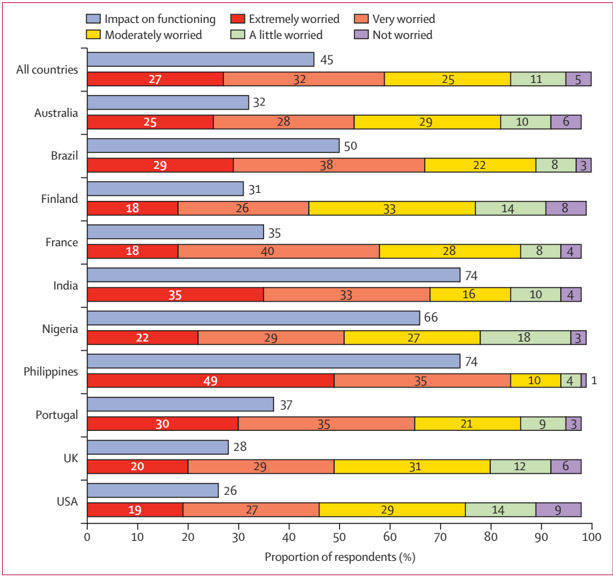
Background Climate change has important implications for the health and futures of children and young people, yet they have little power to limit its harm, making them vulnerable to climate anxiety. This is the first large-scale investigation of climate anxiety in children and young people globally and its relationship with perceived government response. Methods We surveyed 10 000 children and young people (aged 16-25 years) in ten countries (Australia, Brazil, Finland, France, India, Nigeria, Philippines, Portugal, the UK, and the USA; 1000 participants per country). Invitations to complete the survey were sent via the platform Kantar between May 18 and June 7, 2021. Data were collected on participants' thoughts and feelings about climate change, and government responses to climate change. Descriptive statistics were calculated for each aspect of climate anxiety, and Pearson's correlation analysis was done to evaluate whether climate-related distress, functioning, and negative beliefs about climate change were linked to thoughts and feelings about government response. Findings Respondents across all countries were worried about climate change (59% were very or extremely worried and 84% were at least moderately worried). More than 50% reported each of the following emotions: sad, anxious, angry, powerless, helpless, and guilty. More than 45% of respondents said their feelings about climate change negatively affected their daily life and functioning, and many reported a high n…
Verified 2026-11-25 · 1 reference not checked yet
Overview
CoChat Summary
TL;DR
This global survey of 10,000 people aged 16–25 across ten countries found widespread climate anxiety and distress, with many reporting negative functional impacts. Climate distress was correlated with negative perceptions of government responses and feelings of betrayal.
Key findings
- 59% were very or extremely worried about climate change and 84% were at least moderately worried; more than 50% reported feeling sad, anxious, angry, powerless, helpless, and guilty.
- More than 45% said their feelings about climate change negatively affected their daily life and functioning; 75% said the future is frightening and 83% said people have failed to take care of the planet.
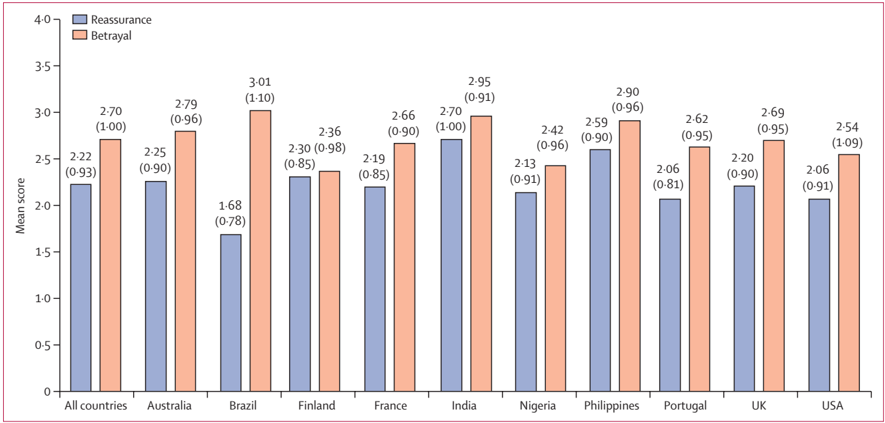
- Respondents rated government responses negatively (mean 14.96 on a 9–18 scale, SD 2.57) and reported greater betrayal (mean 2.7, SD 1.0) than reassurance (mean 2.22, SD 0.93; p<0.0001).
- Climate anxiety and distress were correlated with perceived inadequate government response and associated feelings of betrayal.
Methods
- Cross-sectional online survey of 10,000 children and young people aged 16–25 years in ten countries (Australia, Brazil, Finland, France, India, Nigeria, Philippines, Portugal, the UK, and the USA; 1000 per country), recruited via Kantar between May 18 and June 7, 2021.
- Quota sampling was based on age, gender, and region, with data weighted to OECD statistics for each country by age group, gender, and region.
- Descriptive statistics were calculated for climate anxiety constructs, and Pearson’s correlation analysis explored links between climate-related distress, functioning, negative beliefs, and thoughts/feelings about government response; findings significant at p≤0.001 are reported.
Limitations
- The paper states that non-standardised measures were used because no appropriate standardised measures existed; the study cannot indicate severity compared with normative samples, did not measure mental health outcomes, and used a yes/no/prefer-not-to-say response scale.
- The paper states that equal sample sizes per country were not weighted by population size, so aggregated results are not globally representative; online polling required internet access and sometimes English, and gender was recorded only as male or female.
- Evident from the text: the cross-sectional design cannot establish causality between perceived government response and climate distress.
Model-written summary. Check it against the paper before relying on it.
Integrity signals
Registry
Cites
Statistics
Figures
Verification
Claims the paper makes
12 Valid · 0 Not valid · 19 Not checked · 99 Own results and interpretations
Every source the paper cites for this claim was checked and supports it.
In the paper
“Children are now turning to legal action based on government failure to protect ecosystems, young citizens, and their futures. 26”
What the sources say
- Supportedcites [26] 26 Salas RN, Jacobs W, Perera F. The case of Juliana v. US-children and the health burdens of climate change. N Engl J Med 2019; 380: 2085-87 . source
The supplied Abstract passages describe children filing suit over federal inaction on climate change, which they say violates their constitutional rights. They also connect that inaction to threats to children’s safe environment and to future generations, supporting the citing sentence’s paraphrase. (LLM, conf=0.88)
plainstates a cause- Asserted: passes — The authors put it forward as true.
- Checkable: passes — It can be checked against evidence.
- Load-bearing: unclear — It is unclear whether the paper’s conclusions depend on it.
- Based: passes — The paper gives a reason why it holds.
- Supported
A result the paper reports from its own data — it cites no other source for it, so there is none to check. The quote shows it is in the paper.
In the paper
“in the Global North, Portugal (which had dramatic increases in wildfires since 2017) showed the highest level of worry.”
plainn = 1,000- Asserted: passes — The authors put it forward as true.
- Checkable: passes — It can be checked against evidence.
- Load-bearing: unclear — It is unclear whether the paper’s conclusions depend on it.
- Based: passes — The paper gives a reason why it holds.
A result the paper reports from its own data — it cites no other source for it, so there is none to check. The quote shows it is in the paper.
In the paper
“Respondents rated governmental responses to climate change negatively”
plain- Asserted: passes — The authors put it forward as true.
- Checkable: passes — It can be checked against evidence.
- Load-bearing: passes — The paper’s conclusions depend on it.
- Based: passes — The paper gives a reason why it holds.
A result the paper reports from its own data — it cites no other source for it, so there is none to check. The quote shows it is in the paper.
In the paper
“This distress was associated with beliefs about inadequate governmental response and feelings of betrayal.”
plainstates an association- Asserted: passes — The authors put it forward as true.
- Checkable: passes — It can be checked against evidence.
- Load-bearing: passes — The paper’s conclusions depend on it.
- Based: passes — The paper gives a reason why it holds.
A result the paper reports from its own data — it cites no other source for it, so there is none to check. The quote shows it is in the paper.
In the paper
“More than 45% of respondents said their feelings about climate change negatively affected their daily life and functioning”
- Also stated in: § Results · p. 5 · plain
“More than 45% of respondents said their feelings about climate change negatively affected their daily lives”
plainn = 10- Asserted: passes — The authors put it forward as true.
- Checkable: passes — It can be checked against evidence.
- Load-bearing: passes — The paper’s conclusions depend on it.
- Based: passes — The paper gives a reason why it holds.
- Also stated in: § Results · p. 5 · plain
50 more claims
Create a free account to see all 130 claims and to verify the 1 reference still open.
- Probably not a substantial claim. 51
- It may state two separate claims as one. 41
- The quote only partly states this claim. 6
Claims other papers make about this one
Each is checked against this paper’s own text: does it say what the citing paper says it does?
The source backs part of the claim, not all of it — or backs it for a different population, condition or comparison.
In the citing paper
“Investigations into anxiety about climate change have revealed that it is increasingly common for many people across the globe [9], with large-scale international studies identifying growing concern about climate change [10–12].”
From The relationship between climate change and mental health: a systematic review of the association between eco-anxiety, psychological distress, and symptoms of major affective disorders (2024) · cites this paper as [10]
Experimental — accuracy not yet measuredThe source backs part of the claim, not all of it — or backs it for a different population, condition or comparison.
In the citing paper
“The high prevalence of eco-anxiety [10] - be it at clinical or subclinical levels - underscores the need for broader level changes related to climate change.”
From The relationship between climate change and mental health: a systematic review of the association between eco-anxiety, psychological distress, and symptoms of major affective disorders (2024) · cites this paper as [10]
Experimental — accuracy not yet measuredThe source backs part of the claim, not all of it — or backs it for a different population, condition or comparison.
In the citing paper
“and varied understandings and experiences of climate change have differing impacts on the relationship with mental health [10, 12].”
From The relationship between climate change and mental health: a systematic review of the association between eco-anxiety, psychological distress, and symptoms of major affective disorders (2024) · cites this paper as [10]
Experimental — accuracy not yet measuredThe source backs part of the claim, not all of it — or backs it for a different population, condition or comparison.
In the citing paper
“A global survey of 10,000 young people (16-25) across 10 countries found: (1) 75% were frightened about the future; (2) 84% were moderately worried; (3) 59% were very or extremely worried; and (4) 45%+ reported climate change-related feelings negatively affected their daily life and functioning [21].”
From Climate Distress: A Review of Current Psychological Research and Practice (2023) · cites this paper as [21]
Experimental — accuracy not yet measuredThe source backs part of the claim, not all of it — or backs it for a different population, condition or comparison.
In the citing paper
“An overall lack of trust in government was also identified, with a wide belief that the government response to climate change will continue to be inadequate [21].”
From Climate Distress: A Review of Current Psychological Research and Practice (2023) · cites this paper as [21]
Experimental — accuracy not yet measured
21 more claims about this paper
Create a free account to see every claim other papers make about this one.
Self-check
Percentages, sums and reported differences re-computed from the paper’s own numbers.
Rated minor: it would not touch a result — a value no result rests on, a p-value that stays on the same side of the significance level, or a conflict that is clerical, resolved elsewhere in the paper, or outside its own findings.
In the paper
“15 543 people began the survey and 10 000 (68%) completed it.”
Reported 68 · recomputed 64.337644
Citations
Cites
Mental health of young people: A global public-health challenge
Patel, V., Flisher, A. J., Hetrick, S., & McGorry, P. (2007) · The Lancet · doi:10.1016/s0140-6736(07)60368-7 · Cited by 3,126 · cited 2×
“23 Children facing a future severely damaged by climate change will need support.”
Stress and Health: Psychological, Behavioral, and Biological Determinants
Schneiderman, N., Ironson, G., & Siegel, S. D. (2005) · Annual Review of Clinical Psychology · doi:10.1146/annurev.clinpsy.1.102803.144141 · Cited by 2,252 · cited 2×
“22 Exposure to chronic stress in childhood has a long-lasting impact and increases the risk of developing mental health problems.”
Development and validation of a measure of climate change anxiety
Clayton, S., & Karazsia, B. T. (2020) · Journal of Environmental Psychology · doi:10.1016/j.jenvp.2020.101434 · Cited by 1,196
Self-citationAnxiety and the Ecological Crisis: An Analysis of Eco-Anxiety and Climate Anxiety
Pihkala, P. (2020) · Sustainability · doi:10.3390/su12197836 · Cited by 978 · cited 2×
“In threatening and uncertain situations such as the climate crisis, this response can be seen as what is sometimes referred to as practical anxiety 1,4 because it has the beneficial effect of leading people to reassess their behaviour in order to respond appropriately.”
Self-citationMoral Injury: An Integrative Review
Griffin, B. J., Purcell, N., Burkman, K., Litz, B. T., Bryan, C. J., Schmitz, M., Villierme, C., Walsh, J., & Maguen, S. (2019) · Journal of Traumatic Stress · doi:10.1002/jts.22362 · Cited by 752 · cited 2×
“28 This might include an awareness of or failure to prevent harmful unethical behaviour.”
Stanley, S. K., Hogg, T. L., Leviston, Z., & Walker, I. (2021) · The Journal of Climate Change and Health · doi:10.1016/j.joclim.2021.100003 · Cited by 715
Anxiety, worry, and grief in a time of environmental and climate crisis: a narrative review
Ojala, M., Cunsolo, A., Ogunbode, C. A., & Middleton, J. (2021) · Annual Review of Environment and Resources · doi:10.1146/annurev-environ-012220-022716 · Cited by 670
The case for systems thinking about climate change and mental health
Berry, H. L., Waite, T. D., Dear, K. B. G., Capon, A. G., & Murray, V. (2018) · Nature Climate Change · doi:10.1038/s41558-018-0102-4 · Cited by 485 · cited 2×
“Changing climate and weather-related disasters have diverse impacts, both direct (eg, destruction and trauma) and indirect (eg, strained personal and public resources, interrupted community functioning), 2 as well as resulting in climate anxiety.”
Eco-Anxiety and Environmental Education
Pihkala, P. (2020) · Sustainability · doi:10.3390/su122310149 · Cited by 475
Self-citationThe Hogg Eco-Anxiety Scale: Development and Validation of a Multidimensional Scale
(2021) · doi:10.31219/osf.io/rxudb · Cited by 465
Research works printed but not linked: 4
- 11 Jensen T. Ecologies of guilt in environmental rhetorics. Cham: Palgrave Macmillan, 2019.
- 18 UNICEF. One billion children at 'extremely high risk' of the impacts of the climate crisis. Aug 20, 2021. https://www.unicef.org. uk/press-releases/onebillion-children-at-extremely-high-risk-of-theimpacts-of-the-climate-crisis-unicef (accessed Sept 5, 2021).
- 27 Weintrobe S. Psychological roots of the climate crisis: neoliberal exceptionalism and the culture of uncare. New York, NY: Bloomsbury Academic, 2021.
- 32 Mavronicola N. Torture, inhumanity and degradation under article 3 of the ECHR: absolute rights and absolute wrongs. Oxford: Bloomsbury Publishing, 2021.
Cited by
Items 2,101–2,164 of 2,164
Ojala, M., Palmo, S., & Nuojua, S. (2026) · Environmental Education Research · doi:10.1080/13504622.2026.2727881
“Young people are highly concerned about climate change (Chiw and Ling 2019; Fløttum, Dahl, and Rivenes 2016; Gifford and Comeau 2011; Hickman et al. 2021; Jones and Davison 2021; Lewandowski et al. 2024), but they do not necessarily make more sustainable choices than older generations (Gifford and…”
Shah, S. A. A., Činčera, J., & Kroufek, R. (2026) · Environmental Education Research · doi:10.1080/13504622.2026.2730575 · Cited by 1
Aruta, J. J. B. R., Teng, J. C. C., Mansibang, M. A. C., Clarke, C. L. P., & Gollon, H. K. Y. (2026) · Frontiers in Conservation Science · doi:10.3389/fcosc.2026.1922371
Suryani, H., & Ali, M. I. (2026) · Open Education Studies · doi:10.1515/edu-2025-0160 · Cited by 2
“It may also be associated with psychological distance, helplessness, eco-anxiety, or disengagement when environmental problems are perceived as overwhelming (Hickman et al. 2021; Ojala 2012; Whitmarsh 2009).”
Toward an integrative psychological framework of existential hope: navigating uncertain futures.
Bohlmeijer, E., Nieuwenhuis, M., Domínguez, A. R., ten Klooster, P., & Malboeuf‐Hurtubise, C. (2026) · Frontiers in Psychology · doi:10.3389/fpsyg.2026.1850611 · Cited by 1
“One illustrative example is eco-anxiety, which refers to the distress individuals may experience when acknowledging or realizing the destructive consequences of human activity on the climate and natural environment (Pihkala, 2020; Hickman et al., 2021).”
Alisha, T. T., Romate, J., Rajkumar, E., Sruthi, K. S., Lipsa, J. M., & Manjima, M. (2026) · Frontiers in Climate · doi:10.3389/fclim.2026.1837284 · Cited by 1
Cancelled: The Impact of Climate Anxiety on the Concept of Sustainable Consumption
Yeşilyurt, H., & Dora, S. O. (2026) · IntechOpen eBooks · doi:10.5772/intechopen.1017565 · Cited by 1
Climate emotion profiles as moderators of ecological coping and depression in Ukraine
Baranov, V. (2026) · Cogent Psychology · doi:10.1080/23311908.2026.2731169
Perry, J., Wale, W., Walshe, N., & Rushton, E. A. C. (2026) · Environmental Education Research · doi:10.1080/13504622.2026.2727877 · Cited by 1
Ocio, L. J., Legardeur, J., Mendizabal, M., & Rubio-Varas, M. (2026) · Open Research Europe · doi:10.12688/openreseurope.24311.1
5. The Supposed Impotence of Ethics
ten Have, H. (2026) · Open Book Publishers · doi:10.11647/obp.0548.05 · Cited by 1
Wishing well: a data-driven investigation of Italian adolescents’ wishes and trust in the future
Gagliardi, I., Passarelli, M., Albizzati, A., Lazzarini, I., Ponzini, G., Sellitto, G., & Bodini, A. (2026) · Statistical Methods & Applications · doi:10.1007/s10260-026-00886-5
Rochat, S., Tacchini, S., Duay, M., & Rossier, J. (2026) · L’Orientation scolaire et professionnelle · doi:10.4000/16s6d
Nagre, A., & Dixit, A. S. (2026) · International journal of organizational analysis · doi:10.1108/ijoa-03-2026-6675 · Cited by 1
From anxiety to action: women’s lived experiences of eco-anxiety in the context of climate change
Çakaloğlu, T., & Altay, S. U. (2026) · Current Psychology · doi:10.1007/s12144-026-10059-y
“Despite growing scholarly interest in eco-anxiety, the empirical literature has been disproportionately focused on urban and Global North populations, and on younger age groups or student samples (Hickman et al., 2021 ; Ojala et al., 2021 ).”
Die Rolle der Biodiversität im Übergang zu einer klimagerechten Gesellschaft
Dong, X., Schinko, T., & Winiwarter, V. (2026) · Springer eBooks · doi:10.1007/978-3-662-74109-2_18
One Health – One Planet – One Mind: integrating eco-anxiety into the One Health paradigm
Umar, S. I., Maaji, S. M., Beli, I. I., & Nura, Z. M. (2026) · One Health · doi:10.1016/j.onehlt.2026.101588
“As it is not a clinical disorder, though, it has measurable effects on emotional well-being, cognition, and behavior, especially within young people, indigenous communities, and populations relying directly on natural ecosystems [14].”
Climate Justice and One Health Adaptation Policies in Public Health and Disaster Medicine
Adamopoulos, I., Eslahi, A. V., Syrou, N. F., Diamanti, K., Κατσογιάννου, Μ., Tsirkas, P., Mijwil, M. M., Tornjanski, V., Mishra, H., Hrustemović, E., et al. (2026) · Public Health Challenges · doi:10.1002/puh2.70370
“Climate adaptation at the subnational level is determined by local government actions, with a focus on disaster-risk reduction in low-and middle-income countries [ 55 ].”
da Cunha, J. S., Carneiro, R., Félix, M., & Rosário, P. (2026) · Frontiers in Psychology · doi:10.3389/fpsyg.2026.1882370
“This lack of social and political power may be related to young people’s perception that governments are primarily responsible for combating CC (Corner et al., 2015) and to feelings of frustration stemming from unequal power (Rebelo et al., 2025; Hickman et al., 2021).”
Stollberg, J., Klackl, J., & Jonas, E. (2026) · Current Research in Ecological and Social Psychology · doi:10.1016/j.cresp.2026.100287 · Cited by 1
Integral Ecology as Praxis of Hope: Dreams from Bethany Land Institute, Uganda
Ojeifo, E. O. (2026) · The anthropocene: Politik - economics - society - science · doi:10.1007/978-3-032-32125-1_6
Teaching history and the climate crisis: missed opportunities in Finnish textbooks?
Nevalainen, L.-M. K. (2026) · History Education Research Journal · doi:10.14324/herj.23.1.23
Bureau, J., Gauthier, A. J., With, S., Villeneuve, V., Becerra, A. K. E., Hull, S. E., Lorteau, S., Racine, N., & Deneault, A. (2026) · Current Psychology · doi:10.1007/s12144-026-10019-6 · Cited by 1
“Without support, excessive worry can increase susceptibility to anxiety and hopelessness, highlighting how crucial it is to understand the relational processes that shape how young people (aged 16–25 years) deal with climate emotions (Hickman et al., 2021).”
Chong, H. J. H., Hashim, N. E. N., Moy, F. M., Norazharuddin, Y., & Say, Y. (2026) · Social Sciences & Humanities Open · doi:10.1016/j.ssaho.2026.103521
Views of Central European high school students on environmental issues and policies
Lipták, B., Kouba, A., Patoka, J., Patoková, B., & Prokop, P. (2026) · Environmental & Socio-economic Studies · doi:10.2478/environ-2026-0017
Chulluncuy, E. T. H., Ccoa, V. L., Blanco, A. Z., Huamaní, M. C., & Ochoa, J. H. (2026) · European Journal of Investigation in Health Psychology and Education · doi:10.3390/ejihpe16090145
“…climate anxiety along two main lines: on one hand, its adverse impact on mental well-being, insomnia, and perceived institutional betrayal (Hickman et al., 2021; Ogunbode et al., 2022, 2023); on the other, its close relationship with information salience, general concern, and…”
Nawawonganun, R., Sornlorm, K., & Mahato, R. K. (2026) · PLoS ONE · doi:10.1371/journal.pone.0358849
“Research has demonstrated that parental worry about environmental threats can significantly impact psychological well-being, a phenomenon that overlaps conceptually with eco-anxiety, although it may manifest more broadly as psychological distress [6,7].”
Amin, M. R., Wahab, S. A., Islam, M. M., & Hossain, M. A. (2026) · Journal of Applied Research in Higher Education · doi:10.1108/jarhe-04-2026-0622
Ahamd, N., Zerhouni, O., Laignel, B., Codou, O., & Vallée, B. (2026) · Journal of Environmental Psychology · doi:10.1016/j.jenvp.2026.103218
The Right to Hope: Collective Agency and the Politics of Repair in the Digital Age
Rauf, B., & Barranco, K. (2026) · Development · doi:10.1057/s41301-026-00518-1
Phan, D., Spirkl, N., Kauk, J., & Asbrand, J. (2026) · Research Square · doi:10.21203/rs.3.rs-10677469/v1
“What We Know Is a Drop”: Contextualizing Netflix’s Dark
Joy, S. (2026) · Springer eBooks · doi:10.1007/978-3-032-18950-9_1
From climate awareness to action: evaluating a group-based intervention for youth
Kara, Y., Özkalay, Ç. C., & Aslan, Ş. (2026) · Social Work With Groups · doi:10.1080/01609513.2026.2739323
Gøtzsche‐Astrup, O. (2026) · Group Processes & Intergroup Relations · doi:10.1177/13684302261481446
Aslan, A. M., Koç, H., & Gökalp, Z. Ş. (2026) · Current Psychology · doi:10.1007/s12144-026-10089-6
“…concerns about future stability and psychological safety (Cianconi et al., 2020 ; Sheate, 2025), as well as with depres - sive symptoms, existential emptiness, helplessness, and climate-related distress, particularly among young adults (Clayton, 2020 ; Hickman et al., 2021 ; Betro et al., 2024).”
InfluentialÜzar, U., Kömürcüoğlu, E. D., & Kömürcüoğlu, Ö. F. (2026) · Ecological Economics · doi:10.1016/j.ecolecon.2026.109257
Schinaia, C. (2026) · Psychoanalytic Inquiry · doi:10.1080/07351690.2026.2738530
Climate Change Coping Scale: Turkish Adaptation and Psychometric Evaluation among Young Adults
Özer, D., & Altun, Ö. Ş. (2026) · Psikiyatride Guncel Yaklasimlar - Current Approaches in Psychiatry · doi:10.18863/pgy.1904102
Institutional betrayal in climate action: Youth experiences and future pathways
Nosek, G., Tozer, L., Craig, J. P., Classens, M., Fisher, A., Moosa, I. M. A., Naqvi, E., Sojoudi, Z., Ali, A., Rolston, I. A., et al. (2026) · Environmental Science & Policy · doi:10.1016/j.envsci.2026.104497
Salleh, M. Z. M., & Malek, N. A. (2026) · E3S Web of Conferences · doi:10.1051/e3sconf/202674406005
“The global survey by [2] demonstrated the scale of climate-related worry among young people aged 16 to 25, while later studies linked eco-anxiety to well-being, life satisfaction, mental-health symptoms and pro-environmental behaviour across diverse contexts [8].”
Hewege, C., Perera, C. R., & Ganesan, B. (2026) · International Journal of Environmental Research and Public Health · doi:10.3390/ijerph23101266
Zysset, A. E., Kerry, M. J., & Dratva, J. (2026) · Frontiers in Public Health · doi:10.3389/fpubh.2026.1932199
Raile, P. (2026) · Frontiers in Cognition · doi:10.3389/fcogn.2026.1927324
Thawing the climate freeze: a trauma-informed heuristic for collective climate disengagement
Athira, O. S., Jose, K. A., & Philip, N. A. (2026) · Frontiers in Conservation Science · doi:10.3389/fcosc.2026.1983941
Lampret, A., Plohl, N., Smrke, U., Rutar, M., Musil, B., & Kos, T. (2026) · Research Square · doi:10.21203/rs.3.rs-10969685/v1
"The Name of the Title Is Hope' -- Hope and Resilience in Child-Computer Interaction
Sim, G., Eriksson, E. W., Bodén, M., Fails, J. A., Constantin, A., Good, J., Read, J. C., & Korte, J. (2026) · Nordic Conference on Human-Computer Interaction · doi:10.1145/3821402.3830127
Adolescence : l’incertitude de l’inachevé – Enjeux du soin
Votadoro, P., & Corcos, M. (2026) · Nouvelle Revue de l enfance et de l adolescence · doi:10.3917/nrea.014.0078
Nakano, Y., & HONDO, H. (2026) · International Journal of Sustainable Development & World Ecology · doi:10.1080/13504509.2026.2738668
Lykins, A. D., Parsons, M. E., Cosh, S., & Tully, P. J. (2026) · Journal of Environmental Psychology · doi:10.1016/j.jenvp.2026.103234
Mathé, M., Grisetto, F., Nau, A., Gauvrit, N., & Roger, C. (2026) · Journal of Anxiety Disorders · doi:10.1016/j.janxdis.2026.103240
Is education possible without belief in social progress?
Standish, A. (2026) · Educational Philosophy and Theory · doi:10.1080/00131857.2026.2687508 · Cited by 1
“International surveys show that most young people believe that ‘the future is frightening’ and over half think that ‘humanity is doomed’ (Hickman et al., 2021, p. 868).”
Ideas of progress in the geography curriculum
Alcock, D. (2026) · Educational Philosophy and Theory · doi:10.1080/00131857.2026.2653154
“Taken together, these—and other—trends have led to increases in reported levels of anxiety, especially ‘eco-anxiety’ among young people (see, for example, Hickman et al., 2021), significantly shaping their outlook on the future.”
Education and Climate Change: Synthesizing the Evidence to Guide Future Research
Kraft, M. A., Malik, S., & Falken, G. T. (2026) · American Educational Research Journal · doi:10.3102/00028312261478064 · Cited by 1
Corrêa, L. Q., de Almeida, B. P., Santos, S. O., Santo, S. R. D. E., de Sousa, J. V. T., Pereira, D. E., Júnior, C. D. S. O., Furtado, C. L. C., Dumith, S. C., & da Silva, M. P. (2026) · Ciência & Saúde Coletiva · doi:10.1590/1413-81232026319.14892024
Moffitt, V., Kennedy, K. P., Pinto-Martin, J., & Malefakis, A. (2026) · Frontiers in Psychology · doi:10.3389/fpsyg.2026.1935891
Écoanxiété : quand la peur du réchauffement climatique devient paralysante
Michel, G. (2026) · Cerveau & Psycho · doi:10.3917/cerpsy.191.0080
Tesnoba kot družbeni barometer: evolucijski zaveznik ali breme sodobnega človeštva?
Šprah, L. (2026) · Alternator · doi:10.3986/alternator.2026.15
Spiteri, J. (2026) · Educational Review · doi:10.1080/00131911.2026.2716374
Still Warm: A Digital Game for Players to Address Climate Grief
Baker-Ramos, R., Hester, J. D., & Cabral, A. (2026) · International Conference on Information Technology for Social Good (GoodIT) · doi:10.1145/3794786.3830769
“Millennial and Gen Z adults worldwide increasingly struggle with climate/ecological grief: strong emotions of anxiety, fear, pain, sadness, anger, and betrayal due to the impending climate crisis [16, 18, 20].”
Urbanowicz, A., Zimny-Zając, A., Dróżdż, M., Dudek, K., Łątka, K., Żórawska, J., Agrawal, S., & Mazur, G. (2026) · BMJ Public Health · doi:10.1136/bmjph-2026-005535
Exploring a child's representations of the sea through drawings and narratives
Baustad, A. G., & Deguara, J. (2026) · Contemporary Issues in Early Childhood · doi:10.1177/14639491261494456
The Weight of Warming Seas: A Feminist Analysis of Eco-Anxiety Among Indonesian Women
Hayati, Y., Ghaluh, B. M., Nursaid, N., & Wulandari, E. (2026) · Feminism & Psychology · doi:10.1177/09593535261494638
Pu, Y., Mareschal, I., Rasolomalala, N., Solomon, S., Rasamison, H., & Hadfield, K. (2026) · Progress in Disaster Science · doi:10.1016/j.pdisas.2026.100757
Climate Anxiety Features and Factors: A Mixed-Methods Study of Professional Perspectives
Pitt, C., Norris, K., & Pecl, G. T. (2026) · Springer eBooks · doi:10.1007/978-981-92-0585-1_28
Metadata
- Authors
- Hickman, C., Marks, E., Pihkala, P., Clayton, S., Lewandowski, R. E., Mayall, E. E., Wray, B., Mellor, C., & van Susteren, L.
- Affiliations
- University of Bath (GB)
- University of Helsinki (FI)
- College of Wooster (US)
- NYU Langone Health (US)
- University of East Anglia (GB)
- London School of Hygiene & Tropical Medicine (GB)
- Oxford Health NHS Foundation Trust (GB)
- Corresponding author
- Hickman, Caroline
- Venue
- The Lancet Planetary Health
- Publisher
- Elsevier BV
- Published
- 2021-12
- Volume
- 5
- Issue
- 12
- Pages
- e863-e873
- ISSN
- 2542-5196 (ISSN-L)
- OpenAlex
- W4200005759
- Semantic Scholar
- 4a876cc35863ba593aacf58fe6a24773b3cb9c29
- Cited by
- 2,324
- References
- 27
- Citations by year
- 2026: 566 · 2025: 652 · 2024: 566 · 2023: 364 · 2022: 170 · 2021: 4
- FWCI
- 382.19
- Type
- journal article
- Language
- en
- Open access
- gold
- doi.org
- Licence
- cc-by-nc-nd
- www.elsevier.com/tdm/userlicense/1.0/ (tdm)
- www.elsevier.com/legal/tdmrep-license (tdm)
- creativecommons.org/licenses/by-nc-nd/4.0/ (vor)
- Locations
- The Lancet Planetary Health (publishedVersion, cc-by-nc-nd)
- PubMed (publishedVersion)
- DOAJ (DOAJ: Directory of Open Access Journals) (submittedVersion, cc-by-sa)
- Työväentutkimus Vuosikirja (submittedVersion)
- Topics
- Social Sciences › Sociology and Political Science › Climate Change Communication and Perception
- Physical Sciences › Environmental Science › Health, Toxicology and Mutagenesis › Climate Change and Health Impacts
- Social Sciences › Psychology › Clinical Psychology › COVID-19 and Mental Health
- Keywords
- climate anxiety, children and young people, climate change, betrayal, climate change beliefs, daily functioning, global survey
- MeSH terms
- Adolescent, Adult, Anxiety, Australia, Child, Government, Humans, Surveys and Questionnaires, Young Adult, Climate Change
About these checks
Registry, retraction, Cites and statistics results are computed, not judged, with one exception: a printed reference that no index lists is read once by a model before it counts as a citation error. Claims are extracted by a model and kept only when their quote appears verbatim in the text; each cited source is then checked, with a model’s help, for whether it says what the claim relies on. Those verdicts can be wrong — read the claim’s quote and the cited source before relying on one.
The claim verdicts this report counts are experimental: their accuracy is not yet measured.
A language model drew the claims from the paper on 2026-10-10, under version 3 of the claim definition (model deepseek-v4.1-flash, prompt extract-v3).
A second model labelled each claim on 2026-10-10 (model jev-1.13-20260917, definition revision gold-guideline-v0.2).
Cited sources are checked with a language model’s help (gpt-6-sol).
Statistics and arithmetic are recomputed, not judged.
Confidence bands are shown only for fields calibrated on our annotated test set. None is calibrated yet, so no band is shown.
What counts as a claim ›How we measure confidence ›How we check this ›
Are you an author, or do you see a problem with this page? Request a review
Data sources
Bibliographic data: Semantic Scholar, OpenAlex, Crossref.
Contains information from the Semantic Scholar Academic Graph Datasets, made available under the ODC Attribution License (ODC-BY 1.0).
Semantic Scholar’s data is described in: Kinney, R., et al. (2023). The Semantic Scholar Open Data Platform. arXiv:2301.10140.
