

Climate anxiety in children and young people and their beliefs about government responses to climate change: a global survey
Open accessThe DOI matches its Crossref record; 27 of the 30 references it cites were found in a registry or an index, and 1 are not checked yet; 14 of the 48 sources its claims cite were checked for support.
Abstract
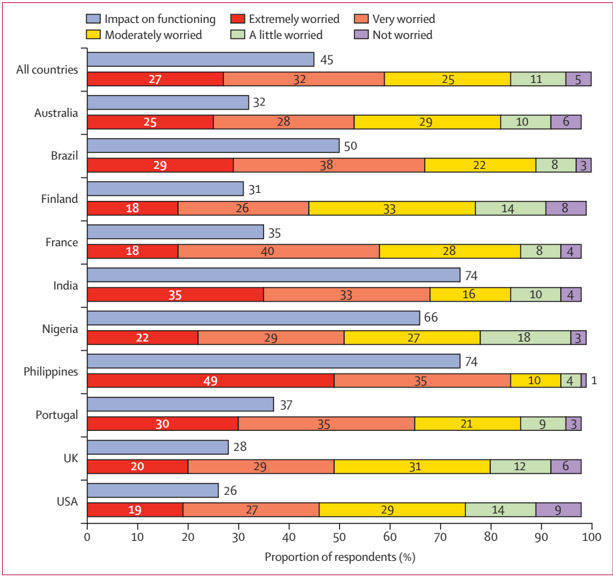
Background Climate change has important implications for the health and futures of children and young people, yet they have little power to limit its harm, making them vulnerable to climate anxiety. This is the first large-scale investigation of climate anxiety in children and young people globally and its relationship with perceived government response. Methods We surveyed 10 000 children and young people (aged 16-25 years) in ten countries (Australia, Brazil, Finland, France, India, Nigeria, Philippines, Portugal, the UK, and the USA; 1000 participants per country). Invitations to complete the survey were sent via the platform Kantar between May 18 and June 7, 2021. Data were collected on participants' thoughts and feelings about climate change, and government responses to climate change. Descriptive statistics were calculated for each aspect of climate anxiety, and Pearson's correlation analysis was done to evaluate whether climate-related distress, functioning, and negative beliefs about climate change were linked to thoughts and feelings about government response. Findings Respondents across all countries were worried about climate change (59% were very or extremely worried and 84% were at least moderately worried). More than 50% reported each of the following emotions: sad, anxious, angry, powerless, helpless, and guilty. More than 45% of respondents said their feelings about climate change negatively affected their daily life and functioning, and many reported a high n…
Verified 2026-11-25 · 1 reference not checked yet
Overview
CoChat Summary
TL;DR
This global survey of 10,000 people aged 16–25 across ten countries found widespread climate anxiety and distress, with many reporting negative functional impacts. Climate distress was correlated with negative perceptions of government responses and feelings of betrayal.
Key findings
- 59% were very or extremely worried about climate change and 84% were at least moderately worried; more than 50% reported feeling sad, anxious, angry, powerless, helpless, and guilty.
- More than 45% said their feelings about climate change negatively affected their daily life and functioning; 75% said the future is frightening and 83% said people have failed to take care of the planet.
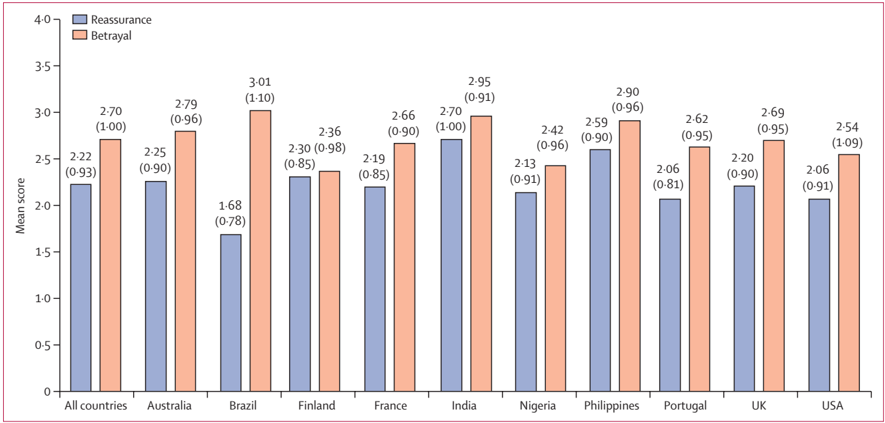
- Respondents rated government responses negatively (mean 14.96 on a 9–18 scale, SD 2.57) and reported greater betrayal (mean 2.7, SD 1.0) than reassurance (mean 2.22, SD 0.93; p<0.0001).
- Climate anxiety and distress were correlated with perceived inadequate government response and associated feelings of betrayal.
Methods
- Cross-sectional online survey of 10,000 children and young people aged 16–25 years in ten countries (Australia, Brazil, Finland, France, India, Nigeria, Philippines, Portugal, the UK, and the USA; 1000 per country), recruited via Kantar between May 18 and June 7, 2021.
- Quota sampling was based on age, gender, and region, with data weighted to OECD statistics for each country by age group, gender, and region.
- Descriptive statistics were calculated for climate anxiety constructs, and Pearson’s correlation analysis explored links between climate-related distress, functioning, negative beliefs, and thoughts/feelings about government response; findings significant at p≤0.001 are reported.
Limitations
- The paper states that non-standardised measures were used because no appropriate standardised measures existed; the study cannot indicate severity compared with normative samples, did not measure mental health outcomes, and used a yes/no/prefer-not-to-say response scale.
- The paper states that equal sample sizes per country were not weighted by population size, so aggregated results are not globally representative; online polling required internet access and sometimes English, and gender was recorded only as male or female.
- Evident from the text: the cross-sectional design cannot establish causality between perceived government response and climate distress.
Model-written summary. Check it against the paper before relying on it.
Integrity signals
Registry
Cites
Statistics
Figures
Verification
Claims the paper makes
12 Valid · 0 Not valid · 19 Not checked · 99 Own results and interpretations
Every source the paper cites for this claim was checked and supports it.
In the paper
“Children are now turning to legal action based on government failure to protect ecosystems, young citizens, and their futures. 26”
What the sources say
- Supportedcites [26] 26 Salas RN, Jacobs W, Perera F. The case of Juliana v. US-children and the health burdens of climate change. N Engl J Med 2019; 380: 2085-87 . source
The supplied Abstract passages describe children filing suit over federal inaction on climate change, which they say violates their constitutional rights. They also connect that inaction to threats to children’s safe environment and to future generations, supporting the citing sentence’s paraphrase. (LLM, conf=0.88)
plainstates a cause- Asserted: passes — The authors put it forward as true.
- Checkable: passes — It can be checked against evidence.
- Load-bearing: unclear — It is unclear whether the paper’s conclusions depend on it.
- Based: passes — The paper gives a reason why it holds.
- Supported
A result the paper reports from its own data — it cites no other source for it, so there is none to check. The quote shows it is in the paper.
In the paper
“in the Global North, Portugal (which had dramatic increases in wildfires since 2017) showed the highest level of worry.”
plainn = 1,000- Asserted: passes — The authors put it forward as true.
- Checkable: passes — It can be checked against evidence.
- Load-bearing: unclear — It is unclear whether the paper’s conclusions depend on it.
- Based: passes — The paper gives a reason why it holds.
A result the paper reports from its own data — it cites no other source for it, so there is none to check. The quote shows it is in the paper.
In the paper
“Respondents rated governmental responses to climate change negatively”
plain- Asserted: passes — The authors put it forward as true.
- Checkable: passes — It can be checked against evidence.
- Load-bearing: passes — The paper’s conclusions depend on it.
- Based: passes — The paper gives a reason why it holds.
A result the paper reports from its own data — it cites no other source for it, so there is none to check. The quote shows it is in the paper.
In the paper
“This distress was associated with beliefs about inadequate governmental response and feelings of betrayal.”
plainstates an association- Asserted: passes — The authors put it forward as true.
- Checkable: passes — It can be checked against evidence.
- Load-bearing: passes — The paper’s conclusions depend on it.
- Based: passes — The paper gives a reason why it holds.
A result the paper reports from its own data — it cites no other source for it, so there is none to check. The quote shows it is in the paper.
In the paper
“More than 45% of respondents said their feelings about climate change negatively affected their daily life and functioning”
- Also stated in: § Results · p. 5 · plain
“More than 45% of respondents said their feelings about climate change negatively affected their daily lives”
plainn = 10- Asserted: passes — The authors put it forward as true.
- Checkable: passes — It can be checked against evidence.
- Load-bearing: passes — The paper’s conclusions depend on it.
- Based: passes — The paper gives a reason why it holds.
- Also stated in: § Results · p. 5 · plain
50 more claims
Create a free account to see all 130 claims and to verify the 1 reference still open.
- Probably not a substantial claim. 51
- It may state two separate claims as one. 41
- The quote only partly states this claim. 6
Claims other papers make about this one
Each is checked against this paper’s own text: does it say what the citing paper says it does?
The source backs part of the claim, not all of it — or backs it for a different population, condition or comparison.
In the citing paper
“Investigations into anxiety about climate change have revealed that it is increasingly common for many people across the globe [9], with large-scale international studies identifying growing concern about climate change [10–12].”
From The relationship between climate change and mental health: a systematic review of the association between eco-anxiety, psychological distress, and symptoms of major affective disorders (2024) · cites this paper as [10]
Experimental — accuracy not yet measuredThe source backs part of the claim, not all of it — or backs it for a different population, condition or comparison.
In the citing paper
“The high prevalence of eco-anxiety [10] - be it at clinical or subclinical levels - underscores the need for broader level changes related to climate change.”
From The relationship between climate change and mental health: a systematic review of the association between eco-anxiety, psychological distress, and symptoms of major affective disorders (2024) · cites this paper as [10]
Experimental — accuracy not yet measuredThe source backs part of the claim, not all of it — or backs it for a different population, condition or comparison.
In the citing paper
“and varied understandings and experiences of climate change have differing impacts on the relationship with mental health [10, 12].”
From The relationship between climate change and mental health: a systematic review of the association between eco-anxiety, psychological distress, and symptoms of major affective disorders (2024) · cites this paper as [10]
Experimental — accuracy not yet measuredThe source backs part of the claim, not all of it — or backs it for a different population, condition or comparison.
In the citing paper
“A global survey of 10,000 young people (16-25) across 10 countries found: (1) 75% were frightened about the future; (2) 84% were moderately worried; (3) 59% were very or extremely worried; and (4) 45%+ reported climate change-related feelings negatively affected their daily life and functioning [21].”
From Climate Distress: A Review of Current Psychological Research and Practice (2023) · cites this paper as [21]
Experimental — accuracy not yet measuredThe source backs part of the claim, not all of it — or backs it for a different population, condition or comparison.
In the citing paper
“An overall lack of trust in government was also identified, with a wide belief that the government response to climate change will continue to be inadequate [21].”
From Climate Distress: A Review of Current Psychological Research and Practice (2023) · cites this paper as [21]
Experimental — accuracy not yet measured
21 more claims about this paper
Create a free account to see every claim other papers make about this one.
Self-check
Percentages, sums and reported differences re-computed from the paper’s own numbers.
Rated minor: it would not touch a result — a value no result rests on, a p-value that stays on the same side of the significance level, or a conflict that is clerical, resolved elsewhere in the paper, or outside its own findings.
In the paper
“15 543 people began the survey and 10 000 (68%) completed it.”
Reported 68 · recomputed 64.337644
Citations
Cites
Mental health of young people: A global public-health challenge
Patel, V., Flisher, A. J., Hetrick, S., & McGorry, P. (2007) · The Lancet · doi:10.1016/s0140-6736(07)60368-7 · Cited by 3,126 · cited 2×
“23 Children facing a future severely damaged by climate change will need support.”
Stress and Health: Psychological, Behavioral, and Biological Determinants
Schneiderman, N., Ironson, G., & Siegel, S. D. (2005) · Annual Review of Clinical Psychology · doi:10.1146/annurev.clinpsy.1.102803.144141 · Cited by 2,252 · cited 2×
“22 Exposure to chronic stress in childhood has a long-lasting impact and increases the risk of developing mental health problems.”
Development and validation of a measure of climate change anxiety
Clayton, S., & Karazsia, B. T. (2020) · Journal of Environmental Psychology · doi:10.1016/j.jenvp.2020.101434 · Cited by 1,196
Self-citationAnxiety and the Ecological Crisis: An Analysis of Eco-Anxiety and Climate Anxiety
Pihkala, P. (2020) · Sustainability · doi:10.3390/su12197836 · Cited by 978 · cited 2×
“In threatening and uncertain situations such as the climate crisis, this response can be seen as what is sometimes referred to as practical anxiety 1,4 because it has the beneficial effect of leading people to reassess their behaviour in order to respond appropriately.”
Self-citationMoral Injury: An Integrative Review
Griffin, B. J., Purcell, N., Burkman, K., Litz, B. T., Bryan, C. J., Schmitz, M., Villierme, C., Walsh, J., & Maguen, S. (2019) · Journal of Traumatic Stress · doi:10.1002/jts.22362 · Cited by 752 · cited 2×
“28 This might include an awareness of or failure to prevent harmful unethical behaviour.”
Stanley, S. K., Hogg, T. L., Leviston, Z., & Walker, I. (2021) · The Journal of Climate Change and Health · doi:10.1016/j.joclim.2021.100003 · Cited by 715
Anxiety, worry, and grief in a time of environmental and climate crisis: a narrative review
Ojala, M., Cunsolo, A., Ogunbode, C. A., & Middleton, J. (2021) · Annual Review of Environment and Resources · doi:10.1146/annurev-environ-012220-022716 · Cited by 670
The case for systems thinking about climate change and mental health
Berry, H. L., Waite, T. D., Dear, K. B. G., Capon, A. G., & Murray, V. (2018) · Nature Climate Change · doi:10.1038/s41558-018-0102-4 · Cited by 485 · cited 2×
“Changing climate and weather-related disasters have diverse impacts, both direct (eg, destruction and trauma) and indirect (eg, strained personal and public resources, interrupted community functioning), 2 as well as resulting in climate anxiety.”
Eco-Anxiety and Environmental Education
Pihkala, P. (2020) · Sustainability · doi:10.3390/su122310149 · Cited by 475
Self-citationThe Hogg Eco-Anxiety Scale: Development and Validation of a Multidimensional Scale
(2021) · doi:10.31219/osf.io/rxudb · Cited by 465
Research works printed but not linked: 4
- 11 Jensen T. Ecologies of guilt in environmental rhetorics. Cham: Palgrave Macmillan, 2019.
- 18 UNICEF. One billion children at 'extremely high risk' of the impacts of the climate crisis. Aug 20, 2021. https://www.unicef.org. uk/press-releases/onebillion-children-at-extremely-high-risk-of-theimpacts-of-the-climate-crisis-unicef (accessed Sept 5, 2021).
- 27 Weintrobe S. Psychological roots of the climate crisis: neoliberal exceptionalism and the culture of uncare. New York, NY: Bloomsbury Academic, 2021.
- 32 Mavronicola N. Torture, inhumanity and degradation under article 3 of the ECHR: absolute rights and absolute wrongs. Oxford: Bloomsbury Publishing, 2021.
Cited by
Items 1,401–1,500 of 2,164
Chapitre 4. Changements climatiques
Campagna, C., Ouimet, M.-J., Généreux, M., & Pétrin-Desrosiers, C. (2023) · Cairn.info · doi:10.3917/ehesp.goupi.2023.01.0113 · Cited by 1
Climate Change and the Environmental Humanities
Heyd, T. (2023) · Handbooks in philosophy · doi:10.1007/978-3-030-16960-2_111-1
Carvings in stone: design research for public health investigations in the age of COVID-19
Mages, M. A., Chehade, E. C., Carr, S. J., Kim, M., Mello, S., Thomas, M., & Yang, Y. (2023) · Design for Health · doi:10.1080/24735132.2023.2231167
Mattera, K. (2023) · Open Access Victoria University of Wellington | Te Herenga Waka (Figshare) · doi:10.26686/wgtn.23640840 · Cited by 1
Differential Harm: Patterns of Uneven Destruction
Liberto, Y. D. (2023) · HARM – Journal of Hostility Aggression Repression and Malice · doi:10.46586/harm.2023.11024 · Cited by 1
“In a recent global survey on climate anxiety, it was found that 59% respondents across all countries were “very or extremely worried” (Hickman et al., 2021, p. e863), and 84% at least moderately worried (Hickman et al., 2021, p. e863).”
BackgroundPublic Mental Health in der Klimakrise
Rottke, D., Cirstea, A., Bokhof, B., Liebau, L. D., Pohlmann, L., & Knebusch, V. (2023) · Public Health Forum · doi:10.1515/pubhef-2023-0078 · Cited by 2
Vision: Holistic Sustainability
Laurent, É. (2023) · Springer eBooks · doi:10.1007/978-3-031-38989-4_3
The Role of Mindfulness in Moderating Climate Distress During Wildfire SeasonPreprint
Guan, J., Dutcher, E. G., Goldin, P. R., Ahmadi, S. E., Fromer, E., Weiser, S. D., Maibach, E. W., Prather, A. A., & Epel, E. S. (2023) · SSRN Electronic Journal · doi:10.2139/ssrn.4589850
Anderson, S. (2023) · Claremont-UC Undergraduate Research Conference on the European Union · doi:10.5642/urceu.muau6464
The Courage to Be a Spiritual Leader in the Age of the “New Normal”: Alfred Adler Reconsidered
Yip, T. C. Y. (2023) · Springer eBooks · doi:10.1007/978-981-99-2641-1_13
Tasmanian Secondary Students’ Experiences of Education for Sustainability
Brett, P., & Ayre, I. (2023) · Education for sustainability · doi:10.1007/978-981-99-3802-5_25
Sjöstedt, W. (2023) · VBN Forskningsportal (Aalborg Universitet) · doi:10.54337/aau561777692 · Cited by 1
Thacker, I. (2023) · SSRN Electronic Journal · doi:10.2139/ssrn.4616390
Climate Change and the Environmental Humanities
Heyd, T. (2023) · Handbooks in philosophy · doi:10.1007/978-3-031-07002-0_111
Logan, M. R. (2023) · Springer eBooks · doi:10.1007/978-3-031-46162-0_1
Chung, I. H. (2023) · Human Ecology Research · doi:10.6115/her.2023.039
Écoanxiété des adultes : quels effets sur les jeunes enfants ?
Romano, H. (2023) · Métiers de la Petite Enfance · doi:10.1016/j.melaen.2023.11.007
Role of Health Equity in the Climate Action Plans of London Boroughs: A Health Policy ReportPreprint
Pattnaik, A. (2023) · medRxiv · doi:10.1101/2023.12.15.23300030
“20,23 Additionally, the community should be regularly notified about the progress in the implementation of the CAPs.”
BackgroundDisrupting STEM Education by Braiding Indigenous Ways of Knowing and Environmental Education
Dodier, S. (2023) · SFU Educational Review · doi:10.21810/sfuer.v15i1.6158
“I would argue that this strictly conceptual approach – far from emotions – is in dissonance with the eco-anxiety felt by an increasing number of students worldwide (Hickman et al., 2021).”
BackgroundVeränderung braucht Halt: Resilienz für zukunftsfähige Organisationen
Sommer, L. K., & Broßeder, S. (2023) · Chefsache · doi:10.1007/978-3-658-41210-4_5
“It Was Beautiful Here, and Then the Pollution Came”:
Nandyal, N. (2023) · Climate Literacy in Education · doi:10.24926/cle.v1i2.5798
“Yet in interviews, worry over the environment did not seem to affect the day-to-day life nor long term plans of participants, a common indicator in measuring eco-anxiety (Hickman et al., 2021 ).”
BackgroundFighting for ‘Justice for All’ in an Era of Deepening Exploitation and Ecological Crisis
Bradshaw, E. A., & Leighton, P. A. (2023) · Critical criminological perspectives · doi:10.1007/978-3-031-46213-9_6
Save Children's Lives: Climate-Responsible Banking Survival Guide
Seidel, F. (2023) · Springer eBooks · doi:10.1007/978-3-031-41781-8_16
Whose uncertainty? Addressing the intersectional reader through the wound of trauma
Park, S. S. (2023) · Frontiers of Narrative Studies · doi:10.1515/fns-2023-2014
Kyle, W. C., Jr., & Belciak, E. A. (2024) · Education and human development · doi:10.5772/intechopen.114114
Germaine, C., & Wake, P. (2024) · Amsterdam University Press eBooks · doi:10.2307/jj.10819591.26
23. Imagining the Future: Game Hacking and Youth Climate Action
Germaine, C., & Wake, P. (2024) · Amsterdam University Press eBooks · doi:10.1515/9789048557219-024 · Cited by 4
Amel, E. L., Manning, C. M., Daus, C. S., & Quinn, M. (2023) · Psychology and our planet · doi:10.1007/978-3-031-50555-3_10 · Cited by 1
Climate Change and Mental Health in the Philippines: a systematic reviewPreprint
Villarino, R. T., Hozhabri, Saint-Onge, & Bernard, P. (2024) · doi:10.31234/osf.io/k74bp
Carsuzaa, F., Fieux, M., Bartier, S., Fath, L., Alexandru, M., Legré, M., & Favier, V. (2024) · Annales françaises d Oto-rhino-laryngologie et de Pathologie Cervico-faciale · doi:10.1016/j.aforl.2023.05.008
Sarkar, S., da Costa, M. P., Nakagami, Y., & Patil, V. (2024) · Indian Journal of Psychological Medicine · doi:10.1177/02537176231225648
Hyde, E., & Conus, P. (2022) · Médecine & Hygiène eBooks · doi:10.3917/mh.senn.2022.01.0232
Forum, I. T. (2024) · International transport forum policy papers · doi:10.1787/686a7ed5-en
van Dijk, S., van Schie, K., Smeets, T. J. M., et al. (2024) · doi:10.31234/osf.io/p8exa
An environmental justice fictional case study for engaging non-majors in human biology
Peters, J. J. (2024) · Journal of Microbiology and Biology Education · doi:10.1128/jmbe.00005-24
Therapeutischer Blick in eine klimakranke Welt
Meißner, A. (2024) · NeuroTransmitter · doi:10.1007/s15016-024-3692-2
Moral submissiveness: social origin as a vulnerability for well-being on a warming planet
Weihgold, V. (2024) · Frontiers in Psychology · doi:10.3389/fpsyg.2024.1355736
A cognitive analytic approach for working alongside young people
Barnes, N. (2024) · Oxford University Press eBooks · doi:10.1093/oxfordhb/9780198866572.013.21
Corporate Climate Policy and CEO Age: Age MattersPreprint
Barter, N., & Omura, A. (2024) · SSRN Electronic Journal · doi:10.2139/ssrn.4767698
Lima, R. O., Belém, A., Lycarião, D., Oliveira, T. M., Evangelista, S., Massarani, L., & Alves, M. (2024) · Social Science Research Network · doi:10.2139/ssrn.4792106 · Cited by 4
Stewards of Tomorrow: Best Practices for Transformative Environmental EducationPreprint
Peters, C. (2024) · SSRN Electronic Journal · doi:10.2139/ssrn.4787103
Introducing a New Model of Wellbeing: Applications to the General Public and Student Population.
Mead, J. (2023) · Cronfa (Swansea University) · doi:10.23889/suthesis.66119 · Cited by 2
“I Cannot Bring A Child Into This World”: Hearing And Writing I Poems With BirthStrike Testimonials
Meynell, L. (2024) · The Qualitative Report · doi:10.46743/2160-3715/2024.6888 · Cited by 1
Enjeux de santé en lien avec l’environnement et le rôle des soignants
Vuilleumier, S. (2024) · Soins · doi:10.1016/j.soin.2024.03.005
Resolving the Crisis: From Turmoil to New PracticePreprint
Shkliarevsky, G. (2024) · SSRN Electronic Journal · doi:10.2139/ssrn.4822677 · Cited by 1
French agricultural education students: “intermediaries” in the fight against climate change?
Lévy, R., Corso, J.-P. D., & Fall, F. (2024) · International Journal of Sustainability in Higher Education · doi:10.1108/ijshe-10-2023-0482 · Cited by 1
The Interface of Climate and Psychiatry
Pinsky, E. G. (2024) · Elsevier eBooks · doi:10.1016/b978-0-443-11844-9.00087-4
Exploring Eco-Anxiety and Eco-Coping in Young Adults in IndiaPreprint
Jain, V., Jose, A., Eldhose, N. J., & John, D. (2024) · Research Square · doi:10.21203/rs.3.rs-4371214/v1 · Cited by 3
Hopenwasser, K. (2024) · Cambridge University Press eBooks · doi:10.1017/9781009252904.008 · Cited by 1
Multidisciplinary Perspectives on Youth Climate Distress
Haase, E., & Hudson, K. (2024) · Cambridge University Press eBooks · doi:10.1017/9781009252904.011
A Research Agenda for Young People’s Psychological Response to Climate Change
Wortzel, J. R. (2024) · Cambridge University Press eBooks · doi:10.1017/9781009252904.010
A Legal Perspective on Judicial Remedies to Respond to Young People’s Climate Distress
Rodgers, A., & Dunn, K. (2024) · Cambridge University Press eBooks · doi:10.1017/9781009252904.015
Pediatricians’ Perspectives: Youth Climate Distress in the Pediatric Setting
Ahdoot, S. (2024) · Cambridge University Press eBooks · doi:10.1017/9781009252904.014 · Cited by 1
Éco-anxiété de l’adolescent et autres avatars des craintes modernes : de quoi parle-t-on vraiment ?
Romano, H. (2024) · Journal de Pédiatrie et de Puériculture · doi:10.1016/j.jpp.2024.05.005 · Cited by 2
Participative Dimension: “Leave No One Behind”
Ventura, P. S., Romeo, M., Valera, S., Serrano, J., Hurtado, C. B., Miralles, F., Panisello, J., Lledó-Cisneros, M., Baños-Ruiz, I., Romera‐Castillo, C., et al. (2024) · doi:10.3390/msf2024025010
“Over 45% reported that their feelings about climate change negatively impacted their daily life and functioning, emphasizing the profound psychological implications of the climate crisis [10].”
BackgroundEducating for a Just Transition, or the Poverty of Human Capital Theory
Ridley, D. (2024) · New Formations · doi:10.3898/newf:110-111.08.2024
Dossa, K. F., & Miassi, Y. E. (2024) · European journal of ecology, biology and agriculture. · doi:10.59324/ejeba.2024.1(2).08
Planetary health. A new social determinant of health and an avoidable health inequality
Smith, L. (2024) · Journal of Pediatric Nursing · doi:10.1016/j.pedn.2024.06.012
Piedra, F.-A., Piedra, F.-A., Salazar, M. A., et al. (2024) · bioRxiv (Cold Spring Harbor Laboratory) · doi:10.1101/2024.07.01.601593
Goddard, P. B., Kravitz, B., Scribner, A., Milks, K. J., & Peterson, C. (2024) · The Hoosier Science Teacher · doi:10.14434/thst.v47i1.37892
Pettini, S. (2024) · Zbornik radova Filozofskog fakulteta u Pristini · doi:10.5937/zrffp54-50233
Environmental Exposures, Climate Change, and Mental Health: Impacts in Vulnerable Communities
Nori‐Sarma, A., & Galea, S. (2024) · Springer eBooks · doi:10.1007/978-3-031-56736-0_13 · Cited by 2
Faith in Equity, Equity in Faith: Insights about Care for Climate-Related Mental Health Issues
Gore, K., Neidhardt, J., & Roessel, M. H. (2024) · Springer eBooks · doi:10.1007/978-3-031-56736-0_20
JEDI: A Priority When Addressing Climate Change and Its Impact on Adolescent Mental Health
Israni, S. T., Matlow, R. B., Nadeau, K. C., Sampath, V., & Wray, B. (2024) · Springer eBooks · doi:10.1007/978-3-031-56736-0_3
Self-citationChanging bank accounts as a preventative health action: Why ACP-UK is making the change
Rolt, M., Chasey, R., Cussans, A., et al. (2024) · Clinical Psychology Forum · doi:10.53841/bpscpf.2024.1.376.35
The conviction of the inevitable: Collapsism and collective action in contemporary rural France
Tournadre-Plancq, J. (2024) · Ethnography · doi:10.1177/14661381241266936 · Cited by 2
“Added to this is the greater spread of these notions across Western societies; a spread that most certainly echoes the rise of “ climate anxiety, ” especially among the younger generations (Marks et al., 2021).”
Positive Visionen für eine nachhaltige Zukunft? – Eine soziologische Betrachtung
Uhrig, S. (2024) · Springer eBooks · doi:10.1007/978-3-658-44832-5_1
Emotional responses to climate change, mental health, and climate action: How are they related?Preprint
Mintz, K. K. (2024) · Research Square · doi:10.21203/rs.3.rs-4275680/v1 · Cited by 1
Public Health in Disaster: Emotional Health and Life Incidents Extraction during Hurricane HarveyPreprint
Hoang, T., Nguyễn, Q. A., & Nguyen, L. (2024) · Preprints.org · doi:10.20944/preprints202407.2291.v1
Children: Trends and Issues in LIS Research
Mears, S. (2024) · Elsevier eBooks · doi:10.1016/b978-0-323-95689-5.00138-3
enquadramento da extensão universitária climática
Brose, M. E. (2024) · Caminho Aberto revista de extensão do IFSC · doi:10.35700/2359-0599.2024.18.3521
Santos, R. R. (2024) · Elsevier eBooks · doi:10.1016/b978-0-12-824000-7.00012-x
Public Health in Disaster: Emotional Health and Life Incidents Extraction during Hurricane HarveyPreprint
Hoang, T., Nguyen, Q. A., & Nguyen, L. (2024) · Preprints.org · doi:10.20944/preprints202407.2291.v3
Public Health in Disaster: Emotional Health and Life Incidents Extraction during Hurricane HarveyPreprint
Hoang, T., Nguyễn, Q. A., & Nguyen, L. (2024) · Preprints.org · doi:10.20944/preprints202407.2291.v2
Brandt, L., & Heinz, A. (2024) · Der Nervenarzt · doi:10.1007/s00115-024-01735-0
The psychosocial correlates of alterations in climate among children
Ranjan, A. (2024) · Elsevier eBooks · doi:10.1016/b978-0-443-23788-1.00008-7
Diferencia en ansiedad debida al cambio climático entre mujeres y hombres en Guatemala
Singer, V. S. (2024) · Emergentes - Revista Científica · doi:10.60112/erc.v4i3.213
“…Nigeria, Filipinas, Portugal, Inglaterra y EEUU) tomando una muestra de 10,000 jóvenes entre 16-25 años y se pudo observar que el 59% dijeron que estaban extremadamente preocupados por el cambio climático, y más del 45% indicaba que esto les afectaba en su vida cotidiana (Hickman et al 2021).”
BackgroundÉtats anxieux et névrose : critique des concepts
Marcelli, D., Braconnier, A., & Tandonnet, L. (2024) · Elsevier eBooks · doi:10.1016/b978-2-294-78567-2.00015-0
Chatmon, J., Kuo, T., Plunkett, S. W., Besnilian, A., & Robles, B. (2024) · Journal of American College Health · doi:10.1080/07448481.2024.2400568
“14 Compared to plant-derived foods, animal-derived counterparts (e.g., meat, dairy, eggs, fish) and/or those that are more processed are known to contribute to global warming.”
Human Brain and Behavior in the Geospatial Context: Why and How
Paus, T. (2024) · Springer eBooks · doi:10.1007/978-3-031-64699-7_4
Bulut, N. D. (2024) · Ormancılık Araştırma Dergisi · doi:10.17568/ogmoad.1536850
Planetary risk society: from ignored problems to fast solutions
Kunnas, J. (2024) · International Review of Applied Economics · doi:10.1080/02692171.2024.2417006
“These feelings were correlated with perceived inadequate government response and associated feelings of betrayal (Hickman et al. 2021).”
Les choix de placement vert dépendent aussi des émotions
Hervé, F., & Marsat, S. (2024) · The Conversation · doi:10.64628/aak.rc65adcfw
Kligler-Vilenchik, N., & Literat, I. (2024) · Oxford University Press eBooks · doi:10.1093/oso/9780197795156.003.0002
Kligler-Vilenchik, N., & Literat, I. (2024) · Oxford University Press eBooks · doi:10.1093/oso/9780197795156.002.0004
Expressive Citizenship: Reframing Youth Political Expression on Social Media
Kligler-Vilenchik, N., & Literat, I. (2024) · Oxford University Press eBooks · doi:10.1093/oso/9780197795156.003.0006 · Cited by 1
And I’m Always Winning Like I’m Donald Trump”: Lip-synching the 2016 Election on Musical.ly
Kligler-Vilenchik, N., & Literat, I. (2024) · Oxford University Press eBooks · doi:10.1093/oso/9780197795156.003.0003
Young People, Politics, Social Media
Kligler-Vilenchik, N., & Literat, I. (2024) · Oxford University Press eBooks · doi:10.1093/oso/9780197795156.003.0001 · Cited by 1
Kligler-Vilenchik, N., & Literat, I. (2024) · Oxford University Press eBooks · doi:10.1093/oso/9780197795156.002.0005
Advance praise for Not Your Parents’ Politics
Kligler-Vilenchik, N., & Literat, I. (2024) · Oxford University Press eBooks · doi:10.1093/oso/9780197795156.002.0007
Kligler-Vilenchik, N., & Literat, I. (2024) · Oxford University Press eBooks · doi:10.1093/oso/9780197795156.003.0005
Kligler-Vilenchik, N., & Literat, I. (2024) · Oxford University Press eBooks · doi:10.1093/oso/9780197795156.003.0004
How Do Religions and Religiosity Matter for Climate Anxiety?Preprint
Toros, E. (2024) · Research Square · doi:10.21203/rs.3.rs-5038275/v1
Mutiarini, R., Harahap, F. A., Makonda, F., et al. (2024) · Environmental Communication · doi:10.1080/17524032.2024.2421939
“Young people, more than any other generation, will inherit the long-term impacts of today’s environmental decisions, motivating them to take on leadership roles in shaping climate policy (Hickman et al., 2021).”
Erderhitzung und Klimaemotionen – wie sich die Klimakrise auf die psychische Gesundheit auswirkt
Liu, S., Heinzel, S., & Peter, F. (2024) · Springer eBooks · doi:10.1007/978-3-662-69213-4_27
Education in the Anthropocene: Epistemology, Methodology and Praxeology
Prouteau, F. (2024) · Anthropocene - humanities and social sciences · doi:10.1007/978-3-031-75419-7_4
Metadata
- Authors
- Hickman, C., Marks, E., Pihkala, P., Clayton, S., Lewandowski, R. E., Mayall, E. E., Wray, B., Mellor, C., & van Susteren, L.
- Affiliations
- University of Bath (GB)
- University of Helsinki (FI)
- College of Wooster (US)
- NYU Langone Health (US)
- University of East Anglia (GB)
- London School of Hygiene & Tropical Medicine (GB)
- Oxford Health NHS Foundation Trust (GB)
- Corresponding author
- Hickman, Caroline
- Venue
- The Lancet Planetary Health
- Publisher
- Elsevier BV
- Published
- 2021-12
- Volume
- 5
- Issue
- 12
- Pages
- e863-e873
- ISSN
- 2542-5196 (ISSN-L)
- OpenAlex
- W4200005759
- Semantic Scholar
- 4a876cc35863ba593aacf58fe6a24773b3cb9c29
- Cited by
- 2,324
- References
- 27
- Citations by year
- 2026: 566 · 2025: 652 · 2024: 566 · 2023: 364 · 2022: 170 · 2021: 4
- FWCI
- 382.19
- Type
- journal article
- Language
- en
- Open access
- gold
- doi.org
- Licence
- cc-by-nc-nd
- www.elsevier.com/tdm/userlicense/1.0/ (tdm)
- www.elsevier.com/legal/tdmrep-license (tdm)
- creativecommons.org/licenses/by-nc-nd/4.0/ (vor)
- Locations
- The Lancet Planetary Health (publishedVersion, cc-by-nc-nd)
- PubMed (publishedVersion)
- DOAJ (DOAJ: Directory of Open Access Journals) (submittedVersion, cc-by-sa)
- Työväentutkimus Vuosikirja (submittedVersion)
- Topics
- Social Sciences › Sociology and Political Science › Climate Change Communication and Perception
- Physical Sciences › Environmental Science › Health, Toxicology and Mutagenesis › Climate Change and Health Impacts
- Social Sciences › Psychology › Clinical Psychology › COVID-19 and Mental Health
- Keywords
- climate anxiety, children and young people, climate change, betrayal, climate change beliefs, daily functioning, global survey
- MeSH terms
- Adolescent, Adult, Anxiety, Australia, Child, Government, Humans, Surveys and Questionnaires, Young Adult, Climate Change
About these checks
Registry, retraction, Cites and statistics results are computed, not judged, with one exception: a printed reference that no index lists is read once by a model before it counts as a citation error. Claims are extracted by a model and kept only when their quote appears verbatim in the text; each cited source is then checked, with a model’s help, for whether it says what the claim relies on. Those verdicts can be wrong — read the claim’s quote and the cited source before relying on one.
The claim verdicts this report counts are experimental: their accuracy is not yet measured.
A language model drew the claims from the paper on 2026-10-10, under version 3 of the claim definition (model deepseek-v4.1-flash, prompt extract-v3).
A second model labelled each claim on 2026-10-10 (model jev-1.13-20260917, definition revision gold-guideline-v0.2).
Cited sources are checked with a language model’s help (gpt-6-sol).
Statistics and arithmetic are recomputed, not judged.
Confidence bands are shown only for fields calibrated on our annotated test set. None is calibrated yet, so no band is shown.
What counts as a claim ›How we measure confidence ›How we check this ›
Are you an author, or do you see a problem with this page? Request a review
Data sources
Bibliographic data: Semantic Scholar, OpenAlex, Crossref.
Contains information from the Semantic Scholar Academic Graph Datasets, made available under the ODC Attribution License (ODC-BY 1.0).
Semantic Scholar’s data is described in: Kinney, R., et al. (2023). The Semantic Scholar Open Data Platform. arXiv:2301.10140.
