

How Censorship in China Allows Government Criticism but Silences Collective Expression
Open accessThe DOI matches its Crossref record; 53 of the 54 references it cites were found in a registry or an index, and 1 are not checked yet; none of the 12 sources its claims cite is checked for support yet.
Abstract
We offer the first large scale, multiple source analysis of the outcome of what may be the most extensive effort to selectively censor human expression ever implemented. To do this, we have devised a system to locate, download, and analyze the content of millions of social media posts originating from nearly 1,400 different social media services all over China before the Chinese government is able to find, evaluate, and censor (i.e., remove from the Internet) the subset they deem objectionable. Using modern computer-assisted text analytic methods that we adapt to and validate in the Chinese language, we compare the substantive content of posts censored to those not censored over time in each of 85 topic areas. Contrary to previous understandings, posts with negative, even vitriolic, criticism of the state, its leaders, and its policies are not more likely to be censored. Instead, we show that the censorship program is aimed at curtailing collective action by silencing comments that represent, reinforce, or spur social mobilization, regardless of content. Censorship is oriented toward attempting to forestall collective activities that are occurring now or may occur in the future—and, as such, seem to clearly expose government intent.
Checked 2026-11-22 · 1 reference not checked yet
Overview
CoChat Summary
TL;DR
The paper uses large-scale, real-time collection of Chinese social media posts to test why China censors online expression. It finds that censorship does not target criticism of the state or leaders; instead, it targets posts with collective action potential, regardless of whether they support or criticize the government.
Key findings
- Across the data, an average of approximately 13% of all social media posts were censored. Ex ante political sensitivity had only a weak relationship with censorship: Low and Medium categories were censored at 16% and 17%, respectively, versus 24% for High.
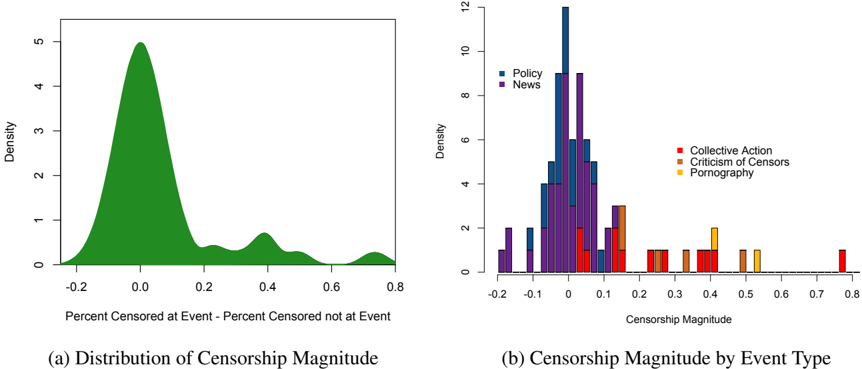
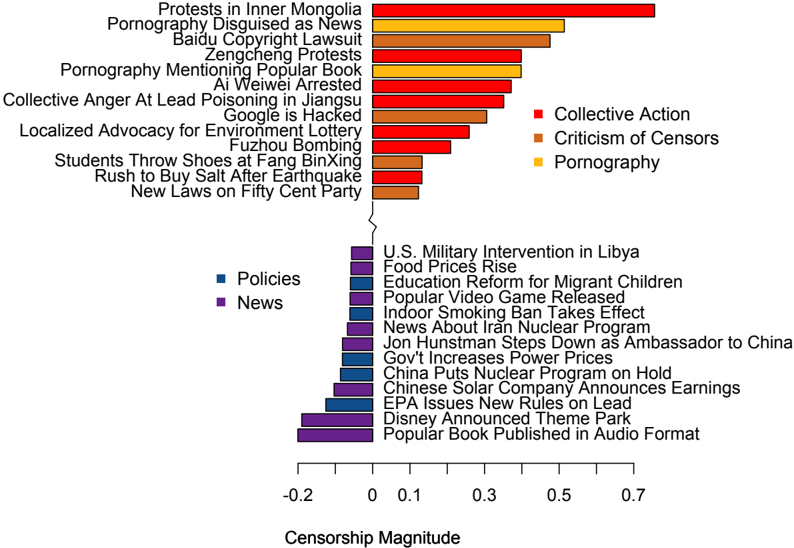
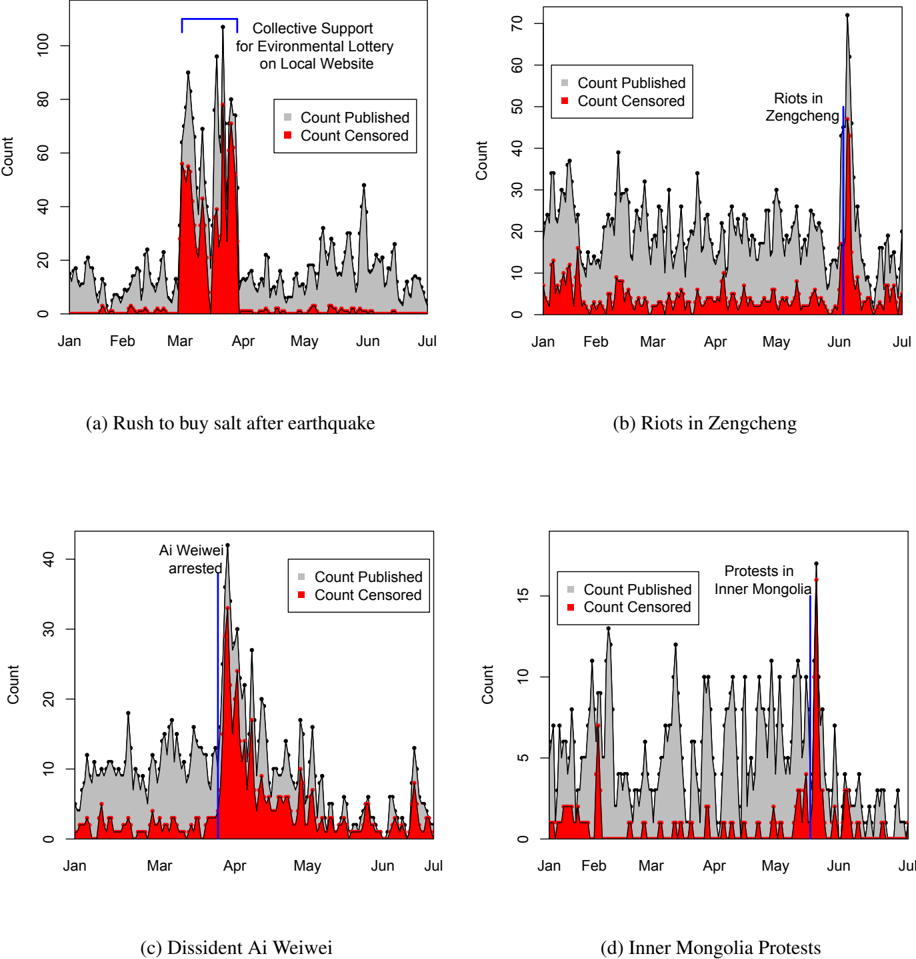
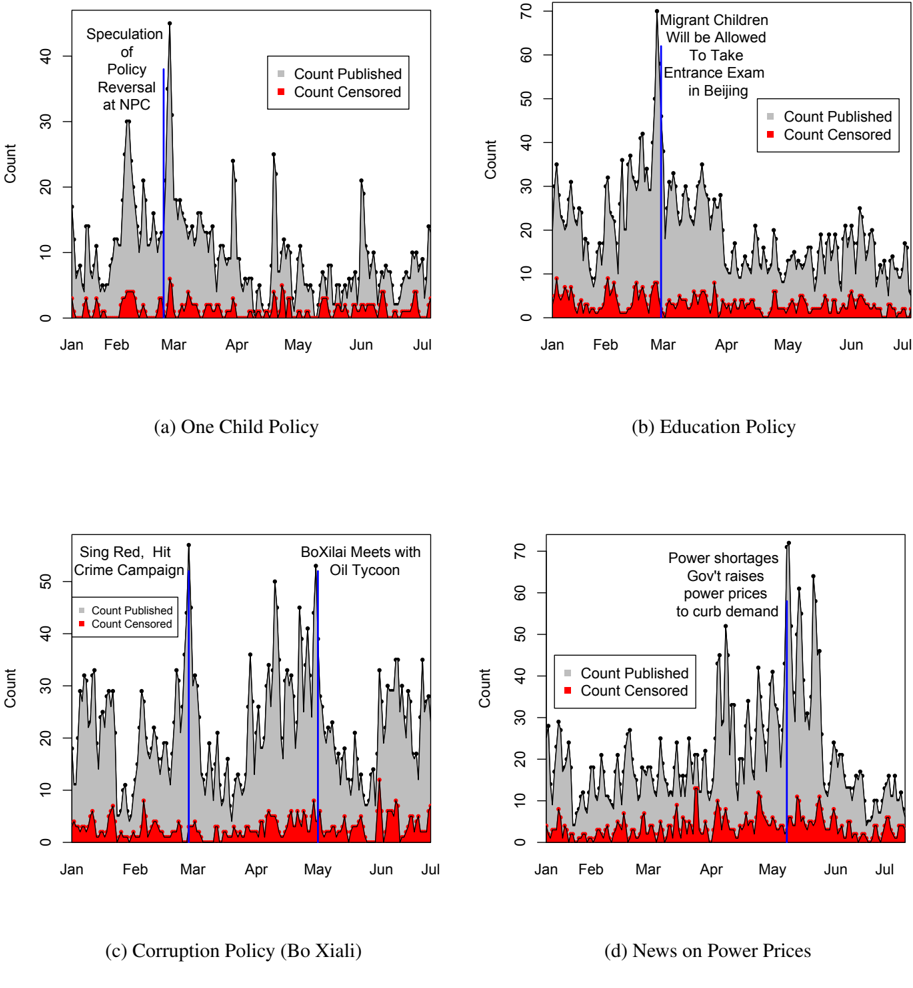
- Censorship was much higher during volume bursts tied to collective action: average censorship magnitude was 27% for collective action, compared with -1% for policy and -4% for news.
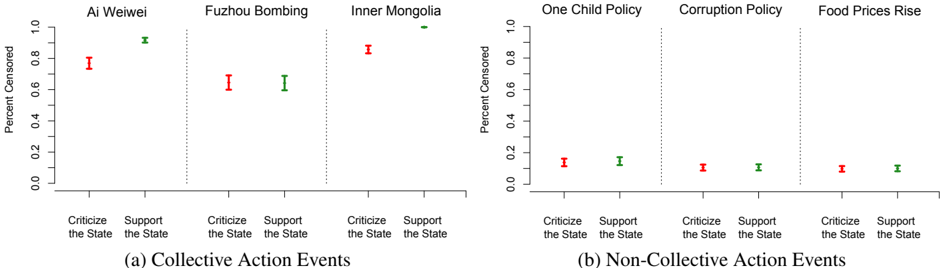
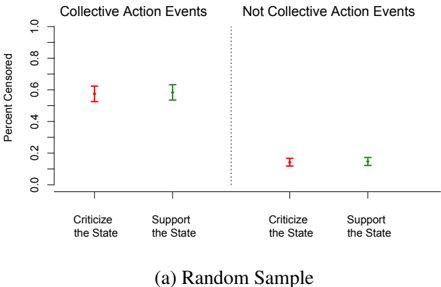
- For collective action events such as Ai Weiwei’s arrest, Inner Mongolia protests, and Fuzhou bombings, posts were censored at about 80% on average whether they criticized or supported the state. For non-collective-action events such as the one child policy, corruption policy, and food prices, censorship was about 10% on average for both critical and supportive posts.
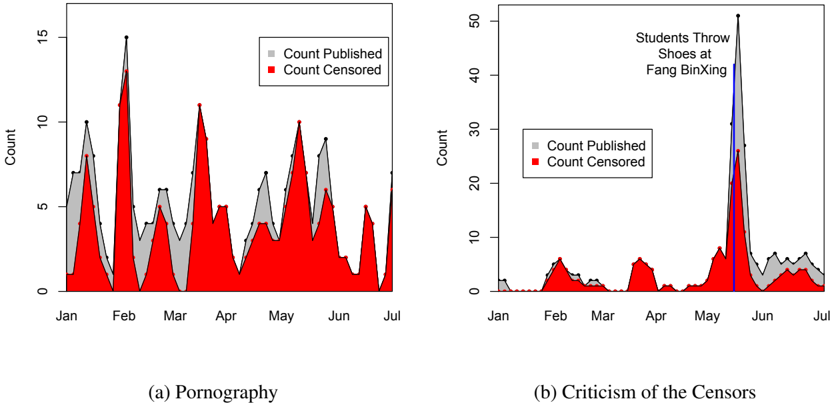
- Censorship also targeted pornography and criticism of the censors, but not government policy or other news. The authors argue censorship is aimed at curtailing collective action by silencing comments that represent, reinforce, or spur social mobilization.
Methods
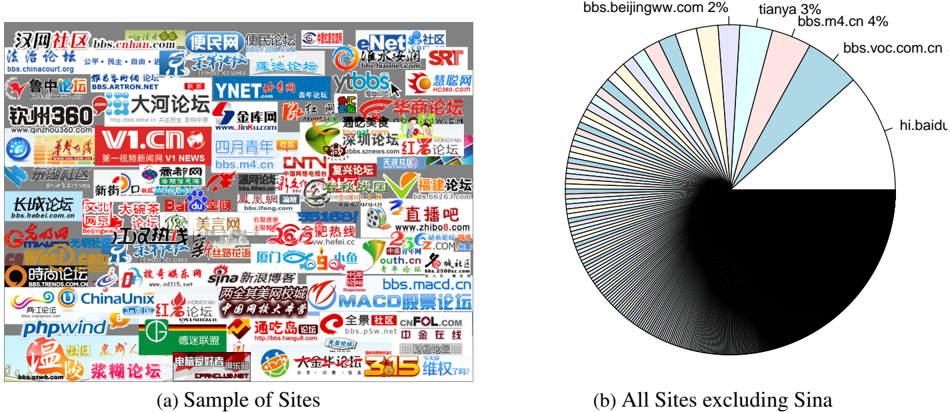
- The authors built a system to locate, download, and analyze posts from 1,382 Chinese websites during the first half of 2011, before government censors could remove them. They collected 3,674,698 posts, randomly selected 127,283 for further analysis, and overall collected and analyzed 11,382,221 posts.
- They used a stratified random sampling design covering 85 topic areas across three hypothesized political sensitivity levels, detected 87 volume bursts in 67 of the 85 topic areas using robust regression-based burst detection, and classified events into collective action potential, criticism of censors, pornography, government policies, and other news.
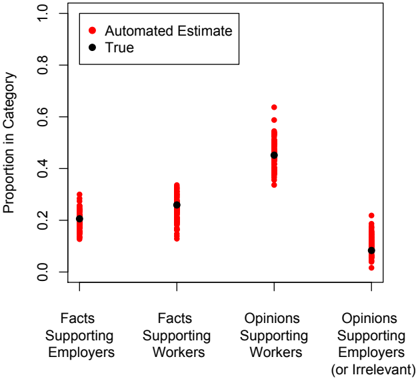
- To analyze content, they adapted the Hopkins and King “ReadMe” automated text analysis method to Chinese and extended it with a Bayesian procedure to estimate the percent censored within categories. Validation used native Chinese speakers coding 1,000 posts about 2010 labor strikes, with 100 as training and 900 as test; event coding reliability was 98.9% (86 of 87 events).
Limitations
- The paper states that its methodology misses self-censorship and censorship that may occur before the post is obtained; it also does not quantify the direct effects of the Great Firewall, keyword blocking, or search filtering.
- The authors state they have not studied physical violence, such as arrest of bloggers, or threats of the same; although many officials and levels of government influence censorship decisions, their data only sometimes distinguish among these sources, and they cannot determine the consequences of these limitations.
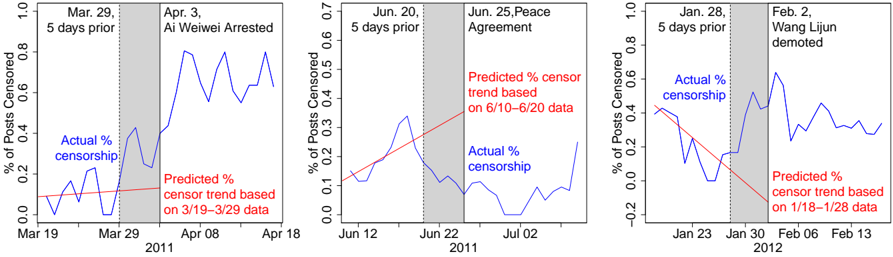
- The authors note that the presumably smaller number of discussions they cannot observe are likely to be those of most interest to the Chinese government, and they offer little evidence connecting social media findings to press freedom or other types of human expression in China. They also state that the predictive analysis was conducted retrospectively and with only three events, so further prospective validation would be valuable.
Model-written summary. Check it against the paper before relying on it.
Integrity signals
Registry
Cites
Statistics
Figures
Verification
Claims the paper makes
0 Valid · 7 Not valid · 7 Not checked · 88 Own results and interpretations
A result the paper reports from its own data — it cites no other source for it, so there is none to check. The quote shows it is in the paper.
In the paper
“Our data show that the Chinese censorship program allows for a wide variety of criticisms of the Chinese government, its officials, and its policies.”
§ How Censorship in China Allows Government Criticism but Silences Collective Expression * > Outline of Results
plain- Asserted: passes — The authors put it forward as true.
- Checkable: passes — It can be checked against evidence.
- Load-bearing: passes — The paper’s conclusions depend on it.
- Based: passes — The paper gives a reason why it holds.
A result the paper reports from its own data — it cites no other source for it, so there is none to check. The quote shows it is in the paper.
In the paper
“Contrary to previous understandings, posts with negative, even vitriolic, criticism of the state, its leaders, and its policies are not more likely to be censored.”
- Also stated in: § 1 Introduction · plain
“we find that when the Chinese people write scathing criticisms of their government and its leaders, the probability that their post will be censored does not increase.”
§ How Censorship in China Allows Government Criticism but Silences Collective Expression * > Abstract
plain- Asserted: passes — The authors put it forward as true.
- Checkable: passes — It can be checked against evidence.
- Load-bearing: passes — The paper’s conclusions depend on it.
- Based: passes — The paper gives a reason why it holds.
- Also stated in: § 1 Introduction · plain
A result the paper reports from its own data — it cites no other source for it, so there is none to check. The quote shows it is in the paper.
In the paper
“Large increases in online volume are good predictors of censorship when these increases are associated with events related to collective action, e.g., protest on the ground.”
§ How Censorship in China Allows Government Criticism but Silences Collective Expression * > Outline of Results
plainstates an association- Asserted: passes — The authors put it forward as true.
- Checkable: passes — It can be checked against evidence.
- Load-bearing: passes — The paper’s conclusions depend on it.
- Based: passes — The paper gives a reason why it holds.
A result the paper reports from its own data — it cites no other source for it, so there is none to check. The quote shows it is in the paper.
In the paper
“In addition, we measure sentiment within each of these events and show that during these events, the government censors views that are both supportive and critical of the state.”
§ How Censorship in China Allows Government Criticism but Silences Collective Expression * > Outline of Results
plainstates a cause- Asserted: passes — The authors put it forward as true.
- Checkable: passes — It can be checked against evidence.
- Load-bearing: passes — The paper’s conclusions depend on it.
- Based: passes — The paper gives a reason why it holds.
A result the paper reports from its own data — it cites no other source for it, so there is none to check. The quote shows it is in the paper.
In the paper
“We thus conduct the same analysis for the demotion of Wang Lijun in Panel (c) of Figure 11, and again see a large difference in actual and predicted percent censorship before Wang's demotion.”
§ How Censorship in China Allows Government Criticism but Silences Collective Expression * > Additional information
plainSingle case- Asserted: passes — The authors put it forward as true.
- Checkable: passes — It can be checked against evidence.
- Load-bearing: unclear — It is unclear whether the paper’s conclusions depend on it.
- Based: passes — The paper gives a reason why it holds.
46 more claims
Create a free account to see all 102 claims and every source verdict.
- Probably not a substantial claim. 26
- It may state two separate claims as one. 33
Claims other papers make about this one
Each is checked against this paper’s own text: does it say what the citing paper says it does?
The source backs part of the claim, not all of it — or backs it for a different population, condition or comparison.
In the citing paper
“Authorities are keen to review social media posts and have contentious messages removed (King etal., 2013) to ensure that potential threats remain invisible.”
From How Dictators Control the Internet: A Review Essay (2020) · cites this paper as King et al., 2013
Experimental — accuracy not yet measuredThe source backs part of the claim, not all of it — or backs it for a different population, condition or comparison.
In the citing paper
“In most autocratic regimes, governmental interference in digital infrastructure and communication is commonplace.”
From How Dictators Control the Internet: A Review Essay (2020) · cites this paper as King et al., 2013
Experimental — accuracy not yet measuredThe source backs part of the claim, not all of it — or backs it for a different population, condition or comparison.
In the citing paper
“First, the timing of censorship during a coup is consistent with many studies that have shown that Internet censorship is targeted during sensitive political time periods and periods of potential power transitions, such as elections and large-scale protests [23,25,44,47,73].”
From A multi-perspective view of Internet censorship in Myanmar (2021) · cites this paper as [44]
Experimental — accuracy not yet measuredThe cited source says what the claim attributes to it.
In the citing paper
“research has shown how mobilization organized through public coordination is repressed using that very same public information-for instance, repression is preemptively increased before focal days (Truex 2019); and autocracies censor online calls for collective action (King, Pan, and Roberts 2013), coerce online opinion leaders (Pan and Siegel 2020), and at times, turn off the internet entirely.”
From Coordinated Dis-Coordination (2024) · cites this paper as King, Pan, and Roberts 2013
The check wasn’t confident either way, so it gives no verdict — never disputed.
In the citing paper
“In China, for instance, two virtual police officers remind citizens that their browsing behavior is monitored (King etal., 2013).”
From How Dictators Control the Internet: A Review Essay (2020) · cites this paper as King et al., 2013
Experimental — accuracy not yet measured
1 more claim about this paper
Create a free account to see every claim other papers make about this one.
Citations
Cites
Robust estimation of a location parameter
Huber, P. J. (1964) · The Annals of Mathematical Statistics · doi:10.1214/aoms/1177703732 · Cited by 7,228
Robust Regression and Outlier Detection
Piepel, G. F. (1989) · Technometrics · doi:10.1080/00401706.1989.10488524 · Cited by 6,144
Robust Regression and Outlier Detection
Rousseeuw, P. J., & Leroy, A. M. (1987) · Wiley Series in Probability and Statistics · doi:10.1002/0471725382 · Cited by 5,609
Logistic Regression in Rare Events Data
King, G., & Zeng, L. (2001) · Political Analysis · doi:10.1093/oxfordjournals.pan.a004868 · Cited by 4,316 · cited 1×
“We do this via well-known and widely used case-control methodology (King and Zeng 2001).”
MethodSelf-citationDemocracy and Development: Political Institutions and Well-Being in the World, 1950–1990
Przeworski, A., Alvarez, M. E., Cheibub, J. A., & Limongi, F. (2000) · doi:10.1017/cbo9780511804946 · Cited by 2,845
Rightful Resistance in Rural China
O'Brien, K. J., & Li, L. (2006) · Cambridge University Press eBooks · doi:10.1017/cbo9780511791086 · Cited by 1,104
The Dynamics of Informational Cascades: The Monday Demonstrations in Leipzig, East Germany, 1989–91
Lohmann, S. (1994) · World Politics · doi:10.2307/2950679 · Cited by 1,035 · cited 1×
“Protests in East Germany, Eastern Europe, and most recently the Middle East have all preceded regime change (Ash 2002; Lohmann 1994; Przeworski et al. 2000).”
BackgroundRightful Resistance in Rural China
O'Brien, K., & Li, L.-J. (2006) · doi:10.1017/cbo9780511791086.003 · Cited by 987
China's Changing of the Guard: Authoritarian Resilience
Nathan, A. J. (2003) · Journal of Democracy · doi:10.1353/jod.2003.0019 · Cited by 927
Sparks and prairie fires: A theory of unanticipated political revolution
Kuran, T. (1989) · Public Choice · doi:10.1007/bf00116762 · Cited by 905 · cited 1×
“In fact, Kuran (1989) and Lohmann (2002) show that it is information about a collective action event that propels collective action and so distinguishing this from explicit calls for collective action would be difficult if not impossible.”
Background
Research works printed but not linked: 13
- 22. Freedom House. 2012. "Freedom of the Press, 2012." www.freedomhouse.org.
- 8. Chang, Parris. 1983. Elite Conflict in the Post-Mao China. New York: Occasional Papers Reprints.
- 26. Hinton, Harold. 1955. The "Unprincipled Dispute" Within Chinese Communist Top Lead- ership. Washington, DC: U.S. Information Agency.
- 44. Perry, Elizabeth. 2002. Challenging the Mandate of Heaven: Social Protest and State Power in China. Armork, NY: M. E. Sharpe.
- 52. Schurmann, Franz. 1966. Ideology and Organization in Communist China. Berkeley, CA: University of California Press.
- Tsai, 2007, Capitalism without Democracy: The Private Sector in Contemporary China
- 48. Qiang, Xiao. 2011. The Rise of Online Public Opinion and Its Political Impact. In Chang- ing Media, Changing China, ed. Susan Shirk. New York: Oxford University Press pp. 202-224.
- 9. Charles, David. 1966. The Dismissal of Marshal P'eng Teh-huai. In China Under Mao: Politics Takes Command, ed. Roderick MacFarquhar. Cambridge: MIT University Press pp. 20-33.
- 54. Shirk, Susan. 2007. China: Fragile Superpower: How China's Internal Politics Could Derail Its Peaceful Rise. New York: Oxford University Press.
- 56. Teiwes, Frederick. 1979. Politics and Purges in China: Retification and the Decline of Party Norms. Armork, NY: M. E. Sharpe. Tsai, Kellee. 2007a. Capitalism without Democracy: The Private Sector in Contemporary China. Ithaca, NY: Cornell University Press.
- 15. Duan, Qing. 2007. China's IT Leadership. Vdm Verlag.
- 38. MacFarquhar, Roderick. 1974. The Origins of the Cultural Revolution Volume 1: Contra- dictions Among the People 1956-1957. New York: Columbia University Press.
- 12. Chen, Xiaoyan and Peng Hwa Ang. 2011. Internet Police in China: Regulation, Scope and Myths. In Online Society in China: Creating, Celebrating, and Instrumentalising the Online Carnival, ed. David Herold and Peter Marolt. New York: Routledge pp. 40-52.
Cited by
Items 1,001–1,100 of 2,443
Shifting Gears Amid COVID‐19: Information Availability, Pandemic Imprints and Firms’ PPE Production
Liu, Y. V., & Marquis, C. (2024) · Journal of Management Studies · doi:10.1111/joms.13116 · Cited by 8
Handbook of Media and Communication Governance
Asmolov, G. (2024) · Edward Elgar Publishing eBooks · doi:10.4337/9781800887206 · Cited by 10
Luo, Y., & Fang, K. (2024) · The International Journal of Press/Politics · doi:10.1177/19401612241291812 · Cited by 9
“However, this independence comes with risks, including legal repercussions and censorship (King et al. 2013).”
O cão que nem sempre late: o Grupo Globo e a cobertura das eleições presidenciais de 2014 e 1998
Júnior, J. F., & Sassara, L. D. O. (2016) · Compolítica · doi:10.21878/compolitica.2016.6.1.232 · Cited by 48
Les jeunes Chinois dans différents espaces nationaux : expressions et engagements politiques
Frenkiel, É., & Wang, S. (2017) · Participations · doi:10.3917/parti.017.0007 · Cited by 10
Re-theorizing civil society in China: Agency and the discursive politics of civil society engagement
Gleiss, M. S., Sæther, E., & Fürst, K. (2018) · China Information · doi:10.1177/0920203x18790395 · Cited by 9
Knowledge Sharing Network in a Community of Illicit Practice: A Cybermarket Subreddit Case
Kwon, K. H., Yu, W.-W., Kilar, S., Shao, C., Broussard, K., & Lutes, T. (2020) · Hawaii International Conference on System Sciences (HICSS) · doi:10.24251/hicss.2020.334 · Cited by 7
“detect the anomaly period in social media activities [35].”
BackgroundPublic discourse, political legitimacy, and collective identity: Cases from Iraq, Brazil and China
Hänska, M., Bahiya, A., Amaral, F. P., & Sui, Y. (2020) · Communications · doi:10.1515/commun-2020-2081 · Cited by 8
“…discussion, even vitriolic criticism of the government, is allowed, evidence suggests that censorship is specifically targeted to forestall “collective action by silencing comments that represent, reinforce, or spur social mobilization, regardless of content” (King, Pan, and Roberts, 2013, p. 326).”
BackgroundPolitical Opportunities for Participation and China’s Leadership Transition
Fu, D., & Distelhorst, G. (2020) · Oxford University Press eBooks · doi:10.1093/oso/9780190093488.003.0003 · Cited by 9
Cordell, R., Gleditsch, K. S., Kern, F. G., & Saavedra-Lux, L. (2020) · Journal of Peace Research · doi:10.1177/0022343320959122 · Cited by 8
“Scholars have used a variety of text sources, including online blogs, social media data, speeches, and newspaper articles (Hopkins & King, 2010; Schrodt & Brackle, 2013; King, Pan & Roberts, 2013; Jamal et al., 2015).”
Zhang, K., He, B., & Wu, J. (2021) · Contemporary Politics · doi:10.1080/13569775.2021.1884376 · Cited by 7
“Indeed, research has shown that Chinese governments employ a set of sophisticated techniques to censor and manipulate public opinions online (King et al., 2013, 2017), such that conflicts that manifest online are quickly resolved before turning to collective actions offline.”
BackgroundMigrant Inflows and Online Expressions of Regional Prejudice in China
Wang, X., Zhang, Y., Wang, S., & Zhao, K. (2021) · Public Opinion Quarterly · doi:10.1093/poq/nfab004 · Cited by 9
Jia, H. (2021) · Routledge eBooks · doi:10.4324/9781003160212 · Cited by 11
Chinese Nationalism through the Prism of the Sino–Japanese Dispute over the Diaoyu/Senkaku Islands
Burcu, O. (2022) · Asian Studies Review · doi:10.1080/10357823.2022.2040429 · Cited by 11
Social media, fear, and support for state surveillance: The case of China’s social credit system
Zeng, Y., & Wong, S. H. (2022) · China Information · doi:10.1177/0920203x221088141 · Cited by 15
Zhang, M. (2022) · Urban Geography · doi:10.1080/02723638.2022.2044664 · Cited by 7
“In parallel, the state hid itself, turning to the management of public opinion (King et al., 2013).”
BackgroundPublic Attitude and Opinion Leaders: Mapping Chinese Discussion of EU's Energy Role on Social Media
Zhang, L., & Wang, P. (2022) · JCMS Journal of Common Market Studies · doi:10.1111/jcms.13350 · Cited by 8
Zhang, Y. (2022) · The China Journal · doi:10.1086/719953 · Cited by 7
Regulating Competition in the Digital Platform Economy: Russia and China Compared
Remington, T. F., Qian, J., & Avdasheva, S. B. (2022) · Problems of Post-Communism · doi:10.1080/10758216.2022.2117199 · Cited by 7
“In China, far-reaching limits on politically sensitive content on search and social media applications are not new (cf King, Pan, and Roberts 2013), but the recent demands for greater access to the data on users that the platform companies have amassed will expand the regime’s ability to monitor…”
BackgroundCheng, E. W., & Lee, F. L. F. (2023) · Social movement studies · doi:10.1080/14742837.2023.2236032 · Cited by 14
Spatiotemporal analysis of censored content on Twitter
Varol, O. (2016) · ACM Conference on Web Science (WebSci) · doi:10.1145/2908131.2908208 · Cited by 7
“If discussions turn to sensitive topics, concerned governments intervene and attempt to control information dissemination [4, 1].”
BackgroundVisualizing truth-telling in Ai Xiaoming’s documentary activism
Zeng, J. (2017) · Studies in Documentary Film · doi:10.1080/17503280.2017.1340795 · Cited by 7
Yin, L., & Flew, T. (2018) · Thesis Eleven · doi:10.1177/0725513618756098 · Cited by 7
Speaking to Theory and Speaking to the China Field
O’Brien, K. J. (2018) · Issues & Studies · doi:10.1142/s1013251118400076 · Cited by 13
Fears, hopes and the politics of time-space: The media frames of Japan in the Chinese People's Daily
Guan, T., & Liu, T. (2018) · International Communication Gazette · doi:10.1177/1748048518802248 · Cited by 7
Science communication activism: Protesting Traditional Chinese Medicine in China
Zhu, Q., & Horst, M. (2019) · Public Understanding of Science · doi:10.1177/0963662519865405 · Cited by 7
Seeking Credibility from Uncertainty: How Formal Cooptation Institution Unleashes Outspoken NGOs
Li, S., & Wang, X. (2020) · VOLUNTAS International Journal of Voluntary and Nonprofit Organizations · doi:10.1007/s11266-020-00204-x · Cited by 9
Beckley, M. (2020) · Journal of Global Security Studies · doi:10.1093/jogss/ogaa010 · Cited by 11
Weibo to the Rescue? A study of social media use in citizen–government relations in China
Homburg, V. M. F., & Moody, R. (2021) · Transforming Government People Process and Policy · doi:10.1108/tg-06-2021-0101 · Cited by 9
Stein, E. A. (2016) · Journal of Politics in Latin America · doi:10.1177/1866802x1600800204 · Cited by 10
The Political Economy of New Media: Challenges and Opportunities Across Democracies and Autocracies
Sobbrio, F. (2018) · Journal of Development Perspectives · doi:10.5325/jdevepers.2.1-2.0049 · Cited by 8
Hu, A., & Chen, Y. (2020) · Poetics · doi:10.1016/j.poetic.2020.101478 · Cited by 7
Human Rights Texts: Converting Human Rights Primary Source Documents into DataPreprint
Fariss, C. J., Jones, Z. M., Linder, F., et al. (2015) · SSRN Electronic Journal · doi:10.2139/ssrn.2502980 · Cited by 7
Political Bias of Corporate News in China: Role of Commercialization and Conglomeration ReformsPreprint
Piotroski, J. D., Wong, T. J., & Zhang, T. (2015) · SSRN Electronic Journal · doi:10.2139/ssrn.2674780 · Cited by 7
Чмель, К. Ш., Савин, Н. Ю., & Carpini, M. X. D. (2018) · SSRN Electronic Journal · doi:10.2139/ssrn.3289145 · Cited by 9
“Nevertheless, there is a consistent evidence that Chinese censorship is directed toward messages promoting collective actions and contributing to offline mobilization, rather than those containing just criticism of the government (King et al., 2013).”
BackgroundDelegated Dictatorship: Examining the State and Market Forces behind Information Control in China
Miller, B. (2018) · Deep Blue (University of Michigan) · Cited by 11
Media Disruption and Revolutionary Unrest: Evidence from Mubarak's Quasi-ExperimentPreprint
Mehrdad, N. (2016) · SSRN Electronic Journal · doi:10.2139/ssrn.2809789 · Cited by 8
The Effect of Independent Online Media in an AutocracyPreprint
Enikolopov, R., Rochlitz, M., Schoors, K., & Zakharov, N. (2022) · Social Science Research Network · doi:10.2139/ssrn.4131355 · Cited by 3
Disguised Repression: Targeting Opponents with Non-Political Crimes to Undermine DissentPreprint
Pan, J., Xu, X., & Xu, Y. (2023) · SSRN Electronic Journal · doi:10.2139/ssrn.4488481 · Cited by 7
Self-citationEmpathy as exoneration or resistance? The politics of male empathy in the Chinese #Metoo movement
Liu, J. (2021) · Feminist Media Studies · doi:10.1080/14680777.2021.1986092 · Cited by 7
Applying Insights from China: A Typology for Subnational Comparative Politics
Zhu, H., & Rothschild, V. (2024) · Chinese Political Science Review · doi:10.1007/s41111-024-00264-0 · Cited by 7
“…analysis and comparison (Snyder 1999; Giraudy et al. 2019) to argue that even in a strong, centralized, top-down state such as China, there are some policy areas where the preferences of the center are less important—in these cases, theories and findings may be applicable to other contexts.”
He, R., & Chang, J. (2025) · International Journal of Cultural Studies · doi:10.1177/13678779241308289 · Cited by 8
“Driven by its fear of collective activism and social movements that might potentially dent its authority, the CCP does everything to sti fl e even the tiniest burgeon of cultural anomaly and social unrest (King et al., 2013).”
Beidollahkhani, A. (2025) · Higher Education Policy · doi:10.1057/s41307-025-00413-3 · Cited by 11
Zhai, H. (2025) · Social Media + Society · doi:10.1177/20563051251369816 · Cited by 9
“King et al. (2013, 2017) demonstrate that Chinese censorship systematically targets online collective expressions, even neutral or positive, to prevent potential social mobilization.”
The 2021 Henan flood increased citizen demand for government-led climate change adaptation in China
Shen, S. V. (2025) · Communications Earth & Environment · doi:10.1038/s43247-025-02745-9 · Cited by 8
“Crucially, the LLMB is analytically distinct from commercial blogs or microblogs, which have received substantial scholarly attention for their relationship to government censorship 41,42 .”
Why the everyday is essential: Navigating censorship and surveillance on WeChat in China
de Kloet, J., & Poell, T. (2025) · Media Culture & Society · doi:10.1177/01634437251380415 · Cited by 14
“Particularly insightful is large-scale censorship research, which shows that a lot of contentious content can indeed freely circulate on Chinese social media, but content aimed at inciting collective action is systematically censored (King et al., 2013).”
Performative Propaganda Engagement: How Celebrity Fans Engage with State Propaganda on Weibo
Lu, Y. (2025) · Political Communication · doi:10.1080/10584609.2025.2584999 · Cited by 8
“Simultaneously, the CCP implements large-scale censorship, from account bans to selective content removal, to eliminate dissenting voices and limit the public’s access to unfavorable content (Chen & Yang, 2019; King et al., 2013; Roberts, 2018).”
Linguistic Fingerprints of Internet Censorship: The Case of Sina Weibo
Ng, K. Y., Feldman, A., & Peng, J. (2020) · Proceedings of the AAAI Conference on Artificial Intelligence · doi:10.1609/aaai.v34i01.5381 · Cited by 6
“Question 1 explores how humans perform on the task of censorship classification; question 2 explores whether a blogpost is controversial; question 3 serves as a way to explore in our data the concept of Collective Action Potential (CAP) suggested by King et al.(2013).”
BackgroundResultInfluentialAlternative to civil society governance: platform control over the third sector in China
Cui, C., & Wu, J. (2022) · Journal of Asian Public Policy · doi:10.1080/17516234.2022.2116166 · Cited by 8
“…of adaptive governance, the government has also transformed ICT into a new control mechanism to manage state–society relations through evolving censorship technologies, online propaganda, as well as strengthened regulation in cyberspace (King et al., 2013; Lagerkvist, 2008; Rød & Weidmann, 2015).”
Cyberwarfare and the Weaponization of Information in US–China 21st‐Century Geostrategic Rivalry
Tan, E., & Sayankina, S. (2023) · Pacific Focus · doi:10.1111/pafo.12233 · Cited by 9
The Double-Edged Sword of State Media Credibility: Experimental Evidence from China
Gu, Y., & Zheng, B. (2023) · Journal of Chinese Political Science · doi:10.1007/s11366-023-09877-9 · Cited by 8
“Moreover, with the proliferation of digital media, measures to control information have become increasingly refined [31].”
Untapped Potential: Designed Digital Trace Data in Online Survey Experiments
Macke, E., Daviss, C., & Williams-Baron, E. (2024) · Sociological Methods & Research · doi:10.1177/00491241241268770 · Cited by 12
“…have used search data (e.g., Ginsberg et al. 2009; Goel et al. 2010; Lazer et al. 2014), social media posts (e.g., Bail 2017; Bail et al. 2020; King, Pan, and Roberts 2013; McCormick et al. 2017; Schober et al. 2016), email data (e.g., Bhatt, Goldberg, and Srivastava 2022; Kossinets and Watts…”
Slowing Down or Adapting to Technological Progress? Robot Replacement Risks and Policy Preferences
Fan, Z., Ning, J., & He, A. J. (2024) · Regulation & Governance · doi:10.1111/rego.12642 · Cited by 12
Lan, X., Zhang, T., Cheng, Y., & Kiousis, S. K. (2024) · Asian Journal of Communication · doi:10.1080/01292986.2024.2434231 · Cited by 6
“Meanwhile, it strategically adjusts censorship practices, such as selective censorship and fluctuations in intensity (Cairns & Carlson, 2016; King et al., 2013), to better serve its interests.”
Illiberal responses to “fake news” in Southeast Asia
Cho, C. S. M. (2025) · Democratization · doi:10.1080/13510347.2024.2442395 · Cited by 14
The elasticity of the public sphere: Expansion, contraction and 'other' media
Budarick, J. (2016) · University of Adelaide Press eBooks · doi:10.20851/publics-02 · Cited by 6
Wang, Q. (2018) · Global Media and China · doi:10.1177/2059436418804274 · Cited by 6
Rathnayake, C., & Caliandro, A. (2021) · Lecture notes in computer science · doi:10.1007/978-3-030-71292-1_30 · Cited by 6
Jiang, Y., & Kuang, X. (2021) · Problems of Post-Communism · doi:10.1080/10758216.2021.1969249 · Cited by 10
“As was found in existing studies on media censorship in China (e.g. King, Pan, and Roberts 2013), the Chinese party-state is particularly intolerant of expressions that are related to or could lead to collective action, not to mention its recent intolerance toward actual collective action like the…”
BackgroundResultInfluentialTeaching Computational Social Science for All
Kim, J. Y., & Ng, Y. M. M. (2022) · PS Political Science & Politics · doi:10.1017/s1049096521001815 · Cited by 9
“…methods present many new opportunities to address key questions in political science (Brady 2019; Clark and Golder 2015; Monroe et al. 2015), from polarization and mis-information in the United States (Tucker et al. 2018) to censorship and collective action in China (King, Pan, and Roberts 2013).”
BackgroundPolitical Science and Digitalization – Global Perspectives
Kneuer, M., Milner, H. V., & Budrich, V. B. (2019) · Verlag Barbara Budrich eBooks · doi:10.3224/84742332 · Cited by 22
Bias in Text Analysis for International Relations Research
Windsor, L. (2022) · Global Studies Quarterly · doi:10.1093/isagsq/ksac021 · Cited by 15
Zhang, C., Ma, B., Gan, Y., & Xu, H. (2022) · Chinese Political Science Review · doi:10.1007/s41111-022-00222-8 · Cited by 7
“Some scholars have found that, in recent years, a large number of Chinese citizens have started to express their views on an unexpected event or on a hot topic through online platforms, and online public opinion has gradually become a new reference system for state governance (King et al. 2013).”
Explaining the diffusion of radical ideas
Hsiao, Y., & Pfaff, S. J. (2022) · Sociology Compass · doi:10.1111/soc4.13023 · Cited by 10
Hong, J. Y., & Yang, L. Y. (2022) · Political Science Research and Methods · doi:10.1017/psrm.2022.35 · Cited by 6
Dornschneider, S., & Edmonds, B. (2022) · Government and Opposition · doi:10.1017/gov.2022.37 · Cited by 9
“State interventions on social media could be expected to have a dam-pening effect, as suggested by studies on media censorship that show that the consistent removal of alternative information over time curtails collective action (Chen and Yang 2019; King et al. 2013).”
BackgroundZhang, R. (2023) · Information Communication & Society · doi:10.1080/1369118x.2023.2179373 · Cited by 9
“Pornography is one of the few topics that get a continuously high level of censorship on the Chinese internet (King et al., 2013).”
BackgroundLet's report our rivals: how Chinese fandoms game content moderation to restrain opposing voices
Zhao, A., & Chen, Z. (2023) · Journal of Quantitative Description Digital Media · doi:10.51685/jqd.2023.006 · Cited by 14
Broadcasting Out-Group Repression to the In-Group: Evidence From China
Carter, E. B., & Carter, B. L. (2023) · Journal of Conflict Resolution · doi:10.1177/00220027231185148 · Cited by 7
“This, indeed, is why the CCP employs propaganda, censorship, and repression in the run-up to sensitive an-niversaries and in their immediate aftermath (Carter and Carter 2020; King, Pan and Roberts 2013, 2017; Truex 2019).”
BackgroundInfluentialYan, X., & La, L. (2023) · Perspectives on Politics · doi:10.1017/s1537592723002815 · Cited by 10
“As the criteria of censorship often re fl ects the intent and goals of the government (King, Pan, and Roberts, 2013), our fi ndings indicate that rulers may be more threatened by the direct and open ridicule of the supreme leader as an individual, as this is a sign of public and symbolic de fi ance…”
InfluentialChinese seafarers’ use of the Internet and social media to promote labor rights
Tang, L. (2023) · Asian and Pacific migration journal · doi:10.1177/01171968231210327 · Cited by 10
“…is also worth mentioning that expressions of solidarity on WeChat are subject to constraints, as the internet and social media are tightly controlled in China, and Chinese authorities are wary of collective action, especially since Xi Jinping came to power (King et al., 2013; Yang and Tang, 2018).”
BackgroundArayankalam, J., Soral, P., Khan, A., Krishnan, S., & Bose, I. (2024) · Information & Management · doi:10.1016/j.im.2024.103919 · Cited by 13
Autocratic Institutions and Foreign Policy
Jost, T. (2024) · Oxford University Press eBooks · doi:10.1093/oxfordhb/9780198843061.013.16 · Cited by 9
Chen, X., Zheng, P., & Mou, J. (2024) · Policy & Internet · doi:10.1002/poi3.419 · Cited by 8
“The Chinese government employs a comprehensive Internet real ‐ name registration (RNR) policy (Chen et al., 2016), Internet censorship, and information control to achieve its governance objectives (King et al., 2013), such as preventing collective activities (King et al., 2013).”
CHANG, S., & Hess, S. (2018) · Modern Asian Studies · doi:10.1017/s0026749x16000615 · Cited by 8
Chen, L. (2017) · Chinese Journal of Communication · doi:10.1080/17544750.2017.1357643 · Cited by 7
A user-driven free speech application for anonymous and verified online, public group discourse
Nekrasov, M., Iland, D., Metzger, M. J., Parks, L., & Belding, E. (2018) · Journal of Internet Services and Applications · doi:10.1186/s13174-018-0093-4 · Cited by 6
“By using characters associated with China or Korea, even if the characters did not correspond to actual or Korean text, users exposed themselves to perceptions of siding with these countries.”
BackgroundInfluentialZhang, J., & Zhong, Z. (2018) · Political Psychology · doi:10.1111/pops.12498 · Cited by 7
Municipal Government Use of Social Media: An Analysis of Three Chinese Cities
Gu, T., Harrison, T. M., & Zhu, Y. (2020) · Hawaii International Conference on System Sciences (HICSS) · doi:10.24251/hicss.2020.223 · Cited by 9
In-group trust and self-rated health in East Asia using quadri-national survey data
Sung, P., & Son, J. (2020) · International Journal of Comparative Sociology · doi:10.1177/0020715220937752 · Cited by 7
“This negative association may reflect the nonvoluntary nature of organizational membership in China—organizations must be officially registered, and the state assigns people to certain organizations (King et al., 2013).”
BackgroundWhy the Rule of Law? Experimental Evidence from China
Wilking, J. R., & Love, G. J. (2020) · Justice System Journal · doi:10.1080/0098261x.2020.1803776 · Cited by 8
“Of course, while social media in China is also subject to censorship (e.g. Fu, Chan and Chau 2013; King, Pan, and Roberts 2013) and propaganda, the central government is incentivized to allow stories regarding corruption, as this is a means to monitor lower level officials (e.g. Lorentzen 2014;…”
BackgroundThe semiotic guerrilla: Internet subcultures as political resistance in China
Jiang, C., Renyi, H., & Ren, H. (2021) · Journal of Media and Communication Studies · doi:10.5897/jmcs2021.0750 · Cited by 8
“This confirms what King et al. (2013) describe as the indiscriminate, thus least costly, approach the Chinese censors take in suppressing speech, deleting anything that could lead to activism offline regardless of its content.”
BackgroundMuise, D., Lu, Y., Pan, J., & Reeves, B. B. (2022) · Mobile Media & Communication · doi:10.1177/20501579221080333 · Cited by 8
“In 2017, China had a 48% smartphone penetration rate (Statista, 2019a), a fl ourishing domestic app eco-system, an extensive online censorship regime (King et al., 2013, 2014; Wu & Taneja, 2016), and a broad array of uses for the smartphone (Taneja & Wu, 2014).”
BackgroundSelf-citation“Yes-Man” Firms: Government Campaign and Policy Positioning of Businesses in China
Naoi, M., Shi, W.-Y., & Zhu, B.-L. (2022) · International Studies Quarterly · doi:10.1093/isq/sqac075 · Cited by 6
Masterson, J. R. (2014) · Advances in electronic government, digital divide, and regional development book series · doi:10.4018/978-1-4666-6292-6.ch013 · Cited by 6
Huang, P., Lee, F. L. F., & Lin, G. (2016) · Communication and the Public · doi:10.1177/2057047316668660 · Cited by 6
Let’s Get Emotional: the Strategic Use of Emotions in China’s Foreign Policy
Primiano, C. B. (2018) · East Asia · doi:10.1007/s12140-018-9296-3 · Cited by 6
Ng, J., & Landry, P. F. (2013) · SSRN Electronic Journal · Cited by 6
Measuring Internet Activity: A (Selective) Review of Methods and MetricsPreprint
Faris, R., & Jones, R. H. (2013) · SSRN Electronic Journal · doi:10.2139/ssrn.2353457 · Cited by 6
Cantoni, D., Yang, D., Yuchtman, N., & Zhang, Y. J. (2017) · National Bureau of Economic Research · doi:10.3386/w23110 · Cited by 11
“…economy of contemporary Greater China: for example, Lorentzen (2013) highlights the central government’s tolerance of certain types of protests; King et al. (2013) study information control policies that aim at suppressing collective actions; Martinez-Bravo et al. (2014) study the…”
How COVID-19 has Impacted American Attitudes Toward China: A Study on TwitterPreprint
Cook, G. G., Huang, J., & Xie, Y. F. (2021) · doi:10.31235/osf.io/h3r5u · Cited by 6
Does Legality Produce Political Legitimacy? An Experimental ApproachPreprint
Fu, Y., Xu, Y., & Zhang, T. (2021) · SSRN Electronic Journal · doi:10.2139/ssrn.3966711 · Cited by 6
Alvarez, R. M., & Kim, S. S. (2019) · Oxford University Press eBooks · doi:10.1093/obo/9780199756223-0285 · Cited by 6
User Anonymity and Information Quality of Social Media: Evidence from a Natural ExperimentPreprint
Huang, K., Wang, Y., Wong, T. J., & Zhang, T. (2024) · SSRN Electronic Journal · doi:10.2139/ssrn.4885972 · Cited by 6
Prosocial MediaPreprint
Weyl, E. G., Thorburn, L., de Keulenaar, E. V., Mchangama, J., Siddarth, D., & Tang, A. (2025) · SSRN Electronic Journal · doi:10.2139/ssrn.5141171 · Cited by 10
Garbe, L., Maerz, S. F., & Freyburg, T. (2026) · Democratization · doi:10.1080/13510347.2024.2442377 · Cited by 8
Chen, K., Lu, Y., & Wang, Y. (2023) · Chinese Journal of Communication · doi:10.1080/17544750.2023.2264406 · Cited by 6
“State influence refers to how various levels of state actors use information control strategies to shape the content and interactions on digital platforms, including but not limited to censorship (King et al., 2013), clickbait (Lu & Pan, 2021), and ideotain-ment (Zou, 2023).”
BackgroundInfluentialChang, Y. (2025) · Alternatives Global Local Political · doi:10.1177/03043754251321237 · Cited by 10
“…permits only selective criticism of the government while curtailing attempts to utilize the Internet as a platform for advocating social protest (King et al., 2013), and also dissemination of information that favors its own stance (Zeng, 2015), may result in a homogenized, subservient…”
Yang, J., Jiang, H., Dai, M., & Guo, W. (2025) · Frontiers in Psychology · doi:10.3389/fpsyg.2025.1634604 · Cited by 12
“…mechanisms are generally understood to serve core State objectives—such as agenda setting and shaping public perceptions (Brady, 2009; Chen and Yang, 2019), influencing attitudes and opinions (Pan et al., 2022), and raising the costs of citizen protest and collective action (King et al., 2013).”
Does social media undermine trust? Institutional trust in civil society and governance institutions
Parr, C. S. (2025) · Journal of Public Policy · doi:10.1017/s0143814x25100834 · Cited by 9
“Many governments have responded by attempting to curtail civil society and regulate online spaces (King et al., 2013; Dupuy et al., 2014; Ong, 2021; Chaudhry, 2022).”
Metadata
- Authors
- KING, G., PAN, J., & ROBERTS, M. E.
- Affiliations
- Harvard University (US)
- Corresponding author
- KING, GARY
- PAN, JENNIFER
- Venue
- American Political Science Review
- Publisher
- Cambridge University Press (CUP)
- Published
- 2013-05
- Volume
- 107
- Issue
- 2
- Pages
- 326-343
- ISSN
- 0003-0554 (ISSN-L)
- 1537-5943
- OpenAlex
- W2144188763
- Cited by
- 2,415
- References
- 48
- Citations by year
- 2026: 161 · 2025: 206 · 2024: 249 · 2023: 272 · 2022: 230 · 2021: 193 · 2020: 206 · 2019: 157 · 2018: 178 · 2017: 153 · 2016: 137 · 2015: 120 · 2014: 91 · 2013: 54
- FWCI
- 395.09
- Type
- journal article
- Language
- en
- Open access
- green
- nrs.harvard.edu
- Licence
- Locations
- American Political Science Review (publishedVersion)
- Digital Access to Scholarship at Harvard (DASH) (Harvard University) (submittedVersion, cc-by)
- RePEc: Research Papers in Economics (submittedVersion)
- Topics
- Social Sciences › Communication › Social Media and Politics
- Social Sciences › Law › Freedom of Expression and Defamation
- Social Sciences › Sociology and Political Science › Media Influence and Politics
- Keywords
- internet censorship, Chinese government, social media, collective action, social mobilization, political criticism, online speech
About these checks
Registry, retraction, Cites and statistics results are computed, not judged, with one exception: a printed reference that no index lists is read once by a model before it counts as a citation error. Claims are extracted by a model and kept only when their quote appears verbatim in the text; each cited source is then checked, with a model’s help, for whether it says what the claim relies on. Those verdicts can be wrong — read the claim’s quote and the cited source before relying on one.
A language model drew the claims from the paper on 2026-10-11, under version 3 of the claim definition (model deepseek-v4.1-flash, prompt extract-v3).
A second model labelled each claim on 2026-10-11 (model jev-1.13-20260917, definition revision gold-guideline-v0.2).
Statistics and arithmetic are recomputed, not judged.
Confidence bands are shown only for fields calibrated on our annotated test set. None is calibrated yet, so no band is shown.
What counts as a claim ›How we measure confidence ›How we check this ›
Are you an author, or do you see a problem with this page? Request a review
Data sources
Bibliographic data: Semantic Scholar, OpenAlex, Crossref.
Contains information from the Semantic Scholar Academic Graph Datasets, made available under the ODC Attribution License (ODC-BY 1.0).
Semantic Scholar’s data is described in: Kinney, R., et al. (2023). The Semantic Scholar Open Data Platform. arXiv:2301.10140.
