

Associations of cannabis and cigarette use with psychotic experiences at age 18: findings from the Avon Longitudinal Study of Parents and Children
Open accessThe DOI matches its Crossref record; 40 of the 40 references it cites were found in a registry or an index.
Abstract
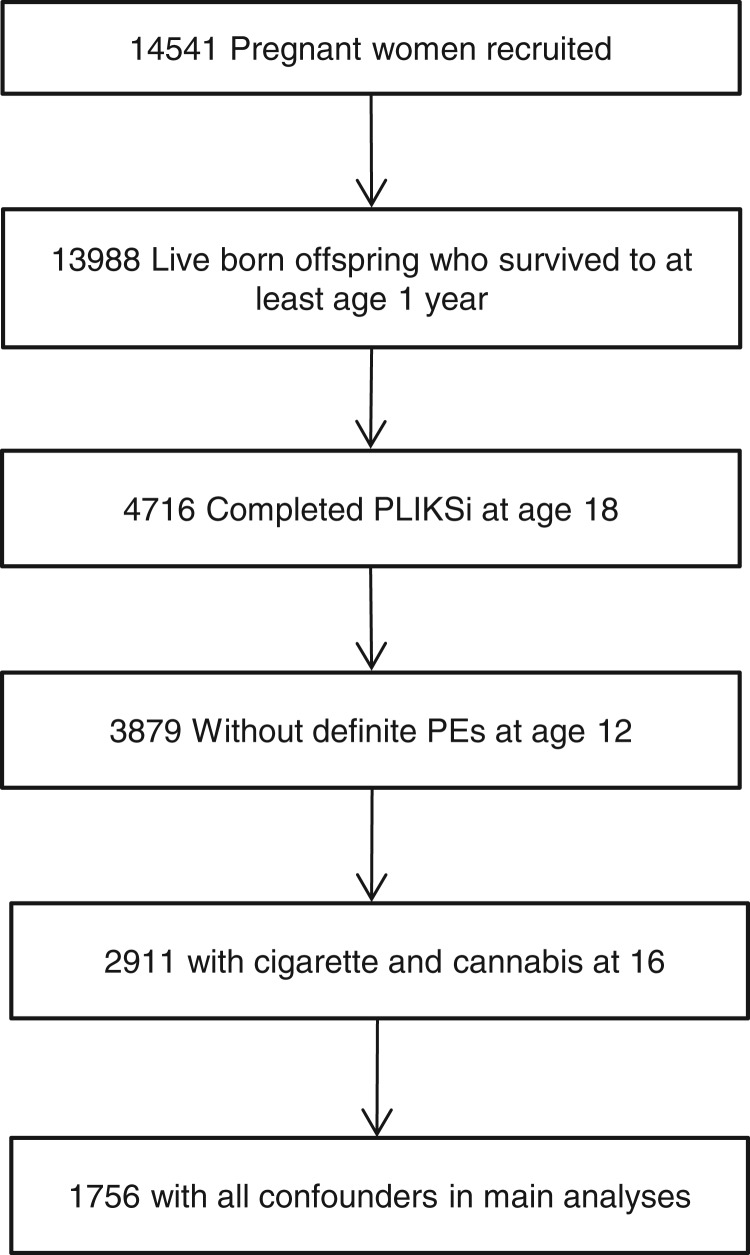
Background.: A clearer understanding of the basis for the association between cannabis use and psychotic experiences (PEs) is required. Our aim was to examine the extent to which associations between cannabis and cigarette use and PEs are due to confounding. Method.: A cohort study of 1756 adolescents with data on cannabis use, cigarette use and PEs. Results.: Cannabis use and cigarette use at age 16 were both associated, to a similar degree, with PEs at age 18 [odds ratio (OR) 1.48, 95% confidence interval (CI) 1.18–1.86 for cannabis and OR 1.61, 95% CI 1.31–1.98 for cigarettes]. Adjustment for cigarette smoking frequency (OR 1.27, 95% CI 0.91–1.76) or other illicit drug use (OR 1.25, 95% CI 0.91–1.73) substantially attenuated the relationship between cannabis and PEs. The attenuation was to a lesser degree when cannabis use was adjusted for in the cigarette PE association (OR 1.42, 95% CI 1.05–1.92). However, almost all of the participants used cannabis with tobacco, including those who classed themselves as non-cigarette smokers. Conclusions.: Teasing out the effects of cannabis from tobacco is highly complex and may not have been dealt with adequately in studies to date, including this one. Complementary methods are required to robustly examine the independent effects of cannabis, tobacco and other illicit drugs on PEs.
Overview
The claims and statistics of this paper haven’t been checked yet.
Free: it reads the open-access text and checks the first 5 claims that cite a source we can check. Create a free account to check every claim.
Integrity signals
Registry
Cites
Statistics
Figures
Verification
Claims the paper makes
The claims and statistics of this paper haven’t been checked yet.
Free: it reads the open-access text and checks the first 5 claims that cite a source we can check. Create a free account to check every claim.
Claims other papers make about this one
Each is checked against this paper’s own text: does it say what the citing paper says it does?
The source backs part of the claim, not all of it — or backs it for a different population, condition or comparison.
In the citing paper
“After further adjustment for cigarette use and other illicit drug use this association attenuated to the null, though the authors discuss the difficulty of teasing out confounding versus mediating effects, as well as the potential problem of overadjustment with such highly correlated measures.”
From Association Between Cannabis and Psychosis: Epidemiologic Evidence (2016) · cites this paper as [23]
Experimental — accuracy not yet measuredThe source backs part of the claim, not all of it — or backs it for a different population, condition or comparison.
In the citing paper
“Whilst the CHDS, NEMESIS and ALSPAC studies all attempted to model for attrition, and found no evidence that this impacted on the findings (14,17,23), these methods rely on a number of assumptions, and bias cannot be entirely excluded.”
From Association Between Cannabis and Psychosis: Epidemiologic Evidence (2016) · cites this paper as [23]
Experimental — accuracy not yet measuredThe cited source says what the claim attributes to it.
In the citing paper
“In the ALSPAC birth cohort, cumulative cannabis use at age 16 was associated with psychotic experiences at age 18 after adjustment for pre-birth and childhood confounders (23).”
From Association Between Cannabis and Psychosis: Epidemiologic Evidence (2016) · cites this paper as [23]
Self-check
Percentages, sums and reported differences re-computed from the paper’s own numbers.
The self-check needs the paper’s full text.
Citations
Cites
The Strengths and Difficulties Questionnaire: A research note
Goodman, R. (1997) · Journal of Child Psychology and Psychiatry · doi:10.1111/j.1469-7610.1997.tb01545.x · Cited by 14,908 · cited 1×
“1992) Borderline personality: an eight-level measure assessed by interview at age 11 Bullying: a two-level measure assessed by interview at age 8 Peer problems: a 10-point scale assessed by the Strengths and Difficulties Questionnaire (SDQ; Goodman, 1997) at age 8 Depression at age 12: a 26-point scale assessed by the…”
MethodSAUNDERS, J. B., AASLAND, O. G., BABOR, T. F., DE LA FUENTE, J. R., & GRANT, M. (1993) · Addiction · doi:10.1111/j.1360-0443.1993.tb02093.x · Cited by 13,597
Wechsler Intelligence Scale for Children
(2018) · The SAGE Encyclopedia of Intellectual and Developmental Disorders · doi:10.4135/9781483392271.n537 · Cited by 4,109
Boyd, A., Golding, J., Macleod, J., Lawlor, D. A., Fraser, A., Henderson, J., Molloy, L., Ness, A., Ring, S., & Davey Smith, G. (2013) · International Journal of Epidemiology · doi:10.1093/ije/dys064 · Cited by 2,996 · cited 1×
“The cohort has been described in detail previously (Boyd et al. 2013).”
MethodSelf-citationCannabis use and risk of psychotic or affective mental health outcomes: a systematic review.
Moore, T. H., Zammit, S., Lingford-Hughes, A., Barnes, T. R., Jones, P. B., Burke, M., & Lewis, G. (2007) · The Lancet · doi:10.1016/s0140-6736(07)61162-3 · Cited by 2,224 · cited 1×
“Longitudinal studies have attempted to assess this and a systematic review (Moore et al. 2007) reported consistent evidence of an association between cannabis and psychosis, but of modest size in epidemiological terms.”
BackgroundSelf-citation(1995) · International Journal of Methods in Psychiatric Research · Cited by 1,847
Socioeconomic status and smoking: a review
Hiscock, R., Bauld, L., Amos, A., Fidler, J. A., & Munafò, M. (2012) · Annals of the New York Academy of Sciences · doi:10.1111/j.1749-6632.2011.06202.x · Cited by 1,572 · cited 1×
“Tobacco use may be a marker for factors such as socio-economic status or family adversity that increase risk of psychosis (Hiscock et al. 2012), and that might confound the association between cannabis and psychotic * Address for correspondence: Ms.”
BackgroundCannabis use in adolescence and risk for adult psychosis: longitudinal prospective study.
Arseneault, L., Cannon, M., Poulton, R., Murray, R., Caspi, A., & Moffitt, T. E. (2002) · BMJ · doi:10.1136/bmj.325.7374.1212 · Cited by 1,399 · cited 1×
“2006) have reported point estimates that attenuate more than studies controlling for fewer confounders (Arseneault et al. 2002; Henquet et al. 2005).”
BackgroundD'Souza, D. C., Perry, E., MacDougall, L., Ammerman, Y., Cooper, T., Wu, Y.-T., Braley, G., Gueorguieva, R., & Krystal, J. H. (2004) · Neuropsychopharmacology · doi:10.1038/sj.npp.1300496 · Cited by 1,024 · cited 1×
“Associations of cannabis and cigarette use with psychotic experiences at age 18: findings from the”
BackgroundZammit, S., Allebeck, P., Andreasson, S., Lundberg, I., & Lewis, G. (2002) · BMJ · doi:10.1136/bmj.325.7374.1199 · Cited by 871 · cited 1×
“In general, longitudinal studies controlling for more confounders (Zammit et al. 2002; Fergusson et al. 2005; Wiles et al. 2006) have reported point estimates that attenuate more than studies controlling for fewer confounders (Arseneault et al.”
BackgroundSelf-citationHenquet, C., Krabbendam, L., Spauwen, J., Kaplan, C., Lieb, R., Wittchen, H.-U., & van Os, J. (2005) · BMJ · doi:10.1136/bmj.38267.664086.63 · Cited by 765 · cited 3×
“2006) have reported point estimates that attenuate more than studies controlling for fewer confounders (Arseneault et al. 2002; Henquet et al. 2005).”
BackgroundMethodMacleod, J., Oakes, R., Copello, A., Crome, I., Egger, M., Hickman, M., Oppenkowski, T., Stokes-Lampard, H., & Smith, G. D. (2004) · The Lancet · doi:10.1016/s0140-6736(04)16200-4 · Cited by 639 · cited 2×
“…are broadly consistent, although an earlier review reported inconsistent associations between cannabis use and psychological problems more broadly, and highlighted the need for stronger causal evidence, given the likelihood of residual confounding in most studies to date (Macleod et al. 2004).”
BackgroundResultSelf-citationThe co‐occurring use and misuse of cannabis and tobacco: a review
Agrawal, A., Budney, A. J., & Lynskey, M. T. (2012) · Addiction · doi:10.1111/j.1360-0443.2012.03837.x · Cited by 525
Nicotine use in schizophrenia: The self medication hypotheses
Kumari, V., & Postma, P. (2005) · Neuroscience & Biobehavioral Reviews · doi:10.1016/j.neubiorev.2005.02.006 · Cited by 468
Cannabis dependence and psychotic symptoms in young people
FERGUSSON, D. M., HORWOOD, L. J., & SWAIN-CAMPBELL, N. R. (2003) · Psychological Medicine · doi:10.1017/s0033291702006402 · Cited by 415 · cited 1×
“Adjusting for binary measures of (i) dependence or (ii) ever versus never smoked (as used in many studies, for example: Fergusson et al. 2003; Henquet et al. 2005; Wiles et al. 2006; Rossler et al. 2012) resulted in adjusted ORs of 1.36 (95% CI 1.02–1.82) and 1.49 (95% CI 1.11–1.98) respectively.”
MethodInfluentialBrion, M.-J. A., Lawlor, D. A., Matijasevich, A., Horta, B., Anselmi, L., Araújo, C. L., Menezes, A. M. B., Victora, C. G., & Smith, G. D. (2011) · International Journal of Epidemiology · doi:10.1093/ije/dyr020 · Cited by 350
Zammit, S., Kounali, D., Cannon, M., David, A. S., Gunnell, D., Heron, J., Jones, P. B., Lewis, S., Sullivan, S., Wolke, D., et al. (2013) · American Journal of Psychiatry · doi:10.1176/appi.ajp.2013.12060768 · Cited by 319 · cited 2×
“Participants were defined as having a psychotic disorder (Zammit et al. 2013) if they reported definite PEs, not attributed to sleep or fever, and occurring at least once a month for the previous 6 months.”
Self-citationKuepper, R., van Os, J., Lieb, R., Wittchen, H.-U., Hofler, M., & Henquet, C. (2011) · BMJ · doi:10.1136/bmj.d738 · Cited by 304 · cited 1×
“Although there is evidence that the relationship between cannabis and psychotic outcomes may not be solely due to intoxication effects (Kuepper et al. 2011), our findings highlight problems of disentangling confounding effects of other substances.”
BackgroundTests of causal linkages between cannabis use and psychotic symptoms
Fergusson, D. M., Horwood, L. J., & Ridder, E. M. (2005) · Addiction · doi:10.1111/j.1360-0443.2005.01001.x · Cited by 268 · cited 2×
“In general, longitudinal studies controlling for more confounders (Zammit et al. 2002; Fergusson et al. 2005; Wiles et al. 2006) have reported point estimates that attenuate more than studies controlling for fewer confounders (Arseneault et al. 2002; Henquet et al. 2005).”
BackgroundWiles, N. J., Zammit, S., Bebbington, P., Singleton, N., Meltzer, H., & Lewis, G. (2006) · British Journal of Psychiatry · doi:10.1192/bjp.bp.105.012179 · Cited by 245 · cited 5×
“In general, longitudinal studies controlling for more confounders (Zammit et al. 2002; Fergusson et al. 2005; Wiles et al. 2006) have reported point estimates that attenuate more than studies controlling for fewer confounders (Arseneault et al. 2002; Henquet et al. 2005).”
BackgroundMethodInfluentialSelf-citationAdolescent cannabis use and psychosis: epidemiology and neurodevelopmental models
Malone, D. T., Hill, M. N., & Rubino, T. (2010) · British Journal of Pharmacology · doi:10.1111/j.1476-5381.2010.00721.x · Cited by 237
Differentiating Early-Onset Persistent Versus Childhood-Limited Conduct Problem Youth
Barker, E. D., & Maughan, B. (2009) · American Journal of Psychiatry · doi:10.1176/appi.ajp.2009.08121770 · Cited by 199 · cited 1×
“…20.8 (128) 45.5 (35) 65.9 (60) <0.001 Hazardous alcohol use age 16 15.1 (147) 51.2 (315) 70.1 (54) 72.5 (66) <0.001 a Those with a score of 4 or over. b Those with a score of 17 or over. c As reported in Barker & Maughan (2009). models, and evidence of an association was weaker than in the CCA.”
BackgroundInfluentialConfounding in epidemiological studies: why "independent" effects may not be all they seem.
Smith, G. D., & Phillips, A. N. (1992) · BMJ · doi:10.1136/bmj.305.6856.757 · Cited by 186
Weiser, M., Reichenberg, A., Grotto, I., Yasvitzky, R., Rabinowitz, J., Lubin, G., Nahon, D., Knobler, H. Y., & Davidson, M. (2004) · American Journal of Psychiatry · doi:10.1176/appi.ajp.161.7.1219 · Cited by 171
Tobacco Use Before, At, and After First-Episode Psychosis: A Systematic Meta-Analysis
Myles, N., Newall, H. D., Curtis, J., Nielssen, O., Shiers, D., & Large, M. (2012) · The Journal of Clinical Psychiatry · doi:10.4088/jcp.11r07222 · Cited by 158 · cited 1×
“…models suggests possible mechanisms for smoking as a self-medication (Spielewoy & Markou, 2004; Weiss et al. 2007a,b) or for alleviating side-effects of antipsychotic medication, there is some evidence that people who smoke have an increased risk of developing later psychosis (Myles et al. 2012b).”
BackgroundMethamphetamine use and schizophrenia: A population-based cohort study in California
Callaghan, R. C., Cunningham, J. K., Allebeck, P., Arenovich, T., Sajeev, G., Remington, G., Boileau, I., & Kish, S. J. (2012) · American Journal of Psychiatry · doi:10.1176/appi.ajp.2011.10070937 · Cited by 150 · cited 2×
“Conclusions from other systematic reviews (Minozzi et al. 2010) and longitudinal studies (Callaghan et al. 2012; Rossler et al. 2012) are broadly consistent, although an earlier review reported inconsistent associations between cannabis use and psychological problems more broadly, and highlighted…”
ResultInvestigating the Association Between Cigarette Smoking and Schizophrenia in a Cohort Study
Zammit, S., Allebeck, P., Dalman, C., Lundberg, I., Hemmingsson, T., & Lewis, G. (2003) · American Journal of Psychiatry · doi:10.1176/appi.ajp.160.12.2216 · Cited by 121 · cited 1×
“2011), although in one study this was reversed after adjustment (Zammit et al. 2003).”
Self-citationMechanisms Underlying the Comorbidity of Tobacco Use in Mental Health and Addictive Disorders
Morisano, D., Bacher, I., Audrain-McGovern, J., & George, T. P. (2009) · The Canadian Journal of Psychiatry · doi:10.1177/070674370905400603 · Cited by 89 · cited 2×
“Tobacco use is strongly associated with psychosis (Morisano et al. 2009), and although evidence from animal models suggests possible mechanisms for smoking as a self-medication (Spielewoy & Markou, 2004; Weiss et al.”
BackgroundSimultaneous cannabis and tobacco use and cannabis-related outcomes in young women
Agrawal, A., Lynskey, M. T., Madden, P. A. F., Pergadia, M. L., Bucholz, K. K., & Heath, A. C. (2008) · Drug and Alcohol Dependence · doi:10.1016/j.drugalcdep.2008.10.019 · Cited by 81
MINOZZI, S., DAVOLI, M., BARGAGLI, A. M., AMATO, L., VECCHI, S., & PERUCCI, C. A. (2010) · Drug and Alcohol Review · doi:10.1111/j.1465-3362.2009.00132.x · Cited by 78 · cited 1×
“Conclusions from other systematic reviews (Minozzi et al. 2010) and longitudinal studies (Callaghan et al.”
BackgroundGage, S. H., Zammit, S., & Hickman, M. (2013) · F1000 Medicine Reports · doi:10.3410/m5-2 · Cited by 78 · cited 2×
“2004) but it is less clear to what extent cannabis use leads to PEs not due to intoxication effects (Gage et al. 2013b).”
BackgroundSelf-citationMyles, N., Newall, H., Nielssen, O., & Large, M. (2012) · Current Pharmaceutical Design · doi:10.2174/138161212802884816 · Cited by 70 · cited 1×
“…models suggests possible mechanisms for smoking as a self-medication (Spielewoy & Markou, 2004; Weiss et al. 2007a,b) or for alleviating side-effects of antipsychotic medication, there is some evidence that people who smoke have an increased risk of developing later psychosis (Myles et al. 2012b).”
BackgroundLinking substance use with symptoms of subclinical psychosis in a community cohort over 30 years
Rössler, W., Hengartner, M. P., Angst, J., & Ajdacic‐Gross, V. (2012) · Addiction · doi:10.1111/j.1360-0443.2011.03760.x · Cited by 67 · cited 5×
“Conclusions from other systematic reviews (Minozzi et al. 2010) and longitudinal studies (Callaghan et al. 2012; Rossler et al. 2012) are broadly consistent, although an earlier review reported inconsistent associations between cannabis use and psychological problems more broadly, and highlighted…”
BackgroundMethodResultInfluentialWeiss, S., Nosten‐Bertrand, M., McIntosh, J. M., Giros, B., & Martres, M. (2007) · Neuropsychopharmacology · doi:10.1038/sj.npp.1301385 · Cited by 61 · cited 2×
“…et al. 2009), and although evidence from animal models suggests possible mechanisms for smoking as a self-medication (Spielewoy & Markou, 2004; Weiss et al. 2007a,b) or for alleviating side-effects of antipsychotic medication, there is some evidence that people who smoke have an increased…”
BackgroundHickman, M., Vickerman, P., Macleod, J., Lewis, G., Zammit, S., Kirkbride, J., & Jones, P. (2009) · Addiction · doi:10.1111/j.1360-0443.2009.02736.x · Cited by 58 · cited 1×
“To improve our understanding of how cannabis and tobacco use impact on later PEs, a focus on areas of study where it is possible to examine longterm independent effects is needed (Hickman et al. 2009).”
BackgroundSelf-citationvan Gastel, W. A., MacCabe, J. H., Schubart, C. D., Vreeker, A., Tempelaar, W., Kahn, R. S., & Boks, M. P. M. (2013) · Psychological Medicine · doi:10.1017/s0033291713000202 · Cited by 53 · cited 1×
“The relationship between cannabis, tobacco use and psychosis is complex and inadequately addressed to date (see, for example, van Gastel et al. 2013).”
BackgroundFunctional alterations of nicotinic neurotransmission in dopamine transporter knock-out mice
Weiss, S., Tzavara, E. T., Davis, R. J., Nomikos, G. G., McIntosh, J. M., Giros, B., & Martres, M. (2007) · Neuropharmacology · doi:10.1016/j.neuropharm.2007.02.002 · Cited by 46 · cited 1×
“…et al. 2009), and although evidence from animal models suggests possible mechanisms for smoking as a self-medication (Spielewoy & Markou, 2004; Weiss et al. 2007a,b) or for alleviating side-effects of antipsychotic medication, there is some evidence that people who smoke have an increased…”
BackgroundSpielewoy, C., & Markou, A. (2004) · Behavior Genetics · doi:10.1023/b:bege.0000017878.75206.fd · Cited by 39 · cited 2×
“…with psychosis (Morisano et al. 2009), and although evidence from animal models suggests possible mechanisms for smoking as a self-medication (Spielewoy & Markou, 2004; Weiss et al. 2007a,b) or for alleviating side-effects of antipsychotic medication, there is some evidence that people who…”
BackgroundUsing Mendelian randomisation to infer causality in depression and anxiety research
Gage, S. H., Smith, G. D., Zammit, S., Hickman, M., & Munafò, M. R. (2013) · Depression and Anxiety · doi:10.1002/da.22150 · Cited by 32 · cited 1×
“Acute cannabis intoxication can cause transient psychotic experiences (PEs) (D’Souza et al. 2004) but it is less clear to what extent cannabis use leads to PEs not due to intoxication effects (Gage et al. 2013b).”
BackgroundSelf-citationA prospective study of smoking in young women and risk of later psychiatric hospitalization
Sørensen, H. J., Mortensen, E. L., Reinisch, J. M., & Mednick, S. A. (2010) · Nordic Journal of Psychiatry · doi:10.3109/08039481003786386 · Cited by 28 · cited 1×
“There have been fewer longitudinal studies focusing on the relationship between tobacco use and psychosis compared to cannabis use, and these report an increased risk of psychosis in smokers (Weiser et al. 2004; Sorensen et al. 2011), although in one study this was reversed after adjustment (Zammit et al.”
Cited by
Association Between Cannabis and Psychosis: Epidemiologic Evidence
Gage, S. H., Hickman, M., & Zammit, S. (2016) · Biological Psychiatry · doi:10.1016/j.biopsych.2015.08.001 · Cited by 379
Self-citationWhy young people's substance use matters for global health
Hall, W. D., Patton, G., Stockings, E., Weier, M., Lynskey, M., Morley, K. I., & Degenhardt, L. (2016) · The Lancet Psychiatry · doi:10.1016/s2215-0366(16)00013-4 · Cited by 334
Murray, R. M., Quigley, H., Quattrone, D., Englund, A., & Di Forti, M. (2016) · World Psychiatry · doi:10.1002/wps.20341 · Cited by 315
Cannabis use and risk of schizophrenia: a Mendelian randomization study
Vaucher, J., Keating, B. J., Lasserre, A. M., Gan, W., Lyall, D. M., Ward, J., Smith, D. J., Pell, J. P., Sattar, N., Paré, G., et al. (2018) · Molecular Psychiatry · doi:10.1038/mp.2016.252 · Cited by 260
“accounting for tobacco use reduces the cannabisschizophrenia relationship.(30) Hence, the lack of confounding by tobacco consumption, as”
Gage, S. H., Jones, H. J., Burgess, S., Bowden, J., Davey Smith, G., Zammit, S., & Munafò, M. R. (2017) · Psychological Medicine · doi:10.1017/s0033291716003172 · Cited by 211
“Some studies (Callaghan et al. 2012; Rossler et al. 2012), although not all (Gage et al. 2014), conducted since this meta-analysis have also found evidence of an association between cannabis use and later psychotic experiences or schizophrenia.”
ResultSelf-citation
Metadata
- Authors
- Gage, S. H., Hickman, M., Heron, J., Munafò, M. R., Lewis, G., Macleod, J., & Zammit, S.
- Affiliations
- University of Bristol (GB)
- Cardiff University (GB)
- Corresponding author
- Gage, S. H.
- Venue
- Psychological Medicine
- Publisher
- Cambridge University Press (CUP)
- Published
- 2014-04-10
- Volume
- 44
- Issue
- 16
- Pages
- 3435-3444
- ISSN
- 0033-2917 (ISSN-L)
- 1469-8978
- PMC
- PMC4255321
- OpenAlex
- W2158274508
- Cited by
- 91
- References
- 40
- Citations by year
- 2026: 1 · 2024: 4 · 2023: 6 · 2022: 4 · 2021: 8 · 2020: 10 · 2019: 13 · 2018: 9 · 2017: 14 · 2016: 12 · 2015: 10
- FWCI
- 8.75
- Type
- journal article
- Language
- en
- Open access
- hybrid
- doi.org
- Locations
- Psychological Medicine (publishedVersion, cc-by)
- PubMed Central (publishedVersion, cc-by)
- PubMed (publishedVersion)
- Bristol Research (University of Bristol) (publishedVersion)
- UCL Discovery (University College London) (submittedVersion)
- ORCA Online Research @Cardiff (Cardiff University) (submittedVersion)
- Funders
- Wellcome Trust (076467, 102215, 74882)
- United Kingdom Clinical Research Collaboration
- University of Bristol (74882, 076467)
- Medical Research Council (74882, G0701503, G0802736, G0800612, MR/K023195/1, 076467, G0800612 and G0802736, MR/L010305/1, MC_PC_15018, MR/K023233/1)
- Economic and Social Research Council (ES/G007489/1)
- Topics
- Health Sciences › Medicine › Pharmacology (medical) › Cannabis and Cannabinoid Research
- Health Sciences › Medicine › Psychiatry and Mental health › Schizophrenia research and treatment
- Health Sciences › Medicine › Public Health, Environmental and Occupational Health › Smoking Behavior and Cessation
- Keywords
- cannabis use, cigarette smoking, psychotic experiences, adolescent substance use, confounding, illicit drug use, Avon Longitudinal Study of Parents and Children
- MeSH terms
- Adolescent, Female, United Kingdom, Humans, Longitudinal Studies, Male, Marijuana Smoking, Parents, Psychotic Disorders, Surveys and Questionnaires, Smoking, Cohort Studies, Comorbidity, Odds Ratio
About these checks
Registry, retraction, Cites and statistics results are computed, not judged, with one exception: a printed reference that no index lists is read once by a model before it counts as a citation error. Claims are extracted by a model and kept only when their quote appears verbatim in the text; each cited source is then checked, with a model’s help, for whether it says what the claim relies on. Those verdicts can be wrong — read the claim’s quote and the cited source before relying on one.
Statistics and arithmetic are recomputed, not judged.
Confidence bands are shown only for fields calibrated on our annotated test set. None is calibrated yet, so no band is shown.
What counts as a claim ›How we measure confidence ›How we check this ›
Are you an author, or do you see a problem with this page? Request a review
Data sources
Bibliographic data: Semantic Scholar, OpenAlex, Crossref.
Contains information from the Semantic Scholar Academic Graph Datasets, made available under the ODC Attribution License (ODC-BY 1.0).
Semantic Scholar’s data is described in: Kinney, R., et al. (2023). The Semantic Scholar Open Data Platform. arXiv:2301.10140.
