

Rapid antidepressant effects of the psychedelic ayahuasca in treatment-resistant depression: a randomized placebo-controlled trial
Open accessPublished version of a preprint
The DOI matches its Crossref record; 55 of the 55 references it cites were found in a registry or an index.
Abstract
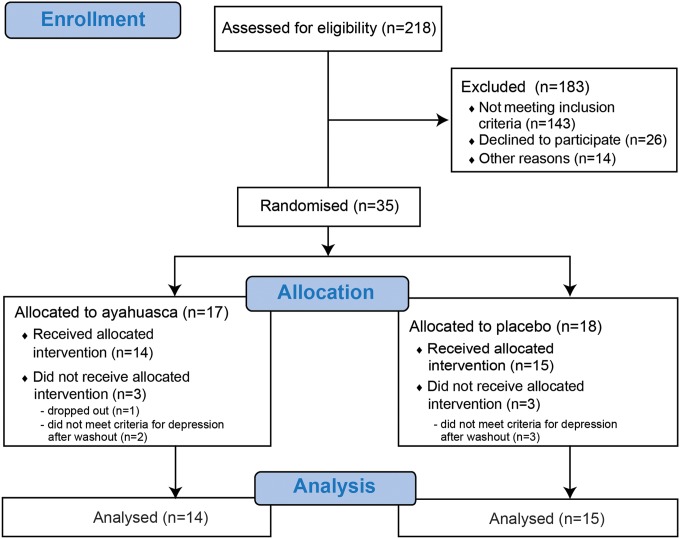
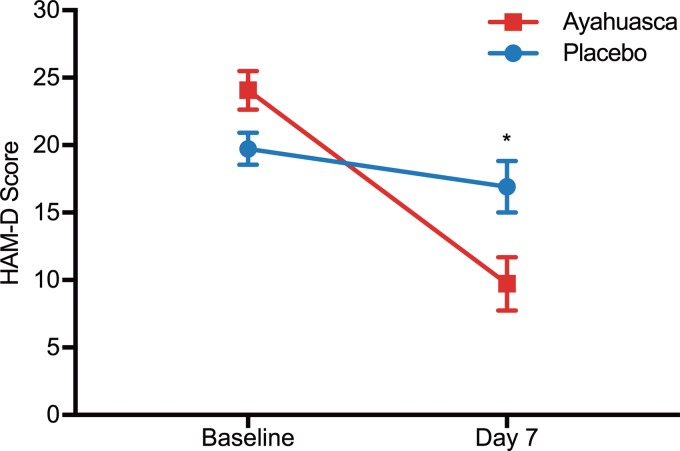
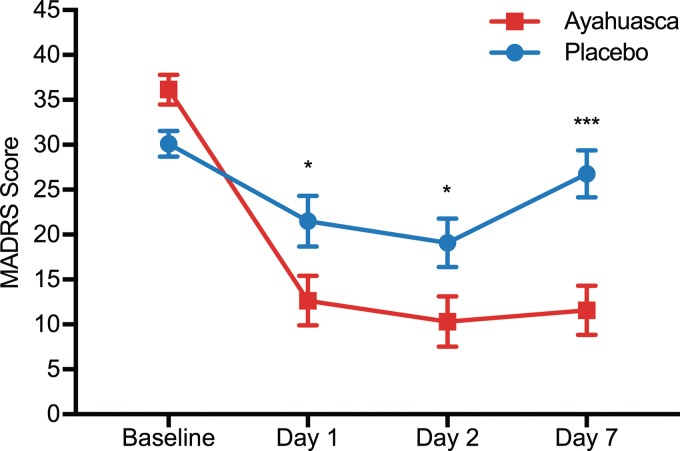
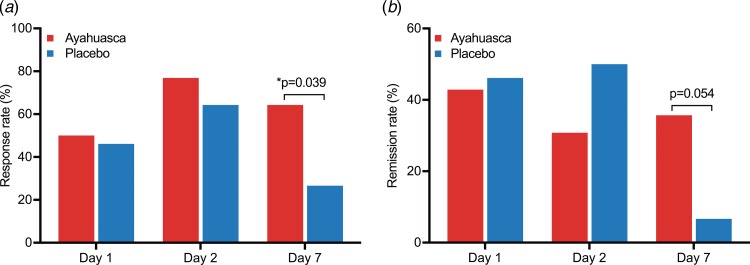
Background: Recent open-label trials show that psychedelics, such as ayahuasca, hold promise as fast-onset antidepressants in treatment-resistant depression. Methods: To test the antidepressant effects of ayahuasca, we conducted a parallel-arm, double-blind randomized placebo-controlled trial in 29 patients with treatment-resistant depression. Patients received a single dose of either ayahuasca or placebo. We assessed changes in depression severity with the Montgomery-Åsberg Depression Rating Scale (MADRS) and the Hamilton Depression Rating scale at baseline, and at 1 (D1), 2 (D2), and 7 (D7) days after dosing. Results: We observed significant antidepressant effects of ayahuasca when compared with placebo at all-time points. MADRS scores were significantly lower in the ayahuasca group compared with placebo at D1 and D2 ( p = 0.04), and at D7 ( p < 0.0001). Between-group effect sizes increased from D1 to D7 (D1: Cohen's d = 0.84; D2: Cohen's d = 0.84; D7: Cohen's d = 1.49). Response rates were high for both groups at D1 and D2, and significantly higher in the ayahuasca group at D7 (64% v. 27%; p = 0.04). Remission rate showed a trend toward significance at D7 (36% v. 7%, p = 0.054). Conclusions: To our knowledge, this is the first controlled trial to test a psychedelic substance in treatment-resistant depression. Overall, this study brings new evidence supporting the safety and therapeutic value of ayahuasca, dosed within an appropriate setting, to help treat depression. This study is registered at http://clinicaltrials.gov (NCT02914769).
Overview
The claims and statistics of this paper haven’t been checked yet.
Free: it reads the open-access text and checks the first 5 claims that cite a source we can check. Create a free account to check every claim.
Integrity signals
Registry
Cites
Statistics
Figures
Verification
Claims the paper makes
The claims and statistics of this paper haven’t been checked yet.
Free: it reads the open-access text and checks the first 5 claims that cite a source we can check. Create a free account to check every claim.
Claims other papers make about this one
Each is checked against this paper’s own text: does it say what the citing paper says it does?
The cited source doesn’t support the claim as written.
In the citing paper
“overall psychiatric scales in the ayahuasca group were significatively higher than those in the placebo group in all time points after dosing.”
From Virtual reality and psychedelics for the treatment of psychiatric disease: A systematic literature review (2020) · doi:10.36131/cnfioritieditore20200606 · cites this paper as Palhano-Fontes et al. (2019)
Checked by a reasoning model — may be wrong.
Experimental — accuracy not yet measuredThe source backs part of the claim, not all of it — or backs it for a different population, condition or comparison.
In the citing paper
“Ayahuasca stimulates emotional dream-like experiences involving potent cognitive-affective changes and spiritual insights (Dobkin de Rios, 1971) that have been associated with substantial and enduring antidepressant effects (Palhano-Fontes et al., 2019; Weiss et al., 2021).”
From Prospective examination of the therapeutic role of psychological flexibility and cognitive reappraisal in the ceremonial use of ayahuasca (2022) · cites this paper as Palhano-Fontes et al., 2019
Experimental — accuracy not yet measuredThe source backs part of the claim, not all of it — or backs it for a different population, condition or comparison.
In the citing paper
“Ayahuasca, or its chemical equivalent known as pharmahuasca, has emerged as a tool for psychotherapy in the contexts of affective and substance use disorders [130,131], thus calling for a better understanding of its possible mechanisms of action.”
From Molecular and Functional Imaging Studies of Psychedelic Drug Action in Animals and Humans. (2021) · cites this paper as [130]
Experimental — accuracy not yet measuredThe source backs part of the claim, not all of it — or backs it for a different population, condition or comparison.
In the citing paper
“Moreover, comorbid conditions such as suicidality and substance use disorders further complicate research efforts (13, 18, 20, 21).”
From Psychoanalytically informed MDMA-assisted therapy for pathological narcissism: a novel theoretical approach (2025) · cites this paper as [20]
Experimental — accuracy not yet measuredThe source backs part of the claim, not all of it — or backs it for a different population, condition or comparison.
In the citing paper
“Ayahuasca has been demonstrated to be safe in naturalistic (35, 108) and clinical settings, across varying dosages and multiple administrations (26, 109–112).”
From Ayahuasca-assisted meaning reconstruction therapy for grief: a non-randomized clinical trial protocol (2025) · cites this paper as [26]
Experimental — accuracy not yet measured
16 more claims about this paper
Create a free account to see every claim other papers make about this one.
Self-check
Percentages, sums and reported differences re-computed from the paper’s own numbers.
The self-check needs the paper’s full text.
Citations
Cites
Hamilton, M. (1960) · Journal of Neurology, Neurosurgery & Psychiatry · doi:10.1136/jnnp.23.1.56 · Cited by 32,817 · cited 1×
“HAM-D was applied only at baseline and D7, as it was designed to access depression symptoms present in the last week (Hamilton, 1960).”
MethodAntidepressant effects of ketamine in depressed patients
Berman, R. M., Cappiello, A., Anand, A., Oren, D. A., Heninger, G. R., Charney, D. S., & Krystal, J. H. (2000) · Biological Psychiatry · doi:10.1016/s0006-3223(99)00230-9 · Cited by 3,856 · cited 7×
“While we find a response rate to placebo of 46% at D1, and 26% at D7, ketamine trials have found a placebo effect of the order of 0 – 6% at D1, and 0 – 11% at D7 (Berman et al. , 2000; Zarate et al. , 2006; Murrough et al. , 2013; Lapidus et al. , 2014).”
BackgroundInfluentialA randomized trial of an N-methyl-D-aspartate antagonist in treatment-resistant major depression.
Zarate, C. A., Singh, J. B., Carlson, P. J., Brutsche, N. E., Ameli, R., Luckenbaugh, D. A., Charney, D. S., & Manji, H. K. (2006) · Archives of General Psychiatry · doi:10.1001/archpsyc.63.8.856 · Cited by 3,766 · cited 4×
“At D7, the ketamine response rate ranges between 7 and 35% (Berman et al., 2000; Zarate et al., 2006; Murrough et al., 2013; Lapidus et al., 2014), while in our study 64% responded to ayahuasca.”
BackgroundInfluentialOtte, C., Gold, S. M., Penninx, B. W., Pariante, C. M., Etkin, A., Fava, M., Mohr, D. C., & Schatzberg, A. F. (2016) · Nature Reviews Disease Primers · doi:10.1038/nrdp.2016.65 · Cited by 2,269 · cited 2×
“We recently found that a single ayahuasca session in patients with depression increases blood flow in brain regions consistently implicated in the regulation of mood and emotions, such as the left nucleus accumbens, right insula and left subgenual area (Otte et al. , 2016; Sanches et al. , 2016).”
BackgroundGriffiths, R. R., Johnson, M. W., Carducci, M. A., Umbricht, A., Richards, W. A., Richards, B. D., Cosimano, M. P., & Klinedinst, M. A. (2016) · Journal of Psychopharmacology · doi:10.1177/0269881116675513 · Cited by 2,201
Nichols, D. E. (2016) · Pharmacological Reviews · doi:10.1124/pr.115.011478 · Cited by 1,762
Ross, S., Bossis, A., Guss, J., Agin-Liebes, G., Malone, T., Cohen, B., Mennenga, S. E., Belser, A., Kalliontzi, K., Babb, J., et al. (2016) · Journal of Psychopharmacology · doi:10.1177/0269881116675512 · Cited by 1,698 · cited 4×
“Prior studies suggest that elements of the psychedelic experience, such as experiences of mystical-type, account for the therapeutic benefit (Bogenschutz et al., 2015; Garcia-Romeu et al., 2015; Majić et al., 2015; Griffiths et al., 2016; Ross et al., 2016).”
BackgroundInfluentialCarhart-Harris, R. L., Bolstridge, M., Rucker, J., Day, C. M. J., Erritzoe, D., Kaelen, M., Bloomfield, M., Rickard, J. A., Forbes, B., Feilding, A., et al. (2016) · The Lancet Psychiatry · doi:10.1016/s2215-0366(16)30065-7 · Cited by 1,540 · cited 4×
“substances affect the brain, and also probing their potential in treating different psychiatric conditions, including mood disorders (Grob et al., 2011; Osório et al., 2015; Carhart-Harris et al., 2016; Griffiths et al., 2016; Ross et al., 2016; Sanches et al., 2016).”
BackgroundResultInfluentialThe default mode network and self-referential processes in depression
Sheline, Y. I., Barch, D. M., Price, J. L., Rundle, M. M., Vaishnavi, S. N., Snyder, A. Z., Mintun, M. A., Wang, S., Coalson, R. S., & Raichle, M. E. (2009) · Proceedings of the National Academy of Sciences · doi:10.1073/pnas.0812686106 · Cited by 1,480 · cited 2×
“Moreover, we have shown that ayahuasca reduces the activity of the Default Mode Network (Palhano-Fontes et al. , 2015), a brain network found to be hyperactive in depression (Sheline et al. , 2009).”
BackgroundPilot Study of Psilocybin Treatment for Anxiety in Patients With Advanced-Stage Cancer
Grob, C. S., Danforth, A. L., Chopra, G. S., Hagerty, M., McKay, C. R., Halberstadt, A. L., & Greer, G. R. (2011) · Archives of General Psychiatry · doi:10.1001/archgenpsychiatry.2010.116 · Cited by 1,206 · cited 2×
“…exploring how these substances affect the brain, and also probing their potential in treating different psychiatric conditions, including mood disorders (Grob et al. , 2011; Osório et al. , 2015; Carhart-Harris et al. , 2016; Griffiths et al. , 2016; Ross et al. , 2016; Sanches et al. , 2016).”
BackgroundMurrough, J. W., Iosifescu, D. V., Chang, L. C., Al Jurdi, R. K., Green, C. E., Perez, A. M., Iqbal, S., Pillemer, S., Foulkes, A., Shah, A., et al. (2013) · American Journal of Psychiatry · doi:10.1176/appi.ajp.2013.13030392 · Cited by 1,205 · cited 7×
“While we find a response rate to placebo of 46% at D1, and 26% at D7, ketamine trials have found a placebo effect of the order of 0 – 6% at D1, and 0 – 11% at D7 (Berman et al. , 2000; Zarate et al. , 2006; Murrough et al. , 2013; Lapidus et al. , 2014).”
BackgroundInfluentialPsilocybin-assisted treatment for alcohol dependence: A proof-of-concept study
Bogenschutz, M. P., Forcehimes, A. A., Pommy, J. A., Wilcox, C. E., Barbosa, P., & Strassman, R. J. (2015) · Journal of Psychopharmacology · doi:10.1177/0269881114565144 · Cited by 1,151 · cited 2×
“Prior studies suggest that elements of the psychedelic experience, such as experiences of mystical-type, account for the therapeutic benefit (Bogenschutz et al., 2015; Garcia-Romeu et al., 2015; Majić et al., 2015; Griffiths et al., 2016; Ross et al., 2016).”
BackgroundBremner, J. D., Krystal, J. H., Putnam, F. W., Southwick, S. M., Marmar, C., Charney, D. S., & Mazure, C. M. (1998) · Journal of Traumatic Stress · doi:10.1023/a:1024465317902 · Cited by 817 · cited 9×
“Acute effects were assessed with the Clinician-Administered Dissociative States Scale (CADSS) (Bremner et al. , 1998), the Brief Psychiatric Rating Scale (BPRS) (Crippa et al. , 2001), and the Young Mania Rating Scale (YMRS) (Vilela et al. , 2005), applied at − 10 min, +1:40 h, +2:40 h, and +4:00 h after intake.”
MethodInfluentialThe neurobiology of psychedelic drugs: implications for the treatment of mood disorders
Vollenweider, F. X., & Kometer, M. (2010) · Nature Reviews Neuroscience · doi:10.1038/nrn2884 · Cited by 723 · cited 4×
“Additionally, research with serotonergic psychedelics has gained momentum (Vollenweider and Kometer, 2010).”
BackgroundInfluentialOsório, F. D. L., Sanches, R. F., Macedo, L. R., dos Santos, R. G., Maia-de-Oliveira, J. P., Wichert-Ana, L., de Araujo, D. B., Riba, J., Crippa, J. A., & Hallak, J. E. (2015) · Revista Brasileira de Psiquiatria · doi:10.1590/1516-4446-2014-1496 · Cited by 488
Self-citationA Randomized Controlled Trial of Intranasal Ketamine in Major Depressive Disorder
Lapidus, K. A. B., Levitch, C. F., Perez, A. M., Brallier, J. W., Parides, M. K., Soleimani, L., Feder, A., Iosifescu, D. V., Charney, D. S., & Murrough, J. W. (2014) · Biological Psychiatry · doi:10.1016/j.biopsych.2014.03.026 · Cited by 480 · cited 7×
“While we find a response rate to placebo of 46% at D1, and 26% at D7, ketamine trials have found a placebo effect of the order of 0 – 6% at D1, and 0 – 11% at D7 (Berman et al. , 2000; Zarate et al. , 2006; Murrough et al. , 2013; Lapidus et al. , 2014).”
BackgroundInfluentialPsilocybin-Occasioned mystical experiences in the treatment of tobacco addiction.
Garcia-Romeu, A., Griffiths, R., & Johnson, M. (2015) · Current Drug Abuse Reviews · doi:10.2174/1874473708666150107121331 · Cited by 476 · cited 2×
“Prior studies suggest that elements of the psychedelic experience, such as experiences of mystical-type, account for the therapeutic benefit (Bogenschutz et al., 2015; Garcia-Romeu et al., 2015; Majić et al., 2015; Griffiths et al., 2016; Ross et al., 2016).”
BackgroundSanches, R. F., de Lima Osório, F., dos Santos, R. G., Macedo, L. R. H., Maia-de-Oliveira, J. P., Wichert-Ana, L., de Araujo, D. B., Riba, J., Crippa, J. A. S., & Hallak, J. E. C. (2016) · Journal of Clinical Psychopharmacology · doi:10.1097/jcp.0000000000000436 · Cited by 466
Self-citationPalhano-Fontes, F., Andrade, K. C., Tofoli, L. F., Santos, A. C., Crippa, J. A. S., Hallak, J. E. C., Ribeiro, S., & de Araujo, D. B. (2015) · PLOS ONE · doi:10.1371/journal.pone.0118143 · Cited by 454 · cited 2×
“Moreover, we have shown that ayahuasca reduces the activity of the Default Mode Network (Palhano-Fontes et al. , 2015), a brain network found to be hyperactive in depression (Sheline et al. , 2009).”
BackgroundSelf-citationStrassman, R. J. (1994) · Archives of General Psychiatry · doi:10.1001/archpsyc.1994.03950020022002 · Cited by 453 · cited 2×
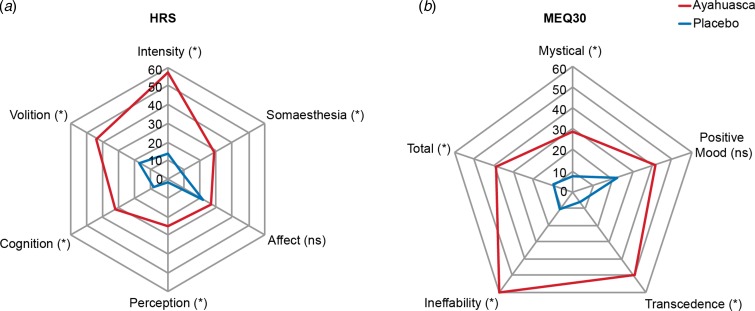
“When the acute psychedelic effects ceased, patients had a last psychiatric evaluation, debriefed their experience, and responded to the Hallucinogenic Rating Scale (HRS) (Strassman et al., 1994) and Mystical Experience Questionnaire (MEQ30) (MacLean et al.”
BackgroundMethodSegal, Z. V., Bieling, P., Young, T., MacQueen, G., Cooke, R., Martin, L., Bloch, R., & Levitan, R. D. (2010) · Archives of General Psychiatry · doi:10.1001/archgenpsychiatry.2010.168 · Cited by 429 · cited 2×
“, 2016), and meditation practices have been associated with antidepressant effects (Segal et al., 2010).”
BackgroundMacLean, K. A., Leoutsakos, J. S., Johnson, M. W., & Griffiths, R. R. (2012) · Journal for the Scientific Study of Religion · doi:10.1111/j.1468-5906.2012.01685.x · Cited by 405 · cited 2×
“, 1994) and Mystical Experience Questionnaire (MEQ30) (MacLean et al., 2012).”
BackgroundRiba, J., Valle, M., Urbano, G., Yritia, M., Morte, A., & Barbanoj, M. J. (2003) · The Journal of Pharmacology and Experimental Therapeutics · doi:10.1124/jpet.103.049882 · Cited by 390 · cited 4×
“…viridis that contains the psychedelic N, N-dimethyltryptamine (N,N-DMT), a serotonin and sigma-1 receptors agonist (Carbonaro and Gatch, 2016), and Banisteriopsis caapi , rich in reversible monoamine oxidase inhibitors (MAOi) such as harmine, harmaline, and tetrahydroharmine (Riba et al. , 2003).”
BackgroundInfluentialHuman psychopharmacology of hoasca, a plant hallucinogen used in ritual context in Brazil.
GROB, C. S., McKENNA, D. J., CALLAWAY, J. C., BRITO, G. S., NEVES, E. S., OBERLAENDER, G., SAIDE, O. L., LABIGALINI, E., TACLA, C., MIRANDA, C. T., et al. (1996) · The Journal of Nervous and Mental Disease · doi:10.1097/00005053-199602000-00004 · Cited by 338 · cited 4×
“Over the last two decades, mental health evaluations of regular ayahuasca consumers have shown preserved cognitive function, increased well-being, reduction of anxiety, and depressive symptoms when compared to non-ayahuasca consumers (Grob et al., 1996; Bouso et al., 2012; Barbosa et al., 2016).”
BackgroundInfluentialPharmacokinetics of Hoasca alkaloids in healthy humans
Callaway, J. C., McKenna, D. J., Grob, C. S., Brito, G. S., Raymon, L. P., Poland, R. E., Andrade, E. N., Andrade, E. O., & Mash, D. C. (1999) · Journal of Ethnopharmacology · doi:10.1016/s0378-8741(98)00168-8 · Cited by 315
Bouso, J. C., González, D., Fondevila, S., Cutchet, M., Fernández, X., Ribeiro Barbosa, P. C., Alcázar-Córcoles, M. Á., Araújo, W. S., Barbanoj, M. J., Fábregas, J. M., et al. (2012) · PLoS ONE · doi:10.1371/journal.pone.0042421 · Cited by 313 · cited 4×
“Over the last two decades, mental health evaluations of regular ayahuasca consumers have shown preserved cognitive function, increased well-being, reduction of anxiety, and depressive symptoms when compared to non-ayahuasca consumers (Grob et al., 1996; Bouso et al., 2012; Barbosa et al., 2016).”
BackgroundInfluentialNeuropharmacology of N,N-dimethyltryptamine
Carbonaro, T. M., & Gatch, M. B. (2016) · Brain Research Bulletin · doi:10.1016/j.brainresbull.2016.04.016 · Cited by 268 · cited 7×
“For instance, sigma-1 receptors (σ1R) have been implicated in depression, and it was reported to be activated by N, N-DMT (Cai et al., 2015; Carbonaro and Gatch, 2016).”
BackgroundInfluentialMajić, T., Schmidt, T. T., & Gallinat, J. (2015) · Journal of Psychopharmacology · doi:10.1177/0269881114568040 · Cited by 261 · cited 1×
“Prior studies suggest that elements of the psychedelic experience, such as experiences of mystical-type, account for the therapeutic benefit (Bogenschutz et al., 2015; Garcia-Romeu et al., 2015; Majić et al., 2015; Griffiths et al., 2016; Ross et al., 2016).”
BackgroundConway, C. R., George, M. S., & Sackeim, H. A. (2017) · JAMA Psychiatry · doi:10.1001/jamapsychiatry.2016.2586 · Cited by 244 · cited 6×
“Only treatment-resistant patients were selected, defined herein as those with inadequate responses to at least two antidepressant medications from different classes (Conway et al., 2017).”
BackgroundInfluentialThe therapeutic potentials of Ayahuasca: possible effects against various diseases of civilization
Frecska, E., Bokor, P., & Winkelman, M. (2016) · Frontiers in Pharmacology · doi:10.3389/fphar.2016.00035 · Cited by 242 · cited 4×
“It has been suggested that visions may play an important role in the therapeutic effect of ayahuasca, as they may help bringing clarity to introspective events (Frecska et al. , 2016).”
BackgroundInfluentialSeeing with the eyes shut: neural basis of enhanced imagery following ayahuasca ingestion.
de Araujo, D. B., Ribeiro, S., Cecchi, G. A., Carvalho, F. M., Sanchez, T. A., Pinto, J. P., de Martinis, B. S., Crippa, J. A., Hallak, J. E. C., & Santos, A. C. (2012) · Human Brain Mapping · doi:10.1002/hbm.21381 · Cited by 239 · cited 1×
“Visions are common during the effects of ayahuasca, and are most frequent with the eyes closed (Shanon, 2002; De Araujo et al. , 2012).”
BackgroundSelf-citationThe antipodes Of the mind: Charting the Phenomenology of the Ayahuasca Experience
Shanon, B. (2002) · doi:10.1093/oso/9780199252923.001.0001 · Cited by 232
Soler, J., Elices, M., Franquesa, A., Barker, S., Friedlander, P., Feilding, A., Pascual, J. C., & Riba, J. (2016) · Psychopharmacology · doi:10.1007/s00213-015-4162-0 · Cited by 209 · cited 1×
“Moreover, a recent study observed that a single dose of ayahuasca enhanced mindfulness-related capacities (Soler et al., 2016), and meditation practices have been associated with antidepressant effects (Segal et al.”
BackgroundMorales-García, J. A., de la Fuente Revenga, M., Alonso-Gil, S., Rodríguez-Franco, M. I., Feilding, A., Perez-Castillo, A., & Riba, J. (2017) · Scientific Reports · doi:10.1038/s41598-017-05407-9 · Cited by 175 · cited 2×
“Likewise, harmine seems to stimulate neurogenesis of human neural progenitor cells, derived from pluripotent stem cells (Dakic et al. , 2016), and progenitor cells from adult mice brains (Morales-García et al. , 2017), a mechanism also observed in rodents following antidepressant treatment.”
BackgroundThe Antipodes of the Mind: Charting the Phenomenology of the Ayahuasca Experience
Shanon, B. (2003) · Cited by 148
Reliability and validity of a Portuguese version of the Young Mania Rating Scale
Vilela, J. A. A., Crippa, J. A. S., Del-Ben, C. M., & Loureiro, S. R. (2005) · Brazilian Journal of Medical and Biological Research · doi:10.1590/s0100-879x2005000900019 · Cited by 141 · cited 5×
“, 2001), and the Young Mania Rating Scale (YMRS) (Vilela et al., 2005), applied at −10 min, +1:40 h, +2:40 h, and +4:00 h after intake.”
MethodInfluentialdos Santos, R. G., Valle, M., Bouso, J. C., Nomdedéu, J. F., Rodríguez-Espinosa, J., McIlhenny, E. H., Barker, S. A., Barbanoj, M. J., & Riba, J. (2011) · Journal of Clinical Psychopharmacology · doi:10.1097/jcp.0b013e31823607f6 · Cited by 136 · cited 3×
“Dosing sessions lasted approximately 8 h, from 8:00 a.m. to 4:00 p.m., and intake usually occurred at 10:00 a.m.”
BackgroundPic‐Taylor, A., da Motta, L. G., de Morais, J. A., Melo, W., Santos, A. D. F. A., Campos, L. A., Mortari, M. R., von Zuben, M. V., & Caldas, E. D. (2015) · Behavioural Processes · doi:10.1016/j.beproc.2015.05.004 · Cited by 133 · cited 2×
“single ayahuasca dose increases swimming time in a forced-swim test (Pic-Taylor et al., 2015).”
BackgroundNotes of a Botanist on the Amazon & Andes
Wallace, A. R. (2016) · Cited by 129
The Internationalization of Ayahuasca
Macrae, E. (2012) · Journal of Contemporary Religion · doi:10.1080/13537903.2012.722324 · Cited by 124
Fortunato, J. J., Réus, G. Z., Kirsch, T. R., Stringari, R. B., Fries, G. R., Kapczinski, F. P., Hallak, J. E. C., Zuardi, A. W., Crippa, J. A. S., & Quevedo, J. (2009) · Brain Research Bulletin · doi:10.1016/j.brainresbull.2009.09.008 · Cited by 120
Self-citationPsychological and neuropsychological assessment of regular hoasca users
Barbosa, P. C. R., Strassman, R. J., da Silveira, D. X., Areco, K., Hoy, R., Pommy, J., Thoma, R., & Bogenschutz, M. (2016) · Comprehensive Psychiatry · doi:10.1016/j.comppsych.2016.09.003 · Cited by 105 · cited 4×
“Over the last two decades, mental health evaluations of regular ayahuasca consumers have shown preserved cognitive function, increased well-being, reduction of anxiety, and depressive symptoms when compared to non-ayahuasca consumers (Grob et al., 1996; Bouso et al., 2012; Barbosa et al., 2016).”
BackgroundInfluentialHashimoto, K. (2009) · Central Nervous System Agents in Medicinal Chemistry · doi:10.2174/1871524910909030197 · Cited by 102 · cited 2×
“For instance, the antidepressant fluvoxamine, which has a high affinity for σ1R do not present response rates compatible to that was found herein (Delgado et al., 1988; Hashimoto, 2009).”
BackgroundFortunato, J. J., Réus, G. Z., Kirsch, T. R., Stringari, R. B., Fries, G. R., Kapczinski, F., Hallak, J. E., Zuardi, A. W., Crippa, J. A., & Quevedo, J. (2010) · Journal of Neural Transmission · doi:10.1007/s00702-010-0451-2 · Cited by 98 · cited 1×
“In fact, studies in animal models reported that chronic administration of harmine reduces immobility time, increases climbing and swimming time, reverses anhedonia, increases adrenal gland weight, and increases BDNF levels in the hippocampus (Fortunato et al. , 2010 a , 2010 b ).”
BackgroundSelf-citationNew hypothesis and treatment targets of depression: an integrated view of key findings
Cai, S., Huang, S., & Hao, W. (2015) · Neuroscience Bulletin · doi:10.1007/s12264-014-1486-4 · Cited by 95 · cited 7×
“Most currently available antidepressants have a similar efficacy profile and mechanisms of action, based on the modulation of brain monoamines, and usually, take about 2 weeks to start being effective (Cai et al., 2015; Conway et al., 2017; Otte et al., 2016).”
BackgroundInfluentialThe internationalization of Ayahuasca
Jungaberle, H., & Labate, B. C. (2011) · Cited by 94
Crippa, J. A. S., Sanches, R. F., Hallak, J. E. C., Loureiro, S. R., & Zuardi, A. W. (2001) · Acta Psychiatrica Scandinavica · doi:10.1034/j.1600-0447.2001.00185.x · Cited by 90
Self-citationSpruce, R. (2014) · Cambridge University Press eBooks · doi:10.1017/cbo9781107252646 · Cited by 88
Harmine stimulates proliferation of human neural progenitors
Dakic, V., Maciel, R. D. M., Drummond, H., Nascimento, J. M., Trindade, P., & Rehen, S. K. (2016) · PeerJ · doi:10.7717/peerj.2727 · Cited by 87 · cited 2×
“Likewise, harmine seems to stimulate neurogenesis of human neural progenitor cells, derived from pluripotent stem cells (Dakic et al., 2016), and progenitor cells from adult mice brains (Morales-García et al.”
BackgroundCarneiro, A. M., Fernandes, F., & Moreno, R. A. (2015) · Health and Quality of Life Outcomes · doi:10.1186/s12955-015-0235-3 · Cited by 86 · cited 2×
“We used the MADRS and the HAM-D (Carneiro et al., 2015) to access depression severity.”
MethodPlacebo response in depression
Sonawalla, S. B., & Rosenbaum, J. F. (2002) · Dialogues in Clinical Neuroscience · doi:10.31887/dcns.2002.4.1/ssonawalla · Cited by 84 · cited 2×
“Although promising, these studies have not controlled for the placebo effect, which can be remarkably high in clinical trials for depression, reaching 30–40% of the patients (Sonawalla and Rosenbaum, 2002).”
BackgroundMcKenna, D. J., Towers, G. H. N., & Abbott, F. S. (1984) · Journal of Ethnopharmacology · doi:10.1016/0378-8741(84)90048-5 · Cited by 63 · cited 2×
“Ayahuasca is most often prepared by decoction of two plants (McKenna et al. , 1984): Psychotria viridis that contains the psychedelic N, N-dimethyltryptamine (N,N-DMT), a serotonin and sigma-1 receptors agonist (Carbonaro and Gatch, 2016), and Banisteriopsis caapi , rich in reversible monoamine…”
BackgroundEfficacy of fluvoxamine in treatment-refractory depression
Delgado, P. L., Price, L. H., Charney, D. S., & Heninger, G. R. (1988) · Journal of Affective Disorders · doi:10.1016/0165-0327(88)90009-2 · Cited by 63 · cited 2×
“For instance, the antidepressant fluvoxamine, which has a high affinity for σ1R do not present response rates compatible to that was found herein (Delgado et al., 1988; Hashimoto, 2009).”
BackgroundPsychopharmacologic treatment of borderline personality disorder
Ripoll, L. H. (2013) · Dialogues in Clinical Neuroscience · doi:10.31887/dcns.2013.15.2/lripoll · Cited by 54 · cited 2×
“Second, patients with comorbid personality disorders present higher placebo responses (Ripoll, 2013), and in our study, most patients (76”
BackgroundThe therapeutic potentials of Ayahuasca in the treatment of depression
Palhano-Fontes, F., Alchieri, J. C., Oliveira, J. P. M., Soares, B. L., Hallak, J. E. C., Galvao-Coelho, N., & de Araujo, D. B. (2014) · The Therapeutic Use of Ayahuasca · doi:10.1007/978-3-642-40426-9_2 · Cited by 36 · cited 1×
“A growing body of evidence gives support to the observed rapid antidepressant effects of ayahuasca (Palhano-Fontes et al. , 2014).”
ResultSelf-citation
Research works printed but not linked: 3
- World Health Organization (2017) Depression and Other Common Mental Disorders: Global Health Estimates. Rep. CC BY-NC-SA 3.0 IGO. Geneva: World Health Organization.
- Tafur J (2017) The Fellowship of the River: A Medical Doctor's Exploration into Traditional Amazonian Plant Medicine. Espiritu, Phoenix.
- Luna LE (2011) Indigenous and Mestizo use of Ayahuasca. An Overview. The Ethnopharmacology of Ayahuasca. Tivandrum: Transworld Research Network.
Cited by
REBUS and the anarchic brain: Toward a unified model of the brain action of psychedelics
Carhart-Harris, R. L., & Friston, K. J. (2019) · Pharmacological Reviews · doi:10.1124/pr.118.017160 · Cited by 1,180
Psychedelic drugs: neurobiology and potential for treatment of psychiatric disorders
Vollenweider, F. X., & Preller, K. H. (2020) · Nature Reviews Neuroscience · doi:10.1038/s41583-020-0367-2 · Cited by 570
Novel and emerging treatments for major depression
Marwaha, S., Palmer, E., Suppes, T., Cons, E., Young, A. H., & Upthegrove, R. (2023) · The Lancet · doi:10.1016/s0140-6736(22)02080-3 · Cited by 588
Johnson, M. W., Hendricks, P. S., Barrett, F. S., & Griffiths, R. R. (2019) · Pharmacology & Therapeutics · doi:10.1016/j.pharmthera.2018.11.010 · Cited by 506
Davis, A. K., Barrett, F. S., & Griffiths, R. R. (2020) · Journal of Contextual Behavioral Science · doi:10.1016/j.jcbs.2019.11.004 · Cited by 375
“, psilocybin, LSD, ayahuasca, 5-MeO-DMT) administered in clinical trials (Carhart-Harris, et al., 2016; Johnson & Griffiths, 2017; Palhano-Fontes et al., 2018; dos Santos et al., 2016) and used in naturalistic settings (Johnson et al.”
Method
Metadata
- Authors
- Palhano-Fontes, F., Barreto, D., Onias, H., Andrade, K. C., Novaes, M. M., Pessoa, J. A., Mota-Rolim, S. A., Osório, F. L., Sanches, R., dos Santos, R. G., Tófoli, L. F., de Oliveira Silveira, G., Yonamine, M., Riba, J., Santos, F. R., Silva-Junior, A. A., Alchieri, J. C., Galvão-Coelho, N. L., Lobão-Soares, B., Hallak, J. E. C., Arcoverde, E., Maia-de-Oliveira, J. P., & Araújo, D. B.
- Affiliations
- Universidade Federal do Rio Grande do Norte (BR)
- Universidade de São Paulo (BR)
- Universidade Estadual de Campinas (UNICAMP) (BR)
- Corresponding author
- Araújo, Dráulio B.
- ORCID
- Venue
- Psychological Medicine
- Publisher
- Cambridge University Press (CUP)
- Published
- 2018-06-15
- Volume
- 49
- Issue
- 4
- Pages
- 655-663
- ISSN
- 0033-2917 (ISSN-L)
- 1469-8978
- PMC
- PMC6378413
- OpenAlex
- W2952169207
- Semantic Scholar
- 8e6a44612a52817ea7aa6d429c7bebd0e4d85192
- Cited by
- 852
- References
- 55
- Citations by year
- 2026: 93 · 2025: 98 · 2024: 142 · 2023: 124 · 2022: 131 · 2021: 116 · 2020: 77 · 2019: 45 · 2018: 22
- FWCI
- 76.38
- Type
- journal article
- Language
- en
- Open access
- hybrid
- doi.org
- Locations
- Psychological Medicine (publishedVersion, cc-by)
- bioRxiv (Cold Spring Harbor Laboratory) (acceptedVersion)
- Europe PMC (PubMed Central) (publishedVersion, cc-by)
- PubMed Central (publishedVersion, cc-by)
- PubMed (publishedVersion)
- Americanae (AECID Library) (publishedVersion, other-oa)
- LA Referencia (Red Federada de Repositorios Institucionales de Publicaciones Científicas) (publishedVersion, other-oa)
- Funders
- Coordenação de Aperfeiçoamento de Pessoal de Nível Superior (#1677/2012, 1577/2013)
- Conselho Nacional de Desenvolvimento Científico e Tecnológico (466760/2014, #479466/2013)
- Universidade Federal do Rio Grande do Norte
- Topics
- Social Sciences › Psychology › Clinical Psychology › Psychedelics and Drug Studies
- Health Sciences › Medicine › Pharmacology (medical) › Treatment of Major Depression
- Life Sciences › Neuroscience › Biological Psychiatry › Tryptophan and brain disorders
- Keywords
- ayahuasca, treatment-resistant depression, antidepressant effects, psychedelics, single-dose administration, depression remission
- MeSH terms
- Adult, Antidepressive Agents, Double-Blind Method, Female, Hallucinogens, Humans, Male, Phytotherapy, Psychiatric Status Rating Scales, Time Factors, Treatment Outcome, Banisteriopsis, Depressive Disorder, Treatment-Resistant
About these checks
Registry, retraction, Cites and statistics results are computed, not judged, with one exception: a printed reference that no index lists is read once by a model before it counts as a citation error. Claims are extracted by a model and kept only when their quote appears verbatim in the text; each cited source is then checked, with a model’s help, for whether it says what the claim relies on. Those verdicts can be wrong — read the claim’s quote and the cited source before relying on one.
Statistics and arithmetic are recomputed, not judged.
Confidence bands are shown only for fields calibrated on our annotated test set. None is calibrated yet, so no band is shown.
What counts as a claim ›How we measure confidence ›How we check this ›
Are you an author, or do you see a problem with this page? Request a review
Data sources
Bibliographic data: Semantic Scholar, OpenAlex, Crossref.
Contains information from the Semantic Scholar Academic Graph Datasets, made available under the ODC Attribution License (ODC-BY 1.0).
Semantic Scholar’s data is described in: Kinney, R., et al. (2023). The Semantic Scholar Open Data Platform. arXiv:2301.10140.
