

Rapid antidepressant effects of the psychedelic ayahuasca in treatment-resistant depression: a randomized placebo-controlled trial
Open accessPublished version of a preprint
The DOI matches its Crossref record; 55 of the 55 references it cites were found in a registry or an index.
Abstract
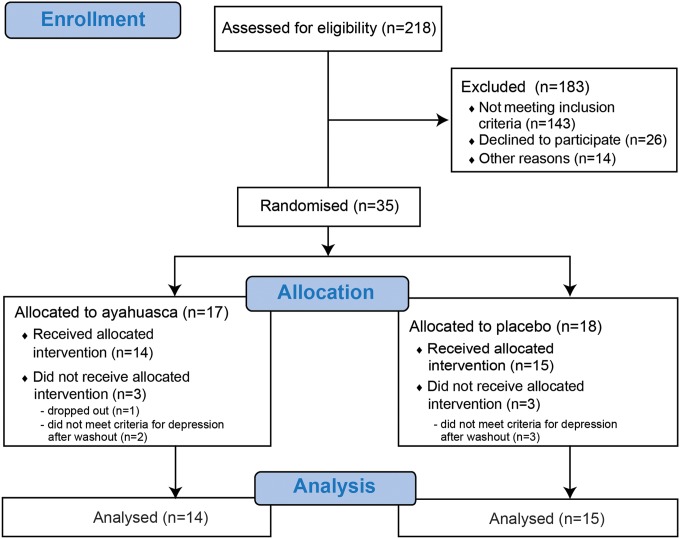
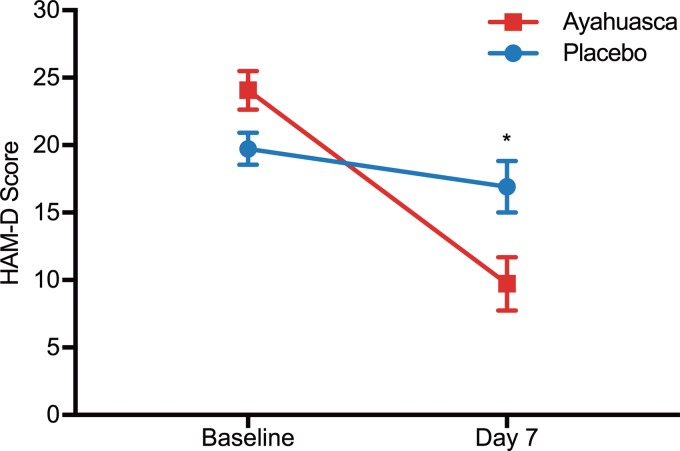
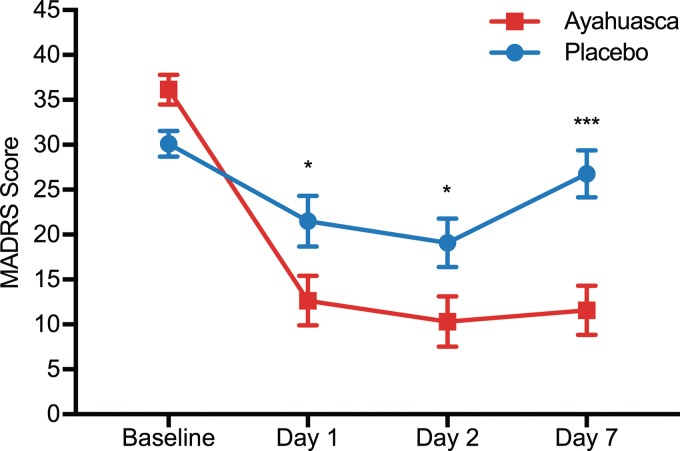
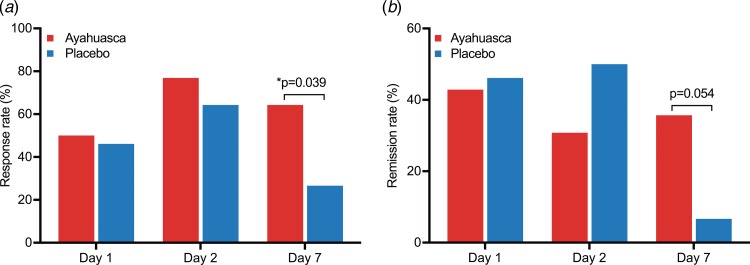
Background: Recent open-label trials show that psychedelics, such as ayahuasca, hold promise as fast-onset antidepressants in treatment-resistant depression. Methods: To test the antidepressant effects of ayahuasca, we conducted a parallel-arm, double-blind randomized placebo-controlled trial in 29 patients with treatment-resistant depression. Patients received a single dose of either ayahuasca or placebo. We assessed changes in depression severity with the Montgomery-Åsberg Depression Rating Scale (MADRS) and the Hamilton Depression Rating scale at baseline, and at 1 (D1), 2 (D2), and 7 (D7) days after dosing. Results: We observed significant antidepressant effects of ayahuasca when compared with placebo at all-time points. MADRS scores were significantly lower in the ayahuasca group compared with placebo at D1 and D2 ( p = 0.04), and at D7 ( p < 0.0001). Between-group effect sizes increased from D1 to D7 (D1: Cohen's d = 0.84; D2: Cohen's d = 0.84; D7: Cohen's d = 1.49). Response rates were high for both groups at D1 and D2, and significantly higher in the ayahuasca group at D7 (64% v. 27%; p = 0.04). Remission rate showed a trend toward significance at D7 (36% v. 7%, p = 0.054). Conclusions: To our knowledge, this is the first controlled trial to test a psychedelic substance in treatment-resistant depression. Overall, this study brings new evidence supporting the safety and therapeutic value of ayahuasca, dosed within an appropriate setting, to help treat depression. This study is registered at http://clinicaltrials.gov (NCT02914769).
Overview
The claims and statistics of this paper haven’t been checked yet.
Free: it reads the open-access text and checks the first 5 claims that cite a source we can check. Create a free account to check every claim.
Integrity signals
Registry
Cites
Statistics
Figures
Verification
Claims the paper makes
The claims and statistics of this paper haven’t been checked yet.
Free: it reads the open-access text and checks the first 5 claims that cite a source we can check. Create a free account to check every claim.
Claims other papers make about this one
Each is checked against this paper’s own text: does it say what the citing paper says it does?
The cited source doesn’t support the claim as written.
In the citing paper
“overall psychiatric scales in the ayahuasca group were significatively higher than those in the placebo group in all time points after dosing.”
From Virtual reality and psychedelics for the treatment of psychiatric disease: A systematic literature review (2020) · doi:10.36131/cnfioritieditore20200606 · cites this paper as Palhano-Fontes et al. (2019)
Checked by a reasoning model — may be wrong.
Experimental — accuracy not yet measuredThe source backs part of the claim, not all of it — or backs it for a different population, condition or comparison.
In the citing paper
“Ayahuasca stimulates emotional dream-like experiences involving potent cognitive-affective changes and spiritual insights (Dobkin de Rios, 1971) that have been associated with substantial and enduring antidepressant effects (Palhano-Fontes et al., 2019; Weiss et al., 2021).”
From Prospective examination of the therapeutic role of psychological flexibility and cognitive reappraisal in the ceremonial use of ayahuasca (2022) · cites this paper as Palhano-Fontes et al., 2019
Experimental — accuracy not yet measuredThe source backs part of the claim, not all of it — or backs it for a different population, condition or comparison.
In the citing paper
“Ayahuasca, or its chemical equivalent known as pharmahuasca, has emerged as a tool for psychotherapy in the contexts of affective and substance use disorders [130,131], thus calling for a better understanding of its possible mechanisms of action.”
From Molecular and Functional Imaging Studies of Psychedelic Drug Action in Animals and Humans. (2021) · cites this paper as [130]
Experimental — accuracy not yet measuredThe source backs part of the claim, not all of it — or backs it for a different population, condition or comparison.
In the citing paper
“Moreover, comorbid conditions such as suicidality and substance use disorders further complicate research efforts (13, 18, 20, 21).”
From Psychoanalytically informed MDMA-assisted therapy for pathological narcissism: a novel theoretical approach (2025) · cites this paper as [20]
Experimental — accuracy not yet measuredThe source backs part of the claim, not all of it — or backs it for a different population, condition or comparison.
In the citing paper
“Ayahuasca has been demonstrated to be safe in naturalistic (35, 108) and clinical settings, across varying dosages and multiple administrations (26, 109–112).”
From Ayahuasca-assisted meaning reconstruction therapy for grief: a non-randomized clinical trial protocol (2025) · cites this paper as [26]
Experimental — accuracy not yet measured
16 more claims about this paper
Create a free account to see every claim other papers make about this one.
Self-check
Percentages, sums and reported differences re-computed from the paper’s own numbers.
The self-check needs the paper’s full text.
Citations
Cites
Hamilton, M. (1960) · Journal of Neurology, Neurosurgery & Psychiatry · doi:10.1136/jnnp.23.1.56 · Cited by 32,817 · cited 1×
“HAM-D was applied only at baseline and D7, as it was designed to access depression symptoms present in the last week (Hamilton, 1960).”
MethodAntidepressant effects of ketamine in depressed patients
Berman, R. M., Cappiello, A., Anand, A., Oren, D. A., Heninger, G. R., Charney, D. S., & Krystal, J. H. (2000) · Biological Psychiatry · doi:10.1016/s0006-3223(99)00230-9 · Cited by 3,856 · cited 7×
“While we find a response rate to placebo of 46% at D1, and 26% at D7, ketamine trials have found a placebo effect of the order of 0 – 6% at D1, and 0 – 11% at D7 (Berman et al. , 2000; Zarate et al. , 2006; Murrough et al. , 2013; Lapidus et al. , 2014).”
BackgroundInfluentialA randomized trial of an N-methyl-D-aspartate antagonist in treatment-resistant major depression.
Zarate, C. A., Singh, J. B., Carlson, P. J., Brutsche, N. E., Ameli, R., Luckenbaugh, D. A., Charney, D. S., & Manji, H. K. (2006) · Archives of General Psychiatry · doi:10.1001/archpsyc.63.8.856 · Cited by 3,766 · cited 4×
“At D7, the ketamine response rate ranges between 7 and 35% (Berman et al., 2000; Zarate et al., 2006; Murrough et al., 2013; Lapidus et al., 2014), while in our study 64% responded to ayahuasca.”
BackgroundInfluentialOtte, C., Gold, S. M., Penninx, B. W., Pariante, C. M., Etkin, A., Fava, M., Mohr, D. C., & Schatzberg, A. F. (2016) · Nature Reviews Disease Primers · doi:10.1038/nrdp.2016.65 · Cited by 2,269 · cited 2×
“We recently found that a single ayahuasca session in patients with depression increases blood flow in brain regions consistently implicated in the regulation of mood and emotions, such as the left nucleus accumbens, right insula and left subgenual area (Otte et al. , 2016; Sanches et al. , 2016).”
BackgroundGriffiths, R. R., Johnson, M. W., Carducci, M. A., Umbricht, A., Richards, W. A., Richards, B. D., Cosimano, M. P., & Klinedinst, M. A. (2016) · Journal of Psychopharmacology · doi:10.1177/0269881116675513 · Cited by 2,201
Nichols, D. E. (2016) · Pharmacological Reviews · doi:10.1124/pr.115.011478 · Cited by 1,762
Ross, S., Bossis, A., Guss, J., Agin-Liebes, G., Malone, T., Cohen, B., Mennenga, S. E., Belser, A., Kalliontzi, K., Babb, J., et al. (2016) · Journal of Psychopharmacology · doi:10.1177/0269881116675512 · Cited by 1,698 · cited 4×
“Prior studies suggest that elements of the psychedelic experience, such as experiences of mystical-type, account for the therapeutic benefit (Bogenschutz et al., 2015; Garcia-Romeu et al., 2015; Majić et al., 2015; Griffiths et al., 2016; Ross et al., 2016).”
BackgroundInfluentialCarhart-Harris, R. L., Bolstridge, M., Rucker, J., Day, C. M. J., Erritzoe, D., Kaelen, M., Bloomfield, M., Rickard, J. A., Forbes, B., Feilding, A., et al. (2016) · The Lancet Psychiatry · doi:10.1016/s2215-0366(16)30065-7 · Cited by 1,540 · cited 4×
“substances affect the brain, and also probing their potential in treating different psychiatric conditions, including mood disorders (Grob et al., 2011; Osório et al., 2015; Carhart-Harris et al., 2016; Griffiths et al., 2016; Ross et al., 2016; Sanches et al., 2016).”
BackgroundResultInfluentialThe default mode network and self-referential processes in depression
Sheline, Y. I., Barch, D. M., Price, J. L., Rundle, M. M., Vaishnavi, S. N., Snyder, A. Z., Mintun, M. A., Wang, S., Coalson, R. S., & Raichle, M. E. (2009) · Proceedings of the National Academy of Sciences · doi:10.1073/pnas.0812686106 · Cited by 1,480 · cited 2×
“Moreover, we have shown that ayahuasca reduces the activity of the Default Mode Network (Palhano-Fontes et al. , 2015), a brain network found to be hyperactive in depression (Sheline et al. , 2009).”
BackgroundPilot Study of Psilocybin Treatment for Anxiety in Patients With Advanced-Stage Cancer
Grob, C. S., Danforth, A. L., Chopra, G. S., Hagerty, M., McKay, C. R., Halberstadt, A. L., & Greer, G. R. (2011) · Archives of General Psychiatry · doi:10.1001/archgenpsychiatry.2010.116 · Cited by 1,206 · cited 2×
“…exploring how these substances affect the brain, and also probing their potential in treating different psychiatric conditions, including mood disorders (Grob et al. , 2011; Osório et al. , 2015; Carhart-Harris et al. , 2016; Griffiths et al. , 2016; Ross et al. , 2016; Sanches et al. , 2016).”
Background
Research works printed but not linked: 3
- World Health Organization (2017) Depression and Other Common Mental Disorders: Global Health Estimates. Rep. CC BY-NC-SA 3.0 IGO. Geneva: World Health Organization.
- Tafur J (2017) The Fellowship of the River: A Medical Doctor's Exploration into Traditional Amazonian Plant Medicine. Espiritu, Phoenix.
- Luna LE (2011) Indigenous and Mestizo use of Ayahuasca. An Overview. The Ethnopharmacology of Ayahuasca. Tivandrum: Transworld Research Network.
Cited by
REBUS and the anarchic brain: Toward a unified model of the brain action of psychedelics
Carhart-Harris, R. L., & Friston, K. J. (2019) · Pharmacological Reviews · doi:10.1124/pr.118.017160 · Cited by 1,180
Psychedelic drugs: neurobiology and potential for treatment of psychiatric disorders
Vollenweider, F. X., & Preller, K. H. (2020) · Nature Reviews Neuroscience · doi:10.1038/s41583-020-0367-2 · Cited by 570
Novel and emerging treatments for major depression
Marwaha, S., Palmer, E., Suppes, T., Cons, E., Young, A. H., & Upthegrove, R. (2023) · The Lancet · doi:10.1016/s0140-6736(22)02080-3 · Cited by 588
Johnson, M. W., Hendricks, P. S., Barrett, F. S., & Griffiths, R. R. (2019) · Pharmacology & Therapeutics · doi:10.1016/j.pharmthera.2018.11.010 · Cited by 506
Davis, A. K., Barrett, F. S., & Griffiths, R. R. (2020) · Journal of Contextual Behavioral Science · doi:10.1016/j.jcbs.2019.11.004 · Cited by 375
“, psilocybin, LSD, ayahuasca, 5-MeO-DMT) administered in clinical trials (Carhart-Harris, et al., 2016; Johnson & Griffiths, 2017; Palhano-Fontes et al., 2018; dos Santos et al., 2016) and used in naturalistic settings (Johnson et al.”
MethodAndersen, K. A. A., Carhart‐Harris, R., Nutt, D. J., & Erritzoe, D. (2021) · Acta Psychiatrica Scandinavica · doi:10.1111/acps.13249 · Cited by 347
Adverse effects of psychedelics: From anecdotes and misinformation to systematic science
Schlag, A. K., Aday, J., Salam, I., Neill, J. C., & Nutt, D. J. (2022) · Journal of Psychopharmacology · doi:10.1177/02698811211069100 · Cited by 325
Blinding and expectancy confounds in psychedelic randomized controlled trials
Muthukumaraswamy, S. D., Forsyth, A., & Lumley, T. (2021) · Expert Review of Clinical Pharmacology · doi:10.1080/17512433.2021.1933434 · Cited by 324
Neural correlates of the DMT experience assessed with multivariate EEG
Timmermann, C., Roseman, L., Schartner, M., Milliere, R., Williams, L. T. J., Erritzoe, D., Muthukumaraswamy, S., Ashton, M., Bendrioua, A., Kaur, O., et al. (2019) · Scientific Reports · doi:10.1038/s41598-019-51974-4 · Cited by 315
Psychedelics, mystical experience, and therapeutic efficacy: a systematic review
Ko, K., Knight, G., Rucker, J. J., & Cleare, A. J. (2022) · Frontiers in Psychiatry · doi:10.3389/fpsyt.2022.917199 · Cited by 306
Anderson, B. T., Danforth, A., Daroff, P. R., Stauffer, C., Ekman, E., Agin-Liebes, G., Trope, A., Boden, M. T., Dilley, P. J., Mitchell, J., et al. (2020) · EClinicalMedicine · doi:10.1016/j.eclinm.2020.100538 · Cited by 284
“, excluding for any lifetime psychedelic use), [46] but we anticipated that such exclusion criteria would have rendered recruiting for a group therapy study with our population unfeasible.”
BackgroundDesigner drugs: mechanism of action and adverse effects
Luethi, D., & Liechti, M. E. (2020) · Archives of Toxicology · doi:10.1007/s00204-020-02693-7 · Cited by 262
Mason, N. L., Kuypers, K. P. C., Müller, F., Reckweg, J., Tse, D. H. Y., Toennes, S. W., Hutten, N. R. P. W., Jansen, J. F. A., Stiers, P., Feilding, A., et al. (2020) · Neuropsychopharmacology · doi:10.1038/s41386-020-0718-8 · Cited by 258
Therapeutic alliance and rapport modulate responses to psilocybin assisted therapy for depression
Murphy, R., Kettner, H., Zeifman, R., Giribaldi, B., Kartner, L., Martell, J., Read, T., Murphy-Beiner, A., Baker-Jones, M., Nutt, D., et al. (2022) · Frontiers in Pharmacology · doi:10.3389/fphar.2021.788155 · Cited by 250
“Telephone screening was followed by a remote Hamilton Depression (HAM-D; Hamilton, 1960) assessment with a minimum score of 17, indicating moderate-to-severe MDD, was required in order to proceed.”
InfluentialPsychedelics in Psychiatry: Neuroplastic, Immunomodulatory, and Neurotransmitter Mechanisms
Inserra, A., De Gregorio, D., & Gobbi, G. (2021) · Pharmacological Reviews · doi:10.1124/pharmrev.120.000056 · Cited by 232
dos Santos, R. G., Bouso, J. C., Alcázar-Córcoles, M. Á., & Hallak, J. E. C. (2018) · Expert Review of Clinical Pharmacology · doi:10.1080/17512433.2018.1511424 · Cited by 227
“Furthermore, these results were recently replicated in a RCT with 29 patients with treatment-resistant MDD in which no psychotherapeutic intervention was used (different from the open-label study, a predefined music playlist was used in this RCT): compared with placebo, single-dose ayahuasca administration was associa…”
ResultSelf-citationCessation and reduction in alcohol consumption and misuse after psychedelic use
Garcia-Romeu, A., Davis, A. K., Erowid, F., Erowid, E., Griffiths, R. R., & Johnson, M. W. (2019) · Journal of Psychopharmacology · doi:10.1177/0269881119845793 · Cited by 225
“…and antidepressant effects in individuals with treatment-resistant depression (Carhart-Harris et al., 2016, 2017; dos Santos et al., 2016; Palhano-Fontes et al., 2019), as well as patients with symptoms of anxiety or depression associated with life-threatening illness (Gasser et al.,…”
BackgroundBreeksema, J. J., Niemeijer, A. R., Krediet, E., Vermetten, E., & Schoevers, R. A. (2020) · CNS Drugs · doi:10.1007/s40263-020-00748-y · Cited by 224
DMT Models the Near-Death Experience
Timmermann, C., Roseman, L., Williams, L., Erritzoe, D., Martial, C., Cassol, H., Laureys, S., Nutt, D., & Carhart-Harris, R. (2018) · Frontiers in Psychology · doi:10.3389/fpsyg.2018.01424 · Cited by 220
Kettner, H., Rosas, F. E., Timmermann, C., Kärtner, L., Carhart-Harris, R. L., & Roseman, L. (2021) · Frontiers in Pharmacology · doi:10.3389/fphar.2021.623985 · Cited by 221
Human brain effects of DMT assessed via EEG-fMRI
Timmermann, C., Roseman, L., Haridas, S., Rosas, F. E., Luan, L., Kettner, H., Martell, J., Erritzoe, D., Tagliazucchi, E., Pallavicini, C., et al. (2023) · Proceedings of the National Academy of Sciences · doi:10.1073/pnas.2218949120 · Cited by 216
A Meta-Analysis of Placebo-Controlled Trials of Psychedelic-Assisted Therapy
Luoma, J. B., Chwyl, C., Bathje, G. J., Davis, A. K., & Lancelotta, R. (2020) · Journal of Psychoactive Drugs · doi:10.1080/02791072.2020.1769878 · Cited by 212
“…to achieve blinding included using a low-dose psychedelic (Gasser et al. 2014; Griffiths et al. 106; Mithoefer et al. 2011; Oehen et al. 2013; Ot’alora et al. 2018) or a substance that mimicked some of the psychoactive substances’ effects (Palhano-Fontes et al. 2019; Ross et al. 2016) as a control.”
BackgroundUthaug, M. V., Lancelotta, R., van Oorsouw, K., Kuypers, K. P. C., Mason, N., Rak, J., Šuláková, A., Jurok, R., Maryška, M., Kuchař, M., et al. (2019) · Psychopharmacology · doi:10.1007/s00213-019-05236-w · Cited by 197
“2016), and was recently confirmed in a randomized placebo-controlled clinical trial in patients suffering from treatment-resistant depression (Palhano-Fontes et al. 2018).”
BackgroundLearning to Let Go: A Cognitive-Behavioral Model of How Psychedelic Therapy Promotes Acceptance
Wolff, M., Evens, R., Mertens, L. J., Koslowski, M., Betzler, F., Gründer, G., & Jungaberle, H. (2020) · Frontiers in Psychiatry · doi:10.3389/fpsyt.2020.00005 · Cited by 194
Garcia-Romeu, A., & Richards, W. A. (2018) · International Review of Psychiatry · doi:10.1080/09540261.2018.1486289 · Cited by 189
Forstmann, M., Yudkin, D. A., Prosser, A. M. B., Heller, S. M., & Crockett, M. J. (2020) · Proceedings of the National Academy of Sciences · doi:10.1073/pnas.1918477117 · Cited by 185
Breeksema, J. J., Kuin, B. W., Kamphuis, J., van den Brink, W., Vermetten, E., & Schoevers, R. A. (2022) · Journal of Psychopharmacology · doi:10.1177/02698811221116926 · Cited by 178
“, 2016); one study did not report on physiological parameters (Palhano-Fontes et al., 2019).”
BackgroundInfluentialAlmeida, R. N. D., Galvão, A. C. D. M., da Silva, F. S., Silva, E. A. D. S., Palhano-Fontes, F., Maia-de-Oliveira, J. P., de Araújo, L.-S. B., Lobão-Soares, B., & Galvão-Coelho, N. L. (2019) · Frontiers in Psychology · doi:10.3389/fpsyg.2019.01234 · Cited by 177
Self-citationPsychedelic-Assisted Psychotherapy—A Systematic Review of Associated Psychological Interventions
Cavarra, M., Falzone, A., Ramaekers, J. G., Kuypers, K. P. C., & Mento, C. (2022) · Frontiers in Psychology · doi:10.3389/fpsyg.2022.887255 · Cited by 171
D’Souza, D. C., Syed, S. A., Flynn, L. T., Safi-Aghdam, H., Cozzi, N. V., & Ranganathan, M. (2022) · Neuropsychopharmacology · doi:10.1038/s41386-022-01344-y · Cited by 162
“reported that ayahuasca reduced depression scores in patients with treatment-resistant depression (n= 29) in a parallel-arm, double-blind, randomized, placebo-controlled trial [22].”
BackgroundGarcia-Romeu, A., Davis, A. K., Erowid, E., Erowid, F., Griffiths, R. R., & Johnson, M. W. (2020) · Frontiers in Psychiatry · doi:10.3389/fpsyt.2019.00955 · Cited by 157
Timmermann, C., Bauer, P. R., Gosseries, O., Vanhaudenhuyse, A., Vollenweider, F., Laureys, S., Singer, T., Antonova, E., & Lutz, A. (2023) · Trends in Cognitive Sciences · doi:10.1016/j.tics.2022.11.006 · Cited by 150
Psychedelic therapy for depressive symptoms: A systematic review and meta-analysis
Ko, K., Kopra, E. I., Cleare, A. J., & Rucker, J. J. (2023) · Journal of Affective Disorders · doi:10.1016/j.jad.2022.09.168 · Cited by 150
Yao, Y., Guo, D., Lu, T., Liu, F.-L., Huang, S., Diao, M.-Q., Li, S., Zhang, X.-J., Kosten, T. R., Shi, J., et al. (2024) · Psychiatry Research · doi:10.1016/j.psychres.2024.115886 · Cited by 175
A non-hallucinogenic LSD analog with therapeutic potential for mood disorders
Lewis, V., Bonniwell, E. M., Lanham, J. K., Ghaffari, A., Sheshbaradaran, H., Cao, A. B., Calkins, M. M., Bautista-Carro, M. A., Arsenault, E., Telfer, A., et al. (2023) · Cell Reports · doi:10.1016/j.celrep.2023.112203 · Cited by 168
History repeating: guidelines to address common problems in psychedelic science
van Elk, M., & Fried, E. I. (2023) · Therapeutic Advances in Psychopharmacology · doi:10.1177/20451253231198466 · Cited by 137
“29 Nonetheless, authors concluded that the ‘study brings new evidence supporting the safety and therapeutic value of psychedelics’ (our highlight).”
BackgroundGalvão-Coelho, N. L., Marx, W., Gonzalez, M., Sinclair, J., de Manincor, M., Perkins, D., & Sarris, J. (2021) · Psychopharmacology · doi:10.1007/s00213-020-05719-1 · Cited by 137
Serotonergic psychedelics and personality: A systematic review of contemporary research
Bouso, J. C., dos Santos, R. G., Alcázar-Córcoles, M. Á., & Hallak, J. E. C. (2018) · Neuroscience & Biobehavioral Reviews · doi:10.1016/j.neubiorev.2018.02.004 · Cited by 134
Self-citationInteroception and the origin of feelings: A new synthesis
Carvalho, G. B., & Damasio, A. (2021) · BioEssays · doi:10.1002/bies.202000261 · Cited by 132
“effects, increased blood flow to areas implicated in the regulation of mood and emotions, including the insula.[100,101] Finally, meditative practice impacts affect and alters neural processing of interoceptive information, enhancing some (albeit probably not all) aspects of interoceptive awareness.”
BackgroundPsychedelic drugs—a new era in psychiatry?
Nutt, D. J. (2019) · Dialogues in Clinical Neuroscience · doi:10.31887/dcns.2019.21.2/dnutt · Cited by 180
Changes in inflammatory biomarkers are related to the antidepressant effects of Ayahuasca
Galvão-Coelho, N. L., de Menezes Galvão, A. C., de Almeida, R. N., Palhano-Fontes, F., Campos Braga, I., Lobão Soares, B., Maia-de-Oliveira, J. P., Perkins, D., Sarris, J., & de Araujo, D. B. (2020) · Journal of Psychopharmacology · doi:10.1177/0269881120936486 · Cited by 128
“In this trial patients received a single dose of ayahuasca or placebo and a significant antidepressant effect of ayahuasca was observed 1, 2, and 7 days after treatment (Palhano-Fontes et al., 2018).”
BackgroundMethodInfluentialSelf-citationAgin-Liebes, G., Haas, T. F., Lancelotta, R., Uthaug, M. V., Ramaekers, J. G., & Davis, A. K. (2021) · ACS Pharmacology & Translational Science · doi:10.1021/acsptsci.1c00018 · Cited by 124
Jones, B. D. M., Razza, L. B., Weissman, C. R., Karbi, J., Vine, T., Mulsant, L. S., Brunoni, A. R., Husain, M. I., Mulsant, B. H., Blumberger, D. M., et al. (2021) · JAMA Network Open · doi:10.1001/jamanetworkopen.2021.25531 · Cited by 121
Microdosing psychedelics: Motivations, subjective effects and harm reduction
Lea, T., Amada, N., Jungaberle, H., Schecke, H., & Klein, M. (2020) · International Journal of Drug Policy · doi:10.1016/j.drugpo.2019.11.008 · Cited by 121
Subacute effects of the psychedelic ayahuasca on the salience and default mode networks
Pasquini, L., Palhano-Fontes, F., & Araujo, D. B. (2020) · Journal of Psychopharmacology · doi:10.1177/0269881120909409 · Cited by 119
“Recent clinical trials have explored the antidepressant effects of ayahuasca (Palhano-Fontes et al., 2019; Sanches et al., 2016).”
BackgroundResultInfluentialSelf-citationAdverse effects of ayahuasca: Results from the Global Ayahuasca Survey
Bouso, J. C., Andión, Ó., Sarris, J. J., Scheidegger, M., Tófoli, L. F., Opaleye, E. S., Schubert, V., & Perkins, D. (2022) · PLOS Global Public Health · doi:10.1371/journal.pgph.0000438 · Cited by 118
Self-citationUthaug, M. V., Lancelotta, R., Szabo, A., Davis, A. K., Riba, J., & Ramaekers, J. G. (2020) · Psychopharmacology · doi:10.1007/s00213-019-05414-w · Cited by 117
Brito-da-Costa, A. M., Dias-da-Silva, D., Gomes, N. G. M., Dinis-Oliveira, R. J., & Madureira-Carvalho, Á. (2020) · Pharmaceuticals · doi:10.3390/ph13110334 · Cited by 117
“Patients diagnosed with treatment-refractory depression have been found to benefit from the consumption of a single dose of ayahuasca [115,133,194].”
BackgroundDark Classics in Chemical Neuroscience:N,N-Dimethyltryptamine (DMT)
Cameron, L. P., & Olson, D. E. (2018) · ACS Chemical Neuroscience · doi:10.1021/acschemneuro.8b00101 · Cited by 115
Jha, M. K., & Mathew, S. J. (2023) · American Journal of Psychiatry · doi:10.1176/appi.ajp.20230025 · Cited by 114
Meditation Increases the Entropy of Brain Oscillatory Activity
Vivot, R. M., Pallavicini, C., Zamberlán, F., Vigo, D. E., & Tagliazucchi, E. (2020) · Neuroscience · doi:10.1016/j.neuroscience.2020.01.033 · Cited by 130
Efficacy of psychedelic treatments on depressive symptoms: A meta-analysis
Romeo, B., Karila, L., Martelli, C., & Benyamina, A. (2020) · Journal of Psychopharmacology · doi:10.1177/0269881120919957 · Cited by 113
“In most studies, the placebo was a classical placebo (Palhano-Fontes et al., 2019) or an active placebo which could be a very low dose of psychedelic (Gasser et al., 2014; Griffiths et al., 2016), or niacin (Grob et al., 2011; Ross et al., 2016).”
BackgroundInfluentialUthaug, M. V., Mason, N. L., Toennes, S. W., Reckweg, J. T., de Sousa Fernandes Perna, E. B., Kuypers, K. P. C., van Oorsouw, K., Riba, J., & Ramaekers, J. G. (2021) · Psychopharmacology · doi:10.1007/s00213-021-05817-8 · Cited by 112
“…found in stress-related psychopathologies like depression, anxiety disorders, and post-traumatic stress disorder (PTSD) (Chamberlain et al. 2006; Cusi et al. 2011; Donges et al. 2005; Lee and Orsillo 2014; Morrison et al. 2016; Nietlisbach et al. 2010; Palm and Follette 2011; Parlar et al. 2014).”
Backgrounddos Santos, R. G., & Hallak, J. E. C. (2020) · Neuroscience & Biobehavioral Reviews · doi:10.1016/j.neubiorev.2019.12.001 · Cited by 111
Self-citationJiménez-Garrido, D. F., Gómez-Sousa, M., Ona, G., Dos Santos, R. G., Hallak, J. E. C., Alcázar-Córcoles, M. Á., & Bouso, J. C. (2020) · Scientific Reports · doi:10.1038/s41598-020-61169-x · Cited by 110
Self-citationClassic Psychedelic Drugs: Update on Biological Mechanisms
Vollenweider, F. X., & Smallridge, J. W. (2022) · Pharmacopsychiatry · doi:10.1055/a-1721-2914 · Cited by 128
“However, not every study found an increase in openness as a personality trait [73] or a correlation between the overall mystical experience and the enduring therapeutic effects in patients [74, 75].”
Correll, C. U., Solmi, M., Cortese, S., Fava, M., Højlund, M., Kraemer, H. C., McIntyre, R. S., Pine, D. S., Schneider, L. S., & Kane, J. M. (2023) · World Psychiatry · doi:10.1002/wps.21056 · Cited by 109
Galvão, A. C. D. M., de Almeida, R. N., Silva, E. A. D. S., Freire, F. A. M., Palhano-Fontes, F., Onias, H., Arcoverde, E., Maia-de-Oliveira, J. P., de Araújo, D. B., Lobão-Soares, B., et al. (2018) · Frontiers in Psychiatry · doi:10.3389/fpsyt.2018.00185 · Cited by 108
Self-citationNovel drug developmental strategies for treatment‐resistant depression
Borbély, É., Simon, M., Fuchs, E., Wiborg, O., Czéh, B., & Helyes, Z. (2022) · British Journal of Pharmacology · doi:10.1111/bph.15753 · Cited by 106
“TRD patients exhibit a higher rate of comorbid psychiatric and general medical conditions, and self-harming behaviour not resulting in death compared with non-TRD patients (Döme et al., 2021; Parker & Graham, 2015).”
McCulloch, D. E.-W., Knudsen, G. M., Barrett, F. S., Doss, M. K., Carhart-Harris, R. L., Rosas, F. E., Deco, G., Kringelbach, M. L., Preller, K. H., Ramaekers, J. G., et al. (2022) · Neuroscience & Biobehavioral Reviews · doi:10.1016/j.neubiorev.2022.104689 · Cited by 122
Zeifman, R. J., Wagner, A. C., Watts, R., Kettner, H., Mertens, L. J., & Carhart-Harris, R. L. (2020) · Frontiers in Psychiatry · doi:10.3389/fpsyt.2020.00782 · Cited by 106
“, (13, 14)] and suicidal ideation (13, 15) and that these effects are sustained over time [e.”
BackgroundKangaslampi, S. (2023) · Journal of Psychedelic Studies · doi:10.1556/2054.2023.00243 · Cited by 124
Argento, E., Capler, R., Thomas, G., Lucas, P., & Tupper, K. W. (2019) · Drug and Alcohol Review · doi:10.1111/dar.12985 · Cited by 102
Martial, C., Cassol, H., Charland‐Verville, V., Pallavicini, C., Sanz, C., Zamberlán, F., Vivot, R. M., Erowid, F., Erowid, E., Laureys, S., et al. (2019) · Consciousness and Cognition · doi:10.1016/j.concog.2019.01.011 · Cited by 124
Kadriu, B., Greenwald, M., Henter, I. D., Gilbert, J. R., Kraus, C., Park, L. T., & Zarate, C. A. (2021) · International Journal of Neuropsychopharmacology · doi:10.1093/ijnp/pyaa087 · Cited by 99
Does Psychedelic Therapy Have a Transdiagnostic Action and Prophylactic Potential?
Kočárová, R., Horáček, J., & Carhart-Harris, R. (2021) · Frontiers in Psychiatry · doi:10.3389/fpsyt.2021.661233 · Cited by 96
Reckweg, J. T., van Leeuwen, C. J., Henquet, C., van Amelsvoort, T., Theunissen, E. L., Mason, N. L., Paci, R., Terwey, T. H., & Ramaekers, J. G. (2023) · Frontiers in Psychiatry · doi:10.3389/fpsyt.2023.1133414 · Cited by 96
Chi, T., & Gold, J. A. (2020) · Journal of the Neurological Sciences · doi:10.1016/j.jns.2020.116715 · Cited by 95
Dunlap, L. E., Azinfar, A., Ly, C., Cameron, L. P., Viswanathan, J., Tombari, R. J., Myers-Turnbull, D., Taylor, J. C., Grodzki, A. C., Lein, P. J., et al. (2020) · Journal of Medicinal Chemistry · doi:10.1021/acs.jmedchem.9b01404 · Cited by 95
Beyond the 5-HT2AReceptor: Classic and Nonclassic Targets in Psychedelic Drug Action
Cameron, L. P., Benetatos, J., Lewis, V., Bonniwell, E. M., Jaster, A. M., Moliner, R., Castrén, E., McCorvy, J. D., Palner, M., & Aguilar-Valles, A. (2023) · The Journal of Neuroscience · doi:10.1523/jneurosci.1384-23.2023 · Cited by 93
Brennan, W., & Belser, A. B. (2022) · Frontiers in Psychology · doi:10.3389/fpsyg.2022.866018 · Cited by 90
dos Santos, R. G., Osório, F. D. L., Rocha, J. M., Rossi, G. N., Bouso, J. C., Rodrigues, L. S., de Oliveira Silveira, G., Yonamine, M., & Hallak, J. E. C. (2021) · Journal of Clinical Psychopharmacology · doi:10.1097/jcp.0000000000001428 · Cited by 90
“Ayahuasca was well tolerated, with vomiting being the only adverse effect reported (being reported by 47% of the volunteers).21,22 These results were recently replicated in a placebo-controlled trial with 29 patients with TRD.23 Furthermore, recent controlled trials with classic serotonergic hallucinogens including ly…”
ResultSelf-citationBender, D., & Hellerstein, D. J. (2022) · Psychopharmacology · doi:10.1007/s00213-021-06049-6 · Cited by 88
The role of Indigenous knowledges in psychedelic science
Fotiou, E. (2019) · Journal of Psychedelic Studies · doi:10.1556/2054.2019.031 · Cited by 104
Mason, N. L., Szabó, A., Kuypers, K. P. C., Mallaroni, P., de la Torre, R., Reckweg, J. T., Tse, D. H. Y., Hutten, N. R. P. W., Feilding, A., & Ramaekers, J. G. (2023) · Brain Behavior and Immunity · doi:10.1016/j.bbi.2023.09.004 · Cited by 104
The impact of Ayahuasca on suicidality: results from a randomized controlled trial
Zeifman, R. J., Palhano-Fontes, F., Hallak, J., Arcoverde, E., Maia-Oliveira, J. P., & Araujo, D. B. (2019) · Frontiers in Pharmacology · doi:10.3389/fphar.2019.01325 · Cited by 87
Self-citationExamining changes in personality following shamanic ceremonial use of ayahuasca
Weiss, B., Miller, J. D., Carter, N. T., & Keith Campbell, W. (2021) · Scientific Reports · doi:10.1038/s41598-021-84746-0 · Cited by 86
Kiraga, M. K., Mason, N. L., Uthaug, M. V., van Oorsouw, K. I. M., Toennes, S. W., Ramaekers, J. G., & Kuypers, K. P. C. (2021) · Frontiers in Pharmacology · doi:10.3389/fphar.2021.721537 · Cited by 85
Lima da Cruz, R. V., Moulin, T. C., Petiz, L. L., & Leão, R. N. (2018) · Frontiers in Molecular Neuroscience · doi:10.3389/fnmol.2018.00312 · Cited by 84
“…of a single dose treatment, was made to address the gap between the molecular mechanisms, subjective and hormonal effects underlying Ayahuasca acute administration to depression diagnosed patients (dos Santos et al., 2016; Sanches et al., 2016; Galvão et al., 2018; Palhano-Fontes et al., 2018).”
Zeifman, R. J., Singhal, N., SANTOS, R. G. D., Sanches, R. F., Osório, F. D. L., Hallak, J. E. C., & Weissman, C. R. (2020) · Psychopharmacology · doi:10.1007/s00213-020-05692-9 · Cited by 96
Self-citationKozłowska, U., Nichols, C. D., Wiatr, K., & Figiel, M. (2021) · Journal of Neurochemistry · doi:10.1111/jnc.15509 · Cited by 89
Novel antidepressant drugs: Beyond monoamine targets
Gonda, X., Döme, P., Neill, J. C., & Tarazi, F. I. (2021) · CNS Spectrums · doi:10.1017/s1092852921000791 · Cited by 91
Hutten, N. R. P. W., Mason, N. L., Dolder, P. C., & Kuypers, K. P. C. (2019) · Frontiers in Psychiatry · doi:10.3389/fpsyt.2019.00672 · Cited by 77
“Recent clinical studies have suggested that LSD (13), psilocybin (14), ayahuasca (15), and methylenedioxymethamphetamine (MDMA) (16, 17), in combination with psychological support, can provide therapeutic relief for those suffering from post-traumatic stress disorder (PTSD), anxiety, and depression.”
BackgroundRaison, C. L., Jain, R., Penn, A., Cole, S. P., & Jain, S. (2022) · Frontiers in Psychiatry · doi:10.3389/fpsyt.2022.831092 · Cited by 100
Magnesium–ibogaine therapy in veterans with traumatic brain injuries
Cherian, K. N., Keynan, J. N., Anker, L. A., Faerman, A., Brown, R. E., Shamma, A., Keynan, O., Coetzee, J. P., Batail, J.-M. V., Phillips, A., et al. (2024) · Nature Medicine · doi:10.1038/s41591-023-02705-w · Cited by 99
“…placebo-controlled RCTs may help to establish the potential therapeutic benefits of ibogaine and the MISTIC protocol, the interpretation of placebo-controlled RCTs of psychedelic medicines is limited by the fact that very few studies 65,69 have suggested that their blinds may have been intact.”
The Psychedelic Future of Post-Traumatic Stress Disorder Treatment
Zaretsky, T. G., Jagodnik, K. M., Barsic, R., Antonio, J. H., Bonanno, P. A., MacLeod, C., Pierce, C., Carney, H., Morrison, M. T., Saylor, C., et al. (2024) · Current Neuropharmacology · doi:10.2174/1570159x22666231027111147 · Cited by 85
5-HT2A receptors: Pharmacology and functional selectivity
Cummins, B. R., Billac, G. B., Nichols, D. E., & Nichols, C. D. (2025) · Pharmacological Reviews · doi:10.1016/j.pharmr.2025.100059 · Cited by 86
Renelli, M., Fletcher, J., Tupper, K. W., Files, N., Loizaga-Velder, A., & Lafrance, A. (2018) · Eating and Weight Disorders - Studies on Anorexia Bulimia and Obesity · doi:10.1007/s40519-018-0619-6 · Cited by 92
Lea, T., Amada, N. M., Jungaberle, H., Schecke, H., Scherbaum, N., & Klein, M. (2020) · Psychopharmacology · doi:10.1007/s00213-020-05477-0 · Cited by 93
“Clinical trials have investigated psilocybin and ayahuasca for treatment-resistant depression (Carhart-Harris et al. 2018; Palhano-Fontes et al. 2019), psilocybin for alcohol dependence (Bogenschutz et al. 2015) and nicotine dependence (Johnson et al. 2017), and psilocybin and lysergic acid…”
BackgroundDuan, W., Cao, D., Wang, S., & Cheng, J. (2023) · Chemical Reviews · doi:10.1021/acs.chemrev.3c00375 · Cited by 85
Romeo, B., Hermand, M., Pétillion, A., Karila, L., & Benyamina, A. (2021) · Journal of Psychiatric Research · doi:10.1016/j.jpsychires.2021.03.002 · Cited by 76
Therapeutic potential of ayahuasca in grief: a prospective, observational study
González, D., Cantillo, J., Pérez, I., Farré, M., Feilding, A., Obiols, J. E., & Bouso, J. C. (2020) · Psychopharmacology · doi:10.1007/s00213-019-05446-2 · Cited by 75
Moreton, S. G., Szalla, L., Menzies, R. E., & Arena, A. F. A. (2019) · Psychopharmacology · doi:10.1007/s00213-019-05391-0 · Cited by 93
Witkin, J. M., Martin, A. E., Golani, L. K., Xu, N. Z., & Smith, J. L. (2019) · Advances in Pharmacology · doi:10.1016/bs.apha.2019.03.002 · Cited by 72
van Oorsouw, K., Toennes, S. W., & Ramaekers, J. G. (2022) · Psychopharmacology · doi:10.1007/s00213-021-06046-9 · Cited by 74
“The current findings add to the existing literature on the therapeutic potential of ayahuasca or its analogues (De Lima Osório et al. 2015; Palhano-Fontes et al. 2019; Ruffell et al. 2021; Sanches et al. 2016) and are a first step to more controlled clinical trials investigating the long-term antidepressant effects of…”
BackgroundResultInfluentialRuffell, S. G. D., Netzband, N., Tsang, W., Davies, M., Inserra, A., Butler, M., Rucker, J. J. H., Tófoli, L. F., Dempster, E. L., Young, A. H., et al. (2021) · Frontiers in Psychiatry · doi:10.3389/fpsyt.2021.687615 · Cited by 74
Self-citationSarris, J., Perkins, D., Cribb, L., Schubert, V., Opaleye, E., Bouso, J. C., Scheidegger, M., Aicher, H., Simonova, H., Horák, M., et al. (2021) · Journal of Affective Disorders Reports · doi:10.1016/j.jadr.2021.100098 · Cited by 73
Self-citationAntidepressant effects of a psychedelic experience in a large prospective naturalistic sample
Nygart, V. A., Pommerencke, L. M., Haijen, E., Kettner, H., Kaelen, M., Mortensen, E. L., Nutt, D. J., Carhart-Harris, R. L., & Erritzoe, D. (2022) · Journal of Psychopharmacology · doi:10.1177/02698811221101061 · Cited by 73
“…and anxiety symptoms and disorders (Barbosa et al., 2016; Carhart-Harris et al., 2017, 2021a, 2021b; Davis et al., 2021a; Gasser et al., 2014; Griffiths et al., 2016; Grob et al., 2011; Moreno et al., 2006; Osório et al., 2015; Palhano-Fontes et al., 2019; Ross et al., 2016; Sanches et al., 2016).”
BackgroundInfluentialExpectancy Effects in Psychedelic Trials
Szigeti, B., & Heifets, B. D. (2024) · Biological Psychiatry Cognitive Neuroscience and Neuroimaging · doi:10.1016/j.bpsc.2024.02.004 · Cited by 120
Berlowitz, I., Walt, H., Ghasarian, C., Mendive, F., & Martin-Soelch, C. (2019) · Journal of Psychoactive Drugs · doi:10.1080/02791072.2019.1607956 · Cited by 72
Metadata
- Authors
- Palhano-Fontes, F., Barreto, D., Onias, H., Andrade, K. C., Novaes, M. M., Pessoa, J. A., Mota-Rolim, S. A., Osório, F. L., Sanches, R., dos Santos, R. G., Tófoli, L. F., de Oliveira Silveira, G., Yonamine, M., Riba, J., Santos, F. R., Silva-Junior, A. A., Alchieri, J. C., Galvão-Coelho, N. L., Lobão-Soares, B., Hallak, J. E. C., Arcoverde, E., Maia-de-Oliveira, J. P., & Araújo, D. B.
- Affiliations
- Universidade Federal do Rio Grande do Norte (BR)
- Universidade de São Paulo (BR)
- Universidade Estadual de Campinas (UNICAMP) (BR)
- Corresponding author
- Araújo, Dráulio B.
- ORCID
- Venue
- Psychological Medicine
- Publisher
- Cambridge University Press (CUP)
- Published
- 2018-06-15
- Volume
- 49
- Issue
- 4
- Pages
- 655-663
- ISSN
- 0033-2917 (ISSN-L)
- 1469-8978
- PMC
- PMC6378413
- OpenAlex
- W2952169207
- Semantic Scholar
- 8e6a44612a52817ea7aa6d429c7bebd0e4d85192
- Cited by
- 852
- References
- 55
- Citations by year
- 2026: 93 · 2025: 98 · 2024: 142 · 2023: 124 · 2022: 131 · 2021: 116 · 2020: 77 · 2019: 45 · 2018: 22
- FWCI
- 76.38
- Type
- journal article
- Language
- en
- Open access
- hybrid
- doi.org
- Locations
- Psychological Medicine (publishedVersion, cc-by)
- bioRxiv (Cold Spring Harbor Laboratory) (acceptedVersion)
- Europe PMC (PubMed Central) (publishedVersion, cc-by)
- PubMed Central (publishedVersion, cc-by)
- PubMed (publishedVersion)
- Americanae (AECID Library) (publishedVersion, other-oa)
- LA Referencia (Red Federada de Repositorios Institucionales de Publicaciones Científicas) (publishedVersion, other-oa)
- Funders
- Coordenação de Aperfeiçoamento de Pessoal de Nível Superior (#1677/2012, 1577/2013)
- Conselho Nacional de Desenvolvimento Científico e Tecnológico (466760/2014, #479466/2013)
- Universidade Federal do Rio Grande do Norte
- Topics
- Social Sciences › Psychology › Clinical Psychology › Psychedelics and Drug Studies
- Health Sciences › Medicine › Pharmacology (medical) › Treatment of Major Depression
- Life Sciences › Neuroscience › Biological Psychiatry › Tryptophan and brain disorders
- Keywords
- ayahuasca, treatment-resistant depression, antidepressant effects, psychedelics, single-dose administration, depression remission
- MeSH terms
- Adult, Antidepressive Agents, Double-Blind Method, Female, Hallucinogens, Humans, Male, Phytotherapy, Psychiatric Status Rating Scales, Time Factors, Treatment Outcome, Banisteriopsis, Depressive Disorder, Treatment-Resistant
About these checks
Registry, retraction, Cites and statistics results are computed, not judged, with one exception: a printed reference that no index lists is read once by a model before it counts as a citation error. Claims are extracted by a model and kept only when their quote appears verbatim in the text; each cited source is then checked, with a model’s help, for whether it says what the claim relies on. Those verdicts can be wrong — read the claim’s quote and the cited source before relying on one.
Statistics and arithmetic are recomputed, not judged.
Confidence bands are shown only for fields calibrated on our annotated test set. None is calibrated yet, so no band is shown.
What counts as a claim ›How we measure confidence ›How we check this ›
Are you an author, or do you see a problem with this page? Request a review
Data sources
Bibliographic data: Semantic Scholar, OpenAlex, Crossref.
Contains information from the Semantic Scholar Academic Graph Datasets, made available under the ODC Attribution License (ODC-BY 1.0).
Semantic Scholar’s data is described in: Kinney, R., et al. (2023). The Semantic Scholar Open Data Platform. arXiv:2301.10140.
