

Algorithm aversion: People erroneously avoid algorithms after seeing them err.
Open accessThe DOI matches its Crossref record; 23 of the 23 references it cites were found in a registry or an index; none of the 22 sources its claims cite is checked for support yet.
Abstract
Research shows that evidence-based algorithms more accurately predict the future than do human forecasters. Yet when forecasters are deciding whether to use a human forecaster or a statistical algorithm, they often choose the human forecaster. This phenomenon, which we call algorithm aversion, is costly, and it is important to understand its causes. We show that people are especially averse to algorithmic forecasters after seeing them perform, even when they see them outperform a human forecaster. This is because people more quickly lose confidence in algorithmic than human forecasters after seeing them make the same mistake. In 5 studies, participants either saw an algorithm make forecasts, a human make forecasts, both, or neither. They then decided whether to tie their incentives to the future predictions of the algorithm or the human. Participants who saw the algorithm perform were less confident in it, and less likely to choose it over an inferior human forecaster. This was true even among those who saw the algorithm outperform the human.
Overview
CoChat Summary
TL;DR
People become less willing to use a statistical algorithm after seeing it perform and make mistakes, even when it outperforms a human forecaster. This “algorithm aversion” is driven partly by people losing confidence in algorithms more quickly than in humans after observing errors.
Key findings
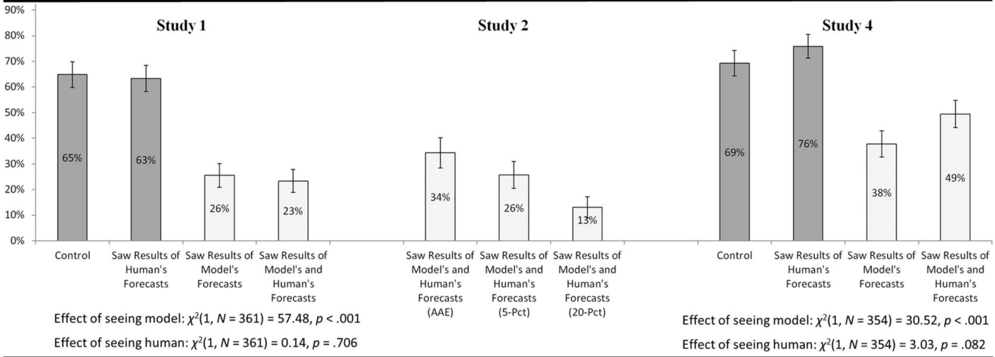
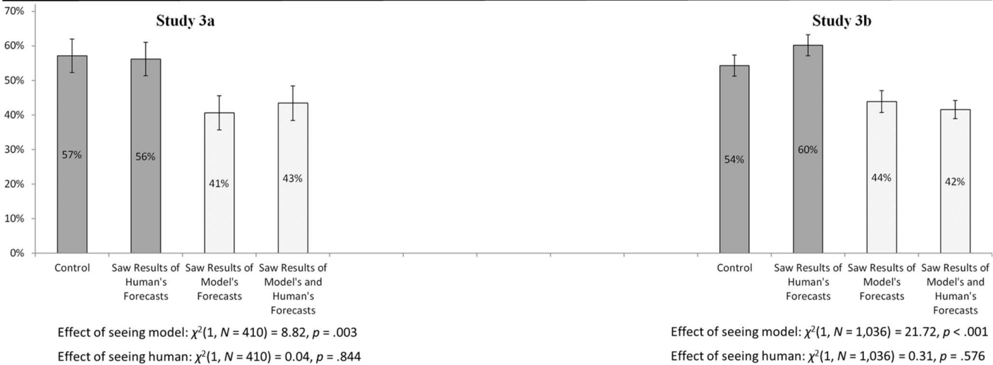
- Across five studies, seeing the algorithm perform reduced participants’ likelihood of choosing it over a human forecaster. In the model-and-human conditions, 610 of 741 participants (83%) saw the model outperform the human, yet these participants were among the least likely to choose the model.
- The model outperformed humans in all five studies. For example, bonuses if choosing model vs. human were Study 1: $1.78 vs. $1.38; Study 2: $1.77 vs. $1.09; Study 3a: $0.48 vs. $0.31; Study 3b: $0.49 vs. $0.30; Study 4: $1.79 vs. $1.38. Human forecasters produced 15–29% more error in the MBA task and 90–97% more error in the airline-passenger task.
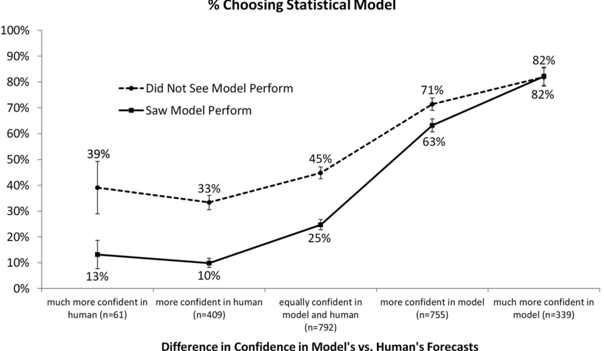
- Seeing the model perform significantly decreased confidence in the model’s forecasts in all four studies where this was tested, whereas seeing the human perform significantly decreased confidence in the human only in Study 4. Confidence in the model’s forecasts significantly mediated the effect of seeing the model perform on choosing the model; confidence in the human did not.
- In Study 2, participants paid for forecasts within 20 percentiles were less likely to choose the model than those paid within 5 percentiles, χ²(1, N = 139) = 3.56, p = .059, and those paid by average absolute error, χ²(1, N = 136) = 8.56, p = .003; this effect was mediated by confidence in their own forecasts, not confidence in the model’s forecasts.
Methods
- Five studies had participants forecast real outcomes: MBA student success (Studies 1, 2, and 4) or U.S. state rank in airline passengers (Studies 3a and 3b). Participants were assigned to control, human, model, or model-and-human conditions, then chose whether to tie incentivized bonuses to the model or the human forecaster (themselves in Studies 1–3, another participant in Study 4).
- Final samples were Study 1: 361; Study 2: 206; Study 3a: 410; Study 3b: 1,036; Study 4: 354. Studies 1, 2, and 4 were run in the Wharton Behavioral Lab; Studies 3a and 3b used Amazon Mechanical Turk.
- Main analyses compared forecasting performance and choice rates, measured confidence and beliefs, and used binary mediation analyses with Preacher and Hayes’s bootstrapping procedure.
Limitations
- The paper states it did not explore all boundaries of the effect, including whether it would persist if algorithms were many times more accurate than humans, and whether results depend on features shared by the two forecasting tasks.
- The paper states it did not explore how algorithm variations—complexity, transparency, forecaster involvement in construction, and designer expertise—affect algorithm aversion.
- The paper states algorithm aversion is not entirely driven by seeing algorithms err, and it has little to say about how best to reduce aversion among those who have seen an algorithm err. The text also cautions that cross-experiment comparisons should be made cautiously.
Model-written summary. Check it against the paper before relying on it.
Integrity signals
Registry
Cites
Statistics
Figures
Verification
Claims the paper makes
0 Valid · 2 Not valid · 16 Not checked · 90 Own results and interpretations
A result the paper reports from its own data — it cites no other source for it, so there is none to check. The quote shows it is in the paper.
In the paper
“the majority of people who were equally confident in the model's and human's forecasts chose to tie their bonuses to the human's forecasts, particularly when they had seen the model perform.”
plainstates an association- Asserted: passes — The authors put it forward as true.
- Checkable: passes — It can be checked against evidence.
- Load-bearing: passes — The paper’s conclusions depend on it.
- Based: passes — The paper gives a reason why it holds.
A result the paper reports from its own data — it cites no other source for it, so there is none to check. The quote shows it is in the paper.
In the paper
“Consistent with research on the adoption of decision aids (see Highhouse, 2008), participants thought that the human forecasters were better than the model at getting better with practice, learning from mistakes, and finding underappreciated candidates.”
plain- Asserted: passes — The authors put it forward as true.
- Checkable: passes — It can be checked against evidence.
- Load-bearing: passes — The paper’s conclusions depend on it.
- Based: passes — The paper gives a reason why it holds.
A result the paper reports from its own data — it cites no other source for it, so there is none to check. The quote shows it is in the paper.
In the paper
“Our studies show that this resistance at least partially arises from greater intolerance for error from algorithms than from humans.”
plainstates a possible cause- Asserted: passes — The authors put it forward as true.
- Checkable: passes — It can be checked against evidence.
- Load-bearing: passes — The paper’s conclusions depend on it.
- Based: passes — The paper gives a reason why it holds.
A result the paper reports from its own data — it cites no other source for it, so there is none to check. The quote shows it is in the paper.
In the paper
“Participants rightfully thought that the model was better than human forecasters at avoiding obvious mistakes, appropriately weighing various attributes, and consistently weighing information.”
plain- Asserted: passes — The authors put it forward as true.
- Checkable: passes — It can be checked against evidence.
- Load-bearing: unclear — It is unclear whether the paper’s conclusions depend on it.
- Based: passes — The paper gives a reason why it holds.
A result the paper reports from its own data — it cites no other source for it, so there is none to check. The quote shows it is in the paper.
In the paper
“This effect was evident in two distinct domains of judgment, including one in which the human forecasters produced nearly twice as much error as the algorithm.”
plain- Asserted: passes — The authors put it forward as true.
- Checkable: passes — It can be checked against evidence.
- Load-bearing: unclear — It is unclear whether the paper’s conclusions depend on it.
- Based: passes — The paper gives a reason why it holds.
75 more claims
Create a free account to see all 108 claims and to verify the 12 references still open.
- It may state two separate claims as one. 13
- Probably not a substantial claim. 16
Claims other papers make about this one
Each is checked against this paper’s own text: does it say what the citing paper says it does?
The source backs part of the claim, not all of it — or backs it for a different population, condition or comparison.
In the citing paper
“Traditional theorizing assumes trade-offs between trust and skepticism (Dietvorst et al., 2015), automation and engagement (Freeman et al., 2014), or efficiency and depth (Ishowo-Oloko et al., 2019)”
From Pedagogical partnerships with generative AI in higher education: how dual cognitive pathways paradoxically enable transformative learning (2026) · cites this paper as Dietvorst et al., 2015
Experimental — accuracy not yet measuredThe source backs part of the claim, not all of it — or backs it for a different population, condition or comparison.
In the citing paper
“Existing research typically examines trust versus skepticism in human-AI interactions as binary constructs (Dietvorst et al., 2015; Logg et al., 2019), missing the possibility that partnerships might simultaneously activate both vigilant and offloading behaviors.”
From Pedagogical partnerships with generative AI in higher education: how dual cognitive pathways paradoxically enable transformative learning (2026) · cites this paper as Dietvorst et al., 2015
Experimental — accuracy not yet measuredThe source backs part of the claim, not all of it — or backs it for a different population, condition or comparison.
In the citing paper
“It aligns with the theoretical rationale on algorithm aversion (Dietvorst et al. 2015;Hohensinn et al. 2024) and appreciation (Logg et al. 2019), which suggests that people are more likely to accept and trust AI systems when they produce desirable results but become skeptical when outcomes are unfavorable.”
From Holding AI Accountable Like Herding Cats: The Contingent Impact on the Legitimacy of Algorithmic Bureaucracy (2026) · cites this paper as Dietvorst et al. 2015
Experimental — accuracy not yet measuredThe source backs part of the claim, not all of it — or backs it for a different population, condition or comparison.
In the citing paper
“Research on algorithm appreciation and algorithm aversion further suggests that people may either defer to algorithms or reject them depending on prior experience, perceived expertise, and error visibility (Dietvorst et al., 2015; Logg et al., 2019).”
From College students' metacognitive awareness of generative-AI reliance: an experimental study of decision confidence and attribution bias (2026) · cites this paper as Dietvorst et al., 2015
Experimental — accuracy not yet measuredThe source backs part of the claim, not all of it — or backs it for a different population, condition or comparison.
In the citing paper
“Earlier research has mentioned gender, self-confidence, expertise, and general algorithm aversion or appreciation.15,28”
From Appropriate trust in artificial intelligence for the optical diagnosis of colorectal polyps: the role of human/artificial intelligence interaction (2024) · cites this paper as [28]
Experimental — accuracy not yet measured
22 more claims about this paper
Create a free account to see every claim other papers make about this one.
Statistics recomputed
Every reported test result, recomputed from its test statistic and degrees of freedom. A result shows as not adding up only once an independent check has confirmed it.
- Consistentt(360) = 4.98reported p < .001 · recomputed p < .001
“t (360) = 4.98, p < .001”
- Consistentt(204) = 6.26reported p < .001 · recomputed p < .001
“t (204) = 6.26, p < .001”
- Consistentt(405) = 7.73reported p < .001 · recomputed p < .001
“t (405) = 7.73, p < .001”
- Consistentt(353) = 5.11reported p < .001 · recomputed p < .001
“t (353) = 5.11, p < .001”
- Consistentχ²(1) = 39.94reported p < .001 · recomputed p < .001
“χ 2 (1, N = 271) = 39.94, p < .001”
19 more recomputed tests
Create a free account to see every test the Stats check recomputed.
Self-check
Percentages, sums and reported differences re-computed from the paper’s own numbers.
Self-check results appear here once an independent check has confirmed them.
Citations
Cites
Preacher, K. J., & Hayes, A. F. (2008) · Behavior Research Methods · doi:10.3758/brm.40.3.879 · Cited by 34,117 · cited 1×
“We then used Preacher and Hayes’s (2008) bootstrapping procedure to obtain unbiased 95% confidence intervals around the mediated effects.”
Method(2023) · doi:10.1126/science · Cited by 6,063
The trouble with overconfidence.
Moore, D. A., & Healy, P. J. (2008) · Psychological Review · doi:10.1037/0033-295x.115.2.502 · Cited by 2,358
“Clinical versus Actuarial Judgment.”
Dawes, R. M., Faust, D., & Meehl, P. E. (1989) · Science · doi:10.1126/science.2648573 · Cited by 2,298
The robust beauty of improper linear models in decision making.
Dawes, R. M. (1979) · American Psychologist · doi:10.1037/0003-066x.34.7.571 · Cited by 1,966
Preference and belief: Ambiguity and competence in choice under uncertainty
Heath, C., & Tversky, A. (1991) · Journal of Risk and Uncertainty · doi:10.1007/bf00057884 · Cited by 1,654
Clinical versus mechanical prediction: a meta-analysis
Grove, W. M., Zald, D. H., Lebow, B. S., Snitz, B. E., & Nelson, C. (2000) · Psychological Assessment · doi:10.1037/1040-3590.12.1.19 · Cited by 1,640
Grove, W. M., & Meehl, P. E. (1996) · Psychology, Public Policy, and Law · doi:10.1037/1076-8971.2.2.293 · Cited by 1,457 · cited 4×
“…1996), the notion that algorithms cannot properly consider individual targets (Grove & Meehl, 1996), concerns about the ethicality of relying on algorithms to make important decisions (Dawes, 1979), and the presumed inability of algorithms to incorporate qualitative data (Grove & Meehl, 1996).”
BackgroundMethodInfluential(2007) · Cited by 1,133
Competing on analytics: the new science of winning
(2007) · Choice Reviews Online · doi:10.5860/choice.44-6322 · Cited by 941
Research works printed but not linked: 1
- Clark, D. (2012, November 7). How Nate Silver won the 2012 presidential election. Harvard Business Review Blog . Retrieved from http://blogs .hbr.org/cs/2012/11/how\_nate\_silver\_won\_the\_2012\_p.html
Cited by
Items 701–800 of 3,918
How do people react to political bias in generative artificial intelligence (AI)?
Messer, U. (2024) · Comput. Hum. Behav. Artif. Humans · doi:10.1016/j.chbah.2024.100108 · Cited by 29
Kim, T., Usman, U., Garvey, A. M., & Duhachek, A. (2025) · Consumer Psychology Review · doi:10.1002/arcp.70008 · Cited by 43
Wang, Y. (2025) · Organization Management Journal · doi:10.1108/omj-11-2024-2342 · Cited by 39
Wong, K. K. L., Han, Y., Cai, Y., Ouyang, W., Du, H., & Liu, C. (2025) · Bioengineering · doi:10.3390/bioengineering12101070 · Cited by 39
Do, H. J., Kong, H.-K., Tetali, P., Lee, J., & Bailey, B. P. (2023) · Proceedings of the ACM on Human-Computer Interaction · doi:10.1145/3579532 · Cited by 32
“However, Dietvorst et al. argued that a system acknowledging mistakes can make errors stand out and people may lose trust and likability in algorithmic decisions (i.e., algorithmic aversion) [24].”
Backgroundde Jong, S., Paananen, V., Tag, B., & van Berkel, N. (2025) · Proceedings of the ACM on Human-Computer Interaction · doi:10.1145/3710946 · Cited by 32
“We do not show participants the correct answer to the task, as seeing an AI system err has been shown to influence participant perception [21].”
Should I Follow AI-based Advice? Measuring Appropriate Reliance in Human-AI Decision-Making
Schemmer, M., Hemmer, P., Kühl, N., Benz, C., & Satzger, G. (2022) · arXiv · doi:10.48550/arxiv.2204.06916 · Cited by 33
“Our experiment thereby highlights the general tendency of humans to ignore AI advice that is in literature usually discussed as algorithm aversion [6].”
BackgroundA Mixed-Methods Approach to Understanding User Trust after Voice Assistant Failures
Baughan, A., Wang, X., Liu, A., Mercurio, A., Chen, J., & Ma, X. (2023) · Proceedings of the 2023 CHI Conference on Human Factors in Computing Systems · doi:10.1145/3544548.3581152 · Cited by 32
“in terms of people’s confdence in a machine’s ability to perform as expected, benevolence (well-meaning), and integrity to adhere to ethical standards [36] Broadly, past research has evaluated how various factors such as accuracy and errors afect people’s trust in algorithms [19, 20, 67].”
BackgroundThe nudging effect of AIGC labeling on users’ perceptions of automated news: evidence from EEG
Liu, Y., Wang, S., & Yu, G. (2023) · Frontiers in Psychology · doi:10.3389/fpsyg.2023.1277829 · Cited by 32
“…without AIGC labeling; NE, evaluative news without AIGC labeling; LD, descriptive news with AIGC labeling; LE, evaluative news with AIGC labeling. were mostly young people with backgrounds in humanities and social sciences, and their algorithm aversion was relatively high (Dietvorst et al., 2015).”
BackgroundThe AI‐augmented crowd: How human crowdvoters adopt AI (or not)
Freisinger, E., Unfried, M., & Schneider, S. (2023) · Journal of Product Innovation Management · doi:10.1111/jpim.12708 · Cited by 38
Algorithms as partners in crime: A lesson in ethics by design
Krügel, S., Ostermaier, A., & Uhl, M. (2022) · Computers in Human Behavior · doi:10.1016/j.chb.2022.107483 · Cited by 40
Human, Do You Think This Painting is the Work of a Real Artist?
Park, J., Kang, H., & Kim, H. Y. (2023) · International Journal of Human-Computer Interaction · doi:10.1080/10447318.2023.2232978 · Cited by 39
“In fact, some of previous research reported that humans showed an algorithm aversion in some cases (Dietvorst et al., 2015).”
A longitudinal approach for understanding algorithm use
Chacon, A., Kausel, E. E., & Reyes, T. H. (2022) · Journal of Behavioral Decision Making · doi:10.1002/bdm.2275 · Cited by 37
Chang, Y., & Wang, R. (2023) · Computers in Human Behavior · doi:10.1016/j.chb.2023.107872 · Cited by 38
Saragih, M., & Morrison, B. W. (2022) · International Journal of Human–Computer Interaction · doi:10.1080/10447318.2021.1990518 · Cited by 26
Ebrahimi, S., Abdelhalim, E., Hassanein, K., & Head, M. M. (2024) · European Journal of Information Systems · doi:10.1080/0960085x.2024.2395531 · Cited by 40
“This is particularly true when users realise that an algorithm has made a mistake, which often causes them to lose trust in the algorithm (Dietvorst et al., 2015).”
Recommender Systems and Algorithmic Hate
Smith, J. J., Jayne, L., & Burke, R. (2022) · ACM Conference on Recommender Systems (RecSys) · doi:10.1145/3523227.3551480 · Cited by 40
Duani, N., Barasch, A., & Morwitz, V. G. (2024) · Journal of the Association for Consumer Research · doi:10.1086/729440 · Cited by 39
“Contrary to the extensive literature documenting consumers ’ algorithm aversion (Dietvorst et al. 2015; Longoni et al. 2019), these fi ndings add to the small, but growing subset of research showing cases where consumers are actually more accepting of algorithmic decision making (Castelo et al.…”
BackgroundMethodRevisiting ba : How generative AI transforms knowledge creation
He, X., Antonczak, L., & Burger‐Helmchen, T. (2025) · Journal of Knowledge Management · doi:10.1108/jkm-07-2025-1065 · Cited by 40
Roumbanis, L. (2025) · Futures · doi:10.1016/j.futures.2025.103538 · Cited by 37
Algorithmic pricing: Implications for marketing strategy and regulation
Spann, M., Bertini, M., Koenigsberg, O., Zeithammer, R., Aparicio, D., Chen, Y., Fantini, F., Jin, G. Z., Morwitz, V. G., Leszczyc, P. T. L. P., et al. (2025) · International Journal of Research in Marketing · doi:10.1016/j.ijresmar.2025.05.001 · Cited by 41
Malin, C. D., Kupfer, C., Fleiß, J., Kubicek, B., & Thalmann, S. (2023) · Administrative Sciences · doi:10.3390/admsci13110231 · Cited by 34
“Our results show that HR professionals’ respective beliefs determine perceived use cases and barriers and thus have an impact on the actual use of AI.”
BackgroundResultAlgorithm Reliance: Fast and Slow
Snyder, C., Keppler, S. M., & Leider, S. (2025) · Management Science · doi:10.1287/mnsc.2023.01989 · Cited by 41
Unpacking AI Chatbot Dependency: A Dual-Path Model of Cognitive and Affective Mechanisms
Zhai, N., Ma, X., & Ding, X. (2025) · Information · doi:10.3390/info16121025 · Cited by 37
Ghosting the Machine: Judicial Resistance to a Recidivism Risk Assessment Instrument
Pruss, D. (2023) · 2023 ACM Conference on Fairness Accountability and Transparency · doi:10.1145/3593013.3593999 · Cited by 31
“I argue, however, that this algorithm aversion cannot be accounted for by individuals’ distrust of the tools or automation anxieties, per the explanations given by existing scholarship [8, 16].”
BackgroundYANIT, M., Yanit, M., & Wan, F. (2023) · Computers in Human Behavior · doi:10.1016/j.chb.2023.107870 · Cited by 34
Post hoc explanations improve consumer responses to algorithmic decisions
Mourali, M., Novakowski, D., Pogacar, R., & Brigden, N. (2024) · Journal of Business Research · doi:10.1016/j.jbusres.2024.114981 · Cited by 31
Mozafari, N., Weiger, W. H., & Hammerschmidt, M. (2021) · Hawaii International Conference on System Sciences (HICSS) · doi:10.24251/hicss.2021.355 · Cited by 38
Using artificial intelligence to assess personal qualities in college admissions
Lira, B., Gardner, M., Quirk, A., Stone, C., Rao, A., Ungar, L., Hutt, S. J., Hickman, L., D’Mello, S. K., & Duckworth, A. L. (2023) · Science Advances · doi:10.1126/sciadv.adg9405 · Cited by 37
“Seeing algorithms as complements rather than replacements for human judgment may also counter algorithm aversion, the tendency to trust human decision-makers over algorithms, even in the face of contradictory evidence ( 44 ).”
BackgroundFenneman, A., Sickmann, J., Pitz, T., & Sanfey, A. G. (2021) · PLoS ONE · doi:10.1371/journal.pone.0247084 · Cited by 34
Volles, B. K., Kerckhove, A. V., & Geuens, M. (2023) · Journal of Business Research · doi:10.1016/j.jbusres.2023.114020 · Cited by 34
Predictive algorithms in the delivery of public employment services
Körtner, J., & Bonoli, G. (2023) · Edward Elgar Publishing eBooks · doi:10.4337/9781800880887.00037 · Cited by 48
Managerial Accounting for Decision-Making and Planning
Casas‐Arce, P., Cheng, M. M., Grabner, I., & Modell, S. (2022) · Journal of Management Accounting Research · doi:10.2308/jmar-10784 · Cited by 37
Park, G. W., Panda, P., Tankelevitch, L., & Rintel, S. (2024) · Designing Interactive Systems Conference · doi:10.1145/3643834.3661507 · Cited by 39
“For example, participants suggested more human-in-the-loop design elements or more previews for organizers, which provides information on difering options and opinions among attendees.”
BackgroundIncentives, Framing, and Reliance on Algorithmic Advice: An Experimental Study
Greiner, B., Grünwald, P., Lindner, T., Lintner, G., & Wiernsperger, M. (2025) · Management Science · doi:10.1287/mnsc.2022.02777 · Cited by 38
Jones, S., & Free, C. W. (2026) · Journal of Accounting Literature · doi:10.1108/jal-12-2025-0693 · Cited by 40
Online social networking sites and mental health research.
Toseeb, U., & Inkster, B. (2015) · Frontiers in Psychiatry · doi:10.3389/fpsyt.2015.00036 · Cited by 30
How Does AI Improve Human Decision-Making? Evidence from the AI-Powered Go Program
Choi, S., Kim, N., Kim, J., & Kang, H. (2021) · SSRN Electronic Journal · doi:10.2139/ssrn.3893835 · Cited by 30
Bankuoru Egala, S., & Liang, D. (2024) · European Journal of Information Systems · doi:10.1080/0960085x.2023.2251927 · Cited by 30
“Dietvorst et al. (2015) defined algorithm aversion as the human deci-sion-makers’ (DMs) reluctance to use superior but imperfect technologies mediated by algorithms.”
InfluentialGood Explanation for Algorithmic TransparencyPreprint
Lu, J., Lee, D., Kim, T. W., & Danks, D. J. (2019) · SSRN Electronic Journal · doi:10.2139/ssrn.3503603 · Cited by 30
Forecast adjustments during post-promotional periods
Hewage, H. C., Perera, H. N., & Baets, S. D. (2021) · European Journal of Operational Research · doi:10.1016/j.ejor.2021.07.057 · Cited by 32
The effects of generative AI’s human-like competencies on clinical decision-making
Spatscheck, N., Schaschek, M., & Winkelmann, A. (2024) · Journal of Decision System · doi:10.1080/12460125.2024.2430731 · Cited by 37
Savardi, M., Signoroni, A., Benini, S., Vaccher, F., Alberti, M., Ciolli, P., Di Meo, N., Falcone, T., Ramanzin, M., Romano, B., et al. (2025) · Insights into Imaging · doi:10.1186/s13244-024-01893-4 · Cited by 30
Ireland, L. (2019) · Journal of Crime and Justice · doi:10.1080/0735648x.2019.1655781 · Cited by 32
Snijders, C. C. P., Conijn, R., de Fouw, E., & van Berlo, K. (2022) · International Journal of Human-Computer Interaction · doi:10.1080/10447318.2022.2097601 · Cited by 39
Maslej, M. M., Kloiber, S. M., Ghassemi, M., Yu, J., & Hill, S. (2023) · Translational Psychiatry · doi:10.1038/s41398-023-02509-z · Cited by 35
“These perceptions can be diverse, with preferences observed for both human and AI-based decision support [11, 12].”
BackgroundThe Future of Motivation in and of Teams
Chen, G., & Kanfer, R. (2023) · Annual Review of Organizational Psychology and Organizational Behavior · doi:10.1146/annurev-orgpsych-111821-031621 · Cited by 40
Bursell, M., & Roumbanis, L. (2024) · Big Data & Society · doi:10.1177/20539517231221758 · Cited by 43
“Meanwhile, the concept can also be used to further theorize the issue of human decision control and the problem of “ algorithm aversion ” (Burton et al., 2020; Dietvorst et al., 2015).”
Lünich, M., Keller, B., & Marcinkowski, F. (2023) · Technology Knowledge and Learning · doi:10.1007/s10758-023-09698-y · Cited by 34
“On the one hand, there is algo-rithm aversion (Dietvorst et al. 2015; Dietvorst & Bharti 2020; for an overview, see Burton et al.2020), and on the other hand, there is algorithmic appreciation (Araujo et al., 2020; Logg et al., 2019; Thurman et al., 2019).”
Arakawa, R., Yakura, H., & Goto, M. (2023) · Proceedings of the 2023 CHI Conference on Human Factors in Computing Systems · doi:10.1145/3544548.3581133 · Cited by 29
“For instance, trust may not be built between systems andworkers because of poor outputs that conflict with workers’ intentions or do not meet their expectations [6, 26, 31, 81], resulting in ignorance of the systems.”
BackgroundAkter, T., Ahmed, T., Kapadia, A., & Swaminathan, M. (2022) · ACM Transactions on Accessible Computing · doi:10.1145/3506857 · Cited by 29
We and It: An Interdisciplinary Review of the Experimental Evidence on Human-Machine InteractionPreprint
Chugunova, M., & Sele, D. (2020) · SSRN Electronic Journal · doi:10.3929/ethz-b-000442053 · Cited by 30
Zhu, G., Zheng, J., Du, H., & Hou, J. (2024) · International Journal of Human-Computer Interaction · doi:10.1080/10447318.2024.2413294 · Cited by 30
“Building on the concepts of computer aversion, technopho-bia and algorithm aversion (Dietvorst et al., 2015; Khasawneh, 2018; Mahmud et al., 2022; Meier, 1985), AV aversion here can be defined as a negative reaction to autonomous vehicles, involving a strong dislike or active avoidance of using…”
OM Forum—The Best of Both Worlds: Machine Learning and Behavioral Science in Operations Management
Davis, A. M., Mankad, S., Corbett, C. J., & Katok, E. (2024) · Manufacturing & Service Operations Management · doi:10.1287/msom.2022.0553 · Cited by 37
Can Data Science Change Human Resources?
Cappelli, P. H., Tambe, P. B., & Yakubovich, V. (2019) · Springer eBooks · doi:10.1007/978-3-030-20680-2_5 · Cited by 38
How Accurate Does It Feel? – Human Perception of Different Types of Classification Mistakes
Papenmeier, A., Kern, D., Hienert, D., Kammerer, Y., & Seifert, C. (2022) · CHI Conference on Human Factors in Computing Systems · doi:10.1145/3491102.3501915 · Cited by 23
Evaluating the impact of uncertainty visualization on model reliance
Zhao, J., Wang, Y., Mancenido, M. V., Chiou, E. K., & Maciejewski, R. (2024) · IEEE Transactions on Visualization and Computer Graphics · doi:10.1109/tvcg.2023.3251950 · Cited by 16
A Proposal for Identifying and Managing Bias in Artificial Intelligence
Schwartz, R., Down, L., Jonas, A., & Tabassi, E. (2021) · doi:10.6028/nist.sp.1270-draft · Cited by 50
Pütten, A. M. R.-V. D., & Sach, A. (2024) · Frontiers in Psychology · doi:10.3389/fpsyg.2024.1416504 · Cited by 38
A voice inside my head: The psychological and behavioral consequences of auditory technologies
Lieberman, A., Schroeder, J., & Amir, O. (2022) · Organizational Behavior and Human Decision Processes · doi:10.1016/j.obhdp.2022.104133 · Cited by 31
Föyen, L. F., Zapel, E. C. M., Lekander, M., Hedman‐Lagerlöf, E., & Lindsäter, E. (2025) · Internet Interventions · doi:10.1016/j.invent.2025.100841 · Cited by 40
“…of perceived authorship may also reflect well-established cognitive biases, such as authority bias — where humans tend to assign greater credibility to perceived experts — and algorithm aversion, a tendency to distrust machine-generated output after witnessing errors (Dietvorst et al., 2015).”
Bias in the Loop: How Humans Evaluate AI-Generated Suggestions
Beck, J., Eckman, S., Kern, C. A., & Kreuter, F. (2026) · Harvard Data Science Review · doi:10.1162/99608f92.0e98898d · Cited by 34
Cui, K. Z., Demirer, M., Jaffe, S., Musolff, L., Peng, S., & Salz, T. (2026) · Management Science · doi:10.1287/mnsc.2025.00535 · Cited by 28
“This suggests that factors other than access, such as individual preferences and perceived quality of the tool, play important roles in engineers’ decisions to use this tool (Dietvorst, Simmons, and Massey 2015, 2018).”
Adapting to the algorithm: how accuracy comparisons promote the use of a decision aid
Liang, G., Sloane, J. F., Donkin, C., & Newell, B. R. (2022) · Cognitive Research: Principles and Implications · doi:10.1186/s41235-022-00364-y · Cited by 29
Advice from artificial intelligence: a review and practical implications
Baines, J. I., Dalal, R. S., Ponce, L. P., & Tsai, H.-C. (2024) · Frontiers in Psychology · doi:10.3389/fpsyg.2024.1390182 · Cited by 28
Misplaced Trust: Measuring the Interference of Machine Learning in Human Decision-Making
Suresh, H., Lao, N., & Liccardi, I. (2020) · DSpace@MIT (Massachusetts Institute of Technology) · Cited by 28
Public preferences for governing AI technology: Comparative evidence
Ehret, S. (2022) · Journal of European Public Policy · doi:10.1080/13501763.2022.2094988 · Cited by 28
“There is a general tendency of individuals to distrust algorithms (Burton et al., 2020; Dietvorst et al., 2015; Logg et al., 2019), conditional on the expectations placed on algorithms in their domains (Castelo et al., 2019; Logg et al.,2019; Prahl & Van Swol, 2017).”
BackgroundSelf-fulfilling prophecies and machine learning in resuscitation science
De-Arteaga, M., & Elmer, J. (2023) · Resuscitation · doi:10.1016/j.resuscitation.2022.10.014 · Cited by 28
Regulating Robo-AdvisoryPreprint
Maume, P. (2018) · SSRN Electronic Journal · doi:10.2139/ssrn.3167137 · Cited by 28
Rebitschek, F. G., Gigerenzer, G., & Wagner, G. G. (2021) · Scientific Reports · doi:10.1038/s41598-021-99802-y · Cited by 37
Man versus machine: on artificial intelligence and hedge funds performance
Grobys, K., Kolari, J. W., & Niang, J. (2022) · Applied Economics · doi:10.1080/00036846.2022.2032585 · Cited by 28
Who Made This? Algorithms and Authorship Credit
Jago, A. S., & Carroll, G. R. (2023) · Personality and Social Psychology Bulletin · doi:10.1177/01461672221149815 · Cited by 28
Jang, W., Kim, S., Chun, J. W., Jung, A., & Kim, H. (2023) · Journal of Hospitality and Tourism Technology · doi:10.1108/jhtt-01-2022-0013 · Cited by 32
Liu, C.-Y., & Yin, B. (2024) · Computers in Human Behavior · doi:10.1016/j.chb.2024.108406 · Cited by 33
Maasland, C., & Weißmüller, K. S. (2022) · Frontiers in Psychology · doi:10.3389/fpsyg.2022.779028 · Cited by 34
New Vistas on Responsible Learning Analytics: A Data Feminist Perspective
Pargman, T. C., McGrath, C., Viberg, O., & Knight, S. (2023) · Journal of Learning Analytics · doi:10.18608/jla.2023.7781 · Cited by 35
Can AI close the gender gap in the job market? Individuals' preferences for AI evaluations
Steinberg, A. L. S., & Hohenberger, C. (2023) · Computers in Human Behavior Reports · doi:10.1016/j.chbr.2023.100287 · Cited by 30
Biswas, M. I., Talukder, M. S., & Khan, A. R. (2024) · China Accounting and Finance Review · doi:10.1108/cafr-08-2023-0095 · Cited by 32
People choose to receive human empathy despite rating AI empathy higher
Wenger, J. D., Cameron, C. D., & Inzlicht, M. (2026) · Communications Psychology · doi:10.1038/s44271-025-00387-3 · Cited by 18
“Wealsonotethatour fi nding of AI empathy avoidance may not be speci fi c to empathy per se, but rather a symptom of a larger algorithmic aversion 34,35 .”
Recent trends in the digitalization of finance and accounting
Breuer, W., & Knetsch, A. (2023) · Journal of Business Economics · doi:10.1007/s11573-023-01181-5 · Cited by 29
“This tendency to prefer human inaccurate forecasts over superior algorithmic predictions is called “algorithm aversion” (e.g., Dietvorst et al. 2015 ), while the opposite, the preference to take advice from algorithms rather than humans is known as “algorithm appreciation” (Logg et al. 2019 ).”
BackgroundAlgorithm, Human, or the Centaur: How to Enhance Clinical Care?Preprint
Dean, A., Orfanoudaki, A., Saghafian, S., Song, K., Chakkera, H. A., & Cook, C. B. (2023) · SSRN Electronic Journal · doi:10.2139/ssrn.4302002 · Cited by 38
Frøsig, T. B., & Roméro, M. (2024) · arXiv (Cornell University) · doi:10.48550/arxiv.2407.06655 · Cited by 32
van der Zander, Q. E. W., Roumans, R., Kusters, C. H. J., Dehghani, N., Masclee, A. A. M., de With, P. H. N., van der Sommen, F., Snijders, C. C. P., & Schoon, E. J. (2024) · Gastrointestinal Endoscopy · doi:10.1016/j.gie.2024.06.029 · Cited by 27
Man vs. Machine: Comparing Discretionary and Systematic Hedge Fund PerformancePreprint
Harvey, C. R., Rattray, S., Sinclair, A. J., & Hemert, O. V. (2016) · SSRN Electronic Journal · doi:10.2139/ssrn.2880641 · Cited by 27
Acceptance of Medical Treatment Regimens Provided by AI vs. Human
Wu, J., Xu, L., Yu, F., & Peng, K. (2021) · Applied Sciences · doi:10.3390/app12010110 · Cited by 28
A Classification of Decision Automation and Delegation in Digital Investment Management Systems
Rühr, A., Streich, D. J., Berger, B., & Heß, T. (2019) · Hawaii International Conference on System Sciences (HICSS) · doi:10.24251/hicss.2019.174 · Cited by 34
Longoni, C., Bonezzi, A., & Morewedge, C. K. (2020) · Judgment and Decision Making · doi:10.1017/s1930297500007233 · Cited by 23
Dignity and use of algorithm in performance evaluation
Zhang, L., & Amos, C. (2023) · Behaviour and Information Technology · doi:10.1080/0144929x.2022.2164214 · Cited by 31
Implementation of algorithms in pattern & impression evidence: A responsible and practical roadmap
Swofford, H. J., & Champod, C. (2021) · Forensic Science International Synergy · doi:10.1016/j.fsisyn.2021.100142 · Cited by 40
The Effect of Advice Valence on the Perceived Credibility of Data Analytics
Chen, C. X., Hudgins, R., & Wright, W. F. (2021) · Journal of Management Accounting Research · doi:10.2308/jmar-2020-015 · Cited by 32
Lyons, J. B., Hobbs, K. L., Rogers, S. C., & Clouse, H. S. (2023) · Frontiers in Neuroergonomics · doi:10.3389/fnrgo.2023.1201777 · Cited by 29
Lünich, M., & Keller, B. (2024) · ACM Conference on Fairness, Accountability, and Transparency (FAccT) · doi:10.1145/3630106.3658953 · Cited by 45
“Literature on algorithmic aversion indicates that observed errors in AI systems reduce people’s confidence in them [24, 57].”
BackgroundAlgorithms and dehumanization: a definition and avoidance model
Schultz, M. D., Clegg, M., Hofstetter, R., & Seele, P. (2024) · AI & Society · doi:10.1007/s00146-024-02123-7 · Cited by 35
“This tendency has been documented for statistical forecasting (Dietvorst et al. 2015, 2018), medical advice (Longoni et al. 2019), and personal recommendations (Yeomans et al. 2019).”
Balancing AI transparency: Trust, Certainty, and Adoption
Ngo, V. M. (2025) · Information Development · doi:10.1177/02666669251346124 · Cited by 30
User Perceptions of News Recommender Systems and Trust in Media Outlets: A Five-Country Study
Blassnig, S., Mitova, E., Strikovic, E., Urman, A., de Vreese, C. H., Hannák, A., & Esser, F. (2024) · Journalism Studies · doi:10.1080/1461670x.2024.2364628 · Cited by 30
Who Gives Feedback Matters: Student Biases Towards Human and AI ‐Generated Formative Feedback
Nazaretsky, T., Mejia‐Domenzain, P., Swamy, V., Frej, J., & Käser, T. (2026) · Journal of Computer Assisted Learning · doi:10.1111/jcal.70153 · Cited by 26
Calibrating Human-AI Collaboration: Impact of Risk, Ambiguity and Transparency on Algorithmic Bias
Schmidt, P., & Biessmann, F. (2020) · Lecture Notes in Computer Science · doi:10.1007/978-3-030-57321-8_24 · Cited by 26
“Responsible usage of such assistive technology requires an appropriate level of trust into ML systems [7].”
After opening the black box: Meta-dehumanization matters in algorithm recommendation aversion
Chen, G., Dang, J., & Liu, L. (2024) · Computers in Human Behavior · doi:10.1016/j.chb.2024.108411 · Cited by 30
Lünich, M., & Kieslich, K. (2022) · AI & Society · doi:10.1007/s00146-022-01412-3 · Cited by 31
Procedural Justice and Risk-Assessment AlgorithmsPreprint
Wang, A. (2018) · SSRN Electronic Journal · doi:10.2139/ssrn.3170136 · Cited by 32
Metadata
- Authors
- Dietvorst, B. J., Simmons, J. P., & Massey, C.
- Affiliations
- University of Pennsylvania (US)
- Venue
- Journal of Experimental Psychology: General
- Published
- 2015
- Volume
- 144
- Issue
- 1
- Pages
- 114-126
- ISSN
- 0096-3445 (ISSN-L)
- 1939-2222
- OpenAlex
- W3125633690
- Cited by
- 3,232
- References
- 22
- Citations by year
- 2026: 1025 · 2025: 563 · 2024: 445 · 2023: 404 · 2022: 266 · 2021: 216 · 2020: 137 · 2019: 88 · 2018: 41 · 2017: 26 · 2016: 14 · 2015: 5
- FWCI
- 13.96
- Type
- journal article
- Language
- en
- Open access
- green
- doi.org
- Locations
- Journal of Experimental Psychology General (publishedVersion)
- SSRN Electronic Journal (publishedVersion)
- PubMed (publishedVersion)
- ScholarlyCommons (University of Pennsylvania) (submittedVersion)
- Funders
- Wharton Behavioral Laboratory
- Wharton Risk Center Ackoff Doctoral Student Fellowship
- Topics
- Social Sciences › Decision Sciences › General Decision Sciences › Decision-Making and Behavioral Economics
- Social Sciences › Decision Sciences › Management Science and Operations Research › Forecasting Techniques and Applications
- Social Sciences › Human Factors and Ergonomics › Human-Automation Interaction and Safety
- Keywords
- algorithm aversion, trust in algorithms, prediction confidence, evidence-based algorithm, decision-making
- MeSH terms
- Algorithms, Avoidance Learning, Culture, Decision Making, Female, Forecasting, Humans, Male, Motivation, Comprehension, Young Adult
About these checks
Registry, retraction, Cites and statistics results are computed, not judged, with one exception: a printed reference that no index lists is read once by a model before it counts as a citation error. Claims are extracted by a model and kept only when their quote appears verbatim in the text; each cited source is then checked, with a model’s help, for whether it says what the claim relies on. Those verdicts can be wrong — read the claim’s quote and the cited source before relying on one.
A language model drew the claims from the paper on 2026-11-14, under version 3 of the claim definition (model deepseek-v4.1-flash, prompt extract-v3).
A second model labelled each claim on 2026-11-14 (model jev-1.13-20260917, definition revision gold-guideline-v0.2).
Statistics and arithmetic are recomputed, not judged.
Confidence bands are shown only for fields calibrated on our annotated test set. None is calibrated yet, so no band is shown.
What counts as a claim ›How we measure confidence ›How we check this ›
Are you an author, or do you see a problem with this page? Request a review
Data sources
Bibliographic data: Semantic Scholar, OpenAlex, Crossref.
Contains information from the Semantic Scholar Academic Graph Datasets, made available under the ODC Attribution License (ODC-BY 1.0).
Semantic Scholar’s data is described in: Kinney, R., et al. (2023). The Semantic Scholar Open Data Platform. arXiv:2301.10140.
