

Algorithm aversion: People erroneously avoid algorithms after seeing them err.
Open accessThe DOI matches its Crossref record; 23 of the 23 references it cites were found in a registry or an index; none of the 22 sources its claims cite is checked for support yet.
Abstract
Research shows that evidence-based algorithms more accurately predict the future than do human forecasters. Yet when forecasters are deciding whether to use a human forecaster or a statistical algorithm, they often choose the human forecaster. This phenomenon, which we call algorithm aversion, is costly, and it is important to understand its causes. We show that people are especially averse to algorithmic forecasters after seeing them perform, even when they see them outperform a human forecaster. This is because people more quickly lose confidence in algorithmic than human forecasters after seeing them make the same mistake. In 5 studies, participants either saw an algorithm make forecasts, a human make forecasts, both, or neither. They then decided whether to tie their incentives to the future predictions of the algorithm or the human. Participants who saw the algorithm perform were less confident in it, and less likely to choose it over an inferior human forecaster. This was true even among those who saw the algorithm outperform the human.
Overview
CoChat Summary
TL;DR
People become less willing to use a statistical algorithm after seeing it perform and make mistakes, even when it outperforms a human forecaster. This “algorithm aversion” is driven partly by people losing confidence in algorithms more quickly than in humans after observing errors.
Key findings
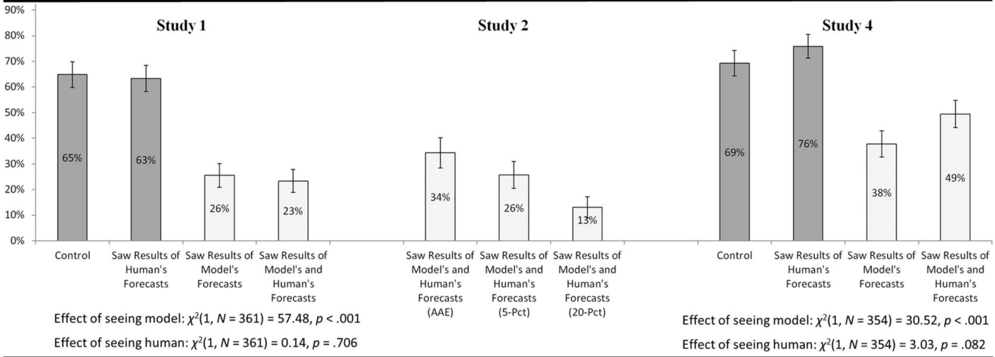
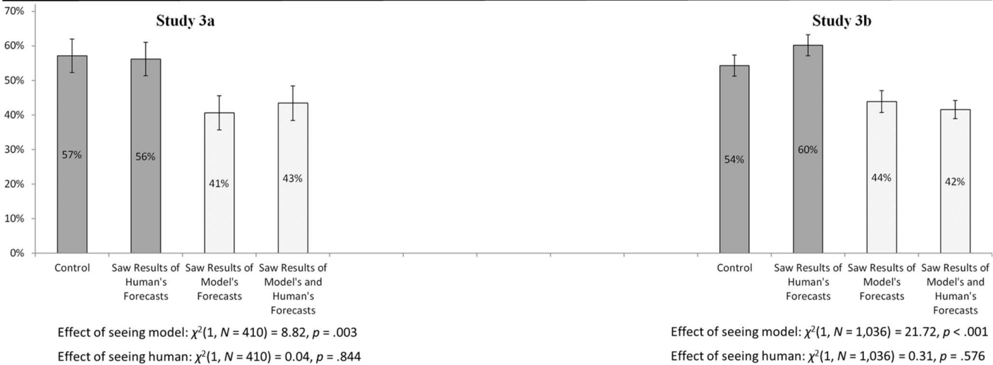
- Across five studies, seeing the algorithm perform reduced participants’ likelihood of choosing it over a human forecaster. In the model-and-human conditions, 610 of 741 participants (83%) saw the model outperform the human, yet these participants were among the least likely to choose the model.
- The model outperformed humans in all five studies. For example, bonuses if choosing model vs. human were Study 1: $1.78 vs. $1.38; Study 2: $1.77 vs. $1.09; Study 3a: $0.48 vs. $0.31; Study 3b: $0.49 vs. $0.30; Study 4: $1.79 vs. $1.38. Human forecasters produced 15–29% more error in the MBA task and 90–97% more error in the airline-passenger task.
- Seeing the model perform significantly decreased confidence in the model’s forecasts in all four studies where this was tested, whereas seeing the human perform significantly decreased confidence in the human only in Study 4. Confidence in the model’s forecasts significantly mediated the effect of seeing the model perform on choosing the model; confidence in the human did not.
- In Study 2, participants paid for forecasts within 20 percentiles were less likely to choose the model than those paid within 5 percentiles, χ²(1, N = 139) = 3.56, p = .059, and those paid by average absolute error, χ²(1, N = 136) = 8.56, p = .003; this effect was mediated by confidence in their own forecasts, not confidence in the model’s forecasts.
Methods
- Five studies had participants forecast real outcomes: MBA student success (Studies 1, 2, and 4) or U.S. state rank in airline passengers (Studies 3a and 3b). Participants were assigned to control, human, model, or model-and-human conditions, then chose whether to tie incentivized bonuses to the model or the human forecaster (themselves in Studies 1–3, another participant in Study 4).
- Final samples were Study 1: 361; Study 2: 206; Study 3a: 410; Study 3b: 1,036; Study 4: 354. Studies 1, 2, and 4 were run in the Wharton Behavioral Lab; Studies 3a and 3b used Amazon Mechanical Turk.
- Main analyses compared forecasting performance and choice rates, measured confidence and beliefs, and used binary mediation analyses with Preacher and Hayes’s bootstrapping procedure.
Limitations
- The paper states it did not explore all boundaries of the effect, including whether it would persist if algorithms were many times more accurate than humans, and whether results depend on features shared by the two forecasting tasks.
- The paper states it did not explore how algorithm variations—complexity, transparency, forecaster involvement in construction, and designer expertise—affect algorithm aversion.
- The paper states algorithm aversion is not entirely driven by seeing algorithms err, and it has little to say about how best to reduce aversion among those who have seen an algorithm err. The text also cautions that cross-experiment comparisons should be made cautiously.
Model-written summary. Check it against the paper before relying on it.
Integrity signals
Registry
Cites
Statistics
Figures
Verification
Claims the paper makes
0 Valid · 2 Not valid · 16 Not checked · 90 Own results and interpretations
A result the paper reports from its own data — it cites no other source for it, so there is none to check. The quote shows it is in the paper.
In the paper
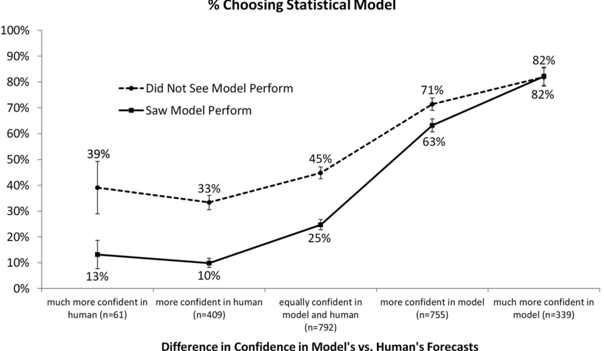
“the majority of people who were equally confident in the model's and human's forecasts chose to tie their bonuses to the human's forecasts, particularly when they had seen the model perform.”
plainstates an association- Asserted: passes — The authors put it forward as true.
- Checkable: passes — It can be checked against evidence.
- Load-bearing: passes — The paper’s conclusions depend on it.
- Based: passes — The paper gives a reason why it holds.
A result the paper reports from its own data — it cites no other source for it, so there is none to check. The quote shows it is in the paper.
In the paper
“Consistent with research on the adoption of decision aids (see Highhouse, 2008), participants thought that the human forecasters were better than the model at getting better with practice, learning from mistakes, and finding underappreciated candidates.”
plain- Asserted: passes — The authors put it forward as true.
- Checkable: passes — It can be checked against evidence.
- Load-bearing: passes — The paper’s conclusions depend on it.
- Based: passes — The paper gives a reason why it holds.
A result the paper reports from its own data — it cites no other source for it, so there is none to check. The quote shows it is in the paper.
In the paper
“Our studies show that this resistance at least partially arises from greater intolerance for error from algorithms than from humans.”
plainstates a possible cause- Asserted: passes — The authors put it forward as true.
- Checkable: passes — It can be checked against evidence.
- Load-bearing: passes — The paper’s conclusions depend on it.
- Based: passes — The paper gives a reason why it holds.
A result the paper reports from its own data — it cites no other source for it, so there is none to check. The quote shows it is in the paper.
In the paper
“Participants rightfully thought that the model was better than human forecasters at avoiding obvious mistakes, appropriately weighing various attributes, and consistently weighing information.”
plain- Asserted: passes — The authors put it forward as true.
- Checkable: passes — It can be checked against evidence.
- Load-bearing: unclear — It is unclear whether the paper’s conclusions depend on it.
- Based: passes — The paper gives a reason why it holds.
A result the paper reports from its own data — it cites no other source for it, so there is none to check. The quote shows it is in the paper.
In the paper
“This effect was evident in two distinct domains of judgment, including one in which the human forecasters produced nearly twice as much error as the algorithm.”
plain- Asserted: passes — The authors put it forward as true.
- Checkable: passes — It can be checked against evidence.
- Load-bearing: unclear — It is unclear whether the paper’s conclusions depend on it.
- Based: passes — The paper gives a reason why it holds.
75 more claims
Create a free account to see all 108 claims and to verify the 12 references still open.
- It may state two separate claims as one. 13
- Probably not a substantial claim. 16
Claims other papers make about this one
Each is checked against this paper’s own text: does it say what the citing paper says it does?
The source backs part of the claim, not all of it — or backs it for a different population, condition or comparison.
In the citing paper
“Traditional theorizing assumes trade-offs between trust and skepticism (Dietvorst et al., 2015), automation and engagement (Freeman et al., 2014), or efficiency and depth (Ishowo-Oloko et al., 2019)”
From Pedagogical partnerships with generative AI in higher education: how dual cognitive pathways paradoxically enable transformative learning (2026) · cites this paper as Dietvorst et al., 2015
Experimental — accuracy not yet measuredThe source backs part of the claim, not all of it — or backs it for a different population, condition or comparison.
In the citing paper
“Existing research typically examines trust versus skepticism in human-AI interactions as binary constructs (Dietvorst et al., 2015; Logg et al., 2019), missing the possibility that partnerships might simultaneously activate both vigilant and offloading behaviors.”
From Pedagogical partnerships with generative AI in higher education: how dual cognitive pathways paradoxically enable transformative learning (2026) · cites this paper as Dietvorst et al., 2015
Experimental — accuracy not yet measuredThe source backs part of the claim, not all of it — or backs it for a different population, condition or comparison.
In the citing paper
“It aligns with the theoretical rationale on algorithm aversion (Dietvorst et al. 2015;Hohensinn et al. 2024) and appreciation (Logg et al. 2019), which suggests that people are more likely to accept and trust AI systems when they produce desirable results but become skeptical when outcomes are unfavorable.”
From Holding AI Accountable Like Herding Cats: The Contingent Impact on the Legitimacy of Algorithmic Bureaucracy (2026) · cites this paper as Dietvorst et al. 2015
Experimental — accuracy not yet measuredThe source backs part of the claim, not all of it — or backs it for a different population, condition or comparison.
In the citing paper
“Research on algorithm appreciation and algorithm aversion further suggests that people may either defer to algorithms or reject them depending on prior experience, perceived expertise, and error visibility (Dietvorst et al., 2015; Logg et al., 2019).”
From College students' metacognitive awareness of generative-AI reliance: an experimental study of decision confidence and attribution bias (2026) · cites this paper as Dietvorst et al., 2015
Experimental — accuracy not yet measuredThe source backs part of the claim, not all of it — or backs it for a different population, condition or comparison.
In the citing paper
“Earlier research has mentioned gender, self-confidence, expertise, and general algorithm aversion or appreciation.15,28”
From Appropriate trust in artificial intelligence for the optical diagnosis of colorectal polyps: the role of human/artificial intelligence interaction (2024) · cites this paper as [28]
Experimental — accuracy not yet measured
22 more claims about this paper
Create a free account to see every claim other papers make about this one.
Statistics recomputed
Every reported test result, recomputed from its test statistic and degrees of freedom. A result shows as not adding up only once an independent check has confirmed it.
- Consistentt(360) = 4.98reported p < .001 · recomputed p < .001
“t (360) = 4.98, p < .001”
- Consistentt(204) = 6.26reported p < .001 · recomputed p < .001
“t (204) = 6.26, p < .001”
- Consistentt(405) = 7.73reported p < .001 · recomputed p < .001
“t (405) = 7.73, p < .001”
- Consistentt(353) = 5.11reported p < .001 · recomputed p < .001
“t (353) = 5.11, p < .001”
- Consistentχ²(1) = 39.94reported p < .001 · recomputed p < .001
“χ 2 (1, N = 271) = 39.94, p < .001”
19 more recomputed tests
Create a free account to see every test the Stats check recomputed.
Self-check
Percentages, sums and reported differences re-computed from the paper’s own numbers.
Self-check results appear here once an independent check has confirmed them.
Citations
Cites
Preacher, K. J., & Hayes, A. F. (2008) · Behavior Research Methods · doi:10.3758/brm.40.3.879 · Cited by 34,117 · cited 1×
“We then used Preacher and Hayes’s (2008) bootstrapping procedure to obtain unbiased 95% confidence intervals around the mediated effects.”
Method(2023) · doi:10.1126/science · Cited by 6,063
The trouble with overconfidence.
Moore, D. A., & Healy, P. J. (2008) · Psychological Review · doi:10.1037/0033-295x.115.2.502 · Cited by 2,358
“Clinical versus Actuarial Judgment.”
Dawes, R. M., Faust, D., & Meehl, P. E. (1989) · Science · doi:10.1126/science.2648573 · Cited by 2,298
The robust beauty of improper linear models in decision making.
Dawes, R. M. (1979) · American Psychologist · doi:10.1037/0003-066x.34.7.571 · Cited by 1,966
Preference and belief: Ambiguity and competence in choice under uncertainty
Heath, C., & Tversky, A. (1991) · Journal of Risk and Uncertainty · doi:10.1007/bf00057884 · Cited by 1,654
Clinical versus mechanical prediction: a meta-analysis
Grove, W. M., Zald, D. H., Lebow, B. S., Snitz, B. E., & Nelson, C. (2000) · Psychological Assessment · doi:10.1037/1040-3590.12.1.19 · Cited by 1,640
Grove, W. M., & Meehl, P. E. (1996) · Psychology, Public Policy, and Law · doi:10.1037/1076-8971.2.2.293 · Cited by 1,457 · cited 4×
“…1996), the notion that algorithms cannot properly consider individual targets (Grove & Meehl, 1996), concerns about the ethicality of relying on algorithms to make important decisions (Dawes, 1979), and the presumed inability of algorithms to incorporate qualitative data (Grove & Meehl, 1996).”
BackgroundMethodInfluential(2007) · Cited by 1,133
Competing on analytics: the new science of winning
(2007) · Choice Reviews Online · doi:10.5860/choice.44-6322 · Cited by 941
Research works printed but not linked: 1
- Clark, D. (2012, November 7). How Nate Silver won the 2012 presidential election. Harvard Business Review Blog . Retrieved from http://blogs .hbr.org/cs/2012/11/how\_nate\_silver\_won\_the\_2012\_p.html
Cited by
Items 801–900 of 3,918
Agarwal, R., DUGAS, M. A., & Gao, G. G. (2023) · Journal of Economics & Management Strategy · doi:10.1111/jems.12555 · Cited by 34
Consumers' promotion focus mitigates the negative effects of chatbots on purchase likelihood
Khan, H., Sararueangpong, P., Mathmann, F., & Wang, D. (2023) · Journal of Consumer Behaviour · doi:10.1002/cb.2289 · Cited by 26
Human preferences toward algorithmic advice in a word association task
Bogert, E., Lauharatanahirun, N., & Schecter, A. (2022) · Scientific Reports · doi:10.1038/s41598-022-18638-2 · Cited by 35
Heterogeneity in Algorithm-Assisted Decision-Making: A Case Study in Child Abuse Hotline Screening
Cheng, L., & Chouldechova, A. (2022) · Proceedings of the ACM on Human-Computer Interaction · doi:10.1145/3555101 · Cited by 32
Content Moderation on Social Media: Does It Matter Who and Why Moderates Hate Speech?
Wang, S., & Kim, K. J. (2023) · Cyberpsychology Behavior and Social Networking · doi:10.1089/cyber.2022.0158 · Cited by 29
“14 This may be because individuals lose confidence in algorithmic (compared to human) forecasters more quickly after seeing them make the same mistakes.”
Moylan, R., & Code, J. (2023) · Teachers and Teaching · doi:10.1080/13540602.2023.2263732 · Cited by 28
“…(2019) found that people may prefer algorithmic decisions over those made by humans, especially in relation to numeric and quantifiable judgements, Dietvorst et al. (2015, 2018) discovered that people often feel averse to algorithms when they witness them making errors, and that this aversion may…”
Fairness and Trust in AI Decision-Making: The Role of Human Involvement and Outcome Favorability
Choung, H., David, P., Mahmud, H., & Norcutt, S. (2025) · International Journal of Human-Computer Interaction · doi:10.1080/10447318.2025.2576634 · Cited by 29
“…skepticism persists, as humans are still perceived as more capable of nuanced, empathic judgment in subjective domains (Logg et al., 2019), and algorithmic aversion, the tendency to distrust algorithm following errors, remains a barrier to acceptance (Dietvorst et al., 2015; Mahmud et al., 2022).”
Hybrid forecasting of geopolitical events†
Benjamin, D. M., Morstatter, F., Abbas, A. E., Abeliuk, A., Atanasov, P. D., Bennett, S. T., Beger, A., Birari, S., Budescu, D. V., Catasta, M., et al. (2023) · AI Magazine · doi:10.1002/aaai.12085 · Cited by 44
What algorithmic evaluation fails to deliver: respectful treatment and individualized consideration
Chun, J. S., Cremer, D. D., Oh, E., & Kim, Y. (2024) · Scientific Reports · doi:10.1038/s41598-024-76320-1 · Cited by 26
“Even if algorithms advance to better address potential biases compared to human evaluators 27,28 , they may still be seen as non-human evaluators assessing numerous targets simultaneously.”
BackgroundHan, J., & Ko, D. (2025) · Behavioral Sciences · doi:10.3390/bs15101370 · Cited by 36
Hasan, R. (2025) · American Journal of Interdisciplinary Studies · doi:10.63125/0fd1yb74 · Cited by 30
Effective Generative AI: The Human-Algorithm CentaurPreprint
Saghafian, S. (2023) · SSRN Electronic Journal · doi:10.2139/ssrn.4594780 · Cited by 31
Liao, W., Oh, Y. J., Feng, B., & Zhang, J. (2023) · Communication Research · doi:10.1177/00936502221138427 · Cited by 27
“Existent research has touched effects of artificial agents’ identity (e.g., C. Edwards et al., 2016; A. Edwards et al., 2019; Dietvorst et al., 2015; Ho et al., 2018; Prahl & Swol, 2017, 2017; Spence et al., 2014; also see Fox et al., 2015) but have not yet attended fully to the social…”
BackgroundFrank, D., Chrysochou, P., Mitkidis, P., Otterbring, T., & Ariely, D. (2024) · Technology in Society · doi:10.1016/j.techsoc.2024.102732 · Cited by 30
Design and implementation of an intelligent tutoring system in the view of learner autonomy
Le, H., & Jia, J. (2022) · Interactive Technology and Smart Education · doi:10.1108/itse-12-2021-0210 · Cited by 26
The reputational and ethical consequences of deceptive chatbot use
McGuire, J., Cremer, D. D., Hesselbarth, Y., Schutter, L. D., Mai, K. M., & Hiel, A. V. (2023) · Scientific Reports · doi:10.1038/s41598-023-41692-3 · Cited by 31
Assessing AI receptivity through a persuasion knowledge lens
Watson, J., Valsesia, F., & Segal, S. (2024) · Current Opinion in Psychology · doi:10.1016/j.copsyc.2024.101834 · Cited by 30
Designing an Algorithm-Driven Text Generation System for Personalized and Interactive News Reading
Kim, D., & Lee, J. (2019) · International Journal of Human–Computer Interaction · doi:10.1080/10447318.2018.1437864 · Cited by 20
Understanding model power in social AI
Brandtzæg, P. B., Skjuve, M. B., & Følstad, A. (2024) · AI & Society · doi:10.1007/s00146-024-02053-4 · Cited by 26
“Such aversion was first observed with algorithms (Dietvorst et al. 2015).”
Claure, H., Kim, S., Kizilcec, R. F., & Jung, M. F. (2022) · Computers in Human Behavior · doi:10.1016/j.chb.2022.107628 · Cited by 36
The impact of humans vs. AI recommendation on consumer reactions to products exposure
Mazzù, M. F., Andria, A., Baccelloni, A., & Angelis, M. D. (2025) · Electronic Commerce Research · doi:10.1007/s10660-025-10048-6 · Cited by 31
“For instance, they frequently prefer human forecast - ers over statistical algorithms, even when the algorithm performs better – a pattern observed whether the human forecaster is another person or themselves [15].”
InfluentialBurgess, P. (2021) · AI & Society · doi:10.1007/s00146-021-01170-8 · Cited by 25
Quality perceptions and intended engagement in response to AI-generated and AI-assisted news
Gilardi, F., Lorenzo, S. D., Ezzaini, J., Santa, B., Streiff, B., Zurfluh, E., & Hoes, E. (2026) · Scientific Reports · doi:10.1038/s41598-026-58743-0 · Cited by 28
Hybrid social learning in human-algorithm cultural transmission
Brinkmann, L., Gezerli, D., Kleist, K. V., Müller, T. F., Rahwan, I., & Pescetelli, N. (2022) · Philosophical Transactions of the Royal Society A: Mathematical, Physical and Engineering Sciences · doi:10.1098/rsta.2020.0426 · Cited by 24
Generative AI and Personalized Video AdvertisementsPreprint
Kumar, M., & Kapoor, A. (2023) · Social Science Research Network · doi:10.2139/ssrn.4614118 · Cited by 20
Gutzwiller, R. S., & Reeder, J. (2020) · Human Factors The Journal of the Human Factors and Ergonomics Society · doi:10.1177/0018720820903893 · Cited by 29
Comparing minds and machines: implications for financial stability
Buckmann, M., Haldane, A., & Hüser, A. (2021) · Oxford Review of Economic Policy · doi:10.1093/oxrep/grab017 · Cited by 29
Marano, P., & Li, S. (2023) · Risks · doi:10.3390/risks11010012 · Cited by 32
Bargaining with algorithms: How consumers respond to offers proposed by algorithms versus humans
Shen, Z., & Jin, L. (2024) · Journal of Retailing · doi:10.1016/j.jretai.2024.05.001 · Cited by 26
Rix, J., Berger, B., Heß, T., & Rzepka, C. H. (2025) · Journal of Management Information Systems · doi:10.1080/07421222.2025.2487308 · Cited by 30
“While some studies focus on the emergence of algorithm aversion when algorithms err [8, 25], others find this aversion even before humans become familiar with the algorithm [12, 18, 61].”
InfluentialMachine learning in bail decisions and judges’ trustworthiness
Morin-Martel, A. (2023) · AI & Society · doi:10.1007/s00146-023-01673-6 · Cited by 31
“Another study shows that this extends to the use of algorithms in managerial decisions (Höddinghaus et al. 2021), while a study by Dietvorst et al. (2015) concludes that “people more quickly lose confidence in algorithmic than human forecasters after seeing them make the same mistake.””
BackgroundArtificial intelligence ethics in services: are we paying attention to that?!
Tlili, A., Denden, M., Abed, M., & Huang, R. (2024) · Service Industries Journal · doi:10.1080/02642069.2024.2369322 · Cited by 28
“The fifth blue cluster (e.g. Bonnefon et al., 2016; Dietvorst et al., 2015; Huang & Rust, 2018) discusses the continuous debate of how AI and humans should collaborate to achieve a given service effectively instead of AI simply replacing humans.”
Sun, L., Tang, Y., & Ma, X. (2025) · European Journal of Marketing · doi:10.1108/ejm-02-2023-0082 · Cited by 28
Neumann, M., Niessen, A. S. M., Hurks, P. P. M., & Meijer, R. R. (2023) · International Journal of Selection and Assessment · doi:10.1111/ijsa.12416 · Cited by 27
Commentary on the M5 forecasting competition
Kolassa, S. (2021) · International Journal of Forecasting · doi:10.1016/j.ijforecast.2021.08.006 · Cited by 24
Ahdadou, M., Aajly, A., & Tahrouch, M. (2023) · International Journal of Disclosure and Governance · doi:10.1057/s41310-023-00207-2 · Cited by 26
The Best Decisions Are Not the Best Advice: Making Adherence-Aware Recommendations
Grand-Clément, J., & Pauphilet, J. (2024) · Management Science · doi:10.1287/mnsc.2023.01851 · Cited by 47
Forecast value added in demand planning
Fildes, R. A., Goodwin, P. B., & Baets, S. D. (2024) · International Journal of Forecasting · doi:10.1016/j.ijforecast.2024.07.006 · Cited by 24
Vasiliki, M., Serdaris, P., Antoniadis, I. I., & Spinthiropoulos, K. G. (2025) · Administrative Sciences · doi:10.3390/admsci15110440 · Cited by 34
Judgements of research co-created by generative AI: experimental evidence
Niszczota, P., & Conway, P. J. (2023) · Economics and Business Review/The Poznań University of Economics Review · doi:10.18559/ebr.2023.2.744 · Cited by 27
Taking Advice from ChatGPTPreprint
Zhang, P. (2023) · PsyArXiv (OSF Preprints) · doi:10.31234/osf.io/b53vn · Cited by 26
He, G., Demartini, G., & Gadiraju, U. (2025) · Proceedings of the 2025 CHI Conference on Human Factors in Computing Systems · doi:10.1145/3706598.3713218 · Cited by 23
“However, on tasks entailing potential risks ( e.g., monetary payments or hiring an employee), humans hesitate to trust such AI systems due to loss aversion [96] and algorithmic aversion [13, 19, 40, 71].”
Improving evaluations of advanced robots by depicting them in harmful situations
Grundke, A., Stein, J., & Appel, M. (2022) · Computers in Human Behavior · doi:10.1016/j.chb.2022.107565 · Cited by 27
Preventing algorithm aversion: People are willing to use algorithms with a learning label
Chacon, A., Kausel, E. E., Reyes, T. H., & Trautmann, S. T. (2024) · Journal of Business Research · doi:10.1016/j.jbusres.2024.115032 · Cited by 27
Algorithmic gender bias: investigating perceptions of discrimination in automated decision-making
Kim, S., Oh, P., & Lee, J. (2024) · Behaviour and Information Technology · doi:10.1080/0144929x.2024.2306484 · Cited by 30
“However, observing or experiencing unequal and biased ADM in social contexts could result in immediate re-evaluation that may lead to algorithm aversion or refusal (Dietvorst, Simmons, and Massey 2014).”
To err is human: Bias salience can help overcome resistance to medical AI
Isaac, M. S., Wang, R. J.-H., Napper, L. E., & Marsh, J. K. (2024) · Computers in Human Behavior · doi:10.1016/j.chb.2024.108402 · Cited by 27
Measuring the effect of mental workload and explanations on appropriate AI reliance using EEG
Zhang, Z. T., Argın, S. K., Bilen, M. B., Urgun, D., Deniz, S. M., Liu, Y., & Hassib, M. E. (2024) · Behaviour and Information Technology · doi:10.1080/0144929x.2024.2431055 · Cited by 24
“However, people’s reliance on AI-generated decision recommendations is often inappropriate, with multiple studies observing either underreliance (rejection of correct/beneficial recommendations) [3,4,5] or overreliance (acceptance of incorrect/detrimental recommendations) [6,7,8].”
Jungmann, F., Ziegelmayer, S., Lohöfer, F. K., Metz, S., Müller-Leisse, C., Englmaier, M., Makowski, M. R., Kaissis, G. A., & Braren, R. (2022) · European Radiology · doi:10.1007/s00330-022-09165-9 · Cited by 35
Survey of EU ethical guidelines for commercial AI: case studies in financial services
Huang, J. Y., Gupta, A., & Youn, M. (2021) · AI and Ethics · doi:10.1007/s43681-021-00048-1 · Cited by 25
Beyond Recommendations: From Backward to Forward AI Support of Pilots' Decision-Making Process
Zhang, Z. T., Feger, S. S., Dullenkopf, L., Liao, R., Süsslin, L., Liu, Y., & Butz, A. (2024) · Proceedings of the ACM on Human-Computer Interaction · doi:10.1145/3687024 · Cited by 16
“…(human relies on AI even when it is disadvantageous to do so) [2, 6, 8, 24, 32, 39, 43, 47, 56, 66] and underreliance (human rejects AI even when it would be beneficial to rely on it) [12–14 In practice, AI support often turns out less useful to decision makers than imagined [4, 34, 71].”
BackgroundWeber, R. O., Johs, A. J., Goel, P., & Marques-Silva, J. P. (2024) · AI Magazine · doi:10.1002/aaai.12184 · Cited by 49
Freisinger, E., & Schneider, S. (2024) · European Management Journal · doi:10.1016/j.emj.2024.10.004 · Cited by 30
Al-Asmari, A. S., Alruwaili, R. F., Alotaibi, R. F., Youssef, I. K., & ASKLANY, S. A. (2025) · PLoS ONE · doi:10.1371/journal.pone.0331003 · Cited by 23
“One well-documented psychological pattern influencing trust is algorithm aversion, a phenomenon in which users prefer human judgment over algorithmic recommendations after witnessing AI make errors, even when those algorithms outperform humans on average [3].”
Luo, W., Zhang, Y., & Mu, M. (2025) · Humanities and Social Sciences Communications · doi:10.1057/s41599-025-05607-z · Cited by 31
Hillo, J., Vento, I., & Erkkilä, T. (2026) · Public Administration · doi:10.1111/padm.70028 · Cited by 22
Blind Justice: Algorithmically Masking Race in Charging Decisions
Chohlas-Wood, A., Nudell, J., Yao, K., Lin, Z. (., Nyarko, J., & Goel, S. (2021) · Proceedings of the 2021 AAAI/ACM Conference on AI, Ethics, and Society · doi:10.1145/3461702.3462524 · Cited by 22
My job is a game, and I am the owner: How gamification facilitates self-leadership for gig workers
Mao, M., Zhang, L., Li, J., & Rivkin, W. (2024) · Journal of Business Research · doi:10.1016/j.jbusres.2024.114877 · Cited by 25
Yue, Z., Tuk, M. A., & Klesse, A.-K. (2024) · Journal of the Association for Consumer Research · doi:10.1086/730710 · Cited by 23
“Traditionally, research studying the acceptance of algorithmic advice has construed algorithms as independent entities and utilizes advice originating from humans as the benchmarking condition (e.g., Dietvorst et al. 2015; Castelo et al. 2019).”
BackgroundCheng, X., Zeng, A., Yang, B., Liu, Y., & Zhang, X. (2025) · Electronic Commerce Research and Applications · doi:10.1016/j.elerap.2025.101497 · Cited by 23
Do I Trust a Machine? Differences in User Trust Based on System Performance
Yu, K., Berkovsky, S., Conway, D., Taib, R., Zhou, J. J., & Chen, F. (2018) · Human-computer interaction series · doi:10.1007/978-3-319-90403-0_12 · Cited by 26
The Effect of Medical Artificial Intelligence Innovation Locus on Consumer Adoption of New Products
Huang, X., Wu, X., Cao, X., & Wu, J. (2021) · Technological Forecasting and Social Change · doi:10.1016/j.techfore.2023.122902 · Cited by 25
Editorial: How to deal with the human factor in supply chain management?
Hoberg, K., Thornton, L. M., & Wieland, A. (2020) · International Journal of Physical Distribution & Logistics Management · doi:10.1108/ijpdlm-10-2019-0311 · Cited by 27
Kim, H., Choi, S., & Shin, H. H. (2025) · International Journal of Contemporary Hospitality Management · doi:10.1108/ijchm-04-2024-0549 · Cited by 25
Lim, J. S., Hong, N., & Schneider, E. (2025) · Computers in Human Behavior · doi:10.1016/j.chb.2025.108761 · Cited by 22
Strategic Responses to Algorithmic Recommendations: Evidence from Hotel Pricing
Garcia, D., Tolvanen, J., & Wagner, A. K. (2024) · Management Science · doi:10.1287/mnsc.2022.03740 · Cited by 33
Mori, Y., Kopylov, U., Sinonquel, P., Ebigbo, A., Dekker, E., de Groof, A. J., Ahmad, O. F., Kader, R., Săftoiu, A., Schoon, E. J., et al. (2025) · Endoscopy · doi:10.1055/a-2742-4342 · Cited by 26
“Definition The tendency Mitigation measures”
Mok, L., Nanda, S., & Anderson, A. (2023) · Proceedings of the ACM on Human-Computer Interaction · doi:10.1145/3610100 · Cited by 29
“…provided by algorithmic predictions for computation-intensive tasks [1, 13, 85], people are averse to algorithmic advice even when it offers substantial performance improvements [33, 34, 53], although they occasionally over-rely on algorithms for quantitative tasks requiring expertise [49, 70].”
BackgroundInfluentialCrowdsourcing – A Step Towards Advanced Machine Learning
Abhigna, B. S., Soni, N., & Dixit, S. (2018) · Procedia Computer Science · doi:10.1016/j.procs.2018.05.062 · Cited by 29
Tsai, C.-C., Kim, J. Y., Chen, Q., Rowell, B. E., Yang, X. J., Kontar, R. A., Whitaker, M., & Lester, C. A. (2025) · Journal of Medical Internet Research · doi:10.2196/59946 · Cited by 27
“Conversely, algorithmic aversion reflects the tendency of users to not trust the algorithm’s performance after seeing it make mistakes, even when its performance is better than humans [26].”
Wu, Y., Kim, K. J., & Mou, Y. (2022) · New Media & Society · doi:10.1177/14614448221138072 · Cited by 25
Find the Good. Seek the Unity: A Hidden Markov Model of Human-AI Delegation Dynamics
Liu, J., Yue, W. T., Leung, A. C. M., & Zhang, X. (2022) · MIS Quarterly · doi:10.25300/misq/2024/18232 · Cited by 32
Human Control and Discretion in AI-driven Decision-making in Government
Mitrou, L., Janssen, M., & Loukis, E. (2021) · International Conference on Theory and Practice of Electronic Governance · doi:10.1145/3494193.3494195 · Cited by 39
AI-induced indifference: Unfair AI reduces prosociality
Zhang, R. Z., Kyung, E. J., Longoni, C., Cian, L., & Mrkva, K. (2024) · Cognition · doi:10.1016/j.cognition.2024.105937 · Cited by 28
Kim, S. (2024) · International Journal of Human-Computer Studies · doi:10.1016/j.ijhcs.2024.103387 · Cited by 23
“…approval, acceptance, and appreciation of algorithms and AI, as well as their support for relevant public policies (Choung, David, et al., 2023; Dietvorst et al., 2014; Schiff et al., 2022) The present research also examined whether the perceived pervasiveness of discriminatory AI outcomes…”
BackgroundInfluentialSilber, D., Hoffmann, A. O. I., & Belli, A. (2025) · International Journal of Bank Marketing · doi:10.1108/ijbm-10-2024-0647 · Cited by 25
Zhang, W.-Z., & Lian, R. (2025) · BMC Psychology · doi:10.1186/s40359-025-02741-w · Cited by 24
“” Research has shown that people have a high sensitivity to errors made by AI algorithms and a low tolerance for them [13, 46].”
Hudecek, M. F. C., Lermer, E., Gaube, S., Cecil, J., Heiss, S. F., & Batz, F. (2024) · Computers in Human Behavior Artificial Humans · doi:10.1016/j.chbah.2024.100046 · Cited by 23
“Negative attitudes toward AI are reflected by the so-called algorithm aversion described by Dietvorst et al. (2015).”
BackgroundGovernance of High-Risk AI Systems in Healthcare and Credit Scoring
Bartsch, S. C., Behn, O., Benlian, A., Brownsword, R., Bücker, S., Düwell, M., Formánek, N., Jungtäubl, M., Leyer, M., Richter, A., et al. (2025) · Business & Information Systems Engineering · doi:10.1007/s12599-025-00944-4 · Cited by 30
“Minor mistakes made by AI can provoke stronger negative reactions than similar mistakes made by humans, as people often hold AI to a higher standard (Dietvorst et al. 2015).”
Knowing (Not) to Know: Explainable Artificial Intelligence and Human Metacognition
von Zahn, M., Liebich, L., Jussupow, E., Hinz, O. F., & Bauer, K. (2025) · Information Systems Research · doi:10.1287/isre.2024.1431 · Cited by 39
Giraldi, L., Rossi, L., & Rudawska, E. D. (2024) · Journal of Information Science · doi:10.1177/01655515241293775 · Cited by 24
Made With AI: Consumer Engagement With Social Media Containing AI Disclosures
Carney, S., Riveros, I., & Tully, S. M. (2026) · Journal of Consumer Research · doi:10.1093/jcr/ucag013 · Cited by 29
Artificial Intelligence in Marketing and Consumer Behavior Research
Kim, T., Usman, U., Garvey, A. M., & Duhachek, A. (2023) · Foundations and Trends® in Marketing · doi:10.1561/1700000078 · Cited by 27
Student reactions to AI versus human feedback in teamwork skills assessment
Kotlyar, I., & Krasman, J. (2025) · International Journal of Educational Technology in Higher Education · doi:10.1186/s41239-025-00555-9 · Cited by 21
“This is consistent with algorithm aversion (Dietvorst et al., 2015), which reflects users’ reluctance to trust algorithmic judgments even when they are accurate and may be exacerbated by perceived lack of social presence, emotional warmth, or perceived authenticity in AI communication (Dzindolet et…”
InfluentialKaptchuk, G., Goldstein, D. G., Hargittai, E., Hofman, J. M., & Redmiles, E. M. (2022) · Digital Threats Research and Practice · doi:10.1145/3488307 · Cited by 23
Algorithmic risk assessment in the hands of humans
Stevenson, M. T., & Doleac, J. L. (2024) · American Economic Journal: Economic Policy · doi:10.1257/pol.20220620 · Cited by 21
The Managerial Effects of Algorithmic Fairness Activism
Cowgill, B., Dell’Acqua, F., & Matz, S. (2020) · AEA Papers and Proceedings · doi:10.1257/pandp.20201035 · Cited by 21
Reducing prejudice with counter‐stereotypical AI
Hermann, E., De Freitas, J., & Puntoni, S. (2025) · Consumer Psychology Review · doi:10.1002/arcp.1102 · Cited by 21
Reinecke, S. (2020) · Springer eBooks · doi:10.1007/978-3-658-31563-4_22 · Cited by 21
Ben-David, D., & Sade, O. (2019) · SSRN Electronic Journal · doi:10.2139/ssrn.3361710 · Cited by 31
Goodwin, P. B., Moritz, B. B., & Siemsen, E. (2018) · Wiley eBooks · doi:10.1002/9781119138341.ch12 · Cited by 27
AI in medical diagnosis: A contextualised study of patient motivations and concerns
Hajiheydari, N., Delgosha, M. S., & Saheb, T. (2025) · Social Science & Medicine · doi:10.1016/j.socscimed.2025.117850 · Cited by 22
We Have Been Assimilated: Some Principles for Thinking About Algorithmic Systems
Edwards, P. N. (2018) · IFIP advances in information and communication technology · doi:10.1007/978-3-030-04091-8_3 · Cited by 24
Wang, D., & Chen, G. (2024) · IEEE Transactions on Education · doi:10.1109/te.2024.3421606 · Cited by 20
“This phenomenon is often observed in the context of decision-making under uncertainty, where individuals exhibit a reluctance to trust algorithmic recommendations over human judgment [20].”
Do Teachers Consider Advice? On the Acceptance of Computerized Expert Models
Kaufmann, E., & Budescu, D. V. (2019) · Journal of Educational Measurement · doi:10.1111/jedm.12251 · Cited by 26
Perceptions of AI engaging in human expression
Bower, A. H., & Steyvers, M. (2021) · Scientific Reports · doi:10.1038/s41598-021-00426-z · Cited by 24
An interdisciplinary perspective on AI-supported decision making in medicine
Ammeling, J., Aubreville, M., Fritz, A., Kießig, A., Krügel, S., & Uhl, M. (2024) · Technology in Society · doi:10.1016/j.techsoc.2024.102791 · Cited by 23
Ruwe, T., & Kuklick, L. (2025) · British Journal of Educational Technology · doi:10.1111/bjet.70011 · Cited by 22
Wang, X., Chen, L., & Yin, M. (2023) · International Joint Conference on Artificial Intelligence · doi:10.24963/ijcai.2023/343 · Cited by 27
“However, they seldom lead to a team that outperforms both humans and AI, possibly due to decision makers’ inappropriate reliance on AI recommendations [Dietvorst et al. , 2015; Buc¸inca et al. , 2021].”
BackgroundComparing preferences for skin cancer screening: AI-enabled app vs dermatologist
Gaube, S., Biebl, I., Engelmann, M. K. M., Kleine, A., & Lermer, E. (2024) · Social Science & Medicine · doi:10.1016/j.socscimed.2024.116871 · Cited by 21
Signaling transparency in the era of artificial intelligence
Wang, F., López, C., & Okazaki, S. (2025) · Internet Research · doi:10.1108/intr-11-2023-1041 · Cited by 27
Metadata
- Authors
- Dietvorst, B. J., Simmons, J. P., & Massey, C.
- Affiliations
- University of Pennsylvania (US)
- Venue
- Journal of Experimental Psychology: General
- Published
- 2015
- Volume
- 144
- Issue
- 1
- Pages
- 114-126
- ISSN
- 0096-3445 (ISSN-L)
- 1939-2222
- OpenAlex
- W3125633690
- Cited by
- 3,232
- References
- 22
- Citations by year
- 2026: 1025 · 2025: 563 · 2024: 445 · 2023: 404 · 2022: 266 · 2021: 216 · 2020: 137 · 2019: 88 · 2018: 41 · 2017: 26 · 2016: 14 · 2015: 5
- FWCI
- 13.96
- Type
- journal article
- Language
- en
- Open access
- green
- doi.org
- Locations
- Journal of Experimental Psychology General (publishedVersion)
- SSRN Electronic Journal (publishedVersion)
- PubMed (publishedVersion)
- ScholarlyCommons (University of Pennsylvania) (submittedVersion)
- Funders
- Wharton Behavioral Laboratory
- Wharton Risk Center Ackoff Doctoral Student Fellowship
- Topics
- Social Sciences › Decision Sciences › General Decision Sciences › Decision-Making and Behavioral Economics
- Social Sciences › Decision Sciences › Management Science and Operations Research › Forecasting Techniques and Applications
- Social Sciences › Human Factors and Ergonomics › Human-Automation Interaction and Safety
- Keywords
- algorithm aversion, trust in algorithms, prediction confidence, evidence-based algorithm, decision-making
- MeSH terms
- Algorithms, Avoidance Learning, Culture, Decision Making, Female, Forecasting, Humans, Male, Motivation, Comprehension, Young Adult
About these checks
Registry, retraction, Cites and statistics results are computed, not judged, with one exception: a printed reference that no index lists is read once by a model before it counts as a citation error. Claims are extracted by a model and kept only when their quote appears verbatim in the text; each cited source is then checked, with a model’s help, for whether it says what the claim relies on. Those verdicts can be wrong — read the claim’s quote and the cited source before relying on one.
A language model drew the claims from the paper on 2026-11-14, under version 3 of the claim definition (model deepseek-v4.1-flash, prompt extract-v3).
A second model labelled each claim on 2026-11-14 (model jev-1.13-20260917, definition revision gold-guideline-v0.2).
Statistics and arithmetic are recomputed, not judged.
Confidence bands are shown only for fields calibrated on our annotated test set. None is calibrated yet, so no band is shown.
What counts as a claim ›How we measure confidence ›How we check this ›
Are you an author, or do you see a problem with this page? Request a review
Data sources
Bibliographic data: Semantic Scholar, OpenAlex, Crossref.
Contains information from the Semantic Scholar Academic Graph Datasets, made available under the ODC Attribution License (ODC-BY 1.0).
Semantic Scholar’s data is described in: Kinney, R., et al. (2023). The Semantic Scholar Open Data Platform. arXiv:2301.10140.
