

Comprehensive molecular characterization of human colon and rectal cancer
Open accessThe DOI matches its Crossref record; 47 of the 49 references it cites were found in a registry or an index.
Abstract
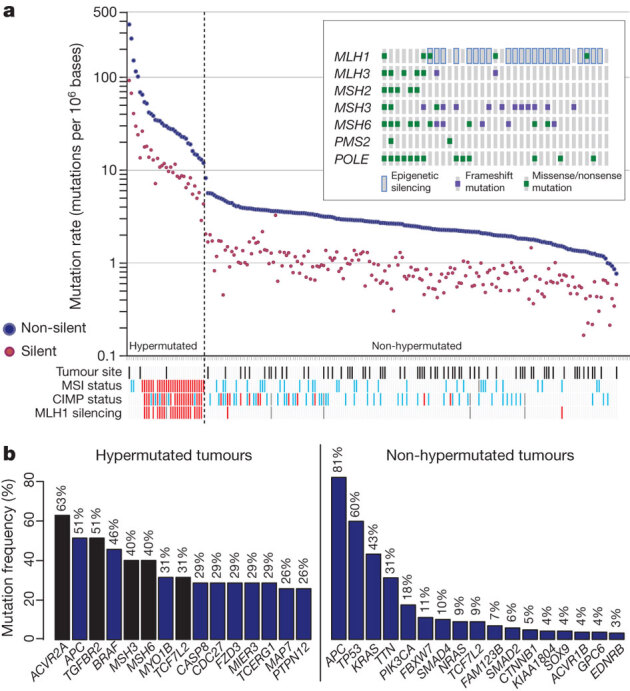
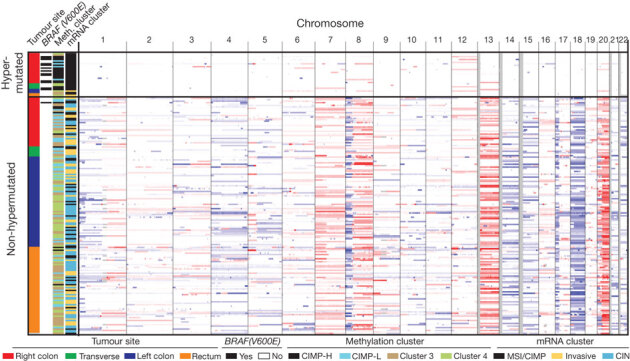
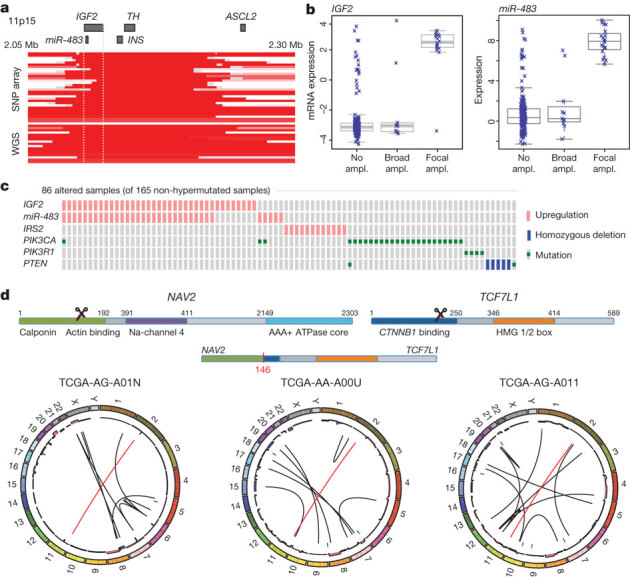
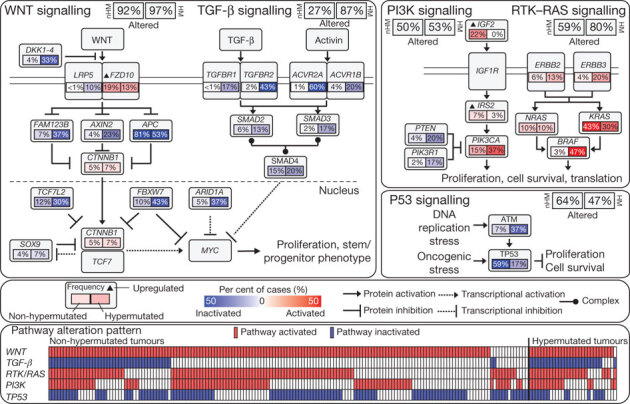
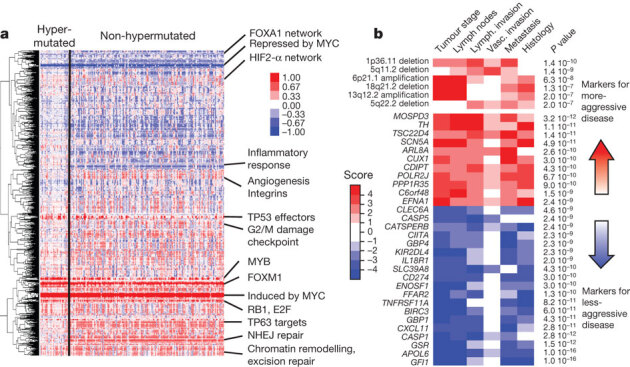
To characterize somatic alterations in colorectal carcinoma, we conducted a genome-scale analysis of 276 samples, analysing exome sequence, DNA copy number, promoter methylation and messenger RNA and microRNA expression. A subset of these samples (97) underwent low-depth-of-coverage whole-genome sequencing. In total, 16% of colorectal carcinomas were found to be hypermutated: three-quarters of these had the expected high microsatellite instability, usually with hypermethylation and MLH1 silencing, and one-quarter had somatic mismatch-repair gene and polymerase ε (POLE) mutations. Excluding the hypermutated cancers, colon and rectum cancers were found to have considerably similar patterns of genomic alteration. Twenty-four genes were significantly mutated, and in addition to the expected APC, TP53, SMAD4, PIK3CA and KRAS mutations, we found frequent mutations in ARID1A, SOX9 and FAM123B. Recurrent copy-number alterations include potentially drug-targetable amplifications of ERBB2 and newly discovered amplification of IGF2. Recurrent chromosomal translocations include the fusion of NAV2 and WNT pathway member TCF7L1. Integrative analyses suggest new markers for aggressive colorectal carcinoma and an important role for MYC-directed transcriptional activation and repression. The Cancer Genome Atlas consortium reports on their genome-wide characterization of somatic alterations in colorectal cancer; in addition to revealing a remarkably consistent pattern of genomic alteration, with 24 genes being significantly mutated, the study identifies new targets for therapeutic intervention and suggests an important role for MYC-directed transcriptional activation and repression. The Cancer Genome Atlas consortium reports on their genome-wide characterization of somatic alterations in colorectal carcinoma. Combined analysis of exome sequence data, DNA copy number, promoter methylation, messenger RNA and microRNA expression, as well as low-coverage whole-genome sequencing reveal that 16% of these carcinomas have hypermutation. Of these, three-quarters have the expected high microsatellite instability, but the rest have somatic mismatch repair gene mutations. The data reveal a remarkably consistent pattern of genomic alteration, with 24 genes being significantly mutated. As well as identifying new biomarkers for aggressive colorectal carcinoma, the data imply an important role for MYC-directed transcriptional activation and repression.
Overview
The claims and statistics of this paper haven’t been checked yet.
Free: it reads the open-access text and checks the first 5 claims that cite a source we can check. Create a free account to check every claim.
Integrity signals
Registry
Cites
Statistics
Figures
Verification
Claims the paper makes
The claims and statistics of this paper haven’t been checked yet.
Free: it reads the open-access text and checks the first 5 claims that cite a source we can check. Create a free account to check every claim.
Claims other papers make about this one
Each is checked against this paper’s own text: does it say what the citing paper says it does?
The source backs part of the claim, not all of it — or backs it for a different population, condition or comparison.
In the citing paper
“KRAS G12V had an increased rate of comutation with TCF7L2, which encodes TCF4, a regulator of Wnt signaling often dysregulated in COAD49–51, specifically the R488C mutation.”
From The origins and genetic interactions of KRAS mutations are allele- and tissue-specific (2021) · cites this paper as [49]
Experimental — accuracy not yet measuredThe source backs part of the claim, not all of it — or backs it for a different population, condition or comparison.
In the citing paper
“PI3K α is both a key regulator and effector of KRAS-dependent signaling and is also activated through mutations involving the PIK3CA gene locus in colorectal cancer, including mutations co-occurring with KRAS [19].”
From Anti-tumor efficacy of a potent and selective non-covalent KRASG12D inhibitor (2022) · cites this paper as [19]
Experimental — accuracy not yet measuredThe source backs part of the claim, not all of it — or backs it for a different population, condition or comparison.
In the citing paper
“Approximately 55% of colorectal cancers (CRCs) are driven by mutational activation of KRAS, BRAF, NRAS, and thus are hard-wired to oncogenic RAS/RAF/MEK/ERK pathway signaling [1–3].”
From An integrative gene expression signature analysis identifies CMS4 KRAS-mutated colorectal cancers sensitive to combined MEK and SRC targeted therapy (2022) · cites this paper as [2]
Experimental — accuracy not yet measuredThe source backs part of the claim, not all of it — or backs it for a different population, condition or comparison.
In the citing paper
“TALENs targeting position 1320 of the APC coding sequence (Fig 3A), a known hotspot commonly mutated in FAP patients [2].”
From Modeling APC mutagenesis and familial adenomatous polyposis using human iPS cells (2018) · cites this paper as [2]
Experimental — accuracy not yet measuredThe source backs part of the claim, not all of it — or backs it for a different population, condition or comparison.
In the citing paper
“which represent ~10–11% of all CRCs (Network, 2012)”
From A Landscape of Therapeutic Cooperativity in KRAS Mutant Cancers Reveals Principles for Controlling Tumor Evolution (2017) · cites this paper as Network, 2012
Experimental — accuracy not yet measured
6 more claims about this paper
Create a free account to see every claim other papers make about this one.
Self-check
Percentages, sums and reported differences re-computed from the paper’s own numbers.
The self-check needs the paper’s full text.
Citations
Cites
Integrated genomic analyses of ovarian carcinoma
Perou, C. M. (2019) · Carolina Digital Repository (University of North Carolina at Chapel Hill) · doi:10.17615/hvp3-wg08 · Cited by 7,925
Comprehensive genomic characterization defines human glioblastoma genes and core pathways
The Cancer Genome Atlas Research Network (2008) · Nature · doi:10.1038/nature07385 · Cited by 7,735
Self-citationUmar, A., Boland, C. R., Terdiman, J. P., Syngal, S., Chapelle, A. D. L., Ruschoff, J., Fishel, R., Lindor, N. M., Burgart, L. J., Hamelin, R., et al. (2004) · JNCI Journal of the National Cancer Institute · doi:10.1093/jnci/djh034 · Cited by 3,183
The Consensus Coding Sequences of Human Breast and Colorectal Cancers
Sjöblom, T., Jones, S., Wood, L. D., Parsons, D. W., Lin, J., Barber, T. D., Mandelker, D., Leary, R. J., Ptak, J., Silliman, N., et al. (2006) · Science · doi:10.1126/science.1133427 · Cited by 3,169
The Genomic Landscapes of Human Breast and Colorectal Cancers
Wood, L. D., Parsons, D. W., Jones, S., Lin, J., Sjöblom, T., Leary, R. J., Shen, D., Boca, S. M., Barber, T., Ptak, J., et al. (2007) · Science · doi:10.1126/science.1145720 · Cited by 2,833
Clues to the Pathogenesis of Familial Colorectal Cancer
Aaltonen, L. A., Peltomäki, P., Leach, F. S., Sistonen, P., Pylkkänen, L., Mecklin, J.-P., Järvinen, H., Powell, S. M., Jen, J., Hamilton, S. R., et al. (1993) · Science · doi:10.1126/science.8484121 · Cited by 2,710
Ionov, Y., Peinado, M. A., Malkhosyan, S., Shibata, D., & Perucho, M. (1993) · Nature · doi:10.1038/363558a0 · Cited by 2,708
TGFβ Signaling in Growth Control, Cancer, and Heritable Disorders
Massagué, J., Blain, S. W., & Lo, R. S. (2000) · Cell · doi:10.1016/s0092-8674(00)00121-5 · Cited by 2,385
Landon, M., Saam, J., Brown, K. L., Moyes, K., Evans, B., & Wenstrup, R. (2015) · Oncology · doi:10.1159/000430097 · Cited by 1,939
Molecular Genetics of Colorectal Cancer
Fearon, E. R. (2011) · Annual Review of Pathology: Mechanisms of Disease · doi:10.1146/annurev-pathol-011110-130235 · Cited by 1,805
Cited by
Items 601–700 of 1,135
Multi-region exome sequencing reveals genomic evolution from preneoplasia to lung adenocarcinoma
Hu, X., Fujimoto, J., Ying, L., Fukuoka, J., Ashizawa, K., Sun, W., Reuben, A., Chow, C.-W., McGranahan, N., Chen, R., et al. (2019) · Nature Communications · doi:10.1038/s41467-019-10877-8 · Cited by 173
Developmental pathways in colon cancer: Crosstalk between WNT, BMP, Hedgehog and Notch
Bertrand, F. E., Angus, C. W., Partis, W. J., & Sigounas, G. (2012) · Cell Cycle · doi:10.4161/cc.22134 · Cited by 173
Early-onset Colorectal Cancer is Distinct From Traditional Colorectal Cancer
Yeo, H., Betel, D., Abelson, J. S., Zheng, X. E., Yantiss, R., & Shah, M. A. (2017) · Clinical Colorectal Cancer · doi:10.1016/j.clcc.2017.06.002 · Cited by 173
Takeda, H., Kataoka, S., Nakayama, M., Ali, M. A. E., Oshima, H., Yamamoto, D., Park, J.-W., Takegami, Y., An, T., Jenkins, N. A., et al. (2019) · Proceedings of the National Academy of Sciences · doi:10.1073/pnas.1904714116 · Cited by 172
Comprehensive characterization of circular RNAs in ~ 1000 human cancer cell lines
Ruan, H., Xiang, Y., Ko, J., Li, S., Jing, Y., Zhu, X., Ye, Y., Zhang, Z., Mills, T., Feng, J., et al. (2019) · Genome Medicine · doi:10.1186/s13073-019-0663-5 · Cited by 171
HER2 Positivity Predicts Unresponsiveness to EGFR-Targeted Treatment in Metastatic Colorectal Cancer
Sartore-Bianchi, A., Amatu, A., Porcu, L., Ghezzi, S., Lonardi, S., Leone, F., Bergamo, F., Fenocchio, E., Martinelli, E., Borelli, B., et al. (2019) · The Oncologist · doi:10.1634/theoncologist.2018-0785 · Cited by 171
Update on Lynch syndrome genomics
Peltomäki, P. (2016) · Familial Cancer · doi:10.1007/s10689-016-9882-8 · Cited by 171
Geographic and age variations in mutational processes in colorectal cancer
Díaz-Gay, M., dos Santos, W., Moody, S., Kazachkova, M., Abbasi, A., Steele, C. D., Vangara, R., Senkin, S., Wang, J., Fitzgerald, S., et al. (2025) · Nature · doi:10.1038/s41586-025-09025-8 · Cited by 170
“This was first reported in the USA 2 and subsequently observed in Australia, Canada, Japan and multiple European countries 3,4 .”
InfluentialTao, Y., Kang, B., Petkovich, D. A., Bhandari, Y. R., In, J., Stein-O'Brien, G., Kong, X., Xie, W., Zachos, N., Maegawa, S., et al. (2019) · Cancer Cell · doi:10.1016/j.ccell.2019.01.005 · Cited by 170
“human COAD, notwithstanding the strong association between BRAFV600E and CIMP, including frequent mutual exclusivity between BRAFV600E and inactivating APC mutations, there are BRAFV600E COAD cases without CIMP and with APC mutations (TCGA, 2012).”
BackgroundInfluentialDetecting somatic point mutations in cancer genome sequencing data: a comparison of mutation callers
Wang, Q., Jia, P., Li, F., Chen, H., Ji, H., Hucks, D., Dahlman, K. B., Pao, W., & Zhao, Z. (2013) · Genome Medicine · doi:10.1186/gm495 · Cited by 170
Implications of NQO1 in cancer therapy
Oh, E.-T., & Park, H. J. (2015) · BMB Reports · doi:10.5483/bmbrep.2015.48.11.190 · Cited by 170
TCF/LEF Transcription Factors: An Update from the Internet Resources
Hrckulak, D., Kolar, M., Strnad, H., & Korinek, V. (2016) · Cancers · doi:10.3390/cancers8070070 · Cited by 170
Mouse models of colorectal cancer: Past, present and future perspectives
Bürtin, F., Mullins, C. S., & Linnebacher, M. (2020) · World Journal of Gastroenterology · doi:10.3748/wjg.v26.i13.1394 · Cited by 170
Zhou, Y., Wan, G., Spizzo, R., Ivan, C., Mathur, R., Hu, X., Ye, X., Lu, J., Fan, F., Xia, L., et al. (2014) · Molecular Oncology · doi:10.1016/j.molonc.2013.09.004 · Cited by 169
“The role of miR-203 is disease and tissue-type specific; it has anti-oncogenic effect in prostate cancer (Boll et al., 2013; Viticchie et al., 2011) and melanoma (Noguchi et al., 2012).”
BackgroundKwak, E. L., Ahronian, L. G., Siravegna, G., Mussolin, B., Borger, D. R., Godfrey, J. T., Jessop, N. A., Clark, J. W., Blaszkowsky, L. S., Ryan, D. P., et al. (2015) · Cancer Discovery · doi:10.1158/2159-8290.cd-15-0748 · Cited by 169
TNIK inhibition abrogates colorectal cancer stemness
Masuda, M., Uno, Y., Ohbayashi, N., Ohata, H., Mimata, A., Kukimoto-Niino, M., Moriyama, H., Kashimoto, S., Inoue, T., Goto, N., et al. (2016) · Nature Communications · doi:10.1038/ncomms12586 · Cited by 168
Mismatch Repair-Deficient Colorectal Cancer: Building on Checkpoint Blockade
Jin, Z., & Sinicrope, F. A. (2022) · Journal of Clinical Oncology · doi:10.1200/jco.21.02691 · Cited by 168
Non-canonical functions of the RB protein in cancer
Dick, F. A., Goodrich, D. W., Sage, J., & Dyson, N. J. (2018) · Nature Reviews Cancer · doi:10.1038/s41568-018-0008-5 · Cited by 168
González, N., Diabetes Cancer Connect Consortium, Prieto, I., del Puerto-Nevado, L., Portal-Nuñez, S., Ardura, J. A., Corton, M., Fernández-Fernández, B., Aguilera, O., Gomez-Guerrero, C., et al. (2017) · Oncotarget · doi:10.18632/oncotarget.14472 · Cited by 168
Is β-Catenin a Druggable Target for Cancer Therapy?
Cui, C., Zhou, X., Zhang, W., Qu, Y., & Ke, X. (2018) · Trends in Biochemical Sciences · doi:10.1016/j.tibs.2018.06.003 · Cited by 168
The Developing Story of Predictive Biomarkers in Colorectal Cancer
Boussios, S., Ozturk, M., Moschetta, M., Karathanasi, A., Zakynthinakis-Kyriakou, N., Katsanos, K., Christodoulou, D., & Pavlidis, N. (2019) · Journal of Personalized Medicine · doi:10.3390/jpm9010012 · Cited by 168
Inhibitor-Sensitive FGFR2 and FGFR3 Mutations in Lung Squamous Cell Carcinoma
Liao, R. G., Jung, J., Tchaicha, J., Wilkerson, M. D., Sivachenko, A., Beauchamp, E. M., Liu, Q., Pugh, T. J., Pedamallu, C. S., Hayes, D. N., et al. (2013) · Cancer Research · doi:10.1158/0008-5472.can-12-3950 · Cited by 167
Chun, Y. S., Passot, G., Yamashita, S., Nusrat, M., Katsonis, P., Loree, J. M., Conrad, C., Tzeng, C.-W. D., Xiao, L., Aloia, T. A., et al. (2019) · Annals of Surgery · doi:10.1097/sla.0000000000002450 · Cited by 167
Jones, R. P., Sutton, P. A., Evans, J. P., Clifford, R., McAvoy, A., Lewis, J., Rousseau, A., Mountford, R., McWhirter, D., & Malik, H. Z. (2017) · British Journal of Cancer · doi:10.1038/bjc.2017.37 · Cited by 166
VHL Deficiency Drives Enhancer Activation of Oncogenes in Clear Cell Renal Cell Carcinoma
Yao, X., Tan, J., Lim, K. J., Koh, J., Ooi, W. F., Li, Z., Huang, D., Xing, M., Chan, Y. S., Qu, J. Z., et al. (2017) · Cancer Discovery · doi:10.1158/2159-8290.cd-17-0375 · Cited by 166
Aberrant gene expression in mucosa adjacent to tumor reveals a molecular crosstalk in colon cancer
Sanz-Pamplona, R., Berenguer, A., Cordero, D., Molleví, D. G., Crous-Bou, M., Sole, X., Paré-Brunet, L., Guino, E., Salazar, R., Santos, C., et al. (2014) · Molecular Cancer · doi:10.1186/1476-4598-13-46 · Cited by 166
Babur, Ö., Gönen, M., Aksoy, B. A., Schultz, N., Ciriello, G., Sander, C., & Demir, E. (2015) · Genome Biology · doi:10.1186/s13059-015-0612-6 · Cited by 166
Targeted Nanoparticles for Colorectal Cancer
Cisterna, B. A., Kamaly, N., Choi, W. I., Tavakkoli, A., Farokhzad, O. C., & Vilos, C. (2016) · Nanomedicine · doi:10.2217/nnm-2016-0194 · Cited by 166
Inhibiting the inhibitors: Targeting anti-apoptotic proteins in cancer and therapy resistance
Shahar, N., & Larisch, S. (2020) · Drug Resistance Updates · doi:10.1016/j.drup.2020.100712 · Cited by 165
Behdenna, A., Colange, M., Haziza, J., Gema, A., Appé, G., Azencott, C.-A., & Nordor, A. (2023) · BMC Bioinformatics · doi:10.1186/s12859-023-05578-5 · Cited by 165
Mismatch repair deficiency is not sufficient to elicit tumor immunogenicity
Westcott, P. M. K., Muyas, F., Hauck, H., Smith, O. C., Sacks, N. J., Ely, Z. A., Jaeger, A. M., Rideout, W. M., Zhang, D., Bhutkar, A., et al. (2023) · Nature Genetics · doi:10.1038/s41588-023-01499-4 · Cited by 165
“In particular, MMRd is associated with some of the highest TMBs observed in cancer (hypermutation) 11–15 and remarkable response rates to pem-brolizumab 2,5 .”
BackgroundLu, Y., Kweon, S.-S., Tanikawa, C., Jia, W.-H., Xiang, Y.-B., Cai, Q., Zeng, C., Schmit, S. L., Shin, A., Matsuo, K., et al. (2019) · Gastroenterology · doi:10.1053/j.gastro.2018.11.066 · Cited by 165
Large-scale profiling of microRNAs for The Cancer Genome Atlas
Chu, A., Robertson, G., Brooks, D., Mungall, A. J., Birol, I., Coope, R., Ma, Y., Jones, S., & Marra, M. A. (2016) · Nucleic Acids Research · doi:10.1093/nar/gkv808 · Cited by 165
Genome-wide association study of colorectal cancer identifies six new susceptibility loci
Schumacher, F. R., Schmit, S. L., Jiao, S., Edlund, C. K., Wang, H., Zhang, B., Hsu, L., Huang, S.-C., Fischer, C. P., Harju, J. F., et al. (2015) · Nature Communications · doi:10.1038/ncomms8138 · Cited by 165
The Landscape of Somatic Genetic Alterations in Metaplastic Breast Carcinomas
Ng, C. K. Y., Piscuoglio, S., Geyer, F. C., Burke, K. A., Pareja, F., Eberle, C. A., Lim, R. S., Natrajan, R., Riaz, N., Mariani, O., et al. (2017) · Clinical Cancer Research · doi:10.1158/1078-0432.ccr-16-2857 · Cited by 165
Bacolla, A., Tainer, J. A., Vasquez, K. M., & Cooper, D. N. (2016) · Nucleic Acids Research · doi:10.1093/nar/gkw261 · Cited by 164
Germann, M., Zangger, N., Sauvain, M., Sempoux, C., Bowler, A. D., Wirapati, P., Kandalaft, L. E., Delorenzi, M., Tejpar, S., Coukos, G., et al. (2020) · EMBO Molecular Medicine · doi:10.15252/emmm.201910681 · Cited by 164
Boolean Network Model for Cancer Pathways: Predicting Carcinogenesis and Targeted Therapy Outcomes
Fumiã, H. F., & Martins, M. L. (2013) · PLoS ONE · doi:10.1371/journal.pone.0069008 · Cited by 164
A panel of genes methylated with high frequency in colorectal cancer
Mitchell, S. M., Ross, J. P., Drew, H. R., Ho, T., Brown, G. S., Saunders, N. F., Duesing, K. R., Buckley, M. J., Dunne, R., Beetson, I., et al. (2014) · BMC Cancer · doi:10.1186/1471-2407-14-54 · Cited by 164
“In recent TCGA consortium data [34] all but two of the 19 genes (EPB4IL3 and ZSCAN18) show evidence of methylation in cancer.”
BackgroundMethodDNA Hypomethylating Drugs in Cancer Therapy
Sato, T., Issa, J.-P. J., & Kropf, P. (2017) · Cold Spring Harbor Perspectives in Medicine · doi:10.1101/cshperspect.a026948 · Cited by 164
Farrar, J. E., Schuback, H. L., Ries, R. E., Wai, D., Hampton, O. A., Trevino, L. R., Alonzo, T. A., Guidry Auvil, J. M., Davidsen, T. M., Gesuwan, P., et al. (2016) · Cancer Research · doi:10.1158/0008-5472.can-15-1015 · Cited by 163
Measuring cancer evolution from the genome
Graham, T. A., & Sottoriva, A. (2017) · The Journal of Pathology · doi:10.1002/path.4821 · Cited by 163
Ye, Q., Cai, W., Zheng, Y., Evers, B. M., & She, Q.-B. (2014) · Oncogene · doi:10.1038/onc.2013.122 · Cited by 163
Recurrent WNT pathway alterations are frequent in relapsed small cell lung cancer
Wagner, A. H., Devarakonda, S., Skidmore, Z. L., Krysiak, K., Ramu, A., Trani, L., Kunisaki, J., Masood, A., Waqar, S. N., Spies, N. C., et al. (2018) · Nature Communications · doi:10.1038/s41467-018-06162-9 · Cited by 163
A reinforcing HNF4–SMAD4 feed-forward module stabilizes enterocyte identity
Chen, L., Toke, N. H., Luo, S., Vasoya, R. P., Fullem, R. L., Parthasarathy, A., Perekatt, A. O., & Verzi, M. P. (2019) · Nature Genetics · doi:10.1038/s41588-019-0384-0 · Cited by 163
Lee, K.-W., Lee, S. S., Kim, S.-B., Sohn, B. H., Lee, H.-S., Jang, H.-J., Park, Y.-Y., Kopetz, S., Kim, S. S., Oh, S. C., et al. (2015) · Clinical Cancer Research · doi:10.1158/1078-0432.ccr-14-1374 · Cited by 163
Wang, X., & Zhang, B. (2013) · Bioinformatics · doi:10.1093/bioinformatics/btt543 · Cited by 162
Rosty, C., Young, J. P., Walsh, M. D., Clendenning, M., Walters, R. J., Pearson, S., Pavluk, E., Nagler, B., Pakenas, D., Jass, J. R., et al. (2013) · Modern Pathology · doi:10.1038/modpathol.2012.240 · Cited by 162
The cancer COMPASS: navigating the functions of MLL complexes in cancer
Ford, D. J., & Dingwall, A. K. (2015) · Cancer Genetics · doi:10.1016/j.cancergen.2015.01.005 · Cited by 162
Regulation of MYC gene expression by aberrant Wnt/β-catenin signaling in colorectal cancer
Rennoll, S. (2015) · World Journal of Biological Chemistry · doi:10.4331/wjbc.v6.i4.290 · Cited by 162
Ong, P. S., Wang, L. Z., Dai, X., Tseng, S. H., Loo, S. J., & Sethi, G. (2016) · Frontiers in Pharmacology · doi:10.3389/fphar.2016.00395 · Cited by 162
“Such mutation is highly prevalent in cancers of the breast, colon, rectum, lung, ovary, cervix, and endometrium (Shayesteh et al., 1999; Ma et al., 2000; Samuels et al., 2004; Network, 2012a,b, 2013, 2014).”
BRAF-Mutated Colorectal Cancer: Clinical and Molecular Insights
Caputo, F., Santini, C., Bardasi, C., Cerma, K., Casadei-Gardini, A., Spallanzani, A., Andrikou, K., Cascinu, S., & Gelsomino, F. (2019) · International Journal of Molecular Sciences · doi:10.3390/ijms20215369 · Cited by 162
The mutational landscape of phosphorylation signaling in cancer
Reimand, J., Wagih, O., & Bader, G. D. (2013) · Scientific Reports · doi:10.1038/srep02651 · Cited by 162
α-Ketoglutarate attenuates Wnt signaling and drives differentiation in colorectal cancer
Tran, T. Q., Hanse, E. A., Habowski, A. N., Li, H., Ishak Gabra, M. B., Yang, Y., Lowman, X. H., Ooi, A. M., Liao, S. Y., Edwards, R. A., et al. (2020) · Nature Cancer · doi:10.1038/s43018-020-0035-5 · Cited by 161
Evolutionary history of human colitis-associated colorectal cancer
Baker, A.-M., Cross, W., Curtius, K., Al Bakir, I., Choi, C.-H. R., Davis, H. L., Temko, D., Biswas, S., Martinez, P., Williams, M. J., et al. (2019) · Gut · doi:10.1136/gutjnl-2018-316191 · Cited by 161
Neoadjuvant Rectal (NAR) Score: a New Surrogate Endpoint in Rectal Cancer Clinical Trials
George, T. J., Allegra, C. J., & Yothers, G. (2015) · Current Colorectal Cancer Reports · doi:10.1007/s11888-015-0285-2 · Cited by 161
Dunne, P. D., McArt, D. G., Bradley, C. A., O'Reilly, P. G., Barrett, H. L., Cummins, R., O'Grady, T., Arthur, K., Loughrey, M. B., Allen, W. L., et al. (2016) · Clinical Cancer Research · doi:10.1158/1078-0432.ccr-16-0032 · Cited by 161
Danilova, L., Wang, H., Sunshine, J., Kaunitz, G. J., Cottrell, T. R., Xu, H., Esandrio, J., Anders, R. A., Cope, L., Pardoll, D. M., et al. (2016) · Proceedings of the National Academy of Sciences · doi:10.1073/pnas.1607836113 · Cited by 161
Kong, X., Chen, J., Xie, W., Brown, S. M., Cai, Y., Wu, K., Fan, D., Nie, Y., Yegnasubramanian, S., Tiedemann, R. L., et al. (2019) · Cancer Cell · doi:10.1016/j.ccell.2019.03.003 · Cited by 161
Dissecting the Dual Nature of Hyaluronan in the Tumor Microenvironment
Liu, M., Tolg, C., & Turley, E. (2019) · Frontiers in Immunology · doi:10.3389/fimmu.2019.00947 · Cited by 161
Brennan, C. A., Clay, S. L., Lavoie, S. L., Bae, S., Lang, J. K., Fonseca-Pereira, D., Rosinski, K. G., Ou, N., Glickman, J. N., & Garrett, W. S. (2021) · Gut Microbes · doi:10.1080/19490976.2021.1987780 · Cited by 161
Kim, T.-M., Jung, S.-H., An, C. H., Lee, S. H., Baek, I.-P., Kim, M. S., Park, S.-W., Rhee, J.-K., Lee, S.-H., & Chung, Y.-J. (2015) · Clinical Cancer Research · doi:10.1158/1078-0432.ccr-14-2413 · Cited by 161
Drug Resistance in Colorectal Cancer: From Mechanism to Clinic
Wang, Q., Shen, X., Chen, G., & Du, J. (2022) · Cancers · doi:10.3390/cancers14122928 · Cited by 160
Novellasdemunt, L., Foglizzo, V., Cuadrado, L., Antas, P., Kucharska, A., Encheva, V., Snijders, A. P., & Li, V. S. W. (2017) · Cell Reports · doi:10.1016/j.celrep.2017.09.072 · Cited by 160
“Its loss initiates adenoma formation through constitutive Wnt activation (The Cancer Genome Atlas Network, 2012; Nagase and Nakamura, 1993).”
BackgroundWang, J., Ma, Z., Carr, S. A., Mertins, P., Zhang, H., Zhang, Z., Chan, D. W., Ellis, M. J. C., Townsend, R. R., Smith, R. D., et al. (2017) · Molecular & Cellular Proteomics · doi:10.1074/mcp.m116.060301 · Cited by 160
Ardini, E., Bosotti, R., Borgia, A. L., De Ponti, C., Somaschini, A., Cammarota, R., Amboldi, N., Raddrizzani, L., Milani, A., Magnaghi, P., et al. (2014) · Molecular Oncology · doi:10.1016/j.molonc.2014.06.001 · Cited by 157
Significance of Streptococcus gallolyticus subsp. gallolyticus Association With Colorectal Cancer
Pasquereau-Kotula, E., Martins, M., Aymeric, L., & Dramsi, S. (2018) · Frontiers in Microbiology · doi:10.3389/fmicb.2018.00614 · Cited by 160
Genomic and transcriptomic determinants of response to neoadjuvant therapy in rectal cancer
Chatila, W. K., Kim, J. K., Walch, H., Marco, M. R., Chen, C.-T., Wu, F., Omer, D. M., Khalil, D. N., Ganesh, K., Qu, X., et al. (2022) · Nature Medicine · doi:10.1038/s41591-022-01930-z · Cited by 156
Saleh, M. N., Patel, M. R., Bauer, T. M., Goel, S., Falchook, G. S., Shapiro, G. I., Chung, K. Y., Infante, J. R., Conry, R. M., Rabinowits, G., et al. (2021) · Clinical Cancer Research · doi:10.1158/1078-0432.ccr-21-0715 · Cited by 159
TGFβ signaling directs serrated adenomas to the mesenchymal colorectal cancer subtype
Fessler, E., Drost, J., van Hooff, S. R., Linnekamp, J. F., Wang, X., Jansen, M., De Sousa E Melo, F., Prasetyanti, P. R., IJspeert, J. E., Franitza, M., et al. (2016) · EMBO Molecular Medicine · doi:10.15252/emmm.201606184 · Cited by 159
Harnessing the potential of epigenetic therapy to target solid tumors
Ahuja, N., Easwaran, H., & Baylin, S. B. (2014) · Journal of Clinical Investigation · doi:10.1172/jci69736 · Cited by 159
Prognostic genome and transcriptome signatures in colorectal cancers
Nunes, L., Li, F., Wu, M., Luo, T., Hammarström, K., Torell, E., Ljuslinder, I., Mezheyeuski, A., Edqvist, P.-H., Löfgren-Burström, A., et al. (2024) · Nature · doi:10.1038/s41586-024-07769-3 · Cited by 159
Subgroups and prognostication in stage III colon cancer: future perspectives for adjuvant therapy
Auclin, E., Zaanan, A., Vernerey, D., Douard, R., Gallois, C., Laurent-Puig, P., Bonnetain, F., & Taieb, J. (2017) · Annals of Oncology · doi:10.1093/annonc/mdx030 · Cited by 159
ARID1A loss in cancer: Towards a mechanistic understanding
Mathur, R. (2018) · Pharmacology & Therapeutics · doi:10.1016/j.pharmthera.2018.05.001 · Cited by 159
Overview of the oncogenic signaling pathways in colorectal cancer: Mechanistic insights
Farooqi, A. A., de la Roche, M., Djamgoz, M. B. A., & Siddik, Z. H. (2019) · Seminars in Cancer Biology · doi:10.1016/j.semcancer.2019.01.001 · Cited by 156
Zhai, J., Chen, H., Wong, C. C., Peng, Y., Gou, H., Zhang, J., Pan, Y., Chen, D., Lin, Y., Wang, S., et al. (2023) · Gastroenterology · doi:10.1053/j.gastro.2023.04.032 · Cited by 158
Radiologic and Genomic Evolution of Individual Metastases during HER2 Blockade in Colorectal Cancer
Siravegna, G., Lazzari, L., Crisafulli, G., Sartore-Bianchi, A., Mussolin, B., Cassingena, A., Martino, C., Lanman, R. B., Nagy, R. J., Fairclough, S., et al. (2018) · Cancer Cell · doi:10.1016/j.ccell.2018.06.004 · Cited by 159
Characterization of the Usage of the Serine Metabolic Network in Human Cancer
Mehrmohamadi, M., Liu, X., Shestov, A. A., & Locasale, J. W. (2014) · Cell Reports · doi:10.1016/j.celrep.2014.10.026 · Cited by 157
Integrated Multiregional Analysis Proposing a New Model of Colorectal Cancer Evolution
Uchi, R., Takahashi, Y., Niida, A., Shimamura, T., Hirata, H., Sugimachi, K., Sawada, G., Iwaya, T., Kurashige, J., Shinden, Y., et al. (2016) · PLOS Genetics · doi:10.1371/journal.pgen.1005778 · Cited by 157
Cancer resistance to therapies against the EGFR-RAS-RAF pathway: The role of MEK
Martinelli, E., Morgillo, F., Troiani, T., & Ciardiello, F. (2017) · Cancer Treatment Reviews · doi:10.1016/j.ctrv.2016.12.001 · Cited by 146
Li, H., Rokavec, M., Jiang, L., Horst, D. A., & Hermeking, H. (2017) · Gastroenterology · doi:10.1053/j.gastro.2017.04.017 · Cited by 166
Microsatellite instability in colorectal cancer
Nojadeh, J. N., Sharif, S. B., & Sakhinia, E. (2018) · PubMed · doi:10.17179/excli2017-948 · Cited by 131
Mechanisms of Resistance to KRASG12C-Targeted Therapy
Akhave, N. S., Biter, A. B., & Hong, D. S. (2021) · Cancer Discovery · doi:10.1158/2159-8290.cd-20-1616 · Cited by 156
Cancer Pharmacogenomics: Early Promise, But Concerted Effort Needed
McLeod, H. L. (2013) · Science · doi:10.1126/science.1234139 · Cited by 155
Smedt, L. D., Lemahieu, J., Palmans, S., Govaere, O., Tousseyn, T., Cutsem, E. V., Prenen, H., Tejpar, S., Spaepen, M., Matthijs, G., et al. (2015) · British Journal of Cancer · doi:10.1038/bjc.2015.213 · Cited by 179
McNerney, M. E., Brown, C. D., Wang, X., Bartom, E. T., Karmakar, S., Bandlamudi, C., Yu, S., Ko, J., Sandall, B. P., Stricker, T. P., et al. (2012) · Blood · doi:10.1182/blood-2012-04-426965 · Cited by 175
Tug-of-war between driver and passenger mutations in cancer and other adaptive processes
McFarland, C. D., Mirny, L. A., & Korolev, K. S. (2014) · Proceedings of the National Academy of Sciences · doi:10.1073/pnas.1404341111 · Cited by 156
Yoon, H. H., Tougeron, D., Shi, Q., Alberts, S. R., Mahoney, M. R., Nelson, G. D., Nair, S. G., Thibodeau, S. N., Goldberg, R. M., Sargent, D. J., et al. (2014) · Clinical Cancer Research · doi:10.1158/1078-0432.ccr-13-3140 · Cited by 156
Gallo, L. H., Nelson, K. N., Meyer, A. N., & Donoghue, D. J. (2015) · Cytokine & Growth Factor Reviews · doi:10.1016/j.cytogfr.2015.03.003 · Cited by 166
Esquivel, J., Lowy, A. M., Markman, M. M., Chua, T. C., Pelz, J. O. W., Baratti, D., Baumgartner, J. M., Berri, R. N., Bretcha-Boix, P., D, M. D. M., et al. (2014) · Annals of Surgical Oncology · doi:10.1245/s10434-014-3798-z · Cited by 157
Janakiram, M., Chinai, J. M., Fineberg, S., Fiser, A., Montagna, C., Medavarapu, R., Castano, E., Jeon, H., Ohaegbulam, K. C., Zhao, R., et al. (2015) · Clinical Cancer Research · doi:10.1158/1078-0432.ccr-14-1495 · Cited by 154
Luo, Y., Xie, C., Brocker, C. N., Fan, J., Wu, X., Feng, L., Wang, Q., Zhao, J., Lu, D., Tandon, M., et al. (2019) · Gastroenterology · doi:10.1053/j.gastro.2019.05.057 · Cited by 172
The deubiquitinase USP28 controls intestinal homeostasis and promotes colorectal cancer
Diefenbacher, M. E., Popov, N., Blake, S. M., Schülein-Völk, C., Nye, E., Spencer-Dene, B., Jaenicke, L. A., Eilers, M., & Behrens, A. (2014) · Journal of Clinical Investigation · doi:10.1172/jci73733 · Cited by 153
RAS-MAPK pathway epigenetic activation in cancer: miRNAs in action
Masliah‐Planchon, J., Garinet, S., & Pasmant, É. (2015) · Oncotarget · doi:10.18632/oncotarget.6476 · Cited by 169
Emerging Roles of Wnt Ligands in Human Colorectal Cancer
Nie, X., Liu, H., Liu, L., Wang, Y., & Chen, W. (2020) · Frontiers in Oncology · doi:10.3389/fonc.2020.01341 · Cited by 161
Perturbed BMP signaling and denervation promote muscle wasting in cancer cachexia
Sartori, R., Hagg, A., Zampieri, S., Armani, A., Winbanks, C. E., Viana, L. R., Haidar, M., Watt, K. I., Qian, H., Pezzini, C., et al. (2021) · Science Translational Medicine · doi:10.1126/scitranslmed.aay9592 · Cited by 165
Mutational signatures of DNA mismatch repair deficiency in C. elegans and human cancers
Meier, B., Volkova, N. V., Hong, Y., Schofield, P., Campbell, P. J., Gerstung, M., & Gartner, A. (2018) · Genome Research · doi:10.1101/gr.226845.117 · Cited by 154
Role of MYC-Regulated Long Noncoding RNAs in Cell Cycle Regulation and Tumorigenesis
Kim, T., Jeon, Y.-J., Cui, R., Lee, J.-H., Peng, Y., Kim, S.-H., Tili, E., Alder, H., & Croce, C. M. (2015) · JNCI Journal of the National Cancer Institute · doi:10.1093/jnci/dju505 · Cited by 158
Imamura, Y., Lochhead, P., Yamauchi, M., Kuchiba, A., Qian, Z. R., Liao, X., Nishihara, R., Jung, S., Wu, K., Nosho, K., et al. (2014) · Molecular Cancer · doi:10.1186/1476-4598-13-135 · Cited by 151
Werner syndrome helicase is a selective vulnerability of microsatellite instability-high tumor cells
Lieb, S., Blaha-Ostermann, S., Kamper, E., Rippka, J., Schwarz, C., Ehrenhöfer-Wölfer, K., Schlattl, A., Wernitznig, A., Lipp, J. J., Nagasaka, K., et al. (2019) · eLife · doi:10.7554/elife.43333 · Cited by 148
Metadata
- Authors
- The Cancer Genome Atlas Network
- Affiliations
- Broad Institute (US)
- Corresponding author
- The Cancer Genome Atlas Network
- Venue
- Nature
- Published
- 2012-07-18
- Volume
- 487
- Issue
- 7407
- Pages
- 330-337
- ISSN
- 0028-0836 (ISSN-L)
- 1476-4687
- PMC
- PMC3401966
- OpenAlex
- W2262414037
- Semantic Scholar
- 56321e765211d85a29621551d0df9a1cfc0a78ca
- Cited by
- 8,499
- References
- 49
- Citations by year
- 2026: 389 · 2025: 455 · 2024: 502 · 2023: 591 · 2022: 678 · 2021: 754 · 2020: 736 · 2019: 686 · 2018: 677 · 2017: 673 · 2016: 646 · 2015: 616 · 2014: 578 · 2013: 424 · 2012: 86
- FWCI
- 393.35
- Type
- journal article
- Language
- en
- Open access
- hybrid
- doi.org
- Licence
- cc-by-nc-sa
- creativecommons.org/licenses/by-nc-sa/3.0/ (tdm)
- creativecommons.org/licenses/by-nc-sa/3.0/ (vor)
- Locations
- Nature (publishedVersion, cc-by-nc-sa)
- PubMed Central (publishedVersion, cc-by-nc-sa)
- PubMed (publishedVersion)
- eScholarship (California Digital Library) (submittedVersion)
- eSpace (Curtin University) (submittedVersion, cc-by-nc-sa)
- Scholarworks@UNIST (Ulsan National Institute of Science and Technology) (submittedVersion)
- Funders
- National Institutes of Health
- National Human Genome Research Institute (U54HG003067, U54HG003079, U54HG003273, R01HG006272)
- National Cancer Institute (U24CA126554, U24CA143882, U24CA143843, U24CA143840, U24CA143858, U24CA144025, U24CA143866, U24CA143883, U24CA143845, U24CA143867, U24CA143848, U24CA143799, U24CA143835, P30CA016672, P30CA016086)
- Topics
- Health Sciences › Medicine › Pathology and Forensic Medicine › Genetic factors in colorectal cancer
- Life Sciences › Biochemistry, Genetics and Molecular Biology › Cancer Research › Cancer Genomics and Diagnostics
- Health Sciences › Medicine › Oncology › Colorectal Cancer Treatments and Studies
- Keywords
- colorectal cancer, colon cancer, rectal cancer, somatic mutations, microsatellite instability, mismatch repair gene mutations, POLE mutation, DNA copy number alterations, promoter methylation, gene expression, microRNA expression, ARID1A, SOX9, ERBB2 amplification, APC, TP53, SMAD4, PIK3CA, KRAS, therapeutic target
- MeSH terms
- Colonic Neoplasms, Humans, Mutation, Rectal Neoplasms, Sequence Analysis, DNA, DNA Methylation, Polymorphism, Single Nucleotide, Gene Expression Profiling, DNA Copy Number Variations, Exome, Mutation Rate
About these checks
Registry, retraction, Cites and statistics results are computed, not judged, with one exception: a printed reference that no index lists is read once by a model before it counts as a citation error. Claims are extracted by a model and kept only when their quote appears verbatim in the text; each cited source is then checked, with a model’s help, for whether it says what the claim relies on. Those verdicts can be wrong — read the claim’s quote and the cited source before relying on one.
Statistics and arithmetic are recomputed, not judged.
Confidence bands are shown only for fields calibrated on our annotated test set. None is calibrated yet, so no band is shown.
What counts as a claim ›How we measure confidence ›How we check this ›
Are you an author, or do you see a problem with this page? Request a review
Data sources
Bibliographic data: Semantic Scholar, OpenAlex, Crossref.
Contains information from the Semantic Scholar Academic Graph Datasets, made available under the ODC Attribution License (ODC-BY 1.0).
Semantic Scholar’s data is described in: Kinney, R., et al. (2023). The Semantic Scholar Open Data Platform. arXiv:2301.10140.
