

Comprehensive molecular characterization of human colon and rectal cancer
Open accessThe DOI matches its Crossref record; 47 of the 49 references it cites were found in a registry or an index.
Abstract
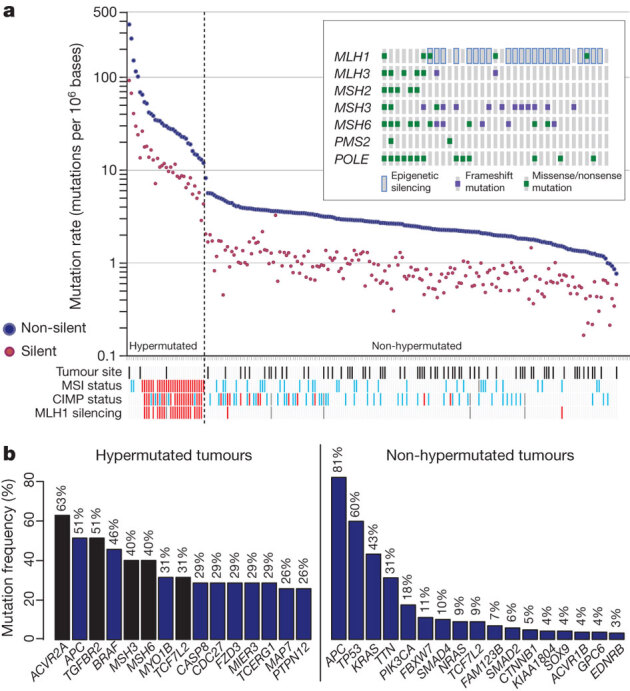
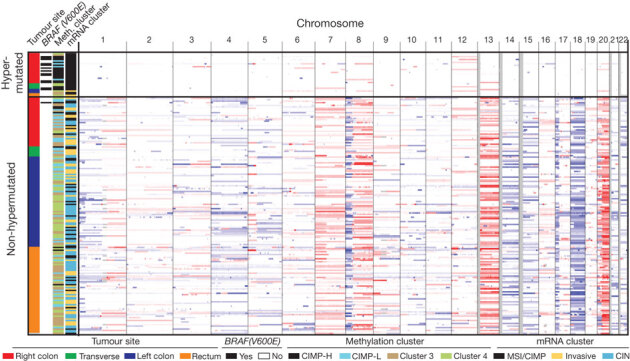
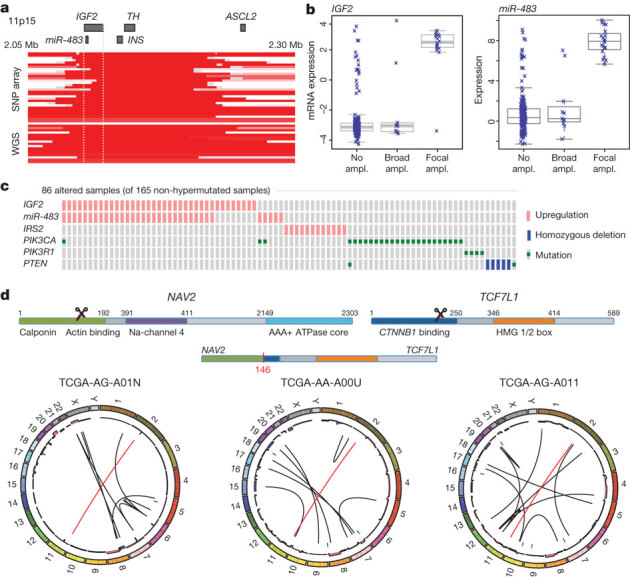
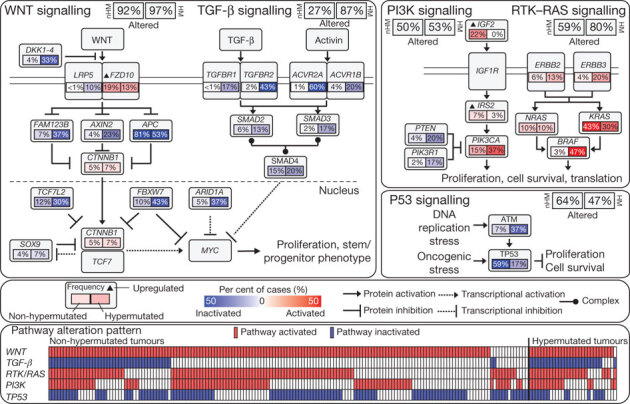
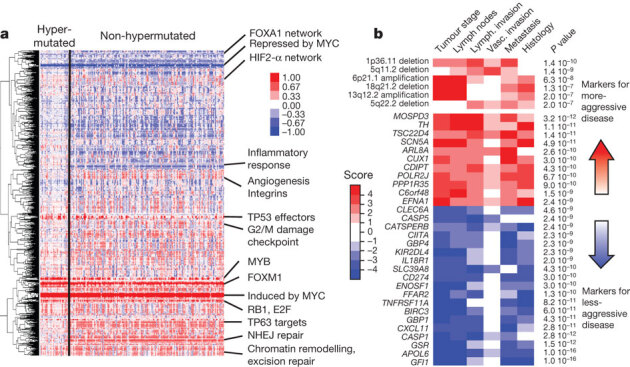
To characterize somatic alterations in colorectal carcinoma, we conducted a genome-scale analysis of 276 samples, analysing exome sequence, DNA copy number, promoter methylation and messenger RNA and microRNA expression. A subset of these samples (97) underwent low-depth-of-coverage whole-genome sequencing. In total, 16% of colorectal carcinomas were found to be hypermutated: three-quarters of these had the expected high microsatellite instability, usually with hypermethylation and MLH1 silencing, and one-quarter had somatic mismatch-repair gene and polymerase ε (POLE) mutations. Excluding the hypermutated cancers, colon and rectum cancers were found to have considerably similar patterns of genomic alteration. Twenty-four genes were significantly mutated, and in addition to the expected APC, TP53, SMAD4, PIK3CA and KRAS mutations, we found frequent mutations in ARID1A, SOX9 and FAM123B. Recurrent copy-number alterations include potentially drug-targetable amplifications of ERBB2 and newly discovered amplification of IGF2. Recurrent chromosomal translocations include the fusion of NAV2 and WNT pathway member TCF7L1. Integrative analyses suggest new markers for aggressive colorectal carcinoma and an important role for MYC-directed transcriptional activation and repression. The Cancer Genome Atlas consortium reports on their genome-wide characterization of somatic alterations in colorectal cancer; in addition to revealing a remarkably consistent pattern of genomic alteration, with 24 genes being significantly mutated, the study identifies new targets for therapeutic intervention and suggests an important role for MYC-directed transcriptional activation and repression. The Cancer Genome Atlas consortium reports on their genome-wide characterization of somatic alterations in colorectal carcinoma. Combined analysis of exome sequence data, DNA copy number, promoter methylation, messenger RNA and microRNA expression, as well as low-coverage whole-genome sequencing reveal that 16% of these carcinomas have hypermutation. Of these, three-quarters have the expected high microsatellite instability, but the rest have somatic mismatch repair gene mutations. The data reveal a remarkably consistent pattern of genomic alteration, with 24 genes being significantly mutated. As well as identifying new biomarkers for aggressive colorectal carcinoma, the data imply an important role for MYC-directed transcriptional activation and repression.
Overview
The claims and statistics of this paper haven’t been checked yet.
Free: it reads the open-access text and checks the first 5 claims that cite a source we can check. Create a free account to check every claim.
Integrity signals
Registry
Cites
Statistics
Figures
Verification
Claims the paper makes
The claims and statistics of this paper haven’t been checked yet.
Free: it reads the open-access text and checks the first 5 claims that cite a source we can check. Create a free account to check every claim.
Claims other papers make about this one
Each is checked against this paper’s own text: does it say what the citing paper says it does?
The source backs part of the claim, not all of it — or backs it for a different population, condition or comparison.
In the citing paper
“KRAS G12V had an increased rate of comutation with TCF7L2, which encodes TCF4, a regulator of Wnt signaling often dysregulated in COAD49–51, specifically the R488C mutation.”
From The origins and genetic interactions of KRAS mutations are allele- and tissue-specific (2021) · cites this paper as [49]
Experimental — accuracy not yet measuredThe source backs part of the claim, not all of it — or backs it for a different population, condition or comparison.
In the citing paper
“PI3K α is both a key regulator and effector of KRAS-dependent signaling and is also activated through mutations involving the PIK3CA gene locus in colorectal cancer, including mutations co-occurring with KRAS [19].”
From Anti-tumor efficacy of a potent and selective non-covalent KRASG12D inhibitor (2022) · cites this paper as [19]
Experimental — accuracy not yet measuredThe source backs part of the claim, not all of it — or backs it for a different population, condition or comparison.
In the citing paper
“Approximately 55% of colorectal cancers (CRCs) are driven by mutational activation of KRAS, BRAF, NRAS, and thus are hard-wired to oncogenic RAS/RAF/MEK/ERK pathway signaling [1–3].”
From An integrative gene expression signature analysis identifies CMS4 KRAS-mutated colorectal cancers sensitive to combined MEK and SRC targeted therapy (2022) · cites this paper as [2]
Experimental — accuracy not yet measuredThe source backs part of the claim, not all of it — or backs it for a different population, condition or comparison.
In the citing paper
“TALENs targeting position 1320 of the APC coding sequence (Fig 3A), a known hotspot commonly mutated in FAP patients [2].”
From Modeling APC mutagenesis and familial adenomatous polyposis using human iPS cells (2018) · cites this paper as [2]
Experimental — accuracy not yet measuredThe source backs part of the claim, not all of it — or backs it for a different population, condition or comparison.
In the citing paper
“which represent ~10–11% of all CRCs (Network, 2012)”
From A Landscape of Therapeutic Cooperativity in KRAS Mutant Cancers Reveals Principles for Controlling Tumor Evolution (2017) · cites this paper as Network, 2012
Experimental — accuracy not yet measured
6 more claims about this paper
Create a free account to see every claim other papers make about this one.
Self-check
Percentages, sums and reported differences re-computed from the paper’s own numbers.
The self-check needs the paper’s full text.
Citations
Cites
Integrated genomic analyses of ovarian carcinoma
Perou, C. M. (2019) · Carolina Digital Repository (University of North Carolina at Chapel Hill) · doi:10.17615/hvp3-wg08 · Cited by 7,925
Comprehensive genomic characterization defines human glioblastoma genes and core pathways
The Cancer Genome Atlas Research Network (2008) · Nature · doi:10.1038/nature07385 · Cited by 7,735
Self-citationUmar, A., Boland, C. R., Terdiman, J. P., Syngal, S., Chapelle, A. D. L., Ruschoff, J., Fishel, R., Lindor, N. M., Burgart, L. J., Hamelin, R., et al. (2004) · JNCI Journal of the National Cancer Institute · doi:10.1093/jnci/djh034 · Cited by 3,183
The Consensus Coding Sequences of Human Breast and Colorectal Cancers
Sjöblom, T., Jones, S., Wood, L. D., Parsons, D. W., Lin, J., Barber, T. D., Mandelker, D., Leary, R. J., Ptak, J., Silliman, N., et al. (2006) · Science · doi:10.1126/science.1133427 · Cited by 3,169
The Genomic Landscapes of Human Breast and Colorectal Cancers
Wood, L. D., Parsons, D. W., Jones, S., Lin, J., Sjöblom, T., Leary, R. J., Shen, D., Boca, S. M., Barber, T., Ptak, J., et al. (2007) · Science · doi:10.1126/science.1145720 · Cited by 2,833
Clues to the Pathogenesis of Familial Colorectal Cancer
Aaltonen, L. A., Peltomäki, P., Leach, F. S., Sistonen, P., Pylkkänen, L., Mecklin, J.-P., Järvinen, H., Powell, S. M., Jen, J., Hamilton, S. R., et al. (1993) · Science · doi:10.1126/science.8484121 · Cited by 2,710
Ionov, Y., Peinado, M. A., Malkhosyan, S., Shibata, D., & Perucho, M. (1993) · Nature · doi:10.1038/363558a0 · Cited by 2,708
TGFβ Signaling in Growth Control, Cancer, and Heritable Disorders
Massagué, J., Blain, S. W., & Lo, R. S. (2000) · Cell · doi:10.1016/s0092-8674(00)00121-5 · Cited by 2,385
Landon, M., Saam, J., Brown, K. L., Moyes, K., Evans, B., & Wenstrup, R. (2015) · Oncology · doi:10.1159/000430097 · Cited by 1,939
Molecular Genetics of Colorectal Cancer
Fearon, E. R. (2011) · Annual Review of Pathology: Mechanisms of Disease · doi:10.1146/annurev-pathol-011110-130235 · Cited by 1,805
Cited by
Items 201–300 of 1,135
Cornerstones of CRISPR–Cas in drug discovery and therapy
Fellmann, C., Gowen, B. G., Lin, P.-C., Doudna, J. A., & Corn, J. E. (2017) · Nature Reviews Drug Discovery · doi:10.1038/nrd.2016.238 · Cited by 443
Oncogenic transformation of diverse gastrointestinal tissues in primary organoid culture
Li, X., Nadauld, L., Ootani, A., Corney, D. C., Pai, R. K., Gevaert, O., Cantrell, M. A., Rack, P. G., Neal, J. T., Chan, C. W.-M., et al. (2014) · Nature Medicine · doi:10.1038/nm.3585 · Cited by 442
O'Connell, M. J., Colangelo, L. H., Beart, R. W., Petrelli, N. J., Allegra, C. J., Sharif, S., Pitot, H. C., Shields, A. F., Landry, J. C., Ryan, D. P., et al. (2014) · Journal of Clinical Oncology · doi:10.1200/jco.2013.53.7753 · Cited by 439
Eukaryotic Mismatch Repair in Relation to DNA Replication
Kunkel, T. A., & Erie, D. A. (2015) · Annual Review of Genetics · doi:10.1146/annurev-genet-112414-054722 · Cited by 432
CMScaller: an R package for consensus molecular subtyping of colorectal cancer pre-clinical models
Eide, P. W., Bruun, J., Lothe, R. A., & Sveen, A. (2017) · Scientific Reports · doi:10.1038/s41598-017-16747-x · Cited by 437
Juric, D., Rodon, J., Tabernero, J., Janku, F., Burris, H. A., Schellens, J. H. M., Middleton, M. R., Berlin, J., Schuler, M., Gil-Martin, M., et al. (2018) · Journal of Clinical Oncology · doi:10.1200/jco.2017.72.7107 · Cited by 431
Jackstadt, R., van Hooff, S. R., Leach, J. D., Cortes-Lavaud, X., Lohuis, J. O., Ridgway, R. A., Wouters, V. M., Roper, J., Kendall, T. J., Roxburgh, C. S., et al. (2019) · Cancer Cell · doi:10.1016/j.ccell.2019.08.003 · Cited by 433
Molecular pathological classification of colorectal cancer
Müller, M. F., Ibrahim, A. E. K., & Arends, M. J. (2016) · Virchows Archiv · doi:10.1007/s00428-016-1956-3 · Cited by 432
Cancer Cell Lines for Drug Discovery and Development
Wilding, J. L., & Bodmer, W. F. (2014) · Cancer Research · doi:10.1158/0008-5472.can-13-2971 · Cited by 432
Early-onset colorectal cancer: initial clues and current views
Hofseth, L. J., Hebert, J. R., Chanda, A., Chen, H., Love, B. L., Pena, M. M., Murphy, E. A., Sajish, M., Sheth, A., Buckhaults, P. J., et al. (2020) · Nature Reviews Gastroenterology & Hepatology · doi:10.1038/s41575-019-0253-4 · Cited by 428
Clinical and genomic landscape of gastric cancer with a mesenchymal phenotype
Oh, S. C., Sohn, B. H., Cheong, J.-H., Kim, S.-B., Lee, J. E., Park, K. C., Lee, S. H., Park, J.-L., Park, Y.-Y., Lee, H.-S., et al. (2018) · Nature Communications · doi:10.1038/s41467-018-04179-8 · Cited by 424
Therapeutic potential of targeting the Wnt/β-catenin signaling pathway in colorectal cancer
Cheng, X., Xu, X., Chen, D., Zhao, F., & Wang, W. (2019) · Biomedicine & Pharmacotherapy · doi:10.1016/j.biopha.2018.11.082 · Cited by 417
Microsatellite Instability Testing and Its Role in the Management of Colorectal Cancer
Kawakami, H., Zaanan, A., & Sinicrope, F. A. (2015) · Current Treatment Options in Oncology · doi:10.1007/s11864-015-0348-2 · Cited by 418
Tomasetti, C., Vogelstein, B., & Parmigiani, G. (2013) · Proceedings of the National Academy of Sciences · doi:10.1073/pnas.1221068110 · Cited by 414
The Many Roles of BAF (mSWI/SNF) and PBAF Complexes in Cancer
Hodges, C., Kirkland, J. G., & Crabtree, G. R. (2016) · Cold Spring Harbor Perspectives in Medicine · doi:10.1101/cshperspect.a026930 · Cited by 414
Rational Selection of Syngeneic Preclinical Tumor Models for Immunotherapeutic Drug Discovery
Mosely, S. I. S., Prime, J. E., Sainson, R. C. A., Koopmann, J.-O., Wang, D. Y. Q., Greenawalt, D. M., Ahdesmaki, M. J., Leyland, R., Mullins, S., Pacelli, L., et al. (2017) · Cancer Immunology Research · doi:10.1158/2326-6066.cir-16-0114 · Cited by 415
Extensive transduction of nonrepetitive DNA mediated by L1 retrotransposition in cancer genomes
Tubio, J. M. C., Li, Y., Ju, Y. S., Martincorena, I., Cooke, S. L., Tojo, M., Gundem, G., Pipinikas, C. P., Zamora, J., Raine, K., et al. (2014) · Science · doi:10.1126/science.1251343 · Cited by 412
“(C) Transductions arising from somatically acquired L1 copies in a colon cancer (TCGA-D5-6540), a head and neck cancer (LB771-HNC), and a prostate cancer (PD11335a).”
BackgroundInfluentialGene expression patterns unveil a new level of molecular heterogeneity in colorectal cancer
Budinska, E., Popovici, V., Tejpar, S., D'Ario, G., Lapique, N., Sikora, K. O., Di Narzo, A. F., Yan, P., Hodgson, J. G., Weinrich, S., et al. (2013) · The Journal of Pathology · doi:10.1002/path.4212 · Cited by 409
TP53 Mutations in Human Cancer: Database Reassessment and Prospects for the Next Decade
Leroy, B., Anderson, M., & Soussi, T. (2014) · Human Mutation · doi:10.1002/humu.22552 · Cited by 408
Hypermutation in human cancer genomes: footprints and mechanisms
Roberts, S. A., & Gordenin, D. A. (2014) · Nature Reviews Cancer · doi:10.1038/nrc3816 · Cited by 405
Mechanisms of PTEN loss in cancer: It’s all about diversity
Álvarez-Garcia, V., Tawil, Y., Wise, H. M., & Leslie, N. R. (2019) · Seminars in Cancer Biology · doi:10.1016/j.semcancer.2019.02.001 · Cited by 401
Weischenfeldt, J., Dubash, T., Drainas, A. P., Mardin, B. R., Chen, Y., Stütz, A. M., Waszak, S. M., Bosco, G., Halvorsen, A. R., Raeder, B., et al. (2017) · Nature Genetics · doi:10.1038/ng.3722 · Cited by 404
Determinants and clinical implications of chromosomal instability in cancer
Sansregret, L., Vanhaesebroeck, B., & Swanton, C. (2018) · Nature Reviews Clinical Oncology · doi:10.1038/nrclinonc.2017.198 · Cited by 396
Mertins, P., Yang, F., Liu, T., Mani, D. R., Petyuk, V. A., Gillette, M. A., Clauser, K. R., Qiao, J. W., Gritsenko, M. A., Moore, R. J., et al. (2014) · Molecular & Cellular Proteomics · doi:10.1074/mcp.m113.036392 · Cited by 400
Microsatellite Instability Detection by Next Generation Sequencing
Salipante, S. J., Scroggins, S. M., Hampel, H. L., Turner, E. H., & Pritchard, C. C. (2014) · Clinical Chemistry · doi:10.1373/clinchem.2014.223677 · Cited by 399
Molecular Mechanisms of Colon Cancer Progression and Metastasis: Recent Insights and Advancements
Malki, A., ElRuz, R. A., Gupta, I., Allouch, A., Vranic, S., & Al Moustafa, A.-E. (2020) · International Journal of Molecular Sciences · doi:10.3390/ijms22010130 · Cited by 398
Compton, C. C., Byrd, D. R., Garcia-Aguilar, J., Kurtzman, S. H., Olawaiye, A., & Washington, M. K. (2012) · AJCC Cancer Staging Atlas · doi:10.1007/978-1-4614-2080-4_14 · Cited by 395
Only three driver gene mutations are required for the development of lung and colorectal cancers
Tomasetti, C., Marchionni, L., Nowak, M. A., Parmigiani, G., & Vogelstein, B. (2015) · Proceedings of the National Academy of Sciences · doi:10.1073/pnas.1421839112 · Cited by 395
Signaling pathways involved in colorectal cancer progression
Koveitypour, Z., Panahi, F., Vakilian, M., Peymani, M., Seyed Forootan, F., Nasr Esfahani, M. H., & Ghaedi, K. (2019) · Cell & Bioscience · doi:10.1186/s13578-019-0361-4 · Cited by 393
Yamashita, R., Long, J., Longacre, T., Peng, L., Berry, G., Martin, B., Higgins, J., Rubin, D. L., & Shen, J. (2021) · The Lancet Oncology · doi:10.1016/s1470-2045(20)30535-0 · Cited by 391
Myant, K. B., Cammareri, P., McGhee, E. J., Ridgway, R. A., Huels, D. J., Cordero, J. B., Schwitalla, S., Kalna, G., Ogg, E.-L., Athineos, D., et al. (2013) · Cell Stem Cell · doi:10.1016/j.stem.2013.04.006 · Cited by 391
Distinct evolution and dynamics of epigenetic and genetic heterogeneity in acute myeloid leukemia
Li, S., Garrett-Bakelman, F. E., Chung, S. S., Sanders, M. A., Hricik, T., Rapaport, F., Patel, J., Dillon, R., Vijay, P., Brown, A. L., et al. (2016) · Nature Medicine · doi:10.1038/nm.4125 · Cited by 387
Immunomic, genomic and transcriptomic characterization of CT26 colorectal carcinoma
Castle, J. C., Loewer, M., Boegel, S., de Graaf, J., Bender, C., Tadmor, A. D., Boisguerin, V., Bukur, T., Sorn, P., Paret, C., et al. (2014) · BMC Genomics · doi:10.1186/1471-2164-15-190 · Cited by 384
Best practices for variant calling in clinical sequencing
Koboldt, D. C. (2020) · Genome Medicine · doi:10.1186/s13073-020-00791-w · Cited by 384
Multi-omics of 34 colorectal cancer cell lines - a resource for biomedical studies
Berg, K. C. G., Eide, P. W., Eilertsen, I. A., Johannessen, B., Bruun, J., Danielsen, S. A., Bjørnslett, M., Meza-Zepeda, L. A., Eknæs, M., Lind, G. E., et al. (2017) · Molecular Cancer · doi:10.1186/s12943-017-0691-y · Cited by 382
The Integrated Genomic Landscape of Thymic Epithelial Tumors
Radovich, M., Pickering, C. R., Felau, I., Ha, G., Zhang, H., Jo, H., Hoadley, K. A., Anur, P., Zhang, J., McLellan, M., et al. (2018) · Cancer Cell · doi:10.1016/j.ccell.2018.01.003 · Cited by 381
Wnt/β-catenin signaling pathway in carcinogenesis and cancer therapy
Song, P., Gao, Z., Bao, Y., Chen, L., Huang, Y., Liu, Y., Dong, Q., & Wei, X. (2024) · Journal of Hematology & Oncology · doi:10.1186/s13045-024-01563-4 · Cited by 382
“The Wnt signaling pathway alterations are universally observed in CRC tissues, with more than 90% of CRC cases harboring mutations in genes such as APC, CTNNB1, RNF42, AXIN1, or RSPO [196].”
BackgroundDNA Replication and Oncogene-Induced Replicative Stress
Hills, S. A., & Diffley, J. F. X. (2014) · Current Biology · doi:10.1016/j.cub.2014.04.012 · Cited by 381
The Landscape of Microsatellite Instability in Colorectal and Endometrial Cancer Genomes
Kim, T.-M., Laird, P. W., & Park, P. J. (2013) · Cell · doi:10.1016/j.cell.2013.10.015 · Cited by 380
Clinical and molecular characterization of early‐onset colorectal cancer
Willauer, A. N., Liu, Y., Pereira, A. A. L., Lam, M., Morris, J. S., Raghav, K. P. S., Morris, V. K., Menter, D., Broaddus, R., Meric‐Bernstam, F., et al. (2019) · Cancer · doi:10.1002/cncr.31994 · Cited by 375
Weren, R. D. A., Ligtenberg, M. J. L., Kets, C. M., de Voer, R. M., Verwiel, E. T. P., Spruijt, L., van Zelst-Stams, W. A. G., Jongmans, M. C., Gilissen, C., Hehir-Kwa, J. Y., et al. (2015) · Nature Genetics · doi:10.1038/ng.3287 · Cited by 378
Singhal, R., & Shah, Y. M. (2020) · Journal of Biological Chemistry · doi:10.1074/jbc.rev120.011188 · Cited by 376
Clinical-Grade Detection of Microsatellite Instability in Colorectal Tumors by Deep Learning
Echle, A., Grabsch, H. I., Quirke, P., van den Brandt, P. A., West, N. P., Hutchins, G. G. A., Heij, L. R., Tan, X., Richman, S. D., Krause, J., et al. (2020) · Gastroenterology · doi:10.1053/j.gastro.2020.06.021 · Cited by 376
Haraldsdottir, S., Hampel, H., Tomsic, J., Frankel, W. L., Pearlman, R., de la Chapelle, A., & Pritchard, C. C. (2014) · Gastroenterology · doi:10.1053/j.gastro.2014.08.041 · Cited by 376
Mouradov, D., Sloggett, C., Jorissen, R. N., Love, C. G., Li, S., Burgess, A. W., Arango, D., Strausberg, R. L., Buchanan, D., Wormald, S., et al. (2014) · Cancer Research · doi:10.1158/0008-5472.can-14-0013 · Cited by 375
Testa, U., Pelosi, E., & Castelli, G. (2018) · Medical Sciences · doi:10.3390/medsci6020031 · Cited by 374
for the Biallelic Mismatch Repair Deficiency Consortium, Shlien, A., Campbell, B. B., de Borja, R., Alexandrov, L. B., Merico, D., Wedge, D., Van Loo, P., Tarpey, P. S., Coupland, P., et al. (2015) · Nature Genetics · doi:10.1038/ng.3202 · Cited by 374
A panoply of errors: polymerase proofreading domain mutations in cancer
Rayner, E., van Gool, I. C., Palles, C., Kearsey, S. E., Bosse, T., Tomlinson, I., & Church, D. N. (2016) · Nature Reviews Cancer · doi:10.1038/nrc.2015.12 · Cited by 373
Nakamura, Y., Taniguchi, H., Ikeda, M., Bando, H., Kato, K., Morizane, C., Esaki, T., Komatsu, Y., Kawamoto, Y., Takahashi, N., et al. (2020) · Nature Medicine · doi:10.1038/s41591-020-1063-5 · Cited by 373
Brannon, A., Vakiani, E., Sylvester, B. E., Scott, S. N., McDermott, G., Shah, R. H., Kania, K., Viale, A., Oschwald, D. M., Vacic, V., et al. (2014) · Genome Biology · doi:10.1186/preaccept-1207406452128377 · Cited by 372
Somatic mutation of CDKN1B in small intestine neuroendocrine tumors
Francis, J. M., Kiezun, A., Ramos, A. H., Serra, S., Pedamallu, C. S., Qian, Z. R., Banck, M. S., Kanwar, R., Kulkarni, A. A., Karpathakis, A., et al. (2013) · Nature Genetics · doi:10.1038/ng.2821 · Cited by 369
Single-cell multiomics sequencing and analyses of human colorectal cancer
Bian, S., Hou, Y., Zhou, X., Li, X., Yong, J., Wang, Y., Wang, W., Yan, J., Hu, B., Guo, H., et al. (2018) · Science · doi:10.1126/science.aao3791 · Cited by 362
Germline ETV6 mutations in familial thrombocytopenia and hematologic malignancy
Zhang, M. Y., Churpek, J. E., Keel, S. B., Walsh, T., Lee, M. K., Loeb, K. R., Gulsuner, S., Pritchard, C. C., Sanchez-Bonilla, M., Delrow, J. J., et al. (2015) · Nature Genetics · doi:10.1038/ng.3177 · Cited by 367
Distinct Mesenchymal Cell Populations Generate the Essential Intestinal BMP Signaling Gradient
McCarthy, N., Manieri, E., Storm, E. E., Saadatpour, A., Luoma, A. M., Kapoor, V. N., Madha, S., Gaynor, L. T., Cox, C., Keerthivasan, S., et al. (2020) · Cell Stem Cell · doi:10.1016/j.stem.2020.01.008 · Cited by 361
Integrative Annotation of Variants from 1092 Humans: Application to Cancer Genomics
Khurana, E., Fu, Y., Colonna, V., Mu, X. J., Kang, H. M., Lappalainen, T., Sboner, A., Lochovsky, L., Chen, J., Harmanci, A., et al. (2013) · Science · doi:10.1126/science.1235587 · Cited by 365
Schell, J. C., Olson, K. A., Jiang, L., Hawkins, A. J., Van Vranken, J. G., Xie, J., Egnatchik, R. A., Earl, E. G., DeBerardinis, R. J., & Rutter, J. (2014) · Molecular Cell · doi:10.1016/j.molcel.2014.09.026 · Cited by 363
End-joining, translocations and cancer
Bunting, S. F., & Nussenzweig, A. (2013) · Nature Reviews Cancer · doi:10.1038/nrc3537 · Cited by 359
ARID1A loss impairs enhancer-mediated gene regulation and drives colon cancer in mice
Mathur, R., Alver, B. H., San Roman, A. K., Wilson, B. G., Wang, X., Agoston, A. T., Park, P. J., Shivdasani, R. A., & Roberts, C. W. M. (2017) · Nature Genetics · doi:10.1038/ng.3744 · Cited by 360
Wnt signaling in adult intestinal stem cells and cancer
Krausova, M., & Korinek, V. (2014) · Cellular Signalling · doi:10.1016/j.cellsig.2013.11.032 · Cited by 361
Genomic Analysis of Immune Cell Infiltrates Across 11 Tumor Types
Iglesia, M. D., Parker, J. S., Hoadley, K. A., Serody, J. S., Perou, C. M., & Vincent, B. G. (2016) · Journal of the National Cancer Institute · doi:10.1093/jnci/djw144 · Cited by 360
Myeloid Cell-Derived Reactive Oxygen Species Induce Epithelial Mutagenesis
Canli, Ö., Nicolas, A. M., Gupta, J., Finkelmeier, F., Goncharova, O., Pesic, M., Neumann, T., Horst, D., Löwer, M., Sahin, U., et al. (2017) · Cancer Cell · doi:10.1016/j.ccell.2017.11.004 · Cited by 359
NOTCH1 Mutations Occur Early during Cutaneous Squamous Cell Carcinogenesis
South, A. P., Purdie, K. J., Watt, S. A., Haldenby, S., den Breems, N. Y., Dimon, M., Arron, S. T., Kluk, M. J., Aster, J. C., McHugh, A., et al. (2014) · Journal of Investigative Dermatology · doi:10.1038/jid.2014.154 · Cited by 357
Pan-Cancer Landscape of Aberrant DNA Methylation across Human Tumors
Saghafinia, S., Mina, M., Riggi, N., Hanahan, D., & Ciriello, G. (2018) · Cell Reports · doi:10.1016/j.celrep.2018.09.082 · Cited by 357
Driver and Passenger Mutations in Cancer
Pon, J. R., & Marra, M. A. (2015) · Annual Review of Pathology: Mechanisms of Disease · doi:10.1146/annurev-pathol-012414-040312 · Cited by 355
Exploring immunotherapy in colorectal cancer
Weng, J., Li, S., Zhu, Z., Liu, Q., Zhang, R., Yang, Y., & Li, X. (2022) · Journal of Hematology & Oncology · doi:10.1186/s13045-022-01294-4 · Cited by 355
The AMP-activated protein kinase (AMPK) and cancer: Many faces of a metabolic regulator
Faubert, B., Vincent, E. E., Poffenberger, M. C., & Jones, R. G. (2015) · Cancer Letters · doi:10.1016/j.canlet.2014.01.018 · Cited by 354
DNA polymerase ɛ and δ exonuclease domain mutations in endometrial cancer
Church, D. N., Briggs, S. E. W., Palles, C., Domingo, E., Kearsey, S. J., Grimes, J. M., Gorman, M., Martin, L., Howarth, K. M., Hodgson, S. V., et al. (2013) · Human Molecular Genetics · doi:10.1093/hmg/ddt131 · Cited by 352
Differential DNA mismatch repair underlies mutation rate variation across the human genome
Supek, F., & Lehner, B. (2015) · Nature · doi:10.1038/nature14173 · Cited by 350
In vivo genome editing and organoid transplantation models of colorectal cancer and metastasis
Roper, J., Tammela, T., Cetinbas, N. M., Akkad, A., Roghanian, A., Rickelt, S., Almeqdadi, M., Wu, K., Oberli, M. A., Sánchez-Rivera, F. J., et al. (2017) · Nature Biotechnology · doi:10.1038/nbt.3836 · Cited by 348
Oncogenic ERBB3 mutations in human cancers.
Jaiswal, B. S., Kljavin, N. M., Stawiski, E. W., Chan, E., Parikh, C., Durinck, S., Chaudhuri, S., Pujara, K., Guillory, J., Edgar, K. A., et al. (2013) · Cancer Cell · doi:10.1016/j.ccr.2013.04.012 · Cited by 350
Metabolic Pathways Regulating Colorectal Cancer Initiation and Progression
La Vecchia, S., & Sebastián, C. (2020) · Seminars in Cell & Developmental Biology · doi:10.1016/j.semcdb.2019.05.018 · Cited by 349
Optimized base editors enable efficient editing in cells, organoids and mice
Zafra, M. P., Schatoff, E. M., Katti, A., Foronda, M., Breinig, M., Schweitzer, A. Y., Simon, A., Han, T., Goswami, S., Montgomery, E., et al. (2018) · Nature Biotechnology · doi:10.1038/nbt.4194 · Cited by 347
Roepman, P., Schlicker, A., Tabernero, J., Majewski, I., Tian, S., Moreno, V., Snel, M. H., Chresta, C. M., Rosenberg, R., Nitsche, U., et al. (2014) · International Journal of Cancer · doi:10.1002/ijc.28387 · Cited by 346
Computational solutions for omics data
Berger, B., Peng, J., & Singh, M. (2013) · Nature Reviews Genetics · doi:10.1038/nrg3433 · Cited by 346
Tumor suppression by the Fbw7 ubiquitin ligase: mechanisms and opportunities
Davis, R. J., Welcker, M., & Clurman, B. E. (2014) · Cancer Cell · doi:10.1016/j.ccell.2014.09.013 · Cited by 343
“We performed a meta-analysis of TCGA data using the cBioPortal for Cancer Genomics online interface to compare and contrast Fbw7 mutations across cancer types (Table 2) (Cerami et al., 2012; Gao et al., 2013).”
Elevated RNA Editing Activity Is a Major Contributor to Transcriptomic Diversity in Tumors
Paz-Yaacov, N., Bazak, L., Buchumenski, I., Porath, H. T., Danan-Gotthold, M., Knisbacher, B. A., Eisenberg, E., & Levanon, E. Y. (2015) · Cell Reports · doi:10.1016/j.celrep.2015.08.080 · Cited by 341
Schütte, M., Risch, T., Abdavi-Azar, N., Boehnke, K., Schumacher, D., Keil, M., Yildiriman, R., Jandrasits, C., Borodina, T., Amstislavskiy, V., et al. (2017) · Nature Communications · doi:10.1038/ncomms14262 · Cited by 339
Genomics-Driven Oncology: Framework for an Emerging Paradigm
Garraway, L. A. (2013) · Journal of Clinical Oncology · doi:10.1200/jco.2012.46.8934 · Cited by 340
Shen, Y., Wang, X., Lu, J., Salfenmoser, M., Wirsik, N. M., Schleussner, N., Imle, A., Freire Valls, A., Radhakrishnan, P., Liang, J., et al. (2020) · Cancer Cell · doi:10.1016/j.ccell.2020.05.005 · Cited by 339
Intron retention is a widespread mechanism of tumor-suppressor inactivation
Jung, H., Lee, D., Lee, J., Park, D., Kim, Y. J., Park, W.-Y., Hong, D., Park, P. J., & Lee, E. (2015) · Nature Genetics · doi:10.1038/ng.3414 · Cited by 339
Novellasdemunt, L., Antas, P., & Li, V. S. W. (2015) · American Journal of Physiology-Cell Physiology · doi:10.1152/ajpcell.00117.2015 · Cited by 339
Increased global transcription activity as a mechanism of replication stress in cancer
Kotsantis, P., Silva, L. M., Irmscher, S., Jones, R. M., Folkes, L., Gromak, N., & Petermann, E. (2016) · Nature Communications · doi:10.1038/ncomms13087 · Cited by 336
The future of epigenetic therapy in solid tumours—lessons from the past
Azad, N., Zahnow, C. A., Rudin, C. M., & Baylin, S. B. (2013) · Nature Reviews Clinical Oncology · doi:10.1038/nrclinonc.2013.42 · Cited by 335
Shamloo, B., & Usluer, S. (2019) · Cancers · doi:10.3390/cancers11081178 · Cited by 336
Molecular epidemiology and diagnostics of KRAS mutations in human cancer
Timar, J., & Kashofer, K. (2020) · Cancer and Metastasis Reviews · doi:10.1007/s10555-020-09915-5 · Cited by 334
Rectal and colon cancer: Not just a different anatomic site
Tamas, K., Walenkamp, A. M. E., de Vries, E. G. E., van Vugt, M. A. T. M., Beets-Tan, R. G., van Etten, B., de Groot, D. J. A., & Hospers, G. A. P. (2015) · Cancer Treatment Reviews · doi:10.1016/j.ctrv.2015.06.007 · Cited by 331
Taieb, J., Svrcek, M., Cohen, R., Basile, D., Tougeron, D., & Phelip, J.-M. (2022) · European Journal of Cancer · doi:10.1016/j.ejca.2022.07.020 · Cited by 326
Causes of Socioeconomic Disparities in Colorectal Cancer and Intervention Framework and Strategies
Carethers, J. M., & Doubeni, C. A. (2020) · Gastroenterology · doi:10.1053/j.gastro.2019.10.029 · Cited by 327
TSGene: a web resource for tumor suppressor genes
Zhao, M., Sun, J., & Zhao, Z. (2013) · Nucleic Acids Research · doi:10.1093/nar/gks937 · Cited by 330
Treatment sequencing in metastatic colorectal cancer
Modest, D. P., Pant, S., & Sartore-Bianchi, A. (2019) · European Journal of Cancer · doi:10.1016/j.ejca.2018.12.019 · Cited by 329
The impact of site-specific digital histology signatures on deep learning model accuracy and bias
Howard, F. M., Dolezal, J., Kochanny, S., Schulte, J., Chen, H., Heij, L., Huo, D., Nanda, R., Olopade, O. I., Kather, J. N., et al. (2021) · Nature Communications · doi:10.1038/s41467-021-24698-1 · Cited by 330
Junk DNA and the long non-coding RNA twist in cancer genetics
Ling, H., Vincent, K., Pichler, M., Fodde, R., Berindan-Neagoe, I., Slack, F. J., & Calin, G. A. (2015) · Oncogene · doi:10.1038/onc.2014.456 · Cited by 328
Becker, W. R., Nevins, S. A., Chen, D. C., Chiu, R., Horning, A. M., Guha, T. K., Laquindanum, R., Mills, M., Chaib, H., Ladabaum, U., et al. (2022) · Nature Genetics · doi:10.1038/s41588-022-01088-x · Cited by 321
Chen, B., Scurrah, C. R., McKinley, E. T., Simmons, A. J., Ramirez-Solano, M. A., Zhu, X., Markham, N. O., Heiser, C. N., Vega, P. N., Rolong, A., et al. (2021) · Cell · doi:10.1016/j.cell.2021.11.031 · Cited by 325
SMAD2,SMAD3 and SMAD4 Mutations in Colorectal Cancer
Fleming, N. I., Jorissen, R. N., Mouradov, D., Christie, M., Sakthianandeswaren, A., Palmieri, M., Day, F., Li, S., Tsui, C., Lipton, L., et al. (2013) · Cancer Research · doi:10.1158/0008-5472.can-12-2706 · Cited by 324
The genomic landscape of small intestine neuroendocrine tumors
Banck, M. S., Kanwar, R., Kulkarni, A. A., Boora, G. K., Metge, F., Kipp, B. R., Zhang, L., Thorland, E. C., Minn, K. T., Tentu, R., et al. (2013) · Journal of Clinical Investigation · doi:10.1172/jci67963 · Cited by 324
The Role of p53 Signaling in Colorectal Cancer
Liebl, M. C., & Hofmann, T. G. (2021) · Cancers · doi:10.3390/cancers13092125 · Cited by 318
Ou, S.-H. I., Jänne, P. A., Leal, T. A., Rybkin, I. I., Sabari, J. K., Barve, M. A., Bazhenova, L., Johnson, M. L., Velastegui, K. L., Cilliers, C., et al. (2022) · Journal of Clinical Oncology · doi:10.1200/jco.21.02752 · Cited by 322
Portrait of the PI3K/AKT pathway in colorectal cancer
Danielsen, S. A., Eide, P. W., Nesbakken, A., Guren, T., Leithe, E., & Lothe, R. A. (2015) · Biochimica et Biophysica Acta (BBA) - Reviews on Cancer · doi:10.1016/j.bbcan.2014.09.008 · Cited by 321
POLE Proofreading Mutations Elicit an Antitumor Immune Response in Endometrial Cancer
van Gool, I. C., Eggink, F. A., Freeman-Mills, L., Stelloo, E., Marchi, E., de Bruyn, M., Palles, C., Nout, R. A., de Kroon, C. D., Osse, E. M., et al. (2015) · Clinical Cancer Research · doi:10.1158/1078-0432.ccr-15-0057 · Cited by 320
Metadata
- Authors
- The Cancer Genome Atlas Network
- Affiliations
- Broad Institute (US)
- Corresponding author
- The Cancer Genome Atlas Network
- Venue
- Nature
- Published
- 2012-07-18
- Volume
- 487
- Issue
- 7407
- Pages
- 330-337
- ISSN
- 0028-0836 (ISSN-L)
- 1476-4687
- PMC
- PMC3401966
- OpenAlex
- W2262414037
- Semantic Scholar
- 56321e765211d85a29621551d0df9a1cfc0a78ca
- Cited by
- 8,499
- References
- 49
- Citations by year
- 2026: 389 · 2025: 455 · 2024: 502 · 2023: 591 · 2022: 678 · 2021: 754 · 2020: 736 · 2019: 686 · 2018: 677 · 2017: 673 · 2016: 646 · 2015: 616 · 2014: 578 · 2013: 424 · 2012: 86
- FWCI
- 393.35
- Type
- journal article
- Language
- en
- Open access
- hybrid
- doi.org
- Licence
- cc-by-nc-sa
- creativecommons.org/licenses/by-nc-sa/3.0/ (tdm)
- creativecommons.org/licenses/by-nc-sa/3.0/ (vor)
- Locations
- Nature (publishedVersion, cc-by-nc-sa)
- PubMed Central (publishedVersion, cc-by-nc-sa)
- PubMed (publishedVersion)
- eScholarship (California Digital Library) (submittedVersion)
- eSpace (Curtin University) (submittedVersion, cc-by-nc-sa)
- Scholarworks@UNIST (Ulsan National Institute of Science and Technology) (submittedVersion)
- Funders
- National Institutes of Health
- National Human Genome Research Institute (U54HG003067, U54HG003079, U54HG003273, R01HG006272)
- National Cancer Institute (U24CA126554, U24CA143882, U24CA143843, U24CA143840, U24CA143858, U24CA144025, U24CA143866, U24CA143883, U24CA143845, U24CA143867, U24CA143848, U24CA143799, U24CA143835, P30CA016672, P30CA016086)
- Topics
- Health Sciences › Medicine › Pathology and Forensic Medicine › Genetic factors in colorectal cancer
- Life Sciences › Biochemistry, Genetics and Molecular Biology › Cancer Research › Cancer Genomics and Diagnostics
- Health Sciences › Medicine › Oncology › Colorectal Cancer Treatments and Studies
- Keywords
- colorectal cancer, colon cancer, rectal cancer, somatic mutations, microsatellite instability, mismatch repair gene mutations, POLE mutation, DNA copy number alterations, promoter methylation, gene expression, microRNA expression, ARID1A, SOX9, ERBB2 amplification, APC, TP53, SMAD4, PIK3CA, KRAS, therapeutic target
- MeSH terms
- Colonic Neoplasms, Humans, Mutation, Rectal Neoplasms, Sequence Analysis, DNA, DNA Methylation, Polymorphism, Single Nucleotide, Gene Expression Profiling, DNA Copy Number Variations, Exome, Mutation Rate
About these checks
Registry, retraction, Cites and statistics results are computed, not judged, with one exception: a printed reference that no index lists is read once by a model before it counts as a citation error. Claims are extracted by a model and kept only when their quote appears verbatim in the text; each cited source is then checked, with a model’s help, for whether it says what the claim relies on. Those verdicts can be wrong — read the claim’s quote and the cited source before relying on one.
Statistics and arithmetic are recomputed, not judged.
Confidence bands are shown only for fields calibrated on our annotated test set. None is calibrated yet, so no band is shown.
What counts as a claim ›How we measure confidence ›How we check this ›
Are you an author, or do you see a problem with this page? Request a review
Data sources
Bibliographic data: Semantic Scholar, OpenAlex, Crossref.
Contains information from the Semantic Scholar Academic Graph Datasets, made available under the ODC Attribution License (ODC-BY 1.0).
Semantic Scholar’s data is described in: Kinney, R., et al. (2023). The Semantic Scholar Open Data Platform. arXiv:2301.10140.
