

Comprehensive molecular characterization of human colon and rectal cancer
Open accessThe DOI matches its Crossref record; 47 of the 49 references it cites were found in a registry or an index.
Abstract
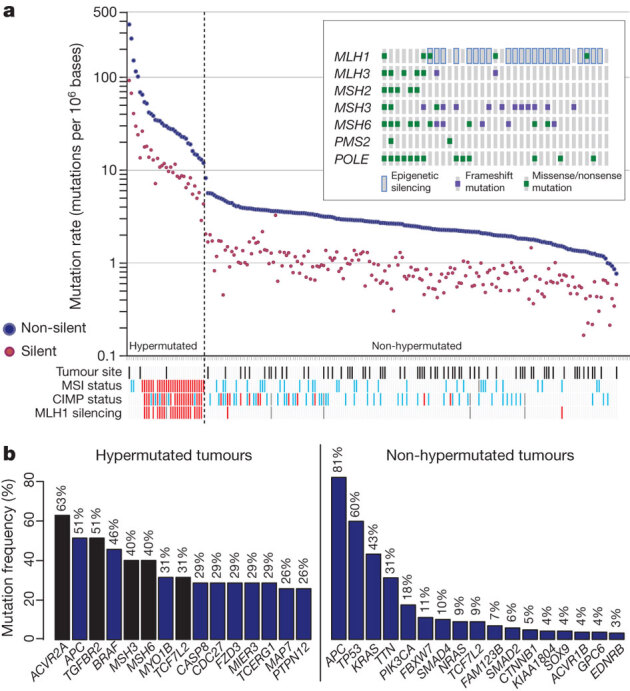
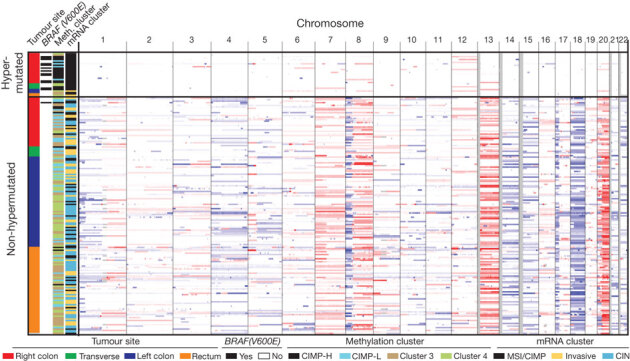
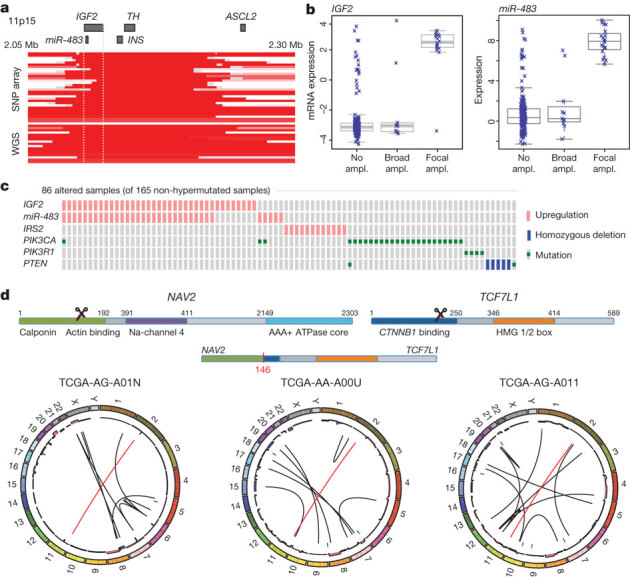
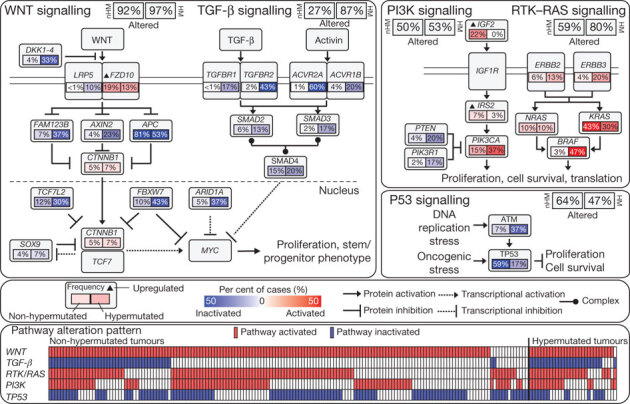
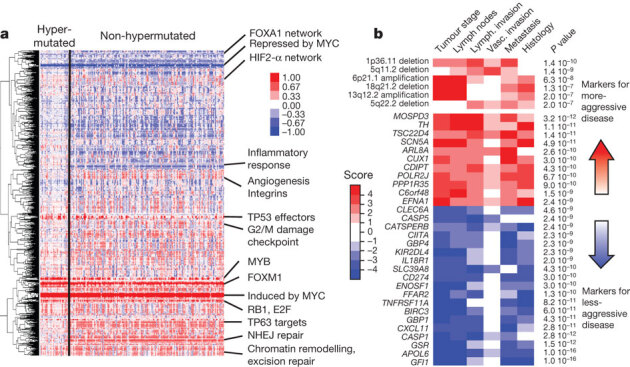
To characterize somatic alterations in colorectal carcinoma, we conducted a genome-scale analysis of 276 samples, analysing exome sequence, DNA copy number, promoter methylation and messenger RNA and microRNA expression. A subset of these samples (97) underwent low-depth-of-coverage whole-genome sequencing. In total, 16% of colorectal carcinomas were found to be hypermutated: three-quarters of these had the expected high microsatellite instability, usually with hypermethylation and MLH1 silencing, and one-quarter had somatic mismatch-repair gene and polymerase ε (POLE) mutations. Excluding the hypermutated cancers, colon and rectum cancers were found to have considerably similar patterns of genomic alteration. Twenty-four genes were significantly mutated, and in addition to the expected APC, TP53, SMAD4, PIK3CA and KRAS mutations, we found frequent mutations in ARID1A, SOX9 and FAM123B. Recurrent copy-number alterations include potentially drug-targetable amplifications of ERBB2 and newly discovered amplification of IGF2. Recurrent chromosomal translocations include the fusion of NAV2 and WNT pathway member TCF7L1. Integrative analyses suggest new markers for aggressive colorectal carcinoma and an important role for MYC-directed transcriptional activation and repression. The Cancer Genome Atlas consortium reports on their genome-wide characterization of somatic alterations in colorectal cancer; in addition to revealing a remarkably consistent pattern of genomic alteration, with 24 genes being significantly mutated, the study identifies new targets for therapeutic intervention and suggests an important role for MYC-directed transcriptional activation and repression. The Cancer Genome Atlas consortium reports on their genome-wide characterization of somatic alterations in colorectal carcinoma. Combined analysis of exome sequence data, DNA copy number, promoter methylation, messenger RNA and microRNA expression, as well as low-coverage whole-genome sequencing reveal that 16% of these carcinomas have hypermutation. Of these, three-quarters have the expected high microsatellite instability, but the rest have somatic mismatch repair gene mutations. The data reveal a remarkably consistent pattern of genomic alteration, with 24 genes being significantly mutated. As well as identifying new biomarkers for aggressive colorectal carcinoma, the data imply an important role for MYC-directed transcriptional activation and repression.
Overview
The claims and statistics of this paper haven’t been checked yet.
Free: it reads the open-access text and checks the first 5 claims that cite a source we can check. Create a free account to check every claim.
Integrity signals
Registry
Cites
Statistics
Figures
Verification
Claims the paper makes
The claims and statistics of this paper haven’t been checked yet.
Free: it reads the open-access text and checks the first 5 claims that cite a source we can check. Create a free account to check every claim.
Claims other papers make about this one
Each is checked against this paper’s own text: does it say what the citing paper says it does?
The source backs part of the claim, not all of it — or backs it for a different population, condition or comparison.
In the citing paper
“KRAS G12V had an increased rate of comutation with TCF7L2, which encodes TCF4, a regulator of Wnt signaling often dysregulated in COAD49–51, specifically the R488C mutation.”
From The origins and genetic interactions of KRAS mutations are allele- and tissue-specific (2021) · cites this paper as [49]
Experimental — accuracy not yet measuredThe source backs part of the claim, not all of it — or backs it for a different population, condition or comparison.
In the citing paper
“PI3K α is both a key regulator and effector of KRAS-dependent signaling and is also activated through mutations involving the PIK3CA gene locus in colorectal cancer, including mutations co-occurring with KRAS [19].”
From Anti-tumor efficacy of a potent and selective non-covalent KRASG12D inhibitor (2022) · cites this paper as [19]
Experimental — accuracy not yet measuredThe source backs part of the claim, not all of it — or backs it for a different population, condition or comparison.
In the citing paper
“Approximately 55% of colorectal cancers (CRCs) are driven by mutational activation of KRAS, BRAF, NRAS, and thus are hard-wired to oncogenic RAS/RAF/MEK/ERK pathway signaling [1–3].”
From An integrative gene expression signature analysis identifies CMS4 KRAS-mutated colorectal cancers sensitive to combined MEK and SRC targeted therapy (2022) · cites this paper as [2]
Experimental — accuracy not yet measuredThe source backs part of the claim, not all of it — or backs it for a different population, condition or comparison.
In the citing paper
“TALENs targeting position 1320 of the APC coding sequence (Fig 3A), a known hotspot commonly mutated in FAP patients [2].”
From Modeling APC mutagenesis and familial adenomatous polyposis using human iPS cells (2018) · cites this paper as [2]
Experimental — accuracy not yet measuredThe source backs part of the claim, not all of it — or backs it for a different population, condition or comparison.
In the citing paper
“which represent ~10–11% of all CRCs (Network, 2012)”
From A Landscape of Therapeutic Cooperativity in KRAS Mutant Cancers Reveals Principles for Controlling Tumor Evolution (2017) · cites this paper as Network, 2012
Experimental — accuracy not yet measured
6 more claims about this paper
Create a free account to see every claim other papers make about this one.
Self-check
Percentages, sums and reported differences re-computed from the paper’s own numbers.
The self-check needs the paper’s full text.
Citations
Cites
Integrated genomic analyses of ovarian carcinoma
Perou, C. M. (2019) · Carolina Digital Repository (University of North Carolina at Chapel Hill) · doi:10.17615/hvp3-wg08 · Cited by 7,925
Comprehensive genomic characterization defines human glioblastoma genes and core pathways
The Cancer Genome Atlas Research Network (2008) · Nature · doi:10.1038/nature07385 · Cited by 7,735
Self-citationUmar, A., Boland, C. R., Terdiman, J. P., Syngal, S., Chapelle, A. D. L., Ruschoff, J., Fishel, R., Lindor, N. M., Burgart, L. J., Hamelin, R., et al. (2004) · JNCI Journal of the National Cancer Institute · doi:10.1093/jnci/djh034 · Cited by 3,183
The Consensus Coding Sequences of Human Breast and Colorectal Cancers
Sjöblom, T., Jones, S., Wood, L. D., Parsons, D. W., Lin, J., Barber, T. D., Mandelker, D., Leary, R. J., Ptak, J., Silliman, N., et al. (2006) · Science · doi:10.1126/science.1133427 · Cited by 3,169
The Genomic Landscapes of Human Breast and Colorectal Cancers
Wood, L. D., Parsons, D. W., Jones, S., Lin, J., Sjöblom, T., Leary, R. J., Shen, D., Boca, S. M., Barber, T., Ptak, J., et al. (2007) · Science · doi:10.1126/science.1145720 · Cited by 2,833
Clues to the Pathogenesis of Familial Colorectal Cancer
Aaltonen, L. A., Peltomäki, P., Leach, F. S., Sistonen, P., Pylkkänen, L., Mecklin, J.-P., Järvinen, H., Powell, S. M., Jen, J., Hamilton, S. R., et al. (1993) · Science · doi:10.1126/science.8484121 · Cited by 2,710
Ionov, Y., Peinado, M. A., Malkhosyan, S., Shibata, D., & Perucho, M. (1993) · Nature · doi:10.1038/363558a0 · Cited by 2,708
TGFβ Signaling in Growth Control, Cancer, and Heritable Disorders
Massagué, J., Blain, S. W., & Lo, R. S. (2000) · Cell · doi:10.1016/s0092-8674(00)00121-5 · Cited by 2,385
Landon, M., Saam, J., Brown, K. L., Moyes, K., Evans, B., & Wenstrup, R. (2015) · Oncology · doi:10.1159/000430097 · Cited by 1,939
Molecular Genetics of Colorectal Cancer
Fearon, E. R. (2011) · Annual Review of Pathology: Mechanisms of Disease · doi:10.1146/annurev-pathol-011110-130235 · Cited by 1,805
Cited by
Items 901–1,000 of 1,135
miR-1269 promotes metastasis and forms a positive feedback loop with TGF-β
Bu, P., Wang, L., Chen, K.-Y., Rakhilin, N., Sun, J., Closa, A., Tung, K.-L., King, S., Kristine Varanko, A., Xu, Y., et al. (2015) · Nature Communications · doi:10.1038/ncomms7879 · Cited by 123
Park, J.-J., & Lee, M. (2013) · Gut and Liver · doi:10.5009/gnl.2013.7.6.629 · Cited by 123
Regulation of deoxynucleotide metabolism in cancer: novel mechanisms and therapeutic implications
Kohnken, R., Kodigepalli, K. M., & Wu, L. (2015) · Molecular Cancer · doi:10.1186/s12943-015-0446-6 · Cited by 123
Organoid cultures of early-onset colorectal cancers reveal distinct and rare genetic profiles
Yan, H. H. N., Siu, H. C., Ho, S. L., Yue, S. S. K., Gao, Y., Tsui, W. Y., Chan, D., Chan, A. S., Wong, J. W. H., Man, A. H. Y., et al. (2020) · Gut · doi:10.1136/gutjnl-2019-320019 · Cited by 121
Zhao, Y., Pan, Z., Namburi, S., Pattison, A., Posner, A., Balachander, S., Paisie, C. A., Reddi, H. V., Rueter, J., Gill, A. J., et al. (2020) · EBioMedicine · doi:10.1016/j.ebiom.2020.103030 · Cited by 122
Mutational landscape of cancer-driver genes across human cancers
Sinkala, M. (2023) · Scientific Reports · doi:10.1038/s41598-023-39608-2 · Cited by 176
Targeting the peripheral neural-tumour microenvironment for cancer therapy
Yaniv, D., Mattson, B. J., Talbot, S., Gleber‐Netto, F. O., & Amit, M. (2024) · Nature Reviews Drug Discovery · doi:10.1038/s41573-024-01017-z · Cited by 153
CanDrA: Cancer-Specific Driver Missense Mutation Annotation with Optimized Features
Mao, Y., Chen, H., Liang, H., Meric-Bernstam, F., Mills, G. B., & Chen, K. (2013) · PLoS ONE · doi:10.1371/journal.pone.0077945 · Cited by 122
RSPO2–LGR5 signaling has tumour-suppressive activity in colorectal cancer
Wu, C., Qiu, S., Lu, L., Zou, J., Li, W., Wang, O., Zhao, H., Wang, H., Tang, J., Chen, L., et al. (2014) · Nature Communications · doi:10.1038/ncomms4149 · Cited by 134
Early-onset colorectal cancer: A separate subset of colorectal cancer
Silla, I. O. (2014) · World Journal of Gastroenterology · doi:10.3748/wjg.v20.i46.17288 · Cited by 122
Gao, Q., Zhao, Y., Wang, X., Guo, W., Gao, S., Wei, L., Shi, J.-Y., Shi, G., Wang, Z., Zhang, Y., et al. (2014) · Gastroenterology · doi:10.1053/j.gastro.2014.01.062 · Cited by 125
Elsayed, F. A., Kets, C. M., Ruano, D., van den Akker, B., Mensenkamp, A. R., Schrumpf, M., Nielsen, M., Wijnen, J., Tops, C. M. J., Ligtenberg, M. J. L., et al. (2014) · European Journal of Human Genetics · doi:10.1038/ejhg.2014.242 · Cited by 121
Peter, S., Bultinck, J., Myant, K., Jaenicke, L. A., Walz, S., Müller, J., Gmachl, M., Treu, M., Boehmelt, G., Ade, C. P., et al. (2014) · EMBO Molecular Medicine · doi:10.15252/emmm.201403927 · Cited by 122
Eggink, F. A., van Gool, I. C., Leary, A. F., Pollock, P. M., Crosbie, E. J., Mileshkin, L., Jordanova, E. S., Adam, J., Freeman-Mills, L., Church, D. N., et al. (2017) · OncoImmunology · doi:10.1080/2162402x.2016.1264565 · Cited by 155
Tosi, F., Magni, E., Amatu, A., Mauri, G., Bencardino, K. B., Truini, M., Veronese, S. M., Carlis, L. G. D., Ferrari, G. C., Nichelatti, M., et al. (2017) · Clinical Colorectal Cancer · doi:10.1016/j.clcc.2017.01.004 · Cited by 138
Cremolini, C., Morano, F., Moretto, R., Berenato, R., Tamborini, E., Perrone, F., Rossini, D., Gloghini, A., Busico, A., Zucchelli, G., et al. (2017) · Annals of Oncology · doi:10.1093/annonc/mdx546 · Cited by 132
Zajac, O., Raingeaud, J., Libanje, F., Lefèbvre, C., Sabino, D., Martins, I., Roy, P., Benatar, C., Canet-Jourdan, C., Azorin, P., et al. (2018) · Nature Cell Biology · doi:10.1038/s41556-017-0027-6 · Cited by 135
Metabolism and Epigenetic Interplay in Cancer: Regulation and Putative Therapeutic Targets
Miranda‐Gonçalves, V., Lameirinhas, A., Henrique, R., & Jerónimo, C. (2018) · Frontiers in Genetics · doi:10.3389/fgene.2018.00427 · Cited by 136
Xu, J., Wu, P., Chen, Y., Meng, Q., Dawood, H., & Dawood, H. (2019) · BMC Bioinformatics · doi:10.1186/s12859-019-3116-7 · Cited by 121
Levine, A. J., Jenkins, N. A., & Copeland, N. G. (2019) · Cancer Cell · doi:10.1016/j.ccell.2018.11.009 · Cited by 121
Nassar, A. H., Adib, E., Abou Alaiwi, S., El Zarif, T., Groha, S., Akl, E. W., Nuzzo, P. V., Mouhieddine, T. H., Perea-Chamblee, T., Taraszka, K., et al. (2022) · Cancer Cell · doi:10.1016/j.ccell.2022.08.022 · Cited by 121
STAT3-YAP/TAZ signaling in endothelial cells promotes tumor angiogenesis
Shen, Y., Wang, X., Liu, Y., Singhal, M., Gürkaşlar, C., Valls, A. F., Lei, Y., Hu, W., Schermann, G., Adler, H., et al. (2021) · Science Signaling · doi:10.1126/scisignal.abj8393 · Cited by 121
Opposing activities of the Ras and Hippo pathways converge on regulation of YAP protein turnover
Hong, X., Nguyen, H. T., Chen, Q., Zhang, R., Hagman, Z., Voorhoeve, P. M., & Cohen, S. M. (2014) · The EMBO Journal · doi:10.15252/embj.201489385 · Cited by 121
Replicative DNA polymerase mutations in cancer
Heitzer, E., & Tomlinson, I. (2014) · Current Opinion in Genetics & Development · doi:10.1016/j.gde.2013.12.005 · Cited by 121
Immune Escape Mechanisms in Colorectal Cancer Pathogenesis and Liver Metastasis
Pancione, M., Giordano, G., Remo, A., Febbraro, A., Sabatino, L., Manfrin, E., Ceccarelli, M., & Colantuoni, V. (2014) · Journal of Immunology Research · doi:10.1155/2014/686879 · Cited by 142
Long non-coding RNAs in colorectal cancer: implications for pathogenesis and clinical application
Xu, M., Qi, P., & Du, X. (2014) · Modern Pathology · doi:10.1038/modpathol.2014.33 · Cited by 126
Discovery of biclonal origin and a novel oncogene SLC12A5 in colon cancer by single-cell sequencing
Yu, C., Yu, J. Q., Yao, X., Wu, W. K. K., Lu, Y., Tang, S., Li, X., Bao, L., Li, X., Hou, Y., et al. (2014) · Cell Research · doi:10.1038/cr.2014.43 · Cited by 130
Yakirevich, E., Resnick, M. B., Mangray, S., Wheeler, M., Jackson, C. L., Lombardo, K. A., Lee, J., Kim, K.-M., Gill, A. J., Wang, K., et al. (2016) · Clinical Cancer Research · doi:10.1158/1078-0432.ccr-15-3000 · Cited by 121
Oddo, D., Sennott, E. M., Barault, L., Valtorta, E., Arena, S., Cassingena, A., Filiciotto, G., Marzolla, G., Elez, E., van Geel, R. M. J. M., et al. (2016) · Cancer Research · doi:10.1158/0008-5472.can-16-0396 · Cited by 121
Gonzalez-Exposito, R., Semiannikova, M., Griffiths, B., Khan, K., Barber, L. J., Woolston, A., Spain, G., von Loga, K., Challoner, B., Patel, R., et al. (2019) · Journal for ImmunoTherapy of Cancer · doi:10.1186/s40425-019-0575-3 · Cited by 120
de Vries, N. L., van Unen, V., Ijsselsteijn, M. E., Abdelaal, T., van der Breggen, R., Farina Sarasqueta, A., Mahfouz, A., Peeters, K. C. M. J., Höllt, T., Lelieveldt, B. P. F., et al. (2020) · Gut · doi:10.1136/gutjnl-2019-318672 · Cited by 121
Evolutionary dynamics of neoantigens in growing tumors
Lakatos, E., Williams, M. J., Schenck, R. O., Cross, W. C. H., Househam, J., Zapata, L., Werner, B., Gatenbee, C., Robertson-Tessi, M., Barnes, C. P., et al. (2020) · Nature Genetics · doi:10.1038/s41588-020-0687-1 · Cited by 121
Farin, H. F., Mosa, M. H., Ndreshkjana, B., Grebbin, B. M., Ritter, B., Menche, C., Kennel, K. B., Ziegler, P. K., Szabó, L., Bollrath, J., et al. (2023) · Cancer Discovery · doi:10.1158/2159-8290.cd-23-0050 · Cited by 120
“3E).”
Functional annotation of colon cancer risk SNPs
Yao, L., Tak, Y. G., Berman, B. P., & Farnham, P. J. (2014) · Nature Communications · doi:10.1038/ncomms6114 · Cited by 120
Li, X., Wu, W. K. K., Xing, R., Wong, S. H., Liu, Y., Fang, X., Zhang, Y., Wang, M., Wang, J., Li, L., et al. (2016) · Cancer Research · doi:10.1158/0008-5472.can-15-2443 · Cited by 132
Maxfield, K. E., Taus, P. J., Corcoran, K., Wooten, J., Macion, J., Zhou, Y., Borromeo, M., Kollipara, R. K., Yan, J., Xie, Y., et al. (2015) · Nature Communications · doi:10.1038/ncomms9840 · Cited by 120
Parseghian, C. M., Napolitano, S., Loree, J. M., & Kopetz, S. (2019) · Clinical Cancer Research · doi:10.1158/1078-0432.ccr-19-0823 · Cited by 121
Bile salt hydrolase in non-enterotoxigenic Bacteroides potentiates colorectal cancer
Sun, L., Zhang, Y., Cai, J., Rimal, B., Rocha, E. R., Coleman, J. P., Zhang, C., Nichols, R. G., Luo, Y., Kim, B., et al. (2023) · Nature Communications · doi:10.1038/s41467-023-36089-9 · Cited by 140
Matzke‐Ogi, A., Jannasch, K., Shatirishvili, M., Fuchs, B., Chiblak, S., Morton, J. P., Tawk, B., Lindner, T., Sansom, O. J., Alves, F., et al. (2015) · Gastroenterology · doi:10.1053/j.gastro.2015.10.020 · Cited by 135
Transcriptomic characterization of fibrolamellar hepatocellular carcinoma
Simon, E. P., Freije, C. A., Farber, B. A., Lalazar, G., Darcy, D. G., Honeyman, J. N., Chiaroni-Clarke, R., Dill, B. D., Molina, H., Bhanot, U. K., et al. (2015) · Proceedings of the National Academy of Sciences · doi:10.1073/pnas.1424894112 · Cited by 109
Drake, J. M., Graham, N. A., Lee, J. K., Stoyanova, T. I., Faltermeier, C. M., Sud, S., Titz, B., Huang, J., Pienta, K. J., Graeber, T. G., et al. (2013) · Proceedings of the National Academy of Sciences · doi:10.1073/pnas.1319948110 · Cited by 129
RNF43 is a tumour suppressor gene mutated in mucinous tumours of the ovary
Ryland, G. L., Hunter, S. M., Doyle, M. A., Rowley, S. M., Christie, M., Allan, P. E., Bowtell, D. D., Australian Ovarian Cancer Study Group, Gorringe, K. L., & Campbell, I. G. (2013) · The Journal of Pathology · doi:10.1002/path.4134 · Cited by 119
Hotspots of aberrant enhancer activity punctuate the colorectal cancer epigenome
Cohen, A. J., Saiakhova, A., Corradin, O., Luppino, J. M., Lovrenert, K., Bartels, C. F., Morrow, J. J., Mack, S. C., Dhillon, G., Beard, L., et al. (2017) · Nature Communications · doi:10.1038/ncomms14400 · Cited by 119
Context matters—consensus molecular subtypes of colorectal cancer as biomarkers for clinical trials
Fontana, E., Eason, K., Cervantes, A., Salazar, R., & Sadanandam, A. (2019) · Annals of Oncology · doi:10.1093/annonc/mdz052 · Cited by 117
Lima, Z. S., Ghadamzadeh, M., Arashloo, F. T., Amjad, G., Ebadi, M. R., & Younesi, L. (2019) · Journal of Hematology & Oncology · doi:10.1186/s13045-019-0725-6 · Cited by 138
ARID1A Mutations Are Associated with Increased Immune Activity in Gastrointestinal Cancer
Li, L., Li, M., Jiang, Z., & Wang, X. (2019) · Cells · doi:10.3390/cells8070678 · Cited by 126
APC/C ubiquitin ligase: Functions and mechanisms in tumorigenesis
Schrock, M. S., Stromberg, B. R., Scarberry, L., & Summers, M. K. (2020) · Seminars in Cancer Biology · doi:10.1016/j.semcancer.2020.03.001 · Cited by 137
Li, Q.-H., Wang, Y.-Z., Tu, J., Liu, C.-W., Yuan, Y.-J., Lin, R., He, W.-L., Cai, S.-R., He, Y.-L., & Ye, J.-N. (2020) · Gastroenterology Report · doi:10.1093/gastro/goaa026 · Cited by 119
Liu, R., Truax, A. D., Chen, L., Hu, P., Li, Z., Chen, J., Song, C., Chen, L., & Ting, J. P.-Y. (2015) · Oncotarget · doi:10.18632/oncotarget.5587 · Cited by 118
IGF2 signaling and regulation in cancer
Brouwer‐Visser, J., & Huang, G. S. (2015) · Cytokine & Growth Factor Reviews · doi:10.1016/j.cytogfr.2015.01.002 · Cited by 128
FAK/PYK2 promotes the Wnt/β-catenin pathway and intestinal tumorigenesis by phosphorylating GSK3β
Gao, C., Chen, G., Kuan, S.-F., Zhang, D. H., Schlaepfer, D. D., & Hu, J. (2015) · eLife · doi:10.7554/elife.10072 · Cited by 118
Pan-Cancer Analysis of Mutation Hotspots in Protein Domains
Miller, M. L., Reznik, E., Gauthier, N. P., Aksoy, B. A., Korkut, A., Gao, J., Ciriello, G., Schultz, N., & Sander, C. (2015) · Cell Systems · doi:10.1016/j.cels.2015.08.014 · Cited by 118
Kane, D. P., & Shcherbakova, P. V. (2014) · Cancer Research · doi:10.1158/0008-5472.can-13-2892 · Cited by 117
Wei, Q., Ye, Z., Zhong, X. Y., Li, L., Wang, C., Myers, R. E., Palazzo, J., Fortuna, D., Yan, A., Waldman, S. A., et al. (2017) · Annals of Oncology · doi:10.1093/annonc/mdx278 · Cited by 118
Widespread Post-transcriptional Attenuation of Genomic Copy-Number Variation in Cancer
Gonçalves, E., Fragoulis, A., Garcia-Alonso, L., Cramer, T., Saez-Rodriguez, J., & Beltrao, P. (2017) · Cell Systems · doi:10.1016/j.cels.2017.08.013 · Cited by 117
TRIM47 is up-regulated in colorectal cancer, promoting ubiquitination and degradation of SMAD4
Liang, Q., Tang, C., Tang, M., Zhang, Q., Gao, Y., & Ge, Z. (2019) · Journal of Experimental & Clinical Cancer Research · doi:10.1186/s13046-019-1143-x · Cited by 123
Guanylate-Binding Protein 1: An Emerging Target in Inflammation and Cancer
Honkala, A. T., Tailor, D., & Malhotra, S. V. (2020) · Frontiers in Immunology · doi:10.3389/fimmu.2019.03139 · Cited by 118
Sun, L., Wan, A. H., Zhou, Z., Chen, D., Liang, H., Liu, C., Yan, S., Niu, Y., Lin, Z., Zhan, S., et al. (2020) · Gut · doi:10.1136/gutjnl-2020-320652 · Cited by 127
Malik, V., Kalakoti, Y., & Sundar, D. (2021) · BMC Genomics · doi:10.1186/s12864-021-07524-2 · Cited by 139
3D and organoid culture in research: physiology, hereditary genetic diseases and cancer
Suarez-Martinez, E., Suazo-Sanchez, I., Celis-Romero, M., & Carnero, A. (2022) · Cell & Bioscience · doi:10.1186/s13578-022-00775-w · Cited by 118
Li, S., Li, Z., Liu, W., & Zhao, M. (2015) · Cancer Biology & Therapy · doi:10.4161/15384047.2014.972215 · Cited by 135
Mediator kinase module and human tumorigenesis
Clark, A. D., Oldenbroek, M., & Boyer, T. (2015) · Critical Reviews in Biochemistry and Molecular Biology · doi:10.3109/10409238.2015.1064854 · Cited by 135
Zanella, E. R., Galimi, F., Sassi, F., Migliardi, G., Cottino, F., Leto, S. M., Lupo, B., Erriquez, J., Isella, C., Comoglio, P. M., et al. (2015) · Science Translational Medicine · doi:10.1126/scitranslmed.3010445 · Cited by 117
Systematic discovery of complex insertions and deletions in human cancers
Ye, K., Wang, J., Jayasinghe, R., Lameijer, E.-W., McMichael, J. F., Ning, J., McLellan, M. D., Xie, M., Cao, S., Yellapantula, V., et al. (2016) · Nature Medicine · doi:10.1038/nm.4002 · Cited by 117
Epithelial calcineurin controls microbiota-dependent intestinal tumor development
Peuker, K., Muff, S., Wang, J., Künzel, S., Bosse, E., Zeissig, Y., Luzzi, G., Basic, M., Strigli, A., Ulbricht, A., et al. (2016) · Nature Medicine · doi:10.1038/nm.4072 · Cited by 117
APC/C Dysfunction Limits Excessive Cancer Chromosomal Instability
Sansregret, L., Patterson, J. O., Dewhurst, S. M., López‐García, C., Koch, A., McGranahan, N., Chao, W. C. H., Barry, D. J., Rowan, A., Instrell, R., et al. (2017) · Cancer Discovery · doi:10.1158/2159-8290.cd-16-0645 · Cited by 125
Haraldsdóttir, S., Rafnar, Þ., Frankel, W. L., Einarsdottir, S., Sigurðsson, Á., Hampel, H., Snæbjörnsson, P., Másson, G., Weng, D. Y., Arngrímsson, R., et al. (2017) · Nature Communications · doi:10.1038/ncomms14755 · Cited by 147
Immune Checkpoint Inhibition in Colorectal Cancer: Microsatellite Instability and Beyond
Cohen, R., Rousseau, B., Vidal, J., Colle, R., Diaz, L. A., & André, T. (2019) · Targeted Oncology · doi:10.1007/s11523-019-00690-0 · Cited by 131
Erson-Omay, Z., Çağlayan, A. O., Schultz, N. D., Weinhold, N., Omay, S. B., Özduman, K., Köksal, Y., Li, J., Harmancı, A. S., Clark, V. E., et al. (2015) · Neuro-Oncology · doi:10.1093/neuonc/nov027 · Cited by 125
MEK and PI3K inhibition in solid tumors: rationale and evidence to date
Jokinen, E., & Koivunen, J. P. (2015) · Therapeutic Advances in Medical Oncology · doi:10.1177/1758834015571111 · Cited by 116
Cai, L., Yuan, W., Zhang, Z., He, L., & Chou, K. (2016) · Scientific Reports · doi:10.1038/srep36540 · Cited by 119
SOX17 enables immune evasion of early colorectal adenomas and cancers
Goto, N., Westcott, P. M. K., Goto, S., Imada, S., Taylor, M. S., Eng, G., Braverman, J., Deshpande, V., Jacks, T., Agudo, J., et al. (2024) · Nature · doi:10.1038/s41586-024-07135-3 · Cited by 116
Sorbye, H., Dragomir, A., Sundström, M., Pfeiffer, P., Thunberg, U., Bergfors, M., Aasebø, K., Eide, G. E., Ponten, F., Qvortrup, C., et al. (2015) · PLOS ONE · doi:10.1371/journal.pone.0131046 · Cited by 115
Jm, B., Jh, K., Cho, N.-Y., Ty, K., & Kang, G. H. (2013) · British Journal of Cancer · doi:10.1038/bjc.2013.430 · Cited by 130
Parallel states of pathological Wnt signaling in neonatal brain injury and colon cancer
Fancy, S. P. J., Harrington, E. P., Baranzini, S. E., Silbereis, J. C., Shiow, L. R., Yuen, T. J., Huang, E. J., Lomvardas, S., & Rowitch, D. H. (2014) · Nature Neuroscience · doi:10.1038/nn.3676 · Cited by 115
Molecular Biomarkers in the Personalized Treatment of Colorectal Cancer
Sinicrope, F. A., Okamoto, K., Kasi, P. M., & Kawakami, H. (2016) · Clinical Gastroenterology and Hepatology · doi:10.1016/j.cgh.2016.02.008 · Cited by 116
Olfactomedin 4 expression and functions in innate immunity, inflammation, and cancer
Liu, W., & Rodgers, G. P. (2016) · Cancer and Metastasis Reviews · doi:10.1007/s10555-016-9624-2 · Cited by 115
Biomarker concordance between primary colorectal cancer and its metastases
Bhullar, D. S., Barriuso, J., Mullamitha, S., Saunders, M. P., O'Dwyer, S. T., & Aziz, O. (2019) · EBioMedicine · doi:10.1016/j.ebiom.2019.01.050 · Cited by 115
Ashizawa, M., Okayama, H., Ishigame, T., Min, A. K. T., Saito, K., Ujiie, D., Murakami, Y., Kikuchi, T., Nakayama, Y., Noda, M., et al. (2019) · Molecular Cancer Research · doi:10.1158/1541-7786.mcr-18-0831 · Cited by 122
m6A binding protein YTHDF2 in cancer
Chen, X., Zhou, X., & Wang, X. (2022) · Experimental Hematology and Oncology · doi:10.1186/s40164-022-00269-y · Cited by 124
Osumi, H., Shinozaki, E., Yamaguchi, K., & Zembutsu, H. (2019) · Scientific Reports · doi:10.1038/s41598-019-53711-3 · Cited by 114
Smyth, E. C., Sclafani, F., & Cunningham, D. (2014) · OncoTargets and Therapy · doi:10.2147/ott.s44941 · Cited by 120
RHOA inactivation enhances Wnt signalling and promotes colorectal cancer
Rodrigues, P., Macaya, I., Bazzocco, S., Mazzolini, R., Andretta, E., Dopeso, H., Mateo-Lozano, S., Bilić, J., Cartón-García, F., Nieto, R., et al. (2014) · Nature Communications · doi:10.1038/ncomms6458 · Cited by 114
Somatic MED12 mutations in uterine leiomyosarcoma and colorectal cancer
Kämpjärvi, K., Mäkinen, N., Kilpivaara, O., Arola, J. T., Heinonen, H.-R., Böhm, J., Abdel-Wahab, O. I., Lehtonen, H. J., Pelttari, L. M., Mehine, M. M., et al. (2012) · British Journal of Cancer · doi:10.1038/bjc.2012.428 · Cited by 114
Lee, H., Palm, J., Grimes, S. M., & Ji, H. P. (2015) · Genome Medicine · doi:10.1186/s13073-015-0226-3 · Cited by 126
Important molecular genetic markers of colorectal cancer
Kudryavtseva, A. V., Lipatova, A. V., Zaretsky, A. R., Moskalev, A. A., Fedorova, M. S., Rasskazova, A. S., Shibukhova, G. A., Snezhkina, A. V., Kaprin, A. D., Alekseev, B. Y., et al. (2016) · Oncotarget · doi:10.18632/oncotarget.9796 · Cited by 114
A temporal shift of the evolutionary principle shaping intratumor heterogeneity in colorectal cancer
Saito, T., Niida, A., Uchi, R., Hirata, H., Komatsu, H., Sakimura, S., Hayashi, S., Nambara, S., Kuroda, Y., Ito, S., et al. (2018) · Nature Communications · doi:10.1038/s41467-018-05226-0 · Cited by 119
Cai, H., Jing, C., Chang, X., Ding, D., Han, T., Yang, J., Lu, Z., Hu, X., Liu, Z., Wang, J., et al. (2019) · Journal of Translational Medicine · doi:10.1186/s12967-019-1941-0 · Cited by 119
Rocha, C., Papon, L., Cacheux, W., Sousa, P. M., Lascano, V., Tort, O., Giordano, T., Vacher, S., Lemmers, B., Mariani, P., et al. (2014) · The EMBO Journal · doi:10.15252/embj.201488466 · Cited by 129
Pan-cancer analysis of whole genomes
Campbell, P. J., Getz, G., Stuart, J. M., Korbel, J. O., & Stein, L. D. (2017) · bioRxiv (Cold Spring Harbor Laboratory) · doi:10.1101/162784 · Cited by 114
Tracing oncogene-driven remodelling of the intestinal stem cell niche
Yum, M. K., Han, S., Fink, J., Wu, S.-H. S., Dabrowska, C., Trendafilova, T., Mustata, R., Chatzeli, L., Azzarelli, R., Pshenichnaya, I., et al. (2021) · Nature · doi:10.1038/s41586-021-03605-0 · Cited by 114
CUX1, a haploinsufficient tumour suppressor gene overexpressed in advanced cancers
Ramdzan, Z. M., & Nepveu, A. (2014) · Nature reviews. Cancer · doi:10.1038/nrc3805 · Cited by 133
Omberg, L., Ellrott, K., Yuan, Y., Kandoth, C., Wong, C., Kellen, M. R., Friend, S. H., Stuart, J., Liang, H., & Margolin, A. A. (2013) · Nature Genetics · doi:10.1038/ng.2761 · Cited by 112
Zhang, B., Zhang, B., Chen, X., Bae, S., Singh, K. P., Washington, M. K., & Datta, P. K. (2014) · British Journal of Cancer · doi:10.1038/bjc.2013.789 · Cited by 121
Targeting Wnts at the Source—New Mechanisms, New Biomarkers, New Drugs
Madan, B., & Virshup, D. M. (2015) · Molecular Cancer Therapeutics · doi:10.1158/1535-7163.mct-14-1038 · Cited by 114
Wiegering, A., Uthe, F. W., Jamieson, T., Ruoss, Y., Hüttenrauch, M., Küspert, M., Pfann, C., Nixon, C., Herold, S., Walz, S., et al. (2015) · Cancer Discovery · doi:10.1158/2159-8290.cd-14-1040 · Cited by 111
The phosphoinositide 3-kinase pathway and therapy resistance in cancer
Brown, K. K., & Toker, A. (2015) · F1000Prime Reports · doi:10.12703/p7-13 · Cited by 111
Ohtsuka, M., Ling, H. Y., Ivan, C., Pichler, M., Matsushita, D., Goblirsch, M. J., Stiegelbauer, V., Shigeyasu, K., Zhang, X., Chen, M., et al. (2016) · EBioMedicine · doi:10.1016/j.ebiom.2016.10.026 · Cited by 123
The deubiquitinase USP9X regulates FBW7 stability and suppresses colorectal cancer
Khan, O. M., Carvalho, J., Spencer‐Dene, B., Mitter, R., Frith, D., Snijders, A. P., Wood, S. A., & Behrens, A. (2018) · Journal of Clinical Investigation · doi:10.1172/jci97325 · Cited by 122
Inherited DNA-Repair Defects in Colorectal Cancer
AlDubayan, S. H., Giannakis, M., Moore, N. D., Han, G. C., Reardon, B. M., Hamada, T., Mu, X. J., Nishihara, R., Qian, Z., Liu, L., et al. (2018) · The American Journal of Human Genetics · doi:10.1016/j.ajhg.2018.01.018 · Cited by 134
Metadata
- Authors
- The Cancer Genome Atlas Network
- Affiliations
- Broad Institute (US)
- Corresponding author
- The Cancer Genome Atlas Network
- Venue
- Nature
- Published
- 2012-07-18
- Volume
- 487
- Issue
- 7407
- Pages
- 330-337
- ISSN
- 0028-0836 (ISSN-L)
- 1476-4687
- PMC
- PMC3401966
- OpenAlex
- W2262414037
- Semantic Scholar
- 56321e765211d85a29621551d0df9a1cfc0a78ca
- Cited by
- 8,499
- References
- 49
- Citations by year
- 2026: 389 · 2025: 455 · 2024: 502 · 2023: 591 · 2022: 678 · 2021: 754 · 2020: 736 · 2019: 686 · 2018: 677 · 2017: 673 · 2016: 646 · 2015: 616 · 2014: 578 · 2013: 424 · 2012: 86
- FWCI
- 393.35
- Type
- journal article
- Language
- en
- Open access
- hybrid
- doi.org
- Licence
- cc-by-nc-sa
- creativecommons.org/licenses/by-nc-sa/3.0/ (tdm)
- creativecommons.org/licenses/by-nc-sa/3.0/ (vor)
- Locations
- Nature (publishedVersion, cc-by-nc-sa)
- PubMed Central (publishedVersion, cc-by-nc-sa)
- PubMed (publishedVersion)
- eScholarship (California Digital Library) (submittedVersion)
- eSpace (Curtin University) (submittedVersion, cc-by-nc-sa)
- Scholarworks@UNIST (Ulsan National Institute of Science and Technology) (submittedVersion)
- Funders
- National Institutes of Health
- National Human Genome Research Institute (U54HG003067, U54HG003079, U54HG003273, R01HG006272)
- National Cancer Institute (U24CA126554, U24CA143882, U24CA143843, U24CA143840, U24CA143858, U24CA144025, U24CA143866, U24CA143883, U24CA143845, U24CA143867, U24CA143848, U24CA143799, U24CA143835, P30CA016672, P30CA016086)
- Topics
- Health Sciences › Medicine › Pathology and Forensic Medicine › Genetic factors in colorectal cancer
- Life Sciences › Biochemistry, Genetics and Molecular Biology › Cancer Research › Cancer Genomics and Diagnostics
- Health Sciences › Medicine › Oncology › Colorectal Cancer Treatments and Studies
- Keywords
- colorectal cancer, colon cancer, rectal cancer, somatic mutations, microsatellite instability, mismatch repair gene mutations, POLE mutation, DNA copy number alterations, promoter methylation, gene expression, microRNA expression, ARID1A, SOX9, ERBB2 amplification, APC, TP53, SMAD4, PIK3CA, KRAS, therapeutic target
- MeSH terms
- Colonic Neoplasms, Humans, Mutation, Rectal Neoplasms, Sequence Analysis, DNA, DNA Methylation, Polymorphism, Single Nucleotide, Gene Expression Profiling, DNA Copy Number Variations, Exome, Mutation Rate
About these checks
Registry, retraction, Cites and statistics results are computed, not judged, with one exception: a printed reference that no index lists is read once by a model before it counts as a citation error. Claims are extracted by a model and kept only when their quote appears verbatim in the text; each cited source is then checked, with a model’s help, for whether it says what the claim relies on. Those verdicts can be wrong — read the claim’s quote and the cited source before relying on one.
Statistics and arithmetic are recomputed, not judged.
Confidence bands are shown only for fields calibrated on our annotated test set. None is calibrated yet, so no band is shown.
What counts as a claim ›How we measure confidence ›How we check this ›
Are you an author, or do you see a problem with this page? Request a review
Data sources
Bibliographic data: Semantic Scholar, OpenAlex, Crossref.
Contains information from the Semantic Scholar Academic Graph Datasets, made available under the ODC Attribution License (ODC-BY 1.0).
Semantic Scholar’s data is described in: Kinney, R., et al. (2023). The Semantic Scholar Open Data Platform. arXiv:2301.10140.
