

Comprehensive molecular characterization of human colon and rectal cancer
Open accessThe DOI matches its Crossref record; 47 of the 49 references it cites were found in a registry or an index.
Abstract
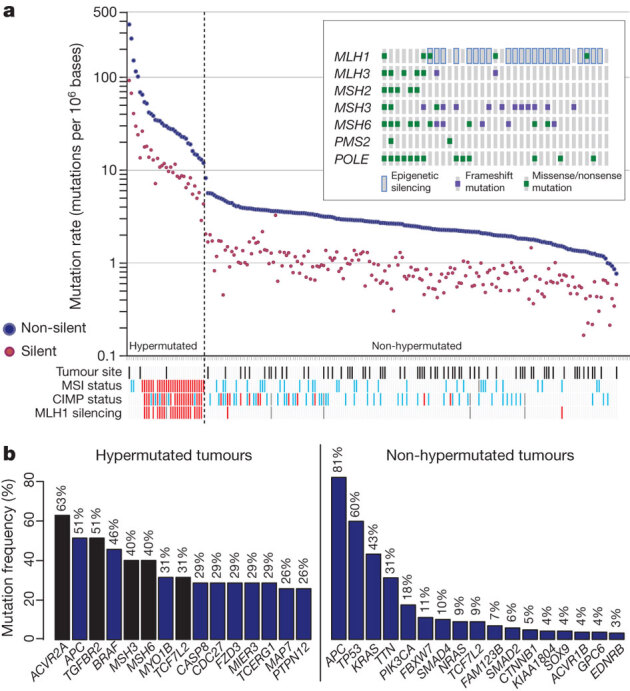
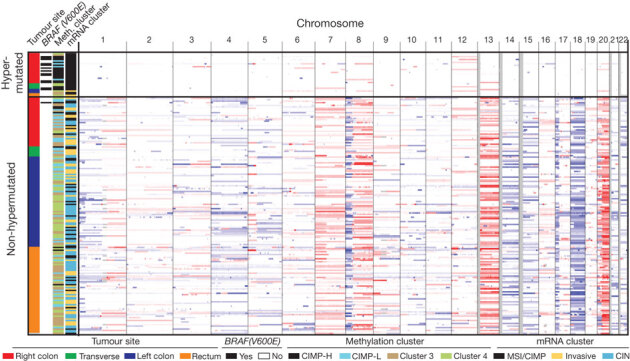
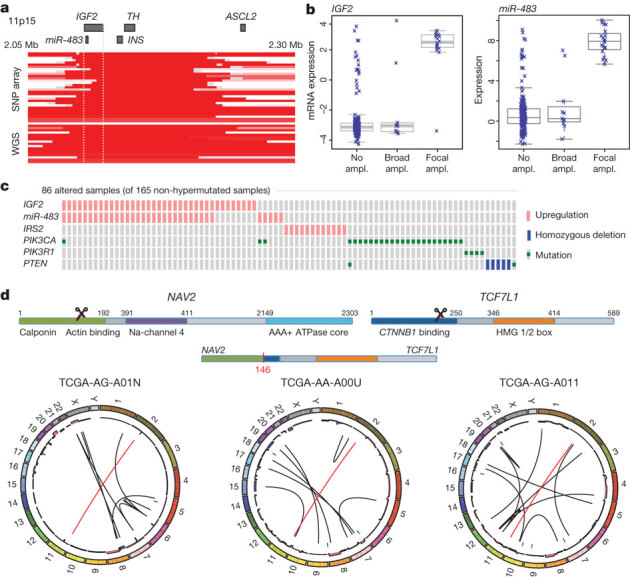
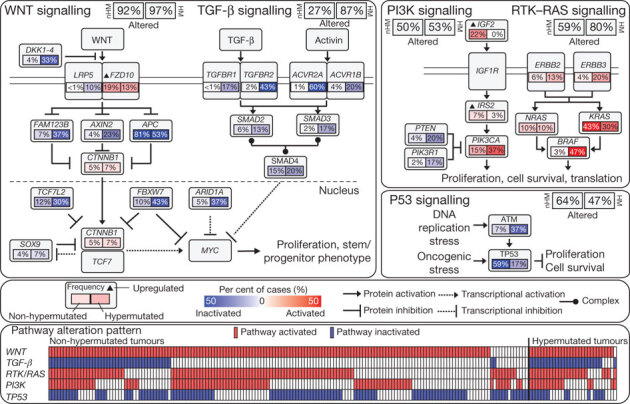
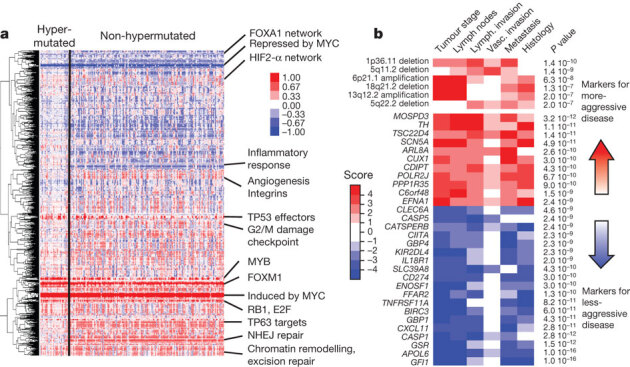
To characterize somatic alterations in colorectal carcinoma, we conducted a genome-scale analysis of 276 samples, analysing exome sequence, DNA copy number, promoter methylation and messenger RNA and microRNA expression. A subset of these samples (97) underwent low-depth-of-coverage whole-genome sequencing. In total, 16% of colorectal carcinomas were found to be hypermutated: three-quarters of these had the expected high microsatellite instability, usually with hypermethylation and MLH1 silencing, and one-quarter had somatic mismatch-repair gene and polymerase ε (POLE) mutations. Excluding the hypermutated cancers, colon and rectum cancers were found to have considerably similar patterns of genomic alteration. Twenty-four genes were significantly mutated, and in addition to the expected APC, TP53, SMAD4, PIK3CA and KRAS mutations, we found frequent mutations in ARID1A, SOX9 and FAM123B. Recurrent copy-number alterations include potentially drug-targetable amplifications of ERBB2 and newly discovered amplification of IGF2. Recurrent chromosomal translocations include the fusion of NAV2 and WNT pathway member TCF7L1. Integrative analyses suggest new markers for aggressive colorectal carcinoma and an important role for MYC-directed transcriptional activation and repression. The Cancer Genome Atlas consortium reports on their genome-wide characterization of somatic alterations in colorectal cancer; in addition to revealing a remarkably consistent pattern of genomic alteration, with 24 genes being significantly mutated, the study identifies new targets for therapeutic intervention and suggests an important role for MYC-directed transcriptional activation and repression. The Cancer Genome Atlas consortium reports on their genome-wide characterization of somatic alterations in colorectal carcinoma. Combined analysis of exome sequence data, DNA copy number, promoter methylation, messenger RNA and microRNA expression, as well as low-coverage whole-genome sequencing reveal that 16% of these carcinomas have hypermutation. Of these, three-quarters have the expected high microsatellite instability, but the rest have somatic mismatch repair gene mutations. The data reveal a remarkably consistent pattern of genomic alteration, with 24 genes being significantly mutated. As well as identifying new biomarkers for aggressive colorectal carcinoma, the data imply an important role for MYC-directed transcriptional activation and repression.
Overview
The claims and statistics of this paper haven’t been checked yet.
Free: it reads the open-access text and checks the first 5 claims that cite a source we can check. Create a free account to check every claim.
Integrity signals
Registry
Cites
Statistics
Figures
Verification
Claims the paper makes
The claims and statistics of this paper haven’t been checked yet.
Free: it reads the open-access text and checks the first 5 claims that cite a source we can check. Create a free account to check every claim.
Claims other papers make about this one
Each is checked against this paper’s own text: does it say what the citing paper says it does?
The source backs part of the claim, not all of it — or backs it for a different population, condition or comparison.
In the citing paper
“KRAS G12V had an increased rate of comutation with TCF7L2, which encodes TCF4, a regulator of Wnt signaling often dysregulated in COAD49–51, specifically the R488C mutation.”
From The origins and genetic interactions of KRAS mutations are allele- and tissue-specific (2021) · cites this paper as [49]
Experimental — accuracy not yet measuredThe source backs part of the claim, not all of it — or backs it for a different population, condition or comparison.
In the citing paper
“PI3K α is both a key regulator and effector of KRAS-dependent signaling and is also activated through mutations involving the PIK3CA gene locus in colorectal cancer, including mutations co-occurring with KRAS [19].”
From Anti-tumor efficacy of a potent and selective non-covalent KRASG12D inhibitor (2022) · cites this paper as [19]
Experimental — accuracy not yet measuredThe source backs part of the claim, not all of it — or backs it for a different population, condition or comparison.
In the citing paper
“Approximately 55% of colorectal cancers (CRCs) are driven by mutational activation of KRAS, BRAF, NRAS, and thus are hard-wired to oncogenic RAS/RAF/MEK/ERK pathway signaling [1–3].”
From An integrative gene expression signature analysis identifies CMS4 KRAS-mutated colorectal cancers sensitive to combined MEK and SRC targeted therapy (2022) · cites this paper as [2]
Experimental — accuracy not yet measuredThe source backs part of the claim, not all of it — or backs it for a different population, condition or comparison.
In the citing paper
“TALENs targeting position 1320 of the APC coding sequence (Fig 3A), a known hotspot commonly mutated in FAP patients [2].”
From Modeling APC mutagenesis and familial adenomatous polyposis using human iPS cells (2018) · cites this paper as [2]
Experimental — accuracy not yet measuredThe source backs part of the claim, not all of it — or backs it for a different population, condition or comparison.
In the citing paper
“which represent ~10–11% of all CRCs (Network, 2012)”
From A Landscape of Therapeutic Cooperativity in KRAS Mutant Cancers Reveals Principles for Controlling Tumor Evolution (2017) · cites this paper as Network, 2012
Experimental — accuracy not yet measured
6 more claims about this paper
Create a free account to see every claim other papers make about this one.
Self-check
Percentages, sums and reported differences re-computed from the paper’s own numbers.
The self-check needs the paper’s full text.
Citations
Cites
Integrated genomic analyses of ovarian carcinoma
Perou, C. M. (2019) · Carolina Digital Repository (University of North Carolina at Chapel Hill) · doi:10.17615/hvp3-wg08 · Cited by 7,925
Comprehensive genomic characterization defines human glioblastoma genes and core pathways
The Cancer Genome Atlas Research Network (2008) · Nature · doi:10.1038/nature07385 · Cited by 7,735
Self-citationUmar, A., Boland, C. R., Terdiman, J. P., Syngal, S., Chapelle, A. D. L., Ruschoff, J., Fishel, R., Lindor, N. M., Burgart, L. J., Hamelin, R., et al. (2004) · JNCI Journal of the National Cancer Institute · doi:10.1093/jnci/djh034 · Cited by 3,183
The Consensus Coding Sequences of Human Breast and Colorectal Cancers
Sjöblom, T., Jones, S., Wood, L. D., Parsons, D. W., Lin, J., Barber, T. D., Mandelker, D., Leary, R. J., Ptak, J., Silliman, N., et al. (2006) · Science · doi:10.1126/science.1133427 · Cited by 3,169
The Genomic Landscapes of Human Breast and Colorectal Cancers
Wood, L. D., Parsons, D. W., Jones, S., Lin, J., Sjöblom, T., Leary, R. J., Shen, D., Boca, S. M., Barber, T., Ptak, J., et al. (2007) · Science · doi:10.1126/science.1145720 · Cited by 2,833
Clues to the Pathogenesis of Familial Colorectal Cancer
Aaltonen, L. A., Peltomäki, P., Leach, F. S., Sistonen, P., Pylkkänen, L., Mecklin, J.-P., Järvinen, H., Powell, S. M., Jen, J., Hamilton, S. R., et al. (1993) · Science · doi:10.1126/science.8484121 · Cited by 2,710
Ionov, Y., Peinado, M. A., Malkhosyan, S., Shibata, D., & Perucho, M. (1993) · Nature · doi:10.1038/363558a0 · Cited by 2,708
TGFβ Signaling in Growth Control, Cancer, and Heritable Disorders
Massagué, J., Blain, S. W., & Lo, R. S. (2000) · Cell · doi:10.1016/s0092-8674(00)00121-5 · Cited by 2,385
Landon, M., Saam, J., Brown, K. L., Moyes, K., Evans, B., & Wenstrup, R. (2015) · Oncology · doi:10.1159/000430097 · Cited by 1,939
Molecular Genetics of Colorectal Cancer
Fearon, E. R. (2011) · Annual Review of Pathology: Mechanisms of Disease · doi:10.1146/annurev-pathol-011110-130235 · Cited by 1,805
Cited by
Items 701–800 of 1,135
High-throughput proteomics and AI for cancer biomarker discovery
Xiao, Q., Zhang, F., Xu, L., Yue, L., Kon, O. L., Zhu, Y., & Guo, T. (2021) · Advanced Drug Delivery Reviews · doi:10.1016/j.addr.2021.113844 · Cited by 161
Mammalian MYC Proteins and Cancer
Tansey, W. P. (2014) · New Journal of Science · doi:10.1155/2014/757534 · Cited by 151
SAMHD1‐dependent retroviral control and escape in mice
Rehwinkel, J., Maelfait, J., Bridgeman, A., Rigby, R. E., Hayward, B. E., Liberatore, R. A., Bieniasz, P. D., Towers, G. J., Moita, L. F., Crow, Y. J., et al. (2013) · The EMBO Journal · doi:10.1038/emboj.2013.163 · Cited by 173
You, S., Li, S., Zeng, L., Song, J., Li, Z., Li, W., Ni, H., Xu, X., Deng, W., Li, H., et al. (2024) · Cancer Cell · doi:10.1016/j.ccell.2024.06.014 · Cited by 175
An Integrative Approach to Precision Cancer Medicine Using Patient-Derived Xenografts
Cho, S., Kang, W., Han, J. Y., Min, S., Kang, J., Lee, A., Kwon, J. Y., Lee, C., & Park, H. (2016) · Molecules and Cells · doi:10.14348/molcells.2016.2350 · Cited by 161
Genomics and emerging biomarkers for immunotherapy of colorectal cancer
Kather, J. N., Halama, N., & Jaeger, D. (2018) · Seminars in Cancer Biology · doi:10.1016/j.semcancer.2018.02.010 · Cited by 150
Tam, B. Y. Y., Chiu, K., Chung, H., Bossard, C., Nguyen, J. D., Creger, E., Eastman, B. W., Mak, C. C., Ibanez, M., Ghias, A., et al. (2019) · Cancer Letters · doi:10.1016/j.canlet.2019.09.009 · Cited by 162
Colorectal cancer immunotherapy-Recent progress and future directions
Zhao, W., Jin, L., Chen, P., Li, D., Gao, W., & Dong, G. (2022) · Cancer Letters · doi:10.1016/j.canlet.2022.215816 · Cited by 165
Pilati, C., Shinde, J., Alexandrov, L. B., Assié, G., André, T., Hélias‐Rodzewicz, Z., Ducoudray, R., Le Corre, D., Zucman‐Rossi, J., Emile, J., et al. (2017) · The Journal of Pathology · doi:10.1002/path.4880 · Cited by 150
The Cancer Cell Map Initiative: Defining the Hallmark Networks of Cancer
Krogan, N. J., Lippman, S., Agard, D. A., Ashworth, A., & Ideker, T. (2015) · Molecular Cell · doi:10.1016/j.molcel.2015.05.008 · Cited by 149
Identification of recurrent regulated alternative splicing events across human solid tumors
Danan-Gotthold, M., Golan‐Gerstl, R., Eisenberg, E., Meir, K., Karni, R., & Levanon, E. Y. (2015) · Nucleic Acids Research · doi:10.1093/nar/gkv210 · Cited by 167
AP4 is a mediator of epithelial–mesenchymal transition and metastasis in colorectal cancer
Jackstadt, R., Röh, S., Neumann, J., Jung, P., Hoffmann, R., Horst, D., Berens, C., Bornkamm, G. W., Kirchner, T., Menssen, A., et al. (2013) · Journal of Experimental Medicine · doi:10.1084/jem.20120812 · Cited by 150
Ampullary Cancers Harbor ELF3 Tumor Suppressor Gene Mutations and Exhibit Frequent WNT Dysregulation
Gingras, M., Covington, K. R., Chang, D. K.-F., Donehower, L. A., Gill, A. J., Ittmann, M., Creighton, C. J., Johns, A. L., Shinbrot, E., Dewal, N., et al. (2016) · Cell Reports · doi:10.1016/j.celrep.2015.12.005 · Cited by 156
Alonso, M. H., Aussó, S., López‐Doriga, A., Cordero, D., Guinó, E., Solé, X., Barenys, M., de, J., Capellá, G., Salazar, R., et al. (2017) · British Journal of Cancer · doi:10.1038/bjc.2017.208 · Cited by 160
Mitophagy in Intestinal Epithelial Cells Triggers Adaptive Immunity during Tumorigenesis
Ziegler, P. K., Bollrath, J., Pallangyo, C. K., Matsutani, T., Canli, Ö., De Oliveira, T., Diamanti, M. A., Müller, N., Gamrekelashvili, J., Putoczki, T., et al. (2018) · Cell · doi:10.1016/j.cell.2018.05.028 · Cited by 149
Uniform genomic data analysis in the NCI Genomic Data Commons
Zhang, Z., Hernandez, K. M., Savage, J. H., Li, S., Miller, D. P., Agrawal, S., Ortuño, F. M., Staudt, L. M., Heath, A. P., & Grossman, R. L. (2021) · Nature Communications · doi:10.1038/s41467-021-21254-9 · Cited by 189
Chu, X., Li, X., Zhang, Y., Dang, G., Miao, Y., Xu, W., Wang, J., Zhang, Z., & Cheng, S. (2024) · Nature Cancer · doi:10.1038/s43018-024-00807-z · Cited by 201
Naumov, V. A., Generozov, E. V., Zaharjevskaya, N. B., Matushkina, D. S., Larin, A. K., Chernyshov, S. V., Alekseev, M. V., Shelygin, Y. A., & Govorun, V. M. (2013) · Epigenetics · doi:10.4161/epi.25577 · Cited by 149
Patterns of missplicing due to somatic U2AF1 mutations in myeloid neoplasms
Przychodzen, B., Jerez, A., Guinta, K., Sekeres, M. A., Padgett, R., Maciejewski, J. P., & Makishima, H. (2013) · Blood · doi:10.1182/blood-2013-01-480970 · Cited by 149
Normanno, N., Rachiglio, A. M., Lambiase, M., Martinelli, E., Fenizia, F., Esposito, C., Roma, C., Troiani, T., Rizzi, D., Tatangelo, F., et al. (2015) · Annals of Oncology · doi:10.1093/annonc/mdv176 · Cited by 160
Liu, Y., Wang, G., Yu, Y., Mei, Z., Liang, Z., Cui, A., Wu, T., Liu, C.-Y., & Cui, L. (2015) · Oncogene · doi:10.1038/onc.2015.342 · Cited by 155
Comparative pan-cancer DNA methylation analysis reveals cancer common and specific patterns
Yang, X., Gao, L., & Zhang, S. (2016) · Briefings in Bioinformatics · doi:10.1093/bib/bbw063 · Cited by 159
McCubrey, J. A., Rakus, D., Gizak, A., Steelman, L. S., Abrams, S. L., Lertpiriyapong, K., Fitzgerald, T. L., Yang, L. V., Montalto, G., Cervello, M., et al. (2016) · Biochimica et Biophysica Acta (BBA) - Molecular Cell Research · doi:10.1016/j.bbamcr.2016.09.004 · Cited by 162
Validating the concept of mutational signatures with isogenic cell models
Zou, X., Owusu, M., Harris, R., Jackson, S. P., Loizou, J. I., & Nik-Zainal, S. (2018) · Nature Communications · doi:10.1038/s41467-018-04052-8 · Cited by 149
The evolutionary landscape of colorectal tumorigenesis
Cross, W., Kovac, M., Mustonen, V., Temko, D., Davis, H., Baker, A.-M., Biswas, S., Arnold, R., Chegwidden, L., Gatenbee, C., et al. (2018) · Nature Ecology & Evolution · doi:10.1038/s41559-018-0642-z · Cited by 147
Mex3a marks drug-tolerant persister colorectal cancer cells that mediate relapse after chemotherapy
Álvarez-Varela, A., Novellasdemunt, L., Barriga, F. M., Hernando‐Momblona, X., Cañellas-Socias, A., Cano-Crespo, S., Sevillano, M., Cortina, C., Stork, D., Morral, C., et al. (2022) · Nature Cancer · doi:10.1038/s43018-022-00402-0 · Cited by 164
Radioprotection of IDH1 -Mutated Cancer Cells by the IDH1-Mutant Inhibitor AGI-5198
Molenaar, R. J., Botman, D., Smits, M. A., Hira, V. V., van Lith, S. A., Stap, J., Henneman, P., Khurshed, M., Lenting, K., Mul, A. N., et al. (2015) · Cancer Research · doi:10.1158/0008-5472.can-14-3603 · Cited by 148
Spier, I., Holzapfel, S., Altmüller, J., Zhao, B., Horpaopan, S., Vogt, S. L., Chen, S., Morak, M., Raeder, S., Kayser, K., et al. (2014) · International Journal of Cancer · doi:10.1002/ijc.29396 · Cited by 150
Mouradov, D., Domingo, E., Gibbs, P., Jorissen, R. N., Li, S., Soo, P. Y., Lipton, L., Desai, J., Danielsen, H. E., Oukrif, D., et al. (2013) · American Journal of Gastroenterology · doi:10.1038/ajg.2013.292 · Cited by 148
Evolution of DNA Methylation Is Linked to Genetic Aberrations in Chronic Lymphocytic Leukemia
Oakes, C. C., Claus, R., Gu, L., Assenov, Y., Hüllein, J., Zucknick, M., Bieg, M., Brocks, D., Bogatyrova, O., Schmidt, C. R., et al. (2014) · Cancer Discovery · doi:10.1158/2159-8290.cd-13-0349 · Cited by 148
Progress in Understanding the IL-6/STAT3 Pathway in Colorectal Cancer
Lin, Y., He, Z., Ye, J., Liu, Z., She, X., Gao, X., & Liang, R. (2020) · OncoTargets and Therapy · doi:10.2147/ott.s278013 · Cited by 165
Bortolomeazzi, M., Keddar, M. R., Montorsi, L., Acha-Sagredo, A., Benedetti, L., Temelkovski, D., Choi, S., Petrov, N., Todd, K., Wai, P., et al. (2021) · Gastroenterology · doi:10.1053/j.gastro.2021.06.064 · Cited by 146
MicroRNAs in the etiology of colorectal cancer: Pathways and clinical implications
Strubberg, A. M., & Madison, B. B. (2017) · Disease Models & Mechanisms · doi:10.1242/dmm.027441 · Cited by 147
Falzone, L., Scola, L., Zanghì, A., Biondi, A., Cataldo, A. D., Libra, M., & Candido, S. (2018) · Aging · doi:10.18632/aging.101444 · Cited by 161
Drier, Y., Lawrence, M. S., Carter, S. L., Stewart, C., Gabriel, S. B., Lander, E. S., Meyerson, M., Beroukhim, R., & Getz, G. (2013) · Genome Research · doi:10.1101/gr.141382.112 · Cited by 147
Chen, Z.-Y., Raghav, K. P. S., Lieu, C. H., Jiang, Z.-Q., Eng, C., Vauthey, J.-N., Chang, G. J., Qiao, W., Morris, J. S., Hong, D. S., et al. (2015) · British Journal of Cancer · doi:10.1038/bjc.2015.61 · Cited by 158
Cancer Genomics and Inherited Risk
Stadler, Z. K., Schrader, K. A., Vijai, J., Robson, M. E., & Offit, K. (2014) · Journal of Clinical Oncology · doi:10.1200/jco.2013.49.7271 · Cited by 146
Immunotherapy for Colorectal Cancer
Boland, P., & Ma, W. (2017) · Cancers · doi:10.3390/cancers9050050 · Cited by 144
Mateo, J., Ganji, G., Lemech, C., Burris, H. A., Han, S.-W., Swales, K., Decordova, S., DeYoung, M. P., Smith, D. A., Kalyana-Sundaram, S., et al. (2017) · Clinical Cancer Research · doi:10.1158/1078-0432.ccr-17-0725 · Cited by 145
Brohl, A. S., Kahen, E., Yoder, S., Teer, J. K., & Reed, D. R. (2017) · Scientific Reports · doi:10.1038/s41598-017-15183-1 · Cited by 152
Kloor, M., Reuschenbach, M., Pauligk, C., Karbach, J., Rafiyan, M.-R., Al-Batran, S.-E., Tariverdian, M., Jäger, E., & von Knebel Doeberitz, M. (2020) · Clinical Cancer Research · doi:10.1158/1078-0432.ccr-19-3517 · Cited by 145
CXCL11 Correlates With Antitumor Immunity and an Improved Prognosis in Colon Cancer
Cao, Y., Jiao, N., Sun, T., Ma, Y., Zhang, X., Chen, H., Hong, J., & Zhang, Y. (2021) · Frontiers in Cell and Developmental Biology · doi:10.3389/fcell.2021.646252 · Cited by 163
Non-coding RNAs as liquid biopsy biomarkers in cancer
Toden, S., & Goel, A. (2022) · British Journal of Cancer · doi:10.1038/s41416-021-01672-8 · Cited by 169
TGF-β signaling in liver and gastrointestinal cancers
Katz, L. H., Likhter, M., Jogunoori, W. S., Belkin, M. D., Ohshiro, K., & Mishra, L. (2016) · Cancer Letters · doi:10.1016/j.canlet.2016.03.033 · Cited by 148
Mechanisms of action of vitamin D in colon cancer
Ferrer‐Mayorga, G., Larriba, M. J., Crespo, P., & Múñoz, A. (2018) · The Journal of Steroid Biochemistry and Molecular Biology · doi:10.1016/j.jsbmb.2018.07.002 · Cited by 162
The role of miRNAs in colorectal cancer progression and chemoradiotherapy
Zhang, N., Hu, X., Du, Y., & Du, J. (2020) · Biomedicine & Pharmacotherapy · doi:10.1016/j.biopha.2020.111099 · Cited by 158
Prospective experimental treatment of colorectal cancer patients based on organoid drug responses
Ooft, S. N., Weeber, F., Schipper, L., Dijkstra, K. K., McLean, C. M., Kaing, S., van de Haar, J., Prevoo, W., van Werkhoven, E., Snaebjornsson, P., et al. (2021) · ESMO Open · doi:10.1016/j.esmoop.2021.100103 · Cited by 140
Morkel, M., Riemer, P., Bläker, H., & Sers, C. (2015) · Oncotarget · doi:10.18632/oncotarget.4750 · Cited by 144
Putative cis-regulatory drivers in colorectal cancer
Ongen, H., Andersen, C. L., Bramsen, J. B., Oster, B., Rasmussen, M. H., Ferreira, P. G., Sandoval, J., Vidal, E., Whiffin, N., Planchon, A., et al. (2014) · Nature · doi:10.1038/nature13602 · Cited by 144
Gala, M. K., Mizukami, Y., Le, L. P., Moriichi, K., Austin, T. R., Yamamoto, M., Lauwers, G. Y., Bardeesy, N. M., & Chung, D. C. (2013) · Gastroenterology · doi:10.1053/j.gastro.2013.10.045 · Cited by 159
Xi, R., Lee, S., Xia, Y., Kim, T.-M., & Park, P. J. (2016) · Nucleic Acids Research · doi:10.1093/nar/gkw491 · Cited by 144
Chemoradiotherapy Resistance in Colorectal Cancer Cells is Mediated by Wnt/β-catenin Signaling
Emons, G., Spitzner, M., Reineke, S., Möller, J., Auslander, N., Kramer, F., Hu, Y., Beissbarth, T., Wolff, H. A., Rave-Fränk, M., et al. (2017) · Molecular Cancer Research · doi:10.1158/1541-7786.mcr-17-0205 · Cited by 144
Genetic and epigenetic alterations of colorectal cancer
Hong, S. N. (2018) · Intestinal Research · doi:10.5217/ir.2018.16.3.327 · Cited by 172
Aghabozorgi, A. S., Bahreyni, A., Soleimani, A., Bahrami, A., Khazaei, M., Ferns, G. A., Avan, A., & Hassanian, S. M. (2019) · Biochimie · doi:10.1016/j.biochi.2018.11.003 · Cited by 144
Hypermutated tumours in the era of immunotherapy: The paradigm of personalised medicine
Nebot-Bral, L., Brandão, D., Verlingue, L., Rouleau, É., Caron, O., Despras, E., Dakdouki, Y. E., Champiat, S., Aoufouchi, S., Leary, A. F., et al. (2017) · European Journal of Cancer · doi:10.1016/j.ejca.2017.07.026 · Cited by 155
Existing and Emerging Technologies for Tumor Genomic Profiling
MacConaill, L. E. (2013) · Journal of Clinical Oncology · doi:10.1200/jco.2012.46.5948 · Cited by 154
Vitamin D Is a Multilevel Repressor of Wnt/b-Catenin Signaling in Cancer Cells
Larriba, M. J., González‐Sancho, J. M., Barbáchano, A., Niell, N., Ferrer‐Mayorga, G., & Múñoz, A. (2013) · Cancers · doi:10.3390/cancers5041242 · Cited by 164
Mills, J. C., & Sansom, O. J. (2015) · Science Signaling · doi:10.1126/scisignal.aaa7540 · Cited by 151
Frequent PTPRK–RSPO3 fusions and RNF43 mutations in colorectal traditional serrated adenoma
Sekine, S., Yamashita, S., Tanabe, T., Hashimoto, T., Yoshida, H., Taniguchi, H., Kojima, M., Shinmura, K., Saito, Y., Hiraoka, N., et al. (2016) · The Journal of Pathology · doi:10.1002/path.4709 · Cited by 142
Tokunaga, R., Sakamoto, Y., Nakagawa, S., Ohuchi, M., Izumi, D., Kosumi, K., Taki, K., Higashi, T., Miyamoto, Y., Yoshida, N., et al. (2016) · International Journal of Colorectal Disease · doi:10.1007/s00384-016-2668-5 · Cited by 148
Clinical relevance of colorectal cancer molecular subtypes
Rodríguez-Salas, N., Dominguez, G., Barderas, R., Mendiola, M., García‐Albéniz, X., Maurel, J., & Batlle, J. F. (2016) · Critical Reviews in Oncology/Hematology · doi:10.1016/j.critrevonc.2016.11.007 · Cited by 171
Ortmayr, K., Dubuis, S., & Zampieri, M. (2019) · Nature Communications · doi:10.1038/s41467-019-09695-9 · Cited by 142
Newey, A., Griffiths, B. L., Michaux, J., Pak, H. S., Stevenson, B. J., Woolston, A., Semiannikova, M., Spain, G., Barber, L. J., Matthews, N., et al. (2019) · Journal for ImmunoTherapy of Cancer · doi:10.1186/s40425-019-0769-8 · Cited by 145
Lithium and Therapeutic Targeting of GSK-3
Snitow, M. E., Bhansali, R. S., & Klein, P. S. (2021) · Cells · doi:10.3390/cells10020255 · Cited by 167
Gatalica, Z., Vranic, S., Xiu, J., Swensen, J., & Reddy, S. (2016) · Familial Cancer · doi:10.1007/s10689-016-9884-6 · Cited by 141
Chen, J., Zaidi, S., Rao, S., Chen, J., Phan, L. M., Farci, P., Su, X., Shetty, K., White, J. C., Zamboni, F., et al. (2017) · Gastroenterology · doi:10.1053/j.gastro.2017.09.007 · Cited by 153
Small molecule promotes β-catenin citrullination and inhibits Wnt signaling in cancer
Qu, Y., Olsen, J. R., Xing, Y., Cheng, P. F., Levesque, M. P., Brokstad, K. A., Hoffman, P. S., Oyan, A. M., Zhang, W., Kalland, K., et al. (2017) · Nature Chemical Biology · doi:10.1038/nchembio.2510 · Cited by 154
Molecular Pathology of Colorectal Cancer
Harada, S., & Morlote, D. M. (2019) · Advances in Anatomic Pathology · doi:10.1097/pap.0000000000000247 · Cited by 171
POLE/POLD1 mutation and tumor immunotherapy
Ma, X., Lin, D., Liu, X., Ou, K., & Yang, L. (2022) · Journal of Experimental & Clinical Cancer Research · doi:10.1186/s13046-022-02422-1 · Cited by 162
AXIN1 and AXIN2 variants in gastrointestinal cancers
Mazzoni, S. M., & Fearon, E. R. (2014) · Cancer Letters · doi:10.1016/j.canlet.2014.09.018 · Cited by 140
moCluster: Identifying Joint Patterns Across Multiple Omics Data Sets
Meng, C., Helm, D., Frejno, M., & Kuster, B. (2016) · Journal of Proteome Research · doi:10.1021/acs.jproteome.5b00824 · Cited by 140
Banh, R. S., Iorio, C., Marcotte, R., Xu, Y., Cojocari, D., Rahman, A. M. A., Pawling, J., Zhang, W., Sinha, A., Rose, C. M., et al. (2016) · Nature Cell Biology · doi:10.1038/ncb3376 · Cited by 147
A Network of Conserved Synthetic Lethal Interactions for Exploration of Precision Cancer Therapy
Srivas, R., Shen, J. P., Yang, C. C., Sun, S. M., Li, J., Gross, A. M., Jensen, J., Licon, K., Bojorquez-Gomez, A., Klepper, K., et al. (2016) · Molecular Cell · doi:10.1016/j.molcel.2016.06.022 · Cited by 151
Recent advances in Lynch syndrome
Biller, L. H., Syngal, S., & Yurgelun, M. B. B. (2019) · Familial Cancer · doi:10.1007/s10689-018-00117-1 · Cited by 168
Role of POLE and POLD1 in familial cancer
Mur, P., García-Mulero, S., del Valle, J., Magraner-Pardo, L., Vidal, A., Pineda, M., Cinnirella, G., Martín-Ramos, E., Pons, T., López-Doriga, A., et al. (2020) · Genetics in Medicine · doi:10.1038/s41436-020-0922-2 · Cited by 140
Mathematical Modelling of Molecular Pathways Enabling Tumour Cell Invasion and Migration
Cohen, D., Martignetti, L., Robine, S., Barillot, E., Zinovyev, A. Y., & Calzone, L. (2015) · PLoS Computational Biology · doi:10.1371/journal.pcbi.1004571 · Cited by 150
Management of colorectal cancer
Stintzing, S. (2014) · F1000Prime Reports · doi:10.12703/p6-108 · Cited by 192
Niederreiter, L., Fritz, T. M. J., Adolph, T. E., Krismer, A.-M., Offner, F. A., Tschurtschenthaler, M., Flak, M. B., Hosomi, S., Tomczak, M. F., Kaneider, N. C., et al. (2013) · Journal of Experimental Medicine · doi:10.1084/jem.20122341 · Cited by 139
Molecular markers for colorectal cancer screening
Dickinson, B., Kisiel, J. B., Ahlquist, D. A., & Grady, W. M. (2015) · Gut · doi:10.1136/gutjnl-2014-308075 · Cited by 157
Mouse models of intestinal cancer
Jackstadt, R., & Sansom, O. J. (2016) · The Journal of Pathology · doi:10.1002/path.4645 · Cited by 138
Nicolas, E., Golemis, E. A., & Arora, S. (2016) · Gene · doi:10.1016/j.gene.2016.06.031 · Cited by 139
DNA methylation aberrancies as a guide for surveillance and treatment of human cancers
Liang, G., & Weisenberger, D. J. (2017) · Epigenetics · doi:10.1080/15592294.2017.1311434 · Cited by 152
Genetic and epigenetic drivers of neuroendocrine tumours (NET)
Domenico, A. D., Wiedmer, T., Marinoni, I., & Perren, A. A. (2017) · Endocrine Related Cancer · doi:10.1530/erc-17-0012 · Cited by 162
Modeling Human Digestive Diseases With CRISPR-Cas9–Modified Organoids
Fujii, M., Clevers, H., & Sato, T. (2019) · Gastroenterology · doi:10.1053/j.gastro.2018.11.048 · Cited by 140
Ballhausen, A., Przybilla, M. J., Jendrusch, M., Haupt, S., Pfaffendorf, E., Seidler, F., Witt, J., Hernandez Sanchez, A., Urban, K., Draxlbauer, M., et al. (2020) · Nature Communications · doi:10.1038/s41467-020-18514-5 · Cited by 139
Lussier, D. M., Alspach, E., Ward, J. P., Miceli, A. P., Runci, D., White, J. M., Mpoy, C., Arthur, C. D., Kohlmiller, H. N., Jacks, T., et al. (2021) · Proceedings of the National Academy of Sciences · doi:10.1073/pnas.2102611118 · Cited by 152
Cause, Epidemiology, and Histology of Polyps and Pathways to Colorectal Cancer
Sullivan, B. A., Noujaim, M. G., & Roper, J. (2022) · Gastrointestinal Endoscopy Clinics of North America · doi:10.1016/j.giec.2021.12.001 · Cited by 181
Localized Data Fusion for Kernel k-Means Clustering with Application to Cancer Biology
Gönen, M., & Margolin, A. A. (2014) · neural information processing systems · Cited by 139
A multi-gene signature predicts outcome in patients with pancreatic ductal adenocarcinoma
Haider, S., Wang, J., Nagano, A., Desai, A., Arumugam, P., Dumartin, L., Fitzgibbon, J., Hagemann, T., Marshall, J. F., Kocher, H. M., et al. (2014) · Genome Medicine · doi:10.1186/s13073-014-0105-3 · Cited by 145
Farshidfar, F., Weljie, A. M., Kopciuk, K. A., Hilsden, R. J., McGregor, S. E., Buie, W. D., MacLean, A. R., Vogel, H. J., & Bathe, O. F. (2016) · British Journal of Cancer · doi:10.1038/bjc.2016.243 · Cited by 152
A panel of microRNA signature in serum for colorectal cancer diagnosis
Zhu, M., Huang, Z., Zhu, D., Zhou, X., Shan, X., Qi, L.-W., Wu, L., Cheng, W., Zhu, J., Zhang, L., et al. (2017) · Oncotarget · doi:10.18632/oncotarget.15059 · Cited by 137
Hartmaier, R. J., Albacker, L. A., Chmielecki, J., Bailey, M., He, J., Goldberg, M. E., Ramkissoon, S., Suh, J., Elvin, J. A., Chiacchia, S., et al. (2017) · Cancer Research · doi:10.1158/0008-5472.can-16-2479 · Cited by 138
Wu, C., Lyu, J., Yang, E. J., Liu, Y., Zhang, B., & Shim, J. S. (2018) · Nature Communications · doi:10.1038/s41467-018-05694-4 · Cited by 136
Wu, H., Lu, X.-X., Wang, J., Yang, T., Li, X., He, X., Li, Y., Ye, W.-L., Wu, Y., Gan, W.-J., et al. (2019) · Autophagy · doi:10.1080/15548627.2019.1586250 · Cited by 147
Lee, D., Han, S., Bae, J. M., Jang, H. S., Han, H., Kim, H., Bang, D., Jeong, S., Park, K. J., Kang, G. H., et al. (2019) · Clinical Cancer Research · doi:10.1158/1078-0432.ccr-19-1105 · Cited by 155
MSIseq: Software for Assessing Microsatellite Instability from Catalogs of Somatic Mutations
Ni Huang, M., McPherson, J. R., Cutcutache, I., Teh, B. T., Tan, P., & Rozen, S. G. (2015) · Scientific Reports · doi:10.1038/srep13321 · Cited by 137
Deep convolutional neural networks for accurate somatic mutation detection
Sahraeian, S. M. E., Liu, R., Lau, B., Podesta, K., Mohiyuddin, M., & Lam, H. Y. K. (2019) · Nature Communications · doi:10.1038/s41467-019-09027-x · Cited by 136
Vlachavas, E., Pilalis, E. D., Papadodima, O., Koczan, D., Willis, S., Klippel, S., Cheng, C., Pan, L., Sachpekidis, C., Pintzas, A., et al. (2019) · Computational and Structural Biotechnology Journal · doi:10.1016/j.csbj.2019.01.007 · Cited by 140
Khakoo, S. S., Carter, P. D., Brown, G., Valeri, N., Picchia, S., Bali, M. A., Shaikh, R., Jones, T., Begum, R., Rana, I., et al. (2020) · Clinical Cancer Research · doi:10.1158/1078-0432.ccr-19-1996 · Cited by 145
Luo, X.-J., Zhao, Q., Liu, J. S., Zheng, J., Qiu, M., Ju, H., & Xu, R. (2020) · Molecular Therapy · doi:10.1016/j.ymthe.2020.12.017 · Cited by 145
Metadata
- Authors
- The Cancer Genome Atlas Network
- Affiliations
- Broad Institute (US)
- Corresponding author
- The Cancer Genome Atlas Network
- Venue
- Nature
- Published
- 2012-07-18
- Volume
- 487
- Issue
- 7407
- Pages
- 330-337
- ISSN
- 0028-0836 (ISSN-L)
- 1476-4687
- PMC
- PMC3401966
- OpenAlex
- W2262414037
- Semantic Scholar
- 56321e765211d85a29621551d0df9a1cfc0a78ca
- Cited by
- 8,499
- References
- 49
- Citations by year
- 2026: 389 · 2025: 455 · 2024: 502 · 2023: 591 · 2022: 678 · 2021: 754 · 2020: 736 · 2019: 686 · 2018: 677 · 2017: 673 · 2016: 646 · 2015: 616 · 2014: 578 · 2013: 424 · 2012: 86
- FWCI
- 393.35
- Type
- journal article
- Language
- en
- Open access
- hybrid
- doi.org
- Licence
- cc-by-nc-sa
- creativecommons.org/licenses/by-nc-sa/3.0/ (tdm)
- creativecommons.org/licenses/by-nc-sa/3.0/ (vor)
- Locations
- Nature (publishedVersion, cc-by-nc-sa)
- PubMed Central (publishedVersion, cc-by-nc-sa)
- PubMed (publishedVersion)
- eScholarship (California Digital Library) (submittedVersion)
- eSpace (Curtin University) (submittedVersion, cc-by-nc-sa)
- Scholarworks@UNIST (Ulsan National Institute of Science and Technology) (submittedVersion)
- Funders
- National Institutes of Health
- National Human Genome Research Institute (U54HG003067, U54HG003079, U54HG003273, R01HG006272)
- National Cancer Institute (U24CA126554, U24CA143882, U24CA143843, U24CA143840, U24CA143858, U24CA144025, U24CA143866, U24CA143883, U24CA143845, U24CA143867, U24CA143848, U24CA143799, U24CA143835, P30CA016672, P30CA016086)
- Topics
- Health Sciences › Medicine › Pathology and Forensic Medicine › Genetic factors in colorectal cancer
- Life Sciences › Biochemistry, Genetics and Molecular Biology › Cancer Research › Cancer Genomics and Diagnostics
- Health Sciences › Medicine › Oncology › Colorectal Cancer Treatments and Studies
- Keywords
- colorectal cancer, colon cancer, rectal cancer, somatic mutations, microsatellite instability, mismatch repair gene mutations, POLE mutation, DNA copy number alterations, promoter methylation, gene expression, microRNA expression, ARID1A, SOX9, ERBB2 amplification, APC, TP53, SMAD4, PIK3CA, KRAS, therapeutic target
- MeSH terms
- Colonic Neoplasms, Humans, Mutation, Rectal Neoplasms, Sequence Analysis, DNA, DNA Methylation, Polymorphism, Single Nucleotide, Gene Expression Profiling, DNA Copy Number Variations, Exome, Mutation Rate
About these checks
Registry, retraction, Cites and statistics results are computed, not judged, with one exception: a printed reference that no index lists is read once by a model before it counts as a citation error. Claims are extracted by a model and kept only when their quote appears verbatim in the text; each cited source is then checked, with a model’s help, for whether it says what the claim relies on. Those verdicts can be wrong — read the claim’s quote and the cited source before relying on one.
Statistics and arithmetic are recomputed, not judged.
Confidence bands are shown only for fields calibrated on our annotated test set. None is calibrated yet, so no band is shown.
What counts as a claim ›How we measure confidence ›How we check this ›
Are you an author, or do you see a problem with this page? Request a review
Data sources
Bibliographic data: Semantic Scholar, OpenAlex, Crossref.
Contains information from the Semantic Scholar Academic Graph Datasets, made available under the ODC Attribution License (ODC-BY 1.0).
Semantic Scholar’s data is described in: Kinney, R., et al. (2023). The Semantic Scholar Open Data Platform. arXiv:2301.10140.
