

Comprehensive molecular characterization of human colon and rectal cancer
Open accessThe DOI matches its Crossref record; 47 of the 49 references it cites were found in a registry or an index.
Abstract
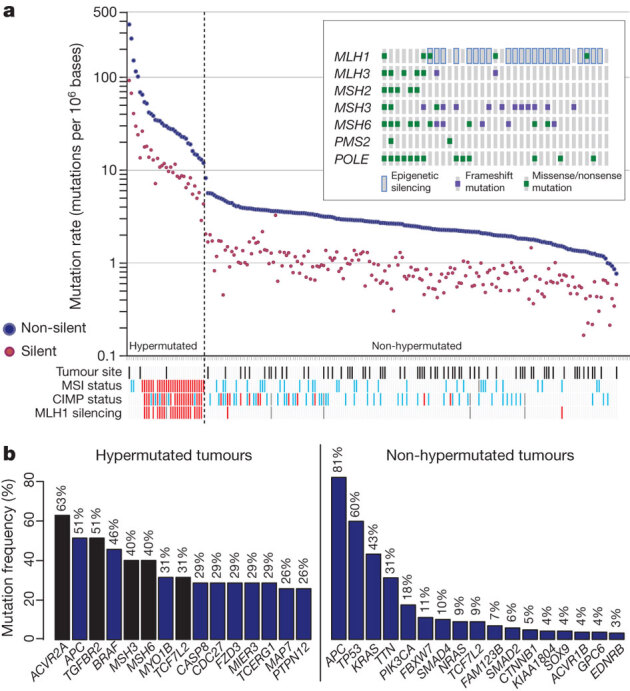
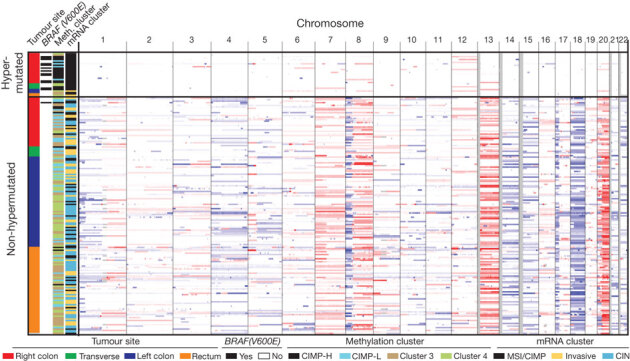
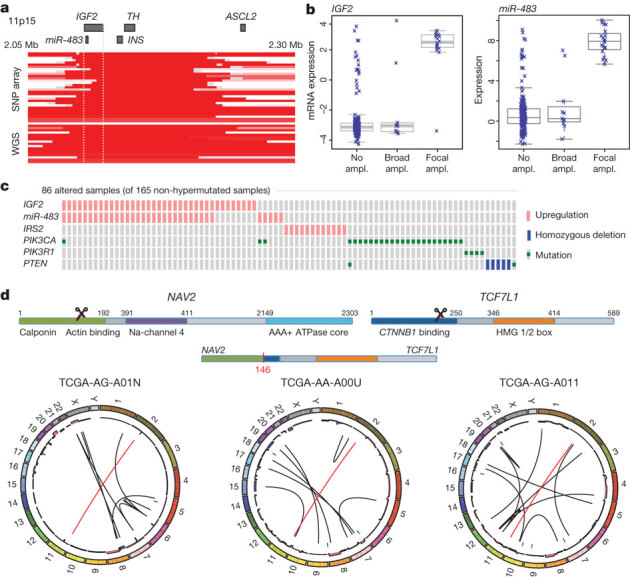
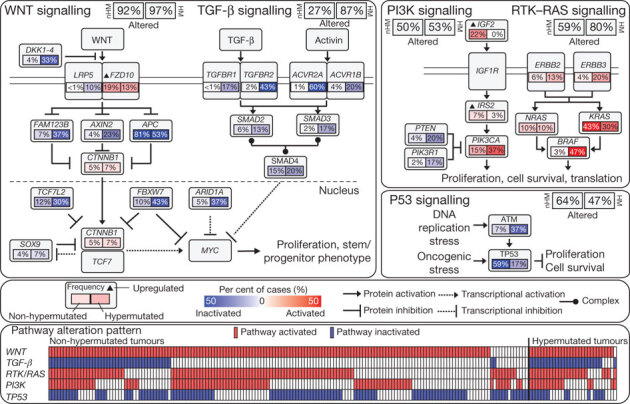
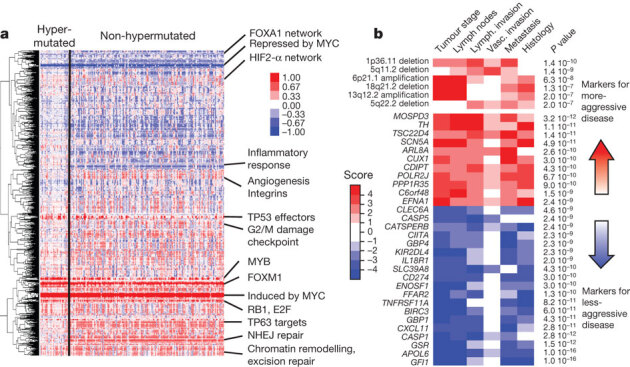
To characterize somatic alterations in colorectal carcinoma, we conducted a genome-scale analysis of 276 samples, analysing exome sequence, DNA copy number, promoter methylation and messenger RNA and microRNA expression. A subset of these samples (97) underwent low-depth-of-coverage whole-genome sequencing. In total, 16% of colorectal carcinomas were found to be hypermutated: three-quarters of these had the expected high microsatellite instability, usually with hypermethylation and MLH1 silencing, and one-quarter had somatic mismatch-repair gene and polymerase ε (POLE) mutations. Excluding the hypermutated cancers, colon and rectum cancers were found to have considerably similar patterns of genomic alteration. Twenty-four genes were significantly mutated, and in addition to the expected APC, TP53, SMAD4, PIK3CA and KRAS mutations, we found frequent mutations in ARID1A, SOX9 and FAM123B. Recurrent copy-number alterations include potentially drug-targetable amplifications of ERBB2 and newly discovered amplification of IGF2. Recurrent chromosomal translocations include the fusion of NAV2 and WNT pathway member TCF7L1. Integrative analyses suggest new markers for aggressive colorectal carcinoma and an important role for MYC-directed transcriptional activation and repression. The Cancer Genome Atlas consortium reports on their genome-wide characterization of somatic alterations in colorectal cancer; in addition to revealing a remarkably consistent pattern of genomic alteration, with 24 genes being significantly mutated, the study identifies new targets for therapeutic intervention and suggests an important role for MYC-directed transcriptional activation and repression. The Cancer Genome Atlas consortium reports on their genome-wide characterization of somatic alterations in colorectal carcinoma. Combined analysis of exome sequence data, DNA copy number, promoter methylation, messenger RNA and microRNA expression, as well as low-coverage whole-genome sequencing reveal that 16% of these carcinomas have hypermutation. Of these, three-quarters have the expected high microsatellite instability, but the rest have somatic mismatch repair gene mutations. The data reveal a remarkably consistent pattern of genomic alteration, with 24 genes being significantly mutated. As well as identifying new biomarkers for aggressive colorectal carcinoma, the data imply an important role for MYC-directed transcriptional activation and repression.
Overview
The claims and statistics of this paper haven’t been checked yet.
Free: it reads the open-access text and checks the first 5 claims that cite a source we can check. Create a free account to check every claim.
Integrity signals
Registry
Cites
Statistics
Figures
Verification
Claims the paper makes
The claims and statistics of this paper haven’t been checked yet.
Free: it reads the open-access text and checks the first 5 claims that cite a source we can check. Create a free account to check every claim.
Claims other papers make about this one
Each is checked against this paper’s own text: does it say what the citing paper says it does?
The source backs part of the claim, not all of it — or backs it for a different population, condition or comparison.
In the citing paper
“KRAS G12V had an increased rate of comutation with TCF7L2, which encodes TCF4, a regulator of Wnt signaling often dysregulated in COAD49–51, specifically the R488C mutation.”
From The origins and genetic interactions of KRAS mutations are allele- and tissue-specific (2021) · cites this paper as [49]
Experimental — accuracy not yet measuredThe source backs part of the claim, not all of it — or backs it for a different population, condition or comparison.
In the citing paper
“PI3K α is both a key regulator and effector of KRAS-dependent signaling and is also activated through mutations involving the PIK3CA gene locus in colorectal cancer, including mutations co-occurring with KRAS [19].”
From Anti-tumor efficacy of a potent and selective non-covalent KRASG12D inhibitor (2022) · cites this paper as [19]
Experimental — accuracy not yet measuredThe source backs part of the claim, not all of it — or backs it for a different population, condition or comparison.
In the citing paper
“Approximately 55% of colorectal cancers (CRCs) are driven by mutational activation of KRAS, BRAF, NRAS, and thus are hard-wired to oncogenic RAS/RAF/MEK/ERK pathway signaling [1–3].”
From An integrative gene expression signature analysis identifies CMS4 KRAS-mutated colorectal cancers sensitive to combined MEK and SRC targeted therapy (2022) · cites this paper as [2]
Experimental — accuracy not yet measuredThe source backs part of the claim, not all of it — or backs it for a different population, condition or comparison.
In the citing paper
“TALENs targeting position 1320 of the APC coding sequence (Fig 3A), a known hotspot commonly mutated in FAP patients [2].”
From Modeling APC mutagenesis and familial adenomatous polyposis using human iPS cells (2018) · cites this paper as [2]
Experimental — accuracy not yet measuredThe source backs part of the claim, not all of it — or backs it for a different population, condition or comparison.
In the citing paper
“which represent ~10–11% of all CRCs (Network, 2012)”
From A Landscape of Therapeutic Cooperativity in KRAS Mutant Cancers Reveals Principles for Controlling Tumor Evolution (2017) · cites this paper as Network, 2012
Experimental — accuracy not yet measured
6 more claims about this paper
Create a free account to see every claim other papers make about this one.
Self-check
Percentages, sums and reported differences re-computed from the paper’s own numbers.
The self-check needs the paper’s full text.
Citations
Cites
Integrated genomic analyses of ovarian carcinoma
Perou, C. M. (2019) · Carolina Digital Repository (University of North Carolina at Chapel Hill) · doi:10.17615/hvp3-wg08 · Cited by 7,925
Comprehensive genomic characterization defines human glioblastoma genes and core pathways
The Cancer Genome Atlas Research Network (2008) · Nature · doi:10.1038/nature07385 · Cited by 7,735
Self-citationUmar, A., Boland, C. R., Terdiman, J. P., Syngal, S., Chapelle, A. D. L., Ruschoff, J., Fishel, R., Lindor, N. M., Burgart, L. J., Hamelin, R., et al. (2004) · JNCI Journal of the National Cancer Institute · doi:10.1093/jnci/djh034 · Cited by 3,183
The Consensus Coding Sequences of Human Breast and Colorectal Cancers
Sjöblom, T., Jones, S., Wood, L. D., Parsons, D. W., Lin, J., Barber, T. D., Mandelker, D., Leary, R. J., Ptak, J., Silliman, N., et al. (2006) · Science · doi:10.1126/science.1133427 · Cited by 3,169
The Genomic Landscapes of Human Breast and Colorectal Cancers
Wood, L. D., Parsons, D. W., Jones, S., Lin, J., Sjöblom, T., Leary, R. J., Shen, D., Boca, S. M., Barber, T., Ptak, J., et al. (2007) · Science · doi:10.1126/science.1145720 · Cited by 2,833
Clues to the Pathogenesis of Familial Colorectal Cancer
Aaltonen, L. A., Peltomäki, P., Leach, F. S., Sistonen, P., Pylkkänen, L., Mecklin, J.-P., Järvinen, H., Powell, S. M., Jen, J., Hamilton, S. R., et al. (1993) · Science · doi:10.1126/science.8484121 · Cited by 2,710
Ionov, Y., Peinado, M. A., Malkhosyan, S., Shibata, D., & Perucho, M. (1993) · Nature · doi:10.1038/363558a0 · Cited by 2,708
TGFβ Signaling in Growth Control, Cancer, and Heritable Disorders
Massagué, J., Blain, S. W., & Lo, R. S. (2000) · Cell · doi:10.1016/s0092-8674(00)00121-5 · Cited by 2,385
Landon, M., Saam, J., Brown, K. L., Moyes, K., Evans, B., & Wenstrup, R. (2015) · Oncology · doi:10.1159/000430097 · Cited by 1,939
Molecular Genetics of Colorectal Cancer
Fearon, E. R. (2011) · Annual Review of Pathology: Mechanisms of Disease · doi:10.1146/annurev-pathol-011110-130235 · Cited by 1,805
Cited by
Items 801–900 of 1,135
The drug efflux pump MDR1 promotes intrinsic and acquired resistance to PROTACs in cancer cells
Kurimchak, A. M., Herrera-Montávez, C., Montserrat-Sangrà, S., Araiza-Olivera, D., Hu, J., Neumann-Domer, R., Kuruvilla, M., Bellacosa, A., Testa, J. R., Jin, J., et al. (2022) · Science Signaling · doi:10.1126/scisignal.abn2707 · Cited by 136
Exonuclease 1-dependent and independent mismatch repair
Goellner, E. M., Putnam, C. D., & Kolodner, R. D. (2015) · DNA repair · doi:10.1016/j.dnarep.2015.04.010 · Cited by 148
Novel recurrently mutated genes in African American colon cancers
Guda, K., Veigl, M. L., Varadan, V., Nosrati, A., Ravi, L., Lutterbaugh, J., Beard, L., Willson, J. K. V., Sedwick, W. D., Wang, Z., et al. (2015) · Proceedings of the National Academy of Sciences · doi:10.1073/pnas.1417064112 · Cited by 140
(2017) · PubMed
Pai, R. K., Bettington, M. L., Srivastava, A., & Rosty, C. (2019) · Modern Pathology · doi:10.1038/s41379-019-0280-2 · Cited by 149
Mutation Hotspots in the β-Catenin Gene: Lessons from the Human Cancer Genome Databases.
Kim, S., & Jeong-Yu, S. (2019) · PubMed · doi:10.14348/molcells.2018.0436 · Cited by 127
Single-cell genomic and transcriptomic landscapes of primary and metastatic colorectal cancer tumors
Wang, R., Li, J., Zhou, X., Mao, Y., Wang, W., Gao, S., Wang, W., Gao, Y., Chen, K., Yu, S., et al. (2022) · Genome Medicine · doi:10.1186/s13073-022-01093-z · Cited by 163
Histopathology images predict multi-omics aberrations and prognoses in colorectal cancer patients
Tsai, P.-C., Lee, T.-H., Kuo, K.-C., Su, F.-Y., Lee, T.-L. M., Marostica, E., Ugai, T., Zhao, M., Lau, M. C., Väyrynen, J. P., et al. (2023) · Nature Communications · doi:10.1038/s41467-023-37179-4 · Cited by 136
Wnt/β-Catenin Signaling Pathway in the Development and Progression of Colorectal Cancer
He, K., & Gan, W.-J. (2023) · Cancer Management and Research · doi:10.2147/cmar.s411168 · Cited by 167
Mechanisms and Consequences of Cancer Genome Instability: Lessons from Genome Sequencing Studies
Lee, J.-K., Choi, Y.-L., Kwon, M., & Park, P. J. (2016) · Annual Review of Pathology: Mechanisms of Disease · doi:10.1146/annurev-pathol-012615-044446 · Cited by 135
Chanrion, M., Kuperstein, I., Barrière, C., El Marjou, F., Cohen, D., Vignjevic, D., Stimmer, L., Paul-Gilloteaux, P., Bièche, I., Tavares, S. D. R., et al. (2014) · Nature Communications · doi:10.1038/ncomms6005 · Cited by 134
Identification of Druggable Cancer Driver Genes Amplified across TCGA Datasets
Chen, Y., McGee, J., Chen, X., Doman, T. N., Gong, X., Zhang, Y., Hamm, N., Ma, X., Higgs, R. E., Bhagwat, S. V., et al. (2014) · PLoS ONE · doi:10.1371/journal.pone.0098293 · Cited by 133
Siemens, H., Jackstadt, R., Kaller, M., & Hermeking, H. (2013) · Oncotarget · doi:10.18632/oncotarget.1202 · Cited by 135
Tricoli, J. V., Blair, D. G., Anders, C. K., Bleyer, W. A., Boardman, L. A., Khan, J. I., Kummar, S., Hayes‐Lattin, B., Hunger, S. P., Merchant, M. S., et al. (2016) · Cancer · doi:10.1002/cncr.29871 · Cited by 156
Liu, Y., Wong, C. C., Ding, Y., Gao, M., Wen, J., Lau, H. C.-H., Cheung, A. H. K., Huang, D., Huang, H., & Yu, J. Q. (2024) · Nature Microbiology · doi:10.1038/s41564-024-01695-w · Cited by 152
The mini-driver model of polygenic cancer evolution
Castro-Giner, F., Ratcliffe, P. J., & Tomlinson, I. P. M. (2015) · Nature reviews. Cancer · doi:10.1038/nrc3999 · Cited by 149
Targeting CDK1 and MEK/ERK Overcomes Apoptotic Resistance in BRAF-Mutant Human Colorectal Cancer
Zhang, P., Kawakami, H., Liu, W., Zeng, X., Strebhardt, K., Tao, K., Huang, S., & Sinicrope, F. A. (2018) · Molecular Cancer Research · doi:10.1158/1541-7786.mcr-17-0404 · Cited by 138
Hughes, L., Simons, C. C. J. M., van den Brandt, P. A., van Engeland, M., & Weijenberg, M. P. (2017) · Current Colorectal Cancer Reports · doi:10.1007/s11888-017-0395-0 · Cited by 153
The lysine‐specific methyltransferase KMT2C/MLL3 regulates DNA repair components in cancer
Rampias, T. N., Karagiannis, D., Avgeris, M., Polyzos, A., Kokkalis, A., Kanaki, Z., Kousidou, E., Tzetis, M., Kanavakis, E., STRAVODIMOS, K. G., et al. (2019) · EMBO Reports · doi:10.15252/embr.201846821 · Cited by 154
Interplay between bile acids and the gut microbiota promotes intestinal carcinogenesis
Wang, S., Dong, W., Liu, L., Xu, M., Wang, Y., Liu, T., Zhang, Y., Wang, B., & Cao, H. (2019) · Molecular Carcinogenesis · doi:10.1002/mc.22999 · Cited by 139
A Pan-Cancer Catalogue of Cancer Driver Protein Interaction Interfaces
Porta-Pardo, E., Garcia-Alonso, L., Hrabe, T., Dopazo, J., & Godzik, A. (2015) · PLOS Computational Biology · doi:10.1371/journal.pcbi.1004518 · Cited by 133
Ma, Z., Xiang, X., Li, S., Xie, P., Gong, Q., Goh, B.-C., & Wang, L. (2022) · Seminars in Cancer Biology · doi:10.1016/j.semcancer.2020.09.011 · Cited by 133
Mowat, C., Mosley, S. R., Namdar, A., Schiller, D., & Baker, K. (2021) · Journal of Experimental Medicine · doi:10.1084/jem.20210108 · Cited by 133
Crisafulli, G., Bianchi, A. S., Lazzari, L., Pietrantonio, F., Amatu, A., Macagno, M., Barault, L., Cassingena, A., Bartolini, A., Luraghi, P., et al. (2022) · Cancer Discovery · doi:10.1158/2159-8290.cd-21-1434 · Cited by 147
Combined Mutation of Apc, Kras , and Tgfbr2 Effectively Drives Metastasis of Intestinal Cancer
Sakai, E., Nakayama, M., Oshima, H., Kouyama, Y., Niida, A., Fujii, S., Ochiai, A., Nakayama, K. I., Mimori, K., Suzuki, Y., et al. (2018) · Cancer Research · doi:10.1158/0008-5472.can-17-3303 · Cited by 133
Ogino, S., Lochhead, P., Giovannucci, E., Meyerhardt, J. A., Fuchs, C. S., & Chan, A. T. (2014) · Oncogene · doi:10.1038/onc.2013.244 · Cited by 133
Next-generation sequencing technologies: breaking the sound barrier of human genetics
Bahassi, E. M., & Stambrook, P. J. (2014) · Mutagenesis · doi:10.1093/mutage/geu031 · Cited by 164
Molecular phenotypes of colorectal cancer and potential clinical applications
Kocarnik, J. M., Shiovitz, S., & Phipps, A. I. (2015) · Gastroenterology Report · doi:10.1093/gastro/gov046 · Cited by 132
KRAS, NRAS and BRAF mutations in colorectal cancer and melanoma
Cicenas, J., Tamošaitis, L., Kvederavičiūtė, K., Tarvydas, R., Staniute, G., Kalyan, K. P., Meškinytė-Kaušilienė, E., Stankevičius, V., & Valius, M. (2017) · Medical Oncology · doi:10.1007/s12032-016-0879-9 · Cited by 164
Rezasoltani, S., Aghdaei, H. A., Dabiri, H., Sepahi, A. A., Modarressi, M. H., & Mojarad, E. N. (2018) · Microbial Pathogenesis · doi:10.1016/j.micpath.2018.08.035 · Cited by 149
Spontaneous mutations in the single TTN gene represent high tumor mutation burden
Oh, J., Jang, S. J., Kim, J., Sohn, I., Lee, J., Cho, E. J., Chun, S., & Sung, C. O. (2020) · npj Genomic Medicine · doi:10.1038/s41525-019-0107-6 · Cited by 160
Ishaque, N., Abba, M. L., Hauser, C., Patil, N., Paramasivam, N., Huebschmann, D., Leupold, J. H., Balasubramanian, G. P., Kleinheinz, K., Toprak, U. H., et al. (2018) · Nature Communications · doi:10.1038/s41467-018-07041-z · Cited by 132
Raghav, K., Loree, J. M., Morris, J. S., Overman, M. J., Yu, R., Meric-Bernstam, F., Menter, D., Korphaisarn, K., Kee, B., Muranyi, A., et al. (2019) · JCO Precision Oncology · doi:10.1200/po.18.00226 · Cited by 132
The mutational landscape of hepatocellular carcinoma
Lee, J. (2015) · Clinical and Molecular Hepatology · doi:10.3350/cmh.2015.21.3.220 · Cited by 149
The Role of Chemokines in Promoting Colorectal Cancer Invasion/Metastasis
Itatani, Y., Kawada, K., Inamoto, S., Yamamoto, T., Ogawa, R., Taketo, M., & Sakai, Y. (2016) · International Journal of Molecular Sciences · doi:10.3390/ijms17050643 · Cited by 132
Cell-type-specific signaling networks in heterocellular organoids
Qin, X., Sufi, J., Vlckova, P., Kyriakidou, P., Acton, S. E., Li, V. S. W., Nitz, M., & Tape, C. J. (2020) · Nature Methods · doi:10.1038/s41592-020-0737-8 · Cited by 132
The Long Noncoding RNA CCAT2 Induces Chromosomal Instability Through BOP1-AURKB Signaling
Chen, B., Dragomir, M. P., Fabris, L., Bayraktar, R., Knutsen, E., Liu, X., Tang, C., Li, Y., Shimura, T., Ivković, T. C., et al. (2020) · Gastroenterology · doi:10.1053/j.gastro.2020.08.018 · Cited by 141
Role of Wnt/β‐Catenin Signaling in the Chemoresistance Modulation of Colorectal Cancer
Yuan, S., Tao, F., Zhang, X., Zhang, Y., Sun, X., & Wu, D. (2020) · BioMed Research International · doi:10.1155/2020/9390878 · Cited by 131
“Wnt/β-catenin signaling pathway is found altered in more than 90% CRC patients, making it a crucial therapeutic target [11].”
BackgroundHelsten, T. L., Schwaederle, M. C., & Kurzrock, R. (2015) · Cancer and Metastasis Reviews · doi:10.1007/s10555-015-9579-8 · Cited by 135
IAPP-driven metabolic reprogramming induces regression of p53-deficient tumours in vivo
Venkatanarayan, A., Raulji, P., Norton, W., Chakravarti, D., Coarfa, C., Su, X., Sandur, S. K., Ramirez, M. S., Lee, J., Kingsley, C. V., et al. (2015) · Nature · doi:10.1038/nature13910 · Cited by 130
Mutations of KRAS/NRAS/BRAF predict cetuximab resistance in metastatic colorectal cancer patients
Hsu, H.-C., Thiam, T. K., Lu, Y.-J., Yeh, C. Y., Tsai, W.-S., You, J. F., Hung, H. Y., Tsai, C.-N., Hsu, A., Chen, H.-C., et al. (2016) · Oncotarget · doi:10.18632/oncotarget.8076 · Cited by 131
Oncogenic KRAS and BRAF Drive Metabolic Reprogramming in Colorectal Cancer
Hutton, J. E., Wang, X., Zimmerman, L. J., Slebos, R. J. C., Trenary, I. A., Young, J. D., Li, M., & Liebler, D. C. (2016) · Molecular & Cellular Proteomics · doi:10.1074/mcp.m116.058925 · Cited by 131
Regan, J. L., Schumacher, D., Staudte, S., Steffen, A., Haybaeck, J., Keilholz, U., Schweiger, C., Golob‐Schwarzl, N., Mumberg, D., Henderson, D. A., et al. (2017) · Cell Reports · doi:10.1016/j.celrep.2017.11.025 · Cited by 142
Prostaglandin E2 as a potent therapeutic target for treatment of colon cancer
Karpisheh, V., Nikkhoo, A., Hojjat‐Farsangi, M., Namdar, A., Azizi, G., Ghalamfarsa, G., Sabz, G., Yousefi, M., Yousefi, B., & Jadidi‐Niaragh, F. (2019) · Prostaglandins & Other Lipid Mediators · doi:10.1016/j.prostaglandins.2019.106338 · Cited by 142
A Wnt-Induced Phenotypic Switch in Cancer-Associated Fibroblasts Inhibits EMT in Colorectal Cancer
Mosa, M. H., Michels, B. E., Menche, C., Nicolas, A. M., Darvishi, T., Greten, F. R., & Farin, H. F. (2020) · Cancer Research · doi:10.1158/0008-5472.can-20-0263 · Cited by 130
Ahadi, M. S., Sokolova, A., Brown, I., Chou, A. S. Y., & Gill, A. J. (2021) · Pathology · doi:10.1016/j.pathol.2020.10.010 · Cited by 143
The Role of TP53 in Adaptation and Evolution
Voskarides, K., & Giannopoulou, N. (2023) · Cells · doi:10.3390/cells12030512 · Cited by 168
Xiao, Q., Wu, J., Wang, W.-J., Chen, S., Zheng, Y., Yu, X., Meeth, K., Sahraei, M., Bothwell, A. L. M., Chen, L., et al. (2018) · Nature Medicine · doi:10.1038/nm.4496 · Cited by 130
Inhibition of poly(ADP-ribosyl)ation in cancer: Old and new paradigms revisited
Lupo, B., & Trusolino, L. (2014) · Biochimica et Biophysica Acta (BBA) - Reviews on Cancer · doi:10.1016/j.bbcan.2014.07.004 · Cited by 130
The clinical and biological significance of MIR-224 expression in colorectal cancer metastasis
Ling, H., Pickard, K., Ivan, C., Isella, C., Ikuo, M., Mitter, R., Spizzo, R., Bullock, M. D., Braicu, C., Pileczki, V., et al. (2016) · Gut · doi:10.1136/gutjnl-2015-309372 · Cited by 130
Molecular subtypes in cancers of the gastrointestinal tract
Bijlsma, M. F., Sadanandam, A., Tan, P. B. O., & Vermeulen, L. (2017) · Nature Reviews Gastroenterology & Hepatology · doi:10.1038/nrgastro.2017.33 · Cited by 154
Lannagan, T. R. M., Lee, Y. K., Wang, T., Roper, J., Bettington, M. L., Fennell, L., Vrbanac, L., Jonavicius, L., Somashekar, R., Gieniec, K., et al. (2019) · Gut · doi:10.1136/gutjnl-2017-315920 · Cited by 129
Exploiting DNA repair defects in colorectal cancer
Reilly, N. M., Novara, L., Di Nicolantonio, F., & Bardelli, A. (2019) · Molecular Oncology · doi:10.1002/1878-0261.12467 · Cited by 130
Wnt Signaling in the Regulation of Immune Cell and Cancer Therapeutics
Haseeb, M., Pirzada, R. H., Ain, Q. U., & Choi, S. (2019) · Cells · doi:10.3390/cells8111380 · Cited by 144
The co-evolution of the genome and epigenome in colorectal cancer
Heide, T., Househam, J., Cresswell, G. D., Spiteri, I., Lynn, C., Mossner, M., Kimberley, C., Fernandez-Mateos, J., Chen, B., Zapata, L., et al. (2022) · Nature · doi:10.1038/s41586-022-05202-1 · Cited by 130
Conditional Selection of Genomic Alterations Dictates Cancer Evolution and Oncogenic Dependencies
Mina, M., Raynaud, F., Tavernari, D., Battistello, E., Sungalee, S., Saghafinia, S., Laessle, T., Sanchez-Vega, F., Schultz, N., Oricchio, E., et al. (2017) · Cancer Cell · doi:10.1016/j.ccell.2017.06.010 · Cited by 129
Loss of CDX2 expression is associated with poor prognosis in colorectal cancer patients
Bae, J. M. (2015) · World Journal of Gastroenterology · doi:10.3748/wjg.v21.i5.1457 · Cited by 129
RNA editing in RHOQ promotes invasion potential in colorectal cancer
Han, S.-W., Kim, H.-P., Shin, J.-Y., Jeong, E.-G., Lee, W.-C., Kim, K. Y., Park, S. Y., Lee, D.-W., Won, J.-K., Jeong, S.-Y., et al. (2014) · Journal of Experimental Medicine · doi:10.1084/jem.20132209 · Cited by 128
STAT3 inhibition sensitizes colorectal cancer to chemoradiotherapy in vitro and in vivo
Spitzner, M., Roesler, B., Bielfeld, C., Emons, G., Gaedcke, J., Wolff, H. A., Rave‐Fränk, M., Kramer, F., Beissbarth, T., Kitz, J., et al. (2014) · International Journal of Cancer · doi:10.1002/ijc.28429 · Cited by 128
Gerling, M., Büller, N. V. J. A., Kirn, L. M., Joost, S., Frings, O., Englert, B., Bergström, Å., Kuiper, R. V., Blaas, L., Wielenga, M. C. B., et al. (2016) · Nature Communications · doi:10.1038/ncomms12321 · Cited by 127
Analysis of somatic microsatellite indels identifies driver events in human tumors
Maruvka, Y. E., Mouw, K. W., Karlic, R., Parasuraman, P., Kamburov, A., Polak, P., Haradhvala, N. J., Hess, J. M., Rheinbay, E., Brody, Y., et al. (2017) · Nature Biotechnology · doi:10.1038/nbt.3966 · Cited by 128
Interaction between Host MicroRNAs and the Gut Microbiota in Colorectal Cancer
Yuan, C., Burns, M. B., Subramanian, S., & Blekhman, R. (2018) · mSystems · doi:10.1128/msystems.00205-17 · Cited by 143
Zhang, J., Späth, S. S., Marjani, S. L., Zhang, W., & Pan, X. (2018) · Precision Clinical Medicine · doi:10.1093/pcmedi/pby007 · Cited by 157
Mao, Y., Feng, Q., Zheng, P., Yang, L., Liu, T., Xu, Y., Zhu, D., Chang, W., Ji, M., Tu, Y., et al. (2018) · Cancer Management and Research · doi:10.2147/cmar.s171855 · Cited by 151
The landscape of somatic mutation in normal colorectal epithelial cells
Lee-Six, H., Ellis, P., Osborne, R. J., Sanders, M. A., Moore, L., Georgakopoulos, N., Torrente, F., Noorani, A., Goddard, M., Robinson, P., et al. (2018) · bioRxiv (Cold Spring Harbor Laboratory) · doi:10.1101/416800 · Cited by 128
Allgayer, H., Mahapatra, S., Mishra, B., Swain, B., Saha, S., Khanra, S., Kumari, K., Panda, V. K., Malhotra, D., Patil, N. S., et al. (2025) · Molecular Cancer · doi:10.1186/s12943-025-02338-2 · Cited by 127
Yan, H., Wang, X., Zhang, Q., Tang, Z., Jiang, Y.-H., Fan, H., Sun, Y., Yang, P., & Liu, F. (2013) · Carcinogenesis · doi:10.1093/carcin/bgt398 · Cited by 133
Quantifying Clonal and Subclonal Passenger Mutations in Cancer Evolution
Bozic, I., Gerold, J. M., & Nowak, M. A. (2016) · PLOS Computational Biology · doi:10.1371/journal.pcbi.1004731 · Cited by 125
Exosome-encapsulated microRNAs as circulating biomarkers for colorectal cancer
Yan, S., Han, B., Gao, S., Wang, X., Wang, Z., Wang, F., Zhang, J., Xu, D., & Sun, B. (2017) · Oncotarget · doi:10.18632/oncotarget.18557 · Cited by 135
Colorectal Cancer and Metabolism
Brown, R. E., Short, S. P., & Williams, C. S. (2018) · Current Colorectal Cancer Reports · doi:10.1007/s11888-018-0420-y · Cited by 146
Tumor-on-chip modeling of organ-specific cancer and metastasis
Del Piccolo, N., Shirure, V. S., Bi, Y., Goedegebuure, S. P., Gholami, S., Hughes, C. C. W., Fields, R. C., & George, S. C. (2021) · Advanced Drug Delivery Reviews · doi:10.1016/j.addr.2021.05.008 · Cited by 126
Littlefield, P., Liu, L., Mysore, V., Shan, Y., Shaw, D. E., & Jura, N. (2014) · Science Signaling · doi:10.1126/scisignal.2005786 · Cited by 126
Biopsies: next-generation biospecimens for tailoring therapy
Basik, M., Aguilar‐Mahecha, A., Rousseau, C., Diaz, Z., Tejpar, S., Spatz, A., Greenwood, C. M. T., & Batist, G. (2013) · Nature Reviews Clinical Oncology · doi:10.1038/nrclinonc.2013.101 · Cited by 132
Jensen, N. F., Stenvang, J., Beck, M. K., Hanáková, B., Belling, K., Do, K. N., Viuff, B. M., Nygård, S. B., Gupta, R., Rasmussen, M. H., et al. (2015) · Molecular Oncology · doi:10.1016/j.molonc.2015.02.008 · Cited by 138
Meyer, M. J., Lapcevic, R., Romero, A. E., Yoon, M., Das, J., Beltrán, J. F., Mort, M., Stenson, P. D., Cooper, D. N., Paccanaro, A., et al. (2016) · Human Mutation · doi:10.1002/humu.22963 · Cited by 125
Robinson, T. J., Thomas, S. M., Dinan, M. A., Roman, S. A., Sosa, J. A., & Hyslop, T. (2016) · Journal of Clinical Oncology · doi:10.1200/jco.2016.67.6437 · Cited by 130
Molecular characterization of colorectal cancer related peritoneal metastatic disease
Lenos, K. J., Bach, S., Ferreira Moreno, L., ten Hoorn, S., Sluiter, N. R., Bootsma, S., Vieira Braga, F. A., Nijman, L. E., van den Bosch, T., Miedema, D. M., et al. (2022) · Nature Communications · doi:10.1038/s41467-022-32198-z · Cited by 125
Oncogenic KRAS Drives Lipofibrogenesis to Promote Angiogenesis and Colon Cancer Progression
Hsu, W.-H., LaBella, K. A., Lin, Y., Xu, P., Lee, R., Hsieh, C.-E., Yang, L., Zhou, A., Blecher, J. M., Wu, C.-J., et al. (2023) · Cancer Discovery · doi:10.1158/2159-8290.cd-22-1467 · Cited by 125
Cajuso, T., Hänninen, U. A., Kondelin, J., Gylfe, A. E., Tanskanen, T., Katainen, R., Pitkänen, E., Ristolainen, H., Kaasinen, E., Taipale, M., et al. (2014) · International Journal of Cancer · doi:10.1002/ijc.28705 · Cited by 125
Day, F. L., Jorissen, R. N., Lipton, L., Mouradov, D., Sakthianandeswaren, A., Christie, M., Li, S., Tsui, C., Tie, J., Desai, J., et al. (2013) · Clinical Cancer Research · doi:10.1158/1078-0432.ccr-12-3614 · Cited by 124
The mutational landscape of chromatin regulatory factors across 4,623 tumor samples
Gonzalez-Perez, A., Jene-Sanz, A., & Lopez-Bigas, N. (2013) · Genome Biology · doi:10.1186/gb-2013-14-9-r106 · Cited by 125
Pabla, B. (2015) · World Journal of Clinical Oncology · doi:10.5306/wjco.v6.i5.133 · Cited by 125
Aberrant DNA Methylation in Colorectal Cancer: What Should We Target?
Tse, J. W. T., Jenkins, L. J., Chionh, F. J. M., & Mariadason, J. M. (2017) · Trends in cancer · doi:10.1016/j.trecan.2017.08.003 · Cited by 148
Tales from the crypt: intestinal niche signals in tissue renewal, plasticity and cancer
Spit, M., Koo, B., & Maurice, M. M. (2018) · Open Biology · doi:10.1098/rsob.180120 · Cited by 141
CHASMplus Reveals the Scope of Somatic Missense Mutations Driving Human Cancers
Tokheim, C., & Karchin, R. (2019) · Cell Systems · doi:10.1016/j.cels.2019.05.005 · Cited by 124
Alternative transcription and alternative splicing in cancer
Pal, S., Gupta, R., & Davuluri, R. V. (2012) · Pharmacology & Therapeutics · doi:10.1016/j.pharmthera.2012.08.005 · Cited by 144
Genome-wide mutational landscape of mucinous carcinomatosis peritonei of appendiceal origin
Alakus, H., Babicky, M. L., Ghosh, P., Yost, S., Jepsen, K., Dai, Y., Arias, A., Samuels, M. L., Mose, E. S., Schwab, R. B., et al. (2014) · Genome Medicine · doi:10.1186/gm559 · Cited by 107
Next generation sequencing in cancer research and clinical application
Shyr, D., & Liu, Q. (2013) · Biological Procedures Online · doi:10.1186/1480-9222-15-4 · Cited by 153
Mucosa-associated microbiota signature in colorectal cancer
Gao, R., Kong, C., Huang, L., Li, H., Qu, X., Liu, Z., Lan, P., Wang, J., & Qin, H. (2017) · European Journal of Clinical Microbiology & Infectious Diseases · doi:10.1007/s10096-017-3026-4 · Cited by 131
Network-based machine learning and graph theory algorithms for precision oncology
Zhang, W., Chien, J., Yong, J., & Kuang, R. (2017) · npj Precision Oncology · doi:10.1038/s41698-017-0029-7 · Cited by 124
Uncovering pseudotemporal trajectories with covariates from single cell and bulk expression data
Campbell, K. R., & Yau, C. (2018) · Nature Communications · doi:10.1038/s41467-018-04696-6 · Cited by 154
Nuclear chromosome locations dictate segregation error frequencies
Klaasen, S. J., Truong, M. A., van Jaarsveld, R. H., Koprivec, I., Štimac, V., de Vries, S. G., Risteski, P., Kodba, S., Vukušić, K., de Luca, K. L., et al. (2022) · Nature · doi:10.1038/s41586-022-04938-0 · Cited by 134
Li, Q., Chan, H., Liu, W., Liu, C., Zhou, Y., Huang, D., Wang, X., Li, X., Xie, C., Liu, W. Y.-Z., et al. (2023) · Cancer Cell · doi:10.1016/j.ccell.2023.06.011 · Cited by 134
on behalf of the DeCoDe PET group, Goos, J. A. C. M., Coupé, V. M. H., Diosdado, B., Diemen, P. M. D., Karga, C., Beliën, J. A. M., Carvalho, B. G., van den Tol, M. P., Verheul, H. M. W., et al. (2013) · British Journal of Cancer · doi:10.1038/bjc.2013.608 · Cited by 125
Gut microbiome and anticancer immune response: really hot Sh*t!
Viaud, S., Daillère, R., Boneca, I. G., Lepage, P., Langella, P., Chamaillard, M., Pittet, M. J., Ghiringhelli, F., Trinchieri, G., Goldszmid, R., et al. (2015) · Cell Death & Differentiation · doi:10.1038/cdd.2014.56 · Cited by 123
Lee, M. S., Helms, T. L., Feng, N., Gay, J., Chang, Q. E., Tian, F., Wu, J. Y., Toniatti, C., Heffernan, T. P., Powis, G., et al. (2016) · Oncotarget · doi:10.18632/oncotarget.9153 · Cited by 123
Impaired Wnt Signaling in the Prefrontal Cortex of Alzheimer’s Disease
Folke, J., Pakkenberg, B., & Brudek, T. (2019) · Molecular Neurobiology · doi:10.1007/s12035-018-1103-z · Cited by 123
Sforza, V., Martinelli, E., Ciardiello, F., Gambardella, V., Napolitano, S., Martini, G., della Corte, C., Cardone, C., Ferrara, M. L., Reginelli, A., et al. (2016) · World Journal of Gastroenterology · doi:10.3748/wjg.v22.i28.6345 · Cited by 123
Attenuating the p53 Pathway in Human Cancers: Many Means to the Same End
Wasylishen, A. R., & Lozano, G. (2016) · Cold Spring Harbor Perspectives in Medicine · doi:10.1101/cshperspect.a026211 · Cited by 123
Takeda, H., Wei, Z., Koso, H., Rust, A. G., Yew, C. C. K., Mann, M. B., Ward, J. M., Adams, D. J., Copeland, N. G., & Jenkins, N. A. (2015) · Nature Genetics · doi:10.1038/ng.3175 · Cited by 132
Metadata
- Authors
- The Cancer Genome Atlas Network
- Affiliations
- Broad Institute (US)
- Corresponding author
- The Cancer Genome Atlas Network
- Venue
- Nature
- Published
- 2012-07-18
- Volume
- 487
- Issue
- 7407
- Pages
- 330-337
- ISSN
- 0028-0836 (ISSN-L)
- 1476-4687
- PMC
- PMC3401966
- OpenAlex
- W2262414037
- Semantic Scholar
- 56321e765211d85a29621551d0df9a1cfc0a78ca
- Cited by
- 8,499
- References
- 49
- Citations by year
- 2026: 389 · 2025: 455 · 2024: 502 · 2023: 591 · 2022: 678 · 2021: 754 · 2020: 736 · 2019: 686 · 2018: 677 · 2017: 673 · 2016: 646 · 2015: 616 · 2014: 578 · 2013: 424 · 2012: 86
- FWCI
- 393.35
- Type
- journal article
- Language
- en
- Open access
- hybrid
- doi.org
- Licence
- cc-by-nc-sa
- creativecommons.org/licenses/by-nc-sa/3.0/ (tdm)
- creativecommons.org/licenses/by-nc-sa/3.0/ (vor)
- Locations
- Nature (publishedVersion, cc-by-nc-sa)
- PubMed Central (publishedVersion, cc-by-nc-sa)
- PubMed (publishedVersion)
- eScholarship (California Digital Library) (submittedVersion)
- eSpace (Curtin University) (submittedVersion, cc-by-nc-sa)
- Scholarworks@UNIST (Ulsan National Institute of Science and Technology) (submittedVersion)
- Funders
- National Institutes of Health
- National Human Genome Research Institute (U54HG003067, U54HG003079, U54HG003273, R01HG006272)
- National Cancer Institute (U24CA126554, U24CA143882, U24CA143843, U24CA143840, U24CA143858, U24CA144025, U24CA143866, U24CA143883, U24CA143845, U24CA143867, U24CA143848, U24CA143799, U24CA143835, P30CA016672, P30CA016086)
- Topics
- Health Sciences › Medicine › Pathology and Forensic Medicine › Genetic factors in colorectal cancer
- Life Sciences › Biochemistry, Genetics and Molecular Biology › Cancer Research › Cancer Genomics and Diagnostics
- Health Sciences › Medicine › Oncology › Colorectal Cancer Treatments and Studies
- Keywords
- colorectal cancer, colon cancer, rectal cancer, somatic mutations, microsatellite instability, mismatch repair gene mutations, POLE mutation, DNA copy number alterations, promoter methylation, gene expression, microRNA expression, ARID1A, SOX9, ERBB2 amplification, APC, TP53, SMAD4, PIK3CA, KRAS, therapeutic target
- MeSH terms
- Colonic Neoplasms, Humans, Mutation, Rectal Neoplasms, Sequence Analysis, DNA, DNA Methylation, Polymorphism, Single Nucleotide, Gene Expression Profiling, DNA Copy Number Variations, Exome, Mutation Rate
About these checks
Registry, retraction, Cites and statistics results are computed, not judged, with one exception: a printed reference that no index lists is read once by a model before it counts as a citation error. Claims are extracted by a model and kept only when their quote appears verbatim in the text; each cited source is then checked, with a model’s help, for whether it says what the claim relies on. Those verdicts can be wrong — read the claim’s quote and the cited source before relying on one.
Statistics and arithmetic are recomputed, not judged.
Confidence bands are shown only for fields calibrated on our annotated test set. None is calibrated yet, so no band is shown.
What counts as a claim ›How we measure confidence ›How we check this ›
Are you an author, or do you see a problem with this page? Request a review
Data sources
Bibliographic data: Semantic Scholar, OpenAlex, Crossref.
Contains information from the Semantic Scholar Academic Graph Datasets, made available under the ODC Attribution License (ODC-BY 1.0).
Semantic Scholar’s data is described in: Kinney, R., et al. (2023). The Semantic Scholar Open Data Platform. arXiv:2301.10140.
