

Comprehensive molecular characterization of human colon and rectal cancer
Open accessThe DOI matches its Crossref record; 47 of the 49 references it cites were found in a registry or an index.
Abstract
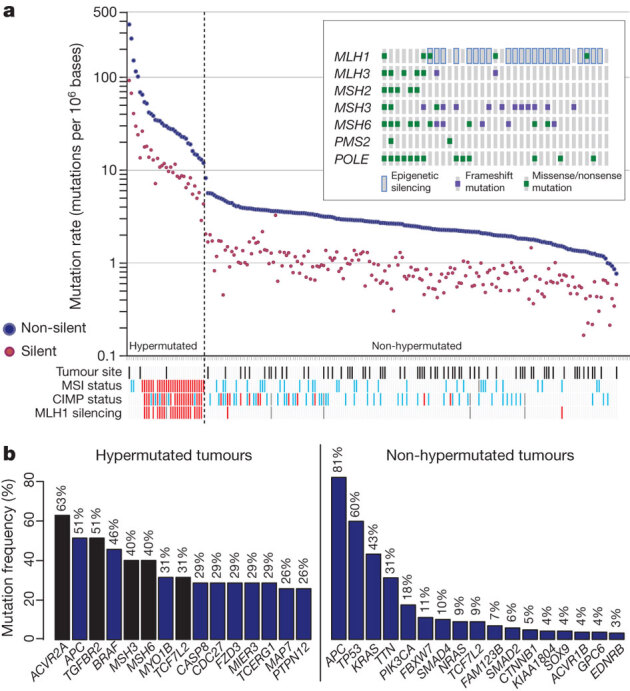
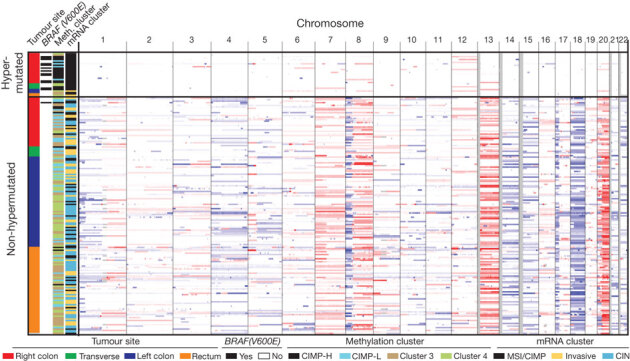
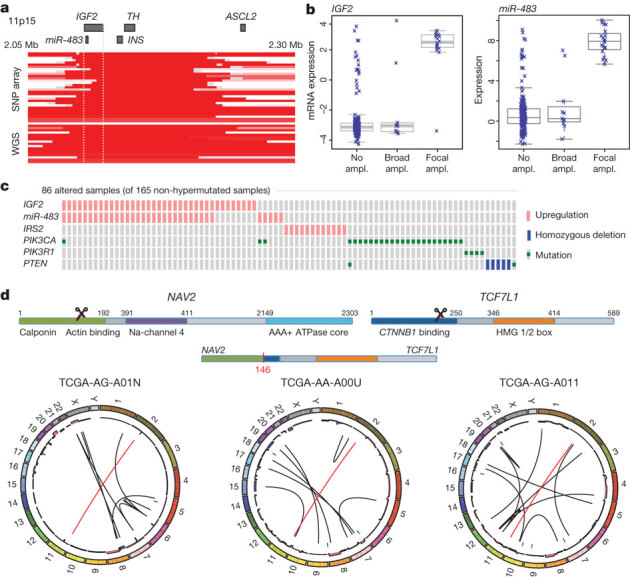
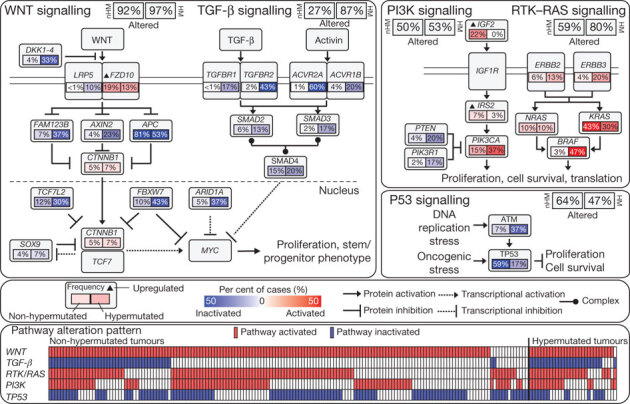
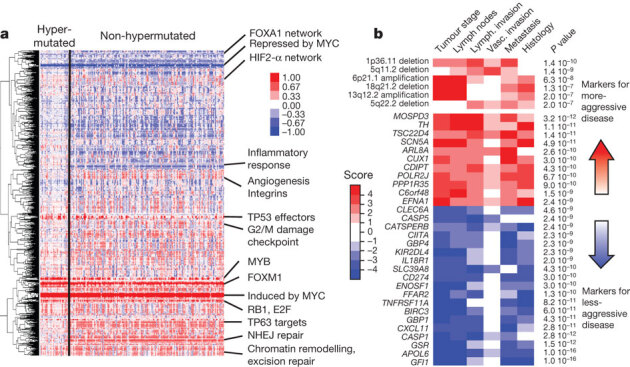
To characterize somatic alterations in colorectal carcinoma, we conducted a genome-scale analysis of 276 samples, analysing exome sequence, DNA copy number, promoter methylation and messenger RNA and microRNA expression. A subset of these samples (97) underwent low-depth-of-coverage whole-genome sequencing. In total, 16% of colorectal carcinomas were found to be hypermutated: three-quarters of these had the expected high microsatellite instability, usually with hypermethylation and MLH1 silencing, and one-quarter had somatic mismatch-repair gene and polymerase ε (POLE) mutations. Excluding the hypermutated cancers, colon and rectum cancers were found to have considerably similar patterns of genomic alteration. Twenty-four genes were significantly mutated, and in addition to the expected APC, TP53, SMAD4, PIK3CA and KRAS mutations, we found frequent mutations in ARID1A, SOX9 and FAM123B. Recurrent copy-number alterations include potentially drug-targetable amplifications of ERBB2 and newly discovered amplification of IGF2. Recurrent chromosomal translocations include the fusion of NAV2 and WNT pathway member TCF7L1. Integrative analyses suggest new markers for aggressive colorectal carcinoma and an important role for MYC-directed transcriptional activation and repression. The Cancer Genome Atlas consortium reports on their genome-wide characterization of somatic alterations in colorectal cancer; in addition to revealing a remarkably consistent pattern of genomic alteration, with 24 genes being significantly mutated, the study identifies new targets for therapeutic intervention and suggests an important role for MYC-directed transcriptional activation and repression. The Cancer Genome Atlas consortium reports on their genome-wide characterization of somatic alterations in colorectal carcinoma. Combined analysis of exome sequence data, DNA copy number, promoter methylation, messenger RNA and microRNA expression, as well as low-coverage whole-genome sequencing reveal that 16% of these carcinomas have hypermutation. Of these, three-quarters have the expected high microsatellite instability, but the rest have somatic mismatch repair gene mutations. The data reveal a remarkably consistent pattern of genomic alteration, with 24 genes being significantly mutated. As well as identifying new biomarkers for aggressive colorectal carcinoma, the data imply an important role for MYC-directed transcriptional activation and repression.
Overview
The claims and statistics of this paper haven’t been checked yet.
Free: it reads the open-access text and checks the first 5 claims that cite a source we can check. Create a free account to check every claim.
Integrity signals
Registry
Cites
Statistics
Figures
Verification
Claims the paper makes
The claims and statistics of this paper haven’t been checked yet.
Free: it reads the open-access text and checks the first 5 claims that cite a source we can check. Create a free account to check every claim.
Claims other papers make about this one
Each is checked against this paper’s own text: does it say what the citing paper says it does?
The source backs part of the claim, not all of it — or backs it for a different population, condition or comparison.
In the citing paper
“KRAS G12V had an increased rate of comutation with TCF7L2, which encodes TCF4, a regulator of Wnt signaling often dysregulated in COAD49–51, specifically the R488C mutation.”
From The origins and genetic interactions of KRAS mutations are allele- and tissue-specific (2021) · cites this paper as [49]
Experimental — accuracy not yet measuredThe source backs part of the claim, not all of it — or backs it for a different population, condition or comparison.
In the citing paper
“PI3K α is both a key regulator and effector of KRAS-dependent signaling and is also activated through mutations involving the PIK3CA gene locus in colorectal cancer, including mutations co-occurring with KRAS [19].”
From Anti-tumor efficacy of a potent and selective non-covalent KRASG12D inhibitor (2022) · cites this paper as [19]
Experimental — accuracy not yet measuredThe source backs part of the claim, not all of it — or backs it for a different population, condition or comparison.
In the citing paper
“Approximately 55% of colorectal cancers (CRCs) are driven by mutational activation of KRAS, BRAF, NRAS, and thus are hard-wired to oncogenic RAS/RAF/MEK/ERK pathway signaling [1–3].”
From An integrative gene expression signature analysis identifies CMS4 KRAS-mutated colorectal cancers sensitive to combined MEK and SRC targeted therapy (2022) · cites this paper as [2]
Experimental — accuracy not yet measuredThe source backs part of the claim, not all of it — or backs it for a different population, condition or comparison.
In the citing paper
“TALENs targeting position 1320 of the APC coding sequence (Fig 3A), a known hotspot commonly mutated in FAP patients [2].”
From Modeling APC mutagenesis and familial adenomatous polyposis using human iPS cells (2018) · cites this paper as [2]
Experimental — accuracy not yet measuredThe source backs part of the claim, not all of it — or backs it for a different population, condition or comparison.
In the citing paper
“which represent ~10–11% of all CRCs (Network, 2012)”
From A Landscape of Therapeutic Cooperativity in KRAS Mutant Cancers Reveals Principles for Controlling Tumor Evolution (2017) · cites this paper as Network, 2012
Experimental — accuracy not yet measured
6 more claims about this paper
Create a free account to see every claim other papers make about this one.
Self-check
Percentages, sums and reported differences re-computed from the paper’s own numbers.
The self-check needs the paper’s full text.
Citations
Cites
Integrated genomic analyses of ovarian carcinoma
Perou, C. M. (2019) · Carolina Digital Repository (University of North Carolina at Chapel Hill) · doi:10.17615/hvp3-wg08 · Cited by 7,925
Comprehensive genomic characterization defines human glioblastoma genes and core pathways
The Cancer Genome Atlas Research Network (2008) · Nature · doi:10.1038/nature07385 · Cited by 7,735
Self-citationUmar, A., Boland, C. R., Terdiman, J. P., Syngal, S., Chapelle, A. D. L., Ruschoff, J., Fishel, R., Lindor, N. M., Burgart, L. J., Hamelin, R., et al. (2004) · JNCI Journal of the National Cancer Institute · doi:10.1093/jnci/djh034 · Cited by 3,183
The Consensus Coding Sequences of Human Breast and Colorectal Cancers
Sjöblom, T., Jones, S., Wood, L. D., Parsons, D. W., Lin, J., Barber, T. D., Mandelker, D., Leary, R. J., Ptak, J., Silliman, N., et al. (2006) · Science · doi:10.1126/science.1133427 · Cited by 3,169
The Genomic Landscapes of Human Breast and Colorectal Cancers
Wood, L. D., Parsons, D. W., Jones, S., Lin, J., Sjöblom, T., Leary, R. J., Shen, D., Boca, S. M., Barber, T., Ptak, J., et al. (2007) · Science · doi:10.1126/science.1145720 · Cited by 2,833
Clues to the Pathogenesis of Familial Colorectal Cancer
Aaltonen, L. A., Peltomäki, P., Leach, F. S., Sistonen, P., Pylkkänen, L., Mecklin, J.-P., Järvinen, H., Powell, S. M., Jen, J., Hamilton, S. R., et al. (1993) · Science · doi:10.1126/science.8484121 · Cited by 2,710
Ionov, Y., Peinado, M. A., Malkhosyan, S., Shibata, D., & Perucho, M. (1993) · Nature · doi:10.1038/363558a0 · Cited by 2,708
TGFβ Signaling in Growth Control, Cancer, and Heritable Disorders
Massagué, J., Blain, S. W., & Lo, R. S. (2000) · Cell · doi:10.1016/s0092-8674(00)00121-5 · Cited by 2,385
Landon, M., Saam, J., Brown, K. L., Moyes, K., Evans, B., & Wenstrup, R. (2015) · Oncology · doi:10.1159/000430097 · Cited by 1,939
Molecular Genetics of Colorectal Cancer
Fearon, E. R. (2011) · Annual Review of Pathology: Mechanisms of Disease · doi:10.1146/annurev-pathol-011110-130235 · Cited by 1,805
Cited by
Items 101–200 of 1,135
Mechanisms underlying mutational signatures in human cancers
Helleday, T., Eshtad, S., & Nik-Zainal, S. (2014) · Nature Reviews Genetics · doi:10.1038/nrg3729 · Cited by 838
Targeting RAF kinases for cancer therapy: BRAF-mutated melanoma and beyond
Holderfield, M., Deuker, M. M., McCormick, F., & McMahon, M. (2014) · Nature Reviews Cancer · doi:10.1038/nrc3760 · Cited by 833
Inulin: Properties, health benefits and food applications
Shoaib, M., Shehzad, A., Omar, M., Rakha, A., Raza, H., Sharif, H. R., Shakeel, A., Ansari, A., & Niazi, S. (2016) · Carbohydrate Polymers · doi:10.1016/j.carbpol.2016.04.020 · Cited by 828
p53: 800 million years of evolution and 40 years of discovery
Levine, A. J. (2020) · Nature Reviews Cancer · doi:10.1038/s41568-020-0262-1 · Cited by 826
Ribosome biogenesis in cancer: new players and therapeutic avenues
Pelletier, J., Thomas, G., & Volarević, S. (2018) · Nature Reviews Cancer · doi:10.1038/nrc.2017.104 · Cited by 812
Wnt signaling in development and tissue homeostasis
Steinhart, Z., & Angers, S. (2018) · Development · doi:10.1242/dev.146589 · Cited by 821
“These genetic experiments are corroborated by the fact that APC loss-of-function mutations induce adenoma formation (Morin, 1997) and occur in 80% of colorectal cancers (Cancer Genome Atlas Network, 2012).”
BackgroundIntegrating human sequence data sets provides a resource of benchmark SNP and indel genotype calls
Zook, J. M., Chapman, B., Wang, J., Mittelman, D., Hofmann, O., Hide, W., & Salit, M. (2014) · Nature Biotechnology · doi:10.1038/nbt.2835 · Cited by 814
Milestones of Lynch syndrome: 1895–2015
Lynch, H. T., Snyder, C. L., Shaw, T. G., Heinen, C. D., & Hitchins, M. P. (2015) · Nature Reviews Cancer · doi:10.1038/nrc3878 · Cited by 810
Chang, M. T., Asthana, S., Gao, S. P., Lee, B. H., Chapman, J. S., Kandoth, C., Gao, J., Socci, N. D., Solit, D. B., Olshen, A. B., et al. (2016) · Nature Biotechnology · doi:10.1038/nbt.3391 · Cited by 808
Proteogenomic Analysis of Human Colon Cancer Reveals New Therapeutic Opportunities
Vasaikar, S., Huang, C., Wang, X., Petyuk, V. A., Savage, S. R., Wen, B., Dou, Y., Zhang, Y., Shi, Z., Arshad, O. A., et al. (2019) · Cell · doi:10.1016/j.cell.2019.03.030 · Cited by 799
De Sousa E Melo, F., Wang, X., Jansen, M., Fessler, E., Trinh, A., de Rooij, L. P. M. H., de Jong, J. H., de Boer, O. J., van Leersum, R., Bijlsma, M. F., et al. (2013) · Nature Medicine · doi:10.1038/nm.3174 · Cited by 771
Development of PI3K inhibitors: lessons learned from early clinical trials
Rodon, J., Dienstmann, R., Serra, V., & Tabernero, J. (2013) · Nature Reviews Clinical Oncology · doi:10.1038/nrclinonc.2013.10 · Cited by 766
Comprehensive Analysis of Hypermutation in Human Cancer
Campbell, B. B., Light, N., Fabrizio, D., Zatzman, M., Fuligni, F., de Borja, R., Davidson, S., Edwards, M., Elvin, J. A., Hodel, K. P., et al. (2017) · Cell · doi:10.1016/j.cell.2017.09.048 · Cited by 765
β-Catenin-Driven Cancers Require a YAP1 Transcriptional Complex for Survival and Tumorigenesis
Rosenbluh, J., Nijhawan, D., Cox, A. G., Li, X., Neal, J. T., Schafer, E. J., Zack, T. I., Wang, X., Tsherniak, A., Schinzel, A. C., et al. (2012) · Cell · doi:10.1016/j.cell.2012.11.026 · Cited by 757
Patient-Derived Organoids Predict Chemoradiation Responses of Locally Advanced Rectal Cancer
Yao, Y., Xu, X., Yang, L., Zhu, J., Wan, J., Shen, L., Xia, F., Fu, G., Deng, Y., Pan, M., et al. (2020) · Cell Stem Cell · doi:10.1016/j.stem.2019.10.010 · Cited by 755
IL-6R/STAT3/miR-34a feedback loop promotes EMT-mediated colorectal cancer invasion and metastasis
Rokavec, M., Öner, M. G., Li, H., Jackstadt, R., Jiang, L., Lodygin, D., Kaller, M., Horst, D., Ziegler, P. K., Schwitalla, S., et al. (2014) · Journal of Clinical Investigation · doi:10.1172/jci73531 · Cited by 753
The landscape of somatic mutation in normal colorectal epithelial cells
Lee-Six, H., Olafsson, S., Ellis, P., Osborne, R. J., Sanders, M. A., Moore, L., Georgakopoulos, N., Torrente, F., Noorani, A., Goddard, M., et al. (2019) · Nature · doi:10.1038/s41586-019-1672-7 · Cited by 747
Variable Clonal Repopulation Dynamics Influence Chemotherapy Response in Colorectal Cancer
Kreso, A., O'Brien, C. A., van Galen, P., Gan, O. I., Notta, F., Brown, A. M. K., Ng, K., Ma, J., Wienholds, E., Dunant, C., et al. (2013) · Science · doi:10.1126/science.1227670 · Cited by 744
Network-based stratification of tumor mutations
Hofree, M., Shen, J. P., Carter, H., Gross, A., & Ideker, T. (2013) · Nature Methods · doi:10.1038/nmeth.2651 · Cited by 737
Tumor biomarkers for diagnosis, prognosis and targeted therapy
Zhou, Y., Tao, L., Qiu, J., Xu, J., Yang, X., Zhang, Y., Tian, X., Guan, X., Cen, X., & Zhao, Y. (2024) · Signal Transduction and Targeted Therapy · doi:10.1038/s41392-024-01823-2 · Cited by 720
Dulak, A. M., Stojanov, P., Peng, S., Lawrence, M. S., Fox, C., Stewart, C., Bandla, S., Imamura, Y., Schumacher, S. E., Shefler, E., et al. (2013) · Nature Genetics · doi:10.1038/ng.2591 · Cited by 735
Wnt/β-catenin signaling in cancers and targeted therapies
Yu, F., Yu, C., Li, F., Zuo, Y., Wang, Y., Yao, L., Wu, C., Wang, C., & Ye, L. (2021) · Signal Transduction and Targeted Therapy · doi:10.1038/s41392-021-00701-5 · Cited by 734
Gut microbiota in colorectal cancer development and therapy
Wong, C. C., & Yu, J. (2023) · Nature Reviews Clinical Oncology · doi:10.1038/s41571-023-00766-x · Cited by 721
Analysis of DNA methylation in cancer: location revisited
Koch, A., Joosten, S. C., Feng, Z., de Ruijter, T. C., Draht, M. X., Melotte, V., Smits, K. M., Veeck, J., Herman, J. G., Van Neste, L., et al. (2018) · Nature Reviews Clinical Oncology · doi:10.1038/s41571-018-0004-4 · Cited by 710
Microbiota organization is a distinct feature of proximal colorectal cancers
Dejea, C. M., Wick, E. C., Hechenbleikner, E. M., White, J. R., Mark Welch, J. L., Rossetti, B. J., Peterson, S. N., Snesrud, E. C., Borisy, G. G., Lazarev, M., et al. (2014) · Proceedings of the National Academy of Sciences · doi:10.1073/pnas.1406199111 · Cited by 700
Ren, J., Ding, L., Zhang, D., Shi, G., Xu, Q., Shen, S., Wang, Y., Wang, T., & Hou, Y. (2018) · Theranostics · doi:10.7150/thno.25541 · Cited by 698
Fujimoto, A., Furuta, M., Totoki, Y., Tsunoda, T., Kato, M., Shiraishi, Y., Tanaka, H., Taniguchi, H., Kawakami, Y., Ueno, M., et al. (2016) · Nature Genetics · doi:10.1038/ng.3547 · Cited by 689
The mathematics of cancer: integrating quantitative models
Altrock, P. M., Liu, L. L., & Michor, F. (2015) · Nature Reviews Cancer · doi:10.1038/nrc4029 · Cited by 685
The emerging complexity of gene fusions in cancer
Mertens, F., Johansson, B., Fioretos, T., & Mitelman, F. (2015) · Nature Reviews Cancer · doi:10.1038/nrc3947 · Cited by 682
Haplotyping germline and cancer genomes with high-throughput linked-read sequencing
Zheng, G. X. Y., Lau, B. T., Schnall-Levin, M., Jarosz, M., Bell, J. M., Hindson, C. M., Kyriazopoulou-Panagiotopoulou, S., Masquelier, D. A., Merrill, L., Terry, J. M., et al. (2016) · Nature Biotechnology · doi:10.1038/nbt.3432 · Cited by 677
Pan-cancer image-based detection of clinically actionable genetic alterations
Kather, J. N., Heij, L. R., Grabsch, H. I., Loeffler, C., Echle, A., Muti, H. S., Krause, J., Niehues, J. M., Sommer, K. A. J., Bankhead, P., et al. (2020) · Nature Cancer · doi:10.1038/s43018-020-0087-6 · Cited by 662
Hijacked in cancer: the KMT2 (MLL) family of methyltransferases
Rao, R. C., & Dou, Y. (2015) · Nature Reviews Cancer · doi:10.1038/nrc3929 · Cited by 669
Medulloblastomics: the end of the beginning
Northcott, P. A., Jones, D. T. W., Kool, M., Robinson, G. W., Gilbertson, R. J., Cho, Y.-J., Pomeroy, S. L., Korshunov, A., Lichter, P., Taylor, M. D., et al. (2012) · Nature Reviews Cancer · doi:10.1038/nrc3410 · Cited by 663
A molecular portrait of microsatellite instability across multiple cancers
Cortes-Ciriano, I., Lee, S., Park, W.-Y., Kim, T.-M., & Park, P. J. (2017) · Nature Communications · doi:10.1038/ncomms15180 · Cited by 658
Amplification of the MET Receptor Drives Resistance to Anti-EGFR Therapies in Colorectal Cancer
Bardelli, A., Corso, S., Bertotti, A., Hobor, S., Valtorta, E., Siravegna, G., Sartore-Bianchi, A., Scala, E., Cassingena, A., Zecchin, D., et al. (2013) · Cancer Discovery · doi:10.1158/2159-8290.cd-12-0558 · Cited by 657
From tumour heterogeneity to advances in precision treatment of colorectal cancer
Punt, C. J. A., Koopman, M., & Vermeulen, L. (2017) · Nature Reviews Clinical Oncology · doi:10.1038/nrclinonc.2016.171 · Cited by 654
TRKing Down an Old Oncogene in a New Era of Targeted Therapy
Vaishnavi, A., Le, A. T., & Doebele, R. C. (2015) · Cancer Discovery · doi:10.1158/2159-8290.cd-14-0765 · Cited by 642
Human symptoms–disease network
Zhou, X., Menche, J., Barabási, A.-L., & Sharma, A. (2014) · Nature Communications · doi:10.1038/ncomms5212 · Cited by 653
DNA Damage and Repair Biomarkers of Immunotherapy Response
Mouw, K. W., Goldberg, M. S., Konstantinopoulos, P. A., & D'Andrea, A. D. (2017) · Cancer Discovery · doi:10.1158/2159-8290.cd-17-0226 · Cited by 645
Distal and proximal colon cancers differ in terms of molecular, pathological, and clinical features
Missiaglia, E., Jacobs, B., D'Ario, G., Di Narzo, A. F., Soneson, C., Budinska, E., Popovici, V., Vecchione, L., Gerster, S., Yan, P., et al. (2014) · Annals of Oncology · doi:10.1093/annonc/mdu275 · Cited by 646
ATM and ATR as therapeutic targets in cancer
Weber, A. M., & Ryan, A. J. (2015) · Pharmacology & Therapeutics · doi:10.1016/j.pharmthera.2014.12.001 · Cited by 635
Stromal contribution to the colorectal cancer transcriptome
Isella, C., Terrasi, A., Bellomo, S. E., Petti, C., Galatola, G., Muratore, A., Mellano, A., Senetta, R., Cassenti, A., Sonetto, C., et al. (2015) · Nature Genetics · doi:10.1038/ng.3224 · Cited by 640
“Level 3 TCGA RNA-seq data for both colon (337) and rectum (113) adenocarcinomas were downloaded from the TCGA Data Portal (April 2013 release; see URLs).”
InfluentialEpidemiology and Mechanisms of the Increasing Incidence of Colon and Rectal Cancers in Young Adults
Stoffel, E. M., & Murphy, C. C. (2020) · Gastroenterology · doi:10.1053/j.gastro.2019.07.055 · Cited by 637
Early‐onset colorectal cancer in young individuals
Mauri, G., Sartore‐Bianchi, A., Russo, A., Marsoni, S., Bardelli, A., & Siena, S. (2019) · Molecular Oncology · doi:10.1002/1878-0261.12417 · Cited by 634
Identification of neutral tumor evolution across cancer types
Williams, M. J., Werner, B., Barnes, C. P., Graham, T. A., & Sottoriva, A. (2016) · Nature Genetics · doi:10.1038/ng.3489 · Cited by 625
Comparative Molecular Analysis of Gastrointestinal Adenocarcinomas
Liu, Y., Sethi, N. S., Hinoue, T., Schneider, B. G., Cherniack, A. D., Sanchez-Vega, F., Seoane, J. A., Farshidfar, F., Bowlby, R., Islam, M., et al. (2018) · Cancer Cell · doi:10.1016/j.ccell.2018.03.010 · Cited by 615
Revisiting Global Gene Expression Analysis
Lovén, J., Orlando, D. A., Sigova, A. A., Lin, C. Y., Rahl, P. B., Burge, C. B., Levens, D. L., Lee, T. I., & Young, R. A. (2012) · Cell · doi:10.1016/j.cell.2012.10.012 · Cited by 616
“…2001; Bittner et al., 2000; Golub et al., 1999; Lapointe et al., 2004; Northcott et al., 2012; Ramaswamy et al., 2001; Ross et al., 2000; Schmitz et al., 2012; Shipp et al., 2002; Su et al., 2001; Cancer Genome Atlas, 2012; van ’t Veer et al., 2002; van de Vijver et al., 2002; Yeoh et al., 2002).”
A pan-cancer proteomic perspective on The Cancer Genome Atlas
Akbani, R., Ng, P. K. S., Werner, H. M. J., Shahmoradgoli, M., Zhang, F., Ju, Z., Liu, W., Yang, J.-Y., Yoshihara, K., Li, J., et al. (2014) · Nature Communications · doi:10.1038/ncomms4887 · Cited by 607
Epigenomic alterations define lethal CIMP-positive ependymomas of infancy
Mack, S. C., Witt, H., Piro, R. M., Gu, L., Zuyderduyn, S., Stütz, A. M., Wang, X., Gallo, M., Garzia, L., Zayne, K., et al. (2014) · Nature · doi:10.1038/nature13108 · Cited by 607
Kraft, J. C., Freeling, J. P., Wang, Z., & Ho, R. J. Y. (2014) · Journal of Pharmaceutical Sciences · doi:10.1002/jps.23773 · Cited by 606
Pathways of Colorectal Carcinogenesis
Nguyen, L. H., Goel, A., & Chung, D. C. (2020) · Gastroenterology · doi:10.1053/j.gastro.2019.08.059 · Cited by 606
Ling, H., Spizzo, R., Atlasi, Y., Nicoloso, M., Shimizu, M., Redis, R. S., Nishida, N., Gafà, R., Song, J., Guo, Z., et al. (2013) · Genome Research · doi:10.1101/gr.152942.112 · Cited by 602
NF‐κB signaling in inflammation and cancer
Zhang, T., Ma, C., Zhang, Z., Zhang, H., & Hu, H. (2021) · MedComm · doi:10.1002/mco2.104 · Cited by 574
Neo-antigens predicted by tumor genome meta-analysis correlate with increased patient survival
Brown, S. D., Warren, R. L., Gibb, E. A., Martin, S. D., Spinelli, J. J., Nelson, B. H., & Holt, R. A. (2014) · Genome Research · doi:10.1101/gr.165985.113 · Cited by 594
Cancer as a dysregulated epigenome allowing cellular growth advantage at the expense of the host
Timp, W., & Feinberg, A. P. (2013) · Nature Reviews Cancer · doi:10.1038/nrc3486 · Cited by 586
Therapeutic opportunities within the DNA damage response
Pearl, L. H., Schierz, A. C., Ward, S. E., Al-Lazikani, B., & Pearl, F. M. G. (2015) · Nature Reviews Cancer · doi:10.1038/nrc3891 · Cited by 587
Genetic and biological hallmarks of colorectal cancer
Li, J., Ma, X., Chakravarti, D., Shalapour, S., & DePinho, R. A. (2021) · Genes & Development · doi:10.1101/gad.348226.120 · Cited by 573
Breugom, A. J., Swets, M., Bosset, J.-F., Collette, L., Sainato, A., Cionini, L., Glynne-Jones, R., Counsell, N., Bastiaannet, E., van den Broek, C. B. M., et al. (2015) · The Lancet Oncology · doi:10.1016/s1470-2045(14)71199-4 · Cited by 574
A comprehensive review of m6A/m6Am RNA methyltransferase structures
Oerum, S., Meynier, V., Catala, M., & Tisné, C. (2021) · Nucleic Acids Research · doi:10.1093/nar/gkab378 · Cited by 557
Pickering, C. R., Zhang, J., Yoo, S. Y., Bengtsson, L., Moorthy, S., Neskey, D. M., Zhao, M., Ortega Alves, M. V., Chang, K., Drummond, J., et al. (2013) · Cancer Discovery · doi:10.1158/2159-8290.cd-12-0537 · Cited by 559
Baretti, M., & Le, D. T. (2018) · Pharmacology & Therapeutics · doi:10.1016/j.pharmthera.2018.04.004 · Cited by 556
EPIC: A Tool to Estimate the Proportions of Different Cell Types from Bulk Gene Expression Data
Racle, J., & Gfeller, D. (2020) · Methods in Molecular Biology · doi:10.1007/978-1-0716-0327-7_17 · Cited by 554
Dow, L. E., O’Rourke, K. P., Simon, J., Tschaharganeh, D. F., van Es, J. H., Clevers, H., & Lowe, S. W. (2015) · Cell · doi:10.1016/j.cell.2015.05.033 · Cited by 552
Intra-tumour diversification in colorectal cancer at the single-cell level
Roerink, S. F., Sasaki, N., Lee-Six, H., Young, M. D., Alexandrov, L. B., Behjati, S., Mitchell, T. J., Grossmann, S., Lightfoot, H., Egan, D. A., et al. (2018) · Nature · doi:10.1038/s41586-018-0024-3 · Cited by 551
Difference Between Left-Sided and Right-Sided Colorectal Cancer: A Focused Review of Literature
Baran, B., Mert Ozupek, N., Yerli Tetik, N., Acar, E., Bekcioglu, O., & Baskin, Y. (2018) · Gastroenterology Research · doi:10.14740/gr1062w · Cited by 553
Dual role of autophagy in hallmarks of cancer
Singh, S. S., Vats, S., Chia, A. Y.-Q., Tan, T. Z., Deng, S., Ong, M. S., Arfuso, F., Yap, C. T., Goh, B. C., Sethi, G., et al. (2018) · Oncogene · doi:10.1038/s41388-017-0046-6 · Cited by 542
The Genomic Landscape and Clinical Relevance of A-to-I RNA Editing in Human Cancers
Han, L., Diao, L., Yu, S., Xu, X., Li, J., Zhang, R., Yang, Y., Werner, H. M. J., Eterovic, A. K., Yuan, Y., et al. (2015) · Cancer Cell · doi:10.1016/j.ccell.2015.08.013 · Cited by 542
“The detailed read mapping procedure (BAM generation) was previously described in TCGA marker papers (Brennan et al., 2013; Cancer Genome Atlas Research Network, 2008, 2012, 2013; Cancer Genome Atlas Network, 2012a, 2012b; Kandoth et al., 2013).”
Detection of a Recurrent DNAJB1-PRKACA Chimeric Transcript in Fibrolamellar Hepatocellular Carcinoma
Honeyman, J. N., Simon, E. P., Robine, N., Chiaroni-Clarke, R., Darcy, D. G., Lim, I. I. P., Gleason, C. E., Murphy, J. M., Rosenberg, B. R., Teegan, L., et al. (2014) · Science · doi:10.1126/science.1249484 · Cited by 538
“…suggests that PRKACA is amplified in 12% of ovarian serous cystadenocarcinoma(27), 5% of uterine corpus endometrial carcinoma(28), 3% of adenoid cystic carcinoma(29), 2% of lung squamous cell carcinoma(30), 1% of sarcoma(31), colon and rectum adenocarcinoma(32) and breast invasive carcinoma(33).”
BackgroundGenetic Mechanisms of Immune Evasion in Colorectal Cancer
Grasso, C. S., Giannakis, M., Wells, D. K., Hamada, T., Mu, X. J., Quist, M., Nowak, J. A., Nishihara, R., Qian, Z. R., Inamura, K., et al. (2018) · Cancer Discovery · doi:10.1158/2159-8290.cd-17-1327 · Cited by 535
Anti-tumor efficacy of a potent and selective non-covalent KRASG12D inhibitor
Hallin, J., Bowcut, V., Calinisan, A., Briere, D. M., Hargis, L., Engstrom, L. D., Laguer, J., Medwid, J., Vanderpool, D., Lifset, E., et al. (2022) · Nature Medicine · doi:10.1038/s41591-022-02007-7 · Cited by 553
A deep learning model to predict RNA-Seq expression of tumours from whole-slide images
Schmauch, B., Romagnoni, A., Pronier, E., Saillard, C., Maillé, P., Calderaro, J., Kamoun, A., Sefta, M., Toldo, S., Zaslavskiy, M., et al. (2020) · Nature Communications · doi:10.1038/s41467-020-17678-4 · Cited by 533
Metastatic Colorectal Cancer: Current State and Future Directions
Fakih, M. G. (2015) · Journal of Clinical Oncology · doi:10.1200/jco.2014.59.7633 · Cited by 527
Recommendations for management of patients with neuroendocrine liver metastases
Frilling, A., Modlin, I. M., Kidd, M., Russell, C., Breitenstein, S., Salem, R., Kwekkeboom, D., Lau, W.-Y., Klersy, C., Vilgrain, V., et al. (2014) · The Lancet Oncology · doi:10.1016/s1470-2045(13)70362-0 · Cited by 527
Bruno, P. M., Liu, Y., Park, G. Y., Murai, J., Koch, C. E., Eisen, T. J., Pritchard, J. R., Pommier, Y., Lippard, S. J., & Hemann, M. T. (2017) · Nature Medicine · doi:10.1038/nm.4291 · Cited by 519
Angelova, M., Charoentong, P., Hackl, H., Fischer, M. L., Snajder, R., Krogsdam, A. M., Waldner, M. J., Bindea, G., Mlecnik, B., Galon, J., et al. (2015) · Genome Biology · doi:10.1186/s13059-015-0620-6 · Cited by 522
RET revisited: expanding the oncogenic portfolio
Mulligan, L. M. (2014) · Nature Reviews Cancer · doi:10.1038/nrc3680 · Cited by 513
Resistance to anti-EGFR therapy in colorectal cancer: From heterogeneity to convergent evolution
Misale, S., Di Nicolantonio, F., Sartore-Bianchi, A., Siena, S., & Bardelli, A. (2014) · Cancer Discovery · doi:10.1158/2159-8290.cd-14-0462 · Cited by 513
Corcoran, R. B., Atreya, C. E., Falchook, G. S., Kwak, E. L., Ryan, D. P., Bendell, J. C., Hamid, O., Messersmith, W. A., Daud, A., Kurzrock, R., et al. (2015) · Journal of Clinical Oncology · doi:10.1200/jco.2015.63.2471 · Cited by 507
Oncotator: Cancer Variant Annotation Tool
Ramos, A. H., Lichtenstein, L., Gupta, M., Lawrence, M. S., Pugh, T. J., Saksena, G., Meyerson, M., & Getz, G. (2015) · Human Mutation · doi:10.1002/humu.22771 · Cited by 501
RNA sequence analysis reveals macroscopic somatic clonal expansion across normal tissues
Yizhak, K., Aguet, F., Kim, J., Hess, J. M., Kübler, K., Grimsby, J., Frazer, R., Zhang, H., Haradhvala, N. J., Rosebrock, D., et al. (2019) · Science · doi:10.1126/science.aaw0726 · Cited by 500
Colorectal Cancer Cells Enter a Diapause-like DTP State to Survive Chemotherapy
Rehman, S. K., Haynes, J., Collignon, E., Brown, K. R., Wang, Y., Nixon, A. M. L., Bruce, J. P., Wintersinger, J. A., Singh Mer, A., Lo, E. B. L., et al. (2021) · Cell · doi:10.1016/j.cell.2020.11.018 · Cited by 495
“[PubMed: 27880763] Cancer Genome Atlas, N. (2012).”
BackgroundMethodInfluentialQuantitative evidence for early metastatic seeding in colorectal cancer
Hu, Z., Ding, J., Ma, Z., Sun, R., Seoane, J. A., Scott Shaffer, J., Suarez, C. J., Berghoff, A. S., Cremolini, C., Falcone, A., et al. (2019) · Nature Genetics · doi:10.1038/s41588-019-0423-x · Cited by 490
Emerging patterns of somatic mutations in cancer
Watson, I. R., Takahashi, K., Futreal, P. A., & Chin, L. (2013) · Nature Reviews Genetics · doi:10.1038/nrg3539 · Cited by 491
Sohn, B. H., Hwang, J.-E., Jang, H.-J., Lee, H.-S., Oh, S. C., Shim, J.-J., Lee, K.-W., Kim, E. H., Yim, S. Y., Lee, S. H., et al. (2017) · Clinical Cancer Research · doi:10.1158/1078-0432.ccr-16-2211 · Cited by 489
The Wnt Pathway: From Signaling Mechanisms to Synthetic Modulators
Rim, E. Y., Clevers, H., & Nusse, R. (2022) · Annual Review of Biochemistry · doi:10.1146/annurev-biochem-040320-103615 · Cited by 483
Mutational signatures: the patterns of somatic mutations hidden in cancer genomes
Alexandrov, L. B., & Stratton, M. R. (2014) · Current Opinion in Genetics & Development · doi:10.1016/j.gde.2013.11.014 · Cited by 488
Genetics and Genetic Biomarkers in Sporadic Colorectal Cancer
Carethers, J. M., & Jung, B. H. (2015) · Gastroenterology · doi:10.1053/j.gastro.2015.06.047 · Cited by 483
Calderaro, J., Petitprez, F., Becht, E., Laurent, A., Hirsch, T. Z., Rousseau, B., Luciani, A., Amaddeo, G., Derman, J., Charpy, C., et al. (2019) · Journal of Hepatology · doi:10.1016/j.jhep.2018.09.003 · Cited by 479
Directed evolution using dCas9-targeted somatic hypermutation in mammalian cells
Hess, G. T., Frésard, L., Han, K., Lee, C. H., Li, A., Cimprich, K. A., Montgomery, S. B., & Bassik, M. C. (2016) · Nature Methods · doi:10.1038/nmeth.4038 · Cited by 476
Pattern discovery and cancer gene identification in integrated cancer genomic data
Mo, Q., Wang, S., Seshan, V. E., Olshen, A. B., Schultz, N., Sander, C., Powers, R. S., Ladanyi, M., & Shen, R. (2013) · Proceedings of the National Academy of Sciences · doi:10.1073/pnas.1208949110 · Cited by 474
Primary Tumor Location as a Prognostic Factor in Metastatic Colorectal Cancer
Loupakis, F., Yang, D., Yau, L., Feng, S., Cremolini, C., Zhang, W., Maus, M. K. H., Antoniotti, C., Langer, C., Scherer, S. J., et al. (2015) · JNCI: Journal of the National Cancer Institute · doi:10.1093/jnci/dju427 · Cited by 472
Mlecnik, B., Bindea, G., Kirilovsky, A., Angell, H. K., Obenauf, A. C., Tosolini, M., Church, S. E., Maby, P., Vasaturo, A., Angelova, M., et al. (2016) · Science Translational Medicine · doi:10.1126/scitranslmed.aad6352 · Cited by 472
RNF43 is frequently mutated in colorectal and endometrial cancers
Giannakis, M., Hodis, E., Jasmine Mu, X., Yamauchi, M., Rosenbluh, J., Cibulskis, K., Saksena, G., Lawrence, M. S., Qian, Z. R., Nishihara, R., et al. (2014) · Nature Genetics · doi:10.1038/ng.3127 · Cited by 470
Comprehensive molecular characterization of mitochondrial genomes in human cancers
Yuan, Y., Ju, Y. S., Kim, Y., Li, J., Wang, Y., Yoon, C. J., Yang, Y., Martincorena, I., Creighton, C. J., Weinstein, J. N., et al. (2020) · Nature Genetics · doi:10.1038/s41588-019-0557-x · Cited by 465
Mutations and mechanisms of WNT pathway tumour suppressors in cancer
Bugter, J. M., Fenderico, N., & Maurice, M. M. (2021) · Nature Reviews Cancer · doi:10.1038/s41568-020-00307-z · Cited by 466
The mutational landscape of adenoid cystic carcinoma
Ho, A. S., Kannan, K., Roy, D. M., Morris, L. G. T., Ganly, I., Katabi, N., Ramaswami, D., Walsh, L. A., Eng, S., Huse, J. T., et al. (2013) · Nature Genetics · doi:10.1038/ng.2643 · Cited by 467
Analysis of circulating tumour DNA to monitor disease burden following colorectal cancer surgery
Reinert, T., Schøler, L. V., Thomsen, R., Tobiasen, H., Vang, S., Nordentoft, I., Lamy, P., Kannerup, A.-S., Mortensen, F. V., Stribolt, K., et al. (2016) · Gut · doi:10.1136/gutjnl-2014-308859 · Cited by 463
Next-Generation Sequencing in Oncology: Genetic Diagnosis, Risk Prediction and Cancer Classification
Kamps, R., Brandão, R., Bosch, B., Paulussen, A., Xanthoulea, S., Blok, M., & Romano, A. (2017) · International Journal of Molecular Sciences · doi:10.3390/ijms18020308 · Cited by 453
MYC Deregulation in Primary Human Cancers
Kalkat, M., De Melo, J., Hickman, K., Lourenco, C., Redel, C., Resetca, D., Tamachi, A., Tu, W., & Penn, L. (2017) · Genes · doi:10.3390/genes8060151 · Cited by 443
Artificial intelligence in histopathology: enhancing cancer research and clinical oncology
Shmatko, A., Ghaffari Laleh, N., Gerstung, M., & Kather, J. N. (2022) · Nature Cancer · doi:10.1038/s43018-022-00436-4 · Cited by 446
Metadata
- Authors
- The Cancer Genome Atlas Network
- Affiliations
- Broad Institute (US)
- Corresponding author
- The Cancer Genome Atlas Network
- Venue
- Nature
- Published
- 2012-07-18
- Volume
- 487
- Issue
- 7407
- Pages
- 330-337
- ISSN
- 0028-0836 (ISSN-L)
- 1476-4687
- PMC
- PMC3401966
- OpenAlex
- W2262414037
- Semantic Scholar
- 56321e765211d85a29621551d0df9a1cfc0a78ca
- Cited by
- 8,499
- References
- 49
- Citations by year
- 2026: 389 · 2025: 455 · 2024: 502 · 2023: 591 · 2022: 678 · 2021: 754 · 2020: 736 · 2019: 686 · 2018: 677 · 2017: 673 · 2016: 646 · 2015: 616 · 2014: 578 · 2013: 424 · 2012: 86
- FWCI
- 393.35
- Type
- journal article
- Language
- en
- Open access
- hybrid
- doi.org
- Licence
- cc-by-nc-sa
- creativecommons.org/licenses/by-nc-sa/3.0/ (tdm)
- creativecommons.org/licenses/by-nc-sa/3.0/ (vor)
- Locations
- Nature (publishedVersion, cc-by-nc-sa)
- PubMed Central (publishedVersion, cc-by-nc-sa)
- PubMed (publishedVersion)
- eScholarship (California Digital Library) (submittedVersion)
- eSpace (Curtin University) (submittedVersion, cc-by-nc-sa)
- Scholarworks@UNIST (Ulsan National Institute of Science and Technology) (submittedVersion)
- Funders
- National Institutes of Health
- National Human Genome Research Institute (U54HG003067, U54HG003079, U54HG003273, R01HG006272)
- National Cancer Institute (U24CA126554, U24CA143882, U24CA143843, U24CA143840, U24CA143858, U24CA144025, U24CA143866, U24CA143883, U24CA143845, U24CA143867, U24CA143848, U24CA143799, U24CA143835, P30CA016672, P30CA016086)
- Topics
- Health Sciences › Medicine › Pathology and Forensic Medicine › Genetic factors in colorectal cancer
- Life Sciences › Biochemistry, Genetics and Molecular Biology › Cancer Research › Cancer Genomics and Diagnostics
- Health Sciences › Medicine › Oncology › Colorectal Cancer Treatments and Studies
- Keywords
- colorectal cancer, colon cancer, rectal cancer, somatic mutations, microsatellite instability, mismatch repair gene mutations, POLE mutation, DNA copy number alterations, promoter methylation, gene expression, microRNA expression, ARID1A, SOX9, ERBB2 amplification, APC, TP53, SMAD4, PIK3CA, KRAS, therapeutic target
- MeSH terms
- Colonic Neoplasms, Humans, Mutation, Rectal Neoplasms, Sequence Analysis, DNA, DNA Methylation, Polymorphism, Single Nucleotide, Gene Expression Profiling, DNA Copy Number Variations, Exome, Mutation Rate
About these checks
Registry, retraction, Cites and statistics results are computed, not judged, with one exception: a printed reference that no index lists is read once by a model before it counts as a citation error. Claims are extracted by a model and kept only when their quote appears verbatim in the text; each cited source is then checked, with a model’s help, for whether it says what the claim relies on. Those verdicts can be wrong — read the claim’s quote and the cited source before relying on one.
Statistics and arithmetic are recomputed, not judged.
Confidence bands are shown only for fields calibrated on our annotated test set. None is calibrated yet, so no band is shown.
What counts as a claim ›How we measure confidence ›How we check this ›
Are you an author, or do you see a problem with this page? Request a review
Data sources
Bibliographic data: Semantic Scholar, OpenAlex, Crossref.
Contains information from the Semantic Scholar Academic Graph Datasets, made available under the ODC Attribution License (ODC-BY 1.0).
Semantic Scholar’s data is described in: Kinney, R., et al. (2023). The Semantic Scholar Open Data Platform. arXiv:2301.10140.
