

Comprehensive molecular characterization of human colon and rectal cancer
Open accessThe DOI matches its Crossref record; 47 of the 49 references it cites were found in a registry or an index.
Abstract
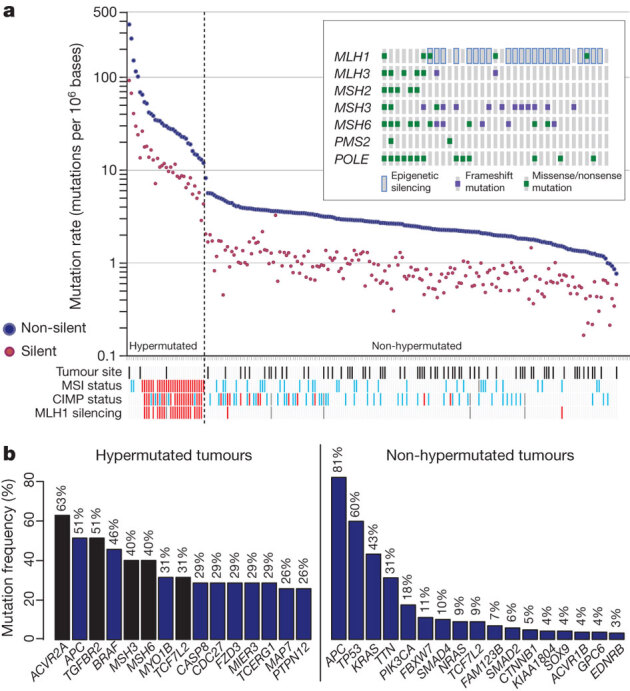
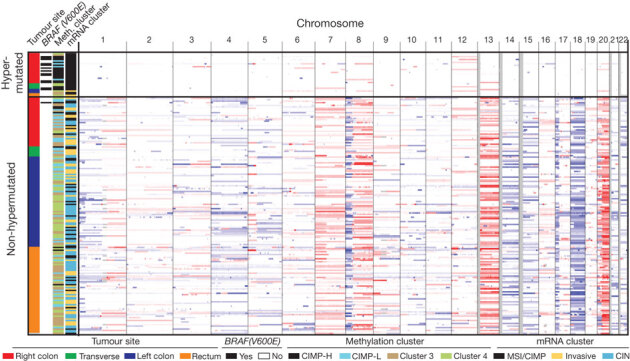
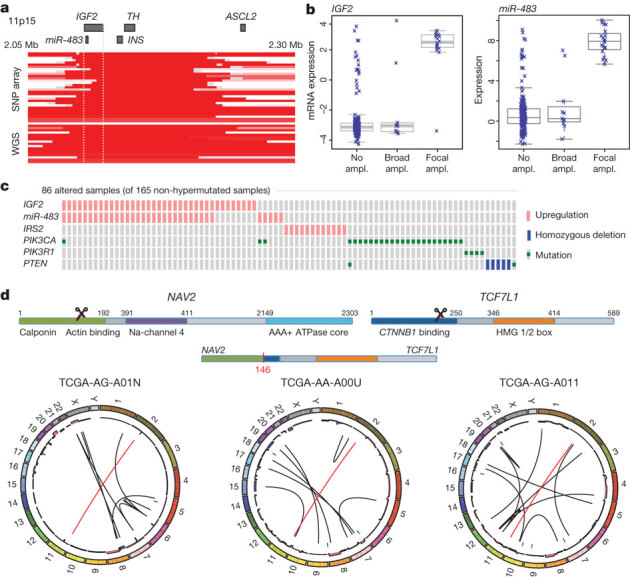
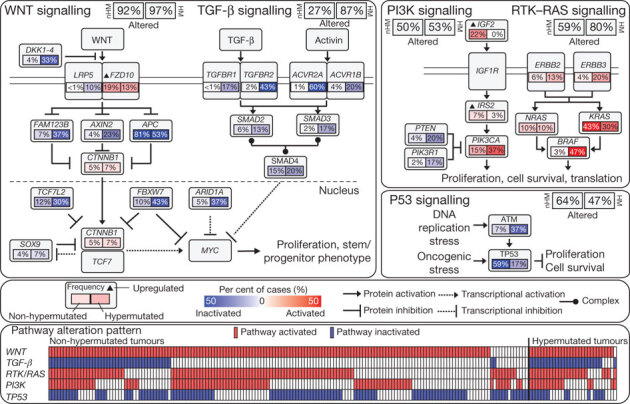
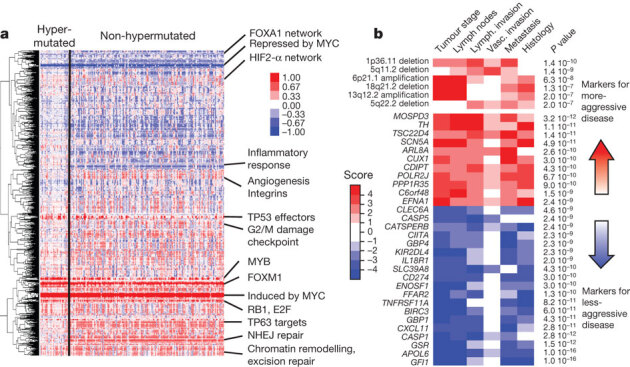
To characterize somatic alterations in colorectal carcinoma, we conducted a genome-scale analysis of 276 samples, analysing exome sequence, DNA copy number, promoter methylation and messenger RNA and microRNA expression. A subset of these samples (97) underwent low-depth-of-coverage whole-genome sequencing. In total, 16% of colorectal carcinomas were found to be hypermutated: three-quarters of these had the expected high microsatellite instability, usually with hypermethylation and MLH1 silencing, and one-quarter had somatic mismatch-repair gene and polymerase ε (POLE) mutations. Excluding the hypermutated cancers, colon and rectum cancers were found to have considerably similar patterns of genomic alteration. Twenty-four genes were significantly mutated, and in addition to the expected APC, TP53, SMAD4, PIK3CA and KRAS mutations, we found frequent mutations in ARID1A, SOX9 and FAM123B. Recurrent copy-number alterations include potentially drug-targetable amplifications of ERBB2 and newly discovered amplification of IGF2. Recurrent chromosomal translocations include the fusion of NAV2 and WNT pathway member TCF7L1. Integrative analyses suggest new markers for aggressive colorectal carcinoma and an important role for MYC-directed transcriptional activation and repression. The Cancer Genome Atlas consortium reports on their genome-wide characterization of somatic alterations in colorectal cancer; in addition to revealing a remarkably consistent pattern of genomic alteration, with 24 genes being significantly mutated, the study identifies new targets for therapeutic intervention and suggests an important role for MYC-directed transcriptional activation and repression. The Cancer Genome Atlas consortium reports on their genome-wide characterization of somatic alterations in colorectal carcinoma. Combined analysis of exome sequence data, DNA copy number, promoter methylation, messenger RNA and microRNA expression, as well as low-coverage whole-genome sequencing reveal that 16% of these carcinomas have hypermutation. Of these, three-quarters have the expected high microsatellite instability, but the rest have somatic mismatch repair gene mutations. The data reveal a remarkably consistent pattern of genomic alteration, with 24 genes being significantly mutated. As well as identifying new biomarkers for aggressive colorectal carcinoma, the data imply an important role for MYC-directed transcriptional activation and repression.
Overview
The claims and statistics of this paper haven’t been checked yet.
Free: it reads the open-access text and checks the first 5 claims that cite a source we can check. Create a free account to check every claim.
Integrity signals
Registry
Cites
Statistics
Figures
Verification
Claims the paper makes
The claims and statistics of this paper haven’t been checked yet.
Free: it reads the open-access text and checks the first 5 claims that cite a source we can check. Create a free account to check every claim.
Claims other papers make about this one
Each is checked against this paper’s own text: does it say what the citing paper says it does?
The source backs part of the claim, not all of it — or backs it for a different population, condition or comparison.
In the citing paper
“KRAS G12V had an increased rate of comutation with TCF7L2, which encodes TCF4, a regulator of Wnt signaling often dysregulated in COAD49–51, specifically the R488C mutation.”
From The origins and genetic interactions of KRAS mutations are allele- and tissue-specific (2021) · cites this paper as [49]
Experimental — accuracy not yet measuredThe source backs part of the claim, not all of it — or backs it for a different population, condition or comparison.
In the citing paper
“PI3K α is both a key regulator and effector of KRAS-dependent signaling and is also activated through mutations involving the PIK3CA gene locus in colorectal cancer, including mutations co-occurring with KRAS [19].”
From Anti-tumor efficacy of a potent and selective non-covalent KRASG12D inhibitor (2022) · cites this paper as [19]
Experimental — accuracy not yet measuredThe source backs part of the claim, not all of it — or backs it for a different population, condition or comparison.
In the citing paper
“Approximately 55% of colorectal cancers (CRCs) are driven by mutational activation of KRAS, BRAF, NRAS, and thus are hard-wired to oncogenic RAS/RAF/MEK/ERK pathway signaling [1–3].”
From An integrative gene expression signature analysis identifies CMS4 KRAS-mutated colorectal cancers sensitive to combined MEK and SRC targeted therapy (2022) · cites this paper as [2]
Experimental — accuracy not yet measuredThe source backs part of the claim, not all of it — or backs it for a different population, condition or comparison.
In the citing paper
“TALENs targeting position 1320 of the APC coding sequence (Fig 3A), a known hotspot commonly mutated in FAP patients [2].”
From Modeling APC mutagenesis and familial adenomatous polyposis using human iPS cells (2018) · cites this paper as [2]
Experimental — accuracy not yet measuredThe source backs part of the claim, not all of it — or backs it for a different population, condition or comparison.
In the citing paper
“which represent ~10–11% of all CRCs (Network, 2012)”
From A Landscape of Therapeutic Cooperativity in KRAS Mutant Cancers Reveals Principles for Controlling Tumor Evolution (2017) · cites this paper as Network, 2012
Experimental — accuracy not yet measured
6 more claims about this paper
Create a free account to see every claim other papers make about this one.
Self-check
Percentages, sums and reported differences re-computed from the paper’s own numbers.
The self-check needs the paper’s full text.
Citations
Cites
Integrated genomic analyses of ovarian carcinoma
Perou, C. M. (2019) · Carolina Digital Repository (University of North Carolina at Chapel Hill) · doi:10.17615/hvp3-wg08 · Cited by 7,925
Comprehensive genomic characterization defines human glioblastoma genes and core pathways
The Cancer Genome Atlas Research Network (2008) · Nature · doi:10.1038/nature07385 · Cited by 7,735
Self-citationUmar, A., Boland, C. R., Terdiman, J. P., Syngal, S., Chapelle, A. D. L., Ruschoff, J., Fishel, R., Lindor, N. M., Burgart, L. J., Hamelin, R., et al. (2004) · JNCI Journal of the National Cancer Institute · doi:10.1093/jnci/djh034 · Cited by 3,183
The Consensus Coding Sequences of Human Breast and Colorectal Cancers
Sjöblom, T., Jones, S., Wood, L. D., Parsons, D. W., Lin, J., Barber, T. D., Mandelker, D., Leary, R. J., Ptak, J., Silliman, N., et al. (2006) · Science · doi:10.1126/science.1133427 · Cited by 3,169
The Genomic Landscapes of Human Breast and Colorectal Cancers
Wood, L. D., Parsons, D. W., Jones, S., Lin, J., Sjöblom, T., Leary, R. J., Shen, D., Boca, S. M., Barber, T., Ptak, J., et al. (2007) · Science · doi:10.1126/science.1145720 · Cited by 2,833
Clues to the Pathogenesis of Familial Colorectal Cancer
Aaltonen, L. A., Peltomäki, P., Leach, F. S., Sistonen, P., Pylkkänen, L., Mecklin, J.-P., Järvinen, H., Powell, S. M., Jen, J., Hamilton, S. R., et al. (1993) · Science · doi:10.1126/science.8484121 · Cited by 2,710
Ionov, Y., Peinado, M. A., Malkhosyan, S., Shibata, D., & Perucho, M. (1993) · Nature · doi:10.1038/363558a0 · Cited by 2,708
TGFβ Signaling in Growth Control, Cancer, and Heritable Disorders
Massagué, J., Blain, S. W., & Lo, R. S. (2000) · Cell · doi:10.1016/s0092-8674(00)00121-5 · Cited by 2,385
Landon, M., Saam, J., Brown, K. L., Moyes, K., Evans, B., & Wenstrup, R. (2015) · Oncology · doi:10.1159/000430097 · Cited by 1,939
Molecular Genetics of Colorectal Cancer
Fearon, E. R. (2011) · Annual Review of Pathology: Mechanisms of Disease · doi:10.1146/annurev-pathol-011110-130235 · Cited by 1,805
Cited by
Items 301–400 of 1,135
Biomarker-guided therapy for colorectal cancer: strength in complexity
Sveen, A., Kopetz, S., & Lothe, R. A. (2020) · Nature Reviews Clinical Oncology · doi:10.1038/s41571-019-0241-1 · Cited by 320
Landscape of somatic single-nucleotide and copy-number mutations in uterine serous carcinoma
Zhao, S., Choi, M., Overton, J. D., Bellone, S., Roque, D. M., Cocco, E., Guzzo, F., English, D. P., Varughese, J., Gasparrini, S., et al. (2013) · Proceedings of the National Academy of Sciences · doi:10.1073/pnas.1222577110 · Cited by 320
Role of the Wnt/β-catenin pathway in gastric cancer: An in-depth literature review
Chiurillo, M. A. (2015) · World Journal of Experimental Medicine · doi:10.5493/wjem.v5.i2.84 · Cited by 317
Performance evaluation for rapid detection of pan-cancer microsatellite instability with MANTIS
Kautto, E. A., Bonneville, R., Miya, J., Yu, L., Krook, M. A., Reeser, J. W., & Roychowdhury, S. (2017) · Oncotarget · doi:10.18632/oncotarget.13918 · Cited by 316
ALK, ROS1, and NTRK Rearrangements in Metastatic Colorectal Cancer
Pietrantonio, F., Di Nicolantonio, F., Schrock, A. B., Lee, J., Tejpar, S., Sartore-Bianchi, A., Hechtman, J. F., Christiansen, J., Novara, L., Tebbutt, N., et al. (2017) · JNCI: Journal of the National Cancer Institute · doi:10.1093/jnci/djx089 · Cited by 317
SWI/SNF Chromatin Remodeling and Human Malignancies
Masliah-Planchon, J., Bièche, I., Guinebretière, J.-M., Bourdeaut, F., & Delattre, O. (2015) · Annual Review of Pathology: Mechanisms of Disease · doi:10.1146/annurev-pathol-012414-040445 · Cited by 316
A Novel Tankyrase Small-Molecule Inhibitor Suppresses APC Mutation–Driven Colorectal Tumor Growth
Lau, T., Chan, E., Callow, M., Waaler, J., Boggs, J., Blake, R. A., Magnuson, S., Sambrone, A., Schutten, M., Firestein, R., et al. (2013) · Cancer Research · doi:10.1158/0008-5472.can-12-4562 · Cited by 316
Loree, J. M., Pereira, A. A. L., Lam, M., Willauer, A. N., Raghav, K., Dasari, A., Morris, V. K., Advani, S., Menter, D. G., Eng, C., et al. (2018) · Clinical Cancer Research · doi:10.1158/1078-0432.ccr-17-2484 · Cited by 316
Assessment of a HER2 scoring system for colorectal cancer: results from a validation study
Valtorta, E., Martino, C., Sartore-Bianchi, A., Penaullt-Llorca, F., Viale, G., Risio, M., Rugge, M., Grigioni, W., Bencardino, K., Lonardi, S., et al. (2015) · Modern Pathology · doi:10.1038/modpathol.2015.98 · Cited by 313
Tissue-specific tumorigenesis: context matters
Schneider, G., Schmidt-Supprian, M., Rad, R., & Saur, D. (2017) · Nature Reviews Cancer · doi:10.1038/nrc.2017.5 · Cited by 311
Chen, H., Gao, S., Liu, W., Wong, C.-C., Wu, J., Wu, J., Liu, D., Gou, H., Kang, W., Zhai, J., et al. (2021) · Gastroenterology · doi:10.1053/j.gastro.2020.11.013 · Cited by 311
TCGA Workflow: Analyze cancer genomics and epigenomics data using Bioconductor packages
Silva, T. C., Colaprico, A., Olsen, C., D'Angelo, F., Bontempi, G., Ceccarelli, M., & Noushmehr, H. (2016) · F1000Research · doi:10.12688/f1000research.8923.1 · Cited by 306
Domingo, E., Freeman-Mills, L., Rayner, E., Glaire, M., Briggs, S., Vermeulen, L., Fessler, E., Medema, J. P., Boot, A., Morreau, H., et al. (2016) · The Lancet Gastroenterology & Hepatology · doi:10.1016/s2468-1253(16)30014-0 · Cited by 308
Clinical Implications of Monitoring Circulating Tumor DNA in Patients with Colorectal Cancer
Schøler, L. V., Reinert, T., Ørntoft, M.-B. W., Kassentoft, C. G., Árnadóttir, S. S., Vang, S., Nordentoft, I., Knudsen, M., Lamy, P., Andreasen, D., et al. (2017) · Clinical Cancer Research · doi:10.1158/1078-0432.ccr-17-0510 · Cited by 306
The NF1 somatic mutational landscape in sporadic human cancers
Philpott, C., Tovell, H., Frayling, I. M., Cooper, D. N., & Upadhyaya, M. (2017) · Human Genomics · doi:10.1186/s40246-017-0109-3 · Cited by 303
The molecular landscape of colorectal cancer cell lines unveils clinically actionable kinase targets
Medico, E., Russo, M., Picco, G., Cancelliere, C., Valtorta, E., Corti, G., Buscarino, M., Isella, C., Lamba, S., Martinoglio, B., et al. (2015) · Nature Communications · doi:10.1038/ncomms8002 · Cited by 302
HER2 Activating Mutations Are Targets for Colorectal Cancer Treatment
Kavuri, S. M., Jain, N., Galimi, F., Cottino, F., Leto, S. M., Migliardi, G., Searleman, A. C., Shen, W., Monsey, J., Trusolino, L., et al. (2015) · Cancer Discovery · doi:10.1158/2159-8290.cd-14-1211 · Cited by 302
Isella, C., Brundu, F., Bellomo, S. E., Galimi, F., Zanella, E., Porporato, R., Petti, C., Fiori, A., Orzan, F., Senetta, R., et al. (2017) · Nature Communications · doi:10.1038/ncomms15107 · Cited by 302
DriverNet: uncovering the impact of somatic driver mutations on transcriptional networks in cancer
Bashashati, A., Haffari, G., Ding, J., Ha, G., Lui, K., Rosner, J., Huntsman, D. G., Caldas, C., Aparicio, S. A., & Shah, S. P. (2012) · Genome Biology · doi:10.1186/gb-2012-13-12-r124 · Cited by 302
BRAF mutant colorectal cancer: prognosis, treatment, and new perspectives
Sanz-Garcia, E., Argiles, G., Elez, E., & Tabernero, J. (2017) · Annals of Oncology · doi:10.1093/annonc/mdx401 · Cited by 302
Defining clinically useful biomarkers of immune checkpoint inhibitors in solid tumours
Holder, A. M., Dedeilia, A., Sierra-Davidson, K., Cohen, S., Liu, D., Parikh, A., & Boland, G. M. (2024) · Nature Reviews Cancer · doi:10.1038/s41568-024-00705-7 · Cited by 298
Targeting immune checkpoints potentiates immunoediting and changes the dynamics of tumor evolution
Efremova, M., Rieder, D., Klepsch, V., Charoentong, P., Finotello, F., Hackl, H., Hermann-Kleiter, N., Löwer, M., Baier, G., Krogsdam, A., et al. (2018) · Nature Communications · doi:10.1038/s41467-017-02424-0 · Cited by 297
Xu, M., Chen, X., Lin, K., Zeng, K., Liu, X., Pan, B., Xu, X., Xu, T., Hu, X., Sun, L., et al. (2018) · Molecular Cancer · doi:10.1186/s12943-018-0894-x · Cited by 298
Ericksen, R. E., Lim, S. L., McDonnell, E., Shuen, W. H., Vadiveloo, M., White, P. J., Ding, Z., Kwok, R., Lee, P., Radda, G. K., et al. (2019) · Cell Metabolism · doi:10.1016/j.cmet.2018.12.020 · Cited by 295
A hot L1 retrotransposon evades somatic repression and initiates human colorectal cancer
Scott, E. C., Gardner, E. J., Masood, A., Chuang, N. T., Vertino, P. M., & Devine, S. E. (2016) · Genome Research · doi:10.1101/gr.201814.115 · Cited by 297
Integrated Omics of Metastatic Colorectal Cancer
Li, C., Sun, Y.-D., Yu, G.-Y., Cui, J.-R., Lou, Z., Zhang, H., Huang, Y., Bai, C.-G., Deng, L.-L., Liu, P., et al. (2020) · Cancer Cell · doi:10.1016/j.ccell.2020.08.002 · Cited by 297
WNT Signaling and Colorectal Cancer
Schatoff, E. M., Leach, B. I., & Dow, L. E. (2017) · Current Colorectal Cancer Reports · doi:10.1007/s11888-017-0354-9 · Cited by 293
Genomic Landscape of Cell-Free DNA in Patients with Colorectal Cancer
Strickler, J. H., Loree, J. M., Ahronian, L. G., Parikh, A. R., Niedzwiecki, D., Pereira, A. A. L., McKinney, M., Korn, W. M., Atreya, C. E., Banks, K. C., et al. (2018) · Cancer Discovery · doi:10.1158/2159-8290.cd-17-1009 · Cited by 295
Integrative multi-omics approaches in cancer research: from biological networks to clinical subtypes
Heo, Y. J., Hwa, C., Lee, G.-H., Park, J.-M., & An, J.-Y. (2021) · Molecules and Cells · doi:10.14348/molcells.2021.0042 · Cited by 294
“In particular, integrative analyses have revealed the recurrence of mutations in the TP53, PIK3CA, and GATA3 genes in breast cancer, but also the presence of specific mutations within subtypes, such as PIK3CA mutations in luminal tumors (Cancer Genome Atlas Network, 2012b).”
BackgroundInfluentialMolecularly targeted cancer therapy: some lessons from the past decade
Huang, M., Shen, A., Ding, J., & Geng, M. (2014) · Trends in Pharmacological Sciences · doi:10.1016/j.tips.2013.11.004 · Cited by 291
Connor, A. A., Denroche, R. E., Jang, G. H., Timms, L., Kalimuthu, S. N., Selander, I., McPherson, T., Wilson, G. W., Chan-Seng-Yue, M. A., Borozan, I., et al. (2017) · JAMA Oncology · doi:10.1001/jamaoncol.2016.3916 · Cited by 289
The amino acid transporter SLC7A5 is required for efficient growth of KRAS-mutant colorectal cancer
Najumudeen, A. K., Ceteci, F., Fey, S. K., Hamm, G., Steven, R. T., Hall, H., Nikula, C. J., Dexter, A., Murta, T., Race, A. M., et al. (2021) · Nature Genetics · doi:10.1038/s41588-020-00753-3 · Cited by 289
The exomes of the NCI-60 panel: a genomic resource for cancer biology and systems pharmacology
Abaan, O. D., Polley, E. C., Davis, S. R., Zhu, Y. J., Bilke, S., Walker, R. L., Pineda, M., Gindin, Y., Jiang, Y., Reinhold, W. C., et al. (2013) · Cancer Research · doi:10.1158/0008-5472.can-12-3342 · Cited by 288
Cancer heterogeneity—a multifaceted view
Melo, F. D. S. E., Vermeulen, L., Fessler, E., & Medema, J. P. (2013) · EMBO reports · doi:10.1038/embor.2013.92 · Cited by 287
Valeri, N., Braconi, C., Gasparini, P., Murgia, C., Lampis, A., Paulus-Hock, V., Hart, J. R., Ueno, L., Grivennikov, S. I., Lovat, F., et al. (2014) · Cancer Cell · doi:10.1016/j.ccr.2014.03.006 · Cited by 286
Genomic Characterization of Upper Tract Urothelial Carcinoma
Sfakianos, J. P., Cha, E. K., Iyer, G., Scott, S. N., Zabor, E. C., Shah, R. H., Ren, Q., Bagrodia, A., Kim, P. H., Hakimi, A. A., et al. (2015) · European Urology · doi:10.1016/j.eururo.2015.07.039 · Cited by 284
Mutational Signature of Aristolochic Acid Exposure as Revealed by Whole-Exome Sequencing
Hoang, M. L., Chen, C.-H., Sidorenko, V. S., He, J., Dickman, K. G., Yun, B. H., Moriya, M., Niknafs, N., Douville, C., Karchin, R., et al. (2013) · Science Translational Medicine · doi:10.1126/scitranslmed.3006200 · Cited by 284
Shain, A. H., Garrido, M., Botton, T., Talevich, E., Yeh, I., Sanborn, J. Z., Chung, J., Wang, N. J., Kakavand, H., Mann, G. J., et al. (2015) · Nature Genetics · doi:10.1038/ng.3382 · Cited by 283
Ganly, I., Makarov, V., Deraje, S., Dong, Y., Reznik, E., Seshan, V., Nanjangud, G., Eng, S., Bose, P., Kuo, F., et al. (2018) · Cancer Cell · doi:10.1016/j.ccell.2018.07.002 · Cited by 283
Mismatch Repair Deficiency and Response to Immune Checkpoint Blockade
Lee, V., Murphy, A., Le, D. T., & Diaz, L. A. (2016) · The Oncologist · doi:10.1634/theoncologist.2016-0046 · Cited by 283
Hieronymus, H., Murali, R., Tin, A., Yadav, K., Abida, W., Moller, H., Berney, D., Scher, H., Carver, B., Scardino, P., et al. (2018) · eLife · doi:10.7554/elife.37294 · Cited by 282
Nakayama, M., & Oshima, M. (2019) · Journal of Molecular Cell Biology · doi:10.1093/jmcb/mjy075 · Cited by 282
DNA Methylation Profiling: An Emerging Paradigm for Cancer Diagnosis
Papanicolau-Sengos, A., & Aldape, K. (2022) · Annual Review of Pathology: Mechanisms of Disease · doi:10.1146/annurev-pathol-042220-022304 · Cited by 279
Lynch Syndrome–Associated Colorectal Cancer
Sinicrope, F. A. (2018) · New England Journal of Medicine · doi:10.1056/nejmcp1714533 · Cited by 279
Li-Fraumeni syndrome: cancer risk assessment and clinical management
McBride, K. A., Ballinger, M. L., Killick, E., Kirk, J., Tattersall, M. H. N., Eeles, R. A., Thomas, D. M., & Mitchell, G. (2014) · Nature Reviews Clinical Oncology · doi:10.1038/nrclinonc.2014.41 · Cited by 281
Sinonasal carcinoma: clinical, pathological, genetic and therapeutic advances
Llorente, J. L., López, F., Suárez, C., & Hermsen, M. A. (2014) · Nature Reviews Clinical Oncology · doi:10.1038/nrclinonc.2014.97 · Cited by 280
Cancer-specific defects in DNA repair pathways as targets for personalized therapeutic approaches
Dietlein, F., Thelen, L., & Reinhardt, H. C. (2014) · Trends in Genetics · doi:10.1016/j.tig.2014.06.003 · Cited by 280
Assessing the clinical utility of cancer genomic and proteomic data across tumor types
Yuan, Y., Van Allen, E. M., Omberg, L., Wagle, N., Amin-Mansour, A., Sokolov, A., Byers, L. A., Xu, Y., Hess, K. R., Diao, L., et al. (2014) · Nature Biotechnology · doi:10.1038/nbt.2940 · Cited by 280
Dysbiosis of gut microbiota in promoting the development of colorectal cancer
Zou, S., Fang, L., & Lee, M.-H. (2018) · Gastroenterology Report · doi:10.1093/gastro/gox031 · Cited by 280
Briggs, S., & Tomlinson, I. (2013) · The Journal of Pathology · doi:10.1002/path.4185 · Cited by 279
Zhou, Y., Bian, S., Zhou, X., Cui, Y., Wang, W., Wen, L., Guo, L., Fu, W., & Tang, F. (2020) · Cancer Cell · doi:10.1016/j.ccell.2020.09.015 · Cited by 278
Shinbrot, E., Henninger, E. E., Weinhold, N., Covington, K. R., Göksenin, A. Y., Schultz, N., Chao, H., Doddapaneni, H., Muzny, D. M., Gibbs, R. A., et al. (2014) · Genome Research · doi:10.1101/gr.174789.114 · Cited by 278
Whole-Exome Sequencing Analyses of Inflammatory Bowel Disease−Associated Colorectal Cancers
Robles, A. I., Traverso, G., Zhang, M., Roberts, N. J., Khan, M. A., Joseph, C., Lauwers, G. Y., Selaru, F. M., Popoli, M., Pittman, M. E., et al. (2016) · Gastroenterology · doi:10.1053/j.gastro.2015.12.036 · Cited by 276
Circulating biomarkers for early detection and clinical management of colorectal cancer
Marcuello, M., Vymetalkova, V., Neves, R. P. L., Duran-Sanchon, S., Vedeld, H. M., Tham, E., van Dalum, G., Flügen, G., Garcia-Barberan, V., Fijneman, R. J., et al. (2019) · Molecular Aspects of Medicine · doi:10.1016/j.mam.2019.06.002 · Cited by 275
Wagner, S. J., Reisenbüchler, D., West, N. P., Niehues, J. M., Zhu, J., Foersch, S., Veldhuizen, G. P., Quirke, P., Grabsch, H. I., van den Brandt, P. A., et al. (2023) · Cancer Cell · doi:10.1016/j.ccell.2023.08.002 · Cited by 275
Colorectal Cancer Liver Metastasis: Evolving Paradigms and Future Directions
Zarour, L. R., Anand, S., Billingsley, K. G., Bisson, W. H., Cercek, A., Clarke, M. F., Coussens, L. M., Gast, C. E., Geltzeiler, C. B., Hansen, L., et al. (2017) · Cellular and Molecular Gastroenterology and Hepatology · doi:10.1016/j.jcmgh.2017.01.006 · Cited by 274
Freed-Pastor, W. A., Lambert, L. J., Ely, Z. A., Pattada, N. B., Bhutkar, A., Eng, G., Mercer, K. L., Garcia, A. P., Lin, L., Rideout, W. M., et al. (2021) · Cancer Cell · doi:10.1016/j.ccell.2021.07.007 · Cited by 273
“, 2014), pancreatic ductal adenocarcinoma (PAAD) (Cancer Genome Atlas Research Network, 2017), and colorectal adenocarcinoma (COAD) (Muzny et al., 2012) patients were obtained from The Cancer Genome Atlas (TCGA, gdac.”
MethodInfluentialMechanism-based cancer therapy: resistance to therapy, therapy for resistance
Ramos, P., & Bentires-Alj, M. (2015) · Oncogene · doi:10.1038/onc.2014.314 · Cited by 272
Li, Y., Liang, L., Dai, W., Cai, G., Xu, Y., Li, X., Li, Q., & Cai, S. (2016) · Molecular Cancer · doi:10.1186/s12943-016-0539-x · Cited by 270
Complex MSH2 and MSH6 mutations in hypermutated microsatellite unstable advanced prostate cancer
Pritchard, C. C., Morrissey, C., Kumar, A., Zhang, X., Smith, C., Coleman, I., Salipante, S. J., Milbank, J., Yu, M., Grady, W. M., et al. (2014) · Nature Communications · doi:10.1038/ncomms5988 · Cited by 269
Spatial genomics enables multi-modal study of clonal heterogeneity in tissues
Zhao, T., Chiang, Z. D., Morriss, J. W., LaFave, L. M., Murray, E. M., Del Priore, I., Meli, K., Lareau, C. A., Nadaf, N. M., Li, J., et al. (2022) · Nature · doi:10.1038/s41586-021-04217-4 · Cited by 268
Kalla, R., Ventham, N. T., Kennedy, N. A., Quintana, J. F., Nimmo, E. R., Buck, A. H., & Satsangi, J. (2015) · Gut · doi:10.1136/gutjnl-2014-307891 · Cited by 267
Bishehsari, F. (2014) · World Journal of Gastroenterology · doi:10.3748/wjg.v20.i20.6055 · Cited by 265
Data processing, multi-omic pathway mapping, and metabolite activity analysis using XCMS Online
Forsberg, E. M., Huan, T., Rinehart, D., Benton, H. P., Warth, B., Hilmers, B., & Siuzdak, G. (2018) · Nature Protocols · doi:10.1038/nprot.2017.151 · Cited by 266
Therapeutic advances of targeting receptor tyrosine kinases in cancer
Tomuleasa, C., Tigu, A.-B., Munteanu, R., Moldovan, C.-S., Kegyes, D., Onaciu, A., Gulei, D., Ghiaur, G., Einsele, H., & Croce, C. M. (2024) · Signal Transduction and Targeted Therapy · doi:10.1038/s41392-024-01899-w · Cited by 260
The kinome 'at large' in cancer
Fleuren, E. D. G., Zhang, L., Wu, J., & Daly, R. J. (2016) · Nature Reviews Cancer · doi:10.1038/nrc.2015.18 · Cited by 264
Quantification of subclonal selection in cancer from bulk sequencing data
Williams, M. J., Werner, B., Heide, T., Curtis, C., Barnes, C. P., Sottoriva, A., & Graham, T. A. (2018) · Nature Genetics · doi:10.1038/s41588-018-0128-6 · Cited by 261
The emerging roles of ARID1A in tumor suppression
Wu, R.-C., Wang, T.-L., & Shih, I.-M. (2014) · Cancer Biology & Therapy · doi:10.4161/cbt.28411 · Cited by 261
Heterogeneity in Colorectal Cancer: A Challenge for Personalized Medicine?
Molinari, C., Marisi, G., Passardi, A., Matteucci, L., De Maio, G., & Ulivi, P. (2018) · International Journal of Molecular Sciences · doi:10.3390/ijms19123733 · Cited by 262
Joubert, B. R., den Dekker, H. T., Felix, J. F., Bohlin, J., Ligthart, S., Beckett, E., Tiemeier, H., van Meurs, J. B., Uitterlinden, A. G., Hofman, A., et al. (2016) · Nature Communications · doi:10.1038/ncomms10577 · Cited by 261
The cancer genome atlas pan-cancer analysis project
Mills, G. B., Mills Shaw, K. R., Shmulevich, I., Stuart, J. M., Ellrott, K., Sander, C., The Cancer Genome Atlas Research Network, Collisson, E. A., Ozenberger, B. A., & Weinstein, J. N. (2019) · PubMed · doi:10.17615/670y-yr53 · Cited by 261
Self-citationComprehensive molecular characterization of human colon and rectal cancer
McCullough, A. (2013) · Yearbook of Pathology and Laboratory Medicine · doi:10.1016/j.ypat.2012.11.050 · Cited by 261
Determinants of metastatic competency in colorectal cancer
Tauriello, D. V. F., Calon, A., Lonardo, E., & Batlle, E. (2017) · Molecular Oncology · doi:10.1002/1878-0261.12018 · Cited by 258
WNT as a Driver and Dependency in Cancer
Parsons, M. J., Tammela, T., & Dow, L. E. (2021) · Cancer Discovery · doi:10.1158/2159-8290.cd-21-0190 · Cited by 257
Emerging critical roles of Fe–S clusters in DNA replication and repair
Fuss, J. O., Tsai, C.-L., Ishida, J. P., & Tainer, J. A. (2015) · Biochimica et Biophysica Acta (BBA) - Molecular Cell Research · doi:10.1016/j.bbamcr.2015.01.018 · Cited by 257
Sveen, A., Bruun, J., Eide, P. W., Eilertsen, I. A., Ramirez, L., Murumägi, A., Arjama, M., Danielsen, S. A., Kryeziu, K., Elez, E., et al. (2018) · Clinical Cancer Research · doi:10.1158/1078-0432.ccr-17-1234 · Cited by 256
Metastatic recurrence in colorectal cancer arises from residual EMP1+ cells
Cañellas-Socias, A., Cortina, C., Hernando-Momblona, X., Palomo-Ponce, S., Mulholland, E. J., Turon, G., Mateo, L., Conti, S., Roman, O., Sevillano, M., et al. (2022) · Nature · doi:10.1038/s41586-022-05402-9 · Cited by 256
Schlicker, A., Beran, G., Chresta, C. M., McWalter, G., Pritchard, A., Weston, S., Runswick, S., Davenport, S., Heathcote, K., Castro, D. A., et al. (2012) · BMC Medical Genomics · doi:10.1186/1755-8794-5-66 · Cited by 256
WIPI proteins: essential PtdIns3 P effectors at the nascent autophagosome
Proikas-Cezanne, T., Takacs, Z., Dönnes, P., & Kohlbacher, O. (2015) · Journal of Cell Science · doi:10.1242/jcs.146258 · Cited by 253
Woolston, A., Khan, K., Spain, G., Barber, L. J., Griffiths, B., Gonzalez-Exposito, R., Hornsteiner, L., Punta, M., Patil, Y., Newey, A., et al. (2019) · Cancer Cell · doi:10.1016/j.ccell.2019.05.013 · Cited by 254
“While KRAS A18D and L19F, and BRAF mutations other than V600E were rare in large CRC cohorts (each <1%) (Giannakis et al., 2016; TCGA, 2012), NF1 mutations have been reported in 5% of cases and successful validation as a predictivemarker in randomized trials could spare these pts ineffective treatment.”
BackgroundPitroda, S. P., Khodarev, N. N., Huang, L., Uppal, A., Wightman, S. C., Ganai, S., Joseph, N., Pitt, J., Brown, M., Forde, M., et al. (2018) · Nature Communications · doi:10.1038/s41467-018-04278-6 · Cited by 254
Locoregional Effects of Microbiota in a Preclinical Model of Colon Carcinogenesis
Tomkovich, S., Yang, Y., Winglee, K., Gauthier, J., Mühlbauer, M., Sun, X., Mohamadzadeh, M., Liu, X., Martin, P., Wang, G. P., et al. (2017) · Cancer Research · doi:10.1158/0008-5472.can-16-3472 · Cited by 252
Recurrent activating mutation in PRKACA in cortisol-producing adrenal tumors
Goh, G., Scholl, U. I., Healy, J. M., Choi, M., Prasad, M. L., Nelson-Williams, C., Kunstman, J. W., Korah, R., Suttorp, A.-C., Dietrich, D., et al. (2014) · Nature Genetics · doi:10.1038/ng.2956 · Cited by 251
Wnt secretion is required to maintain high levels of Wnt activity in colon cancer cells
Voloshanenko, O., Erdmann, G., Dubash, T. D., Augustin, I., Metzig, M., Moffa, G., Hundsrucker, C., Kerr, G., Sandmann, T., Anchang, B., et al. (2013) · Nature Communications · doi:10.1038/ncomms3610 · Cited by 251
TET proteins and the control of cytosine demethylation in cancer
Scourzic, L., Mouly, E., & Bernard, O. A. (2015) · Genome Medicine · doi:10.1186/s13073-015-0134-6 · Cited by 250
Translational advances in pancreatic ductal adenocarcinoma therapy
Hosein, A. N., Dougan, S. K., Aguirre, A. J., & Maitra, A. (2022) · Nature Cancer · doi:10.1038/s43018-022-00349-2 · Cited by 250
Smith, A. W., Seibel, N. L., Lewis, D. R., Albritton, K. H., Blair, D. F., Blanke, C. D., Bleyer, W. A., Freyer, D. R., Geiger, A. M., Hayes‐Lattin, B., et al. (2016) · Cancer · doi:10.1002/cncr.29870 · Cited by 249
Mechanisms of metastatic colorectal cancer
Cañellas-Socias, A., Sancho, E., & Batlle, E. (2024) · Nature Reviews Gastroenterology & Hepatology · doi:10.1038/s41575-024-00934-z · Cited by 249
“These tumours accumulate hundreds to thousands of mutations 39 , many of which are presented at the surface as neoantigens that can be readily recognized by the adaptive immune system 160 .”
Targeting PTPRK-RSPO3 colon tumours promotes differentiation and loss of stem-cell function
Storm, E. E., Durinck, S., de Sousa e Melo, F., Tremayne, J., Kljavin, N., Tan, C., Ye, X., Chiu, C., Pham, T., Hongo, J.-A., et al. (2016) · Nature · doi:10.1038/nature16466 · Cited by 249
Poirier, J. T., Gardner, E. E., Connis, N., Moreira, A. L., de Stanchina, E., Hann, C. L., & Rudin, C. M. (2015) · Oncogene · doi:10.1038/onc.2015.38 · Cited by 248
Poornima, P., Kumar, J. D., Zhao, Q., Blunder, M., & Efferth, T. (2016) · Pharmacological Research · doi:10.1016/j.phrs.2016.06.018 · Cited by 248
Chang, J., Tan, W., Ling, Z., Xi, R., Shao, M., Chen, M., Luo, Y., Zhao, Y., Liu, Y., Huang, X., et al. (2017) · Nature Communications · doi:10.1038/ncomms15290 · Cited by 248
Microsatellite instability: an update
Yamamoto, H., & Imai, K. (2015) · Archives of Toxicology · doi:10.1007/s00204-015-1474-0 · Cited by 247
The BAF complex in development and disease
Alfert, A., Moreno, N., & Kerl, K. (2019) · Epigenetics & Chromatin · doi:10.1186/s13072-019-0264-y · Cited by 247
The Immune Biology of Microsatellite-Unstable Cancer
Kloor, M., & von Knebel Doeberitz, M. (2016) · Trends in Cancer · doi:10.1016/j.trecan.2016.02.004 · Cited by 245
Xue, X., Ramakrishnan, S. K., Weisz, K., Triner, D., Xie, L., Attili, D., Pant, A., Győrffy, B., Zhan, M., Carter-Su, C., et al. (2016) · Cell Metabolism · doi:10.1016/j.cmet.2016.07.015 · Cited by 245
Kim, C. G., Jang, M., Kim, Y., Leem, G., Kim, K. H., Lee, H., Kim, T.-S., Choi, S. J., Kim, H.-D., Han, J. W., et al. (2019) · Science Immunology · doi:10.1126/sciimmunol.aay0555 · Cited by 245
Survival Outcomes in Cancer Patients Predicted by a Partial EMT Gene Expression Scoring Metric
George, J. T., Jolly, M. K., Xu, S., Somarelli, J. A., & Levine, H. (2017) · Cancer Research · doi:10.1158/0008-5472.can-16-3521 · Cited by 244
Targeting the human epidermal growth factor receptor 2 (HER2) oncogene in colorectal cancer
Siena, S., Sartore-Bianchi, A., Marsoni, S., Hurwitz, H. I., McCall, S. J., Penault-Llorca, F., Srock, S., Bardelli, A., & Trusolino, L. (2018) · Annals of Oncology · doi:10.1093/annonc/mdy100 · Cited by 244
The molecular characteristics of colorectal cancer: Implications for diagnosis and therapy (Review)
Nguyen, H., & Duong, H. (2018) · Oncology Letters · doi:10.3892/ol.2018.8679 · Cited by 244
Metadata
- Authors
- The Cancer Genome Atlas Network
- Affiliations
- Broad Institute (US)
- Corresponding author
- The Cancer Genome Atlas Network
- Venue
- Nature
- Published
- 2012-07-18
- Volume
- 487
- Issue
- 7407
- Pages
- 330-337
- ISSN
- 0028-0836 (ISSN-L)
- 1476-4687
- PMC
- PMC3401966
- OpenAlex
- W2262414037
- Semantic Scholar
- 56321e765211d85a29621551d0df9a1cfc0a78ca
- Cited by
- 8,499
- References
- 49
- Citations by year
- 2026: 389 · 2025: 455 · 2024: 502 · 2023: 591 · 2022: 678 · 2021: 754 · 2020: 736 · 2019: 686 · 2018: 677 · 2017: 673 · 2016: 646 · 2015: 616 · 2014: 578 · 2013: 424 · 2012: 86
- FWCI
- 393.35
- Type
- journal article
- Language
- en
- Open access
- hybrid
- doi.org
- Licence
- cc-by-nc-sa
- creativecommons.org/licenses/by-nc-sa/3.0/ (tdm)
- creativecommons.org/licenses/by-nc-sa/3.0/ (vor)
- Locations
- Nature (publishedVersion, cc-by-nc-sa)
- PubMed Central (publishedVersion, cc-by-nc-sa)
- PubMed (publishedVersion)
- eScholarship (California Digital Library) (submittedVersion)
- eSpace (Curtin University) (submittedVersion, cc-by-nc-sa)
- Scholarworks@UNIST (Ulsan National Institute of Science and Technology) (submittedVersion)
- Funders
- National Institutes of Health
- National Human Genome Research Institute (U54HG003067, U54HG003079, U54HG003273, R01HG006272)
- National Cancer Institute (U24CA126554, U24CA143882, U24CA143843, U24CA143840, U24CA143858, U24CA144025, U24CA143866, U24CA143883, U24CA143845, U24CA143867, U24CA143848, U24CA143799, U24CA143835, P30CA016672, P30CA016086)
- Topics
- Health Sciences › Medicine › Pathology and Forensic Medicine › Genetic factors in colorectal cancer
- Life Sciences › Biochemistry, Genetics and Molecular Biology › Cancer Research › Cancer Genomics and Diagnostics
- Health Sciences › Medicine › Oncology › Colorectal Cancer Treatments and Studies
- Keywords
- colorectal cancer, colon cancer, rectal cancer, somatic mutations, microsatellite instability, mismatch repair gene mutations, POLE mutation, DNA copy number alterations, promoter methylation, gene expression, microRNA expression, ARID1A, SOX9, ERBB2 amplification, APC, TP53, SMAD4, PIK3CA, KRAS, therapeutic target
- MeSH terms
- Colonic Neoplasms, Humans, Mutation, Rectal Neoplasms, Sequence Analysis, DNA, DNA Methylation, Polymorphism, Single Nucleotide, Gene Expression Profiling, DNA Copy Number Variations, Exome, Mutation Rate
About these checks
Registry, retraction, Cites and statistics results are computed, not judged, with one exception: a printed reference that no index lists is read once by a model before it counts as a citation error. Claims are extracted by a model and kept only when their quote appears verbatim in the text; each cited source is then checked, with a model’s help, for whether it says what the claim relies on. Those verdicts can be wrong — read the claim’s quote and the cited source before relying on one.
Statistics and arithmetic are recomputed, not judged.
Confidence bands are shown only for fields calibrated on our annotated test set. None is calibrated yet, so no band is shown.
What counts as a claim ›How we measure confidence ›How we check this ›
Are you an author, or do you see a problem with this page? Request a review
Data sources
Bibliographic data: Semantic Scholar, OpenAlex, Crossref.
Contains information from the Semantic Scholar Academic Graph Datasets, made available under the ODC Attribution License (ODC-BY 1.0).
Semantic Scholar’s data is described in: Kinney, R., et al. (2023). The Semantic Scholar Open Data Platform. arXiv:2301.10140.
