

Comprehensive molecular characterization of human colon and rectal cancer
Open accessThe DOI matches its Crossref record; 47 of the 49 references it cites were found in a registry or an index.
Abstract
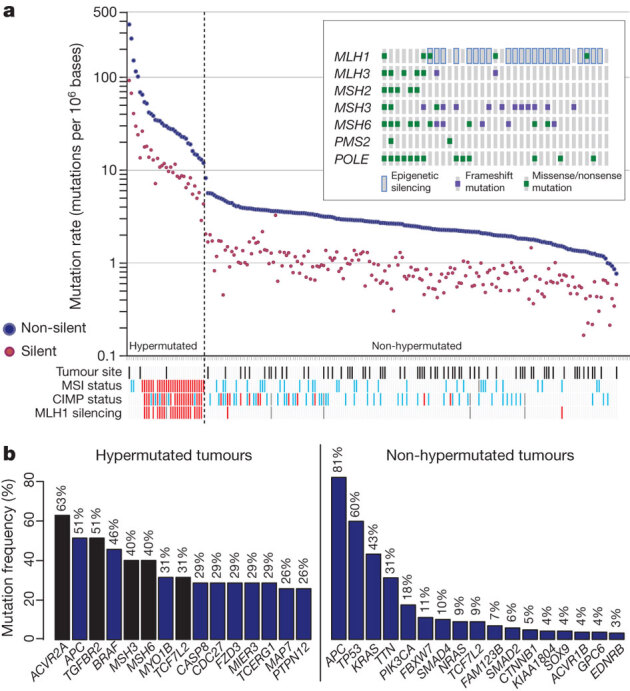
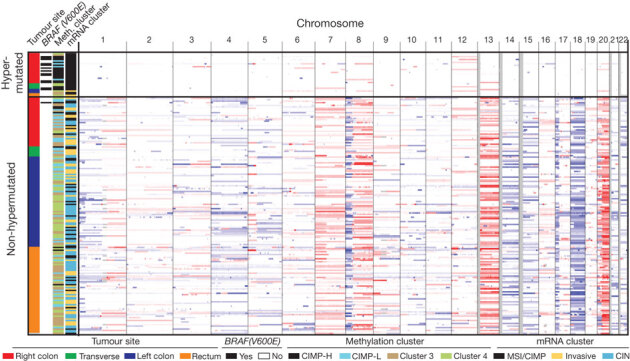
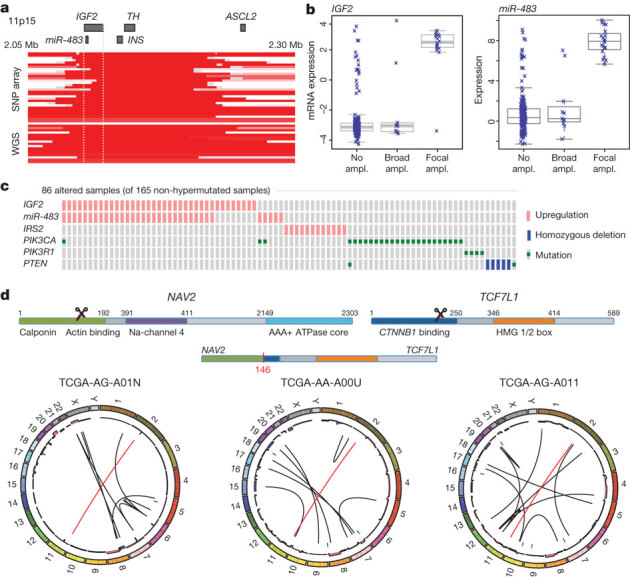
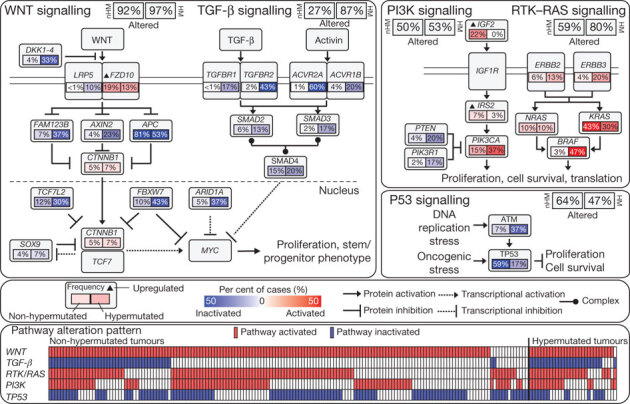
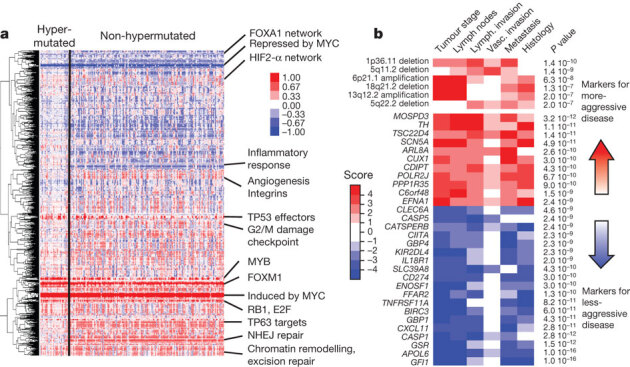
To characterize somatic alterations in colorectal carcinoma, we conducted a genome-scale analysis of 276 samples, analysing exome sequence, DNA copy number, promoter methylation and messenger RNA and microRNA expression. A subset of these samples (97) underwent low-depth-of-coverage whole-genome sequencing. In total, 16% of colorectal carcinomas were found to be hypermutated: three-quarters of these had the expected high microsatellite instability, usually with hypermethylation and MLH1 silencing, and one-quarter had somatic mismatch-repair gene and polymerase ε (POLE) mutations. Excluding the hypermutated cancers, colon and rectum cancers were found to have considerably similar patterns of genomic alteration. Twenty-four genes were significantly mutated, and in addition to the expected APC, TP53, SMAD4, PIK3CA and KRAS mutations, we found frequent mutations in ARID1A, SOX9 and FAM123B. Recurrent copy-number alterations include potentially drug-targetable amplifications of ERBB2 and newly discovered amplification of IGF2. Recurrent chromosomal translocations include the fusion of NAV2 and WNT pathway member TCF7L1. Integrative analyses suggest new markers for aggressive colorectal carcinoma and an important role for MYC-directed transcriptional activation and repression. The Cancer Genome Atlas consortium reports on their genome-wide characterization of somatic alterations in colorectal cancer; in addition to revealing a remarkably consistent pattern of genomic alteration, with 24 genes being significantly mutated, the study identifies new targets for therapeutic intervention and suggests an important role for MYC-directed transcriptional activation and repression. The Cancer Genome Atlas consortium reports on their genome-wide characterization of somatic alterations in colorectal carcinoma. Combined analysis of exome sequence data, DNA copy number, promoter methylation, messenger RNA and microRNA expression, as well as low-coverage whole-genome sequencing reveal that 16% of these carcinomas have hypermutation. Of these, three-quarters have the expected high microsatellite instability, but the rest have somatic mismatch repair gene mutations. The data reveal a remarkably consistent pattern of genomic alteration, with 24 genes being significantly mutated. As well as identifying new biomarkers for aggressive colorectal carcinoma, the data imply an important role for MYC-directed transcriptional activation and repression.
Overview
The claims and statistics of this paper haven’t been checked yet.
Free: it reads the open-access text and checks the first 5 claims that cite a source we can check. Create a free account to check every claim.
Integrity signals
Registry
Cites
Statistics
Figures
Verification
Claims the paper makes
The claims and statistics of this paper haven’t been checked yet.
Free: it reads the open-access text and checks the first 5 claims that cite a source we can check. Create a free account to check every claim.
Claims other papers make about this one
Each is checked against this paper’s own text: does it say what the citing paper says it does?
The source backs part of the claim, not all of it — or backs it for a different population, condition or comparison.
In the citing paper
“KRAS G12V had an increased rate of comutation with TCF7L2, which encodes TCF4, a regulator of Wnt signaling often dysregulated in COAD49–51, specifically the R488C mutation.”
From The origins and genetic interactions of KRAS mutations are allele- and tissue-specific (2021) · cites this paper as [49]
Experimental — accuracy not yet measuredThe source backs part of the claim, not all of it — or backs it for a different population, condition or comparison.
In the citing paper
“PI3K α is both a key regulator and effector of KRAS-dependent signaling and is also activated through mutations involving the PIK3CA gene locus in colorectal cancer, including mutations co-occurring with KRAS [19].”
From Anti-tumor efficacy of a potent and selective non-covalent KRASG12D inhibitor (2022) · cites this paper as [19]
Experimental — accuracy not yet measuredThe source backs part of the claim, not all of it — or backs it for a different population, condition or comparison.
In the citing paper
“Approximately 55% of colorectal cancers (CRCs) are driven by mutational activation of KRAS, BRAF, NRAS, and thus are hard-wired to oncogenic RAS/RAF/MEK/ERK pathway signaling [1–3].”
From An integrative gene expression signature analysis identifies CMS4 KRAS-mutated colorectal cancers sensitive to combined MEK and SRC targeted therapy (2022) · cites this paper as [2]
Experimental — accuracy not yet measuredThe source backs part of the claim, not all of it — or backs it for a different population, condition or comparison.
In the citing paper
“TALENs targeting position 1320 of the APC coding sequence (Fig 3A), a known hotspot commonly mutated in FAP patients [2].”
From Modeling APC mutagenesis and familial adenomatous polyposis using human iPS cells (2018) · cites this paper as [2]
Experimental — accuracy not yet measuredThe source backs part of the claim, not all of it — or backs it for a different population, condition or comparison.
In the citing paper
“which represent ~10–11% of all CRCs (Network, 2012)”
From A Landscape of Therapeutic Cooperativity in KRAS Mutant Cancers Reveals Principles for Controlling Tumor Evolution (2017) · cites this paper as Network, 2012
Experimental — accuracy not yet measured
6 more claims about this paper
Create a free account to see every claim other papers make about this one.
Self-check
Percentages, sums and reported differences re-computed from the paper’s own numbers.
The self-check needs the paper’s full text.
Citations
Cites
Integrated genomic analyses of ovarian carcinoma
Perou, C. M. (2019) · Carolina Digital Repository (University of North Carolina at Chapel Hill) · doi:10.17615/hvp3-wg08 · Cited by 7,925
Comprehensive genomic characterization defines human glioblastoma genes and core pathways
The Cancer Genome Atlas Research Network (2008) · Nature · doi:10.1038/nature07385 · Cited by 7,735
Self-citationUmar, A., Boland, C. R., Terdiman, J. P., Syngal, S., Chapelle, A. D. L., Ruschoff, J., Fishel, R., Lindor, N. M., Burgart, L. J., Hamelin, R., et al. (2004) · JNCI Journal of the National Cancer Institute · doi:10.1093/jnci/djh034 · Cited by 3,183
The Consensus Coding Sequences of Human Breast and Colorectal Cancers
Sjöblom, T., Jones, S., Wood, L. D., Parsons, D. W., Lin, J., Barber, T. D., Mandelker, D., Leary, R. J., Ptak, J., Silliman, N., et al. (2006) · Science · doi:10.1126/science.1133427 · Cited by 3,169
The Genomic Landscapes of Human Breast and Colorectal Cancers
Wood, L. D., Parsons, D. W., Jones, S., Lin, J., Sjöblom, T., Leary, R. J., Shen, D., Boca, S. M., Barber, T., Ptak, J., et al. (2007) · Science · doi:10.1126/science.1145720 · Cited by 2,833
Clues to the Pathogenesis of Familial Colorectal Cancer
Aaltonen, L. A., Peltomäki, P., Leach, F. S., Sistonen, P., Pylkkänen, L., Mecklin, J.-P., Järvinen, H., Powell, S. M., Jen, J., Hamilton, S. R., et al. (1993) · Science · doi:10.1126/science.8484121 · Cited by 2,710
Ionov, Y., Peinado, M. A., Malkhosyan, S., Shibata, D., & Perucho, M. (1993) · Nature · doi:10.1038/363558a0 · Cited by 2,708
TGFβ Signaling in Growth Control, Cancer, and Heritable Disorders
Massagué, J., Blain, S. W., & Lo, R. S. (2000) · Cell · doi:10.1016/s0092-8674(00)00121-5 · Cited by 2,385
Landon, M., Saam, J., Brown, K. L., Moyes, K., Evans, B., & Wenstrup, R. (2015) · Oncology · doi:10.1159/000430097 · Cited by 1,939
Molecular Genetics of Colorectal Cancer
Fearon, E. R. (2011) · Annual Review of Pathology: Mechanisms of Disease · doi:10.1146/annurev-pathol-011110-130235 · Cited by 1,805
Cited by
Items 501–600 of 1,135
Cancer Genomics: Diversity and Disparity Across Ethnicity and Geography
Tan, D. S. W., Mok, T. S. K., & Rebbeck, T. R. (2016) · Journal of Clinical Oncology · doi:10.1200/jco.2015.62.0096 · Cited by 202
Colorectal Cancer Heterogeneity and Targeted Therapy: A Case for Molecular Disease Subtypes
Linnekamp, J. F., Wang, X., Medema, J. P., & Vermeulen, L. (2015) · Cancer Research · doi:10.1158/0008-5472.can-14-2240 · Cited by 202
Genome-Scale CRISPR Screening in Human Intestinal Organoids Identifies Drivers of TGF-β Resistance
Ringel, T., Frey, N., Ringnalda, F., Janjuha, S., Cherkaoui, S., Butz, S., Srivatsa, S., Pirkl, M., Russo, G., Villiger, L., et al. (2020) · Cell Stem Cell · doi:10.1016/j.stem.2020.02.007 · Cited by 202
Characterizing DNA methylation alterations from The Cancer Genome Atlas
Weisenberger, D. J. (2014) · Journal of Clinical Investigation · doi:10.1172/jci69740 · Cited by 200
Yaeger, R., Shah, M. A., Miller, V. A., Kelsen, J. R., Wang, K., Heins, Z. J., Ross, J. S., He, Y., Sanford, E., Yantiss, R. K., et al. (2016) · Gastroenterology · doi:10.1053/j.gastro.2016.04.001 · Cited by 200
Predicting responses to platin chemotherapy agents with biochemically-inspired machine learning
Mucaki, E. J., Zhao, J. Z. L., Lizotte, D. J., & Rogan, P. K. (2019) · Signal Transduction and Targeted Therapy · doi:10.1038/s41392-018-0034-5 · Cited by 200
Repeat expansions confer WRN dependence in microsatellite-unstable cancers
van Wietmarschen, N., Sridharan, S., Nathan, W. J., Tubbs, A., Chan, E. M., Callen, E., Wu, W., Belinky, F., Tripathi, V., Wong, N., et al. (2020) · Nature · doi:10.1038/s41586-020-2769-8 · Cited by 199
Mo, S., Tang, P., Luo, W., Zhang, L., Li, Y., Hu, X., Ma, X., Chen, Y., Bao, Y., He, X., et al. (2022) · Advanced Science · doi:10.1002/advs.202204097 · Cited by 198
Combined PD-1, BRAF and MEK inhibition in BRAFV600E colorectal cancer: a phase 2 trial
Tian, J., Chen, J. H., Chao, S. X., Pelka, K., Giannakis, M., Hess, J., Burke, K., Jorgji, V., Sindurakar, P., Braverman, J., et al. (2023) · Nature Medicine · doi:10.1038/s41591-022-02181-8 · Cited by 198
Inferring regulatory element landscapes and transcription factor networks from cancer methylomes
Yao, L., Shen, H., Laird, P. W., Farnham, P. J., & Berman, B. P. (2015) · Genome Biology · doi:10.1186/s13059-015-0668-3 · Cited by 198
p53 genes function to restrain mobile elements
Wylie, A., Jones, A. E., D'Brot, A., Lu, W.-J., Kurtz, P., Moran, J. V., Rakheja, D., Chen, K. S., Hammer, R. E., Comerford, S. A., et al. (2016) · Genes & Development · doi:10.1101/gad.266098.115 · Cited by 198
“…by the TCGA Research Network (https://tcga-data.nci.nih. gov/tcga; phs000178.v8.p7) for which matched controls were available were downloaded from the Cancer Genomics Hub for inclusion in these studies (The Cancer Genome Atlas Network 2012).”
Tissue-Specific Oncogenic Activity of KRASA146T
Poulin, E. J., Bera, A. K., Lu, J., Lin, Y.-J., Strasser, S. D., Paulo, J. A., Huang, T. Q., Morales, C., Yan, W., Cook, J., et al. (2019) · Cancer Discovery · doi:10.1158/2159-8290.cd-18-1220 · Cited by 197
Clonal evolution of colorectal cancer in IBD
Choi, C.-H. R., Bakir, I. A., Hart, A. L., & Graham, T. A. (2017) · Nature Reviews Gastroenterology & Hepatology · doi:10.1038/nrgastro.2017.1 · Cited by 196
Same-day genomic and epigenomic diagnosis of brain tumors using real-time nanopore sequencing
Euskirchen, P., Bielle, F., Labreche, K., Kloosterman, W. P., Rosenberg, S., Daniau, M., Schmitt, C., Masliah-Planchon, J., Bourdeaut, F., Dehais, C., et al. (2017) · Acta Neuropathologica · doi:10.1007/s00401-017-1743-5 · Cited by 196
Three molecular pathways model colorectal carcinogenesis in Lynch syndrome
Ahadova, A., Gallon, R., Gebert, J., Ballhausen, A., Endris, V., Kirchner, M., Stenzinger, A., Burn, J., von Knebel Doeberitz, M., Bläker, H., et al. (2018) · International Journal of Cancer · doi:10.1002/ijc.31300 · Cited by 195
Sancho, R., Cremona, C. A., & Behrens, A. (2015) · EMBO reports · doi:10.15252/embr.201540188 · Cited by 195
“…mutations in this pathway, frequently truncations of the APC gene that indirectly stabilise the Wnt effector b -catenin, have been found in over 90% of colorectal cancers [28] and APC min/+ mice harbouring mutant APC serve as the most widely used intestinal tumour model in mammals [29,30].”
Endogenous Retroviruses and the Development of Cancer
Kassiotis, G. (2014) · The Journal of Immunology · doi:10.4049/jimmunol.1302972 · Cited by 195
Organoid models of gastrointestinal cancers in basic and translational research
Lau, H. C. H., Kranenburg, O., Xiao, H., & Yu, J. (2020) · Nature Reviews Gastroenterology & Hepatology · doi:10.1038/s41575-019-0255-2 · Cited by 194
DNA mismatch repair and its many roles in eukaryotic cells
Liu, D., Keijzers, G., & Rasmussen, L. J. (2017) · Mutation Research/Reviews in Mutation Research · doi:10.1016/j.mrrev.2017.07.001 · Cited by 193
Kuntz, S., Krieghoff-Henning, E., Kather, J. N., Jutzi, T., Höhn, J., Kiehl, L., Hekler, A., Alwers, E., von Kalle, C., Fröhling, S., et al. (2021) · European Journal of Cancer · doi:10.1016/j.ejca.2021.07.012 · Cited by 191
Chromatin accessibility underlies synthetic lethality of SWI/SNF subunits in ARID1A-mutant cancers
Kelso, T. W. R., Porter, D. K., Amaral, M. L., Shokhirev, M. N., Benner, C., & Hargreaves, D. C. (2017) · eLife · doi:10.7554/elife.30506 · Cited by 192
Sánchez, Y., Segura, V., Marín-Béjar, O., Athie, A., Marchese, F. P., González, J., Bujanda, L., Guo, S., Matheu, A., & Huarte, M. (2014) · Nature Communications · doi:10.1038/ncomms6812 · Cited by 192
Wnt‐induced transcriptional activation is exclusively mediated by TCF/LEF
Schuijers, J., Mokry, M., Hatzis, P., Cuppen, E., & Clevers, H. (2014) · The EMBO Journal · doi:10.1002/embj.201385358 · Cited by 191
Mining cancer methylomes: prospects and challenges
Stirzaker, C., Taberlay, P. C., Statham, A. L., & Clark, S. J. (2014) · Trends in Genetics · doi:10.1016/j.tig.2013.11.004 · Cited by 191
Large Scale Comparison of Gene Expression Levels by Microarrays and RNAseq Using TCGA Data
Guo, Y., Sheng, Q., Li, J., Ye, F., Samuels, D. C., & Shyr, Y. (2013) · PLoS ONE · doi:10.1371/journal.pone.0071462 · Cited by 191
Mismatch Repair and Colon Cancer: Mechanisms and Therapies Explored
Li, S. K. H., & Martin, A. (2016) · Trends in Molecular Medicine · doi:10.1016/j.molmed.2016.02.003 · Cited by 191
The molecular origin and taxonomy of mucinous ovarian carcinoma
Cheasley, D., Wakefield, M. J., Ryland, G. L., Allan, P. E., Alsop, K., Amarasinghe, K. C., Ananda, S., Anglesio, M. S., Au-Yeung, G., Böhm, M., et al. (2019) · Nature Communications · doi:10.1038/s41467-019-11862-x · Cited by 191
PDXNET Consortium, Woo, X. Y., EurOPDX Consortium, Giordano, J., Srivastava, A., Zhao, Z.-M., Lloyd, M. W., de Bruijn, R., Suh, Y.-S., Patidar, R., et al. (2021) · Nature Genetics · doi:10.1038/s41588-020-00750-6 · Cited by 190
Racial and ethnic disparities in colorectal cancer incidence and mortality
(2021) · Advances in Cancer Research · doi:10.1016/bs.acr.2021.02.007 · Cited by 190
Unni, A. M., Lockwood, W. W., Zejnullahu, K., Lee-Lin, S.-Q., & Varmus, H. (2015) · eLife · doi:10.7554/elife.06907 · Cited by 190
MEK inhibitors activate Wnt signalling and induce stem cell plasticity in colorectal cancer
Zhan, T., Ambrosi, G., Wandmacher, A. M., Rauscher, B., Betge, J., Rindtorff, N., Häussler, R. S., Hinsenkamp, I., Bamberg, L., Hessling, B., et al. (2019) · Nature Communications · doi:10.1038/s41467-019-09898-0 · Cited by 189
The genomic landscape of schwannoma
Agnihotri, S., Jalali, S., Wilson, M. R., Danesh, A., Li, M., Klironomos, G., Krieger, J. R., Mansouri, A., Khan, O., Mamatjan, Y., et al. (2016) · Nature Genetics · doi:10.1038/ng.3688 · Cited by 189
Bai, Z., Zhou, Y., Ye, Z., Xiong, J., Lan, H., & Wang, F. (2022) · Frontiers in Immunology · doi:10.3389/fimmu.2021.808964 · Cited by 189
The NF1 gene revisited - from bench to bedside
Yap, Y.-S., McPherson, J. R., Ong, C.-K., Rozen, S. G., Teh, B.-T., Lee, A. S. G., & Callen, D. F. (2014) · Oncotarget · doi:10.18632/oncotarget.2194 · Cited by 189
A nineteen gene‐based risk score classifier predicts prognosis of colorectal cancer patients
Kim, S.-K., Kim, S.-Y., Kim, J.-H., Roh, S. A., Cho, D.-H., Kim, Y. S., & Kim, J. C. (2014) · Molecular Oncology · doi:10.1016/j.molonc.2014.06.016 · Cited by 189
Emerging trends in colorectal cancer: Dysregulated signaling pathways (Review)
Ahmad, R., Singh, J., Wunnava, A., Al‑Obeed, O., Abdulla, M., & Srivastava, S. (2021) · International Journal of Molecular Medicine · doi:10.3892/ijmm.2021.4847 · Cited by 189
Cell Biology of Canonical Wnt Signaling
Albrecht, L. V., Tejeda-Muñoz, N., & De Robertis, E. M. (2021) · Annual Review of Cell and Developmental Biology · doi:10.1146/annurev-cellbio-120319-023657 · Cited by 187
Novel recurrently mutated genes and a prognostic mutation signature in colorectal cancer
Yu, J., Wu, W. K. K., Li, X., He, J., Li, X.-X., Ng, S. S. M., Yu, C., Gao, Z., Yang, J., Li, M., et al. (2015) · Gut · doi:10.1136/gutjnl-2013-306620 · Cited by 188
Processing ribonucleotides incorporated during eukaryotic DNA replication
Williams, J. S., Lujan, S. A., & Kunkel, T. A. (2016) · Nature Reviews Molecular Cell Biology · doi:10.1038/nrm.2016.37 · Cited by 188
Chen, J., Wu, Y., Luo, X., Jin, D., Zhou, W., Ju, Z., Wang, D., Meng, Q., Wang, H., Fu, X., et al. (2021) · Theranostics · doi:10.7150/thno.59546 · Cited by 188
Recent progress in Lynch syndrome and other familial colorectal cancer syndromes
Boland, P. M., Yurgelun, M. B., & Boland, C. R. (2018) · CA: A Cancer Journal for Clinicians · doi:10.3322/caac.21448 · Cited by 188
Molecular subtyping of colorectal cancer: Recent progress, new challenges and emerging opportunities
Wang, W., Kandimalla, R., Huang, H., Zhu, L., Li, Y., Gao, F., Goel, A., & Wang, X. (2019) · Seminars in Cancer Biology · doi:10.1016/j.semcancer.2018.05.002 · Cited by 187
Genomic Sequencing Identifies ELF3 as a Driver of Ampullary Carcinoma
Yachida, S., Wood, L. D., Suzuki, M., Takai, E., Totoki, Y., Kato, M., Luchini, C., Arai, Y., Nakamura, H., Hama, N., et al. (2016) · Cancer Cell · doi:10.1016/j.ccell.2015.12.012 · Cited by 187
Strong, M. J., Xu, G., Morici, L., Splinter Bon-Durant, S., Baddoo, M., Lin, Z., Fewell, C., Taylor, C. M., & Flemington, E. K. (2014) · PLoS Pathogens · doi:10.1371/journal.ppat.1004437 · Cited by 186
Update on genetic predisposition to colorectal cancer and polyposis
Valle, L., de Voer, R. M., Goldberg, Y., Sjursen, W., Försti, A., Ruiz-Ponte, C., Caldés, T., Garré, P., Olsen, M. F., Nordling, M., et al. (2019) · Molecular Aspects of Medicine · doi:10.1016/j.mam.2019.03.001 · Cited by 186
Wang, S., Gao, S., Zeng, Y., Zhu, L., Mo, Y., Wong, C. C., Bao, Y., Su, P., Zhai, J., Wang, L., et al. (2022) · Gastroenterology · doi:10.1053/j.gastro.2021.12.269 · Cited by 185
Narasimhan, V., Wright, J. A., Churchill, M., Wang, T., Rosati, R., Lannagan, T. R. M., Vrbanac, L., Richardson, A. B., Kobayashi, H., Price, T., et al. (2020) · Clinical Cancer Research · doi:10.1158/1078-0432.ccr-20-0073 · Cited by 185
The Insulin/IGF System in Colorectal Cancer Development and Resistance to Therapy
Vigneri, P. G., Tirrò, E., Pennisi, M. S., Massimino, M., Stella, S., Romano, C., & Manzella, L. (2015) · Frontiers in Oncology · doi:10.3389/fonc.2015.00230 · Cited by 185
Expanding the computational toolbox for mining cancer genomes
Ding, L., Wendl, M. C., McMichael, J. F., & Raphael, B. J. (2014) · Nature Reviews Genetics · doi:10.1038/nrg3767 · Cited by 185
Haradhvala, N. J., Kim, J., Maruvka, Y. E., Polak, P., Rosebrock, D., Livitz, D., Hess, J. M., Leshchiner, I., Kamburov, A., Mouw, K. W., et al. (2018) · Nature Communications · doi:10.1038/s41467-018-04002-4 · Cited by 183
Korkut, A., Zaidi, S., Kanchi, R. S., Rao, S., Gough, N. R., Schultz, A., Li, X., Lorenzi, P. L., Berger, A. C., Robertson, G., et al. (2018) · Cell Systems · doi:10.1016/j.cels.2018.08.010 · Cited by 183
SWI/SNF chromatin remodeling complexes and cancer
Biegel, J. A., Busse, T. M., & Weissman, B. E. (2014) · American Journal of Medical Genetics Part C: Seminars in Medical Genetics · doi:10.1002/ajmg.c.31410 · Cited by 183
Tang, W., Zhu, Y., Gao, J., Fu, J., Liu, C., Liu, Y., Song, C., Zhu, S., Leng, Y., Wang, G., et al. (2014) · British Journal of Cancer · doi:10.1038/bjc.2013.724 · Cited by 183
Molecular genetics of colorectal cancer.
Bogaert, J. A., & Prenen, H. (2014) · PubMed Central · Cited by 283
A body map of somatic mutagenesis in morphologically normal human tissues
Li, R., Di, L., Li, J., Fan, W., Liu, Y., Guo, W., Liu, W., Liu, L., Li, Q., Chen, L., et al. (2021) · Nature · doi:10.1038/s41586-021-03836-1 · Cited by 183
CTCF Haploinsufficiency Destabilizes DNA Methylation and Predisposes to Cancer
Kemp, C. J., Moore, J. M., Moser, R., Bernard, B., Teater, M., Smith, L. E., Rabaia, N. A., Gurley, K. E., Guinney, J., Busch, S. E., et al. (2014) · Cell Reports · doi:10.1016/j.celrep.2014.04.004 · Cited by 182
Molecular pathogenesis of sporadic colorectal cancers
Yamagishi, H., Kuroda, H., Imai, Y., & Hiraishi, H. (2016) · Chinese Journal of Cancer · doi:10.1186/s40880-015-0066-y · Cited by 181
Allele-Specific Reprogramming of Cancer Metabolism by the Long Non-coding RNA CCAT2
Redis, R. S., Vela, L. E., Lu, W., Ferreira de Oliveira, J., Ivan, C., Rodriguez-Aguayo, C., Adamoski, D., Pasculli, B., Taguchi, A., Chen, Y., et al. (2016) · Molecular Cell · doi:10.1016/j.molcel.2016.01.015 · Cited by 181
Cellular Plasticity in Intestinal Homeostasis and Disease
de Sousa e Melo, F., & de Sauvage, F. J. (2019) · Cell Stem Cell · doi:10.1016/j.stem.2018.11.019 · Cited by 181
Kanu, N., Grönroos, E., Martinez, P., Burrell, R. A., Yi Goh, X., Bartkova, J., Maya-Mendoza, A., Mistrík, M., Rowan, A. J., Patel, H., et al. (2015) · Oncogene · doi:10.1038/onc.2015.24 · Cited by 181
“Using the same dataset as the published study (which included 281 of the 293 TCGA samples described above, as well as additional samples from other sources (25) we investigated whether there was any relationship between SETD2 mutation status and the MMR deficiency signature.”
InfluentialTrinh, A., Trumpi, K., De Sousa E Melo, F., Wang, X., de Jong, J. H., Fessler, E., Kuppen, P. J. K., Reimers, M. S., Swets, M., Koopman, M., et al. (2017) · Clinical Cancer Research · doi:10.1158/1078-0432.ccr-16-0680 · Cited by 180
Epigenetic inactivation of the p53-induced long noncoding RNA TP53 target 1 in human cancer
Diaz-Lagares, A., Crujeiras, A. B., Lopez-Serra, P., Soler, M., Setien, F., Goyal, A., Sandoval, J., Hashimoto, Y., Martinez-Cardús, A., Gomez, A., et al. (2016) · Proceedings of the National Academy of Sciences · doi:10.1073/pnas.1608585113 · Cited by 180
The genomic landscape of 2,023 colorectal cancers
Cornish, A. J., Gruber, A. J., Kinnersley, B., Chubb, D., Frangou, A., Caravagna, G., Noyvert, B., Lakatos, E., Wood, H. M., Thorn, S., et al. (2024) · Nature · doi:10.1038/s41586-024-07747-9 · Cited by 180
ChIP-seq of plasma cell-free nucleosomes identifies gene expression programs of the cells of origin
Sadeh, R., Sharkia, I., Fialkoff, G., Rahat, A., Gutin, J., Chappleboim, A., Nitzan, M., Fox-Fisher, I., Neiman, D., Meler, G., et al. (2021) · Nature Biotechnology · doi:10.1038/s41587-020-00775-6 · Cited by 179
Qi, J., Yu, Y., Akilli Öztürk, Ö., Holland, J. D., Besser, D., Fritzmann, J., Wulf-Goldenberg, A., Eckert, K., Fichtner, I., & Birchmeier, W. (2016) · Gut · doi:10.1136/gutjnl-2014-307900 · Cited by 179
Wu, P., Heins, Z. J., Muller, J. T., Katsnelson, L., de Bruijn, I., Abeshouse, A. A., Schultz, N., Fenyö, D., & Gao, J. (2019) · Molecular & Cellular Proteomics · doi:10.1074/mcp.tir119.001673 · Cited by 179
Herpers, B., Eppink, B., James, M. I., Cortina, C., Cañellas-Socias, A., Boj, S. F., Hernando-Momblona, X., Glodzik, D., Roovers, R. C., van de Wetering, M., et al. (2022) · Nature Cancer · doi:10.1038/s43018-022-00359-0 · Cited by 178
Arqués, O., Chicote, I., Puig, I., Tenbaum, S. P., Argilés, G., Dienstmann, R., Fernández, N., Caratù, G., Matito, J., Silberschmidt, D., et al. (2016) · Clinical Cancer Research · doi:10.1158/1078-0432.ccr-14-3081 · Cited by 178
Differences in Survival between Colon and Rectal Cancer from SEER Data
Lee, Y.-C., Lee, Y.-L., Chuang, J.-P., & Lee, J.-C. (2013) · PLoS ONE · doi:10.1371/journal.pone.0078709 · Cited by 178
Cancer Systems Biology: a peek into the future of patient care?
Werner, H. M. J., Mills, G. B., & Ram, P. T. (2014) · Nature Reviews Clinical Oncology · doi:10.1038/nrclinonc.2014.6 · Cited by 178
Han, L., Yuan, Y., Zheng, S., Yang, Y., Li, J., Edgerton, M. E., Diao, L., Xu, Y., Verhaak, R. G. W., & Liang, H. (2014) · Nature Communications · doi:10.1038/ncomms4963 · Cited by 178
Role of HOX Genes in Stem Cell Differentiation and Cancer
Bhatlekar, S., Fields, J. Z., & Boman, B. M. (2018) · Stem Cells International · doi:10.1155/2018/3569493 · Cited by 178
Rosty, C., Hewett, D. G., Brown, I. S., Leggett, B. A., & Whitehall, V. L. J. (2013) · Journal of Gastroenterology · doi:10.1007/s00535-012-0720-y · Cited by 178
Consensus molecular subtypes of colorectal cancer are recapitulated in in vitro and in vivo models
Linnekamp, J. F., Hooff, S. R. V., Prasetyanti, P. R., Kandimalla, R., Buikhuisen, J. Y., Fessler, E., Ramesh, P., Lee, K. A. S. T., Bochove, G. G. W., de Jong, J. H., et al. (2018) · Cell Death & Differentiation · doi:10.1038/s41418-017-0011-5 · Cited by 177
A novel approach for data integration and disease subtyping
Nguyen, T., Tagett, R., Diaz, D., & Draghici, S. (2017) · Genome Research · doi:10.1101/gr.215129.116 · Cited by 177
Sebestyén, E., Zawisza, M., & Eyras, E. (2015) · Nucleic Acids Research · doi:10.1093/nar/gku1392 · Cited by 177
Mohan, S., Heitzer, E., Ulz, P., Lafer, I., Lax, S., Auer, M., Pichler, M., Gerger, A., Eisner, F., Hoefler, G., et al. (2014) · PLoS Genetics · doi:10.1371/journal.pgen.1004271 · Cited by 177
Next generation sequencing‐based gene panel tests for the management of solid tumors
Nagahashi, M., Shimada, Y., Ichikawa, H., Kameyama, H., Takabe, K., Okuda, S., & Wakai, T. (2019) · Cancer Science · doi:10.1111/cas.13837 · Cited by 177
Miller, S. A., Policastro, R. A., Sriramkumar, S., Lai, T., Huntington, T. D., Ladaika, C. A., Kim, D., Hao, C., Zentner, G. E., & O'Hagan, H. M. (2021) · Cancer Research · doi:10.1158/0008-5472.can-20-3562 · Cited by 176
NQO1 inhibits proteasome-mediated degradation of HIF-1α
Oh, E.-T., Kim, J.-W., Kim, J. M., Kim, S. J., Lee, J.-S., Hong, S.-S., Goodwin, J., Ruthenborg, R. J., Jung, M. G., Lee, H.-J., et al. (2016) · Nature Communications · doi:10.1038/ncomms13593 · Cited by 176
Sexual Dimorphism in Colon Cancer
Abancens, M., Bustos, V., Harvey, H., McBryan, J., & Harvey, B. J. (2020) · Frontiers in Oncology · doi:10.3389/fonc.2020.607909 · Cited by 176
Billingsley, C. C., Cohn, D. E., Mutch, D. G., Stephens, J. A., Suarez, A. A., & Goodfellow, P. J. (2015) · Cancer · doi:10.1002/cncr.29046 · Cited by 176
Jesinghaus, M., Konukiewitz, B., Keller, G., Kloor, M., Steiger, K., Reiche, M., Penzel, R., Endris, V., Arsenic, R., Hermann, G., et al. (2017) · Modern Pathology · doi:10.1038/modpathol.2016.220 · Cited by 176
Nieminen, T. T., O’Donohue, M.-F., Wu, Y., Lohi, H., Scherer, S. W., Paterson, A. D., Ellonen, P., Abdel-Rahman, W. M., Valo, S., Mecklin, J.-P., et al. (2014) · Gastroenterology · doi:10.1053/j.gastro.2014.06.009 · Cited by 176
Low neoantigen expression and poor T-cell priming underlie early immune escape in colorectal cancer
Westcott, P. M. K., Sacks, N. J., Schenkel, J. M., Ely, Z. A., Smith, O., Hauck, H., Jaeger, A. M., Zhang, D., Backlund, C. M., Beytagh, M. C., et al. (2021) · Nature Cancer · doi:10.1038/s43018-021-00247-z · Cited by 175
A genetic basis for the variation in the vulnerability of cancer to DNA damage
Yard, B. D., Adams, D. J., Chie, E. K., Tamayo, P., Battaglia, J. S., Gopal, P., Rogacki, K., Pearson, B. E., Phillips, J., Raymond, D. P., et al. (2016) · Nature Communications · doi:10.1038/ncomms11428 · Cited by 175
Pan-cancer patterns of DNA methylation
Witte, T., Plass, C., & Gerhauser, C. (2014) · Genome Medicine · doi:10.1186/s13073-014-0066-6 · Cited by 175
Lynch syndrome and Lynch syndrome mimics: The growing complex landscape of hereditary colon cancer
Carethers, J. M. (2015) · World Journal of Gastroenterology · doi:10.3748/wjg.v21.i31.9253 · Cited by 175
The importance of regulatory ubiquitination in cancer and metastasis
Gallo, L. H., Ko, J., & Donoghue, D. J. (2017) · Cell Cycle · doi:10.1080/15384101.2017.1288326 · Cited by 175
Pathology and genetics of hereditary colorectal cancer
Ma, H., Brosens, L. A. A., Offerhaus, G. J. A., Giardiello, F. M., de Leng, W. W. J., & Montgomery, E. A. (2018) · Pathology · doi:10.1016/j.pathol.2017.09.004 · Cited by 175
“39 Although FAP patients have a high risk of developing colorectal tumours, only about one in every 10 6 colorectal epithelial stem cells gives rise to such a tumour, 30 which indicates that additional factors contribute to this process.”
From human genome to cancer genome: The first decade
Wheeler, D. A., & Wang, L. (2013) · Genome Research · doi:10.1101/gr.157602.113 · Cited by 175
The role of neoantigens in response to immune checkpoint blockade
Riaz, N., Morris, L., Havel, J. J., Makarov, V., Desrichard, A., & Chan, T. A. (2016) · International Immunology · doi:10.1093/intimm/dxw019 · Cited by 175
Inflammation and Colorectal Cancer
Long, A. G., Lundsmith, E. T., & Hamilton, K. E. (2017) · Current Colorectal Cancer Reports · doi:10.1007/s11888-017-0373-6 · Cited by 174
Iftekhar, A., Berger, H., Bouznad, N., Heuberger, J., Boccellato, F., Dobrindt, U., Hermeking, H., Sigal, M., & Meyer, T. F. (2021) · Nature Communications · doi:10.1038/s41467-021-21162-y · Cited by 174
Wang, W., Shao, F., Yang, X., Wang, J., Zhu, R., Yang, Y., Zhao, G., Guo, D., Sun, Y., Wang, J., et al. (2021) · Nature Communications · doi:10.1038/s41467-021-23501-5 · Cited by 174
Lee, S., Park, H. Y., Kang, S. Y., Kim, S. J., Hwang, J., Lee, S., Kwak, S. H., Park, K. S., Yoo, H. Y., Kim, W. S., et al. (2015) · Oncotarget · doi:10.18632/oncotarget.3776 · Cited by 174
Colorectal Cancers: An Update on Their Molecular Pathology
Inamura, K. (2018) · Cancers · doi:10.3390/cancers10010026 · Cited by 174
Fidelity of DNA replication—a matter of proofreading
Bębenek, A., & Ziuzia-Graczyk, I. (2018) · Current Genetics · doi:10.1007/s00294-018-0820-1 · Cited by 174
Eso, Y., Shimizu, T., Takeda, H., Takai, A., & Marusawa, H. (2020) · Journal of Gastroenterology · doi:10.1007/s00535-019-01620-7 · Cited by 174
Increased somatic mutation burdens in normal human cells due to defective DNA polymerases
Robinson, P. S., Coorens, T. H. H., Palles, C., Mitchell, E., Abascal, F., Olafsson, S., Lee, B. C. H., Lawson, A. R. J., Lee-Six, H., Moore, L., et al. (2021) · Nature Genetics · doi:10.1038/s41588-021-00930-y · Cited by 173
Metadata
- Authors
- The Cancer Genome Atlas Network
- Affiliations
- Broad Institute (US)
- Corresponding author
- The Cancer Genome Atlas Network
- Venue
- Nature
- Published
- 2012-07-18
- Volume
- 487
- Issue
- 7407
- Pages
- 330-337
- ISSN
- 0028-0836 (ISSN-L)
- 1476-4687
- PMC
- PMC3401966
- OpenAlex
- W2262414037
- Semantic Scholar
- 56321e765211d85a29621551d0df9a1cfc0a78ca
- Cited by
- 8,499
- References
- 49
- Citations by year
- 2026: 389 · 2025: 455 · 2024: 502 · 2023: 591 · 2022: 678 · 2021: 754 · 2020: 736 · 2019: 686 · 2018: 677 · 2017: 673 · 2016: 646 · 2015: 616 · 2014: 578 · 2013: 424 · 2012: 86
- FWCI
- 393.35
- Type
- journal article
- Language
- en
- Open access
- hybrid
- doi.org
- Licence
- cc-by-nc-sa
- creativecommons.org/licenses/by-nc-sa/3.0/ (tdm)
- creativecommons.org/licenses/by-nc-sa/3.0/ (vor)
- Locations
- Nature (publishedVersion, cc-by-nc-sa)
- PubMed Central (publishedVersion, cc-by-nc-sa)
- PubMed (publishedVersion)
- eScholarship (California Digital Library) (submittedVersion)
- eSpace (Curtin University) (submittedVersion, cc-by-nc-sa)
- Scholarworks@UNIST (Ulsan National Institute of Science and Technology) (submittedVersion)
- Funders
- National Institutes of Health
- National Human Genome Research Institute (U54HG003067, U54HG003079, U54HG003273, R01HG006272)
- National Cancer Institute (U24CA126554, U24CA143882, U24CA143843, U24CA143840, U24CA143858, U24CA144025, U24CA143866, U24CA143883, U24CA143845, U24CA143867, U24CA143848, U24CA143799, U24CA143835, P30CA016672, P30CA016086)
- Topics
- Health Sciences › Medicine › Pathology and Forensic Medicine › Genetic factors in colorectal cancer
- Life Sciences › Biochemistry, Genetics and Molecular Biology › Cancer Research › Cancer Genomics and Diagnostics
- Health Sciences › Medicine › Oncology › Colorectal Cancer Treatments and Studies
- Keywords
- colorectal cancer, colon cancer, rectal cancer, somatic mutations, microsatellite instability, mismatch repair gene mutations, POLE mutation, DNA copy number alterations, promoter methylation, gene expression, microRNA expression, ARID1A, SOX9, ERBB2 amplification, APC, TP53, SMAD4, PIK3CA, KRAS, therapeutic target
- MeSH terms
- Colonic Neoplasms, Humans, Mutation, Rectal Neoplasms, Sequence Analysis, DNA, DNA Methylation, Polymorphism, Single Nucleotide, Gene Expression Profiling, DNA Copy Number Variations, Exome, Mutation Rate
About these checks
Registry, retraction, Cites and statistics results are computed, not judged, with one exception: a printed reference that no index lists is read once by a model before it counts as a citation error. Claims are extracted by a model and kept only when their quote appears verbatim in the text; each cited source is then checked, with a model’s help, for whether it says what the claim relies on. Those verdicts can be wrong — read the claim’s quote and the cited source before relying on one.
Statistics and arithmetic are recomputed, not judged.
Confidence bands are shown only for fields calibrated on our annotated test set. None is calibrated yet, so no band is shown.
What counts as a claim ›How we measure confidence ›How we check this ›
Are you an author, or do you see a problem with this page? Request a review
Data sources
Bibliographic data: Semantic Scholar, OpenAlex, Crossref.
Contains information from the Semantic Scholar Academic Graph Datasets, made available under the ODC Attribution License (ODC-BY 1.0).
Semantic Scholar’s data is described in: Kinney, R., et al. (2023). The Semantic Scholar Open Data Platform. arXiv:2301.10140.
