

Comprehensive molecular characterization of human colon and rectal cancer
Open accessThe DOI matches its Crossref record; 47 of the 49 references it cites were found in a registry or an index.
Abstract
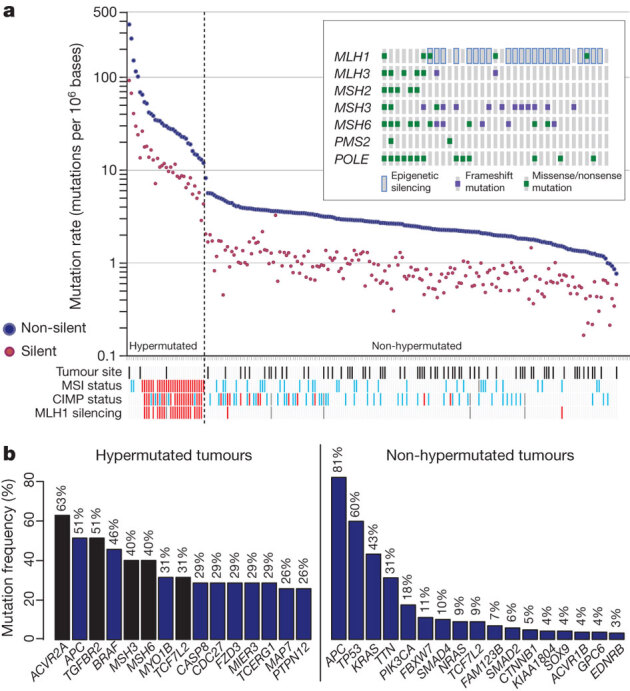
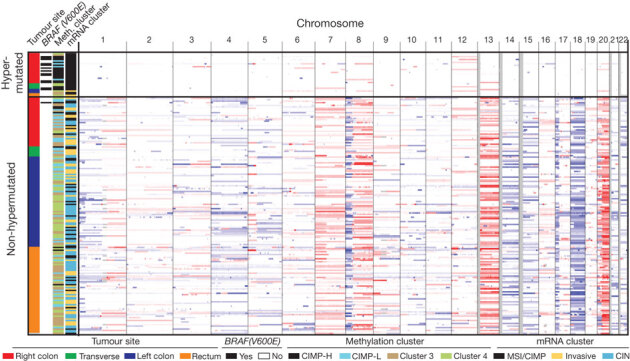
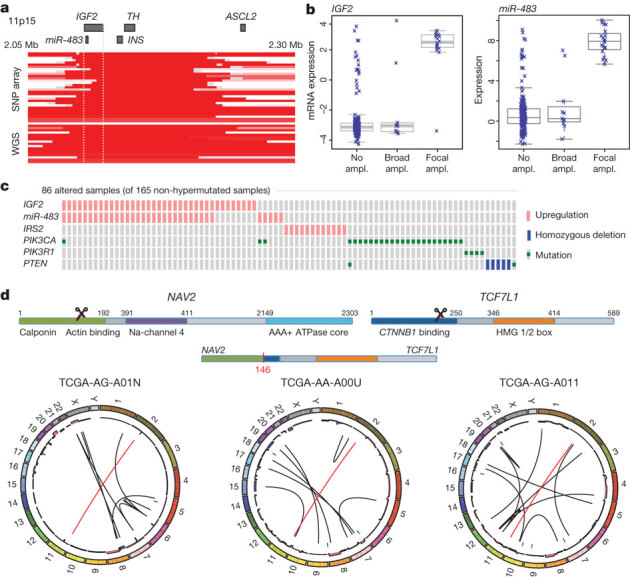
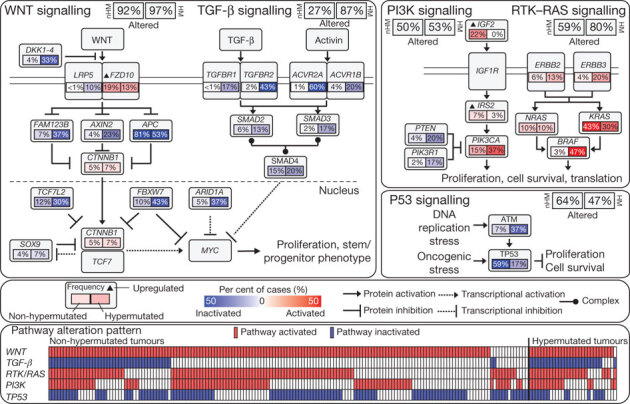
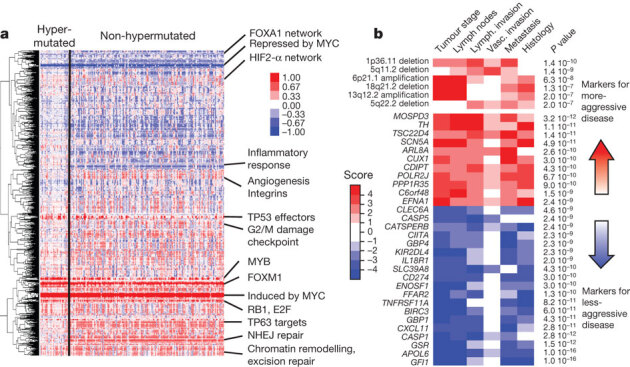
To characterize somatic alterations in colorectal carcinoma, we conducted a genome-scale analysis of 276 samples, analysing exome sequence, DNA copy number, promoter methylation and messenger RNA and microRNA expression. A subset of these samples (97) underwent low-depth-of-coverage whole-genome sequencing. In total, 16% of colorectal carcinomas were found to be hypermutated: three-quarters of these had the expected high microsatellite instability, usually with hypermethylation and MLH1 silencing, and one-quarter had somatic mismatch-repair gene and polymerase ε (POLE) mutations. Excluding the hypermutated cancers, colon and rectum cancers were found to have considerably similar patterns of genomic alteration. Twenty-four genes were significantly mutated, and in addition to the expected APC, TP53, SMAD4, PIK3CA and KRAS mutations, we found frequent mutations in ARID1A, SOX9 and FAM123B. Recurrent copy-number alterations include potentially drug-targetable amplifications of ERBB2 and newly discovered amplification of IGF2. Recurrent chromosomal translocations include the fusion of NAV2 and WNT pathway member TCF7L1. Integrative analyses suggest new markers for aggressive colorectal carcinoma and an important role for MYC-directed transcriptional activation and repression. The Cancer Genome Atlas consortium reports on their genome-wide characterization of somatic alterations in colorectal cancer; in addition to revealing a remarkably consistent pattern of genomic alteration, with 24 genes being significantly mutated, the study identifies new targets for therapeutic intervention and suggests an important role for MYC-directed transcriptional activation and repression. The Cancer Genome Atlas consortium reports on their genome-wide characterization of somatic alterations in colorectal carcinoma. Combined analysis of exome sequence data, DNA copy number, promoter methylation, messenger RNA and microRNA expression, as well as low-coverage whole-genome sequencing reveal that 16% of these carcinomas have hypermutation. Of these, three-quarters have the expected high microsatellite instability, but the rest have somatic mismatch repair gene mutations. The data reveal a remarkably consistent pattern of genomic alteration, with 24 genes being significantly mutated. As well as identifying new biomarkers for aggressive colorectal carcinoma, the data imply an important role for MYC-directed transcriptional activation and repression.
Overview
The claims and statistics of this paper haven’t been checked yet.
Free: it reads the open-access text and checks the first 5 claims that cite a source we can check. Create a free account to check every claim.
Integrity signals
Registry
Cites
Statistics
Figures
Verification
Claims the paper makes
The claims and statistics of this paper haven’t been checked yet.
Free: it reads the open-access text and checks the first 5 claims that cite a source we can check. Create a free account to check every claim.
Claims other papers make about this one
Each is checked against this paper’s own text: does it say what the citing paper says it does?
The source backs part of the claim, not all of it — or backs it for a different population, condition or comparison.
In the citing paper
“KRAS G12V had an increased rate of comutation with TCF7L2, which encodes TCF4, a regulator of Wnt signaling often dysregulated in COAD49–51, specifically the R488C mutation.”
From The origins and genetic interactions of KRAS mutations are allele- and tissue-specific (2021) · cites this paper as [49]
Experimental — accuracy not yet measuredThe source backs part of the claim, not all of it — or backs it for a different population, condition or comparison.
In the citing paper
“PI3K α is both a key regulator and effector of KRAS-dependent signaling and is also activated through mutations involving the PIK3CA gene locus in colorectal cancer, including mutations co-occurring with KRAS [19].”
From Anti-tumor efficacy of a potent and selective non-covalent KRASG12D inhibitor (2022) · cites this paper as [19]
Experimental — accuracy not yet measuredThe source backs part of the claim, not all of it — or backs it for a different population, condition or comparison.
In the citing paper
“Approximately 55% of colorectal cancers (CRCs) are driven by mutational activation of KRAS, BRAF, NRAS, and thus are hard-wired to oncogenic RAS/RAF/MEK/ERK pathway signaling [1–3].”
From An integrative gene expression signature analysis identifies CMS4 KRAS-mutated colorectal cancers sensitive to combined MEK and SRC targeted therapy (2022) · cites this paper as [2]
Experimental — accuracy not yet measuredThe source backs part of the claim, not all of it — or backs it for a different population, condition or comparison.
In the citing paper
“TALENs targeting position 1320 of the APC coding sequence (Fig 3A), a known hotspot commonly mutated in FAP patients [2].”
From Modeling APC mutagenesis and familial adenomatous polyposis using human iPS cells (2018) · cites this paper as [2]
Experimental — accuracy not yet measuredThe source backs part of the claim, not all of it — or backs it for a different population, condition or comparison.
In the citing paper
“which represent ~10–11% of all CRCs (Network, 2012)”
From A Landscape of Therapeutic Cooperativity in KRAS Mutant Cancers Reveals Principles for Controlling Tumor Evolution (2017) · cites this paper as Network, 2012
Experimental — accuracy not yet measured
6 more claims about this paper
Create a free account to see every claim other papers make about this one.
Self-check
Percentages, sums and reported differences re-computed from the paper’s own numbers.
The self-check needs the paper’s full text.
Citations
Cites
Integrated genomic analyses of ovarian carcinoma
Perou, C. M. (2019) · Carolina Digital Repository (University of North Carolina at Chapel Hill) · doi:10.17615/hvp3-wg08 · Cited by 7,925
Comprehensive genomic characterization defines human glioblastoma genes and core pathways
The Cancer Genome Atlas Research Network (2008) · Nature · doi:10.1038/nature07385 · Cited by 7,735
Self-citationUmar, A., Boland, C. R., Terdiman, J. P., Syngal, S., Chapelle, A. D. L., Ruschoff, J., Fishel, R., Lindor, N. M., Burgart, L. J., Hamelin, R., et al. (2004) · JNCI Journal of the National Cancer Institute · doi:10.1093/jnci/djh034 · Cited by 3,183
The Consensus Coding Sequences of Human Breast and Colorectal Cancers
Sjöblom, T., Jones, S., Wood, L. D., Parsons, D. W., Lin, J., Barber, T. D., Mandelker, D., Leary, R. J., Ptak, J., Silliman, N., et al. (2006) · Science · doi:10.1126/science.1133427 · Cited by 3,169
The Genomic Landscapes of Human Breast and Colorectal Cancers
Wood, L. D., Parsons, D. W., Jones, S., Lin, J., Sjöblom, T., Leary, R. J., Shen, D., Boca, S. M., Barber, T., Ptak, J., et al. (2007) · Science · doi:10.1126/science.1145720 · Cited by 2,833
Clues to the Pathogenesis of Familial Colorectal Cancer
Aaltonen, L. A., Peltomäki, P., Leach, F. S., Sistonen, P., Pylkkänen, L., Mecklin, J.-P., Järvinen, H., Powell, S. M., Jen, J., Hamilton, S. R., et al. (1993) · Science · doi:10.1126/science.8484121 · Cited by 2,710
Ionov, Y., Peinado, M. A., Malkhosyan, S., Shibata, D., & Perucho, M. (1993) · Nature · doi:10.1038/363558a0 · Cited by 2,708
TGFβ Signaling in Growth Control, Cancer, and Heritable Disorders
Massagué, J., Blain, S. W., & Lo, R. S. (2000) · Cell · doi:10.1016/s0092-8674(00)00121-5 · Cited by 2,385
Landon, M., Saam, J., Brown, K. L., Moyes, K., Evans, B., & Wenstrup, R. (2015) · Oncology · doi:10.1159/000430097 · Cited by 1,939
Molecular Genetics of Colorectal Cancer
Fearon, E. R. (2011) · Annual Review of Pathology: Mechanisms of Disease · doi:10.1146/annurev-pathol-011110-130235 · Cited by 1,805
Cited by
Items 1,101–1,135 of 1,135
Wang, H., Wen, C., Chen, S., Wang, F., He, L., Li, W., Zhou, Q., Yu, W. K., Huang, L., Chen, J., et al. (2020) · Biochemical Pharmacology · doi:10.1016/j.bcp.2020.114014 · Cited by 32
Chang, S.-C., Lin, P.-C., Lin, J.-K., Lin, C.-H., Yang, S.-H., Liang, W.-Y., Chen, W.-S., & Jiang, J.-K. (2016) · Annals of Surgical Oncology · doi:10.1245/s10434-015-4899-z · Cited by 31
Bi, Y., & Davuluri, R. V. (2013) · BMC Bioinformatics · doi:10.1186/1471-2105-14-262 · Cited by 30
Tsigelny, I. F., Wheler, J. J., Greenberg, J. P., Kouznetsova, V. L., Stewart, D. J., Bazhenova, L., & Kurzrock, R. (2015) · Oncotarget · doi:10.18632/oncotarget.3472 · Cited by 30
The Impact of Cancer Stem Cells in Colorectal Cancer
Radu, P., Zurzu, M., Tigora, A., Paic, V., Bratucu, M., Garofil, D., Surlin, V., Munteanu, A. C., Coman, I. S., Popa, F., et al. (2024) · International Journal of Molecular Sciences · doi:10.3390/ijms25084140 · Cited by 30
Mechanisms of inactivation of the tumour suppressor gene RHOA in colorectal cancer
Dopeso, H., Rodrigues, P., Bilic, J., Bazzocco, S., Cartón-García, F., Macaya, I., de Marcondes, P. G., Anguita, E., Masanas, M., Jiménez-Flores, L. M., et al. (2018) · British Journal of Cancer · doi:10.1038/bjc.2017.420 · Cited by 30
Epidermal growth factor receptor (EGFR) is a target of the tumor-suppressor E3 ligase FBXW7
Boretto, M., Geurts, M. H., Gandhi, S., Ma, Z., Staliarova, N., Celotti, M., Lim, S., He, G.-W., Millen, R., Driehuis, E., et al. (2024) · Proceedings of the National Academy of Sciences · doi:10.1073/pnas.2309902121 · Cited by 30
“FBXW7 is recurrently mutated across cancer types, yet its mutations are most frequent in CRC (32) when ranked per adjusted mutational rate (Fig.”
Katholnig, K., Schütz, B., Fritsch, S. D., Schörghofer, D., Linke, M., Sukhbaatar, N., Matschinger, J. M., Unterleuthner, D., Hirtl, M., Lang, M., et al. (2019) · JCI Insight · doi:10.1172/jci.insight.124164 · Cited by 29
Molecular subtype-specific responses of colon cancer cells to the SMAC mimetic Birinapant
Fichtner, M., Bozkurt, E., Salvucci, M., McCann, C., McAllister, K. A., Halang, L., Düssmann, H., Kinsella, S., Crawford, N., Sessler, T., et al. (2020) · Cell Death & Disease · doi:10.1038/s41419-020-03232-z · Cited by 28
Davis, T. B., Yang, M., Schell, M. J., Wang, H., Ma, L., Pledger, W. J., & Yeatman, T. J. (2018) · Scientific Reports · doi:10.1038/s41598-018-27584-x · Cited by 27
Plattner, C., Lamberti, G., Blattmann, P., Kirchmair, A., Rieder, D., Loncova, Z., Sturm, G., Scheidl, S., Ijsselsteijn, M., Fotakis, G., et al. (2023) · iScience · doi:10.1016/j.isci.2023.108399 · Cited by 27
The Patient-Derived Cancer Organoids: Promises and Challenges as Platforms for Cancer Discovery
Bae, J., Choi, Y. S., Cho, G., & Jang, S. J. (2022) · Cancers · doi:10.3390/cancers14092144 · Cited by 27
(2022) · doi:10.7554/elife.75227 · Cited by 26
Adaptation of a RAS pathway activation signature from FF to FFPE tissues in colorectal cancer
Omolo, B., Yang, M., Lo, F. Y., Schell, M. J., Austin, S., Howard, K., Madan, A., & Yeatman, T. J. (2016) · BMC Medical Genomics · doi:10.1186/s12920-016-0225-2 · Cited by 25
Yang, M., Davis, T. B., Pflieger, L., Nebozhyn, M. V., Loboda, A., Wang, H., Schell, M. J., Thota, R., Pledger, W. J., & Yeatman, T. J. (2022) · BMC Cancer · doi:10.1186/s12885-022-09344-3 · Cited by 22
Therapeutic Potential of PARP Inhibitors in the Treatment of Gastrointestinal Cancers
Alhusaini, A., Cannon, A., Maher, S. G., Reynolds, J. V., & Lynam-Lennon, N. (2021) · Biomedicines · doi:10.3390/biomedicines9081024 · Cited by 24
Cho, S.-Y., Han, J. Y., Na, D., Kang, W., Lee, A., Kim, J., Lee, J., Min, S., Kang, J., Chae, J., et al. (2017) · Molecular Cancer Therapeutics · doi:10.1158/1535-7163.mct-16-0735 · Cited by 24
Halpern, N., Goldberg, Y., Kadouri, L., Duvdevani, M., Hamburger, T., Peretz, T., & Hubert, A. (2017) · OncoTargets and Therapy · doi:10.2147/ott.s126905 · Cited by 23
De La Cena, K. O. C., Ho, R. X.-Y., Amraei, R., Woolf, N., Tashjian, J. Y., Zhao, Q., Richards, S., Walker, J., Huang, J., Chitalia, V. C., et al. (2021) · The American Journal of Pathology · doi:10.1016/j.ajpath.2020.09.015 · Cited by 23
Beyond KRAS Status and Response to Anti-EGFR Therapy in Metastatic Colorectal Cancer
Perkins, G., Pilati, C., Blons, H., & Laurent-Puig, P. (2014) · Pharmacogenomics · doi:10.2217/pgs.14.66 · Cited by 22
Atreya, C. E., Greene, C., McWhirter, R. M., Ikram, N. S., Allen, I. E., Van Loon, K., Venook, A. P., Yeh, B. M., & Behr, S. C. (2016) · Journal of the National Comprehensive Cancer Network · doi:10.6004/jnccn.2016.0165 · Cited by 21
AIM2 Inhibits BRAF-Mutant Colorectal Cancer Growth in a Caspase-1-Dependent Manner
Shah, S., Qin, S., Luo, Y., Huang, Y., Jing, R., Shah, J. N., Chen, J., Chen, H., & Zhong, M. (2021) · Frontiers in Cell and Developmental Biology · doi:10.3389/fcell.2021.588278 · Cited by 19
DNA Repair Capacity and Response to Treatment of Colon Cancer
Vodicka, P., Vodenkova, S., Buchler, T., & Vodickova, L. (2019) · Pharmacogenomics · doi:10.2217/pgs-2019-0070 · Cited by 19
Distinguishing colorectal adenoma from hyperplastic polyp by WNT2 expression
Wang, B., Wang, X., Tseng, Y., Huang, M., Luo, F., Zhang, J., & Liu, J. (2021) · Journal of Clinical Laboratory Analysis · doi:10.1002/jcla.23961 · Cited by 18
Lanauze, C. B., Sehgal, P., Hayer, K., Torres-Diz, M., Pippin, J. A., Grant, S. F. A., & Thomas-Tikhonenko, A. (2021) · Molecular Cancer Research · doi:10.1158/1541-7786.mcr-20-0721 · Cited by 17
Sailem, H. Z., Rittscher, J., & Pelkmans, L. (2020) · Molecular Systems Biology · doi:10.15252/msb.20199083 · Cited by 16
“Moreover, many of the predicted MSD genes also participate in pathways that are often dysregulated in colorectal cancer including TGF b , WNT and PI3K-AKT pathways (Muzny et al , 2012) (Fig 6A).”
Voutsadakis, I. A. (2023) · Cancer Treatment and Research Communications · doi:10.1016/j.ctarc.2023.100746 · Cited by 14
Benchmarking artificial intelligence methods for end-to-end computational pathology
Laleh, N. G., Muti, H. S., Lavinia Loeffler, C. M., Echle, A., Saldanha, O. L., Mahmood, F., Lu, M. Y., Trautwein, C., Langer, R., Dislich, B., et al. (2021) · doi:10.1101/2021.08.09.455633 · Cited by 13
Mapping Immune Correlates and Surfaceome Genes in BRAF Mutated Colorectal Cancers
Morafraile, E. C., Saiz-Ladera, C., Nieto-Jiménez, C., Győrffy, B., Nagy, A., Velasco, G., Pérez-Segura, P., & Ocaña, A. (2023) · Current Oncology · doi:10.3390/curroncol30030196 · Cited by 12
PTPRS drives adaptive resistance to MEK/ERK inhibitors through SRC
Davis, T. B., Yang, M., Wang, H., Lee, C., Yeatman, T. J., & Pledger, W. J. (2019) · Oncotarget · doi:10.18632/oncotarget.27335 · Cited by 11
Tracing unknown tumor origins with a biological-pathway-based transformer model
Xie, J., Chen, Y., Luo, S., Yang, W., Lin, Y., Wang, L., Ding, X., Tong, M., & Yu, R. (2024) · Cell Reports Methods · doi:10.1016/j.crmeth.2024.100797 · Cited by 9
Consensus molecular subtype transition during progression of colorectal cancer
van de Weerd, S., Torang, A., Zwager, L. W., Koelink, P. J., Koster, J., Bastiaansen, B. A., Lammers, V., Longobardi, C., Roodhart, J. M., van Krieken, J. H., et al. (2023) · The Journal of Pathology · doi:10.1002/path.6176 · Cited by 6
Recruiting Immunity for the Fight against Colorectal Cancer: Current Status and Challenges
Al-Hujaily, E. M., Al-Sowayan, B. S., Alyousef, Z., Uddin, S., & Alammari, F. (2022) · International Journal of Molecular Sciences · doi:10.3390/ijms232213696 · Cited by 6
An integrated model for predicting KRAS dependency
(2023) · doi:10.1371/journal.pcbi.1011095 · Cited by 3
Iida, N., Imai, M., Okamoto, W., Kato, T., Esaki, T., Kato, K., Komatsu, Y., Yuki, S., Masuishi, T., Nishina, T., et al. (2024) · Clinical Cancer Research · doi:10.1158/1078-0432.ccr-24-1023 · Cited by 2
Metadata
- Authors
- The Cancer Genome Atlas Network
- Affiliations
- Broad Institute (US)
- Corresponding author
- The Cancer Genome Atlas Network
- Venue
- Nature
- Published
- 2012-07-18
- Volume
- 487
- Issue
- 7407
- Pages
- 330-337
- ISSN
- 0028-0836 (ISSN-L)
- 1476-4687
- PMC
- PMC3401966
- OpenAlex
- W2262414037
- Semantic Scholar
- 56321e765211d85a29621551d0df9a1cfc0a78ca
- Cited by
- 8,499
- References
- 49
- Citations by year
- 2026: 389 · 2025: 455 · 2024: 502 · 2023: 591 · 2022: 678 · 2021: 754 · 2020: 736 · 2019: 686 · 2018: 677 · 2017: 673 · 2016: 646 · 2015: 616 · 2014: 578 · 2013: 424 · 2012: 86
- FWCI
- 393.35
- Type
- journal article
- Language
- en
- Open access
- hybrid
- doi.org
- Licence
- cc-by-nc-sa
- creativecommons.org/licenses/by-nc-sa/3.0/ (tdm)
- creativecommons.org/licenses/by-nc-sa/3.0/ (vor)
- Locations
- Nature (publishedVersion, cc-by-nc-sa)
- PubMed Central (publishedVersion, cc-by-nc-sa)
- PubMed (publishedVersion)
- eScholarship (California Digital Library) (submittedVersion)
- eSpace (Curtin University) (submittedVersion, cc-by-nc-sa)
- Scholarworks@UNIST (Ulsan National Institute of Science and Technology) (submittedVersion)
- Funders
- National Institutes of Health
- National Human Genome Research Institute (U54HG003067, U54HG003079, U54HG003273, R01HG006272)
- National Cancer Institute (U24CA126554, U24CA143882, U24CA143843, U24CA143840, U24CA143858, U24CA144025, U24CA143866, U24CA143883, U24CA143845, U24CA143867, U24CA143848, U24CA143799, U24CA143835, P30CA016672, P30CA016086)
- Topics
- Health Sciences › Medicine › Pathology and Forensic Medicine › Genetic factors in colorectal cancer
- Life Sciences › Biochemistry, Genetics and Molecular Biology › Cancer Research › Cancer Genomics and Diagnostics
- Health Sciences › Medicine › Oncology › Colorectal Cancer Treatments and Studies
- Keywords
- colorectal cancer, colon cancer, rectal cancer, somatic mutations, microsatellite instability, mismatch repair gene mutations, POLE mutation, DNA copy number alterations, promoter methylation, gene expression, microRNA expression, ARID1A, SOX9, ERBB2 amplification, APC, TP53, SMAD4, PIK3CA, KRAS, therapeutic target
- MeSH terms
- Colonic Neoplasms, Humans, Mutation, Rectal Neoplasms, Sequence Analysis, DNA, DNA Methylation, Polymorphism, Single Nucleotide, Gene Expression Profiling, DNA Copy Number Variations, Exome, Mutation Rate
About these checks
Registry, retraction, Cites and statistics results are computed, not judged, with one exception: a printed reference that no index lists is read once by a model before it counts as a citation error. Claims are extracted by a model and kept only when their quote appears verbatim in the text; each cited source is then checked, with a model’s help, for whether it says what the claim relies on. Those verdicts can be wrong — read the claim’s quote and the cited source before relying on one.
Statistics and arithmetic are recomputed, not judged.
Confidence bands are shown only for fields calibrated on our annotated test set. None is calibrated yet, so no band is shown.
What counts as a claim ›How we measure confidence ›How we check this ›
Are you an author, or do you see a problem with this page? Request a review
Data sources
Bibliographic data: Semantic Scholar, OpenAlex, Crossref.
Contains information from the Semantic Scholar Academic Graph Datasets, made available under the ODC Attribution License (ODC-BY 1.0).
Semantic Scholar’s data is described in: Kinney, R., et al. (2023). The Semantic Scholar Open Data Platform. arXiv:2301.10140.
