

Comprehensive molecular characterization of human colon and rectal cancer
Open accessThe DOI matches its Crossref record; 47 of the 49 references it cites were found in a registry or an index.
Abstract
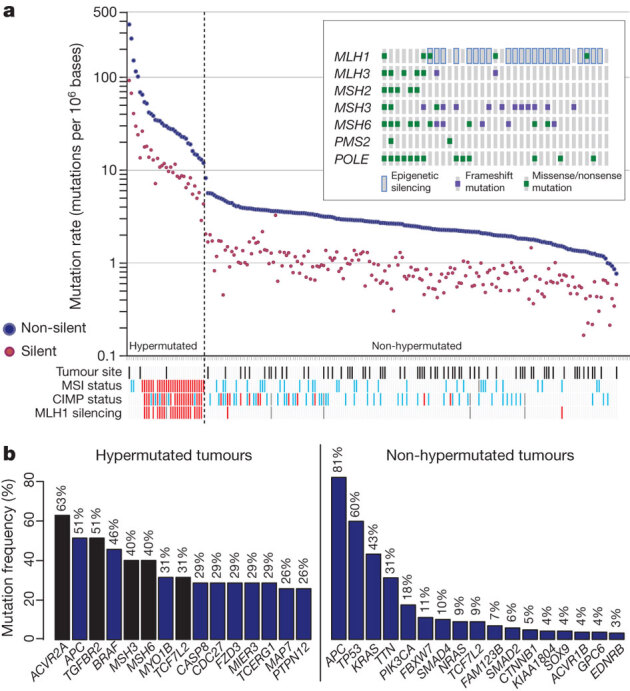
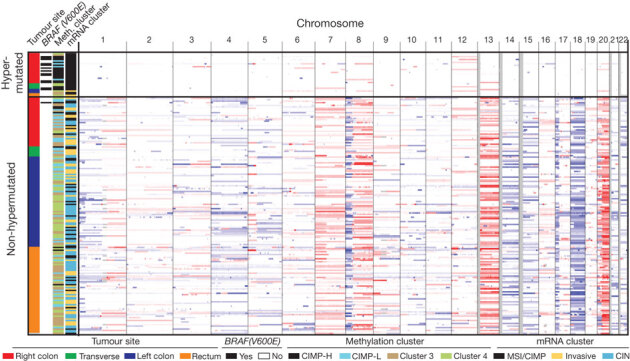
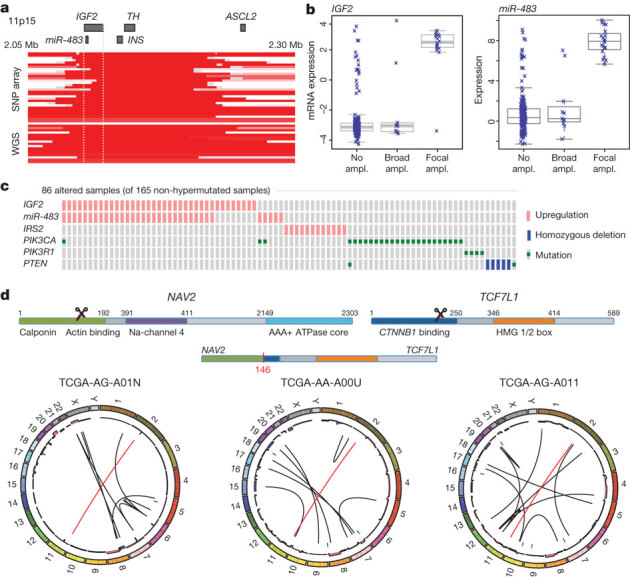
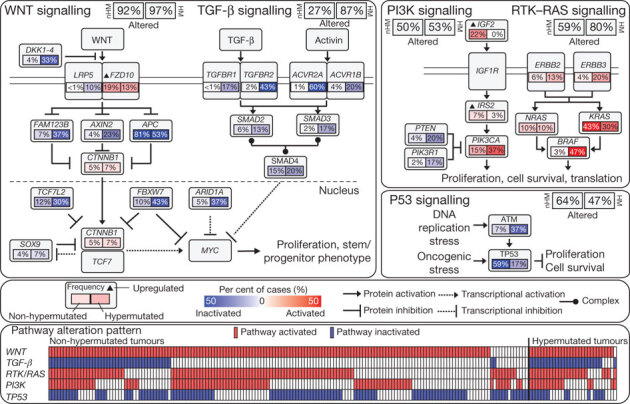
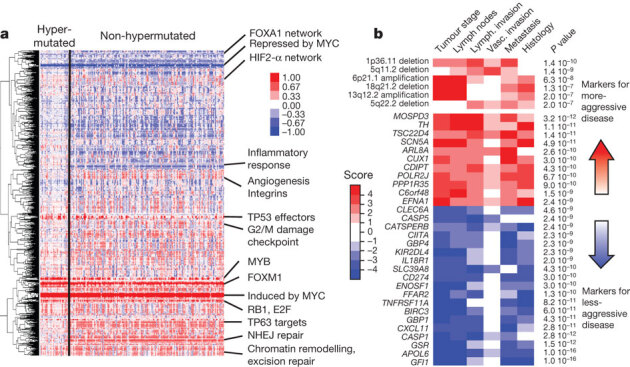
To characterize somatic alterations in colorectal carcinoma, we conducted a genome-scale analysis of 276 samples, analysing exome sequence, DNA copy number, promoter methylation and messenger RNA and microRNA expression. A subset of these samples (97) underwent low-depth-of-coverage whole-genome sequencing. In total, 16% of colorectal carcinomas were found to be hypermutated: three-quarters of these had the expected high microsatellite instability, usually with hypermethylation and MLH1 silencing, and one-quarter had somatic mismatch-repair gene and polymerase ε (POLE) mutations. Excluding the hypermutated cancers, colon and rectum cancers were found to have considerably similar patterns of genomic alteration. Twenty-four genes were significantly mutated, and in addition to the expected APC, TP53, SMAD4, PIK3CA and KRAS mutations, we found frequent mutations in ARID1A, SOX9 and FAM123B. Recurrent copy-number alterations include potentially drug-targetable amplifications of ERBB2 and newly discovered amplification of IGF2. Recurrent chromosomal translocations include the fusion of NAV2 and WNT pathway member TCF7L1. Integrative analyses suggest new markers for aggressive colorectal carcinoma and an important role for MYC-directed transcriptional activation and repression. The Cancer Genome Atlas consortium reports on their genome-wide characterization of somatic alterations in colorectal cancer; in addition to revealing a remarkably consistent pattern of genomic alteration, with 24 genes being significantly mutated, the study identifies new targets for therapeutic intervention and suggests an important role for MYC-directed transcriptional activation and repression. The Cancer Genome Atlas consortium reports on their genome-wide characterization of somatic alterations in colorectal carcinoma. Combined analysis of exome sequence data, DNA copy number, promoter methylation, messenger RNA and microRNA expression, as well as low-coverage whole-genome sequencing reveal that 16% of these carcinomas have hypermutation. Of these, three-quarters have the expected high microsatellite instability, but the rest have somatic mismatch repair gene mutations. The data reveal a remarkably consistent pattern of genomic alteration, with 24 genes being significantly mutated. As well as identifying new biomarkers for aggressive colorectal carcinoma, the data imply an important role for MYC-directed transcriptional activation and repression.
Overview
The claims and statistics of this paper haven’t been checked yet.
Free: it reads the open-access text and checks the first 5 claims that cite a source we can check. Create a free account to check every claim.
Integrity signals
Registry
Cites
Statistics
Figures
Verification
Claims the paper makes
The claims and statistics of this paper haven’t been checked yet.
Free: it reads the open-access text and checks the first 5 claims that cite a source we can check. Create a free account to check every claim.
Claims other papers make about this one
Each is checked against this paper’s own text: does it say what the citing paper says it does?
The source backs part of the claim, not all of it — or backs it for a different population, condition or comparison.
In the citing paper
“KRAS G12V had an increased rate of comutation with TCF7L2, which encodes TCF4, a regulator of Wnt signaling often dysregulated in COAD49–51, specifically the R488C mutation.”
From The origins and genetic interactions of KRAS mutations are allele- and tissue-specific (2021) · cites this paper as [49]
Experimental — accuracy not yet measuredThe source backs part of the claim, not all of it — or backs it for a different population, condition or comparison.
In the citing paper
“PI3K α is both a key regulator and effector of KRAS-dependent signaling and is also activated through mutations involving the PIK3CA gene locus in colorectal cancer, including mutations co-occurring with KRAS [19].”
From Anti-tumor efficacy of a potent and selective non-covalent KRASG12D inhibitor (2022) · cites this paper as [19]
Experimental — accuracy not yet measuredThe source backs part of the claim, not all of it — or backs it for a different population, condition or comparison.
In the citing paper
“Approximately 55% of colorectal cancers (CRCs) are driven by mutational activation of KRAS, BRAF, NRAS, and thus are hard-wired to oncogenic RAS/RAF/MEK/ERK pathway signaling [1–3].”
From An integrative gene expression signature analysis identifies CMS4 KRAS-mutated colorectal cancers sensitive to combined MEK and SRC targeted therapy (2022) · cites this paper as [2]
Experimental — accuracy not yet measuredThe source backs part of the claim, not all of it — or backs it for a different population, condition or comparison.
In the citing paper
“TALENs targeting position 1320 of the APC coding sequence (Fig 3A), a known hotspot commonly mutated in FAP patients [2].”
From Modeling APC mutagenesis and familial adenomatous polyposis using human iPS cells (2018) · cites this paper as [2]
Experimental — accuracy not yet measuredThe source backs part of the claim, not all of it — or backs it for a different population, condition or comparison.
In the citing paper
“which represent ~10–11% of all CRCs (Network, 2012)”
From A Landscape of Therapeutic Cooperativity in KRAS Mutant Cancers Reveals Principles for Controlling Tumor Evolution (2017) · cites this paper as Network, 2012
Experimental — accuracy not yet measured
6 more claims about this paper
Create a free account to see every claim other papers make about this one.
Self-check
Percentages, sums and reported differences re-computed from the paper’s own numbers.
The self-check needs the paper’s full text.
Citations
Cites
Integrated genomic analyses of ovarian carcinoma
Perou, C. M. (2019) · Carolina Digital Repository (University of North Carolina at Chapel Hill) · doi:10.17615/hvp3-wg08 · Cited by 7,925
Comprehensive genomic characterization defines human glioblastoma genes and core pathways
The Cancer Genome Atlas Research Network (2008) · Nature · doi:10.1038/nature07385 · Cited by 7,735
Self-citationUmar, A., Boland, C. R., Terdiman, J. P., Syngal, S., Chapelle, A. D. L., Ruschoff, J., Fishel, R., Lindor, N. M., Burgart, L. J., Hamelin, R., et al. (2004) · JNCI Journal of the National Cancer Institute · doi:10.1093/jnci/djh034 · Cited by 3,183
The Consensus Coding Sequences of Human Breast and Colorectal Cancers
Sjöblom, T., Jones, S., Wood, L. D., Parsons, D. W., Lin, J., Barber, T. D., Mandelker, D., Leary, R. J., Ptak, J., Silliman, N., et al. (2006) · Science · doi:10.1126/science.1133427 · Cited by 3,169
The Genomic Landscapes of Human Breast and Colorectal Cancers
Wood, L. D., Parsons, D. W., Jones, S., Lin, J., Sjöblom, T., Leary, R. J., Shen, D., Boca, S. M., Barber, T., Ptak, J., et al. (2007) · Science · doi:10.1126/science.1145720 · Cited by 2,833
Clues to the Pathogenesis of Familial Colorectal Cancer
Aaltonen, L. A., Peltomäki, P., Leach, F. S., Sistonen, P., Pylkkänen, L., Mecklin, J.-P., Järvinen, H., Powell, S. M., Jen, J., Hamilton, S. R., et al. (1993) · Science · doi:10.1126/science.8484121 · Cited by 2,710
Ionov, Y., Peinado, M. A., Malkhosyan, S., Shibata, D., & Perucho, M. (1993) · Nature · doi:10.1038/363558a0 · Cited by 2,708
TGFβ Signaling in Growth Control, Cancer, and Heritable Disorders
Massagué, J., Blain, S. W., & Lo, R. S. (2000) · Cell · doi:10.1016/s0092-8674(00)00121-5 · Cited by 2,385
Landon, M., Saam, J., Brown, K. L., Moyes, K., Evans, B., & Wenstrup, R. (2015) · Oncology · doi:10.1159/000430097 · Cited by 1,939
Molecular Genetics of Colorectal Cancer
Fearon, E. R. (2011) · Annual Review of Pathology: Mechanisms of Disease · doi:10.1146/annurev-pathol-011110-130235 · Cited by 1,805
Cited by
Items 1,001–1,100 of 1,135
Imperial, R. J. L., Ahmed, Z., Toor, O. M., Erdoğan, C., Khaliq, A. M., Case, P., Case, J., Kennedy, K. F., Cummings, L. S., Melton, N. M., et al. (2018) · Molecular Cancer · doi:10.1186/s12943-018-0923-9 · Cited by 137
Echle, A., Ghaffari Laleh, N., Quirke, P., Grabsch, H. I., Muti, H. S., Saldanha, O. L., Brockmoeller, S. F., van den Brandt, P. A., Hutchins, G. G. A., Richman, S. D., et al. (2022) · ESMO Open · doi:10.1016/j.esmoop.2022.100400 · Cited by 111
Understanding mutagenesis through delineation of mutational signatures in human cancer
Petljak, M., & Alexandrov, L. B. (2016) · Carcinogenesis · doi:10.1093/carcin/bgw055 · Cited by 110
Lang, G. I., Parsons, L., & Gammie, A. E. (2013) · G3 Genes Genomes Genetics · doi:10.1534/g3.113.006429 · Cited by 107
MicroRNAs as growth regulators, their function and biomarker status in colorectal cancer
Cekaite, L., Eide, P. W., Lind, G. E., Skotheim, R. I., & Lothe, R. A. (2016) · Oncotarget · doi:10.18632/oncotarget.6390 · Cited by 107
Rosendahl Huber, A., Pleguezuelos-Manzano, C., Puschhof, J., Ubels, J., Boot, C., Saftien, A., Verheul, M., Trabut, L. T., Groenen, N., van Roosmalen, M., et al. (2024) · Cancer Cell · doi:10.1016/j.ccell.2024.02.009 · Cited by 106
Shia, J., Schultz, N., Kuk, D., Vakiani, E., Middha, S., Segal, N. H., Hechtman, J. F., Berger, M. F., Stadler, Z. K., Weiser, M. R., et al. (2017) · Modern Pathology · doi:10.1038/modpathol.2016.198 · Cited by 105
A pan-cancer organoid platform for precision medicine
Larsen, B. M., Kannan, M., Langer, L. F., Leibowitz, B. D., Bentaieb, A., Cancino, A., Dolgalev, I., Drummond, B. E., Dry, J. R., Ho, C.-S., et al. (2021) · Cell Reports · doi:10.1016/j.celrep.2021.109429 · Cited by 105
Ng, S., Tan, W. J., Pek, M. M. X., Tan, M.-H., & Kurisawa, M. (2019) · Biomaterials · doi:10.1016/j.biomaterials.2019.119400 · Cited by 105
Wong, C. C., Wu, J.-L., Ji, F., Kang, W., Bian, X., Chen, H., Chan, L.-S., Luk, S. T. Y., Tong, S., Xu, J., et al. (2022) · Nature Communications · doi:10.1038/s41467-022-31663-z · Cited by 103
Oh, C.-D., Lu, Y., Liang, S., Mori-Akiyama, Y., Chen, D., de Crombrugghe, B., & Yasuda, H. (2014) · PLoS ONE · doi:10.1371/journal.pone.0107577 · Cited by 101
Manic, G., Signore, M., Sistigu, A., Russo, G., Corradi, F., Siteni, S., Musella, M., Vitale, S., De Angelis, M. L., Pallocca, M., et al. (2018) · Gut · doi:10.1136/gutjnl-2016-312623 · Cited by 98
Zhou, H., Lin, C., Zhang, Y., Zhang, X., Zhang, C., Zhang, P., Xie, X., & Ren, Z. (2017) · Cell Proliferation · doi:10.1111/cpr.12341 · Cited by 98
Feng, J., Hu, Z., Xia, X., Liu, X., Lian, Z., Wang, H., Wang, L., Wang, C., Zhang, X., & Pang, X. (2023) · Oncogene · doi:10.1038/s41388-023-02676-9 · Cited by 95
A meta-learning approach for genomic survival analysis
Qiu, Y. L., Zheng, H., Devos, A., Selby, H., & Gevaert, O. (2020) · Nature Communications · doi:10.1038/s41467-020-20167-3 · Cited by 96
Degradation of CCNK/CDK12 is a druggable vulnerability of colorectal cancer
Dieter, S. M., Siegl, C., Codó, P. L., Huerta, M., Ostermann-Parucha, A. L., Schulz, E., Zowada, M. K., Martin, S., Laaber, K., Nowrouzi, A., et al. (2021) · Cell Reports · doi:10.1016/j.celrep.2021.109394 · Cited by 95
Ahcene Djaballah, S., Daniel, F., Milani, A., Ricagno, G., & Lonardi, S. (2022) · American Society of Clinical Oncology Educational Book · doi:10.1200/edbk_351354 · Cited by 95
Dunne, P. D., Alderdice, M., O'Reilly, P. G., Roddy, A. C., McCorry, A. M. B., Richman, S., Maughan, T., McDade, S. S., Johnston, P. G., Longley, D. B., et al. (2017) · Nature Communications · doi:10.1038/ncomms15657 · Cited by 94
Intersection of Hippo/YAP and Wnt/β-catenin signaling pathways
Konsavage, W. M., & Yochum, G. S. (2013) · Acta Biochimica et Biophysica Sinica · doi:10.1093/abbs/gms084 · Cited by 94
Leto, S. M., & Trusolino, L. (2014) · Journal of Molecular Medicine · doi:10.1007/s00109-014-1161-2 · Cited by 87
Current targeted therapies in the treatment of advanced colorectal cancer: a review
Moriarity, A., O’Sullivan, J., Kennedy, J., Mehigan, B., & McCormick, P. (2016) · Therapeutic Advances in Medical Oncology · doi:10.1177/1758834016646734 · Cited by 87
Consensus molecular subtype classification of colorectal adenomas
Komor, M. A., Bosch, L. J., Bounova, G., Bolijn, A. S., Delis‐van Diemen, P. M., Rausch, C., Hoogstrate, Y., Stubbs, A. P., de Jong, M., Jenster, G., et al. (2018) · The Journal of Pathology · doi:10.1002/path.5129 · Cited by 86
Interactions between epigenetics and metabolism in cancers
Yun, J., Johnson, J. L., Hanigan, C. L., & Locasale, J. W. (2012) · Frontiers in Oncology · doi:10.3389/fonc.2012.00163 · Cited by 82
Hedgehog signaling pathway in colorectal cancer: function, mechanism, and therapy
Wu, C., Zhu, X., Liu, W., Ruan, T., & Tao, K. (2017) · OncoTargets and Therapy · doi:10.2147/ott.s139639 · Cited by 82
Upadhya, S. R., & Ryan, C. J. (2022) · Cell Reports Methods · doi:10.1016/j.crmeth.2022.100288 · Cited by 81
Upadhya, S. R., & Ryan, C. J. (2021) · doi:10.1101/2021.09.22.461108 · Cited by 81
Anderson, G. R., Winter, P. S., Lin, K. H., Nussbaum, D. P., Cakir, M., Stein, E. M., Soderquist, R. S., Crawford, L., Leeds, J. C., Newcomb, R., et al. (2017) · Cell Reports · doi:10.1016/j.celrep.2017.07.006 · Cited by 80
“…therapy in KRAS mutant CRC. Interestingly, this combination’s selectivity for KRAS/PIK3CA double mutant tumors, which represent ~10–11% of all CRCs (Network, 2012), owes to two features: (1) SRC inhibits AKT phosphorylation, leading to BIM induction, only in double mutant tumors; and (2) double…”
BackgroundInfluentialAdipose stem cell niche reprograms the colorectal cancer stem cell metastatic machinery
Di Franco, S., Bianca, P., Sardina, D. S., Turdo, A., Gaggianesi, M., Veschi, V., Nicotra, A., Mangiapane, L. R., Lo Iacono, M., Pillitteri, I., et al. (2021) · Nature Communications · doi:10.1038/s41467-021-25333-9 · Cited by 80
RasGRP1 opposes proliferative EGFR–SOS1–Ras signals and restricts intestinal epithelial cell growth
Depeille, P., Henricks, L. M., van de Ven, R. A. H., Lemmens, E., Wang, C.-Y., Matli, M., Werb, Z., Haigis, K. M., Donner, D., Warren, R., et al. (2015) · Nature Cell Biology · doi:10.1038/ncb3175 · Cited by 80
Li, Y., Xu, C., Wang, B., Xu, F., Ma, F., Qu, Y., Jiang, D., Li, K., Feng, J., Tian, S., et al. (2022) · Nature Communications · doi:10.1038/s41467-022-33282-0 · Cited by 80
Williams, D. S., Mouradov, D., Jorissen, R. N., Newman, M. R., Amini, E., Nickless, D. K., Teague, J. A., Fang, C. G., Palmieri, M., Parsons, M. J., et al. (2019) · Gut · doi:10.1136/gutjnl-2017-315664 · Cited by 79
Hypoxia induces a lipogenic cancer cell phenotype via HIF1α-dependent and -independent pathways
Valli, A., Rodriguez, M., Moutsianas, L., Fischer, R., Fedele, V., Huang, H.-L., Van Stiphout, R., Jones, D., Mccarthy, M., Vinaxia, M., et al. (2015) · Oncotarget · doi:10.18632/oncotarget.3058 · Cited by 79
Gastric Cancer Genomics: Advances and Future Directions
Katona, B. W., & Rustgi, A. K. (2017) · Cellular and Molecular Gastroenterology and Hepatology · doi:10.1016/j.jcmgh.2017.01.003 · Cited by 78
De Robertis, M., Loiacono, L., Fusilli, C., Poeta, M. L., Mazza, T., Sanchez, M., Marchionni, L., Signori, E., Lamorte, G., Vescovi, A. L., et al. (2017) · Clinical Cancer Research · doi:10.1158/1078-0432.ccr-16-0709 · Cited by 78
c‐Src drives intestinal regeneration and transformation
Cordero, J. B., Ridgway, R. A., Valeri, N., Nixon, C., Frame, M. C., Muller, W. J., Vidal, M., & Sansom, O. J. (2014) · The EMBO Journal · doi:10.1002/embj.201387454 · Cited by 77
Fluctuating methylation clocks for cell lineage tracing at high temporal resolution in human tissues
Gabbutt, C., Schenck, R. O., Weisenberger, D. J., Kimberley, C., Berner, A., Househam, J., Lakatos, E., Robertson-Tessi, M., Martin, I., Patel, R., et al. (2022) · Nature Biotechnology · doi:10.1038/s41587-021-01109-w · Cited by 76
The novel role of pyrvinium in cancer therapy
Momtazi‐borojeni, A. A., Abdollahi, E., Ghasemi, F., Caraglia, M., & Sahebkar, A. (2018) · Journal of Cellular Physiology · doi:10.1002/jcp.26006 · Cited by 75
“C-Myc itself cannot be inhibited and, therefore, the inhibition of the Wnt pathway is the best option in preventing the tumorigenesis driven by c-Myc (Network, 2012).”
BackgroundHazar-Rethinam, M., Kleyman, M., Han, G. C., Liu, D., Ahronian, L. G., Shahzade, H. A., Chen, L., Parikh, A. R., Allen, J. N., Clark, J. W., et al. (2018) · Cancer Discovery · doi:10.1158/2159-8290.cd-17-1227 · Cited by 75
Contribution of pks+ E. coli mutations to colorectal carcinogenesis
Chen, B., Ramazzotti, D., Heide, T., Spiteri, I., Fernandez-Mateos, J., James, C., Magnani, L., Graham, T. A., & Sottoriva, A. (2023) · Nature Communications · doi:10.1038/s41467-023-43329-5 · Cited by 74
“3 and 4).”
Monitoring of Technical Variation in Quantitative High-Throughput Datasets
Lauss, M., Visne, I., Kriegner, A., Ringnér, M., Jönsson, G., & Höglund, M. (2013) · Cancer Informatics · doi:10.4137/cin.s12862 · Cited by 74
Kloth, M., Ruesseler, V., Engel, C., Koenig, K., Peifer, M., Mariotti, E., Kuenstlinger, H., Florin, A., Rommerscheidt-Fuss, U., Koitzsch, U., et al. (2016) · Gut · doi:10.1136/gutjnl-2014-309026 · Cited by 73
Acha-Sagredo, A., Andrei, P., Clayton, K., Taggart, E., Antoniotti, C., Woodman, C. A., Afrache, H., Fourny, C., Armero, M., Moinudeen, H. K., et al. (2025) · Cancer Cell · doi:10.1016/j.ccell.2024.12.008 · Cited by 71
McCarthy, A. J., & Chetty, R. (2018) · Journal of Clinical Pathology · doi:10.1136/jclinpath-2018-205095 · Cited by 71
Molecular Landscape of ERBB2/ERBB3 Mutated Colorectal Cancer
Loree, J. M., Bailey, A. M., Johnson, A. M., Yu, Y., Wu, W., Bristow, C. A., Davis, J. S., Shaw, K. R., Broaddus, R., Banks, K. C., et al. (2018) · JNCI: Journal of the National Cancer Institute · doi:10.1093/jnci/djy067 · Cited by 68
Farkas, S. A., Vymetalkova, V., Vodickova, L., Vodicka, P., & Nilsson, T. K. (2014) · Epigenomics · doi:10.2217/epi.14.7 · Cited by 67
Porcellini, E., Laprovitera, N., Riefolo, M., Ravaioli, M., Garajova, I., & Ferracin, M. (2018) · Cancer Letters · doi:10.1016/j.canlet.2018.01.049 · Cited by 66
A systems mechanism for KRAS mutant allele–specific responses to targeted therapy
McFall, T., Diedrich, J. K., Mengistu, M., Littlechild, S. L., Paskvan, K. V., Sisk-Hackworth, L., Moresco, J. J., Shaw, A. S., & Stites, E. C. (2019) · Science Signaling · doi:10.1126/scisignal.aaw8288 · Cited by 65
Santarpia, M., Ciappina, G., Spagnolo, C. C., Squeri, A., Passalacqua, M. I., Aguilar, A., Gonzalez-Cao, M., Giovannetti, E., Silvestris, N., & Rosell, R. (2023) · Translational Lung Cancer Research · doi:10.21037/tlcr-22-639 · Cited by 65
Randrian, V., Evrard, C., & Tougeron, D. (2021) · Cancers · doi:10.3390/cancers13123063 · Cited by 65
Enhancing the landscape of colorectal cancer using targeted deep sequencing
Lee, C. S., Song, I. H., Lee, A., Kang, J., Lee, Y. S., Lee, I. K., Song, Y. S., & Lee, S. H. (2021) · Scientific Reports · doi:10.1038/s41598-021-87486-3 · Cited by 64
Gu, S., Zaidi, S., Hassan, M. I., Mohammad, T., Malta, T. M., Noushmehr, H., Nguyen, B., Crandall, K. A., Srivastav, J., Obias, V., et al. (2020) · Gastroenterology · doi:10.1053/j.gastro.2019.09.023 · Cited by 63
Prognostic Value of KRAS Mutations in Colorectal Cancer Patients
Koulouridi, A., Karagianni, M., Messaritakis, I., Sfakianaki, M., Voutsina, A., Trypaki, M., Bachlitzanaki, M., Koustas, E., Karamouzis, M. V., Ntavatzikos, A., et al. (2022) · Cancers · doi:10.3390/cancers14143320 · Cited by 63
Piskol, R., Huw, L., Sergin, I., Kljin, C., Modrusan, Z., Kim, D., Kljavin, N., Tam, R., Patel, R., Burton, J., et al. (2019) · Clinical Cancer Research · doi:10.1158/1078-0432.ccr-18-3032 · Cited by 62
Deng, S., Vlatkovic, T., Li, M., Zhan, T., Veldwijk, M. R., & Herskind, C. (2022) · Cancers · doi:10.3390/cancers14194874 · Cited by 62
Clinical Utility of Analyzing Circulating Tumor DNA in Patients with Metastatic Colorectal Cancer
Nakamura, Y., & Yoshino, T. (2018) · The Oncologist · doi:10.1634/theoncologist.2017-0621 · Cited by 61
Defective mismatch repair and benefit from bevacizumab for colon cancer: findings from NSABP C-08.
Pogue-Geile, K., Yothers, G., Taniyama, Y., Tanaka, N., Gavin, P., Colangelo, L., Blackmon, N., Lipchik, C., Kim, S. R., Sharif, S., et al. (2013) · JNCI: Journal of the National Cancer Institute · doi:10.1093/jnci/djt140 · Cited by 61
De Angelis, M. L., Zeuner, A., Policicchio, E., Russo, G., Bruselles, A., Signore, M., Vitale, S., De Luca, G., Pilozzi, E., Boe, A., et al. (2016) · Stem Cells Translational Medicine · doi:10.5966/sctm.2015-0214 · Cited by 60
Brubaker, D. K., Paulo, J. A., Sheth, S., Poulin, E. J., Popow, O., Joughin, B. A., Strasser, S. D., Starchenko, A., Gygi, S. P., Lauffenburger, D. A., et al. (2019) · Cell Systems · doi:10.1016/j.cels.2019.07.006 · Cited by 57
“The TCGA characterized proteomic and genomic features of primary CRCs and PDACs (Cancer Genome Atlas, 2012; Cancer Genome Atlas Research Network, 2017).”
BackgroundMethodInfluentialBorozan, I., Zaidi, S. H., Harrison, T. A., Phipps, A. I., Zheng, J., Lee, S., Trinh, Q. M., Steinfelder, R. S., Adams, J., Banbury, B. L., et al. (2022) · Cancer Epidemiology, Biomarkers & Prevention · doi:10.1158/1055-9965.epi-21-0463 · Cited by 57
“The second most commonly mutated gene in colorectal cancer is TP53, having mutations in approximately 53% of tumors (22, 33).”
BackgroundA New Wave of Targeting ‘Undruggable’ Wnt Signaling for Cancer Therapy: Challenges and Opportunities
Park, W.-J., & Kim, M. J. (2023) · Cells · doi:10.3390/cells12081110 · Cited by 57
“For example, genetic mutations of Wnt signaling in colorectal cancer (CRC) are observed in more than 90% of patients and are well-known cancer-driving alterations [25,26].”
BackgroundA weighted exact test for mutually exclusive mutations in cancer
Leiserson, M. D., Reyna, M. A., & Raphael, B. J. (2016) · Bioinformatics · doi:10.1093/bioinformatics/btw462 · Cited by 56
Comprehensive characterization of PTEN mutational profile in a series of 34,129 colorectal cancers
Serebriiskii, I. G., Pavlov, V., Tricarico, R., Andrianov, G., Nicolas, E., Parker, M. I., Newberg, J., Frampton, G., Meyer, J. E., & Golemis, E. A. (2022) · Nature Communications · doi:10.1038/s41467-022-29227-2 · Cited by 55
Pitts, T. M., Newton, T. P., Bradshaw-Pierce, E. L., Addison, R., Arcaroli, J. J., Klauck, P. J., Bagby, S. M., Hyatt, S. L., Purkey, A., Tentler, J. J., et al. (2014) · PLoS ONE · doi:10.1371/journal.pone.0113037 · Cited by 54
Strickler, J. H., Yoshino, T., Stevinson, K., Eichinger, C. S., Giannopoulou, C., Rehn, M., & Modest, D. P. (2023) · The Oncologist · doi:10.1093/oncolo/oyad138 · Cited by 54
“74,75 It will be important to assess if patients with right-sided tumors, who are known to experience poorer outcomes and also have a limited range of therapeutic options, can benefit from currently available KRAS -targeting therapies.”
BackgroundSelective targeting of KRAS oncogenic alleles by CRISPR/Cas9 inhibits proliferation of cancer cells
Lee, W., Lee, J. H., Jun, S., Lee, J. H., & Bang, D. (2018) · Scientific Reports · doi:10.1038/s41598-018-30205-2 · Cited by 53
Lédel, F., Hallström, M., Ragnhammar, P., Öhrling, K., & Edler, D. (2014) · European Journal of Cancer · doi:10.1016/j.ejca.2013.11.008 · Cited by 52
Kato, S., Schwaederlé, M. C., Fanta, P. T., Okamura, R., Leichman, L., Lippman, S. M., Lanman, R. B., Raymond, V. M., Talasaz, A., & Kurzrock, R. (2019) · JCO Precision Oncology · doi:10.1200/po.18.00158 · Cited by 52
Unraveling resistance to immunotherapy in MSI-high colorectal cancer
Heregger, R., Huemer, F., Steiner, M., Gonzalez-Martinez, A., Greil, R., & Weiss, L. (2023) · Cancers · doi:10.3390/cancers15205090 · Cited by 52
“This subtype accounts for about 15% of all CRC localized cases [6,7] and only 3% to 5% of metastatic colorectal cancer (mCRC) cases [8,9]. dMMR/MSI-H CRC can arise due to either sporadic or hereditary causes.”
BackgroundColorectal premalignancy is associated with consensus molecular subtypes 1 and 2
Chang, K., Willis, J. A., Reumers, J., Taggart, M. W., San Lucas, F. A., Thirumurthi, S., Kanth, P., Delker, D. A., Hagedorn, C. H., Lynch, P. M., et al. (2018) · Annals of Oncology · doi:10.1093/annonc/mdy337 · Cited by 51
Georgeson, P., Pope, B. J., Rosty, C., Clendenning, M., Mahmood, K., Joo, J. E., Walker, R., Hutchinson, R. A., Preston, S., Como, J., et al. (2021) · Gut · doi:10.1136/gutjnl-2019-320462 · Cited by 50
Le Corre, D., Ghazi, A., Balogoun, R., Pilati, C., Aparicio, T., Martin-Lannerée, S., Marisa, L., Djouadi, F., Poindessous, V., Crozet, C., et al. (2019) · eBioMedicine · doi:10.1016/j.ebiom.2019.07.036 · Cited by 48
The molecular rationale of Src inhibition in colorectal carcinomas
Gargalionis, A. N., Karamouzis, M. V., & Papavassiliou, A. G. (2014) · International Journal of Cancer · doi:10.1002/ijc.28299 · Cited by 47
Sessile serrated polyps and colon cancer prevention
Rashtak, S., Rego, R., Sweetser, S. R., & Sinicrope, F. A. (2017) · Cancer Prevention Research · doi:10.1158/1940-6207.capr-16-0264 · Cited by 47
Copy number alterations unmasked as enhancer hijackers
Beroukhim, R., Zhang, X., & Meyerson, M. (2017) · Nature Genetics · doi:10.1038/ng.3754 · Cited by 46
Prediction of chemo-response in serous ovarian cancer
Gonzalez Bosquet, J., Newtson, A. M., Chung, R. K., Thiel, K. W., Ginader, T., Goodheart, M. J., Leslie, K. K., & Smith, B. J. (2016) · Molecular Cancer · doi:10.1186/s12943-016-0548-9 · Cited by 46
Molecular pathways: sensitivity and resistance to anti-EGFR antibodies
Bertotti, A., & Sassi, F. (2015) · Clinical Cancer Research · doi:10.1158/1078-0432.ccr-14-0848 · Cited by 45
Genetic Alterations of Metastatic Colorectal Cancer
Testa, U., Castelli, G., & Pelosi, E. (2020) · Biomedicines · doi:10.3390/biomedicines8100414 · Cited by 44
Targeting the DNA Damage Response Pathway as a Novel Therapeutic Strategy in Colorectal Cancer
Catalano, F., Borea, R., Puglisi, S., Boutros, A., Gandini, A., Cremante, M., Martelli, V., Sciallero, S., & Puccini, A. (2022) · Cancers · doi:10.3390/cancers14061388 · Cited by 44
Loree, J. M., Wang, Y., Syed, M. A., Sorokin, A. V., Coker, O., Xiu, J., Weinberg, B. A., Vanderwalde, A. M., Tesfaye, A., Raymond, V. M., et al. (2021) · Clinical Cancer Research · doi:10.1158/1078-0432.ccr-21-0180 · Cited by 43
“Cohort MDA CMS 46 (32) Mayo MDA T200 (33) CARIS Project Genie (34) TCGA (35) NHS and HPFS (36) cfDNA (37)”
BackgroundGandini, A., Puglisi, S., Pirrone, C., Martelli, V., Catalano, F., Nardin, S., Seeber, A., Puccini, A., & Sciallero, S. (2023) · Frontiers in Oncology · doi:10.3389/fonc.2023.1161048 · Cited by 42
Johnson, R. M., Qu, X., Lin, C.-F., Huw, L.-Y., Venkatanarayan, A., Sokol, E., Ou, F.-S., Ihuegbu, N., Zill, O. A., Kabbarah, O., et al. (2022) · Nature Communications · doi:10.1038/s41467-022-33172-5 · Cited by 42
Schell, M. J., Yang, M., Missiaglia, E., Delorenzi, M., Soneson, C., Yue, B., Nebozhyn, M. V., Loboda, A., Bloom, G., & Yeatman, T. J. (2016) · Clinical Cancer Research · doi:10.1158/1078-0432.ccr-15-0143 · Cited by 42
Bowles, D. W., Kochenderfer, M., Cohn, A., Sideris, L., Nguyen, N., Cline-Burkhardt, V., Schnadig, I., Choi, M., Nabell, L., Chaudhry, A., et al. (2016) · Clinical Colorectal Cancer · doi:10.1016/j.clcc.2016.03.004 · Cited by 42
Zhu, X., Tian, X., Ji, L., Zhang, X., Cao, Y., Shen, C., Hu, Y., Wong, J. W. H., Fang, J.-Y., Hong, J., et al. (2021) · npj Precision Oncology · doi:10.1038/s41698-021-00142-x · Cited by 41
Rankin, A., Klempner, S. J., Erlich, R., Sun, J. X., Grothey, A., Fakih, M., George, T. J., Lee, J., Ross, J. S., Stephens, P. J., et al. (2016) · The Oncologist · doi:10.1634/theoncologist.2016-0148 · Cited by 40
Napolitano, S., Matrone, N., Muddassir, A. L., Martini, G., Sorokin, A., De Falco, V., Giunta, E. F., Ciardiello, D., Martinelli, E., Belli, V., et al. (2019) · Journal of Experimental & Clinical Cancer Research · doi:10.1186/s13046-019-1497-0 · Cited by 40
DNA polymerase η mutational signatures are found in a variety of different types of cancer
Rogozin, I. B., Goncearenco, A., Lada, A. G., De, S., Yurchenko, V., Nudelman, G., Panchenko, A. R., Cooper, D. N., & Pavlov, Y. I. (2018) · Cell Cycle · doi:10.1080/15384101.2017.1404208 · Cited by 39
Colorectal Cancer Immunotherapy: State of the Art and Future Directions
Cornista, A. M., Giolito, M. V., Baker, K., Hazime, H., Dufait, I., Datta, J., Khumukcham, S. S., De Ridder, M., Roper, J., Abreu, M. T., et al. (2023) · Gastro Hep Advances · doi:10.1016/j.gastha.2023.09.007 · Cited by 39
Modeling APC mutagenesis and familial adenomatous polyposis using human iPS cells
Sommer, C. A., Capilla, A., Molina-Estevez, F. J., Gianotti-Sommer, A., Skvir, N., Caballero, I., Chowdhury, S., & Mostoslavsky, G. (2018) · PLOS ONE · doi:10.1371/journal.pone.0200657 · Cited by 40
Ruiz-Saenz, A., Atreya, C. E., Wang, C., Pan, B., Dreyer, C. A., Brunen, D., Prahallad, A., Muñoz, D. P., Ramms, D. J., Burghi, V., et al. (2023) · Nature Cancer · doi:10.1038/s43018-022-00508-5 · Cited by 39
“Of note, >90% of CRC tumors also harbor alterations in the WNT signaling pathway, typically an initiating APC mutation 45 .”
Dienstmann, R., Salazar, R., & Tabernero, J. (2014) · American Society of Clinical Oncology Educational Book · doi:10.14694/edbook_am.2014.34.91 · Cited by 38
Xu, T., Wang, X., Wang, Z., Deng, T., Qi, C., Liu, D., Li, Y., Ji, C., Li, J., & Shen, L. (2022) · Therapeutic Advances in Medical Oncology · doi:10.1177/17588359221105022 · Cited by 38
TP53 mutations predict poor response to immunotherapy in patients with metastatic solid tumors
Kim, J., Jung, J., Kim, K., Lee, J., & Im, Y. (2023) · Cancer Medicine · doi:10.1002/cam4.5953 · Cited by 38
The impact of pyrvinium pamoate on colon cancer cell viability
Wiegering, A., Uthe, F.-W., Hüttenrauch, M., Mühling, B., Linnebacher, M., Krummenast, F., Germer, C.-T., Thalheimer, A., & Otto, C. (2014) · International Journal of Colorectal Disease · doi:10.1007/s00384-014-1975-y · Cited by 37
Morris, J. S., Luthra, R., Liu, Y., Duose, D. Y., Lee, W., Reddy, N. G., Windham, J., Chen, H., Tong, Z., Zhang, B., et al. (2021) · Clinical Cancer Research · doi:10.1158/1078-0432.ccr-20-2403 · Cited by 36
DeePathNet: A Transformer-Based Deep Learning Model Integrating Multiomic Data with Cancer Pathways
Cai, Z., Poulos, R. C., Aref, A., Robinson, P. J., Reddel, R. R., & Zhong, Q. (2024) · Cancer Research Communications · doi:10.1158/2767-9764.crc-24-0285 · Cited by 36
Transformer-based deep learning integrates multi-omic data with cancer pathways
Cai, Z., Poulos, R. C., Aref, A., Robinson, P. J., Reddel, R. R., & Zhong, Q. (2022) · doi:10.1101/2022.10.27.514141 · Cited by 36
Peters, N. A., Constantinides, A., Ubink, I., van Kuik, J., Bloemendal, H. J., van Dodewaard, J. M., Brink, M. A., Schwartz, T. P., Lolkema, M. P. J. K., Lacle, M. M., et al. (2022) · Frontiers in Oncology · doi:10.3389/fonc.2022.969855 · Cited by 35
DNA Polymerase ε Deficiency Leading to an Ultramutator Phenotype: A Novel Clinically Relevant Entity
Castellucci, E., He, T., Goldstein, D. Y., Halmos, B., & Chuy, J. (2017) · The Oncologist · doi:10.1634/theoncologist.2017-0034 · Cited by 34
Buikhuisen, J. Y., Gomez Barila, P. M., Torang, A., Dekker, D., de Jong, J. H., Cameron, K., Vitale, S., Stassi, G., van Hooff, S. R., Castro, M. A. A., et al. (2021) · Cancers · doi:10.3390/cancers13040801 · Cited by 33
Metadata
- Authors
- The Cancer Genome Atlas Network
- Affiliations
- Broad Institute (US)
- Corresponding author
- The Cancer Genome Atlas Network
- Venue
- Nature
- Published
- 2012-07-18
- Volume
- 487
- Issue
- 7407
- Pages
- 330-337
- ISSN
- 0028-0836 (ISSN-L)
- 1476-4687
- PMC
- PMC3401966
- OpenAlex
- W2262414037
- Semantic Scholar
- 56321e765211d85a29621551d0df9a1cfc0a78ca
- Cited by
- 8,499
- References
- 49
- Citations by year
- 2026: 389 · 2025: 455 · 2024: 502 · 2023: 591 · 2022: 678 · 2021: 754 · 2020: 736 · 2019: 686 · 2018: 677 · 2017: 673 · 2016: 646 · 2015: 616 · 2014: 578 · 2013: 424 · 2012: 86
- FWCI
- 393.35
- Type
- journal article
- Language
- en
- Open access
- hybrid
- doi.org
- Licence
- cc-by-nc-sa
- creativecommons.org/licenses/by-nc-sa/3.0/ (tdm)
- creativecommons.org/licenses/by-nc-sa/3.0/ (vor)
- Locations
- Nature (publishedVersion, cc-by-nc-sa)
- PubMed Central (publishedVersion, cc-by-nc-sa)
- PubMed (publishedVersion)
- eScholarship (California Digital Library) (submittedVersion)
- eSpace (Curtin University) (submittedVersion, cc-by-nc-sa)
- Scholarworks@UNIST (Ulsan National Institute of Science and Technology) (submittedVersion)
- Funders
- National Institutes of Health
- National Human Genome Research Institute (U54HG003067, U54HG003079, U54HG003273, R01HG006272)
- National Cancer Institute (U24CA126554, U24CA143882, U24CA143843, U24CA143840, U24CA143858, U24CA144025, U24CA143866, U24CA143883, U24CA143845, U24CA143867, U24CA143848, U24CA143799, U24CA143835, P30CA016672, P30CA016086)
- Topics
- Health Sciences › Medicine › Pathology and Forensic Medicine › Genetic factors in colorectal cancer
- Life Sciences › Biochemistry, Genetics and Molecular Biology › Cancer Research › Cancer Genomics and Diagnostics
- Health Sciences › Medicine › Oncology › Colorectal Cancer Treatments and Studies
- Keywords
- colorectal cancer, colon cancer, rectal cancer, somatic mutations, microsatellite instability, mismatch repair gene mutations, POLE mutation, DNA copy number alterations, promoter methylation, gene expression, microRNA expression, ARID1A, SOX9, ERBB2 amplification, APC, TP53, SMAD4, PIK3CA, KRAS, therapeutic target
- MeSH terms
- Colonic Neoplasms, Humans, Mutation, Rectal Neoplasms, Sequence Analysis, DNA, DNA Methylation, Polymorphism, Single Nucleotide, Gene Expression Profiling, DNA Copy Number Variations, Exome, Mutation Rate
About these checks
Registry, retraction, Cites and statistics results are computed, not judged, with one exception: a printed reference that no index lists is read once by a model before it counts as a citation error. Claims are extracted by a model and kept only when their quote appears verbatim in the text; each cited source is then checked, with a model’s help, for whether it says what the claim relies on. Those verdicts can be wrong — read the claim’s quote and the cited source before relying on one.
Statistics and arithmetic are recomputed, not judged.
Confidence bands are shown only for fields calibrated on our annotated test set. None is calibrated yet, so no band is shown.
What counts as a claim ›How we measure confidence ›How we check this ›
Are you an author, or do you see a problem with this page? Request a review
Data sources
Bibliographic data: Semantic Scholar, OpenAlex, Crossref.
Contains information from the Semantic Scholar Academic Graph Datasets, made available under the ODC Attribution License (ODC-BY 1.0).
Semantic Scholar’s data is described in: Kinney, R., et al. (2023). The Semantic Scholar Open Data Platform. arXiv:2301.10140.
