

A variational eigenvalue solver on a photonic quantum processor
Open accessThe DOI matches its Crossref record; 47 of the 48 references it cites were found in a registry or an index; 14 of the 31 sources its claims cite were checked for support.
Abstract
Quantum computers promise to efficiently solve important problems that are intractable on a conventional computer. For quantum systems, where the physical dimension grows exponentially, finding the eigenvalues of certain operators is one such intractable problem and remains a fundamental challenge. The quantum phase estimation algorithm efficiently finds the eigenvalue of a given eigenvector but requires fully coherent evolution. Here we present an alternative approach that greatly reduces the requirements for coherent evolution and combine this method with a new approach to state preparation based on ansätze and classical optimization. We implement the algorithm by combining a highly reconfigurable photonic quantum processor with a conventional computer. We experimentally demonstrate the feasibility of this approach with an example from quantum chemistry—calculating the ground-state molecular energy for He–H+. The proposed approach drastically reduces the coherence time requirements, enhancing the potential of quantum resources available today and in the near future. Quantum computers promise to efficiently solve problems that would be practically impossible with a normal computer. Peruzzo et al. develop a variational computation approach that uses any available quantum resources and, with a photonic quantum processing unit, find the ground-state molecular energy of He–H+.
Overview
CoChat Summary
## TL;DR
The paper introduces a variational alternative to quantum phase estimation for finding eigenvalues, combining short coherent quantum measurements with classical optimization. It experimentally demonstrates the approach on a photonic processor by estimating the ground-state energy curve of He–H\(^+\).
## Key findings
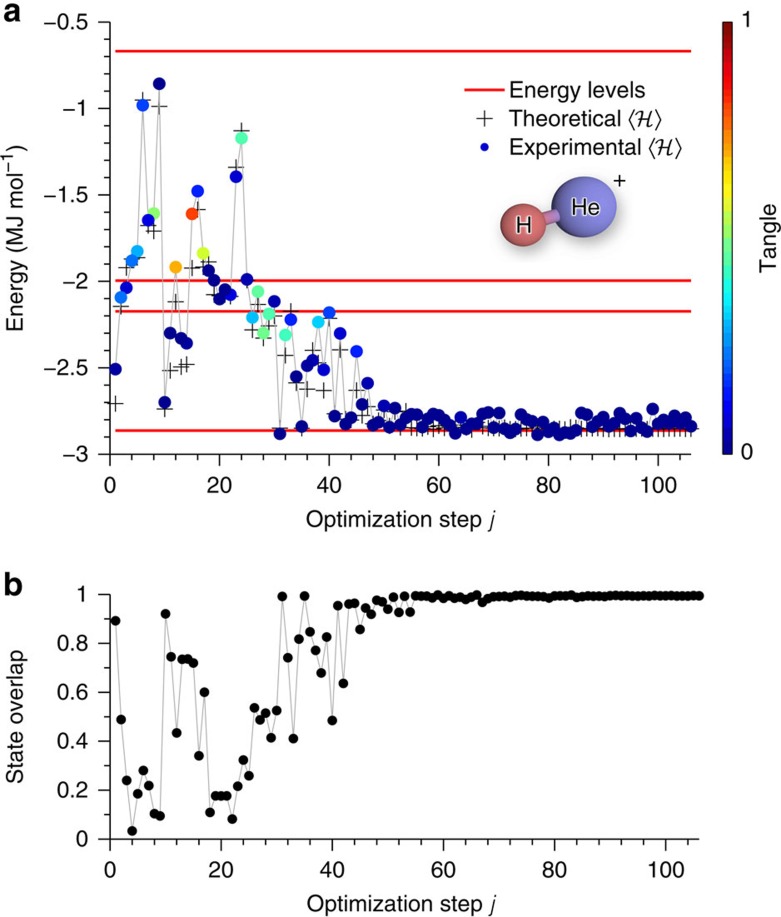
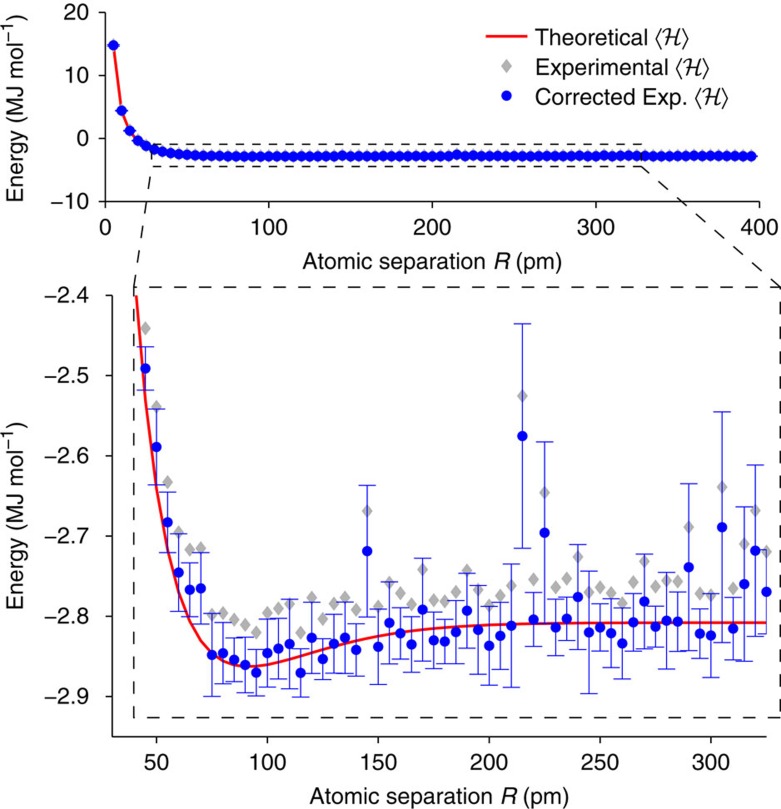
- The authors report an experimental ground-state result for He–H\(^+\): after correcting for experimental errors, they estimate the equilibrium bond length as \(R = 92.3 \pm 0.1\) pm and the ground-state electronic energy as \(E = -2.865 \pm 0.008\) MJ mol\(^{-1}\).
- For the bond dissociation curve, more than 96% of the experimental data are within chemical accuracy of the theoretical values.
- In the discussion, they state that for a 4 × 4 Hamiltonian like the one demonstrated, the QPE circuit would require at least 12 CNOT gates, whereas their method requires one.
- The full experiment was performed in about 158 h, and the bond dissociation curve was obtained by finding the ground states of 79 Hamiltonians.
## Methods
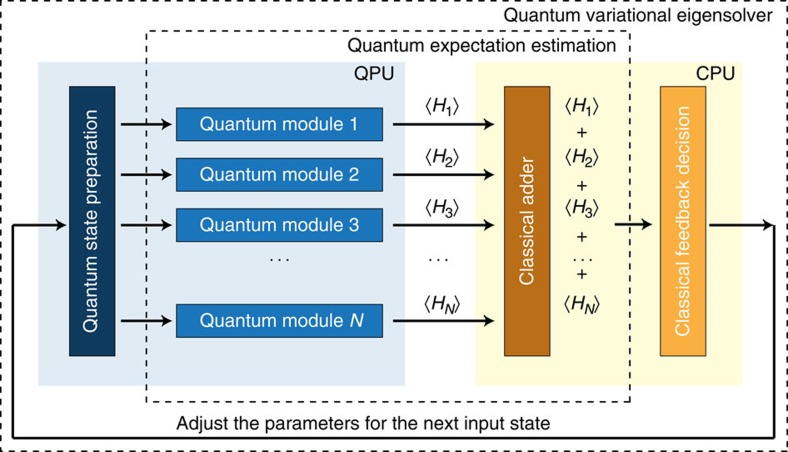
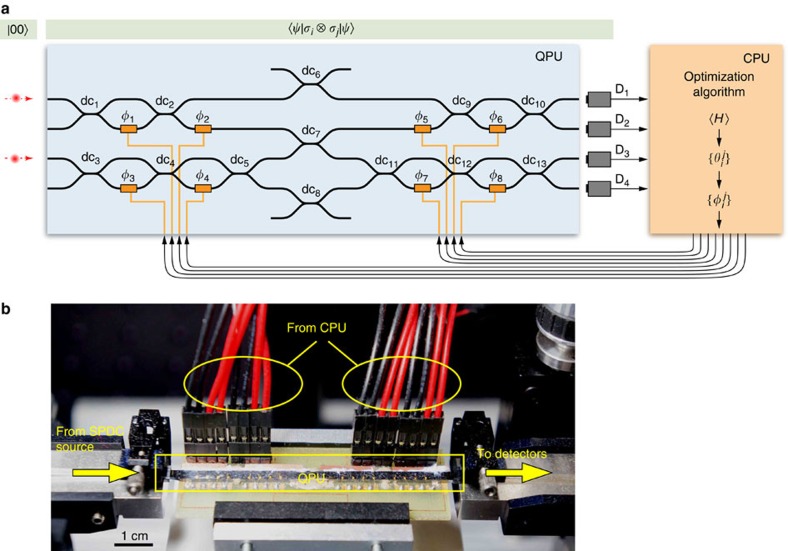
- The paper combines a reconfigurable integrated photonic quantum processor with a classical optimization algorithm: the quantum device estimates Hamiltonian expectation values, and the classical processor updates the state parameters variationally.
- The photonic chip prepares and measures arbitrary two-qubit pure states using single-qubit rotations and one two-qubit entangling gate; the experimental demonstration uses the He–H\(^+\) molecule in a minimal basis.
- For the classical optimization, they use the Nelder–Mead algorithm; expectation values are reconstructed from four two-qubit Pauli measurements at each point.
## Limitations
- The paper states that the method still requires a good approximation to the ground state as input/initialization, and the reliance on multiple separate measurements makes it sensitive to variations in state preparation between calculations.
- The authors report a constant systematic shift of \(\varepsilon = 50\) kJ mol\(^{-1}\) in the measured expectation values; they attribute this to photon-source impurity/distinguishability, circuit imperfections, and unbalanced coupling efficiencies.
- Evident from the text: the demonstration is limited to a two-qubit / 4 × 4 Hamiltonian prototype, so the scalability claim is not experimentally validated here.
Model-written summary. Check it against the paper before relying on it.
Integrity signals
Registry
Cites
Statistics
Figures
Verification
Claims the paper makes
7 Valid · 4 Not valid · 11 Not checked · 59 Own results and interpretations
The cited sources support only part of this claim — read each source’s verdict below.
In the paper
“Recent developments in the field of quantum computation offer a way forward for determining efficient solutions of many instances of large eigenvalue problems that are classically intractable6789101112”
§ A variational eigenvalue solver on a photonic quantum processor > Abstract
What the sources say
- Not matchedcites [6] Nielsen, M. A. & Chuang, I. L. Quantum Computation and Quantum Information Cambridge University Press (2000).
Couldn’t be matched to a paper in Crossref, so it can’t be checked.
- Could not verifycites [7] Kitaev, A. Quantum measurements and the Abelian stabilizer problem. Electronic Colloquium on Computational Complexity (ECCC) 3 (1996). sourceExperimental — accuracy not yet measured
Our copy under this DOI is the ISAAC 2021 paper 'Effective Resistance and Capacitance in Simplicial Complexes and a Quantum Algorithm' (Kitaev's 1995 work appears only as reference [9] in its bibliography), and it nowhere asserts that quantum computation gives efficient solutions to classically intractable large eigenvalue problems. Eigenvalues enter only as complexity parameters — λ, the smallest eigenvalue of the normalized up-Laplacian, in Lemma 31 and Theorem 26 (Section 6.3, 'Time efficient implementations') and in the phase-estimation machinery of Appendix A — and Section 1.1 ('Our Contributions') actually reports the opposite direction for its own problem: 'the quantum algorithm is slower than the classical algorithm in the worst case'. Searched: 'eigenvalue problems classically intractable', 'quantum speedup / exponential advantage', 'phase estimation', 'faster than classical'; no passage addresses the claim's point. (LLM, conf=0.70)
- Partly supportedcites [8] Griffiths, R. B. & Niu, C.-S. Semiclassical fourier transform for quantum computation. Phys. Rev. Lett. 76, 3228–3231 (1996). sourceExperimental — accuracy not yet measured
On p. 1, the paper says a quantum computer, if built, could solve certain problems such as factoring long numbers much faster than conventional algorithms. It also describes a simpler Fourier transform for Shor’s factorization and discrete-logarithm algorithms (p. 1). The copy does not support the claim about efficient solutions to many large eigenvalue problems. (LLM, conf=0.84)
plainstates a cause- Asserted: passes — The authors put it forward as true.
- Checkable: passes — It can be checked against evidence.
- Load-bearing: passes — The paper’s conclusions depend on it.
- Based: passes — The paper gives a reason why it holds.
- Not matched
Every source the paper cites for this claim was checked and supports it.
In the paper
“this would suffer from the N-representability problem, which is known to be intractable for both classical and quantum computers (it is in the quantum complexity class QMA-Hard24).”
§ A variational eigenvalue solver on a photonic quantum processor > Results > Quantum expectation estimation
What the sources say
- Supportedcites [24] Liu, Y.-K., Christandl, M. & Verstraete, F. Quantum computational complexity of the n-representability problem: Qma complete. Phys. Rev. Lett. 98, 110503 (2007). source
The paper states that N-representability is QMA-complete and hence QMA-hard and NP-hard (Abstract). Its discussion of quantum-chemistry relevance says the problem is intractable in the worst case even on a quantum computer, while allowing that particular physical systems may be easier. (LLM, conf=0.93)
boosted- Asserted: passes — The authors put it forward as true.
- Checkable: passes — It can be checked against evidence.
- Load-bearing: passes — The paper’s conclusions depend on it.
- Based: passes — The paper gives a reason why it holds.
- Supported
Every source the paper cites for this claim was checked and supports it.
In the paper
“We have implemented the QPU using integrated quantum photonics technology30.”
§ A variational eigenvalue solver on a photonic quantum processor > Results > Prototype demonstration
What the sources say
- Supportedcites [30] O'Brien, J. L., Furusawa, A. & Vuckovic, J. Photonic quantum technologies. Nat. Photon. 3, 687–695 (2009). source
The citation identifies integrated quantum photonics as the technology used, rather than attributing the citing authors’ QPU implementation to this review. The “Integrated quantum optical circuits” section (p. 6) describes on-chip waveguide circuits performing quantum logic gates and a compiled quantum factoring algorithm. (LLM, conf=0.87)
plain- Asserted: passes — The authors put it forward as true.
- Checkable: passes — It can be checked against evidence.
- Load-bearing: passes — The paper’s conclusions depend on it.
- Based: passes — The paper gives a reason why it holds.
- Supported
The cited sources support only part of this claim — read each source’s verdict below.
In the paper
“The time the quantum computer must remain coherent is determined by the necessity of O(p−1) successive applications of , each of which can require on the order of millions or billions of quantum gates for practical applications1719, as compared to the tens to hundreds of gates achievable in the short term.”
§ A variational eigenvalue solver on a photonic quantum processor > Abstract
What the sources say
- Partly supportedcites [17] Whitfield, J. D., Biamonte, J. & Aspuru-Guzik, A. Simulation of electronic structure hamiltonians using quantum computers. Mol. Phys. 109, 735–750 (2011). sourceExperimental — accuracy not yet measured
Split into 2 atoms — 1 confirmed, 1 partially supported, 0 disputed, 0 misattributed, 0 unverifiable. Expand the claim to see per-atom verdicts.
- Partly supportedcites [19] Jones, N. C. et al. Faster quantum chemistry simulation on fault-tolerant quantum computers. New J. Phys. 14, 115023 (2012). sourceExperimental — accuracy not yet measured
Split into 2 atoms — 0 confirmed, 2 partially supported, 0 disputed, 0 misattributed, 0 unverifiable. Expand the claim to see per-atom verdicts.
plainstates a cause- Asserted: passes — The authors put it forward as true.
- Checkable: passes — It can be checked against evidence.
- Load-bearing: passes — The paper’s conclusions depend on it.
- Based: passes — The paper gives a reason why it holds.
- Partly supported
A result the paper reports from its own data — it cites no other source for it, so there is none to check. The quote shows it is in the paper.
In the paper
“We experimentally demonstrate the feasibility of this approach with an example from quantum chemistry—calculating the ground-state molecular energy for He–H+.”
§ A variational eigenvalue solver on a photonic quantum processor > Abstract
boostedstates a causeSingle case- Asserted: passes — The authors put it forward as true.
- Checkable: passes — It can be checked against evidence.
- Load-bearing: passes — The paper’s conclusions depend on it.
- Based: passes — The paper gives a reason why it holds.
31 more claims
Create a free account to see all 81 claims and to verify the 4 references still open.
- It may state two separate claims as one. 28
- Probably not a substantial claim. 24
Claims other papers make about this one
Each is checked against this paper’s own text: does it say what the citing paper says it does?
The cited source doesn’t support the claim as written.
In the citing paper
“Leveraging quantum resources, the UCC ansatz was instead realized as a PQC on a photonic processor (Peruzzo et al. , 2014).”
From Noisy intermediate-scale quantum algorithms (2022) · cites this paper as Peruzzo et al., 2014
Checked by a reasoning model — may be wrong.
Experimental — accuracy not yet measuredThe cited source doesn’t support the claim as written.
In the citing paper
“The first on-chip GMM of four-qubit cluster state was realised in a laser-writing chip ( Fig.4e ), by manipulating both the polarisation and path DoFs of two photons [85].”
From Integrated photonic quantum technologies (2020) · cites this paper as [85]
Checked by a reasoning model — may be wrong.
Experimental — accuracy not yet measuredThe cited source doesn’t support the claim as written.
In the citing paper
“four-qubit linear- and box-cluster states are generated in a laser-writing photonic chip. This is enabled by on-chip manipulating the two-photon four-qubit hyperentangled state and cluster state, that are encoded in photon's path and polarisation DoFs. The Grover's search algorithm on a four-element database was implemented by controlling the device.”
From Integrated photonic quantum technologies (2020) · cites this paper as [85]
Checked by a reasoning model — may be wrong.
Experimental — accuracy not yet measuredThe source backs part of the claim, not all of it — or backs it for a different population, condition or comparison.
In the citing paper
“Due to its versatility, the variational Hamiltonian ansatz has been implemented for quantum chemistry [21, 29], optimization [24], and for quantum simulation problems [30].”
From Variational quantum algorithms (2021) · cites this paper as [29]
Experimental — accuracy not yet measuredThe source backs part of the claim, not all of it — or backs it for a different population, condition or comparison.
In the citing paper
“For the original VQE (Peruzzo et al. , 2014) and QAOA (Farhi et al. , 2014) it can, for example, be described as a single expectation value min θ ⟨ H ⟩ U ( θ ) , where the differences solely appear in the specific form and construction of the qubit Hamiltonian.”
From Noisy intermediate-scale quantum algorithms (2022) · cites this paper as Peruzzo et al., 2014
Experimental — accuracy not yet measured
12 more claims about this paper
Create a free account to see every claim other papers make about this one.
Citations
Cites
A Simplex Method for Function Minimization
Nelder, J. A., & Mead, R. (1965) · The Computer Journal · doi:10.1093/comjnl/7.4.308 · Cited by 28,905
Quantum computation and quantum information
Law, J. (2001) · ACM SIGSOFT Software Engineering Notes · doi:10.1145/505482.505499 · Cited by 18,842
(1999) · Cited by 12,854
Practical Methods of Optimization
Fletcher, R. (2000) · Wiley eBooks · doi:10.1002/9781118723203 · Cited by 7,605 · cited 3×
“[12] S.”
BackgroundMethodPractical methods of optimization
(1988) · Mathematics and Computers in Simulation · doi:10.1016/0378-4754(88)90129-2 · Cited by 5,818
Quantum Algorithm for Linear Systems of Equations
Harrow, A. W., Hassidim, A., & Lloyd, S. (2009) · Physical Review Letters · doi:10.1103/physrevlett.103.150502 · Cited by 3,325
Conn, A. R., Gould, N. I. M., & Toint, P. L. (2000) · Society for Industrial and Applied Mathematics eBooks · doi:10.1137/1.9780898719857 · Cited by 2,981 · cited 3×
“[14] D.”
MethodInfluential�ber das Paulische �quivalenzverbot
Jordan, P., & Wigner, E. (1928) · Zeitschrift f�r Physik · doi:10.1007/bf01331938 · Cited by 2,597
Molecular Electronic‐Structure Theory
Helgaker, T., Jørgensen, P., & Olsen, J. (2000) · doi:10.1002/9781119019572 · Cited by 2,594
O'Brien, J. L., Furusawa, A., & Vučković, J. (2009) · Nature Photonics · doi:10.1038/nphoton.2009.229 · Cited by 2,388
Self-citation
Research works printed but not linked: 3
- Helgaker, T., Jorgensen, P. & Olsen, J. Mol. Electronic Struct. Theory Wiley, Sussex (2002).
- Saad, Y. Numerical Methods for Large Eigenvalue Problems Vol. 158, (SIAM (1992).
- Rayleigh, J. W. In finding the correction for the open end of an organ-pipe. Phil. Trans. 161, 77 (1870).
Cited by
Items 3,901–4,000 of 4,572
Data Obfuscation for Privacy-Preserving Machine Learning using Quantum Symmetry PropertiesPreprint
Raubitzek, S., Schatten, A., Schrittwieser, S., et al. (2024) · Preprints.org · doi:10.20944/preprints202407.1701.v1
Meson and Baryon spin dependent GPDs via Quantum Computers
Gustin, C. M., & Goldstein, G. R. (2024) · doi:10.22323/1.456.0018
Gain and loss in quantum optical systems
Hernández, O. (2024) · doi:10.48035/tesis/2454/50551
Variatsionnaya kvantovaya optimizatsiya otkrytogo kar'era
Paradezhenko, G. V., Pervishko, A. A., & Yudin, D. (2024) · Письма в Журнал экспериментальной и теоретической физики · doi:10.31857/s1234567824060090
Optimizing Molecular Structures Quantum Computing in Chemical Simulation
Rao, D. J., Krishna, R. V. V., Kumar, N. V. S., & Pandey, A. P. (2024) · Advances in computational intelligence and robotics book series · doi:10.4018/979-8-3693-4001-1.ch011
Performance Study of Variational Quantum Linear Solver for Linear Elastic Problems
Rao, X., & Du, K. (2024) · Mechanisms and machine science · doi:10.1007/978-3-031-68775-4_6 · Cited by 2
Drinko, A., Correr, G. I., Medina, I., Azado, P. C., Canabarro, A., & Soares-Pinto, D. O. (2024) · Research Square · doi:10.21203/rs.3.rs-4803120/v1 · Cited by 1
Portfolio Optimization using Accelerated Quantum Simulation
Belekar, G., Modani, M., & Banerjee, A. (2024) · International Conference on Trends in Quantum Computing and Emerging Business Technologies (TQCEBT) · doi:10.1109/tqcebt59414.2024.10545076
“This collaborative approach allows VQE to efficiently approximate the ground state of a Hamiltonian, making it particularly suitable for early-stage quantum computers, which are limited by quantum noise and decoherence (Peruzzo et al., 2014; McClean et al., 2016).”
BackgroundMethodAcceleration of Variational Quantum Eigen Solver
Modani, M. (2024) · Lecture notes in networks and systems · doi:10.1007/978-3-031-61929-8_29
Schwenzow, T., Wintersperger, K., Safi, H., von Sicard, O., Niedermeier, C. A., Liebrecht, C., Franke, J. E., & Reitelshoefer, S. (2024) · Research Square · doi:10.21203/rs.3.rs-4907806/v1
Numerical Investigation of the Quantum Inverse Algorithm on Small Molecules
Cainelli, M., Baba, R., & Kurashige, Y. (2024) · Journal of Chemical Theory and Computation · doi:10.1021/acs.jctc.4c00483 · Cited by 1
Density-Oriented Quantum Simulator using Block-Encoding Variational Eigensolvers
Vagerwal, A., & Jiang, Z. (2024) · IEEE National Aerospace and Electronics Conference (NAECON) · doi:10.1109/naecon61878.2024.10670687
Universal Euler-Cartan circuits for quantum field theories
Roy, A., Konik, R., & Rogerson, D. (2026) · Physical Review A · doi:10.1103/q257-nzc2 · Cited by 5
“The circuit ansatz either relies on the Hamiltonian whose eigenstate is being sought alongside a heuristically-chosen mixer Hamiltonian [9, 16, 17] or variations of the coupled cluster theory relevant mostly for chemistry problems [5].”
Efficacious Qubit Mappings for Quantum Simulations of the12C Rotational Band
Mumma, D. C., Sun, Z. H., Mercenne, A., Launey, K. D., Rethinasamy, S., & Sauls, J. A. (2024) · IEEE Computer Society Annual Symposium on VLSI · doi:10.1109/isvlsi61997.2024.00119 · Cited by 1
“Earlier studies that aim to solve quantum many-body problems using noisy intermediate-scale quantum (NISQ) computers have been based on various approaches, including the variational quantum eigensolver (VQE) [2], [3], quantum phase estimation [4], [5], and quantum imaginary time evolution [6].”
MethodGauthier, B., Rosenberg, P., Foley, A., & Charlebois, M. (2024) · Physical Review A · doi:10.1103/physreva.110.032624
Quantum error mitigations for quantum approximate optimization algorithms on IBM quantum processors
Liu, S., Lim, H., Choi, J., Castillo, P., Park, G., & Yu, K. (2024) · Quantum Communications and Quantum Imaging · doi:10.1117/12.3030458
“On the other hand, Variational Quantum Algorithms (VQAs), such as Quantum Approximate Optimization Algorithm (QAOA), 19,20 Variation Quantum Eigensolver (VQE), 21 and Quantum Machine Learning, 22–26 have drawn attention as a promising candidate to achieve quantum advantage on NISQ devices.”
Exploring electron-phonon coupling using quantum computing methods
Zhou, P., & Shang, H. (2024) · Physica Scripta · doi:10.1088/1402-4896/ad8a01
Distributed Quantum Computations
Luo, M. (2024) · Springer eBooks · doi:10.1007/978-981-97-6226-2_5
Shallow-Depth Quantum Circuit for Unstructured Database Search
Zhan, J. (2024) · Quantum Reports · doi:10.3390/quantum6040037
Quantum Signal Processing and Quantum Singular Value Transformation on U ( N )
Lu, X., Liu, Y., & Lin, H. (2026) · Quantum · doi:10.22331/q-2026-03-27-2048 · Cited by 12
“…is a fundamental task in quantum metrology [10–12] and has direct applications in numerical integration [13], quantum tomography [14–18], overlap and expectation value estimation in quantum simulation [19–23], Gibbs sampling [24], variational quantum algorithms and quantum machine learning [25–28].”
Radar Cross Section Estimation using the Variational Quantum Linear Solver Algorithm
Pellerin, T., van Gaalen, R., & Harmanny, R. I. A. (2024) · European Radar Conference (EuRAD) · doi:10.23919/eurad61604.2024.10734862
“In VQE [4], one considers a circuit depending on a set of parameters θ , producing an output state | ψ ( θ ) (cid:105) .”
BackgroundMethodZygelman, B. (2024) · Undergraduate topics in computer science · doi:10.1007/978-3-031-66425-0_10
A quantum neural network for multi-classifications by using FRQI with extra measurement
Jian-Jun, H., Yun-Jiang, W., Cheng, C., Wang, Z., & Sha, S. (2024) · Zhongguo kexue. Wulixue Lixue Tianwenxue · doi:10.1360/sspma-2024-0373
Toward Transparent and Controllable Quantum Generative Models
Tian, J., & Yang, W. (2024) · Entropy · doi:10.3390/e26110987 · Cited by 2
“Currently, training a variational quantum eigensolver [19] is limited to obtaining the ground state of a specific Hamiltonian.”
Gao, Q., Sugawara, M., Nation, P. D., Kobayashi, T., Ohnishi, Y., Tezuka, H., & Yamamoto, N. (2024) · Intelligent Computing · doi:10.34133/icomputing.0108 · Cited by 1
Towards Quantum Simulation of Lower-Dimensional Supersymmetric Lattice ModelsPreprint
Mendicelli, E., & Schaich, D. (2024) · Qeios · doi:10.32388/iesa19 · Cited by 1
Li, Y., Zhang, Y., Deng, H., Chen, M., & Li, Z. (2024) · IEEE Transactions on Computer-Aided Design of Integrated Circuits and Systems · doi:10.1109/tcad.2024.3509794 · Cited by 6
“3) UCCSynthesis: also proposed by Cowtan et al. [18] and integrated as a special compilation pass for the UCC ansatz [13] in t | ket (cid:4) .”
Ding, X., & Clark, B. K. (2024) · Physical Review A · doi:10.1103/physreva.110.062403
Circumventing traps in analog quantum machine learning algorithms through co-design
Bravo, R. A., Ponce, J. G., Hu, H.-Y., & Yelin, S. F. (2024) · APL Quantum · doi:10.1063/5.0235279 · Cited by 1
“This approach underpins algorithms like variational quantum eigensolvers (VQEs) 6 , where a circuit with variational parameters is tuned for energy minimization regardless of whether the circuit’s operation directly affects the occupancy of virtual orbitals.”
Quantum Circuit Learning Enhanced by Dynamic Circuit
Sato, Y., & Kawahara, T. (2024) · International Joint Symposium on Artificial Intelligence and Natural Language Processing (iSAI-NLP) · doi:10.1109/isai-nlp64410.2024.10799377
“Notable examples of these quantum-classical hybrid algorithms include the Variational Quantum Eigensolver (VQE) [13], Quantum Approximate Optimization Algorithm (QAOA) [14], and Quantum Circuit Learning (QCL) [15].”
Dechant, D., Markovich, L. A., Dunjko, V., & Tura, J. (2026) · Journal of Mathematical Physics · doi:10.1063/5.0258074 · Cited by 1
Architectures for Quantum Information Processing
Upadhyay, S., Alam, M., & Ghosh, S. (2024) · Springer eBooks · doi:10.1007/978-981-97-9314-3_64
Devendrababu, S., Ganguly, S., Jain, P., Mustafa, H., & Bertel, L. G. A. (2024) · Communications in computer and information science · doi:10.1007/978-3-031-73477-9_11
Murayama, K., Moriyama, Y., Iimura, I., et al. (2024) · Journal of Signal Processing · doi:10.2299/jsp.29.1
Bee-yond the plateau: Training QNNs with swarm algorithms
Guerrero, R. D. (2025) · The Journal of Chemical Physics · doi:10.1063/5.0240466 · Cited by 4
MOSQ: Accelerating Classical Simulation of UCCSD Ansatz Circuits using Merged Operation
Choi, S., Jang, E., Kim, Y., & Ro, W. W. (2024) · IEEE International Conference on Computer Design: VLSI in Computers and Processors (ICCD) · doi:10.1109/iccd63220.2024.00090
Feed-Forward Probabilistic Error Cancellation with Noisy Recovery Gates
Kurosawa, L., Saito, Y., Lee, X., Yan, X., Xie, N., Cai, D., Shin, J., & Asai, N. (2024) · IEEE International Symposium on Embedded Multicore/Many-core Systems-on-Chip (MCSoC) · doi:10.1109/mcsoc64144.2024.00081 · Cited by 1
“…by the possibilities of high-speed computing with quantum computers, many quantum algorithms have been proposed to tackle problems that require a lot of calculation time even in classical computers, such as quantum chemical calculations [1], [2] and combinatorial optimization problems [3], [4].”
Shuttling Compiler for a Trapped-Ion Quantum Computer Architecture with Junctions
Kreppel, F., Melzer, C., Wagner, J., Hilder, J., Poschinger, U., Schmidt‐Kaler, F., & Brinkmann, A. (2024) · IEEE International Conference on Quantum Computing and Engineering (QCE) · doi:10.1109/qce60285.2024.00126 · Cited by 3
Synthesis of Approximate Parametric Circuits for Variational Quantum Algorithms
Burgstahler, B., Wilson, E., Pakin, S., & Mueller, F. (2024) · IEEE International Conference on Quantum Computing and Engineering (QCE) · doi:10.1109/qce60285.2024.00019
“Variational quantum algorithms (VQAs) [11, 14] are a promising approach to solve relevant quantum chemistry [6, 14] and optimization problems algorithmically [4] on quantum computers.”
Toward a Room-Temperature Fully-Integrated Photonic Quantum Simulator
Sanna, M., Baldazzi, A., Broseghini, N., Piccoli, G., Bernard, M., Acerbi, F., Pucker, G., Azzini, S., Ghulinyan, M., & Pavesi, L. (2024) · IEEE International Conference on Quantum Computing and Engineering (QCE) · doi:10.1109/qce60285.2024.00092
Efficient Training of Layerwise-Commuting PQCs with Parallel Gradient Estimation
Brnović, M., Iouchtchenko, D., & Koch-Janusz, M. (2024) · IEEE International Conference on Quantum Computing and Engineering (QCE) · doi:10.1109/qce60285.2024.10410
Enhancing Convergence in Variational Quantum Eigensolver Using CoolMomentum
Tsukayama, D., Shirakashi, J., Shibuya, T., & Imai, H. (2024) · IEEE International Conference on Quantum Computing and Engineering (QCE) · doi:10.1109/qce60285.2024.10388
Large-Sized VQE Performance Profiling in Quantum Chemistry Using a Multi-Node Quantum Simulator
Fukada, K., Shirai, T., Morita, M., et al. (2024) · IEEE International Conference on Quantum Computing and Engineering (QCE) · doi:10.1109/qce60285.2024.10341
Quantum Information for Fusion Energy Sciences (Final Technical Report)
Evert, B., (NNSA), U. N. N. S. A., Fusion Energy Sciences (FES) (SC-24) USDOE Office of Science (SC), Sete, E. A., Cho, Y., Joseph, I., & Lidar, D. A. (2025) · OSTI OAI (U.S. Department of Energy Office of Scientific and Technical Information) · doi:10.2172/2497384
Pragmatic Obfuscation of Factoring in Hamiltonian Simulation and Ground State Estimation
Gopalakrishnan, D., & Mosca, M. (2024) · IEEE International Conference on Trust, Privacy and Security in Intelligent Systems and Applications (TPS-ISA) · doi:10.1109/tps-isa62245.2024.00063
Band Theory and Beyond: Applications of Quantum Algorithms for Quantum Chemistry
Sherbert, K. (2022) · University of North Texas Digital Library (University of North Texas) · doi:10.12794/metadc1944298
Shadow-based quantum subspace algorithm for the nuclear shell model
Yang, R., Wang, T., Lu, B.-N., Li, Y., & Xu, X. (2025) · Physical Review A · doi:10.1103/physreva.111.012620 · Cited by 7
Computational Techniques for Accelerated Materials Discovery
Cerasoli, F. (2021) · University of North Texas Digital Library (University of North Texas) · doi:10.12794/metadc1873684
Quantum Circuit Optimization by Graph Coloring
Lee, H., Jeong, K. C., & Kim, P. (2026) · Quantum · doi:10.22331/q-2026-02-06-1996 · Cited by 7
“Graph coloring has been used to optimally group Pauli strings to minimize the number of measurements in variational quantum eigensolver [32, 33, 34, 35, 36].”
Exploiting symmetry in variational quantum channel coding
Wu, J., Xie, W., Fu, H., Zhu, M., & Li, X. (2025) · Physical Review A · doi:10.1103/physreva.111.012443
Fast batch gradient descent in quantum neural networks
Shim, J. Y., & Kim, J. (2025) · Electronics Letters · doi:10.1049/ell2.70162
Digital-analog variational neural-simulation hybrid eigensolver with classical shadow
Shingu, Y., Zhang, Y., Matsuzaki, Y., Nikuni, T., Yuan, X., & Huang, Y. (2025) · Japanese Journal of Applied Physics · doi:10.35848/1347-4065/adb438 · Cited by 1
Exploring the Potential of Quantum Monte Carlo Method for Computational Fluid Dynamics Simulations
Bosco, F. S. D., Agarwal, R., Akhtar, A., Kolluru, R., Lineswala, R., Chopra, A., & Steijl, R. (2025) · AIAA SciTech Forum · doi:10.2514/6.2025-0303
Exploring Optimal and Suboptimal Beamforming Solutions Using Weighted Subspace-Search-VQE
Dhara, B., Agrawal, M., & Roy, S. D. (2025) · International Conference on Communication Systems & Networks (COMSNETS) · doi:10.1109/comsnets63942.2025.10885773
“To reduce the substantial hardware requirements associated with quantum computing and to fully harness the capabilities of Noisy Intermediate-Scale Quantum (NISQ) devices [5], the Variational Quantum Eigensolver (VQE) algorithm[6] was introduced.”
The Virtual Quantum Device (VQD): A tool for detailed emulation of quantum computers
Gustiani, C., Jones, T., & Benjamin, S. C. (2025) · Quantum · doi:10.22331/q-2025-02-25-1642 · Cited by 9
“The variational Quantum Eigensolver (VQE) [95] is an promising route by which noisy-intermediate scale quantum (NISQ) devices may solve practical problems.”
Efficient Quantum Estimation of Hamiltonian Spectra via Shallow Circuits
Zhu, P., Wu, C., Wang, Y., Liu, J., Xia, G., Wang, Y., Zheng, Q., Yu, M., Zhao, C. M., Du, Y., et al. (2025) · Journal of Chemical Theory and Computation · doi:10.1021/acs.jctc.4c01601
Sun, S., Kumar, C., Shen, K., Shishenina, E., & Mendl, C. B. (2025) · The Journal of Physical Chemistry A · doi:10.1021/acs.jpca.4c07045 · Cited by 3
“− 5 VQE exploits the variational nature of the ground state energy, i.e., , where | init is the initial state, U ( θ ) is the parametrized unitary gate, which is often referred as “ansatz”, and H is the Hamiltonian.”
Quantum memory assisted observable estimation
Markovich, L. A., Almasi, A., Zeytinoǧlu, S., & Borregaard, J. (2025) · Quantum · doi:10.22331/q-2025-03-06-1655 · Cited by 2
“In general, the state | Ψ ⟩ is repeatedly prepared, and the Pauli strings are measured sequentially via projective measurements to obtain estimates of every Pauli string: ⟨ ˆ P j ⟩ ≡ ⟨ Ψ | ˆ P j | Ψ ⟩ [34, 27].”
Mihăilescu, M. I., Niță, Ș. L., Mărăscu, V., et al. (2025) · Studies in big data · doi:10.1007/978-3-031-77145-3_3
Efficient swap test method for enhanced multipartite entanglement quantification
Wang, Y., & Cai, Q.-Y. (2025) · Physics Letters A · doi:10.1016/j.physleta.2025.130416 · Cited by 1
Harnessing optical aberrations for mode sorting
Bezuidenhout, H., Peters, C., Forbes, A., et al. (2025) · doi:10.1117/12.3046920
“This approach is used for solving the dynamics of many complex systems such as molecular dynamics 7 and combinatorial optimisation 8 to name a few.”
Two-dimensional physics-constrained hardware-efficient ansatz on quantum computers
Xiao, X., Fang, W., & Li, Z. (2025) · Chinese Science Bulletin (Chinese Version) · doi:10.1360/tb-2024-1146
Workflow Analysis for IBM Quantum: Execution Cost Under Different Configurations and Parameters
De-Giuda, S., Guasch, F., Gatti, L., Silvera, S., & Sotelo, R. (2025) · International Conference on Consumer Electronics · doi:10.1109/icce63647.2025.10929802
“In this paper, we implemented the VQE [8] algorithm.”
Domain adaptation method inspired by quantum convolutional neural network
Wu, C., Pei, J., 吴, Y. 逸. W., Zhang, A., & Zhao, S. (2025) · Chinese Physics B · doi:10.1088/1674-1056/adc7ed
Quantum imaginary time evolution and the unit-disk maximum independent set problem
Penas, V. A., Losada, M., & Lamberti, P. W. (2025) · Physical Review A · doi:10.1103/physreva.111.042403 · Cited by 2
“Several quantum algorithms have been proposed for this purpose, including adiabatic quantum optimization [1], quantum annealing [2], and classical quantum variational algorithms such as the quantum approximate optimization algorithm (QAOA) [3–9] and the variational quantum eigensolver (VQE) [10–12].”
Resource-Optimized Grouping Shadow for Efficient Energy Estimation
Li, M., Lin, M., & Beach, M. J. S. (2025) · Quantum · doi:10.22331/q-2025-04-07-1694 · Cited by 2
“Within the realm of the Variational Quantum Eigensolver (VQE) [4, 5], efficient measurement strategies are particularly crucial for tackling the electronic structure problem.”
NordIQuEst: The Nordic–Estonian Quantum Computing e–Infrastructure Quest
Carugno, C., Muff, J., Johansson, M. P., Karlsson, S., & Lanzanova, A. (2025) · Communications in computer and information science · doi:10.1007/978-3-031-86240-3_8 · Cited by 3
“Variational Quantum Algorithms (VQA) – such as the Variational Quantum Eigensolver (VQE) for chemistry problems [17], and the Quantum Approximate Optimization Algorithms (QAOA) for combinatorial optimization problems [8] – require the interplay with classical routines to be tuned to the specific…”
BackgroundQuantum Amplitude‐Phase Judgment Circuits for Full Quantization Algorithms
Dong, Z., Wang, H., Zeng, Y., & Chang, S. (2025) · Advanced Quantum Technologies · doi:10.1002/qute.202400596
Resource-optimized VQE implementation: Bridging algorithmic innovation and hardware realities
Yu, L.-W. (2025) · Science China Physics Mechanics and Astronomy · doi:10.1007/s11433-025-2651-5
Kuji, H., Shingu, Y., Nikuni, T., Imoto, T., Sugisaki, K., & Matsuzaki, Y. (2025) · Physical Review A · doi:10.1103/physreva.111.042618
Roshani, N., Stein, J., Zorn, M., Kölle, M., Altmann, P. J., & Linnhoff–Popien, C. (2025) · Lecture notes in computer science · doi:10.1007/978-3-031-87327-0_12 · Cited by 1
Quantum Transfer Learning: The Impact of Classical Preprocessing
Kölle, M., Maurer, J., Altmann, P. J., Sünkel, L., Stein, J., Hager, J., Zielinski, S., & Linnhoff–Popien, C. (2025) · Lecture notes in computer science · doi:10.1007/978-3-031-87327-0_18 · Cited by 3
Drinko, A., Correr, G. I., Medina, I., Azado, P. C., Canabarro, A., & Soares-Pinto, D. O. (2025) · AVS Quantum Science · doi:10.1116/5.0247631 · Cited by 2
“This case is a specific type of VQA named Variational Quantum Eigen-solver (VQE) [29–31, 54, 57].”
Structural Analysis Model of Truss Systems Using Quantum Neural Networks
Dept. of Architectural Eng, K. U., Ha, H., Shon, S., & Lee, S. (2025) · Journal of the Korean Association for Spatial Structures · doi:10.9712/kass.2025.25.1.87
Digital quantum simulation of reaction–diffusion systems on lattice
Yao, L. H. (2025) · The European Physical Journal B · doi:10.1140/epjb/s10051-025-00930-5
pLazyQML: A parallel package for efficient execution of QML models on classical computersPreprint
García-Vega, D., Llorente, F. P., Castaño, A. L., et al. (2025) · Research Square · doi:10.21203/rs.3.rs-6378366/v1
Miháliková, I., Krejčí, M., & Friák, M. (2025) · Scientific Reports · doi:10.1038/s41598-025-00151-x · Cited by 6
Unraveling the rodeo algorithm through the Zeeman model
Gomes, R. F. I., Rocha, J. C. S., Nogueira, W. A. T., & Dias, R. A. (2025) · Physica Scripta · doi:10.1088/1402-4896/add58c · Cited by 4
“…connected qubits without being susceptible to decoherence (and with a comprehensive error correction protocol), these devices can be used to compare whether there is any quantum advantage over classic methods and execute algorithms combined with proper techniques such as VQE [21] and QAOA [22].”
Accelerating fermionic system simulation on quantum computers
Li, Q.-S., Zhang, J., Liu, H., Wang, Q., Wu, Y.-C., & Guo, G. (2025) · Physical Review A · doi:10.1103/physreva.111.052606
“To more rapidly demonstrate the advantages of quantum computing, a quantum variational algo-rithm, the variational quantum eigensolver (VQE) [9–12], has been proposed.”
Hu, Z., & Kais, S. (2025) · Annalen der Physik · doi:10.1002/andp.202500176 · Cited by 1
Quantum‐Enhanced Computing for the Antiferromagnetic J1−J2$J_1-J_2$ Heisenberg Model
Guo, Y., Guo, F., Zhong, B., Chen, X., Yuan, X., Jin, X., & Tang, H. L. (2025) · Advanced Quantum Technologies · doi:10.1002/qute.202300240 · Cited by 1
Optimization of Quantum Encoding for Combinatorial Problems in Rydberg Atom Array
Liu, J., Zhu, Y., Zheng, Q., Cui, J., & Su, Z. (2025) · International Conference on Quantum Communications, Networking, and Computing (QCNC) · doi:10.1109/qcnc64685.2025.00017
“More advantaged quantum applications include quantum algorithms with speedup [7], [8], quantum protocols for secure and efficient communications [9], [10], and quantum machine learning [11], [12].”
Quantum computing: promises, achievements and challenges
Ayral, T. (2025) · Photoniques · doi:10.1051/photon/202513166 · Cited by 1
A quantum constraint generation framework for binary linear programs
Czégel, A., & G.-Tóth, B. (2025) · EPJ Quantum Technology · doi:10.1140/epjqt/s40507-025-00364-z · Cited by 2
“Hybrid algorithms slightly differ as they are like most global optimization algorithms, use two algorithms: one hyper-parameterized, usually local, solver and an optimizer aiming to find optimal solutions for the original problem by guiding the local solver [5–8].”
Ahmed, Z. (2025) · SSRN Electronic Journal · doi:10.2139/ssrn.5272847
Li, G., Wang, S., Ni, X., Gao, F., Guo, F.-Z., Qin, S., & Wen, Q. (2025) · Physics Letters A · doi:10.1016/j.physleta.2025.130690 · Cited by 2
Overview of the New Perspectives on Optimization Algorithms Research
Lambert‐Torres, G., de Moraes, C. H. V., & de Andrade, G. C. C. (2025) · IntechOpen eBooks · doi:10.5772/intechopen.1010958
Method for simulating open-system dynamics using midcircuit measurements on a quantum computer
Stenger, J., Bazargan, G., Bronn, N. T., & Gunlycke, D. (2025) · Physical review. B./Physical review. B · doi:10.1103/njcp-264s · Cited by 1
Wang, P., Yang, X., Wu, C.-W., Li, C.-Y., Wu, W., & Chen, P.-X. (2025) · Physical Review A · doi:10.1103/79nd-mr7f · Cited by 3
Variational Quantum Eigensolver for Classification in Distributed Data Sets
Wiśniewska, J., & Sawerwain, M. (2025) · Lecture notes in computer science · doi:10.1007/978-3-031-90200-0_4
Scalable quantum simulations of molecular systems via improved optimization of neural quantum states
Zhang, G.-Z., Huang, J.-C., Ye, L., Li, J., & Hu, H. (2025) · The Journal of Chemical Physics · doi:10.1063/5.0269200 · Cited by 1
Andrade-Plascencia, J., Kuanysheva, T., Bostan, D., Kendrick, B. K., & Babikov, D. (2025) · Journal of Chemical Theory and Computation · doi:10.1021/acs.jctc.5c00504 · Cited by 1
Tan, K. C., Liu, D., Bharti, K., Bhowmick, D., & Sengupta, P. (2025) · Physical review. B./Physical review. B · doi:10.1103/gydb-9jt2
Reducing the Cost of Clifford+T Quantum Gates
Ishioka, T., Lukac, M., & Nagayama, S. (2025) · IEEE International Symposium on Multiple-Valued Logic · doi:10.1109/ismvl64713.2025.00029
“Quantum computing is an upcoming technology that has the potential to accelerate many computational tasks [1], [2], [3], [4], [5], [6].”
Zhang, J., & Tian, Z. (2025) · Quantum Information Processing · doi:10.1007/s11128-025-04812-8 · Cited by 1
“These algorithms include the following categories: variational quantum eigensolver (VQE) [7], quantum approximate optimization algo-rithm (QAOA) [6], and variational quantum machine learning (QML) [8].”
InfluentialQuantum technologies in decentralization
Griffin, P., Raymond, R., & Idé, T. (2025) · Elsevier eBooks · doi:10.1016/b978-0-443-34717-7.00023-4
Kaicher, M., Dommert, F., Wever, C., Amsler, M., Kühn, M., & QUTAC Material Science Working Group (2025) · Journal of Physics Communications · doi:10.1088/2399-6528/ade75c · Cited by 1
Metadata
- Authors
- Peruzzo, A., McClean, J., Shadbolt, P., Yung, M.-H., Zhou, X.-Q., Love, P. J., Aspuru-Guzik, A., & O’Brien, J. L.
- Affiliations
- The University of Sydney (AU)
- Harvard University (US)
- University of Bristol (GB)
- Haverford College (US)
- Corresponding author
- Peruzzo, Alberto
- O’Brien, Jeremy L.
- Venue
- Nature Communications
- Published
- 2014-07-23
- Volume
- 5
- Issue
- 1
- Pages
- 4213-4213
- ISSN
- 2041-1723 (ISSN-L)
- PMC
- PMC4124861
- OpenAlex
- W2161685427
- Cited by
- 4,552
- References
- 48
- Citations by year
- 2026: 591 · 2025: 765 · 2024: 722 · 2023: 658 · 2022: 564 · 2021: 561 · 2020: 346 · 2019: 191 · 2018: 83 · 2017: 29 · 2016: 18 · 2015: 16 · 2014: 4
- FWCI
- 22.24
- Type
- journal article
- Language
- en
- Open access
- hybrid
- doi.org
- Licence
- cc-by-nc-nd
- creativecommons.org/licenses/by-nc-nd/4.0 (tdm)
- creativecommons.org/licenses/by-nc-nd/4.0 (vor)
- Locations
- Nature Communications (publishedVersion, cc-by-nc-nd)
- Europe PMC (PubMed Central) (publishedVersion, cc-by-nc-nd)
- PubMed Central (publishedVersion, cc-by-nc-nd)
- PubMed (publishedVersion)
- arXiv (Cornell University) (submittedVersion)
- OSTI OAI (U.S. Department of Energy Office of Scientific and Technical Information) (submittedVersion, cc-by-nc-nd)
- Digital Access to Scholarship at Harvard (DASH) (Harvard University) (submittedVersion, cc-by)
- RePEc: Research Papers in Economics (submittedVersion)
- RMIT Research Repository (RMIT University Library) (submittedVersion, cc-by-nc-nd)
- Figshare (submittedVersion, cc-by-nc-nd)
- UWA Profiles and Research Repository (UWA) (submittedVersion, cc-by-nc-nd)
- Bristol Research (University of Bristol) (submittedVersion)
- arXiv (Cornell University)
- Funders
- National Science Foundation (DE-FG02-97ER25308, 0955518, 1037992)
- U.S. Department of Energy (DEFG0297ER25308, DE‐FG02‐, FG02-97ER25308)
- Alfred P. Sloan Foundation
- John Templeton Foundation
- Camille and Henry Dreyfus Foundation
- Royal Academy of Engineering
- National Natural Science Foundation of China (61033001, 61361136003)
- Engineering and Physical Sciences Research Council (EP/J017175/1, EP/L024020/1, EP/K021931/1)
- Australian Research Council (DE140101700)
- National Key Research and Development Program of China (61033001, 2011CBA00301, 61361136003, 2011CBA00300)
- Division of Chemistry (CHE-1037992)
- Air Force Office of Scientific Research (FA 9550-12-1-0046, FA9550-, FA9550-12, FA9550‐12‐1)
- Topics
- Physical Sciences › Computer Science › Artificial Intelligence › Quantum Computing Algorithms and Architecture
- Physical Sciences › Physics and Astronomy › Atomic and Molecular Physics, and Optics › Quantum Information and Cryptography
- Physical Sciences › Physics and Astronomy › Atomic and Molecular Physics, and Optics › Quantum many-body systems
- Keywords
- variational quantum eigensolver, photonic quantum processors, quantum chemistry, classical optimization, hybrid quantum-classical computation
About these checks
Registry, retraction, Cites and statistics results are computed, not judged, with one exception: a printed reference that no index lists is read once by a model before it counts as a citation error. Claims are extracted by a model and kept only when their quote appears verbatim in the text; each cited source is then checked, with a model’s help, for whether it says what the claim relies on. Those verdicts can be wrong — read the claim’s quote and the cited source before relying on one.
The claim verdicts this report counts are experimental: their accuracy is not yet measured.
A language model drew the claims from the paper on 2026-10-10, under version 3 of the claim definition (model deepseek-v4.1-flash, prompt extract-v3).
A second model labelled each claim on 2026-10-10 (model jev-1.13-20260917, definition revision gold-guideline-v0.2).
Cited sources are checked with a language model’s help (qwen3.8-omni-flash and gpt-6-sol).
Statistics and arithmetic are recomputed, not judged.
Confidence bands are shown only for fields calibrated on our annotated test set. None is calibrated yet, so no band is shown.
What counts as a claim ›How we measure confidence ›How we check this ›
Are you an author, or do you see a problem with this page? Request a review
Data sources
Bibliographic data: Semantic Scholar, OpenAlex, Crossref.
Contains information from the Semantic Scholar Academic Graph Datasets, made available under the ODC Attribution License (ODC-BY 1.0).
Semantic Scholar’s data is described in: Kinney, R., et al. (2023). The Semantic Scholar Open Data Platform. arXiv:2301.10140.
