

A variational eigenvalue solver on a photonic quantum processor
Open accessThe DOI matches its Crossref record; 47 of the 48 references it cites were found in a registry or an index; 14 of the 31 sources its claims cite were checked for support.
Abstract
Quantum computers promise to efficiently solve important problems that are intractable on a conventional computer. For quantum systems, where the physical dimension grows exponentially, finding the eigenvalues of certain operators is one such intractable problem and remains a fundamental challenge. The quantum phase estimation algorithm efficiently finds the eigenvalue of a given eigenvector but requires fully coherent evolution. Here we present an alternative approach that greatly reduces the requirements for coherent evolution and combine this method with a new approach to state preparation based on ansätze and classical optimization. We implement the algorithm by combining a highly reconfigurable photonic quantum processor with a conventional computer. We experimentally demonstrate the feasibility of this approach with an example from quantum chemistry—calculating the ground-state molecular energy for He–H+. The proposed approach drastically reduces the coherence time requirements, enhancing the potential of quantum resources available today and in the near future. Quantum computers promise to efficiently solve problems that would be practically impossible with a normal computer. Peruzzo et al. develop a variational computation approach that uses any available quantum resources and, with a photonic quantum processing unit, find the ground-state molecular energy of He–H+.
Overview
CoChat Summary
## TL;DR
The paper introduces a variational alternative to quantum phase estimation for finding eigenvalues, combining short coherent quantum measurements with classical optimization. It experimentally demonstrates the approach on a photonic processor by estimating the ground-state energy curve of He–H\(^+\).
## Key findings
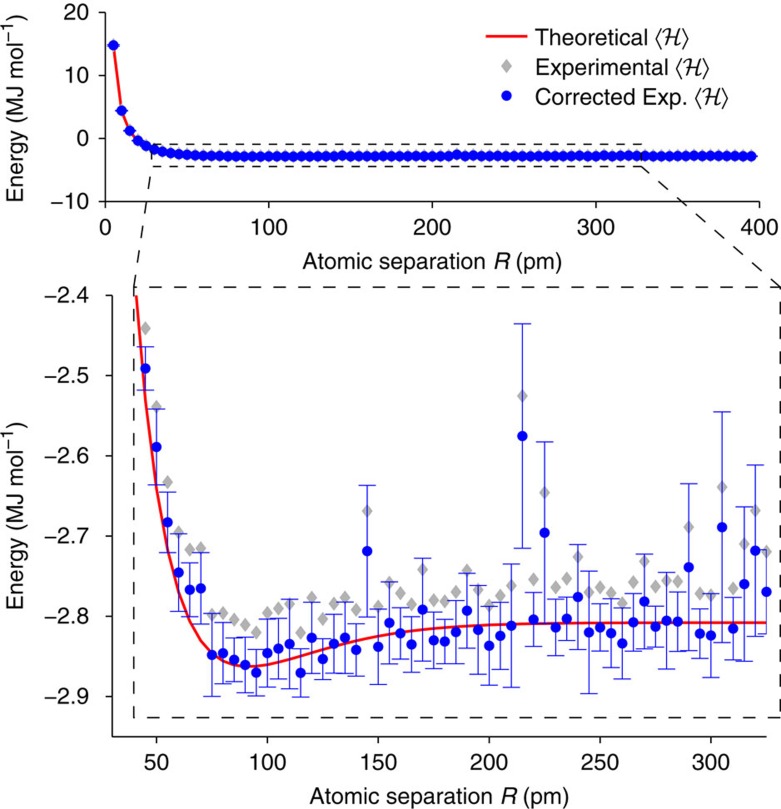
- The authors report an experimental ground-state result for He–H\(^+\): after correcting for experimental errors, they estimate the equilibrium bond length as \(R = 92.3 \pm 0.1\) pm and the ground-state electronic energy as \(E = -2.865 \pm 0.008\) MJ mol\(^{-1}\).
- For the bond dissociation curve, more than 96% of the experimental data are within chemical accuracy of the theoretical values.
- In the discussion, they state that for a 4 × 4 Hamiltonian like the one demonstrated, the QPE circuit would require at least 12 CNOT gates, whereas their method requires one.
- The full experiment was performed in about 158 h, and the bond dissociation curve was obtained by finding the ground states of 79 Hamiltonians.
## Methods
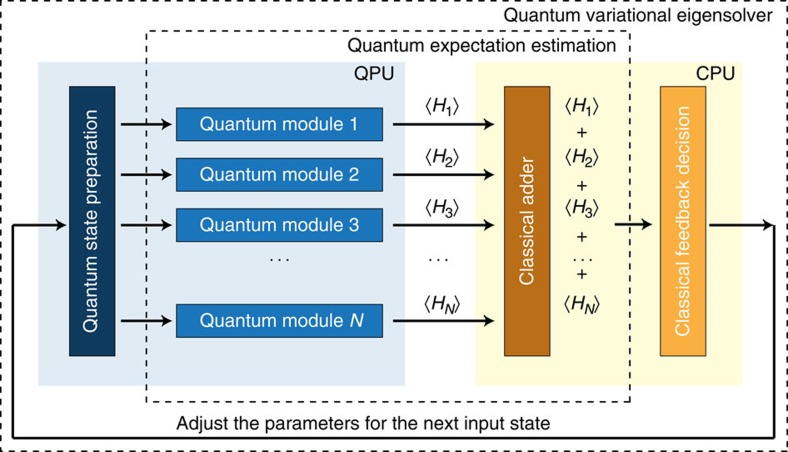
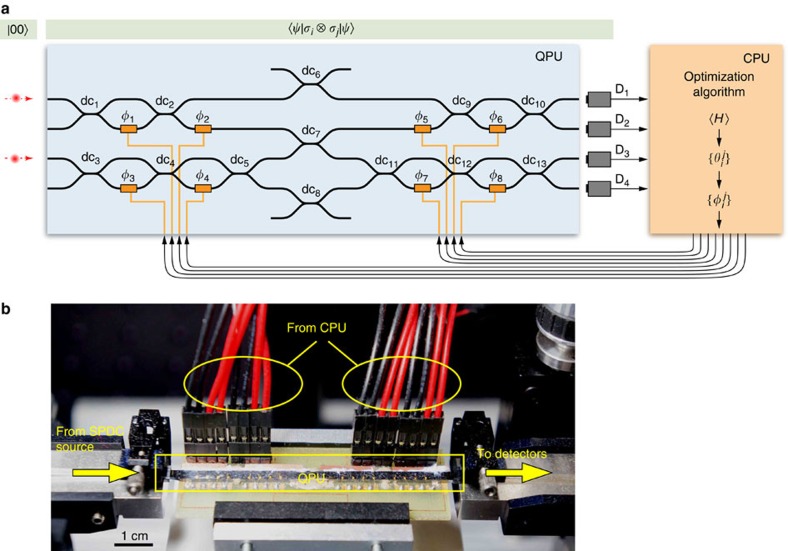
- The paper combines a reconfigurable integrated photonic quantum processor with a classical optimization algorithm: the quantum device estimates Hamiltonian expectation values, and the classical processor updates the state parameters variationally.
- The photonic chip prepares and measures arbitrary two-qubit pure states using single-qubit rotations and one two-qubit entangling gate; the experimental demonstration uses the He–H\(^+\) molecule in a minimal basis.
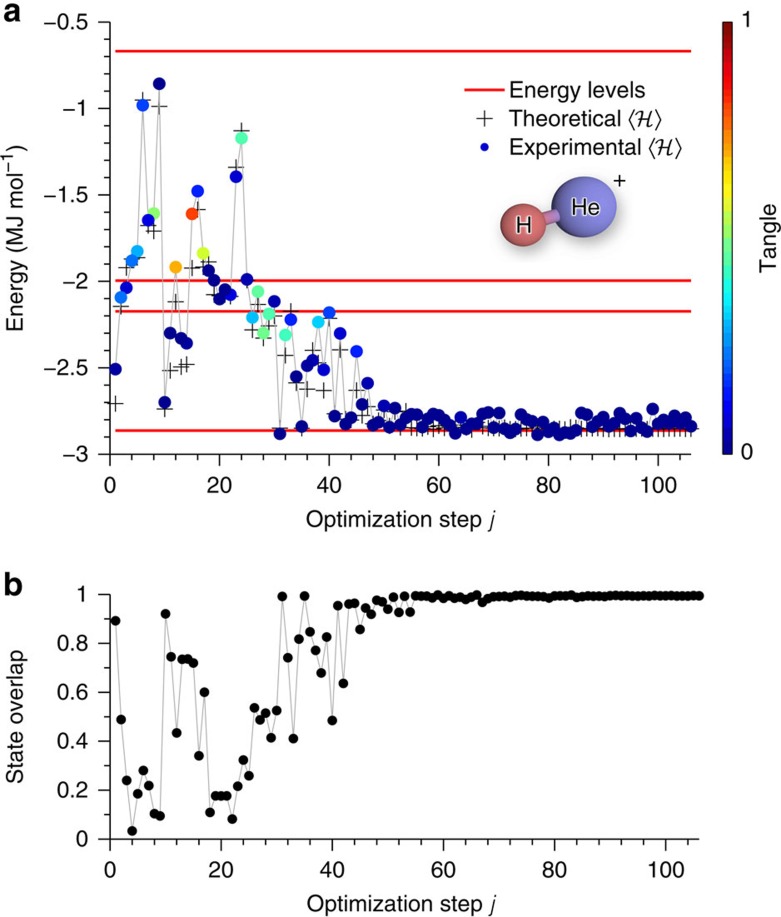
- For the classical optimization, they use the Nelder–Mead algorithm; expectation values are reconstructed from four two-qubit Pauli measurements at each point.
## Limitations
- The paper states that the method still requires a good approximation to the ground state as input/initialization, and the reliance on multiple separate measurements makes it sensitive to variations in state preparation between calculations.
- The authors report a constant systematic shift of \(\varepsilon = 50\) kJ mol\(^{-1}\) in the measured expectation values; they attribute this to photon-source impurity/distinguishability, circuit imperfections, and unbalanced coupling efficiencies.
- Evident from the text: the demonstration is limited to a two-qubit / 4 × 4 Hamiltonian prototype, so the scalability claim is not experimentally validated here.
Model-written summary. Check it against the paper before relying on it.
Integrity signals
Registry
Cites
Statistics
Figures
Verification
Claims the paper makes
7 Valid · 4 Not valid · 11 Not checked · 59 Own results and interpretations
The cited sources support only part of this claim — read each source’s verdict below.
In the paper
“Recent developments in the field of quantum computation offer a way forward for determining efficient solutions of many instances of large eigenvalue problems that are classically intractable6789101112”
§ A variational eigenvalue solver on a photonic quantum processor > Abstract
What the sources say
- Not matchedcites [6] Nielsen, M. A. & Chuang, I. L. Quantum Computation and Quantum Information Cambridge University Press (2000).
Couldn’t be matched to a paper in Crossref, so it can’t be checked.
- Could not verifycites [7] Kitaev, A. Quantum measurements and the Abelian stabilizer problem. Electronic Colloquium on Computational Complexity (ECCC) 3 (1996). sourceExperimental — accuracy not yet measured
Our copy under this DOI is the ISAAC 2021 paper 'Effective Resistance and Capacitance in Simplicial Complexes and a Quantum Algorithm' (Kitaev's 1995 work appears only as reference [9] in its bibliography), and it nowhere asserts that quantum computation gives efficient solutions to classically intractable large eigenvalue problems. Eigenvalues enter only as complexity parameters — λ, the smallest eigenvalue of the normalized up-Laplacian, in Lemma 31 and Theorem 26 (Section 6.3, 'Time efficient implementations') and in the phase-estimation machinery of Appendix A — and Section 1.1 ('Our Contributions') actually reports the opposite direction for its own problem: 'the quantum algorithm is slower than the classical algorithm in the worst case'. Searched: 'eigenvalue problems classically intractable', 'quantum speedup / exponential advantage', 'phase estimation', 'faster than classical'; no passage addresses the claim's point. (LLM, conf=0.70)
- Partly supportedcites [8] Griffiths, R. B. & Niu, C.-S. Semiclassical fourier transform for quantum computation. Phys. Rev. Lett. 76, 3228–3231 (1996). sourceExperimental — accuracy not yet measured
On p. 1, the paper says a quantum computer, if built, could solve certain problems such as factoring long numbers much faster than conventional algorithms. It also describes a simpler Fourier transform for Shor’s factorization and discrete-logarithm algorithms (p. 1). The copy does not support the claim about efficient solutions to many large eigenvalue problems. (LLM, conf=0.84)
plainstates a cause- Asserted: passes — The authors put it forward as true.
- Checkable: passes — It can be checked against evidence.
- Load-bearing: passes — The paper’s conclusions depend on it.
- Based: passes — The paper gives a reason why it holds.
- Not matched
Every source the paper cites for this claim was checked and supports it.
In the paper
“this would suffer from the N-representability problem, which is known to be intractable for both classical and quantum computers (it is in the quantum complexity class QMA-Hard24).”
§ A variational eigenvalue solver on a photonic quantum processor > Results > Quantum expectation estimation
What the sources say
- Supportedcites [24] Liu, Y.-K., Christandl, M. & Verstraete, F. Quantum computational complexity of the n-representability problem: Qma complete. Phys. Rev. Lett. 98, 110503 (2007). source
The paper states that N-representability is QMA-complete and hence QMA-hard and NP-hard (Abstract). Its discussion of quantum-chemistry relevance says the problem is intractable in the worst case even on a quantum computer, while allowing that particular physical systems may be easier. (LLM, conf=0.93)
boosted- Asserted: passes — The authors put it forward as true.
- Checkable: passes — It can be checked against evidence.
- Load-bearing: passes — The paper’s conclusions depend on it.
- Based: passes — The paper gives a reason why it holds.
- Supported
Every source the paper cites for this claim was checked and supports it.
In the paper
“We have implemented the QPU using integrated quantum photonics technology30.”
§ A variational eigenvalue solver on a photonic quantum processor > Results > Prototype demonstration
What the sources say
- Supportedcites [30] O'Brien, J. L., Furusawa, A. & Vuckovic, J. Photonic quantum technologies. Nat. Photon. 3, 687–695 (2009). source
The citation identifies integrated quantum photonics as the technology used, rather than attributing the citing authors’ QPU implementation to this review. The “Integrated quantum optical circuits” section (p. 6) describes on-chip waveguide circuits performing quantum logic gates and a compiled quantum factoring algorithm. (LLM, conf=0.87)
plain- Asserted: passes — The authors put it forward as true.
- Checkable: passes — It can be checked against evidence.
- Load-bearing: passes — The paper’s conclusions depend on it.
- Based: passes — The paper gives a reason why it holds.
- Supported
The cited sources support only part of this claim — read each source’s verdict below.
In the paper
“The time the quantum computer must remain coherent is determined by the necessity of O(p−1) successive applications of , each of which can require on the order of millions or billions of quantum gates for practical applications1719, as compared to the tens to hundreds of gates achievable in the short term.”
§ A variational eigenvalue solver on a photonic quantum processor > Abstract
What the sources say
- Partly supportedcites [17] Whitfield, J. D., Biamonte, J. & Aspuru-Guzik, A. Simulation of electronic structure hamiltonians using quantum computers. Mol. Phys. 109, 735–750 (2011). sourceExperimental — accuracy not yet measured
Split into 2 atoms — 1 confirmed, 1 partially supported, 0 disputed, 0 misattributed, 0 unverifiable. Expand the claim to see per-atom verdicts.
- Partly supportedcites [19] Jones, N. C. et al. Faster quantum chemistry simulation on fault-tolerant quantum computers. New J. Phys. 14, 115023 (2012). sourceExperimental — accuracy not yet measured
Split into 2 atoms — 0 confirmed, 2 partially supported, 0 disputed, 0 misattributed, 0 unverifiable. Expand the claim to see per-atom verdicts.
plainstates a cause- Asserted: passes — The authors put it forward as true.
- Checkable: passes — It can be checked against evidence.
- Load-bearing: passes — The paper’s conclusions depend on it.
- Based: passes — The paper gives a reason why it holds.
- Partly supported
A result the paper reports from its own data — it cites no other source for it, so there is none to check. The quote shows it is in the paper.
In the paper
“We experimentally demonstrate the feasibility of this approach with an example from quantum chemistry—calculating the ground-state molecular energy for He–H+.”
§ A variational eigenvalue solver on a photonic quantum processor > Abstract
boostedstates a causeSingle case- Asserted: passes — The authors put it forward as true.
- Checkable: passes — It can be checked against evidence.
- Load-bearing: passes — The paper’s conclusions depend on it.
- Based: passes — The paper gives a reason why it holds.
31 more claims
Create a free account to see all 81 claims and to verify the 4 references still open.
- It may state two separate claims as one. 28
- Probably not a substantial claim. 24
Claims other papers make about this one
Each is checked against this paper’s own text: does it say what the citing paper says it does?
The cited source doesn’t support the claim as written.
In the citing paper
“Leveraging quantum resources, the UCC ansatz was instead realized as a PQC on a photonic processor (Peruzzo et al. , 2014).”
From Noisy intermediate-scale quantum algorithms (2022) · cites this paper as Peruzzo et al., 2014
Checked by a reasoning model — may be wrong.
Experimental — accuracy not yet measuredThe cited source doesn’t support the claim as written.
In the citing paper
“The first on-chip GMM of four-qubit cluster state was realised in a laser-writing chip ( Fig.4e ), by manipulating both the polarisation and path DoFs of two photons [85].”
From Integrated photonic quantum technologies (2020) · cites this paper as [85]
Checked by a reasoning model — may be wrong.
Experimental — accuracy not yet measuredThe cited source doesn’t support the claim as written.
In the citing paper
“four-qubit linear- and box-cluster states are generated in a laser-writing photonic chip. This is enabled by on-chip manipulating the two-photon four-qubit hyperentangled state and cluster state, that are encoded in photon's path and polarisation DoFs. The Grover's search algorithm on a four-element database was implemented by controlling the device.”
From Integrated photonic quantum technologies (2020) · cites this paper as [85]
Checked by a reasoning model — may be wrong.
Experimental — accuracy not yet measuredThe source backs part of the claim, not all of it — or backs it for a different population, condition or comparison.
In the citing paper
“Due to its versatility, the variational Hamiltonian ansatz has been implemented for quantum chemistry [21, 29], optimization [24], and for quantum simulation problems [30].”
From Variational quantum algorithms (2021) · cites this paper as [29]
Experimental — accuracy not yet measuredThe source backs part of the claim, not all of it — or backs it for a different population, condition or comparison.
In the citing paper
“For the original VQE (Peruzzo et al. , 2014) and QAOA (Farhi et al. , 2014) it can, for example, be described as a single expectation value min θ ⟨ H ⟩ U ( θ ) , where the differences solely appear in the specific form and construction of the qubit Hamiltonian.”
From Noisy intermediate-scale quantum algorithms (2022) · cites this paper as Peruzzo et al., 2014
Experimental — accuracy not yet measured
12 more claims about this paper
Create a free account to see every claim other papers make about this one.
Citations
Cites
A Simplex Method for Function Minimization
Nelder, J. A., & Mead, R. (1965) · The Computer Journal · doi:10.1093/comjnl/7.4.308 · Cited by 28,905
Quantum computation and quantum information
Law, J. (2001) · ACM SIGSOFT Software Engineering Notes · doi:10.1145/505482.505499 · Cited by 18,842
(1999) · Cited by 12,854
Practical Methods of Optimization
Fletcher, R. (2000) · Wiley eBooks · doi:10.1002/9781118723203 · Cited by 7,605 · cited 3×
“[12] S.”
BackgroundMethodPractical methods of optimization
(1988) · Mathematics and Computers in Simulation · doi:10.1016/0378-4754(88)90129-2 · Cited by 5,818
Quantum Algorithm for Linear Systems of Equations
Harrow, A. W., Hassidim, A., & Lloyd, S. (2009) · Physical Review Letters · doi:10.1103/physrevlett.103.150502 · Cited by 3,325
Conn, A. R., Gould, N. I. M., & Toint, P. L. (2000) · Society for Industrial and Applied Mathematics eBooks · doi:10.1137/1.9780898719857 · Cited by 2,981 · cited 3×
“[14] D.”
MethodInfluential�ber das Paulische �quivalenzverbot
Jordan, P., & Wigner, E. (1928) · Zeitschrift f�r Physik · doi:10.1007/bf01331938 · Cited by 2,597
Molecular Electronic‐Structure Theory
Helgaker, T., Jørgensen, P., & Olsen, J. (2000) · doi:10.1002/9781119019572 · Cited by 2,594
O'Brien, J. L., Furusawa, A., & Vučković, J. (2009) · Nature Photonics · doi:10.1038/nphoton.2009.229 · Cited by 2,388
Self-citation
Research works printed but not linked: 3
- Helgaker, T., Jorgensen, P. & Olsen, J. Mol. Electronic Struct. Theory Wiley, Sussex (2002).
- Saad, Y. Numerical Methods for Large Eigenvalue Problems Vol. 158, (SIAM (1992).
- Rayleigh, J. W. In finding the correction for the open end of an organ-pipe. Phil. Trans. 161, 77 (1870).
Cited by
Items 4,001–4,100 of 4,572
Relational Database Engines on Quantum Platforms
Haritsa, J. R., & Kesarwani, M. (2024) · doi:10.1145/3703323.3704285
Krishnan, U. (2024) · International Journal of Artificial Intelligence Data Science and Machine Learning · doi:10.63282/3050-9262.ijaidsml-v5i4p101
Bai, S.-C., & Ran, S.-J. (2025) · Chinese Physics B · doi:10.1088/1674-1056/adeb5b
Kim, S., & Shin, D. (2025) · Journal of computational fluids engineering · doi:10.6112/kscfe.2025.30.2.001
Phan, H.-V., Phan, Q., Wu, Y.-K., & Phan, Q. D. (2025) · IEEE Industry Applications Society Annual Meeting (IAS) · doi:10.1109/ias62731.2025.11061533
“The foundational VQE algorithm was first introduced in a simplified form suitable for NISQ-era quantum processors [6].”
Szczepanik, M., & Zak, E. J. (2025) · The Journal of Chemical Physics · doi:10.1063/5.0267596 · Cited by 2
A Learning-Oriented Quantum Circuit Simulator with Classical Problem Extensions
Navyasri, J. (2025) · International Journal for Research in Applied Science and Engineering Technology · doi:10.22214/ijraset.2025.72898
AdaptDQC: Adaptive Distributed Quantum Computing With Quantitative Performance Analysis
Xiang, D., Lu, L., Tan, S., Jia, X., Zhou, Z., Sun, G., Chen, M., & Yin, J. (2025) · IEEE Transactions on Computers · doi:10.1109/tc.2025.3586027 · Cited by 6
Applications of Quantum Computing:A Review of Current and Emerging Use Cases
Tupe, S. (2025) · International Journal For Multidisciplinary Research · doi:10.36948/ijfmr.2025.v07i04.50738
POPQC: Parallel Optimization for Quantum Circuits
Liu, P., Arora, J., Xu, M., & Acar, U. A. (2025) · ACM Symposium on Parallelism in Algorithms and Architectures (SPAA) · doi:10.1145/3694906.3743325 · Cited by 3
Quantum optimization techniques and applications
Lee, E., & Kim, S. (2025) · Advances in computers · doi:10.1016/bs.adcom.2025.06.001 · Cited by 1
Single-qudit-based variational quantum eigensolver using orbital angular momentum states
Kim, B., Hu, K.-Y., Sohn, M., et al. (2025) · Optica Quantum 2.0 Conference and Exhibition · doi:10.1364/quantum.2025.qtu3a.23
Silicon photonics variational quantum circuits leveraging integrated entangled photon sources
Baldazzi, A., Sanna, M., Azzini, S., & Pavesi, L. (2025) · Quantum 2.0 Conference and Exhibition · doi:10.1364/quantum.2025.qtu4a.6
Addressing the gradient vanishing problem in parameterized quantum circuit training and optimization
Cho, J., & Kim, S. (2025) · Advances in computers · doi:10.1016/bs.adcom.2025.06.018
Quantum Information Processing
Natarajan, V. (2025) · Springer eBooks · doi:10.1007/978-981-96-5051-4_1 · Cited by 1
Huffman-Code-Based Ternary Tree Transformation
Li, Q., Liu, H., Wang, Q., Wu, Y.-C., & Guo, G. (2025) · Chinese Physics Letters · doi:10.1088/0256-307x/42/10/100001 · Cited by 2
Quantome: A Quantum Surrogate Model for Biophysical LandscapesPreprint
Malik, A. J., & Ascher, D. B. (2025) · bioRxiv (Cold Spring Harbor Laboratory) · doi:10.1101/2025.08.06.668871
“These applications all build upon VQE’s foundational capability: calculating the ground state energy of a molecular Hamiltonian, first demonstrated on small molecules [8].”
Ollive, R., & Louise, S. (2025) · IEEE International Symposium on Parallel & Distributed Processing, Workshops and Phd Forum · doi:10.1109/ipdpsw66978.2025.00083 · Cited by 4
Noncontextual Pauli Hamiltonians
Ralli, A., Weaving, T., & Love, P. J. (2025) · Journal of Physics A Mathematical and Theoretical · doi:10.1088/1751-8121/adf677
Self-citationTransforming machine learning: An exploration of quantum algorithms and their applications
Pawan, Y. V. R. N., & Kolla, B. P. (2025) · Advances in computers · doi:10.1016/bs.adcom.2025.06.005 · Cited by 2
Practical Design by Contract Framework for Quantum Applications
Yamaguchi, M., Yoshioka, N., & Ishikawa, F. (2025) · doi:10.1145/3696630.3731621
Quantum Monte Carlo simulations
Jung, H., & Kim, S. (2025) · Advances in computers · doi:10.1016/bs.adcom.2025.07.008
A Recursive Estimation Algorithm for Fast Variational Quantum Algorithms
Kahani, S. S., & Nobakhti, A. (2025) · Lecture notes in networks and systems · doi:10.1007/978-3-031-92602-0_1
Disentangling quantum autoencoder
Sireesh, A., Alhajri, A., Kim, M. S., & Haug, T. (2025) · Quantum Science and Technology · doi:10.1088/2058-9565/adfc07 · Cited by 1
“Quantum autoencoders have been implemented using variational quantum algorithms [19], in which the unitary is represented by a parameterized quantum circuit that is trained on a few example states.”
Gupta, A. K., Vaidya, P., & Sonia, S. (2025) · International Conference on Computing for Sustainable Global Development · doi:10.23919/indiacom66777.2025.11115508
“Authors [1] showed that the proposed architecture successfully combines the benefits of quantum mechanics with a neural network architecture Utilizing Hilbert space for data representation, the network performs much better in high interpretability and contextual awareness-requiring tasks [16].”
331Chapter 14 Design and deployment of a quantum algorithm on cloud
Morapakula, S. N. (2025) · De Gruyter eBooks · doi:10.1515/9783111264349-014
1Chapter 1 Geometric quantum machine learning (GQML): concepts, challenges, and applications
Masta, A. K. (2025) · De Gruyter eBooks · doi:10.1515/9783111264349-001
Lee, D., & Ryu, H. (2025) · Journal of Chemical Theory and Computation · doi:10.1021/acs.jctc.5c00961 · Cited by 2
“Ever since its initial proposal for tackling small-size molecular Hamiltonians [6], the variational quantum eigensolver (VQE) has been the most extensively utilized and developed algorithms over the past decade for simulations of electronic structures in NISQ computers with support of classical…”
Reduced Sampling Overhead for Probabilistic Error Cancellation by Pauli Error Propagation
Scheiber, T., Haubenwallner, P., & Heller, M. (2025) · Quantum · doi:10.22331/q-2025-08-29-1840 · Cited by 12
“A further interesting possible application for near-term quantum algorithms is the minimization of the number of state preparations in the Variational Quantum Eigensolver (VQE) [38].”
Qiu, D. (2025) · Elsevier eBooks · doi:10.1016/b978-0-44-327704-7.00011-6
Yushankhaï, V. Y., & Siurakshina, L. (2025) · Physics of Particles and Nuclei · doi:10.1134/s1063779625700091
“OF A MOLECULE The VQA method was first used to simulate the electronic system of a molecule and to find the energy of its ground state [4].”
Hai, V. T., Urbaneja, J., & Ho, L. B. (2025) · IEEE International Conference on Quantum Software (QSW) · doi:10.1109/qsw67625.2025.00022
“VQAs have been successfully applied to a wide range of problems, including variational quantum eigen-solvers [12]–[14], quantum approximate optimization algorithms [15], and studies in quantum foundations [16], [17].”
Calculation of Moscovium Atom by Quantum Algorithms in the Presence of Noise
Durova, A. V., Maltsev, I. A., Groshev, M. E., & Шабаев, В. М. (2025) · Physics of Particles and Nuclei · doi:10.1134/s1063779625700029
“Therefore the class of variational quantum algorithms, in particular, the Variational Quantum Eigensolver (VQE) [2], is of significant importance.”
InfluentialMarruzzo, A., Casalegno, M., Macchi, P., Mascherpa, F., Tirri, B., Raos, G., & Genoni, A. (2025) · Advances in quantum chemistry · doi:10.1016/bs.aiq.2025.07.007 · Cited by 1
“…eigenvalues with high precision provided that a fault-tolerant quantum hardware is available, and the Variational Quantum Eigensolver (VQE) [23, 24], a hybrid quantum-classical method tailored for approximating ground-state energies on current noisy intermediate-scale quantum (NISQ)…”
Babakhel, O., Tabassum, M., & Sharma, T. (2025) · Information systems engineering and management · doi:10.1007/978-3-031-99786-0_7
PHOENIX: Pauli-Based High-Level Optimization Engine for Instruction Execution on NISQ Devices
Yang, Z., Ding, D., Zhu, C., Chen, J., & Xie, Y. (2025) · ACM/IEEE Design Automation Conference (DAC) · doi:10.1109/dac63849.2025.11133028 · Cited by 3
“…(VQA) is a leading class of algorithms proposed to achieve the quantum advantage (e.g., VQE for chemistry and condensed-matter simulation [5], QAOA for combinatorial optimization [6]) due to its modest resource requirements of qubit number and circuit depth as well as its…”
Quantum Circuit Learning for Sparse Identification of Quantum Hamiltonian Dynamics
Tateyama, Y., & Kato, Y. (2025) · IEEE International Conference on Quantum Control, Computing and Learning (qCCL) · doi:10.1109/qccl65142.2025.11158935
“Notable examples include quantum circuit learning (QCL) [2] and variational quantum eigensolver (VQE) [3], where classical parameters in quantum circuits are optimized using classical algorithms running on classical computers.”
Comparison of different approaches to the Quadratic Assignment ProblemPreprint
Melas, E. (2025) · SSRN Electronic Journal · doi:10.2139/ssrn.5519195
A topical review on time-independent perturbation theory in one-dimensional quantum systems
Lavagna, L., Carillo, S., & Panella, M. (2025) · Physica Scripta · doi:10.1088/1402-4896/ae0a8f
Hamiltonian Formulation of a Finite-State Automaton
Kwon, Y., & Agha, G. (2025) · Lecture notes in computer science · doi:10.1007/978-3-032-05291-9_13
Variational quantum subspace construction via symmetry-preserving cost functions
Akande, H. A., Perrin, A., Senjean, B., & Saubanère, M. (2025) · Physical Review A · doi:10.1103/6hpp-zl5h · Cited by 5
Lotfi, A., McQuillan, I., & Rayan, S. (2026) · Research in the Mathematical Sciences · doi:10.21203/rs.3.rs-6890100/v1
Preparing the Gutzwiller wave function for attractive SU(3) fermions on a quantum computer
Xu, H., Seki, K., & Yunoki, S. (2025) · Physical Review Research · doi:10.1103/rc6z-837q · Cited by 1
“In particular, the variational quantum eigensolver [9] and quantum imaginary time evolution [10, 11] have emerged as prominent quantum algorithms for obtaining ground and excited states.”
Quantum Computational Methods for Higher Order Modes Detection in Transmission Lines
Colella, E., Bastianelli, L., Primiani, V. M., et al. (2025) · International Symposium on Electromagnetic Compatibility - EMC Europe (EMC Europe) · doi:10.1109/emceurope61644.2025.11176301
“Originally developed for quantum chemistry applications [6], VQE has since been adapted to solve general eigenvalue problems, making it a powerful tool for computational physics and engineering.”
Quantum Optimization Techniques
Thé, J. V. G., Fraser, R. A., & Rosas-Bustos, J. R. (2025) · Springer eBooks · doi:10.1007/978-3-031-98245-3_6
Benchmarking quantum simulation of chemical Hamiltonians using the sorted-list encoding
Ku, C., Chen, Y., Hu, A., & Hsieh, M.-H. (2026) · Physical Review Research · doi:10.1103/6q7b-h9db · Cited by 5
“This includes Variational Quantum Eigensolver (VQE) [46–49], quantum imaginary time evolution algorithms [50, 51], quantum Monte Carlo methods [52], Quantum Phase Estimation (QPE) [53, 54], among others.”
Quantum speedup for solving the one-dimensional Hubbard model using quantum annealing
Vyas, K., Jin, F., Raedt, H. A. D., & Michielsen, K. F. L. (2026) · Physical Review Research · doi:10.1103/bj6c-t252 · Cited by 2
Counting the Ground State Degeneracy by Evolution Methods
Zhen, G., & Li, Y. (2025) · Physical Review Letters · doi:10.1103/38gb-h7wv · Cited by 2
Ikhtiarudin, A., Sunnardianto, G. K., Fathurrahman, F., Agusta, M. K., & Dipojono, H. K. (2026) · Physica Scripta · doi:10.1088/1402-4896/ae784b · Cited by 11
Jet Tagging with a Graph-Based Quantum Neural Network: First Study on the Feasibility and Outlook
Chen, Y. A., & Chen, K. F. (2025) · EPJ Web of Conferences · doi:10.1051/epjconf/202533701285
Quantum block Krylov subspace projector algorithm for computing low-lying eigenenergies
Oliveira, M. G. J., & Glaser, N. (2025) · Physical Review A · doi:10.1103/p8wj-gplb · Cited by 3
“…methods to find eigenvalues, such as quantum phase estimation [13], iterative phase estimation [14], variational quantum eigen-solver (VQE) [15, 16], subspace search variational quantum eigensolver (SSVQE) [17], quantum multiple eigenvalue Gaussian filtered search (QMEGS) [18], multi-modal…”
Quantencomputing und Künstliche Intelligenz
Lorenz, J. M. (2025) · Springer eBooks · doi:10.1007/978-3-662-71567-3_12
Aizpurua, B., Singh, S., & Orús, R. (2026) · Physical Review Research · doi:10.1103/fmps-tjwy · Cited by 1
“The first develops hybrid classical-quantum algorithms—including the Variational Quantum Eigen-solver (VQE) [2, 3], the Quantum Approximate Optimization Algorithm (QAOA) [4, 5], and quantum variants of classical ML methods such as Quantum Boltz-mann Machines [6] and Variational Quantum Classifiers…”
iSwitch: QEC on Demand via In-Situ Encoding of Bare Qubits for Ion Trap Architectures
Yin, K., Fang, X., Chen, Z., Hayes, D., Kaur, E., Nejabati, R., Häffner, H., Campbell, W. C., Hudson, E. R., Palsberg, J., et al. (2026) · International Conference on Architectural Support for Programming Languages and Operating Systems (ASPLOS) · doi:10.1145/3779212.3790177 · Cited by 14
“Rather than providing a universal optimization for arbitrary circuits, state injection specifically targets applications with sparse non-Clifford gates, such as VQE and QAOA, promising candidates for demonstrating near-term quantum advantage [38], [39], [40].”
Naseri, M., Diaz, G. S., Salahub, D. R., & Gusarov, S. (2025) · Computational and Theoretical Chemistry · doi:10.1016/j.comptc.2025.115541 · Cited by 1
Moments-based improved quantum computation of the electric dipole moment of molecular systems
Jones, M. A., Vallury, H. J., Per, M. C., Quiney, H. M., & Hollenberg, L. C. L. (2026) · Physical Review Applied · doi:10.1103/y4nq-kcw1 · Cited by 2
“We note that there are many improvements and adaptations that can be made to VQE to improve its accuracy and/or reduce the quantum computational cost and we expect many of these to be compatible with the moments-based methods for energy and non-energetic property estimation.”
InfluentialQuantum reservoir computing for predicting and characterizing chaotic maps
Li, Q., Mukhopadhyay, C., Minati, L., & Bayat, A. (2026) · Physical Review Research · doi:10.1103/qwvv-xqfq · Cited by 3
Beyond ground states: Physics-inspired optimization of excited states of classical Hamiltonians
Altelarrea-Ferré, E., Barberà-Rodríguez, J., Jansen, D., & Acín, A. (2026) · Physical Review Applied · doi:10.1103/ltys-tnj3
“In this formulation, the optimal solu-tion corresponds to the ground state of the Hamiltonian, which can be targeted using computational methods that include both classical [5–9] and quantum [10–12] techniques.”
Arseniev, B., & Zacharov, I. (2025) · Quantum Reports · doi:10.3390/quantum7040047
“Reducing non-commuting terms directly lowers measurement cost in variational and hybrid schemes [27,28].”
An integrated optical hardware for realization of quantum error correction operators
Armaghani, S., & Rostami, A. (2025) · Scientific Reports · doi:10.1038/s41598-025-20024-7 · Cited by 1
Oshima, K. (2025) · IET Quantum Communication · doi:10.1049/qtc2.70021 · Cited by 2
A Hybrid Quantum Computing Method for UV–Vis Spectroscopy of Solvated Molecules at Room Temperature
Bistafa, C., Kirsopp, J. J. M., Romero, A. M., Koyama, J., & Krompiec, M. (2025) · The Journal of Physical Chemistry A · doi:10.1021/acs.jpca.5c02811
Data-efficient quantum noise modeling via machine learning
Ji, Y., Roth, M., Kreplin, D. A., Polian, I., & Wilhelm, F. K. (2026) · Physical Review Applied · doi:10.1103/5r9m-y6z6 · Cited by 5
“…[1], variational algorithms exemplified by the quantum approximate optimization algorithm (QAOA) [2] and the variational quantum eigensolver (VQE) [3] have been explored for diverse applications, including portfolio optimization [4], unit commitment in power systems [5], and quantum chemistry [6].”
Quantum Speedup in Molecular Integral Evaluation through Angular Momentum Coupling
Hu, H., Peslherbe, G. H., Ooi, H. K., & Hu, A. (2025) · IntechOpen eBooks · doi:10.5772/intechopen.1011922
Venturelli, F. A., Das, S., & Caruso, F. (2025) · Physical Review A · doi:10.1103/cjjm-87gl · Cited by 6
“The QAOA algorithm belongs to the large class of circuit-based quantum machine learning algorithms, known as variational quantum algorithms (VQAs) [14, 15], which are ideal to implement in noisy intermediate-scale quantum (NISQ) devices.”
Erol, V. (2025) · SSRN Electronic Journal · doi:10.2139/ssrn.5634697
Du, Y., Wang, X., Guo, N., Yu, Z., Qian, Y., Zhang, K., Hsieh, M.-H., Rebentrost, P., & Tao, D. (2025) · Springer eBooks · doi:10.1007/978-981-95-1284-3_4
The implications of quantum computing in real world scenarios
Pokhriyal, S., Pokhriyal, T., & Rawal, D. N. (2025) · AIP conference proceedings · doi:10.1063/5.0294579
Translating the Nearest Convex Hull Classifier from Classical to Quantum Computing
Cattan, G., Andreev, A., & Barthélemy, Q. (2025) · Quantum Reports · doi:10.3390/quantum7040051
“In the field of quantum optimization, the main approaches are the variational quantum eigensolver (VQE) [15], the quantum approximate optimization algorithm (QAOA) [16], and quantum annealing (QA) [17].”
Studies of quantum combinatorial optimization algorithms: <?A3B2 pi6?>a review
Li, Z., Wu, Y., Zhang, R., Wen, J., Wang, T., & Wang, C. (2025) · Chinese Science Bulletin (Chinese Version) · doi:10.1360/csb-2025-5565
Hưng, N., Thai, N. D., Thang, P., et al. (2025) · Journal of Military Science and Technology · doi:10.54939/1859-1043.j.mst.iite.2025.12-18
Quantum Machine Learning for IoT Data Analysis: Challenges and Opportunities
Langote, M. S., Borhade, D., Gopale, P., & Tanpure, R. (2025) · Lecture notes in networks and systems · doi:10.1007/978-981-96-5918-0_5
Zeng, X., Zhang, H., Zhang, S., Liu, P., Linghu, K., Cui, J., Cai, X., Liu, J., Li, Z., & Yang, J. (2025) · The Journal of Physical Chemistry Letters · doi:10.1021/acs.jpclett.5c02770 · Cited by 3
Adaptive time compressed QITE (ACQ) and its geometrical interpretation
Meléndez, A. A., Almudéver, C. G., García-March, M. Á., Gómez-Lurbe, R., Ion, L., Bera, M. L., Sanz, R., Mehrabankar, S., Pandit, T., Pérez, A., et al. (2026) · Quantum Science and Technology · doi:10.1088/2058-9565/ae7828 · Cited by 2
“These include quantum–classical variational algorithms such as quantum approximate optimization algorithm [9, 10] and the variational quantum eigen-solver [11], that are proposals with reduced quantum resources targeted for the NISQ era [12], or adiabatic state preparation [13].”
Matrix product state on a quantum computer
Liu, Y., Huang, G.-Y., Wang, Y., & Wu, J. (2025) · New Journal of Physics · doi:10.1088/1367-2630/ae1ce5 · Cited by 3
“For example, algorithms such as the variational quantum eigensolver (VQE) [22, 23], are troubled with ‘Barren Plateaus’ [24, 25], and are more time consuming to converge to an accurate result.”
Interpolation-based coordinate descent method for parameterized quantum circuits
Lai, Z., Hu, J., Ko, T., Wu, J., & An, D. (2026) · Communications Physics · doi:10.1038/s42005-025-02473-8 · Cited by 5
“…fi elds:thevariationalquantumeigensolver (VQE) has been used to determine ground state energies of molecular systems and to simulate quantum dynamics 1 – 7 , while the quantum approximate optimization algorithm (QAOA) shows considerable promise fortackling combinatorialoptimizationproblems 8 – 10 .”
Power and Limitations of Distributed Quantum State Purification
Zhao, B., Chen, Y.-A., Zhao, X., Zhu, C., Chiribella, G., & Wang, X. (2026) · Physical Review Letters · doi:10.1103/3bb1-pmtp · Cited by 11
Quantum phase classification via partial tomography-based quantum hypothesis testing
Tanji, A., Yano, H., & Yamamoto, N. (2026) · Scientific Reports · doi:10.1038/s41598-025-34610-2 · Cited by 3
Li, H., Yang, Y., Wang, ., Xie, S., Zha, Z., Sun, H., Chen, J., Sun, J., & Ying, S. (2026) · Annalen der Physik · doi:10.1002/andp.202500333 · Cited by 2
“This method is often referred to as Variational Quantum Simulation (VQS) [ 27–29 ]—an approach related to the framework of variational quantum eigensolvers (VQE) [ 33, 34 ].”
Ho, M., Khoo, J. Y., Mak, A. M., & Carrazza, S. (2026) · Quantum Science and Technology · doi:10.1088/2058-9565/ae6a1c · Cited by 1
Optimisation of Variational Quantum Classifier by Controlling Feature map and Ansatz RepetitionsPreprint
Rahman, S. U., & Yousaf, S. (2025) · Research Square · doi:10.21203/rs.3.rs-8053203/v1
Position Paper: Quantum Neural Networks - A Paradigm Shift in AI or a Theoretical Promise?
Kashif, M., & Shafique, M. (2025) · International Joint Conference on Neural Networks (IJCNN) · doi:10.1109/ijcnn64981.2025.11227994 · Cited by 6
Mori, Y., Hakoshima, H., & Fujii, K. (2026) · PRX Quantum · doi:10.1103/qw5z-3bwz · Cited by 2
“This circuit class is widely used in quantum algorithms, including variational quantum algorithms [48, 49] and Trotterized quantum simulation tasks [35].”
Erol, V. (2025) · SSRN Electronic Journal · doi:10.2139/ssrn.5765711
Correlated purification for restoring N -representability in quantum simulation
Wang, Y., Avdic, I., Rose, M., Torres, L. I. P., Schouten, A. O., Sung, K. J., & Mazziotti, D. A. (2026) · Physical Review A · doi:10.1103/hwhj-b9cq
Dy-Part: A Dynamic, Noise-Aware Scheduler for Optimizing Hybrid Quantum-Classical AlgorithmsPreprint
Ansari, M. Q. (2025) · Research Square · doi:10.21203/rs.3.rs-8041248/v1
Compact cavity-dressed Hamiltonian framework at arbitrarily strong light-matter coupling
Garwoła, J., & Segal, D. (2026) · Physical Review Research · doi:10.1103/2q8s-w1jp
Utility-Scale Quantum State Preparation: Classical Training using Pauli Path Simulation
Lin, C.-J., Gharibyan, H., & Su, V. P. (2026) · Quantum · doi:10.22331/q-2026-03-09-2014 · Cited by 13
“Variational quantum algorithms (VQAs) [7–9] provide a widely used framework for ground-state preparation and are particularly well suited to near-term quantum devices.”
STMC: Small-Tile Multiple-Copy Compilation for Reliable Measurement-Based Quantum Computing
Dong, R., Mo, Z., Li, Y., Pawar, A., Yang, J., Zhang, Y., & Tang, X. (2025) · 2025 IEEE/ACM International Conference On Computer Aided Design (ICCAD) · doi:10.1109/iccad66269.2025.11240760
“2) Benchmarks: We use four representative quantum computing benchmarks: Quantum Approximate Optimization Algorithm (QAOA) [32], Hardware Efficient Ansatz (HWEA) [33], Bernstein–Vazirani (BV) [34], and Variational Quantum Eigensolver (VQE) [35].”
Imaginary time spectral transforms for excited-state preparation
Millar, D. A., Anderson, L. W., Altamura, E., Wallis, O., Sahin, M., Crain, J. N., & Thomson, S. J. (2026) · Physical Review Research · doi:10.1103/v4rc-gmcx · Cited by 2
“This could be obtained on quantum hardware using, for example, the variational quantum eigen-solver (VQE) [36,37].”
Dai, J., Vidwans, A., Wan, E. H., Miller, A. X., & Soley, M. B. (2026) · Journal of Chemical Theory and Computation · doi:10.1021/acs.jctc.5c01939
“…only the standard scalar product and thereby its associated quantum circuits 3,58 without recourse to twin pairs of left-and right-eigenvector Ansatz parameters 28,29 and (ii) the pseudovariance can be shown to be purely nonnegative and to feature global minima of zero only for eigenstates, i.e.”
Hu, S., Li, X., Ruan, B., & Liu, Z. (2025) · Physica A Statistical Mechanics and its Applications · doi:10.1016/j.physa.2025.131155 · Cited by 6
A quantum eigenvalue solver based on tensor networks
Leimkuhler, O., & Whaley, K. B. (2025) · npj Quantum Information · doi:10.1038/s41534-025-01128-4 · Cited by 5
“Hybrid quantum-classical algorithms, such as the variational quantum eigensolver (VQE) and its contemporary variants 25 – 29 , aim to achieve practical ground state energy estimates with extremely low depthquantumcircuitsattheexpenseofagreatermeasurementcost.”
Adaptive quantum optimization algorithms for programmable atom-cavity systems
Luo, Y., Li, X., & Lin, J. H. (2025) · Physical Review A · doi:10.1103/515w-htjp · Cited by 2
Graph-based block-diagonalization of full configuration interaction Hamiltonian
Park, H., & Lee, H. (2025) · The Journal of Chemical Physics · doi:10.1063/5.0294472
Application of Langevin dynamics to advance the Quantum Natural Gradient optimization algorithm
Borysenko, O., Bratchenko, M. I., Lukin, I., Luhanko, M., Омельченко, И. Н., Sotnikov, A., & Lomi, A. (2025) · Physica A Statistical Mechanics and its Applications · doi:10.1016/j.physa.2025.131158 · Cited by 1
“The best known applications include the Variational Quantum Eigensolver (VQE) [1], Quantum Approximate Optimization Algorithm (QAOA) [2] and Quantum Neural Networks (QNNs) [3, 4, 5].”
Optimising Quantum Algorithm Schemes According to the Topology of Quantum Computers
Keibas, G., & Petkevičius, L. (2025) · IEEE Workshop on Advances in Information, Electronic and Electrical Engineering (AIEEE) · doi:10.1109/aieee66149.2025.11050773 · Cited by 1
“Different types of quantum computers exist: superconducting [21], photons [13], isolated ions [11], neutral atoms [20].”
Quantitative logics for directed evolution of an asexual population
Park, K. (2026) · PLoS ONE · doi:10.1371/journal.pone.0354488
“Additionally, in the future, it could be expected that the optimization process in such high-dimensional potential landscapes, using techniques such as quantum annealing [50,51] or QAOA [52], may be efficiently conducted on future fault-tolerant quantum computing systems [53].”
Extending Qutes: a practical high-level language for quantum computing
Faro, S., Marino, F. P., & Messina, G. (2025) · The Computer Journal · doi:10.1093/comjnl/bxaf133
A Conceptual Study on Quantum Simulation–based Optimization System for Soil–Microbe Interaction
DaiHwan, L., & HyunHo, H. (2025) · The Journal of Korean Institute of Information Technology · doi:10.14801/jkiit.2025.23.11.275
Metadata
- Authors
- Peruzzo, A., McClean, J., Shadbolt, P., Yung, M.-H., Zhou, X.-Q., Love, P. J., Aspuru-Guzik, A., & O’Brien, J. L.
- Affiliations
- The University of Sydney (AU)
- Harvard University (US)
- University of Bristol (GB)
- Haverford College (US)
- Corresponding author
- Peruzzo, Alberto
- O’Brien, Jeremy L.
- Venue
- Nature Communications
- Published
- 2014-07-23
- Volume
- 5
- Issue
- 1
- Pages
- 4213-4213
- ISSN
- 2041-1723 (ISSN-L)
- PMC
- PMC4124861
- OpenAlex
- W2161685427
- Cited by
- 4,552
- References
- 48
- Citations by year
- 2026: 591 · 2025: 765 · 2024: 722 · 2023: 658 · 2022: 564 · 2021: 561 · 2020: 346 · 2019: 191 · 2018: 83 · 2017: 29 · 2016: 18 · 2015: 16 · 2014: 4
- FWCI
- 22.24
- Type
- journal article
- Language
- en
- Open access
- hybrid
- doi.org
- Licence
- cc-by-nc-nd
- creativecommons.org/licenses/by-nc-nd/4.0 (tdm)
- creativecommons.org/licenses/by-nc-nd/4.0 (vor)
- Locations
- Nature Communications (publishedVersion, cc-by-nc-nd)
- Europe PMC (PubMed Central) (publishedVersion, cc-by-nc-nd)
- PubMed Central (publishedVersion, cc-by-nc-nd)
- PubMed (publishedVersion)
- arXiv (Cornell University) (submittedVersion)
- OSTI OAI (U.S. Department of Energy Office of Scientific and Technical Information) (submittedVersion, cc-by-nc-nd)
- Digital Access to Scholarship at Harvard (DASH) (Harvard University) (submittedVersion, cc-by)
- RePEc: Research Papers in Economics (submittedVersion)
- RMIT Research Repository (RMIT University Library) (submittedVersion, cc-by-nc-nd)
- Figshare (submittedVersion, cc-by-nc-nd)
- UWA Profiles and Research Repository (UWA) (submittedVersion, cc-by-nc-nd)
- Bristol Research (University of Bristol) (submittedVersion)
- arXiv (Cornell University)
- Funders
- National Science Foundation (DE-FG02-97ER25308, 0955518, 1037992)
- U.S. Department of Energy (DEFG0297ER25308, DE‐FG02‐, FG02-97ER25308)
- Alfred P. Sloan Foundation
- John Templeton Foundation
- Camille and Henry Dreyfus Foundation
- Royal Academy of Engineering
- National Natural Science Foundation of China (61033001, 61361136003)
- Engineering and Physical Sciences Research Council (EP/J017175/1, EP/L024020/1, EP/K021931/1)
- Australian Research Council (DE140101700)
- National Key Research and Development Program of China (61033001, 2011CBA00301, 61361136003, 2011CBA00300)
- Division of Chemistry (CHE-1037992)
- Air Force Office of Scientific Research (FA 9550-12-1-0046, FA9550-, FA9550-12, FA9550‐12‐1)
- Topics
- Physical Sciences › Computer Science › Artificial Intelligence › Quantum Computing Algorithms and Architecture
- Physical Sciences › Physics and Astronomy › Atomic and Molecular Physics, and Optics › Quantum Information and Cryptography
- Physical Sciences › Physics and Astronomy › Atomic and Molecular Physics, and Optics › Quantum many-body systems
- Keywords
- variational quantum eigensolver, photonic quantum processors, quantum chemistry, classical optimization, hybrid quantum-classical computation
About these checks
Registry, retraction, Cites and statistics results are computed, not judged, with one exception: a printed reference that no index lists is read once by a model before it counts as a citation error. Claims are extracted by a model and kept only when their quote appears verbatim in the text; each cited source is then checked, with a model’s help, for whether it says what the claim relies on. Those verdicts can be wrong — read the claim’s quote and the cited source before relying on one.
The claim verdicts this report counts are experimental: their accuracy is not yet measured.
A language model drew the claims from the paper on 2026-10-10, under version 3 of the claim definition (model deepseek-v4.1-flash, prompt extract-v3).
A second model labelled each claim on 2026-10-10 (model jev-1.13-20260917, definition revision gold-guideline-v0.2).
Cited sources are checked with a language model’s help (qwen3.8-omni-flash and gpt-6-sol).
Statistics and arithmetic are recomputed, not judged.
Confidence bands are shown only for fields calibrated on our annotated test set. None is calibrated yet, so no band is shown.
What counts as a claim ›How we measure confidence ›How we check this ›
Are you an author, or do you see a problem with this page? Request a review
Data sources
Bibliographic data: Semantic Scholar, OpenAlex, Crossref.
Contains information from the Semantic Scholar Academic Graph Datasets, made available under the ODC Attribution License (ODC-BY 1.0).
Semantic Scholar’s data is described in: Kinney, R., et al. (2023). The Semantic Scholar Open Data Platform. arXiv:2301.10140.
