

A variational eigenvalue solver on a photonic quantum processor
Open accessThe DOI matches its Crossref record; 47 of the 48 references it cites were found in a registry or an index; 14 of the 31 sources its claims cite were checked for support.
Abstract
Quantum computers promise to efficiently solve important problems that are intractable on a conventional computer. For quantum systems, where the physical dimension grows exponentially, finding the eigenvalues of certain operators is one such intractable problem and remains a fundamental challenge. The quantum phase estimation algorithm efficiently finds the eigenvalue of a given eigenvector but requires fully coherent evolution. Here we present an alternative approach that greatly reduces the requirements for coherent evolution and combine this method with a new approach to state preparation based on ansätze and classical optimization. We implement the algorithm by combining a highly reconfigurable photonic quantum processor with a conventional computer. We experimentally demonstrate the feasibility of this approach with an example from quantum chemistry—calculating the ground-state molecular energy for He–H+. The proposed approach drastically reduces the coherence time requirements, enhancing the potential of quantum resources available today and in the near future. Quantum computers promise to efficiently solve problems that would be practically impossible with a normal computer. Peruzzo et al. develop a variational computation approach that uses any available quantum resources and, with a photonic quantum processing unit, find the ground-state molecular energy of He–H+.
Overview
CoChat Summary
## TL;DR
The paper introduces a variational alternative to quantum phase estimation for finding eigenvalues, combining short coherent quantum measurements with classical optimization. It experimentally demonstrates the approach on a photonic processor by estimating the ground-state energy curve of He–H\(^+\).
## Key findings
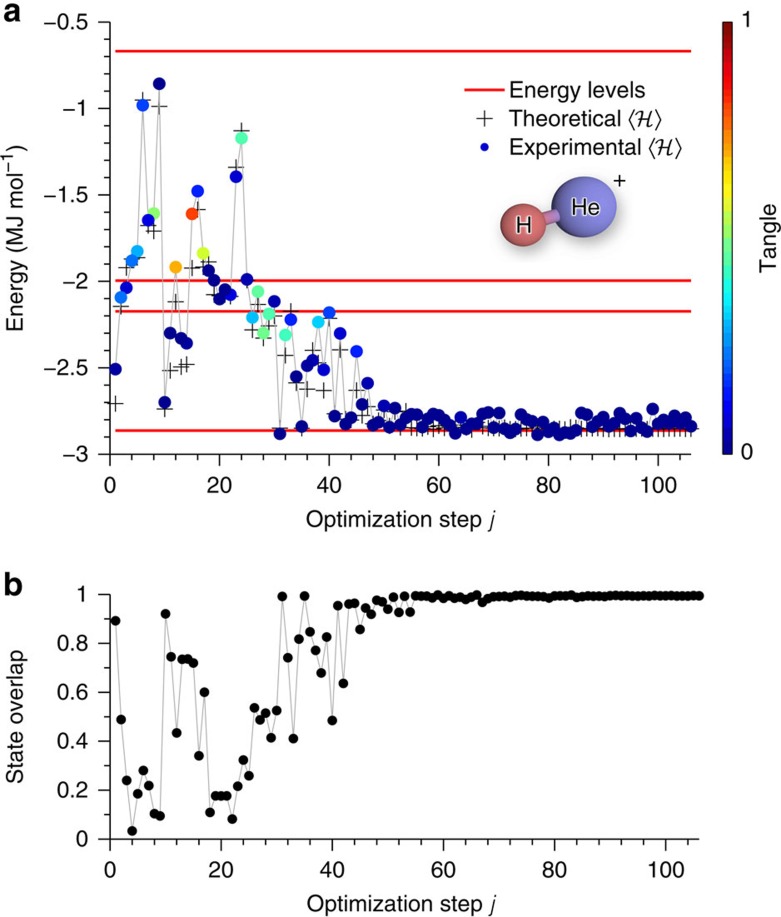
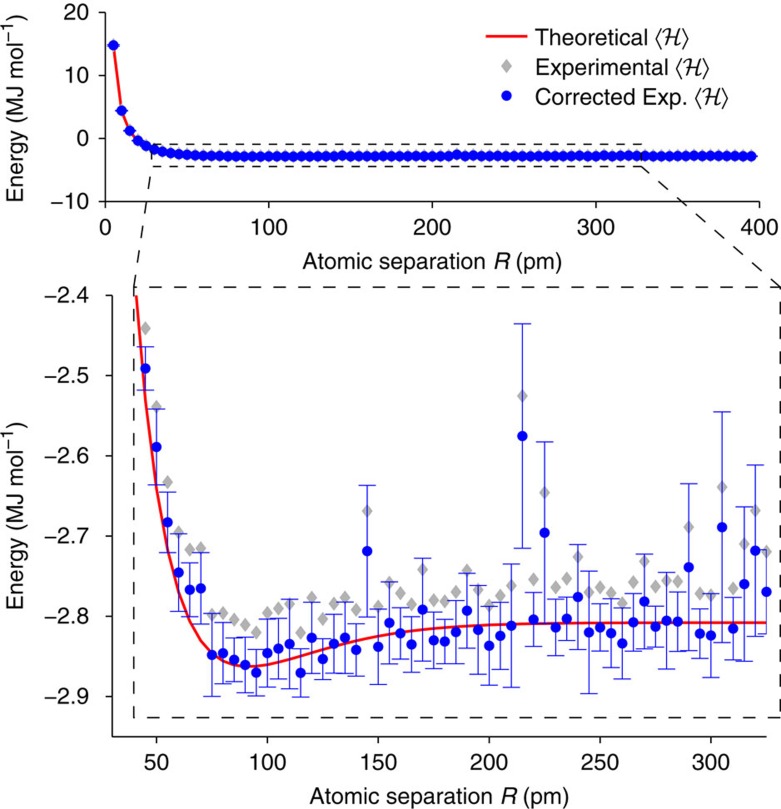
- The authors report an experimental ground-state result for He–H\(^+\): after correcting for experimental errors, they estimate the equilibrium bond length as \(R = 92.3 \pm 0.1\) pm and the ground-state electronic energy as \(E = -2.865 \pm 0.008\) MJ mol\(^{-1}\).
- For the bond dissociation curve, more than 96% of the experimental data are within chemical accuracy of the theoretical values.
- In the discussion, they state that for a 4 × 4 Hamiltonian like the one demonstrated, the QPE circuit would require at least 12 CNOT gates, whereas their method requires one.
- The full experiment was performed in about 158 h, and the bond dissociation curve was obtained by finding the ground states of 79 Hamiltonians.
## Methods
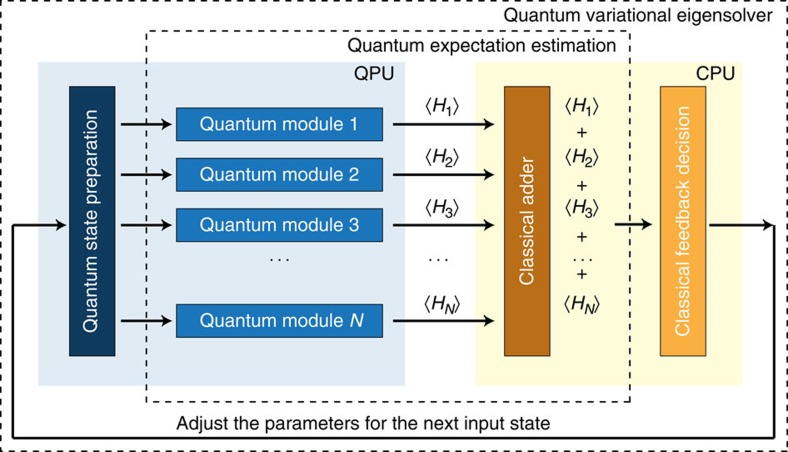
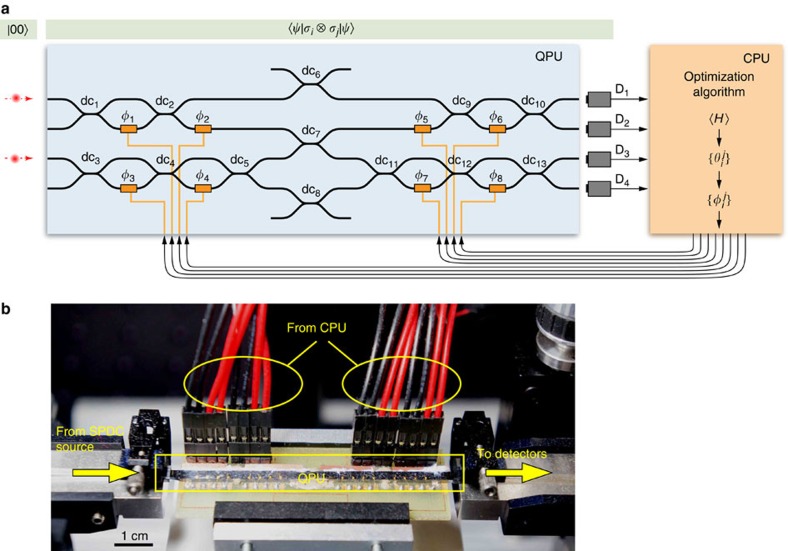
- The paper combines a reconfigurable integrated photonic quantum processor with a classical optimization algorithm: the quantum device estimates Hamiltonian expectation values, and the classical processor updates the state parameters variationally.
- The photonic chip prepares and measures arbitrary two-qubit pure states using single-qubit rotations and one two-qubit entangling gate; the experimental demonstration uses the He–H\(^+\) molecule in a minimal basis.
- For the classical optimization, they use the Nelder–Mead algorithm; expectation values are reconstructed from four two-qubit Pauli measurements at each point.
## Limitations
- The paper states that the method still requires a good approximation to the ground state as input/initialization, and the reliance on multiple separate measurements makes it sensitive to variations in state preparation between calculations.
- The authors report a constant systematic shift of \(\varepsilon = 50\) kJ mol\(^{-1}\) in the measured expectation values; they attribute this to photon-source impurity/distinguishability, circuit imperfections, and unbalanced coupling efficiencies.
- Evident from the text: the demonstration is limited to a two-qubit / 4 × 4 Hamiltonian prototype, so the scalability claim is not experimentally validated here.
Model-written summary. Check it against the paper before relying on it.
Integrity signals
Registry
Cites
Statistics
Figures
Verification
Claims the paper makes
7 Valid · 4 Not valid · 11 Not checked · 59 Own results and interpretations
The cited sources support only part of this claim — read each source’s verdict below.
In the paper
“Recent developments in the field of quantum computation offer a way forward for determining efficient solutions of many instances of large eigenvalue problems that are classically intractable6789101112”
§ A variational eigenvalue solver on a photonic quantum processor > Abstract
What the sources say
- Not matchedcites [6] Nielsen, M. A. & Chuang, I. L. Quantum Computation and Quantum Information Cambridge University Press (2000).
Couldn’t be matched to a paper in Crossref, so it can’t be checked.
- Could not verifycites [7] Kitaev, A. Quantum measurements and the Abelian stabilizer problem. Electronic Colloquium on Computational Complexity (ECCC) 3 (1996). sourceExperimental — accuracy not yet measured
Our copy under this DOI is the ISAAC 2021 paper 'Effective Resistance and Capacitance in Simplicial Complexes and a Quantum Algorithm' (Kitaev's 1995 work appears only as reference [9] in its bibliography), and it nowhere asserts that quantum computation gives efficient solutions to classically intractable large eigenvalue problems. Eigenvalues enter only as complexity parameters — λ, the smallest eigenvalue of the normalized up-Laplacian, in Lemma 31 and Theorem 26 (Section 6.3, 'Time efficient implementations') and in the phase-estimation machinery of Appendix A — and Section 1.1 ('Our Contributions') actually reports the opposite direction for its own problem: 'the quantum algorithm is slower than the classical algorithm in the worst case'. Searched: 'eigenvalue problems classically intractable', 'quantum speedup / exponential advantage', 'phase estimation', 'faster than classical'; no passage addresses the claim's point. (LLM, conf=0.70)
- Partly supportedcites [8] Griffiths, R. B. & Niu, C.-S. Semiclassical fourier transform for quantum computation. Phys. Rev. Lett. 76, 3228–3231 (1996). sourceExperimental — accuracy not yet measured
On p. 1, the paper says a quantum computer, if built, could solve certain problems such as factoring long numbers much faster than conventional algorithms. It also describes a simpler Fourier transform for Shor’s factorization and discrete-logarithm algorithms (p. 1). The copy does not support the claim about efficient solutions to many large eigenvalue problems. (LLM, conf=0.84)
plainstates a cause- Asserted: passes — The authors put it forward as true.
- Checkable: passes — It can be checked against evidence.
- Load-bearing: passes — The paper’s conclusions depend on it.
- Based: passes — The paper gives a reason why it holds.
- Not matched
Every source the paper cites for this claim was checked and supports it.
In the paper
“this would suffer from the N-representability problem, which is known to be intractable for both classical and quantum computers (it is in the quantum complexity class QMA-Hard24).”
§ A variational eigenvalue solver on a photonic quantum processor > Results > Quantum expectation estimation
What the sources say
- Supportedcites [24] Liu, Y.-K., Christandl, M. & Verstraete, F. Quantum computational complexity of the n-representability problem: Qma complete. Phys. Rev. Lett. 98, 110503 (2007). source
The paper states that N-representability is QMA-complete and hence QMA-hard and NP-hard (Abstract). Its discussion of quantum-chemistry relevance says the problem is intractable in the worst case even on a quantum computer, while allowing that particular physical systems may be easier. (LLM, conf=0.93)
boosted- Asserted: passes — The authors put it forward as true.
- Checkable: passes — It can be checked against evidence.
- Load-bearing: passes — The paper’s conclusions depend on it.
- Based: passes — The paper gives a reason why it holds.
- Supported
Every source the paper cites for this claim was checked and supports it.
In the paper
“We have implemented the QPU using integrated quantum photonics technology30.”
§ A variational eigenvalue solver on a photonic quantum processor > Results > Prototype demonstration
What the sources say
- Supportedcites [30] O'Brien, J. L., Furusawa, A. & Vuckovic, J. Photonic quantum technologies. Nat. Photon. 3, 687–695 (2009). source
The citation identifies integrated quantum photonics as the technology used, rather than attributing the citing authors’ QPU implementation to this review. The “Integrated quantum optical circuits” section (p. 6) describes on-chip waveguide circuits performing quantum logic gates and a compiled quantum factoring algorithm. (LLM, conf=0.87)
plain- Asserted: passes — The authors put it forward as true.
- Checkable: passes — It can be checked against evidence.
- Load-bearing: passes — The paper’s conclusions depend on it.
- Based: passes — The paper gives a reason why it holds.
- Supported
The cited sources support only part of this claim — read each source’s verdict below.
In the paper
“The time the quantum computer must remain coherent is determined by the necessity of O(p−1) successive applications of , each of which can require on the order of millions or billions of quantum gates for practical applications1719, as compared to the tens to hundreds of gates achievable in the short term.”
§ A variational eigenvalue solver on a photonic quantum processor > Abstract
What the sources say
- Partly supportedcites [17] Whitfield, J. D., Biamonte, J. & Aspuru-Guzik, A. Simulation of electronic structure hamiltonians using quantum computers. Mol. Phys. 109, 735–750 (2011). sourceExperimental — accuracy not yet measured
Split into 2 atoms — 1 confirmed, 1 partially supported, 0 disputed, 0 misattributed, 0 unverifiable. Expand the claim to see per-atom verdicts.
- Partly supportedcites [19] Jones, N. C. et al. Faster quantum chemistry simulation on fault-tolerant quantum computers. New J. Phys. 14, 115023 (2012). sourceExperimental — accuracy not yet measured
Split into 2 atoms — 0 confirmed, 2 partially supported, 0 disputed, 0 misattributed, 0 unverifiable. Expand the claim to see per-atom verdicts.
plainstates a cause- Asserted: passes — The authors put it forward as true.
- Checkable: passes — It can be checked against evidence.
- Load-bearing: passes — The paper’s conclusions depend on it.
- Based: passes — The paper gives a reason why it holds.
- Partly supported
A result the paper reports from its own data — it cites no other source for it, so there is none to check. The quote shows it is in the paper.
In the paper
“We experimentally demonstrate the feasibility of this approach with an example from quantum chemistry—calculating the ground-state molecular energy for He–H+.”
§ A variational eigenvalue solver on a photonic quantum processor > Abstract
boostedstates a causeSingle case- Asserted: passes — The authors put it forward as true.
- Checkable: passes — It can be checked against evidence.
- Load-bearing: passes — The paper’s conclusions depend on it.
- Based: passes — The paper gives a reason why it holds.
31 more claims
Create a free account to see all 81 claims and to verify the 4 references still open.
- It may state two separate claims as one. 28
- Probably not a substantial claim. 24
Claims other papers make about this one
Each is checked against this paper’s own text: does it say what the citing paper says it does?
The cited source doesn’t support the claim as written.
In the citing paper
“Leveraging quantum resources, the UCC ansatz was instead realized as a PQC on a photonic processor (Peruzzo et al. , 2014).”
From Noisy intermediate-scale quantum algorithms (2022) · cites this paper as Peruzzo et al., 2014
Checked by a reasoning model — may be wrong.
Experimental — accuracy not yet measuredThe cited source doesn’t support the claim as written.
In the citing paper
“The first on-chip GMM of four-qubit cluster state was realised in a laser-writing chip ( Fig.4e ), by manipulating both the polarisation and path DoFs of two photons [85].”
From Integrated photonic quantum technologies (2020) · cites this paper as [85]
Checked by a reasoning model — may be wrong.
Experimental — accuracy not yet measuredThe cited source doesn’t support the claim as written.
In the citing paper
“four-qubit linear- and box-cluster states are generated in a laser-writing photonic chip. This is enabled by on-chip manipulating the two-photon four-qubit hyperentangled state and cluster state, that are encoded in photon's path and polarisation DoFs. The Grover's search algorithm on a four-element database was implemented by controlling the device.”
From Integrated photonic quantum technologies (2020) · cites this paper as [85]
Checked by a reasoning model — may be wrong.
Experimental — accuracy not yet measuredThe source backs part of the claim, not all of it — or backs it for a different population, condition or comparison.
In the citing paper
“Due to its versatility, the variational Hamiltonian ansatz has been implemented for quantum chemistry [21, 29], optimization [24], and for quantum simulation problems [30].”
From Variational quantum algorithms (2021) · cites this paper as [29]
Experimental — accuracy not yet measuredThe source backs part of the claim, not all of it — or backs it for a different population, condition or comparison.
In the citing paper
“For the original VQE (Peruzzo et al. , 2014) and QAOA (Farhi et al. , 2014) it can, for example, be described as a single expectation value min θ ⟨ H ⟩ U ( θ ) , where the differences solely appear in the specific form and construction of the qubit Hamiltonian.”
From Noisy intermediate-scale quantum algorithms (2022) · cites this paper as Peruzzo et al., 2014
Experimental — accuracy not yet measured
12 more claims about this paper
Create a free account to see every claim other papers make about this one.
Citations
Cites
A Simplex Method for Function Minimization
Nelder, J. A., & Mead, R. (1965) · The Computer Journal · doi:10.1093/comjnl/7.4.308 · Cited by 28,905
Quantum computation and quantum information
Law, J. (2001) · ACM SIGSOFT Software Engineering Notes · doi:10.1145/505482.505499 · Cited by 18,842
(1999) · Cited by 12,854
Practical Methods of Optimization
Fletcher, R. (2000) · Wiley eBooks · doi:10.1002/9781118723203 · Cited by 7,605 · cited 3×
“[12] S.”
BackgroundMethodPractical methods of optimization
(1988) · Mathematics and Computers in Simulation · doi:10.1016/0378-4754(88)90129-2 · Cited by 5,818
Quantum Algorithm for Linear Systems of Equations
Harrow, A. W., Hassidim, A., & Lloyd, S. (2009) · Physical Review Letters · doi:10.1103/physrevlett.103.150502 · Cited by 3,325
Conn, A. R., Gould, N. I. M., & Toint, P. L. (2000) · Society for Industrial and Applied Mathematics eBooks · doi:10.1137/1.9780898719857 · Cited by 2,981 · cited 3×
“[14] D.”
MethodInfluential�ber das Paulische �quivalenzverbot
Jordan, P., & Wigner, E. (1928) · Zeitschrift f�r Physik · doi:10.1007/bf01331938 · Cited by 2,597
Molecular Electronic‐Structure Theory
Helgaker, T., Jørgensen, P., & Olsen, J. (2000) · doi:10.1002/9781119019572 · Cited by 2,594
O'Brien, J. L., Furusawa, A., & Vučković, J. (2009) · Nature Photonics · doi:10.1038/nphoton.2009.229 · Cited by 2,388
Self-citation
Research works printed but not linked: 3
- Helgaker, T., Jorgensen, P. & Olsen, J. Mol. Electronic Struct. Theory Wiley, Sussex (2002).
- Saad, Y. Numerical Methods for Large Eigenvalue Problems Vol. 158, (SIAM (1992).
- Rayleigh, J. W. In finding the correction for the open end of an organ-pipe. Phil. Trans. 161, 77 (1870).
Cited by
Items 4,101–4,200 of 4,572
Quantum Computing for Graph Optimization: An Approach to the Shortest Path Problem
Bembale, A., Singh, N., Vinayaka, P., & Choudhary, J. (2025) · Lecture notes in networks and systems · doi:10.1007/978-981-95-0681-1_27
Optimal Qubit Reuse for Quantum Computation with Gate Reordering and Eager Measurement
Yu, W., Chen, T.-F., Chan, Y., Jiang, J.-H. R., Chiou, D.-W., & Chang, Y. (2025) · IEEE International Conference on Quantum Computing and Engineering (QCE) · doi:10.1109/qce65121.2025.00067
Combinatorial Optimization with Few Qubits
Raymond, R., Buts, A., & Pistoia, M. (2025) · IEEE International Conference on Quantum Computing and Engineering (QCE) · doi:10.1109/qce65121.2025.00015 · Cited by 1
“Quantum algorithms utilizing parameterized quantum circuits in the form of Variational Quantum Eigen-solver (VQE) [3], [4] and Quantum Approximate Optimization Algorithm (QAOA) [5] are popular for optimization that promise quantum advantages under noisy and limitation of near-term quantum devices…”
Artag, J., Awaya, K., Kanezashi, T., et al. (2025) · IEEE International Conference on Quantum Computing and Engineering (QCE) · doi:10.1109/qce65121.2025.10448
“Within this framework, we conduct a comparative study of Classical Genetic Algorithm (CGA), Quantum-Inspired Genetic Algorithm (QIGA) [3, 4], and hybrid Quantum-Assisted Genetic Algorithm (QAGA) with Variational Quantum Eigensolver (VQE) [5] mutations.”
Kojima, R., Kamoshita, M., & Kanno, K. (2025) · IEEE International Conference on Quantum Computing and Engineering (QCE) · doi:10.1109/qce65121.2025.00250 · Cited by 5
“Quantum chemistry is attracting attention as a promising application of quantum algorithms on quantum computers, and various studies have been actively conducted, including quantum algorithms based on FTQC [2–5], and can be implemented in NISQ devices (NISQ algo-rithm) [6–12].”
InfluentialEfficient Quantum Gradient and Higher-Order Derivative Estimation Via Generalized Hadamard Test
Li, D., Dulal, D., Ohorodnikov, M., Wang, H., & Ding, Y. (2025) · IEEE International Conference on Quantum Computing and Engineering (QCE) · doi:10.1109/qce65121.2025.00024 · Cited by 12
“…have been shown, in practice, to accelerate convergence in numerous VQAs, including the Quantum Approximate Optimization Algorithm (QAOA) [12]–[14], Variational Quantum Eigensolver (VQE) [15]–[18], Quantum-Assisted Quantum Compilation (QAQC) [19], [20], and Quantum Neural Networks (QNNs) [21]–[26].”
Towards Solving Large QUBO Problems Using Quantum Algorithms: Improving the LogQ Scheme
Chatterjee, Y., & Messud, J. (2025) · IEEE International Conference on Quantum Computing and Engineering (QCE) · doi:10.1109/qce65121.2025.00218 · Cited by 2
Murota, K., & Kobori, T. (2025) · IEEE International Conference on Quantum Computing and Engineering (QCE) · doi:10.1109/qce65121.2025.00171
“This synergetic strategy has already shown promise in contexts such as variational quantum eigensolvers (VQEs) [38] and quantum generative modeling [39].”
Optimal Fermion-Qubit Mappings via Quadratic Assignment
Chiew, M., Ibrahim, C., Safro, I., & Strelchuk, S. (2025) · IEEE International Conference on Quantum Computing and Engineering (QCE) · doi:10.1109/qce65121.2025.00068 · Cited by 12
On Quantum Bsde Solver for High-Dimensional Parabolic Pdes
Su, H., & Tseng, H.-H. (2025) · IEEE International Conference on Quantum Computing and Engineering (QCE) · doi:10.1109/qce65121.2025.10320 · Cited by 1
“Key examples include the Variational Quantum Eigensolver (VQE) [8], [9] for electronic-structure problems and the Quantum Approximate Optimisation Algorithm (QAOA) [10], [11] for combinatorial optimisation.”
Making Neural Networks More Suitable for Approximate Clifford+T Circuit Synthesis
Weiden, M., Kalloor, J., Kubiatowicz, J. D., & Iancu, C. (2025) · IEEE International Conference on Quantum Computing and Engineering (QCE) · doi:10.1109/qce65121.2025.00062 · Cited by 1
“This suite includes Shor’s algorithm [34], TFIM, Heisenberg, and Hubbard model circuits from quantum chemistry simulations [3], as well as trained VQE [25], QAOA [11], and Quantum Phase Estimation circuits [13].”
Plazanet, M., & Ayral, T. (2025) · The Journal of Chemical Physics · doi:10.1063/5.0299885 · Cited by 1
“This hybrid algorithm, called the variational quantum eigensolver (VQE, [31], see [37] for a review), a priori allows one to pick a variational state whose preparation on the quantum processor will be faster than decoherence, while being complex enough that its energy would be hard to measure on a…”
Reinforcement Learning for Quantum Phase Estimation Using Deep Q-Network
Sundharess, B., Vikash Krishna, R., Gopika, S. S., Sinha, S., Donald, A. C., & Paul, A. (2025) · IEEE Madhya Pradesh Section Conference (MPCON) · doi:10.1109/mpcon66082.2025.11256566
“This project uses the core algorithm for reinforcement learning: the Deep Q-Network, which is the amalgamation of the traditional Q-learning and deep neural networks, so it will work well for complex optimization in the task of Quantum Phase Estimation [13].”
Kodanganti, K. K., & Kodanganti, D. (2025) · IEEE India Council International Subsections Conference (INDISCON) · doi:10.1109/indiscon66021.2025.11254748 · Cited by 1
“To summarize, the literature presents a straightforward trend from theory [19], to the realization of VQE [3], and quantum-enhanced generative models [5].”
Slice-wise initial state optimization to improve cost and accuracy of the VQE on lattice models
Gaberle, C., & Jattana, M. S. (2025) · Physica Scripta · doi:10.1088/1402-4896/ae26f8 · Cited by 2
“…quantum (NISQ) era, the Variational Quantum Eigensolver (VQE), which overcomes the downsides of these devices in a classical-assisted optimization scheme, is one of the most promising algorithms to leverage quantum computing even in these still early stages of hardware development [1, 2, 3].”
Anderson, D. Z., Chomaz, P., Takeuchi, S., Arakawa, Y., Baba, Y., Benson, O. J., Soderberg, K.-A., Diamanti, E., Elkouss, D., Fujii, K., et al. (2025) · Journal of Physics B Atomic Molecular and Optical Physics · doi:10.1088/1361-6455/ae271a
Anurag, K. S. V., Patra, A. K., Ghevade, V. D., Shankar, P. S., Bhat, R., Raghavendra, V., Maitra, R., & Jaiganesh, G. (2026) · Journal of Computational Chemistry · doi:10.1002/jcc.70379 · Cited by 9
“The VQE algorithm, on the other hand, approximates the ground-state energy of the given Hamiltonian by preparing parameterized quantum circuits, known as ansätze, and iteratively optimizing the parameters of the ansatz using classical optimizer feedback loops 23,24 .”
Random State Approach to Quantum Computation of Electronic-Structure Properties
Bai, Y., Xiong, F., & Kuang, X. (2025) · Chinese Physics Letters · doi:10.1088/0256-307x/43/1/010604 · Cited by 2
Wakaura, H., & Tomono, T. (2025) · International Journal of Quantum Information · doi:10.1142/s0219749925500388 · Cited by 9
Modeling and Performance Evaluation of Hybrid Classical–Quantum Serverless Computing Platforms
Kartik, W., Shubham, V., Dhananjay, M., & Gaikwad, P. P. V. (2025) · International Journal of Advanced Research in Science Communication and Technology · doi:10.48175/ijarsct-30155
Thermal Weight Determination and Interstate Coupling in State-Averaged ADAPT-VQE
Grimsley, H. R., & Evangelista, F. A. (2025) · Journal of Chemical Theory and Computation · doi:10.1021/acs.jctc.5c01313
Selected Configuration Interaction Using Time-Evolved Population Statistics
Weaving, T., Mingare, A., Ralli, A., & Coveney, P. V. (2026) · Journal of Chemical Theory and Computation · doi:10.1021/acs.jctc.5c01994 · Cited by 14
“101 For smaller systems, most of the molecular integrals are significant, and therefore the number of two-electron terms increases as = L M ( ) 4 .”
Gradient scalability and Taylor surrogation of quantum cost landscapes
Meyer, S., Scala, F., Tacchino, F., & Lucchi, A. (2026) · Physical Review Research · doi:10.1103/l9bp-dccf · Cited by 2
Djordjević, I. B. (2025) · Elsevier eBooks · doi:10.1016/b978-0-443-40568-6.00006-9
Doubling qubits in a trapped-ion system via vibrational dual-rail encoding
Kang, M.-S., Chen, W., Kwon, H., Kim, K., & Huh, J. (2026) · Physical Review A · doi:10.1103/vd8s-75px · Cited by 5
“Variational quantum eigensolver (VQE) [58] and quantum approximate optimization algorithm (QAOA) [59] are VQAs that use parameterized quantum circuits to minimize the expectation value of a target Hamiltonian through parameter optimization.”
Li, X., & Yin, Z. (2026) · Physical review. B./Physical review. B · doi:10.1103/fq4j-2p2l
“In particular, the Variational Quantum Eigensolver (VQE) [6–10] enables approximate ground state preparation without requiring fault-tolerant error correction, opening new pathways for studying QPTs on near-term quantum hardware [11, 12].”
Chen, L., Zou, P., & Yu, Y. (2025) · Chinese Physics B · doi:10.1088/1674-1056/ae29f7
Measurement-efficient ADAPT-VQE with the SOAP parameter optimizer
Jiang, X., Sheng, Z., Gong, C., Li, W., & Shuai, Z. (2025) · The Journal of Chemical Physics · doi:10.1063/5.0296397
Khinevich, V., & Mizukami, W. (2025) · Physical Review Research · doi:10.1103/rbhc-dkh1 · Cited by 9
“Ad-ditionally, the reaction barriers for two [3+2] cycloaddition reactions are evaluated, and the application of CBS extrapolation techniques to enhance QC-CBT-AFQMC calculations is discussed.”
InfluentialExtended parameter-shift rules with minimal derivative variance for parameterized quantum circuits
Lai, Z., Hu, J., An, D., & Wen, Z. (2025) · Physical Review Applied · doi:10.1103/f57b-q28w · Cited by 1
“In the VQA framework, the variational quantum eigensolver (VQE) [5–11] not only efficiently estimates the ground-state energies of molecular systems, but also simulates quantum dynamics, while the quantum approximate optimization algorithm (QAOA) [12–14] offers distinct advantages for tackling…”
Variational quantum algorithm for generalized eigenvalue problems of non-Hermitian systems
Li, J., Fan, Z., Yao, H., Yang, C., Fei, S.-M., Zhou, Z.-T., Dou, M.-H., & Ma, T.-Y. (2025) · Physical Review A · doi:10.1103/n7fj-lvx5
“…eigen-solver (VQE)—a classical-quantum hybrid framework designed to estimate ground state energies of Hamiltonians on near-term quantum devices [13–15]—has been further extended to the variational quantum generalized eigen-solver (VQGE) for computing minimal generalized eigenvalues of…”
Liu, Y., Hu, Z., Zheng, X., & Li, Z. (2025) · Physical Review A · doi:10.1103/b8tq-169m · Cited by 1
Qiao, M., & Liu, Y.-X. (2025) · Physical Review A · doi:10.1103/p78c-9rxb · Cited by 1
“Representative hybrid approaches like the variational quantum eigensolver (VQE) [9–11] have been successfully applied to chemistry [11–14], materials science [15–18], biology [19–21], and drug discovery [22–24].”
Quantum Computers and Computing a Better World
Velu, C. K., Norman, K. W., Zhu, Y., Putra, F. H. R., & Noble, C. (2025) · Springer eBooks · doi:10.1007/978-3-031-99808-9_2
Unbiased observable estimation with approximate channels in fault-tolerant quantum computation
Khitrin, D., Brown, K. R., & Anand, A. (2025) · Quantum Science and Technology · doi:10.1088/2058-9565/ae2efa · Cited by 4
Additional file 1 of Modelling carbon capture on metal-organic frameworks with quantum computing
Greene‐Diniz, G., Manrique, D. Z., Sennane, W., Magnin, Y., Shishenina, E., Cordier, P., Llewellyn, P. L., Krompiec, M., Rančić, M. J., & Ramo, D. M. (2024) · Figshare · doi:10.6084/m9.figshare.26554478
LABRIKI, F. E., Elassad, Z. E. A., Meslouhi, O. E., et al. (2025) · SSRN Electronic Journal · doi:10.2139/ssrn.5525974
OpenMP-Q: Quantum Task Offloading in OpenMP
Mittal, S., Mahesh, A., & Mueller, F. (2025) · Lecture notes in computer science · doi:10.1007/978-3-032-06343-4_6
“Variational algorithms such as QAOA [17] (Quantum Approximate Optimization Algorithm) and VQE [32] (Variational quantum eigensolver) extend this promise to domains with realistic applications including combinatorial optimization, quantum chemistry, and machine-learning.”
Efficient full-state simulation for quantum AI systems
Zhao, Y., Chen, Y., Li, H., Wang, Y., Chang, K., Wang, B., Li, B., & Han, Y. (2025) · Elsevier eBooks · doi:10.1016/b978-0-44-330259-6.00016-5
Variational Quantum Factorization on a Silicon Photonic Chip
Baldazzi, A., Sanna, M., Azzini, S., & Pavesi, L. (2025) · Conference on Lasers and Electro-Optics · doi:10.1364/cleo_fs.2025.ff105_6
Encoding molecular structures in quantum machine learning
Boy, C., Altamura, E., Manawadu, D., Tavernelli, I., Mensa, S., & Wales, D. J. (2025) · Machine Learning Science and Technology · doi:10.1088/2632-2153/ae304f · Cited by 6
“In contrast to methods like variational quantum eigensolvers (VQE) [40] or meta-VQE [41], which require separate circuit evaluations for each molecular configuration, MQT offers a more data-efficient alternative.”
Quantum Computing Reveals Energetics of Tau Peptide FragmentsPreprint
Guruacharya, A., & Rajbanshi, B. (2025) · bioRxiv (Cold Spring Harbor Laboratory) · doi:10.64898/2025.12.21.695828
“Variational quantum algorithms, particularly the variational quantum eigensolver (VQE), have been extensively explored as near-term strategies for computing molecular ground-state energies on noisy intermediate-scale quantum (NISQ) devices [4,5].”
Prospects for Quantum Computing in Onboard Computer Systems for Robotics
Bocharov, N. (2025) · Summa · doi:10.1109/summa68668.2025.11302253
“For perception tasks, the principal component analysis (PCA) method [8] is often used to reduce data dimensionality (to extract the main features of an image or a point cloud).”
Security Evaluation of Quantum Circuit Split Compilation Under an Oracle-Guided Attack
Zhang, H., & Liu, Y. (2025) · IEEE International Conference on Computer Design: VLSI in Computers and Processors (ICCD) · doi:10.1109/iccd65941.2025.00053
“For example, the Quantum Approximate Optimization Algorithm (QAOA) targets combinatorial optimization with potential polynomial advantages [16], [17], while the Variational Quantum Eigen-solver (VQE) has shown promise in quantum chemistry applications [18], [19].”
Quantum-Enhanced Hardware Platforms for 6G Mobile Edge Computing
Ghaderi, S., Bassoli, R., & Fitzek, F. H. P. (2025) · IEEE Future Networks World Forum (FNWF) · doi:10.1109/fnwf66845.2025.11317287
“…and latency: Near-term utility at the mobile edge is limited to shallow hybrid variational circuits (e.g., QAOA/VQE: VQE on photonics shown in [11]) with depths of 1–3 and end-to-end hybrid iteration latencies within 50–200 µs under tight coupling; loose LAN/NIC coupling typically requires…”
Quantum Machine Learning: Merging Quantum and AI
Gadde, S. S., & Nalwade, A. P. (2026) · Springer eBooks · doi:10.1007/978-3-032-10775-6_8
Quantum Clustering for Classification of DNA Sequences
Vancea, V. (2026) · Communications in computer and information science · doi:10.1007/978-3-032-12481-4_11
Quantum Computing as a Paradigm Shift in Mechanical and Allied Engineering
Sharma, V. K. (2026) · Springer eBooks · doi:10.1007/978-3-032-10775-6_11
Prediction of Molecular Structures and Properties by Using Quantum Technology
Krishna, R. (2025) · American Journal of Physical Chemistry · doi:10.11648/j.ajpc.20251404.14
Advancements in numerical methods for quantum resources
Kožić, S. B., Torre, G., & Giampaolo, S. M. (2026) · Journal of Statistical Mechanics Theory and Experiment · doi:10.1088/1742-5468/ae1ff9 · Cited by 1
“Alternatively, Variational Quantum Eigensolver and related quantum solvers prepare variational states on hardware for observable estimation, supplying experimental inputs for resource measures and revealing the impact of device noise [126–128].”
QAISim: a toolkit for modeling and simulation of AI in quantum cloud computing environments
Singh, I., Gill, S. S., Sun, J., & Mol, J. A. (2026) · Cluster Computing · doi:10.1007/s10586-025-05879-9
“PQCs or Variational Quantum Circuits (VQCs) are quantum models with a set of trainable variables used in its operations [28, 29, 30].”
Optimal Complexity of Parameterized Quantum Circuits
Correr, G. I., Azado, P. C., Soares-Pinto, D. O., & Carlo, G. G. (2026) · Entropy · doi:10.3390/e28010073 · Cited by 3
“Knowing which are the best architectures for implementing different quantum protocols like variational quantum algorithms, is also highly relevant [5–8].”
Variational quantum eigensolver models of molecular quantum dot cellular automata
Gautam, N. B., & Blair, E. P. (2026) · Journal of Applied Physics · doi:10.1063/5.0304168
Drug Discovery with Quantum Machine Learning
Pyrkov, A., Aliper, A., Bezrukov, D. S., & Zhavoronkov, A. A. (2026) · Springer eBooks · doi:10.1007/978-3-031-98022-0_10 · Cited by 1
Real-time error mitigation for variational optimization on quantum hardware
Robbiati, M., Sopena, A., Papaluca, A., & Carrazza, S. (2026) · Physical Review Research · doi:10.1103/zyb2-zl2d · Cited by 14
“They have several concrete applications already validated, such as electronic structure modelization in quantum chemistry [3–6], for instance.”
BackgroundApplication of Quantum Computers to Study the Dative Bond Between Pyridine Molecule and Lithium Ion
Ghasemi, F., Kawashima, Y., & Moon, K. (2025) · IEEE Conference on Pervasive and Intelligent Computing (PICom) · doi:10.1109/picom68402.2025.00045
“The most notable among these hybrid algorithms is the Variational Quantum Eigensolver (VQE) [17].”
Hybrid Quantum-Classical Simulations of Graphene Analogues: Adsorption Energetics Beyond DFT
Rayabharam, A., & Aluru, N. R. (2026) · The Journal of Physical Chemistry A · doi:10.1021/acs.jpca.5c06607 · Cited by 1
Quantum Computing-Based State-of-Charge Estimation of Electric Vehicle Battery
Kumar, S. S., Vinod Kumar, D. M., & Deshmukh, R. (2026) · Advances in computational intelligence and robotics book series · doi:10.4018/979-8-3373-7041-5.ch011
Mapping the quantum computing landscape: growth, collaboration, and thematic convergence
Conde-Torres, D., Seco-González, A., Piñeiro, Á., & Fandino, R. G. (2026) · EPJ Quantum Technology · doi:10.1140/epjqt/s40507-026-00464-4 · Cited by 3
“The variational quantum eigensolver (VQE), proposed in 2014, together with amplitude amplification protocols, enabled the first practical applications in quantum chemistry, finance, and optimization on noisy intermediate-scale quantum (NISQ) devices [23].”
Fast and memory-efficient strong simulation of noisy adaptive linear optical circuits
Brugière, T. G. D., & Heurtel, N. (2026) · Computer Physics Communications · doi:10.1016/j.cpc.2025.110016 · Cited by 1
“The versatility and computational power of linear optics have led to extensive studies both in the context of passive implementations [1,32,27] and adaptive approaches for quantum applications [10,20] and scalable quantum computing schemes [43,28,9,5,15,3].”
Goyal, K., & Pathak, A. (2025) · International Conference on AI-ML Systems (AIMLSystems) · doi:10.1109/aimlsystems67835.2025.11331164
Quantum Machine Learning Models for Enhancing Big Data Analytics
Prasant, P., Hariharan, R., Sudha, E., Jeshurun, S. B., Radhakrishna, V., & Reddy, P. V. V. (2025) · International Conference on Future Technologies (ICFT) · doi:10.1109/icft66708.2025.11336505 · Cited by 2
“The models are useful in areas of fraud detection, medical diagnosis, and IoT anomaly detection through the application of these models since their prediction accuracy is enhanced, and the complexity of parameters is lower [20].”
Scalable Quantum Approximate Optimisation with Adaptive Bayesian Dimensionality Reduction
Alizadeh, A., Pourabdollah, A., & Lotfi, A. (2025) · IEEE International Conference on Quantum Artificial Intelligence (QAI) · doi:10.1109/qai63978.2025.00037
Connecting Quantum Computing with Classical Stochastic Simulation
Blanchet, J., Squillante, M. S., Szegedy, M., & Wang, G. (2025) · Winter Simulation Conference · doi:10.1109/wsc68292.2025.11339097 · Cited by 2
“Algorithms like the Variational Quantum Eigensolver (VQE) due to Peruzzo et al. (2014) and the Quantum Approximate Optimization Algorithm (QAOA) due to Farhi et al. (2014) are heuristic hybrid approaches that combine quantum resources with classical feedback, aiming to achieve quantum advantage.”
An Effective QUBO Formulation for Knapsack Problems
Samanta, S., Wang, D.-G., Hodges, T. M. W., & Ferenczi, A. (2025) · 2025 IEEE International Conference on Quantum Artificial Intelligence (QAI) · doi:10.1109/qai63978.2025.00039 · Cited by 1
ResQGRNN: Quantum-Compatible Residual Learning for Graph Recurrent Neural Networks
Kaldari, J., Kashif, M., Al-Kuwari, S. M., & Shafique, M. (2025) · IEEE International Conference on Quantum Artificial Intelligence (QAI) · doi:10.1109/qai63978.2025.00026
“VQEs can be used to find the near-ground state of a system [24], leading to various applications ranging from drug discovery [25] to finance [26].”
Approximating Ground States of Quantum Hamiltonians with Snapshot-QAOA
Tate, R., Langfitt, Q., Pelofske, E., Kirmani, A. A., Bärtschi, A., Golden, J. K., & Eidenbenz, S. (2025) · IEEE International Conference on Quantum Artificial Intelligence (QAI) · doi:10.1109/qai63978.2025.00035 · Cited by 1
Edwards, M. S. (2026) · Springer eBooks · doi:10.1007/978-3-032-03650-6_10
An Automatic Operator Designer for Variational Quantum Eigensolver Search Based on RNN Prediction
Ji, J., Zhuo, E., Wang, L., Zhang, Z., & Yu, X. (2026) · Communications in computer and information science · doi:10.1007/978-981-95-4791-3_5
Quantum distortion model for running variational quantum algorithms without error corrections
Daskin, A. (2026) · Discover Quantum Science · doi:10.1007/s44464-026-00006-y
“The Variational Quantum Eigensolver (VQE) is a hybrid quantum-classical algorithm [54, 63] designed to find the ground state energy of quantum systems.”
Predicting Adaptively Chosen Observables in Quantum Systems
Huang, J., Lewis, L., Huang, H.-Y., & Preskill, J. P. (2026) · PRX Quantum · doi:10.1103/xhn1-vnp9 · Cited by 5
Chao, S., Deng, Y., Liu, Z., & Zhang, Y. (2025) · Conference proceedings/Conference proceedings - IEEE International Conference on Systems, Man, and Cybernetics · doi:10.1109/smc58881.2025.11342998
“In order to solve this problem, Peruzzo et al. proposed the Variational Quantum Eigensolver (VQE), which greatly reduced the required circuit depth [2].”
Electro-Optic Photonic Ququart Variational Quantum Eigensolver on Lithium-Niobate-on-Insulator
Lee, J., Kim, Y., Han, S. H., et al. (2025) · Frontiers in Optics + Laser Science (FiO, LS) · doi:10.1364/fio.2025.ftu1b.3
Hettiarachchi, A., & Dissanayaka, K. D. (2025) · International Conference on Advancements in Computing (ICAC) · doi:10.1109/icac69156.2025.11361497 · Cited by 1
“Similarly, variational quantum eigensolvers may require different protection levels during state preparation versus energy estimation [8].”
Photonic QPU With Coherent States for Reversible Quantum Logic
Aguiar, A. F., Gomes, O. C. V., & Silva, J. B. R. (2026) · Annalen der Physik · doi:10.1002/andp.202500635
Distributed exact generalized Grover’s algorithm
Zhou, X., Xu, X., Zheng, S., & Luo, L. (2026) · Frontiers of Computer Science · doi:10.1007/s11704-025-50239-w · Cited by 6
Self-citationAlfraihi, H., Zada, I., Ahmed, M., et al. (2026) · IET Software · doi:10.1049/sfw2/7827044
Singh, M. S. I., & Rawal, B. S. (2026) · Springer eBooks · doi:10.1007/978-981-95-2498-3_6
Lang, R. A., Mehendale, S. G., Ryabinkin, I. G., & Izmaylov, A. F. (2026) · Journal of Chemical Theory and Computation · doi:10.1021/acs.jctc.5c01849 · Cited by 3
“State-specific excited-state solvers, such as ∆ ADAPT-VQE 39 , address this challenge by extending the ∆ SCF method 40 to the quantum-computing setting.”
InfluentialK-ADAPT-VQE: Optimizing Molecular Ground State Searches by Chunking Operators
Bespalova, T. A., Ladhari, O., & Masella, G. (2026) · Communications in computer and information science · doi:10.1007/978-3-032-13855-2_20 · Cited by 1
Chen, Y. C., Wu, R., Cheng, M. H., et al. (2026) · Communications in computer and information science · doi:10.1007/978-3-032-13855-2_21
Hamiltonian-based qutrit quantum neural network with multi-subspace feature mapPreprint
Rodríguez, P. A. (2026) · Research Square · doi:10.21203/rs.3.rs-8332601/v1
Introduction to quantum computing
Sheets, H. D., & Dupin, M. (2026) · Elsevier eBooks · doi:10.1016/b978-0-443-34193-9.01002-4
Global and public health implications for quantum computing
Haider, M. R., Sarwar, G., Rahman, M. H., & Rahman, A. E. (2026) · Elsevier eBooks · doi:10.1016/b978-0-443-34193-9.00008-9
Getting ready for a quantum future
Roosan, D. (2026) · Elsevier eBooks · doi:10.1016/b978-0-443-34193-9.00015-6 · Cited by 1
Analysis of Fourth-, Fifth-, and Infinite-Order Triple Excitations in Unitary Coupled Cluster Theory
Windom, Z. W., & Claudino, D. (2026) · The Journal of Physical Chemistry A · doi:10.1021/acs.jpca.5c07483
Variational quantum algorithm for constrained combinatorial optimization problems
Li, H., Han, Y.-L., Wang, Z., & Fei, S. (2026) · Physical Review A · doi:10.1103/ykxd-h19w · Cited by 3
“As hybrid quantum-classical algorithms, VQAs have emerged as the leading strategy to attain quantum advantages on noisy intermediate-scale quantum devices [13, 15, 16].”
Nguyen, B. T., Nguyen, V., & Thi, H. L. (2026) · International Journal of Modern Physics C · doi:10.1142/s0129183126430011 · Cited by 1
Kelemen, Á. A., Perczel, A., & Jákli, I. (2026) · International Journal of Quantum Chemistry · doi:10.1002/qua.70160
Learning-Based Graph Shrinking for Quantum Optimization of Constrained Combinatorial Problems
Sharma, M., & Lau, H. C. (2026) · Communications in computer and information science · doi:10.1007/978-3-032-17625-7_3
Hybrid Learning and Optimization Methods for Solving Capacitated Vehicle Routing Problem
Sharma, M., & Lau, H. C. (2026) · Communications in computer and information science · doi:10.1007/978-3-032-17625-7_2 · Cited by 1
“Specifically, each routing subproblem is reformulated as a Quadratic Unconstrained Binary Optimization (QUBO) instance and solved using quantum variational algorithms such as the Variational Quantum Eigensolver (VQE) [20] or the Quantum Approximate Optimization Algorithm (QAOA) [21].”
Hossain, S. M., Lee, S.-C., & Bhattacharjee, S. (2026) · Advanced Quantum Technologies · doi:10.1002/qute.202500871 · Cited by 4
“VQE has been successfully demonstrated for a range of small molecular systems, including H 2 , LiH, BeH 2 , H 4 , HeH + , and CO 2 [ 4, 6, 13–17 ], and extended to larger molecules through symmetry-based qubit reduction and tailored variational ansätze [ 3 ].”
InfluentialHan, D. B., Hu, K.-Y., Lim, H., & Kim, H. W. (2026) · The Journal of Physical Chemistry Letters · doi:10.1021/acs.jpclett.5c03857 · Cited by 1
A Quaternary Interpretation of Quantum Dynamics (QIQD) Dialogic Computer
Malik, P., & Hilton, K. (2025) · IEEE Annual Information Technology, Electronics and Mobile Communication Conference (IEMCON) · doi:10.1109/iemcon67450.2025.11381037
“Algorithms such as Shor’s factoring [2], Grover’s search [3], and the Variational Quantum Eigensolver (VQE) [4] have shown the potential of this model.”
Efficient Quantum Amplitude Encoding via Improved Success Probability
Lu, X. P., Li, X., Li, Y., Yi, X., Hou, S., & Pan, C. (2025) · International Conference on Computing, Communication, Perception and Quantum Technology (CCPQT) · doi:10.1109/ccpqt66408.2025.11382951 · Cited by 1
“…Quantum Algorithms (VQAs) based on Parametrized Quantum Circuits (PQCs), such as the Quantum Approximate Optimization Algorithm (QAOA) [17] and the Variational Quantum Eigensolver (VQE) [18]–[20], alongside with Quantum Neural Networks (QNN) [21]–[23], which are designed for machine learning tasks.”
Molecular Ground-State Energy Estimation Using VQE
Enoth Kumar, N., Irene, S., Jani, V., Sethukkarasi, C., & Ethirajan, D. (2025) · IEEE Pune Section International Conference (PuneCon) · doi:10.1109/punecon67554.2025.11378391 · Cited by 1
“Here, the VQE provides a real-world and effective solution [6].”
InfluentialJaiswal, A., Sheetal, Shyam, R., A., A. P., Badiger, V. S., & Jeelan, P. M. (2025) · IEEE Pune Section International Conference (PuneCon) · doi:10.1109/punecon67554.2025.11379349
Quantum Computing: Principles, Technologies, and Future Directions - A Comprehensive Review
Nagaraju, D., Nimmala, H., Srinivasulu, T., Hemabala, K., & Jayalakshmi, P. (2025) · 2025 IEEE Pune Section International Conference (PuneCon) · doi:10.1109/punecon67554.2025.11378432
The role of the parameter landscape in Hartree–Fock quantum computing benchmarks
der Stichelen, R. V., Bohy, R., Bultinck, P., & Acke, G. (2026) · The Journal of Chemical Physics · doi:10.1063/5.0301030
Ochoa, R. O., Calderón, L. M., Pérez-Sánchez, J. B., Bagherimehrab, M., Aldossary, A., Vegge, T., Buonassisi, T., & Aspuru‐Guzik, A. (2026) · Digital Discovery · doi:10.1039/d5dd00484e
“36,37 40 Thus, heuristic methods that make use of a compressed representation of the wavefunction, like Har-tree – Fock, 41 DFT, 42 coupled cluster, 43 VQE, 44 or others, are needed and used to approximate the eigenstates.”
Self-citation
Metadata
- Authors
- Peruzzo, A., McClean, J., Shadbolt, P., Yung, M.-H., Zhou, X.-Q., Love, P. J., Aspuru-Guzik, A., & O’Brien, J. L.
- Affiliations
- The University of Sydney (AU)
- Harvard University (US)
- University of Bristol (GB)
- Haverford College (US)
- Corresponding author
- Peruzzo, Alberto
- O’Brien, Jeremy L.
- Venue
- Nature Communications
- Published
- 2014-07-23
- Volume
- 5
- Issue
- 1
- Pages
- 4213-4213
- ISSN
- 2041-1723 (ISSN-L)
- PMC
- PMC4124861
- OpenAlex
- W2161685427
- Cited by
- 4,552
- References
- 48
- Citations by year
- 2026: 591 · 2025: 765 · 2024: 722 · 2023: 658 · 2022: 564 · 2021: 561 · 2020: 346 · 2019: 191 · 2018: 83 · 2017: 29 · 2016: 18 · 2015: 16 · 2014: 4
- FWCI
- 22.24
- Type
- journal article
- Language
- en
- Open access
- hybrid
- doi.org
- Licence
- cc-by-nc-nd
- creativecommons.org/licenses/by-nc-nd/4.0 (tdm)
- creativecommons.org/licenses/by-nc-nd/4.0 (vor)
- Locations
- Nature Communications (publishedVersion, cc-by-nc-nd)
- Europe PMC (PubMed Central) (publishedVersion, cc-by-nc-nd)
- PubMed Central (publishedVersion, cc-by-nc-nd)
- PubMed (publishedVersion)
- arXiv (Cornell University) (submittedVersion)
- OSTI OAI (U.S. Department of Energy Office of Scientific and Technical Information) (submittedVersion, cc-by-nc-nd)
- Digital Access to Scholarship at Harvard (DASH) (Harvard University) (submittedVersion, cc-by)
- RePEc: Research Papers in Economics (submittedVersion)
- RMIT Research Repository (RMIT University Library) (submittedVersion, cc-by-nc-nd)
- Figshare (submittedVersion, cc-by-nc-nd)
- UWA Profiles and Research Repository (UWA) (submittedVersion, cc-by-nc-nd)
- Bristol Research (University of Bristol) (submittedVersion)
- arXiv (Cornell University)
- Funders
- National Science Foundation (DE-FG02-97ER25308, 0955518, 1037992)
- U.S. Department of Energy (DEFG0297ER25308, DE‐FG02‐, FG02-97ER25308)
- Alfred P. Sloan Foundation
- John Templeton Foundation
- Camille and Henry Dreyfus Foundation
- Royal Academy of Engineering
- National Natural Science Foundation of China (61033001, 61361136003)
- Engineering and Physical Sciences Research Council (EP/J017175/1, EP/L024020/1, EP/K021931/1)
- Australian Research Council (DE140101700)
- National Key Research and Development Program of China (61033001, 2011CBA00301, 61361136003, 2011CBA00300)
- Division of Chemistry (CHE-1037992)
- Air Force Office of Scientific Research (FA 9550-12-1-0046, FA9550-, FA9550-12, FA9550‐12‐1)
- Topics
- Physical Sciences › Computer Science › Artificial Intelligence › Quantum Computing Algorithms and Architecture
- Physical Sciences › Physics and Astronomy › Atomic and Molecular Physics, and Optics › Quantum Information and Cryptography
- Physical Sciences › Physics and Astronomy › Atomic and Molecular Physics, and Optics › Quantum many-body systems
- Keywords
- variational quantum eigensolver, photonic quantum processors, quantum chemistry, classical optimization, hybrid quantum-classical computation
About these checks
Registry, retraction, Cites and statistics results are computed, not judged, with one exception: a printed reference that no index lists is read once by a model before it counts as a citation error. Claims are extracted by a model and kept only when their quote appears verbatim in the text; each cited source is then checked, with a model’s help, for whether it says what the claim relies on. Those verdicts can be wrong — read the claim’s quote and the cited source before relying on one.
The claim verdicts this report counts are experimental: their accuracy is not yet measured.
A language model drew the claims from the paper on 2026-10-10, under version 3 of the claim definition (model deepseek-v4.1-flash, prompt extract-v3).
A second model labelled each claim on 2026-10-10 (model jev-1.13-20260917, definition revision gold-guideline-v0.2).
Cited sources are checked with a language model’s help (qwen3.8-omni-flash and gpt-6-sol).
Statistics and arithmetic are recomputed, not judged.
Confidence bands are shown only for fields calibrated on our annotated test set. None is calibrated yet, so no band is shown.
What counts as a claim ›How we measure confidence ›How we check this ›
Are you an author, or do you see a problem with this page? Request a review
Data sources
Bibliographic data: Semantic Scholar, OpenAlex, Crossref.
Contains information from the Semantic Scholar Academic Graph Datasets, made available under the ODC Attribution License (ODC-BY 1.0).
Semantic Scholar’s data is described in: Kinney, R., et al. (2023). The Semantic Scholar Open Data Platform. arXiv:2301.10140.
