

A variational eigenvalue solver on a photonic quantum processor
Open accessThe DOI matches its Crossref record; 47 of the 48 references it cites were found in a registry or an index; 14 of the 31 sources its claims cite were checked for support.
Abstract
Quantum computers promise to efficiently solve important problems that are intractable on a conventional computer. For quantum systems, where the physical dimension grows exponentially, finding the eigenvalues of certain operators is one such intractable problem and remains a fundamental challenge. The quantum phase estimation algorithm efficiently finds the eigenvalue of a given eigenvector but requires fully coherent evolution. Here we present an alternative approach that greatly reduces the requirements for coherent evolution and combine this method with a new approach to state preparation based on ansätze and classical optimization. We implement the algorithm by combining a highly reconfigurable photonic quantum processor with a conventional computer. We experimentally demonstrate the feasibility of this approach with an example from quantum chemistry—calculating the ground-state molecular energy for He–H+. The proposed approach drastically reduces the coherence time requirements, enhancing the potential of quantum resources available today and in the near future. Quantum computers promise to efficiently solve problems that would be practically impossible with a normal computer. Peruzzo et al. develop a variational computation approach that uses any available quantum resources and, with a photonic quantum processing unit, find the ground-state molecular energy of He–H+.
Overview
CoChat Summary
## TL;DR
The paper introduces a variational alternative to quantum phase estimation for finding eigenvalues, combining short coherent quantum measurements with classical optimization. It experimentally demonstrates the approach on a photonic processor by estimating the ground-state energy curve of He–H\(^+\).
## Key findings
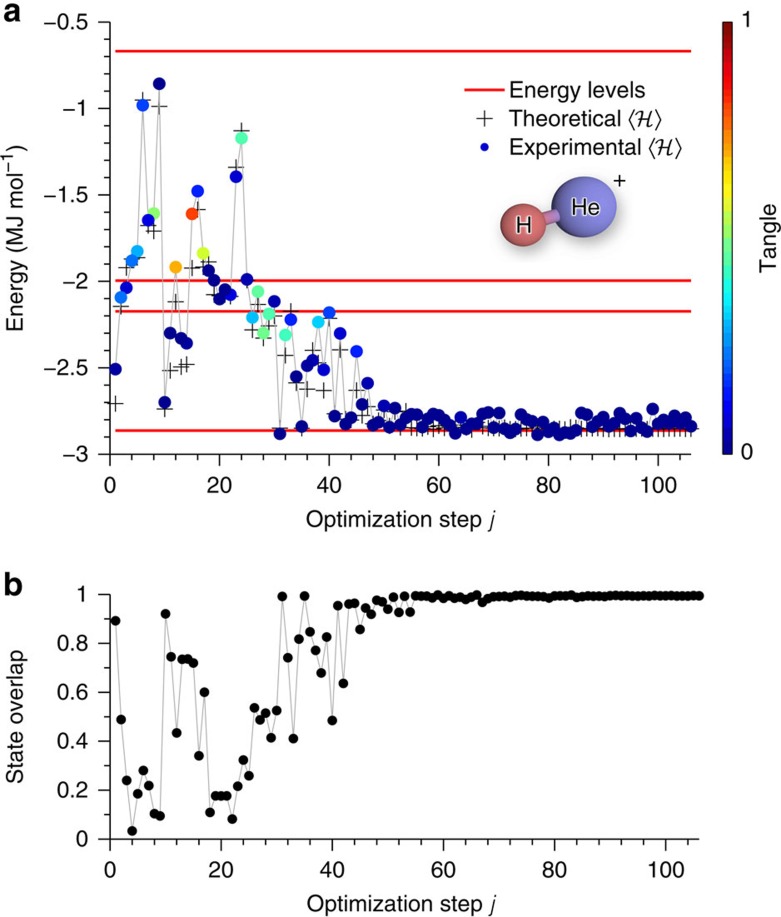
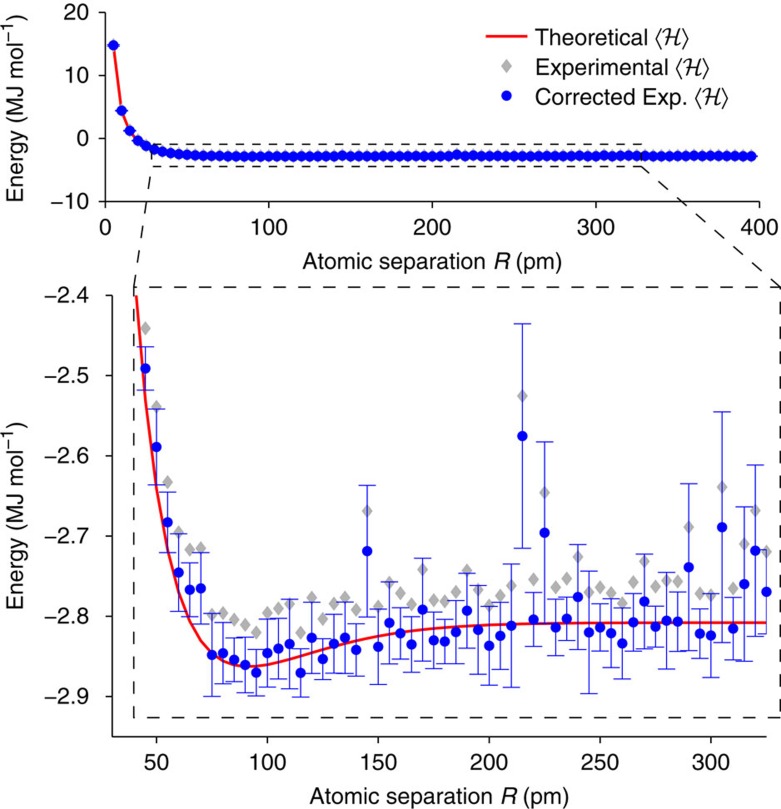
- The authors report an experimental ground-state result for He–H\(^+\): after correcting for experimental errors, they estimate the equilibrium bond length as \(R = 92.3 \pm 0.1\) pm and the ground-state electronic energy as \(E = -2.865 \pm 0.008\) MJ mol\(^{-1}\).
- For the bond dissociation curve, more than 96% of the experimental data are within chemical accuracy of the theoretical values.
- In the discussion, they state that for a 4 × 4 Hamiltonian like the one demonstrated, the QPE circuit would require at least 12 CNOT gates, whereas their method requires one.
- The full experiment was performed in about 158 h, and the bond dissociation curve was obtained by finding the ground states of 79 Hamiltonians.
## Methods
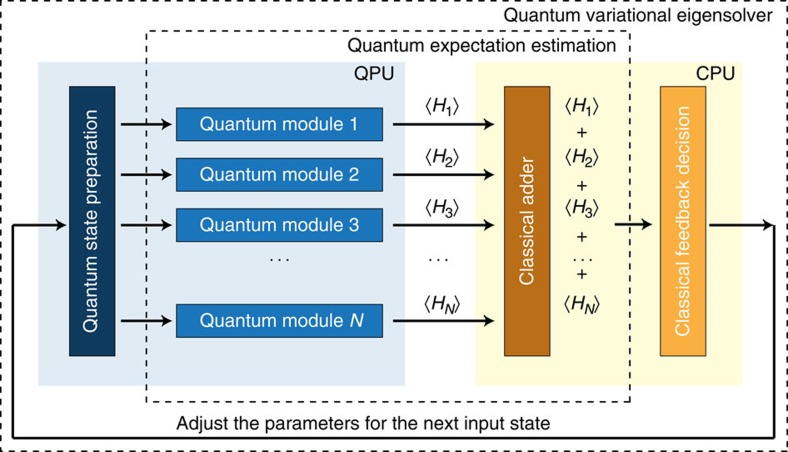
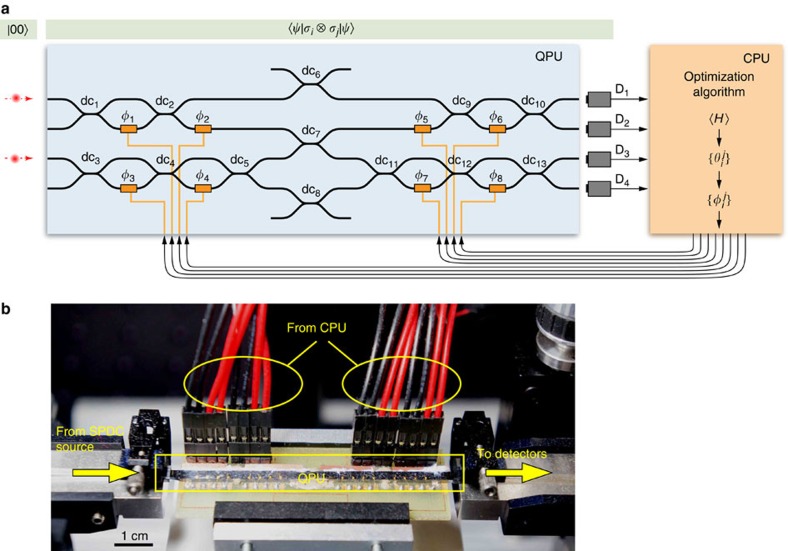
- The paper combines a reconfigurable integrated photonic quantum processor with a classical optimization algorithm: the quantum device estimates Hamiltonian expectation values, and the classical processor updates the state parameters variationally.
- The photonic chip prepares and measures arbitrary two-qubit pure states using single-qubit rotations and one two-qubit entangling gate; the experimental demonstration uses the He–H\(^+\) molecule in a minimal basis.
- For the classical optimization, they use the Nelder–Mead algorithm; expectation values are reconstructed from four two-qubit Pauli measurements at each point.
## Limitations
- The paper states that the method still requires a good approximation to the ground state as input/initialization, and the reliance on multiple separate measurements makes it sensitive to variations in state preparation between calculations.
- The authors report a constant systematic shift of \(\varepsilon = 50\) kJ mol\(^{-1}\) in the measured expectation values; they attribute this to photon-source impurity/distinguishability, circuit imperfections, and unbalanced coupling efficiencies.
- Evident from the text: the demonstration is limited to a two-qubit / 4 × 4 Hamiltonian prototype, so the scalability claim is not experimentally validated here.
Model-written summary. Check it against the paper before relying on it.
Integrity signals
Registry
Cites
Statistics
Figures
Verification
Claims the paper makes
7 Valid · 4 Not valid · 11 Not checked · 59 Own results and interpretations
The cited sources support only part of this claim — read each source’s verdict below.
In the paper
“Recent developments in the field of quantum computation offer a way forward for determining efficient solutions of many instances of large eigenvalue problems that are classically intractable6789101112”
§ A variational eigenvalue solver on a photonic quantum processor > Abstract
What the sources say
- Not matchedcites [6] Nielsen, M. A. & Chuang, I. L. Quantum Computation and Quantum Information Cambridge University Press (2000).
Couldn’t be matched to a paper in Crossref, so it can’t be checked.
- Could not verifycites [7] Kitaev, A. Quantum measurements and the Abelian stabilizer problem. Electronic Colloquium on Computational Complexity (ECCC) 3 (1996). sourceExperimental — accuracy not yet measured
Our copy under this DOI is the ISAAC 2021 paper 'Effective Resistance and Capacitance in Simplicial Complexes and a Quantum Algorithm' (Kitaev's 1995 work appears only as reference [9] in its bibliography), and it nowhere asserts that quantum computation gives efficient solutions to classically intractable large eigenvalue problems. Eigenvalues enter only as complexity parameters — λ, the smallest eigenvalue of the normalized up-Laplacian, in Lemma 31 and Theorem 26 (Section 6.3, 'Time efficient implementations') and in the phase-estimation machinery of Appendix A — and Section 1.1 ('Our Contributions') actually reports the opposite direction for its own problem: 'the quantum algorithm is slower than the classical algorithm in the worst case'. Searched: 'eigenvalue problems classically intractable', 'quantum speedup / exponential advantage', 'phase estimation', 'faster than classical'; no passage addresses the claim's point. (LLM, conf=0.70)
- Partly supportedcites [8] Griffiths, R. B. & Niu, C.-S. Semiclassical fourier transform for quantum computation. Phys. Rev. Lett. 76, 3228–3231 (1996). sourceExperimental — accuracy not yet measured
On p. 1, the paper says a quantum computer, if built, could solve certain problems such as factoring long numbers much faster than conventional algorithms. It also describes a simpler Fourier transform for Shor’s factorization and discrete-logarithm algorithms (p. 1). The copy does not support the claim about efficient solutions to many large eigenvalue problems. (LLM, conf=0.84)
plainstates a cause- Asserted: passes — The authors put it forward as true.
- Checkable: passes — It can be checked against evidence.
- Load-bearing: passes — The paper’s conclusions depend on it.
- Based: passes — The paper gives a reason why it holds.
- Not matched
Every source the paper cites for this claim was checked and supports it.
In the paper
“this would suffer from the N-representability problem, which is known to be intractable for both classical and quantum computers (it is in the quantum complexity class QMA-Hard24).”
§ A variational eigenvalue solver on a photonic quantum processor > Results > Quantum expectation estimation
What the sources say
- Supportedcites [24] Liu, Y.-K., Christandl, M. & Verstraete, F. Quantum computational complexity of the n-representability problem: Qma complete. Phys. Rev. Lett. 98, 110503 (2007). source
The paper states that N-representability is QMA-complete and hence QMA-hard and NP-hard (Abstract). Its discussion of quantum-chemistry relevance says the problem is intractable in the worst case even on a quantum computer, while allowing that particular physical systems may be easier. (LLM, conf=0.93)
boosted- Asserted: passes — The authors put it forward as true.
- Checkable: passes — It can be checked against evidence.
- Load-bearing: passes — The paper’s conclusions depend on it.
- Based: passes — The paper gives a reason why it holds.
- Supported
Every source the paper cites for this claim was checked and supports it.
In the paper
“We have implemented the QPU using integrated quantum photonics technology30.”
§ A variational eigenvalue solver on a photonic quantum processor > Results > Prototype demonstration
What the sources say
- Supportedcites [30] O'Brien, J. L., Furusawa, A. & Vuckovic, J. Photonic quantum technologies. Nat. Photon. 3, 687–695 (2009). source
The citation identifies integrated quantum photonics as the technology used, rather than attributing the citing authors’ QPU implementation to this review. The “Integrated quantum optical circuits” section (p. 6) describes on-chip waveguide circuits performing quantum logic gates and a compiled quantum factoring algorithm. (LLM, conf=0.87)
plain- Asserted: passes — The authors put it forward as true.
- Checkable: passes — It can be checked against evidence.
- Load-bearing: passes — The paper’s conclusions depend on it.
- Based: passes — The paper gives a reason why it holds.
- Supported
The cited sources support only part of this claim — read each source’s verdict below.
In the paper
“The time the quantum computer must remain coherent is determined by the necessity of O(p−1) successive applications of , each of which can require on the order of millions or billions of quantum gates for practical applications1719, as compared to the tens to hundreds of gates achievable in the short term.”
§ A variational eigenvalue solver on a photonic quantum processor > Abstract
What the sources say
- Partly supportedcites [17] Whitfield, J. D., Biamonte, J. & Aspuru-Guzik, A. Simulation of electronic structure hamiltonians using quantum computers. Mol. Phys. 109, 735–750 (2011). sourceExperimental — accuracy not yet measured
Split into 2 atoms — 1 confirmed, 1 partially supported, 0 disputed, 0 misattributed, 0 unverifiable. Expand the claim to see per-atom verdicts.
- Partly supportedcites [19] Jones, N. C. et al. Faster quantum chemistry simulation on fault-tolerant quantum computers. New J. Phys. 14, 115023 (2012). sourceExperimental — accuracy not yet measured
Split into 2 atoms — 0 confirmed, 2 partially supported, 0 disputed, 0 misattributed, 0 unverifiable. Expand the claim to see per-atom verdicts.
plainstates a cause- Asserted: passes — The authors put it forward as true.
- Checkable: passes — It can be checked against evidence.
- Load-bearing: passes — The paper’s conclusions depend on it.
- Based: passes — The paper gives a reason why it holds.
- Partly supported
A result the paper reports from its own data — it cites no other source for it, so there is none to check. The quote shows it is in the paper.
In the paper
“We experimentally demonstrate the feasibility of this approach with an example from quantum chemistry—calculating the ground-state molecular energy for He–H+.”
§ A variational eigenvalue solver on a photonic quantum processor > Abstract
boostedstates a causeSingle case- Asserted: passes — The authors put it forward as true.
- Checkable: passes — It can be checked against evidence.
- Load-bearing: passes — The paper’s conclusions depend on it.
- Based: passes — The paper gives a reason why it holds.
31 more claims
Create a free account to see all 81 claims and to verify the 4 references still open.
- It may state two separate claims as one. 28
- Probably not a substantial claim. 24
Claims other papers make about this one
Each is checked against this paper’s own text: does it say what the citing paper says it does?
The cited source doesn’t support the claim as written.
In the citing paper
“Leveraging quantum resources, the UCC ansatz was instead realized as a PQC on a photonic processor (Peruzzo et al. , 2014).”
From Noisy intermediate-scale quantum algorithms (2022) · cites this paper as Peruzzo et al., 2014
Checked by a reasoning model — may be wrong.
Experimental — accuracy not yet measuredThe cited source doesn’t support the claim as written.
In the citing paper
“The first on-chip GMM of four-qubit cluster state was realised in a laser-writing chip ( Fig.4e ), by manipulating both the polarisation and path DoFs of two photons [85].”
From Integrated photonic quantum technologies (2020) · cites this paper as [85]
Checked by a reasoning model — may be wrong.
Experimental — accuracy not yet measuredThe cited source doesn’t support the claim as written.
In the citing paper
“four-qubit linear- and box-cluster states are generated in a laser-writing photonic chip. This is enabled by on-chip manipulating the two-photon four-qubit hyperentangled state and cluster state, that are encoded in photon's path and polarisation DoFs. The Grover's search algorithm on a four-element database was implemented by controlling the device.”
From Integrated photonic quantum technologies (2020) · cites this paper as [85]
Checked by a reasoning model — may be wrong.
Experimental — accuracy not yet measuredThe source backs part of the claim, not all of it — or backs it for a different population, condition or comparison.
In the citing paper
“Due to its versatility, the variational Hamiltonian ansatz has been implemented for quantum chemistry [21, 29], optimization [24], and for quantum simulation problems [30].”
From Variational quantum algorithms (2021) · cites this paper as [29]
Experimental — accuracy not yet measuredThe source backs part of the claim, not all of it — or backs it for a different population, condition or comparison.
In the citing paper
“For the original VQE (Peruzzo et al. , 2014) and QAOA (Farhi et al. , 2014) it can, for example, be described as a single expectation value min θ ⟨ H ⟩ U ( θ ) , where the differences solely appear in the specific form and construction of the qubit Hamiltonian.”
From Noisy intermediate-scale quantum algorithms (2022) · cites this paper as Peruzzo et al., 2014
Experimental — accuracy not yet measured
12 more claims about this paper
Create a free account to see every claim other papers make about this one.
Citations
Cites
A Simplex Method for Function Minimization
Nelder, J. A., & Mead, R. (1965) · The Computer Journal · doi:10.1093/comjnl/7.4.308 · Cited by 28,905
Quantum computation and quantum information
Law, J. (2001) · ACM SIGSOFT Software Engineering Notes · doi:10.1145/505482.505499 · Cited by 18,842
(1999) · Cited by 12,854
Practical Methods of Optimization
Fletcher, R. (2000) · Wiley eBooks · doi:10.1002/9781118723203 · Cited by 7,605 · cited 3×
“[12] S.”
BackgroundMethodPractical methods of optimization
(1988) · Mathematics and Computers in Simulation · doi:10.1016/0378-4754(88)90129-2 · Cited by 5,818
Quantum Algorithm for Linear Systems of Equations
Harrow, A. W., Hassidim, A., & Lloyd, S. (2009) · Physical Review Letters · doi:10.1103/physrevlett.103.150502 · Cited by 3,325
Conn, A. R., Gould, N. I. M., & Toint, P. L. (2000) · Society for Industrial and Applied Mathematics eBooks · doi:10.1137/1.9780898719857 · Cited by 2,981 · cited 3×
“[14] D.”
MethodInfluential�ber das Paulische �quivalenzverbot
Jordan, P., & Wigner, E. (1928) · Zeitschrift f�r Physik · doi:10.1007/bf01331938 · Cited by 2,597
Molecular Electronic‐Structure Theory
Helgaker, T., Jørgensen, P., & Olsen, J. (2000) · doi:10.1002/9781119019572 · Cited by 2,594
O'Brien, J. L., Furusawa, A., & Vučković, J. (2009) · Nature Photonics · doi:10.1038/nphoton.2009.229 · Cited by 2,388
Self-citation
Research works printed but not linked: 3
- Helgaker, T., Jorgensen, P. & Olsen, J. Mol. Electronic Struct. Theory Wiley, Sussex (2002).
- Saad, Y. Numerical Methods for Large Eigenvalue Problems Vol. 158, (SIAM (1992).
- Rayleigh, J. W. In finding the correction for the open end of an organ-pipe. Phil. Trans. 161, 77 (1870).
Cited by
Items 4,401–4,500 of 4,572
Symmetry-adapted energy estimation on quantum devices
Nogaki, K., Backes, S., Shirakawa, T., Yunoki, S., & Arita, R. (2026) · Physical review. B./Physical review. B · doi:10.1103/w3bj-r494
Challenges and Opportunities in the Quantum-Enhanced AI Industry
Rismayanti, I., Anwar, N., Panuntun, D. P., et al. (2026) · Advances in computational intelligence and robotics book series · doi:10.4018/979-8-2600-0156-1.ch008
Senapati, P., Luo, W., Peng, B., & Guan, Q. (2026) · ACM Great Lakes Symposium on VLSI (GLSVLSI) · doi:10.1145/3787109.3816378 · Cited by 1
MA-RQAOA: A System-Algorithm Co-Design Framework for Coherence-Limited Topological Quantum Computing
Zhao, X., & Wang, H. (2026) · IEEE International Symposium on Circuits and Systems proceedings · doi:10.1109/iscas66217.2026.11562873
“Current hybrid quantum-classical algorithms, such as the Variational Quantum Eigen-solver (VQE) and the Quantum Approximate Optimization Algorithm (QAOA) [9], [10], are fundamentally hardware-agnostic [11].”
Yadav, P., & Kumari, J. (2026) · Advances in computational intelligence and robotics book series · doi:10.4018/979-8-2600-0156-1.ch011
Wang, Q., Zhukas, L. A., Miao, Q., Dalvi, A. S., Love, P. J., Monroe, C., Chong, F. T., & Ravi, G. S. (2026) · npj Unconventional Computing · doi:10.1038/s44335-026-00073-5
“According to the variational principle 5 , the minimum of this cost function provides an estimate of the ground state energy of the system.”
Self-citationError Mitigation in Dynamic Circuits for Hamiltonian Simulation
Shirgure, S., & Niu, S. (2026) · ACM Great Lakes Symposium on VLSI (GLSVLSI) · doi:10.1145/3787109.3816384 · Cited by 3
Learning Quantum Algorithm Footprints to Circumvent Obfuscation: An End-to-End Approach
Lushi, D., & Saeed, S. M. (2026) · IEEE VLSI Test Symposium (VTS) · doi:10.1109/vts69484.2026.11563362
“…are hybrid quantum-classical algorithms that leverage parametrized quantum circuits to solve combinatorial optimization problems using Quantum Approximate Optimization Algorithm (QAOA) [14], or find the ground state of molecular Hamil-tonians using Variational Quantum Eigensolver (VQE) [15].”
Analytical Dimensions and Performance Evaluation of the Quantum Approximate Optimization Algorithm
Trigueros, B., Roig, P. J., Alcaraz, S., & Gilly, K. (2026) · International Conference on Integrated Intelligence and Cognitive Engineering (ICIICE) · doi:10.1109/iciice69672.2026.11565281
“Representative examples include the Variational Quantum Eigensolver (VQE) [10] and the Quantum Approximate Optimization Algorithm (QAOA) [11].”
DAG-Aware Gate Fusion for Efficient State-Vector Quantum-Circuit Simulation
Li, S., Wang, Z.-A., & Fan, H. (2026) · IEEE Transactions on Quantum Engineering · doi:10.1109/tqe.2026.3705783
“Additional circuit families, including random circuits, quan-383 tum Fourier transform (QFT) circuits [25], and variational 384 quantum eigensolver [26], [27], [28] with hardware-efficient 385 ansatz [29] (VQE-HE) circuits, are also evaluated.”
Park, K. J., Peddireddy, D., & Aggarwal, V. (2026) · ACM Transactions on Quantum Computing · doi:10.1145/3821430
Daka, C., & Bhattacharyya, S. (2026) · New Journal of Physics · doi:10.1088/1367-2630/ae8053 · Cited by 1
All-valid-state HOBO encoding for constrained combinatorial optimization on NISQ devices
Wang, J., Kanezashi, T., Tsukayama, D., Awaya, K., SAITO, R., Shirakashi, J., Shibuya, T., & Imai, H. (2026) · EPJ Quantum Technology · doi:10.1140/epjqt/s40507-026-00535-6
“In addition, the variational quantum eigensolver (VQE) is another well-known variational framework [18–21].”
Preparation of the single-spinon wave function on a quantum computer
Faílde, D., Gómez, A., & Fernández-Rossier, J. (2026) · Physical Review Research · doi:10.1103/qlsh-5pdm · Cited by 1
“In the case of the Heisenberg model, the strategy we choose to prepare the ground state of the model in a quantum computer is the so-called Variational Quantum Eigensolver (VQE) [26].”
Nambury, S. B. (2026) · Research Square · doi:10.21203/rs.3.rs-9953338/v1 · Cited by 1
Long, X., Yang, X., Wang, X., Feng, Y., Vieira, C. H. S., Liu, R., Nie, X., Li, J. W., & Lu, D. (2026) · Physical Review Letters · doi:10.1103/b834-zjgf · Cited by 2
Hybrid VQE–Graph Neural Network Framework for Scalable Binding-Affinity Prediction
Neeraja, P., & Umamageswaran, J. (2026) · International Conference on Computational Robotics, Testing and Engineering Evaluation (ICCRTEE) · doi:10.1109/iccrtee68719.2026.11566360
“…including the Variational Quantum Eigensolver VQE and the Quantum Approximate Optimization Algorithm QAOA have emerged as preferred methods for running molecular simulations and performing optimization tasks on noisy intermediate-scale quantum NISQ systems in current scientific research [1]– [3].”
InfluentialGupta, S., Maheshwari, A., & Naruka, A. (2026) · Advances in computational intelligence and robotics book series · doi:10.4018/979-8-2600-2601-4.ch006
Transforming Scientic Innovation for Global Human Safety and ProsperityPreprint
Shibah, S. R. M. (2026) · SSRN Electronic Journal · doi:10.2139/ssrn.6880678
Symmetry-based perturbation theory for electronic structure calculations
Anonymous, Nguyen, N., Gujarati, T. P., & Motta, M. (2026) · Physical Review A · doi:10.1103/n5g8-tdp8 · Cited by 1
“…NISQ algorithms aim to prepare states of interest with a quantum circuit depth that is orders of magnitude shallower than QPE by introducing variational parameters in the variational quantum eigensolver [24] or by employing approximate circuits such as the local unitary cluster Jastrow ansatz [25].”
He, C., Li, Q., & Zhang, J. (2026) · Processes · doi:10.3390/pr14132095 · Cited by 1
MetaMorphQ: Physics-Based Metamorphic Testing of Variational Quantum Circuits
Nguyen, N. N., Le, J., Vu, T. T., Nguyen, T. T. N., & Shen, J. (2026) · IEEE International Conference on Quantum Software (QSW) · doi:10.1109/qsw72780.2026.00026 · Cited by 2
“The Variational Quantum Eigensolver [2], [3] is the most prominent member of this family: it encodes a computational task as a quantum Hamiltonian and trains a parametrised circuit (the ansatz) to approximate its lowest-energy eigenstate via a hybrid quantum-classical optimisation loop.”
Quantum-classical adaptive autoencoding of time-series signals for secure biometric authentication
Dutta, S., Basu, B., Roy, S., & Roy, U. (2026) · Quantum Machine Intelligence · doi:10.1007/s42484-026-00417-1
“For reconstruction-based one-class learning–particularly when embedded into parameterized quantum circuits (Peruzzo et al. 2014 ; McClean et al. 2016 ; Abbas et al. 2021 ; Kim et al. 2023 ; Majid et al. 2025 )–ses - sion separation is not optional; it is structurally necessary to distinguish…”
Mariyanto, D. C., Prihadi, H. L., Fauzi, A. D., Handoko, L. T., Sarwono, Y. P., & Zhang, R. Q. (2026) · International Journal of Quantum Chemistry · doi:10.1002/qua.70255
Large-scale portfolio optimization with variational neural annealing
Anonymous, Javanparast, B., Goerz, D., & Inack, E. M. (2026) · Physical review. E · doi:10.1103/p22k-x7p6 · Cited by 1
“Gate-based quantum algorithms, such as the Quantum Approximate Optimization Algorithm (QAOA) [32] or the Variational Quantum Eigensolver (VQE) [33], encode the portfolio objective into a parameterized circuit.”
Quantum Machine Learning for Water Pollution Profiling in the Rio Santiago Basin
Abraham-Mexicano, A., Muro-Medina, C. V., Flores-Payán, V., Pinzón, E. R., Recio-Colmenares, C. L., Recio-Colmenares, R., & García, C. A. G. (2026) · Quantum Reports · doi:10.3390/quantum8030060
“Accordingly, the study is positioned across quantum-computing implementation and algorithmic foundations [1–4], water-quality artificial-intelligence and Rio Santiago environmental context [5–7], time-series, wastewater-monitoring, source-data, toxicology, and regulatory references [8–12],…”
Yoshikawa, T., Takanashi, T., & Nakai, H. (2026) · The Journal of Physical Chemistry A · doi:10.1021/acs.jpca.6c00669
Pulse-based variational quantum algorithms
Tao, H.-X., & Wu, R.-B. (2026) · Quantum Review Letters · doi:10.1016/j.qrl.2026.06.002
Mokhtar, B., Inoue, N., & Tsuchimochi, T. (2026) · The Journal of Chemical Physics · doi:10.1063/5.0333047
“To overcome these limitations, hybrid quantum-classical algorithms such as the Variational Quantum Eigensolver (VQE) have been developed 8 .”
Diagonal-Budgeted Trotterization for Efficient Quantum Hamiltonian Simulation
Chundury, S., Burgstahler, B., Li, J., Suh, I., & Mueller, F. (2026) · International Conference on Supercomputing · doi:10.1145/3797905.3807869 · Cited by 1
Building Hybrid Quantum–Classical Computing Ecosystems: A Survey
Bharadwaj, D., Hou, Y., Knapen, A., Kwun, G., Zhitkov, N., & Ravi, G. S. (2026) · Communications in computer and information science · doi:10.1007/978-981-95-7829-0_13 · Cited by 1
Quantum Computing as a Service (QCaaS): Architecture, Orchestration, and Performance Tradeoffs
Kumar, R., Upadhyay, H., Pandey, C. P., et al. (2026) · doi:10.1109/icctwc68241.2026.11582971
Sparse-graph optimization using weighted quantum wires in Rydberg-atom arrays
de Oliveira, A. G., Kombe, J., Pelegrí, G., Schroff, P., Wells-Pestell, M. T., Walker, D. M., Daley, A. J., & Pritchard, J. D. (2026) · Physical Review Applied · doi:10.1103/bxsl-f1zc · Cited by 7
“Typically, this state preparation is achieved through quantum annealing algorithms (QAA) [3, 4] that rely on the quantum adiabatic principle, or using hybrid quantum-classical approaches [5, 6] such as the Variational Quantum Eigensolver (VQE) [7– 10].”
Hasnaoui, H., Limongi, L., Giordani, T., Polacchi, B., Quaranta, A., Bernard, M., Sciarrino, F., & Lobino, M. (2026) · Applied Physics Reviews · doi:10.1063/5.0308063 · Cited by 2
A regularization method for quantum neural networks using data symmetry
Ohno, H. (2026) · Discover Quantum Science · doi:10.1007/s44464-026-00039-3
“In practical settings, QML models are typically trained using a quantum-classical hybrid approach [18], where parameterized quantum circuits are optimized using classical algorithms.”
A robust strontium tweezer apparatus for quantum computing
Venderbosch, M., van Herk, R., Guo, Z., Mellado, J. P., Festenstein, M., van Rensburg, D. J., Knottnerus, I. H. A., Tseng, Y. C., Urech, A., Spreeuw, R. J. C., et al. (2026) · AIP Advances · doi:10.1063/5.0324304 · Cited by 1
Pankkonen, J. V. (2026) · Physics Open · doi:10.1016/j.physo.2026.100444
“Variational quantum algorithms (VQAs) [1–4] have emerged as a leading framework for leveraging the noisy intermediate-scale quantum (NISQ) [5] devices for near-term quantum computation.”
Overcoming Challenges in Implementing Quantum AI
Mahata, A. (2026) · Springer eBooks · doi:10.1007/978-3-032-19536-4_13
Fundamentals of Artificial Intelligence in Drug Discovery and Healthcare
Fakhoury, N. (2026) · Springer eBooks · doi:10.1007/978-3-032-19536-4_2
Quantum Annealing for Optimal Feature Subset Selection for Enhanced Medical Classification
Bhattacharya, A., Etemi, B. P., & Samanta, D. (2026) · Procedia Computer Science · doi:10.1016/j.procs.2026.06.599
Designing Biologics with Quantum AI
Khan, M. Z. I., Sojib, N., Karim, M., & Roosan, D. (2026) · Springer eBooks · doi:10.1007/978-3-032-19536-4_6
Quantum Artificial Intelligence for Protein Structure Prediction
Roosan, D., & Khan, R. I. (2026) · Springer eBooks · doi:10.1007/978-3-032-19536-4_5
The Quantum–Bio-Singularity: Synthesis of Current Paradigms and a Roadmap for Therapeutic Frontiers
Roosan, D. (2026) · Springer eBooks · doi:10.1007/978-3-032-19536-4_15
The Convergence of Quantum Computing and AI: Accelerating Next-Generation Therapeutic Discovery
Ashakin, M. R. (2026) · Springer eBooks · doi:10.1007/978-3-032-19536-4_3
A Dependability Profile for Hybrid Quantum–Classical Systems
Sonawane, P. A., Kelly, A., & Mahmud, N. (2026) · International Conference on Dependable Systems and Networks workshops · doi:10.1109/dsn-w70714.2026.00046
Small Molecule Drug Discovery Enhanced by Quantum AI
Karim, M., Sojib, N., Khan, M. Z. I., & Roosan, D. (2026) · Springer eBooks · doi:10.1007/978-3-032-19536-4_8
Kitajima, H., Bistafa, C., Kobayashi, T., Kanno, S., Okada, O., Murasaki, K., Koyama, J., Saito, R., & Gao, Q. (2026) · Journal of Chemical Information and Modeling · doi:10.1021/acs.jcim.6c00544
Wagaskar, K. A., & Palkar, B. (2026) · Lecture notes in networks and systems · doi:10.1007/978-3-032-27563-9_43
Localized sample-based quantum diagonalization for strongly correlated chemistry
Wang, Q., Sung, K. J., D’Cunha, R., Hermes, M. R., Gujarati, T. P., Kawashima, Y., Ohnishi, Y., Jones, G. O., Motta, M., & Gagliardi, L. (2026) · Proceedings of the National Academy of Sciences · doi:10.1073/pnas.2603914123 · Cited by 7
Anonymous, Valero, E., & Germán Rodrigo, A. (2026) · Physical Review A · doi:10.1103/2kdj-6pdz · Cited by 1
Kodirovich, K. M., Safarovich, K. K., Majidovich, E. R., et al. (2026) · IEEE International Conference on Computational Intelligence and Communication Networks (CICN) · doi:10.1109/cicn70047.2026.11594265
“In this paper, the Quantum Adaptive Laboratory Intelligence (QALI) framework is proposed, with the combination of QML in every stage of the laboratory lifecycle[6].”
Simulating Catalytic Systems: A Hybrid DFT-VQE Approach
Singh, A. K., Pandey, R., & Srivastava, P. (2026) · International Conference on Computational Intelligence and Communication Networks (CICN) · doi:10.1109/cicn70047.2026.11594262
“The active-space Hamiltonian was then solved using VQE with a unitary coupled-cluster singles-and-doubles ansatz (reps=1), a parity mapper, and a COBYLA optimiser [4], [5].”
InfluentialTowards quantum simulation of rotating nuclei using quantum variational algorithms
Roy, D., & Nag, S. (2026) · The European Physical Journal Plus · doi:10.1140/epjp/s13360-026-08047-z · Cited by 1
“In estimating ground-state energies, excited states, expectation values of observables, and other properties of complex quantum systems, the Variational Quantum Eigensolver (VQE), Variational Quantum Deflation (VQD), and ADAPT-VQE have demonstrated significant promise among these algorithms [1]-[5].”
Quantum Computing and Sustainable Development: What Are the Benefits?
Zemate, A. A., & Sedra, M. B. (2026) · E3S Web of Conferences · doi:10.1051/e3sconf/202672601045
Floquet-informed learning of time-periodic Hamiltonians
Anonymous (2026) · Physical Review A · doi:10.1103/y2vg-tb3f · Cited by 1
Scalable quantum algorithm for meson scattering in a lattice gauge theory
Chai, Y., Guo, Y., & Kühn, S. (2026) · Physical Review Research · doi:10.1103/f93h-rlzy · Cited by 20
Accelerated Quantum Algorithm Prototyping: Modular Simulation and Noise Modelling with CUDA Support
Marevac, E., Kadušić, E., Zivic, N. S., & Ruland, C. (2026) · Journal of Advances in Information Technology · doi:10.12720/jait.17.6.1188-1210
“|1 ⟩ 𝑈𝑈 This avoids allocating a large block matrix while preserving the asymptotic operation count [28].”
An adaptive quantum-classical approach for scalable clustering and analytical decision-making
Hidayat, R., Novkaniza, F., Rustam, Z., & Akdemir, :. O. (2026) · Decision Analytics Journal · doi:10.1016/j.dajour.2026.100734
Quantum Davis-Putnam-Logemann-Loveland and generalized constraints in iterative quantum algorithms
Anonymous, & Hadfield, S. (2026) · Physical Review A · doi:10.1103/8g3p-tyz1 · Cited by 8
LogicQuBit: A simple and modular framework for simulating quantum algorithms
Pietralonga, C. S., & Paz, W. S. (2026) · SoftwareX · doi:10.1016/j.softx.2026.102876
Quantum machine learning in predictive maintenance: A comprehensive state-of-the-art review
Lisan, Z. A., Sifat, M. S. I., Kabir, M. A., Mahmud, A., Rehman, A. U., & Bermak, A. (2026) · Computers & Electrical Engineering · doi:10.1016/j.compeleceng.2026.111374 · Cited by 1
A silicon photonics quantum solver for the travelling salesman problem
Baldazzi, A., Azzini, S., & Pavesi, L. (2026) · doi:10.1364/cleo_fs.2026.fm3a.7
MCM-Leak: Exploiting Mid-Circuit Measurement Control for Covert Quantum Information Leakage
Lushi, D., & Saeed, S. M. (2026) · IEEE International Symposium on Hardware Oriented Security and Trust (HOST) · doi:10.1109/host68814.2026.11604661
Data quantum Fisher information predicts trainability in variational quantum algorithms
Ganguly, S., Masta, A. K., Devendrababu, S., & Ganguly, S. (2026) · Academia quantum. · doi:10.20935/acadquant8415
Park, U., Lee, J., Moon, S., Jeon, H., Kim, Y.-S., Jung, H., & Kwon, H. (2026) · Conference on Lasers and Electro-Optics · doi:10.1364/cleo_fs.2026.fm1a.5
Quantum‐Enhanced Protein Folding and Drug Discovery with Energy‐Aware Algorithms
Nikitha, K., Renushree, S., & Ajithkumar, M. (2026) · doi:10.1002/9781394444144.ch11
Ugail, H., & Howard, N. (2026) · PLoS ONE · doi:10.1371/journal.pone.0353739 · Cited by 2
Quantum Neural Networks in the NISQ Era: Architectures, Challenges, and Applications
Palihakkara, K. W., & Jayakody, M. N. (2026) · Proceedings in Technology Transfer · doi:10.1007/978-981-92-0423-6_19
The Quantum Leap in Bioinformatics
Kaulgud, S. P., Shirahatti, A. P., Mrutyunjaya, M. S., Madhusudhan, M. V., & Pasha, A. (2026) · Wiley eBooks · doi:10.1002/9781394444144.ch2
Pavithra, G., Ashwini, S. S., Hamsaveni, M., et al. (2026) · doi:10.1002/9781394444144.ch7
AI-Empowered Quantum Circuit Synthesis and Compilation Optimization: Overview and Prospects
Yan, G., Wu, W., Chen, Y., Pan, K., Lü, X., Zh, Z., Wang, Y., Wang, R. L., & Yan, J. (2026) · IEEE Transactions on Pattern Analysis and Machine Intelligence · doi:10.1109/tpami.2026.3715237 · Cited by 102
Practical demonstration of high-accuracy electronic structure on a quantum computer
Per, M. C., Rhodes, N., Srikumar, M., & Dai, J. W. (2026) · AIP Advances · doi:10.1063/5.0329448
GLEAM: Mitigating Barren Plateaus in Hybrid Quantum Machine Learning via Small-World Entanglement
Ding, Z., Xing, F., Xia, Y., & Zeng, P. (2026) · International Conference on Image Processing and Artificial Intelligence (ICIPAI) · doi:10.1109/icipai70034.2026.11605634
“The backbone of our architecture lies in the paradigm of Variational Quantum Algorithms [33], which includes prominent examples like the Variational Quantum Eigensolver (VQE) [34] and the Quantum Approximate Optimization Algorithm (QAOA) [35].”
Freericks, J. K. (2026) · Springer eBooks · doi:10.1007/978-3-031-87845-9_19
Protecting Quantum Circuits Through Compiler-Resistant Obfuscation
Parayil, P., Raj, A., & Balachandran, V. (2026) · Lecture notes in computer science · doi:10.1007/978-3-032-32560-0_7
Singh, N. P., Omana, J., & Nair, S. G. S. (2026) · Frontiers in Artificial Intelligence · doi:10.3389/frai.2026.1836641
“There are heuristic alternatives, such as the Variational Quantum Eigensolver (VQE) (Peruzzo et al., 2014; Kandala et al., 2017) and hardware-efficient variants, which rely on the quality of the ansatz and the optimization landscape and have performance that is not guaranteed to scale with a…”
InfluentialEliminating vendor lock-in in quantum machine learning via framework-agnostic neural networks
Kumaresan, P., Singaravelu, S., Rajendran, L., & Sivasubramani, S. (2026) · Frontiers in Quantum Science and Technology · doi:10.3389/frqst.2026.1862700
A review of variational quantum algorithms: Insights into fault-tolerant quantum computing
Wang, Z., Huang, J., Ye, R., Li, Q., Ding, Q.-M., Huang, Y., Zhang, T., Zeng, Y., Gao, J., Yuan, X., et al. (2026) · Frontiers of Physics · doi:10.15302/frontphys.2027.023301 · Cited by 7
“…efficiently capture electron correlations by including only low-order excitations or physically significant Hamiltonian terms, while quantum information guided designs tailor entanglement using classical approximations to further enhance expressibility and shallow circuit performance [9, 29–31].”
The quantum ensemble variational optimization algorithm: Applications to molecular inverse design
Calcagno, F., Cabral, D. G. A., Rivalta, I., & Batista, V. S. (2026) · Proceedings of the National Academy of Sciences · doi:10.1073/pnas.2531186123
Dobariya, A. R., Gohil, J. A., Anghelescu, P., Ionescu, V. M., & Enescu, M. C. (2026) · International Conference on Electronics, Computers and Artificial Intelligence (ECAI) · doi:10.1109/ecai69016.2026.11613609
“Molecular simulations using Variational Quantum Eigensolver (VQE) have achieved chemical accuracy with an error rate 1 kcal/mol for small molecules [10],[24],[39].”
InfluentialMitigating barren plateaus in quantum denoising diffusion probabilistic models
Cao, H., Zhang, K., Tao, D., & Su, Z. (2026) · Physical Review A · doi:10.1103/gg2j-xtk6 · Cited by 1
Impact of gate-voltage noise on silicon spin-qubit variational quantum eigensolvers
Wang, X., Khromets, B., Merino, Z. D., & Baugh, J. (2026) · Quantum Science and Technology · doi:10.1088/2058-9565/ae9188
Patra, C., Mondal, D., Halder, S., Halder, D., Laskar, M. R., Goel, R., & Maitra, R. (2026) · Quantum Science and Technology · doi:10.1088/2058-9565/ae917f · Cited by 16
“Consequently, near-term research focuses on hybrid quantum–classical approaches like the variational quantum eigensolver [8–10], quantum approximate optimization algorithm [11] and projective quantum eigensolver [12] where quantum processors are dedicated to the evaluation of expectation values and…”
Resource-Efficient Quantum Algorithms for Selected Hamiltonian Subspace Diagonalization
Graves, V., Hlatshwayo, M. Q., Kapourniotis, T., & Γεωργόπουλος, Κ. (2026) · Journal of Chemical Theory and Computation · doi:10.1021/acs.jctc.6c00521 · Cited by 2
“A more widely explored algorithm is the variational quantum eigensolver (VQE) [5, 6], and its variants such as ADAPT-VQE [7].”
Anonymous, Kim, J., Ramos, T., Fedorov, A. K., Man’ko, V. I., & Huh, J. (2026) · Physical Review Applied · doi:10.1103/y162-z8m9 · Cited by 1
“Initially, the spin system is prepared in the domain-wall state in which spins on the left (right) half are aligned up (down) along the z axis.”
Achieving double-logarithmic precision dependence in optimization-based quantum unstructured search
Anonymous, An, D., Hu, J., & Wen, Z. (2026) · Physical Review A · doi:10.1103/7k6t-m463 · Cited by 2
“On the other hand, for broader quantum applications such as ground-state preparation for generic molecular Hamiltonians [50, 51], implementing exact Newton or gradient steps may be intractable on quantum computers.”
Kumar, H. S., Naik, E. H., Hemanth, G., & Karthik, B. M. (2026) · International Conference on Computing Methodologies and Communication (ICCMC) · doi:10.1109/iccmc69250.2026.11624761
Local-observable-guided generative quantum circuits for degenerate ground spaces
Anonymous, Zhang, L., Zhu, Y., Yang, K., Zeng, X., & Wang, Z. (2026) · Physical Review A · doi:10.1103/yc8j-sp2z
“More recently, the variational quantum eigensolver (VQE) and its extensions have provided a hardware-compatible route to ground-state preparation through parameterized quantum circuits (PQCs) [ 19–24 ] .”
Coupled integrated photonic quantum memristors using a single photon source made of a colour center
Baldazzi, A., Ancel, R. P. G. K., Guaraldo, S., Fattori, I., Chen, X., Akar, Z. A., Déturche, R., Azzini, S., Couteau, C., & Pavesi, L. (2026) · Opto-Electronic Advances · doi:10.29026/oea.2026.260048 · Cited by 2
Hybrid Classical-Quantum Architecture for Vectorised Image Classification of Hand-Written Sketches
Cordero, Y., Biswas, S., Vilariño, F., & Bilkis, M. (2026) · Lecture notes in computer science · doi:10.1007/978-3-032-31673-8_24 · Cited by 1
DistributedEstimator: Distributed training of quantum neural networks via circuit cutting
Singh, P., Toosi, A. N., & Buyya, R. (2026) · Future Generation Computer Systems · doi:10.1016/j.future.2026.108746 · Cited by 1
Algorithmic Quantum Simulations of Quantum Thermodynamics
Anonymous, Nan, J., Chen, D., Zache, T. V., Zhu, Q., Zhang, Y., Li, Y., Chen, X., Ying, C., Zha, C., et al. (2026) · Physical Review Letters · doi:10.1103/n7tv-p5bp · Cited by 1
Liu, C., & Deng, Y. (2026) · Journal of Chemical Theory and Computation · doi:10.1021/acs.jctc.6c00432
Auxiliary-field quantum Monte Carlo on quantum hardware via unitary dilation
Anonymous (2026) · Physical Review A · doi:10.1103/9k3q-gd64
Mondal, D., Patra, A. K., & Maitra, R. (2026) · Chemical Science · doi:10.1039/d6sc03132c · Cited by 2
“Neverthe-less, despite this theoretical advantage, the simulation of large and realistic chemical systems is still beyond the capabilities of present day quantum hardware because of the limited number of fault-tolerant qubits and restricted gate fidelities 3–6 .”
TUSQ: Tracking, Uncomputation, and Sampling for Noisy Quantum Simulation
Dangwal, S., Oberoi, T., Sailopal, A., Shah, D., & Chong, F. T. (2026) · Proceedings - International Symposium on Computer Architecture/Proceedings · doi:10.1109/isca66397.2026.00163
“Quantum computing has the potential to speed up tasks like factoring [35], unordered search [19], and physics and chemistry simulations [24], [33].”
da Rosa, E. C. R., Marchi, J., & de Santiago, R. (2026) · Anais do I Simpósio Brasileiro de Computação e Comunicação Quânticas (SBCCQ 2026) · doi:10.5753/sbccq.2026.20785
“In this section, we present three implementations to solve the Max-Cut problem us-ing quantum computing: QAOA [Farhi et al. 2014], FALQON [Magann et al. 2022], and VQE [Peruzzo et al. 2014].”
QCLink: Offloading Hybrid Quantum-Classical Computation to SmartNICs via RDMA
Li, X., Lu, Y., Liu, Z., Yue, X.-F., Chen, J., Peng, Y., Li, T.-T., Li, Z.-X., Zhao, Z.-M., & Yin, J. (2026) · IEEE International Conference on Distributed Computing Systems · doi:10.1109/2575-8411.2026.00013
“Most existing quantum software stacks execute hybrid algorithms in a host-centric manner: the classical optimization loop runs on a host CPU, while quantum evaluations are dispatched to a remote backend or simulator through a layered software stack ( e.g., runtime scheduler, serialization,…”
CARL: Crosstalk-Aware Quantum Compilation Based on Reinforcement Learning
Zhang, X., Liu, Y., Mao, Y., Xu, X., & Yang, Y. (2026) · IEEE International Conference on Distributed Computing Systems (ICDCS) · doi:10.1109/2575-8411.2026.00043
“Beyond its well-known applications in integer factorization and database search, the technology is becoming critical for quantum simulation in material science [2] and drug discovery [3].”
Metadata
- Authors
- Peruzzo, A., McClean, J., Shadbolt, P., Yung, M.-H., Zhou, X.-Q., Love, P. J., Aspuru-Guzik, A., & O’Brien, J. L.
- Affiliations
- The University of Sydney (AU)
- Harvard University (US)
- University of Bristol (GB)
- Haverford College (US)
- Corresponding author
- Peruzzo, Alberto
- O’Brien, Jeremy L.
- Venue
- Nature Communications
- Published
- 2014-07-23
- Volume
- 5
- Issue
- 1
- Pages
- 4213-4213
- ISSN
- 2041-1723 (ISSN-L)
- PMC
- PMC4124861
- OpenAlex
- W2161685427
- Cited by
- 4,552
- References
- 48
- Citations by year
- 2026: 591 · 2025: 765 · 2024: 722 · 2023: 658 · 2022: 564 · 2021: 561 · 2020: 346 · 2019: 191 · 2018: 83 · 2017: 29 · 2016: 18 · 2015: 16 · 2014: 4
- FWCI
- 22.24
- Type
- journal article
- Language
- en
- Open access
- hybrid
- doi.org
- Licence
- cc-by-nc-nd
- creativecommons.org/licenses/by-nc-nd/4.0 (tdm)
- creativecommons.org/licenses/by-nc-nd/4.0 (vor)
- Locations
- Nature Communications (publishedVersion, cc-by-nc-nd)
- Europe PMC (PubMed Central) (publishedVersion, cc-by-nc-nd)
- PubMed Central (publishedVersion, cc-by-nc-nd)
- PubMed (publishedVersion)
- arXiv (Cornell University) (submittedVersion)
- OSTI OAI (U.S. Department of Energy Office of Scientific and Technical Information) (submittedVersion, cc-by-nc-nd)
- Digital Access to Scholarship at Harvard (DASH) (Harvard University) (submittedVersion, cc-by)
- RePEc: Research Papers in Economics (submittedVersion)
- RMIT Research Repository (RMIT University Library) (submittedVersion, cc-by-nc-nd)
- Figshare (submittedVersion, cc-by-nc-nd)
- UWA Profiles and Research Repository (UWA) (submittedVersion, cc-by-nc-nd)
- Bristol Research (University of Bristol) (submittedVersion)
- arXiv (Cornell University)
- Funders
- National Science Foundation (DE-FG02-97ER25308, 0955518, 1037992)
- U.S. Department of Energy (DEFG0297ER25308, DE‐FG02‐, FG02-97ER25308)
- Alfred P. Sloan Foundation
- John Templeton Foundation
- Camille and Henry Dreyfus Foundation
- Royal Academy of Engineering
- National Natural Science Foundation of China (61033001, 61361136003)
- Engineering and Physical Sciences Research Council (EP/J017175/1, EP/L024020/1, EP/K021931/1)
- Australian Research Council (DE140101700)
- National Key Research and Development Program of China (61033001, 2011CBA00301, 61361136003, 2011CBA00300)
- Division of Chemistry (CHE-1037992)
- Air Force Office of Scientific Research (FA 9550-12-1-0046, FA9550-, FA9550-12, FA9550‐12‐1)
- Topics
- Physical Sciences › Computer Science › Artificial Intelligence › Quantum Computing Algorithms and Architecture
- Physical Sciences › Physics and Astronomy › Atomic and Molecular Physics, and Optics › Quantum Information and Cryptography
- Physical Sciences › Physics and Astronomy › Atomic and Molecular Physics, and Optics › Quantum many-body systems
- Keywords
- variational quantum eigensolver, photonic quantum processors, quantum chemistry, classical optimization, hybrid quantum-classical computation
About these checks
Registry, retraction, Cites and statistics results are computed, not judged, with one exception: a printed reference that no index lists is read once by a model before it counts as a citation error. Claims are extracted by a model and kept only when their quote appears verbatim in the text; each cited source is then checked, with a model’s help, for whether it says what the claim relies on. Those verdicts can be wrong — read the claim’s quote and the cited source before relying on one.
The claim verdicts this report counts are experimental: their accuracy is not yet measured.
A language model drew the claims from the paper on 2026-10-10, under version 3 of the claim definition (model deepseek-v4.1-flash, prompt extract-v3).
A second model labelled each claim on 2026-10-10 (model jev-1.13-20260917, definition revision gold-guideline-v0.2).
Cited sources are checked with a language model’s help (qwen3.8-omni-flash and gpt-6-sol).
Statistics and arithmetic are recomputed, not judged.
Confidence bands are shown only for fields calibrated on our annotated test set. None is calibrated yet, so no band is shown.
What counts as a claim ›How we measure confidence ›How we check this ›
Are you an author, or do you see a problem with this page? Request a review
Data sources
Bibliographic data: Semantic Scholar, OpenAlex, Crossref.
Contains information from the Semantic Scholar Academic Graph Datasets, made available under the ODC Attribution License (ODC-BY 1.0).
Semantic Scholar’s data is described in: Kinney, R., et al. (2023). The Semantic Scholar Open Data Platform. arXiv:2301.10140.
