

A variational eigenvalue solver on a photonic quantum processor
Open accessThe DOI matches its Crossref record; 47 of the 48 references it cites were found in a registry or an index; 14 of the 31 sources its claims cite were checked for support.
Abstract
Quantum computers promise to efficiently solve important problems that are intractable on a conventional computer. For quantum systems, where the physical dimension grows exponentially, finding the eigenvalues of certain operators is one such intractable problem and remains a fundamental challenge. The quantum phase estimation algorithm efficiently finds the eigenvalue of a given eigenvector but requires fully coherent evolution. Here we present an alternative approach that greatly reduces the requirements for coherent evolution and combine this method with a new approach to state preparation based on ansätze and classical optimization. We implement the algorithm by combining a highly reconfigurable photonic quantum processor with a conventional computer. We experimentally demonstrate the feasibility of this approach with an example from quantum chemistry—calculating the ground-state molecular energy for He–H+. The proposed approach drastically reduces the coherence time requirements, enhancing the potential of quantum resources available today and in the near future. Quantum computers promise to efficiently solve problems that would be practically impossible with a normal computer. Peruzzo et al. develop a variational computation approach that uses any available quantum resources and, with a photonic quantum processing unit, find the ground-state molecular energy of He–H+.
Overview
CoChat Summary
## TL;DR
The paper introduces a variational alternative to quantum phase estimation for finding eigenvalues, combining short coherent quantum measurements with classical optimization. It experimentally demonstrates the approach on a photonic processor by estimating the ground-state energy curve of He–H\(^+\).
## Key findings
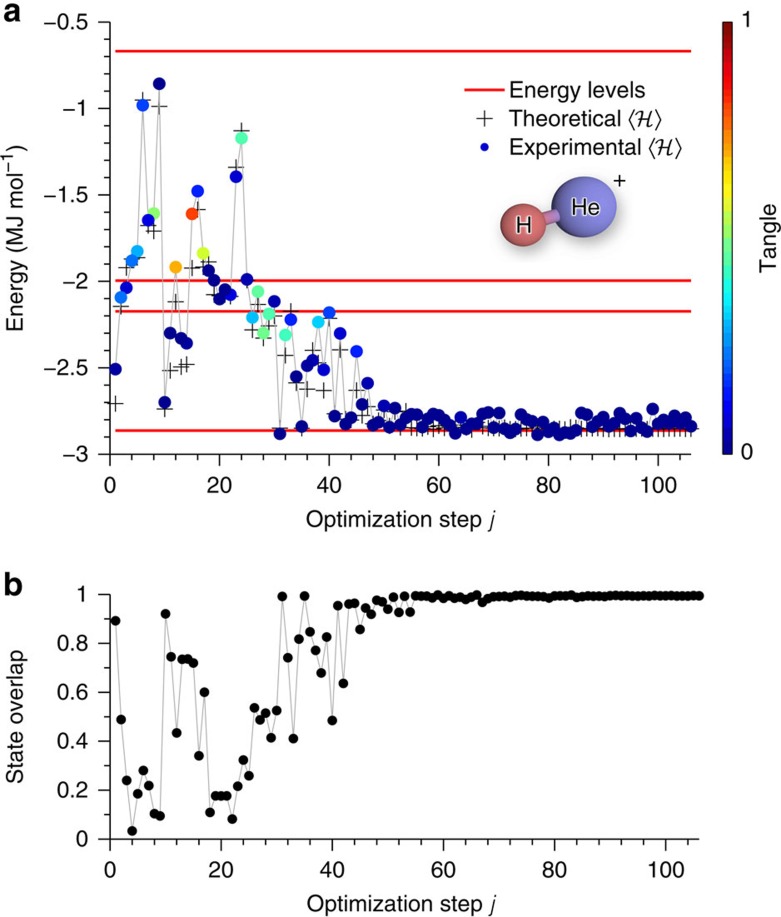
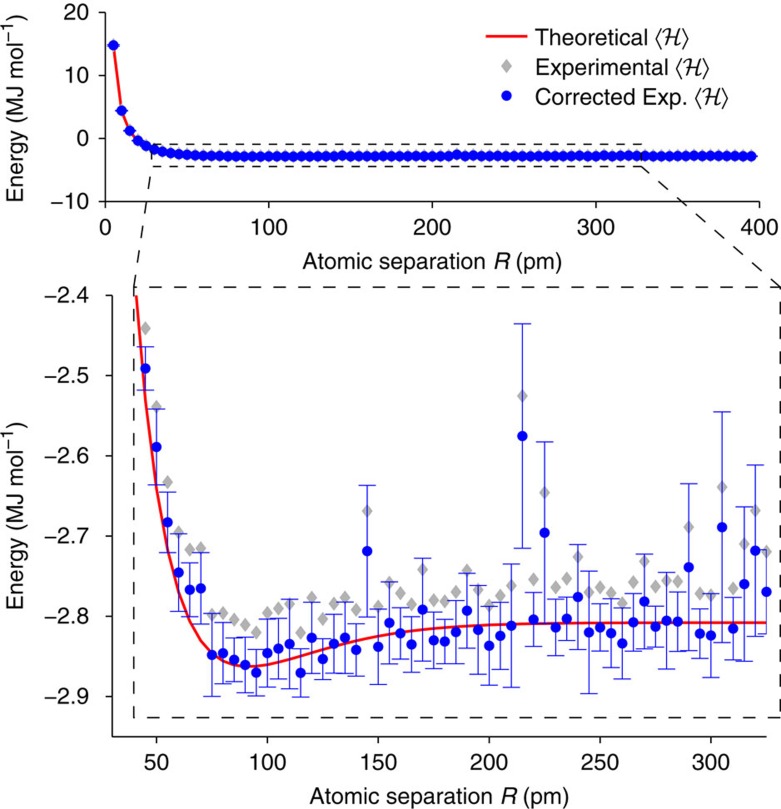
- The authors report an experimental ground-state result for He–H\(^+\): after correcting for experimental errors, they estimate the equilibrium bond length as \(R = 92.3 \pm 0.1\) pm and the ground-state electronic energy as \(E = -2.865 \pm 0.008\) MJ mol\(^{-1}\).
- For the bond dissociation curve, more than 96% of the experimental data are within chemical accuracy of the theoretical values.
- In the discussion, they state that for a 4 × 4 Hamiltonian like the one demonstrated, the QPE circuit would require at least 12 CNOT gates, whereas their method requires one.
- The full experiment was performed in about 158 h, and the bond dissociation curve was obtained by finding the ground states of 79 Hamiltonians.
## Methods
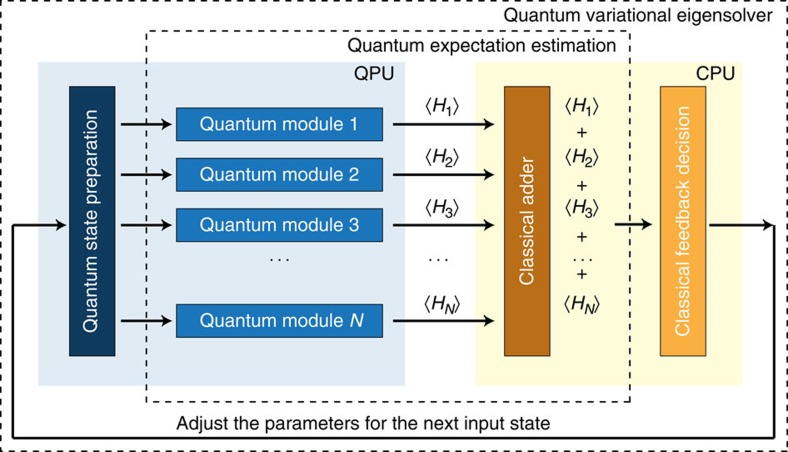
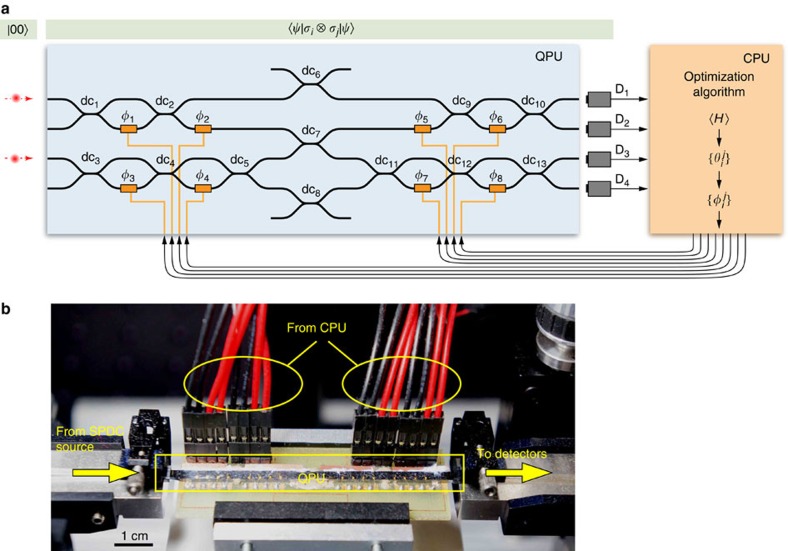
- The paper combines a reconfigurable integrated photonic quantum processor with a classical optimization algorithm: the quantum device estimates Hamiltonian expectation values, and the classical processor updates the state parameters variationally.
- The photonic chip prepares and measures arbitrary two-qubit pure states using single-qubit rotations and one two-qubit entangling gate; the experimental demonstration uses the He–H\(^+\) molecule in a minimal basis.
- For the classical optimization, they use the Nelder–Mead algorithm; expectation values are reconstructed from four two-qubit Pauli measurements at each point.
## Limitations
- The paper states that the method still requires a good approximation to the ground state as input/initialization, and the reliance on multiple separate measurements makes it sensitive to variations in state preparation between calculations.
- The authors report a constant systematic shift of \(\varepsilon = 50\) kJ mol\(^{-1}\) in the measured expectation values; they attribute this to photon-source impurity/distinguishability, circuit imperfections, and unbalanced coupling efficiencies.
- Evident from the text: the demonstration is limited to a two-qubit / 4 × 4 Hamiltonian prototype, so the scalability claim is not experimentally validated here.
Model-written summary. Check it against the paper before relying on it.
Integrity signals
Registry
Cites
Statistics
Figures
Verification
Claims the paper makes
7 Valid · 4 Not valid · 11 Not checked · 59 Own results and interpretations
The cited sources support only part of this claim — read each source’s verdict below.
In the paper
“Recent developments in the field of quantum computation offer a way forward for determining efficient solutions of many instances of large eigenvalue problems that are classically intractable6789101112”
§ A variational eigenvalue solver on a photonic quantum processor > Abstract
What the sources say
- Not matchedcites [6] Nielsen, M. A. & Chuang, I. L. Quantum Computation and Quantum Information Cambridge University Press (2000).
Couldn’t be matched to a paper in Crossref, so it can’t be checked.
- Could not verifycites [7] Kitaev, A. Quantum measurements and the Abelian stabilizer problem. Electronic Colloquium on Computational Complexity (ECCC) 3 (1996). sourceExperimental — accuracy not yet measured
Our copy under this DOI is the ISAAC 2021 paper 'Effective Resistance and Capacitance in Simplicial Complexes and a Quantum Algorithm' (Kitaev's 1995 work appears only as reference [9] in its bibliography), and it nowhere asserts that quantum computation gives efficient solutions to classically intractable large eigenvalue problems. Eigenvalues enter only as complexity parameters — λ, the smallest eigenvalue of the normalized up-Laplacian, in Lemma 31 and Theorem 26 (Section 6.3, 'Time efficient implementations') and in the phase-estimation machinery of Appendix A — and Section 1.1 ('Our Contributions') actually reports the opposite direction for its own problem: 'the quantum algorithm is slower than the classical algorithm in the worst case'. Searched: 'eigenvalue problems classically intractable', 'quantum speedup / exponential advantage', 'phase estimation', 'faster than classical'; no passage addresses the claim's point. (LLM, conf=0.70)
- Partly supportedcites [8] Griffiths, R. B. & Niu, C.-S. Semiclassical fourier transform for quantum computation. Phys. Rev. Lett. 76, 3228–3231 (1996). sourceExperimental — accuracy not yet measured
On p. 1, the paper says a quantum computer, if built, could solve certain problems such as factoring long numbers much faster than conventional algorithms. It also describes a simpler Fourier transform for Shor’s factorization and discrete-logarithm algorithms (p. 1). The copy does not support the claim about efficient solutions to many large eigenvalue problems. (LLM, conf=0.84)
plainstates a cause- Asserted: passes — The authors put it forward as true.
- Checkable: passes — It can be checked against evidence.
- Load-bearing: passes — The paper’s conclusions depend on it.
- Based: passes — The paper gives a reason why it holds.
- Not matched
Every source the paper cites for this claim was checked and supports it.
In the paper
“this would suffer from the N-representability problem, which is known to be intractable for both classical and quantum computers (it is in the quantum complexity class QMA-Hard24).”
§ A variational eigenvalue solver on a photonic quantum processor > Results > Quantum expectation estimation
What the sources say
- Supportedcites [24] Liu, Y.-K., Christandl, M. & Verstraete, F. Quantum computational complexity of the n-representability problem: Qma complete. Phys. Rev. Lett. 98, 110503 (2007). source
The paper states that N-representability is QMA-complete and hence QMA-hard and NP-hard (Abstract). Its discussion of quantum-chemistry relevance says the problem is intractable in the worst case even on a quantum computer, while allowing that particular physical systems may be easier. (LLM, conf=0.93)
boosted- Asserted: passes — The authors put it forward as true.
- Checkable: passes — It can be checked against evidence.
- Load-bearing: passes — The paper’s conclusions depend on it.
- Based: passes — The paper gives a reason why it holds.
- Supported
Every source the paper cites for this claim was checked and supports it.
In the paper
“We have implemented the QPU using integrated quantum photonics technology30.”
§ A variational eigenvalue solver on a photonic quantum processor > Results > Prototype demonstration
What the sources say
- Supportedcites [30] O'Brien, J. L., Furusawa, A. & Vuckovic, J. Photonic quantum technologies. Nat. Photon. 3, 687–695 (2009). source
The citation identifies integrated quantum photonics as the technology used, rather than attributing the citing authors’ QPU implementation to this review. The “Integrated quantum optical circuits” section (p. 6) describes on-chip waveguide circuits performing quantum logic gates and a compiled quantum factoring algorithm. (LLM, conf=0.87)
plain- Asserted: passes — The authors put it forward as true.
- Checkable: passes — It can be checked against evidence.
- Load-bearing: passes — The paper’s conclusions depend on it.
- Based: passes — The paper gives a reason why it holds.
- Supported
The cited sources support only part of this claim — read each source’s verdict below.
In the paper
“The time the quantum computer must remain coherent is determined by the necessity of O(p−1) successive applications of , each of which can require on the order of millions or billions of quantum gates for practical applications1719, as compared to the tens to hundreds of gates achievable in the short term.”
§ A variational eigenvalue solver on a photonic quantum processor > Abstract
What the sources say
- Partly supportedcites [17] Whitfield, J. D., Biamonte, J. & Aspuru-Guzik, A. Simulation of electronic structure hamiltonians using quantum computers. Mol. Phys. 109, 735–750 (2011). sourceExperimental — accuracy not yet measured
Split into 2 atoms — 1 confirmed, 1 partially supported, 0 disputed, 0 misattributed, 0 unverifiable. Expand the claim to see per-atom verdicts.
- Partly supportedcites [19] Jones, N. C. et al. Faster quantum chemistry simulation on fault-tolerant quantum computers. New J. Phys. 14, 115023 (2012). sourceExperimental — accuracy not yet measured
Split into 2 atoms — 0 confirmed, 2 partially supported, 0 disputed, 0 misattributed, 0 unverifiable. Expand the claim to see per-atom verdicts.
plainstates a cause- Asserted: passes — The authors put it forward as true.
- Checkable: passes — It can be checked against evidence.
- Load-bearing: passes — The paper’s conclusions depend on it.
- Based: passes — The paper gives a reason why it holds.
- Partly supported
A result the paper reports from its own data — it cites no other source for it, so there is none to check. The quote shows it is in the paper.
In the paper
“We experimentally demonstrate the feasibility of this approach with an example from quantum chemistry—calculating the ground-state molecular energy for He–H+.”
§ A variational eigenvalue solver on a photonic quantum processor > Abstract
boostedstates a causeSingle case- Asserted: passes — The authors put it forward as true.
- Checkable: passes — It can be checked against evidence.
- Load-bearing: passes — The paper’s conclusions depend on it.
- Based: passes — The paper gives a reason why it holds.
31 more claims
Create a free account to see all 81 claims and to verify the 4 references still open.
- It may state two separate claims as one. 28
- Probably not a substantial claim. 24
Claims other papers make about this one
Each is checked against this paper’s own text: does it say what the citing paper says it does?
The cited source doesn’t support the claim as written.
In the citing paper
“Leveraging quantum resources, the UCC ansatz was instead realized as a PQC on a photonic processor (Peruzzo et al. , 2014).”
From Noisy intermediate-scale quantum algorithms (2022) · cites this paper as Peruzzo et al., 2014
Checked by a reasoning model — may be wrong.
Experimental — accuracy not yet measuredThe cited source doesn’t support the claim as written.
In the citing paper
“The first on-chip GMM of four-qubit cluster state was realised in a laser-writing chip ( Fig.4e ), by manipulating both the polarisation and path DoFs of two photons [85].”
From Integrated photonic quantum technologies (2020) · cites this paper as [85]
Checked by a reasoning model — may be wrong.
Experimental — accuracy not yet measuredThe cited source doesn’t support the claim as written.
In the citing paper
“four-qubit linear- and box-cluster states are generated in a laser-writing photonic chip. This is enabled by on-chip manipulating the two-photon four-qubit hyperentangled state and cluster state, that are encoded in photon's path and polarisation DoFs. The Grover's search algorithm on a four-element database was implemented by controlling the device.”
From Integrated photonic quantum technologies (2020) · cites this paper as [85]
Checked by a reasoning model — may be wrong.
Experimental — accuracy not yet measuredThe source backs part of the claim, not all of it — or backs it for a different population, condition or comparison.
In the citing paper
“Due to its versatility, the variational Hamiltonian ansatz has been implemented for quantum chemistry [21, 29], optimization [24], and for quantum simulation problems [30].”
From Variational quantum algorithms (2021) · cites this paper as [29]
Experimental — accuracy not yet measuredThe source backs part of the claim, not all of it — or backs it for a different population, condition or comparison.
In the citing paper
“For the original VQE (Peruzzo et al. , 2014) and QAOA (Farhi et al. , 2014) it can, for example, be described as a single expectation value min θ ⟨ H ⟩ U ( θ ) , where the differences solely appear in the specific form and construction of the qubit Hamiltonian.”
From Noisy intermediate-scale quantum algorithms (2022) · cites this paper as Peruzzo et al., 2014
Experimental — accuracy not yet measured
12 more claims about this paper
Create a free account to see every claim other papers make about this one.
Citations
Cites
A Simplex Method for Function Minimization
Nelder, J. A., & Mead, R. (1965) · The Computer Journal · doi:10.1093/comjnl/7.4.308 · Cited by 28,905
Quantum computation and quantum information
Law, J. (2001) · ACM SIGSOFT Software Engineering Notes · doi:10.1145/505482.505499 · Cited by 18,842
(1999) · Cited by 12,854
Practical Methods of Optimization
Fletcher, R. (2000) · Wiley eBooks · doi:10.1002/9781118723203 · Cited by 7,605 · cited 3×
“[12] S.”
BackgroundMethodPractical methods of optimization
(1988) · Mathematics and Computers in Simulation · doi:10.1016/0378-4754(88)90129-2 · Cited by 5,818
Quantum Algorithm for Linear Systems of Equations
Harrow, A. W., Hassidim, A., & Lloyd, S. (2009) · Physical Review Letters · doi:10.1103/physrevlett.103.150502 · Cited by 3,325
Conn, A. R., Gould, N. I. M., & Toint, P. L. (2000) · Society for Industrial and Applied Mathematics eBooks · doi:10.1137/1.9780898719857 · Cited by 2,981 · cited 3×
“[14] D.”
MethodInfluential�ber das Paulische �quivalenzverbot
Jordan, P., & Wigner, E. (1928) · Zeitschrift f�r Physik · doi:10.1007/bf01331938 · Cited by 2,597
Molecular Electronic‐Structure Theory
Helgaker, T., Jørgensen, P., & Olsen, J. (2000) · doi:10.1002/9781119019572 · Cited by 2,594
O'Brien, J. L., Furusawa, A., & Vučković, J. (2009) · Nature Photonics · doi:10.1038/nphoton.2009.229 · Cited by 2,388
Self-citation
Research works printed but not linked: 3
- Helgaker, T., Jorgensen, P. & Olsen, J. Mol. Electronic Struct. Theory Wiley, Sussex (2002).
- Saad, Y. Numerical Methods for Large Eigenvalue Problems Vol. 158, (SIAM (1992).
- Rayleigh, J. W. In finding the correction for the open end of an organ-pipe. Phil. Trans. 161, 77 (1870).
Cited by
Items 4,301–4,400 of 4,572
Sampling (noisy) quantum circuits through randomized rounding
Martinez, V., Fawzi, O., & França, D. S. (2026) · Quantum · doi:10.22331/q-2026-04-15-2068 · Cited by 1
“This description encapsulates many quantum algorithms designed for combinatorial optimization, such as QAOA [FGG14] or VQE [PMS + 14].”
Wang, C.-C., Wang, Y. J., Tu, C.-H., & Hung, S. (2026) · Proceedings of the International Conference on Parallel Processing · doi:10.1145/3832810.3832819 · Cited by 1
Lai, J., Fu, Q., Li, Z., & Yang, J. (2026) · Journal of Chemical Theory and Computation · doi:10.1021/acs.jctc.5c01768
Scalable multi-objective genetic algorithm for quantum circuit optimization
Ghlib, R., Bouhadouza, R., & Hnaien, F. (2026) · Scientific Reports · doi:10.1038/s41598-026-47674-5 · Cited by 1
Deep Variational Quantum Circuits with Barren-Plateau-Free Architectures
Zhang, K., Hsieh, M.-H., & Tao, D. (2026) · Artificial Intelligence Science and Engineering · doi:10.23919/aise.2026.000005 · Cited by 1
Larsson, E. D., Kjellgren, E. R., Reinholdt, P., & Kongsted, J. (2026) · The Journal of Chemical Physics · doi:10.1063/5.0339816
A Hybrid Quantum–Classical Machine Learning Framework for Black Carbon Forecasting
Oliva-González, I., González, L. T., Lara‐Montaño, O. D., Ramírez, A. I., Mendoza, A., & Hernández-Romero, I. M. (2026) · EPJ Quantum Technology · doi:10.1140/epjqt/s40507-026-00511-0
Exploiting biased noise in variational quantum models
van Rossum, C., Shrapnel, S., & Gupta, R. S. (2026) · Quantum Science and Technology · doi:10.1088/2058-9565/ae636a · Cited by 1
Çifci, P., Akkoyun, S., & Ronde, L. L. (2026) · The European Physical Journal A · doi:10.1140/epja/s10050-026-01939-9
Quantum machine learning for complex systems: paradigms, applications, and challenges
Singh, V., Bhatia, A. S., Saggi, M. K., Sajjan, M., & Kais, S. (2026) · Academia quantum. · doi:10.20935/acadquant8243 · Cited by 5
Ali, S., Shukla, D. K., Dagur, A., Kumar, A., Shukla, N., & Satpathy, S. (2026) · Sustainable Computing Informatics and Systems · doi:10.1016/j.suscom.2026.101367
Electron-molecule scattering via R -matrix variational algorithms on a quantum computer
Picozzi, D., Tennyson, J., Graves, V., & Gorfinkiel, J. D. (2026) · Physical Review A · doi:10.1103/q8ry-hlxt
Quantum complex language processing: a framework for semantic encoding in hilbert space
Routh, A., Dey, T. K., & Singh, O. (2026) · Engineering Research Express · doi:10.1088/2631-8695/ae660c
Using Quantum Computing for Optimizing 3-D Scenes and Their Lighting
Shah, J., Hiwarkar, S., Patil, M., Ugale, S., & Uplaonkar, D. S. (2026) · International Conference on Emerging Technologies and Future Innovations (ETFI) · doi:10.1109/etfi68128.2026.11484087
“i. Alberto Peruzzo et al. (2014) introduced a new way of using quantum devices at a time when hardware was far from perfect.”
Niazi, S. (2026) · Drug Design Development and Therapy · doi:10.2147/dddt.s590730 · Cited by 1
“30,37,38,49 Yet results can be sensitive to the ansatz choice and the behavior of the classical optimizer; noisy hardware can bias gradients and lead to false convergence.”
Exploring Clifford and near-Clifford initialization strategies for quantum variational optimization
de Palhares, A. B., Varela, J. M., Duarte, D. H. G., & Chaves, R. (2026) · International Journal of Modern Physics C · doi:10.1142/s0129183126430059
EEG-Based Emotion Recognition Using Quantum Kernel–Based Machine Learning
Bhatt, A., Jain, S., Jain, C., Baranwal, A., Sharma, C., & Tiwari, S. (2026) · International Conference on Advancements and Key Challenges in Green Energy and Computing (AKGEC) · doi:10.1109/akgec68790.2026.11485872 · Cited by 1
“● The Compute-Uncompute fidelity method was used to evaluate similarities between quantum states[17] ● Verification of the kernel setup was performed by computing a small (2×2) test kernel matrix, which yielded values near 1.0 along the diagonal and ensured positive semi-definiteness (PSD).”
InfluentialQuantum computing approach to atomic and molecular three-body systems
Haidar, M., Nogueira, H. D., & Karr, J. (2026) · Physical Review A · doi:10.1103/h6dt-gfqx
Application of quantum annealing to computation of molecular properties
Sahoo, P., Prasannaa, V., & Das, B. (2025) · Physical Review A · doi:10.1103/7np1-njdc · Cited by 1
Jha, M., Chen, S. Y.-C., Kulkarni, C. M., & Kim, J. (2026) · Engineering Applications of Artificial Intelligence · doi:10.1016/j.engappai.2026.114991 · Cited by 2
Zhang, S. F., Liu, Z., & Li, Z. (2026) · The Journal of Chemical Physics · doi:10.1063/5.0319519
Lalwani, K., Gakhar, M., & Narula, C. (2026) · International Conference on Next-Gen Quantum and Advanced Computing: Algorithms, Security, and Beyond (NQComp) · doi:10.1109/nqcomp68334.2026.11497716
Noor, K., & Fatima, U. (2026) · Global Conference on Wireless and Optical Technologies (GCWOT) · doi:10.1109/gcwot69191.2026.11499728
“Variational approaches move QML one step further: Peruzzo et al. (2014) introduced the VQE algorithm [5]; Farhi and Neven (2018) developed the QAOA framework [6].”
Tracking Affine Subspace with Gaussian Elimination for Adaptive Quantum Circuit Simulation
Jin, K., On, J., & Cha, G. (2026) · ACM Transactions on Quantum Computing · doi:10.1145/3815191
“…algebra [19], variational quantum eigensolver ( VQE ) with a unitary coupled-cluster singles and doubles ( UCCSD ) ansatz for quantum chemistry [39], Grover’s algorithm for unstructured search with varying qubit counts, and the Bernstein–Vazirani oracle algorithm [18]; (ii) arithmetic and…”
Decoherence-free quantum error mitigation by density matrix vectorization
Shang, Z.-X., Chen, Z., & Cheng, C.-S. (2026) · Physical Review Research · doi:10.1103/kzyj-j3g8 · Cited by 1
A Quantum Variational Approach to Prototypical Recurrent Unit
Garjan, M. S., Cesari, T., & Barbeau, M. (2026) · International Conference on Quantum Communications, Networking, and Computing (QCNC) · doi:10.1109/qcnc69040.2026.00126
“Single-qubit rotations control amplitudes and phases, while entangling gates such as circular CNOT layers create correlations; repeating layers enhances expressivity [25], [26].”
Active Sampling Sample-Based Quantum Diagonalization from Finite-Shot Measurements
Miura, R. (2026) · International Conference on Quantum Communications, Networking, and Computing (QCNC) · doi:10.1109/qcnc69040.2026.00163 · Cited by 3
“The variational quantum eigensolver (VQE) is a standard approach: prepare a parametrized quantum state and estimate energy by measuring each term of H [3, 4].”
Meta-Learning for GPU-Accelerated Quantum Many-Body Problems
Chen, Y.-H., Chang, J.-Y., Huang, T.-W., & Kuo, E.-J. (2026) · International Conference on Quantum Communications, Networking, and Computing (QCNC) · doi:10.1109/qcnc69040.2026.00154
Real Quantum Computers Applied to Audio
Alani, A., & Miranda, E. R. (2026) · 2026 International Conference on Quantum Communications, Networking, and Computing (QCNC) · doi:10.1109/qcnc69040.2026.00175
Quantum phase recognition via swap-test-based correlation mechanism
Chen, J.-L., Li, X., & Yin, Z. (2026) · Physical Review A · doi:10.1103/rcjd-bgdb
A Model Context Protocol Server for Quantum Execution in Hybrid Quantum-HPC Environments
Shiraishi, M., Hamamura, I., Ishigaki, T., & Kadowaki, T. (2026) · International Conference on Quantum Communications, Networking, and Computing (QCNC) · doi:10.1109/qcnc69040.2026.00145 · Cited by 3
“This operation serves as the core sub-routine for evaluating cost functions in Variational Quantum Algorithms (VQAs), including the Variational Quantum Eigen-solver (VQE) [16] and the Quantum Approximate Optimization Algorithm (QAOA) [17].”
Kulkarni, V. R., Lee, J. C., Hutchings, A., Albahri, A., Nana, J., Xu, S., & Chaudhary, V. (2026) · International Conference on Quantum Communications, Networking, and Computing (QCNC) · doi:10.1109/qcnc69040.2026.00125 · Cited by 2
“Variational Quantum Algorithms (VQAs) like VQE repeatedly execute a fixed ansatz U ( ⃗θ ) while updating parameters ⃗θ [10].”
Raaj, N., & Benila, S. (2026) · International Conference on Recent Advances in Electrical, Electronics, Ubiquitous Communication, and Computational Intelligence (RAEEUCCI) · doi:10.1109/raeeucci67649.2026.11504553
Efficient implementation of single particle Hamiltonians in exponentially reduced qubit space
Plesch, M., Friák, M., & Mohammad, I. A. (2026) · Quantum · doi:10.22331/q-2026-05-08-2099
“Among them, the Variational Quantum Eigensolver (VQE) [14–19] stands out as a practical candidate for near-term devices: it minimizes the expectation value of a Hamiltonian to approximate ground state using shallow ansätze.”
Ahsan, M. (2026) · ACM Transactions on Quantum Computing · doi:10.1145/3815786
“VQE has emerged as a scalable alternative [25, 29, 31], enabling ground-state estimation on NISQ devices.”
Variational compilation of native gates for efficient trapped-ion Hamiltonian simulation
Wang, P., Li, C. Z., Shi, H., & Chen, P. (2026) · Chinese Physics B · doi:10.1088/1674-1056/ae6b33
Quantum circuit evolutionary framework applied to the set partitioning problem
Fernandez, B. O., Bloot, R., & Moret, M. A. (2026) · The Journal of Supercomputing · doi:10.1007/s11227-026-08511-8 · Cited by 1
“The Variational Quantum Eigensolver (VQE) [8] and Quantum Approximate Optimization Algorithm (QAOA) [9] are the prominent ones.”
Quantum-Inspired approaches to Multi-robot Scheduling and Control using QAOA and VQE
Ramaraj, S., Jaiganesh, M., Mercy, S., Kumar, B. A., Senthur Balaji, K., & Lathika, M. (2026) · International Conference on Devices, Circuits and Systems (ICDCS) · doi:10.1109/icdcs68853.2026.11510830
“The Variational Quantum Eigen solver (VQE), proposed by Peruzzo et al. (2014) [2], has gained traction for its application in solving eigenvalue problems on quantum hardware.”
Calculations of Ground-State Energy Eigenvalues in Hadron Physics with Quantum Simulation
Zhu, C., 李, G. 刚. L., Song, M., & Luo, X. (2026) · International Journal of Theoretical Physics · doi:10.1007/s10773-026-06359-5
“Variational Quantum Eigensolver (VQE) [19, 25, 30] is a hybrid quantum-classical algorithm based on the Rayleigh-Ritz variational principle.”
Efficient Quantum Optimization via Dynamical Simulation
Çatlı, A. B., Simon, S., & Wiebe, N. (2026) · PRX Quantum · doi:10.1103/t59v-8flk · Cited by 25
A Distributed Variational Quantum Eigensolver Algorithm for Unit Commitment
Hasanzadeh, M., Rajabi, A., & Kargarian, A. (2026) · 2026 IEEE Texas Power and Energy Conference (TPEC) · doi:10.1109/tpec67884.2026.11513141 · Cited by 7
“VQE is a hybrid quantum–classical method that approximates the ground state of an Ising (or QUBO-derived) Hamiltonian using a parameterized circuit and a classical optimizer [10].”
Nonia, R. K., Sarkar, M., & Shaw, D. K. (2026) · SSRN Electronic Journal · doi:10.2139/ssrn.6778403
Singh, D., Mehendale, S., Arvind, & Dorai, K. (2026) · Pramana · doi:10.1007/s12043-025-03102-3
Mahanta, A., Kaur, J., Kumar, K. S., & Jain, M. (2026) · International Conference on Smart Electronic Devices and Intelligent Systems (ICSEDIS) · doi:10.1109/icsedis68157.2026.11518232
“Recent studies investigated the new type of mitigation strategies like local cost functions, shallow ansatz, noise-sensitive optimizers, and error-reducing strategies (Peruzzo et al., 2014)-(Endo et al., 2021).”
Diagonal Adaptive Non-local Observables on Quantum Neural Networks
Tseng, H.-A., Li, Y., Lin, H.-Y., & Chen, S. Y.-C. (2026) · International Conference on Computer Communications and Networks (ICCCN) · doi:10.1109/icccn69946.2026.11662839 · Cited by 1
“VQAs support applications such as the variational quantum eigensolver for many-body and molecular problems [5], [6], and they also provide the backbone for quantum machine-learning models This work is supported by the U.S. DOE, under award DE-SC-0012704 and BNL’s LDRD #24-061.”
Analysis of quantum primitives for quantum utility
Kim, T., & Choi, B.-S. (2026) · Quantum Information Processing · doi:10.1007/s11128-026-05201-5
Exponential depth decay in Sridhara-compressed VQE simulation for molecular energy ranking
Lima, D., & Al-Kuwari, S. M. (2026) · Physical Chemistry Chemical Physics · doi:10.1039/d5cp04680g
A Universal Quantum Gradient Descent Framework for Exact Cover Problems
Huo, J., Zhang, R., & Cao, C. (2026) · International Conference on Advanced Electronic Materials, Computers and Software Engineering (AEMCSE) · doi:10.1109/aetcse69203.2026.11504007
“To mitigate these hardware constraints, variational quantum eigen-solver (VQE) has emerged as a prominent hybrid classical-quantum approach [9].”
Deterministic ground state preparation via power-cosine filtering of time evolution operators
Jo, J. (2026) · Physics Letters A · doi:10.1016/j.physleta.2026.131813
“Currently, the most prevalent approach on near-term devices is the Variational Quantum Eigensolver (VQE) [4].”
Rohe, T., Baumann, M., Ruiloba, F. H., Altmann, P. J., Stenzel, G., & Linnhoff–Popien, C. (2026) · IEEE International Conference on Quantum Software (QSW) · doi:10.1109/qsw72780.2026.00014 · Cited by 2
“The Variational Quantum Eigensolver (VQE), introduced by Peruzzo et al. [1], is a hybrid quantum–classical algorithm that approximates the ground-state energy of a Hamiltonian H C by minimising the expectation value over parameters θ of a parameterised quantum circuit (ansatz) U ( θ ) .”
A Structure‐Based Benchmarking Suite for Quantum Learning
Lee, D., & Choi, B.-S. (2026) · Concurrency and Computation Practice and Experience · doi:10.1002/cpe.70758
Quantum machine learning for capacity degradation analysis of Li-ion batteries
Chandra, G., Singh, R., Verma, N., & Kumar, A. (2026) · Computational Materials Science · doi:10.1016/j.commatsci.2026.114791 · Cited by 1
A, F. K., & Raghavan, G. (2026) · Research Square · doi:10.21203/rs.3.rs-9598370/v1
Ganguly, S. (2026) · Research Square · doi:10.21203/rs.3.rs-9487599/v1 · Cited by 1
Automatic De-Quantization of Quantum Programs Using Constant Propagation
Remme, L., Weinert, A., Waschk, A., Burgholzer, L., & Wille, R. (2026) · IEEE International Conference on Quantum Software (QSW) · doi:10.1109/qsw72780.2026.00021
“…( 18 and 42 qubits) [2], VBE VBE ripple carry adder ( 4 , 7 , 10 , . . . 199 qubits) [46], VQE variational quantum eigensolver with SU(2) ansatz [60], real amplitudes ansatz [61], and two local ansatz [62] ( 2 to 200 qubits each) [63] WState the creation of a W-State ( 2 to 200 qubits) [64].”
DVQE: Discrete variational quantum eigensolver for memory allocation in continual learning
Zheng, Y., Xie, C., Fang, C., Zhou, Y., Pan, W., & Shi, H. (2026) · Neurocomputing · doi:10.1016/j.neucom.2026.134086 · Cited by 1
Inoue, N., & Nakamura, H. (2026) · Journal of Computational Chemistry · doi:10.1002/jcc.70400
“For example, the unitary coupled cluster (UCC) [4–7] method has emerged as a promising approach within the variational quantum eigensolver (VQE) framework [8].”
Resource-efficient quantum optimization via higher-order encoding
Koch, F., Panahiyan, S., Mukherjee, R., Doetsch, J. A., & Jaksch, D. (2026) · EPJ Quantum Technology · doi:10.1140/epjqt/s40507-026-00526-7 · Cited by 8
A-QAOA: IMPROVED CONVERGENCE VIA ADAPTIVE PARAMETER SCHEDULING IN PRECISION AGRICULTURE
Vivekanand, J., & Yogesh Kumar, B. (2026) · Genetics and Molecular Research · doi:10.4238/2md73f52
Adaptive V16: Cost-Aware Reinforcement Learning Control for Robust NISQ Variational Optimization
Sivaparvathi, K., & Prabhavathi, C. (2026) · International Conference on Knowledge Engineering and Communication Systems (ICKECS) · doi:10.1109/ickecs70176.2026.11527763
“Under ideal conditions, the prepared state is 𝜌(𝜽) = 𝑈(𝜽)𝜌 0 𝑈 † (𝜽) , and the objective is the expectation value 𝐶(𝜽) = Tr [ 𝑂 𝜌(𝜽) ], where 𝑂 is the observable encoding the task (e.g., a Hamiltonian in VQE or a cost operator in QAOA) [2], [3].”
Quantum Assisted Drug Discovery in Human Beings
Anupama, B. S., R, A. S., & Kumar, A. C. (2026) · International Conference on Knowledge Engineering and Communication Systems (ICKECS) · doi:10.1109/ickecs70176.2026.11527919
Role of overparametrization in quantum approximate optimization
Rabinovich, D., Kardashin, A., & Adhikary, S. (2026) · Physical Review A · doi:10.1103/m1d6-1v47 · Cited by 4
Measurement Reduction in Orbital‐Optimized Variational Quantum Eigensolver via Orbital Compression
Tao, Y., Wan, L., & Liu, J. (2026) · International Journal of Quantum Chemistry · doi:10.1002/qua.70221
“17,21,48 In this work, we approximate the wave function using k -UpCCGSD ansatz 48 where double excitations are restricted to the simultaneous promotion of an electron pair from one spatial orbital to another, so that the single-and double-excitation operators ˆ T ( l ) 1 and ˆ T ( l ) 2 in the l…”
Correlated Optical Reservoir Computing
Sun, P., Wang, L., Kong, L., Sun, Y., & Zhang, X. (2026) · Laser & Photonics Review · doi:10.1002/lpor.202501823 · Cited by 2
Chaidron, C., & Imrani, H. T. (2026) · npj Heritage Science · doi:10.1038/s40494-026-02680-8
PyFock: A Just-In-Time Compiled Gaussian Basis DFT Python Code for CPU and GPU Architectures
Sharma, M., & Sierka, M. (2026) · The Journal of Physical Chemistry A · doi:10.1021/acs.jpca.6c03727 · Cited by 1
Dynamic Transformation of Quantum Algorithms for Resource-Constrained Architectures
Kole, A., Krüger, L., Datta, K., Weingarten, L., Sengupta, I., & Drechsler, R. (2026) · SN Computer Science · doi:10.1007/s42979-026-05089-z
“Furthermore, design automation techniques [ 11 – 14 ], including algorithms such as the Variational Quantum Eigensolver (VQE) [ 15 – 17] and the Quantum Approximate Optimization Algorithm (QAOA) [ 18 – 20], have achieved significant reductions in qubit usage.”
Solution of the equation-of-motion phonon method eigenvalue problems on the D-wave quantum annealer
Lucia, C. D., Martone, A., D'Aniello, F. A., Mastroianni, A., Nunziata, G., Gregorio, G. D., Folprecht, R., Knapp, F., Iudice, N. L., & Veselý, P. (2026) · Physical Review C · doi:10.1103/h6pm-chbl
Quantum Computing Applications in Engineering: Current Status and Future Prospects
Rukmanikanthan, S., Dullah, H., Teoh, Y. X., & Ahmed, A. N. (2026) · Archives of Computational Methods in Engineering · doi:10.1007/s11831-026-10569-9 · Cited by 1
“…classes, including QAOA-type variational optimisation for Ising/QUBO problems [33 ], VQE-type eigensolvers for eigenvalue/ ground-state Estimation [34 ], and HHL-type linear-system solvers under strong structural assumptions [36 ]; learning-oriented approaches (e.g., kernel-based QML) are treated…”
InfluentialSumeet, Hörmann, M., & Schmidt, K. P. (2026) · Physical Review Research · doi:10.1103/sdpn-s42c · Cited by 2
“Recent years have witnessed significant progress in hybrid quantum-classical algorithms, particularly in using the variational quantum eigensolver (VQE) [1] to compute ground-state properties of strongly correlated systems.”
InfluentialBincoletto, D., Stein, K., Motyl, J., & Kottmann, J. S. (2026) · Machine Learning Science and Technology · doi:10.1088/2632-2153/ae7532 · Cited by 4
“A class of algorithms capable of direct state preparation are variational quantum eigensolvers (VQE) [11, 12] that use the variational principle to optimize parameters of specific circuit designs [13, 14].”
Spectral-aware contrastive learning for sample-efficient quantum architecture search
He, Z., Chen, H., Zhou, Y., et al. (2026) · Engineering Applications of Artificial Intelligence · doi:10.1016/j.engappai.2026.115214
Miriyala, S., & Chirra, V. R. (2026) · Advanced Quantum Technologies · doi:10.1002/qute.70310 · Cited by 1
“VQE [ 37, 50 ] and ADAPT-VQE [ 39 ] dominated early demonstrations on photonic and superconducting hardware.”
Li, D., Yang, X., Wang, X., & Zhang, W. (2026) · Advanced Intelligent Systems · doi:10.1002/aisy.202600009
Hamiltonian-Informed Point Group Symmetry-Respecting Ansätze for the Variational Quantum Eigensolver
He, R., Ablimit, A., Hong, X., Chai, Q., Zhou, J., Guan, J., Cui, G., & Ying, S. (2026) · Journal of Chemical Theory and Computation · doi:10.1021/acs.jctc.6c00057 · Cited by 3
BRIDG-Q: Barren-Plateau-Resilient Initialisation with Data-Aware LLM-Generated Quantum Circuits
Nguyen, N. N., Vu, T. T., Le, J., Dam, H. K., Duong, D. H., & Hoang, D. T. (2026) · IFIP advances in information and communication technology · doi:10.1007/978-3-032-27993-4_30 · Cited by 1
Probing quantum phase transitions in the sdg -Interacting Boson Model using von neumann entropy
Ghapanvari, M., Sayedi, M., Amiri, N., et al. (2026) · Chinese Physics C · doi:10.1088/1674-1137/ae75fc
Quantum optimization algorithms for strongly correlated many-body systems
Pexe, G. E. L., Rattighieri, L. A. M., Prado, P. B. B., Fritsch, A. R., & Fanchini, F. F. (2026) · Journal of Physics Condensed Matter · doi:10.1088/1361-648x/ae9dd5 · Cited by 1
Quantum Computing Explained: A Beginner's Guide to the Future of Processing
John, W. M. (2025) · International Journal of Information Technology Research Studies (IJITRS) · doi:10.63090/ijitrs/3139.3209.0013
Quantum Information Harvesting with the Parallel Quantum Flow Algorithm
Bauman, N. P., Panyala, A., Liu, C., Zheng, M., Wang, M., & Kowalski, K. (2026) · The Journal of Physical Chemistry Letters · doi:10.1021/acs.jpclett.6c02025 · Cited by 1
Optimal Compilation of Syndrome Extraction Circuits for General Quantum LDPC Codes
Zhang, K., Gao, D., Yang, Z., Zhou, R., Liu, F., Ji, Z., & Chen, J. (2026) · Design, Automation, and Test in Europe · doi:10.23919/date69613.2026.11539585 · Cited by 9
Quantum computing applications in drug discovery: Unraveling complex molecular interactions
Kulkarni, A. D., Katkar, T. R., Jadhav, S., & Jadhav, P. A. (2026) · AIP conference proceedings · doi:10.1063/5.0327515
Potential energy minimization for structural analysis via decomposition-free quantum computing
Xu, Y., & Hu, H. (2026) · Computers & Structures · doi:10.1016/j.compstruc.2026.108309
Adaptive Noise-Aware Variational Quantum Classifier for Robust Machine Learning on NISQ Devices
Vinodh Kumar, S., & Pravin, P. (2026) · International Conference on Intelligent Computing and Automation for Sustainable Solutions (ICASS) · doi:10.1109/icass69550.2026.11547692
“All in all, these results mean that optimized, noise-conscious mitigation rather than off-the-shelf EM protocols is still crucial to maintaining VQA trainability and achieving practical pre-fault-tolerant quantum advantage in [1].”
CoTenN: Constrained Optimization with Tensor Networks
Sharma, R., Peng, C., Dangwal, S., & Achour, S. (2026) · Proceedings of the ACM on Programming Languages · doi:10.1145/3808272
“UnconstrainedHamiltonian-basedproblemencodingsareimplementableon quantumcomputersandannealers[1,4,68],usingvariationalquantumeigensolvers,aclassofhybrid quantum/classicalalgorithms[19,30,38,42].”
Equality Saturation for Quantum Circuit Optimization
Yang, G., Raun, P., Tao, R., & Gu, R. (2026) · Proceedings of the ACM on Programming Languages · doi:10.1145/3808254 · Cited by 3
“Throughout, we will use a set of 176 benchmark circuits, comprised of quantum algorithms important for both near-term and long-term applications, such as QAOA [22], QFT [11], and VQE [47].”
Realization of fermionic Laughlin state on a quantum processor
Shen, L., Lin, M., Lin, C. Y.-Y., Xiao, D., & Cao, T. (2026) · Nature Communications · doi:10.1038/s41467-026-72769-y · Cited by 11
“Hybrid quantum-classical algorithms [47–49] provide a viable strategy for quantum simulations in the NISQ era by employing shallow, parameterized circuits refined through classical optimization.”
Hybrid Path-Sums for Hybrid Quantum Programs
Chareton, C., Issa, J., Nguyen, M., Blanco, N., & Bardin, S. (2026) · Proceedings of the ACM on Programming Languages · doi:10.1145/3808314 · Cited by 5
Quantum solver for single-impurity Anderson models with particle-hole symmetry
Karabin, M., Sohail, T., Bykov, D., Pérez, E. A. C., Ghosh, S., Meena, M. G., Kim, S., Shehata, A., Suh, I., Terletska, H., et al. (2026) · Physical Review Research · doi:10.1103/7ys3-tl4l · Cited by 2
“The limitation of circuit depth in current quantum hardware makes the optimization of shallow parametrized quantum circuits via the variational quantum eigensolver (VQE) [20, 21] a common strategy to prepare the AIM ground state in the noisy intermediate-scale quantum era.”
Recent Developments in Quantum Machine Learning
Kahvazadeh, I., & Fong, A. C. (2025) · International Conference on Intelligent & Innovative Practices in Engineering & Management (IIPEM) · doi:10.1109/iipem65914.2025.11547992
“These limitations motivate the use of quantum computing paradigms, which exploit these uniquely quantum properties to enable new computational models and algorithmic strategies for learning and optimization [4].”
An Uncertainty-Aware Adaptive Hybrid Quantum-Classical Learning Framework for Drug Discovery
Nantha, A. S., Jayalakshmi, M., Maharajan, K., KaiSu, H., & Sanmugasundaram, R. (2026) · International Conference on Signal, Systems, and Computing for Next-Gen Automation (ICSSCNA) · doi:10.1109/icsscna68616.2026.11546736
“Variance-based uncertainty estimation is a well-established and interpretable technique in classical machine learning and has been successfully applied in scientific domains to guide adaptive inference and resource allocation [14].”
Beevi, L. S., Bhama, P. R. K. S., Prathap, P. M. J., & Muthupandian, V. (2026) · International Conference on Air Defense and Security (ICADS) · doi:10.1109/icads69450.2026.11545470 · Cited by 1
A quantum-imaginary-time-evolution-based simulation of parallel mutation-selection-drift model
Jiang, L., Xiao, G., Dai, G., He, K., Cheng, M., Yang, L., Chang, J., Liu, J., & Chen, W. (2026) · Physics Letters A · doi:10.1016/j.physleta.2026.131896
Gaussian process model kernels for noisy optimization in variational quantum algorithms
Arceci, L., Kuzmin, V., & van Bijnen, R. (2026) · Physical Review Research · doi:10.1103/p947-r9l1 · Cited by 1
Jones, G. M., Amoussou, M. J., Leach, M. O., & Jacobsen, H. (2026) · Journal of Chemical Theory and Computation · doi:10.1021/acs.jctc.6c01195 · Cited by 1
Uvarov, A., & Izmaylov, A. F. (2026) · Journal of Chemical Theory and Computation · doi:10.1021/acs.jctc.6c00274 · Cited by 5
PACOX: A FPGA-based Pauli Composer Accelerator for Pauli String Computation
Le, T. X. H., Hai, V. T., Le, V. T. D., et al. (2026) · doi:10.1109/coolchips68842.2026.11556991
“7 shows the execution time for computing n -Pauli strings on the Heisenberg [15], QChem [16], TFIM [17], and Stabilizer [18] testcases with qubit counts ranging from 3 to 19.”
Chandrasekaran, M. (2026) · 2026 IEEE Wireless Communications and Networking Conference Workshops (WCNCW) · doi:10.1109/wcncw67598.2026.11555717
“Variational quantum algorithms, including VQC-based approaches, can approximate solutions to QUBO formulations and related Hamiltonians using near-2026 term quantum devices [4], [5].”
Mahapatra, C. (2026) · BioChem · doi:10.3390/biochem6020014
“Quantum electronic structure calculations were formulated in second-quantized form using standard quantum chemistry Hamiltonians and evaluated using a Variational Quantum Eigensolver (VQE) framework implemented with open-source quantum software libraries [23,24].”
Metadata
- Authors
- Peruzzo, A., McClean, J., Shadbolt, P., Yung, M.-H., Zhou, X.-Q., Love, P. J., Aspuru-Guzik, A., & O’Brien, J. L.
- Affiliations
- The University of Sydney (AU)
- Harvard University (US)
- University of Bristol (GB)
- Haverford College (US)
- Corresponding author
- Peruzzo, Alberto
- O’Brien, Jeremy L.
- Venue
- Nature Communications
- Published
- 2014-07-23
- Volume
- 5
- Issue
- 1
- Pages
- 4213-4213
- ISSN
- 2041-1723 (ISSN-L)
- PMC
- PMC4124861
- OpenAlex
- W2161685427
- Cited by
- 4,552
- References
- 48
- Citations by year
- 2026: 591 · 2025: 765 · 2024: 722 · 2023: 658 · 2022: 564 · 2021: 561 · 2020: 346 · 2019: 191 · 2018: 83 · 2017: 29 · 2016: 18 · 2015: 16 · 2014: 4
- FWCI
- 22.24
- Type
- journal article
- Language
- en
- Open access
- hybrid
- doi.org
- Licence
- cc-by-nc-nd
- creativecommons.org/licenses/by-nc-nd/4.0 (tdm)
- creativecommons.org/licenses/by-nc-nd/4.0 (vor)
- Locations
- Nature Communications (publishedVersion, cc-by-nc-nd)
- Europe PMC (PubMed Central) (publishedVersion, cc-by-nc-nd)
- PubMed Central (publishedVersion, cc-by-nc-nd)
- PubMed (publishedVersion)
- arXiv (Cornell University) (submittedVersion)
- OSTI OAI (U.S. Department of Energy Office of Scientific and Technical Information) (submittedVersion, cc-by-nc-nd)
- Digital Access to Scholarship at Harvard (DASH) (Harvard University) (submittedVersion, cc-by)
- RePEc: Research Papers in Economics (submittedVersion)
- RMIT Research Repository (RMIT University Library) (submittedVersion, cc-by-nc-nd)
- Figshare (submittedVersion, cc-by-nc-nd)
- UWA Profiles and Research Repository (UWA) (submittedVersion, cc-by-nc-nd)
- Bristol Research (University of Bristol) (submittedVersion)
- arXiv (Cornell University)
- Funders
- National Science Foundation (DE-FG02-97ER25308, 0955518, 1037992)
- U.S. Department of Energy (DEFG0297ER25308, DE‐FG02‐, FG02-97ER25308)
- Alfred P. Sloan Foundation
- John Templeton Foundation
- Camille and Henry Dreyfus Foundation
- Royal Academy of Engineering
- National Natural Science Foundation of China (61033001, 61361136003)
- Engineering and Physical Sciences Research Council (EP/J017175/1, EP/L024020/1, EP/K021931/1)
- Australian Research Council (DE140101700)
- National Key Research and Development Program of China (61033001, 2011CBA00301, 61361136003, 2011CBA00300)
- Division of Chemistry (CHE-1037992)
- Air Force Office of Scientific Research (FA 9550-12-1-0046, FA9550-, FA9550-12, FA9550‐12‐1)
- Topics
- Physical Sciences › Computer Science › Artificial Intelligence › Quantum Computing Algorithms and Architecture
- Physical Sciences › Physics and Astronomy › Atomic and Molecular Physics, and Optics › Quantum Information and Cryptography
- Physical Sciences › Physics and Astronomy › Atomic and Molecular Physics, and Optics › Quantum many-body systems
- Keywords
- variational quantum eigensolver, photonic quantum processors, quantum chemistry, classical optimization, hybrid quantum-classical computation
About these checks
Registry, retraction, Cites and statistics results are computed, not judged, with one exception: a printed reference that no index lists is read once by a model before it counts as a citation error. Claims are extracted by a model and kept only when their quote appears verbatim in the text; each cited source is then checked, with a model’s help, for whether it says what the claim relies on. Those verdicts can be wrong — read the claim’s quote and the cited source before relying on one.
The claim verdicts this report counts are experimental: their accuracy is not yet measured.
A language model drew the claims from the paper on 2026-10-10, under version 3 of the claim definition (model deepseek-v4.1-flash, prompt extract-v3).
A second model labelled each claim on 2026-10-10 (model jev-1.13-20260917, definition revision gold-guideline-v0.2).
Cited sources are checked with a language model’s help (qwen3.8-omni-flash and gpt-6-sol).
Statistics and arithmetic are recomputed, not judged.
Confidence bands are shown only for fields calibrated on our annotated test set. None is calibrated yet, so no band is shown.
What counts as a claim ›How we measure confidence ›How we check this ›
Are you an author, or do you see a problem with this page? Request a review
Data sources
Bibliographic data: Semantic Scholar, OpenAlex, Crossref.
Contains information from the Semantic Scholar Academic Graph Datasets, made available under the ODC Attribution License (ODC-BY 1.0).
Semantic Scholar’s data is described in: Kinney, R., et al. (2023). The Semantic Scholar Open Data Platform. arXiv:2301.10140.
