

Combination of anti-angiogenic therapy and immune checkpoint blockade normalizes vascular-immune crosstalk to potentiate cancer immunity
Open accessThe DOI matches its Crossref record; 100 of the 100 references it cites were found in a registry or an index.
Abstract
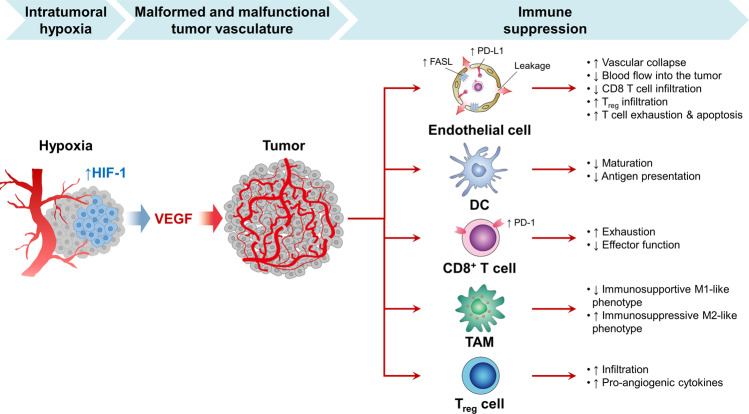
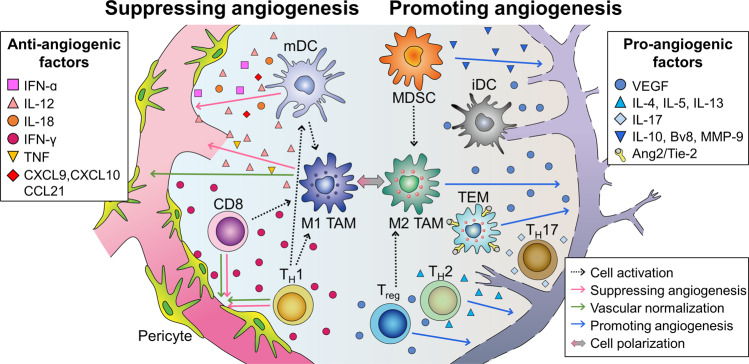
Cancer immunotherapy with immune checkpoint inhibitors (ICIs) has revolutionized the treatment of advanced cancers. However, the tumor microenvironment (TME) functions as a formidable barrier that severely impairs the efficacy of ICIs. While the crosstalk between tumor vessels and immune cells determines the nature of anti-tumor immunity, it is skewed toward a destructive cycle in growing tumors. First, the disorganized tumor vessels hinder CD8+T cell trafficking into the TME, disable effector functions, and even kill T cells. Moreover, VEGF, the key driver of angiogenesis, interferes with the maturation of dendritic cells, thereby suppressing T cell priming, and VEGF also induces TOX-mediated exhaustion of CD8+T cells. Meanwhile, a variety of innate and adaptive immune cells contribute to the malformation of tumor vessels. Protumoral M2-like macrophages as well as T H 2 and Treg cells secrete pro-angiogenic factors that accelerate uncontrolled angiogenesis and promote vascular immaturity. While CD8+T and CD4+T H 1 cells suppress angiogenesis and induce vascular maturation by secreting IFN-γ, they are unable to infiltrate the TME due to malformed tumor vessels. These findings led to preclinical studies that demonstrated that simultaneous targeting of tumor vessels and immunity is a viable strategy to normalize aberrant vascular-immune crosstalk and potentiate cancer immunotherapy. Furthermore, this combination strategy has been evidently demonstrated through recent pivotal clinical trials, granted approval from FDA, and is now being used in patients with kidney, liver, lung, or uterine cancer. Overall, combining anti-angiogenic therapy and ICI is a valid therapeutic strategy that can enhance cancer immunity and will further expand the landscape of cancer treatment.
Overview
The claims and statistics of this paper haven’t been checked yet.
Free: it reads the open-access text and checks the first 5 claims that cite a source we can check. Create a free account to check every claim.
Integrity signals
Registry
Cites
Statistics
Figures
Verification
Claims the paper makes
The claims and statistics of this paper haven’t been checked yet.
Free: it reads the open-access text and checks the first 5 claims that cite a source we can check. Create a free account to check every claim.
Self-check
Percentages, sums and reported differences re-computed from the paper’s own numbers.
The self-check needs the paper’s full text.
Citations
Cites
Cancer immunotherapy using checkpoint blockade
Ribas, A., & Wolchok, J. D. (2018) · Science · doi:10.1126/science.aar4060 · Cited by 6,791
Normalization of Tumor Vasculature: An Emerging Concept in Antiangiogenic Therapy
Jain, R. K. (2005) · Science · doi:10.1126/science.1104819 · Cited by 5,527
Macrophage Diversity Enhances Tumor Progression and Metastasis
Qian, B.-Z., & Pollard, J. W. (2010) · Cell · doi:10.1016/j.cell.2010.03.014 · Cited by 5,188
Interleukin-12 and the regulation of innate resistance and adaptive immunity
Trinchieri, G. (2003) · Nature Reviews Immunology · doi:10.1038/nri1001 · Cited by 3,927
Macrophage plasticity and interaction with lymphocyte subsets: cancer as a paradigm
Biswas, S. K., & Mantovani, A. (2010) · Nature Immunology · doi:10.1038/ni.1937 · Cited by 3,840
Atezolizumab for First-Line Treatment of Metastatic Nonsquamous NSCLC
Socinski, M. A., Jotte, R. M., Cappuzzo, F., Orlandi, F., Stroyakovskiy, D., Nogami, N., Rodríguez-Abreu, D., Moro-Sibilot, D., Thomas, C. A., Barlesi, F., et al. (2018) · New England Journal of Medicine · doi:10.1056/nejmoa1716948 · Cited by 3,733
Pembrolizumab plus axitinib versus sunitinib for advanced renal-cell carcinoma
Rini, B. I., Plimack, E. R., Stus, V., Gafanov, R., Hawkins, R., Nosov, D., Pouliot, F., Alekseev, B., Soulières, D., Melichar, B., et al. (2019) · New England Journal of Medicine · doi:10.1056/nejmoa1816714 · Cited by 3,403
Avelumab plus Axitinib versus Sunitinib for Advanced Renal-Cell Carcinoma
Motzer, R. J., Penkov, K., Haanen, J., Rini, B., Albiges, L., Campbell, M. T., Venugopal, B., Kollmannsberger, C., Negrier, S., Uemura, M., et al. (2019) · New England Journal of Medicine · doi:10.1056/nejmoa1816047 · Cited by 2,503
Macrophage plasticity and polarization in tissue repair and remodelling
Mantovani, A., Biswas, S. K., Galdiero, M. R., Sica, A., & Locati, M. (2013) · The Journal of Pathology · doi:10.1002/path.4133 · Cited by 2,384
Pàez-Ribes, M., Allen, E., Hudock, J., Takeda, T., Okuyama, H., Viñals, F., Inoue, M., Bergers, G., Hanahan, D., & Casanovas, O. (2009) · Cancer Cell · doi:10.1016/j.ccr.2009.01.027 · Cited by 2,339
Enhancing cancer immunotherapy using antiangiogenics: opportunities and challenges
Fukumura, D., Kloepper, J., Amoozgar, Z., Duda, D. G., & Jain, R. K. (2018) · Nature Reviews Clinical Oncology · doi:10.1038/nrclinonc.2018.29 · Cited by 2,027
Tumor angiogenesis: causes, consequences, challenges and opportunities
Lugano, R., Ramachandran, M., & Dimberg, A. (2020) · Cellular and Molecular Life Sciences · doi:10.1007/s00018-019-03351-7 · Cited by 1,986
Gabrilovich, D. I., Chen, H. L., Girgis, K. R., Cunningham, H. T., Meny, G. M., Nadaf, S., Kavanaugh, D., & Carbone, D. P. (1996) · Nature Medicine · doi:10.1038/nm1096-1096 · Cited by 1,977
The tumor microenvironment at a glance
Balkwill, F. R., Capasso, M., & Hagemann, T. (2012) · Journal of Cell Science · doi:10.1242/jcs.116392 · Cited by 1,857
Microenvironmental regulation of tumour angiogenesis
De Palma, M., Biziato, D., & Petrova, T. V. (2017) · Nature Reviews Cancer · doi:10.1038/nrc.2017.51 · Cited by 1,847
Plasmacytoid dendritic cells in immunity
Colonna, M., Trinchieri, G., & Liu, Y.-J. (2004) · Nature Immunology · doi:10.1038/ni1141 · Cited by 1,678
TOX transcriptionally and epigenetically programs CD8+ T cell exhaustion
Khan, O., Giles, J. R., McDonald, S., Manne, S., Ngiow, S. F., Patel, K. P., Werner, M. T., Huang, A. C., Alexander, K. A., Wu, J. E., et al. (2019) · Nature · doi:10.1038/s41586-019-1325-x · Cited by 1,646
The role of myeloid cells in the promotion of tumour angiogenesis
Murdoch, C., Muthana, M., Coffelt, S. B., & Lewis, C. E. (2008) · Nature Reviews Cancer · doi:10.1038/nrc2444 · Cited by 1,642
Antiangiogenesis Strategies Revisited: From Starving Tumors to Alleviating Hypoxia
Jain, R. K. (2014) · Cancer Cell · doi:10.1016/j.ccell.2014.10.006 · Cited by 1,589
Tumour hypoxia promotes tolerance and angiogenesis via CCL28 and Treg cells
Facciabene, A., Peng, X., Hagemann, I. S., Balint, K., Barchetti, A., Wang, L.-P., Gimotty, P. A., Gilks, C. B., Lal, P., Zhang, L., et al. (2011) · Nature · doi:10.1038/nature10169 · Cited by 1,376
DeNardo, D. G., Barreto, J. B., Andreu, P., Vasquez, L., Tawfik, D., Kolhatkar, N., & Coussens, L. M. (2009) · Cancer Cell · doi:10.1016/j.ccr.2009.06.018 · Cited by 1,353
De Palma, M., Venneri, M. A., Galli, R., Sergi, L. S., Politi, L. S., Sampaolesi, M., & Naldini, L. (2005) · Cancer Cell · doi:10.1016/j.ccr.2005.08.002 · Cited by 1,311
Yang, L., DeBusk, L. M., Fukuda, K., Fingleton, B., Green-Jarvis, B., Shyr, Y., Matrisian, L. M., Carbone, D. P., & Lin, P. C. (2004) · Cancer Cell · doi:10.1016/j.ccr.2004.08.031 · Cited by 1,140
Huang, Y., Yuan, J., Righi, E., Kamoun, W. S., Ancukiewicz, M., Nezivar, J., Santosuosso, M., Martin, J. D., Martin, M. R., Vianello, F., et al. (2012) · Proceedings of the National Academy of Sciences · doi:10.1073/pnas.1215397109 · Cited by 1,099
Tumor endothelium FasL establishes a selective immune barrier promoting tolerance in tumors
Motz, G. T., Santoro, S. P., Wang, L.-P., Garrabrant, T., Lastra, R. R., Hagemann, I. S., Lal, P., Feldman, M. D., Benencia, F., & Coukos, G. (2014) · Nature Medicine · doi:10.1038/nm.3541 · Cited by 1,035
Sinha, P., Clements, V. K., Bunt, S. K., Albelda, S. M., & Ostrand-Rosenberg, S. (2007) · The Journal of Immunology · doi:10.4049/jimmunol.179.2.977 · Cited by 847
Mutual regulation of tumour vessel normalization and immunostimulatory reprogramming
Tian, L., Goldstein, A., Wang, H., Ching Lo, H., Sun Kim, I., Welte, T., Sheng, K., Dobrolecki, L. E., Zhang, X., Putluri, N., et al. (2017) · Nature · doi:10.1038/nature21724 · Cited by 841
T-Regulatory Cells: Key Players in Tumor Immune Escape and Angiogenesis
Facciabene, A., Motz, G. T., & Coukos, G. (2012) · Cancer Research · doi:10.1158/0008-5472.can-11-3687 · Cited by 821
Combined antiangiogenic and anti–PD-L1 therapy stimulates tumor immunity through HEV formation
Allen, E., Jabouille, A., Rivera, L. B., Lodewijckx, I., Missiaen, R., Steri, V., Feyen, K., Tawney, J., Hanahan, D., Michael, I. P., et al. (2017) · Science Translational Medicine · doi:10.1126/scitranslmed.aak9679 · Cited by 820
Cellular abnormalities of blood vessels as targets in cancer
Baluk, P., Hashizume, H., & McDonald, D. M. (2005) · Current Opinion in Genetics & Development · doi:10.1016/j.gde.2004.12.005 · Cited by 781
A mechanism of hypoxia-mediated escape from adaptive immunity in cancer cells
Barsoum, I. B., Smallwood, C. A., Siemens, D. R., & Graham, C. H. (2014) · Cancer Research · doi:10.1158/0008-5472.can-13-0992 · Cited by 767
Anti-angiogenesis for cancer revisited: Is there a role for combinations with immunotherapy?
Ramjiawan, R. R., Griffioen, A. W., & Duda, D. G. (2017) · Angiogenesis · doi:10.1007/s10456-017-9552-y · Cited by 672
Improving immunotherapy outcomes with anti-angiogenic treatments and vice versa
Khan, K. A., & Kerbel, R. S. (2018) · Nature Reviews Clinical Oncology · doi:10.1038/nrclinonc.2018.9 · Cited by 657
Bv8 regulates myeloid-cell-dependent tumour angiogenesis
Shojaei, F., Wu, X., Zhong, C., Yu, L., Liang, X.-H., Yao, J., Blanchard, D., Bais, C., Peale, F. V., van Bruggen, N., et al. (2007) · Nature · doi:10.1038/nature06348 · Cited by 644
Mazzieri, R., Pucci, F., Moi, D., Zonari, E., Ranghetti, A., Berti, A., Politi, L. S., Gentner, B., Brown, J. L., Naldini, L., et al. (2011) · Cancer Cell · doi:10.1016/j.ccr.2011.02.005 · Cited by 639
Defining the role of the tumor vasculature in antitumor immunity and immunotherapy
Schaaf, M. B., Garg, A. D., & Agostinis, P. (2018) · Cell Death & Disease · doi:10.1038/s41419-017-0061-0 · Cited by 629
Zeisberger, S. M., Odermatt, B., Marty, C., Zehnder-Fjällman, A. H. M., Ballmer-Hofer, K., & Schwendener, R. A. (2006) · British Journal of Cancer · doi:10.1038/sj.bjc.6603240 · Cited by 623
Synergistic effect of immune checkpoint blockade and anti-angiogenesis in cancer treatment
Yi, M., Jiao, D., Qin, S., Chu, Q., Wu, K., & Li, A. (2019) · Molecular Cancer · doi:10.1186/s12943-019-0974-6 · Cited by 608
TGF-β signaling in vascular biology and dysfunction
Goumans, M.-J., Liu, Z., & ten Dijke, P. (2009) · Cell Research · doi:10.1038/cr.2008.326 · Cited by 601
Orchestrating the orchestrators: chemokines in control of T cell traffic
Bromley, S. K., Mempel, T. R., & Luster, A. D. (2008) · Nature Immunology · doi:10.1038/ni.f.213 · Cited by 593
Schmittnaegel, M., Rigamonti, N., Kadioglu, E., Cassará, A., Wyser Rmili, C., Kiialainen, A., Kienast, Y., Mueller, H.-J., Ooi, C.-H., Laoui, D., et al. (2017) · Science Translational Medicine · doi:10.1126/scitranslmed.aak9670 · Cited by 582
Improving immune–vascular crosstalk for cancer immunotherapy
Huang, Y., Kim, B. Y. S., Chan, C. K., Hahn, S. M., Weissman, I. L., & Jiang, W. (2018) · Nature Reviews Immunology · doi:10.1038/nri.2017.145 · Cited by 563
Tumeh, P. C., Hellmann, M. D., Hamid, O., Tsai, K. K., Loo, K. L., Gubens, M. A., Rosenblum, M., Harview, C. L., Taube, J. M., Handley, N., et al. (2017) · Cancer Immunology Research · doi:10.1158/2326-6066.cir-16-0325 · Cited by 560
Origin and development of dendritic cells
Liu, K., & Nussenzweig, M. C. (2010) · Immunological Reviews · doi:10.1111/j.0105-2896.2009.00879.x · Cited by 543
Normalizing Function of Tumor Vessels: Progress, Opportunities, and Challenges
Martin, J. D., Seano, G., & Jain, R. K. (2019) · Annual Review of Physiology · doi:10.1146/annurev-physiol-020518-114700 · Cited by 530
Oyama, T., Ran, S., Ishida, T., Nadaf, S., Kerr, L. D., Carbone, D. P., & Gabrilovich, D. I. (1998) · PubMed · Cited by 530
Perivascular M2 Macrophages Stimulate Tumor Relapse after Chemotherapy
Hughes, R., Qian, B.-Z., Rowan, C., Muthana, M., Keklikoglou, I., Olson, O. C., Tazzyman, S., Danson, S., Addison, C., Clemons, M., et al. (2015) · Cancer Research · doi:10.1158/0008-5472.can-14-3587 · Cited by 518
The parallel lives of angiogenesis and immunosuppression: cancer and other tales
Motz, G. T., & Coukos, G. (2011) · Nature Reviews Immunology · doi:10.1038/nri3064 · Cited by 481
Oyama, T., Ran, S., Ishida, T., Nadaf, S., Kerr, L., Carbone, D. P., & Gabrilovich, D. I. (1998) · The Journal of Immunology · doi:10.4049/jimmunol.160.3.1224 · Cited by 481
Makker, V., Rasco, D., Vogelzang, N. J., Brose, M. S., Cohn, A. L., Mier, J., Di Simone, C., Hyman, D. M., Stepan, D. E., Dutcus, C. E., et al. (2019) · The Lancet Oncology · doi:10.1016/s1470-2045(19)30020-8 · Cited by 476
The Intersection between Tumor Angiogenesis and Immune Suppression
Rahma, O. E., & Hodi, F. S. (2019) · Clinical Cancer Research · doi:10.1158/1078-0432.ccr-18-1543 · Cited by 472
Deletion of vascular endothelial growth factor in myeloid cells accelerates tumorigenesis
Stockmann, C., Doedens, A., Weidemann, A., Zhang, N., Takeda, N., Greenberg, J. I., Cheresh, D. A., & Johnson, R. S. (2008) · Nature · doi:10.1038/nature07445 · Cited by 471
Conejo-Garcia, J. R., Benencia, F., Courreges, M.-C., Kang, E., Mohamed-Hadley, A., Buckanovich, R. J., Holtz, D. O., Jenkins, A., Na, H., Zhang, L., et al. (2004) · Nature Medicine · doi:10.1038/nm1097 · Cited by 437
The discovery of placenta growth factor and its biological activity
De Falco, S. (2012) · Experimental and Molecular Medicine · doi:10.3858/emm.2012.44.1.025 · Cited by 425
Shigeta, K., Datta, M., Hato, T., Kitahara, S., Chen, I. X., Matsui, A., Kikuchi, H., Mamessier, E., Aoki, S., Ramjiawan, R. R., et al. (2020) · Hepatology · doi:10.1002/hep.30889 · Cited by 409
Albini, A., Bruno, A., Noonan, D. M., & Mortara, L. (2018) · Frontiers in Immunology · doi:10.3389/fimmu.2018.00527 · Cited by 392
Heusinkveld, M., de Vos van Steenwijk, P. J., Goedemans, R., Ramwadhdoebe, T. H., Gorter, A., Welters, M. J. P., van Hall, T., & van der Burg, S. H. (2011) · The Journal of Immunology · doi:10.4049/jimmunol.1100889 · Cited by 368
Liu, J., Duan, Y., Cheng, X., Chen, X., Xie, W., Long, H., Lin, Z., & Zhu, B. (2011) · Biochemical and Biophysical Research Communications · doi:10.1016/j.bbrc.2011.03.021 · Cited by 361
T Cell Dysfunction in Cancer Immunity and Immunotherapy
Xia, A., Zhang, Y., Xu, J., Yin, T., & Lu, X.-J. (2019) · Frontiers in Immunology · doi:10.3389/fimmu.2019.01719 · Cited by 341
Park, J.-S., Kim, I.-K., Han, S., Park, I., Kim, C., Bae, J., Oh, S. J., Lee, S., Kim, J. H., Woo, D.-C., et al. (2016) · Cancer Cell · doi:10.1016/j.ccell.2016.10.018 · Cited by 327
Self-citationSTING activation reprograms tumor vasculatures and synergizes with VEGFR2 blockade
Yang, H., Lee, W. S., Kong, S. J., Kim, C. G., Kim, J. H., Chang, S. K., Kim, S., Kim, G., Chon, H. J., & Kim, C. (2019) · Journal of Clinical Investigation · doi:10.1172/jci125413 · Cited by 313
Self-citationProduction of type I interferons
Asselin-Paturel, C., & Trinchieri, G. (2005) · The Journal of Experimental Medicine · doi:10.1084/jem.20051395 · Cited by 305
De Palma, M., Mazzieri, R., Politi, L. S., Pucci, F., Zonari, E., Sitia, G., Mazzoleni, S., Moi, D., Venneri, M. A., Indraccolo, S., et al. (2008) · Cancer Cell · doi:10.1016/j.ccr.2008.09.004 · Cited by 301
Dendritic Cell Subsets Differentially Regulate Angiogenesis in Human Ovarian Cancer
Curiel, T. J., Cheng, P., Mottram, P., Alvarez, X., Moons, L., Evdemon-Hogan, M., Wei, S., Zou, L., Kryczek, I., Hoyle, G., et al. (2004) · Cancer Research · doi:10.1158/0008-5472.can-04-1272 · Cited by 297
Tie2-expressing monocytes: regulation of tumor angiogenesis and therapeutic implications
De Palma, M., Murdoch, C., Venneri, M. A., Naldini, L., & Lewis, C. E. (2007) · Trends in Immunology · doi:10.1016/j.it.2007.09.004 · Cited by 287
Watkins, S. K., Egilmez, N. K., Suttles, J., & Stout, R. D. (2007) · The Journal of Immunology · doi:10.4049/jimmunol.178.3.1357 · Cited by 273
Tumour ischaemia by interferon-γ resembles physiological blood vessel regression
Kammertoens, T., Friese, C., Arina, A., Idel, C., Briesemeister, D., Rothe, M., Ivanov, A., Szymborska, A., Patone, G., Kunz, S., et al. (2017) · Nature · doi:10.1038/nature22311 · Cited by 269
Baer, C., Squadrito, M. L., Laoui, D., Thompson, D., Hansen, S. K., Kiialainen, A., Hoves, S., Ries, C. H., Ooi, C.-H., & De Palma, M. (2016) · Nature Cell Biology · doi:10.1038/ncb3371 · Cited by 259
Kim, C. G., Jang, M., Kim, Y., Leem, G., Kim, K. H., Lee, H., Kim, T.-S., Choi, S. J., Kim, H.-D., Han, J. W., et al. (2019) · Science Immunology · doi:10.1126/sciimmunol.aay0555 · Cited by 245
Self-citationTransforming growth factor-β and the hallmarks of cancer
Tian, M., Neil, J. R., & Schiemann, W. P. (2011) · Cellular Signalling · doi:10.1016/j.cellsig.2010.10.015 · Cited by 244
Okunishi, K., Dohi, M., Nakagome, K., Tanaka, R., Mizuno, S., Matsumoto, K., Miyazaki, J.-I., Nakamura, T., & Yamamoto, K. (2005) · The Journal of Immunology · doi:10.4049/jimmunol.175.7.4745 · Cited by 240
Increased vessel perfusion predicts the efficacy of immune checkpoint blockade
Zheng, X., Fang, Z., Liu, X., Deng, S., Zhou, P., Wang, X., Zhang, C., Yin, R., Hu, H., Chen, X., et al. (2018) · Journal of Clinical Investigation · doi:10.1172/jci96582 · Cited by 239
Piqueras, B., Connolly, J., Freitas, H., Palucka, A. K., & Banchereau, J. (2006) · Blood · doi:10.1182/blood-2005-07-2965 · Cited by 235
LeCouter, J., Zlot, C., Tejada, M., Peale, F., & Ferrara, N. (2004) · Proceedings of the National Academy of Sciences · doi:10.1073/pnas.0407697101 · Cited by 219
Methylation-dependent regulation of HIF-1α stability restricts retinal and tumour angiogenesis
Kim, Y., Nam, H. J., Lee, J., Park, D. Y., Kim, C., Yu, Y. S., Kim, D., Park, S. W., Bhin, J., Hwang, D., et al. (2016) · Nature Communications · doi:10.1038/ncomms10347 · Cited by 208
Self-citationMice overexpressing placenta growth factor exhibit increased vascularization and vessel permeability
Odorisio, T., Schietroma, C., Zaccaria, M. L., Cianfarani, F., Tiveron, C., Tatangelo, L., Failla, C. M., & Zambruno, G. (2002) · Journal of Cell Science · doi:10.1242/jcs.115.12.2559 · Cited by 203
Angiopoietin-2: An Attractive Target for Improved Antiangiogenic Tumor Therapy
Gerald, D., Chintharlapalli, S., Augustin, H. G., & Benjamin, L. E. (2013) · Cancer Research · doi:10.1158/0008-5472.can-12-4697 · Cited by 202
Cheng, A.-L., Qin, S., Ikeda, M., Galle, P., Ducreux, M., Zhu, A., Kim, T.-Y., Kudo, M., Breder, V., Merle, P., et al. (2019) · Annals of Oncology · doi:10.1093/annonc/mdz446.002 · Cited by 194
Ly6Clo monocytes drive immunosuppression and confer resistance to anti-VEGFR2 cancer therapy
Jung, K., Heishi, T., Khan, O. F., Kowalski, P. S., Incio, J., Rahbari, N. N., Chung, E., Clark, J. W., Willett, C. G., Luster, A. D., et al. (2017) · Journal of Clinical Investigation · doi:10.1172/jci93182 · Cited by 164
The Impact of the Immune System on Tumor: Angiogenesis and Vascular Remodeling
Stockmann, C., Schadendorf, D., Klose, R., & Helfrich, I. (2014) · Frontiers in Oncology · doi:10.3389/fonc.2014.00069 · Cited by 163
Iwahashi (2011) · Oncology Reports · doi:10.3892/or.2011.1201 · Cited by 160
Chon, H. J., Lee, W. S., Yang, H., Kong, S. J., Lee, N. K., Moon, E. S., Choi, J., Han, E. C., Kim, J. H., Ahn, J. B., et al. (2019) · Clinical Cancer Research · doi:10.1158/1078-0432.ccr-18-1932 · Cited by 158
Self-citationIntertwined regulation of angiogenesis and immunity by myeloid cells
Rivera, L. B., & Bergers, G. (2015) · Trends in Immunology · doi:10.1016/j.it.2015.02.005 · Cited by 158
Intratumoral Myeloid Cells Regulate Responsiveness and Resistance to Antiangiogenic Therapy
Rivera, L. B., Meyronet, D., Hervieu, V., Frederick, M. J., Bergsland, E., & Bergers, G. (2015) · Cell Reports · doi:10.1016/j.celrep.2015.03.055 · Cited by 147
Dendritic cell–endothelial cell cross-talk in angiogenesis
Sozzani, S., Rusnati, M., Riboldi, E., Mitola, S. M. F., & Presta, M. (2007) · Trends in Immunology · doi:10.1016/j.it.2007.07.006 · Cited by 146
Jung, K., Heishi, T., Incio, J., Huang, Y., Beech, E. Y., Pinter, M., Ho, W. W., Kawaguchi, K., Rahbari, N. N., Chung, E., et al. (2017) · Proceedings of the National Academy of Sciences · doi:10.1073/pnas.1710754114 · Cited by 138
Vascular RhoJ is an effective and selective target for tumor angiogenesis and vascular disruption
Kim, C., Yang, H., Fukushima, Y., Saw, P. E., Lee, J., Park, J.-S., Park, I., Jung, J., Kataoka, H., Lee, D., et al. (2014) · Cancer Cell · doi:10.1016/j.ccr.2013.12.010 · Cited by 131
Self-citationRole of Macrophage Polarization in Tumor Angiogenesis and Vessel Normalization
Chen, P., & Bonaldo, P. (2013) · International review of cytology · doi:10.1016/b978-0-12-407704-1.00001-4 · Cited by 129
Orchestration of Angiogenesis by Immune Cells
Bruno, A., Pagani, A., Pulze, L., Albini, A., Dallaglio, K., Noonan, D. M., & Mortara, L. (2014) · Frontiers in Oncology · doi:10.3389/fonc.2014.00131 · Cited by 128
Nishino, M., Ramaiya, N. H., Chambers, E. S., Adeni, A. E., Hatabu, H., Jänne, P. A., Hodi, F. S., & Awad, M. M. (2016) · Journal for ImmunoTherapy of Cancer · doi:10.1186/s40425-016-0193-2 · Cited by 115
Stein, S., Pishvaian, M. J., Lee, M. S., Lee, K.-H., Hernandez, S., Kwan, A., Liu, B., Grossman, W., Iizuka, K., & Ryoo, B.-Y. (2018) · Journal of Clinical Oncology · doi:10.1200/jco.2018.36.15_suppl.4074 · Cited by 112
Llovet, J. M., Kudo, M., Cheng, A., Finn, R. S., Galle, P. R., Kaneko, S., Meyer, T., Qin, S., Dutcus, C. E., Chen, E., et al. (2019) · Journal of Clinical Oncology · doi:10.1200/jco.2019.37.15_suppl.tps4152 · Cited by 112
Freedman, R. S., Kudelka, A. P., Kavanagh, J. J., Verschraegen, C. F., Edwards, C., Nash, M., Levy, L. B., Atkinson, E. N., Zhang, H., Melichar, B., et al. (2000) · PubMed · Cited by 106
Gene Transfer of IFN-γ into Established Brain Tumors Represses Growth by Antiangiogenesis
Fathallah-Shaykh, H. M., Zhao, L.-J., Kafrouni, A. I., Smith, G. M., & Forman, J. (2000) · The Journal of Immunology · doi:10.4049/jimmunol.164.1.217 · Cited by 88
Indraccolo, S., Gola, E., Rosato, A., Minuzzo, S. A., Habeler, W., Tisato, V., Roni, V., Esposito, G., Morini, M., Albini, A., et al. (2002) · Gene Therapy · doi:10.1038/sj.gt.3301703 · Cited by 88
Vascular density and VEGF expression in hepatic lesions.
Brodsky, S. V., Mendelev, N., Melamed, M. R., & Ramaswamy, G. (2007) · PubMed · Cited by 74
Dikov, M. M., Oyama, T., Cheng, P., Takahashi, T., Takahashi, K., Sepetavec, T., Edwards, B., Adachi, Y., Nadaf, S., Daniel, T., et al. (2001) · PubMed · Cited by 61
Iida (2010) · Oncology Reports · doi:10.3892/or.2010.1118 · Cited by 54
Clodronate inhibits tumor angiogenesis in mouse models of ovarian cancer
Reusser, N. M., Dalton, H. J., Pradeep, S., González-Villasana, V., Jennings, N. B., Vasquez, H. G., Wen, Y., Rupaimoole, R., Nagaraja, A. S., Gharpure, K. M., et al. (2014) · Cancer Biology & Therapy · doi:10.4161/cbt.29184 · Cited by 41
Lee, J., Kim, C., Yang, H., Park, I., Oh, N., Hua, S. S., Jeong, H., An, H. J., Kim, S. C., Lee, G. M., et al. (2015) · Molecular Cancer Therapeutics · doi:10.1158/1535-7163.mct-14-0968-t · Cited by 32
Self-citation
Cited by
Combination strategies with PD-1/PD-L1 blockade: current advances and future directions
Yi, M., Zheng, X., Niu, M., Zhu, S., Ge, H., & Wu, K. (2022) · Molecular Cancer · doi:10.1186/s12943-021-01489-2 · Cited by 1,445
Treatment landscape of triple-negative breast cancer — expanded options, evolving needs
Bianchini, G., De Angelis, C., Licata, L., & Gianni, L. (2022) · Nature Reviews Clinical Oncology · doi:10.1038/s41571-021-00565-2 · Cited by 1,382
Angiogenic signaling pathways and anti-angiogenic therapy for cancer
Liu, Z.-L., Chen, H.-H., Zheng, L.-L., Sun, L.-P., & Shi, L. (2023) · Signal Transduction and Targeted Therapy · doi:10.1038/s41392-023-01460-1 · Cited by 1,300
Zhu, A. X., Abbas, A. R., de Galarreta, M. R., Guan, Y., Lu, S., Koeppen, H., Zhang, W., Hsu, C.-H., He, A. R., Ryoo, B.-Y., et al. (2022) · Nature Medicine · doi:10.1038/s41591-022-01868-2 · Cited by 652
Molecular Mechanisms and Future Implications of VEGF/VEGFR in Cancer Therapy
Patel, S. A., Nilsson, M. B., Le, X., Cascone, T., Jain, R. K., & Heymach, J. V. (2023) · Clinical Cancer Research · doi:10.1158/1078-0432.ccr-22-1366 · Cited by 481
Metadata
- Authors
- Lee, W. S., Yang, H., Chon, H. J., & Kim, C.
- Affiliations
- CHA University Bundang Medical Center (KR)
- Corresponding author
- Chon, Hong Jae
- Kim, Chan
- Venue
- Experimental & Molecular Medicine
- Published
- 2020-09
- Volume
- 52
- Issue
- 9
- Pages
- 1475-1485
- ISSN
- 1226-3613 (ISSN-L)
- 2092-6413
- PMC
- PMC8080646
- OpenAlex
- W3084409519
- Cited by
- 796
- References
- 99
- Citations by year
- 2026: 154 · 2025: 187 · 2024: 128 · 2023: 137 · 2022: 123 · 2021: 63 · 2020: 4
- FWCI
- 8.94
- Type
- journal article
- Language
- en
- Open access
- gold
- doi.org
- Licence
- cc-by
- creativecommons.org/licenses/by/4.0 (tdm)
- creativecommons.org/licenses/by/4.0 (vor, 10 d)
- Locations
- Experimental & Molecular Medicine (publishedVersion, cc-by)
- PubMed Central (publishedVersion, cc-by)
- PubMed (publishedVersion)
- DOAJ (DOAJ: Directory of Open Access Journals) (submittedVersion)
- Funders
- National Research Foundation
- National Research Foundation of Korea (NRF-2020R1C1C1010722, 2020R1C1C1010722, NRF-2020R1A2C2004530, 2020R1A2C2004530)
- Ministry of Science and ICT, South Korea
- Topics
- Health Sciences › Medicine › Oncology › Cancer Immunotherapy and Biomarkers
- Life Sciences › Biochemistry, Genetics and Molecular Biology › Molecular Biology › Angiogenesis and VEGF in Cancer
- Life Sciences › Immunology and Microbiology › Immunology › Immunotherapy and Immune Responses
- Keywords
- anti-angiogenic therapy, immune checkpoint inhibitors, tumor microenvironment, tumor angiogenesis, vascular endothelial growth factor, CD8+ T cell exhaustion, dendritic cell maturation, M2 macrophages, regulatory T cells, Th2 cells, vascular normalization, cancer immunotherapy, combination therapy, interferon-gamma
- MeSH terms
- Immune Checkpoint Inhibitors, Animals, Antineoplastic Combined Chemotherapy Protocols, Cell Communication, Humans, Neoplasms, Neovascularization, Pathologic, Signal Transduction, Treatment Outcome, Angiogenesis Inhibitors, Immunomodulation, Molecular Targeted Therapy, Tumor Microenvironment
About these checks
Registry, retraction, Cites and statistics results are computed, not judged, with one exception: a printed reference that no index lists is read once by a model before it counts as a citation error. Claims are extracted by a model and kept only when their quote appears verbatim in the text; each cited source is then checked, with a model’s help, for whether it says what the claim relies on. Those verdicts can be wrong — read the claim’s quote and the cited source before relying on one.
Statistics and arithmetic are recomputed, not judged.
Confidence bands are shown only for fields calibrated on our annotated test set. None is calibrated yet, so no band is shown.
What counts as a claim ›How we measure confidence ›How we check this ›
Are you an author, or do you see a problem with this page? Request a review
Data sources
Bibliographic data: Semantic Scholar, OpenAlex, Crossref.
Contains information from the Semantic Scholar Academic Graph Datasets, made available under the ODC Attribution License (ODC-BY 1.0).
Semantic Scholar’s data is described in: Kinney, R., et al. (2023). The Semantic Scholar Open Data Platform. arXiv:2301.10140.
